Chapter I · (continued 4)
Reading edition
Great preparations were made to “stop the mill” further down, both on 425 the Dover and Brighton lines; but they were unnecessary, as the travellers turned off at Reigate Junction on to the Guildford line, along which the train rattled at a good pace—we may say, “in peaceful serenity”—until within a short distance of the latter old-fashioned country town, where the first stoppage was made for water. In due course the journey was resumed, and in a short time the travellers entered the wild district where the military town of Aldershott is situated, the deserted appearance of which satisfied all that the “pilot” to whom the selection of the locale had been entrusted had made a “happy choice.” It was near seven o’clock when the first train discharged its living burthen at Farnborough station, after a most pleasant journey through one of the prettiest counties in England, which, illumined by a glorious sun, and shooting forth in vernal beauty, must have inspired all with feelings of intense gratification; whilst the Benicia Boy and the numerous Americans present must have been struck with the highly favourable contrast to the miserable pilgrimage which from all accounts preceded their representative’s last appearance in the Ring, when he fought Morrissey in America.
No time was lost in choosing the spot for the ring, which was quickly and well formed by the veteran Tom Oliver and his son, in a meadow adjoining the railway, situate on the borders of Hampshire and Surrey, and within half-a-mile of the Farnborough Station on the South Western line. By this time the second train had reached its destination, and the crowd could not have numbered fewer than twelve hundred persons, both of high and low degree, though compared with former mills the present “congregation” must unhesitatingly be pronounced the most aristocratic ever assembled at the ring side. It included the bearers of names highly distinguished in the pages of Burke and Debrett; officers of the army and navy, members of Parliament, justices of the peace, and even brethren of the cloth; whilst the muster of literati on behalf of the leading metropolitan journals, and the most popular periodicals and miscellanies—to say nothing of the editorial and pictorial staffs of our American contemporaries, Wilkes’s Spirit of the Times and Frank Leslie’s Illustrated News—gave quite a new feature to the gathering, and evinced at the same time the overwhelming interest and excitement this national rivalry had created throughout both hemispheres. The sale of inner-ring tickets (raised to 10s. each on this occasion) produced a large revenue to the Pugilistic Benevolent Association, and Billy Duncan’s speculation in chairs must have been a most successful one, judging from the demand for those conveniences, by means of 426 which the spectators were enabled to “see the fight” with comparative comfort.[29]
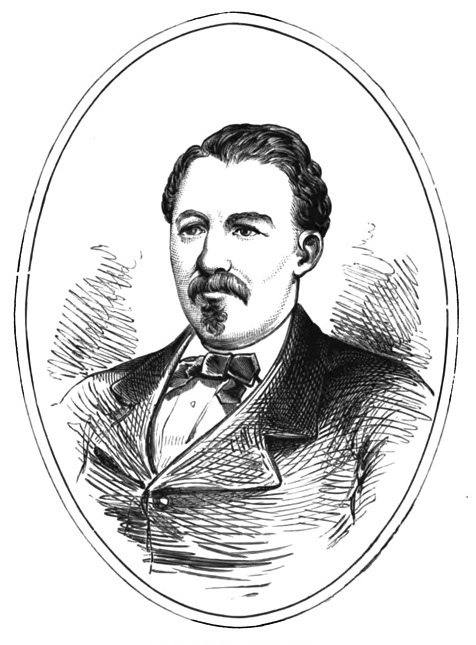
JOHN CAMEL HEENAN.
Appearance of the Men.—All being in readiness, and the immense crowd disposed in tolerable order by the exertions of those of the ring-keepers who chose to do their duty, Tom Sayers appeared at the ring-side, and having deposited his hat within the ropes, quickly followed it himself, attended by his old pal, Harry Brunton, and the accomplished Jemmy Welsh, as seconds. The Benicia Boy was not long in following his example, attended by Jack Macdonald and his trainer, Cusick. Tom looked as dapper and well set up as ever, and was full of smiles. “The Boy” (aged 26), whose attire was not quite so fashionable, was also all on the broad grin. They eyed one another curiously for a few seconds, this being, it must be recollected, their first meeting, and then advancing, shook hands most cordially together, each regarding the other with evident friendly feeling. The warmth of the greeting appeared to give great satisfaction to the surrounding multitude, who cheered vociferously. The men conversed for a few minutes, but of course the subject of their interview did not transpire. Umpires and a referee having now been appointed, the signal was given to prepare for the combat. The first ceremony, that of tying the colours to the stakes, was then proceeded with, and no time was cut to waste in doffing their upper toggery. Each had taken the precaution to put on his boots and drawers previous to entering the ring, so that the usual tedious process of lacing the men’s boots was dispensed with. In Heenan’s case, however, there would have been no necessity for this, as his boots were of fashionable make, with elastic sides. He was the first to appear in buff, and a single glance was sufficient to show that his condition was all that could be desired by the most fastidious. Tom’s mahogany bust was quickly after bared to the gaze of the multitude, and here, too, was evidence of strict attention to his work. They had a last rub from their seconds, and now advanced to give the final friendly shake. This was the time to get a fair idea of their respective proportions, and in size it really looked a horse to a hen. Heenan stood full four inches and a half over Tom, and had an immense advantage in length. Every muscle on his 427 broad back, his shoulders, and arms, was well developed, and gave evidence of enormous power. His legs were rather light, but still there was no lack here of wire and activity. His skin was exceedingly fair and transparent, and shone like that of a thorough-bred. His mug was hard, and looked older than we expected, his cheek-bones being very prominent, and now that they had been denuded of much that was superfluous, his tout ensemble was far more like that of his brother professional than on his first interview with us. Tom looked brown and hard as nails: his well-knit frame seemed fitter that we have seen it for years. He looked visibly older even than when he fought Brettle, but, considering what he has gone through, this is not to be wondered at. The only points in which there appeared any advantage on his side were in his loins and his legs, which were cast in a decidedly stronger mould than those of his towering opponent. The contrast between them was far greater than between Tom and the Tipton Slasher, and taking into consideration the fact that the advantage in age on this occasion was t’other way, Tom’s work seemed indeed cut out. That he had the remotest doubt as to the result we do not for an instant believe. He smiled confidently, and had evidently made up his mind to do or die. Heenan seemed to have an equally decided opinion as to the termination of the battle, and, to use an expression of his own countrymen, he was “all thar.” He won the toss for corners, and, of course, placed himself with his back to the sun; and, in addition to this, he had the advantage of being on slightly rising ground, so that Tom had all the way through to fight up hill. The usual ceremony was now gone through by the seconds and men. Time was called at twenty-nine minutes past seven, and they commenced
THE FIGHT.
Round 1.—Heenan at once threw himself into very fair position, his left well balanced ready for a shoot, and the right across the body. Tom’s position was the same as ever, lightly but firmly planted on his pins. He smiled and nodded, and on Heenan trying to lead off his left got well back. Heenan tried again, his reach being tremendous, but again did Tom get well away. Tom now essayed a draw, but “the Boy” was awake. Each feinted and dodged to find out a weak point, but for a short time each fortress was too well guarded. At last Tom let go his left and right, but out of distance. Heenan shook his nob and grinned, then again tried a lead, but was short. They got gradually to Heenan’s corner, who appeared disposed to fight on the defensive, and the sun being in Tom’s eyes seemed to bother him not a little. At length they came together, and sharp left-handers were exchanged, Tom getting on “the Boy’s” nose, drawing first blood, and Heenan leaving his sign manual on Tom’s frontispiece. Heavy counter-hits followed, Tom again getting on the nose, and receiving on the nob. More sparring ensued to a close, when Heenan seized Tom round the neck, but Tom pegged away at the back of his head until he made him leave that, and Tom fell laughing.
2.—Heenan showed marks of Tom’s handiwork on the back of his neck, and Tom’s forehead was flushed. Heenan kept to his corner, whither Tom went to draw him out; 428 when he thought Tom was near enough, “the Boy” lunged out his left, but Tom stopped him and got back. Heenan tried again, and just reached Tom’s nose. After one or two feints a pretty counter took place, Tom getting on the nose, and receiving a sharp one over the right eye. Heenan then closed, got well hold of him, and threw the Champion, falling heavily on him. Offers to take 2 to 1.
3.—After a little lively fiddling, Tom got too near to the big’un, who instantly slung out his left straight and full on the bridge of Tom’s beak, knocking him clean off his pins. (“First knock-down” for Heenan.)
4.—Tom, on coming up, looked rather astonished, and his eyes blinked in the sun like a dissipated owl. Heenan went at once to him at the scratch, dodged him, and once more planted a heavy spank with his left, this time on the jaw, and down went Tom again, amidst the shouts of the Yankees, who now offered 6 to 4 on Heenan. The Sayers party looked excessively blue.
5.—Tom’s mug showed visible marks of “the Boy’s” powers of hitting. He was cautious, and kept away from his man; Jack followed, and letting go his left on the mouth was well countered by Tom on the proboscis. Heenan now bored in, and after dodging Tom, got again heavily on the sneezer, and Tom fell.
6.—Tom’s countenance, though not swelled, was much flushed, while the Boy was almost scatheless. He was somewhat wild, and tried both hands, but missed. Counter-hits ensued, in which Tom received the full weight of Heenan’s ponderous fist on his right arm, which was driven back against his face. Tom reached Heenan’s left cheek, leaving his mark. Heenan retaliated on the right brow, and Tom fell.
7.—Tom’s right peeper displayed marks of pepper, and it was perceptible that he had sustained severe injury to his right arm, which was beginning to swell, and which he now kept close to his body, as if to support it. Still he went to Heenan in his corner, and that hero delivered his left, but not effectively, on the chest. Tom danced away, and as he turned round napped a little one from the right on his back. He was quickly out of harm’s way, and, coming again, dodged his man until he let fly, when Tom countered him heavily on the right cheek, drawing the claret and raising a considerable bump. The blow staggered Heenan, who stood all of a heap for a moment. Soon did he collect himself, and as Tom came again, lodged a little one on the nose, but was once more countered very heavily on the right cheek, the cut being increased and the bump enlarged. Slight exchanges followed, in which Tom received on the right eye and Heenan on the right cheek, whereupon Heenan went to his corner for a sponge. He seemed in no hurry to come away, and Tom stood in the middle of the ring until Heenan went slowly to him, and tried his left, but it was no go. He tried again, but only just reached Tom’s brow. Tom now feinted and got home on the right peeper, Heenan missing an upper-cut. Tom danced away, came again on another tack, and bang went his left on the sore spot, a heavy spank, and he was instantly out of danger, laughing; Heenan rushed after him, but was well stopped, thrice in succession. Again and again Tom went to him, and baulked his efforts to effect a lodgment, and then Heenan napped another slashing crack on the right cheek, which had the effect of at once closing his dexter goggle. He retreated for a wipe, and was followed by Tom, and some mutual cautious dodging and feinting took place. At last Heenan got on the top of Tom’s smeller, but not heavily, and Tom then avoided another attempt. Once more did Heenan retire to Jack Macdonald for consolation and advice; Tom walking round and eying him in an inquisitive manner, as if admiring his handiwork. Tom, after satisfying his curiosity, went close, and slight exchanges followed, without mischief. Heenan tried his left and was stopped. Both very cautious, and neither disposed to go within gunshot. Heenan now led off and got slightly on the mouth with his left, Tom retaliating on the closed peeper. Mutual taps and stops, and then Tom got his left heavily on the old spot another cracker, whereupon Heenan once more retired into the privacy of his corner, amidst cries of 2 to 1 on Sayers. Tom, after a few turns and a touch of the sponge, went to him, but Heenan shook his nob and seemed disinclined for work. Tom finding he could not draw him, retreated, whereupon “the Boy” came out, and let go his left viciously, which was beautifully stopped. He then feinted, and got well on the bridge of Tom’s snorer as he was retreating, and again knocked him off his pins. Tom rolled over, laughing, and was carried to his corner. This round lasted 13 minutes, and was a fine specimen of stratagem and skill, especially on the part of Tom. His right arm now was much swollen, and so painful that he could make little or no use of it.
8.—Tom slowest to the call of time, but directly he was at the scratch “the Boy” retired to his corner, whither Tom had to follow him. Heenan at once let go his left, but Tom laughed and jumped back. A slight exchange followed, and Tom napped a straight one on the sniffer. Heenan now missed a couple of well-meant shots, and Tom jumped away from a third, and as he turned his back upon Heenan got a right-hander on the back of the neck. Heenan followed him up, but Tom grinned and jumped nimbly away. His activity on his pins was as remarkable as ever. Heenan pursued him, and at last lodged his left slightly on the nozzle, and once more turned on the tap. Tom, however, countered him 429 on the damaged cheek, which caused “the Boy” to retire for the kind offices of Jack Macdonald. On Tom’s going to him he let go his left on the kisser, drawing the carmine, and this led to pretty exchanges at long shots on the cheek. Heenan at this time appeared weak, and the hopes of the Sayers party were greatly in the ascendant. Heenan preferred his corner to the scratch, and Tom had some difficulty in persuading him to leave. This he at last accomplished, and some beautiful stops were made on both sides. Another break away ensued, after which they countered effectively, but Tom was heaviest on the right cheek, which was now swelled as big as two. Heenan’s blow alighted on Tom’s oration trap, and drew more of the ruby. On his trying to repeat this lodgment, Tom stopped him cleverly. Capital exchanges followed, in which Tom was again at home on the cheek very heavily. Heenan rushed at him, but Tom was away, and after once or twice being baulked Heenan again retired to his corner. After Tom had scrutinized him carefully, he rubbed his hands and went to him, whereupon Heenan let fly his left, but Tom got well away laughing; Heenan shook his head and also laughed good-humouredly. Tom now crept in, and pop went his left on the plague-spot, and off went the Champion laughing. More dodging and stopping on both sides, until Tom was once more on the cheek a slogger. Heenan retaliated sharply on the bridge of the snout, but was stopped in a second attempt, and Tom nailed him on the right cheek very heavily and got away. Heenan tried to take the lead, but Tom jumped back. “The Boy,” persevering, got well on the forehead, but was unsuccessful in a second essay. The first was sufficient to leave a bump on the gallant Tom. More sparring until a severe counter-exchange took place, in which Tom got a hot’un on the whistler, which shook his ivories, and turned on a fresh tap. It was a staggerer, but Tom recovered and went to his man, when more severe counters were interchanged, Heenan getting another rum one on the cheek, and dropping his left with effect on Tom’s sneezer. Both now indulged in a wipe, and washed their mouths out. They came again, now like giants refreshed, and each in turn tried a lead, but each was well stopped. Tom’s right arm, from the continual stopping such a heavy cannonade as Heenan’s, was now much discoloured and swollen, and utterly useless for all purposes of hitting, and he was thus deprived of his principal weapon. After a good deal of this another heavy exchange followed, in which Tom was at home on the old spot, and Heenan on the jaw heavily, knocking Tom once more off his pins. This round lasted 20 minutes, and was a splendid specimen of milling on both sides. Tom’s nose and mouth were bleeding, but both his eyes were well open. His arm was his chief drawback. Heenan’s right eye had been long closed, his cheek was fearfully swollen, and his mouth was also somewhat out of straight.
9.—Heenan came up as if he intended to force the fighting. He led off viciously, but Tom got well away. “The Boy” followed him closely, and at last got on Tom’s mouth, drawing more of the juice. He followed suit on the snuffer-tray with a like result, and counter-hits ensued, in which each did mischief. Heenan continued to bore in, and at last Tom, after getting a little one on the back, dropped laughing.
10.—Tom was very slow to the call of time, and appeared to want nursing. It was evidently heavy work struggling against such superior mettle. He stood in the middle of the ring until Heenan went to him, when slight counter-hits were exchanged; after which they closed. Heenan lifted Tom from the ground and threw him heavily with the greatest ease.
11.—Tom, again very much behindhand in coming to time, and the friends of Heenan did not appear in much hurry. When they did come up Tom had to go into Heenan’s corner. After a dodge or two Tom got his right on the good eye rather heavily, but it was not such a right-hander as of yore, and evidently gave him pain. Heenan returned on the chest, and Tom fell.
12.—“Time, Time!” neither too ready. On Sayers at last facing his man, Heenan caught him, but not very heavily, on the jaw, and dropped on the saving suit.
13.—Heenan, first to leave his second’s knee, now went to Tom, and after a dodge or two popped the left very straight on Tom’s nose, once more knocking him clean off his legs. He turned round on returning to his corner, and looking to Mr. Falkland, his umpire, exclaimed, “That’s one for you, Fred!” Offers were now made to lay 5 to 4 on Heenan, but the takers seemed scarce.
14.—Tom, very weak, came up cautiously and slowly, his nose being large enough for two. Heenan, seeing Tom’s state, tried to force the fighting, but Tom got cleverly out of the difficulty. Heenan followed him up, and popped a rattler on the throat, without a return. He paused, and then sent a little one on the scent-bottle, but Tom countered him well and straight on the nose, drawing the crimson in profusion. Heenan, nothing daunted, let go his left, and was stopped. He then swung round his right heavily on the jaw. They got to close quarters and some heavy in-fighting took place, in which Tom was very busy. At length both were down heavily, Heenan under.
15.—Neither seemed in a hurry to leave his second’s knee, but Tom was slowest in answering the call. Heenan at once went to him, got the left well on the proboscis and his right on the jaw, and down again fell the Champion in a heap.
430
16.—Tom shook himself together, but was very cautious. He sparred as if requiring rest, until Heenan came in, when slight exchanges took place, Tom getting it on the nose, and Heenan on the whistler, but neither very heavily. Heenan then made a sudden dart, and planting heavily on Tom’s mouth, once more knocked him off his legs. (Loud cheers for Heenan.)
17.—Tom did not display many marks from his repeated knock-down blows, but came up smiling, although somewhat tired. Heenan’s mug was decidedly the most disfigured, being so much swelled. Heenan took the lead, but did not get heavily on. He tried again with his right, but the blow passed over Tom’s nob. Counter hits followed on the nose, in which Tom’s delivery was most effective, but Tom was down.
18.—Very slight exchanges, followed by a heavy counter, in which Heenan’s mouth came in for pepper, and Tom got it slightly on the nose, and fell.
19.—Tom slow to time; Heenan not in a hurry. At last, on facing one another, Heenan went in to a close, and, throwing Tom, fell on him.
20.—Heenan followed Sayers, who was on the retreat, and after one or two dodges, caught him on the jaw heavily with his right. He tried again, but Tom jumped back. Still he persevered, and heavy exchanges followed at close quarters, and both were in the end down at the ropes.
21.—Sayers very slow, which Heenan seeing, dashed at him, slung out the left on the nose, and again floored the Champion.
22.—Tom seemed none the worse for this floorer; it rather seemed to do him good, for he came fresher, which Heenan seeing, he retired to his corner. Tom followed and tried to deliver, but missed, and the Benicia Boy dropped him with another straight one on the jaw. Heenan’s left hand was now much puffed, and did not seem to leave such impressions as formerly.
23.—The time was very badly kept on both sides, and there were now complaints that the Benicia Boy was allowed a stool in the ring. An appeal was made to the referee, who at once ordered its removal, as contrary to the laws. Heenan rushed at Tom, who retreated and got one on the back. Tom then turned round and missed his right. They closed, and Tom pegged away merrily on the nose and left cheek, and in the end both down, Tom under. One hour and eleven minutes had now elapsed.
24.—The Benicia Boy, first up, tried his left by a sudden dart, but was stopped. An attempt with the right just landed on the side of Tom’s nut, and he fell. (5 to 4 on Heenan still offered.)
25.—Tom, weak, came up slow, but cheerful. He waited the attack, which was not long in coming, and after getting a little one on the side of his head, Tom popped his left very heavily on the snout, drawing more home-brewed. Heenan, wild, rushed in and bored Tom down.
26.—Tom, fresher, came up gaily, and tried to lead off with his left, but the Boy stopped him prettily. Another effort landed on Heenan’s good eye. Heenan in return planted a rattler on Tom’s jaw with his right, which staggered him, and was all but a knock down. Tom soon shook himself together, whereupon Heenan let fly his left, but Tom was well away. Following up, “the Boy” got on Tom’s chest, but not heavily. Exchanges; Heenan on the ’tato-trap, and Tom on the nose, a smasher, each drawing the cork. Heavy counters followed with the left, and they broke away. Heenan came again, and got on Tom’s snorer heavily with his left, once more staggering him. Twice after this did Tom stop Heenan’s right and they closed. After some slight fibbing Tom fell, Heenan hitting him when down. An appeal of foul was overruled, the blow being obviously accidental.
27.—“The Boy” came up determined and led off, but Tom was away. A second attempt was equally unsuccessful, and as Tom turned his back to dash away, the Boy caught him on the neck, but not heavily. Sharp exchanges followed, Tom on the left cheek and nose, and “the Boy” on the mouth. Heenan then went in and tried his left, but was short, whereupon he retired to his corner, had a wipe, and wetted his whistle, and then went to the middle of the ring. Tom joined issue at once, and some heavy exchanges took place, each on the nose, and Heenan now tried to close, reaching after Tom to catch him round the neck. Tom kept out of harm’s way, but at length “the Boy” bored him down at the ropes.
28.—Both much fatigued, wanted all the time they could get. After some sparring, Heenan ran at Tom, who darted away. The Boy rapidly pursued, and they got together, and in the fibbing Tom was busy on Heenan’s good cheek, while he caught it on the mouth. In the end Tom was down.
29.—Tom still slow to time. The Boy at once went to him, and got heavily on the top of his nut. Tom countered with effect with his right on the left cheek, and then popped his left on the proboscis. Heavy exchanges followed in Tom’s favour, who met “the Boy” very straight and effectively on the nozzle, opening a fresh bin. A break away, followed by slight exchanges, led to a harmless close, and Tom slipped down.
30.—Heenan’s other eye was now quickly closing, and he had evidently no time to lose. He was strongest on his legs, but his punishment was far more visible than Tom’s. He tried to lead off, but Tom met him neatly on the nose, turning on the red port. “The Boy” rushed at Tom, and literally ran over and fell on him.
31.—After standing some time in his corner, Heenan was fetched out by Tom, who 431 had now recovered a little. A short spar was followed by another retreat, after which Tom went in and got a little ’un on the left cheek, but it lacked steam. More sparring, and Heenan again retired. Tom stood and examined him with the eye of a connoisseur until he came out, when good exchanges took place, Tom getting heavily on the mouth, and Heenan on the nose. A break away; more sparring for wind; Heenan again to his corner. On Tom going at him he slung out his left heavily on the nose, and prone once more fell the brave Champion.
32.—Tom all alive, dodged, and caught “the Boy” on the chin. He turned to retreat, and “the Boy” nailed him on the body, but not heavily. Heenan then tried repeatedly to draw Tom, but the latter would not go into Heenan’s corner. “The Boy,” therefore, had to go out, and some rapid hits and stops followed, without any apparent damage; each, however, got a small tap on the mouth. Heenan having taken another rest in his corner, came out, and got a hot one on the left cheek for his pains, which all but shut up the other eye. This brought on exchanges, each on the mazzard, and then Heenan reached Tom’s nose. Heavy determined counter-deliveries on the note ensued, after which Heenan floored Tom by a right-hander on the cheek. The betting was now even, Sayers for choice. It was obvious that, strong as Heenan was, unless he could make a decided change, he must in a very few minutes be blind.
33.—The Benicia Boy, feeling he had no time to lose, rushed in, but only just reached Tom’s chest. Both seemed fagged, and they stood a few seconds, and then went to close quarters, where Tom, as usual, was busy on “the Boy’s” frontispiece, until he let him slip through his arms on to the ground.
34.—Heenan again tried to force the fighting, but Tom got away. They then stood and sparred until Heenan let fly his left, which did not reach its destination. He retired for counsel, and then came at Tom and tried his right at the body, but without success. Steady exchanges led to close and rapid in-fighting, and both fell, Tom under. Heenan’s eye all but closed up.
35.—The Benicia Boy dashed viciously in, and caught Tom on the snout, but the blow was without powder. Tom retreated from the vigorous onslaught; Heenan followed and got home on the jaw with the right, still with no effect. Tom now turned and ran, Heenan after him, when, on turning round, Tom napped one on the nose. He, however, landed another little pop on the good eye. Sharp exchanges at close quarters ended in the downfall of Tom. Two hours had now elapsed.
36.—The Benicia Boy’s face was a spectacle to behold, while Tom was very weak. The Boy rushed to a close, and caught Tom round the neck, dragging him to the ropes. At this time, the police, who had been gradually making their way to the ring, began a violent struggle to get close and put a stop to hostilities. “The Boy” tried to hold Tom, but the latter slipped through his arms and fell.
37.—Tom was first up, and seemed the better man; he made his left twice on Heenan’s eye, and the latter at length caught him round the neck at the ropes and there held him. Tom’s efforts to extricate himself were vain, but he administered severe punishment to Heenan’s face. The police at this time got closer, there was a rush to the ropes from all sides, and we, in company with others, including the referee, were completely shut out from the view. We are informed that the round ended in both going to grass at the expiration of two hours and six minutes. We had hoped that the men would now have been withdrawn, as the referee had been forced from his post, and the police were close by. The battle, so far as it may be called a battle, was for the time over, and the men should have been taken away. However, although the referee sent orders for a cessation of hostilities, five more so-called rounds were fought, with pretty equal advantage. Heenan’s right eye was fast closing, his left being in complete darkness. The ring was half full of people, however, and neither man had a fair chance. Much do we regret the unpleasant duty that now is imposed upon us, of finding fault with the Benicia Boy for conduct which was not only unmanly, but quite against the rules of the Ring, and had the Referee been present, would inevitably have lost him the battle. We can ourselves declare, as an impartial eye witness of the mêlée, that in the fourth of these supplementary rounds, while Sayers was on his second’s knee, Heenan rushed at him in a very excited state, let fly left and right at Tom’s seconds, floored them, and kicked at them when on the ground in desperate style, after which he closed with Sayers, and after a wild rally, they fell together. The final round was merely a wild scramble, in which both fell. The referee by this time was able to get near again, and ordered the men to desist from fighting. Immediately after this Heenan rushed away from the ring, and ran some distance with the activity of a deer, proving that as far as strength was concerned, he was as fit as ever; but he had not been away from the ring many minutes before he was totally blind. Tom Sayers, although a little tired, and suffering from his arm and the desperate hug in the 37th round, was also strong on his pins, and could have fought some time longer. The blues being now in force, there was, of course, no chance of the men again meeting, and an adjournment was necessary. It was found that the authorities were up in arms in all directions, so that it would be mere waste of time to go elsewhere. Backward 432 home was therefore the word, and the men and their friends returned to the Metropolis shortly after three o’clock. The whole time occupied, up to the men’s leaving the ring, was two hours and twenty minutes.
Remarks.—Up to the unfortunate departure of the referee, this was decidedly the very best Championship fight we ever witnessed. It was to the time aforesaid fought out with a manliness, a fairness, and a determination on both sides worthy of the highest commendation. Without any attempt at shifting, each scorned to take a mean advantage, and loudly and repeatedly was each of them cheered. The game displayed on both sides was remarkable. The gluttony and bottom of Tom Sayers are too proverbial to need further comment at our hand; but as certain rumours had been flying about to the effect that Heenan was destitute of those qualities, we deem it right to express our belief that a gamer, more determined fellow, never pulled off a shirt. His punishment was terrible, and yet he took it round after round without flinching, and almost invariably with a smile on his face. We are bound to own that in this, as in his talent, he very agreeably disappointed us; and had we not known his career, we certainly should never have set him down for a novice. He has an excellent delivery with his left, which was as straight as a dart, and early in the fight was very heavy. It appears to us, however, that his hands are not strong, for before half the battle was got through his left hand was so much swelled as to be almost useless; and this, doubtless, was fortunate for Tom, who with his right arm gone, could have made but a poor stand against such a weapon had it retained its original hardness. Of his right Heenan makes but little use. Of his conduct at the conclusion of the battle we cannot speak in too strong terms. We trust it was occasioned by the state of excitement in which he was owing to the ring being broken, and by the fact that, being almost blind, he took the unoffending seconds of his opponent for some other persons. The state of Heenan’s eyesight was shown by the fact that he hit out with both hands at Jemmy Welsh, who wore a red and black striped woollen shirt, mistaking him for his antagonist. Of Tom Sayers we need not say more than that he fought the battle throughout with consummate tact and judgment, and, considering that his right arm (his principal weapon) was rendered almost useless from the commencement, too much praise cannot be awarded to him for his courage and coolness. We are of opinion, even without that arm, that he would eventually have pulled through, had the fight been finished on the day. But it is useless speculating on possibilities or probabilities. On the question of nationality, the only point that has been decided, and the only point in our opinion requiring decision, is that both England and America possess brave sons, and each country had reason to be proud of the Champion she had selected. Both were, doubtless, anxious to have it settled; but for ourselves, were we asked, we should say each is so good that he is deserving a belt, and we would call on our countrymen to subscribe for such a trophy as a reward for Heenan’s enterprise and boldness in coming, as he has done, to face the British Champion on his own ground.
The writer of these lines, having been one of the less than half-dozen sporting writers and reporters who remained among the driving crowd which swayed hither and thither in the broken ring after the departure of the referee, and as several of these, notably The Times reporter, wrote their published accounts from hearsay, feels himself freely entitled to express his unbiassed opinion on the probable result of the battle, and to describe “the occurrents of the fight,” in its last struggles, from the avouchment of his own eyesight.
The fight, which began at twenty-four minutes past seven, was over at a quarter to ten, lasting two hours and twenty minutes.
When the ring was broken in, in the thirty-seventh round, and the referee shut out from view, Heenan, who was fast becoming blind, hugged Sayers on the ropes. The ropes were lowered by Tom’s friends, doubtless, but were not cut. Had the referee been there, he would unquestionably have ordered the round to have been closed. Rule 28 of the Ring Code 433 was as follows, before the Farnborough fight. It has since been enlarged in its scope to prevent similar dangerous practices more effectually:—“28. Where a man shall have his antagonist across the ropes in such a position as to be helpless, and to endanger his life by strangulation or apoplexy, it shall be in the power of the referee to direct the seconds to take their man away, and thus conclude the round; and that the man or his seconds refusing to obey the direction of the referee shall be deemed the loser.” Of this the Yankee scribes chose to be utterly oblivious, though the articles specified the battle to be under the New Rules of the Ring—i.e., those of 1853. The referee, however, so say the American party, sent an order for the cessation of hostilities. This, though since confirmed, was not believed by Sayers’ friends, who, seeing victory within his grasp, thought it a mere ruse to obtain a drawn battle.
Five rounds were thereafter fought, Heenan’s sight being so defective that, in the fourth of these, the forty-first, Heenan rushed from his corner while Sayers was on his second’s knee, and, letting fly at Jemmy Welsh, knocked him nearly over, and kicked at Harry Brunton, if he did not strike him, of which we are not certain. He then hugged Sayers, and they both fell; Tom hitting up sharply in Heenan’s battered frontispiece. A cry was raised that the referee had declared the fight over, whereon Heenan rushed from the ring with great activity, followed by his clamorous friends. We stayed, and found Sayers strong, with his sight good, and in all respects but his injured dexter arm—of little use since the fourth round—able, as he said, “to fight an hour.”
Leaving Tom, we hurried to the carriages, the train standing on the Farnborough embankment, where we saw Heenan, already blind as a bat, lifted into his compartment. Arrived at the Bricklayers’ Arm Station, we accompanied the gallant Champion to the hostelrie of his old friend, Ned Elgee, “The Swan,” Old Kent Road. Here no sooner was the hero seated, for he refused to go to bed, than he inquired after his opponent. His friend and backer (Mr. John Gideon) suggested that the heroes should meet and shake hands, and the writer of this hastened across the road to invite the Benicia Boy and his friends to an interview. He was in a close cab wrapped in blankets—blind, unpresentable, and seemingly unconscious. Tom was soon cheerful, and over a little tea regretted that the doctor’s veto prevented his partaking of the champagne creaming around him to his health and success, amid plaudits to his bravery.
Sayers was next morning at Norfolk Street, at the stakeholder and 434 referee’s office, and a photograph has fixed beyond dispute his condition, which, save his right arm already spoken of, was nothing beyond a tumefied mouth and a few bumps on his hard forehead. Heenan, on the contrary, despite the absurd declarations of his American letter-writer, was not in a condition to see or be seen. For fully forty-eight hours he was in “darkness,” in bed in an upper-room at Osborne’s Hotel in the Adelphi, and for more than that time in a critical condition, as we know from unimpugnable proof. The friends of Heenan pretended to base their great grievance on the fact that, as the contest was not finished on the day, it ought to have been resumed during the week. The answer to this is, first, that this was mere bounce, as Heenan was in no condition to resume hostilities; secondly, that in the condition of Sayers’s right arm he was entitled, by Ring precedents (the fight having been once interrupted) to a reasonable period to recover its use; thirdly, that it would have been contrary to all dictates of humanity—and fairness, which includes humanity, is a prized attribute of British boxing; fourthly, that public opinion was opposed in the strongest manner to the two brave fellows who had so heroically contended, and had been baulked of a result by no fault or shortcoming of either, after such punishment as they had undergone, renewing their interrupted struggle. For these and other cogent reasons, it was proposed by the referee and stakeholder, and—after the subsidence of the American mortification to a better state of feeling—agreed to by both men, that two similar belts should be made, one to be presented to each champion.
We shall not record the ceremonial of this presentation—which was performed on the part of England by Frank Dowling, Esq., editor of Bell’s Life, and on that of America by G. Wilkes, Esq., editor of the New York Spirit of the Times—as the whole affair, speeches and all, savour too strongly of the circus style of bunkum and bombast. The modest paragraph in the Times of May 30th, 1860, though written as an avant courrier, is more to our taste:—
“The Championship Belts.—America and England shake hands cordially to-day. What our greatest diplomatists and engineers have failed to achieve has been accomplished by the Benicia Boy and Tom Sayers, whose fame will descend to future generations, and whose posterity will each be enabled to show a fac-simile of that much desired ‘belt,’ so boldly challenged, so manfully defended. The Atlantic cable has not linked the two nations together, but the good feeling which has been shown by the two gladiators, who on this day receive at the Alhambra their respective ‘belts,’ will be responded to by the two nations on either side of the Atlantic. We have been favoured with a view of the old belt, ‘the belt’ still open to competition, and of the two other belts to be presented to the ‘two Champions of England,’ for such is the inscription upon the case of each. Both are precisely similar in every respect, and the somewhat clumsy workmanship, in frosted silver, carefully copied from the original, is by Mr. C. F. Hancock, of Bruton Street.”
435
How British admiration of true courage expressed itself in the substantial form of a public subscription, and how Members of Parliament, the Stock Exchange, Lloyd’s, and Mark Lane, clubbed their gold pieces to enable the Champion to pass in peace and competence the remainder of his days, guarded from the stings and sorrows of poverty, have been told in the columns of the contemporary sporting press.
After Mace’s victories over Sam Hurst and Tom King, there was some talk of Sayers coming out from his retirement and having a turn with the Norwich man, but it ended in smoke. As Tom, from the universal interest excited by his heroic display, was an object of interest to the multitude, he received liberal offers from some Yankee circus proprietors, and by the aid of the “rhino” thus earned became first a shareholder, and then proprietor of Howes and Cushing’s Circus, under the management of Jem Myers. The speculation, we suspect, carried Tom out of his depth, and the horses, mules, carriages, &c. were sold off some twelve months after their purchase. Tom’s free living degenerated into excess during this loose and excited life of a travelling showman and exhibitor; for poor Tom, in his simple faith, was by no means an Artemus Ward, and no match for Yankee smartness. There is little doubt that Tom at this time laid the seeds of the inflammatory disease which shortened his days, and cut him off at the early age of thirty-nine.
The kind friends who uncompromisingly stipulated, when Tom’s capital was invested, that he should “fight no more,” did not place any restriction on his re-appearance in the roped arena. When King and Heenan fought, on December 10, 1863, Sayers conformed to the etiquette of his profession, and seconded “the American.” Heenan’s party evidently believed that Tom’s prestige would scatter dismay in the ranks of King’s followers, and help to overwhelm the “jolly young waterman” at the outset. Poor Sayers’ descent had, however, commenced, and when he stepped into the ring, in Heenan’s corner, it was plain he was there more for dramatic effect than anything else. Attired in a fur cap, a yellow flannel jacket, and jack-boots, he was vociferously applauded when he commenced his duties in attending to Heenan’s toilette. Even then people said, “How are the mighty fallen,” for poor Tom was no more equal to his onerous task than a child. During the fight at Wadhurst he looked in strange bewilderment at King and Heenan, and when the “Benicia Boy” required assistance, his second was perfectly helpless. Still the gladiator quitted the scene in a graceful and generous manner, in having stood esquire to the opponent 436 who was instrumental in bringing out that steel, courage, and pluck of which the first of English pugilists was composed.
As it no doubt will prove interesting to all those who have admired the wonderful pluck and endurance of the greatest gladiator of modern times to know something of the progress of that insidious disease which gradually but surely did its work, we append a few particulars. Since the memorable battle of Farnborough—when Sayers appeared in the ring the picture of health, and the result proved that his physique could not have been improved upon—he now and again showed symptoms of the hectic flush which is the precursor of an affection of the lungs. This was brought on by the course of life he subsequently chose, or rather by the force of circumstances under which he was placed. Unable to fall back upon the pleasures of a cultivated mind from want of education, Tom became the idol of his fellows; he cast off all those restraints which had secured for him health and victory, and plunged into excesses of living—late hours and dissipation. Nature’s laws are not to be broken with impunity, and in the beginning of 1866 he fell into a very low condition, and betrayed symptoms of consumption, aggravated with diabetes, for which Mr. Adams, F.R.C.S., attended him on February 20, at his sister’s, Mrs. King’s, 16, Claremont Square, Pentonville. His robust and healthy frame exhibited a great change for the worse, and the doctor then feared, from his having wasted away so much, coughing frequently, and losing strength fast, that he was sinking into a decline. He was ready to acknowledge his physical weakness, but when told of the serious nature of the disease then apprehended, he became as docile as a child, and obeyed the injunctions of his medical adviser, who, we may remark in passing, expressed to us the melancholy pleasure which he experienced whilst Tom was under his care. However, the dreaded enemy was stalled-off by careful watching and nursing, and he recovered sufficiently to take a trip to Brighton about the middle of April. When there, he appeared strong and robust, and like his former self. This, however, was not to last long, for at the end of August he returned to his sister’s, in Claremont Square, and in a consultation held there between Dr. Adams and Mr. Brown, they came to the conclusion that actual and absolute disease of the lungs had set in, and that he could not survive many weeks. He took a fancy to go to his old friend’s, Mr. Mensley, High Street, Camden Town, on October 16, and there he stayed until he died. For the satisfaction of Dr. Adams himself, that gentleman called in Dr. Gull to consult, but they both agreed that 437 nothing more could be done to save him. A reaction took place in his condition after being a fortnight at Mr. Mensley’s; he seemed to get fresher and stronger, and for a week remained in a doubtful state, giving hopes to his friends that he would survive the illness. A relapse came on, and with it unconsciousness, and for the last few days he had only a few intervals of consciousness. Mr. Litten, assistant chaplain of St. Pancras, attended by desire of Sayers, and administered the consolations of religion. He passed away at six o’clock on Wednesday evening, November 7th, in the presence of his father, with his two children at hand. For upwards of four-and-twenty hours before his death he was in a state of semi-insensibility, and could only recognise his friends on being aroused and appealed to. But the great change came with comparative peace at last, and when nature compelled him to “throw up the sponge,” he left the world, let us hope, without that pain which no man feared less when he stood up in defence of his reputation as the Emperor of British boxers. Many were the inquiries made for the health of poor Tom, and it is satisfactory to know that he was visited by some who had taken a part against him in the battle-field, and that he bid them, each and all, a peaceful farewell.
The amount of money subscribed for Sayers by his personal admirers and the public was £3,000, which sum was invested in the names of trustees, Tom to receive the interest during his life, providing he never fought again; and, in the event of his fighting again or dying, the interest was to go to the children until of age, when it was to be divided between them. Tom left only two children—young Tom, then at boarding-school, and fourteen years old, and Sarah, in her seventeenth year. Independent of the interest in this sum, Sayers left a considerable amount of property in plate and other valuables. Some of his backers have treasured up souvenirs of him. Mr. John Gideon, Tom’s earliest “guide, philosopher, and friend,” has the boots in which Sayers fought Heenan, with the Farnborough grass and earth attaching to the spikes, just as the great gladiator left them.
Those who remember the personal appearance of the departed Champion will have his bronzed, square, and good-humoured, lion-like phiz in their mind’s eye; those who did not see him in the flesh must imagine a round, broad, but not particularly thick-set man, standing 5 feet 8½ inches in his stocking-feet, with finely turned hips, and small but powerful and flat loins, remarkably round ribs and girth, and square shoulders. His arms were of medium length, and so round as not to show prominently the biceps, or 438 even the outer muscles of the fore-arm, to the extent often seen in men of far inferior powers of hitting and general strength. Indeed, the bulk of Sayers was so compactly packed that you did not realise his true size and weight at a cursory glance, and it was this close and neat packing of his trunk—excuse the pun—that doubtless was an important ingredient in many a “long day” in which Tom’s lasting powers were the admiration of every spectator. Tom’s head was certainly of the “bullet” shape, and it was supported by a neck of the sort known as “bull,” conveying the idea of enduring strength and determination to back it. We have no phrenological examination of Tom’s “bumps” before us, but we doubt not those of combativeness and amativeness were fully developed. Tom’s fighting weight began at 10st. 6lb.; in his later battles it was 10st. 10lb. to 10st. 12lb. The photographs which figure in the print-shop windows do not convey a fair idea of Tom’s good-tempered and often merry expression: he seems to have been taken when filled with the contemplation of the seriousness of the position of having one’s “counterfeit presentment” multiplied and sent forth to the world. From the hips downward Tom was not a “model man.” Though round in the calf, his thighs were decidedly deficient in muscular development; yet no man made better use of his pins in getting in and out again, as witness his up-hill performances with the six-foot Slasher, and the ponderous and more active Benicia Boy. It was to Tom’s excellent judgment of time and distance that the severity of his hitting was due, and to his mighty heart—a bigger never found place in man’s bosom—that his triumphant finish of many a well-fought day is to be attributed. No man ever fought more faithfully to his friends or bravely with his foes in “the battle of life;” and therefore is the tribute of a record of his deeds due to Tom Sayers.
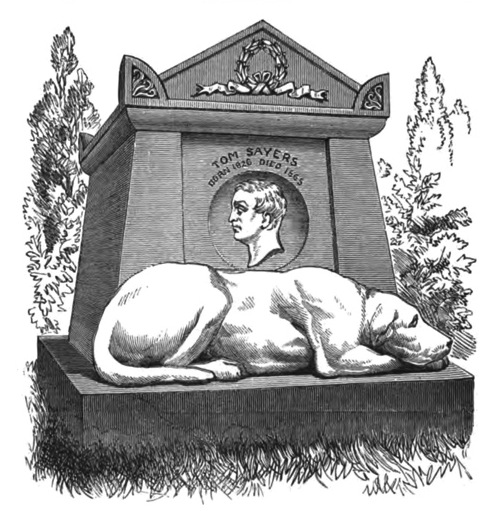
His remains were consigned to their parent earth, on Wednesday, November 15th, 1866, at the Highgate Cemetery, attended by an immense concourse of the sympathising and curious. A committee of friends, the admirers of true British courage, raised a monument over the spot where—
“After life’s fitful fever he sleeps well.”
Of this monument we present a faithful delineation.
439
It would be an unpardonable omission were we to conclude the biography of Tom Sayers without appending the remarkable poem, attributed to the pen of William Makepeace Thackeray, which appeared in Punch, April 28th, 1860. We need hardly say that it is a paraphrase rather than a parody of Lord Macaulay’s legend of “Horatius” in the “Lays of Ancient Rome.”
THE COMBAT OF SAYERIUS AND HEENANUS.
A LAY OF ANCIENT LONDON.
(Supposed to be recounted to his Great-grandchildren, April 17th, A.D. 1920, by an Ancient Gladiator.)
Close round my chair, my children, And gather at my knee, The while your mother poureth The Old Tom in my tea; 440 What while your father quaffeth His meagre Bordeaux wine— ’Twas not on such potations Were reared these thews o’ mine. Such drinks came in the very year— Methinks I mind it well— That the great fight of Heenanus With Sayerius befell.[30] These knuckles then were iron, This biceps like a cord, This fist shot from the shoulder A bullock would have floored. Crawleius his Novice, They used to call me then In the Domus Savilliana[31] Among the sporting men. There, on benefit occasions, The gloves I oft put on, Walking round to show my muscle When the set-to was done; While ringing in the arena The showered denarii fell, That told Crawleius’ Novice Had used his mauleys well. ’Tis but some sixty years since The times of which I speak, And yet the words I’m using Will sound to you like Greek. What know ye, race of milksops, Untaught of the P.R., What stopping, lunging, countering, Fibbing, or rallying are? What boots to use the lingo, When you have lost the thing? How paint to you the glories Of Belcher, Cribb, or Spring— To you, whose sire turns up his eyes At mention of the Ring? Yet, in despite of all the jaw And gammon of this time, That brands the art of self-defence— Old England’s art—as crime, From off mine ancient memories The rust of time I’ll shake. Your youthful bloods to quicken And your British pluck to wake; I know it only slumbers, Let cant do what it will, The British bull-dog will be The British bull-dog still. Then gather to your grandsire’s knee, The while his tale is told How Sayerius and Heenanus Milled in those days of old. 441 Y Fyghte. The Beaks and Blues were watching Agog to atop the mill, As we gathered to the station In the April morning chill; By twos and threes, by fours and tens, To London Bridge we drew; For we had had “the office” That were good men and true; And saving such, the place of fight Was ne’er a man that knew. From East, from West, from North and South, The London Fancy poured, Down to the sporting cabman, Up to the sporting lord; From the “Horseshoe” in Tichbourne Street Sharp Owen Swift was there; Jem Burn had left the “Rising Sun,” All in the Street of Air; Langham had out the “Cambrian,” With tough old Alec Reid, And towering high above the crowd Shone Ben Caunt’s fragrant weed; Not only fighting covies, But sporting swells besides— Dukes, Lords, M.P’s., and Guardsmen, With county Beaks for guides; And tongues that sway our Senators, And hands the pen that wield, Were cheering on the Champions Upon that morning’s field. And hark! the bell is ringing, The engine puffs amain, And through the dark towards Brighton On shrieks the tearing train; But turning off where Reigate Unites the clustering lines, By poultry-haunted Dorking A devious course it twines, By Wootton, Shier, and Guildford, Across the winding Wey, Till by heath-girded Farnborough Our doubling course we stay, Where Aldershot lay snoring All in the morning gray, Nor dreamed “the Camp” what combat Should be fought here to-day. The stakes are pitched, the ropes are rove, The men have ta’en their stand; Heenanus wins the toss for place, And takes the eastward hand; Cussiccius and Macdonaldus[32] Upon “the Boy” attend; Sayerius owns Bruntonius With Jim Welshius for friend.[33] And each upon the other now A curious eye may throw, And from the seconds’ final rub In buff at length they show, And from their corners to the scratch Move stalwartly and slow. 442 Then each his hand stretched forth to grasp His foeman’s fives in friendly clasp; Each felt his balance trim and true— Each up to square his mauleys threw— Each tried his best to draw his man— The feint, the dodge, the opening plan, Till right and left Sayerius tried— Heenanus’ grin proclaimed him “wide;” Then shook his nut—a “lead” essayed, Nor reached Sayerius’ watchful head. At length each left is sudden flung, We heard the ponderous thud, And from each tongue the news was rung, Sayerius hath “first blood!” Adown Heenanus’ Roman nose Freely the tell-tale claret flows, While stern Sayerius’ forehead shows That in the interchange of blows Heenanus’ aim was good! Again each iron mauley swung, And loud the counter-hitting rung, Till breathless both, and wild with blows, Fiercely they grappled for a close; One moment in close hug they swing, Hither and thither round the ring, Then from Heenanus’ clinch of brass, Sayerius, smiling, slips to grass! I trow mine ancient breath would fail To follow through the fight Each gallant round’s still changing tale, Each feat of left and right. How through two well-fought hours and more Through bruise, and blow, and blood, Like sturdy bull-dogs, as they were, Those well-matched heroes stood. How nine times in that desperate mill Heenanus, in his strength, Knocked stout Sayerius off his pins, And laid him all at length; But how in each succeeding round Sayerius smiling came, With head as cool, and wind as sound, As his first moment on the ground, Still confident and game. How from Heenanus’ sledge-like fist, Striving a smasher to resist, Sayerius’ stout right arm gave way, Yet the maimed hero still made play, And when “in-fighting” threatened ill, Was nimble in “out-fighting,” still— Still did his own maintain— In mourning put Heenanus’ glims, Till blinded eyes and helpless limbs, The chances squared again. How blind Heenanus, in despite Of bleeding face and waning sight, So gallantly kept up the fight, That not a man could say Which of the two ’twere wise to back, Or on which side some random crack Might not decide the day; And leave us—whoso won the prize— Victor and vanquished, in all eyes, An equal meed to pay. 443 Two hours and more the fight had sped, Near unto ten it drew, But still opposed—one-armed to blind— They stood, those dauntless two. Ah, me! that I have lived to hear Such men as ruffians scorned, Such deeds of valour “brutal” called, Canted, preached-down, and mourned! Ah! that these old eyes ne’er again, A gallant mill shall see! No more behold the ropes and stakes, With colours flying free! * * * * * But I forget the combat— How shall I tell the close? That left the Champion’s belt in doubt Between those well-matched foes? Fain would I shroud the tale in night— The meddling Blues that thrust in sight— The ring-keepers o’erthrown; The broken ropes—th’ encumbered fight— Heenanus’ sudden blinded flight— Sayerius pausing, as he might, Just when ten minutes, used aright Had made the day his own! Alas! e’en in those brighter days We still had Beaks and Blues— Still canting rogues, their mud to fling, On self-defence, and on the Ring, And fistic art abuse! And ’twas such varmint had the power The Champions’ fight to stay, And leave unsettled to this hour The honours of that day! But had those honours rested— Divided as was due, Sayerius and Heenanus Had cut the Belt in two. And now my fists are feeble, And my blood is thin and cold, But ’tis better than Old Tom to me To recall those days of old. And may you, my great-grandchildren, That gather round my knee, Ne’er see worse men, nor iller times Than I and mine might be, Though England then had prize-fighters— Even reprobates like me.
444