THE BIRTH AT MOREAU OF THE TEMPERANCE REFORMATION.
Reading edition
By Dr. Charles A. Ingraham.
History concerns itself chiefly with the fiats of kings, the councils of cabinets, the enactments of legislatures, the processes and results of diplomacy and the issues of war. Upon the pages of the world's annals appears the magnificent pageantry of the past, as with silken banners and silver trumpets dominion proudly passes in perpetual review. Thus, as the historian animates his chapters with those dramatic, intellectual and heroic elements which abound in the court, the statehouse and upon the field of battle, the high spirit of chivalry is encouraged and an intelligent patriotism is promoted. But how fares it with that company of men and women who, frequently in obscure places and by unpretentious methods, have in the realms of discovery, invention and ethics, also advanced the prosperity and happiness of society? It must be admitted that they are too often neglected and that the fruitful lessons which their lives have to communicate remain too generally unappropriated. This paper, diverging somewhat from the beaten highway of history, has for its purpose, to rescue from threatened oblivion the memory of a noble man and the record of his monumental work.
A few months since, while attending a convention held in one of the churches of Easton, the discussion having turned to the subject of temperance, I remarked that it might be proper to state that we were congregated not far from the place where the world's first temperance society had its birth. I was afterward surprised and gratified to learn that in that very neighborhood Dr. Clark, its founder, had dwelt when a young man engaged in the study of medicine. Not being of a superstitious turn, I have dismissed from my mind the notion that his shade was at my elbow prompting me to introduce him to the audience. My interest having been revived, I consulted the leading reference books with the result of discovering that, while they all were in substantial agreement as to Dr. Clark having established the initial temperance association at Moreau in 1808, there were no biographical accounts of him, nor details concerning the history of the organization. This, for so great an event and institution, struck me as being a very remarkable omission. My curiosity to learn more was now stronger than ever, and the centennial anniversary of the formation of the association being near, I resolved to unearth, if possible, the full history of the society and the life of its founder. Being utterly in the dark as to any authority upon the subject, I made known my desire for information through the medium of newspapers circulating in the historic townships, and with gratifying results.
My principal materials have been these: "The History of the Temperance Reformation," 1853, by Rev. Lebbeus Armstrong, a member of the society and intimately associated with Dr. Clark in the establishment of the same; "A History of Temperance in Saratoga County," 1855, by Judge William Hay; and an obituary by the late Dr. A. W. Holden, of Glens Falls, which appeared in the Messenger of that place in 1866. The last is an admirable elucidation of the life and character, to the closing day, of the great champion of temperance. The two physicians had been fellow townsmen, and evidently friends, if we may judge by the sympathetically appreciative manner with which Dr. Holden writes. Of the 408 pages of Armstrong's and of the 153 pages of Hay's book, but comparatively few are devoted to Dr. Clark and his work. The authors boast of him and his achievement, but, living yet in the dim light of his day, they were evidently unable to perceive fully the grandeur of the moral movement which he had inaugurated. Hence, their works are taken up mainly with discussions of the Maine liquor law, which then agitated much of the country. Armstrong's and Hay's books have become very rare, but copies of both may be found in the New York State library.
Among every people, in every age, intemperance has been recognized as an evil, and from ancient times a variety of means have been adopted to prevent or diminish its desolating influences. Royal decrees have gone forth commanding the rooting up of vineyards, and parliaments have legislated against it. The code of Draco even went so far as to visit the penalty of death upon the drunkard. The milder methods of moral suasion have, since the earliest recorded days, been with loving constancy declaimed in the ears of the people, but so imperative is the demand for strong drink that the cup continues in spite of all hindrances to hold dominion over multitudes of men.
But beyond all other peoples of the world in love of intoxicating beverages stand the Teutonic races, among whom it is said distilled liquors were first substituted for fermented drinks. The classic pages of Tacitus tell us of the unbridled license which the northern tribes of Europe gave to their appetites and of the scenes of drunken riot which characterized their social events. The chase, the battle and the feast were their delights, and when done with life, their ambition was to reside in the immortal hall of Valhalla. There, each day having fought before the palace, and with every trace of their wounds duly obliterated, they hoped to sit down daily to regale themselves with mead and meat. The convivial propensities of the Teuton have been inherited by the Anglo-Saxon race, and it cannot be denied that the English speaking people are among the heaviest drinking populations of the earth. Yet, the Germanic family of nations has done more for the advancement of civilization than perhaps any other race in history. It has emancipated and exalted woman, and hallowed the home, and fostered patriotism and religion. It has produced the greatest scholars, the most brilliant scientists and the profoundest philosophers. But among nations as among individuals, it is against the intellectually highly organized that the genius of alcohol particularly directs its malevolent arts.
The latter half of the 18th century saw England almost overwhelmed with drunkenness and its associated vices. In a sermon entitled, "On Dissipation," by John Wesley, published in 1788, he opens his discourse with this statement:
"Almost in every part of our nation, more especially in the large and populous towns, we hear a general complaint among sensible persons of the still increasing dissipation. It is observed to diffuse itself more and more in the court, the city and the country."
During the close of the same period this country was given over body and soul to the alluring power of inebriation. Intemperance was the rule rather than the exception, as it has become in our day. Occasions of birth, marriage and death were alike considered appropriate to the free indulgence in liquor, and all classes participated in the drinking, even clergymen joining in the convivialities with little or no forfeiture of dignity.
Social distempers, like those of the body, are accompanied by the agency of restoration. The sick man, debilitated and suffering from the violence of his symptoms, seeks his bed and calls his physician, thus placing himself in the most favorable attitude for recovery. Were it not for the realization of his distress, he might, in default of rest and medicine, hurry himself into the grave. So, within some of the more morally sensitive souls of the country, commenced to be experienced an unhappy sense of our degradation and depth of misery. Cries of warning and expostulation began to be heard in the land. One of these rose higher than the others, even echoing down through the years to our own time. It was that of Dr. Benjamin Rush, of Philadelphia. Standing in relation to Dr. Clark as of a voice crying in the wilderness, his work in the field of temperance merits more than a casual remark. It consists of but a small, thirty-two page pamphlet, but condensed in its limited proportions is a world of moral dynamite.
It bears the title: "An Inquiry Into the Effects of Ardent Spirits Upon the Human Body and Mind, With an Account of the Means of Preventing and of the Remedies for Curing Them," and was published in 1785. So great had been the salutary influence of this little treatise, that the centennial anniversary of its issue was duly celebrated at Philadelphia. It is not a profound essay; indeed, the wayfaring man, though a fool, may easily grasp its lucid ideas. Neither is it calculated to be very offensive to any class of readers, for it takes issue only with distilled liquors, recommending fermented beverages as substitutes. Moreover, the confirmed toper can read the pamphlet, not only without umbrage, but with interest; for there is an intensity, a directness of statement in its style which hold the reader, even to this day, with the simple art of its literary merit. Besides, there appears running through its pages a quaint humor, which no doubt had much to do with gaining its popularity throughout the length and breadth of the land.
A unique and ingenious feature of the essay is the author's "Moral and Physical Thermometer," which forms its frontispiece. On the ascending scale, "Strong Beer" is placed in the lowest and "Water" at the highest degree, with remarks indicating improving mental and physical conditions in the rising course. On the descending scale, "Punch" occupies the highest while "Rum day and night" is found at the lowest place, accompanied between points by a fearfully intensifying array of vices, diseases and penalties.
In this connection might be quoted the author's interpretation of a familiar myth:
"The fable of Prometheus, on whose liver a vulture was said to prey constantly, as a punishment for his stealing fire from heaven, was intended to illustrate the painful effects of ardent spirits upon that organ of the body."
Here is a curious anticipation of the modern gold cure, as it took form in the fertile intellect of Dr. Rush:
"The association of the idea of ardent spirits, with a painful or disagreeable impression upon some part of the body, has sometimes cured the love of strong drink. . . . This appeal to that operation of the human mind, which obliges it to associate ideas, accidentally or otherwise combined, for the cure of vice, is very ancient. It was resorted to by Moses when he compelled the Children of Israel to drink the solution of the golden calf (which they had idolized) in water. This solution if made, as it most probably was, by means of what is called hepar sulphuris, was extremely bitter, and nauseous, and could never be recollected afterwards, without bringing into equal detestation, the sin which subjected them to the necessity of drinking it."
In this pamphlet was sounded the first effective call for a combined movement against the evil of intemperance—a trumpet call which reverberated in the soul of Dr. Clark until, nobly responding, he stood forth alone before the world, having inscribed upon his banner the word, Organization. For Dr. Rush had said:
"Let good men of every class unite and besiege the general and state governments, with petitions to limit the number of taverns, to impose heavy duties upon ardent spirits, to inflict a mark of disgrace, or a temporary abridgment of some civil right upon every man convicted of drunkenness. . . . To aid the operation of these laws, would it not be extremely useful for the rulers of the different denominations of Christian churches to unite and render the sale and consumption of ardent spirits a subject of ecclesiastical jurisdiction?"
Such are a few of the characteristic portions of Dr. Rush's famous essay, a work which revived, not only the moral sense of this country, but also of England, where it was republished in the following year. But the giant of intemperance exhibited no signs of weakness, though he had been undoubtedly pierced in a vital part. The weapon of Dr. Rush had been slim, but keen—a highly tempered rapier, more effective than in after years was the broad sword of Lyman Beecher's "Sermons on Temperance." With an amiable exterior, the skillful reforming fencer had managed to keep his antagonist off his guard while he transfixed and permanently crippled him. But another mode of attack was necessary in order to bring him under control. To indulge yet further in figurative speech: Dr. Rush had manufactured the ammunition but who was to fire the gun?
It is always a pleasure to visit the homes of eminent persons who long since have died. To look upon the scenes that they once beheld; to walk in the paths that they once trod, is like coming into familiar intercourse with the intimate friend of the honored dead, and we go from the places hallowed by such associations with a sense of having gained almost a personal acquaintance with the great who there have had a habitation. The native town of Dr. Billy James Clark was beautiful old Northampton, in Massachusetts. Primitively Nonotuck of the Indians, it was venerable even on his birthday, January 4, 1778, and then, as now, it was foremost in culture and intelligence. Here, Jonathan Edwards had lived and labored, leaving upon the town an ineradicable impress of his saintly character and heavenly doctrines. Here, David Brainerd the zealous missionary to the Indians, broken in health, had died under the roof of Edwards, who had extended to him the loving hand of hospitality. It was eminently fitting that a life destined to exercise so profoundly beneficial an influence in promoting the higher estate of the race should have its beginning in a town so distinguished for its enlightenment and piety.
Ithamar Clark, when his little son Billy was about six years old, left Northampton and took up his residence in Williamstown, Massachusetts, where also was the home of Mrs. Clark's father. For a period of four years the boy attended the school which afterwards developed into Williams College, at the end of which time the family changed its home to Pownal, Vermont. Of the details of the domestic life of the Clarks, we have no record. Nothing is known of the wife of Ithamar Clark, except that her maiden name was Sarah Simonds, and that she was a daughter of Benjamin Simonds, who had been a colonel in the Continental army, serving in the campaign against Burgoyne. It is probable that the moral and religious leanings of Dr. Clark were inherited from or instilled by his mother. His father seems not to have been much interested in the ideas that his son did so much to advance. Previous to his settling at Pownal, he had followed agriculture and shoe-making, but now, in the capacity of tavern-keeper, he began selling liquor.
In Dr. Holden's article it is stated that the tavern was located upon a farm that Mr. Clark had purchased, one and a half miles from Pownal on the Bennington road.
Young Billy Clark, standing behind his father's bar and dealing out intoxicating drinks, was in a position to observe thoroughly the pernicious effects of dallying with alcohol. His daily occupation was an open book, as thrilling as lurid chapters of fiction, and the letters of it remained upon his soul in characters of unquenchable fire. Abraham Lincoln, when a young man, having gone down the Mississippi as a flat-boatman, visited the slave market of New Orleans. He was deeply affected by the harrowing scenes he there beheld, and he registered a vow that should ever the opportunity present itself, he would strike with all his power the institution that encouraged such iniquities. Thus was planted the germ that budded, blossomed and bore fruit in the Proclamation of Emancipation. No doubt it was the memory of his father's bar-room, with the evils radiating from it, that urged forward Dr. Clark to the culmination of his great destiny.
Some writers give the name of Dr. Clark as William J. or W. J. Clark, but he himself signed it, B. J. Clark, while the best authorities refer to him as Dr. Billy J. Clark. It is probable that Dr. Clark, becoming widely known by the more familiar title, found it convenient to substitute the same for William.
When about fifteen years of age, his father having died, young Clark returned to Northampton to attend school there for a term of one year. This experience was probably of great benefit to the youth, not only in improving his education, but by introducing him to one of the most refined and intelligent communities in New England. The inspiration of the life of Edwards was dominant in the society of the old town, and his books were still treasured and read. It is interesting to reflect that the living spirit of the great divine may have been a quickening influence in the heart of this thoughtful youth; that the story of the heroic life of Brainerd may have appealed to his religious and enterprising nature; that the memory of one or both of these devoted men may have contributed to the molding of his mind into the worthy fashion in which it subsequently displayed itself to the world. Be this as it may, not long after his return to the farm, he abandoned the bar and began the study of medicine under Dr. Caleb Gibbs, of Pownal. Still making his home at the farm, he pursued his studies for the space of two years, remunerating his preceptor by assuming the care of his horses. We find him at the end of that period, in 1797, entering as a student the office of Dr. Lemuel Wicker, of Easton, Washington County, N. Y., with whom he remained until March 21, 1799, when he began the practice of medicine in the town of Moreau. He opened his office not far from what afterwards became known as Clark's Corners. This historic neighborhood is situated about three miles in a westerly direction from Fort Edward, and five miles south of Glens Falls. Here, having married Joanna Payn, of Fort Miller, and purchased a farm, he made his permanent residence. The rise of Dr. Clark had been phenomenal; from a bartender to the dignity of a profession, and all in the space of four or five years! Dr. Clark was but twenty-one when he came to Moreau. Having previously satisfied the preliminary requirements, he was advanced to the full privileges of a physician in a license granted by the judge of the court of common pleas for Washington County, in the month of June following his settlement in Saratoga County.
From his home in Moreau, Dr. Clark for thirty-four years went up and down the long stretches of his rides, ministering faithfully to the sick. The region was in a primitive condition, with poor roads, and was but thinly inhabited. Exhausting to body and mind, as must necessarily have been his labors, he yet had a disposition to employ himself in the sphere of agriculture and to inform himself upon the political issues of the day. In 1820 he represented his county as Member of Assembly. Through his daily visits to the sick, Dr. Clark was afforded exceptional advantages for observing and studying the effects upon the people of the prevailing intemperance, which had taken a particularly strong grasp upon the population among which he had come to dwell.
Armstrong seems to attribute the heavy drinking in Moreau to the leading industry, stating that "all the towns and counties in the vicinity of the ever-rolling Hudson were teeming with lumber."
Whatever may have been the predisposing cause of the general and excessive use of intoxicants in England, it is not difficult to point out the conditions which contributed to the growth of the same practice in this country. The lives of the people were laborious, monotonous, and unmitigated by those social relaxations which in modern times so greatly lighten the burdens and alleviate the sorrows of life. Books and periodicals were not plentiful, and the character of the prevailing literature was not such as to invite the attention of the average reader. Transportation being by horsepower along the country roads, public houses, each with its bar, were encountered at every turn, while the little stores to be found at the cross-roads, also dispensed liquor to all comers. Add to this the fact that the materials from which intoxicating beverages are manufactured were abundantly grown within our borders, and near to our shores, and it will be appreciated how naturally the people fell into intemperate habits.
For a period of nine years, while Dr. Clark, in all extremities of weather, rode on horseback to the bedsides of his widely separated patients, the burden of the drink-evil weighed heavily upon his mind. He was a man of energy; one who was not easily thwarted in the carrying out of his plans. But here was a task that seemed too hard for him. What could one man accomplish in the presence of such indifference and overwhelming opposition?
The mode of action that Dr. Clark finally adopted was that of organization—a working together of the friends of temperance for a common purpose. This now seems like a very natural solution of the problem of finding his best means of procedure; but Dr. Clark was the first man to announce and to give the idea practical demonstration, though it is not probable that he possessed any clearly defined conception of the lines along which it was to operate, nor of the vast proportions which the movement was destined to attain. Like a prophet under the guiding influence of inspiration, scarcely knowing what he did, he was yet availing himself of a fundamental principle of all nature. For, investigate wherever one may, from the vilest atom of earth to the court of high heaven, organization is the law of every upward step. The ancients, dimly apprehending this sublime truth, conceived of the universe as a gigantic animal, a cosmic leviathan, whole, complete and harmonious in all its parts, while philosophy has ever striven, though in vain, to demonstrate by processes of reason what the higher authority of intuition has proclaimed in all generations.
Dr. Rush, by reason of a liberal education, supplemented by medical study in the capitals of Europe, and on account of his high social, professional and literary standing, greatly outshone his coworker, the struggling country doctor on the frontier of Northern New York. But these two greatest factors in the advent of the temperance reformation, and who, it should be said, were acquaintances through the medium of correspondence, each performed his peculiar part, and who can determine which is entitled to the greater honor. Dr. Rush manufactured the ammunition, but Dr. Clark fired the gun, his match being organization.
The idea of forming a temperance society had perhaps been suggested to Dr. Clark by his connection with the Saratoga County Medical Society, the first institution of its kind in this state, and of which he was the founder. He had attempted early in April, 1808, to interest prominent men, whom he had met at Ballston Springs at a session of court, in his projected temperance enterprise. His plan may have been to establish a central society at the county seat and to encourage the organization of branches in the surrounding towns; but, to use Dr. Clark's own words, "they with one accord began to make excuses and brand our scheme as Utopian and visionary." Previous to this, however, he had taken the initiative in the work among his neighbors, for he says: "I returned to Moreau like a bow well bent that had not lost its elasticity, and resumed the labor there." The determination he exhibited was remarkable, and one cannot dwell upon the difficulties with which he contended and meditate upon the unselfish, devoted and humanitarian spirit by which he was actuated without expressing admiration.
The first successful step in the sublime drama of the temperance reformation took place in the same month of April, referred to a moment ago, when Dr. Clark made his memorable visit to his minister. I quote from Armstrong:
"After having projected a plan of a temperance organization, the doctor determined on a visit to his minister, the author of these memoirs, who was then the pastor of the flourishing Congregational church in the town of Moreau. The visit was made on a dark evening, no moon and cloudy. After riding on horseback about three miles, through deep mud of clay road, in the breaking-up of winter, the doctor knocked at his minister's door, and on entrance, before taking seat in the house, he earnestly uttered the following words: 'Mr. Armstrong, I have come to see you on important business.' Then, lifting up both hands, he continued: 'We shall all become a community of drunkards in this town unless something is done to arrest the progress of intemperance.'"
The poet has sung in soul-stirring numbers of the midnight ride of Paul Revere. There are, indeed, certain resemblances between it and Dr. Clark's historic adventure. It was night; there was national peril; heroes were in the saddle, and the voices of their fervent appeals were destined to reverberate down the aisles of time—"words that shall echo forevermore."
Due notice having been given to the people of the towns of Moreau and Northumberland, a meeting for the purpose of forming a temperance society was held at the public house of Captain Peter L. Mawney, at Clark's Corners, on April 13, 1808. Resolutions were adopted, the chief of which was that "in the opinion of this meeting it is proper, practicable and necessary to form a temperance society in this place; and that the great and leading object of this society is wholly to abstain from ardent spirits." A committee, of which Dr. Clark was chairman, was appointed to prepare the Bylaws for the organization, and twenty-three persons enrolled themselves as members.
The following is the list of the signers: Isaac B. Payn, Ichabod Hawley, David Parsons, James Mott, Alvaro Hawley, Thomas Cotton, David Tillotson, Billy J. Clark, Charles Kellogg, Jr., Elnathan Spencer, Asaph Putnam, Hawley St. John, Nicholas W. Angle, Dan Kellogg, Ephraim Ross, John M. Berry, John T. Sealy, Cyrus Wood, James Rogers, Henry Martin, Sidney Berry, Joseph Sill, Solomon St. John.
The meeting having adjourned one week, to April 20, at the Mawney house, a long and comprehensive system of By-laws was then adopted. Article I stated that "This society shall be known by the appellation of Union Temperance Society of Moreau and Northumberland." Like Dr. Rush's essay, the Constitution of the society took grounds only against spirituous liquors, making exceptions regarding the use of them in circumstances of religious ordinances, sickness and public dinners.
It was not until 1843 that the society "after a long season of declension," on a motion put by Dr. Clark, adopted a resolution of total abstinence.
Col. Sidney Berry, ex-judge of Saratoga county, was chosen president and Dr. Clark secretary of the new society. As there exists an apparent contradiction as to the particular roof under which this historic meeting was held, one account stating that it occurred at the Mawney house and another at the neighboring school house, it is proper to say here that this discrepancy is removed by the statement made in Judge Hay's book, page 22, that the session opened in the Mawney house, but that "the society completed its organization" in the school house. In the association, as a coherent institution, coming into existence within the walls of such a building, may be found a prophecy of what the temperance movement in the future was to lay particular stress upon—that is, upon temperance teaching in the public schools. Indeed, it should be said that the Moreau society itself was an educative organization as well as a moral one, having a circulating library and maintaining a lyceum.
But, although it had at its head intelligent, high-minded and enterprising men, its career was hard and discouraging to its members. "That little, feeble band of temperance brethren," says Armstrong, "holding their quarterly and annual meetings in a country district school house from April, 1808, onward for several years, without the presence of a single female at their temperance meetings; who were made the song of the drunkard; who were ridiculed by the scoffs of the intemperate world; undisciplined in arms of even moral suasive tactics for warfare, and unable of themselves to encounter the Prince of Hell, with his legions of instrumentalities . . . were, nevertheless, the seed of the great temperance reformation."
That Armstrong deplored the narrow ideas which prevailed to the discouraging of women from fraternizing with the society, is more explicitly shown in the words which express his gratification in the great numbers of women who, by their presence and cooperation, subsequently aided so much in the promotion of the work. Dr. Clark also protested against the exclusion of women from membership in the temperance societies. These statements are introduced that it may be known that the two leading men in the Moreau society would have hailed with delight the advent of the Woman's Christian Temperance Union. That great institution, not reckoning many others devoted to the same cause, is of itself alone a glorious monument to the pioneers of Moreau who, in a tempest of scorn and ridicule, laid its foundations. Wisely the Woman's Christian Temperance Union, as the name implies, built up its sublime edifice of the same material—the granite of organization. From towns, through counties, states, nations and the civilized world, it carries on systematically its vast and beneficent enterprises. Words cannot express, nor the mind conceive, the power of the prodigious engine which, distributed in a diversity of directions, is being exerted daily, hourly and momentarily by this great association of consecrated women. And here let me say that not only did the temperance reformation come into existence within the borders of our commonwealth, but that the late Frances Elizabeth Willard, the great light in the organization of which I have been speaking, was a daughter of the state of New York.
Dr. Clark continued in the practice of medicine for a quarter of a century after the formation of the Moreau temperance society, making his residence on the farm of his original purchase. Of this long period of professional labor there remains no memorial, though in common with the routine duties of medical men, it undoubtedly abounded in elements which, interesting of themselves, would be all the more so as belonging to the life of one so distinguished in the annals of reform. Beginning to experience the physical effects of his protracted devotion to his profession, and having accumulated considerable property, Dr. Clark in 1833 purchased real estate in Glens Falls and embarked there in the retail drug business. This successful enterprise engaged his attention until 1849, when he retired from trade. Two years later, longing for the quiet life on the farm, he returned to reside at the old home at Clark's Corners. He was now at the age of seventy-three, but enjoyed, with the exception of a gradual failing of the sense of sight, an almost unimpaired mental and physical vitality. But the gloom before his eyes grew remorselessly thicker and thicker until every familiar scene and the faces of family and friends faded from his view. In the custody of this great affliction, the spirit of Dr. dark was not crushed, but rather purified and exalted, so that he who in earlier years had been conspicuous as the heroic leader, was now none the less remarkable for his Christian humility, hope and love. A few years longer he tarried upon the earth, in order that there might be registered upon the hearts of men the beauty and nobility of the character that was his. And then, at Glens Falls, in the home of his son, James C. Clark, the spirit of the great reformer went to its long home. His death occurred on Wednesday morning, September 20, 1866. Dr. Holden says: "The intelligence of his departure was swiftly borne through the place; his name was on every lip as all, with hushed reverence, bore testimony to his virtues, and to the usefulness of a life luminous with the light of a Christ-born principle."
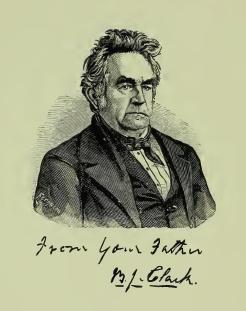
Notwithstanding his portrait, in its severe lines, gives evidence of his decisive mind and undeviating purpose, he yet possessed elements of character that endeared him to all. While in terms of affectionate banter, alluding to his spirit of determination and his practice of proposing to formulate the mind of public meetings in resolutions, he was sometimes spoken of as "Resolution Billy," the people knew that beneath the crust of self-reliant earnestness dwelt the loving humanitarian and the undying fires of a moral volcano.
Unlike the experience of the most of those who entertain pronounced ideas and proclaim them in the face of established custom. Dr. Clark seems to have retained his popularity. Evidently he was a very tactful man. In 1809, the year following the formation of the temperance society, he was made supervisor of the town of Moreau, and although his activity, constant, wide and diversified, was being powerfully directed against the intemperate habits of the people, he seems to have maintained their confidence and friendship. He was again chosen supervisor in 1821. We may derive a hint of his high standing in the public estimation from the fact that he was chosen in 1848 for the New York Electoral college, whose choice was Taylor and Filmore.
The funeral address of Rev. A. J. Fennel, of the Glens Falls Presbyterian Church, has been preserved and appears as a supplement to Dr. Holden's obituary article. Rev. Mr. Fennel having been Dr. Clark's pastor, his discourse is of great biographical value. His opening remarks were particularly well chosen and impressive. He said:
"I feel, my friends, that Providence calls us to perform no mean office to-day. We are to convey to their final resting place the mortal remains of one who has been a power in the world for great good to the children of men—whose name will enter into history as that of a benefactor of the community; and whose influence, as an element in the temperance reformation, will run on into future generations. It cannot do us any hurt, it ought to do us good, to pause a few moments in this habitation now made sacred as the spot whence the earnest spirit of so devoted and useful a man took its departure to the heavenly rest, and reflect on his life of activity and toil, and observe how Providence used him for our good and the good of our children."
With appropriate public demonstrations, the remains of Dr. Clark were borne to the burying ground of the Union Meeting House, in Moreau, and placed to rest beside the grave of his wife. There, two miles from the historic spot where he unfurled the banner of a world-wide moral movement, his ashes mingled with the soil that his devotion has made of honorable distinction.
Thus, have I attempted to disentangle, gather up and lead in continuous discourse the scattered threads which I have found in my study of this neglected subject. If I have rendered more coherent and tangible the life and achievement of a universally influential philanthropist, I shall be pleased; but I hope, besides that good result, the consideration of the memoirs of a man who had a great mission in the world and who ably and conscientiously discharged it, will serve to impress upon us a sense of the power of elevated ideas when duly championed by even one consecrated soul.
Acknowledgement.
In expressing my appreciation of the assistance which has been rendered me in the collection of materials for the preparation of this paper, I would particularly mention Mr. James A. Holden, of Glens Falls, who has furnished me, from the library of his father, the late Dr. A. W. Holden, with most valuable matter, some of which could have been obtained from no other source. I also duly acknowledge my indebtedness to Hon. Grenville M. Ingalsbe, of Sandy Hill, who interested himself in my search for data, and feel myself under obligations to the Schuylerville Standard and to the Glen Falls Times for gratuitously publishing my request for information.
Communications.
From the letters relating to the subject in hand which I have received, I glean the following. I might say that the discrepancy which appears in the descriptions of Dr. Clark's person may be accounted for by the different ages and conditions of health in which he is best remembered by the several Observers:
From Dr. Albert Mott, Cohoes: "The location of the Union Meeting House was at Reynold's Corners, about four or five hundred feet from the corner, directly east. The burying ground was north and across the road from the meeting house."
From Rev. Dr. Jos. E. King, Fort Edward: "In 1858 the old church (Union Meeting House) was filled, to enjoy the commemorative exercises of the 50th year since the origin of the temperance cause, and I heard Hon. Judge McKean, of Saratoga, address the congregation. There was singing, prayer, a poem by Lura Boies, &c."
Statement of Judge Lyman H. Northrup, of Sandy Hill, who remembers Dr. Clark: "He always carried upon his countenance a mild, genial, pleasant expression; dressed with neatness, and appeared to be a good sort of a fellow, and exhibited not at all that asperity which we associate in our minds with the active reformer."
From William Gary, of Gansevoort, who was intimate with Dr. Clark: "He had rather small, black eyes, which would be generally considered rather piercing. His hair was black and very profuse; eye-brows very shaggy. His height I should put at 5 ft. 10 in., and weight about 170 lbs."
From B. F. Lapham, of Glens Falls: "I was well acquainted with Dr. B. J. Clark. He lived on the same street we did for many years, and when he died I helped prepare his body for burial. He was rather eccentric in many things and very resolute. There never was a meeting held but he would suggest some resolution, so they nicknamed him 'Resolution Billy.' Dr. Clark's name will be famous through all time as the originator of the first temperance organization that ever existed. He was an ardent and efficient laborer all his life."
From Miss Anna Mott, of Glens Falls. Miss Mott is a daughter of James Mott, who was a co-laborer in the temperance cause with Dr. Clark, and his neighbor at Clark's Corners: "As I remember Dr. B. J. Clark, he was a cultured, refined man, with fine sensibility. He had a kind word and look for every one that was worthy of it. He was of medium height and size. His hair and eyes were black; his forehead high and broad. His mouth and chin bespoke firmness. His complexion 'was dark. As I saw Dr. Clark, he was a very kind, gentlemanly old man, and appreciated every kindness he received."
From Austin L. Reynolds, of South Glens Falls. Mr. Reynolds knew Dr. Clark for many years, and assisted him in the temperance work: "Dr. Clark's name was Billy, instead of William. He was stocky in form, and weighed about 175 lbs. His height was about 5 ft. 6 in.; complexion fair; dark hair and eyes, and very heavy eyebrows. He was peculiarly successful as a physician and as a business man. Was the owner of several farms and was interested in a paper mill, situated on what is known as Snoot Kill Creek. Later, he moved to Glens Falls and was proprietor of a drug store for a number of years in that village. Then he returned to Clark's Corners with his daughter, Mrs. Alfred C. Farlin (widow), as housekeeper, and remained at his homestead for several years. He lost his eyesight and was entirely blind. Then he returned to Glens Falls, and died in 1866. He left one son and three daughters, all of whom are now dead."
A Visit to Clark's Corners.
In order that I might obtain a better understanding of the topography of the neighborhood, I visited Clark's Corners on a day in August, 1905. Driving west from Fort Edward, at a distance of three miles I came to Reynolds' (four) Corners. I was very courteously received by Mr. Austin L. Reynolds, who gave me full information as to all the historic spots connected with the Moreau society. Mr. Reynolds is at an advanced age, more than eighty, but he promptly and clearly communicated to me the facts herewith set forth.
The roads at Reynolds' Corners run toward the cardinal points, and the burying ground of the Union Meeting House is at a short distance east of the corners, as already has been stated by Dr. Mott. The remains of Dr. Clark were removed from this, the place of their first burial, and were re-interred at Glens Falls. The site of the Union Meeting House is unoccupied, the present chapel standing on other ground, some distance to the west. The Union Meeting House was Dr. Clark's place of worship, and his pastor, Rev. Lebbeus Armstrong, resided at the parsonage, one-half mile south of the church and on the west side of the highway. The cottage which stands on the site of Armstrong's home is now the residence of Mr. Halsey Chambers. It was here that Dr. Clark came in the night upon his historic errand.
Clark's (four) Corners are directly south of Reynolds' Corners and two miles distant. The north and south road is crossed at right angles by the other. Both of these localities are open country, that of Clark's Corners having the appearance of fertility and thrift; pleasant homes and commodious buildings being numerous. Clark's Corners may be conveniently reached from the village of Gansevoort, on the Delaware and Hudson Railroad, two miles south.
The site of the Mawney house is at Clark's Corners. It stood on the northwest corner. Another building has since been erected upon this ground. Dr. Clark's home stood across the road, on the southwest corner. The house has disappeared, but the cellar walls stand almost intact. About forty rods south of the corners and on the east side of the road is the site of the school-house in which the Moreau society held its meetings. A dwelling house, the home of Mr. George Haviland, now occupies that plot of ground.
The sites of the Union Meeting House, parsonage, Mawney house, Dr. Clark's house, and the school house, should be appropriately marked.