Volume 2 / Part 3 — PART THIRD. POTASH IN FERTILIZING MATERIALS AND FERTILIZERS.
Reading edition
224. Introduction.—The potash present in unfertilized soils has been derived from the decay of rocks containing potash minerals. Among these potash producers feldspars are perhaps the most important. For a discussion of the nature of their decomposition and the causes producing it the first part of volume first may be consulted. Potash is quite as extensively distributed as phosphoric acid and no true soils are without it in some proportion. Its presence is necessary to plant growth and it forms, in combination with organic and mineral acids, an essential part of the vegetable organism, existing in exceptionally rich quantities in the seeds. It is possible that potash salts, such as the chlorid, sulfate, and phosphate may be assimilated as such, but, as with other compounds, we must not deny to the plant the remarkable faculty of being able to decompose its most stable salts and to form from the fragments thus produced entirely new compounds. This is certainly true of the potash compounds existing in plants in combination with organic acids. The potash which is assimilated by plants exists in the soil chiefly in a mineral state, and that added as fertilizer is chiefly in the same condition. That part of the potash in a soil arising directly from the decomposition of vegetable matters may exist partly in organic combination, but this portion, in comparison with the total quantity absorbed by the plant, is insignificant.
It is then safe to assume that at least a considerable part of the potash absorbed by the plant is decomposed from its original form of combination by the vegetable biochemical forces, and is finally incorporated in the plant tissues in forms determined by the same powerful forces of vegetable metabolism.
The analyst is not often called upon to investigate the forms in which the potash exists in plants, when engaged in investigation of fertilizers. It is chiefly found in combination with organic and phosphoric acids, and on ignition will appear as phosphate or carbonate in the ash.
225. Forms in which Potash is Found in Fertilizers.—The chief natural sources of potash used in fertilizer fabrication are: First, organic compounds, such as desiccated mineral matters, tobacco waste, cottonseed hulls, etc.; second, the ash derived from burning terrestrial plants of all kinds; third, the natural mineral deposits, such as Stassfurt salts.
All of these forms of potash may be found in mixed fertilizers. While the final methods of analyses are the same in all cases the preliminary treatment is very different, being adapted to the nature of the sample. For analytical purposes, it is highly important that the potash be brought into a soluble mineral form, and that any organic matters which the sample contains be destroyed. If the sample be already of a mineral nature, it may still be mixed with other organic matter and then it requires treatment as above, for it is not safe always to rely solely on the solubility of the potash mineral, and the solution, moreover, in such cases, is likely to contain organic matter. In some States, only that portion of the potash soluble in water is allowed to be considered in official fertilizer work. In these cases it is evident that the organic matter present should not be destroyed in the original sample, but only in the aqueous solution. Since, however, the potash occluded in organic matter becomes constantly available as the process of decay goes on, it is not just to exclude it from the available supply. It may not be so immediately available as when in a soluble mineral state, but it is not long before it becomes valuable. Experience has shown, moreover, that phosphorus, nitrogen, and potash are all more valuable finally when applied to the soil in an organic form. This fact is a corroboration of the theory already advanced that all mineral compound bodies are probably decomposed before they enter as component parts into the tissues of the vegetable organism.
It is highly probable, therefore, that the potash existing in organic compounds, finely divided and easily decomposed, is of equal, if not greater value to plant life than that already in a soluble mineral state. The organic matter, when present, is destroyed, either by ignition at a low temperature, or by moist combustion with an oxidizing agent before the potash is precipitated.
ORGANIC SOURCES OF POTASH.
226. Tobacco Stems and Waste.—Until within a few years tobacco stems and other waste from factories, were treated as a nuisance in this country, and burned or dumped into streams. By burning and saving the ash the potash contained in the stems and waste would be recovered in a form suitable for field use. The nitrogen, however, contained in these waste materials, both in the form of nicotin and of albuminoids would be lost. Ignition of this waste, therefore, should not be practiced. It should be prepared for use by grinding to a fine powder. Applied to the soil in this condition the powder may be useful as an insecticide as well as a fertilizer. Tobacco stems contain from twelve to twenty-seven per cent of moisture, and from twelve to twenty per cent of ash. The composition of the stems from two celebrated tobacco growing regions is subjoined:[185]
Kentucky stems. Connecticut stems.
Moisture 26.70 per cent. 13.47 per cent.
Organic and volatile 60.18 “ “ 70.85 “ “
Ash 13.12 “ “ 15.68 “ “
The ash calculated to the original substance had the following composition:
Kentucky stems. Connecticut stems.
Phosphoric acid 0.67 per cent. 0.53 per cent.
Potash 8.03 “ “ 6.41 “ “
It is thus seen that about half the ash of tobacco stems is composed of potash. The stalks of the tobacco have almost the same composition as the stems, but the percentage of ash is not quite so great. In three samples analyzed at the Connecticut station the percentages of ash found in the water-free substance were 6.64, 7.00, and 7.46 respectively. The pure ash of the stalks was found to have the following composition:[186]
Description of samples.
Constituents Cut Aug. 22. Cut Sept. 17.
Silica 0.82 per cent. 0.57 per cent.
Iron and aluminum oxids 1.38 “ “ 1.38 “ “
Lime 14.01 “ “ 16.58 “ “
Magnesia 6.64 “ “ 7.36 “ “
Potash 56.34 “ “ 54.46 “ “
Soda 1.28 “ “ 1.16 “ “
Sulfuric acid 8.06 “ “ 6.75 “ “
Phosphoric acid 6.37 “ “ 6.27 “ “
Chlorin 6.55 “ “ 7.05 “ “
101.45 “ “ 101.58 “ “
Deduct oxygen = chlorin 1.45 “ “ 1.58 “ “
100.00 “ “ 100.00 “ “
The leaves of the tobacco contain more ash than the stalks or stems, but the percentage of potash therein is less. In eighteen samples analyzed at the Colorado station the percentages of moisture in the leaf varied from 6.08 to 28.00, and those of ash from 22.60 to 28.00.[187] The percentages of potash in the ash varied from 15.20 to 26.30. In these data the carbon dioxid, sand, etc., are included, while in those quoted from the Connecticut station they were excluded.
227. Cottonseed Hulls and Meal.—A considerable quantity of potash is added to the soil in cottonseed meal and hulls. The practice of burning the hulls cannot be recommended, although it is frequently practiced, for the incineration does not increase the quantities of phosphoric acid and potash, while it destroys the availability of the nitrogen. Nevertheless the analyst will often have to deal with samples of the raw materials above mentioned, as well as with the ash of the hulls, in which the potash can be determined by some one of the standard methods to be described. In general it is found that the hulls of seeds and the bark and leaves of plants have a greater percentage of ash than the interior portions. In the case of cottonseed however, an exception is to be noted. The cottonseed meal in the air-dried state has about seven per cent of ash, while the hulls have only about three. When it is remembered, however, that the greater part of the oil has been removed from the meal it will be seen that in the whole seed in the fresh state the discrepancy is not so marked.
In the crude ash of the hulls the percentage of potash varies generally from twenty to twenty-five per cent, but in numerous cases these limits are exceeded. In twelve samples of cottonseed hull ashes examined by the Connecticut station the mean percentage of potash in the crude sample was 22.47, and the extremes 15.57 and 30.24 per cent respectively.[188] In determining the value of the ash per ton the content of phosphoric acid must also be taken into account.
Cottonseed meal contains about 1.75 per cent of potash. Since the mean percentage of ash in the meal is seven, the mean content of potash in the crude ash is about twenty-five.
228. Wood Ashes.—Unleached wood ashes furnish an important quantity of potash fertilizer. The composition of the ash of woods is extremely variable. Not only do different varieties of trees have varying quantities of ash, but in the same variety the bark and twigs will give an ash quite different in quantity and composition from that furnished by the wood itself. In general the hard woods, such as hickory, oak, and maple, furnish a quality of ash superior for fertilizing purposes to that afforded by the soft woods, such as the pine and tulip trees.
The character of the unleached wood ashes found in the trade is indicated by the subjoined analyses. The first table contains the mean, maximum and minimum results of the analyses of ninety-seven samples by Goessmann.[189]
Mean composition of wood ashes.
Means. Maxima. Minima.
Potash 5.5 10.2 2.5
Phosphoric acid 1.9 4.0 0.3
Lime 34.3 50.9 18.0
Magnesia 3.5 7.5 2.3
Insoluble 12.9 27.9 2.1
Moisture 12.0 28.6 0.7
Carbon dioxid and undetermined 29.9
In sixteen analyses made at the Connecticut station the data obtained are given below:[190]
Means. Maxima. Minima.
Potash 5.3 7.7 4.0
Phosphoric acid 1.4 1.8 0.9
In fifteen analyses of ashes from domestic wood-fires in New England stoves, the following mean percentages of potash and phosphoric acid were found:
Potash 9.63
Phosphoric acid 2.32
In leaching, ashes lose chiefly the potassium carbonate and phosphate which they contain. Leached and unleached Canada ashes have the following composition:
Unleached. Leached.
Insoluble 13.0 per cent. 13.0 per cent.
Moisture 12.0 “ “ 30.0 “ “
Calcium carbonate and hydroxid 61.0 “ “ 51.0 “ “
Potassium carbonate 5.5 “ “ 1.1 “ “
Phosphoric acid 1.9 “ “ 1.4 “ “
Undetermined 6.6 “ “ 3.5 “ “
In the wood ashes of commerce therefore, it is evident that the proportion of the potash to the lime is relatively low.
The number of parts by weight of the chief ingredients of the ash in ten thousand pounds of woods of different kinds is given in the table below together with the percentage composition of the pure ash, that is the crude ash deprived of carbon and carbon dioxid.
Pounds of the Ingredients Named in Ten Thousand Pounds of Wood.
Dogwood. Sycamore. Post oak. Ash. Red Oak. Hickory.
Cornus florida. Platanus occidentalis. Q. obtusiloba. F. Americana. Q. rubra. Carya tomentosa.
Potash 9.02 18.06 16.85 14.94 13.95 13.80
Phosphoric acid 5.72 9.55 6.96 1.15 5.98 5.83
Lime 6.41 24.73 35.61 7.60 27.40 18.40
Magnesia 14.67 .49 5.28 .10 3.05 4.86
White oak. Magnolia. Georgia pine. Yellow pine. Black pine. Chestnut. Old field pine.
Q. alba. M. grandiflora. P. palustris. P. mitis. Picea nigra. Castanea vesca or sativa. P. mitis.
Potash 10.60 7.13 5.01 4.54 3.02 2.90 .79
Phosphoric acid 2.49 3.19 1.24 .96 .92 1.09 .73
Lime 7.85 14.21 18.04 15.16 12.46 7.93 12.12
Magnesia .90 2.94 2.03 .74 .10 .34 1.17
The Pure Ashes of the Woods Contain the Following Per Cents of the Ingredient Named.
Dogwood. Sycamore. Post oak. Ash. Red Oak. Hickory.
Cornus florida. Platanus occidentalis. Q. obtusiloba. F. Americana. Q. rubra. Carya tomentosa.
Potash 28.04 23.17 21.92 46.04 24.66 28.60
Phosphoric acid 8.51 12.23 9.00 3.58 10.55 11.97
Lime 38.93 31.62 46.39 23.57 48.26 37.94
Magnesia 6.80 .62 6.88 .60 5.38 10.04
White oak. Magnolia. Georgia pine. Yellow pine. Black pine. Chestnut. Old field pine.
Q. alba. M. grandiflora. P. palustris. P. mitis. Picea nigra. Castanea vesca or sativa. P. mitis.
Potash 42.16 19.54 15.35 19.70 14.30 18.10 3.85
Phosphoric acid 9.48 8.75 3.82 4.18 4.33 6.76 4.11
Lime 29.85 38.94 55.24 65.53 58.98 49.18 67.73
Magnesia 3.43 8.05 6.25 3.20 .50 2.11 6.54
229. Fertilizing Value of Ashes.—Primarily, the fertilizing value of wood-ashes depends on the quantity of plant food which they contain. With the exception of potash and phosphoric acid, however, the constituents of wood-ashes have little, if any, commercial value. The beneficial effects following the application of ashes, however, are greater than would be produced by the same quantities of matter added in a purely manurial state. The organic origin of these materials in the ash has caused them to be presented to the plant in a form peculiarly suited for absorption. Land treated generally with wood-ashes becomes more amenable to culture, is readily kept in good tilth, and thus retains moisture in dry seasons and permits of easy drainage in wet. These effects are probably due to the lime content of the ash, a property moreover favorable to nitrification and adapted to correcting acidity. Injurious iron salts, which are sometimes found in wet and sour lands, are precipitated by the ash and rendered innocuous or even beneficial. A good wood-ash fertilizer therefore is worth more than would be indicated by its commercial value calculated in the usual way.
230. Molasses from Sugar-Beets.—The residual molasses resulting after the extraction of all the crystallizable sugar in beet-sugar manufacture is very rich in potash. The molasses contains from ten to fifteen per cent of ash.
The composition of the ash varies greatly in the content of potash as well as of the other constituents.[191] The content of potassium carbonate varies from twenty-two to fifty-five per cent and, in addition to this, some potassium sulfate and chlorid are usually present.
The following figures give the composition of a good quality of beet-molasses ash:
Potassium carbonate 45.30 per cent
Sodium “ 13.86 “
Potassium chlorid 22.40 “
“ sulfate 8.00 “
Silica, lime, alumina, water, phosphoric
acid, and undetermined 15.82 “
Thus, in 100 parts of such an ash over three-quarters are potash salts. The molasses may be applied directly to the soil or diluted and sprayed over the fields.
231. Residue of Wineries.—The pomace of grapes after being pressed or fermented for wine production contains considerable quantities of potash as crude argol or acid potassium tartrate. This material can be applied directly to the soil or first burned, when its potash will be secured in the form of carbonate.
The use of the winery refuse for fertilizing purposes has not assumed any commercial importance in this country.
232. Destruction of Organic Matter by Direct Ignition.—The simplest and most direct method for destroying organic matter is by direct ignition. The incineration may be conducted in the open air or in a muffle and the temperature should be as low as possible. In no case should a low red heat be exceeded. By reason of the moderate draft produced in a muffle and the more even heat which can be maintained this method of burning is to be preferred. With the exercise of due care, however, excellent results can be obtained in an open dish or one partly closed with a lid. At first, with many samples, the organic matter will burn of its own accord after it is once ignited, and during this combustion the lamp should be withdrawn. The ignition in most cases should be continued in a platinum dish but should the sample contain any reducible metal capable of injuring the platinum a porcelain vessel should be used. The lamp should give a diffused flame to avoid overheating of any portions of the dish and to secure more uniform combustion. In using a muffle the heat employed should be only great enough to secure combustion and the draft should be so regulated as to avoid loss due to the mechanical deportation of the ash particles.
233. Ignition with Sulfuric Acid.—The favorable action of sulfuric acid in securing a perfect incineration may also be utilized in the preparation of samples containing organic matter for potash determinations. In this case the bases which by direct ignition would be secured as carbonates are obtained as sulfates. In the method adopted by the official chemists it is directed to saturate the sample with sulfuric acid and to ignite in a muffle until all organic matter is destroyed.[192] Afterwards, when cool the ash is moistened with a little hydrochloric acid and warmed, whereby it is the more easily detached from the dish. The potash is then determined by any one of the standard methods. This method has several advantages over the direct ignition. Where any chlorids of the alkalies are present in the ash there is danger of loss of potash from volatilization. This is avoided by the sulfate process. Moreover, there is not so much danger in this method of occluding particles of carbon in the ash.
234. The Destruction of Organic Matter by Moist Combustion.—In the process of ignition to destroy organic matter or remove ammonium salts in the determination of potash, there are often sources of error which may cause considerable loss. This loss, as has already been mentioned, may arise from the volatilization of the potash salts or mechanically from spattering. In order to avoid these causes of error de Roode has used aqua regia both for the destruction of the ammonium salts and for the oxidation of the organic matter at least sufficiently to prevent any subsequent reduction of the platinum chlorid.[193] His method consists in boiling a sample of the fertilizer, or an aliquot portion of a solution thereof with aqua regia. The proposed method has not yet had a sufficient experimental demonstration to warrant its use, but analysts may find it profitable to compare this process with the standard methods. The organic matter may also be destroyed by combustion with sulfuric acid, as in the kjeldahl method for nitrogen. The residue, however, contains ammonium sulfate and a large excess of sulfuric acid, and for both reasons would not be in a fit condition for the estimation of potash.
It is suggested that the organic matter might also be destroyed by boiling with strong hydrochloric acid, to which from time to time, small quantities of sodium chlorate free of potash is added. Subsequently the solution could be boiled with addition of a little nitric acid and the ammonium salts be removed.
POTASH IN MINERAL DEPOSITS.
235. Occurrence and History.—The generally accepted theory of the manner in which potash has been collected into deposits suited to use as a fertilizer has already been described.[194] The Stassfurt deposits, which have for many years been almost the sole source of potash in fertilizers, were first known as mines of rock salt. In 1839, having previously been acquired by the Prussian treasury, they were abandoned by reason of the more economical working of rock salt quarries in other localities.[195] It was determined thereafter to explore the extent of these mines by boring, and a well was sunk to the depth of 246 meters, when the upper layer of the salt deposit was reached. The boring was continued into the salt to a total depth of 581 meters without reaching the bottom. The results of these experiments were totally unexpected. Instead of getting a brine saturated with common salt, one was obtained containing large quantities of potassium and magnesium chlorids.[196] Shafts were sunk in other places, and with such favorable results, that in 1862 potash salts became a regular article of commerce from that locality. At first these salts were regarded as troublesome impurities in the brine from which common salt was to be made, but at this time the common salt has come to be regarded as the disturbing factor. At the present time the entire product is controlled by a syndicate of nine large firms located at Stassfurt and vicinity. Outside of the syndicate properties a shaft has been sunk at Anderbeck, (Halberstadt,) which, however, has produced only carnallit, since kainit has not been found there. Also at Sondershausen, potash salts have been discovered and a shaft is now sinking there.
It is thus seen that the potash deposits extend over a wide area in Germany, and there is little fear of the deposits becoming exhausted in many centuries. In this country no potash deposits of any commercial importance have been discovered; but the geological conditions requisite to these formations have not been wanting, and their future discovery is not improbable.
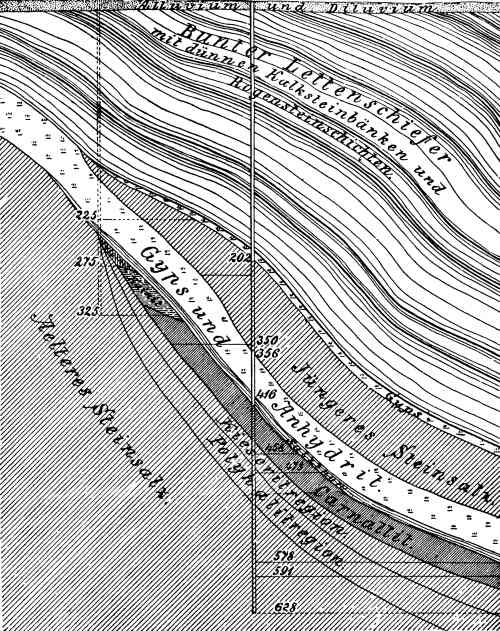
Figure. 17.
Geological Relations of the Potash Deposits near Stassfurt.
236. Changes in Potash Salts in Situ.—The deposits of potash salts are not all found at the present in the same condition in which they were first deposited from the natural brines. The layers of salt have been subjected to the usual upheavals and subsidences peculiar to geological history. The layers of salt were thus tilted and the edges often brought to the surface. Here they were exposed to solution, and the dissolved brine afterward separated its crystallizable salts in new combinations. For instance, kieserit and the potassium chlorid of the carnallit were first dissolved and there was left a salt compound chiefly of potassium and sodium chlorids, sylvinit. In some cases there was a mutual reaction between the magnesium sulfate and the potassium chlorid and the magnesium potassium sulfate, schönit, was thus produced. This salt is also prepared at the mines artificially. The most important of these secondary products however, from the agricultural standpoint, is kainit. This salt arose by the bringing together of potassium sulfate, magnesium sulfate, and magnesium chlorid, and was formed everywhere about the borders of the layers of carnallit wherever water could work upon them. In quantity the kainit, as might be supposed, is far less than the carnallit, the latter existing in immense deposits. There is however quite enough of it to satisfy all the demands of agriculture for an indefinite time. In fact for many purposes the carnallit can take the place of kainit without detriment to the growing crops. The relative positions and quantities of the layers of mineral matters in the potash mines, and the depth in meters at which they are found is shown in Fig. 17.[197]
237. Kainit.—The most important of the natural salts of potash for fertilizing purposes is the mixture known as kainit. It is composed in a pure state of a molecule each of potassium sulfate, magnesium sulfate, magnesium chlorid, and water. Chemically it is represented by the symbols:
K₂SO₄·MgSO₄·MgCl₂·H₂O. Its theoretical percentage of potash (K₂O), oxygen = 16, is 23.2.
Pure kainit, however, is never found in commerce. It is mixed naturally as it comes from the mines with common salt, potassium chlorid, gypsum, and other bodies. The content of potash in the commercial salt is therefore only a little more than half that of the pure mineral. In general it may be taken at 12.5 per cent, of which more than one per cent is derived from the potassium chlorid present. The following analysis given by Maercker may be regarded as typical:[198]
Potassium sulfate 21.3 per cent
Magnesium “ 14.5 “
Magnesium chlorid 12.4 “
Potassium “ 2.0 “
Sodium “ 34.6 “
Calcium sulfate (gypsum) 1.7 “
Water 12.7 “
Alumina 0.8 “
Kainit occurs as a crystalline, partly colorless, partly yellow-red mass. When ground, in which state it is sent into commerce, it forms a fine, gray-colored mass containing many small yellow and red fragments. It is not hygroscopic and if it become moist it is due to the excess of common salt which it contains.
According to Maercker kainit was formerly regarded as a potassium magnesium sulfate. But this conception does not even apply to the pure salt much less to that which comes from the mines. If, therefore, the agronomist desire a fertilizer free from chlorin he would be deceived in choosing kainit which may sometimes contain nearly fifty per cent of its weight of chlorids.
Where a fertilizer free of chlorin is desired, as for instance, in the culture of tobacco, kainit cannot be considered. In many other cases, however, the chlorin content of this body instead of being a detriment may prove positively advantageous, the chlorids on account of their easy diffusibility through the soil serving to distribute the other ingredients.
By reason of the presence of common salt and magnesium chlorid the ground kainit delivered to commerce tends to harden into compact masses. To prevent this in Germany it is recommended to mix it with about two and a half per cent of fine-ground dry peat.
Such a mixture is recommended in all cases where the freshly ground kainit is not to be immediately applied to the soil.
238. Carnallit.—This mineral is a mixture of even molecules of potassium and magnesium chlorids crystallized with six molecules of water. It is represented by the symbols KCl·MgCl₂·6H₂O. As it comes from the mines it contains small quantities of potassium and magnesium sulfates and small quantities of other accidental impurities. Existing as it does in immense quantities it has been extensively used for the manufacture of the commercial potassium chlorid (muriate of potash). For many purposes in agriculture, for instance, fertilizing tobacco fields, it is not suited, and it is less widely used as a fertilizer in general than its alteration product kainit. Its direct use as a fertilizer however is rapidly increasing since later experience has shown that chlorin compounds are capable of a far wider application in agriculture without danger of injury than was formerly supposed. As it comes from the mines, the Stassfurt carnallit has the following composition:[199]
Potassium chlorid 15.5 per cent.
Magnesium “ 21.5 “ “
Magnesium sulfate 12.1 “ “
Sodium chlorid 22.4 “ “
Calcium sulfate 1.9 “ “
Water 26.1 “ “
Undetermined 0.5 “ “
Pure carnallit would have the following composition:
Chlorin 38.3 per cent.
Potassium 14.0 “ “
Magnesium 8.7 “ “
Water 39.0 “ “
Equivalent to
Potassium chlorid 26.8 “ “
Magnesium “ 34.2 “ “
Water 39.0 “ “
The commercial article as taken from the mines, as is seen above, has less potash (K₂O) than kainit, the mean content being about nine and nine-tenths per cent. Those proposing to use this body for fertilizing purposes should bear in mind that it contains less potash and more chlorin than kainit.
Carnallit occurs in characteristic brown-red masses. On account of its highly hygroscopic nature it should be kept as much as possible out of contact with moist air and should not be ground until immediately before using.
By reason of the greater bulk in proportion to its content of potash and its hygroscopic nature and consequent increased difficulty in handling, the price per unit of potash in carnallit is less than in kainit.
In some localities small quantities of ammonium chlorid have been found with carnallit but not to exceed one-tenth per cent. It has therefore no practical significance to the farmer but may be of interest to the analyst.
239. Polyhalit.—Polyhalit is a mineral occurring in Stassfurt deposits and consisting of a mixture of potassium, magnesium, and calcium sulfates, with a small proportion of crystal water. This mineral, on account of its being practically free of chlorin, would be one especially desirable for use in those cases, as in the culture of tobacco, where chlorids are injurious. Unfortunately, it does not occur in sufficient quantities to warrant the expectation of its ever being found in masses large enough to become a general article of commerce. It is found only in pockets or seams among the other Stassfurt deposits, and there is no assurance given on finding one of these deposits of polyhalit that it will extend to any great distance. The composition of the mineral is shown by the following formula: K₂SO₄·MgSO₄·(CaSO₄)₂·H₂O. Its percentage composition is shown by the following numbers:
Potassium sulfate 28.90 per cent.
Magnesium sulfate 19.93 “ “
Calcium sulfate 45.18 “ “
Water 5.99 “ “
The percentage of potash corresponding to the above formula is 15.62. It therefore contains a considerable excess of potash over kainit, and on account of its freedom from chlorids, would be preferred for many purposes.
240. Krugit.—This mineral occurs associated with polyhalit and differs from it only in containing four molecules of calcium sulfate instead of two. Its formula is: K₂SO₄·MgSO₄·(CaSO₄)₄·H₂O. As it comes from the mines it is frequently mixed with a little common salt. Its mean percentage composition as it comes from the mines is given in the following numbers:
Potassium sulfate 18.60 per cent.
Magnesium sulfate 14.70 “ “
Calcium sulfate 61.00 “ “
Sodium chlorid 1.50 “ “
Water 4.20 “ “
The percentage of potash corresponding to the above formula is 10.05. It is therefore less valuable than kainit in so far as its content of potash is concerned. This salt also exists in limited quantities and is not likely to become an important article of commerce.
241. Sylvin.—One of the alteration products of carnallit is a practically pure potassium chlorid which, as it occurs in the Stassfurt mines is known as sylvin. The alteration of the carnallit arises from its solution in water from which, on subsequent evaporation, the potassium chlorid is deposited alone. This mineral is found in only limited quantities in the Stassfurt deposits and it therefore does not have any great commercial importance.
242. Sylvinit.—This mineral has been mined in recent years in considerable quantities. It is, in fact, only common salt carrying large quantities of potassium chlorid together with certain other accidental impurities. It was probably formed by the drying up of a saline mass in such a way as not to permit the complete separation of its mineral constituents. The average composition of sylvinit as it comes from the mines is given in the following table:
Potassium chlorid 30.55 per cent.
Sodium chlorid 46.05 “
Potassium sulfate 6.95 “
Magnesium sulfate 4.80 “
Magnesium chlorid 2.54 “
Calcium sulfate 1.80 “
Water and insoluble 7.29 “
This salt is richer in chlorin than any other of the Stassfurt potash minerals, containing altogether 79.14 per cent of chlorids. Its potash content amounts to 23.04 per cent, but in proportion to the potash which it contains, it is relatively poorer in chlorin than kainit and carnallit. On account of its high content of potash the freights on a given weight thereof as contained in sylvanit are lower than for kainit and carnallit.
243. Kieserit.—The mineral kieserit is essentially magnesium sulfate and it does not necessarily contain any potash salts. Under the name of kieserit, however, or bergkieserit, there is mined a mixture of carnallit and kieserit, which is a commercial source of potash. The mixture contains the following average content of the bodies named:
Potassium chlorid 11.80 per cent.
Magnesium sulfate 21.50 “
Magnesium chlorid 17.20 “
Sodium chlorid 26.70 “
Calcium sulfate 0.80 “
Water 20.70 “
Insoluble 1.30 “
This mixture contains only about seven per cent of potash and would not prove profitable when used at a distance from the mines on account of the cost of freights. It has proved valuable, however, for a top dressing for meadow lands in the vicinity of Stassfurt.
244. Schönit.—Among the Stassfurt deposits there occurs in small quantities a mineral, schönit, which is composed of the sulfates of potassium and magnesium. The quantity of the mineral occurring naturally is very small and therefore it has no commercial importance. When, however, kainit is washed with water the common salt and magnesium chlorid which it contains being more soluble are the first leached out, and the residue has approximately the composition of the pure mineral. This mixture, as prepared in the way mentioned above, has the following average composition:
Potassium sulfate 50.40 per cent.
Magnesium sulfate 34.00 “
Sodium chlorid 2.50 “
Water 11.60 “
The percentage of potash corresponding to the above composition is 27.2. This substance being so rich in potash, and practically free of chlorids, is well suited to transportation to great distances and for general use in the field. Since, however, a considerable expense attends the manufacture of the artificial schönit, the advantages above named give it very little, if any, advantage in competition with the other potash salts as they come from the mines. It has, however, an especial value for the fertilization of tobacco and vineyards.
245. Potassium Sulfate.—Several grades of potassium sulfate are found in the market for fertilizing purposes, some of them quite pure, containing over ninety-seven per cent of the pure sulfate. The following data show the composition of a high grade and low grade potassium sulfate of commerce:
High grade. Low grade.
Potassium sulfate 97.20 per cent. 90.60 per cent.
Potassium chlorid 0.30 “ 1.60 “
Magnesium sulfate 0.70 “ 2.70 “
Magnesium chlorid 0.40 “ 1.00 “
Sodium chlorid 0.20 “ 1.20 “
Insoluble 0.20 “ 0.30 “
Water 0.70 “ 2.20 “
Naturally, high grade sulfates of this kind can only be prepared in chemical factories built especially for the work. The result is that the potash per unit is raised greatly in price. When, however, the fertilizers are to be transported to a great distance, the saving in freight often more than compensates for the higher price of the potash. It therefore happens that there are many places in this country where the actual price of potash per pound is less in high grade sulfates than in kainit or carnallit. When, in addition to this, the especial fitness of the high grade sulfates for certain forms of fertilization, especially tobacco growing, is considered, it is seen that at this distance from the mines these high grade salts are of no inconsiderable importance. The percentage of potash in the high grade sulfates often exceeds fifty.
246. Potassium Magnesium Carbonate.—This salt has lately been manufactured and used to a considerable extent, especially for tobacco fertilizing. As furnished to the trade it has the following average composition:
Potassium carbonate 35 to 40 per cent.
Magnesium carbonate 33 to 36 “
Water of crystallization 25 “
Potassium chlorid, potassium sulfate,
and insoluble 2 to 3 “
The content of potash, as is seen from the above formula, amounts to from seventeen to eighteen per cent. The compound is completely dry, is not hygroscopic, and is, therefore, always ready for distribution. It is especially to be recommended for all those intensive cultures where it is feared that chlorids and sulfates will prove injurious, especially in the cultivation of tobacco.
247. Potash in Factory Residues.—The residues from the potash factories in Stassfurt and vicinity contain considerable quantities of potash and attempts have been made to recover this waste and put it into form for fertilizing uses. The waste waters of the factories are sometimes collected and evaporated, and the residue incinerated. The content of potash in these residues is extremely variable, usually quite low, and they, therefore, cannot be recommended for fertilizing purposes, especially if they are to be transported to any distance.
248. Quantity of Potash Salts Used.—The total quantity of potash delivered to consumers from the Stassfurt mines in 1891, the last year for which complete statistics are at hand was 413,508 tons of kainit and sylvinit, 39,444 tons of carnallit, 18,078 tons of sulfate, and 12,453 tons of the potassium magnesium sulfate. Of the above quantities, 115,245 tons of kainit were shipped to North America, and of the high grade sulfate mentioned, 13,322 tons were sent to other countries, and of the potassium magnesium sulfate, 11,081 tons were exported.
METHODS OF ANALYSIS.
249. Classification of Methods.—To detect the presence of potash in a mixture the aid of the spectroscope may be invoked. In the scale of the spectrum divided into 170 parts, on which the sodium line falls at 50, potassium gives three faint rather broad bands, two red, falling at 17 and 27, and one plum-colored band, near the extreme right of the spectrum, at 153. Potassium, however, does not give brilliant and well-marked spectral bands, such as are afforded by its associates rubidium, caesium, sodium, and lithium. A convenient qualitative test which, for practical purposes will be quite sufficient, may be secured by dipping a platinum loop into a strong acid solution of the supposed potash compound, and viewing through a piece of cobalt glass, the coloration produced thereby when held in the flame of a bunsen. The red-purple tint thereby produced should be compared with that coming from a pure potash salt similarly treated. If a fertilizer sample give no indication of potash when treated as above it may be safely concluded that it does not contain any weighable quantity of potash.
For the estimation of the percentage of potash present in a given sample it may be safely assumed that all of value in agriculture will be given up to an aqueous or slightly acid solution if organic matter have been destroyed as indicated in a previous paragraph. In the case of minerals insoluble in a dilute acid the potash may be determined by some one of the processes given in the first volume.[200] The potash having been obtained in an aqueous or slightly acid (hydrochloric) solution, it may be determined either by precipitation as potassium platinochlorid or as potassium perchlorate. The former method is the one which has been almost exclusively used by analysis in the past, but the latter one is coming into prominence and by reason of the greater economy attending its practice and the excellent results obtained by some analysts, demands a generous consideration.
250. The Platinic Chlorid Method.—The principle of this method rests on the great insolubility of the potassium platinochlorid in strong alcohol and the easy solubility of some of its commonly attending salts; viz., sodium, etc., in the same reagent. Before the precipitation of the potash it is necessary to remove the bases of the earths, sulfates, etc. Barium chlorid and hydroxid, ammonium oxalate or carbonate, sulfuric acid, etc., are used in conjunction or successively to effect these purposes in the manner hereinafter described. The filtrate and washings containing the potash are evaporated to dryness and gently ignited to expel excess of ammonium salts and in the residue taken up with water and acidulated with hydrochloric acid, the potash is precipitated with platinic chlorid solution. The best methods of executing the analysis follow.
251. The Official Agricultural Method.—This method is based on the processes at first proposed by Lindo[201] and Gladding,[202] and is given below as adapted to mixed fertilizers and mineral potash salts.[203]
(1) In Superphosphates.—Boil ten grams with 300 cubic centimeters of water thirty minutes. To the hot solution add ammonia in slight excess, and then a sufficient quantity of ammonium oxalate to precipitate all the lime present; cool and make up to half a liter, mix thoroughly, and filter through a dry filter; evaporate fifty cubic centimeters, corresponding to one gram, nearly to dryness, add one cubic centimeter of dilute sulfuric acid (1 to 1), evaporate to dryness and ignite to whiteness. As all the potash is in form of sulfate, no loss need be apprehended by volatilization of potash, and a full red heat must be maintained until the residue is perfectly white. This residue is dissolved in hot water, plus a few drops of hydrochloric acid, and a slight excess of platinum solution is added. This solution is then evaporated to a thick paste in a small dish, and eighty per cent alcohol added. In evaporating, special precaution should be taken to prevent absorption of ammonia. The precipitate is washed thoroughly with alcohol by decantation and on the filter, as usual. The washing should be continued even after the filtrate is colorless. Ten cubic centimeters of the ammonium chlorid solution, prepared as hereinafter directed, are run through the filter, or the washing may be performed in the dish. The ten cubic centimeters will contain the bulk of the impurities, and are thrown away. Fresh portions of ten cubic centimeters of the ammonium chlorid are run through the filter several times (5 or 6). The filter is then washed thoroughly with pure alcohol, dried, and weighed as usual. Care should be taken that the precipitate is perfectly soluble in water. The platinum solution used contains one gram of metallic platinum in every ten cubic centimeters. To prepare the washing solution of ammonium chlorid, place in a bottle 500 cubic centimeters of water and 100 grams of ammonium chlorid and shake till dissolved. Now pulverize five or ten grains of potassium platinochlorid, put in the bottle and shake at intervals for six or eight hours; let settle over night, then filter off the liquid into a second bottle. The first bottle is then ready for preparation of a fresh supply when needed.
(2) Potassium Chlorids.—In the analysis of these salts an aliquot portion of the solution, containing a half gram, is evaporated with forty cubic centimeters of the platinum solution and a few drops of hydrochloric acid, and washed as before.
(3) Potassium Sulfate, Kainit, Etc.—In the analysis of kainit, dissolve ten grams of the pulverized salt in 300 cubic centimeters of boiling water, add ammonia to slight excess, then a sufficient quantity of ammonium oxalate to throw down all lime present; cool and make up to half a liter, mix thoroughly, and filter on a dry filter; from twenty-five cubic centimeters, corresponding to a half gram, proceed to remove the ammonia, as in the analysis of superphosphates; dissolve the residue in hot water, plus a few drops of hydrochloric acid, and add fifteen cubic centimeters of platinum solution. In the analysis of high-grade sulfate and of double-manure salt (potassium sulfate, magnesium sulfate, containing about twenty-seven per cent of potassium oxid), make up the solution as above, but omit the precipitation, evaporation, etc.; to an aliquot part equal to a half gram add fifteen cubic centimeters of platinum solution. In all cases special care must be taken in the washing with alcohol to remove all the double platinum sodium chlorid which may be present. The washing should be continued some time after the filtrate is colorless. Twenty-five cubic centimeters of the ammonium chlorid solution are employed instead of ten cubic centimeters, and the twenty-five cubic centimeters poured through at least six times to remove all sulfates and chlorids. Wash finally with alcohol; dry and weigh as usual.
252. Alternate Method for Potash.—Boil ten grams of the prepared sample for thirty minutes with 300 cubic centimeters of water, and, after cooling and without filtering, make up to one liter and filter through a dry filter. If the sample have ten per cent of potassium oxid, use fifty cubic centimeters of the filtrate; if less than ten per cent of potassium oxid (ordinary potash fertilizers), use 100 cubic centimeters of the filtrate. In each case make the volume up to 150 cubic centimeters, heat to 100°, and add, drop by drop with constant stirring, a slight excess of barium chlorid, and, without filtering, in the same manner add barium hydrate in slight excess. Filter while hot and wash until the precipitate is free of chlorids. Add to the filtrate one cubic centimeter of strong ammonium hydrate, and then a saturated solution of ammonium carbonate, until the excess of barium is precipitated. Heat and add, in fine powder, a half gram of pure oxalic acid or 0.75 gram of ammonium oxalate. Filter, wash free of chlorids, evaporate the filtrate to dryness in a platinum dish, and ignite carefully over the free flame, below red heat, until all volatile matter is driven off.
The residue is digested with hot water, filtered through a small filter, and washed with successive small portions of water until the filtrate amounts to thirty cubic centimeters or more. To this filtrate, add two drops of hydrochloric acid, in a porcelain dish, and from five to ten cubic centimeters of a solution of ten grams of platinic chlorid in 100 cubic centimeters of water. The mixture is evaporated on a water-bath to a thick sirup, as above, treated with alcohol of eighty per cent strength, washed by decantation, collected in a gooch or other form of filter, washed with strong alcohol, afterwards with five cubic centimeters of ether, dried for thirty minutes at 100°, and weighed.
It is desirable, if there be an appearance of foreign matter in the double salt, that it should be washed, according to the previous method, with ten cubic centimeters of the half-concentrated solution of ammonium chlorid, which has been saturated by shaking with potassium platinochlorid.
253. Method of Solution for Organic Compounds.—In case the potash is contained in organic compounds, like tobacco stems, cottonseed hulls, etc., weigh ten grams, saturate with strong sulfuric acid, and ignite in a muffle to destroy organic matter. Add a little strong hydrochloric acid to moisten the mass and warm slightly so as to loosen it in the dish. Proceed then as in the lindo-gladding or alternate method.
254. Factors.—The use of the factors 0.3056 for converting potassium platinochlorid to potassium chlorid and 0.19308 for converting it to potassium oxid is advised. The latter number is almost identical with that used by the Halle and Stassfurt chemists viz., 0.1927 and 0.1928 respectively.
255. Methods Used at the Halle Station.—(1) In Kainits and other Mineral Salts of Potash.[204]—Five grams of the prepared sample are boiled for half an hour in a half liter flask with from twenty to thirty cubic centimeters of concentrated hydrochloric acid and 100 cubic centimeters of water, and afterwards as much water added as is necessary to fill the flask about three quarters full, and the sulfuric acid is then precipitated with barium chlorid. To avoid an excess of barium chlorid the solution used is of known strength and is added first in such quantity as would precipitate the sulfuric acid from a kainit of low sulfuric acid content. The mixture is then boiled, allowed to settle and tried with a dropping tube containing barium chlorid. If a further precipitate be given a few drops more of barium chlorid solution are added, again boiled and allowed to settle. This is continued until barium chlorid gives no precipitation. After the barium chlorid gives no more precipitate a drop of dilute sulfuric acid is added to test for excess of barium. The operation is continued with the sulfuric acid until it no longer gives a precipitate of barium sulfate. By the alternate use of the barium chlorid and sulfuric acid the exact neutral point can soon be secured. When this point is reached the liquid is allowed to cool, the flask is filled to the mark, its contents filtered, and of the filtrate fifty cubic centimeters, equal to half a gram of the substance, taken for further estimation.
This quantity is evaporated on a water-bath to a sirupy consistence in a porcelain dish with ten cubic centimeters of platinic chlorid. The platinic chlorid solution should contain one gram of platinum in each ten cubic centimeters. The residue is treated with eighty per cent alcohol and, with stirring, allowed to stand for an hour. The precipitate is then collected on a gooch, either of platinum or porcelain, washed about eight times with eighty per cent alcohol and the potassium platinochlorid dried for two hours at 100°. After weighing the precipitate is dissolved in hot water and the residue washed under pressure, first with hot water and then with alcohol. The crucible with the asbestos felt is dried at 100° and weighed. Any impurities which the double salt may have carried down with it are left on the filter and the weight of the original precipitate can thus be corrected. The weight of potassium platinochlorid is multiplied by 0.1927 and the product corresponds to the weight of K₂O in the sample taken.
(2) Estimation of Potash in Guanos and Other Fertilizers containing Organic Substances.—Ten grams of the substances are carefully incinerated at a low temperature in a platinum dish. After ignition the contents of the dish are placed in a half liter flask and boiled for an hour with hydrochloric acid and a few drops of nitric acid. The sulfuric acid can then be precipitated directly with barium chlorid, or better, allow the flask to cool, fill to the mark, filter and treat an aliquot part of the filtrate with barium chlorid as described above. The filtrate from the separated sulfate of barium is neutralized with ammonia and all the bases, with the exception of magnesia and the alkalies, precipitated with ammonium carbonate; boil, fill to the mark and filter. Of this filtrate evaporate from 100 to 200 cubic centimeters in a platinum dish. After evaporation the ammonium salts are driven off by careful ignition, the residue taken up with hot water and filtered through as small a filter as possible into a porcelain dish; the magnesia remaining in the precipitate. The filtrate is acidified with a few drops of hydrochloric acid, ten cubic centimeters of platinic chlorid added and the further determination conducted as with kainit.
256. Dutch Method.—The process used at the Royal Agricultural Station of Holland is almost identical with that employed at Halle.[205]
A. Method for Stassfurt and other Potash Salts.—The necessary reagents are:
1. A dilute solution of barium chlorid:
2. A solution of platinic chlorid containing one gram of platinum in ten cubic centimeters: It must be wholly free from platinous chlorid and nitric acid, and partially freed from an excess of hydrochloric acid by repeated evaporations with water.
3. Alcohol of eighty per cent strength by the volume:
The methods of bringing the potash into solution and of precipitating the sulfuric acid are the same as for the Halle process described above.
Add then twenty cubic centimeters of the platinum solution and evaporate the mixture nearly to dryness. Add a sufficient quantity of eighty per cent alcohol and stir for some time. Allow to stand and then filter through a gooch dried at 120°. Finally wash with eighty per cent alcohol, dry at 120°, and weigh.
B. Method for Potash Superphosphate and other mixed Fertilizers.—The reagents necessary are the same as under A, and, in addition, a saturated solution of barium hydrate and a solution of ammonium carbonate mixed with ammonia.
Boil twenty grams of the substance with water for half an hour, cool, make up to half a liter and filter. Boil fifty cubic centimeters of the filtrate, and add barium chlorid till no more precipitate forms. Mix with baryta water to strong alkaline reaction, cool, make up to 100 cubic centimeters and filter. Raise fifty cubic centimeters of the filtrate to the boiling temperature and add ammonium carbonate solution till no more precipitate forms: Cool, make up to 100 cubic centimeters and filter. Transfer fifty cubic centimeters of the filtrate to a platinum dish, evaporate and heat the residue, avoiding too high a temperature, till the ammonia salts are expelled. Dissolve the residue in water, filter, and treat the filtrate as described under A.
257. Swedish Methods.—The Swedish chemists determine the potash in mineral salts by the platinum chlorid process, but with certain variations from the processes already given. The manipulation is conducted as follows:[206]
Weigh one gram of the sample to be examined and pour about 300 cubic centimeters of hot water over it in a beaker and filter after complete solution; add one cubic centimeter of hydrochloric acid, heat nearly to boiling, add dilute barium chlorid solution from a pipette or burette in a very fine stream stirring, slowly and carefully, till all sulfuric acid is completely precipitated, and only a trace of the precipitant is in excess. If the precipitation be conducted in the way given the barium sulfate will come down in crystalline condition, and settle rapidly within a few minutes, and almost immediately after the precipitation is finished may be filtered clear. The filtrate and washings from the barium sulfate are brought into a liter flask; fill this to the mark, take out fifty cubic centimeters with a pipette, evaporate the greater portion on a water-bath in a porcelain dish, transfer the residue by means of ammonia-free water to a beaker of fifty cubic centimeters capacity, add ten cubic centimeters of platinic chlorid solution, stir well with a glass rod, evaporate on a water-bath to a sirupy condition, allow to cool, and if the residue be too dry, add a few drops of water to allow the sodium platinochlorid to take up crystal water with certainty, stir well, add alcohol after a few minutes, mix carefully, leave the mixture standing for a while in the beaker covered with a watch glass, stirring occasionally; finally decant the solution, which must be of a dark yellow color, through a very small filter, wash the precipitate in the beaker repeatedly with small quantities of alcohol and decant; then transfer the precipitate to the filter, wash with alcohol, dry the filter and the precipitate at a gentle heat till all alcohol has evaporated, carefully transfer the contents of the filter to a watch glass placed on white glazed paper; dissolve the potassium platinochlorid still remaining on the filter in small quantities of boiling water, evaporate the filtrate on a water-bath in an accurately weighed platinum dish to dryness and transfer the same to the main portion of the chlorid from the watch glass. In order to obtain the salt free of the corresponding combinations of sodium, barium, calcium, and magnesium, which salts, although soluble in alcohol, may make the salt impure, before weighing, treat the precipitate twice with small quantities of cold water which will dissolve these impurities; evaporate the solution after addition of one cubic centimeter of platinic chlorid nearly to dryness on a water-bath, treat the residue in the same way as given before, add the small quantity of potassium platinochlorid which is hereby obtained together with the main portion to the platinum dish, dry at 130°, and weigh. Only after having been treated in this way may the precipitated potassium platinochlorid be considered absolutely pure. The Stassfurt salts contain magnesia, often in large quantities and as a consequence the potassium platinochlorid precipitated directly is likely to be contaminated therewith.
258. Methods for the Analysis of Carnallit, Kainit, Sylvinit, and Kieserit.—The chemists of the German Potash Syndicate use the following methods in the analysis of the raw products mentioned above.[207]
(1) Preparation of the Sample.—It is advisable to take from a large well mixed mass at least half a kilogram for the analytical sample and this should be ground to a fine powder in a mill or mortar.
(2) Estimation of the Potash by the Precipitation Method.—In a half liter flask are placed 35.70 grams of kainit or sylvinit, or 30.56 grams of carnallit or bergkieserit, which are boiled with 350 cubic centimeters of water after the addition of ten cubic centimeters of hydrochloric acid. After cooling the flask is filled to the mark with water, well shaken, and its contents filtered. Fifty cubic centimeters of the filtrate are treated in a 200 cubic centimeter flask with a solution of barium chlorid, the flask filled to the mark, well shaken, and its contents filtered. Twenty cubic centimeters of the filtrate, corresponding to 0.3570 or 0.3056 gram of the substance, are treated with five cubic centimeters of platinic chlorid solution and the potassium estimated according to the usual methods.
(3) Estimation of Potash (K₂O) in Raw Potash Salts.—(a) For the determination of potash alone in carnallit, kainit, and sylvinit one hundred grams of the well-mixed sample are put into a graduated flask holding one liter and dissolved by boiling with half a liter of water, acidulated with ten cubic centimeters of hydrochloric. The purpose of adding hydrochloric acid is to bring any polyhalit that might be present in the salts into solution and which it is difficult to dissolve in pure water. After dissolving and cooling the flask is filled up to the mark. The solution, after mixing, is filtered through a dry filter and 100 cubic centimeters of the filtrate, corresponding to ten grams substance, are put into a half liter flask by means of a pipette. After the addition of 200-300 cubic centimeters of water the solution is heated to boiling and the sulfuric acid accurately precipitated with normal barium chlorid solution, containing 104 grams of the dry salt in one liter. The volume of the precipitate is calculated from the amount of barium solution used and from the specific gravity of the barium sulfate. After cooling, the flask is filled up with water as far above the mark as equals the volume of the calculated barium precipitate, and, after thorough mixing, the solution is filtered again through a dry filter. Fifty cubic centimeters of this filtrate, corresponding to one gram substance, are evaporated upon the water-bath with a sufficient amount of platinic chlorid. The residue of potassium platinochlorid is washed with ninety per cent alcohol, dried at 120°, and weighed.
(b) If it be desired to determine separately the quantity of potash present in the form of sulfate and in the form of chlorid, as for example in kainit and in sulfate of potash, or if it is to be determined whether potassium sulfate is in combination with a proportionate amount of magnesium chlorid, as in kainit, or in combination with magnesium sulfate alone, as in schönit, it then becomes necessary to determine besides potash the percentages of chlorin, sulfuric acid, lime, magnesia, the total alkalies, water, and the residue insoluble in water. For this purpose 100 grams of the sample are dissolved, the solution is filtered, the filter washed, and the filtrate made up to one liter; a part of the liquid is taken for the determination of sulfuric acid; by precipitating with barium chlorid, and another part for the determination of lime and magnesia. For the determination of the alkali chlorids, 100 cubic centimeters of the solution, corresponding to ten grams substance, are acidulated with hydrochloric, and, after heating to boiling, the sulfuric acid is completely precipitated with barium chlorid, with the precaution of using not more of the barium solution than is necessary for the complete precipitation. Fifty cubic centimeters of the filtered solution, corresponding to one gram substance, are evaporated to dryness in order to drive off the hydrochloric acid. Magnesium chlorid is decomposed by igniting with oxalic acid or with mercuric oxid. After ignition, the residue is moistened with a little ammonium carbonate for the purpose of converting the calcium oxid that may have been formed into calcium carbonate. The alkali chlorids, which are entirely free of lime and magnesia, are weighed, and potassium chlorid is determined by means of platinic chlorid. The amount of sodium chlorid is obtained by deducting potassium chlorid from the mixed chlorids. For the water determination five grams of the sample are ignited and the loss of weight is determined. The ignited mass is dissolved in water, and for the purpose of determining the quantity of magnesium chlorid that may have been decomposed by the ignition the percentage of chlorin is determined by titration. The difference in the contents of chlorin before and after ignition is subtracted from the loss in weight, after allowance has been made for the absorption of oxygen and for the loss of hydrogen. The rest is water. The results obtained are calculated in the following manner: From the total amount of the sulfuric acid found, that portion is deducted which is combined with calcium as calcium sulfate; the rest of the sulfuric acid is divided into two equal parts for the purpose of calculating the contents of potassium sulfate and magnesium sulfate, according to the molecular proportion in which these salts are present in kainit and in schönit. If there be an excess of potash left uncombined with sulfuric acid, then it is in the form of potassium chlorid; likewise the amount of magnesia, uncombined with sulfuric acid, is to be reckoned as magnesium chlorid. The result of this calculation will tell how much potash is in the form of kainit (K₂SO₄, MgSO₄, MgCl₂ with 6H₂O) and how much of it is in the form of schönit (K₂SO₄, MgSO₄, with 6H₂O) and how much in the form of potassium chlorid. The sodium is reckoned as sodium chlorid.
(c) In calculating the contents of potash, of potassium chlorid, and of potassium sulfate from the weighed potassium platinochlorid, the factors 0.1928, 0.3056, and 0.3566 are used, assuming that the atomic weight of platinum is 197.18.
(d) The two methods which have been described under a and b, and which are in common use in the Stassfurt potash industry, i. e., the so-called precipitation method, and the oxalic acid method, give almost identical results. The first method, however, deserves preference on account of greater simplicity in cases where potash alone is to be determined. Finkner’s method likewise gives results which agree well with the results obtained by the customary methods. It consists in evaporating the salt solution with a sufficient quantity of platinic chlorid without previously removing the sulfuric acid, reducing the potassium platinochlorid, and weighing the metallic platinum.
The following are the results of comparative analyses:
1. After the precipitation method 22.02 per cent KCl
2. After the oxalic acid method 22.03 per cent KCl
3. After Finkner’s method 22.01 per cent KCl
In another sample of carnallit the following results were obtained:
1. After the precipitation method 17.88 per cent KCl
2. After the oxalic acid method 17.88 per cent KCl
In a third sample of carnallit the content of potassium chlorid was as follows:
1. After the precipitation method 18.44 per cent KCl
2. After the oxalic acid method 18.38 per cent KCl
The Anhalt chemists object to precipitating the sulfuric acid and alkaline earths with barium oxid and ammonium carbonate, and afterwards the potash with platinic chlorid. The results obtained with this method are, according to them, very inaccurate, and always too low. This is explained by the fact that it is impossible to precipitate sulfuric acid without at the same time precipitating some of the potash, unless it be in an acid solution.
A separation of the alkaline earths, if potash alone is to be determined, is superfluous, for the reason that calcium and magnesium platinochlorid are soluble in ninety per cent alcohol, even with more facility than sodium platinochlorid.
259. Methods for Concentrated Potash Salts.—In the preceding paragraphs have been given the methods used by the Stassfurt syndicate for the estimation of potash in the raw salts as they come from the mines. Following are the methods used by the same syndicate for the concentrated approximately pure compounds and the other salts which accompany them.
Potassium Chlorid.—The following process is used for the estimation of potassium and other constituents of the high grade chlorids of commerce. In a half liter flask are placed 7.6405 grams of the finely powdered sample, which is dissolved and made up to the mark. With salts which contain more than half a per cent of sulfuric acid the preliminary conversion of the sulfates into the corresponding chlorin compounds, by precipitation with barium chlorid solution, is necessary. Twenty cubic centimeters of the above solution, corresponding to 0.3056 gram of the salt, are placed in a flat porcelain dish having a diameter of about ten centimeters and, after the addition of five cubic centimeters of the platinic chlorid solution, evaporated on the water-bath with constant stirring until, after cooling, the sirupy liquid passes quickly into a fine crystalline condition. The residue is rubbed into a fine powder with a glass rod, mixed with twenty cubic centimeters of ninety-six per cent alcohol and dried at 120° to a constant weight. It is weighed while warm and brought on a moistened filter with alcohol, care being taken that the liquid does not touch the edge of the filter. The filtration can be carried on under a moderate pressure. The complete washing of the potassium platinochlorid can be easily accomplished upon the filter. The filter and the precipitate, after as much of the alcohol wash has been removed as is possible, are dried at 120° to constant weight and weighed while still warm. One milligram of the potassium platinochlorid thus obtained corresponds to a tenth per cent of potassium chlorid.
Estimation of Sodium Chlorid.—For the estimation of the sodium chlorid which may be present in the potassium chlorid twelve and a half grams of the latter salt are dissolved in a quarter liter flask with twenty-five cubic centimeters of boiling water after the addition of a little potassium carbonate for the purpose of converting the magnesium and calcium compounds into carbonates. After filtration 100 cubic centimeters corresponding to five grams of the salt are evaporated to dryness in a porcelain or platinum dish after the addition of a few drops of concentrated hydrochloric acid in order to convert any calcium carbonate which may be present into chlorid. The residue is gently ignited and weighed. In this mixture of potassium and sodium chlorids the potassium chlorid may be estimated in the usual way and the sodium chlorid determined by difference or the respective proportions of the two bases may be calculated after the determination of the total chlorin by precipitation with a standard solution of silver nitrate.
Estimation of Magnesium Chlorid.—In order to estimate the amount of magnesium chlorid in high grade muriate of potash, twenty-five grams of the latter salt are dissolved in a half liter flask and treated with ten cubic centimeters of a normal solution of potash lye. The flask is then filled to the mark with water, thoroughly shaken and its contents filtered. Fifty cubic centimeters of the filtrate are then titrated with one-tenth normal sulfuric acid. The calcium compounds which remain in solution do not influence the result. The quantity of magnesium chlorid originally present corresponds to the number of cubic centimeters of the normal potash lye which has disappeared in the operation. The reaction which takes place is represented by the following equation:
MgCl₂ + 2KOH = MgO₂H₂ + 2KCl.
Potassium Sulfate.—The quantity of potassium sulfate contained in the high grade sulfates of commerce is determined in the following manner: In a half liter flask are placed 8.9235 grams of the finely ground sample which is dissolved in about 350 cubic centimeters of boiling water after the addition of twenty cubic centimeters of hydrochloric acid. The sulfuric acid is thrown out by the addition, drop by drop, of a barium chlorid solution, the contents of the flask being kept boiling meanwhile and thoroughly stirred. From time to time the addition of the barium chlorid is stopped and the upper part of the liquid allowed to become clear by the subsidence of the barium sulfate. It is then noticed whether or not an additional drop of the barium chlorid solution produces a turbidity. Any excess of barium chlorid is removed by the careful addition of sulfuric acid. After the precipitation is complete and the contents of the flask are cooled, it is filled up to the mark with water and its contents filtered. Twenty cubic centimeters of the filtrate, corresponding to 0.357 gram of the original salt are precipitated by platinic chlorid in the usual manner and the resulting potassium platinochlorid collected and weighed. One milligram of the potassium platinochlorid thus obtained corresponds to one-tenth per cent of potassium sulfate in the original salt. To the percentage of potassium sulfate thus found three-tenths per cent are to be added for a correction when high grade potassium sulfate is taken. If the sample be a high grade sulfate of potassium and magnesium no correction should be applied.
Estimation of Potassium Chlorid and Potassium Sulfate in Calcined Manurial Salts.—In these salts 15.281 grams for potassium chlorid or 17.847 grams for potassium sulfate are dissolved in a half liter flask after the addition of ten cubic centimeters of hydrochloric acid. The flask is filled to the mark and its contents filtered and 250 cubic centimeters placed in a half liter flask and treated with barium chlorid solution as indicated above. The rest of the operation is exactly as has been described. In each case one milligram of the potassium platinochlorid corresponds to one-tenth per cent of the desired salt.
Estimation of Magnesium Sulfate in Kieserit.—Ten grams of the finely powdered kieserit are boiled for one hour in a half liter flask two-thirds full of water. After cooling, from fifty to sixty cubic centimeters of double normal potash lye and twenty cubic centimeters of a ten per cent neutral potassium oxalate solution are added, the flask filled to the mark, and after being well shaken and standing for a quarter of an hour, filtered. The reaction is represented by the formula
MgSO₄ + 2KOH = MgO₂H₂ + K₂SO₄.
Fifty cubic centimeters of the filtrate are then titrated with one-tenth normal sulfuric acid. To the percentage of magnesium sulfate found by this process two-tenths per cent are to be added as a correction.
Barium Chlorid Solution.—Dissolve 122 grams of crystallized barium chlorid in water in a liter flask. Add fifty cubic centimeters of hydrochloric acid and water to the mark and shake well.
260. The Barium Oxalate Method.—The principle of this process, worked out by Schweitzer and Lungwitz[208] is based on the fact that in an ammoniacal solution, by means of barium oxalate, all the alkaline earths can be precipitated as oxalates, and sulfuric acid in similar circumstances can be thrown down as a barium salt and the iron and alumina as hydroxids. The reagents used to secure this precipitation are ammonia and barium oxalate.
For the determination of potash in a superphosphate the analytical process is conducted as follows: Ten grams of the superphosphate are mixed with half a liter of water and fifteen grams of barium oxalate dissolved in hydrochloric acid.
The mixture is boiled for twenty minutes and treated with some hydrogen peroxid to oxidize any ferrous iron that may be present. Afterwards the solution is made alkaline with ammonia. After cooling, it is made up to a given volume (half a liter) and filtered. An aliquot part of the filtrate is evaporated to dryness, ignited, extracted with hot water and, after the addition of a few drops of hydrochloric acid, the potassium is precipitated with platinic chlorid, and collected and weighed in the usual manner: Or the ignited residue may be dissolved directly in dilute hydrochloric acid and the rest of the process carried out as indicated.
In kainit the process is conducted as follows: Ten grams of the powdered sample are treated with a hydrochloric acid solution of the barium oxalate containing ten grams of the salt. The rest of the operation is conducted as described above. In the use of this method it is important that always enough of the barium oxalate solution be employed to fully saturate all the sulfuric acid which may be present.
261. Method of DeRoode for Kainit.—All the potash contained in kainit, according to de Roode, passes readily into aqueous solution.[209] On evaporating this aqueous solution to a pasty condition with enough platinic chlorid to unite with all the halogens present all the other bodies can be washed out of the potassium platinochlorid by ammonium chlorid solution and the pure platinum salt thus obtained, which is washed and dried in the usual way. De Roode therefore asserts that it is quite useless to previously precipitate the solution of kainit with barium chlorid, ammonium oxalate, or carbonate. Before the addition of alcohol to the residue obtained by evaporation with platinic chlorid the sodium sulfate present renders the platinum salt sticky and difficult to wash, but the disturbing sodium compound can be readily removed by washing with ammonium chlorid solution.
The method of direct treatment has the advantage of avoiding the occlusion of potash in other precipitates and the danger of loss on ignition. The method as used by de Roode gives results about one-tenth per cent higher than are obtained by the official processes.
262. The Calcium Chlorid Method.—Huston has proposed the addition of calcium chlorid to the solution of a fertilizer in the determination of potash, in order to furnish sufficient calcium to form tricalcium phosphate with all the phosphoric acid present, and thereby permit of the use of platinum dishes in the lindo-gladding method.[210] In testing this process de Roode found that when sufficient calcium chlorid was added to combine with all the phosphoric acid present and then ammonia added in excess and a portion of the solution filtered, no test for phosphoric acid could be obtained; but, that if in addition to the calcium chlorid and ammonia, some ammonium oxalate or carbonate was added, a filtered portion of the solution gave a test for phosphoric acid.[211] This is accounted for by the fact that the calcium phosphate, which is precipitated by the ammonia, is changed by the ammonium oxalate or carbonate into calcium oxalate or carbonate and ammonium phosphate, so that the very object for which the calcium chlorid was added is defeated by the addition of the ammonium oxalate or carbonate. In order to make the use of calcium chlorid effective it is necessary to filter the liquid from the precipitate formed by the calcium chlorid and ammonia and then add the ammonium oxalate or carbonate to the filtrate. This necessitates two separate filtrations and makes the proposed method of Huston as long as the old process.
263. Rapid Control Method for Potash Salts.—For rapid control work where great accuracy is not required Albert recommends that the finely ground substance be placed in a liter flask and about 400 cubic centimeters of water added and three cubic centimeters of hydrochloric acid.[212] After boiling, barium chlorid is added drop by drop as long as a precipitate is produced. After cooling, the flask is filled to the mark and shaken and its contents filtered through a dry filter. An aliquot portion of the filtrate is evaporated with platinum chlorid solution in a smooth porcelain dish almost to dryness and the mass treated with alcohol, filtered through a weighed filter, and well washed with alcohol. The filter is then dried in an air-bath to a constant weight. For the different kinds of potash materials on the market the following proportions are recommended:
Kainit or Carnallit.—Twenty grams in one liter: Fifty cubic centimeters of the filtrate are evaporated with forty of platinic chlorid solution. The weight of potassium platinochlorid obtained × 19.3 gives the per cent of K₂O.
Sulfate of Potash.—Fifteen grams in one liter: Twenty cubic centimeters of the solution are evaporated with fifteen of platinic chlorid. The weight of potassium platinochlorid obtained × 64.33 gives the per cent of K₂O.
Potassium Chlorid.—Ten grams in one liter: Twenty-five cubic centimeters are evaporated with fifteen of platinic chlorid solution. The weight of the precipitate obtained × 77.2 gives the per cent of K₂O.
264. Weighing the Precipitate as Metallic Platinum.—Hilgard calls attention to the difficulty of weighing the double chlorid of platinum and potash as such, although he acknowledges that in the gooch this weighing can be made with great accuracy.[213] He prefers to estimate the platinum in the metallic state and uses for this purpose a platinum crucible the inside of which, half way up from the bottom, is coated with a layer of platinum sponge, which is conveniently prepared by the decomposition of a few decigrams of the platinum double salt by inclining the crucible and rotating it during the progress of the reduction, using about a quarter of an hour in all. The platinum sponge produced in this way greatly favors the decomposition of the double salt for analytical purposes. The decomposition of the salt takes place quickly and quietly and at conveniently low temperatures.
When the decomposition is ended the crucible is strongly heated so as to hold the platinum sponge, which is produced, together sufficiently to prevent its being removed in the subsequent washing of the crucible by decantation. By the ignition at a high temperature necessary to secure this, the greater part of the calcium chlorid is volatilized. After cooling, a few drops of concentrated hydrochloric acid are placed in the crucible and if the slightest yellow color be shown the acid is evaporated and the ignition repeated, with the addition of a little oxalic acid. In most cases the slight yellow color produced comes from a trace of iron and will therefore appear again after the second ignition. The crucible is subsequently washed by repeated decantations, finally with boiling water, and after drying is ignited and weighed.
The advantage of this process is that without further trouble the reduced metal is completely freed of any salts of the alkaline earths, etc., which have been carried down with it and also from any of the uncombined sodium chlorid which may not have been washed out by the alcohol. In fact, the results obtained in this way are nearly always lower than those obtained through the direct weighing of the double salt, and the wash water which is first poured off contains, as a rule, traces of the alkaline earths and almost without exception some sodium chlorid. Correction for the filter ash is unnecessary because the ash is completely dissolved by the treatment received. The platinum sponge which is collected in the crucible in this way is removed in case it does not adhere to the sides and the crucible is then ready for the next operation.
265. Sources of Error in the Platinum Method.—In the comparative work done in the determination of potash by the members of the Association of Official Agricultural Chemists there has been noted, from year to year, marked differences in the data obtained by different analysts. Such differences often are due to personal errors, or a failure to accurately follow the directions for manipulation. Sometimes, however, they are due to sources of error in the processes employed. In the platinum method these sources of error have been long known to exist. Chief among these is the remarkable facility with which potash becomes incorporated with the precipitates of other bodies. The character and magnitude of some of these errors have lately been studied by Robinson.[214]
Many precipitates occlude potash and hold it so firmly that it cannot be washed out with hot water although the potash compounds present in the precipitate are perfectly soluble. It appears to be a kind of molecular adhesion. Barium sulfate has this property of attaching potash molecules in a high degree, and ferric and aluminic compounds only to a slightly less extent. To reduce the losses, consequent on the conditions just mentioned, to a minimum, the sulfuric acid and earthy bases should be very slowly precipitated, with violent agitation, at a boiling temperature.
Another source of loss in the platinum method arises from the use of a solution of ammonium chlorid for washing the potassium platinochlorid precipitate. There is danger here, not only of the solution of the impurities present in the precipitate, but also of a double decomposition by means of which some ammonium may be substituted for the potassium in the washed product. In the official method, moreover, there is danger of securing a final precipitate which may contain traces of calcium and magnesium sulfates when these bodies are abundantly present in the sample taken for analysis. The careful analyst must guard against these sources of error, but it is probably true that he will never secure a practically chemically pure precipitate of potassium platinochlorid when working on the mixed fertilizers found in commerce.
266. Effect of Concentration on the Accuracy of Potash Analysis.—Winton has also studied the sources of error in the determination of potash as platinochlorid, especially with reference to the effect of the concentration of the solution at the time of precipitation.[215]
He finds that the method of precipitating in concentrated solutions and drying the potassium platinochlorid at 130°, depends for its accuracy upon the mutual compensation of three errors; viz., (1) to the solubility of the potassium salt in eighty per cent alcohol, (2) to the presence of water in the crystals which is not driven off at 130°, and (3) the use of a factor based on the wrong atomic weight of platinum.
He finds, further, that the error due to the presence of water occluded in the crystals can be reduced to a minimum, and the process of drying greatly simplified, by adding the solution of platinum chlorid to the potash solution in a dilute condition, not exceeding one per cent in strength. The potassium platinochlorid thus produced can be very effectively dried at 100°. The error due to the solubility of the salt in eighty per cent alcohol can also be greatly reduced by using ninety-five per cent alcohol. The error due to the wrong factor, based on the old atomic weight of platinum, viz., 0.3056, can be corrected by using the factor based on the recently determined atomic weight of platinum, viz., 195, which is 0.30688.
267. Differences in Crystalline Form.—Winton has also observed a distinct difference in the crystals of potassium platinochlorid when obtained from concentrated and dilute solutions.[216] When platinic chlorid is added to a concentrated solution of potassium chlorid, a large part of the salt which is formed is precipitated in a pulverulent state, the remainder being deposited on evaporation. After treating with alcohol, filtering, and drying, the double salt is found in the state of a fine powder which, when examined under the microscope, is found to consist largely of radiating crystals. The characteristic form is one having six arms formed by the intersection, at right angles, of three bars. Numerous globular cavities in the crystals are observed in which mother liquid is enclosed. For this reason the salt is not easily dried at 100°, but when so dried loses additional moisture at 130°, and still more at 160°. The total additional loss, after drying at 100°, from this cause may amount to as much as six-tenths per cent of potassium chlorid.
When, however, the solution of the potassium salt is so dilute that no precipitate at all is formed on the addition of platinic chlorid, the double salt is all deposited, as well as formed slowly, during the evaporation and occurs exclusively as octahedra. These octahedra are comparatively free of cavities, and give up practically all their moisture when dried at 100°. A method of procedure therefore for potash determination, based on the above principle of the addition of the reagent to dilute solutions, and drying the double salt produced upon evaporation, after washing with ninety-five per cent alcohol at 100°, and using the factor 0.30688 for potassium chlorid and 0.1939 for potassium oxid, gives good results and is regarded as better than any of the methods which prescribe the addition of platinic chlorid to highly concentrated potash solutions.
268. Factors for Potash Estimation.—The factor now in use by the official chemists to convert potassium platinochlorid into potash (K₂O) is 0.19308, and for potassium chlorid 0.3056.
Wolfbauer gives the differences which may arise by computing the potash from its platino-double chlorid by the different values assigned to the atomic weight of platinum.[217]
The common factor used to obtain potassium chlorid from potassium platinochlorid is based on the atomic weight 197.18 and is derived from the formula:
2(39.13 + 35.46) = 149.18 = 0.30557.
2 × 39.13 + 197.18 + 6 × 35.46 488.20
The variations arising from taking other assigned values for the atomic weight of platinum are shown in the following table:
Factor for potassium chlorid from Relation to factor 0.30557 in per cent
Atomic weight of Platinum. Determined or calculated by Potassium platinochlorid. Platinum. Potassium platinochlorid. Platinum.
197.18 Berzelius 0.30557 0.75658 100.00 100.00
197.88 Andrews 0.30517 0.75390 99.86 99.65
195.06 Haberstadt 0.30690 0.76468 100.44 101.07
194.87 Seubert and 0.30700 0.76555 100.47 101.20

Clark
The factor 0.3056 is regarded as the best for the computation from potassium platinochlorid and 0.7566 from platinum. It is also suggested that it is better to make the computation from the reduced platinum than from the double salt.
269. Recovery of the Platinum Waste and Preparation of the Platinic Chlorid Solution.—(1) By Reduction in Alkaline Alcohol.—All filtrates containing platinic chlorid, all precipitates of potassium platinochlorid and all residues of metallic platinum should be carefully preserved and the platinum recovered therefrom by the following process: The platinum residues are placed in a large porcelain dish. Since these residues contain a large amount of alcohol they should be diluted with about one-third their volume of water, and when boiling treated with some sodium carbonate. The solid potassium platinochlorids should not be added until the liquid is boiling, and then only little by little. The heating on the water-bath is continued until the liquid floating over the platinum sponge is quite clear and only slightly yellow. The liquid is then poured off and the reduced platinum purified by boiling with hydrochloric acid and water. It is then dried and ignited to destroy any organic matter which may be present. It is advisable to boil the finely divided platinum once with strong nitric acid, and after this is poured off the solution of the platinum is effected in a large porcelain dish over a water-bath by adding about four times its weight of hydrochloric acid, warming, and adding nitric acid, little by little. After the platinum is in solution the evaporation is continued until a drop of the liquid, removed by a glass rod, quickly solidifies. The crystalline mass which is formed on cooling is taken up with water and filtered, and then a sufficient amount of water added so that each ten cubic centimeters will contain one gram of platinum. The specific gravity of this solution is 1.18 at ordinary temperatures. Special care must be taken that the solution contains neither platinous chlorid nor nitrogen compounds. If the first named compound be present it should be converted into platinic chlorid by treatment with fuming hydrochloric acid and a little nitric acid. The last mentioned compound may be removed by evaporating successively with hydrochloric acid and water. If the platinic chlorid be made from waste platinum, the danger of contamination with iridium must be considered. In such a case the platinum should be separated as ammonium platinochlorid, which can afterwards be reduced as above indicated. A convenient test of the purity of platinic chlorid solution is accomplished by the precipitation of a known weight of chemically pure potassium salt.
(2) By Reduction in Nascent Hydrogen.—The platinum residues, filtrates containing platinum, etc., are collected in a large flask and evaporated in a large dish on a water-bath, and reduced by means of zinc and hydrochloric acid to metallic platinum, the mass being warmed until all the zinc has been dissolved. The supernatant liquid standing over the spongy platinum is decanted and the spongy mass boiled twice with distilled water. The spongy platinum is then brought on a filter and washed till the filtrate shows no acid reaction. The filter and platinum sponge are next incinerated in a platinum dish and the residue weighed. The weighed mass of pure platinum is dissolved in hydrochloric acid, with the addition of as little nitric acid as possible, and, after cooling, filtered. The filtrate is afterwards evaporated in a porcelain dish on a water-bath to a sirupy consistence, taken up with water and filtered. To this filtrate enough water is now added to make the solution correspond to one gram of metallic platinum in ten cubic centimeters.
THE ESTIMATION OF POTASH AS PERCHLORATE.
270. General Principles.—By reason of the great cost of platinum chlorid analysts have sought for a reagent of a cheaper nature and yet capable of forming an insoluble compound with potash. Phosphomolybdic and perchloric acids are the reagents which have given the most promising results.[218] The principle of the method with the latter salt is based on the insolubility of potassium perchlorate in strong alcohol containing a little perchloric acid and the comparative easy solubility of the other bases usually associated with potassium in water. The French chemists have stated that magnesia, when present in considerable quantities, interferes with the accuracy of the results. Since in soil analysis considerable quantities of magnesia are often found, this base, according to the French chemists, should previously be removed when present in any considerable quantity, by the process described in the first volume. Kreider, however, as will be seen further on, working in the presence of magnesia, did not notice any disturbing effects caused thereby. The method is applicable to the common potash salts of the trade and with certain precautions to mixed salts. As will be mentioned later on, sulfuric acid should be previously removed and this is likely to introduce an error on account of the tendency of barium sulfate to entangle particles of potash among its molecules and thus remove them from solution. The barium sulfate should be precipitated slowly and in a strongly acid (nitric or hydrochloric) solution. The loss, which is inevitable, is thus reduced to a minimum and does not seriously affect the value of the numbers found. It is important to have an abundant supply of pure perchloric acid, and as this is not readily obtainable in the market the best methods of preparing it are given below. The method, while it has not been worked out extensively, is one of merit, and seemingly is worthy of fair trial by analysts. The process is by no means a new one, but it will not be necessary to describe here its development any further than to refer to the methods proposed by Serullas,[219] Schlösing,[220] Kraut,[221] and Bertrand,[222] The method was fully developed by a committee appointed by the French agricultural chemists in 1887.[223]
Wense has also described an improved method of estimating potash as perchlorate after the removal of sulfuric acid and also a process of preparing perchloric acid by distilling potassium perchlorate with sulfuric acid in a vacuum.[224] He was also the first who proposed the plan of rendering potassium perchlorate insoluble in alcohol by dissolving a little perchloric acid therein.[225] The best approved methods now known of preparing the perchloric acid and conducting the analysis will be described in the following paragraphs.
271. Caspari’s Method for Preparing Perchloric Acid.—A hessian crucible about fifteen centimeters high is filled with moderately well compressed pure potassium chlorate and gradually heated in a suitable furnace until the contents become fluid.[226] The heat must then be carefully regulated to avoid loss by foaming due to the evolution of oxygen. The heat is continued until oxygen is no longer given off and the surface of the liquid becomes encrusted, which will take place in from one and a half to two hours.
After cooling, the contents of the crucible are pulverized and heated, with vigorous stirring, to boiling, with one and a half times their weight of water. By this process the potassium chlorid which has formed during the first reaction is dissolved and is thus removed. The residual salt is washed with additional quantities of cold water and finally dried. To remove the potassium salt from the crude potassium perchlorate obtained as above, recourse is had to hydrofluosilicic acid. The reaction is represented by the following formula: 2KClO₄ + H₂SiF₆ = K₂SiF₆ + HClO₄. In order to effect this decomposition the potassium perchlorate is dissolved in seven times its weight of hot water and an excess of hydrofluosilicic added to the boiling solution. The boiling is continued for about an hour until particles of potassium perchlorate can no longer be detected with addition of water to compensate for evaporation.
On cooling the gelatinous potassium silicofluorid is deposited and the perchloric acid separated therefrom as completely as possible by decantation. The residue is again boiled with water and a little hydrofluosilicic acid and the clear liquor thus obtained added to the first lot. Finally, any residual perchloric acid may be removed on an asbestos felt under pressure. The clear liquid thus obtained is evaporated on a steam-bath to the greatest possible degree of concentration and allowed to stand in a cool place for twenty-four hours, whereby is effected the separation of any remaining potassium silicofluorid or potassium perchlorate. The residual liquid when filtered through an asbestos felt should give a perfectly clear filtrate. In order to throw out the last traces of hydrofluosilicic acid and any sulfuric acid present an equal volume of water is added, and while cold small quantities of barium chlorid are successively added until the barium salt is present in a very slight excess. The clear supernatant liquid is poured off after a few hours and evaporated until the hydrochloric acid is all expelled and white fumes of perchloric acid are noticed. Any potassium perchlorate still remaining will now be separated and, in the cold, sodium perchlorate will also be separated in crystals. The clear residue is again diluted with an equal volume of water and any barium salts present carefully removed with sulfuric acid. The mass is allowed to stand for one or two days, and is then filtered through paper and is ready for use. The purity of the acid obtained depends chiefly on the purity of the hydrofluosilicic acid at first used. Hence to get good results this acid must be free from foreign bodies. If an absolutely pure product be desired the acid above obtained must be distilled in a vacuum.
272. Method of Kreider.—Kreider has worked out a simpler method of preparing perchloric acid which will make it easy for every analyst to make and keep a supply of this admirable yet unappreciated reagent. This method is conducted as follows:[227]
A convenient quantity of sodium chlorate, from 100 to 300 grains, is melted in a glass retort or round-bottomed flask and gradually raised to a temperature at which oxygen is freely, but not too rapidly evolved, and kept at this temperature till the fused mass thickens throughout, indicating the complete conversion of the chlorate to the chlorid and perchlorate, which requires from one and one-half to two hours: or the retort may be connected with a gasometer and the end of the reaction determined by the volume of oxygen expelled, according to the equation
2NAClO₃ = NACl + NAClO₄ + O₂.
The product thus obtained is washed from the retort to a capacious evaporating dish where it is treated with sufficient hydrochloric acid to effect the complete reduction of the residual chlorate, which, if the ignition has been carefully conducted with well distributed heat, will be present in but small amount. It is then evaporated to dryness on the steam-bath, or more quickly over a direct flame, and with but little attention until a point near to dryness has been reached, when stirring will be found of great advantage in facilitating the volatilization of the remaining liquid and in breaking up the mass of salt. Otherwise the perchlorate seems to solidify with a certain amount of water and its removal from the dish, without moistening and reheating, is impossible.
After triturating the residue, easily accomplished in a porcelain mortar, an excess of the strongest hydrochloric acid is added to the dry salt, preferably in a tall beaker where there is less surface for the escape of hydrochloric acid and from which the acid can be decanted without disturbing the precipitated chlorid. If the salt has been reduced to a very fine powder, by stirring energetically for a minute, the hydrochloric acid will set free the perchloric acid and precipitate the sodium as chlorid, which in a few minutes settles, leaving a clear solution of the perchloric acid with the excess of hydrochloric acid. The clear supernatant liquid is then decanted upon a gooch, through which it may be rapidly drawn with the aid of suction, and the residue retreated with the strongest hydrochloric acid, settled, and again decanted, the salt being finally brought upon the filter where it is washed with a little strong hydrochloric acid. A large platinum cone will be found more convenient than the crucible, because of its greater capacity and filtering surface. When the filter will not hold all the sodium chlorid, the latter, after washing, may be removed by water or by mechanical means, with precautions not to disturb the felt, which is then ready for the remainder. Of course, if water is used, the felt had better be washed with a little strong hydrochloric acid before receiving another portion of the salt. This residue will be found to contain only an inconsiderable amount of perchlorate, when tested by first heating to expel the free acid and then treating the dry and powdered residue with ninety-seven per cent alcohol, which dissolves the perchlorate of sodium but has little soluble effect on the chlorid.