Volume 2 / Part 2 — PART SECOND. NITROGEN IN FERTILIZERS.
Reading edition
143. Kinds of Nitrogen in Fertilizers.—Nitrogen is the most costly of the essential plant foods. It has been shown in the first volume, paragraph 23, that the popular notion regarding the relatively great abundance of nitrogen is erroneous. It forms only 0.02 per cent of the matter forming and pertaining to the earth’s crust. The great mass of nitrogen forming the bulk of the atmosphere is inert and useless in respect of its adaptation to plant food. It is not until it becomes oxidized by combustion, electrical discharges, or the action of certain microorganisms that it assumes an agricultural value.
Having already, in the first volume, described the relation of nitrogen to the soil it remains the sole province of the present part to study it as aggregated in a form suited to plant fertilization. In this function nitrogen may claim the attention of the analyst in the following forms:
1. In organic combination in animal or vegetable substances, forming a large class of bodies, of which protein may be taken as the type. Dried blood or cottonseed-meal illustrates this form of combination.
2. In the form of ammonia or combinations thereof, especially as ammonium sulfate, or as amid nitrogen.
3. In a more highly oxidized form as nitrous or nitric acid usually united with a base of which Chile saltpeter may be taken as a type.
The analyst has often to deal with single forms of nitrogenous compounds, but in many instances may also find all the typical forms in a single sample. Among the possible cases which may arise the following are types:
a. The sample under examination may contain nitrogen in all three forms mentioned above.
b. There may be present nitrogen in the organic form mixed with nitric nitrogen.
c. Ammoniacal nitrogen may replace the nitric in the above combination.
d. The sample may contain no organic but only nitric and ammoniacal nitrogen.
e. Only nitric or ammoniacal nitrogen may be present.
144. Determination of the State of Combination.—Some of the sample is mixed with a little powdered soda-lime. If ammoniacal nitrogen be present free ammonia is evolved even in the cold and may be detected either by its odor or by testing the escaping gas with litmus or turmeric paper. A glass rod moistened with strong hydrochloric acid will produce white fumes of ammonium chlorid when brought near the escaping ammonia.
If the sample contain any notable amount of nitric acid it will be revealed by treating an aqueous solution of it with a crystal of ferrous sulfate and strong sulfuric acid. The iron salt should be placed in a test-tube with a few drops of the solution of the fertilizer and the sulfuric acid poured down the sides of the tube in such a way as not to mix with the other liquids. The tube must be kept cold. A dark brown ring will mark the disk of separation between the sulfuric acid and the aqueous solution in case nitric acid be present. If water produce a solution of the sample too highly colored to be used as above, alcohol of eighty per cent strength may be substituted. The coloration produced in this case is of a rose or purple tint.
Nitric nitrogen may also be detected by means of brucin. If a few drops of an aqueous solution of brucin be mixed with the same quantity of an aqueous extract of the sample under examination and strong sulfuric acid be added, as described above, there will be developed at the disk of contact between the acid and the mixed solutions a persistent rose tint varying to yellow.
To detect the presence of organic albuminoid nitrogen the residue insoluble in water, when heated with soda-lime, will give rise to ammonia which may be detected as described above.
145. Microscopic Examination.—If the chemical test reveal the presence of organic nitrogen the next point to be determined is the nature of the substance containing it. Often this is revealed by simple inspection, as in the case of cottonseed-meal. Frequently, however, especially in cases of fine-ground mixed goods, the microscope must be employed to determine the character of the organic matter. It is important to know whether hair, horn, hoof, and other less valuable forms of nitrogenous compounds have been substituted for dried blood, tankage, and more valuable forms. In most cases the qualitative chemical, and microscopic examination will be sufficient. There may be cases, however, where the analyst will be under the necessity of using other means of identification suggested by his skill and experience or the circumstances connected with any particular instance. In such cases the general appearance, odor, and consistence of the sample may afford valuable indications which will aid in discovering the origin of the nitrogenous materials.
SOURCES OF NITROGENOUS FERTILIZERS.
146. Seeds and Seed Residues.—The proteid matters in seeds and seed residues, after the extraction of the oil, are highly prized as sources of nitrogenous fertilizers either for direct application or for mixing. Typical of this class of substances is cottonseed-meal, the residue left after the extraction of the oil which is accomplished at the present time mostly by hydraulic pressure. The residual cakes contain still some oil but nearly half their weight consists of nitrogenous compounds. The following table gives the composition of a sample of cottonseed-meal:
Ash 7.60 per cent.
Fiber 4.90 “
Oil 10.01 “
Protein 51.12 “
Digestible carbohydrates, etc. 26.37 “
While the above shows the composition of a single sample of the meal it should be remembered that there may be wide variations from this standard due either to natural composition or to different degrees of the extraction of the oil.
The composition of the ash is given below:
Phosphoric acid, P₂O₅ 31.01 per cent.
Potash, K₂O 35.50 “
Soda, Na₂O 0.57 “
Lime, CaO 5.68 “
Magnesia, MgO 15.19 “
Sulfuric acid, SO₃ 3.90 “
Insoluble, 0.69 “
Carbon dioxid and undetermined, 7.46 “
The cakes left after the expression of the oil from flaxseed and other oily seeds are also very rich in nitrogenous matters; but these residues are chiefly used for cattle-feeding and only the undigested portions of them pass into the manure. Cottonseed cake-meal is not so well suited for cattle-feeding as the others mentioned, because of the cholin and betaïn which it contains; often in sufficient quantities to render its use dangerous to young animals. The danger in feeding increases as the total quantity of the two bases and also as the relative quantity of cholin to betaïn, the former base being more poisonous than the latter. In a sample of the mixed bases prepared in this laboratory from cottonseed cake-meal the cholin amounted to 17.5 and the betaïn to 82.5 per cent of the whole.[125]
The nitrogen contained in these bases is also included in the total nitrogen found in the meal. The actual proteid value of the numbers obtained for nitrogen is therefore less than that obtained for the whole of the nitrogen by the quantity present as nitrogenous bases.
In the United States cottonseed cake-meal is used in large quantities as a direct fertilizer but not so extensively for mixing as some of the other sources of nitrogen. Its delicate yellow color serves to distinguish it at once from the other bodies used for similar purposes. No special mention need be made of other oil-cake residues. They are quite similar in their composition and uses, and manner of treatment and analysis to the cottonseed product.
147. Fish Scrap.—Certain species of fish, such as the menhaden, are valued more highly for their oil and refuse than for food purposes. But even where fish in large quantities are prepared for human food, there is a considerable quantity of waste matter which is valuable for fertilizing purposes. The residue of fish from which the fat and oil have been extracted, is dried and ground for fertilizing uses. The fish scrap thus obtained is used extensively, especially on the Atlantic border of the United States, for furnishing the nitrogenous ingredient in mixed fertilizers, and also for direct application to the fields. In fish flesh deprived of oil and water, the content of phosphoric acid is about two and one-half per cent, while the proteid matter may amount to three-quarters of the whole.[126]
The use of fish for fertilizing purposes is not new. As early as 1621 the settlers at Plymouth were taught to fertilize their maize fields by Squanto, an Indian. According to Goode, the value of nitrogen derived from the menhaden alone was two million dollars in 1875.[127] In 1878 it is estimated that 200,000 tons of these fish were captured between Cape Henry and the Bay of Fundy. The use of fish scrap for nitrogenous fertilizing has, since then, become an established industry, and the analyst may well examine his samples for this source of nitrogen when they are manufactured at points on the Atlantic coast, in proximity to great fishing centers.
148. Dried Blood and Tankage.—The blood and débris from abattoirs afford abundant sources of nitrogen in a form easily oxidized by the microorganisms of the soil. Blood is prepared for use by simple drying and grinding. The intestines, scraps, and fragments of flesh resulting from trimming and cutting, are placed in tanks and steamed under pressure to remove the fat. The residue is dried and ground, forming the tankage of commerce. Dried blood is richer in proteid matter than any other substance in common use for fertilizing purposes. When in a perfectly dry state, it may contain as much as fourteen per cent of nitrogen, equivalent to nearly eighty-eight per cent of proteid or albuminoid matter. Tankage is less rich in nitrogen than dried blood, but still contains enough to make it a highly desirable constituent of manures. Naturally, it would vary more in its nitrogen content than dried blood.
149. Horn, Hoof, and Hair.—These bodies, although quite rich in nitrogen, are not well suited to fertilizing purposes on account of the extreme slowness of their decomposition. Their presence, therefore, should be regarded in the nature of a fraud, because by the usual methods of analysis they show a high percentage of nitrogen, and therefore acquire a fictitious value. The relative value of the nitrogen in these bodies as compared with the more desirable forms, is given in paragraph 5.
150. Ammoniacal Nitrogen.—In ammonia compounds, nitrogen is used chiefly for fertilizing purposes as sulfate. The ideal nitrogenous fertilizer would be a combination of the ammoniacal and nitric nitrogen found in ammonium nitrate. The high cost of this substance excludes its use except for experimental purposes.
151. Nitrogen in Guanos.—The nitrogen in guanos may be found partly as organic, partly as ammoniacal, and partly as nitric nitrogen. The high manurial value of guanos and bat deposits in caves, is due not only to their phosphoric acid, but also to the fact that part of the nitrogen is immediately available, while a part becomes assimilable by nitrification during the growing season. The content of nitrogen in guanos is extremely variable, and depends largely on the climatic conditions to which the deposit has been subjected. The state in which it exists is also a variable one, but with a constant tendency to assume finally the nitric condition.
The well-known habits of birds in congregating in rookeries during the nights, and at certain seasons of the year, tend to bring into a common receptacle the nitrogenous matters which they have gathered and which are deposited in their excrement and in the decay of their bodies. The feathers of birds are particularly rich in nitrogen, and the nitrogenous content of the flesh of fowls is also high. The decay therefore, of remains of birds, especially if it take place largely excluded from the leaching of water, tends to accumulate vast deposits of nitrogenous matter. If the conditions in such deposits be favorable to the processes of nitrification, the whole of the nitrogen, or at least the larger part of it, which has been collected in this débris, becomes finally converted into nitric acid, and is found combined with appropriate bases as deposits of nitrates. The nitrates of the guano deposits, and of the deposits in caves, arise in this way. If these deposits be subject to moderate leaching, the nitrate may become infiltered into the surrounding soil, making it very rich in this form of nitrogen. The beds and surrounding soils of caves are often found highly impregnated with nitrates.
While for our purpose, deposits of nitrates only are to be considered which are of sufficient value to bear transportation, yet much interest attaches to the formation of nitrates in the soil even when they are not of commercial importance.
In many soils of tropical regions not subject to heavy rainfalls, the accumulation of these nitrates is very great. Müntz and Marcano[128] have investigated many of these soils, to which attention was called first by Humboldt and Boussingault. They state that these soils are incomparably more rich in nitrates than the most fertile soils of Europe. The samples which they examined were collected from different parts of Venezuela and from the valleys of the Orinoco, as well as on the shore of the Sea of Antilles. The nitrated soils are very abundant in this region of South America, where they cover large surfaces. Their composition is variable, but in all of them calcium carbonate and phosphate are met with, and organic nitrogenous material. The nitric acid is found always combined with lime. In some of the soils as high as thirty per cent of calcium nitrate have been found. Nitrification of organic material takes place very rapidly the year round in this tropical region. These nitrated soils are everywhere abundant around caves, as described by Humboldt, which serve as the refuge of birds and bats. The nitrogenous matters, which come from the decay of the remains of these animals, form true deposits of guano, which are gradually spread around, and which, in contact with the limestone and with access of air, suffer complete nitrification with the fixation of the nitric acid by the lime.
Large quantities of this guano are also due to the débris of insects, fragments of elytra, scales of the wings of butterflies, etc., which are brought together in those places by the millions of cubic meters. The nitrification, which takes place in these deposits, has been found to extend its products to a distance of several kilometers through the soil. In some places the quantity of calcium nitrate is so great in the soils that they are converted into a plastic paste by this deliquescent salt.
152. Nitric Nitrogen.—In its purer forms, and suited to manurial purposes, nitric acid exists in combination with sodium as a compound commonly known as Chile saltpeter.
The existence of these nitrate deposits has long been known.[129] The old Indian laws originally prohibited the collection of the salt, but nevertheless it was secretly collected and sold. Up to the year 1821, soda saltpeter was not known in Europe except as a laboratory product. About this time the naturalist, Mariano de Rivero, found on the Pacific coast, in the Province of Tarapacà, immense new deposits of the salt. Later the salt was found in equal abundance in the Territory of Antofagasta, and further to the south in the desert of Atacama, which forms the Department of Taltal.
At the present time the collection and export of saltpeter from Chile is a business of great importance. The largest export which has ever taken place in one year was in 1890, when the amount exported was 927,290,430 kilograms; of this quantity 642,506,985 kilograms were sent to England and 86,124,870 kilograms to the United States. Since that time the imports of this salt into the United States have largely increased.
According to Pissis[130] these deposits are of very ancient origin. This geologist is of the opinion that the nitrate deposits are the result of the decomposition of feldspathic rocks, the bases thus produced gradually becoming united with the nitric acid provided from the air.
According to the theory of Nöllner[131] the deposits are of more modern origin, and due to the decomposition of marine vegetation. Continuous solution of soils beneath the sea gives rise to the formation of great lakes of saturated water, in which occurs the development of much marine vegetation. On the evaporation of this water, due to geologic isolation, the decomposition of nitrogenous organic matter causes generation of nitric acid, which, coming in contact with the calcareous rocks, attacks them, forming calcium nitrate, which, in presence of sodium sulfate, gives rise to a double decomposition into sodium nitrate and calcium sulfate.
The fact that iodin is found in greater or less quantity in Chile saltpeter is one of the chief supports of this hypothesis of marine origin, inasmuch as iodin is always found in sea plants, and not in terrestrial plants. Further than this, it must be taken into consideration that these deposits of sodium nitrate contain neither shells nor fossils, nor do they contain any calcium phosphate. The theory, therefore, that they are due to animal origin is scarcely tenable.
Lately extensive nitrate deposits have been discovered in the U. S. of Columbia.[132] These deposits have been found extending over thirty square miles and vary in thickness from one to ten feet. The visible supply is estimated at 7,372,800,000 tons, containing from 1.0 to 13.5 percent of nitrate. The deposits consist of a mixture of sodium nitrate, sodium chlorid, calcium sulfate, aluminum sulfate, and insoluble silica. It is thought that the amount of these deposits will almost equal those in Chile and Peru.
METHODS OF ANALYSIS.
153. Classification of Methods.—In general there are three direct methods of determining the nitrogen content of fertilizers. First the nitrogen may be secured in a gaseous form and the volume thereof, under standard conditions, measured and the weight of nitrogen computed. This process is commonly known as the absolute method. Practically it has passed out of use in fertilizer work, or is practiced only as a check against new and untried methods, or on certain nitrogenous compounds which do not readily yield all their nitrogen by the other methods. The process, first perfected by Dumas, who has also given it his name, consists in the combustion of the nitrogenous body in an environment of copper oxid by which the nitrogen, by reason of its inertness, is left in a gaseous state after the oxidation of the other constituents; viz., carbon and hydrogen, originally present.
In the second class of methods the nitrogen is converted into ammonia which is absorbed by an excess of standard acid, the residue of which is determined by subsequent titration with a standard alkali. There are two distinct processes belonging to this class, in one of which ammonia is directly produced by dry combustion of an organic nitrogenous compound with an alkali, and in the other ammonium sulfate is produced by moist combustion with sulfuric acid, and the salt thus formed is subsequently distilled with an alkali, and the free ammonia thus formed estimated as above described. Nitric nitrogen may also be reduced to ammonia by nascent hydrogen either in an acid or alkaline solution as described in volume first.
In the third class of determinations is included the estimation of nitric nitrogen by colorimetric methods as described in the first volume. These processes have little practical value in connection with the analyses of commercial fertilizers, but find their chief use in the detection and estimation of extremely minute quantities of nitrites and nitrates. In the following paragraphs will be given the standard methods for the determination of nitrogen in practical work with fertilizing materials and fertilizers.
154. Official Methods.—The methods adopted by the Association of Official Agricultural Chemists have been developed by more than ten years of co-operative work on the part of the leading agricultural chemists of the United States. These methods should be strictly followed in all essential points by all analysts in cases where comparison with other data are concerned. Future experience will doubtless improve the processes both in respect of accuracy and simplicity, but it must be granted that, as at present practiced, they give essentially accurate results.
155. Volumetric Estimation by Combustion with Copper Oxid.—This classical method of analysis is based on the supposition that by the combustion of a substance containing nitrogen in copper oxid and conducting the products of the oxidation over red-hot copper oxid and metallic copper, all of the nitrogen present in whatever form will be obtained in a free state and can subsequently be measured as a gas. The air originally present in all parts of the apparatus must first be removed either by a mercury pump or by carbon dioxid or by both together, the residual carbon dioxid being absorbed by a solution of caustic alkali. Great delicacy of manipulation is necessary to secure a perfect vacuum and as a rule a small quantity of gas may be measured other than nitrogen so that the results of the analyses are often a trifle too high. The presence of another element associated with nitrogen, or the possible allotropic existence of that element, may also prove to be a disturbing factor in this long-practiced analytical process. For instance, if nitrogen be contaminated with another element, e. g., argon, of a greater density the commonly accepted weight of a liter of nitrogen is too great and tables of calculation based on that weight would give results too high.
First will be given the official method for this process, followed by a few simple variations thereof, as practiced in this laboratory.
156. The Official Volumetric Method.—This process may be used for nitrogen in any form of combination.[133]
The apparatus and reagents needed are as follows:
Combustion tube of best hard Bohemian glass, about sixty-six centimeters long and 12.7 millimeters internal diameter.
Azotometer of at least 100 cubic centimeters capacity, accurately calibrated.
Sprengel mercury air-pump.
Small paper scoop, easily made from stiff writing paper.
Coarse cupric oxid.—To be ignited and cooled before using.
Fine cupric oxid.—Prepared by pounding ordinary cupric oxid in a mortar.
Metallic copper.—Granulated copper, or fine copper gauze, reduced and cooled in a current of hydrogen.
Sodium bicarbonate.—Free from organic matter.
Caustic potash solution.—Make a supersaturated solution of caustic potash in hot water. When absorption of carbon dioxid, during the combustion, ceases to be prompt, the solution must be discarded.
Filling the tube.—Of ordinary commercial fertilizers take from one to two grams for analysis. In the case of highly nitrogenized substances the amount to be taken must be regulated by the amount of nitrogen estimated to be present. Fill the tube as follows: (1) About five centimeters of coarse cupric oxid: (2) Place on the small paper scoop enough of the fine cupric oxid to fill, after having been mixed with the substance to be analyzed, about ten centimeters of the tube; pour on this the substance, rinsing the watch-glass with a little of the fine oxid, and mix thoroughly with a spatula; pour into the tube, rinsing the scoop with a little fine oxid: (3) About thirty centimeters of coarse cupric oxid: (4) About seven centimeters of metallic copper: (5) About six centimeters of coarse cupric oxid (anterior layer): (6) A small plug of asbestos: (7) From eight-tenths to one gram of sodium bicarbonate: (8) A large, loose plug of asbestos; place the tube in the furnace, leaving about two and five-tenths centimeters of it projecting; connect with the pump by a rubber stopper smeared with glycerol, taking care to make the connection perfectly tight.
Operation.—Exhaust the air from the tube by means of the pump. When a vacuum has been obtained allow the flow of mercury to continue; light the gas under that part of the tube containing the metallic copper, the anterior layer of cupric oxid (see (5) above), and the sodium bicarbonate. As soon as the vacuum is destroyed and the apparatus filled with carbon dioxid, shut off the flow of mercury and at once introduce the delivery-tube of the pump into the receiving arm of the azotometer just below the surface of the mercury seal, so that the escaping bubbles will pass into the air and not into the tube, thus avoiding the useless saturation of the caustic potash solution.
Set the pump in motion and when the flow of carbon dioxid has very nearly or completely ceased, pass the delivery-tube down into the receiving arm, so that the bubbles will escape into the azotometer. Light the gas under the thirty centimeter layer of oxid, heat gently for a few moments to drive out any moisture that may be present, and bring to a red heat. Heat gradually the mixture of substance and oxid, lighting one jet at a time. Avoid a too rapid evolution of bubbles, which should be allowed to escape at the rate of about one per second or a little faster.
When the jets under the mixture have all been turned on, light the gas under the layer of oxid at the end of the tube. When the evolution of gas has ceased, turn out all the lights except those under the metallic copper and anterior layer of oxid, and allow to cool for a few moments. Exhaust with the pump and remove the azotometer before the flow of mercury is stopped. Break the connection of the tube with the pump, stop the flow of mercury, and extinguish the lights. Allow the azotometer to stand for at least an hour, or cool with a stream of water until a permanent volume and temperature have been reached.
Adjust accurately the level of the potash solution in the bulb to that in the azotometer; note the volume of gas, temperature, and height of barometer; make calculation as usual, or read results from tables.
156. Note on Official Volumetric Method.—The determination of nitrogen in its gaseous state by combustion with copper oxid, has practically gone out of use as an analytical method. The official chemists rarely use it even for control work on samples sent out for comparative analysis. The method recommended differs considerably from the process of Jenkins and Johnson, on which it is based. The only source of oxygen in the official method is in the copper oxid. Hence it is necessary that the oxid in immediate contact with the organic matter be in a sufficiently fine state of subdivision, and that the substance itself be very finely powdered and intimately mixed with the oxidizing material. Failure to attend to these precautions will be followed by an incomplete combustion and a consequent deficit in the volume of nitrogen obtained.
The copper oxid before using is ignited, and is best filled into the tube while still warm by means of a long pointed metal scoop, or other convenient method. The copper spiral, after use, is reduced at a red heat in a current of hydrogen, and may thus be used many times.
157. The Pump.—Any form of mercury pump which will secure a complete vacuum may be used. A most excellent one can be arranged in any laboratory at a very small expense. The pump used in this laboratory for many years answers every purpose, and costs practically nothing, being made out of old material not very valuable for other use.
The construction of the pump and its use in connection with the combustion tube will be clearly understood from the following description:
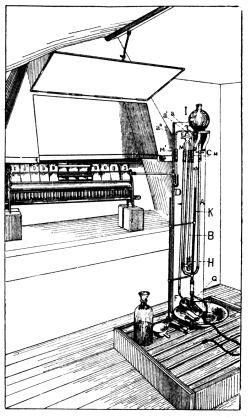
Figure. 10.
Mercury Pump and Azotometer.
A glass bulb I is attached, by means of a heavy rubber tube carrying a screw clamp, to the glass tube A, having heavy walls and a small internal diameter, and being one meter or more in length. The tube A is continued in the form of a U, the two arms being joined by very heavy rubber tubing securely wired. The ends of the glass tubes in the rubber should be bent so that they come near together and form the bend of the U, the rubber simply holding them in place. This is better then to have the tube continuous, avoiding danger of breaking. A tee tube, T, made of the same kind of glass as A, is connected by one arm, a, with the manometer B, by a heavy rubber union well wired. The union is made perfectly air-tight by the tube filled with mercury held by a rubber stopper. The middle arm of the tee, a′, is expanded into a bulb, E, branching into two arms, one of which is connected with A and the other with the delivery-tube F, by the mercury-rubber unions, MM′, just described. The interior of the bulb E should be of such a shape as to allow each drop of mercury to fall at once into F without accumulating in large quantity and being discharged in mass. The third arm of the tee a″ is bent upwards at the end and passes into a mercury sealing tube, D, where it is connected by means of a rubber tube with the delivery-tube from the furnace. The flow of the mercury is regulated by the clamp C, and care should be taken that the supply does not get so low in I as to permit air bubbles to enter A. The manometer B dips into the tube of mercury H. A pump thus constructed is simple, flexible, and perfectly tight. The only part which needs to be specially made is the tee and the one in use here was blown in our own laboratory. The bent end of the delivery-tube F may also be united to the main tube by a rubber joint thus aiding in inserting it into the V-shaped nozzle of the azotometer.
The azotometer used is the one devised by Schiff and modified by Johnson and Jenkins.[134]
We prefer to get the V nozzles separately and join them to any good burette by a rubber tube. The water-jacket is not necessary, but the apparatus can be left exposed until it reaches room temperature.
Any form of mercury pump capable of securing a vacuum may be used, but the one just described is commended by simplicity, economy, effectiveness, and long use.
158. The Pump and Combustion Furnace.—The pump and combustion furnace, as used in the laboratory, are shown in Fig. 10. The pump is constructed as just described, and rests in a wooden tray which catches and holds any mercury which may be spilled. The furnace is placed under a hood which carries off the products of the burning lamps and the hot air. A well-ventilated hood is an important accessory to this process, especially when it is carried on in summer. A small mercury pneumatic trough catches the overflow from the pump and also serves to immerse the end of the delivery-tube during the exhaustion of the combustion tube.
The other details of the arrangement and connections have been sufficiently shown in the previous paragraph.
159. Volumetric Method in this Laboratory.—It has been found convenient here to vary slightly the method of the official chemists in the following respects: The tube used for the combustion is made of hard refractory glass, which will keep its shape at a high red heat. It is drawn out and sealed at one end after being well cleaned and dried. It should be about eighty centimeters in length and from twelve to fourteen millimeters in internal diameter. The relative lengths of the spaces occupied by the several contents of the tube are approximately as follows: Sodium bicarbonate, two; asbestos, three; coarse copper oxid, eight; fine copper oxid, containing sample, sixteen; coarse copper oxid, twenty-five; spiral copper gauze, ten to fifteen; copper oxid, eight; and asbestos plug, five centimeters, respectively.
The copper oxid should be heated for a considerable time to redness in a muffle with free access of air before using and the copper gauze be reduced to pure metallic copper in a current of hydrogen at a low red heat. The anterior layer of copper oxid serves to oxidize any hydrogen that may have been occluded by the copper. When a sample is burned containing all or a considerable part of the nitrogen as nitrates, the longer piece of copper gauze is used.
160. The Combustion.—The tube having been charged and connected with the pump it is first freed from air by running the pump until the mercury no longer rises in the manometer. The end of the tube containing the sodium bicarbonate is then gently heated so that the evolution of carbon dioxid will be at such a rate as to slowly depress the mercury in the manometer, but never fast enough to exceed the capacity of the pump to remove it. The lamp is extinguished under the sodium carbonate and the carbon dioxid completely removed by means of the pump. The delivery-tube is then connected with the azotometer, and the combustion tube carefully heated from the front end backwards, the copper gauze and coarse copper oxid being raised to a red heat before the part containing the sample is reached. When the nitrogen begins to come off, its flow should be so regulated by means of the lamps under the tube, as to be regular and not too rapid. From half an hour to an hour should be employed in completing the combustion. Since most samples of fertilizer contain organic matter, the nitrogen will be mixed with aqueous vapor and carbon dioxid. The former is condensed before reaching the azotometer, and the latter is absorbed by the potassium hydroxid. When the sample is wholly of a mineral nature it should be mixed with some pure sugar, about half a gram, before being placed in the tube. When bubbles of gas no longer come over, the heat should be carried back until there is a gradual evolution of carbon dioxid under the conditions above noted. Finally the gas is turned off and the pump kept in operation until the manometer again shows a perfect vacuum when the operation may be considered finished. In the manipulation our chief variation from the official method consists in connecting the combustion apparatus with the measuring tube before the heat is applied to the front end of the combustion tube. Any particles of the sample which may have stuck to the sides of the tube on filling will thus be subject to combustion and the gases produced measured. Where it is certain that no such adhesion has taken place it is somewhat safer on account of the possible presence of occluded gases to heat the front end of the tube before connecting the combustion apparatus with the azotometer.
161. Method of Johnson and Jenkins.—In the method of Johnson and Jenkins the principal variation from the process described consists in introducing into the combustion tube a source of oxygen whereby any difficultly combustible carbon may be easily oxidized and all the nitrogen be more certainly set free.[135] The potassium chlorate used for this purpose is placed in the posterior part of the tube, which is bent at slight angle to receive it. The sodium bicarbonate is placed in the anterior end of the tube. The combustion goes on as already described, and at its close the potassium chlorate is heated to evolve the oxygen. The free oxygen is absorbed by the reduced copper oxid, or consumed by the unburned carbon. Any excess of oxygen is recognized at once by its action on the copper spiral. As soon as this shows signs of oxidation the evolution of the gas is stopped. Care must be taken not to allow the oxygen to come off so rapidly as to escape entire absorption by the contents of the combustion tube. In such a case the nitrogen in the measuring tube would be contaminated.
It is rarely necessary in fertilizer analysis to have need of more oxygen than is contained in the copper oxid powder in contact with the sample during the progress of combustion.
162. Calculation of Results.—The nitrogen originally present in a definite weight of any substance having been obtained in a gaseous form its volume is read directly in the burette in which it is collected. This instrument may be of many forms but the essential feature of its construction is that it should be accurately calibrated; and the divisions so graduated as to permit of the reading of the volume accurately to a tenth of a cubic centimeter. For this purpose it is best that the internal diameter of the measuring tube be rather small so that at least each ten cubic centimeters occupies a space ten centimeters long. The volume occupied by any gas varies directly with the temperature and inversely with the pressure to which it is subjected. The quantity of aqueous vapor which a moist gas may contain is also a factor to be considered. Inasmuch as the nitrogen in the above process of analysis is collected over a strong solution of potassium hydroxid capable of practically keeping the gas in a dry state the tension of the aqueous vapor may be neglected.
163. Reading the Barometer.—Nearly all the barometers in use in this country have the scale divided in inches and the thermometers thereunto attached are graduated in Fahrenheit degrees. This is especially true of the barometers of the Weather Bureau which are the most reliable and most easy of access to analysts. It is not necessary to correct the reading of the barometer for altitude, but it is important to take account of the temperature at the time of observation. There is not space here to give minute directions for using a barometer. Such directions have been prepared by the Weather Bureau and those desiring it can get copies of the circular.[136]
The temperature of a barometer affects its accuracy in two ways. First the metal scale expands and contracts with changing temperatures: Second, the mercury expands and contracts also at a much greater rate than the scale. If a barometer tube hold thirty cubic inches of mercury the contents will be one ounce lighter at 80° F. than at 32° F. The true pressure of the air is therefore not shown by the observed height of the mercurial column unless the temperature of the scale and of the mercurial column be considered.
Tables of correction for temperature are computed by simple formulas based on the known coefficients of expansion of mercury and brass. For barometers with brass scales the following formula is used for making the correction:
C = -h t - 28.63 .
1.113t + 10978
In this formula t = temperature in degrees Fahrenheit and h = observed reading of the barometer in inches.
Example:—Temperature observed 72°.5 Barometer reading observed, 29.415 inches,
from which C = 0.1165, and this number, according to the conditions of the formula, is to be subtracted from the observed reading. The true reading in the case given is, therefore,
29.298 inches or 744.2 millimeters.
The observed reading 747.1 “
And the correction 2.9 “
Unless extremely accurate work be required the correction for temperature is of very little importance in nitrogen determinations in fertilizers. Each instrument sent out by the Weather Bureau is accompanied by a special card of corrections therefor, but these are of small importance in fertilizer work. In order then to get the correct weight of the gas from its volume the reading of the thermometer and barometer at the time of measurement must be carefully noted. However, after the end of the combustion, the azotometer should be carried into another room which has not been affected by the combustion and allowed to stand until it has reached the room temperature.
Every true gas changes its volume under varying temperatures at the same rate and this rate is the coefficient of gaseous expansion. For one degree of temperature it amounts to 0.003665 of its volume. Representing the coefficient of expansion by K the volume of the gas as read by V, the volume desired at any temperature by V′, the temperature at which the volume is read by t and the desired temperature by t′, the change in volume may be calculated by the following formula:
V′ = V[1 + K(t′ - t)].
Example.—Let the volume of nitrogen obtained by combustion be thirty-five cubic centimeters, and the temperature of observation 22°. What would be the volume of the gas at 0°?
Making the proper substitutions in the formula the equation is reduced to the form below:
V′ = 35[1 + 0.003665(0°-22°)]
or V′ = 35(1 - 0.08063) = 32.18.
Thirty-five cubic centimeters of nitrogen therefore measured at 22° become 32.18 cubic centimeters when measured at 0°.
When gases are to be converted into weight after having been determined by volume, their volume at 0° must first be determined; but this volume must also be calculated to some definite barometric pressure. By common consent this pressure has been taken as that exerted by a column of mercury 760 millimeters in height. Since the volume of a gas is inversely proportional to the pressure to which it is subjected, the calculation is made according to that simple formula. Let the reading of the barometer, at the time of taking the volume of gas, be H, and any other pressure desired H′. Then we have the general formula:
V : V′ = H′ : H; and V′ = HV .
H′
Example: Let the corrected reading of the barometer at the time of noting the volume of the gas be 740 millimeters, and the volume of the gas reduced to 0° be 32.18 cubic centimeters. What will this volume be at a pressure of 760 millimeters?
Substituting the proper values in the formula, we have:
V′ = (32.18 × 740) = 31.33
760
Therefore, a volume of nitrogen which occupies a space of thirty-five cubic centimeters at a temperature of 22°, and at a barometric pressure of 740 millimeters, becomes 31.33 cubic centimeters at a temperature of 0° and a pressure of 760 millimeters.
One liter of nitrogen at 0° and 760 millimeters pressure weighs 1.25456 grams; and one cubic centimeter therefore 0.00125456 gram. To find the weight of gas obtained in the above supposed analysis, it will only be necessary to multiply this number by the volume of nitrogen expressed in cubic centimeters under the standard conditions; viz., 0.0125456 × 31.33 = 0.039305 gram. If the sample taken for analysis weighed half a gram, the percentage of nitrogen found would be 7.85.
164. Tension of the Aqueous Vapor.—It has been shown by experience that when a gas is collected over a potash solution containing fifty per cent of potassium hydroxid, the tension of the aqueous vapor is so far diminished as to be of no perceptible influence on the final result. To correct the volume of a gas, therefore, so collected for this tension, would involve an unnecessary calculation for practical purposes. If a gas thus collected should be transferred to a burette over mercury, on which some water floats, then the correction should be made.
At 0° the tension of aqueous vapor will support a column of mercury 4.525 millimeters high, and at 40° one of 54.969 millimeters.
The following table gives the tension of aqueous vapors in millimeters of a mercurial column for each degree of temperature from zero to forty.
Temperature. Tension of vapor in millimeters. Temperature. Tension of vapor in millimeters.
0° 4.525 21° 18.505
1° 4.867 22° 19.675
2° 5.231 23° 20.909
3° 5.619 24° 22.211
4° 6.032 25° 23.582
5° 6.471 26° 25.026
6° 6.939 27° 26.547
7° 7.436 28° 28.148
8° 7.964 29° 29.832
9° 8.525 30° 31.602
10° 9.126 31° 33.464
11° 9.751 32° 35.419
12° 10.421 33° 37.473
13° 11.130 34° 39.630
14° 11.882 35° 41.893
15° 12.677 36° 44.268
16° 13.519 37° 46.758
17° 14.409 38° 49.368
18° 15.351 39° 52.103
19° 16.345 40° 54.969
20° 17.396
When a gas is in contact with water the aqueous vapor is diffused throughout the mass, and the pressure to which the mixture is subjected, is partly neutralized by the tension of the water vapor. The real pressure to which the gas, whose volume is to be determined is subjected, is therefore diminished by that tension. If for instance a gas in contact with water show a volume of thirty-five cubic centimeters at 22° and 740 millimeters barometric pressure its volume is really greater than if it were perfectly dry. How much greater can be determined by inspecting the table, for at 22° the tension of water vapor is 19.675 millimeters of mercury. The real pressure to which the volume of gas is subjected is therefore 740 - 19.675 = 720.325 millimeters.
If, therefore, in the example given, the nitrogen were in contact with water, the calculation would proceed as follows:
V′ = 32.18 × 720.325 = 30.5
760
and 30.5 × 1.25456 = 38.26.
Hence, 38.26 milligrams of nitrogen correspond to 7.65 per cent, when half a gram of substance is taken for the combustion.
165. Aqueous Tension in Solutions of Potassium Hydroxid.—Even in strong solutions of potassium hydroxid the tension of aqueous vapor is not destroyed, but is reduced to a minimum, which is negligible in the calculation of the percentage by weight of the nitrogen in a sample of fertilizer. When dilute solutions of a caustic alkali are used however, the neglect of the tension of the aqueous vapor may cause an error of some magnitude. In such cases the strength of the solution should be known and correction made according to the following table:[137]
Millimeters tension of aqueous vapor for KOH solutions of
Temperature. 9.09 per cent. 16.66 per cent. 23.08 per cent. 28.57 per cent. 32.89 per cent.
10°.00 8.62 8.01 7.31 6.50 5.62
11°.00 9.21 8.56 7.82 6.95 6.01
12°.10 9.90 9.21 8.41 7.47 6.46
13°.00 10.50 9.77 8.92 7.93 6.86
13°.95 11.17 10.39 9.49 8.44 7.30
15°.15 12.06 11.22 10.25 9.11 7.86
16°.00 12.74 11.85 10.82 9.62 8.33
17°.00 13.57 12.63 11.54 10.26 8.88
18°.00 14.46 13.45 12.29 10.93 9.47
19°.00 15.39 14.33 13.09 11.65 10.09
20°.00 16.38 15.25 13.93 12.40 10.75
21°.00 17.42 16.22 14.82 13.20 11.44
21°.82 18.32 17.06 15.59 13.88 12.04
23°.00 19.68 18.32 16.75 14.92 12.94
24°.00 20.92 19.47 17.80 15.86 13.76
25°.00 22.19 20.67 18.91 16.85 14.62
26°.00 23.55 21.94 20.07 17.89 15.53
26°.98 24.95 23.25 21.27 18.96 16.46
27°.93 26.38 24.59 22.51 20.07 17.45
29°.00 28.08 26.18 23.96 21.38 18.59
30°.00 29.76 27.74 25.40 22.67 19.72
31°.00 31.51 29.38 26.91 24.03 20.91
32°.13 33.61 31.34 28.72 25.65 22.34
33°.00 35.30 32.93 30.18 26.97 23.50
34°.00 37.34 34.84 31.94 28.56 24.89
166. Use of Volumetric Method.—For practical purposes it may be said that the volumetric determination of nitrogen in fertilizer analysis has gone entirely out of use. For control and comparison it is still occasionally practiced but it has had to give way to the more speedy and fully as accurate processes of moist combustion with sulfuric acid which have come into general use in the last decade. The student and analyst however should not fail to master its details and become skilled in its use. There are certain nitrogenous substances such as the alkaloids which are quite refractory when subjected to moist combustion. While such bodies may not occur in fertilizers it is well to have at hand a means of accurately determining their nitrogen content.
167. Tables for Calculating Results.—Where many analyses are to be made by the copper oxid process it has proved convenient to shorten the work of calculating analyses by taking the data given in computation tables.[138] Before using these tables it must be known whether they are calculated on the supposition that the gas is measured in a moist state, partly moist, or wholly dry. Where the nitrogen is collected over water a table must be used in which allowance has been made for the tension of aqueous vapor. In case a saturated solution of a caustic alkali be used in the azotometer it is customary to take no account of the tension and the table employed must be constructed on this supposition. In point of fact even in the strongest alkali solution there is a certain amount of tension but this is so slight as only to affect the results in the second place of percentage decimals. Since, as a rule, only a few analyses are made by this method it will be found safer to use a caustic alkali solution of given strength and to calculate the results from the tables of aqueous tensions given above.
168. The Soda-Lime Process.—This process originally perfected by Varrentrap and Will, and improved by Peligot, was used almost exclusively by analysts until within the last decade for the determination of nitrogen not existing in the nitric form. It is based on the principle that when nitrogen exists as a salt of ammonia, or as an amid, or as proteid matter, it is converted into gaseous ammonia by combustion with an alkali. This ammonia can be carried into a set solution of acid by a stream of gas free of ammonia and the excess of acid remaining after the combustion is complete can be determined by titration against a standard alkali solution. The results under proper conditions are accurate even when a small quantity of nitric nitrogen is present. When, however, there is any considerable quantity of this compound in the sample the method becomes inapplicable by reason of non-reduction of some of the nitrogen oxids produced by the combustion.
In bodies very rich in nitrogen such as urea all the nitrogen is not transformed directly into ammonia at the commencement of the combustion. A portion of it may unite with a part of the carbon to form cyanogen, which may unite with the soda to form sodium cyanid. With an excess of alkali, however, and prolonged combustion this product will be finally decomposed and all the nitrogen be secured as ammonia.
The nascent hydrogen which unites with the nascent nitrogen during the combustion is also derived from the organic matter which always contains enough carbon to decompose the water formed in order to be oxidized to carbon dioxid. While at first, therefore, during combustion, the hydrogen may unite with the oxygen, it becomes again free by the oxidation of the carbon and in this condition unites with the nascent nitrogen to form ammonia. In addition to carbon dioxid, ammonia, and free hydrogen there may also be found among the products of combustion marsh and olefiant gases and other hydrocarbon compounds which dilute, to a greater or less extent, the ammonia formed and help to carry it out of the combustion tube and into the standard acid.
169. The Official Method.—Reagents and Apparatus.—(1) Standard solutions and indicator the same as for the kjeldahl method:
(2) Dry granulated soda-lime, fine enough to pass a 2.5 millimeter sieve:
(3) Soda-lime, fine enough to pass a 1.25 millimeter sieve.[139]
Soda-lime may be easily and cheaply prepared by slaking two and one-half parts of quicklime with a strong solution of one part of commercial caustic soda, care being taken that there is enough water in the solution to slake the lime. The mixture is then dried and heated in an iron pot to incipient fusion, and, when cold, ground and sifted as above.
Instead of soda-lime Johnson’s mixture of sodium and calcium carbonate, or slaked lime may be used. Slaked lime may be granulated by mixing it with a little water to form a thick mass, which is dried in the water-oven until hard and brittle. It is then ground and sifted as above. Slaked lime is much easier to work with than soda-lime, and gives excellent results, though it is probable that more of it should be used in proportion to the substance to be analyzed than is the case with soda-lime.
(4) Asbestos, which has been ignited and kept in a glass-stoppered bottle.
(5) Combustion tubes about forty centimeters long and twelve millimeters internal diameter, drawn out to a closed point at one end.
(6) Large-bulbed U tubes with glass stop-cock, or Will’s tubes with four bulbs.
Manipulation.—The substance to be analyzed should be powdered finely enough to pass through a sieve of one millimeter mesh; from seven-tenths to one and four-tenths grams, according to the amount of nitrogen present, are taken for the determination. Into the closed end of the combustion tube, put a small loose plug of asbestos, and upon it about four centimeters of fine soda-lime. In a porcelain dish or mortar, mix the substance to be analyzed, thoroughly but quickly, with enough fine soda-lime to fill about sixteen centimeters of the tube, or about forty times as much soda-lime as substance, and put the mixture into the combustion tube as quickly as possible by means of a wide-necked funnel, rinsing out the dish and funnel with a little more fine soda-lime, which is to be put in on top of the mixture. Fill the rest of the tube to within about five centimeters of the end with granulated soda-lime, making it as compact as possible by tapping the tube gently while held in a nearly upright position during the filling. The layer of granulated soda-lime should not be less than twelve centimeters long. Lastly, put in a plug of asbestos about two centimeters long, pressed rather tightly, and wipe out the end of the tube to free it from adhering soda-lime.
Connect the tube by means of a well-fitting rubber stopper or cork with the U tube or Will’s bulbs, containing ten cubic centimeters of standard acid, and adjust it in the combustion furnace so that the end of the tube projects about four centimeters from the furnace, supporting the U tube or Will’s bulb suitably. Heat the portion of the tube containing the granulated soda-lime to a moderate redness, and when this is attained extend the heat gradually through the portion containing the substance, so as to keep up a moderate and regular flow of gases through the bulbs, maintaining the heat of the first part until the whole tube is heated uniformly to the same degree. Continue the combustion until gases have ceased bubbling through the acid in the bulbs, and the mixture of substance and soda-lime has become white, or nearly so, which shows that the combustion is finished. The process should occupy about three-quarters of an hour, or not more than one hour. Remove the heat, and when the tube has cooled below redness break off the closed tip and aspirate air slowly through the apparatus for two or three minutes to bring all the ammonia into the acid. Disconnect the tube, wash the acid into a beaker or flask, and titrate with the standard alkali.
During the combustion the end of the tube projecting from the furnace must be kept heated sufficiently to prevent the condensation of moisture, yet not enough to char the stopper. The heat may be regulated by a shield of tin slipped over the projecting end of the combustion tube.
It is found very advantageous to attach a bunsen valve to the exit tube, allowing the evolved gases to pass out freely, but preventing a violent sucking back in case of a sudden condensation of steam in the bulbs.
170. The Official French Method.—The French chemists prefer to drive out the traces of ammonia remaining in the combustion tube by means of the gases arising from the decomposition of oxalic acid.[140] The operation is conducted by mixing about one gram of oxalic acid with enough of dry granular soda-lime to form a layer of four centimeters in length at the bottom of the tube. The rest of the tube is then charged substantially as directed above. At the end of the combustion the oxalic acid is decomposed by heat furnishing sufficient hydrogen to remove from the tube all traces of ammonia which it may contain. The French chemists employ, for titration, either normal acids and alkalies or some decimal thereof or else an acid of such strength as to have each cubic centimeter thereof correspond to ten milligrams of nitrogen, thus making the computation of results exceedingly simple. Such an acid is secured when one liter thereof contains thirty-five grams of pure monohydric sulfuric acid or forty-five grams of pure crystallized oxalic acid. The corresponding alkaline reagent should contain, in each liter, forty grams of pure potassium hydroxid.
171. The Hydrogen Method.—Thibault and Wagner recommend that the combustion with soda-lime be conducted in an atmosphere of hydrogen,[141] and Loges replaces this by common illuminating gas freed from ammonia by conducting it through a tube filled with glass balls moistened with dilute sulfuric acid.[142]
In these cases the combustion tube is left open at both ends and the materials under the tube confined to the proper position by asbestos plugs. The gases used act in a merely mechanical manner and their use affords so few advantages over the method of aspirating air at the end of the combustion as to render it unadvisable.
172. Coloration of the Product.—It often happens, especially in the combustion of animal products, such as tankage and fish scrap, that the acid securing the ammonia is deeply colored by the condensation of some of the other products of combustion. This coloration interferes in a very serious way with the delicacy of the indicator used to determine the end of the reaction. In this case the liquid may be mixed with an alkali and distilled and the ammonia secured in a fresh portion of the standard acid as in the moist combustion process to be hereafter described.
173. General Considerations.—(1) Preparation of Sample.—In the soda-lime method it is of great importance that the organic substances be in a fine state of subdivision so as to admit of intimate mixture with the alkali. In cases where fragments of hoof, horn, hair, or similar substances are to be prepared for combustion it is advisable to first decompose them by heating with a small quantity of sulfuric acid. The excess of acid may be neutralized with marble dust and the resulting mixture dried, rubbed to a fine powder, and mixed with the soda-lime in the usual way. Care must be taken not to lose any of the ammonia from the sulfate which may be formed in mixing with the soda-lime in filling the tube.
(2) Purity of Soda-Lime.—The soda-lime employed must be entirely free of nitrogenous compounds and some blank combustions should be made in proof of its purity.
(3) Temperature.—The temperature of the combustion should not be allowed to exceed low redness. At very high temperatures there would be danger of decomposing the ammonia.
(4) Aspiration of Air.—Before aspiring a current of air through the tube to remove the last traces of ammonia the gas should be put out under the furnace and the tube be allowed to cool below redness to avoid any danger of acting on the nitrogen in the air.
174. The Ruffle Soda-Lime Method.—Many attempts have been made to adapt the soda-lime method to the determination of nitric nitrogen. Of these the process devised by Ruffle is the only one which has proved successful.[143] The method is founded on the action of sulfurous vapors on the nitrogen oxids produced during the combustion whereby sulfuric acid is formed and the nascent nitrogen is joined with hydrogen to form ammonia. By this process all the nitrogen contained in the sample, even if in the nitric form, is finally obtained as ammonia. In the original method the reagents employed were a mixture of sodium thiosulfate and soda-lime and a mixture of charcoal, sulfur, and granulated soda-lime. Subsequently the official chemists substituted sugar for the charcoal.[144] The method was used for a long time by the official chemists and came into general favor until displaced by the simpler and cheaper processes of the moist combustion method adapted to nitric nitrogen. As finally modified and used by the official chemists the process was conducted as described below.
175. The Official Ruffle Method.—[145]Reagents.—(1) Standard solutions and indicator the same as for the kjeldahl method.
(2) A mixture of equal parts by weight of fine-slaked lime and finely powdered sodium thiosulfate dried at 100°:
(3) A mixture of equal parts of weight of finely powdered granulated sugar and flowers of sulfur:
(4) Granulated soda-lime, as described under the soda-lime method:
(5) Combustion tubes of hard Bohemian glass seventy centimeters long and one and three-tenths centimeters in diameter:
(6) Bulbed U tubes or Will’s bulbs, as described under the soda-lime method:
Manipulation.—(a) Clean the U tube and introduce ten cubic centimeters of standard acid.
(b) Fit the cork and glass connecting tube. Fill the tube as follows: (1) A loosely fitting plug of asbestos, previously ignited, and then two and five-tenths to three and five-tenths centimeters of the thiosulfate mixture: (2) The weighed portion of the substance to be analyzed is intimately mixed with from five to ten grams of the sugar and sulfur mixture: (3) Pour on a piece of glazed paper or in a porcelain mortar a sufficient quantity of thiosulfate mixture to fill about twenty-five centimeters of the tube; then add the substance to be analyzed, as previously prepared, mix carefully, and pour into the tube; shake down the contents of the tube; rinse off the paper or mortar with a small quantity of the thiosulfate mixture and pour into the tube; then fill up with soda-lime to within five centimeters of the end of the tube: (4) Place another plug of ignited asbestos at the end of the tube and close with a cork: (5) Hold the tube in a horizontal position and tap on the table until there is a gas-channel along the top of the tube: (6) Make connection with the U tube containing the acid; aspirate and see that the apparatus is tight.
The Combustion.—Place the prepared combustion tube in the furnace, letting the open end project a little, so as not to burn the cork. Commence by heating the soda-lime portion until it is brought to a full red heat. Then turn on slowly jet after jet toward the outer end of the tube, so that the bubbles come off two or three a second. When the whole tube is red hot and the evolution of the gas has ceased and the liquid in the U tube begins to recede toward the furnace, attach the aspirator to the other limb of the U tube, break off the end of the tube, and draw a current of air through for a few minutes. Detach the U tube and wash the contents into a beaker or porcelain dish; add a few drops of the cochineal solution, and titrate.
176. Observations.—In our experience we have found it much more satisfactory to adhere to the earlier directions for preparing the mixture of thiosulfate and alkali. We much prefer to make the mixture with soda-lime and without the previous drying of the sodium salt. Ruffle himself says that the sodium thiosulfate should be dry but not deprived of its water of crystallization.[146] The best method to dry the crystal powder without depriving it of its crystal water is to press it between blotting papers. The official method also contains a typographical error in prescribing that the combustion tube should have a length of thirty centimeters where evidently thirty inches were meant. Ruffle’s original tube was twenty-two inches in length.
As is seen from the above description the method is essentially a reduction process by the action of a powerful deoxidizer in the presence of an alkali. The crystals of the thiosulfate salt cannot be brought into direct contact with a pure alkali, like soda or potash, without forming at once a wet mass which would tend to cake and obstruct the tube. The soda-lime is therefore a mechanical device to prevent this fusion. Where many analyses are to be made an iron tube, for economical reasons, may be substituted for the glass; but the glass tube permits a more intelligent observation of the progress of the analysis.
Since charcoal has very high absorbent powers it will be found always to contain a little nitrogen which may be in a form to generate ammonia during the combustion. The charcoal used should therefore be previously boiled with caustic soda or potash solution, dried, powdered, and preserved in well-stoppered bottles. Although pure sugar is practically free of nitrogen, even when it is used, it is advisable to occasionally make a blank determination and thus ascertain the correction to be made for possible contamination.
177. Boyer’s Modification of Ruffle’s Method.—The principle of the method rests on the observation that if nitrates be heated in a combustion tube with calcium oxalate and soda-lime, not more than two-thirds of the total nitrogen appear as ammonia; but if a certain proportion of sulfur be added the whole of the nitrogen is recovered.[23] The process may be divided into two reactions; viz.:
(1) Action of the calcium oxalate upon the sodium nitrate in presence of soda-lime:
(2) The action of sulfurous acid and of calcium oxalate upon the sodium nitrate in presence of soda-lime.
The analysis is conducted as follows: Dry and pulverize one-half gram of nitrate (Na or K) and mix it intimately with fifty grams of the reducing compound containing approximately ten per cent sulfur, 22.5 per cent neutral calcium oxalate, and 67.5 per cent soda-lime. The combustion tube is charged as follows:
Length of tube fifty-five centimeters: Diameter of tube seventeen millimeters: Add first two grams pulverized calcium oxalate: Add next ten grams pulverized soda-lime: “ “ ten grams of the reducing compound: “ “ the nitrate incorporated with fifty grams of the reducing mixture: Add next ten grams of the reducing mixture: “ “ ten grams pulverized soda-lime: The tube is then lightly closed with an asbestos plug.
The tube is heated gradually from the front backwards, the calcium oxalate furnishing finally the gas necessary to drive out the last traces of ammonia. The process is equally applicable to the determination of nitrogen in all its forms or to mixtures thereof.
The method has also been applied to the mixture of ammoniacal and organic nitrogen and to the mixture of ammoniacal, nitric, and organic nitrogen, the combustions having been made both in an iron and a glass tube. The amounts of material to be used vary from one-half gram to a gram, according to its richness in nitrogen.
The combustion should be terminated in forty minutes.
When a combustion is terminated, the acid containing the ammonia is placed in a beaker and boiled for two or three minutes to drive off the sulfurous and carbonic acids. The titration is then conducted in the usual manner.
The combustion can be carried on just as well in an iron tube as in a glass one. The reagents employed, especially soda-lime, being hygroscopic, a little water is disengaged in heating, which is condensed at the cold extremity of the tube, and which may absorb a little ammonia, unless special precautions are taken to have the materials dry.
THE MOIST COMBUSTION PROCESS.
178. Historical.—As long ago as 1868 Wanklyn proposed to conduct the combustion of organic bodies in a wet way, using potassium permanganate as the oxidizing body.[147] About ten years after this he attempted to extend the method so as to estimate the quantity of proteid matter in a sample by treatment with an alkaline solution in presence of the permanganate salt. One gram of the finely pulverized sample was treated in a liter flask with one-tenth normal potash lye. After digestion for some time, from ten to twenty cubic centimeters were taken for the determination. According to the supposition of Wanklyn, pure albuminoid matters thus treated yielded one-tenth of their weight of ammonia, or about fifty per cent of the total nitrogen appeared as ammonia. The ammonia content of the sample was determined by the colorimetric process devised by Nessler. It is needless to add that the process of Wanklyn proved to be of no practical use whatever, acting differently on different albuminoid matters, and even on the same substance. No other attempt was made to perfect the moist combustion process until Kjeldahl[148] introduced the sulfuric acid method in 1883. The simplicity, economy, and adaptability of this method have brought it into general use. At first the process was only applied to organic nitrogenous compounds in the absence of nitrates, but especially by the modifications proposed by Asboth, Jodlbaur, and Scovell, it has been made applicable to all cases, with the possible exception of a few alkaloidal and allied bodies. The moist combustion process for determining nitrogen is now generally employed by chemists in all countries, not only for fertilizer control, but also for general work.
179. The Method of Kjeldahl.—The process originally proposed by Kjeldahl is applicable only to nitrogenous bodies free of nitric nitrogen. The principle of the process is based on the action of concentrated sulfuric acid at the boiling-point in decomposing nitrogenous compounds without producing volatile combinations and the subsequent completion of the oxidation by means of potassium permanganate. The original process has been modified by many analysts but the basic principle of it has remained unchanged. It will therefore prove useful here to describe the process as originally given.[149]
The weighed substance is placed in a small flask. With solid bodies this is a very simple operation, but with liquids more difficult. Liquids which are not decomposed, on heating, should be evaporated in a thin glass dish which can be ground up and placed in the digestion flask with the desiccated sample. The strongest sulfuric acid is added in sufficient quantity to secure complete decomposition, not less than ten cubic centimeters in any case. The acid must be free of ammonia and be kept in such a way as not to absorb ammonia from the atmosphere of the laboratory. To guard against danger of error from such an impurity frequent control determinations should be made. In control experiments one or two grams of pure sugar should be used as the organic matter. If the acid employed contain traces of ammonia the necessary corrections should be made in each analysis. The flask having been charged is placed on a wire gauze over a small flame. The organic matter becomes black and tar-like and soon there is a rapid decomposition attended with the evolution of gaseous products among which sulfur dioxid is found. To avoid danger from spurting, the digestion flask should be placed in an oblique position. The flask should have, at least, a capacity of 100 cubic centimeters and a long neck and be made of a kind of glass capable of withstanding the action of the boiling acid. Particles of the carbonized organic matter left on the sides of the flask by the foaming of the mass at first are gradually dissolved by the vapors of the boiling acid as the digestion proceeds. The action of the sulfuric acid is not entirely finished when gases cease to be given off but the digestion should be continued until the liquid in the flask is clear and colorless or nearly so. Usually about two hours are required to secure this result. When aided by the means mentioned below the time of digestion can be very materially shortened. By adding some fuming sulfuric acid, or glacial phosphoric acid, the dilution caused by the formation of water in the combustion of the organic matter, can be avoided. For albuminoid bodies it is hardly necessary to continue the combustion until all carbonaceous matter is destroyed. The full complement of ammonia is usually obtained after an hour’s combustion even if the liquid be still black or brown, but with other nitrogenous bodies the case is different so that upon the whole it is safest to secure complete decoloration.
The temperature must be maintained at the boiling-point of the acid or near thereto since at a lower temperature, for instance from 100° to 150°, the formation of ammonia is incomplete. Since all organic substances of whatever kind are dissolved by the boiling acid the previous pulverization of the material need be carried only far enough to secure a fair sample. Many substances give up practically all their nitrogen as ammonium sulfate when heated with sulfuric acid as, for instance, urea, asparagin, and the glutens. In most of the other organic bodies fully ninety per cent of the nitrogen are likewise secured as the ammonium salt. In the aromatic compounds, or even in the form of amid in anilin salts, the nitrogen is more resistant to the action of sulfuric acid. In the alkaloids where the nitrogen is probably a real component of the benzol skeleton the formation of ammonia is very incomplete. But even in the cases where the conversion of the nitrogen into ammonia is practically perfect it is advisable to finish the process by completing the oxidation with potassium permanganate. The permanganate should be used in a dry powdered form and added little by little to the hot contents of the digestion flask, the latter being held in an upright position and removed meanwhile from the lamp. When carefully performed there is no danger of loss of ammonia although the oxidation is, at times, so vigorous as to be attended with evolution of light. The permanganate must always be added in excess and until a permanent green color is produced. The flask is then gently heated for from five to ten minutes over a small flame, but this is not important. The heating must not be too strong or else a strong evolution of oxygen will take place with a consequent reduction of the manganese compound. When this happens the liquid again becomes clear and there is a loss of ammonia.
After cooling, the contents of the flask are diluted with water, the green color giving place to a brown with a rise of temperature. After cooling a second time the whole is brought into a distillation flask of about three-quarters of a liter capacity and attached to a condenser which ends in a vessel containing titrated sulfuric acid. About forty cubic centimeters of sodium hydroxid solution of one and three-tenths specific gravity are added and the stopper at once inserted to prevent any loss of ammonia. To prevent bumping during the distillation some zinc dust is added securing an evolution of hydrogen during the progress of the distillation. In this case the bumping is prevented until near the end of the operation when it begins anew, probably by reason of the separation of solid sodium sulfate. After the end of the distillation, the excess of acid remaining in the receiver is determined by a set alkali solution and thus the quantity of ammonia obtained easily calculated. Kjeldahl, however, preferred to titrate the solution after adding potassium iodate and iodid, a mixture which in the presence of a strong acid sets free a quantity of iodin equivalent to the free acid present. The iodin thus set free is titrated by a set solution of sodium thiosulfate using starch as an indicator. The merits of this method are sharpness of the end reaction and the possibility of using only a small quantity of the nitrogenous body for the combustion. The sulfuric acid used in the receiver is made of the same strength as the thiosulfate solution; viz., about one-twentieth normal. Thirty cubic centimeters of this were found to be the proper amount for use with substances taken in such quantities as to produce ammonia enough to neutralize about half of it. The titration is carried on as follows: A few crystals of potassium iodid are dissolved in the acid mixture obtained after the distillation is completed, then a few drops of the starch-paste and finally a few drops of a four per cent solution of potassium iodate. The iodin set free is then oxidized by the addition of the one-twentieth normal sodium thiosulfate solution until the blue color disappears.
Example: Sulfuric acid used, 30 cc.
Equivalent to sodium thiosulfate, 30 cc.
Blank combustion required, 29.8 cc. thiosulfate solution.
Combustion of 0.645 gram of barley required, 14.5 cc. “ “
Thiosulfate corresponding to barley, 15.3 cc.
In the computation it is more simple to multiply the corresponding number of cubic centimeters of thiosulfate by seven, half the atomic weight of nitrogen, and divide the product by the weight of the substance taken, which will give the per cent of nitrogen therein.
Then 15.3 × 7 × 100 = 1.66 = per cent of nitrogen in sample taken.
0.645
A more detailed description of the method of making the titration follows: After the distillation is finished the condensing-tube is rinsed with a little water, after which the sulfuric acid unneutralized in the receiver is determined. It is advisable first to test the reaction of the distillate with litmus paper before going any further; for if at any time all the acid should be found neutralized it will be necessary to add a sufficient quantity of one-twentieth normal sulfuric acid before adding the potassium iodid, etc., otherwise the determination will be irreparably lost. Add to the contents of the flask ten cubic centimeters of the potassium iodid and two cubic centimeters of the potassium iodate solutions, described further on, and the sodium thiosulfate is then run in from a burette till the fluid, which is constantly kept agitated by shaking the flask, shows only a bare trace of yellow coloration from the iodin still present. Starch solution is then added, and the blue color obtained is at once removed by additional thiosulfate solution. When some experience has been gained, the eye is able to discern, with great certainty, even the slight coloration caused by only a small trace of free iodin.
In regard to the sensitiveness of the end reaction and the accuracy of the result, this method of titration leaves nothing to be wished for. The strength of the thiosulfate solution is determined in exactly the same manner, and with starch as an indicator. For this purpose, measure ten cubic centimeters of one-twentieth normal sulfuric acid into an erlenmeyer, add 120 cubic centimeters of ammonia-free water, ten cubic centimeters of potassium iodid solution, and two cubic centimeters of iodate solution; add thiosulfate solution till the fluid shows only the above-mentioned light yellow tint, then add starch, and finally thiosulfate. In this way the strength of the thiosulfate is ascertained, which of course must be occasionally re-determined, under exactly the same conditions as with the nitrogen determinations themselves, and every possible error is thereby excluded. That the solution once decolorized within a short time again assumes a deep blue color, is a matter of no concern, inasmuch as both solutions are added in such a manner that the end reaction lies exactly at the point when the starch iodid reaction distinctly disappears.
180. Theory of the Reactions.—As has been seen above the final product of heating a nitrogenous organic compound with sulfuric acid and an oxidizing body is ammonium sulfate. The various steps by which this is obtained have been traced by Dafert:[150]
(1) The sulfuric acid abstracts from the organic matter the elements of water:
(2) The sulfur dioxid produced by the action of the residual carbon on sulfuric acid exercises a reducing effect on the nitrogenous bodies present:
(3) From the nitrogenous bodies produced by the above reduction ammonia is formed by the action of an oxidizing body:
(4) The ammonia formed is at once fixed by the acid as ammonium sulfate. According to the theory of Asboth the hydrogen which is formed during the action of sulfuric acid on organic matter, when in a nascent state, also aids greatly in the production of ammonia. This idea is based on the fact that with those bodies which afford a deficit of hydrogen the formation of ammonia is imperfect.[151]
181. Preparation of Reagents.—(1) Pure Sulfuric Acid.—As is well known the so-called pure sulfuric acid in the market usually contains ammonia, a fact which compelled Kjeldahl to determine the quantity of nitrogen in the acid in every instance, and to make correction for the same in the analysis. An acid absolutely free from this impurity may, however, easily be prepared by the distillation of the commercial article in a small glass retort holding easily about 400 cubic centimeters. To conduct this operation without danger it is only necessary to arrange the apparatus so that the heavy fluid is heated to boiling, not from the bottom of the retort, but from its sides, and that the upper portion of the body and neck is kept sufficiently warm so that the sulfuric acid fumes are not allowed to condense and flow back into the retort. Both these ends are attained simply by surrounding the retort with a piece of sheet iron, cylinder-shaped beneath, and with an oval upper part, having an opening of about one centimeter in diameter for the neck of the retort. To conduct the distillation a burner is used with an arrangement for spreading the flame. To avoid with certainty all bumping of the sulfuric acid and the resulting danger therefrom, the lamp is so arranged that only the products of combustion go up between the retort and its iron hood, without allowing the flame itself to come into contact with the glass vessel. The retort should be filled about half full, or with 200 cubic centimeters of acid. By this device, without any danger whatever, about one liter of sulfuric acid may be distilled in a day. The retort will stand numerous distillations. Once begun, the distillation takes care of itself; it is necessary to discontinue it when only the bottom of the retort is covered with sulfuric acid, and to fill fresh acid through a funnel when the retort has cooled off. The first twenty cubic centimeters of the distillate going over are collected by themselves and rejected. What comes over later is, as shown by experience, absolutely ammonia-free, and can be used without any correction, for the nitrogen determinations according to Kjeldahl. The acid is kept in a stoppered bottle in a place not reached by ammonia fumes. The ten cubic centimeter pipette used for measuring the quantity of sulfuric acid required for each determination, is fastened in the perforated rubber stopper with which the bottle is kept closed, and is itself closed above by a small rubber tube with a plug of glass wool in it.
(2) Potassium Permanganate.—Crystals of this salt are crushed (not pulverized) with a pestle into small pieces of about one-half millimeter size, which are kept in a long glass tube of about ten millimeters diameter, closed with a stopper.
(3) Ammonia-free Water.—Common distilled water cannot be used in the determination of nitrogen according to Kjeldahl, since it contains ammonia. It may be obtained free from the same by redistillation in a large glass retort with the addition of a few drops of sulfuric acid. All vessels used in the determination are rinsed out beforehand with this water.
(4) Ammonia-free Soda-lye is most conveniently prepared by adding 270 grams of common sodium hydroxid in sticks, little by little, to one liter of distilled water which is kept continually boiling, by means of a small flame, in a good-sized silver dish. The dish is kept covered with a glass plate. Care has to be exercised not to add the alkali too rapidly, nor in too large quantities at a time for in this case the fluid will boil too violently at every addition of the alkali. After the operation is finished the lye is at once siphoned into a glass flask, and when cold, is poured into a glass-stoppered bottle.
(5) One-twentieth Normal Sulfuric Acid is prepared from sulfuric acid and water both absolutely ammonia-free, and is kept in a place where no fumes of ammonia can reach it, in a well-stoppered glass bottle, the stopper being smeared with vaseline.
(6) Sodium Thiosulfate Solution.—This should be of the same strength as the one-twentieth normal sulfuric acid. It is prepared by dissolving the salt in ammonia-free water, and is compared with the acid, to which has been added potassium iodid and iodate, using starch as an indicator, in the manner described above. The solution is kept in a well-stoppered bottle, in the dark. When the salt and water used are perfectly pure, it will keep unchanged for a long time.
(7) Potassium Iodid.—Dissolve five grams of chemically pure potassium iodid in ammonia-free water and make the volume 100 cubic centimeters. Ten cubic centimeters of this solution are used for each determination; keep the solution in the dark and in a well-stoppered bottle.
(8) Potassium Iodate.—Dissolve four grams of chemically pure potassium iodate in ammonia-free water and make the volume 100 cubic centimeters. Use two cubic centimeters of this solution for each determination.
(9) Starch Solution.—Digest pure starch for about a week with dilute hydrochloric acid, wash perfectly free from chlorin by decantation, and finally dry it between filter-paper. The starch is then dissolved in water with the aid of heat. Such a solution will keep for an indefinite time, if it be saturated with common salt. Ten grams of this starch are dissolved in 1,000 cubic centimeters of ammonia-free water; use one or two cubic centimeters for each determination.
182. Kjeldahl Method as Practiced by the Holland Royal Experiment Station.—Necessary Reagents: 1. Phosphosulfuric acid, made by mixing a liter of sulfuric acid of specific gravity 1.84 with 200 grams of phosphoric anhydrid:
2. Alkaline sodium sulfid solution, made by dissolving 500 grams of sodium hydroxid and six grams of sodium sulfid or eight and one-half grams of potassium sulfid, in a liter of water:
3. Mercury:
4. Paraffin in small pieces:
5. Dilute sulfuric acid and dilute potash solution, both of known strength:
6. Pieces of previously ignited pumice stone or of granulated zinc:
7. Neutral solution of rosolic acid or litmus.
Apparatus: The apparatus necessary consists of oxidation flasks of about 200 cubic centimeters capacity and distillation flasks of about 500 cubic centimeters capacity, both of bohemian glass. Copper may be used for the distillation flasks.[152]
The Process: A gram of the sample to be analyzed is placed in an oxidation flask together with twenty cubic centimeters of phosphosulfuric acid and a drop of mercury, about 600 milligrams, and heated till the fluid becomes colorless. After cooling, dilute and wash the contents of the flask into a distillation flask. The resulting volume should be about 300 cubic centimeters. Add 100 cubic centimeters of the alkaline sodium sulfid solution and some pieces of ignited pumice stone or granulated zinc. Distill the ammonia, receiving the distillate in a flask containing a known volume of the standard sulfuric acid. Titrate with tenth-normal potash, using litmus or rosolic acid as indicator.
183. The Kjeldahl Method as Practiced at the Halle Station.—The method at present in vogue in the German stations of conducting the moist combustion process is well illustrated by the method of procedure followed at Halle.[29] From seven-tenths to one and five-tenths grams of the sample are taken for analysis according to its richness in nitrogen. Because of the fact that so small a quantity of the sample is taken it is of the highest importance that it be perfectly homogeneous throughout its entire mass. Otherwise, grave errors may arise. From the sample, as sent to the laboratory, the analyst should take a subsample and this should be rubbed to a fine powder and the part used for analysis carefully taken therefrom. If the sample be moist it may be rubbed up with an equal weight of gypsum, in which case a double quantity is taken for the determination. Substances like bone-meal, which do not keep well mixed, especially when occasionally shaken, should be intimately mixed before each weighing. The sample taken for analysis is placed in a glass flask of about 150 cubic centimeters capacity. The flasks should be made of a special glass to withstand the tension of the combustion. Those made by Kavalier at Sazava, in Bohemia, have proved to be the most lasting. A globule of mercury weighing a little less than one gram is placed in the flask and also twenty cubic centimeters of pure sulfuric acid of 1.845 specific gravity. The mercury is conveniently measured by an apparatus suggested by Wrampelmayer. It consists of an iron tube holding mercury, and is conveniently filled, from time to time, from a supply vessel placed in a higher position and joined by means of a heavy glass tube and rubber tube connections. The lower end of the iron tube is provided with a movable iron stopper having a pocket just large enough to hold a globule of mercury, weighing a little less than a gram. On turning the stopper the pocket is brought opposite a discharge orifice and the measured globule of mercury is discharged. With substances which tend to produce a strong foaming a little paraffin is used. The flasks after they are charged are placed on circular digesting ovens under a hood as shown in figure 11.
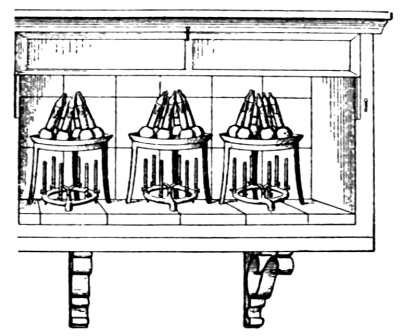
Figure. 11.
Moist Combustion Apparatus of the Halle Agricultural Laboratory.
At first the tripodal support of the flasks is so turned as to bring them between the lamps and in this way a too rapid reaction is at first avoided. After half an hour the tripods are so turned as to bring each flask directly over the lamp, the flame of which is allowed to impinge directly against the glass. The flame is so regulated that after the evolution of the sulfur dioxid has nearly ceased the contents of the flask are brought into gentle ebullition. The boiling is continued until the contents of the flask are colorless, usually about two hours. As a rule such substances as cottonseed-meal and dried blood will take a longer time for complete combustion than other fertilizing materials. During the combustion the flasks are closed with an oblong loose-fitting unground glass stopper. When the oxidation is finished the contents of the flasks are allowed to cool, the stoppers are removed, and enough water is added to fill the flasks about three-quarters full. The flasks are gently shaken, and the possibility of breaking, from the heat developed, must not be overlooked. To avoid confusion the flasks are all numbered before beginning the work, and the numbers noted by the analyst in connection with the samples. The contents of each one are next poured into the distillation flask and the digestion vessels are washed with 100 cubic centimeters of water in three portions, and the wash-water added to the liquid. Sometimes in washing out the digestion flask yellow basic mercury compounds separate on its walls, but this does not, in any way, influence the accuracy of the results. The distillation flasks should have about 600 cubic centimeters capacity. To avoid the transfer the digestion may take place in the distillation flask in which case the latter must be made of special glass as indicated.
To the liquid thus transferred are added seventy-five cubic centimeters of soda-lye containing one and one-half times as much potassium sulfid as is necessary to combine with the mercuric sulfate present. The lye is of such a strength that sixty cubic centimeters are sufficient to neutralize the acid present. It has a specific gravity of 1.375 and contains thirty-three grams of potassium sulfid in a liter.
In order to avoid the bumping which may take place during the distillation, some granulated zinc should be added.
The distillation flask is closed with a rubber stopper carrying a bulb-tube which ends above in a glass tube about three-quarters of a meter long, bent at an acute angle, and passing obliquely downward on a convenient support. This tube is connected by a rubber, with the end tube bent nearly at a right angle and dipping into the standardized acid in the erlenmeyer receiver. The general arrangement of the distilling apparatus is shown in figure 12. Since the contents of the vessel are warmed by mixing with the soda-lye, the flame can be turned on at full head at once at the commencement of the operation. In about a quarter of an hour the liquid in the receiver will be at the boiling-point, and the boiling should be continued for five minutes more, making twenty minutes in all for the completion of the distillation. By this boiling the contents of the receiver are not charged with carbon dioxid, as might happen if a condenser were used. The receiver contains twenty cubic centimeters of a standardized sulfuric acid solution and about fifty cubic centimeters of water.
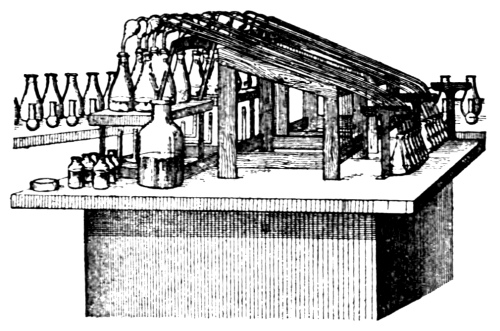
Figure. 12.
Distillation Apparatus of Halle Agricultural Laboratory.
The acid used should contain 38.1 grams of sulfuric acid of 1.845 specific gravity in a liter; and it should be set by titration with chemically pure sodium carbonate. For this purpose seven-tenths gram of sodium carbonate is heated in a platinum crucible for two hours over a small flame, weighed, and placed in an erlenmeyer together with twenty cubic centimeters of the sulfuric acid, care being taken to avoid loss from the vigorous evolution of carbon dioxid. After boiling for ten minutes all the carbon dioxid is removed from solution. After cooling, the excess of acid is determined by titration with a standardized barium hydroxid solution, using rosolic acid as indicator.
The solution of barium hydroxid is made as follows: Digest, with warm water, 260 grams of caustic baryta, Ba(OH)₂, until it is nearly all dissolved, filter, and make up to a volume of ten liters and keep in a flask free of carbon dioxid. A solution of barium hydroxid is to be preferred to the corresponding sodium compound for titration. If traces of carbonate be formed in the two liquids, the sodium salt will remain in solution while the barium compound will settle at the bottom of the flask.
The Indicator.—The indicator used to determine the end of the reaction is made by dissolving one gram of rosolic acid in fifty cubic centimeters of alcohol. From one to two drops are enough for each titration. The color reaction is less definite as the quantity of ammonia in the liquid increases. When the titration solutions have been prepared as above described it is found to require about ninety of the barium hydroxid to neutralize twenty cubic centimeters of the sulfuric acid.
By direct titration with sodium carbonate it is ascertained how many grams of nitrogen the twenty cubic centimeters of sulfuric acid represent.
Example.—Suppose the weight of the dried sodium carbonate prepared as above directed is 0.6989 gram.
½Na₂CO₃, ½N₂
Then 0.6989 : 53 = x : 14
Whence x = 0.184615 gram of nitrogen.
Suppose further that twenty cubic centimeters of sulfuric acid solution require ninety-four cubic centimeters of barium hydroxid for complete saturation and after treatment with the above amount of sodium carbonate, ten and a half cubic centimeters of the barium solution to neutralize the remaining acid.
Then 94 - 10.5 = 83.5
And 0.184615: 83.5 = x: 94.
Whence x = 0.207830 gram of nitrogen corresponding to twenty cubic centimeters of the sulfuric acid used.
Then 0.20783 ÷ 94 = 0.002211 gram of nitrogen corresponding to one cubic centimeter of the barium hydroxid solution.
If then in the analysis of a fertilizer it is found that 60.5 cubic centimeters are required to neutralize the excess of sulfuric acid after distillation the percentage of nitrogen in the sample is found as follows:
60.5 × 0.002211 = 0.13377.
0.20783 - 0.13377 = 0.07406.
0.07406 × 100 = 7.406 = per cent nitrogen in sample when one gram is taken for the combustion.
184. The Official Kjeldahl Method. Not Applicable in the Presence of Nitrates.[153]—Reagents.—(1) Acids.—(a) Standard hydrochloric acid the absolute strength of which has been determined by precipitating with silver nitrate, and weighing the silver chlorid as follows:
To any convenient quantity of the acid to be standardized, add solution of silver nitrate in slight excess, and two cubic centimeters of pure nitric acid, of specific gravity 1.2. Heat to boiling-point, and keep at this temperature for some minutes without allowing violent ebullition, constantly stirring until the precipitate assumes the granular form. Allow to cool somewhat, and then pass the fluid through the asbestos. Wash the precipitate by decantation, with 200 cubic centimeters of very hot water, to which have been added eight cubic centimeters of nitric acid and two cubic centimeters of dilute solution of silver nitrate containing one gram of the salt in 100 cubic centimeters of water. The washing by decantation is performed by adding the hot mixture in small quantities at a time, and beating up the precipitate well with a thin glass rod after each addition. The pump is kept in action all the time, but to keep out dust during the washing the cover is only removed from the crucible when the fluid is to be added.