Volume 2 / Part 1 — PART FIRST. PRELIMINARY TREATMENT AND PHOSPHATES. (continued 2)
Reading edition
55. The Molybdic Acid Method, as Practiced by Direction of the Union of the German Experiment Stations.—The method adopted by the German Experiment Stations is essentially that used at Halle.[41] The samples are brought into solution in the following way: For the estimation of phosphoric acid in bone-meal, fish-guano and raw phosphates, and the total phosphoric acid in superphosphates, five grams of the sample are dissolved in fifty cubic centimeters of aqua regia, made of three parts of hydrochloric acid of 1.12 specific gravity and one part of nitric acid of 1.25 specific gravity, or the solution may be made of a mixture of twenty cubic centimeters of nitric acid of 1.42 specific gravity and fifty cubic centimeters of sulfuric acid of 1.8 specific gravity. The boiling should continue for half an hour. The solution is made up to half a liter and filtered. Fifty cubic centimeters of the filtrate containing the phosphoric acid, with double superphosphates twenty-five cubic centimeters, are digested with 200 cubic centimeters of ammonium molybdate solution for three hours at 50° in a water-bath and, after cooling, filtered, so that as little as possible of the precipitate is collected upon the filter, which is made of strong paper.
The yellow precipitate is washed by decantation in the flask nine times with twenty cubic centimeters of molybdic solution diluted with one volume of water and the filter washed out once with the same quantity of liquid. The funnel, with the filter, is immediately placed upon the flask and the portion of the precipitate collected in the filter dissolved in five per cent ammonia, which is easily accomplished by throwing ammonia upon it from a wash-bottle. Afterwards the filter is washed with a sufficient quantity of hot water and finally removed. The contents of the flask are neutralized warm, with hydrochloric acid, the acid being added until the precipitate first formed, after continued shaking, is again dissolved in the liquid. The solution is then cooled and treated, drop by drop, with constant stirring, with twenty cubic centimeters of magnesia mixture. Finally twenty-five cubic centimeters of dilute ammonia solution are added, the precipitate is not shaken, and, after two hours, is filtered through a gooch.
For the filtering of the ammonium magnesium phosphate by the molybdic method, freshly prepared felts are always employed since the remarkably fine crystalline precipitates will pass through a filter which has once been used. It is necessary also that special precautions be taken in the ignition. The crucible should be heated in a platinum cap, which has the purpose of protecting the contents of the crucible from the access of reducing gases during the ignition. After redness has been reached the cap can be removed and the crucible transferred to a blast where it is strongly ignited for ten minutes before weighing. The precipitate should be pure white.
The molybdic solution is prepared as follows: 150 grams of ammonium molybdate are dissolved in a liter of water, and after the solution is completely cooled, poured into a liter of nitric acid of 1.2 specific gravity.
56. Estimation of Soluble Phosphoric Acid.—1. The extraction of the superphosphates is made as follows: Twenty grams of the superphosphates are placed in a liter flask with 800 cubic centimeters of water and shaken continuously for thirty minutes. The flask is then filled with water to the mark and the whole again thoroughly shaken and filtered. For shaking, a machine is recommended, driven by hand or water power. The normal rate of the machine is fixed at 150 turns per minute.
2. The solution of the total superphosphates, obtained as above, must be boiled with nitric acid before the precipitation of the phosphoric acid in order to convert any phosphoric acid present as pyrophosphoric into tribasic phosphoric acid. For each twenty-five cubic centimeters of the superphosphate solution ten cubic centimeters of concentrated nitric acid are added and the mixture boiled.
3. The precipitation of the phosphoric acid is conducted by the molybdenum method as usually practiced.
4. For the estimation of iron and alumina in each of the superphosphates the Glaser method is recommended provisionally.
57. Methods for Phosphoric Acid used in the Norway Stations.[42]—1. Description of the Method for Total Phosphoric Acid.—For determining the phosphoric acid in bone-meal, fish-guano, and superphosphates, five grams of the substance, with twenty cubic centimeters of nitric acid of 1.42 specific gravity, and fifty cubic centimeters of sulfuric acid of 1.8 specific gravity, are boiled half an hour in a half liter flask, diluted with water, and after cooling, made up to the mark. Fifty cubic centimeters of the filtrate are made alkaline with ammonia, then acid with nitric acid, precipitated with fifty cubic centimeters of molybdic solution for every one-tenth gram of phosphorus pentoxid present, heated over the water-bath for one hour, and allowed to stand twelve hours more, when the supernatant liquid is separated by decantation the precipitate washed thoroughly with dilute molybdate solution (1: 4) dissolved in warm dilute ammonia, and the filter washed with hot water. The ammoniacal solution is neutralized with hydrochloric acid, cooled, mixed, drop by drop, with constant stirring, with from ten to twenty cubic centimeters of magnesia mixture, and after a quarter of an hour one-third the volume of ten per cent ammonia is added. This is allowed to stand two hours, is filtered, washed with five per cent of ammonia until the disappearance of the chlorin reaction, dried, burned in an open crucible over a bunsen, and finally for a quarter of an hour, in a covered crucible heated over the blast.
2. Water-Soluble Phosphoric Acid.—To twenty grams of the substance in a liter flask, are added 800 cubic centimeters of water, and shaken every fifteen minutes for two hours; the volume made up to the mark and the phosphoric acid in fifty cubic centimeters of the filtrate, equaling one gram substance, is determined as under total.
3. Reverted Citrate-Soluble Phosphoric Acid.—Two and five-tenths grams substance are rubbed up with water, then washed upon the filter with about 100 cubic centimeters of water, the residue on the filter washed into a flask with a part of the measured citrate solution, and digested one hour at 35° to 40° with 200 cubic centimeters of Petermann’s citrate solution. The water and citrate extracts are made up to a quarter of a liter each, and the phosphoric acid determined in from twenty-five to fifty cubic centimeters, according to the quantity present.
Solutions. 1. Molybdate Solution.—375 grams of ammonium molybdate are dissolved in two and five-tenths liters of water, and the solution poured into two and five-tenths liters of nitric acid of 1.20 specific gravity.
2. Magnesia Mixture.—275 grams of crystallized magnesium chlorid and 350 grams of ammonium chlorid are dissolved in 3250 cubic centimeters of water and filled up to five liters with ammonia of 0.96 specific gravity.
3. Petermann’s Solution.—One kilogram of citric acid is dissolved in about two liters of water and 1350 cubic centimeters of ammonia of 0.925 specific gravity and filled up with water to 5750 cubic centimeters. The solution then has a specific gravity of 1.09; 300 cubic centimeters of ammonia of 0.925 specific gravity are now added.
58. Swedish Official Method for Determination of Phosphoric Acid.[43]—The Swedish chemists determine phosphoric acid in fertilizers both by the molybdate and the citrate methods. These methods carefully conducted according to the directions given below, give very concordant results. In doubtful cases the former method is taken as the deciding one, it having proved by long practice to give very satisfactory results.
Reagents for the Molybdate Method.—1. Molybdic Solution.—Prepared by dissolving 100 grams of finely powdered molybdic acid with heat, in 400 grams of eight per cent ammonia of 0.967 specific gravity and pouring the solution into 1,500 grams of nitric acid of one and two-tenths specific gravity; or else by dissolving 150 grams ammonium molybdate in one liter of hot water, and pouring the solution into one liter of nitric acid of 1.2 specific gravity. Prepared in this way, the molybdic solution will contain, in the former case five per cent, in the latter case from five to six per cent of molybdic acid, and 100 cubic centimeters of it are required for precipitating one-tenth gram of phosphorus pentoxid.
2. Magnesia Mixture.—Prepared from 110 grams of crystallized magnesium chlorid, 140 grams ammonium chlorid, 700 grams of eight per cent ammonia of 0.967 specific gravity and 1,300 grams of distilled water. The mixture is filtered after a few days, if necessary; ten cubic centimeters of the same are required for precipitating one-tenth gram of phosphorus pentoxid.
3. Ten per cent ammonia of 0.959 specific gravity.
(a) Water-Soluble Phosphoric Acid.—1. Preparation of the Aqueous Solution.—Of superphosphates and in general fertilizers containing water-soluble phosphoric acid, a sample of twenty grams is taken, and water poured over it in a mortar; lumps are crushed lightly, but completely with the pestle without pulverizing it finer; the whole mass is then washed into a graduated flask holding one liter, which at once is filled up to the mark. The volume taken up by the residue insoluble in water, is left out of consideration in the calculation. The sample is left standing in the flask (which is occasionally shaken) at the ordinary temperature of the room for two hours, and the solution is then filtered.
2. The Determination.—Take twenty-five cubic centimeters of the superphosphate solution thus prepared (when a twenty per cent sample is taken equal to one-tenth gram phosphorus pentoxid); add a quantity of molybdic solution sufficient for complete precipitation, leave standing for four hours in a beaker covered with a watch-glass; decant the solution through a small filter, wash the precipitate first by decantation, then on filter, with a mixture containing 100 parts molybdic solution, twenty parts nitric acid of 1.2 specific gravity, and eighty parts water, until a few drops put into alcohol, to which some dilute sulfuric acid has been added, does not, any longer, cause turbidity. The molybdic precipitate is now washed with but little water from the filter into a beaker, and particles adhering to the filter are dissolved by a hot mixture of one part ammonia and three parts water, which is allowed to flow into the beaker till the precipitate is, finally, completely dissolved in it. To the clear solution, add dilute hydrochloric acid while stirring, till the yellow precipitate formed by the acid is no longer immediately dissolved; then add from six to eight cubic centimeters of ammonia through the filter. The volume of the solution is not to exceed seventy-five cubic centimeters. It is now cooled completely and one cubic centimeter of magnesia mixture is added from a burette for every centigram of phosphorus pentoxid which it is expected to contain, and finally one-quarter of its volume of ammonia is added. The precipitate may be filtered after four hours. This is washed on the filter, preferably by means of suction, with a mixture of one part ammonia and three parts water till the filtrate is entirely free from chlorin. After drying, heat the precipitate, first gently, then stronger, and finally with a blast for a few minutes and then weigh it.
Treated with hydrochloric acid it must leave no insoluble residue (SiO₂), nor should hydrogen sulfid cause any precipitation in the solution thus formed (MoO₃).
(b) Total Phosphoric Acid.—1. In Superphosphates.—For the determination of total phosphoric acid, treat a weighed quantity of the superphosphate with nitric acid, if necessary to bring a difficultly soluble residue into solution, with addition of hydrochloric acid, or of potassium chlorate, to destroy organic matter present. Dilute the solution to a definite volume, and determine the phosphoric acid in a measured quantity of the same, as directed under (a) 2; if hydrochloric acid or potassium chlorate, be applied in the preparation of the solution, however, not till the measured quantity has been repeatedly evaporated to dryness with concentrated nitric acid.
2. In Bone-meal.—Destroy organic matter in five grams of the sample by ignition, dissolve the residue in nitric acid, filter from the insoluble residue, dilute the filtrate to half a liter, take an aliquot part containing about one-tenth gram phosphorus pentoxid and determine the phosphoric acid as directed under (a) 2.
3. In Fish-guano (and other fertilizing materials of organic origin).—The organic matter cannot here be removed by simple ignition, as in this way a loss of phosphorus may take place; It is therefore destroyed either in the wet way through nitric acid and potassium chlorate or in the dry way by fusion with a mixture of potassium nitrate and sodium carbonate, otherwise the procedure is as in (b) 1.
4. In Mineral Phosphates.—Determine the phosphoric acid in a solution obtained by nitric acid; organic matter is destroyed preferably in the wet way.
5. In Basic Slag.—Dissolve ten grams of powdered slag by treating it with 100 cubic centimeters of fuming hydrochloric acid with heat; wash the solution into a graduated half liter flask, fill to the mark, shake well, and filter. Determine the phosphoric acid in twenty-five cubic centimeters of the clear filtrate, according to (a) 2, after having first, however, evaporated the solution to dryness and then at least three times evaporated the residue to dryness with concentrated nitric acid.
59. Method Employed by the Royal Experiment Station of Holland.—A. Soluble Phosphoric Acid.[44]—The necessary reagents are:
(1) Molybdate solution, made by dissolving 150 grams of ammonium molybdate in a liter of water and pouring the solution into a liter of nitric acid of 1.20 specific gravity.
(2) A ten per cent solution of ammonium nitrate.
(3) Strong and dilute ammonia, the latter being between two and five-tenths and three per cent of 0.988 specific gravity.
(4) Magnesia mixture made by dissolving 110 grams of crystallized magnesium chlorid, 140 grams of ammonium chlorid, and 700 cubic centimeters of ammonia of 0.96 specific gravity in water and bringing the solution to two liters.
(5) Ammoniacal citrate solution, made by dissolving 500 grams of citric acid in a liter of water, and mixing with four liters of ten per cent ammonia of 0.96 specific gravity.
Manipulation.—Place twenty grams of substance in a mortar together with some cold distilled water or pure rain water, stir, and decant the water and suspended matters into a liter flask. After this has been repeated several times, rub up the residual mass and wash it all into the flask. Fill up to about 900 cubic centimeters and allow to stand two hours (twenty-four hours in the case of double phosphates with more than twenty-two per cent of soluble phosphoric acid), shaking repeatedly; or shaking continuously, for half an hour. Fill up to the liter mark and filter through a dry filter. Take portions of twenty-five or fifty cubic centimeters for each determination, add 100 cubic centimeters of molybdate solution for each 100 milligrams of phosphorus pentoxid present, warm to about 80° for an hour, filter, and wash the precipitate with the ammonium nitrate solution. Add a little molybdate solution to the filtrate, warm, and, if a fresh precipitate be observed, it is to be added to the first. The precipitate is to be dissolved in ammonia, and hydrochloric acid carefully added until the precipitate caused by it only slowly redissolves on stirring. The phosphoric acid is precipitated from the clear liquid which is still ammoniacal with magnesia mixture, using ten cubic centimeters for each 100 milligrams of phosphorus pentoxid present. This is added, drop by drop, and the liquid kept stirred during the addition. Allow it to stand at least two hours, filter, wash with dilute ammonia, dry, and ignite. This last is done at first with a very small flame but is finished with the blast-lamp or in a Rössler furnace. To insure burning to whiteness, nitric acid may be used, but not more than one or two drops.
B. Total Phosphoric Acid.—(1) For bone and flesh-meal, fish-guano, and similar fertilizers the reagents necessary are the same as before.
Carefully burn five grams to ash, boil the ash for half an hour with nitric acid of 1.32 specific gravity, dilute with water, and, after cooling, dilute to 500 cubic centimeters. Filter through a dry filter and take fifty cubic centimeters of the filtrate. Add 100 cubic centimeters of the molybdate solution for each 100 milligrams of phosphorus pentoxid present. Treat further as before described.
(2) Phosphates, guanos, bone-black, etc.
One gram of substance, after powdering, and, if necessary, igniting, is covered with four cubic centimeters of hydrochloric acid of 1.13 specific gravity and a little water and heated for an hour and a half. Evaporate to dryness without filtration, making repeated additions of nitric acid until no more vapors of hydrochloric acid are evolved. Boil the residue with nitric acid, cool, make up to 100 cubic centimeters with water, and shake. Filter and treat fifty cubic centimeters of the resulting solution by the molybdate method and proceed further as before described.
60. Sources of Error in the Molybdate Method.—When conducted with proper care, the gravimetric molybdate method is one of the most exact processes known to analytical chemistry.
There are, however, some sources of error in the process which should be avoided as carefully as possible or taken into account.
1. Error Due to Occluded Silica.—When silica passes into solution in the original sample, and this may be the case especially with mineral phosphates, it may appear both in the yellow precipitate and in the final magnesium pyrophosphate. In all such cases the residue, after ignition, should be dissolved in hydrochloric acid, and any insoluble residue weighed as silica and deducted from the first weight. If the silica be removed by evaporating the solution of the original material to dryness, and igniting to destroy organic matter, care must be taken to reconvert all phosphoric acid into the ortho form by long boiling with nitric acid before precipitation.
Another method of avoiding any trouble from silica consists in using sulfuric and a little nitric acid as the solvent for the original substance. Silica is not soluble in hot concentrated sulfuric acid. The volume of the sulfuric should be about ten times that of the nitric acid used, and the boiling be continued until sulfuric vapors are evolved.
2. Error Due to Arsenic.—Only in rare cases will arsenic be found in phosphatic fertilizing materials. In case of pyritic phosphates, the iron disulfid may carry arsenic. The solution in such a case is best accomplished in hydrochloric acid. If aqua regia be used, all nitric acid should be removed by repeated evaporation with hydrochloric. The arsenic can then be precipitated in the hot dilute hydrochloric acid solution by hydrogen sulfid.
3. Error Due to Occluded Magnesia.—The danger of contamination of the yellow precipitate with magnesium oxid has been pointed out by some authors. The re-solution of the precipitate followed by a second precipitation is the usual remedy proposed. Lorenz states that this source of error may be entirely avoided by the addition of two per cent of citric acid to the phosphomolybdate solution.[45]
4. Error Due to Volatility of Phosphoric Acid.—This source of error has been made the subject of a special study by Neubauer.[46]
From the results, a table has been constructed, the use of which is recommended for phosphoric acid determinations. The source of error in this method lies exclusively in the loss of phosphoric acid by volatilization. The magnesia-covered crucible lid offers a very good control of this error, and its use is recommended to the analyst. Of course, the presence of sulfur in the gas used for ignition is liable to disturb this check.
The following course of procedure in the determination of phosphoric acid can be recommended to avoid or correct this error:
Separate the phosphoric acid in the form of the yellow precipitate and wash this latter in the usual way. Too high a heat should not be employed, nor should the solutions be allowed to stand too long lest excess of molybdic acid separate. Dissolve the phosphomolybdate in 100 cubic centimeters of cold two and five-tenths per cent ammonia and add as many cubic centimeters of the usual magnesia mixture (fifty-five grams magnesium chlorid and seventy grams ammonium chlorid dissolved in a liter of two and five-tenths per cent ammonia) as there are centigrams of phosphorus pentoxid present. Addition should not be made faster than ten cubic centimeters per minute. Stir during the addition. After the precipitation, stir briskly once more and then allow to stand at least three hours. Wash with two and five-tenths per cent ammonia till the chlorin reaction disappears, dry the filter, and introduce into a well-cleaned crucible which has been thoroughly ignited. Place the lid at an angle, carbonize the filter, and gradually raise the heat, though not higher than a medium red heat, till the pyrophosphate becomes completely white. When this happens bring the blast into action and ignite to constant weight. The weight finally accepted must not change even after half an hour’s ignition. Upon this requirement especial stress must be laid. Pure magnesium pyrophosphate does not suffer any loss even after several hours’ ignition nor does a good platinum crucible. To the weighed amount of pyrophosphate, add the correction given in the table. For example, if the weight be 250 milligrams, the correction to be added is four and two-tenths milligrams, and the correct weight is then 254.2 milligrams. Multiplication of the sum by sixty-four gives the amount of phosphorus pentoxid in the weight taken for analysis.
Correction for Phosphoric Acid Determination.
Found, Mg₂P₂O₇ in grams. Lost, milligrams Mg₂P₂O₇ Found, Mg₂P₂O₇ in grams. Lost, milligrams Mg₂P₂O₇
0.10 0.6 0.24 4.0
0.12 0.8 0.25 4.2
0.14 1.2 0.26 4.6
0.15 1.4 0.27 5.0
0.16 1.6 0.28 5.5
0.17 2.4 0.29 6.1
0.18 2.6 0.30 6.8
0.19 3.2 0.31 7.6
0.20 3.5 0.32 8.6
0.21 3.6 0.33 9.6
0.22 3.8 0.34 10.6
When phosphoric acid is to be estimated as pyrophosphate it must always be first separated as molybdate, even when the original solution contains no bases capable of forming insoluble phosphates, as otherwise these corrections will not be applicable.
Using these corrections the estimation of phosphoric acid becomes one of the most accurate of known analytical methods.
61. The Color of the Magnesium Pyrophosphate.—After the final ignition of the magnesium pyrophosphate, whether secured by the citrate or the molybdic method, a black or grayish tint is often noticed. This may be due to traces of organic matter brought down by the precipitate and especially to a lack of care in the initial ignition. Many devices have been proposed for the purpose of avoiding this coloration, although general experiments have shown that there is no appreciable increase in the weight of the precipitate when colored in this way.
When the precipitation is carried on according to the citrate method, Neubauer[47] proposes to eliminate this coloration by the use of ammonium sulfate. About seven cubic centimeters of a saturated solution of ammonium sulfate should be added to the solution before the precipitation by the magnesium mixture. With this precaution it is possible to obtain a perfectly white precipitate after five minutes of ignition. The lively glowing of the precipitate throughout the whole mass at the time of changing into pyrophosphate, is much more easily observed by this treatment than when the mass is gray or black. Even should the addition of the ammonium sulfate solution to one containing a large amount of lime produce a precipitate of crystalline calcium sulfate, it is of no importance inasmuch as the ammonium citrate immediately dissolves large quantities of the calcium salt.
In this laboratory a white pyrophosphate is easily obtained by treating the precipitate on the gooch after washing free of chlorids with a drop or two of ammonium nitrate. The ignition is commenced very gently at first and afterwards when the mass is white the blast is used.
If the ignited residue be gray it may sometimes be whitened by moistening with a drop or two of nitric acid, burning at a very low temperature, followed by the blast. There is no appreciable difference in weight between a gray and white pyrophosphate.
62. Determination of Phosphoric Acid and Nitrogen in the Same Solution by Treatment with Sulfuric Acid and Mercury.—Fertilizing materials which contain organic nitrogen and phosphoric acid, such as bones, are of such a nature that it is often difficult to obtain a fair sample of them in quantities suited to the direct determination; viz., about one gram. Thus it often becomes important to take a much larger quantity of the material, to bring it into solution and to take an aliquot part thereof. It may also often happen that it is important to determine the phosphoric acid in the same sample which has been used for the determination of the nitrogen by moist combustion with sulfuric acid and mercury. In this connection, however, it is somewhat difficult to avoid the precipitation of some of the mercury with the phosphoric acid.
The mercuric sulfate which is produced by the Kjeldahl method is not precipitated in the presence of ammoniacal solution of ammonium citrate, but there may be small quantities of mercurous salts present or some finely divided metallic mercury which may contaminate mechanically the phosphate precipitate. These disturbing influences may be removed by previous treatment with sodium chlorid. If from fifty to sixty cubic centimeters of sulfuric acid have been used for the solution and oxidation and this be made up to half a liter, it will be sufficiently dilute to permit an almost quantitative separation of the mercurous chlorid produced by treatment with sodium chlorid.
Neubauer, who has proposed this method, finds that when sodium chlorid is used previous to the precipitation of the phosphoric acid, a precipitate of ordinary size contains, at most, only one milligram of mercury, while without the use of sodium chlorid as much as four milligrams may be found. The details of the method employed by Neubauer are as follows:
Ten grams of the fertilizing material are placed in a half liter flask with from fifty to sixty cubic centimeters of strong sulfuric acid, two grams of mercury, and a little paraffin to prevent foaming. The oxidation is carried on as usual in the Kjeldahl method. The liquid, after cooling, is diluted with water and one cubic centimeter of a citrate solution of sodium chlorid added, cooled, filled to the mark, filtered, and fifty cubic centimeters taken for the determination of the phosphoric acid, according to the citrate method and the same quantity for the determination of the ammonia by distillation.
THE CITRATE METHOD.
63. General Principles.—It has been seen that in the molybdic method there is introduced a process at considerable cost, both of reagents and time, having for its object the separation of the phosphoric acid from all the other acids and bases which may have been present in the original sample. The phosphorus is thus obtained in composition with molybdenum and ammonium in a form easily soluble in ammonia, from which it can be accurately separated by means of a soluble salt of magnesia.
The citrate method has for its object the suppression of this intermediate step and the determination of the phosphoric acid by direct precipitation in presence of iron, lime, and alumina. The principle on which it is based rests on the well-known power of an alkaline ammonium citrate to hold in solution the salts of iron, alumina, and lime, while at the same time it permits of the separation of phosphoric acid, as ammonium magnesium phosphate. In no case can the citrate method be regarded as an exact analytical process, but large experience has shown that the errors of the method are compensatory and that it affords a good and ready method for fertilizer control.
When phosphoric acid solutions which contain no iron, lime, alumina, or manganese, are precipitated in presence of ammonium citrate the results obtained vary markedly with the quantity of magnesia mixture employed. Grupe and Tollens[48] were the first to point out that a portion of the phosphoric acid might remain in solution, but that the precipitate might contain a sufficient excess of magnesia to compensate for the loss. It has been further shown by Glaser[49] that a portion of the phosphoric acid may be lost by volatilization in the citrate method. When the ignition is carried on in a crucible where the cover is coated with magnesia to intercept the volatilized acid, a considerable quantity of it can be recovered by the molybdic method.
Where too little magnesia mixture is employed, therefore, two sources of loss are to be guarded against; viz., a part of the phosphoric acid may remain in solution and another part be volatilized on ignition. The explanation of the volatilization is as follows: In the presence of ammonium citrate, magnesium chlorid may be partly converted into magnesium citrate and ammonium chlorid. There may be a time, therefore, in the precipitation with not too great excess of magnesia mixture, when proportionally there is little magnesium chlorid and much ammonium chlorid present. The formation of a salt represented by the formula Mg(NH₄)₄(PO₄)₂ may take place which, upon ignition, breaks up into Mg(PO₃)₂ and finally passes into Mg₂P₂O₇ with loss of P₂O₅. This theoretical condition has but little weight, however, practically in the analysis of fertilizers, since in these cases a large quantity of lime is always present. But even in these cases traces of volatile P₂O₅ may be discovered.
Wells[50] has shown that the citrate method gives good results in certain conditions but that this accuracy is reached by a fortunate compensation of errors. The ammonium magnesium salt does not precipitate all the phosphoric acid in this process, but contains enough impurities to make up for this loss.
Johnson[51] in conjunction with Osborne has shown that the results by the citrate method practiced in accordance with the details laid down by Vögel, are too low, but that this difficulty could be overcome by using more and stronger magnesia mixture and a larger quantity of strong ammonia solution. The citrate method was found to give unsatisfactory results when iron and alumina were present in any considerable quantity. In the examination of the final ignited precipitate, which should be pure magnesium pyrophosphate, it was found to consist of only 94.98 to 97.83 per cent of that salt. The chief impurity found was calcium oxid, the percentage of which varied from 2.05 to 3.95 in six cases. There was also a considerable percentage of loss due, probably, to magnesia and pyrophosphoric acid.
The presence of large quantities of iron and alumina also impairs the accuracy of the molybdate method when the precipitation of the yellow salt takes place at too high a temperature. When the temperature of precipitation in the method is above 50° the results are likely to be too high while a great excess of nitric acid in the reagent may produce a contrary effect. In the latter case the filtrate from the yellow salt should be mixed with additional quantities of molybdate solution until no further precipitate takes place.
Many methods of conducting the citrate method have been proposed but the best of them are based on the one elaborated at the experiment station of Halle by Bühring, and which will be given in the next paragraph, followed by some other methods in use in other localities.
64. Method of the Halle Agricultural Experiment Station.[52]—The citrate method, as described by Morgen, is the one employed.[53] The principle depends upon the direct precipitation of the phosphoric acid by magnesia mixture. By the addition of a solution of ammonium-citrate the precipitation of lime, iron, alumina, and other bases, is prevented. The precipitate of ammonium magnesium phosphate is converted by ignition into magnesium pyrophosphate and weighed as such. By the use of this method a part of the phosphoric acid sometimes escapes precipitation and a portion of the other bases is sometimes thrown down with the precipitate. Experience has shown that by adhering to certain precautions the weight of impurities in the precipitate may be made to correspond exactly to the weight of the phosphoric acid which escapes precipitation.
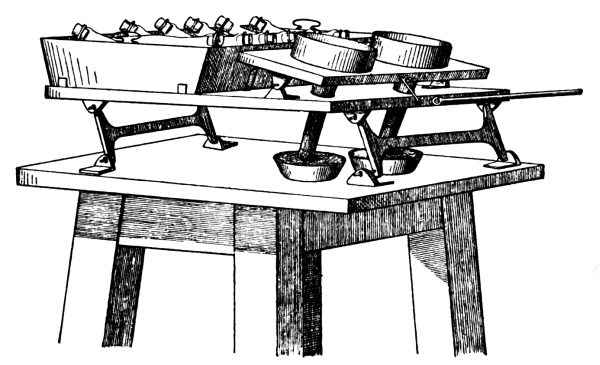
Figure. 3.
Shaking Apparatus for Superphosphates.
(1) Soluble Acid.—The soluble phosphates are first brought into solution in such a way that one liter of water contains the soluble phosphoric acid from twenty grams of the substance. Twenty grams are rubbed in a porcelain mortar with water and through a wide-necked funnel washed into a bottle-shaped flask in which a little water has been previously placed. The flasks employed are made of thick glass in order to withstand shaking. After the substance is washed, the flasks are filled to the mark and closed with rubber stoppers. They are then placed upon a shaking rack as indicated in Fig. 3, which is also furnished with an apparatus for separating the fine meal from basic slag.
On a table, as shown in the figure, is fastened a movable horizontal board by means of hinges. At the left hand of this movable board is placed an open wooden box in which is a perforated shelf for the purpose of holding the flasks, so as to prevent their striking together during the shaking.
For the best results the substance to be examined should be placed in the flask in a dry state and then 800 cubic centimeters of water added and shaken by means of the machine indicated for half an hour. Afterwards the flasks are filled up to the mark, well shaken, and filtered through double folded filters into ordinary flasks of about 400 cubic centimeters capacity. Before any of the filtrate is collected, the first that runs through should be well shaken in the receiving flasks and rejected. Fifty cubic centimeters of the filtrate thus collected, corresponding to one gram of the substance, should be used for the determination.
(2) Total Acid.—For total phosphoric acid, including the insoluble portions, the material is treated as follows: Five grams of the substance are placed in a 500 cubic centimeter flask with twenty cubic centimeters of nitric acid of 1.42 specific gravity, and fifty cubic centimeters of pure concentrated sulfuric acid, and boiled briskly for half an hour. With substances which contain much organic material, a little paraffin is added to avoid frothing. Such substances also require a larger quantity of nitric acid than that above specified. The flasks are allowed to cool, water added, again allowed to cool, and filled up to the mark at 17°.5. If hydrochloric instead of sulfuric acid be used in making the above solution, when the citrate method is employed, the results are always too high because the precipitate contains lime and alumina in such quantities as to render any compensation for them inaccurate. In addition to this the sulfuric has this great advantage over the hydrochloric acid; viz., in not separating silicic acid, inasmuch as the silicic acid is insoluble in boiling sulfuric acid.
(3) Citrate-Soluble Acid.—Two grams of the sample are digested with 100 cubic centimeters of citrate solution, 1.09 specific gravity, for half an hour at 50° in a beaker. Afterwards the soluble matter is separated by filtration with the aid of a filter-pump and the residue washed with a solution of one part water and one part citrate solution until all the dissolved phosphoric acid is removed from the filter. Generally three or four washings are sufficient. The residue on the filter is dried, ignited, and dissolved in a mixture of two cubic centimeters of nitric and twenty cubic centimeters of sulfuric acid, the solution made up to a volume of 200 cubic centimeters, filtered, and 100 cubic centimeters of the filtrate taken for the determination. The acid in the filtrate is nearly neutralized and fifty cubic centimeters of citrate solution are added, and afterwards twenty-five cubic centimeters of magnesia mixture and twenty cubic centimeters of twenty-four per cent ammonia. After standing for forty-eight hours, the precipitate is separated by filtration, ignited, and weighed in the usual way. The difference between the total phosphoric acid and that in the insoluble residue, after treatment with ammonium citrate, as above, gives the quantity of phosphoric acid soluble in the citrate solution. The difference between the total citrate-soluble and the water-soluble gives the quantity of the reverted phosphoric acid.
The ammonium citrate solution used for the digestion is made as follows: Two hundred and fifty grams of crystallized citric acid are dissolved in half a liter of hot water, diluted with 550 cubic centimeters of water, 276 cubic centimeters of twenty-four per cent ammonia added, and finally, exactly neutralized by adding, little by little, fifty per cent citric acid solution.
The Halle methods of separating the water and citrate-soluble acids appear to be less complete and reliable than those in use by the Official Agricultural Chemists of this country. The precipitation of basic phosphates, when large quantities of water are used at once in separating soluble acid, must tend to diminish the quantity obtained, while the lack of care in assuring the neutrality of the citrate solution might lead to varying results.
(4) Double Superphosphates.—In the case of double superphosphates, which sometimes contain large quantities of pyrophosphate, the solution is made in the usual way so that in 100 cubic centimeters there will be contained two grams of the substance. Usually ten grains are taken and the volume made up to half a liter. Twenty-five cubic centimeters of the filtrate are diluted with seventy-five cubic centimeters of water and the pyro converted to orthophosphoric acid by heating with ten cubic centimeters of strong nitric acid on a sand-bath. The heating should be continued until the volume be reduced to twenty-five cubic centimeters. The strongly acid liquid is made alkaline with ammonia, and afterwards slightly acid with nitric, and the rest of the process is carried on in the usual way.
(5) Phosphoric Acid in the Residue of Superphosphate Manufacture.—In the mixture of superphosphates and gypsum, the residue of the manufacture of double superphosphates, the phosphoric acid is estimated in the following manner: Five grams of the substance are placed in a dish, rubbed up with absolute alcohol, and washed into a 250 cubic centimeter flask. The flask is filled with absolute alcohol to the mark, closed with a stopper, and with frequent shaking, allowed to stand for two hours; it is thereupon filtered as quickly as possible; fifty cubic centimeters of the filtrate corresponding to one gram of the substance, are taken for the estimation. This fifty cubic centimeters is evaporated on a sand-bath to a sirupy consistence, diluted with water, and treated, as in the case of the soluble phosphates above mentioned. In all cases as described above, after the solutions are obtained they are treated with the ammonium citrate solution and the phosphoric acid estimated as in the first instance given.
(6) Solutions Employed.—
(a) The citrate solution is made as follows: 1,500 grams of citric acid are dissolved in water, treated with five liters of twenty-four per cent ammonia, and made up to fifteen liters.
(b) The magnesia mixture is made as follows: 500 grams of magnesium chlorid, 1,050 grams of ammonium chlorid, three and five-tenths liters of twenty-four per cent ammonia, and six and five-tenths liters of distilled water are used.
In the case of the superphosphates fifty cubic centimeters of the citrate solution are employed and with the basic slags 100 cubic centimeters; and in both cases twenty-five cubic centimeters of the magnesia mixture.
(7) Details of the Manipulation.—On the addition of the citrate solution there should be no permanent troubling of the liquid but there should be a total clearing up thereof. In order to facilitate this, after the addition of the citrate solution, the flasks should be gently shaken in order to distribute the solution throughout the mass. Solutions from bone-black superphosphates show sometimes, after the addition of the citrate solution, a more or less strong opalescence, but this opalescence does not influence the results. Should it happen that with superphosphates which are made from raw material containing large excesses of iron or clay, fifty cubic centimeters of the citrate solution are not sufficient to prevent the other bases from being precipitated, an additional quantity up to twenty-five cubic centimeters may be added. The addition of the magnesia mixture must follow as quickly as possible after the addition of the citrate solution to avoid a separation of crystalline calcium phosphate. On the addition of the citrate solution there is always a rise in temperature. Inasmuch as the precipitation of the phosphoric acid with magnesia must take place in the cold, the liquid must be cooled after the addition of the citrate,[54] and the cooling should take place as quickly as possible.
The above method was adopted by the chemical section of the International Agricultural Congress held at Vienna, September, 1890.[55]
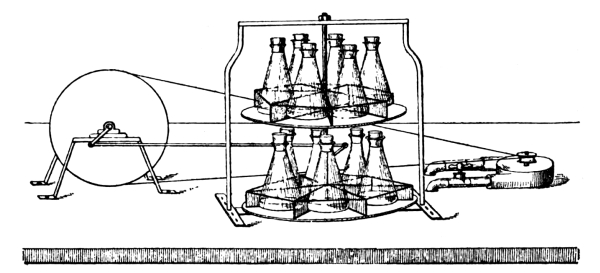
Figure. 4.
Shaking Machine for Ammonium Magnesium Phosphate.
In order to hasten the precipitation of the ammonium magnesium phosphate and to prevent the fixation of the precipitate on the walls of the erlenmeyer, the flask should be shaken for half an hour. For this purpose the flasks should be closed with smooth well-fitting rubber stoppers and placed in a shaking machine. The shaking machine of the form given in Fig. 4, recommended by the Halle station, is very conveniently used for this purpose.
On a vertical axis are carried two stages for holding the flasks. The flasks are prevented from striking each other by means of the partitions shown. The apparatus is conveniently driven by a small water-motor, as indicated, which imparts to the stages a partial back and forth revolution.
After shaking for half an hour, any precipitate adhering to the rubber stoppers is carefully washed off with ammonia water into the flask. The filtration can be made immediately after the shaking or after two or three days; the results are the same.
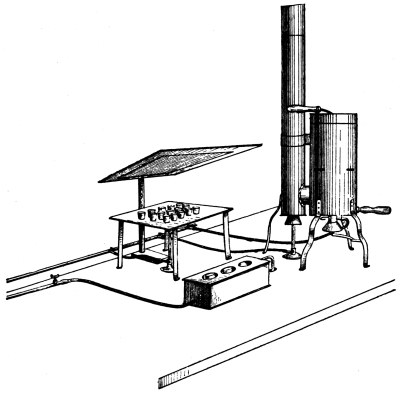
Figure. 5.
Rössler Ignition Furnace.
The filtration of the ammonium magnesium phosphate is made through perforated crucibles. The asbestos felt is prepared in the following way: The coarse fibers of asbestos are chopped up with a sharp knife on a glass plate and boiled for two hours with strong hydrochloric acid; afterwards, by repeated washing with distilled water they are freed from acid and the too fine particles of asbestos which would tend to make the filter too impervious. After the last wash-water is poured off, the asbestos is suspended in water and used for making the felt on the filter. The preparation of the crucible and the filtration under pressure are accomplished in the usual way.
The ignition of the precipitate is accomplished in a Rössler ignition oven, Fig. 5. When the muffle of the furnace shows a white heat or a white-red heat it is at the proper temperature for the estimation. At higher temperatures, the asbestos felt is easily injured. Generally, an ignition of five minutes is sufficient, but with double superphosphates, ten minutes are required.
65. The Swedish Citrate Method.[56]—This method of determining phosphoric acid is founded on the fact that phosphoric acid in the presence of calcium salts, without it being necessary, previously, to convert it into phosphomolybdate, is precipitated directly by magnesia mixture from a solution, to which ammonium citrate has been added, provided first, that the solution contain a sufficient quantity of sulfuric acid, and second, that only as much citrate be added as is required to keep the calcium salts in alkaline solution.[57]
Reagents. (1) Citric Acid Solution.—Prepared by dissolving 500 grams of citric acid in water, and completing to a volume of one liter.
(2) Ten Per Cent Ammonia of 0.959 specific gravity.
(3) Magnesia Mixture, of the usual composition.
The various processes are conducted as follows:
(a) Water-Soluble Phosphoric Acid.—Add twenty cubic centimeters of citric acid solution to fifty cubic centimeters of the water-soluble solution obtained according to the Swedish molybdenum method, and then add thirty-three cubic centimeters of ammonia. When the mixture has cooled, add slowly twenty-five cubic centimeters of the magnesia mixture, and then forty-two cubic centimeters of the ammonia. Keep the solution stirred by means of a closely clipped feather which is pressed tightly against the sides of the beaker; by this process the phosphate is precipitated after half an hour in pure condition and completely, without, in the least, sticking to the wall of the beaker; filter, wash, and ignite, as usually directed.
(b) Insoluble Phosphoric Add.—Moisten, in a porcelain dish, ten grams of the powdered sample with water; add fifty cubic centimeters of concentrated sulfuric acid, and heat for fifteen minutes so high that fumes of sulfuric acid will escape. When the mass has cooled, wash it into a half liter graduated flask, fill to the mark, and shake well. After filtration, the clear filtrate may, after some time, turn turbid by separation of calcium sulfate, but as the ammonium citrate, which is afterwards added, again brings the precipitate into solution, it is of no importance. Take fifty cubic centimeters of the solution, corresponding to one gram of the powdered sample, add twenty cubic centimeters of the citric acid solution, neutralize the mixture approximately, but not exactly, by ammonia; after cooling, add twenty-five cubic centimeters of magnesia mixture; stir the fluid by means of a feather, as described above, till no more precipitate is formed, and finally add thirty-three cubic centimeters of ammonia while stirring for a couple of minutes more; after half an hour the precipitate may be separated by filtration, washed, and ignited, as usually directed.
The above process is essentially the one used with basic slags. When much organic matter is present, by continuing the heating with sulfuric acid for some time, it may be destroyed.
66. Methods Adopted by the Brussels Congress, 1894.—The report of the committee on methods of analysis of phosphoric acid requires the molybdate method to be used in all cases where the quantity to be determined is very small. In other cases the citrate method may be employed.[58]
(1) Soluble Phosphoric Acid.—The soluble phosphoric acid is determined by the method adopted at Brussels in the following manner: Five grams of the sample are rubbed to a powder in a mortar, and then from fifty to sixty cubic centimeters of water added. After allowing to settle for a few minutes the liquid portion is decanted upon a filter. This operation is repeated three or four times. Finally the solid portions are washed upon the filter, and the washing with water is continued until the filtrate amounts to about three-quarters of a liter. A few drops of hydrochloric acid are added until the filtrate is perfectly clear, and the volume is then made up to one liter. Fifty cubic centimeters of the solution are then treated with thirty cubic centimeters of ammonium citrate solution and one-third as much ammonia. Afterwards thirty cubic centimeters of magnesia mixture are added, drop by drop, with constant stirring.
For superphosphates containing more than eighteen per cent of phosphoric acid only one gram is taken, for ordinary superphosphates two grams, and for compound fertilizers four grams. The sample is first treated as above for soluble acid until the filtrate amounts to 200 cubic centimeters, then clarified with a drop of nitric acid, and made up to a quarter of a liter.
(2) Reverted Phosphoric Acid.—The filter containing the residue is then introduced into a quarter liter flask and treated with 100 cubic centimeters of Petermann’s alkaline ammonium citrate solution, vigorously shaken, and left at room temperature for fifteen hours. It is then digested for an hour at 40° and filtered. Fifty cubic centimeters of the filtrate are placed in a flask and, with constant shaking, thirty-five cubic centimeters of magnesia mixture added. The aqueous solution is treated in the same way. The precipitate is collected, ignited and weighed, and multiplied by 0.64 for phosphoric acid. The total acid is determined in the usual way.
67. Dutch Method for Citrate-Soluble Phosphoric Acid.[59]—The reagents necessary are:
(1) Citrate solution, prepared according to Petermann. Dissolve 165 grams of citric acid in 700 cubic centimeters of water, mix with 250 cubic centimeters of ammonia of 0.92 specific gravity, and, after cooling, bring to the volume of one liter.
(2) Magnesia mixture prepared according to Petermann. Dissolve 400 grams of crystallized magnesium chlorid, 800 grams of ammonium chlorid, and 1,600 cubic centimeters of ammonia of 0.96 specific gravity in water, and dilute to five liters.
The quantity to be taken for the analysis is five grams where the fertilizer contains less than six per cent of phosphoric acid (mixed fertilizers); two grams where it contains more than six and less than fifteen per cent (common superphosphates); and one gram where it contains more than fifteen per cent (double superphosphates). Place the weighed substance in a mortar and cover with 100 cubic centimeters of citrate solution. Gently rub up, wash into a half liter flask, and heat in a water-bath for an hour to a temperature between 35° and 38°. Allow to cool, fill up to 500 cubic centimeters, and filter through a dry double filter. If it is not clear at the first filtration, pour through the filter again, repeating this till clearness is attained. Measure 100 cubic centimeters and add seventy-five cubic centimeters of magnesia mixture, allowing the latter to flow into the former very slowly, and constantly stirring during the influx. Allow to stand fifteen hours, filter, wash with ammonia of 0.96 specific gravity, dry, ignite, and weigh.
The per cent of phosphoric acid, except where otherwise indicated, is always to be given as per cent of anhydrous acid (P₂O₅).
68. Comparative Accuracy of the Citrate and Molybdate Methods.—The general use of the citrate method of determining phosphoric acid by the German chemists has led Johnson[60] to review some trials of that method in the Yale laboratory made as early as 1880. These determinations have lately been repeated in comparison with the ordinary molybdate methods with the result that in sixty-seven determinations on bone-dust, superphosphate, cotton-hull ashes, cottonseed-meal, tankage, bone-char, phosphatic guano, and phosphate rock, only three citrate results differed from those obtained by the molybdate method by more than three-tenths of one per cent. The greatest discrepancy between the two methods was 0.41 per cent, and the average difference was 0.09 per cent.
The citrate method was found to give poor results when iron and alumina were present in considerable quantity. Ignited precipitates by the citrate method were found to contain as high as four per cent of lime, and iron and alumina in small quantities when these bodies were abundant in the original substance.
In the molybdate method the rapid precipitation from solutions at 65° was found to give unsatisfactory results and it was found necessary to conduct the process at temperatures between 40° and 50°. With a relative excess of nitric or a relative deficiency of molybdic acid some phosphoric acid may easily escape precipitation. The chief objection to precipitating at 65° is found in the fact that in presence of considerable iron and alumina some of these bodies may be found in the yellow precipitate, whence they pass to the final ammonium magnesium phosphate.
The citrate method, therefore, only gives safe results by compensating errors which in every class of phosphates must be empirically determined.
The molybdate method gives results too high when iron and alumina are present in considerable quantity and the yellow precipitate is obtained at temperatures above 50°. On the other hand, if there, be a great relative excess of nitric acid the results may be too low unless the filtrates from the yellow precipitate be mixed with additional molybdic solution and digested until no further precipitate is formed.
Comparative determinations made, by both methods, by the Association of German Experiment Stations have led to the conclusion that both give practically the same results when each one is conducted with the proper precautions peculiar to it.[61] In the latter part of 1892, at the general meeting of the Association, it was declared that the citrate method, after having been subjected to repeated tests, was found to be satisfactory, changing the composition of the solution so that it might have 1,100 instead of 1,000 grams of citric acid and four liters of twenty-four per cent ammonia to each ten liters. The data afforded by the citrate method, when applied to an artificial mixture of known composition, were more satisfactory than those obtained by the molybdic process.
In this laboratory the citrate method has been found to give nearly agreeing results with the old process. It is much shorter and less expensive; and is recommended most favorably for practical use, suggesting, however, that with every new kind of phosphate or phosphatic fertilizer varying notably in composition from the standard, the work should be checked at first by comparison with the molybdenum method.
BASIC PHOSPHATIC SLAGS.
69. History and Manufacture.—The basic process for the manufacture of Bessemer steel is known in Europe as the Thomas or Thomas and Gilchrist process, and the slags rich in phosphate, one of the waste products of the process, are known by the same name. In this country all the phosphatic slags which have been made in the manufacture of steel have been obtained working under the patents of Reese, and, when prepared for the market, are known as odorless phosphate. The only place where these slags have been made in this country is Pottstown, Pennsylvania. In Europe they are extensively manufactured, in England, France, and Germany, and their use for agricultural purposes has increased until it is quite equal to that of superphosphates.
The quantity of basic slag manufactured in Germany in 1893 was 750,000 tons; in England 160,000; in France 115,000, making the total production of central Europe about 1,000,000, a quantity sufficient to fertilize nearly 5,000,000 acres.
70. Process of Manufacture.—The principle of the process depends upon the arrangement of the furnaces, by means of which the phosphoric acid in the pig iron is caused to combine with the lime which is used as a flux in the converters. A general outline of the process is as follows:
The pigs, which contain from two to four per cent of phosphorus, are melted and introduced into a Bessemer converter lined with dolomite powder cemented with coal-tar, into which has previously been placed a certain quantity of freshly-burned lime. For an average content of three per cent of phosphorus in the pig iron, from fifteen to twenty pounds of lime are used for each 100 pounds of pig iron. As soon as the melted pig iron has been introduced into the converter, the air-blast is started, the converter placed in an upright position, and the purification of the mass begins. The manganese in the iron is converted into oxid, the silicon into silica, the carbon into carbon dioxid and oxid, and the phosphorus into phosphoric acid.
By reason of the oxidation processes, the whole mass suffers a rise of temperature amounting in all to about 700° above the temperature of the melted iron. At this temperature the lime which has been added, melts, and, in this melted state, combines with the phosphoric acid, and the liquid mass floats upon the top of the metallic portion, which has, by this process, been converted into steel.
As soon as the process, which occupies only about fifteen minutes, is completed, the fused slag is poured off into molds, allowed to cool, broken up, and ground to a fine powder. For each five tons of steel which are made in this way, about one ton of basic slag is produced.
In another process, in order to make a slag richer in phosphoric acid, a lime is employed which contains a considerable percentage of phosphate. Although the slag thus produced is richer in phosphoric acid, it is doubtful whether it is any more available for plant growth than that made in the usual way with lime free from phosphoric acid. In other words, when a basic slag is made with a lime free from phosphoric acid, nearly the whole of the phosphoric acid is combined as tetrabasic calcium phosphate. On the other hand, when the lime employed contains some of the ordinary mineral phosphate the basic slag produced becomes a mixture of this mineral phosphate with the tetracalcium salt. The mineral phosphate is probably not rendered any more available than it was before.
It is easily seen from the above outline of the process of manufacture, that basic slags can have a very widely divergent composition. When made from pig iron poor in phosphorus, the slag will have a large excess of uncombined lime and consequently the content of phosphoric acid will be low. When made from pigs rich in phosphorus there may be a comparative deficiency of lime, and in this case the content of phosphoric acid would be unusually high.
It is found also that the content of iron in the slag varies widely. In general, the greater the content of iron the harder the slag and the more difficult to grind. If the pig iron contain sulfur, as is often the case, this sulfur is found also in the slag in combination with the lime, either as a sulfid or sulfate.
No certain formula can therefore be assigned to basic slags and the availability of each one must be judged by its chemical composition.
71. Composition of Basic Slag.—The slags produced by the method above outlined may be amorphous or crystalline. When large masses are slowly cooled the interior often discloses a crystalline composition. In some samples analyzed in this laboratory the crystals were found to be of two forms; viz., acicular and tabular.[62] They had the following composition:
Calculated Per Cents as
CaO. Fe₂O₃. Al₂O₃. MgO. V₂O₂ . P₂O₅. SiO₂.
Acicular crystals 42.69 20.98 3.71 0.49 0.18 27.06 4.96
Tabular crystals 53.61 9.64 0.91 0.08 —— 33.92 1.75
These data show that the two sets of crystals belong to two distinct mineral forms. The presence of vanadium in one of the samples is worthy of remark, and leads to the suggestion that in the slags made of phosphoriferous pigs may be found any of the rare metals which may exist in the ores from which the pigs were made. The amorphous portions may have a widely varying composition and consequent content of phosphoric acid. In all good slags, however, whether in crystalline form or as amorphous powder, the lime and phosphoric acid will be found combined as tetracalcium phosphate (Ca₄P₂O₉).
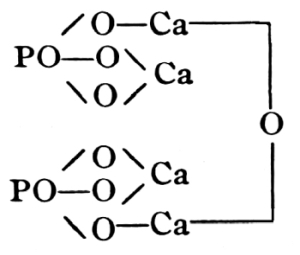
72. Molecular Structure of Tetracalcium Phosphate.—Several theories have been advanced in respect of the atomic arrangement of the elements contained in a molecule of tetracalcium phosphate. It must be confessed that so little is known concerning the reactions of this body as to make theories of its constitution largely visionary. But the existence in definite crystalline form of this salt shows that it is not merely an intimate mechanical mixture, but a true molecular form. As a type of the supposed arrangement of its particles the graphic formula proposed by Kormann may be consulted; viz.,
The crystals of this salt, as may be seen by inspection of the analytical data, contain other bodies than calcium, oxygen, and phosphorus. It would be of interest to push the investigation of their constitution further and see if crystals of pure tetracalcium phosphate could be obtained, and under what conditions they would be contaminated by other metallic oxids. Usually, by the color of the crystals, it will be easy to determine something of the nature, if not the extent of the contamination.
73. Solubility of Phosphatic Slags.—The high agricultural value of basic slags led to an early study of their solubility in ammonium citrate, citric acid, and other organic solutions. Even finely ground mineral phosphates and bones are soluble to some extent in ammonium citrate, as was pointed out as long ago as 1882.[63] The most common solvents used for basic slags are ammonium citrate and citric acid. The ammonium citrate should be the same as that used for the determination of reverted phosphoric acid and the citric acid solution commonly used contains five grams in a hundred cubic centimeters. The slags of different origin and even of different age vary greatly in respect of the quantity of soluble matter they contain. It is believed, however, that a very fair idea of the agricultural value of a slag may be obtained by determining its degree of solubility in one of the menstrua named.
74. Separation by Sifting.—The relative availability of a slag, as in the case of a mineral phosphate, is determined by the percentage of fine material it contains. Sieves of varying apertures are used to determine this percentage. A one-half millimeter or a one-quarter millimeter circular aperture is best, and the percentage of the total material passing through is determined. A method used in Germany consists in sifting the slag in a sieve twenty centimeters in diameter the meshes of which are from 0.14 to 0.17 millimeter square and which measure diagonally from 0.22 to 0.24 millimeter.
75. Solution of Phosphatic Slags.—Sulfuric acid has been found to be an excellent solvent for basic slags preparatory to the determination of phosphoric acid. There is, however, no unanimity of opinion concerning the best method or means of solution. Aqua regia and nitric acid are objected to because they may convert any phosphorus in combination with the iron into phosphoric acid and thus increase the quantity present.[64] But iron phosphid is seldom or ever found in slags and therefore this objection is not always tenable. Sulfuric acid has also been deemed objectionable because the gypsum separated is likely to carry with it some of the other substances to be determined.
Hydrochloric acid is also excluded by some from the list of solvents because it dissolves so many of the foreign elements in the slag and thus tends to complicate the subsequent determination, especially of magnesia. Further than this a hydrochloric acid solution is not suited to the use of the citrate method now so commonly employed. When hydrochloric acid is used, moreover, the dissolved silica must be removed and thus the time required for making a phosphoric acid determination is much increased.
If the sample be sufficiently fine the occlusion of undissolved phosphate particles by the gypsum formed when sulfuric acid is used is not to be feared and the disturbance of volume by the gypsum is pretty nearly constant and can be allowed for. When five grams of slag are used the mean volume of gypsum in the solution is about two cubic centimeters.
76. Estimation of Total Acid.—In the determination of total phosphoric acid in a slag, twenty-five cubic centimeters of the strongest sulfuric acid are placed in an erlenmeyer having a wide neck, and with careful shaking five grams of the fine slag meal gradually added. The flask is heated over a naked flame until solution is complete. When the mass is cold it is washed into a quarter liter flask; again allowed to cool, filled with water to the mark, and two cubic centimeters of water corresponding to the volume of gypsum undissolved, are added, well mixed, and filtered. In fifty cubic centimeters of the filtrate the phosphoric acid is determined by either the molybdic or citrate methods already described.
77. Alternate Method.—The following method may also be used: Ten grams of the substance are heated with fifty cubic centimeters of concentrated sulfuric acid until white vapors have been evolved for some time. The operation lasts for about fifteen minutes and can be carried on in a half liter flask or in a porcelain dish. Without regarding the undissolved material the volume of the liquid is now made up to half a liter and filtered. The filtered liquid becomes turbid after some time through the separation of calcium sulfate, but this turbidity should not be regarded. To fifty cubic centimeters of the solution, corresponding to one gram of substance, twenty cubic centimeters of citric acid solution (500 grams citric acid to the liter) are added, and it is afterwards nearly neutralized by the addition of ten per cent ammonia and the liquid, which is warmed by this operation, cooled. There are now added twenty-five cubic centimeters of the ordinary magnesium chlorid mixture and the solution stirred until turbidity is produced, one-third of its volume of ten per cent ammonia added, and again stirred for about a minute.
Instead of the addition of the citric acid and ammonia the ammonium citrate prepared as follows, may be added: 1,500 grams of citric acid are dissolved with water, made up to three liters and five liters of twenty-four per cent ammonia and seven liters of water added. The rest of the operation is carried on in the usual manner.
78. Halle Method for Basic Slag.—The total phosphoric acid is estimated at the Halle Station by the following process:[65]
Ten grams of the substance are moistened in a porcelain dish with a few drops of water and about five cubic centimeters of a one to one solution of sulfuric acid added, and after the mass has hardened, which takes place very soon, fifty cubic centimeters of concentrated sulfuric acid are added and stirred with a glass rod until it is evenly distributed throughout the whole mass. In stirring this mixture the greatest care must be taken, otherwise the substance would remain attached to the sides of the dish, which during later heating would cause loss through spurting. The complete solution now takes place after a few hours’ heating on a sand-bath. During the cooling the jelly-like mass must be stirred with a glass rod, and after it is cool, by means of a washing-bottle, gently along the sides of the dish, water is added, and when the mixture becomes hot it is again cooled and washed into a half liter flask, which is made up to the mark at a temperature of 17°.5 and filtered. When the acid filtrate stands for some time there is often a separation of gypsum which, however, does not in any way influence the subsequent analysis, which is made in the usual manner.
Fifty cubic centimeters of the filtrate, representing one gram of the original substance, are placed in an erlenmeyer. In the case of double superphosphates which often contain large quantities of pyrophosphates, twenty-five cubic centimeters of the filtrate just obtained, equivalent to five grams of the substance, are diluted with seventy-five cubic centimeters of water, ten cubic centimeters of nitric acid of 1.42 specific gravity added, and heated on a sand-bath to convert the pyro into orthophosphates. The heating should be continued until the liquid is reduced to its original volume of twenty-five cubic centimeters. The strongly acid liquid is saturated with ammonia and with the addition of a drop of rosolic acid as an indicator, again acidified with nitric acid, and treated as with superphosphates.
79. Dutch Method for Basic Slag.—Heat ten grams of the sample with fifty cubic centimeters of sulfuric acid (1.84 specific gravity) till white vapors are evolved, shaking or stirring constantly. After cooling make the fluid up to 500 cubic centimeters with water, taking no account of the undissolved substance. Filter, and to fifty cubic centimeters of the filtrate add 100 cubic centimeters of the ammoniacal citrate solution, and after cooling, twenty-five cubic centimeters of magnesia mixture. Stir or shake for a sufficient time. After the lapse of two hours the precipitate is to be separated by filtration and treated in the usual manner.
80. Estimation of Citrate-Soluble Phosphoric Acid in Basic Slag.—Experience has shown that the manurial value of basic slags does not depend alone on their content of phosphoric acid. Slags may contain tri- as well as tetracalcium phosphate, and even this latter salt may exist in states of differing availability. In determining the availability of basic slag for manurial purposes its solubility in ammonium citrate is considered the best standard. But this solubility will evidently be influenced by the basicity of the sample, or in other words, by the quantity of lime present. A slag rich in calcium oxid would deport itself differently with a given ammonium citrate solution from one in which the lime had been chiefly converted into carbonate. If possible, therefore, all samples should be reduced to the same state of basicity before the action of any given solvent is determined.
Wagner proposes to neutralize the basicity of a slag in the following manner:[66] Five grams of the slag are placed in a half liter flask which is then filled up to the mark with a one per cent solution of citric acid and shaken for half an hour. After filtering, fifty cubic centimeters are titrated with a standard soda solution using phenolphthalein as indicator. This gives the quantity of citric acid necessary to neutralize the slag. To a second portion of five grams of the sample in a half liter flask are added 200 cubic centimeters of water and enough five per cent citric acid solution to neutralize the lime and then 200 cubic centimeters of acid ammonium citrate made as indicated below. After filling to the mark with water it is shaken for half an hour and filtered. To fifty cubic centimeters of the filtrate are added 100 cubic centimeters of molybdic solution and heated to 80°. After cooling, the precipitate is filtered and the phosphoric acid estimated in the usual way.
The acid ammonium citrate solution used is made as follows: Dissolve 160 grams of citric acid with enough ammonia to represent about twenty-eight grams of nitrogen and make up with water to one liter. The exact method is given in 82.
The molybdic solution is made by dissolving 125 grams of molybdic acid in a slight excess of two and a half per cent of ammonia, adding 400 grams of ammonium nitrate, diluting to one liter and pouring the solution into one liter of nitric acid having a specific gravity of 1.19. After allowing to stand at room temperature for one day the mixture is filtered and is then ready for use.
81. Wagner’s Shaking Apparatus.—The latest directions given by Wagner for determining the phosphoric acid in slags and raw phosphates soluble in citrate solutions, are the following:[67] Five grams of the material as it is sent into commerce without grinding or sifting, are placed in a half liter flask and covered with nearly a quarter liter of water, and then 200 cubic centimeters of citrate solution added, prepared as described below. The flask is filled to the mark with water. The flasks, which are of the shape shown in the figure, are closed with rubber stoppers, and without delay placed for half an hour in a rotating apparatus, (Fig. 6) which is turned on its axis from thirty to forty times a minute. If a shaking apparatus be used instead of the one mentioned, 200 cubic centimeters of the citrate solution should be placed in a half liter flask, filled to the mark with water, and the contents poured into a liter flask containing the phosphate. This flask should be placed in a nearly horizontal position in the apparatus and the agitation be continued for half an hour. On removal from the apparatus the mixture is filtered and fifty cubic centimeters thereof treated with double the quantity of molybdic solution at 80° and the precipitate separated after cooling. The precipitate is carefully washed with one per cent nitric acid mixture, after which the filter is broken and the precipitate washed into a beaker with two per cent ammonia and the filter washed therewith until about 100 cubic centimeters have been used. If the solution is turbid from the presence of silicic acid it should be precipitated a second time by addition of molybdic solution until the acid reaction is restored. The ammoniacal solution of the yellow precipitate is treated, drop by drop, with constant stirring, with fifteen cubic centimeters of magnesia mixture, and set aside for two hours. The precipitate is collected, washed, ignited, and weighed in the usual manner. The direct precipitation of the phosphoric acid by the magnesia solution in presence of citrate is not advisable because of the almost general presence of silicic acid which would cause the results to be too high.
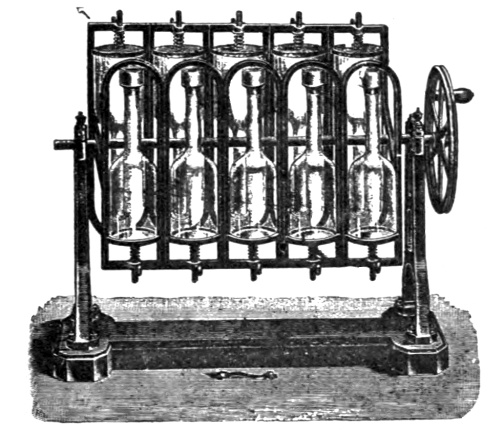
Figure. 6.
Wagner’s Digestion Apparatus for Slags.
The chief objection to this method of Wagner lies in the failure to control the temperature at which the digestion with citrate solution is made. Huston has shown, as will be described further on, that the temperature exercises a great influence in digestion with citrate. Since the laboratory temperature, especially in this country, may vary between 10° and 35°, it is evident that on the same sample the Wagner method would give very discordant results at different seasons of the year.
82. Solutions Employed in the Wagner Method.—1. Ammonium Citrate.—In one liter there should be exactly 150 grams of citric acid and 27.93 grams of ammonia, equivalent to twenty-three grams of nitrogen. The following example illustrates the preparation of ten liters of the solution: In two liters of water and three and a half liters of eight per cent ammonia, 1,500 grams of citric acid are dissolved and the cooled solution made up exactly to eight liters. Dilute twenty-five cubic centimeters of this solution to 250 cubic centimeters and treat twenty-five cubic centimeters of this with three grams of calcined magnesia and distill into forty cubic centimeters of half normal sulfuric acid. Suppose the ammonia nitrogen found correspond to twenty cubic centimeters of fourth normal soda-lye. Then in the eight liters are contained
(20.0 × 0.0035 × 8000)
————————— = 224 grams
2.5
of ammonia nitrogen. Then in order to secure in the ten liters the proper quantity of ammonia there must be added two liters of water containing 230 - 224 = six grams of nitrogen or seven and three-tenths grams ammonia; viz., ninety-four cubic centimeters of 0.967 specific gravity.
2. Molybdate Solution.—Dissolve 125 grams of molybdic acid in dilute two and five-tenths per cent ammonia, avoiding a large excess of the solvent. Add 400 grams of ammonium nitrate, dilute with water to one liter and pour the solution into one liter of nitric acid of 1.19 specific gravity. Allow the preparation to stand for twenty-four hours at 35° and filter.
3. Magnesia Mixture.—Dissolve 110 grams of pure crystallized magnesium chlorid and 140 grams of ammonium chlorid in 700 cubic centimeters of eight per cent ammonia and 130 cubic centimeters of water. Allow to stand several days and filter.
83. Estimation of Lime.—When the lime is to be determined in basic slags some difficulty may be experienced by reason of danger of contamination of the oxalate precipitate with iron and especially manganese, which is often present in slags.
Holleman[68] proposes to estimate the lime in basic slag by a modification of the methods of Classen and Jones. The manipulation is as follows: Fifty cubic centimeters of the solution of slag, equivalent to one gram of substance, are evaporated to a small volume, twenty cubic centimeters of neutral ammonium oxalate solution (one to three) added to the residue and heated on a water-bath with frequent stirring, until the precipitate is pure white and free from lumps. The time required is usually about ten minutes. The precipitate is collected on a filter and washed with hot water until the filtrate contains no oxalic acid. The precipitated calcium oxalate must be snow-white. The filter is broken and the calcium oxalate washed through, first with water and finally with warm, dilute hydrochloric acid (one to one). The calcium oxalate is dissolved by adding fifteen cubic centimeters of concentrated hydrochloric acid, the solution evaporated to a volume of about twenty-five cubic centimeters and ten cubic centimeters of dilute sulfuric acid (one to five), and 150 cubic centimeters of ninety-six per cent alcohol added. After standing three hours or more the precipitate is separated by filtration and washed with ninety-six per cent alcohol until the washings show no acid reaction with methyl orange. The calcium sulfate precipitated is dried to constant weight. This method gives a pure precipitate of calcium sulfate, containing only traces of manganese.
84. Estimation of Caustic Lime.—The lime mechanically present in basic slags is likely to be found as oxid or hydroxid, especially when the sample is of recent manufacture. In the form of oxid the lime may be determined by solution in sugar. In this process one gram of the fine slag meal is shaken for some time with a solution of sugar, as suggested by Stone and Scheuch.[69] The dissolved lime is separated as oxalate by treatment of the solution with the ammonium salt. The calcium oxalate may be determined by ignition in the usual way or volumetrically by solution in sulfuric acid and titration of the free oxalic acid with potassium permanganate solutions. The standard solution of permanganate should be of such a strength as to have one cubic centimeter equivalent to about 0.01 gram of iron. The iron value of the permanganate used multiplied by 0.5 will give the quantity of calcium oxid found.
85. Detection of Adulteration of Phosphatic Slags.—The high agricultural value of phosphatic slags has led to their adulteration and even to the substitution of other bodies. Several patents have also been granted for the manufacture of artificial slags of a value said to be an approximation to that of the by-products of the basic pig iron process.
(1) Method of Blum.—One of the earliest methods of examining basic slag for adulterations is the method of Blum.[70] This method rests upon the principle of the determination of the carbon dioxid in the sample. The basic phosphatic slag is supposed to contain no carbon dioxid. This is true only in case it is freshly prepared. The tetrabasic phosphate, after being kept for some time, gradually absorbs carbon dioxid from the air. As high as nineteen per cent of carbon dioxid have been found in slags which have been kept for a long while. When the slag has absorbed so much of carbon dioxid and water from the air as to be no longer profitable for market, it can be restored to its original condition by ignition.
(2) Method of Richter-Forster.—One of the common adulterants of tetrabasic phosphate is aluminum phosphate. The method of detecting this when mixed with the slag is described by Richter-Forster.[71] The method depends on the fact that soda-lye dissolves the aluminum phosphate, although it does not dissolve any calcium phosphoric acid from the slag. Two grams of the sample to be tested are treated with ten cubic centimeters of soda-lye of from 7° to 8° C. in a small vessel with frequent shaking for a few hours at room temperature. After filtration the filtrate is made acid with hydrochloric and afterwards slightly alkaline with ammonia. With pure basic slag there is a small trace of precipitate produced, but this is due to a little silica which can be dissolved in a slight excess of acetic acid. If, however, the basic slag contain aluminum phosphate, a dense jelly-like precipitate of aluminum phosphate is produced.
(3) Method of Jensch.—Edmund Jensch[72] determines the tetrabasic phosphate in slags by solution in organic acids, and prefers citric acid for this purpose. This method was also recommended by Blum[73].
It is well known that the tetrabasic phosphate in slags is completely soluble in citric acid while the tribasic phosphate is only slightly, if at all, attacked. The neutral ammonium salts of organic acids do not at first attack the tribasic phosphate at all, and they do not completely dissolve the tetrabasic phosphate. The solution used by Jensch is made as follows: Fifty grams of crystallized citric acid are dissolved in one liter of water. A weaker acid dissolves the tetrabasic phosphate too slowly and a stronger one attacks the tribasic phosphate present.
Schucht recommends the following method of procedure:[74] One gram of the slag, finely ground, is treated in a beaker glass with about 150 cubic centimeters of Jensen’s citric acid solution and warmed for twelve hours in an air-bath at from 50° to 70° with frequent shaking. Afterwards it is diluted with 100 cubic centimeters of water, boiled for one minute and filtered. The filter is washed thoroughly with hot water and the phosphoric acid is estimated in the filtrate in the usual way. With artificial mixtures of basic slags and other phosphates the quantity of basic slag can be determined by the above method.
(4) Method of Wrampelmeyer.—According to Wrampelmeyer the most convenient method for discovering the adulteration of basic slag is the use of the microscope.[75] All finely ground natural phosphates are light colored and with a strong magnification appear as rounded masses. In basic slags the particles are mostly black but there are often found red-colored fragments having sharp angles which refract their light in a peculiar way so that, with a very little experience, they can be recognized as being distinctive marks of pure basic slag.
In artificial mixtures of these two phosphates, which we have made in our laboratory, we have been able to detect with certainty as little as one per cent of added mineral phosphate.
One form of adulterating natural mineral phosphates has been mixing them with finely pulverized charcoal or soot to give them the black appearance characteristic of the basic slags. This form of adulteration is at once disclosed by simple ignition or by microscopic examination.
(5) Loss on Ignition.—If all doubts cannot be removed by the use of the microscope, the loss on ignition should be estimated. Natural phosphates all give a high loss on ignition, ranging from eight to twenty-four per cent, while a basic slag gives only a very slight loss on ignition, especially when fresh. A basic slag which has stood for a long while and absorbed carbon dioxid and moisture, may give a loss on ignition approximating, in a maximum case, the minimum loss on ignition from a natural phosphate.
In experiments made in this laboratory in testing for loss on ignition, we have uniformly found that natural mineral phosphates will lose from nearly one to two and one-half times as much on ignition as a basic slag which has been kept for two years. A basic slag in the laboratory more than two years old gave, as loss on ignition, 4.12 per cent. Several samples of finely ground Florida phosphates gave the following percentages of loss on ignition, as compared with a sample of slag.
Odorless phosphate 4.12.
Florida phosphates 8.06, 6.90, 9.58, 6.40, 10.38, and 10.67 respectively.
There are some mineral phosphates, however, which are ignited before being sent to the market. We have one such sample in our laboratory from Florida which gave, on ignition, a loss of only one and four-tenths per cent. In this case it is seen that the application of the process of ignition would not discriminate between a basic slag and a mineral phosphate.
It may often be of interest to know what part of the loss, on ignition, is due to water in form of moisture. In such cases the sample should first be dried to constant weight in a steam-bath and then ignited. In the following data are found the results obtained here with samples treated as above indicated and also ignited directly. Number one is a basic slag two years old and the others Florida phosphates.
Heated to 100° C. then ignited. Ignited directly.
Loss at 100° C. Loss on ignition. Total loss. Loss on ignition.
No. 1 (Slag) 2.57 1.77 4.34 4.12
No. 2 (Rock) 2.61 5.19 7.80 8.06
No. 3 “ 1.09 5.77 6.86 6.90
No. 4 “ 0.42 9.20 9.62 9.58
No. 5 “ 1.81 4.83 6.64 6.40
No. 6 “ 4.36 6.52 10.88 10.83
No. 7 “ 3.31 7.01 10.32 10.67
(6) Presence of Sulfids.—Another point noticed in this laboratory is that the basic slags uniformly contain sulfids which are decomposed upon the addition of an acid with an evolution of hydrogen sulfid.
(7) Presence of Fluorin.—In applying the test for fluorin, it has been uniformly found here that the mineral phosphates respond to the fluorin test while the basic slags, on the contrary, respond to the hydrogen sulfid test. This test, however, was applied only to the few samples we have had and may not be a uniform property.
The absence of fluorin might not prove the absence of adulteration, but its presence would, I believe, certainly prove the fact of the adulteration in that particular sample.
The fluorin test is applied by Böttcher in the following manner:[76] From ten to fifteen grams of the slag are placed in a beaker ten centimeters high and from five to six centimeters in diameter, with fifteen cubic centimeters of concentrated sulfuric acid, stirred with a glass rod, and covered with a watch-glass on the under side of which a drop of water hangs. If there be formed upon the drop of water a white murky rim, it is proof that a mineral phosphate containing fluorin has been added. After from five to ten minutes you can notice on the clean watch-glass the etching produced by the hydrofluoric acid. According to Böttcher an adulteration of ten per cent of raw phosphate in slag can be detected by this method.
(8) Solubility in Water.—Solubility in water is also a good indication, natural phosphates being totally insoluble in water, while a considerable quantity of the basic slag will be dissolved in water on account of the calcium oxid or hydroxid which it contains. If the loss on ignition is low, and the volume-weight and water-solubility high, the analyst may be certain that the sample is a pure slag.
In comparative tests made in our laboratory with a sample of basic slag and seven samples of Florida phosphate, the percentages of material dissolved by water and by a five per cent solution of citric acid were found to be as follows:
Water-soluble. Per cent. Sol. in five per cent citric acid. Per cent.
Odorless phosphate 0.97 16.10
Florida phosphate 0.01 4.15
“ “ 0.09 4.66
“ “ 0.02 3.43
“ “ 0.08 3.61
“ “ 0.02 3.79
“ “ 0.05 4.46
“ “ 0.02 4.24
From the above data it is seen that the solvent action of water especially would be of value inasmuch as it dissolves only a mere trace of the mineral phosphates, approximating one per cent of the amount dissolved from basic slag. In the case of the citric acid it is found that the amount of materials soluble in this solvent for basic slag is fully four times as great as for the mineral phosphates. Both of these processes, therefore, have considerable value for discriminating between the pure and adulterated article of basic slag.
(9) Specific Gravity.—The estimation of the volume specific gravity is also a good indication for judging of the purity of the slag. This is best done by weighing directly a given volume. Basic slag will have a volume-weight of about one and nine-tenths, while natural phosphates will have about one and six-tenths.
(10) Conclusions.—From the above résumé of the standard methods which are in use for determining the adulteration of basic slag, it is seen that there are many cases in which grave doubt might exist even after the careful application of all the methods mentioned. If we had only to consider the adulteration of basic slag with certain of the mineral phosphates, that is, tricalcium phosphate, the problem would be an easy one, but when we add to this the fact that iron and aluminum phosphates are employed in the adulteration, and that artificial slags may be so used, the question becomes more involved.
In doubtful cases one after another of the methods should be applied until there is no doubt whatever of the judgment which should be rendered.
VOLUMETRIC DETERMINATION OF PHOSPHORIC ACID.
86. Classification of Methods.—The time required for a gravimetric determination of phosphoric acid has led analysts to try the speedier if less accurate processes, depending on the use of volumetric methods. The chief difficulty with these methods has been in securing some sharp method of distinguishing the end reaction. In most cases it has been found necessary to remove a portion of the titrated solution and prepare it for final testing by subsidence or filtration. As is well known, this method of determining the end reaction is less accurate and more time-consuming than those processes depending on a change of color in the whole mass. All the volumetric processes now in general use may be divided into two classes; viz., (1) the direct precipitation of phosphoric acid and the determination of the end reaction by any appropriate means, and (2) the previous separation of the phosphoric acid, usually by means of a citro-magnesium or molybdenum mixture, and in the latter case the subsequent titration of the yellow ammonium phosphomolybdate either directly or after reduction to a lower form of oxidation. In respect of extent of application by far the most important volumetric method is the one depending on titration by a uranium salt after previous separation by ammoniacal magnesium citrate. A promising method after previous separation by molybdenum is the one proposed by Pemberton, but it has not yet come into general use. For small quantities of phosphoric acid or of phosphorus, such as are found in steels and irons, the method of Emmerton, either as originally proposed or as modified by Dudley and Noyes, is in frequent use. Where volumetric methods are applied to products separated by molybdic solution, the essential feature of the analytical work is to secure a yellow precipitate of constant composition. If this could be uniformly done such methods would rival the gravimetric processes in accuracy. Hence it is highly important in these methods that the yellow precipitate should be secured as far as possible, under constant conditions of strength of solution, duration of time, and manner of precipitation. In these cases, and in such only, can the quicker volumetric methods be depended on for accurate results.
The direct volumetric precipitation of the phosphoric acid by a uranium salt or otherwise is practiced only when the acid is combined with the alkalies and when iron and alumina are absent and only small quantities of lime present. This method has therefore but little practical value for agricultural purposes. In all volumetric analyses the accuracy of the burettes, pipettes, and other graduated vessels should be proved by careful calibration. Many of the disagreements in laboratories where the analytical work is conducted equally well can be due to no other cause than the inaccuracy of the graduated vessels which are found in commerce. Burettes should not only be calibrated for the whole volume but for at least every five cubic centimeters of the graduation.
URANIUM METHOD AS PRACTICED BY THE FRENCH CHEMISTS.
87. The Uranium Method.—Since the phosphoric acid of practical use for agricultural purposes is nearly always combined with lime, alumina, and iron, its volumetric estimation by means of a standard solution of a uranium salt is to be preceded by a preliminary separation by means of an ammoniacal magnesium citrate solution. The principle of the method was almost simultaneously published by Sutton,[77] Neubauer,[78] and Pincus.[79] The phosphoric acid may also be separated by means of molybdic solution or by tin or bismuth.[80] In practice, however, it has been found that when the uranium method is to be used the magnesium citrate separation is the most convenient. Since this is the method practiced almost universally in France, the method there used will be given in detail. It is based essentially on the process described by Joulie.[81]
88. Preparation of Sample.—(1) Incineration.—Since the organic matters present in a phosphatic fertilizer often interfere with the employment of uranium as a reagent, it is necessary to incinerate the sample taken for analysis.[82]
(2) Solution of the Material.—All phosphates, with the exception of certain aluminum phosphates, amblygonite for example, are easily dissolved in nitric and hydrochloric acids more or less dilute, especially on ebullition. The best solvent, however, for calcium phosphates for the uranium method is incontestably hydrochloric acid which also very easily dissolves the iron and aluminum phosphates, which are often found present with calcium phosphates.
(3) Nitric Acid.—In many laboratories nitric acid is preferred in order to avoid, in part, the solution of ferric oxid which interferes with the determination of phosphoric acid in certain processes. Since it does not act in this way for the citro-magnesium uranium method, it is preferable to employ hydrochloric acid, especially because it dissolves the iron completely and permits thus the operator to judge of the success of the solvent action by the completely white color of the residue.
(4) Pyritic Phosphates.—Certain phosphates contain pyrites which hydrochloric acid does not dissolve, and there is left consequently, a residue more or less colored. In this case it is necessary to add some nitric acid and to prolong the boiling until the pyrite has disappeared, since it might retain a small quantity of phosphoric acid in the state of iron phosphate.
(5) Sulfuric Acid.—Some chemists decompose the phosphates by means of dilute sulfuric acid. This method, which is certainly able to give good results for certain products and for certain processes, presents numerous inconveniences which tend to render its use objectionable for volumetric purposes. The calcium sulfate which is formed, requires prolonged washings which lead to chances of fatal error.
If an aluminum phosphate be under examination, containing only very little or no lime, sulfuric acid is to be preferred to hydrochloric and nitric acids, since it attacks amblygonite, which, as has been before stated, resists the action of the other two acids. But these are cases which are met with very rarely, and which can always be treated by the general method by previously fusing the material with a mixture of sodium and potassium carbonate.
In the great majority of cases the decomposition by hydrochloric acid is very easily accomplished by simply boiling in a glass vessel, and without effecting the separation of the silica. This operation is only necessary after the substance has been fused with alkaline carbonates, or, in case of substances which contain decomposable silicates giving gelatinous silica with hydrochloric acid.
There are two methods [see (6) and (7)] of securing a solution of the sample taken which varies from one to five, and even ten grams, according to the apparent homogeneity of the material to be analyzed.
(6) Solution by Filtration and Washing.—The ordinary method can be employed consisting in decomposing the substance by an acid, filtering, and washing the residue upon the filter, and combining all the wash-waters to make a determinate volume. Afterwards an aliquot fraction of the whole is taken for the precipitation. This method is long, and presents some chances of error, when the insoluble residue is voluminous and contains silica which obstructs the pores of the paper and renders the filtration difficult.
(7) Volumetric Solution.—It is advisable to substitute volumetric solution for solution by filtration and washing, which is accomplished by decomposing the substances in a graduated flask, the volume being afterwards made up to the mark with distilled water after cooling. The solution is then filtered without washing, and by means of a pipette an aliquot part of the original volume is taken for precipitation. Thus all retardations in the process are avoided, and likewise the chances of error from washing on the filter. It is true that this method may lead to a certain error due to the volume of the insoluble matter which is left undecomposed, but since this insoluble matter is usually small in quantity, and since it is always possible to diminish the error therefrom by increasing the volume of the solution, this cause of error is much less to be feared than those due to the difficulties which may occur in the other method. Let us suppose, in order to illustrate the above, that we are dealing with a phosphate containing fifty per cent of insoluble sand which may be considered as an extreme limit. In working on four grams of the material in a flask of 100 cubic centimeters capacity, there will be an insoluble residue of two grams occupying a volume of about one cubic centimeter, the density of the sand being generally nearly two. The one hundred cubic centimeter flask will then contain only ninety-nine cubic centimeters of the real solution, and the error at the most would be 0.01. This error could be reduced to one-half by dissolving only two grams of the material in place of four, or by making the volume up to 200 instead of 100 cubic centimeters.