Volume 2 / Part 2 — PART SECOND. NITROGEN IN FERTILIZERS. (continued 2)
Reading edition
Put the vessels containing the precipitate aside, return the washings once through the asbestos so as to obtain them quite clear, remove them from the receiver, and set aside to recover the excess of silver. Rinse the receiver and complete the washing of the precipitate with about 200 cubic centimeters of cold water. Half of this is used to wash by decantation and the remainder to transfer the precipitate to the crucible with the aid of a trimmed feather. Finish washing in the crucible, the lumps of silver chlorid being broken down with a glass rod. Remove the second filtrate from the receiver and pass about twenty cubic centimeters of ninety-eight per cent alcohol through the precipitate. Dry at from 140° to 150°. Exposure for half an hour is found more than sufficient, at this temperature, to dry the precipitate thoroughly.
(b) Standard sulfuric acid, the absolute strength of which has been determined by precipitation with barium chlorid and weighing the resulting barium sulfate:
For ordinary work half normal acid is recommended, i. e., containing 18.2285 grams of hydrochloric or 24.5185 grams sulfuric acid to the liter; for work in determining very small amounts of nitrogen, one-tenth normal acid is recommended. In titrating mineral acids against ammonia solutions, use cochineal as indicator.
(c) Sulfuric acid, specific gravity 1.84, free of nitrates and also of ammonium sulfate, which is sometimes added in the process of manufacture to destroy nitrogen oxids:
(2) Standard alkali, the strength of which, relative to the acid, has been accurately determined. One-tenth normal ammonia solution, i. e., containing 1.7051 grams of ammonia to the liter, is recommended for accurate work:
(3) Metallic mercury or mercuric oxid, prepared in the wet way: That prepared from mercuric nitrate can not be safely used.
(4) Potassium permanganate finely pulverized:
(5) Granulated zinc, pumice stone, or one-half gram of zinc dust is to be added to the contents of the flasks in distillation, when found necessary, in order to prevent bumping:
(6) Potassium sulfid.—A solution of forty grams of commercial potassium sulfid in one liter of water:
(7) Soda.—A saturated solution of sodium hydroxid free of nitrates:
(8) Indicator.—Solution of cochineal prepared as follows: Tincture of cochineal is prepared by digesting for a day or two, at ordinary temperatures, and frequently agitating, three grams of pulverized cochineal in a mixture of fifty cubic centimeters of strong alcohol with 200 cubic centimeters of distilled water. The solution is decanted or filtered through Swedish paper.
Apparatus.—(1) Kjeldahl digestion flasks of hard, moderately thick, well-annealed glass: These flasks are about twenty-two centimeters long, with a round, pear-shaped bottom, having a maximum diameter of six centimeters and tapering out gradually in a long neck, which is two centimeters in diameter at the narrowest part, and flared a little at the edge. The total capacity is from 225 to 250 cubic centimeters.
(2) Distillation flasks of ordinary shape, of 550 cubic centimeters capacity, or preferably flasks of well-annealed glass, of the same capacity, of pear-shaped bottom, for both digestion and distillation, fitted with a rubber stopper and a bulb-tube above to prevent the possibility of sodium hydroxid being carried over mechanically during distillation: The bulbs are about three centimeters in diameter, the tubes being of the same diameter as the condenser and cut off obliquely at the lower end. This is adjusted to the tube of the condenser by a rubber tube.
Manipulation.—(1) The Digestion.—From seven-tenths to three and five-tenths grams of the substance to be analyzed, according to its proportion of nitrogen, are brought into a digestion flask with approximately seven-tenths gram of mercuric oxid or its equivalent in metallic mercury and twenty cubic centimeters of sulfuric acid. The flask is placed in an inclined position, and heated below the boiling-point of the acid for from five to fifteen minutes or until frothing has ceased. If the mixture froth badly, a small piece of paraffin may be added to prevent it. The heat is then raised until the acid boils briskly. No further attention is required until the contents of the flask have become a clear liquid, which is colorless or at least has only a very pale straw color. The flask is then removed from the frame, held upright, and while still hot, potassium permanganate is dropped in carefully and in small quantities at a time until, after shaking, the liquid remains of a green or purple color.
(2) The distillation.—After cooling, the contents of the flask are transferred to the distilling flask with about 200 cubic centimeters of water, a few pieces of granulated zinc, pumice stone, or one-half gram of zinc dust when found necessary to keep the contents of the flask from bumping, and twenty-five cubic centimeters of potassium sulfid solution are added, shaking the flask to mix its contents. Next add fifty cubic centimeters of the soda solution, or sufficient to make the reaction strongly alkaline, pouring it down the sides of the flask so that it does not mix at once with the acid solution. Connect the flask with the condenser, mix the contents by shaking, and distil until all ammonia has passed over into the standard acid. The first 150 cubic centimeters of the distillate will generally contain all the ammonia. This operation usually requires from forty minutes to one hour and a half. The distillate is then titrated with standard alkali.
The use of mercuric oxid in this operation greatly shortens the time necessary for digestion, which is rarely over an hour and a half in case of substances most difficult to oxidize, and is more commonly less than an hour. In most cases the use of potassium permanganate is quite unnecessary, but it is believed that in exceptional cases it is required for complete oxidation, and in view of the uncertainty it is always used. The potassium sulfid removes all the mercury from the solution, and so prevents the formation of mercurammonium compounds which are not completely decomposed by soda solution. The addition of zinc gives rise to an evolution of hydrogen and prevents violent bumping. Previous to use, the reagents should be tested by a blank experiment with sugar, which will partially reduce any nitrates that are present, which might otherwise escape notice.
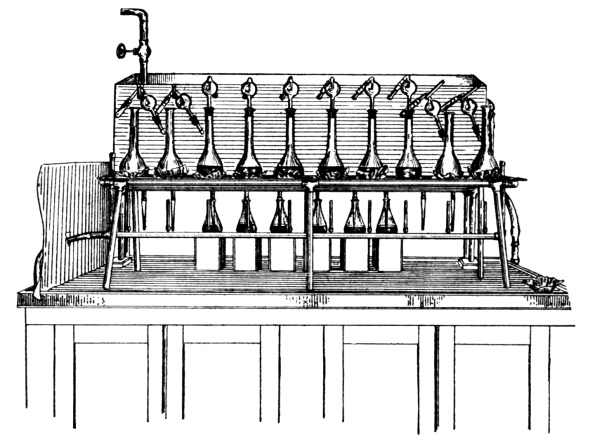
Figure. 13.
Distilling Apparatus.
185. The Distillation Apparatus in Use in the Laboratory of the Department of Agriculture.—In this laboratory the distilling apparatus is arranged as shown in Figure 13. The flasks are the same as are used in the digestion. They are connected to the block tin condensers by the bulb and rubber tubes, shown hanging on the projecting ends of the block tin condensers on the right and left of the figure. The condensers are contained in a trough through which cold water flows during the distillation. The bulb above the flask carries an emergent tube which extends to near the center of the bulb and is bent laterally to avoid any danger of carrying over any alkali that may be projected into the bulb during boiling. The boiling is continued usually for nearly an hour or until bumping begins. The table on which the apparatus is placed is so arranged as to permit of easy access on all sides. The standard acid is held in erlenmeyers placed on wooden blocks so that the end of the condenser which is a drawn-out glass tube, dips beneath the surface of the acid.
186. Patrick’s Distilling Flask.—To avoid the expense and annoyance attending the breaking of the distilling flasks Patrick has proposed to make them of copper.[154] The size, about half a liter, made for the evolution of oxygen for experimental purposes, may be used. A little excess of potassium sulfid is used to make up for any of it which might be consumed by the copper. About twenty-five cubic centimeters of this solution are recommended. No zinc or pumice stone is required to prevent bumping and the distillation may be finished within thirty minutes, thus securing a saving of time. There will doubtless be a slight corrosion of the flasks by the sulfid employed but where the gunning oxidation process is practiced this danger would be avoided.
187. Modifications of the Kjeldahl Process.—It would be impracticable here to give even a summary of the many unimportant changes which the moist combustion process has undergone since the first papers of its author were published. These changes may be divided into three classes; viz., 1. Those changes which refer solely to the quantities of substance taken for analysis, to the composition of the acid mixture, to the duration of the digestion, to the form and size of the flasks, both for digestion and distillation, and to the manner of distillation and of titration. For references to the papers on these subjects the reader may consult the periodic journals.[155] The most important of these minor changes are the following: Instead of the titration by means of separated iodin most chemists have had recourse to the simpler method of direct titration of the excess of acid by a set solution of an alkali. Barium, sodium, and potassium hydroxids are the alkaline solutions most employed. This process permits of a larger quantity of the sample being taken for combustion and of the use of a larger quantity of acid in the receiver. It also implies the use of a larger digestion flask. In fact it is now quite common to make the digestion in a special glass flask large enough to be used also for the distillation. This saves one transfer of the material with the possible danger of loss attending it.
In the distillation it is a common practice, especially in Germany, to do away with the condensing worm and to carry a long glass tube from the distilling flask directly into the acid on the receiver. The only inconvenience in this method is the heating of the contents of the receiving flask, but this is attended with no danger of loss of ammonia and the distillate, on account of the high temperature it acquires, is left free of carbon dioxid. Many of these minor changes have tended to simplify the process, but without affecting the principle of the method in the least.
2. In the second place a class of changes may be mentioned in which there is a marked difference in the method of effecting the oxidation secured by the introduction of a substance, usually a metal, during the digestion for the purpose of accelerating the oxidation. In the original process the only aid to oxidation was applied at the end of the digestion in the use of potassium permanganate. In the modifications now under consideration a metallic oxid or metal is applied at the beginning of the digestion. Copper and mercury are the metals usually employed. A separate paragraph will be given to the description of this modification known as the process of Wilfarth.
3. The third class of changes is even more radical in its nature, having for its object the adaptation of the moist combustion method to oxidized or mineral nitrogen. The chief feature of this class of changes consists in the introduction of a substance rich in hydrocarbons, and capable of easily forming nitro compounds, for the purpose of holding the oxids of nitrogen which are formed during the combustion and helping finally to reduce them to the form of ammonia. The chief varieties of this class of changes were proposed by Asboth, Jodlbaur, and Scovell, and will be fully set forth in separate paragraphs.
188. Method of Wilfarth.—The basis of this modification as already noted rests on the fact that certain metallic oxids have the power of carrying oxygen, and thus assisting in a katalytic way in the combustion of organic matter.[156] The copper and mercury oxids are best adapted for this purpose and experience has shown that mercuric oxid, or even metallic mercury gives the best results. The manipulation is carried out as follows: From one to three grams of the sample, according to its richness in nitrogen, are heated with a mixture of twenty cubic centimeters of acid containing two-fifths fuming and three-fifths ordinary sulfuric acid. To this is added about seven-tenths gram of mercuric oxid prepared in the wet way from a mercury salt free of nitrogen. The combustion takes place in the usual kjeldahl flask. If the boiling be continued until the liquid is entirely colorless, final oxidation with potassium permanganate is unnecessary. To save time the combustion may be stopped when a light amber color is reached, and then the oxidation finished with permanganate. Before distilling, a sufficient quantity of potassium sulfid is added to precipitate all the mercury as sulfid and thus prevent the formation of mercurammonium compounds which would produce a deficit of ammonia. A convenient strength of the sulfid solution is obtained by dissolving forty grams of potassium sulfid in one liter of water. Bumping at the end of the distillation is not usual, especially if potash-lye be used, but should it occur it may be stopped by the addition of zinc dust.
Only when a large excess of potassium sulfid is used is there an evolution of hydrogen sulfid, the presence of which, however, does not influence the accuracy of the results.
The presence of mercuric sulfid in the solution tends to prevent bumping during the distillation, but it is advisable, nevertheless, to use a little zinc dust. Other minor modifications consist of forming the acid mixture with equal volumes of concentrated and fuming sulfuric acid containing in one liter 100 grams of phosphoric acid anhydrid,[157] and using metallic mercury instead of mercuric oxid; or a mixture of half a gram of copper sulfate and one gram of metallic mercury,[158] or half a gram of copper oxid and a few drops of platinic chlorid solution containing 0.04 gram of platinum in a cubic centimeter.[159]
189. Modification of Asboth.—In order to adapt the moist combustion process to nitric nitrogen Asboth proposed the use of benzoic acid.[160] For half a gram of saltpeter 1.75 grams of benzoic acid should be used. At the end of the combustion the residual benzoic acid is oxidized by means of potassium permanganate with a subsequent reheating. If the nitrogen be present as an oxid or as cyanid, one gram of sugar is added. The metallic element added is half a gram of copper oxid. Asboth also recommends that the soda-lye used in the distillation be mixed with sodium potassium tartrate for the purpose of holding the copper and manganese oxids in solution and thus preventing bumping. The alkaline liquor contains in one liter 350 grams of the double tartrate and 300 grams of sodium hydroxid.
The principle on which the use of benzoic acid rests is found in the fact that it easily yields nitro-compounds and thus prevents the loss of the nitrogen oxids, these readily combining with the benzoic acid. The nitro-compounds can be subsequently converted into ammonia by treatment with potassium permanganate.
The pyridin and chinolin groups of bodies do not yield all their nitrogen as ammonia by the above treatment.
The conclusions drawn by Asboth from the analytical data obtained were:
(1) Sugar should be used in the ordinary kjeldahl process in those cases where the nitrogen in the organic substance is present as oxids or as cyanogen.
(2) In the case of nitrates good results may be secured with benzoic acid but permanganate must be added at the end.
(3) The kjeldahl-wilfarth process can be applied with substances difficultly decomposed, e. g., alkaloidal bodies.
190. Variation of Jodlbaur.—The benzoic acid method, although a step forward, is not entirely satisfactory in the treatment of nitrates by moist combustion. Jodlbaur has proposed to substitute for the benzoic, phenolsulfuric acid.[161]
From two to five-tenths gram of a nitrate are treated with twenty cubic centimeters of concentrated sulfuric and two and a half of phenolsulfuric acid, together with three grams of zinc dust and five drops of a solution of platinic chlorid of the strength mentioned above. The phenolsulfuric acid is prepared by dissolving fifty grams of phenol in 100 cubic centimeters of strong sulfuric acid. The combustion is continued until the solution is colorless, which may take as much as five hours. If phosphoric acid anhydrid be used as recommended above, the time of the combustion may be diminished by one-half, but in such a case the glass of the combustion flask is strongly attacked and is quite likely to break.
With substances very rich in nitrates it is advisable to rub them first with dry gypsum.
The theory of the process rests on the fact that by a careful admixture of a nitrogenous substance diluted with land plaster, with phenolsulfuric acid, it is possible to change the nitric acid into nitro-phenol, and by the reducing action of zinc dust to change the nitro-product formed into amido-phenol. This afterwards is transformed into ammonium sulfate by heating with sulfuric acid, by which process, at the same time, all other nitrogenous compounds present in the substance, as with Kjeldahl’s method, likewise form ammonium sulfate, only with the difference that addition of mercury is here absolutely necessary for the complete transformation of the slowly decomposed amido-phenol which again brings about the necessity of decomposing the nitrogenous mercury compounds formed in the solution by potassium sulfid, which is added after or with the soda-lye.
191. The Dutch Jodlbaur Method.—The Royal Experiment Station of Holland directs that the jodlbaur process be carried out as indicated below.[162]
The reagents necessary are:
1. Phenolsulfuric acid, prepared by dissolving 100 grams of pure crystallized phenol in pure sulfuric acid (1.84) and making up the solution to a liter with the same sulfuric acid:
2. Zinc, carefully washed and thoroughly dried:
3. Sodium hydroxid solution, the same as is used in the kjeldahl method:
4. Potassium sulfid solution, made by dissolving 355 grams of potassium sulfid (K₂S), or sodium sulfid solution, made by dissolving 250 grams of sodium sulfid (Na₂S) in a liter of water.
As apparatus, are necessary oxidation flasks holding about 200 cubic centimeters, and distillation flasks holding about 750 cubic centimeters, both of bohemian glass.
Manipulation.—Weigh one gram of substance, moisten it with water, dry, and introduce into an oxidation flask. Cover with fifteen cubic centimeters of phenolsulfuric acid and, after cooling, thoroughly mix by gently shaking. After five minutes add from two to three grams of zinc in small proportions, keeping the flask cool, then twenty cubic centimeters of sulfuric acid, and finally two drops of mercury. Boil the mixture till the fluid is colorless. Cool and dilute. Wash into a distillation flask and add an excess of sodium hydroxid solution and twenty-five cubic centimeters of the sodium (or potassium) sulfid solution. Distil and titrate as in the kjeldahl method.
192. The Halle-Jodlbaur Method.—At the Halle station it is the uniform practice to mix the nitrate with gypsum before the combustion.[163] In the case of Chile phosphates ten grams are rubbed with an equal amount of gypsum, and two grams of the mixture, equal to one gram of the nitrate, taken for the determination. In the case of saltpeter mixtures which contain over eight per cent of nitrogen, one gram of the mixture with gypsum is taken, of guanos one and a half grams, and of lower forms of nitrates or mixtures thereof, from three to five grams.
The sample, as prepared above, is treated with thirty cubic centimeters of a mixture of phenolsulfuric acid and phosphoric acid anhydrid. The mixture is prepared by dissolving sixty-six grams of phenol and 250 grams of phosphoric anhydrid in strong sulfuric acid, and, after cooling, mixing the two solutions and making the volume up to 1,650 cubic centimeters with pure sulfuric acid. The mixture contains, in thirty cubic centimeters, one and two-tenths grams of phenol and four grams of phosphoric anhydrid. In the use of phenolsulfuric acid the the presence of phosphoric anhydrid is indispensable in keeping the sulfuric acid water-free and in absorbing the water produced by the combustion.
The phenolsulfuric acid used contains only enough phenol to reduce half a gram of saltpeter.
The sample and acid mixture having been put in the combustion flask the latter is shaken, at intervals, for an hour, and the contents cooled.
The conversion of the nitrates into nitro-phenol compounds is finished in this time, and the next step consists in reducing these bodies to the amido-phenol group. This is accomplished in the cold by nascent hydrogen produced by the addition of zinc dust to the mixture. From one to three grams of the dust are to be used in proportion to the quantity of nitrates originally present.
The flask should be placed in a cooling mixture and the zinc dust added in small portions to prevent a too violent evolution of hydrogen. After the reduction is ended the flask is allowed to stand for two hours, after which the combustion, distillation, and titration are accomplished in the usual way. On cooling, after the end of the combustion, the contents of the flask become solid. They may be brought again into liquid state by shaking and gentle warming.
193. The Official Kjeldahl Method for Nitric Nitrogen.—As has already been stated, the presence of certain organic compounds, rich in hydrocarbons, permits the reduction of nitric nitrogen to ammonia by combustion with sulfuric acid. Benzol, phenol, and salicylic acid have all been used for this purpose. The official chemists have adopted for their method the salicylic acid process first proposed by Scovell.[164]
Besides the reagents and apparatus given under the Kjeldahl method there will be needed:
(1) Zinc dust: This should be an impalpable powder; granulated zinc or zinc filings will not answer.
(2) Sodium thiosulfate:
(3) Commercial salicylic acid:
It is found most convenient to prepare a solution of 33.3 grams of salicylic acid in one liter of the strongest sulfuric acid, and keep it for use rather than to mix it for each combustion. We prefer the thiosulfate process first mentioned below. In the zinc dust method there has been noticed a tendency for the distillation flask to break just at the end of the process.
The Manipulation.—Place from seven-tenths to three and five-tenths grams of the substance to be analyzed in a kjeldahl digesting flask, add sixty cubic centimeters of sulfuric acid containing one gram of salicylic acid, and shake until thoroughly mixed, then add five grams of crystallized sodium thiosulfate; or add to the substance thirty cubic centimeters of sulfuric acid containing two grams of salicylic acid, then add gradually two grams of zinc dust, shaking the contents of the flask at the same time. Finally place the flask on the stand for holding the digestion flasks, where it is heated over a low flame until all danger from frothing has passed. The heat is then raised until the acid boils briskly and the boiling continued until white fumes no longer pour out of the flask. This requires about five or ten minutes. Add now approximately seven-tenths gram of mercuric oxid or its equivalent in metallic mercury, and continue the boiling until the liquid in the flask is colorless or nearly so. In case the contents of the flask are likely to become solid before this point is reached add ten cubic centimeters more of sulfuric acid. Complete the oxidation with a little potassium permanganate in the usual way, and proceed with the distillation as described in the kjeldahl method. The reagents should be tested by blank experiments.
194. The Gunning Moist Combustion Process.—The modification proposed by Gunning was based upon the observation that in the ordinary kjeldahl process the excess of sulfur trioxid in the beginning of the operation soon escapes or unites with water in a form not easily decomposed.[165] During the progress of the combustion the acid diminishes in strength until it is below the concentration represented by the formula H₂SO₄, and in this diluted condition the oxidation takes place more slowly. Gunning proposes to avoid this difficulty by mixing potassium sulfate with the sulfuric acid. This salt forms with the sulfuric acid, acid salts which, by heating, lose water easier than acid and as is well known, they not only act as decomposing and oxidizing media as well as sulfuric acid, but even in a higher degree, resembling the action of sulfuric acid at high temperatures and under pressure.
By heating this mixture of sulfuric acid and potassium sulfate with organic matters in an open vessel, not only the water originally present, but that which is formed during the oxidation is driven off without loss of acid. For this reason instead of the oxidizing mixture becoming weaker, the acid becomes stronger, the boiling-point rises and this, combined with the fluidity of the mass favors the decomposition and oxidation of the organic matter in a constantly increasing ratio.
The original mixture used by Gunning had the following composition; viz., one part of potassium sulfate and two parts of strong sulfuric acid. The substances are united by heat and, on cooling, are in a semi-solid state, melting, however, easily on the application of heat and assuming a condition to be easily poured from vessel to vessel. The quantity of the sample taken should vary in proportion to its nitrogenous content from half a gram to a gram. The combustion takes place in flasks entirely similar to those used in the ordinary kjeldahl process. In the case of liquids, they should be previously evaporated to dryness before the addition of the oxidizing mixture. At the beginning of the combustion there is a violent foaming attended with evolution of some acid and much water, and afterwards of stronger acid. This loss of acid should not be allowed to go far enough to produce too great concentration of the material in the flask. One of the best ways to avoid it is to place a funnel in the flask covered with a watch-glass which will permit of the condensation and return of the escaping acid. As soon as the foaming ceases, the flame should be so regulated as to permit of the volatilized acid being condensed upon the sides of the flask. In the end a colorless mass is obtained in which no metallic oxids are present, and this mass can at once be diluted with water, treated with alkali, and distilled. According to the nature of the substance from half an hour to an hour and a half are required for the complete combustion.
Modifications of the Gunning Method.—As in the case of the kjeldahl method, numerous minor modifications of the gunning method have been made, the most important of which relate to its application to substances containing nitrates. In general the same processes are employed in this case as with the kjeldahl method. One of the best modifications consists in the use of the mixture of salicylic and sulfuric acids followed by the addition of sodium thiosulfate or of potassium sulfate or sulfid. These modifications will be given in detail under the official methods.
195. Reactions of the Gunning Process.—The various reactions which take place during the combustion according to the gunning method have been tabulated by Van Slyke.[166]
The first reaction to take place is the union of sulfuric acid and potassium sulfate to form potassium acid sulfate in accordance with the following equation:
(1) K₂SO₄ + H₂SO₄ = 2KHSO₄.
When heated, the potassium acid sulfate decomposes, forming potassium disulfate and water, thus:
(2) 2KHSO₄ = K₂S₂O₇ + H₂O.
The potassium disulfate at a higher temperature decomposes, forming normal potassium sulfate and sulfur trioxid, thus:
(3) K₂S₂O₇ = K₂SO₄ + SO₃.
At a sufficiently high temperature the two preceding reactions may take place in one, thus:
2KHSO₄ = K₂SO₄ + H₂O + SO₃.
At the temperature at which these reactions take place, the water that is set free does not recombine with the sulfur trioxid nor with the sulfuric acid that is present in excess, but is expelled from the mixture; hence the mixture becomes more concentrated during the digestion. The sulfur trioxid set free acts upon the organic matter in the powerful manner peculiar to it, and the potassium sulfate formed in the last reaction above unites with another molecule of sulfuric acid, and the same round of reactions is repeated continuously so long as there is an excess of free sulfuric acid present in the mixture. As the liquid becomes more concentrated with the continuation of the digestion, the boiling-point increases so that the effect is the same as heating under pressure. The danger of too great concentration and risk of consequent loss of nitrogen is avoided by using increased proportions of sulfuric acid.
As compared with the kjeldahl the gunning method presents the following advantages:
(1) The gunning method requires fewer reagents. As no form of mercury is used no potassium sulfid is needed, and there is no risk of loss from the presence of mercurammonium compounds.
(2) The solution to which caustic soda is added is clear, so that in neutralizing, it is an easy matter to avoid great excess of alkali, and so, in most cases, to avoid foaming and bumping in distillation.
(3) In the blank determinations less nitrogen is found in the reagents used in the gunning method. In only one case was more nitrogen reported in a blank by this method; in all the others the amount averaged considerably less.
196. The Official Gunning Method.—In a digestion flask holding from 250 to 500 cubic centimeters place from seven-tenths to two and eight-tenths grams of the substance to be analyzed, according to its proportion of nitrogen. Then add ten grams of powdered potassium sulfate and from fifteen to twenty-five cubic centimeters (ordinarily about twenty cubic centimeters) of concentrated sulfuric acid. Conduct the digestion as in the kjeldahl process, starting with a temperature below boiling-point and increasing the heat gradually until frothing ceases. Digest until colorless or nearly so. Do not add either potassium permanganate or potassium sulfid. Dilute, neutralize, and distil as in the kjeldahl method. In neutralizing, it is convenient to add a few drops of phenolphthalein indicator, by which one can tell when the acid is completely neutralized, remembering that the pink color, which indicates an alkaline reaction, is destroyed by a considerable excess of strong fixed alkali. The distillation and titration are conducted as in the kjeldahl method. In distilling, the use of zinc or of any substance to prevent bumping or foaming is generally unnecessary, if too great an excess of fixed alkali be avoided. The amount of sulfuric acid recommended by Gunning is two grams for each gram of potassium sulfate; but Voorhees has found that this mixture is so viscous as to cause troublesome foaming frequently, and after cooling it cakes in a hard mass, which may be difficult to redissolve.[167] To avoid foaming and caking, he has found it an effective means to increase the amount of sulfuric acid used, taking instead of two grams to one of potassium sulfate three or four grams of acid to one of potassium sulfate. It is, therefore, suggested in carrying out the work, to use from five to twenty-five cubic centimeters (ordinarily about twenty cubic centimeters) of sulfuric acid for ten grams of potassium sulfate. In case the potassium sulfate is not free from nitrogen compounds, one or two recrystallizations will make it pure.
197. Gunning Method Adapted to Nitrates.—The essential features of this modification are due to Winton and Voorhees.[168] The modifications of the kjeldahl method, for similar purposes, furnished the material details for the gunning modified process. Winton reports good results from digesting for two hours, from half a gram to a gram of the sample with thirty cubic centimeters of sulfuric containing two grams of salicylic acid, in a flask of half a liter capacity. Two grams of zinc dust are then slowly added, with constant shaking, and the flask heated, at first gently, until, after a few minutes boiling, dense fumes are no longer emitted. Three grams of potassium sulfate are next added and the boiling continued until the solution is colorless, or if iron be present, until a light straw color is produced. On cooling, when the mixture begins to solidify, water is added with caution, and afterwards sodium hydroxid, and the ammonia is obtained by distillation.
In the process, as conducted by Voorhees, about one gram of the sample is digested with ten grams of potassium sulfate and thirty cubic centimeters of sulfuric containing one gram of salicylic acid, and three grains of zinc sulfid. The heat is kept down until frothing ceases, and then the mass kept in gentle ebullition until clear. The distillation is accomplished with the usual precautions. The voorhees process is superior to that recommended by Winton in adding the potassium sulfate at the beginning of the combustion.
198. Official Gunning Method Modified to Include the Nitrogen of Nitrates.—In a digestion flask holding from 250 to 500 cubic centimeters, place from seven-tenths to three and five-tenths grams of the substance to be analyzed, according to the amount of nitrogen present. Add from thirty to thirty-five cubic centimeters of salicylic acid mixture, namely, thirty cubic centimeters of sulfuric to one gram of salicylic acid, shake until thoroughly mixed, and allow to stand from five to ten minutes, with frequent shaking; then add five grams of sodium thiosulfate and ten grams of potassium sulfate. Heat very gently until frothing ceases, then strongly until nearly colorless. Dilute, neutralize, and distil the same as in the gunning method.
DETERMINATION OF NITROGEN IN DEFINITE FORMS OF COMBINATION.
199. Introductory Considerations.—In the foregoing pages has been given a summary of the methods most in vogue for the estimation of nitrogen in fertilizers and fertilizing materials. There are many cases in which the analyst may have to deal with a definite chemical compound, and where a modified or shorter method may be used. There are other cases in which the nitrogen may be present in two or three definite forms, as in artificially mixed fertilizers, and where it is desirable to show the proportions in which the various forms are present. For these reasons it is necessary to be able to use methods by which the percentage of nitrogen in its various forms may be relatively as well as absolutely determined. Such a case would be presented for instance, in that of a fertilizer containing dried blood, sodium nitrate, and ammonium sulfate. It is evident here that the total nitrogen could be determined by the volumetric method by combustion with copper oxid, or by the moist combustion process adapted to nitric nitrogen, but the method of determining the percentage of each constituent has not yet been described.
We have to deal here with a case entirely similar to that of phosphoric acid in a superphosphate. There is no doubt whatever of the uneven assimilability of the different forms of nitrogen. A nitrate, for instance, is already in condition for assimilation by plants. An ammoniacal salt is only partly changed to a state suited to plant nutrition while organic nitrogen is forced to undergo a complete transformation before it becomes available to supply the needs of the growing plant. It is important, therefore, equally to the analyst, the merchant, and the agronomist, to know definitely the forms of combination in which the nitrogen exists and the relative proportion of the different combinations.
200. Nitrogen as Ammonia.—The most frequent form in which nitrogen as ammonia is used for fertilizing is as sulfate. The method of determination to be described is, however, equally applicable to all ammonia salts. When no other form of nitrogenous compound is present the ammonia can be easily and directly determined by distillation with soda- or potash-lye, as described in the final part of the moist combustion process.
To one gram of the ammonia salt add from 200 to 300 cubic centimeters of water and thirty grams of the soda-lye used in the moist combustion process; distil, collect the ammonia, and titrate the excess of sulfuric acid exactly as there described.
Fresenius recommends that the ammonia expelled by distillation be taken up by one-fifth normal sulfuric acid, the excess of which is titrated with one-fifth normal soda, using phenolphthalein as an indicator. If the distillate, on examination, be found to contain thiocyanate, soda-lye cannot be used for the expulsion of ammonia, but, in its place, caustic magnesia is applied.
In all cases where organic matter containing nitrogen is present, caustic magnesia must be substituted for the soda solution. The magnesia must be added in sufficient excess and the distillation continued a little longer than is necessary when soda-lye is used. Otherwise the details of the operation are the same.
In a mixed fertilizer containing organic nitrogen and ammonia salts, the total nitrogen can be determined by the moist combustion process, and the ammoniacal nitrogen by distillation with magnesia. The difference between the two results will give the nitrogen due to the organic matter.
To avoid any danger whatever of decomposing organic nitrogenous compounds, the ammonia may be determined in the cold by treatment with soda-lye, under a bell-jar containing some set sulfuric acid. The operation must be allowed to continue for many days. Even at the end of a long time it will be found that some ammonia is still escaping. It may therefore be finally inferred that all the nitrogen as ammonia is not obtained by this process, or that even magnesia may gradually convert other nitrogenous compounds into ammonia. In this connection the methods of determining ammonia in soils 406, 407, and 408 of volume one may be consulted.
201. Method of Boussingault.—The official French method is essentially the original method of Boussingault with slight modifications. It is conducted as follows:[169] In case the sample is ammonium sulfate about half a gram is placed in a flask of half a liter capacity, together with 300 cubic centimeters of distilled water and two grams of caustic magnesia. The flask is connected with a condenser of glass or metal which ends in a tube drawn out to a point and dipping beneath the set acid in the receiver in the usual way. The acid is colored with litmus or lacmoid tincture. The distillation is continued until about 100 cubic centimeters have gone over. The receiver is then removed with the usual precautions and the residual acid titrated. Suppose twenty cubic centimeters of normal acid have been employed and twelve and a half cubic centimeters of normal alkali be necessary to neutralize the excess of the acid. Then the nitrogen is found by the following equations: 20.0 - 12.5 = 7.5 and 7.5 × 0.014 = 0.105 gram = weight of nitrogen found. Then 0.105 × 100 ÷ 5 = 21.00 = per cent of nitrogen found.
The distilling apparatus of Aubin is preferred by the French chemists, an apparatus so arranged with a reflux partial condenser, that nearly all the aqueous vapor is returned in a condensed state to the flask while the ammonia, on account of its great volatility, is carried over into the receiver. To avoid the regurgitation which might be caused by the concentrated ammonia gas coming in contact with the acid the separable part of the condensing tube is expanded into a bulb large enough to hold all the acid which lies above its mouth. By the means of this apparatus the ammonia is all collected in the standard acid without greatly increasing its volume and the titration is thus rendered sharper. The employment of caustic magnesia has the advantage of not decomposing any organic matters or cyanids that may be present.
If the sample under examination hold part of its ammonia as ammonium magnesium phosphate it will be necessary first to treat it with sulfuric acid in order to set the ammonia free and then to use enough of the magnesium oxid to neutralize the excess of the sulfuric acid and still supply the two grams necessary for the distillation. When the sample contains a considerable quantity of organic matter it sometimes tends to become frothy towards the end of the distillation. This trouble can be avoided by introducing into the flask one or two grams of paraffin.
Where carbon dioxid is given off during the distillation the contents of the receiver must be boiled before titration, or else lacmoid must be used as an indicator instead of litmus.
202. Determination of Thiocyanates in Ammoniacal Fertilizers.—The extended use of ammonium sulfate as a fertilizer renders it important to determine the actual constituents which may be present in samples of this material. The following bodies have been found in commercial ammonium sulfates: Sulfuric acid, chlorin, ammonia, thiocyanic acid, potash, soda, lime and iron oxid. These are found in the soluble portions. In the insoluble portions have been found silica, sulfuric acid, lime, magnesia and iron oxid. A sample of commercial ammonium sulfate analyzed by Jumeau contained the following substances:[170]
Per cent.
Moisture 10.5109
Ammonium sulfate 67.8453
Ammonium thiocyanate 9.3935
Sodium sulfate 9.2429
Potassium sulfate 0.9774
Calcium sulfate 0.6800
Iron thiocyanate 0.5000
Magnesium chlorid traces
Silica 0.0830
Undetermined 0.7670
The determination of the thiocyanic acid in the thiocyanate is generally made by the oxidation of the sulfur to sulfuric acid and its subsequent weighing in the form of barium sulfate. Jumeau has modified the method by determining the amount of the thiocyanate by means of a titrated liquid. The method is practiced as follows:
A solution of ammonium thiocyanate is prepared, containing eight grams of this salt per liter, and its exact content of thiocyanate is rigorously determined by titration with silver nitrate or by the weight of the barium sulfate produced after the oxidation of the sulfur. Ten cubic centimeters of the titrated liquor are taken and diluted with water to about 100 cubic centimeters and ten cubic centimeters of pure sulfuric acid added. Afterward, drop by drop, a solution of potassium permanganate is added, containing about ten grams of that salt per liter. The permanganate is instantly decolorized. There is an evolution of hydrocyanic acid as the thiocyanate passes to the state of sulfuric acid. A single drop in excess gives to the mixture the well-known rose coloration of the permanganate solution which persists for several hours. The number of cubic centimeters necessary to produce the persistent rose tint is noted and the same operation is carried on with from one-half to one gram of the unknown product which is to be assayed. A simple proportion indicates the content of the thiocyanate in the unknown body. The process is of great exactitude and permits the rapid determination of thiocyanic acid in the presence of chlorids, cyanids, etc., which remain without action upon the permanganate. In case chlorids and cyanids are absent the thiocyanate can be determined directly by silver nitrate either by weighing the precipitate or by the process of Volhardt based upon the precipitation of the silver by thiocyanate in the presence of a ferric salt. The end of the reaction is indicated by the red coloration which the liquid shows when the thiocyanate is in excess.
203. Separation of Albuminoid from Amid and Other Forms of Nitrogen in Organic Fertilizers.—It may be of interest to the dealer, farmer, and analyst, to discriminate between the albuminoid and other nitrogen in fertilizers, such as oil-cakes. The final value of the nitrogen for plant nourishment is not greatly different, but the immediate availability for nitrification is a matter of some importance. The most convenient process in such a case is the copper hydroxid separation process as improved by Stutzer.[171] The process is conveniently carried out in accordance with the method prescribed by the official chemists.[172]
Total Crude Protein.—Determine nitrogen as directed for nitrogen in fertilizers and multiply the result by 6.25 for the crude protein.
Determination of Albuminoid Nitrogen.—To from seven-tenths to eight-tenths gram of the substance in a beaker add 100 cubic centimeters of water, heat to boiling, or in the case of substances rich in starch, heat on the water-bath ten minutes, and add a quantity of cupric hydroxid mixture containing from one-half to six-tenths gram of the hydroxid; stir thoroughly, filter when cold, wash with cold water, and put the filter and its contents into the concentrated sulfuric acid for the determination of nitrogen. The filter-papers used must be practically free of nitrogen. Add sufficient potassium sulfid solution to completely precipitate all copper and mercury, and proceed as in the moist combustion process for nitrogen. If the substance examined consist of seed of any kind, or residues of seeds, such as oil-cake or anything else rich in alkaline phosphates, add a few cubic centimeters of a concentrated solution of alum just before adding the cupric hydroxid, and mix well by stirring. This serves to decompose the alkaline phosphates. If this be not done cupric phosphate and free alkali may be formed, and the protein-copper may be partially dissolved in the alkaline liquid.
Cupric Hydroxid.—Prepare the cupric hydroxid as follows: Dissolve 100 grams of pure cupric sulfate in five liters of water, and add twenty-five cubic centimeters of glycerol; add a dilute solution of sodium hydroxid until the liquid is alkaline; filter, rub the precipitate up with water containing five cubic centimeters of glycerol per liter, and then wash by decantation or filtration until the washings are no longer alkaline. Rub the precipitate up again in a mortar with water containing ten per cent of glycerol, thus preparing a uniform gelatinous mass that can be measured out with a pipette. Determine the quantity of cupric hydroxid per cubic centimeter of this mixture.
Amid Nitrogen.—The albuminoid nitrogen determined as above subtracted from the total, gives that part of the organic nitrogen existing in the sample as amids and in other allied forms.
204. Separation of Nitric and Ammoniacal from Organic Nitrogen.—The nitrogen being present in three forms, viz., organic, ammoniacal, and nitric, the separation of the latter two may be accomplished by the following procedure:[173] One gram of the fertilizer is exhausted on a small filter with a two per cent solution of tannin, using from thirty to forty cubic centimeters in small portions. This is sufficient to dissolve all the nitrates and the greater portion of the ammoniacal salts, while the tannin renders insoluble all the organic nitrogenous compounds. The filter and its contents are treated for nitrogen by the kjeldahl process. When the distillation and titration are completed the solution obtained by the aqueous tannin is added to the distilling flask and the operation continued. This represents the ammoniacal nitrogen.
The nitric acid is estimated by the ferrous iron or other appropriate method in another portion of the substance.
This method can be used even when the fertilizer contains ammonium magnesium phosphate. In this case digest one gram for fifteen hours in dilute soda-lye solution, which easily dissolves the ammonium magnesium phosphate. Filter and wash the insoluble part with the tannin solution. The residue is treated as above. The filtered solution distilled with soda-lye furnishes the ammonia. The nitrates are estimated by one of the methods above mentioned.
205. Nitric Nitrogen.—The methods of estimating nitric nitrogen, both when present in weighable quantities and as mere traces have been sufficiently described in the first volume. For convenience, however, the standard methods of procedure will be given here. The moist combustion methods adapted to nitrates and the volumetric copper oxid process have already been described. Of the reduction methods the process of Ulsch is one of the easiest of application and also reliable. As practiced by the official chemists the manipulation is conducted as described in the first volume, page 539.
206. Ulsch Method, Applicable to Mixed Fertilizers.—The method of Ulsch which is found to give good results with pure nitrates or with nitrates in the absence of other forms of nitrogen may also be adapted to mixed fertilizers containing nitrogen in more than one form. Street has developed such a method and shown, by analytical data, that it is applicable in a great number of cases.[174] The process is based on the substitution of magnesia for soda in the distillation and is carried on as follows:
Place one gram of the sample in a half liter flat-bottomed flask. Add about thirty cubic centimeters of water, one gram of reduced iron, and ten cubic centimeters of sulfuric acid diluted with an equal volume of water, shake well, and allow to stand for a short time. This will remove the danger of an explosion caused by the otherwise violent action which takes place. Close the neck of the flask with a rubber stopper through which passes a glass dropping-bulb filled with water. The flask having been stoppered, place it on a slab to which a moderate heat is applied. Allow the solution to come slowly to a boil and then boil for five minutes and cool. Add about 100 cubic centimeters of water, a little paraffin, and about five grams of magnesium oxid. Boil for forty minutes, after which time all the ammonia will be distilled, and collect the ammonia in set acid.
The magnesia causes a slight frothing, which can easily be controlled by adding a little paraffin and by bringing to a boil very gradually. Fully forty minutes are necessary to distil all the ammonia. Tests were made after thirty minutes boiling and traces of ammonia were still found; after forty minutes these traces entirely disappeared.
The method is a quick one. One man can easily do six determinations at a time, and these six determinations can be made in but a little over an hour. Magnesia gives results closely agreeing with theory and causes a very slight frothing, which can be easily controlled. One gram of reduced iron is sufficient in all ordinary complete fertilizers.
Magnesia is preferred to caustic soda in the distillation because it produces less frothing and by reason of the danger of some of the soda-lye being carried over mechanically and thus tending to produce an error of a plus nature. In the use of magnesia, assurance must be had that it is strongly in excess. Being less active in its effects a longer time for the distillation must be taken than when soda-lye is used. The modified ulsch method just described is recommended provisionally and with the expectation that each analyst will ascertain its true merits before allowing it to displace longer approved processes.
207. Method of Schlösing-Wagner.—The Schlösing-Wagner method for estimating nitrogen in the nitrates of fertilizers is carried out at the Halle Experiment Station as follows:[175]
A flask, figure 14, of about 250 cubic centimeters capacity, is provided with a rubber stopper with two holes. Through one of them is passed the stem of a funnel carrying a glass stop-cock. The other carries a delivery-tube leading to the receiving vessel. The end of the delivery tube is bent so as to pass easily under the mouth of the measuring burette and is covered with a piece of rubber tubing.
Fifty cubic centimeters of saturated ferrous chlorid solution and the same quantity of ten per cent hydrochloric acid are placed in the flask. The ferrous chlorid solution is obtained by dissolving nails or other small pieces of iron in hot hydrochloric acid and it is kept in glass stoppered flasks, of about fifty cubic centimeters capacity, entirely filled. The content of one flask is enough for about twelve determinations and by using the whole content of a flask as soon as possible after opening, any danger of oxidation which would take place in a large flask frequently opened is avoided.
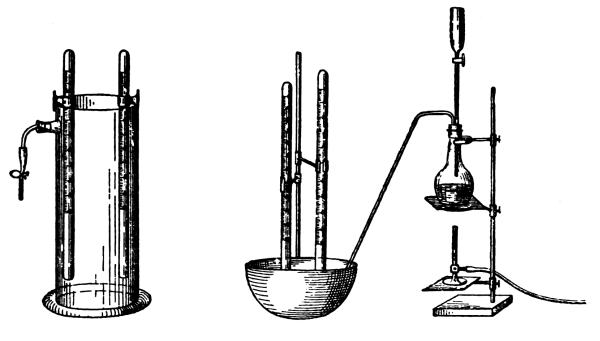
Figure. 14.
Schlösing-Wagner Apparatus.
The contents of the flask are boiled until all the air is driven off. The delivery-tube is then placed under the measuring-tube, which is filled with forty per cent potash-lye. The measuring-tube is previously almost filled with potash-lye and then a few drops of water added and the tube covered with a piece of filter-paper. By a careful and quick inversion the measuring-tube can be brought into the vessel receiving it without any danger of air entering. The boiling is continued for some time and when no more air escapes, the end of the delivery-tube is brought into another freshly filled measuring-tube and the estimation is commenced.
Ten cubic centimeters of a normal saltpeter solution, containing two and a half grams of pure sodium nitrate in 100 cubic centimeters are placed in the funnel and, with continued boiling, allowed to pass, drop by drop, into the flask. When almost all has run out the funnel is washed three times with ten cubic centimeters of ten per cent hydrochloric acid and this is allowed to pass, drop by drop, into the flask. When no more nitric oxid is evolved the measuring-tube is transferred to a large jar filled with distilled water.
The solution of the substance to be examined should be taken in such quantity as will give about the same quantity of gas as is furnished by the ten cubic centimeters test nitrate solution before described; viz., about seventy cubic centimeters. Eight or ten determinations can be made, one following the other, and at the end another determination with normal sodium nitrate solution should be made as a check. At the end of the operation all of the measuring-tubes are in the large jar filled with distilled water. The temperature of the surrounding water will soon be imparted to the contents of each tube and the volume of nitric oxid is read by bringing the level within and without the measuring-tube to the same point. The percentages are calculated for the given temperature and barometer pressure in the usual way; or to avoid computation the volume can be compared directly with the volume furnished by a normal nitrate solution, which is a much simpler method.
208. Schmitt’s Modified Method.—The method is a modification of that already described by the author in which a mixture of powdered zinc and iron is used as a reducing agent.[176] The process is carried out as follows: Ten grams of the nitrate are dissolved and the volume made up to half a liter. Ten cubic centimeters of glacial acetic acid and ten grams of the fine metallic powder, iron and zinc, are placed in a flask of a capacity of about three-quarters of a liter and twenty-five cubic centimeters of the solution of the nitrate added. The flask is covered during the reduction to prevent loss by spraying, and after the solution is complete, which is the case in about ten minutes, the contents of the flask are diluted with from 200 to 300 cubic centimeters of water, thirty cubic centimeters of caustic soda of 1.25 specific gravity added, and the whole distilled as in the kjeldahl process. It must be noted that it is essential that the iron be finely divided; it is mixed with the powdered zinc in equal parts. The total nitrogen can be determined in guanos and nitrate mixtures by the following simple alteration in procedure: One gram of the substance is dissolved in water, five cubic centimeters of glacial acetic acid, and from two to three grams of the mixed metallic powder added, and the whole gently heated for ten or fifteen minutes. After the contents of the flask have cooled, twenty-five cubic centimeters of sulfuric acid are cautiously added in small portions, undue frothing being restrained by the addition of a fragment of paraffin wax. The acetic acid is then driven off by heating, and the remaining contents of the flask boiled until the organic matter is completely decomposed, as in the kjeldahl process. About two hours boiling is required. Neutralization and distillation are then practiced as in the ordinary manner. The method is also applicable to the determination of nitrates in drinking water, provided nitrites and ammonia be absent.
209. Krüger’s Method for Nitric Acid.—About three-tenths gram of the substance dissolved in water is mixed with twenty cubic centimeters of a hydrochloric acid solution of stannous chlorid holding 150 grams of tin per liter.[177] One and a half grams of spongy tin prepared by the action of zinc on stannous chlorid are added. The flask containing the mixture is heated until the tin is dissolved, by which time the nitric acid is completely reduced. The subsequent distillation and titration are accomplished as usual. In the case of nitro and nitroso compounds, after the solution of the tin, twenty cubic centimeters of sulfuric acid are added and heated until sulfuric vapors escape. After cooling, the amido substances formed are oxidized by potassium bichromate before the distillation takes place.
Krüger also estimates the nitrogen in benzol, pyridin, and chinolin derivatives by dissolving them in sulfuric acid, using from two-tenths to eight-tenths of a gram of the alkaloidal bodies and, after cooling the solution, oxidizing by adding finely powdered potassium bichromate.[178] About half a gram more of the potassium bichromate should be used than is necessary for the oxidation of the substances in solution. The entire oxidation does not consume more than from fifteen to thirty minutes.
SODIUM NITRATE.
210. Functions of Sodium Nitrate.—Practically the only form of oxidized nitrogen which is of importance from an agronomic point of view is sodium nitrate, often known in commerce by the name Chile saltpeter. Applied to a growing crop it at once becomes dissolved at the first rainfall or by the natural moisture of the soil. It carries thus to the rootlets of plants a supply of nitrogen in the most highly available state. There is perhaps no other kind of plant food which is offered to the living vegetable in a more completely predigested state, and none to which a quicker response will be given. By reason of its high availability, however, it must be used with care. A too free use of such a stimulating food may have, in the end, an injurious effect upon the crop, and is quite certain to lead to the waste of a considerable portion of expensive material. For this reason sodium nitrate should be applied with extreme care, in small quantities at a time and only when it is needed by the growing crop. It would be useless, for instance, to apply this fertilizer in the autumn with the expectation of its benefitting the crop to a maximum degree the following spring. Again, if the application of this salt should be made just previous to a heavy rain almost or quite the whole of it would be removed beyond the reach of the absorbing organs of the plant.
When once the nitric acid has been absorbed by the living rootlet it is held with great tenacity. Living plants macerated in water give up only a trace of nitric acid, but if they be previously killed with chloroform the nitric acid they contain is easily leached out.
The molecule of sodium nitrate is decomposed in the process of the absorption of the nitric acid. The acid enters the plant organism and the soda is excreted and left to combine with the soil acids. The nascent soda may thus play a role of some importance in decomposing particles of minerals containing potash or phosphoric acid. It is probable that the decomposition of the sodium nitrate takes place in the cells of the absorbing plant organs for it is difficult to understand how it could be accomplished externally. While the soda therefore is of no importance as a direct plant food it can hardly be dismissed as of no value whatever in the process of fertilization. Many of the salts of soda as, for instance, common salt, are quite hygroscopic and serve to attract moisture from the air and thus become carriers of water between the plant and the air in seasons of drought; and sodium nitrate itself is so hygroscopic as not to be suited to the manufacture of gunpowder.
To recapitulate: The chief functions of sodium nitrate are to give to the plant a supply of oxidized nitrogen ready for absorption into its tissues and incidentally to aid, by the residual soda, in the decomposition of silt particles containing potash or phosphoric acid and in supplying to the soil salts of a more or less deliquescent nature.
211. Commercial Forms of Chile Saltpeter.—The Chile saltpeter of commerce may reach the farmer or analyst in the lumpy state in which it is shipped or as finely ground and ready for application to the fields. Unless the farmer is provided with means for grinding, the latter condition is much to be preferred. It permits of a more even distribution of the salt and thus encourages economy in its use. For the chemist also it is advantageous to have the finely ground material, which condition permits more easily a perfect sampling, a process which, with the unground salt, is attended with no little difficulty.
212. Percentage of Nitrogen in Chile Saltpeter.—Chemically pure sodium nitrate contains 16.49 per cent of nitrogen. The salt of commerce is never pure. It contains moisture, potash, magnesia, lime, sulfur, chlorin, iodin, silica and insoluble materials, and traces of other bodies. The value of the salt depends, therefore, not only on the market value of nitrogen at the time of sale, but also on its content of nitrogen. The nitrate of commerce varies greatly in its nitrogen content and is sold on a guaranty of its purity. The best grades range in nitrogen from fifteen to sixteen per cent. The content of nitrogen has long been estimated in the trade by determining the other constituents and counting the rest as nitrogen. This practice arose in former times when no convenient method was at hand for determining nitric nitrogen. The process is tiresome and unreliable because all errors of every kind are accumulated in the nitrogen content, but inasmuch as the method is still required by many merchants, the analyst should be acquainted with it, and it is therefore given further along. The usual methods for determining nitric nitrogen may be applied in all cases where samples of sodium nitrate are under examination, but some special processes are added for convenience.
213. Adulteration of Chile Saltpeter.—The analyst is the only protector of the farmer in guarding against the practice of adulteration of sodium nitrate aside from the honesty of the dealer. Even the honest dealer is compelled to protect himself against fraud, and therefore, the world over, commerce in this fertilizer is now conducted solely on the analyst’s certificate. Happily, therefore, adulteration is almost unknown because it is certain to be detected. Formerly, the saltpeter was adulterated with common salt, or low grade salts from the potash mines; but it is an extremely rare thing now to find any impurities in the salts other than those naturally present.
In every case the analyst may grow suspicious when he finds the content of nitrogen in a sample to fall below thirteen per cent. It must not be forgotten, however, that some potassium nitrate may be present in the sample, and since that salt contains only 13.87 per cent of nitrogen its presence would tend to lower the value of the fertilizer; but although the potash itself is a fertilizer of value it is not worth more than one-third as much as nitrogen. In all cases of suspected adulteration, it is advisable to make a complete analysis. The results of this work will, as a rule, lead the analyst to a correct judgment.
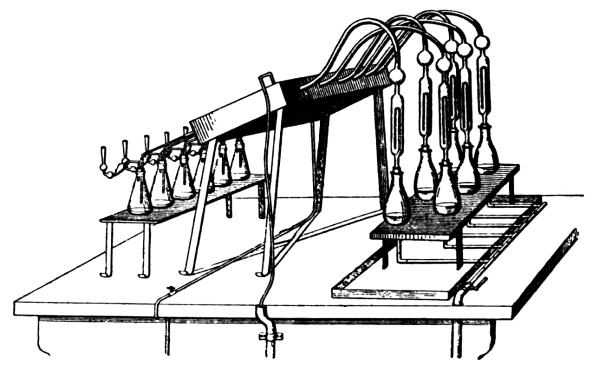
Figure. 15.
Halle Nitric Acid Apparatus.
214. The Halle Zinc-Iron Method.—For determining the nitrogen in Chile saltpeter the reduction method is conducted at the Halle Station as follows:[179] Ten grams of the nitrate are dissolved in one liter and fifty cubic centimeters of the solution corresponding to half a gram of the sample, taken for each determination. The apparatus employed is shown in Fig. 15. A mixture of five grams of zinc dust and an equal weight of iron filings is employed as the source of hydrogen. The reduction takes place in an alkaline medium secured by adding to the other materials mentioned, eighty cubic centimeters of soda-lye of 1.30 specific gravity. The respective quantities of iron and zinc may be measured instead of weighed, as exact proportions are not required. After the addition of all the materials the flask is allowed to stand for an hour at room temperature. The distillation is then commenced and continued until at least 100 cubic centimeters of distillate have been collected. The receiving flasks are ordinary erlenmeyers, each of which contains twenty cubic centimeters of set sulfuric acid, as in the usual kjeldahl process. The flasks are sealed with a few drops of water by the device shown in the figure. After the end of the operation the water in each one is washed back into its proper flask with freshly boiled water. During the vigorous evolution of hydrogen, at the beginning of the operation, some kind of a safety arrangement is necessary to prevent the particles of soda-lye being carried over by the bubbles of that gas. The siphon bulb shown in the figure is found effective for this purpose. In this operation better results are obtained by condensing the escaping steam, and for this reason the block tin tubes are conducted through a tank supplied with a current of cold water. The ends of the tubes should not dip below the surface of the liquid in the receivers. When the condensed liquid collects in considerable quantities in the safety tube the lamp should be extinguished under the flask, which permits the return of the liquid to the flask by means of the siphon. This should be done two or three times during the progress of the distillation to prevent a too high concentration of the soda-lye, thus endangering the flask. The excess of the acid in the receiver is determined by titration, as in the regular kjeldahl method. Blank determinations should be made, from time to time, and corrections made in harmony therewith.
215. Method of the French Sugar Chemists.—The nitrogen in Chile saltpeter is estimated by the French chemists according to the method of Schlösing, described in the first volume, page 500. In order to avoid the trouble of calculating the results from the volume of nitric oxid obtained, a determination is first made with a pure salt, sodium or potassium nitrate. The volume of gas obtained is read directly without correction and taken for direct comparison. The comparison is made as follows:
The solutions of the pure salts and of the sample to be analyzed are made of such a strength as to contain sixty-six grams of sodium nitrate, or eighty grams of potassium nitrate, in a liter. Five cubic centimeters of such a solution will yield a little less than 100 cubic centimeters of nitric oxid under usual conditions. Let the volume of gas obtained with the pure salt be v; and that with the sample be v′. The calculation is then made from the equation:
v′ = x
v 100
Example: Let ninety-five cubic centimeters be the volume of gas from five cubic centimeters of the pure salt (sodium nitrate), and 91.5 cubic centimeters be the volume of gas from five cubic centimeters of the sample; then
91.5 = x , whence x = 96.31.
95 100
Hence the sample analyzed contains 96.31 per cent of sodium nitrate. Since the pure sodium nitrate contains 16.47 per cent of nitrogen the sample under examination would contain
16.47 × 96.31 = 15.86 per cent.
100
It is evident that this comparative method is quite easy of application when the sample under examination has no other nitrate in it except that combined with the one base.
216. Volumetric Method of Gantter.—The process proposed by Gantter for determining the nitrogen, volumetrically, in Chile saltpeter and other nitrates is based on the following principles:[180]
(1) If a nitrate be heated in contact with sulfuric and phosphorous acids, nitrous acid will be formed.
(2) If nitrous acid be boiled with ammonium chlorid, nitrogen will be quantitatively evolved from both compounds. These processes are illustrated by the following formulas:
(a) N₂O₅ + P₂O₃ = N₂O₃ + P₂O₅. (b) N₂O₃ + 2NH₄Cl = 2N₂ + 3H₂O + 2HCl.
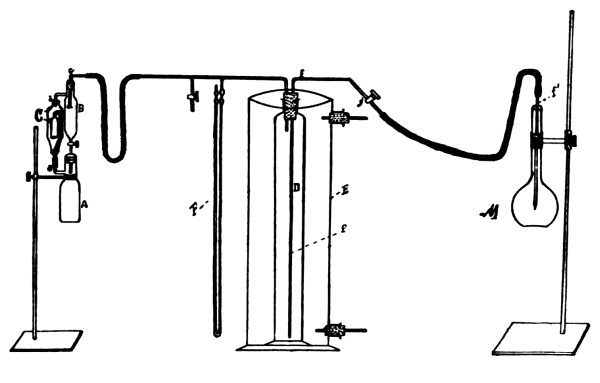
Figure. 16.
Gantter’s Nitrogen Apparatus.
It is seen from the above that the nitrate will give, by this treatment, double the volume of nitrogen which it contains. In practice, the two reactions may be secured in one operation by warming the nitrate solution slowly with sulfuric and phosphorous acids and ammonium chlorid. The nitric acid, as it becomes free, gives a part of its oxygen to the phosphorous compound, and the nitrous acid, in a nascent state, is at once reduced by the ammonium chlorid. There are two sources of error which must be guarded against in the work; a portion of the nitrogen may escape reduction to the elementary state, or some of the nitrate may fail to be decomposed. These errors are easily avoided if the reaction be begun slowly, so that the evolution of gas may be gradual. The temperatures at first should, therefore, be kept as low as possible. The development of red fumes, showing the presence of undecomposed nitrogen oxids, shows that the results will be too low. It is necessary, also, to provide for the absorption of the hydrochloric acid which is formed. The reaction is very conveniently conducted in the apparatus shown in Fig. 16. The decomposition takes place in the flask A and the mixed gases pass into the absorption bulb C. The delivery-tube is very much expanded, as shown in the figure, so that no soda-lye can enter A during the cooling of the flask. The absorption bulb is connected with A and B by the tubes a and b as shown. The tube d connects the apparatus with the gasvolumeter.[181] The bulb B serves as a pipette for the introduction of the decomposing acid. The operation is conducted as follows: Three cubic centimeters of the nitrate solution, containing no more than 300 milligrams of substance, are placed in the flask A with half a gram each of crystallized ammonium chlorid and phosphorous acid. In the bulb B are placed seven cubic centimeters of sulfuric acid to which has been added one-third its volume of water. Two cubic centimeters of acid are allowed to flow from B into A. The apparatus is brought to a constant temperature by being immersed in a large cylinder, E, containing water at a temperature which can easily be controlled. When this constant temperature has been reached the apparatus is taken from the cooling cylinder which contains also a smaller cylinder, D, nearly filled with water and connected through f′ with the measuring apparatus M. The barometer-tube F is half filled with colored water so that the pressure may be equalized before and after the operation. The flask A is warmed very gently at first, and the nitrogen evolved is conducted into D driving an equivalent volume of water into M. The evolution of the gas must be carefully controlled and the heat at once removed if it become too rapid. The appearance of a red color shows the evolution of oxids of nitrogen rendering the analysis inexact. When the evolution of nitrogen has nearly ceased the lamp is removed and some more sulfuric acid allowed to flow into A from B, after which A is again heated, this time to the boiling-point. All vapors of hydrochloric acid produced are absorbed by the soda-lye in C. The boiling is continued a few minutes, but not long enough to darken the liquid in A. After replacing the apparatus in the cylinder E and bringing both temperature and pressure to the same point as before the beginning of the operation, the volume of nitrogen evolved is determined by measuring the water in M.
The apparatus is first set by using pure potassium or sodium nitrate. Since the temperature and pressure do not vary much within an hour or two the volume of water obtained with a sample of white saltpeter can be compared directly with that given off by the same weight of a pure potassium or sodium nitrate without correction.
Example.—Two hundred and fifty milligrams of potassium nitrate, containing 34.625 milligrams of nitrogen, displaced in a given case sixty cubic centimeters of water; therefore one cubic centimeter of water equals 0.578 milligram of nitrogen. If 289 instead of 250 milligrams be taken then the number of cubic centimeters of water displaced divided by five will give the per cent of nitrogen.
217. Method of Difference.—In the analysis of Chile saltpeter by the direct method a variation of 0.25 per cent in the content of nitrogen is allowed from the dealers’ guaranty. This would allow a total variation in the content of sodium nitrate of 1.52 per cent. Dealers and shippers have always been accustomed to estimate the quantity of sodium nitrate in a sample by difference; i. e., by estimating the constituents not sodium nitrate and subtracting the sum of the results from 100. Chile saltpeter usually contains sodium nitrate, water, insoluble ferruginous matters, sodium chlorid, sodium sulfate, magnesium chlorid, sodium iodate, calcium sulfate and sometimes small quantities of potassium nitrate.
When the total sodium nitrate is to be estimated by difference the following procedure, arranged by Crispo,[182] may be followed:
Water.—Dry ten grams of the finely powdered sample to constant weight at 150°-160°.
Chlorin.—The residue, after drying, is dissolved and the volume made up to one-fourth liter with water and the chlorin determined in one-fifth thereof and calculated as sodium chlorid.
Insoluble.—Twenty grams are treated with water until all soluble matter has disappeared, filtered on a tared gooch, and the filtrate dried to constant weight.
Sulfuric Acid.—The sulfuric acid is precipitated by barium chlorid in the slightly acid filtrate from the insoluble matter. The acidity is produced by a few drops of nitric acid. The rest of the process is conducted in the usual way.
Magnesia.—This is precipitated by ammonium sodium phosphate, filtered, ignited, and weighed as pyrophosphate. The magnesium is then calculated as chlorid. Magnesia is rarely found in excess of one-fourth per cent. When this amount is not exceeded the estimation of it may be neglected without any great error. As has already been said the chlorin is all calculated as sodium chlorid. If a part of it be combined with one-fourth per cent of magnesia it would represent 0.59 per cent of magnesium chlorid instead of 0.73 per cent sodium chlorid. In omitting the estimation of the magnesia therefore the importer is only damaged to the extent of 0.14 per cent of sodium nitrate.
Sodium Iodate.—This body, present only in small quantities, may also be neglected. In case the content of this body should reach one-fourth per cent the estimation of chlorin by titration using potassium chromate as indicator is impracticable. Such an instance, however, is rarely known.
Approximate Results.—When the determinations outlined above have been carefully made it is claimed that the result obtained by subtraction from 100 will not vary more than from two-tenths to three-tenths per cent from the true content of sodium nitrate. The method, however, cannot be considered strictly scientific and is much more tedious and chronophagous than the direct determination. In the direct determination, however, the analyst must assure himself that potassium is present in only appreciable quantities otherwise the per cent of sodium nitrate will be too low.
The presence of potassium nitrate is a detriment in this respect only; viz., that it contains a less percentage of nitrogen than the corresponding sodium salt. As a fertilizer, the value of Chile saltpeter may be increased by its content of potassium.
218. The Application of Chile Saltpeter to the Soil.—The analyst is often asked to determine the desirability of the use of sodium nitrate as a fertilizer and the methods and times of applying it. These are questions which are scarcely germane to the purpose of this work but which, nevertheless, for the sake of convenience may be briefly discussed. In the first place it may be said that the data of a chance chemical analysis will not afford a sufficiently broad basis for an answer. A given soil may be very rich in nitrogen as revealed by chemical analysis, and yet poor in an available supply. This is frequently the case with vegetable soils, containing, as they do, large quantities of nitrogen but holding it in practically an inert state. I have found such soils very rich in nitrogen, yet almost entirely devoid of nitrifying organisms. It is necessary therefore in reaching a judgment on this subject from analytical data to consider the different states in which the nitrogen may exist in a soil and above all the nitrifying power of the soil if the nitrogen be chiefly present in an organic state. Culture solutions should therefore be seeded with samples of the soil under examination and the beginning and rapidity of the nitrification carefully noted. In conjunction with this the nitrogen present in the soil in a nitric or ammoniacal form should be accurately determined. These determinations should be made according to the directions given in the first volume, pp. 448-548.
For the determination of nitrifying power we prefer the following method:
219. Taking Samples of Soil in Sterilized Tubes.—Brass tubes are prepared twenty centimeters in length and one and a half in diameter. One end is ground to a beveled edge and compressed in a mold so as to make the cutting edge slightly smaller in diameter than the internal diameter of the tube. It is then ground or filed until smooth and sharp. The blunt end of the tube is stoppered loosely with cotton and it is then sterilized by heating for an hour to 150°. Rubber caps are provided and each one has placed at the bottom a rubber ball to prevent the rubber from being cut by the edges of the brass tube. The caps should be of two distinct colors. Half of the rubber caps are sterilized by being boiled for an hour in water for three successive days. The caps cannot be heated to 150° dry heat with safety. On removing the brass tube from the sterilizing oven as soon as it is cool enough to handle, a sterilized rubber cap is slipped over its cutting end. An unsterilized cap is then slipped over the other end containing the cotton plug. Inasmuch as the cotton plug is never removed it is not necessary to sterilize the cap covering it. Large numbers of the tubes can thus be prepared for use and they can be safely transmitted to a distance by express or mail. For convenience, each tube is encased in a small cloth bag, which is tied with a cord carrying a tag on which the necessary data can be recorded at the time of taking the sample.
The tubes and their rubber caps thus carefully sterilized should not be removed from their cloth envelopes until the moment of taking each sample. After the sample has been taken and the cap replaced on the tube the latter should be immediately enclosed in the cloth sack and labeled with one of the tags therewith enclosed. The sample should be taken in two kinds of soil, in one instance in a cultivated soil, which is most characteristic of the locality, and in the second place a virgin soil of the same type. The virgin soil may be either soil which has been covered with grass or in forest. The spots at which the samples are to be taken having been previously selected, the tags for each tube should be prepared beforehand so as to avoid delay at the time of sampling. A pit with straight walls should be dug, the sides of which are at least two feet wide and even three feet would be better. The pit should be about forty-two inches deep. One of the sides having been made perfectly smooth and without allowing the loose fragments from the top to fall down and adhere to the walls below, the spots at which the samples are to be taken should be marked with a tape line at the following points; viz., three, fifteen, twenty-seven, and thirty-nine inches, respectively, below the surface. Beginning at the bottom point, carefully scrape off the surface of the wall over an area slightly larger than that of the end of the sample tube by means of a spatula, which, just previous to use, has been held for a moment or two in the flame of an alcohol or other convenient lamp. The sample tube having been removed from its sack, it will be noted that the end covered with black rubber is the one which is to be held in the hand, and this black rubber cap should be first removed being careful not to extract the plug of sterilized cotton which closes the end of the tube. Holding the tube firmly by the end, the fingers extending only about two inches from the end, remove the light-colored cap and push the tube with a turning motion into the side of the pit at the point where the surface has been removed with the sterilized spatula. When this is properly done the tube will be filled with a cylinder of soil equal to the length of the part of the tube penetrating the wall of the pit. The tube is then withdrawn, the light rubber cap first replaced, and then the black one. The light rubber cap should be held in the hand during the process in such a way that no dust or particles of soil are permitted to contaminate its inner walls. For this purpose the open end of the cap should be held downward. For the same reason after the removal of the light rubber cap the brass tube should be carefully preserved from dust or fragments, the open end, that is the cutting end, being held downward until ready for use. After one tube has been filled, capped, replaced in the sack and labeled, the spatula should be again sterilized and samples taken in regular order until the top one is finished.
220. Directions for Taking Bulk Samples.—From the sides of the pit described above, bulk samples should be taken as follows:
By means of a spade the soil should be removed from the four sides to the depth of six or nine inches or until the change of color between the soil and subsoil is noted; in all enough to make about 150 pounds of the air-dried soil. In the same way take a sample of the subsoil to the depth of nine additional inches. Remove all stones, large pebbles, sticks, roots, etc., and spread the samples in a sheltered place where they can be air-dried as rapidly as possible. The bulk samples should be taken both from the cultivated and virgin soils. In selecting the cultivated soil, preference should be given to those soils which have not been fertilized within a few years. If recent fertilization have been practiced the character and amount of it should be noted.
221. The Nitrifiable Solution.—The solution to test the nitrifying power of the samples collected as above described is conveniently made as follows:
Potassium phosphate, one gram per liter.
Magnesium sulfate, half a gram per liter.
Calcium chlorid, a trace.
Ammonium sulfate, 200 milligrams of nitrogen per liter.
Calcium carbonate, in excess.
One liter of the above solution is enough for ten samples, each of 100 cubic centimeters. This quantity is placed in an erlenmeyer, which is stoppered with cotton and sterilized by being kept at 100° for an hour on three successive days. The erlenmeyer should be sterilized beforehand by heating for an hour at 150°. The freshly precipitated and washed calcium carbonate should be sterilized separately and added to each erlenmeyer at the time of seeding. Enough should always be used to be in excess of the nitrous and nitric acids found. The seeding is accomplished by filling a sterilized spoon which holds approximately half a gram of the soil, from the contents of one of the brass tubes, lifting the plug in the erlenmeyer and transferring quickly to the flask. This should be done in a perfectly still room, preferably as high above the ground as possible and in a place free from dust and under cover. The cotton plug being replaced the erlenmeyer is shaken until the sample of soil added is thoroughly disintegrated and intimately mixed with its contents. With care and experience the seeding is easily accomplished without danger of accidental contamination.
At the end of each period of five days the beginning and progress of nitrification should be determined by some of the methods described in volume first. Either the ammonia can be determined by nesslerizing or the nitrous and nitric acids estimated. For nitrous acid we prefer the method described in volume first, paragraph 504, and for nitric the one in same volume paragraphs 497 and 498.
By supplementing the analysis of a soil by the above described experiments in nitrification the analyst will be able to judge with sufficient accuracy of its needs for nitric nitrogen.
222. Quantity of Chile Saltpeter to be Applied.—The quantities of Chile saltpeter which should be applied per acre vary with so many conditions as to make any definite statement impossible. On account of the great solubility of this salt no more should be used than is necessary for the nutrition of the crop. For each 100 pounds used, from fourteen to fifteen pounds of nitrogen will be added to the soil. Field crops, as a rule, will require less of the salt than garden crops. There is an economic limit to the application which should not be passed. As a rule 250 pounds per acre will prove to be a maximum dressing. The character of the crop must also be considered. Different amounts are required for sugar beets, tobacco, wheat, and other standard crops. It is rarely the case that a crop demands a dressing of Chile saltpeter alone. It will give the best effects, as a rule, when applied with phosphoric acid or potash. But this is a branch of the subject which cannot be entered into at greater length in this manual. The reader is referred to Stutzer’s work on Chile saltpeter for further information.[183]
223. Consumption of Chile Saltpeter.—The entire consumption of sodium nitrate for manurial purposes in the whole world for 1894 was 992,150 metric tons, valued at $41,000,000. For the several countries using it the consumption was distributed as follows:
Germany 397,200 tons.
France 187,100 “
England 117,000 “
Belgium 123,000 “
United States 100,000 “
Holland 56,700 “
Italy and Spain 5,200 “
Other countries 5,950 “
Total 992,150 “
The above figures represent the actual commerce of each country in Chile saltpeter, and may not give the exact consumption.[184] For instance, Germany exports sodium nitrate to Russia and Austria, but it imports this salt from Holland and Belgium. Belgium imports from France, but its exportation is greater than its importations from that country, so that its actual consumption on the farm probably falls considerably below that given on the table. Holland also exports larger quantities than are imported from neighboring states. The exports from England are inconsiderable compared with the quantities received, amounting only to about 5,000 tons a year, while the exportations from France reach nearly 10,000 tons.
Sodium nitrate has a moderate value at the factories where it is prepared for shipment in Chile. Its chief value at the ports where it is delivered for consumption comes from freights and profits of the syndicate. The factories, where it is prepared for the market, are at or near the deposits, and the freights thence to the sea coast are very high. The rail roads which have been constructed to the high plateaux which contain the deposits, have been built at a very great cost, and the freights charged are correspondingly high. There is also a tax of $1.20 levied on each ton exported. Deducting all costs of transportation and export duties the actual value of sodium nitrate at the factory, ready for shipment, is about sixteen dollars in gold a ton.