Volume 2 / Part 1 — PART FIRST. PRELIMINARY TREATMENT AND PHOSPHATES. (continued 3)
Reading edition
In general it may be said that the errors which do not exceed 0.01 of the total matter under treatment, are negligible for all industrial products. The method of volumetric solution does not present any further inconvenience. It deserves to be and has been generally adopted by reason of its rapidity in all the laboratories where many analyses are to be made. In the volumetric method great care should be taken not to make up to the volume until after the cooling to room temperature, which may be speedily secured by immersing the flask in cold water. Care should also be exercised in taking the sample for analysis by means of the pipette immediately after filtration, and filtration should take place as soon as the volume is made up to the standard. By operating in this way the possible variations from changes of volume due to changes of temperature are avoided.
(8) Examination for Arsenic Acid.—When the sample examined contains pyrites, arsenic is often present. When the decomposition has been effected by means of nitric acid, arsenic acid may be produced. This deports itself in all circumstances like phosphoric acid, and if it is present in the matter under examination it will be found united with the phosphoric acid and determined therewith afterwards. It is easy to avoid this cause of error by passing first a current of sulfurous acid through the solution, carrying it to the boiling-point in order to drive out the excess of sulfurous acid, and afterwards precipitating the arsenic by a current of hydrogen sulfid. After filtration, the rest of the operation can be carried on as already described.
89. Precipitation of the Phosphate by Magnesium Citrate.—By means of an accurate pipette a quantity of the solution representing from 0.125 to 0.250 gram or more is taken, according to the presumed richness of the product to be examined. In order that the following operations may go on well, it is necessary that the quantity of phosphoric acid contained in the sample should be about fifty milligrams. The sample being measured is run into a beaker, and there are added, first, ten cubic centimeters of magnesium citrate solution, and second, a large excess of ammonia. If the quantity of the magnesium citrate solution be sufficient, the mixture should at first remain perfectly limpid and only become turbid at the end of some moments and especially after the mixture is stirred.
If there should be an immediate turbidity produced it is proof that the quantity of magnesium citrate solution employed has been insufficient, and it is necessary to begin again by doubling its amount. Good results cannot be obtained by adding a second portion of the magnesium citrate solution to the original, since the iron and aluminum phosphates which are once formed are redissolved with difficulty. Many chemists at the present time abstain from using the magnesium citrate solution and replace it by a solution of citric acid and one of magnesium sulfate, which they pour successively into the sample under examination. This is a cause of grave errors which it is necessary to point out. Joulie has indeed recognized the fact that the precipitation of the phosphoric acid is not completed in presence of ammonium citrate except it is employed in conjunction with a sufficient excess of magnesia. But the foreign matters which accompany the phosphoric acid require different quantities of ammonium citrate in order to keep them in solution, and it is important to increase the magnesium solution at the time of increasing the citric acid in order to maintain them always in the same proportion. This is easily accomplished by measuring the two solutions, but it is much more easily done by uniting them and adding them together.
90. The Magnesium Citrate Solution.—The formula originally proposed by Joulie, and modified by Millot, and adopted by the French Association of Chemists, is as follows: Citric acid, 400 grams; pure magnesium carbonate, forty grams; caustic magnesia, twenty grams; distilled water, half a liter. After solution, add enough of ammonia to render strongly alkaline, requiring about 600 cubic centimeters. Make the volume up with distilled water to one and a half liters. If the solution be turbid, it is proof that the magnesia or the carbonate employed contains some phosphoric acid which is to be separated by filtration, and the solution can then be preserved indefinitely.
91. Time of Subsidence.—When the phosphoric acid is precipitated by the mixture above mentioned, it is necessary to allow it to subside for a certain time under a bell jar in order to avoid the evaporation of the ammonia. In order to give plenty of time for this subsidence, it is well to make the precipitations in the afternoon and the filtrations the following morning. There are thus secured twelve to fifteen hours of repose, which is time amply sufficient for all cases.
92. Filtration and Washing.—Filtration is performed easily and rapidly upon a small filter without folds placed in a funnel with a long stem of about two millimeters internal diameter. Placed in a series of six or eight, they allow the filtration to take place in regular order without loss of time, the first filter being always empty by the time the last one is filled. The supernatant liquid from the precipitate should first be decanted on the filter, avoiding the throwing of the filtrate on the filter which would greatly retard the process, especially if it should contain a little silica, as often happens.
When the clear liquid is thus decanted as completely as possible, the rest of the precipitate is treated with water to which one-tenth of its volume of ammonia has been added, and the washing is continued by decantation as at first, and afterwards by washing upon the filter until the filtered solution gives no precipitate with sodium phosphate. Four washings are generally sufficient to attain this result.
If the operations which precede have been well-conducted, the total phosphoric acid contained in the material under examination is found upon the filter-paper, except the small portion which remains adhering to the beaker in which the precipitation has been made. The determination of the phosphoric acid comprises the following operations: First, solution of the ammonium magnesium phosphate and second, titration by means of a standard solution of uranium.
93. Solution of the Ammonium Magnesium Phosphate.—The phosphate which has been collected upon the filter is dissolved by a ten per cent solution of pure nitric acid. This solution is caused to pass into the beaker in which the precipitation was made in order to dissolve the particles of phosphate which remain adherent to its sides; and this solution is then thrown upon the filter. The filtrate is then received in a flask of about 150 cubic centimeters capacity, marked at seventy-five cubic centimeters. After two or three washings with the acidulated water, the filter itself is detached from the funnel and introduced into the vessel which contains the solution.
The whole of the filtrate being collected in the flask it is saturated by one-tenth ammoniacal water until a slight turbidity is produced. One or two drops of dilute nitric acid are now added until the liquor becomes limpid, and the flask is placed upon a sand-bath in order to carry the liquid to the boiling-point. After ebullition there are added five cubic centimeters of acid sodium acetate in order to cause the free nitric acid to disappear and immediately the titration, by means of a standard solution of uranium, is undertaken.
94. Acid Sodium Acetate.—The acid sodium acetate is prepared as follows: Crystallized sodium acetate, 100 grams; glacial acetic acid, fifty cubic centimeters; distilled water, enough to make one liter.
95. Standard Solution of Uranium.—A solution of uranium is to be prepared as follows: Pure uranium nitrate, forty grams; distilled water, about 800 cubic centimeters. Dissolve the uranium nitrate in the distilled water and add a few drops of ammonia until a slight turbidity is produced, and then a sufficient amount of acetic acid to cause this turbidity to disappear. The volume is then completed to one liter with distilled water.
The uranium nitrate often contains some uranium phosphate and some ferric nitrate. It is important that it be freed from these foreign substances. This is secured by dissolving it in distilled water and precipitating it by sodium carbonate, which redissolves the uranium oxid and precipitates the iron phosphate and oxid.
The filtered liquor is saturated with nitric acid, and the uranium oxid reprecipitated by ammonia. It is then washed with distilled water by decantation and redissolved in nitric acid, as exactly as possible, evaporated, and crystallized.
The crystals are taken up with ether, which often leaves still a little insoluble matter. The solution is filtered, and the ether evaporated. The salt which remains is perfectly pure. It frequently happens when the uranium nitrate has not been properly purified that the solution prepared as has been indicated above, deposits a light precipitate of phosphate which alters its strength and affords a cause of error. Only those solutions should be employed which have been prepared some days in advance, and which have remained perfectly limpid.
The solution of uranium thus obtained contains uranium nitrate, a little ammonium nitrate, a very small quantity of uranium acetate, some ammonium acetate, and a little free acetic acid. Its sensibility is the more pronounced as the acetates present in it are less in quantity. It is important, therefore, never to prepare the solution with uranium acetate.
96. Typical Solution of Phosphoric Acid.—In order to titrate a solution of uranium, it is necessary to have a standard solution of phosphoric acid; that is to say, a solution containing a precise and known quantity of that acid in a given volume. This solution is prepared by means of acid ammonium phosphate, a salt which is easily obtained pure and dry. Sometimes as it may contain a small quantity of neutral phosphate which modifies the relative proportions of phosphoric acid and ammonia, and it is indispensable to have its strength verified. The titer of the typical solution should be such that it requires for the precipitation of the phosphoric acid which it contains, a volume of the solution of uranium almost exactly equal to its own, in order that the expansions or contractions which the two liquors undergo, by reason of changes in the temperature of the laboratory, should be without influence upon the results.
The solution of uranium prepared as has been indicated above, precipitates almost exactly five milligrams of phosphoric acid per cubic centimeter; the typical solution of phosphoric acid is prepared with eight and one-tenth grams of acid ammonium phosphate pure and dry, which is dissolved in a sufficient quantity of distilled water to make one liter.
The acid ammonium phosphate containing 61.74 per cent of anhydrous phosphoric acid, the quantity above gives exactly five grams of that acid in a liter, or five milligrams in a cubic centimeter.
97. Verification of the Strength of the Standard Solution of Phosphoric Acid.—The strength of the standard solution of phosphoric acid is verified by evaporating a known volume, fifty cubic centimeters for example, with a solution of ferric hydroxid containing a known quantity of ferric oxid. The mass having been evaporated to dryness, and ignited in a platinum crucible, gives an increase in the weight of the iron oxid exactly equal to the amount of anhydrous phosphoric acid contained therein, both the nitric acid and ammonia being driven off by the heat.
To prepare the solution of ferric hydroxid, dissolve twenty grams of iron filings in hydrochloric acid. The solution is filtered to separate the carbon, and it is converted into ferric nitrate by nitric acid, and the solution diluted with distilled water, and the ferric oxid precipitated by a slight excess of ammonia. The precipitate, washed by decantation with distilled water until the wash-water no longer gives a precipitate with silver nitrate, is redissolved in nitric acid, and the solution is concentrated or diluted, as the case may be, to bring the volume to one liter.
In order to determine the quantity of ferric oxid which it contains, fifty cubic centimeters are evaporated to dryness, ignited, and weighed.
A second operation like the above is carried on by adding fifty cubic centimeters of the standard solution of phosphoric acid, and the strength of the solution thus obtained is marked upon the flask.
If the operation have been properly carried on, three or four duplicates will give exactly the same figures. If there are sensible differences, the whole operation should be done over from the first.
98. Titration of the Solution of Uranium.—In a 150 cubic centimeter flask marked at seventy-five cubic centimeters, are poured ten cubic centimeters of the standard solution of phosphoric acid measured with an exact pipette; five cubic centimeters of the acid sodium acetate are added, and distilled water enough to make about thirty cubic centimeters, and the whole carried to the boiling-point. The titration is then carried on by allowing the solution of uranium to fall into the flask from a graduated burette, thoroughly shaking after each addition of the uranium, and trying a drop of the liquor with an equal quantity of a ten per cent solution of potassium ferrocyanid upon a greased white plate. Since the quantity of the uranium solution present will be very nearly ten cubic centimeters at first, nine cubic centimeters can be run in without testing. Afterwards, the operation is continued by adding two or three drops at a time until the test upon the white plate with the potassium ferrocyanid shows the end of the reaction. When there is observed in the final test a slight change of tint, the flask is filled up to the mark with boiling distilled water and the process tried anew. If in the first part of the operation the point of saturation have not been passed, it is still usually necessary to add a drop or two of the uranium solution in order to produce the characteristic reddish coloration, and this increase is rendered necessary by the increase in the volume of the liquid. Proceeding in this manner two or three times allows the attainment of extreme precision, inasmuch as the analyst knows just when to look for the point of saturation.
Correction.—The result of the preceding operation is not absolutely exact. It is evident indeed that in addition to the quantity of uranium necessary for the exact precipitation of the phosphoric acid, it has been necessary to add an excess sufficient to produce the reaction upon the potassium ferrocyanid.
This excess is rendered constant by the precaution of operating always upon the same volume; namely, seventy-five cubic centimeters. It can be determined then once for all by making a blank determination under the same conditions but without using the phosphoric acid.
The result of this determination is that it renders possible the correction which it is necessary to make by subtracting the quantity used in the blank titration from the preceding result in order to obtain the exact strength of the uranium solution.
The operation is carried on as follows: In a flat-bottomed flask of about 150 cubic centimeters capacity and marked at seventy-five cubic centimeters, by means of a pipette, are placed five cubic centimeters of the solution of sodium acetate; some hot distilled water is added until the flask is filled to the mark, and it is then placed upon a sand-bath and heated to the boiling-point. It is taken from the fire, the volume made up to seventy-five cubic centimeters with a little hot distilled water, and one or two drops of the solution of uranium are allowed to flow into the flask from a graduated burette previously filled exactly to zero. After each drop of the solution of uranium the flask is shaken and the liquid tried upon a drop of potassium ferrocyanid, as has been previously indicated. For a skilled eye, four to six drops are generally necessary to obtain the characteristic coloration; that is from two-tenths to three-tenths of a cubic centimeter. Beginners often use from five-tenths to six-tenths, and sometimes even more.
The sole important point is to arrest the operation as soon as the reddish tint is surely seen, for afterwards the intensity of the coloration does not increase proportionally to the quantity of liquor employed.
It is well to note that at the end of some time the coloration becomes more intense than at the moment when the solutions are mixed, so that care must be taken not to pass the saturation-point. This slowness of the reaction is the more marked as there is more sodium or ammonium acetate in the standard solutions. This is the reason that it is important to introduce always the same quantity; namely, five cubic centimeters. This is also the reason why the uranium acetate should not be employed in preparing the standard solution of uranium which ought to contain the least possible amount of acetate in order that the necessary quantity which is carried into each test should be as small as possible and remain without appreciable influence. If it were otherwise, the sensibility of the reaction would be diminished in proportion as a larger quantity of uranium solution was employed, giving rise to errors which would be as much more important as the quantities of phosphoric acid to be determined were greater. The correction for the uranium solution having been determined it is written upon the label of the bottle containing it.
Causes of Errors.—In the work which has just been described, some causes of error may occur to which the attention of analysts should be called.
The first is the error which may arise from the consumption of the small quantity of uranium phosphate which is taken with a stirring rod when the liquid is tested with potassium ferrocyanid. It is very easy to be assured that the end of the reaction has really been reached. For this purpose it is only necessary to note the quantity of the solution already employed and to add to it afterwards four drops; shake, and make a new test with a drop of the potassium ferrocyanid placed near the spot which the last one occupied. If a decidedly reddish tint does not appear at the moment of removing the glass rod, it is to be concluded that the first appearance was an illusion, and the addition of uranium is to be continued. If, on the contrary, the coloration appear of a decided tint, the preceding number may be taken for exact. It is then always beneficial to close the titration by this test of four supplementary drops which will exaggerate the coloration and confirm the figure found.
The second cause of error, and one moreover which is the most frequently met with, consists in passing the end of the reaction by adding the uranium too rapidly. In place of giving then a coloration scarcely perceptible, the test with the drop of potassium ferrocyanid gives a very marked coloration. In this case the analysis can still be saved. For this purpose the analyst has, at his disposal, a tenth normal solution prepared with 100 cubic centimeters of the standard solution of phosphoric acid diluted to one liter with distilled water. Ten cubic centimeters of this tenth normal solution are added, and the titration continued. At the end, the amount of additional phosphoric acid used is subtracted from the total.
A third cause of error is found in the foam which is often found in the liquid, due to the shaking. This foam may retain a portion of the last drops of the solution of uranium which fall upon its surface and prevent its mixture with the rest of the liquid. If the glass stirring rod in being removed from the vessel pass through this froth charged with uranium, the characteristic coloration is obtained before real saturation is reached. Consequently it is necessary to avoid, as much as possible, the formation of the foam, and especially to take care never to take the drop for test after agitation except in the middle of the liquid where the foam does not exist.
Suppose the titration has been made upon ten cubic centimeters of the normal solution of phosphoric acid in the conditions which we have just indicated, and the figure for the uranium obtained is 10.2 cubic centimeters; if now the correction, which may be supposed to amount to two-tenths cubic centimeter, be subtracted there will remain ten cubic centimeters of the uranium solution which would have precipitated exactly fifty milligrams of phosphoric acid.
The quantity of phosphoric acid which precipitates one cubic centimeter of the solution will be consequently expressed by the proportion ⁵⁰/₁₀ = five milligrams, which is exactly the strength required. In the example which has just been given, the inscription upon the flask holding the standard solution would be as follows: Solution of uranium, one cubic centimeter equals five milligrams of phosphorus pentoxid; correction, two-tenths cubic centimeter.
99. Titration of the Sample.—The strength of the solution of uranium having been exactly determined, by means of this solution the strength of the sample in which the phosphoric acid has been previously prepared as ammonium magnesium phosphate is ascertained. In this case the quantity of phosphoric acid being unknown, it is necessary to proceed slowly and to duplicate the tests in order not to pass beyond the point of saturation. From this there necessarily results a certain error in consequence of the removal of quite a number of drops of the solution of the sample before the saturation is complete. It is therefore necessary to make a second determination in which there is at once added almost the quantity of the solution of uranium determined by the first analysis. Afterwards the analysis is finished by additions of very small quantities of uranium until saturation is reached. Suppose, for instance, that the sample was that of a mineral phosphate, five grams of which were dissolved in 100 cubic centimeters, and of which ten cubic centimeters of the solution prepared as above required 15.3 cubic centimeters of the standard solution of uranium. We then would have the following data:
Mineral phosphate, five grams of the material dissolved in twenty cubic centimeters of hydrochloric acid.
Water, sufficient quantity to make 100 cubic centimeters.
Quantity taken, ten cubic centimeters = 0.50 gram of the sample taken.
Solution of uranium required 15.3 cubic centimeters.
Correction 0.2 “ “
Actual quantity of uranium solution 15.1 “ “
Strength of the solution of uranium, one cubic centimeter = fivemilligrams P₂O₅.
Then P₂O₅ in 0.50 gram of the material = 5 × 15.1 = 75.50 milligrams.
Then the per cent of P₂O₅ = 75.5 x 100 = 15.10.
50
The sample under examination ought always to be prepared in duplicate, either by making a single precipitation and re-solution of the ammonium magnesium phosphate which is made up to a certain volume and an aliquot portion of which is taken for the analysis, or by making two precipitations under the conditions previously described. When the content of phosphoric acid in the material under examination is very nearly known, the double operation may be avoided, especially if it be required to have rapid and only approximate analyses, such as those which are made for general control and for the conduct of manufacturing operations. But when analyses are to be used to serve as the basis of a law or for the control of a market, they should always be made in duplicate, and the results ought not to be accepted when the numbers obtained are widely different, since the agreement of the two numbers will show that the work has been well executed.
This method of analysis, much longer to describe than to execute, gives results perfectly exact and always concordant when it is well carried out, provided that the standard solutions, upon which it rests for its accuracy, are correctly prepared and frequently verified in the manner indicated.
The strength of the solution of uranium ought to be verified every three or four days. The strength of the standard solution of phosphoric acid should be verified each time that the temperature of the laboratory undergoes any important change. A solution prepared, for example, in winter when the temperature of the laboratory is from 15° to 18° would no longer be exact in summer when the temperature reaches 28° or 30°.
100. Condition of Phosphoric Acid in Superphosphates.—Superphosphates are the products of the decomposition of phosphates by sulfuric or hydrochloric acid. They contain phosphoric acid combined with water, with lime, with magnesia, and with iron and alumina in various proportions.
These combinations may be classed in three categories: First, those compounds soluble in water; second, those insoluble in water, but very soluble in ammoniacal salts of the organic acids such as the citrate and oxalate; and third, phosphates not soluble in any of the above-named reagents.
In the products soluble in water are met free phosphoric acid, monocalcium phosphate, acid magnesium phosphate, and the iron and aluminum phosphates dissolved in the excess of phosphoric acid. In the products insoluble in water but soluble in the ammonium citrate are found bicalcium phosphate and iron and aluminum phosphates, which together constitute the phosphates called reverted.
These compounds reduced to a very fine state of division in the process of manufacture are considered to contain phosphoric acid of the same economic value.
101. Determination of the Total Phosphoric Acid in Superphosphates and Fertilizers.—The process is carried on exactly as for an ordinary phosphate, and with all the care indicated in connection with the sampling, the incineration, the solution by means of hydrochloric acid, and the separation of the phosphoric acid in the state of ammonium magnesium phosphate, and finally in the titration by uranium.
102. Determination of Soluble and Reverted Phosphoric Acid.—To make this determination a method unique and applicable to all cases consists in extracting, at first, the soluble constituents in distilled water, and following this operation by digestion in the ammonium citrate. The products soluble in water can be determined either separately or at the same time as the products soluble in the ammonium citrate according to the taste of the people interested, without its being necessary to modify very greatly the method of operation.
The determination of the soluble phosphoric acid comprises first, the solution of the soluble constituents in distilled water; second, the solution of the reverted phosphates in ammonium citrate; third, the precipitation of the phosphoric acid dissolved in the two preceding operations, and its determination.
103. Preparation of the Sample for Analysis.—The sample sent to the chemical expert is prepared as has been indicated; that is to say, it is poured on a sieve of which the meshes have a diameter of one millimeter, and sifted upon a sheet of white paper. The parts which do not pass the sieve are broken up either by the hand or in a mortar and added, through the sieve, to the first portions. The product is well mixed and, in this state, the mass presents all the homogeneity desirable for analysis.
Some fertilizers are received in a pasty state which does not permit of their being sifted. It is necessary in such a case to mix them with their own weight either of precipitated calcium sulfate dried at 160° or with fine sand washed with hydrochloric acid and dried, which divides the particles perfectly and permits of their being passed through the meshes of the sieve.
104. Extraction of the Products Soluble in Distilled Water.—The substance having been prepared as has just been indicated, one and a half grams are placed in a glass mortar. Twenty cubic centimeters of distilled water are added, and the substance gently suspended therein. After standing for one minute, the supernatant part is decanted into a small funnel provided with a filter-paper and placed in a flask marked at 150 cubic centimeters. This operation is repeated five times and is terminated by an intimate breaking up of the matter with distilled water. When the volume of 100 cubic centimeters of the filtrate has been obtained, the residue in the mortar is placed on the filter, and the washing is continued until the total volume reaches 150 cubic centimeters. The filtrate is shaken in order to render the liquor homogeneous, and is transferred to a precipitating glass of about 300 cubic centimeters capacity.
105. Solution of the Reverted Phosphates by Ammonium Citrate.—The filter from the above process is detached from the funnel and is introduced into a flask marked at 150 cubic centimeters together with sixty cubic centimeters of alkaline ammonium citrate prepared in the following manner:
Pure citric acid, 400 grams.
Ammonia of 22°, 500 cubic centimeters.
The ammonia is poured upon the citric acid in the form of crystals in a large dish. The mass becomes heated, and the solution takes place rapidly. When it is complete and the solution is cold it is poured into a flask of one liter capacity, and the flask is filled up to the mark with strong ammonia. It is preserved for use in a well-stoppered bottle. The solution must be strongly alkaline.
The flask in which the filter-paper is introduced, together with the ammonium citrate, is stoppered and shaken violently in order to disintegrate the filter-paper and put the reverted phosphates in suspension. There are added then about sixty cubic centimeters of distilled water, and the flask is shaken and left for twelve hours at least, or at most for twenty-four hours. The volume is made up to 150 cubic centimeters with distilled water, and, after mixture, the solution is filtered.
There are thus obtained two solutions which can be precipitated together or separately according to circumstances. The most usual process is to combine the two equal volumes of twenty-five, fifty, or one hundred cubic centimeters, representing one-quarter, one-half, or one gram of the material according to its presumed richness, in a precipitating flask to which are added from ten to twenty cubic centimeters of the solution of magnesia made up as follows:
Magnesium carbonate, 50 grams.
Ammonium chlorid, 100 “
Water, 500 cubic centimeters.
Hydrochloric acid, 120 “ “
After complete solution of the solid matters in the above, add 100 cubic centimeters of ammonia of 22° strength, and distilled water enough to make one liter.
The solutions are thoroughly mixed in a precipitating glass, an excess of ammonia added, and allowed to stand for twelve hours under a bell jar. The phosphoric acid contained in the liquor is separated as ammonium magnesium phosphate. It is collected upon a small filter, washed with a little ammoniacal water, redissolved, and titrated with the uranium solution in the manner already indicated.
Example: The following is an example of this kind of a determination:
(1) One and one-half grams of the superphosphate and distilled water enough to make 150 cubic centimeters.
(2) Filter-paper with reverted phosphates, sixty cubic centimeters of ammonium citrate, and a sufficient quantity of distilled water to make 150 cubic centimeters.
Aqueous solution (1) 25 cc = 0.25 grams of the sample.

Citrate solution (2) 25 cc
Add magnesium solution twenty cubic centimeters and ammonia in excess, and allow from twelve to twenty-four hours of digestion, then filter and wash, dissolve and titrate.
Required of solution of uranium 8.55 cubic centimeters (1 cubic centimeter = 5 milligrams P₂O₅).
Correction 0.20.
Remainder 8.35 × 0.005 = 0.04175 gram P₂O₅ for 0.25 gram of the sample. Then 0.04175 ÷ 0.25 = 16.7 per cent.
From the above data there would be 16.7 per cent of phosphoric acid soluble in water and in ammonium citrate.
If it be desirable to have separately the phosphoric acid soluble in water, a separate precipitation is made of the aqueous solution alone by means of the magnesium citrate solution. The precipitate washed with ammoniacal water is redissolved and titrated in the manner indicated.
In subtracting from the figures obtained with the two solutions together the number obtained for the phosphoric acid soluble in water, the number representing the phosphoric acid soluble in ammonium citrate alone, is obtained.
It is to be noted that the determinations with uranium require always two successive titrations. It would therefore be an advantage in all operations to precipitate a weight of ammonium magnesium phosphate sufficient for allowing this precipitate to be dissolved and made up to 100 cubic centimeters on which amount it would be possible to execute two, three, or four determinations, and thus to obtain a figure absolutely incontestable.
106. Conclusions.—It has been seen from the above data that the French chemists have worked out the uranium volumetric method with great patience and attention to detail. Where many determinations are to be made it is undoubtedly possible for an analyst to reach a high degree of accuracy as well as to attain a desirable rapidity, by using this method. For a few determinations, however, the labor of preparing and setting the standard solutions required would be far greater than the actual determinations either by the molybdate or citrate gravimetric methods. For control work in factories and for routine work connected with fertilizer inspection, the method has sufficient merit to justify a comparison with the processes already in use by the official chemists of this country.
The use of an alkaline ammoniacal citrate solution, however, for the determination of reverted acid renders any comparison of the French method with our own impossible. On the other hand the French method for water-soluble acid is based on the same principle as our own; viz., washing at first with successive small portions of water, and thus avoiding the decomposition of the soluble phosphates, which is, likely to occur when too great a volume of water is added at once.
In the matter of the temperature and time as affecting the solubility of reverted acid, the French method is also distinctly inferior to our own. The digestion is allowed to continue from twelve to twenty-four hours, at the pleasure of the analyst, and meanwhile it is subjected to room temperature. It is not difficult to see that this treatment in the same sample would easily yield disagreeing results between twelve hours at a winter temperature and twenty-four hours at summer heat.
THE DETERMINATION OF PHOSPHORIC ACID BY TITRATION OF THE YELLOW PRECIPITATE.
107. Pemberton’s Volumetric Method.—In order to shorten the work of determining the phosphoric acid, numerous attempts have been made to execute the final determination directly on the yellow precipitate obtained by treating a solution of a phosphate with ammonium molybdate in nitric acid. The composition of this precipitate appears to be somewhat variable, and this fact has cast doubt on the methods of determination based on its weight. Its most probable composition is expressed by the following formula, (NH₄)₃PO₄(MoO₃)₁₂. For convenience in writing reactions this formula should usually be doubled. Pemberton has described a volumetric determination of phosphoric acid in the yellow precipitate which has the merit of being rapid.[83]
In this laboratory the method has not given very satisfactory results when compared with the molybdate gravimetric process. It has however attracted so much attention from analysts as to merit description, and the details of the process are therefore given.
108. The Process.—One gram of phosphate rock, or from two to three grams of phosphatic fertilizer, are dissolved in nitric acid, and, without evaporation, diluted to 250 cubic centimeters. Without filtering, twenty-five cubic centimeters are placed in a four-ounce beaker and ammonia added until a slight precipitate begins to form. Five cubic centimeters of nitric acid of one and four-tenths specific gravity are then added, and afterwards ten cubic centimeters of saturated solution of ammonium nitrate and enough water to make the volume about sixty-five cubic centimeters. The contents of the beaker are boiled, and while still hot, five cubic centimeters of the aqueous solution of ammonium molybdate added. Additional quantities of the molybdate are added, if necessary, until the whole of the phosphorus pentoxid is thrown-out.
After allowing to settle for a moment the contents of the beaker are poured upon a filter seven centimeters in diameter. The precipitate is thoroughly washed with water, both by decantation and on the filter. The filter with its precipitate is transferred to a beaker and titrated with standard alkali, in the presence of phenolphthalein. Each cubic centimeter of alkali employed should correspond to one milligram of phosphorus pentoxid, (P₂O₅).
The reagents employed have the composition indicated below:
Ammonium Molybdate.—Ninety grams of the crystals of ammonium molybdate are placed in a large beaker and dissolved in a little less than one liter of water. The beaker is allowed to stand over night and the clear liquor decanted. Any undissolved acid is brought into solution in a little ammonia water and added to the clear liquor. If a trace of phosphoric acid be present a little magnesium sulfate is added and enough ammonia to produce a slight alkaline reaction. The volume of the solution is then made up to one liter. Each cubic centimeter of this solution is capable of precipitating three milligrams of phosphorus pentoxid.
Standard Potassium Hydroxid.—This solution is made of such strength that one cubic centimeter is equivalent to one milligram of phosphorus pentoxid. Treated with acid of normal strength, 100 cubic centimeters are required to neutralize 32.37 cubic centimeters thereof.
Standard Acid.—This should have the same strength, volume for volume, as the standard alkali solution. It is made by diluting 323.7 cubic centimeters of normal acid to one liter.
Indicator.—The indicator to be used is an alcoholic solution of phenolphthalein, one gram in 100 cubic centimeters of sixty per cent alcohol, and half a cubic centimeter of this should be used for each titration.
Thomson has shown[84] that of the three hydrogen atoms in phosphoric acid two must be saturated with alkali before the reaction with phenolphthalein is neutral. Therefore, when the yellow precipitate is broken up by an alkali, according to the reaction to follow, only four of the six molecules of ammonium are required to form a neutral ammonium phosphate as determined by the indicator employed. The remaining two molecules of ammonium unite with the molybdenum forming also a salt neutral to the indicator.
Phenolphthalein is preferred because, as has been shown by Long, its results are reliable in the presence of ammonium salts unless they be present in large quantity, and if the solution be cold and the indicator be used in sufficient quantity.[85] To prepare the indicator for this work, one gram of phenolphthalein is dissolved in 100 cubic centimeters of sixty percent alcohol. At least one-half of a cubic centimeter of the solution is used for each titration.
The advantages claimed for the method are its speed and accuracy. Much time is saved by avoiding the necessity for the removal of the silica by evaporation. The results of analyses with and without the removal of the silica are practically identical. When the silica is not removed it is noticed that the filtrate from the yellow precipitate has a yellow tint.
The reaction is represented by the following formula:
(NH₄)₆(PO₄)₂(MoO₃)₂₄ + 46KOH = (NH₄)₄(HPO₄)₂ + (NH₄)₂MoO₄ + 23K₂MoO₄ + 22H₂O.
From this reaction it is seen that the total available acidity of one molecule of the yellow precipitate titrated against phenolphthalein is equivalent to twenty-three molecules of potassium hydroxid.
Calculation of Results.—The standard alkali is of such strength that one cubic centimeter is equal to one per cent of phosphoric acid when one gram of material is employed and one-tenth of it taken for each determination. In a given case one gram of a sample was taken and one-tenth of the solution used. Fifty cubic centimeters of alkali were added to the yellow precipitate. It required thirty-two cubic centimeters of standard alkali to neutralize the excess.
The alkali consumed by the yellow precipitate was 50 - 32 = 18. The sample therefore contained eighteen per cent of phosphoric acid.
Comparison with Official Method.—A comparison of the Pemberton volumetric with the official method of the Association of Agricultural Chemists has been made by Day and Bryant.[86] The comparisons were made on samples containing from 1.45 to 37.28 per cent of phosphoric acid and resulted as follows:
Substance. Per cent P₂O₅, Official. Per cent P₂O₅, Pemberton.
No. 1. Florida rock 1.45 1.32
“ 2. “ “ 4.40 4.53
“ 3. Sodium phosphate 19.78 19.99
“ 4. “ “ 19.72 19.73
“ 5. Florida rock 37.28 37.22
This near agreement shows the reliability of the method. The comparison of the Pemberton volumetric method with the official gravimetric method was investigated by the reporter of the Association of Official Agricultural Chemists in 1894.[87] The individual variations were found to be greater than in the regular method but the average results were nearly identical therewith. The method works far better with small percentages of phosphoric acid than with large. Where the average of the results by the official methods gave 12.25 per cent, the volumetric process gave 11.90 per cent, whereas in the determination of a smaller percentage the results were 2.72 and 2.73 per cent, respectively. Kilgore proposes a variation of the method which differs from the original in two principal points.[88] First the temperature of precipitation in the Pemberton process is 100°; but in the modified form from 55° to 60°. At the higher temperature there is danger of depositing molybdic acid.
The second difference is in the composition of the molybdate solution employed. The official molybdate solution contains about sixty grams of molybdenum trioxid in a liter while the Pemberton solution contains sixty-six grams. There is therefore not much difference in strength. The absence of nitric acid, however, from the Pemberton solution favors the deposition of the molybdic acid when heat is applied. Kilgore, therefore, conducts the analysis as follows: The solution of the sample is made according to the official nitric and hydrochloric acid method for total phosphoric acid. For the determination, twenty or forty cubic centimeters are taken, corresponding to two-tenths or four-tenths gram of the sample. Ammonia is added until a slight precipitate is produced and the volume is then made up, with water, to seventy-five cubic centimeters. Add some ammonium nitrate solution, from ten to fifteen cubic centimeters, but this addition is not necessary unless much of the nitric acid has been driven off during solution. Heat in water-bath to 60° and precipitate with some freshly filtered official molybdate solution. Allow to stand for five minutes, filter as quickly as possible, wash four times by decantation using from fifty to seventy-five cubic centimeters of water each time, and then wash on a filter until all acid is removed. The solution and titration of the yellow precipitate are accomplished as in the Pemberton method. The agreement of the results obtained by this modified method was much closer with the official gravimetric method than those obtained by the Pemberton process.
109. Estimation of Phosphoric Acid as a Lead Compound.—In the volumetric lead method, as described by Wavelet, the phosphoric acid is precipitated by the magnesium citrate solution as in the uranium method of Joulie, as practiced by the French chemists, and the washing of the precipitate and its solution in nitric acid are also conducted as in that method.[89] After solution in nitric acid ammonia is added to neutrality and the solution is then made acid with acetic. The phosphoric acid is precipitated in the acid solution by a standard solution of lead nitrate, the precipitate having the formula P₂O₅3PbO.
The end reaction is determined by placing a drop of the titrated mixture on a white greased dish in contact with a drop of a five per cent solution of potassium iodid. When all the phosphoric acid is precipitated the least excess of the lead salt is revealed by the characteristic yellow precipitate of lead iodid.
The author of the process claims that the lead phosphate is insoluble in the excess of acetic acid and that the phosphate itself does not give any yellow coloration with potassium iodid. The process is quite as exact as the uranium method and the end reaction is far sharper and the standard reagents are easily made and preserved.[90] The method described merits, at least, a comparative trial with the uranium process, but cannot be recommended as exact until further approved by experience.
The reagents employed have the following composition:
(1) Disodium phosphate solution containing 10.085 grams per liter
(2) Sodium acetate “ “ 50.000 “ “ “
(3) Lead nitrate “ “ 40.000 “ “ “
(4) Potassium iodid “ “ 50.000 “ “ “
The titrations should be conducted in the cold.
110. Water-Soluble Phosphoric Acid.—Glaser has modified the volumetric method of Kalmann and Meissels for the volumetric estimation of water-soluble phosphoric acid so as to avoid the double titration required by the original method.[91] If methyl orange be used as an indicator in the original method, the determination does not at once lead to the tricalcium salt, but the liquid still contains, after neutralization, some monocalcium phosphate, which is determined by a further titration with phenolphthalein. In the modified method the total phosphoric acid is estimated in one operation as a tricalcium salt. This is secured, by adding, at the proper time, an excess of calcium chlorid. Two grams of the superphosphate are shaken with water several times, and, after settling, filtered, and the insoluble residue finally washed on the filter until the total volume of the filtrate is a quarter of a liter. Of this, fifty cubic centimeters are taken and titrated with tenth normal soda-lye, with addition of two drops of methyl orange, until the acid reaction has entirely disappeared. There is then added some neutral calcium chlorid solution in excess. If iron and alumina be present, a precipitate is produced of which no account need be made. The acid reaction is thus restored. Five drops of the phenolphthalein solution are added and the titration continued until the alkaline reaction is noted throughout the whole mass. Each cubic centimeter of the soda-lye corresponds, in the first titration, to 7.1, and in the second to 3.55 milligrams of phosphoric acid.
111. Estimation of Phosphoric Acid in the Presence of a Large Excess of Iron.—The method given below, due to Emmerton, depends upon the precipitation of a phosphomolybdate, of constant composition, in the presence of a large excess of iron, as in the analysis of iron and steel and iron ores.[92] The molybdenum trioxid obtained is reduced by zinc to Mo₁₂O₁₉. The action of permanganate on this compound is shown in the following equation:
5Mo₁₂O₁₉ + 17(K₂OMn₂O₇) = 60MoO₃ + 17K₂O + 34MnO.
Seventeen molecules of permanganate are equal to sixty molecules of molybdenum trioxid. The iron or steel is dissolved in nitric acid, evaporated to dryness, heated, and redissolved in hydrochloric acid, then treated again with nitric acid and evaporated until a clear and concentrated solution is obtained free from hydrochloric acid.
The solution obtained is diluted to forty cubic centimeters with water and washed into a 400 cubic centimeter flask, making the total volume about seventy-five cubic centimeters. Add strong ammonia, shaking after each addition, until the mass sets to a thick jelly from the ferric hydroxid. Add a few more cubic centimeters of ammonia and shake thoroughly, being sure the ammonia is present in excess. Add next nitric acid gradually, with shaking, until the precipitate has all dissolved; add enough more nitric acid to make the solution a clear amber color. The volume should now be about 250 cubic centimeters. Bring the solution to 85° and add, at once, forty cubic centimeters of molybdate solution of the following strength: Dissolve 100 grams of molybdic acid in 300 cubic centimeters of strong ammonia and 100 cubic centimeters of water, and pour the solution into 1,250 cubic centimeters of nitric acid (1.20); close the flask with a rubber stopper, wrap it in a thick cloth, and shake violently for five minutes. Collect the precipitate on a filter, using pump, and wash with dilute nitric acid (1 HNO₃ : 50 H₂O). If a thin film of the precipitate should adhere to the flask it can be removed by the ammonia in the next operation. Wash the molybdate precipitate into a 500 cubic centimeter flask with dilute ammonia (1 H₃N : 4 H₂O), using about thirty cubic centimeters. Add hot dilute sulfuric acid (1 H₂SO₄ : 4 H₂O) and cover the flask with a small funnel. Add ten grams of granulated zinc and heat until rapid action begins, and then heat gently for five minutes. The reduction is then complete. During the reduction the colors, pink, plum, pale green, and dark green, are seen in the molybdate solution, the latter color marking the end of the reaction.
To remove the zinc, pour through a large folded filter, wash with cold water, and fill up the filter once with cold water. But little oxidation takes place in this way. A port-wine color is seen on the filter, but this does not indicate a sufficient oxidation to make an error.
In titrating, the wine color becomes fainter and finally the solution is perfectly colorless and shows a single drop in excess of the permanganate. The permanganate solution, for convenience, is made so that one cubic centimeter is equal to 0.0001 gram of phosphorus. With iron its value is one cubic centimeter equals 0.006141 gram of iron; and one cubic centimeter equals 0.005574 gram of molybdenum trioxid.
112. Variation of Dudley and Noyes.—The method of Emmerton to determine small quantities of phosphoric acid, or of phosphorus in presence of a large excess of iron, has been modified by Dudley and Pease,[93] and by Noyes and Royse.[94] As modified, the method is not intended for fertilizer analysis, but the principle on which it rests may some time, with proper modifications, find application in fertilizer work. The reduction is accomplished in a Jones’ tube,[95] much simplified, so as to render it suitable for common use. The molybdic acid is reduced to a form, or series of forms, corresponding to molybdenum sesquioxid, as in the Emmerton method, and subsequently as in that method, titrated by a set solution of potassium permanganate.
The iron or steel filings, containing phosphorus, are brought into solution by means of nitric acid. For this purpose two grams of them are placed in a half liter flask together with fifty cubic centimeters of nitric acid of 1.18 specific gravity. The mixture is boiled for one minute, and ten cubic centimeters of permanganate solution of one and a quarter per cent added. Boil again until the pink color disappears. Ferrous sulfate solution is next to be carefully added, shaking meanwhile, until the solution clears. Cool to 50° and add eight cubic centimeters of ammonia of 0.90 specific gravity, stopper the flask, and shake until any precipitate which may form is redissolved. Cool or warm, as the case may be, until the solution is as many degrees above or below 60° as the molybdic solution is above or below 27°. Add sixty cubic centimeters of molybdic solution, stopper, and shake on a machine or by hand for five minutes. After remaining at rest for five minutes pour into a nine centimeter filter of fine texture and wash with the acid ammonium sulfate solution in quantities of from five to ten cubic centimeters each time. The filtrate and washings must be perfectly bright. Continue the washings until the filtrate gives no color with hydrogen sulfid.
Dissolve the yellow precipitate with twelve cubic centimeters of 0.96 ammonia diluted with an equal volume of water, and wash the filter with 100 cubic centimeters of water. Finally add to the filtrate and wash-water eighty cubic centimeters of water and ten of strong sulfuric acid. Pass the mixture through the Jones’ reducing tube and follow it with 200 cubic centimeters of water, taking care that no air enter the tube during the operations. The solution collected in the flask should be at once titrated with potassium permanganate.
Solutions used: (1) Nitric acid.—One part of nitric acid of 1.42 specific gravity and two parts of water by volume. The specific gravity of the mixture is about 1.18.
(2) Permanganate solution for oxidizing.—Dissolve 12.5 grams of potassium permanganate in one liter of water.
(3) Ferrous sulfate.—Fresh crystals not effervesced and free from phosphorus.
(4) Ammonia.—The strong ammonia used should have a specific gravity of about 0.90 and the dilute of 0.96 at 15.5°.
(5) Molybdic Solution.—Dissolve 100 grams of molybdic anhydrid in 400 cubic centimeters of ammonia of 0.96 specific gravity and pour the solution slowly, with constant stirring, into one liter of nitric acid of about 1.20 specific gravity. Heat the mixture to 45° and add one cubic centimeter of a ten per cent solution of sodium phosphate, stir vigorously, and allow to stand in a warm place for eighteen hours. Filter before using.
(6) Add Ammonium Sulfate.—To half a liter of water add 27.5 cubic centimeters of 0.96 ammonia and twenty-four cubic centimeters of strong sulfuric acid, and make the volume one liter with water.
(7) Potassium Permanganate for Titration.—Dissolve four grams of potassium permanganate in two liters of water, heat nearly to boiling for an hour, allow to stand for eighteen hours, and filter on asbestos felt. The solution must not come in contact with rubber or other organic matter. The solution may be standardized with thoroughly air-dried ammonium oxalate in solution with a little dilute sulfuric acid and with ammonium ferrous sulfate partly crystallized in small crystals from a slightly acid solution. The crystals should be well washed and quickly air-dried in a thin layer. The factors 1/1 1/4 2/2 and 1/7 should be used respectively to calculate the iron equivalent. The phosphorus equivalent is obtained by multiplying the iron equivalent by 31 ÷ (36 × 56) = 0.01538.
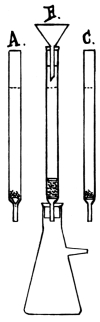
Figure. 7.
Jones’ Reduction Tube.
Reduction Apparatus.—The reduction of the molybdic acid to molybdenum trioxid is accomplished in a tube first proposed by Jones. The apparatus is shown in Figure 7. A piece of moderately heavy glass tubing thirty-five centimeters long with an internal diameter of two centimeters is drawn out at the lower end so as to pass into the stopper of a flask. A circular piece of perforated platinum or porcelain rests on the constricted portion of the tube and this is covered with an asbestos felt. The tube is then nearly filled with powdered zinc which is washed, before using, with dilute sulfuric acid (1 : 20). A, B, C represent different methods of filtering the molybdic solution. In A a platinum cone is placed in the constricted portion of the tube and the asbestos felt placed thereon and the tube then filled with the granulated zinc. In B there is first inserted a perforated disk then some very fine sand and this is covered with another disk. In C there is a perforated disk which is covered with asbestos felt. The filtering arrangement should be such as to prevent any zinc particles from reaching the flask and yet permitting the filtration to go on without much difficulty. A blank determination is first made by adding to 180 cubic centimeters of water, twelve of 0.96 ammonia and ten of strong sulfuric acid. This is poured through the reducing tube and followed with 200 cubic centimeters of water taking care that no air enter the apparatus. Hydrogen peroxid is formed if air enter. Even after standing for a few moments the tube should be washed with dilute sulfuric acid before again using it. The filtrate should be titrated with the permanganate solution and the amount required deducted from the following amounts obtained with the molybdic salt.
Calculations.—The calculations of the amount of phosphorus in a given sample of iron or steel are made according to the following data: In a given case let it be supposed that the permanganate solution is set with a solution of piano wire and it is found that one cubic centimeter of permanganate liquor is equal to 0.003466 gram of metallic iron. It is found that 90.76 parts of molybdic acid will produce the same effect on permanganate as 100 parts of iron. Hence one cubic centimeter of permanganate solution is equivalent to 0.003466 × 0.9076 = 0.003145 gram of molybdic acid. In the yellow precipitate formed, in the conditions named for the analysis it is found that the phosphorus is one and nine-tenths per cent of the molybdic acid present. Therefore one cubic centimeter of permanganate liquor is equal to 0.003145 × 0.019 = 0.0000597 gram of phosphorus. If then, for example, in a sample of iron or steel eight and six-tenths cubic centimeters of permanganate solution, after correction, be found necessary to oxidize the molybdic solution after passing through the Jones’ reducing tube, the amount of phosphorus found is 0.0000597 × 8.6 = 0.051 per cent.
113. The Silver Method.—The separation of the phosphoric acid by silver according to the method of Perrot has been investigated by Spencer, who found the process unreliable.[96] By a modification of the process, however, Spencer obtained fairly satisfactory results. The principle of this method depends on the separation of the phosphoric acid by silver carbonate and the subsequent titration thereof with standard uranium solution after the removal of the excess of silver. The operation is conducted as follows: The fertilizer is first ignited until all organic matter and residual carbon are destroyed. Solution is then accomplished by means of nitric acid and the volume completed to a definite quantity. An aliquot part is taken, after filtration, varying with the supposed strength of the solution so as to contain about 100 milligrams of phosphorus pentoxid. In the slightly nitric acid solution add freshly prepared silver carbonate in excess, that is, sufficient to saturate any free acid present and also to combine with all the phosphoric acid. Wash thoroughly with hot water and then dissolve the mixed phosphate and silver carbonate in nitric acid and remove the silver from the solution with sodium chlorid. The phosphoric acid is determined in the filtrate by means of a standard solution of uranium nitrate in the manner already described. Spencer found that the separation of the phosphoric acid by the silver method was more exact than by the Joulie magnesium citrate process. With practice on the part of the analyst in determining the end reaction the process is both rapid and accurate. The method is also inexpensive, as both the silver and uranium are easily recovered from the waste.
114. Volumetric Silver Method.—Holleman has proposed a modification of the silver method for the volumetric determination of phosphoric acid, which is conducted in the following manner:[97]
In a flask of 200 cubic centimeters capacity, are placed fifty cubic centimeters of the liquid to be analyzed, which should not contain more than two-tenths gram of phosphoric acid. The solution is treated with ten cubic centimeters of a normal solution of sodium acetate and afterwards with a slight excess of decinormal silver solution, four and five-tenths cubic centimeters for each 0.01 gram of phosphoric acid. The solution is then neutralized with tenth normal sodium hydroxid, the amount required having been previously determined by titrating ten cubic centimeters of the liquid to be analyzed, using phenolphthalein as an indicator. Five times the quantity required for the neutralization of the ten cubic centimeters is added, less one-half cubic centimeter. By this treatment the phosphoric acid in the presence of sodium acetate is completely precipitated as silver phosphate. The excess of silver is determined by diluting the mixture to 200 cubic centimeters, filtering, and titrating 100 cubic centimeters of the filtrate with ammonium thiocyanate. The presence of sulfuric and nitric acids does not interfere with the reaction, but of course hydrochloric acid must be absent. Alkalies and alkaline earth metals may be present, but not the heavy metals.
When iron and aluminum are present 100 cubic centimeters of the solution are precipitated with thirty cubic centimeters of normal sodium acetate, the phosphoric acid is determined in fifty cubic centimeters of the filtrate, and the precipitate of iron and aluminum phosphates is ignited and weighed, and its weight multiplied by 2.225 is added to the phosphoric anhydrid found volumetrically. If ammonia be present it must be removed by boiling, as otherwise it affects the titration with phenolphthalein.
For agricultural purposes this method can have but little value inasmuch as the phosphates to be examined almost always have a certain proportion of iron and aluminum. Inasmuch as the amount of these bases has to be determined gravimetrically, there would be no gain in time and no simplification of the processes by the use of the volumetric method as proposed.
TECHNICAL DETERMINATION OF PHOSPHORIC ACID.
115. Desirability Of Methods.—In the preceding paragraphs, has been given a statement of the principal methods now in use by chemists and others connected with fertilizer control for the scientific and agronomic determinations of phosphoric acid, and its agricultural value.
A résumé of the important methods, in a form suited to use in a factory for preparing phosphatic fertilizers for the market, seems desirable. In these factories the chemists have been accustomed to use their own, or private methods, and there has not been a general disposition among them to publish their methods and experience for the common benefit. For factory processes, a method should be not only reasonably accurate, but also simple and rapid. It is evident, therefore, that the general principles already indicated must underlie any method which would prove useful to factory work. Albert has made a résumé of such methods applicable for factory control, and these are given here for convenience, although they are, in many respects, but condensed statements of methods already described.[98]
116. Reagents.—Molybdate Solution.—One hundred and ten grams of pure molybdic acid are dissolved in ammonia of nine-tenths specific gravity and diluted with water to one liter. The solution is poured into one liter of nitric acid, of one and two-tenths specific gravity, and, after standing a few days, filtered.
Concentrated Ammonium Nitrate Solution.—Seven hundred and fifty grams of pure ammonium nitrate are dissolved in water and made up to one liter.
Magnesia Mixture.—Fifty-five grams of magnesium chlorid; seventy grams of ammonium chlorid; 130 cubic centimeters of ammonia of nine-tenths specific gravity are dissolved and diluted with water to one liter.
Two and One-Half Per Cent Ammonia.—One hundred cubic centimeters of ammonia of nine-tenths specific gravity are diluted with water to one liter.
Joulie’s Citrate Solution.—Four hundred grams of citric acid are dissolved in ammonia of nine-tenths specific gravity and diluted to one liter with ammonia of the same strength.
Wagner’s Citrate Solution.—One hundred and fifty grams of citric acid are exactly neutralized with ammonia, then ten grams of citric acid added and diluted to one liter with water.
Sodium Acetate Solution.—One hundred grams of sodium acetate, crystallized, are dissolved in water, treated with 100 cubic centimeters of acetic acid, and diluted to one liter with water.
Calcium Phosphate Solution.—About ten grams of dry, pure tribasic calcium phosphate are dissolved in nitric acid and diluted with water to one liter. In this solution the phosphoric acid is determined gravimetrically by the molybdate or citrate method, and the value of the solution marked on the flask containing it.
Titrated Uranium Solution.—Two hundred and fifty grams of uranium nitrate are dissolved in water, twenty-five grams of sodium acetate added, and the whole diluted to seven liters. One cubic centimeter of this solution corresponds to about 0.005 gram of phosphorus pentoxid. In order to determine its exact value proceed as follows: Twenty-five cubic centimeters of the calcium phosphate solution which, for example, has been found to contain 0.10317 gram of phosphorus pentoxid, are neutralized in a porcelain dish with ammonia, acidified with acetic, treated with ten cubic centimeters of sodium acetate solution, and warmed. Through a burette as much uranium solution is allowed to flow as is necessary to show in a drop of the solution taken out of the dish, when treated with a drop of pure potassium ferrocyanid, a slight brown color. In order to be certain, this operation is repeated two or three times with new quantities of twenty-five cubic centimeters of calcium phosphate solution. Example:
Twenty-five cubic centimeters of the calcium phosphate solution containing 0.10317 gram of phosphorus pentoxid, gave as a mean of three determinations 23.2 cubic centimeters of the uranium solution necessary to produce the brown color with potassium ferrocyanid. Consequently 0.10317 ÷ 23.2 = 0.00445 gram of phosphorus pentoxid equivalent to one cubic centimeter of uranium solution. If, for instance, a quantity of fertilizer weighing exactly five grams, require ten cubic centimeters of the uranium solution for the complete precipitation of its phosphoric acid, then the quantity of phosphoric acid contained in the fertilizer would be equivalent to 10 × 0.0045, equivalent to 0.0445 gram of phosphorus pentoxid. The fertilizer, therefore, contains eight and nine-tenths per cent of phosphorus pentoxid.
Conduct of the Molybdenum Method.—This method rests upon the precipitation of the phosphorus pentoxid by a solution of ammonium molybdate in nitric acid, solution of the precipitate in ammonia, and subsequent precipitation with magnesia.
Manipulation.—Twenty-five or fifty cubic centimeters of a solution of the phosphate which has been made up to a standard volume and containing about one-tenth gram of phosphorus pentoxid, are placed in a beaker together with 100 cubic centimeters of the molybdate solution and treated with as much ammonium nitrate solution as will be sufficient to give the liquid a content of fifteen per cent of ammonium nitrate. The contents of the beaker are well mixed and warmed for about twenty minutes at from 60° to 80°. After cooling, they are filtered and the precipitate washed on the filter with cold water until a drop of the filtrate saturated with ammonia does not become opaque on treatment with ammonium oxalate. The filtrate is then washed from the filter with two and one-half per cent ammonia solution and precipitated slowly and with constant stirring by the magnesia mixture. After standing for two hours the ammonium magnesium phosphate is separated by filtration, washed with two and one-half per cent ammonia until the filtrate contains no more chlorin, and ignited.
Conduct of the Citrate Method.—The principle of this method depends upon the fact that when a sufficient quantity of ammonium citrate is added to phosphate solutions, iron, alumina, and lime are retained in solution when, on the addition of the magnesia mixture in the presence of free ammonia, the phosphoric acid is completely precipitated as ammonium magnesium phosphate.
Manipulation.—From ten to fifty cubic centimeters of the solution of the phosphate to be determined are treated with fifteen cubic centimeters of the Joulie citrate solution avoiding warming. A few pieces of filter-paper, the ash content of which is known, are thrown in and, with stirring, fifteen cubic centimeters of magnesia mixture slowly added and if necessary also some free ammonia. By the small pieces of filter-paper the collection of the precipitate against the sides of the vessel and on the stirring rod is prevented and in this way the production of the precipitate hastened. After standing from one-half an hour to two hours the mixture is filtered, ignited, and weighed. If it be preferred to estimate the phosphoric acid by titration, the precipitate is dissolved in a little nitric acid, made slightly alkaline with ammonia, and then acid with acetic and then afterwards titrated with the standard uranium solution.
Conduct of the Uranium Method.—The principle upon which this method rests depends upon the fact that uranium nitrate or acetate precipitates uranium phosphate from solutions containing phosphoric acid and which contain no other free acid except acetic. In the presence of ammonium salts the precipitate is uranium ammonium phosphate having the formula PO₄NH₄UrO₂. The smallest excess of soluble uranium salt is at once detected by the ordinary treatment with potassium ferrocyanid.
Manipulation.—In all cases the solution is first made slightly alkaline with ammonia and then acid by a few drops of acetic, so that no free mineral acid may be present.
(1) With liquids free from iron:
If, on the addition of ammonium or sodium acetate, no turbidity be produced, the liquid is free from iron and alumina. In this case from ten to fifty cubic centimeters of the solution containing about one-tenth gram of phosphorus pentoxid are treated with ten cubic centimeters of sodium acetate, and afterwards with a quantity of uranium solution corresponding, as nearly as possible, to its supposed content of phosphorus pentoxid, and heated to boiling. From the heated liquid by means of a glass rod, one or two drops are taken and placed upon a porcelain plate and one drop of a freshly prepared solution of potassium ferrocyanid allowed to flow on it. If no brown color be seen at the point of contact of the two drops, additional quantities of the uranium solution are added and, after boiling, again tested with potassium ferrocyanid until a brown color is distinctly visible. The quantity of the uranium solution thus having been determined, duplicate analyses can be made and the whole quantity of the uranium solution added at once with the exception of the last drops, which are added as before.
(2) Solutions containing iron and alumina.
The solution is treated with the ammonium citrate solution of Joulie, the magnesia mixture added slowly, and the precipitate collected on a filter and washed with two and one-half per cent ammonia. The precipitate is then dissolved in nitric acid, made alkaline with ammonia, and then acid with acetic. This solution is then treated with ten cubic centimeters of sodium acetate and titrated with uranium, as described in (1). As an alternative method, 200 cubic centimeters of the superphosphate solution may be treated with fifty cubic centimeters of sodium acetate, allowed to stand for some time, and filtered through a filter of known ash content. In fifty cubic centimeters of the filtrate, which correspond to forty cubic centimeters of the original solution, phosphoric acid may be determined as described above. The precipitate, consisting of iron and aluminum phosphates, is washed three times on the filter with boiling water, dried, and ignited in a platinum dish. The weight of ignited precipitate, diminished by the weight of the ash contained in the filter and divided by two, gives the quantity of phosphorus pentoxid which it is necessary to add to that obtained by titration.
117. Determination of the Phosphoric Acid in all Phosphates and Basic Slags.—
(1) Total phosphoric Acid:
Five grams of the fine phosphate meal, or slag meal, are moistened in a flask of 500 cubic centimeters content with some water and boiled on a sand-bath with forty cubic centimeters of hydrochloric acid of from 16° to 20° Beaumé. The boiling is continued until only a few cubic centimeters of a thick jelly of silicic acid remain. After cooling, some water is added and the phosphate shaken until the thick lumps of silica are finely divided. The flask is then filled to 500 cubic centimeters and its contents filtered. Fifty cubic centimeters of the filtrate are treated with fifteen cubic centimeters of the Joulie solution and treated in the manner described with magnesia mixture, precipitated, ignited, and weighed. The precipitate can also be dissolved and treated with uranium solution as described.
The method used by Oliveri may also be employed and it is carried out as indicated in the following description:[99]
A weighed quantity of the slag is reduced to a fine powder. To five grams of the sample is added three times its weight of potassium chlorate and the whole is intimately mixed. The mixture is then placed in a porcelain dish and hydrochloric acid is added, little by little, until the potash salt is completely decomposed. It is evaporated until the mass is dry. The material is then treated with fuming nitric acid, and the determination of the phosphorus is made by the ordinary gravimetric method.
By carrying on the operation as described above, a reduction of phosphoric acid is avoided, and the presence of an abundant quantity of potash prevents the formation of basic iron phosphate which is insoluble in nitric acid.
(2) Citrate-Soluble Phosphoric Acid.—One gram of the basic slag or phosphate is placed in a 100 cubic centimeter flask and covered with Wagner’s acid citrate solution making the total volume up to 100 cubic centimeters. With frequent shaking the flask is kept at 40° for an hour, or it may be allowed to stand for twelve hours at room temperature with frequent shaking. In fifty cubic centimeters of the filtrate from this flask the phosphoric acid is determined by the magnesia mixture as described. Since, in the present case, the precipitate of ammonium magnesium phosphate contains some silicic acid it cannot be directly ignited but must be treated in the following manner: The precipitate and the filter are thrown into a porcelain dish, the filter-paper torn up into shreds with a glass rod, the precipitate dissolved in nitric acid, neutralized with ammonia, acidified with acetic, and treated with uranium solution. The phosphoric acid may also be estimated by the gravimetric method by dissolving the precipitate again in hydrochloric or nitric acid, evaporating to dryness, and drying for one hour at from 110° to 120°, dissolving again in hydrochloric acid, filtering, and washing the precipitate well. The filtrate, which is now free from silica, can be treated with Joulie’s solution, precipitated with magnesia mixture, the precipitate washed, ignited, and weighed as described. The molybdenum method is preferred in the estimation of citrate-soluble phosphoric acid, especially in slags. For this purpose fifty cubic centimeters of the filtrate from the solution of one gram of slag in 100 cubic centimeters of Wagner’s citrate liquid are treated with 100 cubic centimeters of molybdenum solution and thirty cubic centimeters of ammonium nitrate solution, warmed for twenty minutes at 80°, filtered after cooling, and the yellow precipitate washed with cold water. The water will gradually dissolve all the silicic acid from the yellow precipitate and carry it into the filtrate. The yellow precipitate is then dissolved in two and one-half per cent liquid ammonia and precipitated with magnesia mixture and the precipitate washed, ignited, and weighed in the way described.
118. Determination of Phosphoric Acid in Superphosphates.—(1) Citrate-Soluble Phosphoric Acid.—Five grams of the superphosphate are rubbed with 100 cubic centimeters of Wagner’s acid citrate solution in a mortar and washed into a flask of 500 cubic centimeters content and diluted to 500 cubic centimeters with water. With frequent shaking the flask is allowed to stand for twelve hours, after which its contents are filtered. Fifty cubic centimeters of the filtrate are treated with ten cubic centimeters of the Joulie solution and fifteen cubic centimeters of the magnesia mixture and, if necessary, made distinctly alkaline with ammonia, vigorously stirred, and, after two hours, filtered. The precipitate is washed, ignited, and weighed as described, or titrated, after solution in nitric acid and the addition of sodium acetate, with uranium solution. Example:
The weighed precipitate has 0.1272 gram Mg₂P₂O₇ then the phosphate contains 12.72 × 2 × 0.64 = 16.28 per cent of citrate-soluble P₂O₅.
(2) Water-Soluble Phosphoric Acid.—Twenty grams of superphosphate are rubbed in a mortar and washed into a flask of one liter content and made up to the mark with water. After two hours’ digestion with frequent shaking, the contents of the flask are filtered through a folded filter. Twenty-five cubic centimeters of the filtrate equivalent to five-tenths gram of the substance are precipitated with magnesia mixture, the precipitate filtered, washed, ignited, and weighed, or the moist filtrate may be dissolved upon the filter with a little nitric acid, treated with sodium acetate, and titrated, as described, with uranium solution.
Example: 14.5 cubic centimeters of the uranium solution are required for the precipitate from twenty-five cubic centimeters of the original solution = 0.5 gram superphosphate; it contains then 14.5 × 0.00445 = 0.0645 gram P₂O₅. Consequently the superphosphate contains 12.90 per cent of water-soluble P₂O₅.
Total Phosphoric Add.—Twenty grams of the superphosphate are boiled with fifty cubic centimeters of hydrochloric acid of from 16° to 18° Beaumé for about ten minutes and, after cooling, made up to one liter with water and filtered. Twenty-five cubic centimeters of the filtrate are treated with ten cubic centimeters of Joulie’s citrate solution, a few pieces of filter-paper thrown in, fifteen cubic centimeters of magnesia mixture added, and the whole thoroughly stirred. After standing two hours the contents of the flask are filtered and the precipitate is washed with dilute ammonia and the filter and the precipitate are placed in a platinum crucible. The crucible is heated slowly until the moisture is driven off and the filter burned. Then the temperature is gradually raised to a white heat. The residue is cooled and weighed. Example:
The precipitate weighs, after the subtraction of the filter ash, 0.1390 gram; then the superphosphate contains 13.90 × 2 × 0.64 = 17.79 per cent phosphoric acid.
MISCELLANEOUS NOTES ON PHOSPHATES AND PHOSPHATIC FERTILIZERS.
119. Time Required for Precipitation of Phosphoric Acid.—The length of time required for the complete precipitation of the phosphoric acid by molybdate mixture is perhaps much less than generally supposed. At 65° the precipitation, as shown by de Roode, is complete in five minutes.[100] In a given case the weight of pyrophosphate obtained after five minutes was 0.0676 gram, and exactly the same weight was found after twenty-four hours. In view of these facts analysts would often be able to save time by omitting the delay usually demanded by the setting aside of the yellow precipitate for a few hours in order to secure a complete separation of the phosphoric acid. In the method of the official chemists it is directed that the digestion at 65° be continued for one hour, and this time may possibly be shortened with advantage. In all cases, however, where there is any doubt in regard to the complete separation, some of the molybdate solution should be added to the filtrate and, with renewed digestion, it should be noted whether any additional precipitate be formed.
120. Examination of the Pyrophosphate.—In fertilizer control it is not usually thought necessary to examine the magnesium pyrophosphate for impurities. Among those most likely to be found is silica. It is proper, in all cases where accuracy is required, to dissolve the precipitate in nitric acid, boil for some time to convert the pyro- into orthophosphate, and reprecipitate with molybdate and magnesia mixture. This treatment will separate the silica which remains practically insoluble after the first ignition. It has been observed by some analysts that the results obtained by the official method are a trifle too high and also that on re-solution the second precipitate of pyrophosphate weighs less than the first.[101] The difference in most cases is very little but it may become a quantity of considerable magnitude in samples where soluble silica is found in notable quantities. The danger of contamination with iron, alumina, and arsenic has already been mentioned but it is not of sufficient importance to warrant further attention.
121. Iodin in Phosphates.—The presence of iodin has been detected in many natural phosphates and is of interest in the discussion of the problem of their origin.[102] A qualitative test for the detection of iodin may be applied in the following manner: Some finely ground phosphate is mixed with strong sulfuric acid and the gases arising from the reaction are aspired into some carbon disulfid or chloroform. The violet coloration arising indicates the presence of iodin. The gases carrying the iodin may also be brought into contact with starch-paste producing the well-known blue color.
The quantity of iodin present in a phosphate is rarely more than one or two-tenths of one per cent. It can be determined as a silver salt, in the absence of chlorin or by any of the standard methods found in works on qualitative analysis.
Iodin is quite a constant constituent of Florida phosphates.
For a quantitative determination, the sample is treated with an excess of strong sulfuric acid in a closed flask and during the decomposition a stream of air is aspired through the flask and caused to bubble through absorption bulbs containing sodium hydroxid in solution.
The temperature of the decomposition may be raised to about 200°. After the solution of the sample the sodium iodid formed is oxidized by heating with potassium permanganate, acidulated and mixed with a solution of potassium iodid to hold the free iodin in solution. The free iodin is determined in the usual way by titration with standard sodium thiosulfate solution. The reactions preparatory to the titration are represented by the following formulas:
2KI + H₂SO₄ = K₂SO₄ + 2HI. 2HI + H₂SO₄ = 2H₂O + SO₂ + 2I. 6I + 6NaOH = NaIO₃ + 5NaI + 3H₂O. NaI + 2KMnO₄ + H₂O = NaIO₃ + 2KOH + 2MnO₂. HIO₃ + 5HI = 6I + 3H₂O.
The titration is represented by the following reaction:
2Na₂S₂O₂ + 2I = 2NaI + 2NaI + Na₂S₄O₄.
The decinormal solution of sodium thiosulfate may be used. Grind the crystals of the salt to a fine powder, dry between blotting papers, and use 24.8 grams of the dried salt per liter. The quantity of iodin found in phosphates is so minute that it is hardly worth while to make a quantitative determination of it.
122. Occurrence of Chromium in Phosphates.—In some phosphates a small quantity of chromium has been found. In a sample of phosphate from the Island of Los Roques in the Caribbean Sea, Gilbert found three-fourths per cent of chromium oxid (Cr₂O₃). The phosphates containing chromium have a greenish color and are characterized by great insolubility in solutions containing organic acids. The chromium is to be determined by the usual methods described in mineral analysis.
123. Estimation of Vanadium.—In the complete analysis of basic slags it becomes necessary to determine the presence of vanadium and its quantity. The method used in this laboratory for the purpose is the volumetric process of Lindemann.[103] It is conducted as follows: Dissolve four grams of the finely powdered slag in sixty cubic centimeters of dilute sulfuric acid (1 : 4), boil for a few minutes, cool, make the volume up to 100 cubic centimeters, filter, and take an aliquot part for the determination. Add decinormal potassium permanganate solution in slight excess to secure the oxidation of the vanadium to vanadium pentoxid. Add, drop by drop, a weak solution of ferrous sulfate until the pink color just disappears. Prepare a ferrous sulfate solution by dissolving 2.183 grams of piano wire in sulfuric acid and making the volume to one liter. Titrate the vanadic mixture with this solution until a drop of the clear liquor removed and brought in contact with potassium ferricyanid shows a distinctive blue-green color.
One cubic centimeter of the ferrous sulfate solution is equivalent to 0.002 gram of vanadium, 0.002888 gram of vanadium dioxid, and 0.003648 gram of vanadium pentoxid. The ferrous sulfate solution may also be made and standardized by any of the approved methods in common use.
The method described by Blair, designed especially for the estimation of vanadium in iron and steel, is conducted in the following manner:[104] Five grams of the drillings are dissolved in fifty cubic centimeters of nitric acid of 1.24 specific gravity. The solution is evaporated to dryness in a porcelain dish and heated thereafter until the nitrates are nearly decomposed. After cooling, the dried mass is transferred to a mortar and finely ground with thirty grams of dry sodium carbonate and three grams of sodium nitrate. The finely ground materials are placed in a platinum dish and fused for an hour at a high temperature. Spread the fused mass over the sides of the dish while cooling, and afterwards dissolve in hot water, filter, and wash until the volume is a little over half a liter. Add nitric acid to decompose carbonates, but not completely, and boil to get rid of carbon dioxid, being careful to keep the mass always slightly alkaline. Add nitric acid, drop by drop, until slightly in excess, and then sodium carbonate to marked alkalinity, boil, and filter. Add a slight excess of nitric acid to the filtrate, and the development of a yellow color will indicate the presence of vanadic acid. Add to the solution a small quantity of mercurous nitrate and then an excess of mercuric oxid, suspended in water to render the solution neutral and insure the complete precipitation of mercurous vanadate. The mercurous salt also precipitates phosphoric, chromic, tungstic, and molybdic acids which may be present. Boil, filter, and wash the precipitate with hot water, dry, and ignite. Fuse the residue with sodium carbonate and a little nitrate. Dissolve the fused mass, after cooling, in a little water and filter. Add to the filtrate, ammonium chlorid in excess, from three to five grams for each 100 cubic centimeters of the solution, and allow to stand, with occasional stirring, for some time. Ammonium vanadate, insoluble in a saturated solution of ammonium chlorid, separates as a white powder. It is necessary to keep the solution alkaline, and a drop of ammonia should be added from time to time for this purpose. The appearance of a yellowish tint at any time indicates that the solution has become acid, and this acidity must be corrected, or else the results will be too low. Separate the ammonium vanadate by filtration; wash first with a saturated solution of ammonium chlorid containing a little free ammonia, and then with alcohol. Dry, ignite, and moisten with a few drops of nitric acid; again ignite to obtain the compound as vanadium pentoxid. This compound contains 56.22 per cent of vanadium. The method of Rosenheim and Holversheet may also be used.[105] It is based on the preliminary precipitation of the vanadic acid as a barium or lead salt. The substance supposed to contain vanadium is first brought into solution in such a manner as to secure it as vanadic acid, which is then precipitated with barium chlorid or lead acetate. The precipitate is boiled with hydrochloric acid and potassium bromid, and the liberated bromin determined by the quantity of iodin set free from potassium iodid. In the absence of bodies, such as molybdic acid, which are reduced by sulfurous acid or hydrogen sulfid, the vanadic acid may also be determined by reducing it with one of these reagents and, after removing the excess by boiling, titrating the vanadium tetroxid with potassium permanganate. When vanadic and phosphoric acids occur together the former may be first reduced to tetroxid with sulfurous acid, and after expelling excess of this reagent, the phosphoric acid may be separated with molybdate solution and removed by filtration. When the amount of vanadic acid is large the phosphoric acid should be separated rapidly at 55°-60°, using a considerable excess of the molybdate; or the vanadic acid may first be determined in the solution volumetrically by the bromin process above described, and afterwards the phosphoric acid obtained by evaporating to dryness with a little sulfuric acid, taking the residue up with water, reducing the vanadic with sulfurous acid and precipitating the phosphoric acid with molybdate solution as described above.
124. Fluorin in Bones.—Fluorin is not only a constituent of mineral phosphates but also of bones. According to the researches of Carnot there is often as much as one-half per cent of calcium fluorid in bones and teeth.[106] Gabriel has suggested a means of determining a minimum limit of fluorin in bones and teeth by the development of etchings in comparison with known quantities of pure calcium fluorid. The minimum quantity of calcium fluorid necessary to produce a distinct etching, in known conditions, having been determined, the test is applied to known weights of ignited bone or teeth. He concludes from his results, that the ash of bones and teeth often contains less than one-tenth per cent of fluorin. Since, however, there is a loss of fluorin from calcium fluorid, on ignition, the whole of the fluorin may not have been available in the tests described.
125. Note on the Separation of Iron and Aluminum Phosphates from the Calcium Compound.—There are many points of difference noted in the descriptions given by authors of the deportment of the iron, and aluminum phosphates in presence of a large excess of the calcium salt. Especially is this true of the statements made by Hess and Glaser[107] in paragraphs 34 and 35. The subject is of such importance, from an analytical point of view, as to merit a careful study.
In this laboratory a thorough investigation of the mutual deportment of these three phosphates has been made by Brown with the following results:[108] When a mixture containing a known weight of the salts was treated exactly as Hess directs, in no case was there a complete separation of the iron aluminum phosphate from the calcium salt. In order to discover the cause of the failure, pure solutions of calcium and iron aluminum phosphates were treated under identical conditions by the necessary reagents. Fifty cubic centimeters of a solution of calcium phosphate, containing about one gram of the salt, were treated with 100 cubic centimeters of water and fifty cubic centimeters of the commercial ammonium acetate containing 150 grams of the salt in a liter. An immediate precipitate was produced at ordinary temperature, and on heating to 60° it became abundant. The addition of ammonium chlorid, phosphate, and nitrate in successive portions, does not prevent the precipitation. Making the solution more dilute lessens the difficulty when twenty cubic centimeters of a ten per cent solution of ammonium phosphate are first added, followed by the usual quantity of ammonium acetate; a clear crystalline precipitate is sometimes observed. Experience also shows that the trouble is not due to an excess of the ammonium acetate.
In treating a solution of iron aluminum phosphate, in similar circumstances, with the ammonium acetate, it is found that a complete precipitation takes place.
Since diluting the solution of the calcium salt diminishes its tendency to form a precipitate with the ammonium acetate the true method of separation seems to lie in that direction. The calcium salt is held completely in solution when the separation is made in the following way.
The solution containing the mixed phosphates is diluted so as to contain not more than one gram thereof in half a liter. To this is added one drop of dimethylanilin orange, and afterwards ammonium hydroxid, until a very slight precipitate is formed. The mixture is heated to 70° and from twenty to twenty-five cubic centimeters of a twenty-five per cent solution of acid ammonium acetate are added, enough to change the rose color of the indicator to orange. The iron aluminum phosphate is separated by filtration and washed with a hot five per cent solution of ammonium nitrate.
The washed precipitate shows no impurity due to calcium, as proved by dissolving it, reprecipitating and filtering, adding ammonium hydroxid to the filtrate, and heating for a long time. Sometimes a slight troubling of the clear liquid may be observed which may be due to a slight solubility of the iron aluminum phosphate in washing, an accident that may occur if the temperature be allowed to fall below 70°, but no weighable amount of material is obtained. If due to calcium phosphate, a greater dilution in the first precipitation will remove even this mere trace of that salt. In the above conditions the contamination of the iron aluminum precipitate with calcium phosphate may be entirely avoided. We had also undertaken here the problem of separating the phosphoric acid by the citrate method, followed by a destruction of the citric acid in the filtrate by combustion with sulfuric acid according to the kjeldahl process, and final separation of the iron and alumina in the residues when our attention was called to substantially the same process as described by Jean.[109] The method merits a further critical examination.
126. Phosphoric Acid Soluble in Ammonium Citrate.—There is no other point connected with the determination of phosphoric acid which has excited so much discussion and about which there is such difference of opinion as the solubility of phosphates in ammonium citrate. It was clearly established by Huston, in 1882, that the ammonium citrate, as used in fertilizer analysis, would attack normal tricalcium phosphate as it exists in bones.[110]
In a raw bone, finely ground, containing 20.28 per cent of phosphoric acid, the following quantities were found to be soluble in a neutral ammonium citrate solution of 1.09 specific gravity.
Time of digestion, thirty minutes.
Temperature 30° 40° 50° 60°
Per cent P₂O₅ dissolved 2.76 4.01 3.39 5.88
From this it appears that the quantity of acid dissolved increases with the temperature of digestion with the exception of the number obtained at 50°. When the time of digestion was increased there was also found a progressive increase in the amount of acid passing into solution. At 40° for forty-five minutes the per cent dissolved was 4.97, and at 40° for one hour it was 5.92. These early determinations had the effect of calling attention to the thoroughly empirical process which was in use, in many modified forms, by agricultural chemists, the world over for determining so-called reverted phosphoric acid in fertilizers. Since the publication of the paper above named many investigations have been undertaken by Huston and others relating to this matter.[111] The general results of these studies, tabulated by Huston, are given below.[112]
Influence of the Time of Digestion.
(A) = Temperature, degrees C.
(B) = Citrate-soluble phosphoric acid.
(C) = Total phosphoric acid.
Material. Authority. (A) Time of digestion. (B) Per cent. (C) Per cent.
Bone meal, F. B. Dancy, 65 ½ hour 10.60 19.75

65 1 “ 11.28 19.75
Orchilla guano, F. B. Dancy, 65 ½ “ 6.62 21.68
65 1 “ 6.85
Navassa rock, F. B. Dancy 65 ½ “ 4.64 31.27
65 1 “ 4.81 31.27
Navassa F. B. Dancy, 65 ½ “ 9.00 11.47
superphos., 65 1 “ 9.21 11.47
Bone meal, H. A. Huston, 40 ½ “ 4.01 20.28
40 1 “ 5.92 20.28
Bone meal, H. A. Huston and 65 ½ “ 6.17 23.58

raw, W. J. Jones, Jr., 65 1 “ 6.49 23.58
65 2 hours 8.22 23.58
65 5 “ 9.31 23.58
Steamed bone, H. A. Huston and 65 ½ hour 10.59 27.67
W. J. Jones, Jr., 65 1 “ 12.21
65 2 hours 14.61
65 5 “ 17.94
65 10 “ 19.73
Florida H. A. Huston and 65 ½ hour 0.56 19.75

soft rock, W. J. Jones, Jr., 65 2 hours 1.69
65 5 “ 1.47
Precipitated H. A. Huston and 65 ¼ hour 26.72 33.34
calcium W. J. Jones, Jr., 65 ½ “ 27.26
phosphate from 65 1 “ 27.28
glue works 65 2 hours 27.29
Pamunky H. A. Huston and 65 ½ hour 4.43 13.84
phosphate,[113] W. J. Jones, Jr., 65 1 “ 8.28
65 2 hours 10.34
65 5 “ 11.80
65 10 “ 12.58
Calcined H. A. Huston and 65 ½ hour 21.24 45.15
Redonda, W. J. Jones, Jr., 1 “ 31.70
2 hours 36.92
5 “ 41.00
10 “ 42.70
South H. A. Huston and 65 ½ hour 2.82 25.51
Carolina W. J. Jones, Jr., 1 “ 3.13
rock, 2 hours 3.57
5 “ 3.88
Influence of Temperature.
(A) = Temperature, degrees C.
(B) = Citrate-soluble phosphoric acid.
(C) = Total phosphoric acid.
Material. Authority. Time of digestion. (A) (B) Per cent. (C) Per cent.
Apatite T. S. Gladding[114] ½ hour 40 0.30
Canadian, ½ “ 65 0.56
Orchilla guano, T. S. Gladding, ½ “ 40 4.63
½ “ 65 4.81
South Carolina T. S. Gladding, ½ “ 40 1.09
river rock, ½ “ 65 1.35
Navassa rock, T. S. Gladding, ½ “ 40 2.73
½ “ 65 2.53
Grand T. S. Gladding, ½ “ 40 1.16
Connetable, ½ “ 65 1.96
Redonda, S. W. Johnson and ½ “ 40 1.70 36.68
E. H. Farrington, ½ “ 65 1.85
South Carolina S. W. Johnson and ½ “ 40 1.32 25.48
rock, E. H. Farrington, ½ “ 65 1.65