REPRESENTATIVE ART
Reading edition
While the formal elements which we have previously discussed are fundamentally void of definite meaning, conditions are quite different in representative art. The term itself implies that the work does not affect us by its form alone, but also, sometimes even primarily, by its content. The combination of form and content gives to representative art an emotional value entirely apart from the purely formal esthetic effect.
If has been customary to begin the discussion of representative art with a consideration of the simple attempts of primitive people or of children to draw objects that interest them. I believe that the art problem is obscured by this procedure. The mere attempt to represent something, perhaps to communicate an idea graphically, cannot be claimed to be an art; just as little as the spoken word or the gesture by means of which an idea is communicated, or an object,—perhaps a spear, a shield or a box,—in which an idea of usefulness is incorporated, is in itself a work of art. It is likely that an artistic concept may sometimes be present in the mind of the maker or speaker, but is becomes a work of art only when it is technically perfect, or when it shows striving after a formal pattern. Gestures that have rhythmical structure, words that have rhythmic and tonal beauty are works of art; the implement of perfect form lays claim to beauty; and the graphic or sculptural representation has an esthetic, an artistic value, when the technique of representation has been mastered. When a tyro attempts to create a work of art, we may recognize and study the impulse, but the finished product teaches only his vain efforts to master a difficult task. When man is confronted with a new problem like the building of a house of new, unfamiliar material, he is apt to find a solution, but this achievement is not art, it is a work adapted to a practical end. It may be that the solution is intuitive, that is, that it has not been found by an intellectual process, but after having been solved it is subject to a rational explanation.
Just so when man has to represent an object, he is confronted with a problem that demands a solution. The first solution is not an artistic but a practical achievement. We are dealing with a work of art only when the solution is endowed with formal beauty or strives for it. The artistic work begins after the technical problem has been mastered.
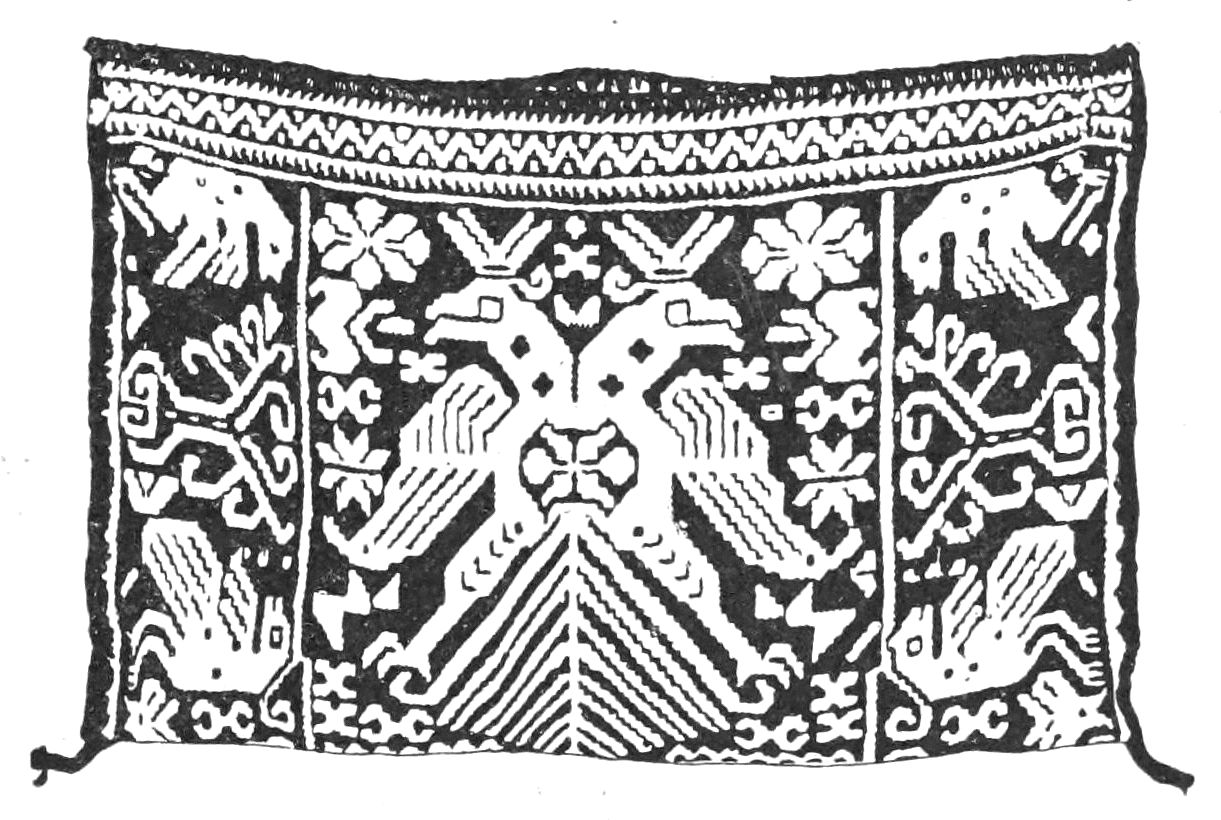
Fig. 59
a
. Embroidery, Huichol Indians, Mexico.
When primitive man is given a pencil and paper and asked to draw an object in nature, he has to use tools unfamiliar to him, and a technique that he has never tried. He must break away from his ordinary methods of work and solve a new problem. The result cannot be a work of art,—except perhaps under very unusual circumstances. Just like the child, the would-be artist is confronted with a task for which he lacks technical preparation, and many of the difficulties that beset the child beset him also. Hence the apparent similarity between children’s drawings and those of primitive man. The attempt of both are made in similar situations. A most characteristic case of this kind was told to me by Mr. Birket-Smith. He asked an Eskimo of Iglulik to draw with a pencil on a piece of paper a walrus hunt. The native was unable to accomplish this task and after several attempts he took a walrus tusk and carved the whole scene in ivory, a technique with which he was familiar.
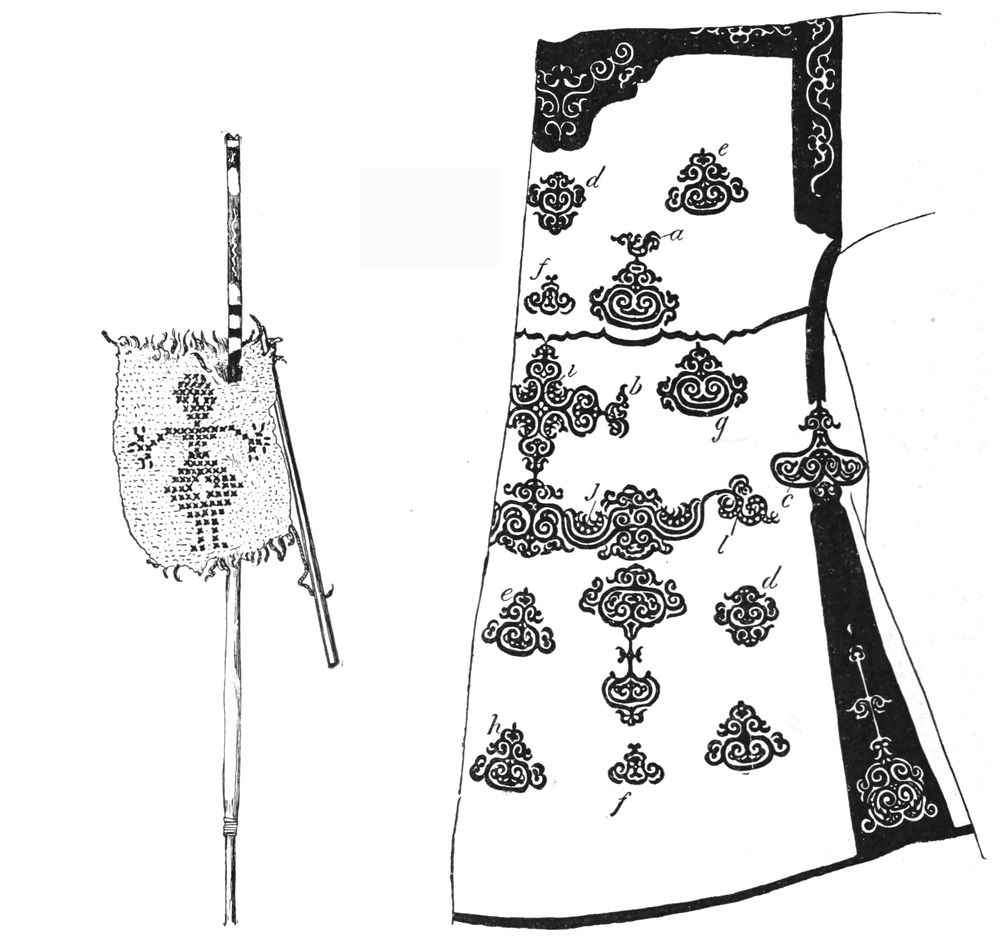
Fig. 59 b. Embroidery, Huichol Indians, Mexico. Fig. 60. Decorated fishskin garment, Amur River.
The contrast between representation for the sake of representation and representation as a work of art appears clearly in many cases. I select a few examples. The Indians of the mountains of northwestern Mexico wear beautifully embroidered or woven clothing, the designs of which are largely based on Spanish motives. Heraldic patterns and isolated animal figures combined with geometrical forms are the constituent elements (fig. 59 a). Besides these embroidered and woven fabrics, which are of excellent workmanship, we find small embroidered rags (fig. 59 b), which are attached to arrows and serve the purpose of representing a prayer to a deity. A roughly outlined figure of a child expresses a prayer for the health of the child; that of a deer, a prayer for success in hunting. The arrows with the attached rags are stuck into the thatched roof of a temple where they are allowed to decay. They are not intended as works of art but only as representations that serve a temporary purpose; hence the disregard of form and of exactness of workmanship.
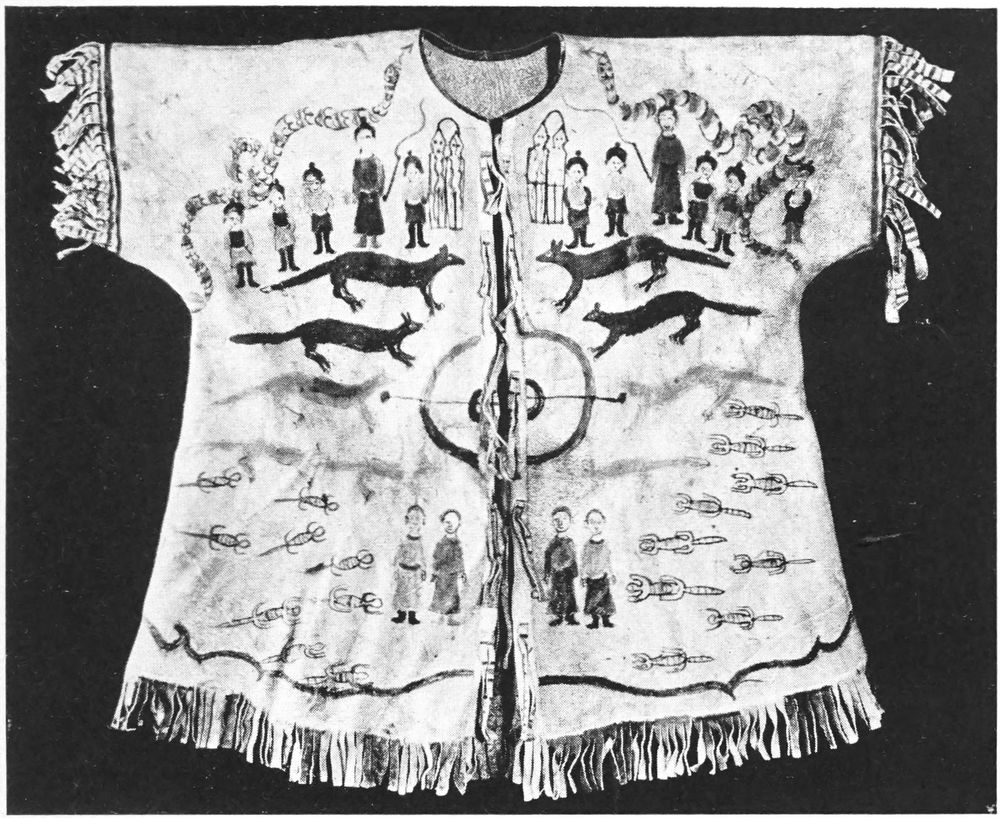
Plate VI.
Shaman’s Dress, Amur River.
Quite similar observations may be made on the clothing of the Amur tribes. The skin clothing worn by the people, particularly on festive occasions, is beautifully ornamented in appliqué, or by painting. The ornaments are in part geometrical, in part representative. Figures of birds and fish abound (fig. 60). On the other hand the painted dresses of shamans are roughly executed (Plate VI). They represent mythological concepts and have a value solely on account of their meaning. The interest does not center in the form. As compared to wearing apparel they are crudely done, for the beauty of execution is of minor importance.
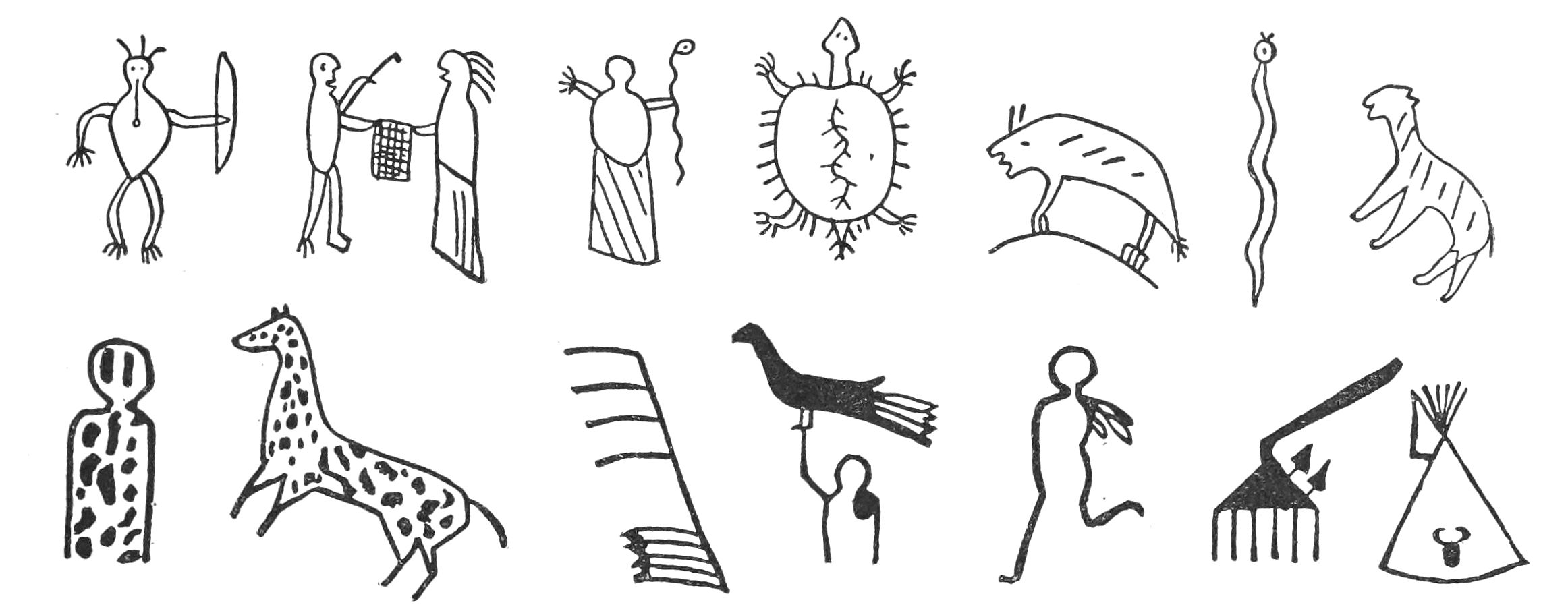
Fig. 61. Upper row, pictographs of Ojibwa Indians; lower row, of Dakota Indians.
A third example is found among the North American Indians of the Great Plains. Their representative art, in the strict sense of the term, is almost entirely confined to a crude form of picture writing. They have not developed a high technique of painting and the forms of horses, men, buffaloes and tents are merely reminders of incidents in the life of the people. The figures (fig. 61) are in no way ornamental and bear no relation to the object on which they are depicted. They are made for the purpose of representation only. They are not art in the rigid sense of the term. Judging from the character of the figures and their use we may safely say that the artistic interest is entirely absent. We may even apply this observation to the picture writing of the ancient Mexicans (fig. 62), which, as compared to their sculpture, is of inferior value. The importance of communicating ideas outweighs the artistic interest. We shall see later on that nevertheless there is a definite relation between artistic style and the forms of inartistic painting (see p. 164).
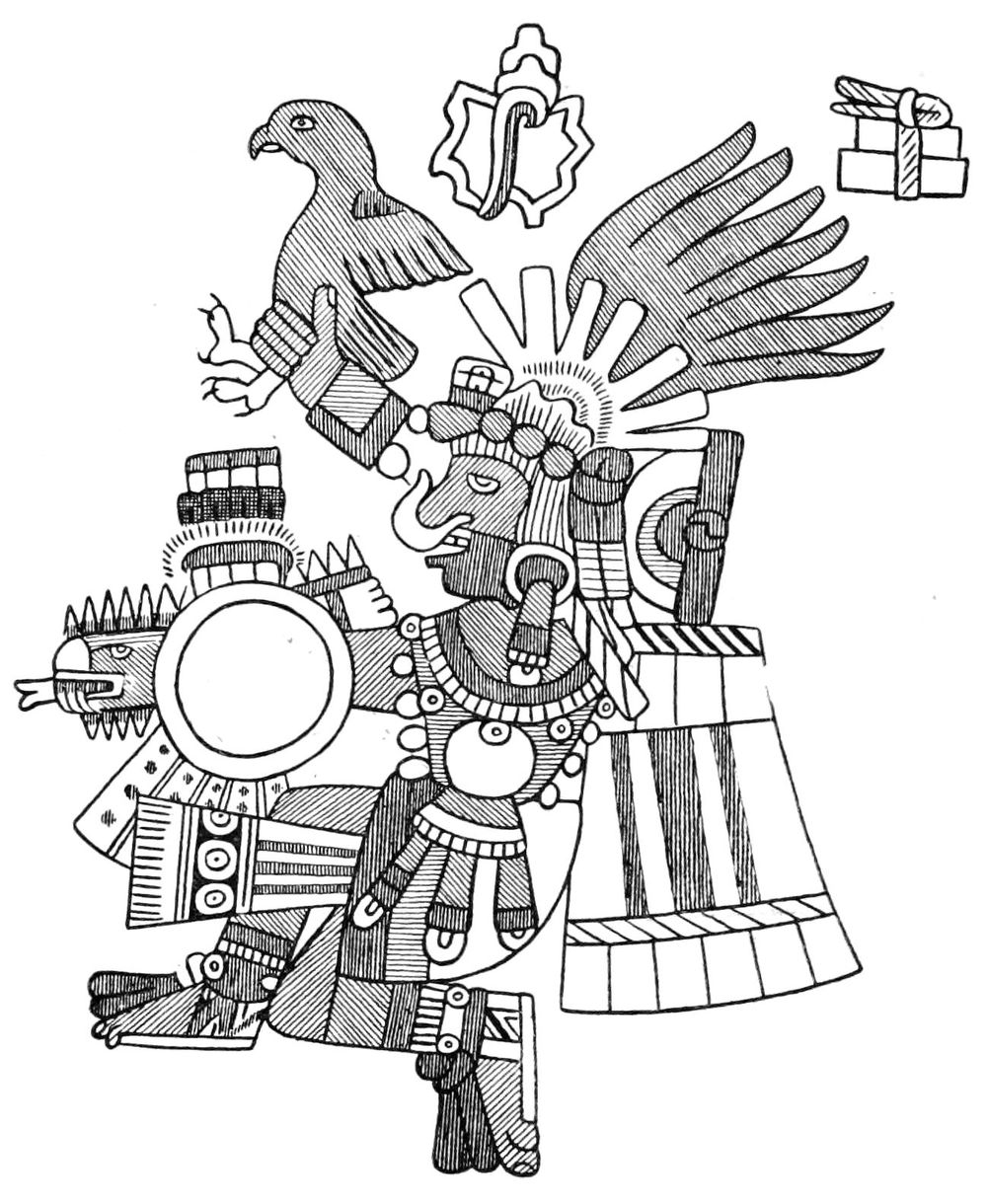
Fig. 62. Mexican painting from Codex Borbonicus.
Incidentally it may be remarked here that the difference in interest sometimes leads to contrasting art styles, provided the representative work is also executed in a perfectly controlled technique. Thus the Northwest Americans who have a very characteristic style of art sometimes make carvings that are intended to deceive by their realism. In one of their ceremonies a person is apparently decapitated and after the decapitation the head is shown held by the hair. This head is carved in wood and done with great care in a most realistic fashion. It is entirely free of the stylistic characteristics of Northwest coast carving and painting (see fig. 156, p. 185).
We revert now to a consideration of the simple, crude representative drawings. The most important inference that may be drawn from the study of such representations, graphic as well as plastic, is that the problem of representation is first of all solved by the use of symbolic forms. There is no attempt at accurate delineation. Neither primitive man nor the child believes that the design or the figure he produces is actually an accurate picture of the object to be represented. A round knob on an elongated cylinder may represent head and body; two pairs of thin, straight strips of rounded cross section, arms and legs; or in a drawing a circle over a rectangle may suggest head and body; straight lines, arms and legs; short diverging lines at the ends of arms and legs, hand and feet.
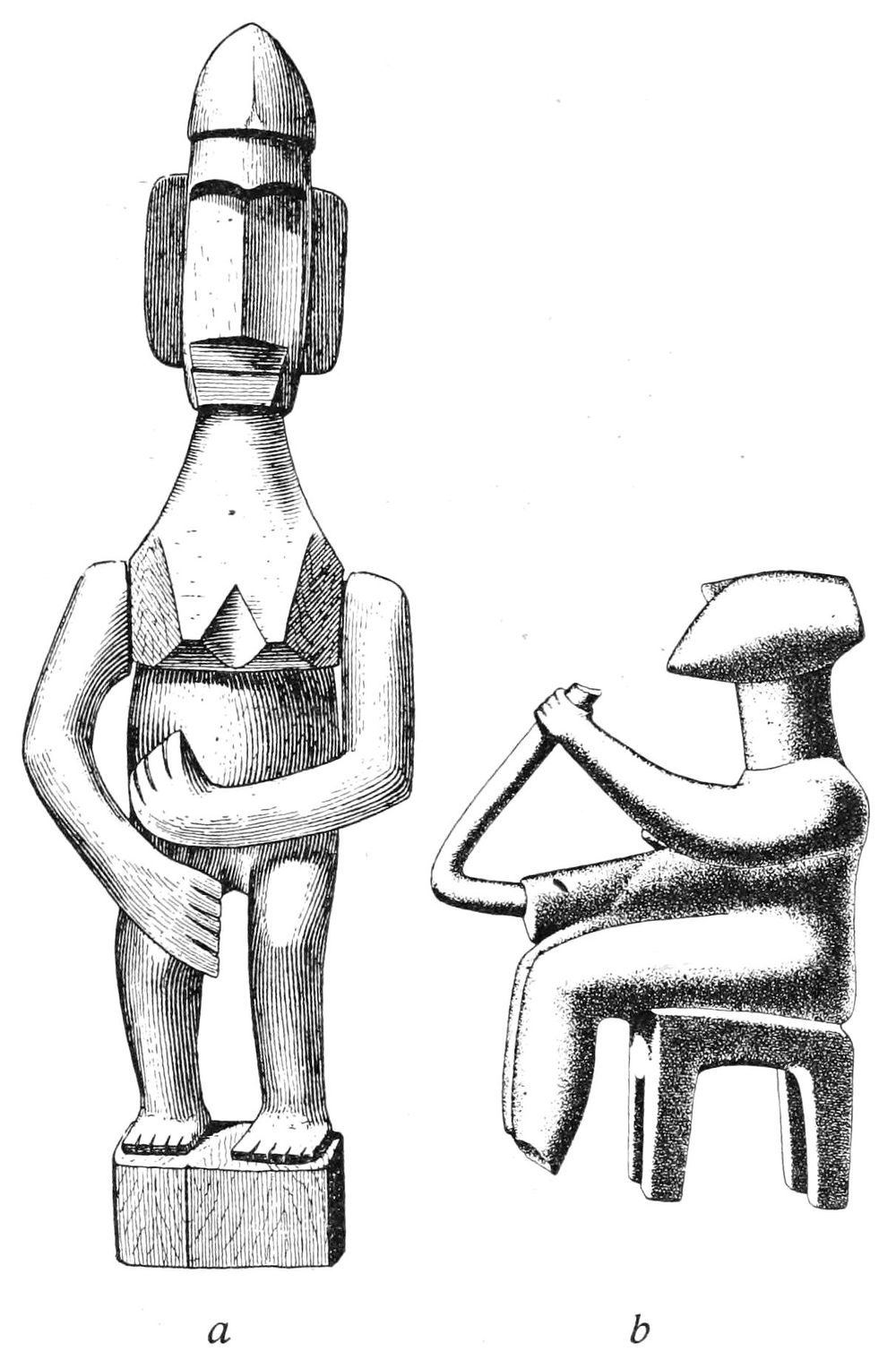
Fig. 63.
a
, Carved figure, Philippine Islands;
b
, Marble figure representing harpist, Thera.
The break between symbolic representation and realism may occur in one of two ways. The artist may endeavor to render the form of the object to be represented in forceful outline and subordinate all consideration of detail under the concept of the mass as a whole. He may even discard all details and cover the form with more or less fanciful decoration without losing the effect of realism of the general outline and of the distribution of surfaces and of masses. On the other hand, he may endeavor to give a realistic representation of details and his work may consist of an assembly of these, with little regard to the form as a whole.
An excellent example of the former method is the Filipino wood carving, fig. 63 a. Head and chest show the concentration of the artist upon the delimiting surfaces and an utter disregard of detail. The same method is used in the figure of a harpist belonging to the ancient art of the Cyclades (fig. 63 b).
In fig. 64, an African mask, the surfaces of forehead, eyes, cheeks and nose are the determinants of the form which has been treated decoratively with the greatest freedom. There are no ears; the eyes are slits with geometrical ornaments; the mouth a circle enclosing a cross. In fig. 65, representing a painted carving from New Guinea, the outline of the face, emphasized by the hair line, eyes, and mouth, is easily recognized, but all the other parts are treated purely decoratively.
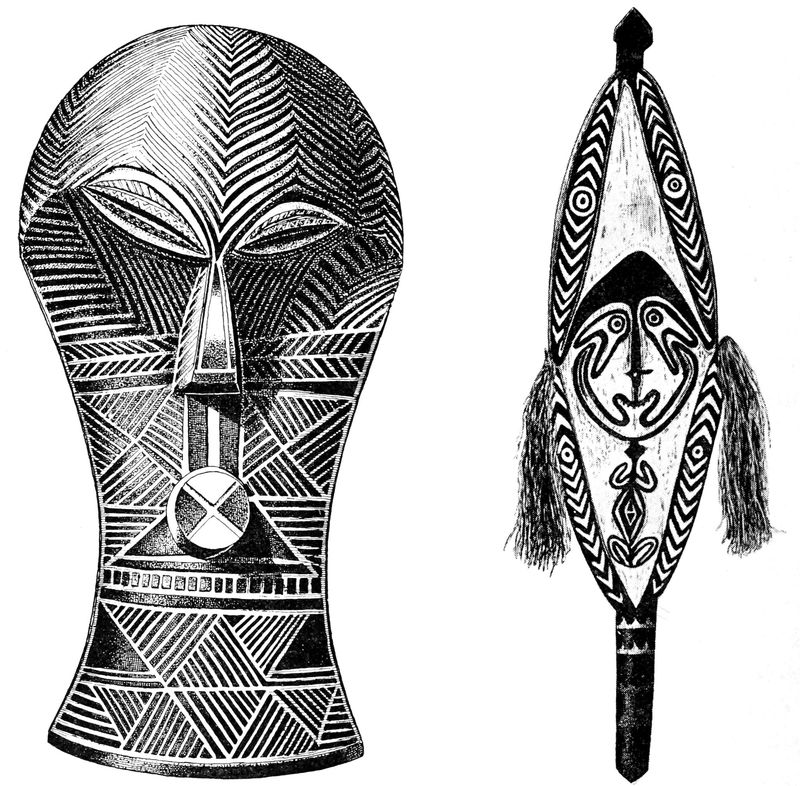
Fig. 64. Wooden mask, Urua, Congo. Fig. 65. Carved board, Papua Gulf, New Guinea.
The opposite method is found, for instance, in Egyptian paintings and reliefs in which eyes, nose, hands, and feet are shown with a fair degree of realism, but composed in ways that distort the natural form and which are perspectively impossible (fig. 66). A still better example is the drawing, fig. 67, an attempt of one of the best Haida artists from Northern British Columbia to illustrate the story of an eagle carrying away a woman. The face of the woman is evidently intended as a three-quarter view. Facial painting will be noticed on the left cheek; the left ear only is shown as seen in profile; the mouth with teeth is placed under the nose in mixed full profile and front view, and has been moved to the right side of the face. In the lower lip is a large labret shown en face, for only in this view was the artist able to show the labret with its characteristic oval surface. The nose seems to be drawn in profile although the nostrils appear en face.
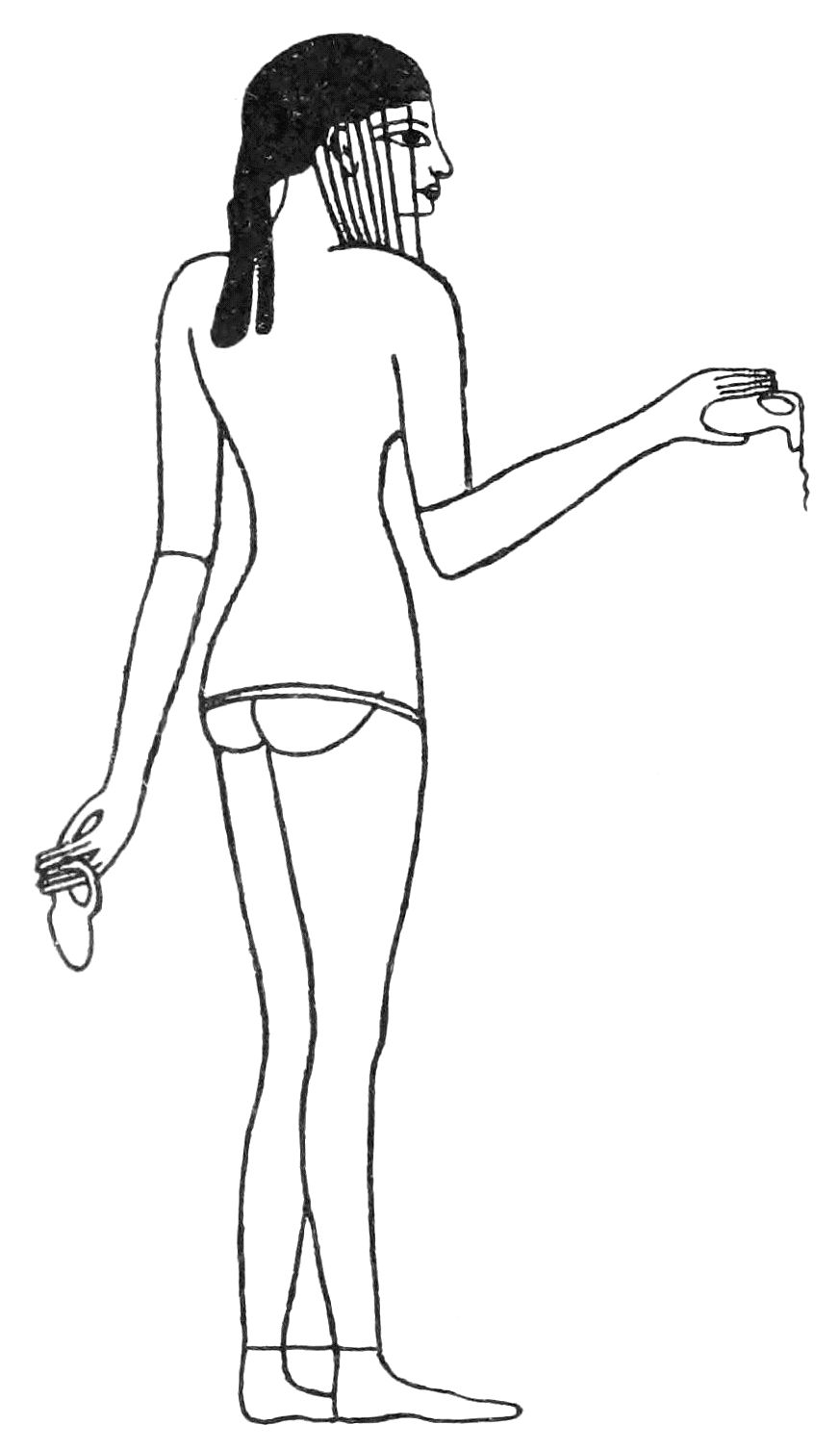
Fig. 66. Egyptian painting.
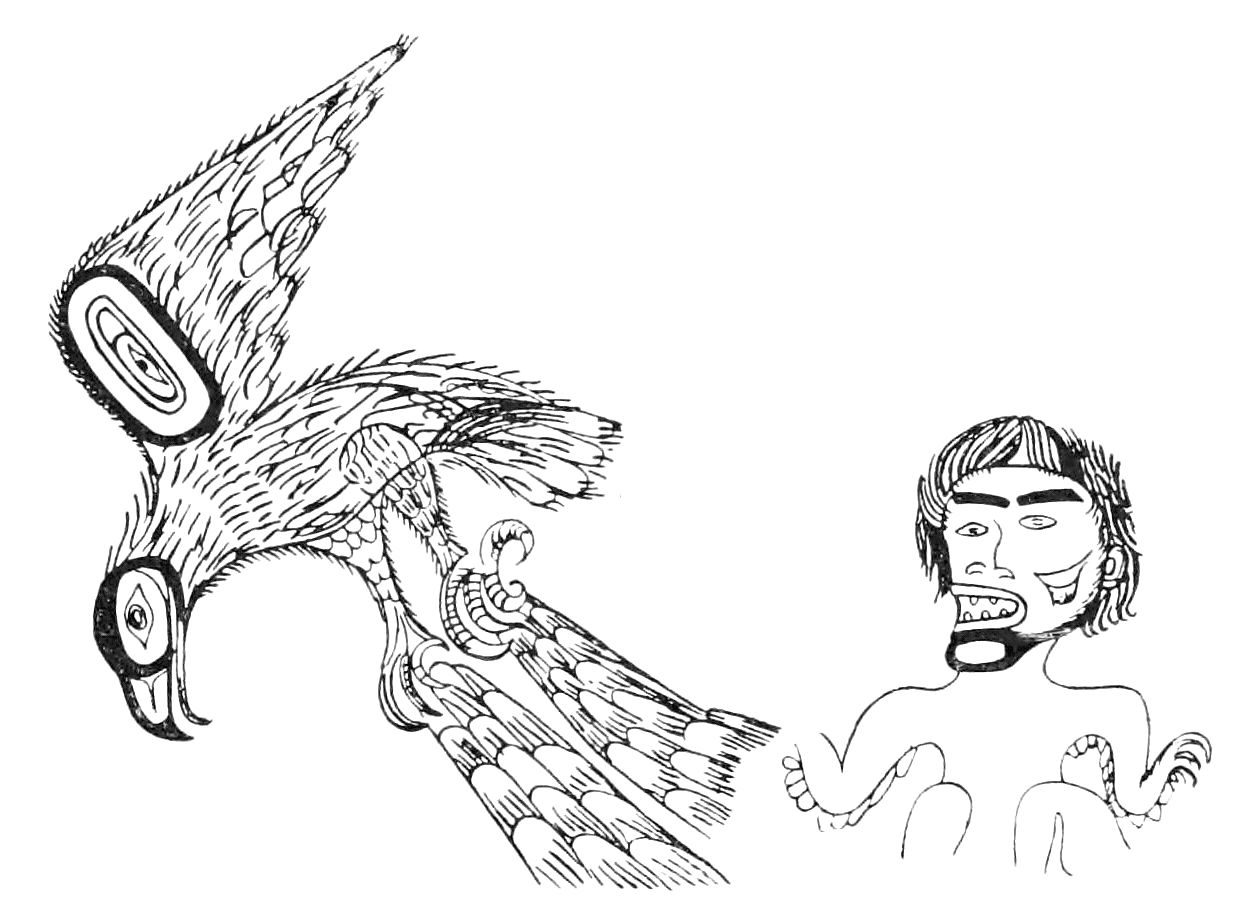
Fig. 67. Haida drawing representing eagle carrying away a woman.
In a graphic representation of objects one of two points of view may be taken: it may be considered as essential that all the characteristic features be shown, or the object may be drawn as it appears at any given moment. In the former case our attention is directed primarily towards those permanent traits that are most striking and by which we recognize the object, while others that are not characteristic, or at least less characteristic, are considered as irrelevant. In the latter case we are interested solely in the visual picture that we receive at any given moment, and the salient features of which attract our attention.
This method is more realistic than the other only if we claim that the essence of realism is the reproduction of a single momentary visual image and if the selection of what appears a salient feature to us is given a paramount value.
In sculpture or modelling in the round these problems do not appear in the same form. Here also attention may be directed primarily towards the representation of the essential, and the same principles of selection may appear that are found in graphic art, but the arrangement of the parts does not offer the same difficulties that are always present in graphic representation. As soon as man is confronted with the problem of representing a three-dimensional object on a two-dimensional surface and showing in a single, permanent position an object that changes its visual appearance from time to time, he must make a choice between these two methods. It is easily intelligible that a profile view of an animal in which only one eye is seen and in which one whole side disappears may not satisfy as a realistic representation. The animal has two eyes and two sides. When it turns I see the other side; it exists and should be part of a satisfying picture. In a front view the animal appears foreshortened. The tail is invisible and so are the flanks; but the animal has tail and flanks and they ought to be there. We are confronted with the same problem in our representations of maps of the whole world. In a map on Mercator projection, or in our planiglobes, we distort the surface of the globe in such a way that all parts are visible. We are interested only in showing, in a manner as satisfactory as possible, the interrelations between the parts of the globe. We combine in one picture aspects that could never be seen at one glance. The same is true in orthogonal architectural drawings, particularly when two adjoining views taken at right angles to each other, are brought into contact, or in copies of designs in which the scenes or designs depicted on a cylinder, a vase, or a spherical pot are developed on a flat surface in order to show at a single glance the interrelations of the decorative forms. In drawings of objects for scientific study we may also sometime adopt a similar view-point, and in order to elucidate important relations, draw as though we were able to look around the corner or through the object. Different moments are represented in diagrams in which mechanical movements are illustrated and in which, in order to explain the operation of a device, various positions of moving parts are shown.
In primitive art both solutions have been attempted: the perspective as well as that showing the essential parts in combination. Since the essential parts are symbols of the object, we may call this method the symbolic one. I repeat that in the symbolic method those features are represented that are considered as permanent and essential, and that there is no attempt on the part of the draftsman to confine himself to a reproduction of what he actually sees at a given moment.
It is easy to show that these points of view are not by any means absent in European art. The combination of different moments in one painting appears commonly in earlier art,—for instance when in Michel Angelo’s painting Adam and Eve appear on one side of the tree of knowledge in Paradise and on the other side of the tree as being driven out by the angel. As a matter of fact, every large canvass contains a combination of distinct views. When we direct our eyes upon a scene we see only a small limited area distinctly, the points farther away appear the more blurred and indistinct the farther removed they are from the center. Nevertheless most of the older paintings of large scenes represent all parts with equal distinctness, as they appear to our eyes when they wander about and take in all the different parts one by one. Rembrandt forced the attention of the spectator upon his main figures by strong lights, as upon the swords in the great scene of the conspiracy of Claudius Civilis and his Batavians against the Romans, but the distant figures are distinct in outline, although in dark colors. On the other hand, Hodler, in his painting of a duel draws compelling attention to the points of the swords which are painted in sharp outline while everything else is the more indistinct the farther removed it is from the point on which the interest of the artist centers.
Traits considered as permanent characteristics play a rôle even in modern art. Until very recent times the complexion of man was conceived as essentially permanent. At least the strong changes that actually occur in different positions have not been painted until very recent times. A person of fair complexion standing between a green bush and a red brick wall has certainly a face green on one side and red on the other, and if the sun shines on his forehead it may be at times intensely yellow. Still we are, or at least were, not accustomed to depict these eminently realistic traits. We rather concentrate our attention upon what is permanent in the individual complexion as seen in ordinary diffuse daylight. We are accustomed to see the accidental momentary lights weakened in favor of the permanent impression.
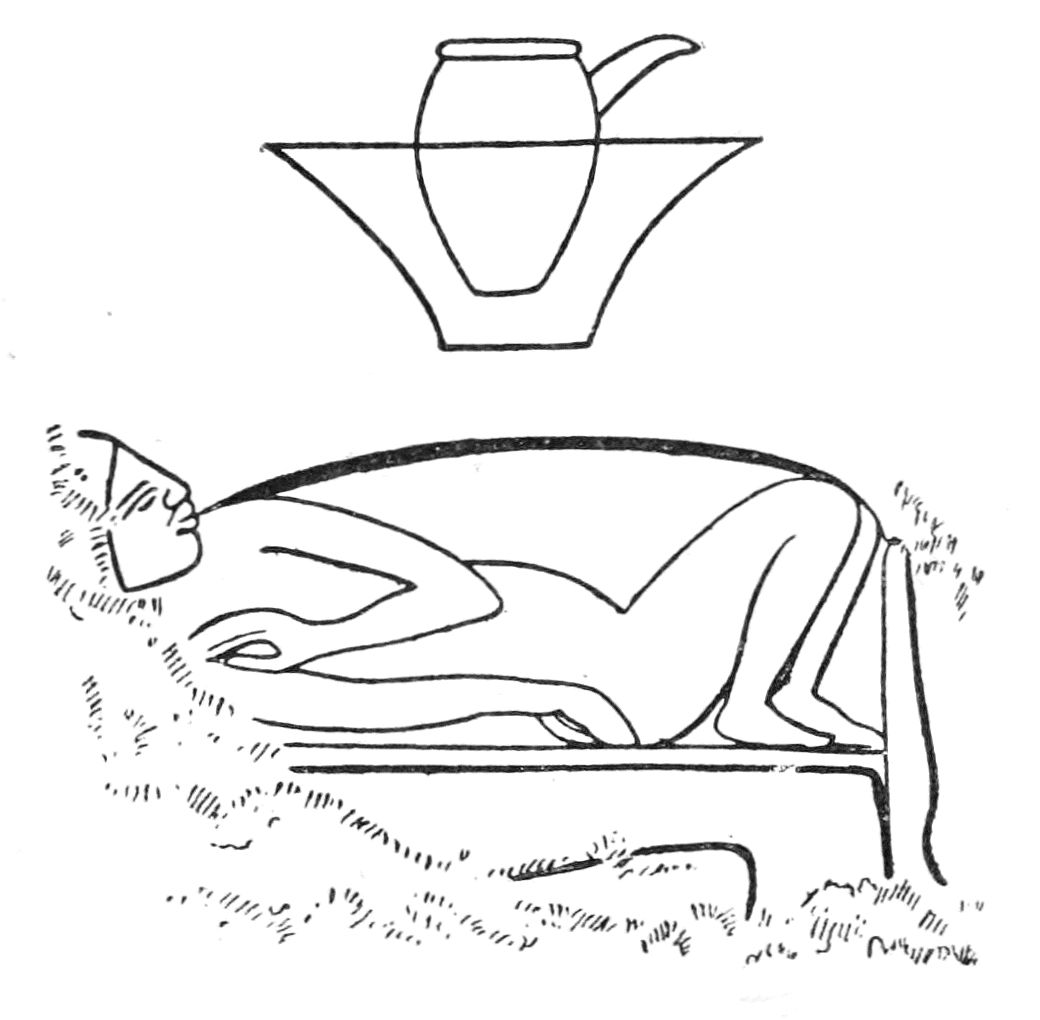
Fig. 68. Egyptian drawings; above: bowl and pitcher; below: sleeping person covered by blanket.
In primitive, symbolic representations these permanent traits appear in the same way, sometimes strongly emphasized. It will be readily seen that children’s drawings are essentially of the character here described. They are not memory images, as Wundt claims, except in so far as the symbols are remembered and reminders, but compositions of what to the child’s mind appears essential, perhaps also as feasible. A person has two eyes which have their most characteristic form in front view, a prominent nose which is most striking in profile; hands with fingers which are best seen when the palms are turned forward; feet the form of which is clear only in profile. The body is essential and so is the clothing, hence the so-called Röntgen pictures in which covered parts are drawn. These drawings are a collection of symbols held together more or less satisfactorily by a general outline, although single traits may be misplaced. The same traits prevail commonly in primitive drawings. When Karl von den Steinen had the South American Indians draw a white man, they placed the moustache as a characteristic symbol on the forehead, for it sufficed to place it as a symbol on the most available space. The Egyptian paintings with their mixture of profile and front views and transparent objects through which hidden parts may be seen (fig. 68) must be viewed in the same manner. They are not by any means proof of an inability to see and draw perspectively; they merely show that the interest of the people centered in the full representation of the symbols.
When exceptionally great weight is attached to the symbol, so that it entirely outweighs the interest in the outline, the general form may be dwarfed and forms originate that, from our perspective point of view, lose all semblance of realism. The most characteristic case of this kind is found in the art of the Northwest coast of America, in which the whole animal form is reduced to an assembly of disconnected symbols. A beaver is adequately represented by a large head with two pairs of large incisors and a squamous tail (see pp. 186 et seq.). However, in this case we are no longer dealing with crude representations, but with a highly developed art. Its form proves that in its development symbolic representation has been of fundamental importance.
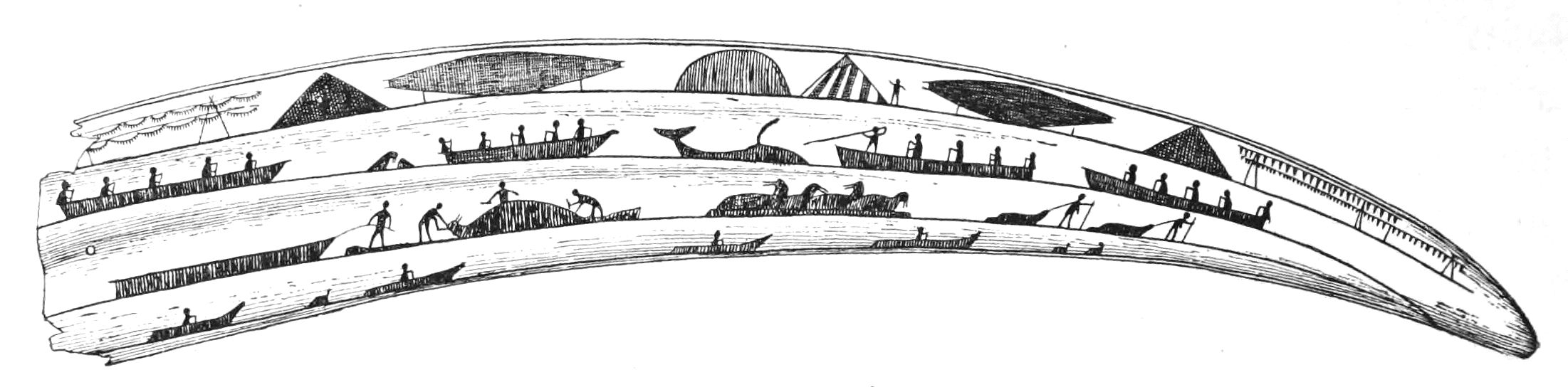
Fig. 69. Eskimo etching on walrus tusk, Alaska.
The second form of representation is by means of perspective drawing, in which the momentary visual impression regardless of the presence or absence of characteristic symbols, is utilized. This method is not by any means absent in the drawings of primitive man as well as in those of children, but it is not as common as symbolic representation. In a way most crude symbolic forms contain a perspective element, although it does not extend over the whole figure, but only over parts which are more or less skilfully put together, so that a semblance of the general outline is maintained. This is the case in Egyptian paintings, in those of Australians and in North American picture writing (see figs. 61, 62). In other cases the art of perspective drawing rises to real excellence. The silhouettes of the Eskimo may be mentioned as a case in point (fig. 69). Their figures are always small, scratched into ivory, antler or bone, and filled with hachure or with black pigment. Form and pose are well-done. Although there is generally no perspective arrangement of groups, each figure is well executed and renders a single visual impression. We find perspective of groups in the rock paintings of South Africa (fig. 70), not perfect, but indicated by the overcutting of figures and by the relative sizes of objects near by and of those seen at a distance. Perspective realism of single figures is even more fully developed in the paintings of later paleolithic man, found in the caves of southern France and of Spain (fig. 71). Less skilful efforts at perspective representation are not rare. On mattings from the Congo region, on basketry hats from Vancouver Island (fig. 72) rather clumsy attempts have been made. In those from the former region there are animals in profile in the latter whaling scenes: men going out in a canoe and hauling in a harpooned whale.
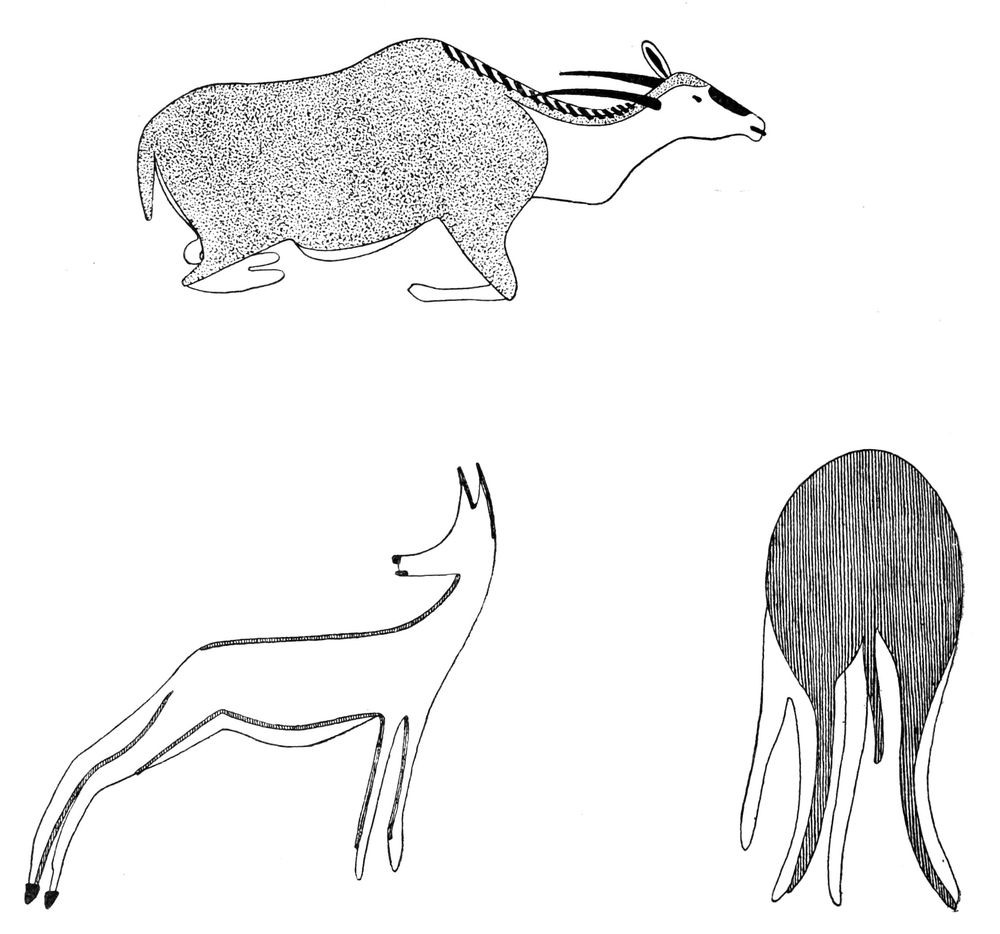
Fig. 70. Bushman rock paintings.
Much more common are carvings in wood, bone or stone, or pottery objects that are not symbolic but true to nature. Ivory carvings of the Eskimo, Chukchee and Koryak (fig. 73), prehistoric carvings, pottery from North America are examples.
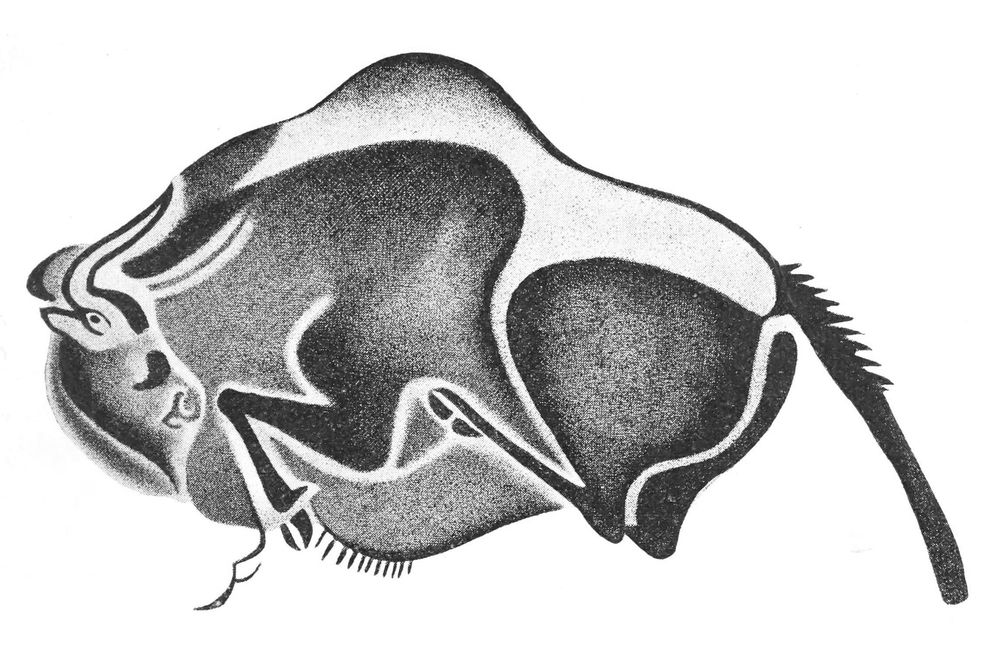
Fig. 71. Paleolithic painting representing bison.
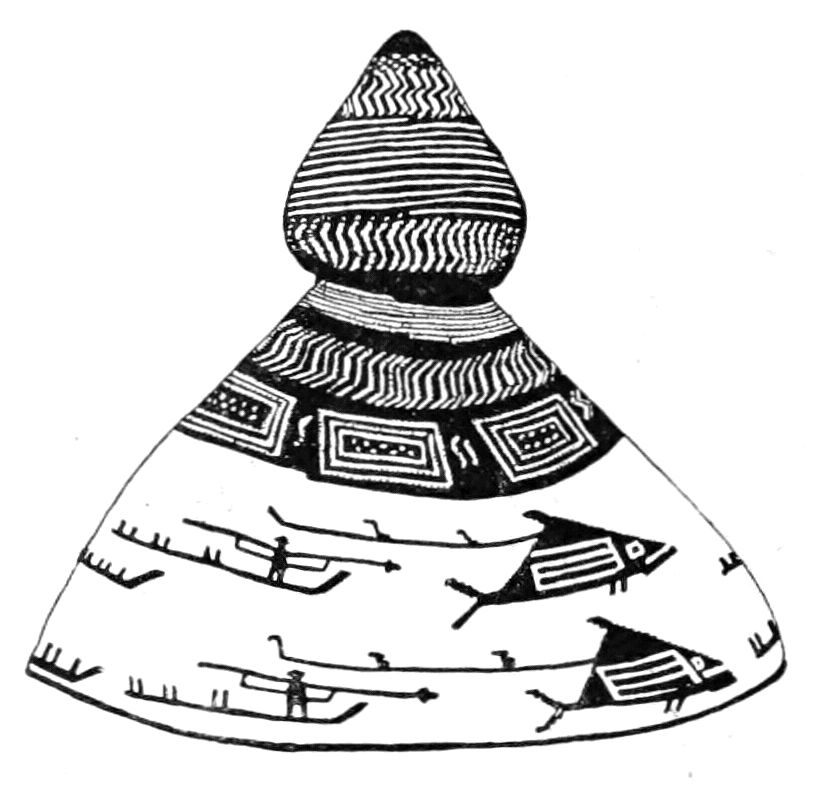
Fig. 72. Hat of the Nootka Indians.
As stated before, a sharp line between the two methods of graphic representation cannot be drawn. In most cases symbolic representations are at least in part perspective, either in so far as the general form is maintained, or as parts are shown in perspective form; while perspective representations may contain symbolic elements. When the Pueblo Indian paints the form of a deer with a fair degree of perspective accuracy (see fig. 142, p. 167), but adds to it a line running from the mouth to the heart as an essential symbol of life; or when the symbols are arranged with a fair degree of correspondence to perspective order we have forms in which both tendencies may be observed. Indeed, some degree of conventional symbolism is found in every drawing or painting, the more so, the more sketchy it is; in other words, the more the representation is confined to salient traits. This is particularly true in all forms of caricature.
If representative art did develop into absolute realism, stereoscopic color photography would be the highest type of art, but this is obviously not the case. Setting aside the emotional appeal of the object itself, an accurate copy of a natural object, such as a glass flower, a painted carving, an imitation of natural sounds or a pantomime may attain an intense emotional appeal, they may excite our admiration on account of the skill of execution; their artistic value will always depend upon the presence of a formal element that is not identical with the form found in nature.
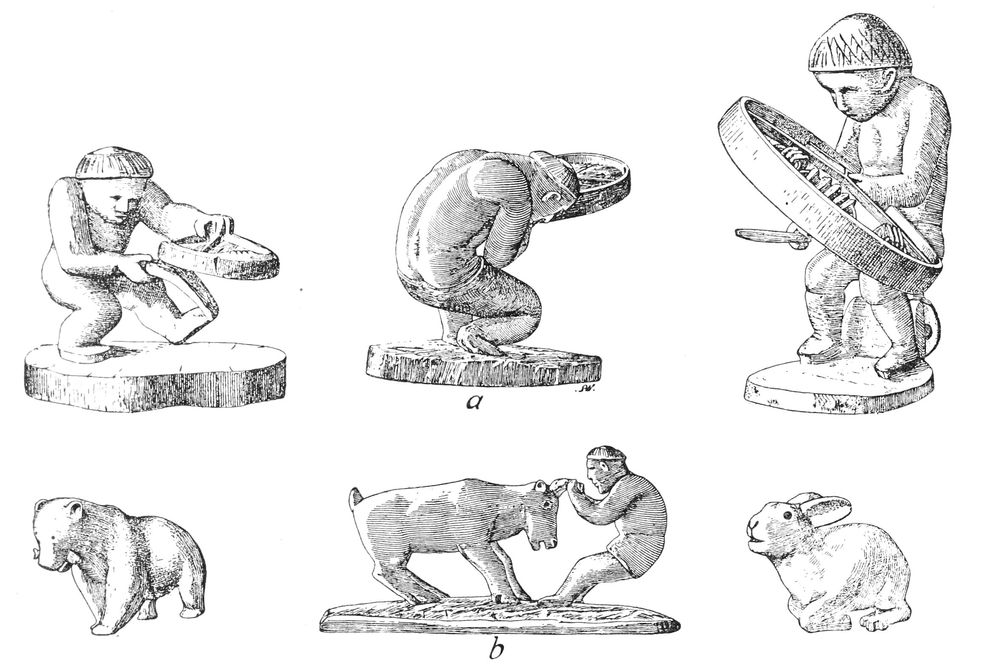
Fig. 73. Koryak carvings.
Stress must be laid upon the distinctive points of view from which the two methods of graphic representation develop, because the development of perspective drawing is often represented as growing out of the cruder symbolic method. As a matter of fact the two have distinct psychological sources which remain active in the early, as well as in the late history of art. Vierkandt[42] designates the various methods of representation as suggestive (andeutend), descriptive (beschreibend), and perspective (anschaulich). Of these the former two correspond to what I have called here symbolic. They differ only in the more or less fragmentary character of the symbols. The perspective type does not develop from the former two as the result of an evolution; it is based on a distinct mental attitude, the early presence of which is manifested by the realistic, perspective paintings of a number of primitive tribes.
The theory of a continuous development from symbolic to realistic art is one of the numerous attempts to prove a continuous development of cultural forms, a steady, unbroken evolution. This view-point has had a deep influence upon the whole theory of ethnology. Evolution, meaning the continuous change of thought and action, or historic continuity, must be accepted unreservedly. It is otherwise, when it is conceived as meaning the universally valid continuous development of one cultural form out of a preceding type, such as the assumed development of economic forms from food gathering through herding to agriculture. In past times these three stages were assumed to be characteristic of all human development, until it was recognized that there is no connection between the invention of agriculture and the domestication of animals,—the former developed through the occupation of woman who gathered the vegetable food supply, the latter through the devotion of men to the chase. The men had no occasion to become familiar with the handling of plants, and the women had just as little opportunity of dealing with animals. The development of agriculture and of herding can, therefore, not possibly be derived from the same sources.
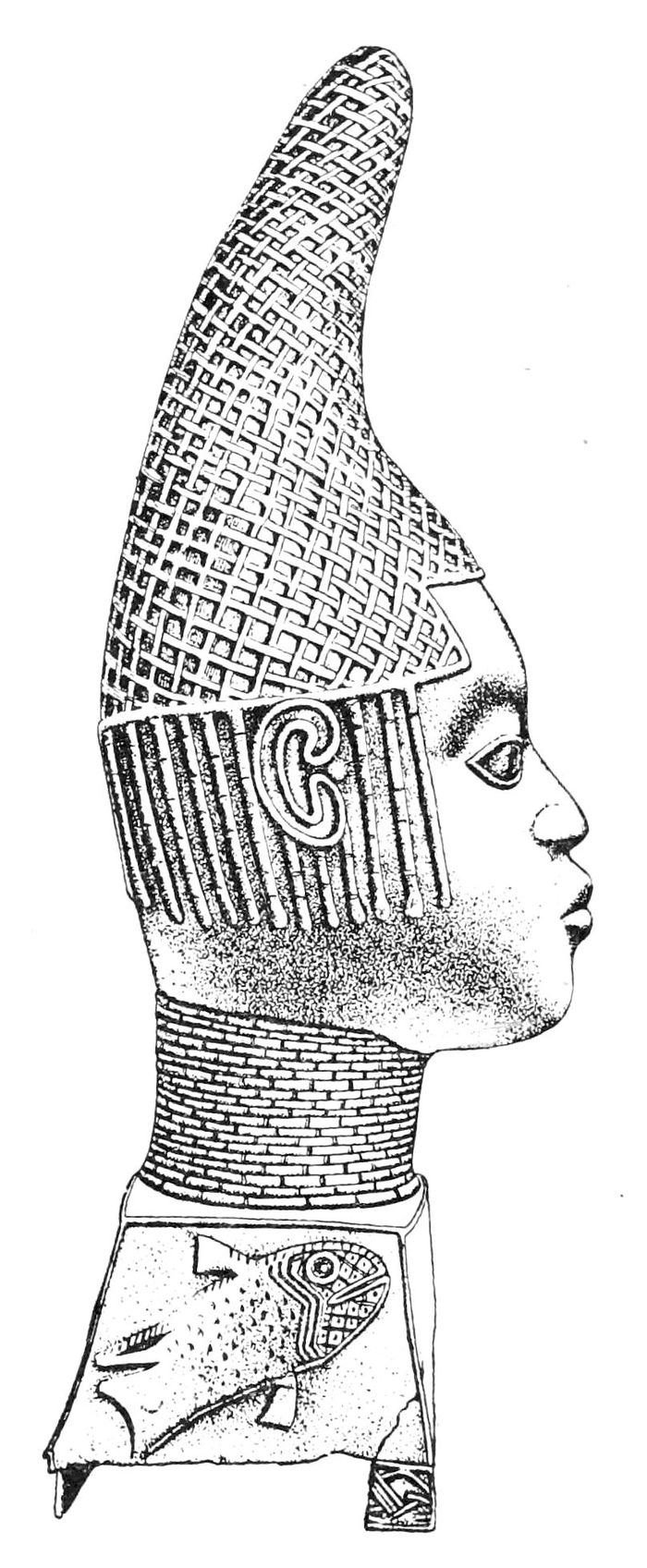
Fig. 74. Bronze casting, Benin.
It is no less arbitrary to assume that social forms must have developed in regular universally valid sequence, one certain stage always being based on the same preceding one in all parts of the world. There is no evidence that would compel us to assume that matrilineal organizations always preceded patrilineal or bilateral ones. On the contrary, it seems much more likely that the life of hunters in single family units, or that of larger groups in more fertile areas has led to entirely different results. We may expect continuous evolution only in those cases in which the social and psychological conditions are continuous.
After this brief excurse, let us revert to our subject. Representations become works of art only when the technique of their manufacture is perfectly controlled, at least by a number of individuals; in other words, when they are executed by one of the processes, that are industrially in common use. Where carving is practiced, we may expect artistic form in carvings; where painting, pottery, or metal work prevail, artistic form is found in the products of those industries in which the highest degree of technical skill is attained. The Eskimo carves in ivory, antler or bone, of which he makes his harpoons and many other utensils; his best representative work is made with the knife and consists of small carvings and etchings in which he applies the same methods that he employs every day. The New Zealander carves in wood, makes delicate stonework, and paints; his best representative work is made by these methods. Metal work and ivory carvings from Benin (fig. 74), headmasks from the Cameroons (fig. 75, p. 82), wood carvings from the Northwest coast of America (see figs. 154-156, pp. 184, 185), pottery from Peru, from the Yoruba country (fig. 76, p. 82), Central America and Arkansas (fig. 77, p. 85), basketry of the Pima, embroideries (see fig. 39, p. 47) and woven fabrics of the Peruvians are other examples.
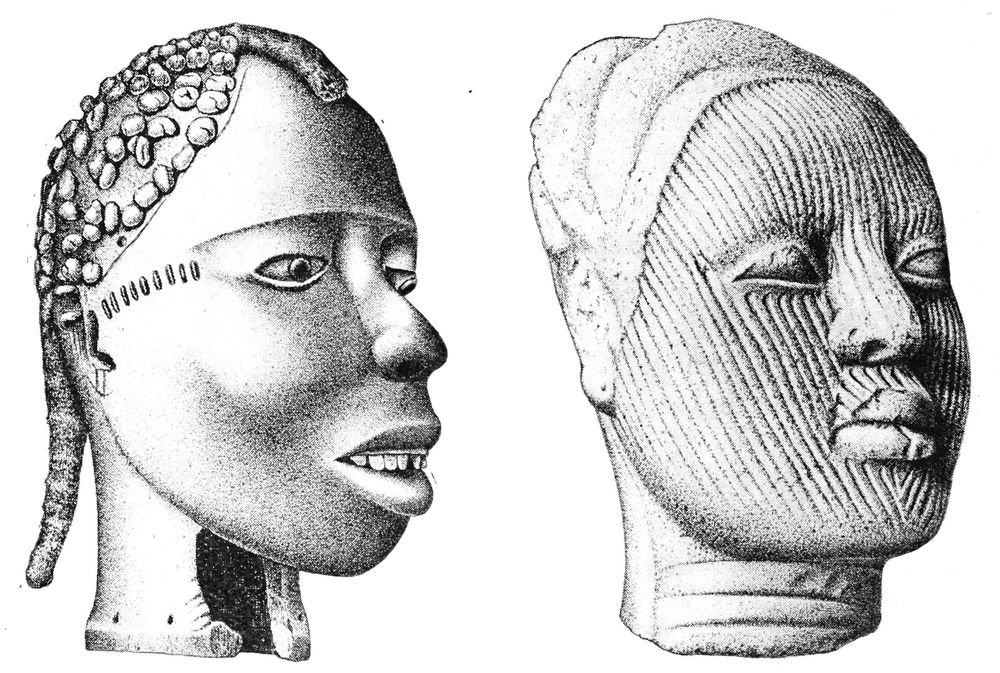
Fig. 75. Headmask, Cross River, Cameroon. Fig. 76. Terra cotta head from Ife, Yoruba country.
Since representations that are intended to have artistic value are made in the most highly developed technique it is not surprising that the formal style of the technique gains an influence over the form of the representation. The angular lines of weaving with coarse materials and the steplike forms of diagonals which are determined by this technique impress themselves often upon representations and become part and parcel of a local style. There develops an intimate relation between the formal and representative elements that brings it about that representation receives a formal value entirely apart from its significance. The deeper the influence of the formal, decorative element upon the method of representation, the more probable it becomes that formal elements attain an emotional value. An association between these two forms of art is established which leads, on the one hand to the conventionalization of representative design, on the other to the imputation of significance into formal elements. It is quite arbitrary to assume a one-sided development from the representative to the formal or vice versa, or even to speak of a gradual transformation of a representative form into a conventional one, because the artistic presentation itself can proceed only on the basis of the technically developed forms. At another place we shall discuss this subject more fully (see pp. 118 et seq.).
In all aspects of life may be observed the controlling influence of pattern, that is of some typical form of behaviour. As we think in a pattern of objective, material causality, primitive man thinks in a pattern in which subjective causality is an important element. As our personal relations to blood relatives are determined by the pattern of our family, so the corresponding relations in other societies are governed by their social patterns. The interpretation of the pattern may change, but its form is apt to continue over long periods.
The same stability of pattern may be observed in the art products of man. When a definite type has once been established, it exerts a compelling influence over new artistic attempts. When its control continues over a long period it may happen that representations are cast in an iron mould and that the most diverse subjects take similar forms. It appears then as though the old pattern had been misunderstood and new forms had developed from it. Thus, according to Von den Steinen, the figurines on carvings from the Marquesas, which originally represented two figures back to back, have determined the type of entirely new representations, or, as he prefers to put it, they have been misunderstood and developed in new ways. I do not doubt that in some cases this process of misinterpretation occurs, but it is not the one that interests us at this place. Striking examples of the overmastering influence of a pattern may be found in many parts of the world. The style of the Northwest coast of America is so rigid that all animal figures represented on plain surfaces are cast in the same mould (see pp. 185 et seq.); the overwhelming frequency of the spiral in New Zealand is another example; the interwoven animal figures of early medieval Germanic art; the angular patterns of the North American Indians (see p. 176); all these illustrate the same condition. In an art, the technique of which does not admit the use of curved lines and in which decorative patterns have developed, there is no room for curved lines, and the curved outlines of objects are broken up into angular forms. The patterns, or as we usually say, the style, dominates the formal as well as the representative art.
However, the style is not by any means completely determined by the general formal tendencies which we have discussed, nor by the relations between these elements and the decorative field, but it depends upon many other conditions.
One more point must be discussed here. Attention has been called to the apparent absence of purely formal elements in the art of those tribes that are from an economical and industrial point of view most primitive, namely the modern Bushmen of South Africa, the Eskimo of Arctic North America, the Australians, and in remote times, the paleolithic hunters. The statement is not quite correct, as has already been pointed out by Vierkandt, because other tribes that live on the same industrial level, do not share these characteristics; particularly the Veddah and the Andaman Islanders. Furthermore, it is not by any means certain that the South African rock sculptures were made by the Bushmen. It seems fairly certain that the best ones of those recorded were made in early times and that the living Bushmen know little about their origin. In the South African paintings and petroglyphs and in the art works of the other tribes mentioned before, we find a highly developed realistic art which exhibits an astonishing truth of perspective perception, in rest as well as in motion. Verworn has based on this observation a distinction of what he calls the physioplastic and ideoplastic art; the former containing truthful, momentary visual images, the latter representing nature remodeled by thought and therefore, in a conventional style.
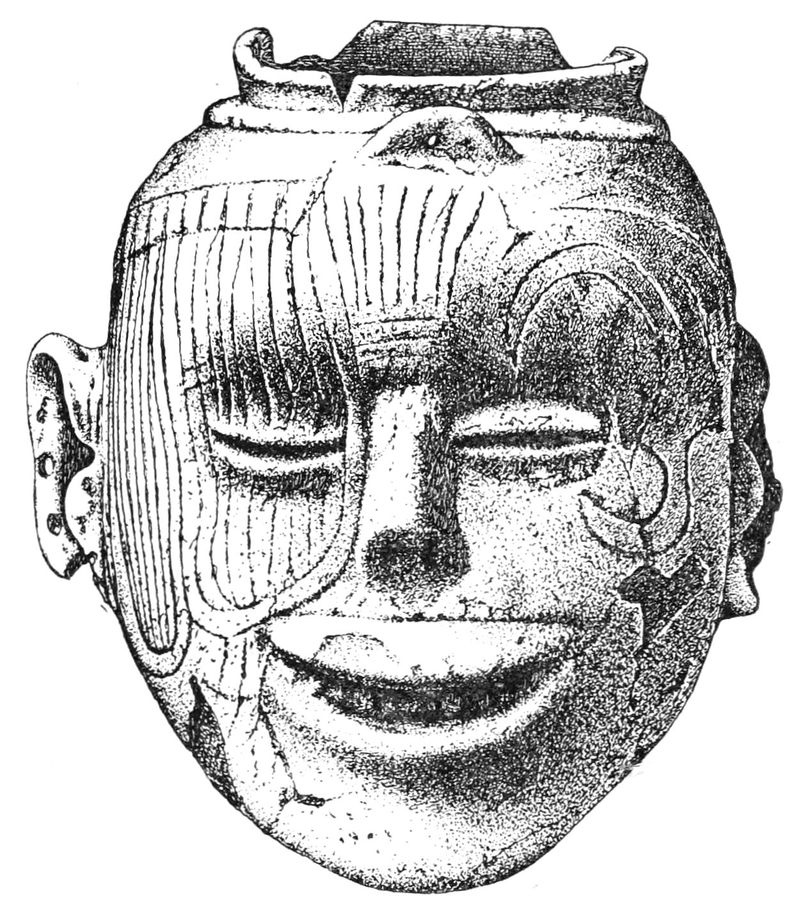
Fig. 77. Pottery head from Arkansas.
I do not believe that the assignment of these styles to distinct levels of culture is tenable, for physioplastic representations are not by any means confined to the tribes of simplest economic structure, nor, as indicated just now, are they common to all of them. We must avoid in these matters, as well as in all other ethnic questions, treating tribes too much as standardized units. Individual variation in physical appearance as well as in mental life is as important in primitive society as in our own. There are artists and craftsmen in all forms of society, as there are believers and unbelievers; there are creative artists who rise above the level of the skilful artisan and tradesmen who are satisfied with a slavish, though accurate adhesion to existing patterns. Where representative art has fallen under the rigid control of technique, there is little opportunity for the development of a naturalistic style; where the technique is free, there we may also expect free forms. This condition is realized in two ways, namely, in those cases in which representative art is not enslaved by a one-sided technique, and under conditions in which a high degree of freedom in the use of a variety of technical processes has been attained. A study of the whole range of art products shows that where a technique is practised that gives tree range to the development of form, naturalistic forms, that is forms relatively free of stylistic mannerisms, although sometimes of bold generalization, occur. Carving in wood, bone, ivory or stone, and modelling in clay are the principal arts that give this freedom which is not so easily found in graphic representation. Therefore we find in many cultures that are otherwise under the strict control of conventional style, at least occasionally figures in the round that are naturalistic. Examples are found in the art of the North Pacific Coast; in bronze castings, wood carvings and clay figures of Africa (figs. 74-76); in pottery of the ancient inhabitants of Arkansas (fig. 77); and in stone work from Mexico, as well as in Peruvian pottery. On the other hand, our modern realism is based on the emancipation from a single rigid style that controls all art production. Such freedom is not found to the same extent in primitive art with its more limited number of technical processes.
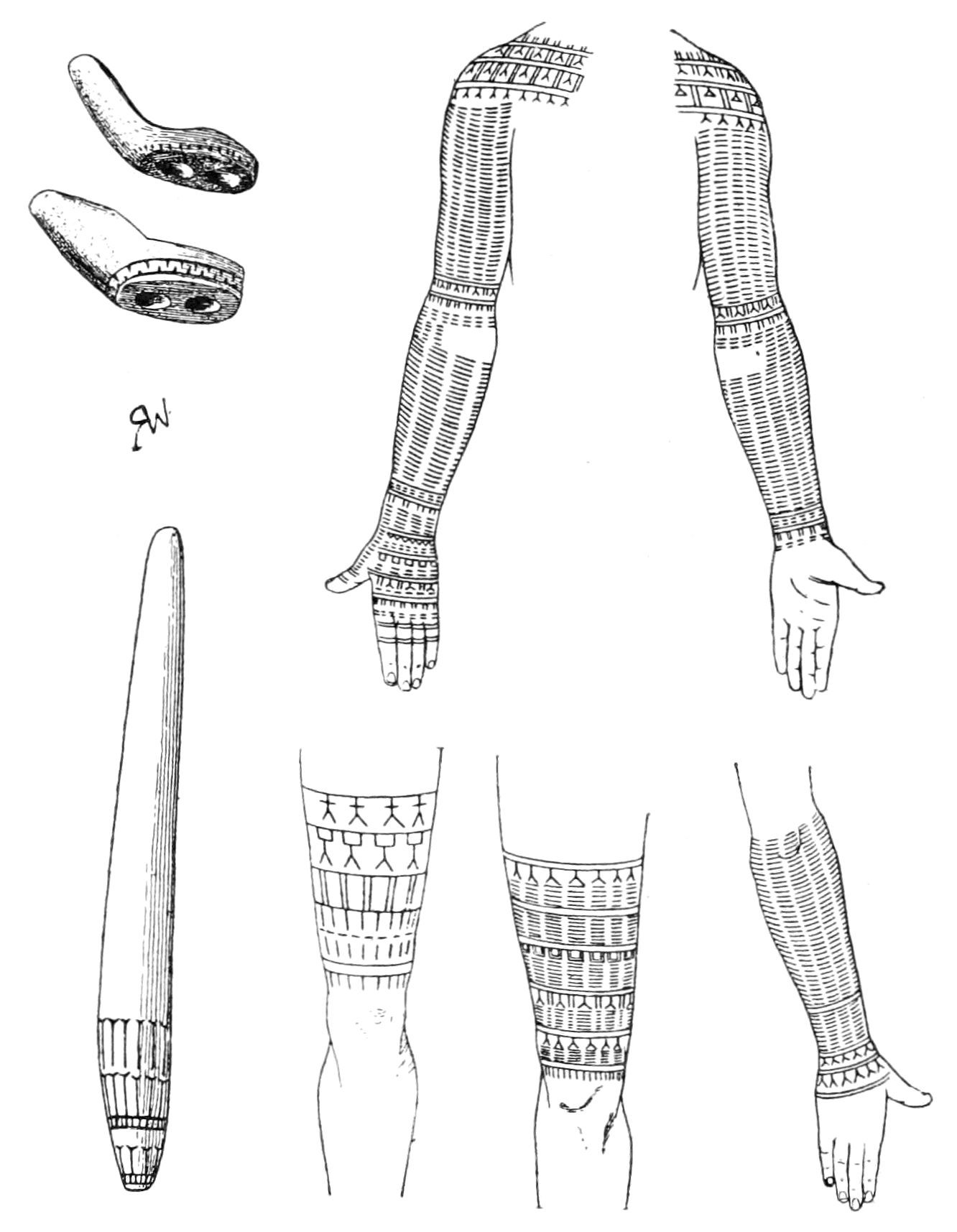
Fig. 78. Ivory and bone carvings, and tattooing of eastern Eskimo.
Another error seems to me to underlie the theory propounded by Max Verworn. It is not only incorrect to assume that representations true to nature are confined to tribes on the lowest economic and industrial level, it can also be shown that at least those living at the present time have ideoplastic art as well as physioplastic art. This is particularly true of the Eskimo. While they do produce a remarkable number of realistic carvings and etchings, they also have a number of conventional, geometric designs which are of regular occurrence. Most prominent among these are the alternating spurline and the sequence of Y shaped figures (fig. 78). The latter has sometimes a symbolic meaning, just as other conventional geometric designs among other groups of people. With small circles at the end of the bifurcated Y it is interpreted as a flower. Furthermore, the clothing of men and women is always decorated with motives that indicate or emphasize the parts of the body they cover, as the shoulderblades or the breastbone. Particularly among the Alaskan is this conventional art ideoplastic in the meaning of Verworn.
We have also shown examples of the geometric, ornamental art of the Bushmen (fig. 8, p. 23); however, we do not know whether it has a symbolic meaning. Their ornamental art is very meagre because they have so little that can become the subject of ornamentation.
It seems more than likely that man of later paleolithic time whose implements are quite on the same level as those of modern primitive tribes, who adorned his body and who used geometrical ornaments on his bone implements, decorated also his clothing and other perishable possessions of which no trace remains. If we imagine the remains of the modern Indians of the plains, or those of Australians exposed for thousands of years to the wet climate of Europe, nothing would remain to give us an insight into the complexity of their culture and into the existence of their symbolic, that is, ideoplastic art.