ART OF THE NORTH PACIFIC COAST OF NORTH AMERICA[100] (continued 2)
Reading edition
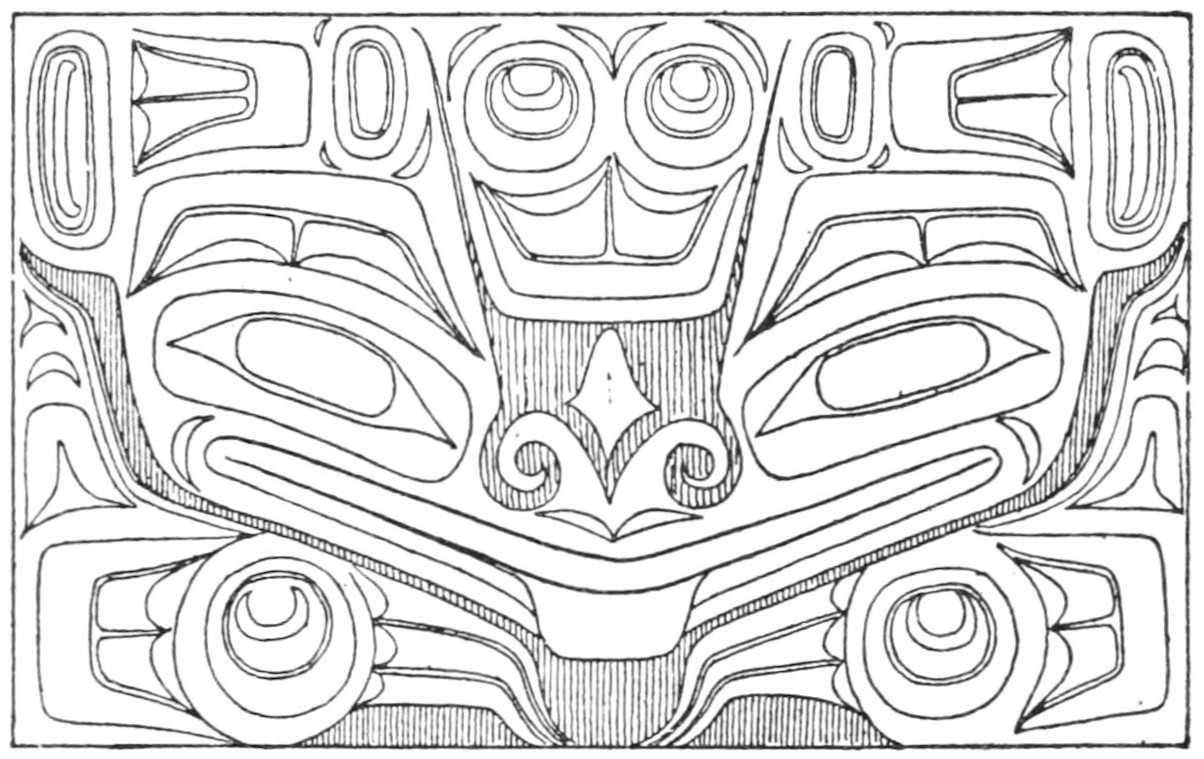
Fig. 259. Front of a slate box with design representing a sea-monster, Haida.
In fig. 259, which represents the front of a small box carved in slate, the same sea-monster is shown. Again we see the animal cut in two, the section separating the eyes and the ears, the mouth, however, being left intact. Here the whole body has been omitted, with the exception of the paws to which the fins are attached. The paws will be recognized turned inward under the mouth, while the fins extend upward along the outer margins of the slab. The dorsal fin has been bisected, and one-half is shown in each upper corner. The ornament in the centre of the upper margin probably represents the tail turned upward over the back so that it almost touches the head. This arrangement must be considered in connection with the formal treatment of boxfronts which will be discussed later (pp. 263 et seq.).
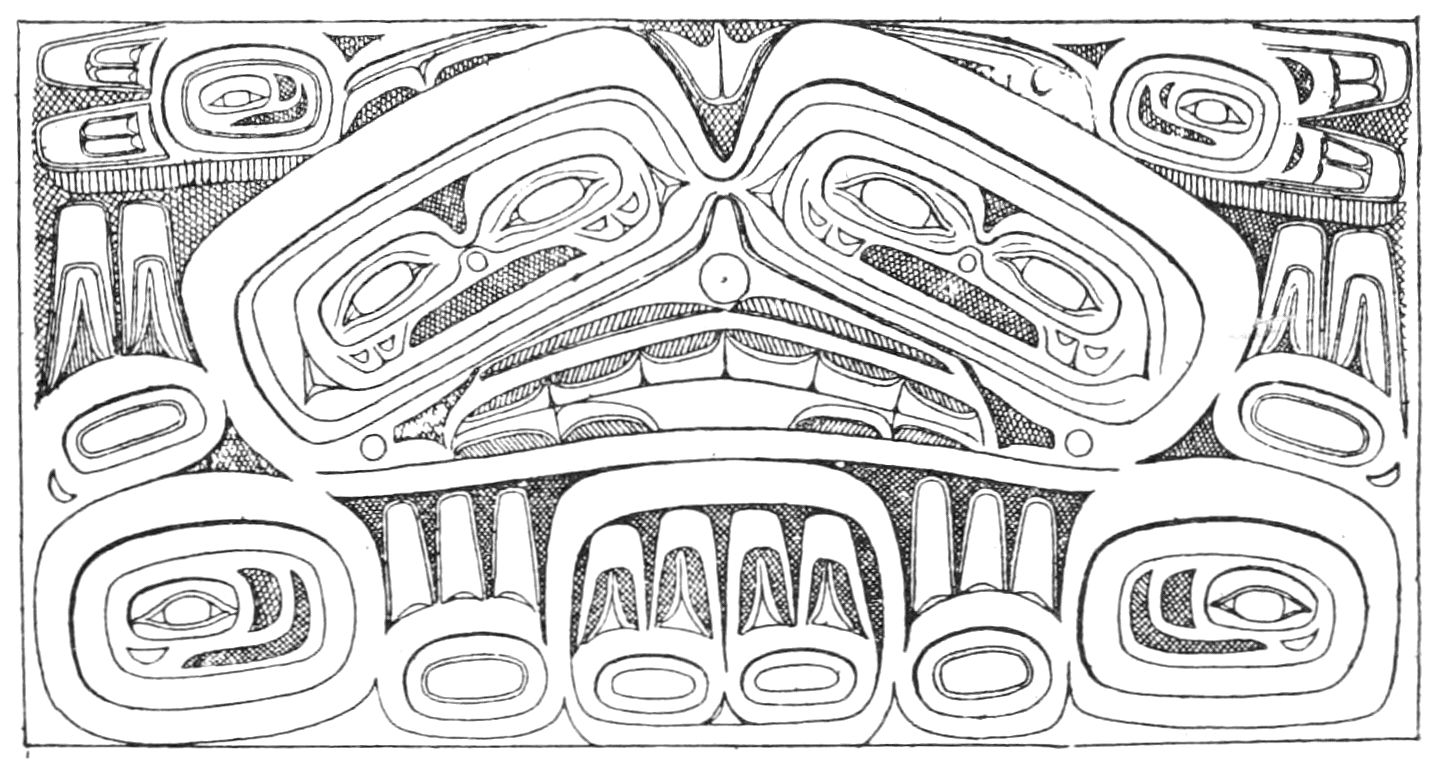
Fig. 260. Slate slab with design representing a sea-monster, Haida.
Fig. 260 represents the carving on a slate slab. We have here a different representation of the sea-monster, which is also, as we might say, much abbreviated. The head occupies by far the larger portion of the carving. The body which is seen underneath the head, in the centre of the slab, is indicated by a comparatively small square with rounded edges, decorated with two fins. The rest of the decoration on the lower edge of the slab must be interpreted as the arms of the monster, the large face on each corner representing an elbow. The whole arm, extending from the elbow to the hand, is omitted. The latter is indicated by an oval the centre of which is occupied by an eye. From it rise the three fingers or claws. The important symbols of the monster, the fins, which are attached to the fore arm, are shown adjoining the elbow, and rise along the sides of the slab, outside of the eyes. The two ornaments occupying the upper corners of the slab are undoubtedly the tail. This arrangement is also determined by the general principles governing the decoration of boxes (see p. 263).
The shark which is shown in fig. 261 is found on one end of a small food tray. I do not need to repeat the description of the shark’s face, on which the characteristic symbols will be recognized. I have introduced this figure here in order to show that the whole body of the animal has been omitted with the sole exception of its pectoral fins, which are carved on the rim of the tray on both sides of the forehead. Their position is somewhat analogous to the one found on the totem pole fig. 213 (p. 219).
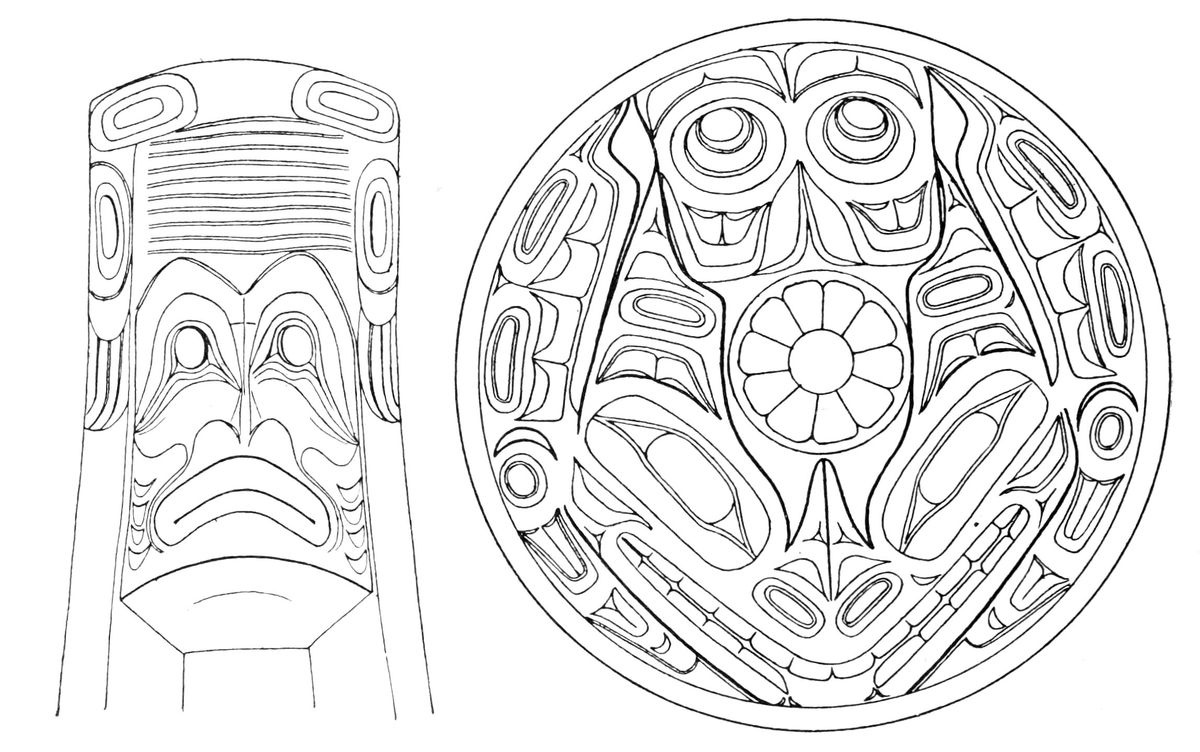
Fig. 261. Design from the end of a food tray representing a shark, Tlingit. Fig. 262. Slate dish with design representing a sculpin, Haida.
In figs. 262 and 263 we find the representations of the sculpin distorted and dissected in the same manner as the sea-monster of the preceding figures.
In fig. 262 the sculpin has been adapted to a circular slate dish. The centre of the design is occupied by a rosette, which has undoubtedly been copied from European patterns. In the drawing the outlines of the various parts of the body have been strengthened in order to make their relations somewhat clearer. It will be noticed that the head is split in two, cohering only at the nose and the upper jaw. The two spines rise immediately from the nose. The two halves of the body extend from the corners of the face upward along the rim of the dish. There they grow thinner, indicating the thin portion of the fish body near the tail. The tail has not been split, and is turned upward and backward so that it touches the central rosette. A comparison between this design and the design at the centre of the upper margin in fig. 259 will show a great similarity between the two, thus making it probable, that, as stated before, the latter design is intended to represent the tail of the monster. The pectoral fins of the sculpin are shown in a rather abnormal position. They are turned forward from the body so that they adjoin the lower jaw. They will be recognized between the jaws and the rim of the dish. The dorsal fin is indicated by the long pointed ornaments extending from the eye towards the tail.
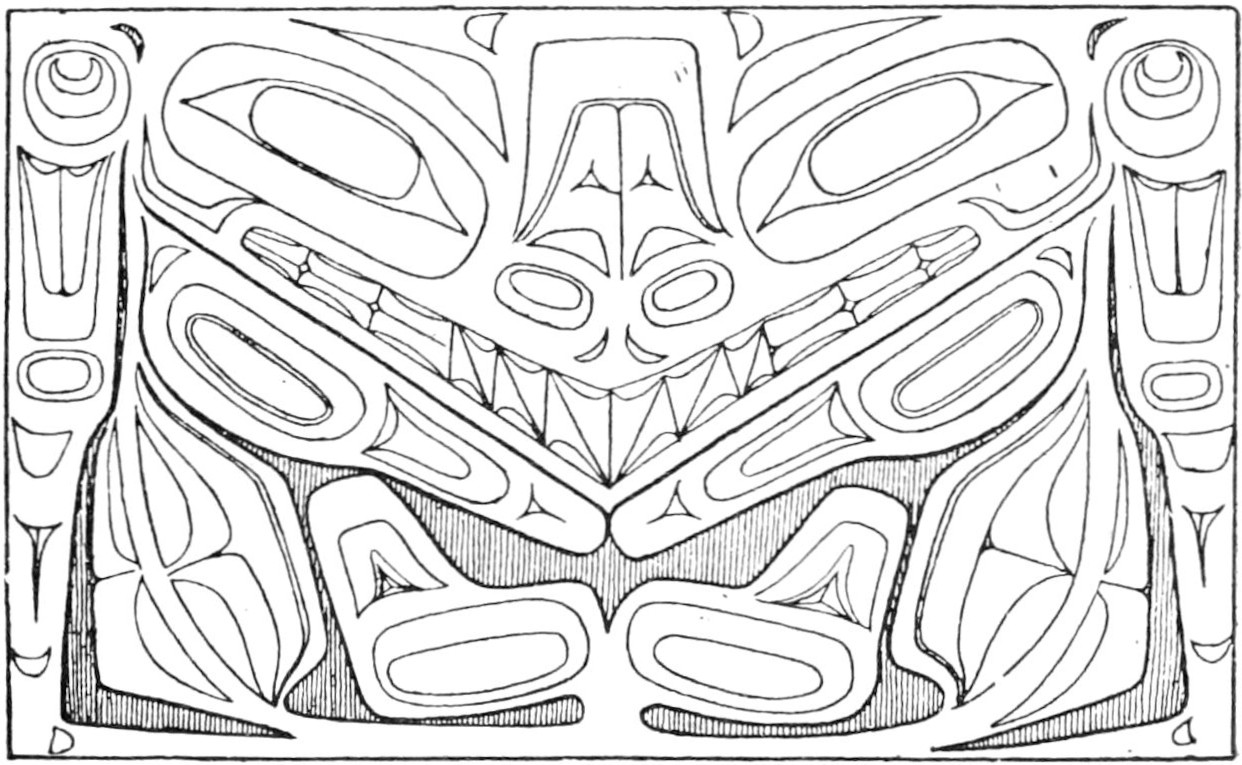
Fig. 263. Front of a slate box with design representing a fish, Haida.
In the design fig. 263 a fish has been dissected in a somewhat different manner. The head occupies the upper margin of the slab. It has a remarkably triangular shape. The body has been bisected from head to tail, and turned and twisted in such a manner that each half extends in a curve downward from the corners of the face to the middle of the lower margin of the slab. The pectoral fins have been left in contact with the corners of the mouth, and are placed in the same position as in the preceding figure, namely, adjoining the lower jaw. They meet just below the chin of the animal. I believe the ornaments which are stretched along the right and left margins of the slab represent the dorsal fins.
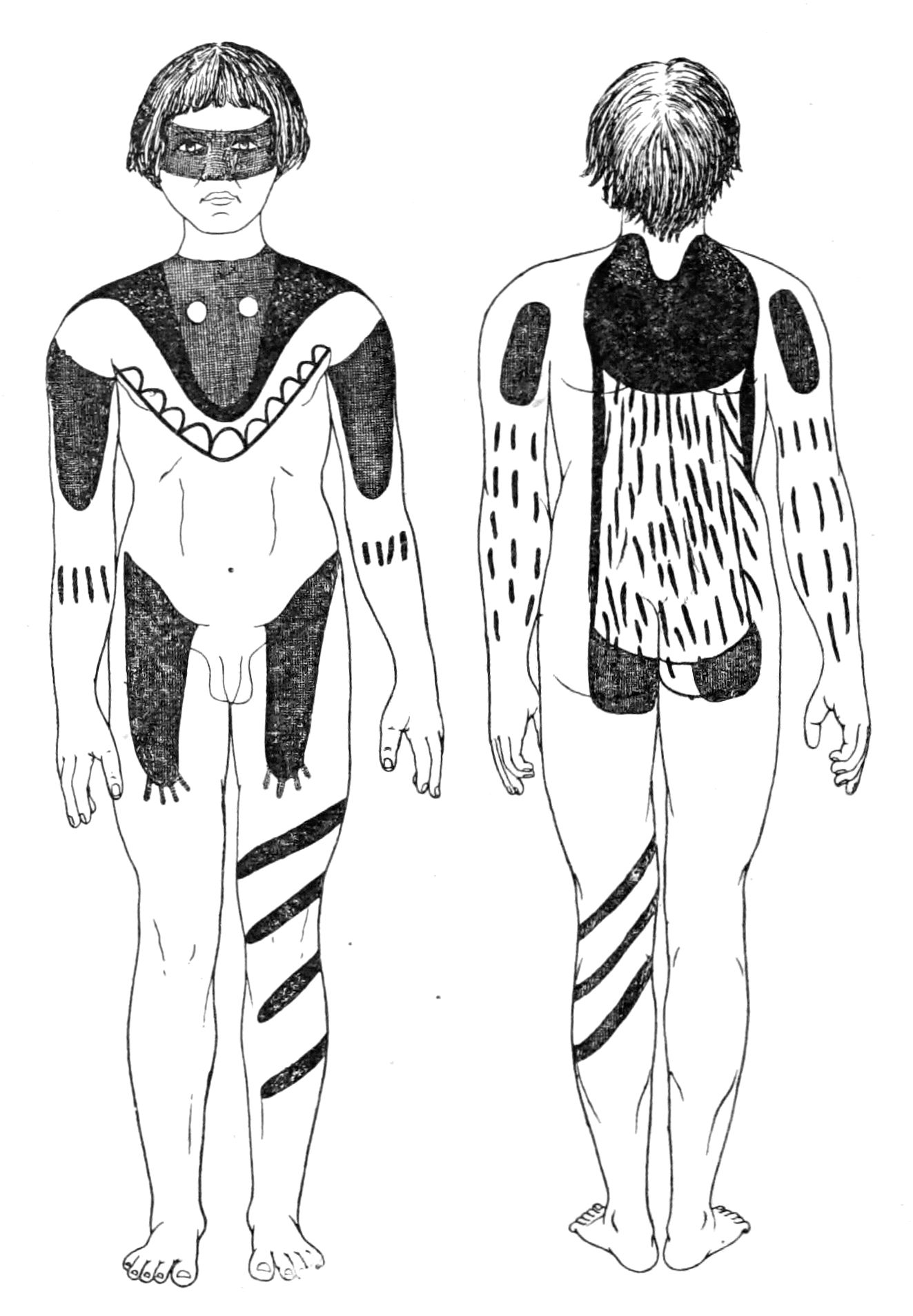
Fig. 264. Body painting representing the bear, Kwakiutl.
I have described at a previous place (p. 215) the extraordinary distortion and dissection of the killer-whale in its adaptation to a blanket, and I have given the description at that place.
Quite a unique distortion is found in body paintings used by the Kwakiutl Indians in a boy’s dance. Fig. 264 is a copy of a body painting representing the bear. On the chest, the head of the bear is shown turned downward. The white spots over the collarbones are the eyes of the bear; the angular line with semicircles, the mouth and teeth. On the upper arms are shown the forelegs, the claws just under the elbow. The hind legs are shown on the front of the thighs. On the back of the person is shown the nape of the bear placed on the upper part of the back; under it, extending downward, is the back, the lines representing hair. The hip joints are shown by dark designs on the buttocks. The spiral design on the left leg was said to represent the tail.
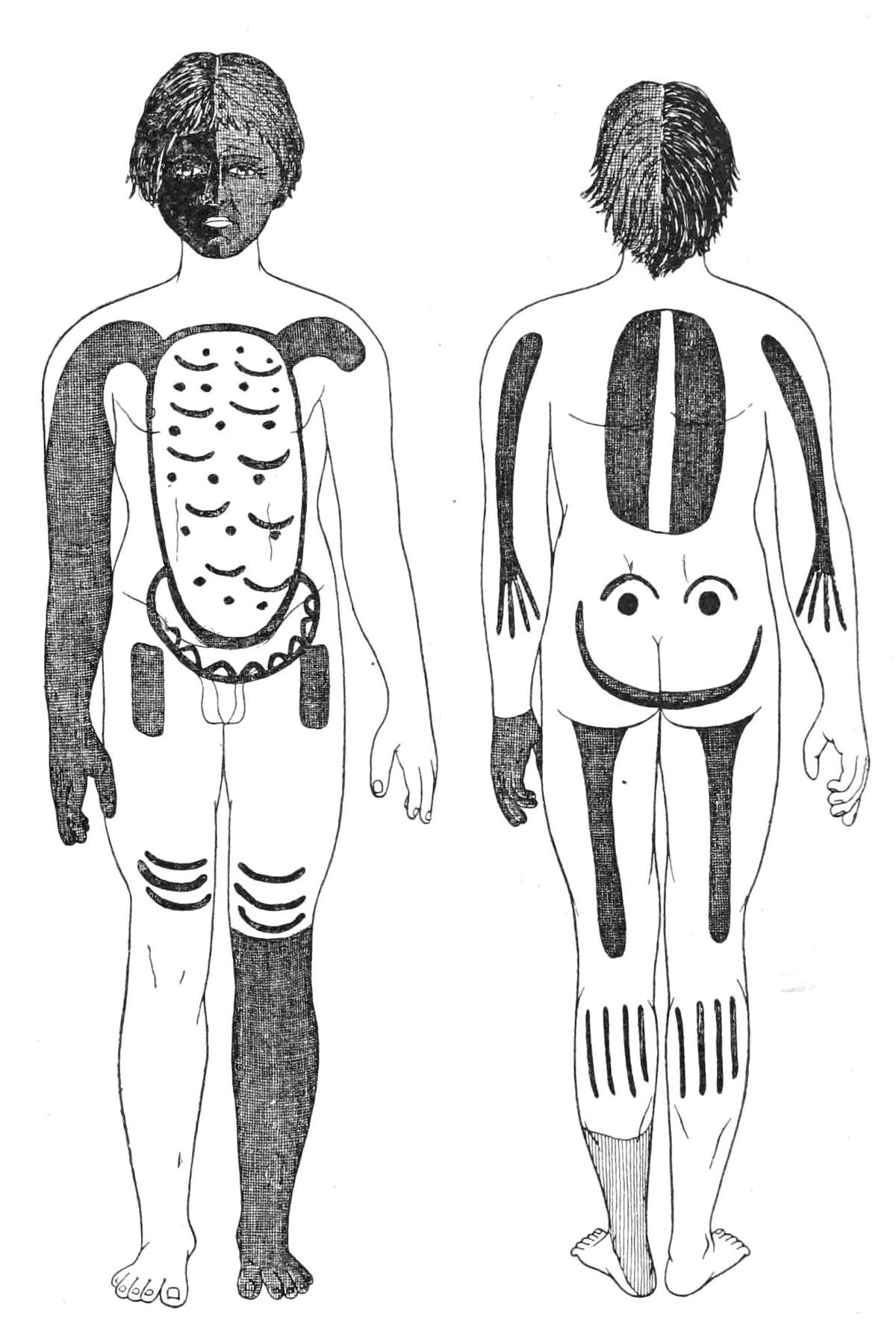
Fig. 265. Body painting representing the frog, Kwakiutl.
Still more remarkable is the frog painting shown in fig. 265. On the small of the back is shown the top of the head of the frog; the two eyes with eyebrows above, the mouth below. Corresponding to this place we find in the front of the body the mouth set with teeth (which really do not belong to the frog). The back of the frog is shown on the upper part of the back; the hind legs on the back of the arms. The opposite side of the hind legs is shown on the front of the arms. It seems probable that in the design which was copied for me by an Indian, the painting on the front of the left arm was accidentally omitted. The shoulder joint is shown on the front of the thighs; the forelegs in corresponding position on the back of the thighs; the ankle joints on the knees; and the foot on the calf of the legs. In other words, the frog is shown in such a way as though the body of the person were the frog. No explanation was given for the black design on the left leg.
We will turn now to the purely formal side of the treatment of the decorative field. There is a tendency to cover the entire surface with design elements. Vacant places are avoided. When the surface of the object represented has no features that lend themselves to decorative development, the artist resorts to devices that enable him to fill the surface with patterns. On totem poles the bodies of the animals represented occupy considerable space. The monotony of the surface is broken by placing the forelegs and hindlegs across the front of the body, by turning up the tail in front, and by adding small animal figures.
Far more important is the application of a great variety of decorative elements, all of which consist of curved lines. The Indians have a decided disinclination to apply equidistant curves. In all work of the better class the lines are so arranged that more or less crescent shaped surfaces result, or that narrow, curved areas, wide in the middle, narrower at the ends, are formed.
The most striking decorative form which is used almost everywhere, consists of a round or oval field, the “eye design”. This pattern is commonly so placed that it corresponds to the location of a joint. In the present stage of the art, the oval is used particularly as shoulder, hip, wrist, and ankle joint, and as a joint at the base of the tail and of the dorsal fin of the whale. It is considered as a cross section of the ball and socket joint; the outer circle the socket, the inner the ball. Often the oval is developed in the form of a face: either as a full face or a profile.
The general disposition of this design demonstrates that the explanation is not by any means always tenable. Thus in the blanket, fig. 205 (p. 215), the eye pattern in the two lower corners has no connection with a joint. In this position, in the mouth of an animal, it is sometimes described as food. The two profile faces higher up on the side of the same blanket, are obviously fillers. They might be replaced by “eye designs”. Another instance of similar kind is found on the upper part of the face of the dish fig. 168 (p. 191). The circular designs shown here might perhaps be interpreted as tail joints, but they are probably decorative elements. The design appears clearly as a filler in fig. 283 f (p. 272) at the inner upper corner on the long side of the box, and on the ears of the beaver, fig. 229, (p. 227). On Chilkat blankets it appears always in fixed positions (see p. 258) and in large boxes it is the constant corner design (see p. 263). Its use and interpretation as a joint is presumably related to the frequent ornamental combination shown, for instance, in the feet on fig. 160 (p. 188) and in the tails fig. 193 (p. 205). The oval represents the joint and the elevated part the limb. These are at the same time formal elements that appear regularly on the lateral border designs on carved boxes (fig. 274, p. 263). The eye design appears in a variety of forms ranging from a large double eye to a circular pattern with black center.
Lieutenant Emmons has collected the various design elements as they appear on the blankets and has given the names by which they are designated by the Tlingit (fig. 266). These names do not fit the explanations given for the whole pattern. The “double eye” (h) and the “eye” (f) are not always eyes but occur also as joints, (fig. 269 b). The profile eye is called the “head of the salmon trout” (c). It is used quite generally as the eye of any animal. The “black eye” (g), the “nostril” (l) and the design called “one in another” (o) are practically identical. They are also used as joints. The frequent use of the circular design of light or dark color, set off against a dark or light background indicates that the tribes of the north west coast do not tolerate areas of the same color, the monotony of which is relieved by the insertion of circular designs of contrasting colors. These may be seen on many blanket and box designs (fig. 274 et seq.).
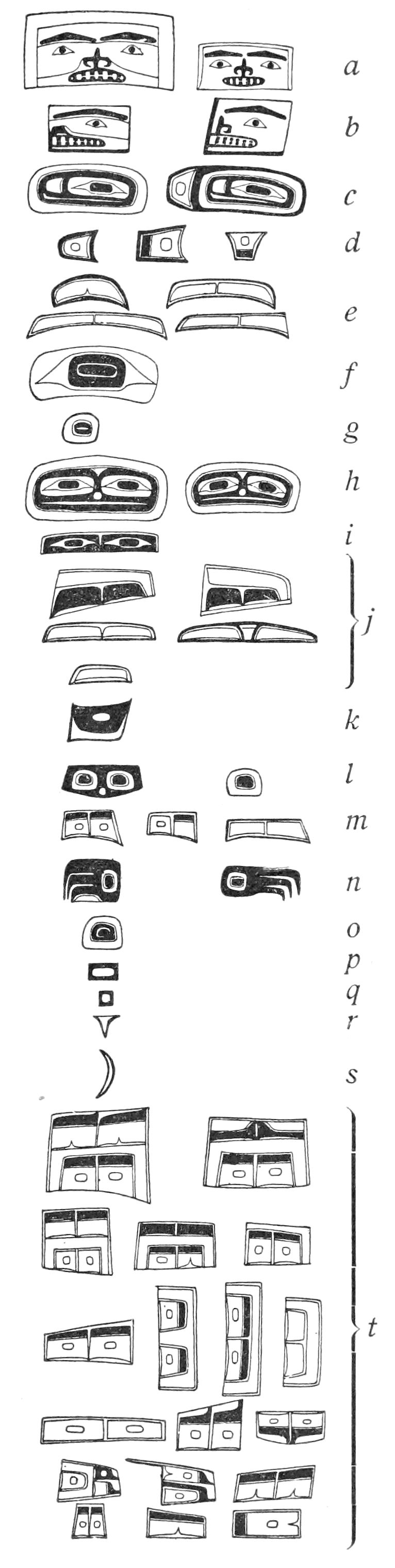
Fig. 266. Design elements from Tlingit blankets.
The forms called “side holes” (p) and “holes”, “ends of gambling sticks” or “rain drops” (q) have white circles relieving a black background. It is quite evident that these designs also, as parts of the whole design, have not the significance implied in the names, nor do the names explain the reason for their use. The frequent occurrence of the white circles, both isolated and in lines, (see figs. 269 et seq., pp. 259 et seq.) proves that they must be considered primarily as a formal element designed to break large surfaces.
It seems to me most likely that the black or white circular design has been the basis from which the eye design has developed. In the style of the north west coast art shoulders, hips, hands, and feet form large dark monotonous surfaces. These are broken by a large white circle or oval, which is again varied by a black center. This tendency would also account for the goggle design (fig. 266 i). The same desire to relieve the monotony of the cheek surface leads to the insertion of an oval design on the cheek (k).
In carved designs these forms are not contrasted by color, but the form alone varies the monotony of the large undecorated surface.
Another characteristic pattern, the narrow crescent, has presumably also originated from the desire to break the monotony of continuous areas. It appears particularly when it is desired to set off two merging patterns against each other. Here also design names obtained by Emmons, “woman’s hair ornament” (r) and “slit” (s) have nothing to do with its function and significance as part of the whole pattern.
The most characteristic filler, next to the eye, is a double curve, which is used to fill angular and round fields that rise over a strongly or gently curved line. Many fillers of this type have a dark colored band at the upper end, generally rounded in paintings or carvings, square in blankets (see fig. 202, lower lateral design on central panel; the tail patterns, fig. 193). In the blankets the angular form is perhaps due to the technique in weaving, although the frequent eye designs prove that round forms are not impossible. On blankets the heavy upper line is often drawn out into a tip (fig. 270 a, over the “goggle” design on the side of the central panel). Examples of these forms have been collected by Lieutenant Emmons who states that the Tlingit call them “the wing feather of red-winged flicker” (fig. 266 t). The use of the pointed form of this design for a bird feather agrees with the theoretical claim of the Kwakiutl (see p. 205), but obviously the explanation does not always fit the meaning of the pattern as a whole, as is shown by the killer-whale design fig. 205 (p. 215) or the whale design fig. 270 (p. 260).
The design is used commonly to represent quite diverse objects. Thus, the double flicker-feather (fig. 266 t), occurs in fig. 269 a as the beak of a bird, occupying the middle of the mouth design between the two large eyes. It occurs also between the ears along the upper border of the design as the single flicker-feather. Here as well as over the beak of the bird, in the lateral fields, it is used only for filling in parts of the design which otherwise would remain undecorated. In fig. 202 (p. 213) the same design occurs between the eyes, just over the nostril, and here also it obviously has nothing to do with the red-winged flicker. Many other cases of this application of the wing feather design, simply for the purpose of filling in spaces, may be observed in practically all the blankets. A comparison of fig. 202 with the box designs fig. 274 shows that the wing feather design may serve to express the forearm and the upper arm. In fig. 274, we have the two hands placed in a position, similar to the paws in figs. 202 and 269 b. On the box fig. 274 a the parts are connected with the body by a narrow red strip, which is divided by characteristic curves into two parts. A comparison of this design with figs. 222 and 223 shows very clearly that they are meant to represent the upper arm. In the blanket design fig. 269 b, the two sections connecting the paw with the body may be recognized distinctly as upper arm and forearm. In the blanket designs fig. 202, the space that is available for the upper arm is much condensed; but it is quite obvious that the two wing feather designs which lie on the outer sides of the paws must be interpreted here also as the forearm and upper arm. Judging by this analogy, I think there can be very little doubt that the two wing feathers placed by the sides of the body in fig. 269 a may be considered in the same way as the two parts of the arm of the animal represented. Since the animal here shown is a bird, these feather designs are in this way made to represent the bones of the wing.
Similar considerations have determined the distribution of ornaments in the design fig. 270 b. Here the two feet will be recognized at the lower edge of the design. Adjoining it, above the “eye”, are two long white flicker-feather designs, which obviously represent the legs. Each of the two inverted double eyes under the jaws must be interpreted as a shoulder joint to which is attached the lower part of the arm in the form of a flicker-feather design.
The forms here discussed are interpreted as various kinds of animals,—birds, quadrupeds, sea-monsters,—but never as the red-winged flicker, nor can the parts be interpreted as ornaments made of flicker-feathers. It is obvious that we are dealing here with a fixed form, which has a conventional name, and which is used for a variety of purposes.
It will be noticed that this design occurs in three principal forms. In one of these it is cut off square at the upper end. Most of those shown in fig. 266 are of this type. Another characteristic form of this design has the pointed wing feather, (as the second one in the series fig. 266 t). A third form, which is not given in the series of named designs, seems to be quite common. It has a rounded tip, and may be observed, for instance, in the beak part in front of the upper eye in the lateral panels of figs. 203 and 269 a; also in the central field in fig. 273 b.
The wing design is applied wherever a somewhat oval or rectangular field which is situated laterally has to be filled in, particularly when the field adjoins another design which is surrounded by heavy black lines, and which forms part of an animal body. For this reason the design appears very commonly in front of, over, or under the eye design. It is used to fill in the ears; it appears at the sides of the body, as in figs. 203 and 269 a; and it is used to fill in small fields which adjoin black lines, as for instance, in the lowest section of the lateral panels in fig. 269 a.
On blankets the light circle on a darker background with black tip and small white segment at the base, is almost ever-present. The white segment at the base is limited very often by a pointed double curve,—like a brace,—which divides the adjoining colored field more or less distinctly into two halves. These may be observed, for instance, in one of the ear designs in figs. 202 and 269 b, and also in the design over the nose in fig. 202.
This pattern is also used as a filler for long narrow spaces. According to Emmons this is called the “mouth design” (fig. 266 j) or the “eyebrow” (e), but it is often used on fields that cannot be interpreted as “mouth” or “eyebrow”, as for instance, in the lateral parts of the lower border of fig. 202 and in the lower corner of the box, fig. 274 b.
Judging from the general application of this design, it is quite obvious that it is not primarily a feather design, but that it is a decorative element used throughout in certain definite positions for the purpose of filling in.
Flat black curves are used quite often for indicating the teeth. These may be observed in fig. 269 a, on the body of fig. 270 a, in the lowest face in fig. 204, in the lower faces of fig. 271.
We have discussed before the adjustment of animal form to the decorative field. The adjustment is not by any means free, but definite, stylistic forms may be recognized. These appear with great clarity on the Chilkat blankets.
The measurements of the blankets show that the central height is very nearly one half of the width. The width of the narrow border, consisting of a black and yellow stripe, is about one twelfth of the total width. The angle of the lower border is quite variable, the vertical distance from a line connecting the lower corners of the blanket to its greatest depth is generally a little less than one sixth of the width. The fundamental trait of the blanket pattern is the division of the field into three panels. The central one about double the width of the lateral ones, or more. In most blankets the line of division of these fields is quite clear and is indicated by black and white lines. The designs on the lateral fields are symmetrical and quite distinct from the central field.
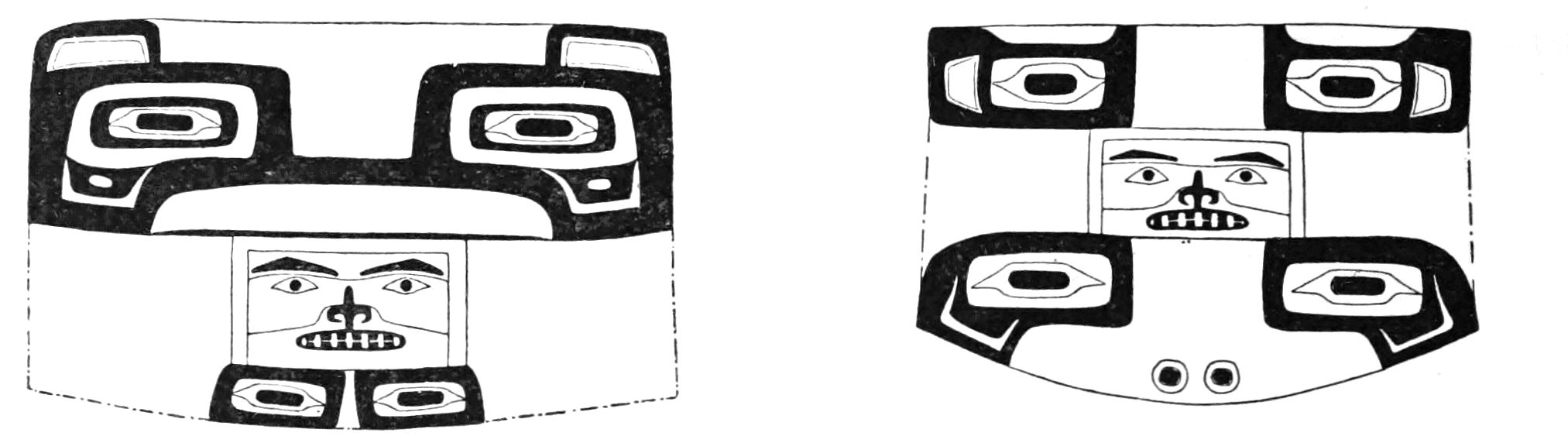
Fig. 267. Schematic design showing the arrangement of the central field of the Chilkat blanket.
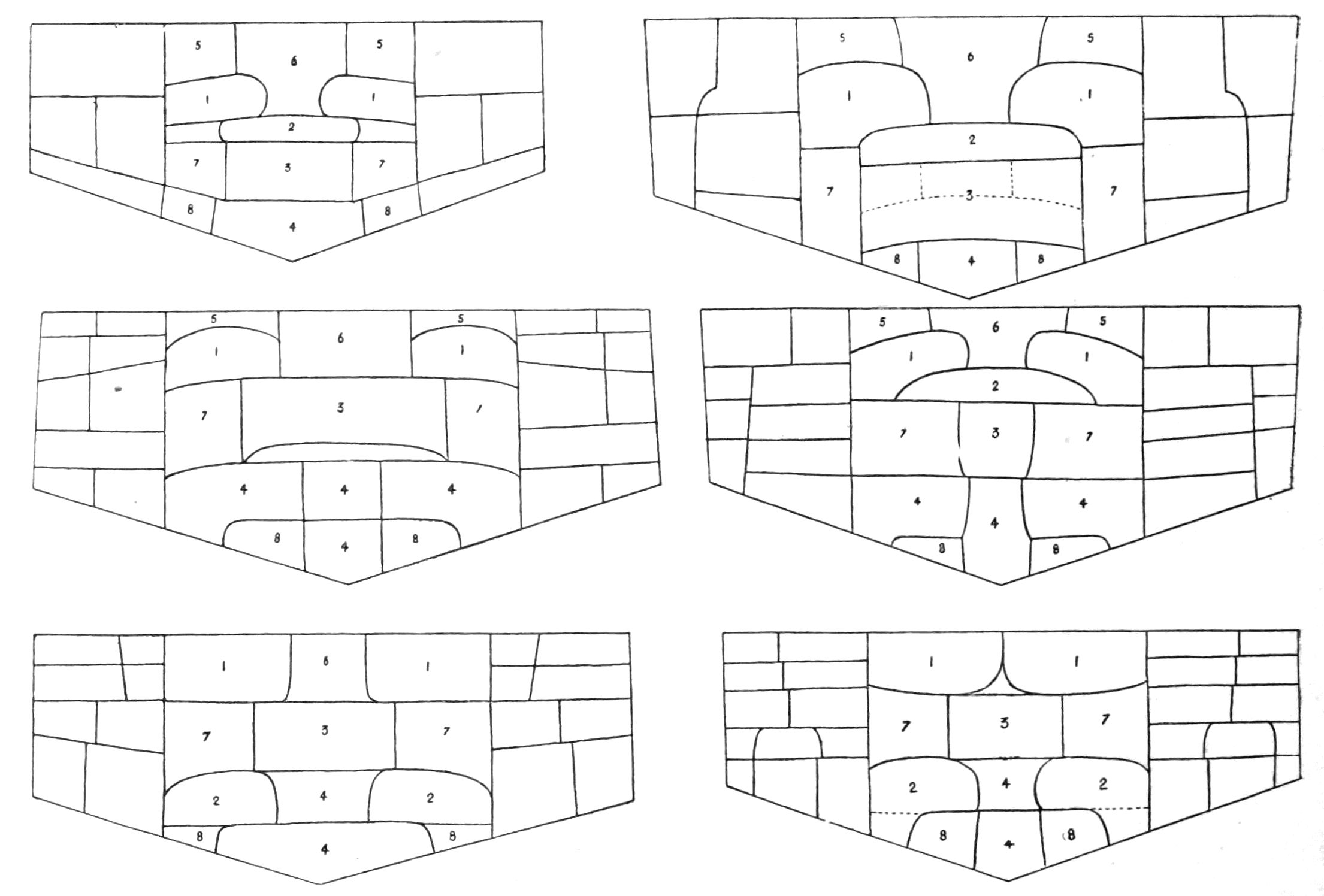
Fig. 268. General plans of Tlingit blankets.
The blankets may be divided into two large groups. Their fundamental patterns are indicated schematically in fig. 267. The one design is clearly a representation of an animal with a large head which occupies the whole upper part of the field down to an almost straight cross line (fields 1, 2, 5, fig. 268). Under it are the body (field 3) and in the lower border the tail and hips (field 4) of the animal. It may be noticed that there are always two tail joints, although in other cases the use of a single tail joint for birds and a double tail joint for sea mammals is fairly consistent. Fields 6, 7, and 8 are used in various ways. They are not essential parts of the animal represented, although field 6 may be utilized for the purpose of showing parts of the back, and field 7 may be utilized for a representation of the fore arms. In this style we may distinguish, in the wide center, a central stripe, consisting of the elements numbered 6, 2, 3, 4 and two lateral stripes 5, 1, 7, and 8. Generally these sections interlock. In a few specimens, the outer limits of field 3 are carried down to the lower border so that they form a continuous broad line with the outer limits of field 4.
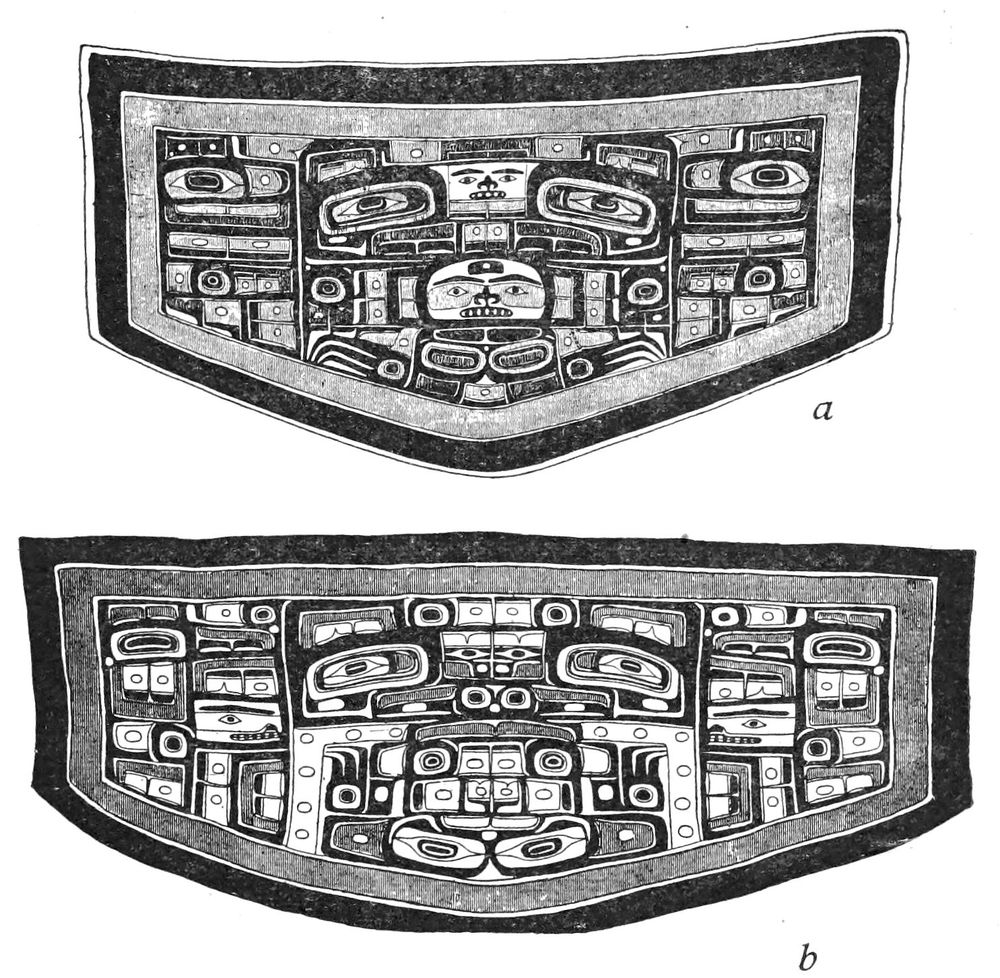
Fig. 269. Chilkat blankets.
Examples of this type are shown in figs. 202 and 269. In these the animal figure in the center appears very clearly. It will be noticed that the large eyes of the animal have always a cheek design attached to them. These appear also in fig. 203, a blanket belonging to the same class, the lower part of which is, however, much less distinctively body and tail belonging to the large head. The reduction of field 7 and its extension to the lower margin is rare in other specimens. In fig. 202 field 7 is occupied by the raised hands of the animal, while in fig. 269 a it is occupied by a wing design. The rectangular frame surrounding the body in fig. 269 b is an exceptional feature which I have seen only in one other modern blanket.
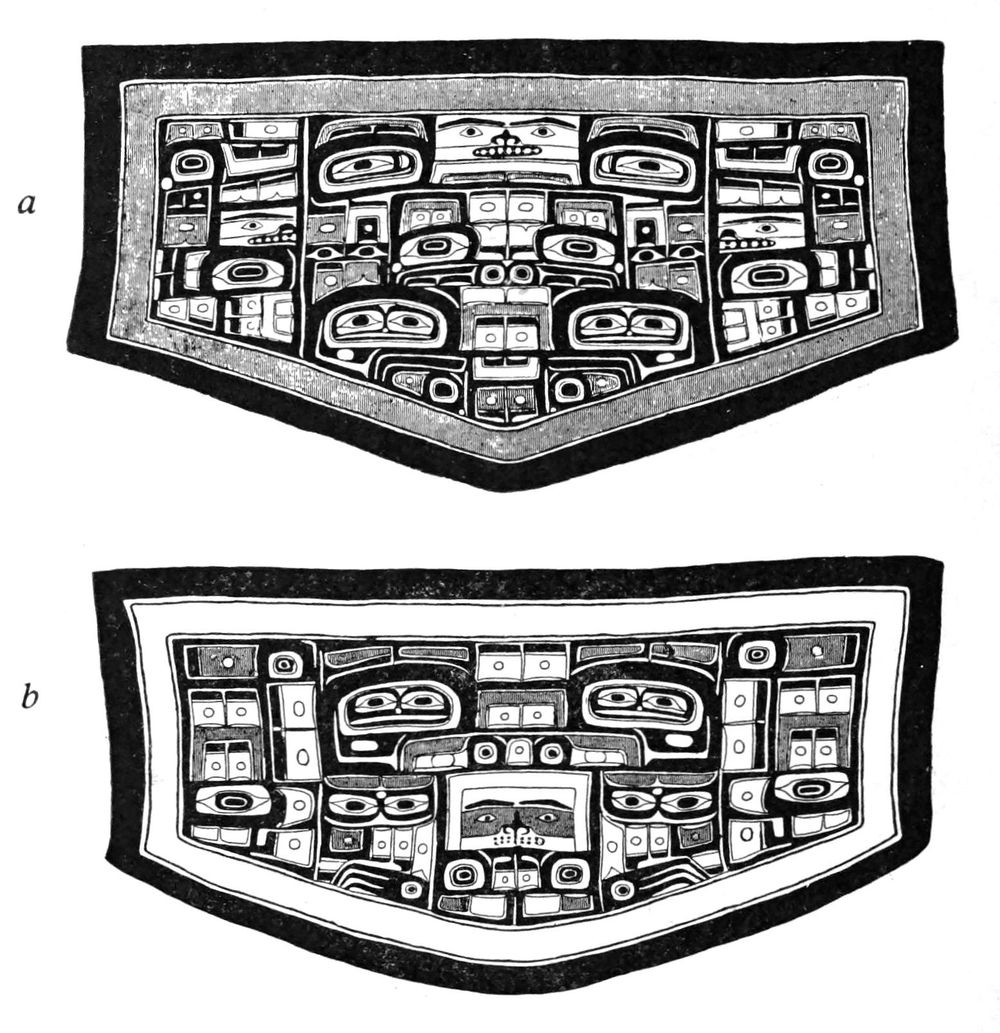
Fig. 270. Chilkat blankets.
A sub-type may be distinguished in which the lower part is treated differently (fig. 270 a). The two eyes of field 4 are of the same size as those of field 1. In this way a more symmetrical impression is produced, but at the expense of the unity of the animal form. This treatment lends itself to a sharper separation of the fields 5, 1, 7, 8 against the fields 6, 2, 3, 4 so that the whole central field seems to be divided into three sections (see fig. 204). Fig. 270 a is decidedly influenced by the second type of blanket; the four eyes being approximately of the same size and symmetrically arranged around a central face.
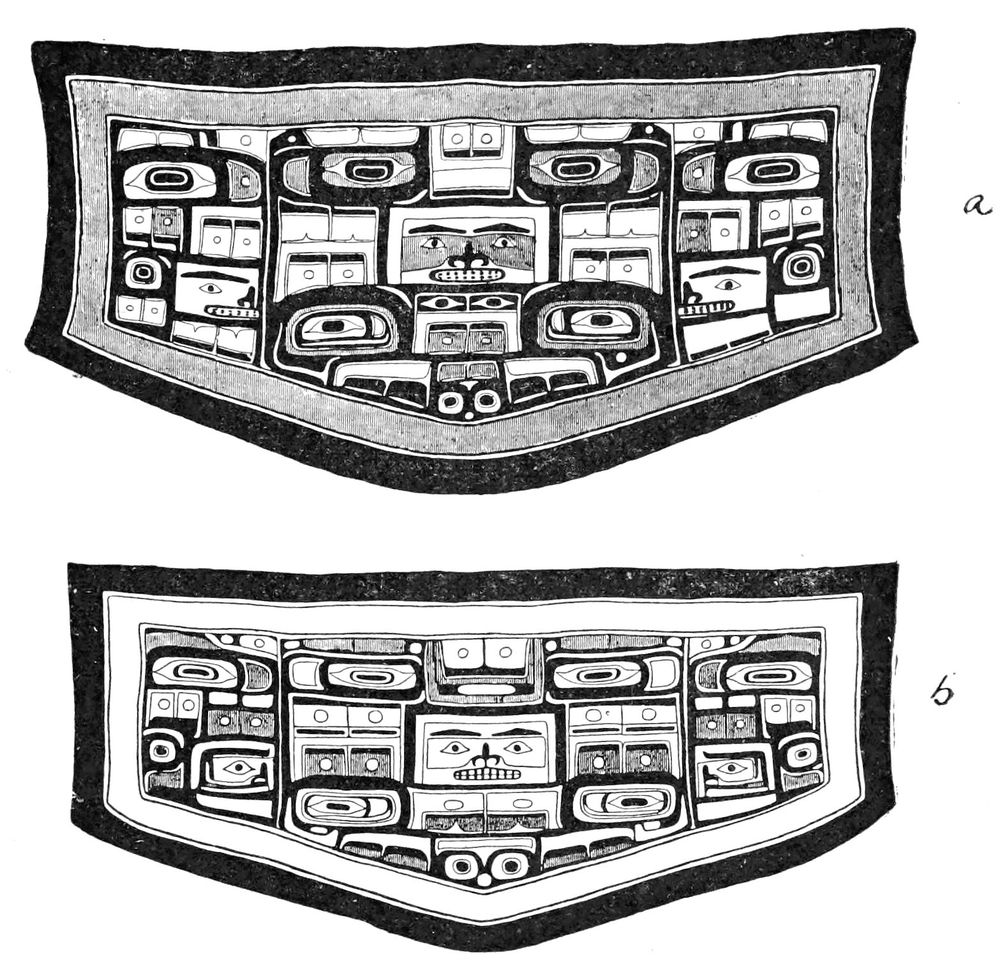
Fig. 271. Chilkat blankets.
The fundamental feature of the second type of blankets is a central face placed a little higher than in the preceding type, so that it forms exactly the center of the whole field. In place of the large eyes on top, we find two large inverted eyes, often without the adjoining jaw design. In many cases two small circular patterns, or small eye designs, occupy the center of the lower border. These may often be identified with the nostril of the head to which the two large lower eyes belong. This pattern is much more symmetrical than the former type, but its symbolism is much more obscure. I presume that the inverted position of the eye in the upper border is essentially due to the attempt to obtain greater symmetry. For an explanation it is necessary that the upper eyes must be viewed as some part of the body that is turned upside down. Characteristic examples of this type are shown in figs. 103 and 271. In these, the fields to the right and left of the central face are treated, in the former, as a profile face; in the second they are decorated with a feather design filler. A somewhat different treatment is given in fig. 272 which may be compared with fig. 270. In both a large face occupies the center of the whole design, surrounded by the four large eyes and the lateral spaces filled with feather designs.
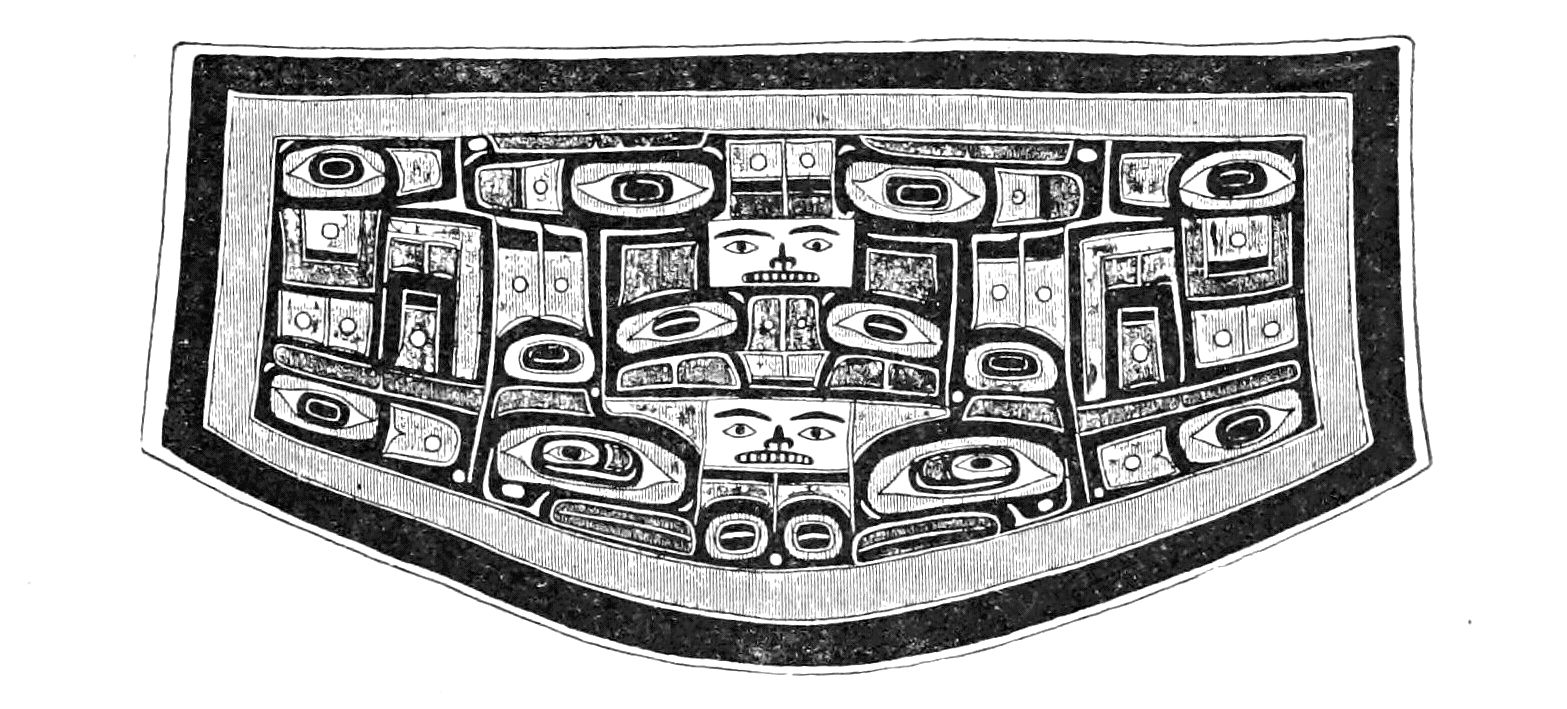
Fig. 272. Chilkat blanket.
In fig. 273 the upper eyes have been moved towards the center and the eye design has been expanded into a profile which occupies the whole upper margin of the central field. In fig. 273 b the lateral fields next to the central face are occupied by the two sides of the dorsal fin so that here the form of a whale is brought out fairly clearly.
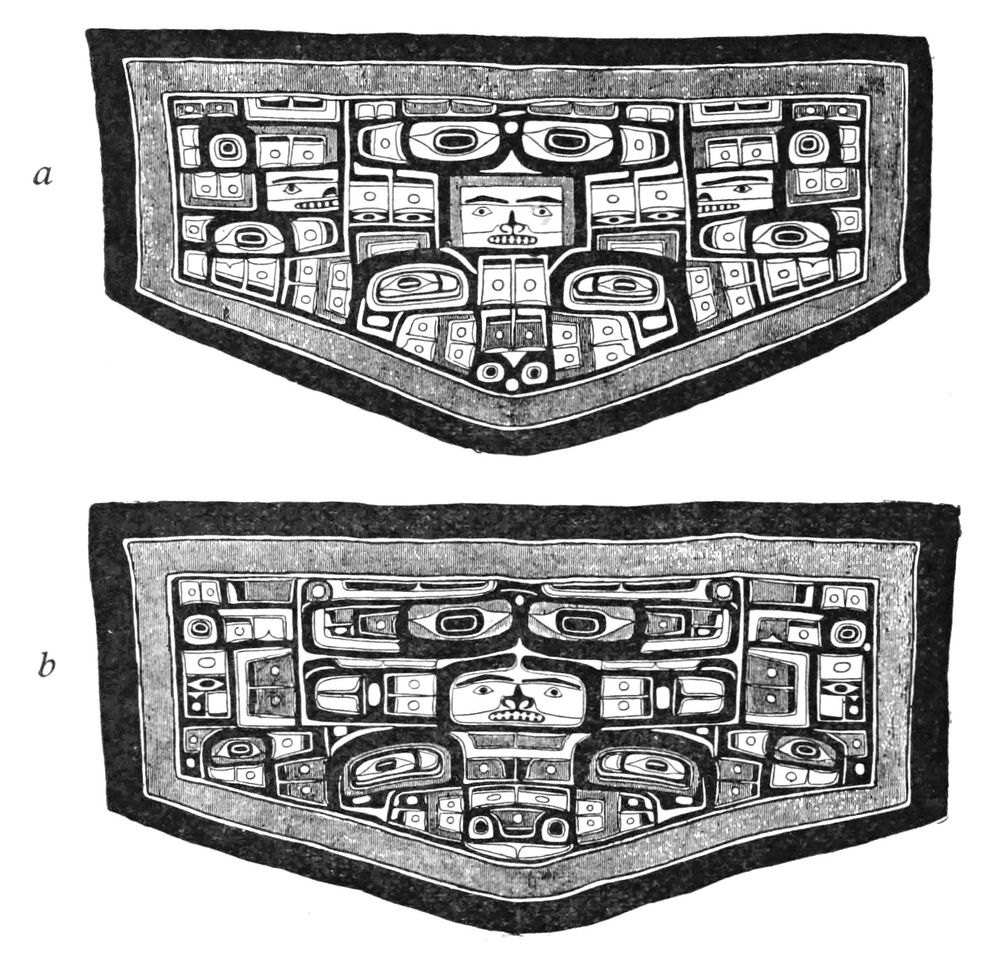
Fig. 273. Chilkat blankets.
The general scheme of the narrow lateral panels is also quite definite. We find on practically all the blankets an eye design,—part of the profile of an animal’s head,—in the upper, outer corner, another eye design near the lower border, generally approximately in the middle of the lateral field. The position of the lower eye design is much more irregular than that of the upper one. In general we are given the impression of an animal, the body of which extends along the extreme outer border of the blanket, the head occupying the centre of the panel, while the feet or tail are shown along the lower border. In this way a space is left in the middle, next to the central panel, which does not belong essentially to the form of the animal.
In both fundamental types the intervening spaces which are not filled by the large eye designs, the body, tail, and extremities, are filled with a variety of patterns which depend only in part upon the selection of the animal to be represented, but are very largely determined by esthetic considerations.
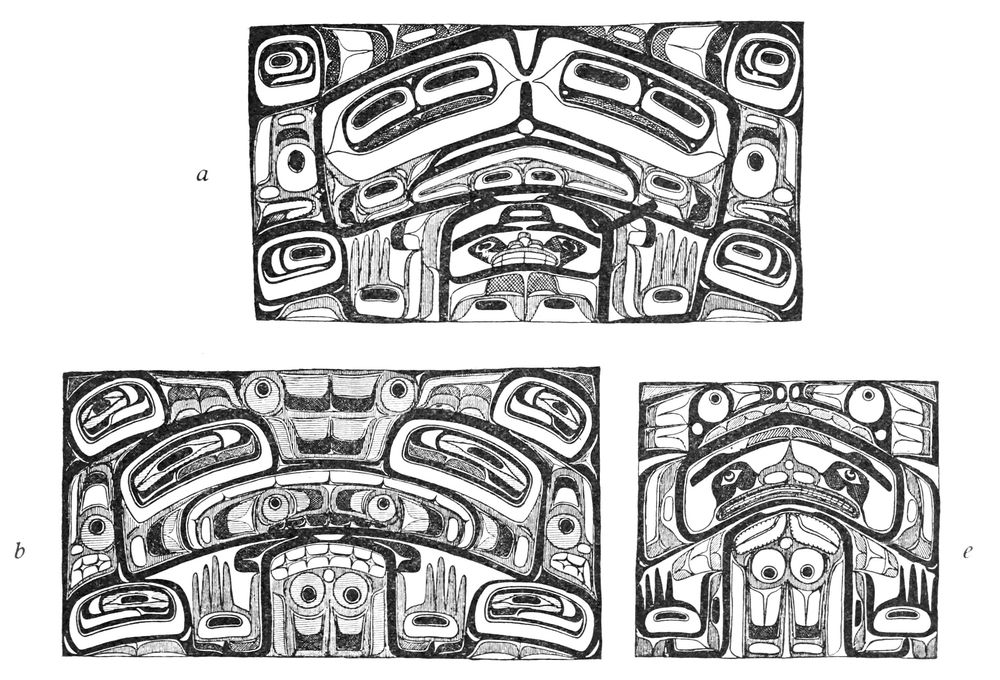
Fig. 274. Front, reverse and side of a painted box.
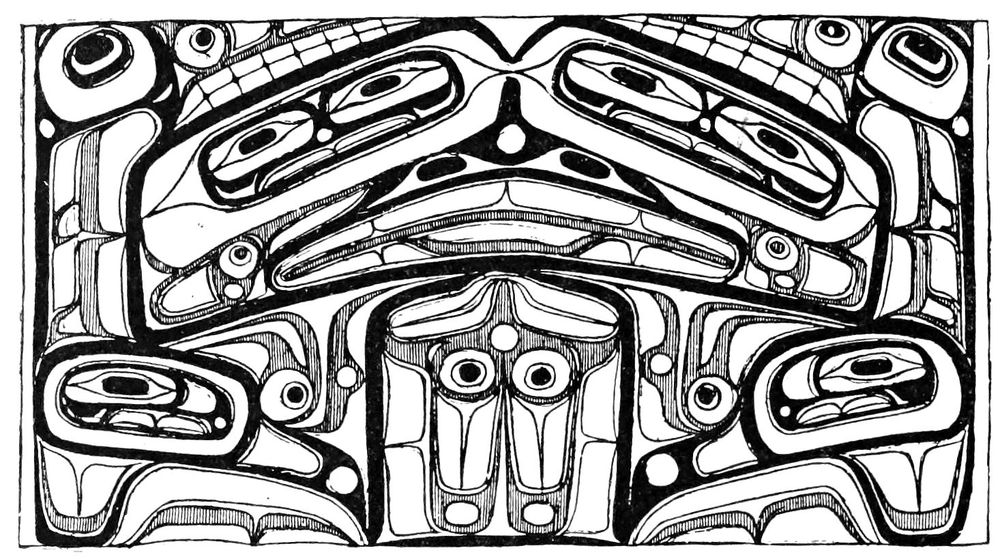
Fig. 275. Painted and carved box front.
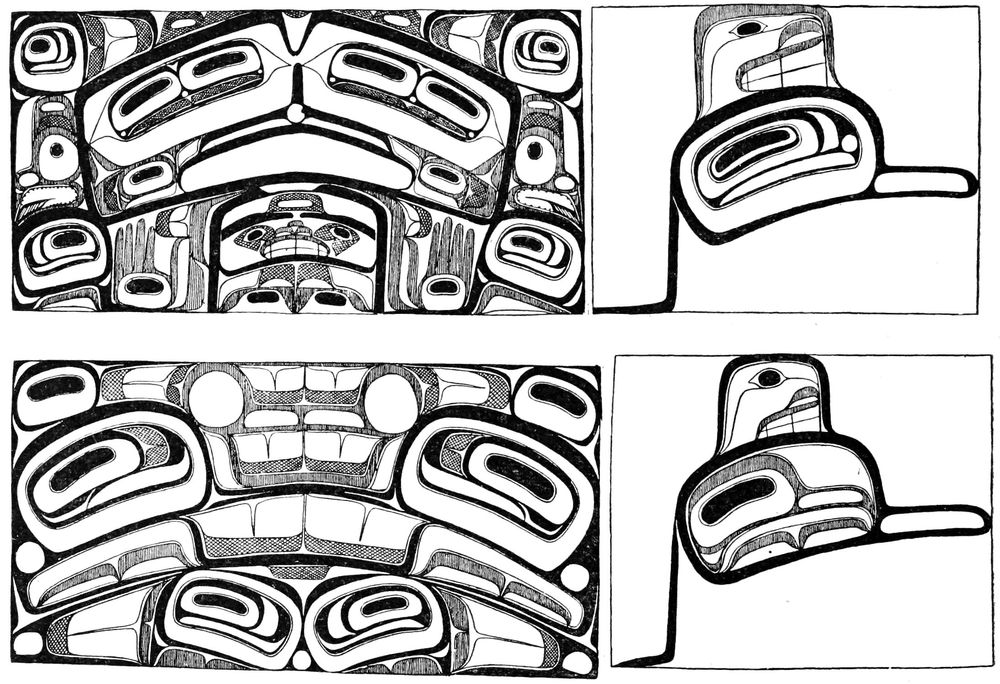
Fig. 276. Four sides of a painted box, Tlingit.
The broad sides of rectangular boxes bear the same fundamental design as the first type of blankets; an animal with an enormous head on the upper border, the body occupying the centre below. A fairly consistent difference between the blanket and box types is that the lower border of the large face is curved on the boxes; straight on the blankets. I believe this difference is due to the desire to avoid excessive parallelism. In the blanket the straight lower line of the head is set off against the curves of the upper part of the head and against the angle in the lower border of the blanket, while in the boxes a straight middle line would appear set off against the parallel upper and lower edges of the box. The lateral panels of the blanket correspond, in a way, to the narrow lateral strips in the front of the long boxes (fig. 274 a) which are characterized by a fairly large eye design in each corner. These are connected by a variety of decorative elements. At the lower border of the box front there originate, in this manner, five fields. The middle one being occupied by the body of the central animal; the corners being occupied by the eye designs which form the basis of the lateral strips. Between these there remain spaces which are often filled with designs representing the fore or hind feet of the central animal. On account of the shifting of the eyes the five field division does not appear as clearly in fig. 275. The reverse side of fig. 276 is treated differently; in the lower field the body is omitted, the two eyes placed in the middle so that a fourfold division of the whole area under the mouth originates. A similar treatment is given to a front (fig. 277 below), in which the eyes are placed in the corners while the middle is occupied by the two sides of a tail, which, however, is treated like a hawk’s face. The arbitrary character of the details appears very clearly in this arrangement.
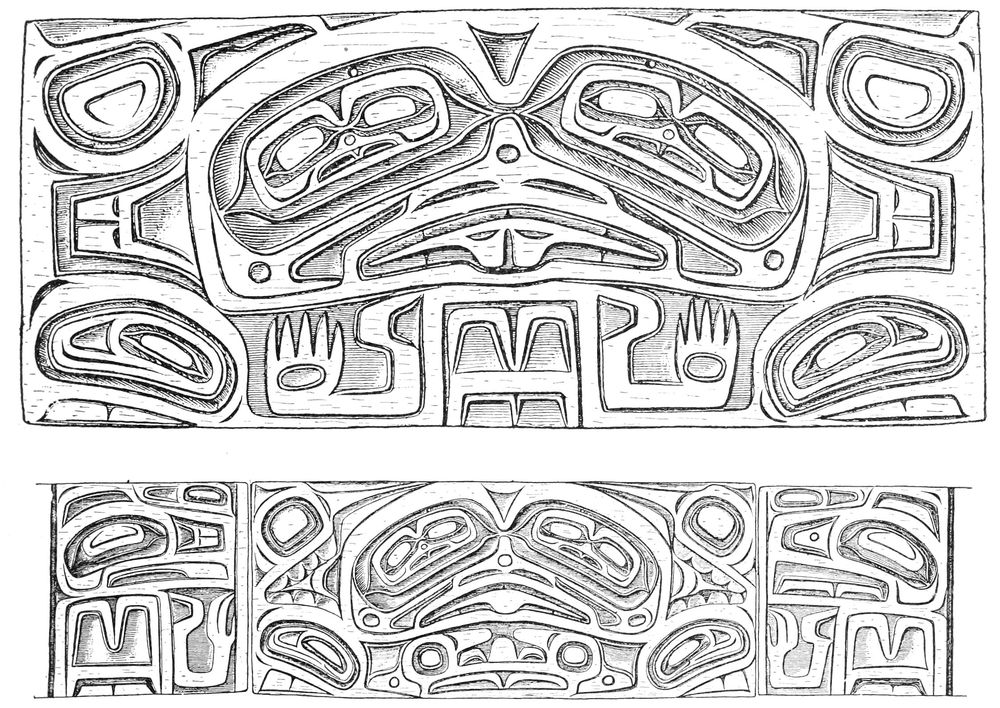
Fig. 277. Four sides of a painted box, front on a larger scale, Tlingit.
The narrow sides of the boxes are generally painted with a design analogous to the central design of the front with this difference, however, that the lateral panels are missing and that the head is more compressed. In a number of cases the short sides are treated differently, as shown in fig. 276. Very rarely the short sides contain a profile figure that does not occupy the whole width of this side (fig. 277).
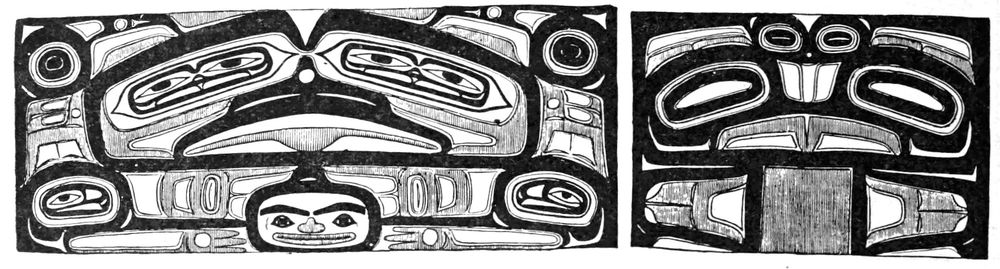
Fig. 278. Front and side of a painted box.
There are also a number of low boxes which are treated somewhat differently. On account of the lowness of the sides the lower rim of the head is drawn straight so that a narrow rectangular panel originates along the lower border (fig. 278). In this specimen the eyes are retained; the central face in the lower field presumably represents the body, to which are attached the arms and hands. In most specimens of this type, however, the lower section is almost entirely suppressed; the large upper face is retained but under it we find only a few ornaments that may be interpreted only as fillers (fig. 279 above).
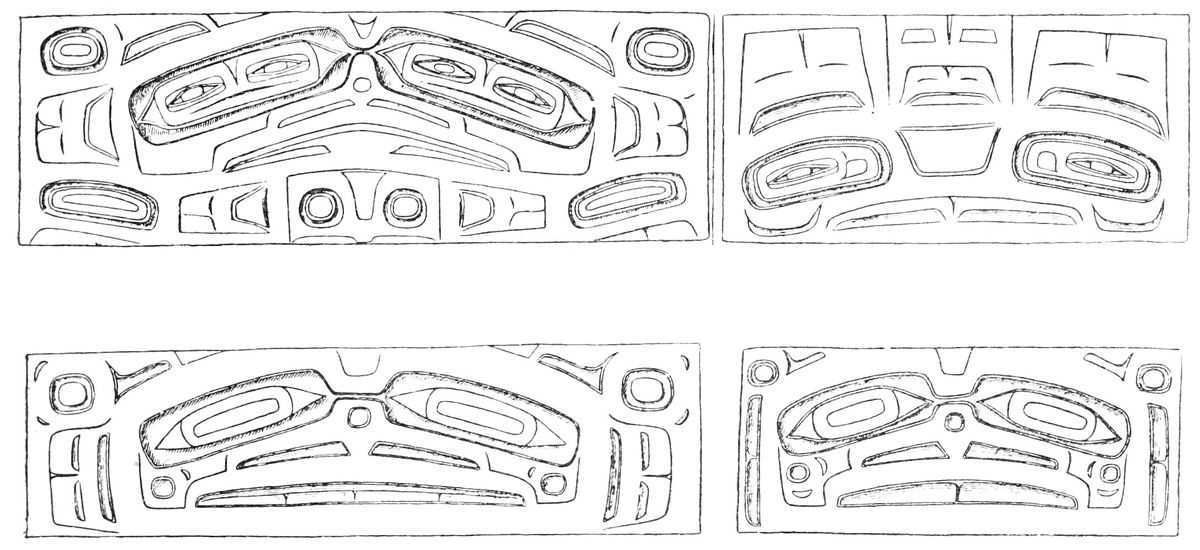
Fig. 279. Front, reverse and side of carved boxes.
There are also a number of low boxes in which the body is entirely suppressed. They contain, essentially, the large head design with a few decorative features along the sides, and the eyes in the upper corners. (Fig. 279 below).
The arrangement of the long boxes is such that the center of the mouth, or a point a little below it, is the center of the decorative field (figs. 274-276). A line drawn from the center of the lower border to the upper corners passes almost always along the corner of the mouth and often also through the sharp curve at the upper, outer outline of the face. The line drawn from the center of the upper border to the lower corner passes, generally, through the corner of the mouth. When the central field along the upper border is wide, so that it reaches down to the upper curve limiting the mouth, the eye is shown in profile (figs. 274 b, 276 reverse). When the central field consists only of a sharp short angle, there is a double eye (figs. 274 a, 275, 276 front, 277).
The general arrangement of lines on the box is such that the upper curves of the face are strongly curved downward. The curvature decreases downward; and in some boxes, for instance in those shown in figs. 275 and 276 reverse, there is a tendency to an arrangement of lines which are convex, upward.
The eye decorations are always so placed that they are not arranged in straight lines. It will be seen that in the best boxes they fall into curves that intersect the black lines of the design. In fig. 274 a, the eyes in the lower corners and those in the mouth are placed so as to form a continuous curve; in fig. 274 b, the arrangement of the eyes in the upper corners, the eyes of the large head, and those in the mouth form a fairly regular curve.
In the square boxes on which only one side of the face is shown on each side (fig. 280), the body is very much reduced in size. In most of these the large head is limited below by a straight line, while on the long boxes containing the full face on the front the lower line of the face is curved. In only one of these (fig. 278) do we find the face limited below by a straight line.
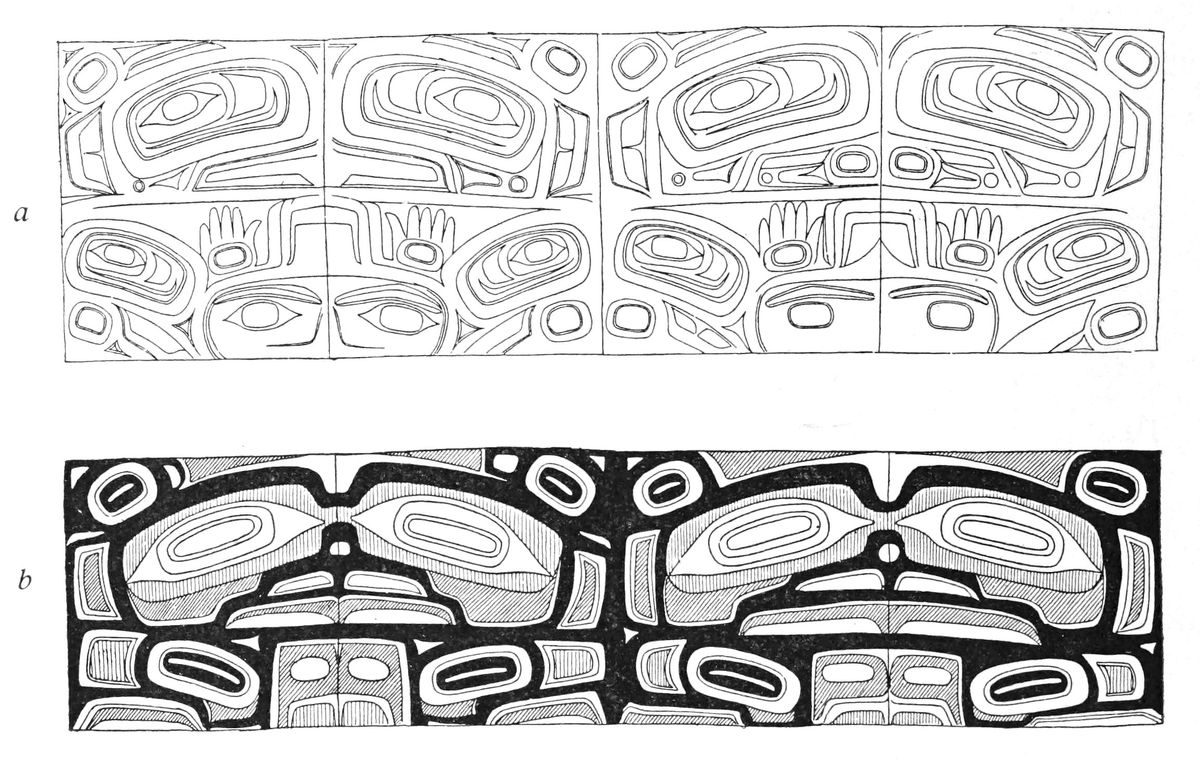
Fig. 280. Carved boxes.
In fig. 280 a, the two sides shown on the left are occupied by a large head on top, corresponding to the blanket fields 1, 2, and 5. The ear (5) is much reduced in size. The sharp beak in the middle indicates that the hawk is meant. Under it is seen a small field corresponding to field 3 on the blankets and under it a face with its two eyes, corresponding to 4. The field 7 is occupied by the arms, indicated by the curved line running from the shoulder to the wrist of the raised hand. The whole lateral field of the blanket is condensed in the narrow strip to the right and left of the face and body. The designs on the upper corners are clearly ornamental and do not represent any particular part of the head; the eyes in the lower corners are considered as feet and toes; the large eyes over the lower corners as knee joints. The two sides of the box shown on the right hand side correspond in all details to those on the left, excepting the mouth, which is treated quite differently; the nostrils being shown in the center.
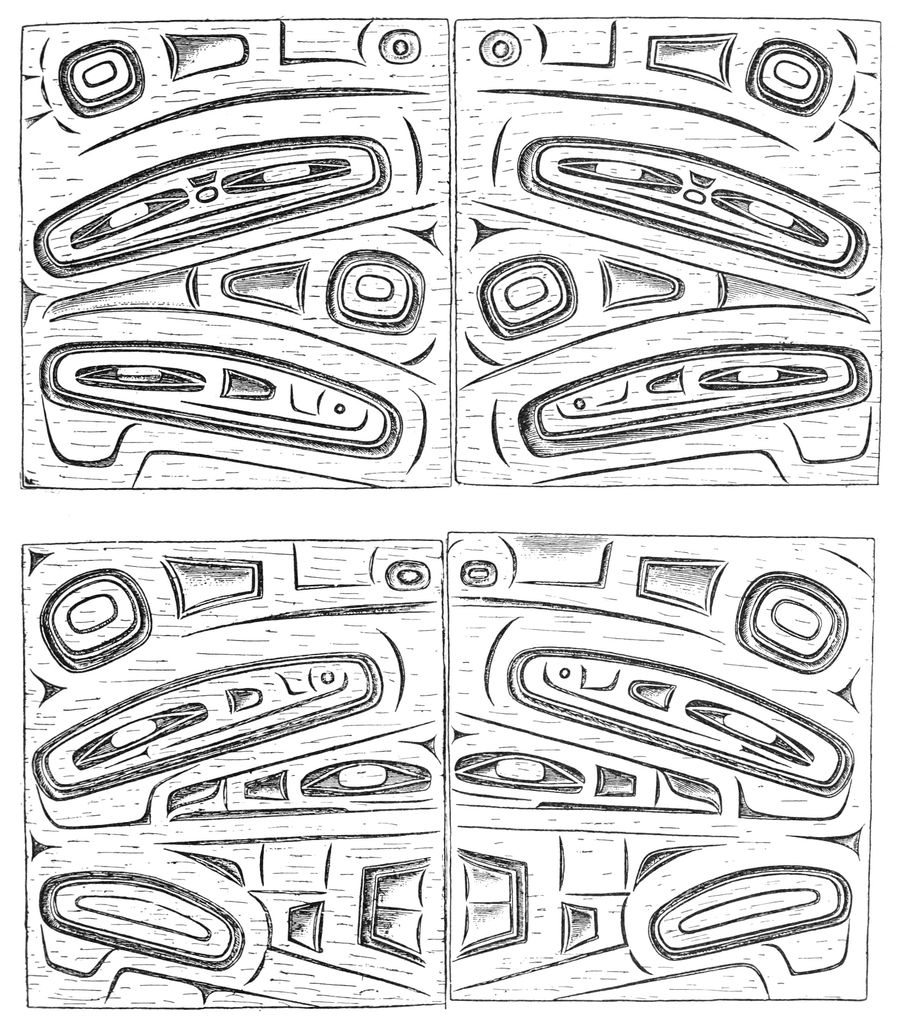
Fig. 281. Carved box, Tlingit.
In fig. 280 b the lower portion of the decorated side is much reduced in size and the marginal fields are simplified. The head may represent a hawk; the eyes in the lower fields are exceptional in so far as they are not placed in the corners but near the body and they may be considered ankle joints and below them the toes. The eye designs in the upper corners take the place of the ears. The reduction of the body is even more marked in fig. 281; here the eye designs and the adjoining curves on the upper margin are clearly fillers; the body has been completely dissolved. The eyes in the lower corners with the attached lower curve show an attempt to represent a flipper. The common character of these three specimens is the horizontal dividing line under the mouth and (excepting the one face in fig. 281) the general tendency to the symmetrical arrangement of lines in the upper and lower fields. The lines in the upper field point from the middle downward, and those in the lower, from the middle upward.
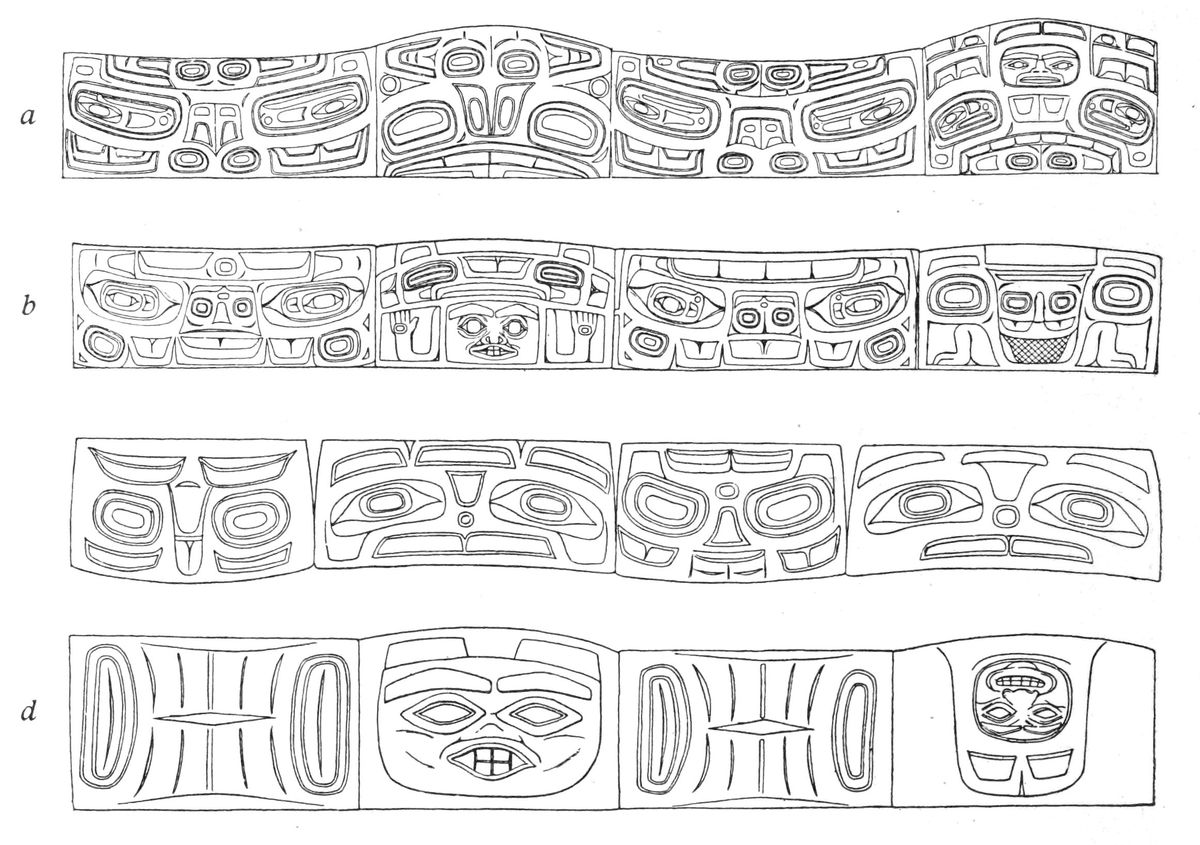
Fig. 282. Carved trays.
There are a number of peculiar developments of the head and body designs which are used on small food trays, the sides of which are bent out of a single plank. In one group of these (fig. 282) the two narrow sides represent, in front, the head of the animal; on the opposite, side the tail. This appears most clearly in figs. 282 b and d; both representing the beaver. In fig. 282 d the beaver’s head and tail are perfectly plain. In 282 b there is considerable confusion; the beaver’s body below is provided with two human arms and over it is indicated the large characteristic head. The tail is shown on the opposite short side, together with the hind legs and the two disconnected eyes which ordinarily would form the hip joints and would be connected with the upper end of the thighs. On all these specimens, 282 a, b, and c, the other sides show an inverted face. This originates evidently in such a way that the eyes represent, at one end, the shoulder joints, at the opposite end, the hip joints, but instead of developing the sides as fore and hind legs, the inverted eyes have lead to the development of a face design which has no particular relation to the animal represented. In other words, we find here, as well as in many other places that elements which are in part derived from representations of parts of animals, have assumed a purely decorative function so that an explanation of the details is, to a great extend, arbitrary. The geometrical decoration on the long side of fig. 282 d is also derived from the shoulder and hip joints, but instead of parts of a face, slit designs fill in the rest of the side.
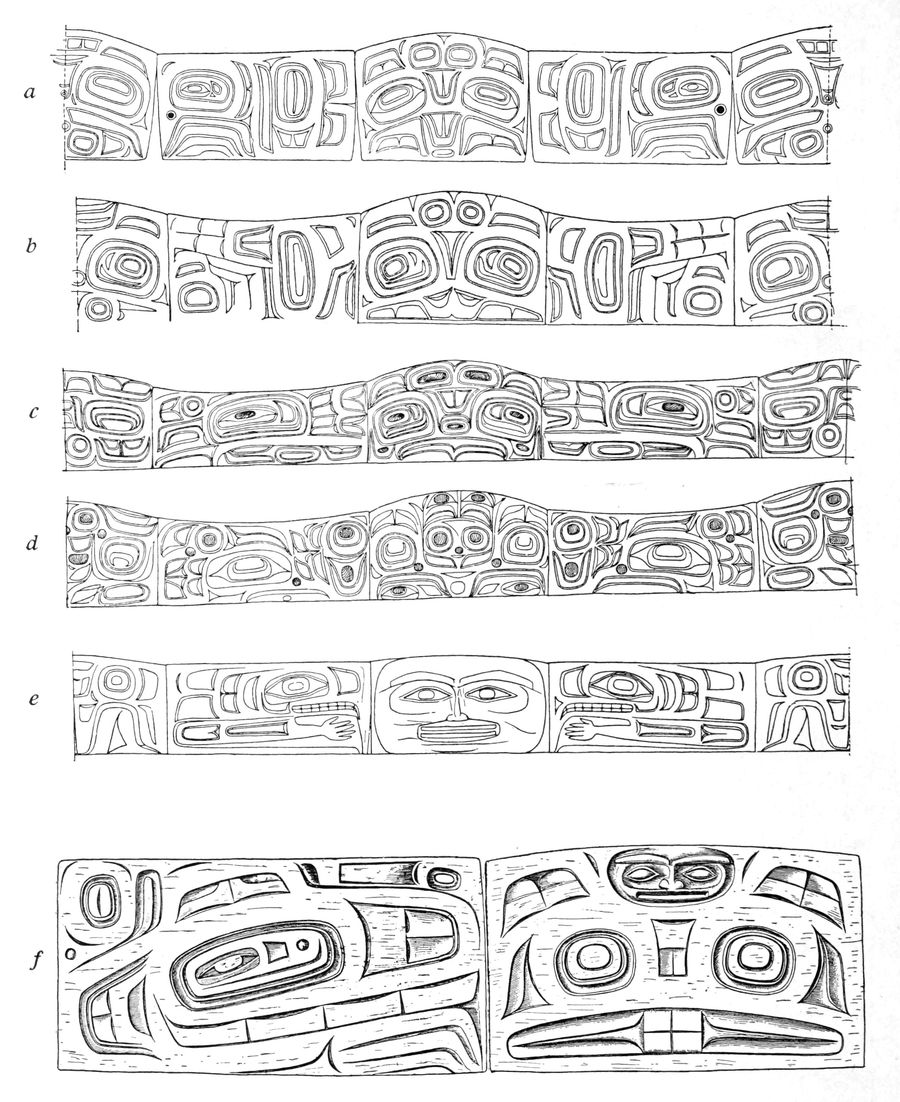
Fig. 283. Carved trays.
The trays shown in fig. 283 are of the same make as those shown before, with the only difference that on the long sides the shoulder joints, knee and foot are shown in the ordinary way. The hind limbs are here represented on the short side, where the hip joints are shown by two large eyes in the upper part of the design. It will be observed, however, that in these cases also there is a considerable amount of arbitrary use of decorative elements that have no particular significance, but which must be considered simply as fillers. This appears most clearly in fig. 283 e, which represents a dish with a design of a human being. Here the arms are represented on the long sides, the shoulder joint by an eye which, however, is provided with lids. The space under the eye is filled in with a mouth which has no function in this position. It is evidently introduced in the same way as the profile faces which serve as fillers on the blankets. The most distinctive specimen of this type is shown in fig. 283 f. It represents a beaver, the face indicated by disconnected eyes, mouth, and ear; the nose showing the form of one of the conventional copper plates used by the northwest coast Indians, while the face in the middle of the upper border is purely ornamental. The opposite short side shows very clearly a tail, hip, legs, and feet and on the long side also the large shoulder joint in the form of an eye with ear; the arm and the foot are distinctly shown but here also, by the addition of four teeth, the shoulder joint is elaborated in the form of a face; the eyes in the corners of the long field are purely ornamental.
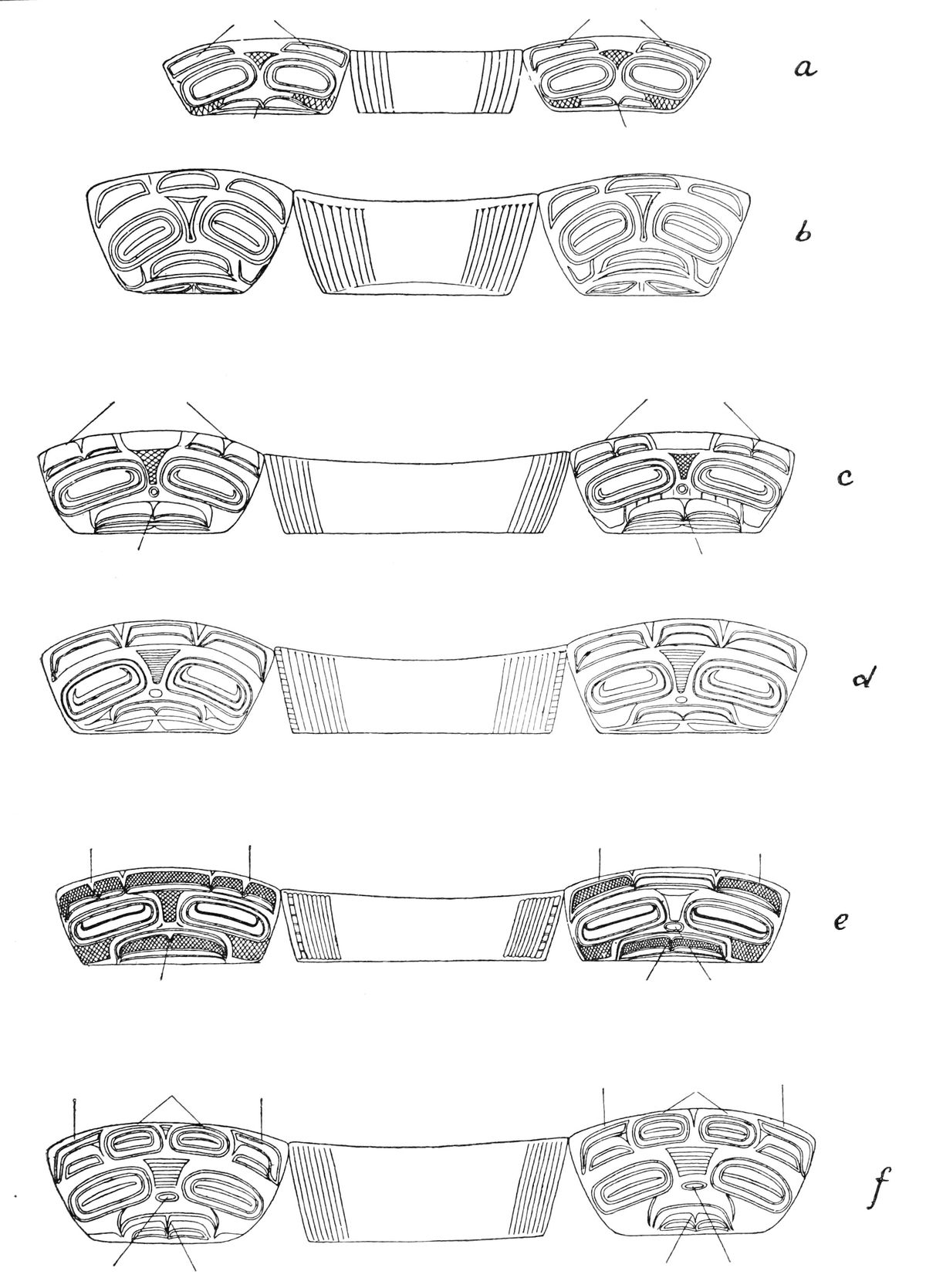
Fig. 284. Carved trays.
To the same group belong also the carved trays cut out of a single piece of wood, shown in fig. 284. Here we have only the head design which is adjusted to the curvature of the upper border of the decorative field. The lines of the face are drawn so as to conform to the decorative field.
It will be observed that the eyes of the large head in the blankets are always almost horizontal while those on the boxes and trays are strongly inclined. I presume this is due to the tendency to avoid massing of parallel lines.
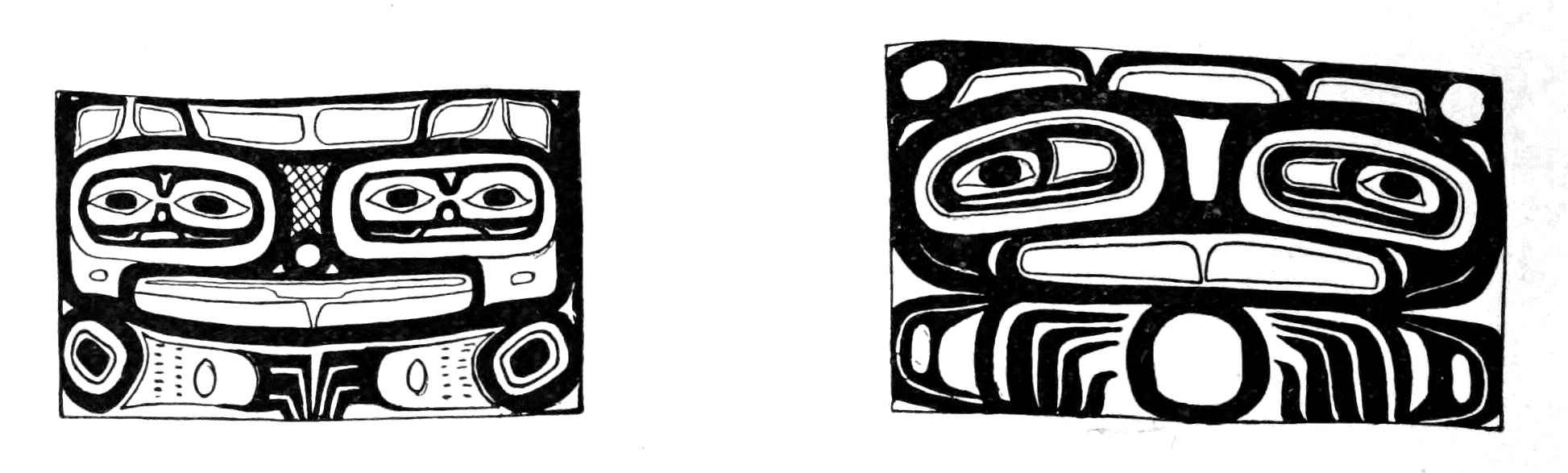
Fig. 285. Designs on Tlingit armor.
The large head design found on the blankets and boxes occurs also on the paintings in the center of the front of slat armour. The lateral panels are missing and the design consists simply of the head with attached shoulder, arm, and hand (fig. 285).

Fig. 286. Painted tray.
A number of square food trays, bent of a single piece of wood, are not decorated according to this plan. The face, consisting of two symmetrical halves, is replaced by a series of profiles (fig. 286); the short and high sides have the large eye in the left hand upper corner; the mouth in the lower right hand corner. The design on the long sides represents the sides of the body. The large eyes stand, presumably, for the shoulder joint and are placed in the center of the side; wrist and fingers are in the lower left hand corner. The significance of the design in the right hand upper corner is not clear. The general distribution of the design elements is evidently determined by the central position of the large eyes.
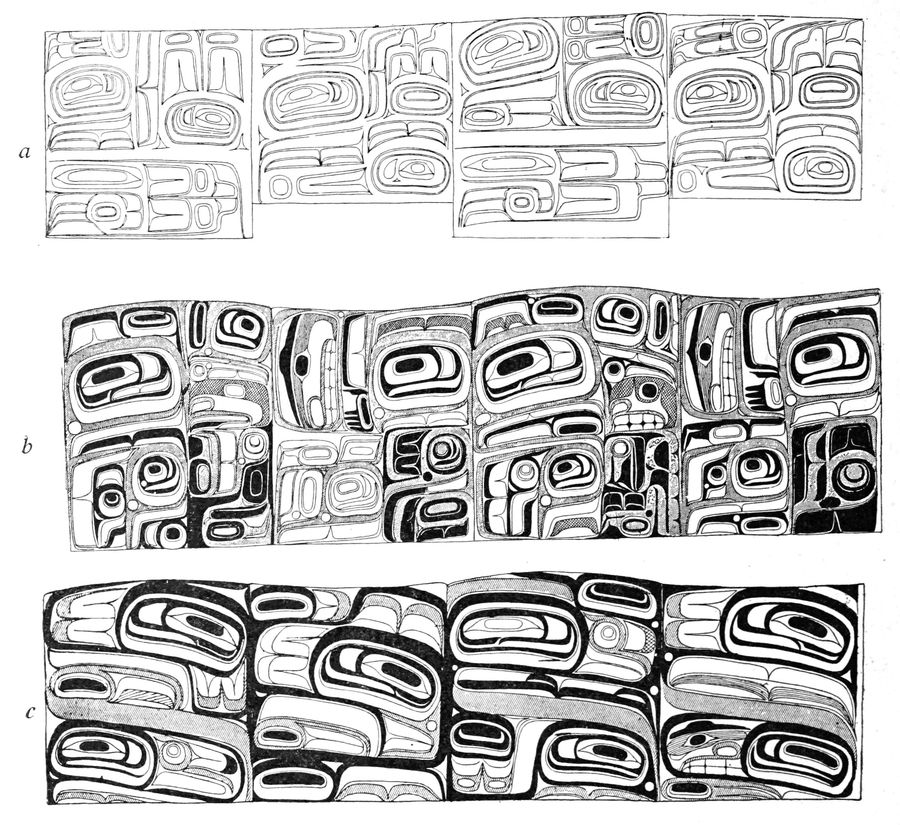
Fig. 287. Painted boxes.
The boxes shown in fig. 287 illustrate that still another pattern is used on square boxes. Each of the four sides of the two boxes shown in figs. 287 a and b, is divided into four rectangles of unequal size. The general plan of the two designs is almost the same, although there are considerable differences in detail. It is quite evident that in 287 a the lower part of the first and third sides represents legs and feet. A distinct wing design appears in the left hand upper rectangle of the fourth side, but otherwise the arrangement of the elements is so arbitrary that a safe interpretation is impossible. It seems plausible that in this case also the attempt at decoration was much more important than the attempt at interpretation. An interpretation was given to me for the box shown in fig. 287 b. Although obtained from Charles Edensaw, one of the best artists among the Haida, I consider it entirely fanciful. The first side to the left, corresponds to the third side, which is opposite to it on the box. The second side corresponds to the fourth side. Edensaw explained the design as showing four interpretations of the raven as culture hero. The upper right hand rectangle of the first side he claimed to represent the head of the raven surmounted by the ear; the large eye to the left of it, in the left hand upper corner, the shoulder and under it the wing and tail. The design in the right hand lower corner he interpreted as the foot; the toes are clearly visible in the lowest right hand corner of this field. He claims that the head turned upside down in the left hand upper rectangle of the second side represents the head of the raven and under it the hand; the raven being conceived as a human being. The rectangle in the upper right hand corner contains the shoulder; the right hand lower corner under it, the tail; and the left hand lower corner, leg and foot.
The box shown in fig. 287 c is related to the general design of fig. 287 b. The somewhat slanting lines between the upper and lower fields occur in both cases, but the vertical division of each side, which is characteristic of the specimen just described, is lacking in the last named specimen.
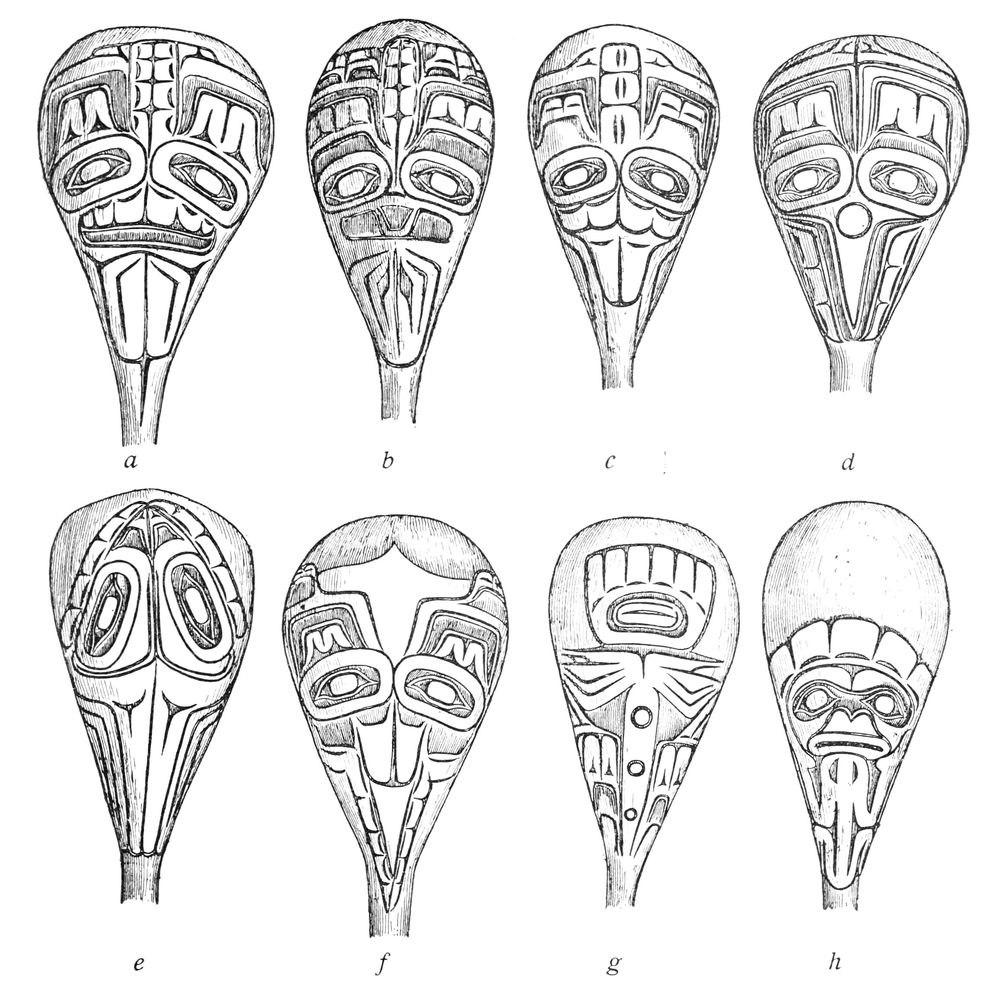
Fig. 288. Horn spoons showing carving on the back;
a
, representing sea-monster;
b
, hawk;
c
, beaver (?);
d
, raven;
e
, killer-whale;
f
, raven;
g
, dlia (?);
h
, sun.
A fairly fixed formal arrangement may also be observed on horn spoons moulded of a single piece (fig. 288). On the back of the spoon is a design, the center of which is a large face. In many specimens the space above the eye is filled by two ear designs which are doubled and unusually large on account of the space that they have to fill. In these specimens the space between the ears is taken up by a narrow decorated strip. In a few simpler forms parts of the bowl of the spoon remain undecorated.
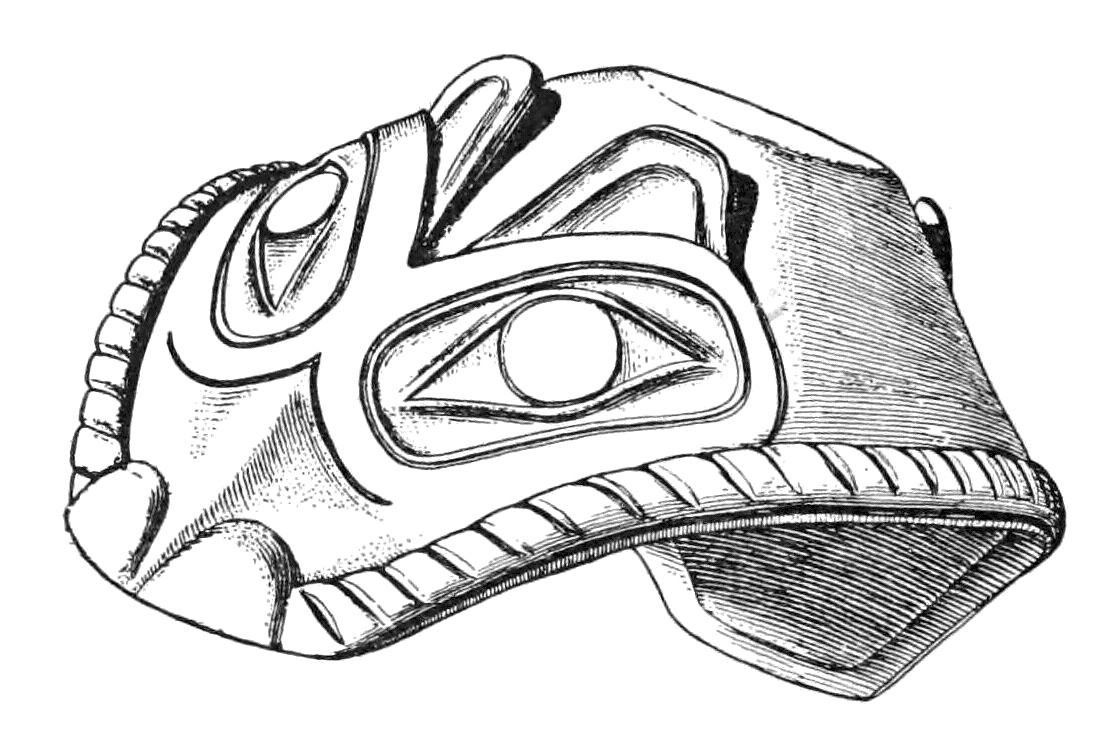
Fig. 289. Dish of horn of big-horn-sheep representing the bear.
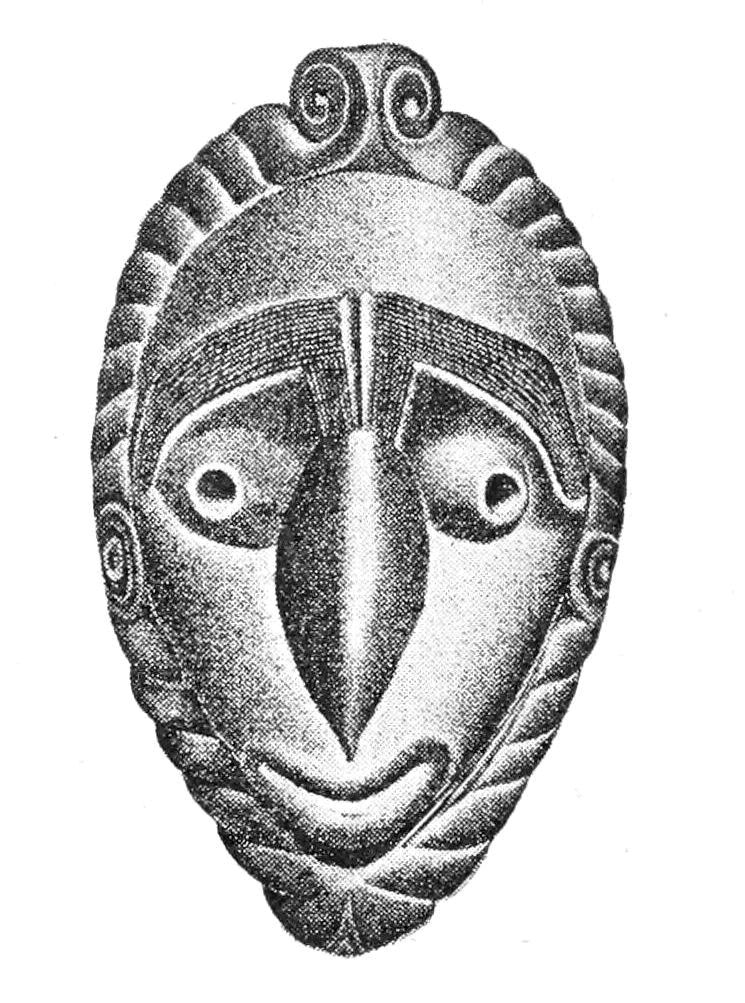
Fig. 290. Mask of Kwakiutl Indians used in winter ceremonial; according to some representing fool dancer, according to others The-One-Shining-Down.
A closer examination of the decorated objects shows that even apart from the decorative use of symbolic motives, geometric elements are not by any means absent. The most striking use of geometrical forms is found on wooden trays, which bear at the ends the characteristic faces, but which are decorated on the sides by groups of short parallel lines (fig. 284, p. 273). The line and circle pattern on the dish (fig. 168, p. 191) illustrates also the use of geometrical forms for decorative purposes. On the berry spoon (fig. 215, p. 221) the space left vacant by the symbolic design is filled in with a net of crossing lines. This specimen shows that the cross hatching which occurs in many specimens,—on the beaver tail (fig. 157, p. 186), on berry spoons (fig. 182, p. 197), on spoons (fig. 189, p. 201) and often in red or black as a filler on boxes (fig. 274, p. 263) has a decorative value even when it may be given at the same time a symbolic meaning. The dish of big-horn-sheep horn (fig. 289) shows a bear’s head at each end. At the same time it has a decorative border which seems to imitate the border of a basket and which is purely ornamental. It serves to close off the rim which without it would seem to end abruptly. A similar device is used on a Kwakiutl mask (fig. 290). Although the encircling ornament is explained as a ring made of twisted, shredded cedar bark, it is obviously essentially ornamental. The circular and spiral designs bring out the ornamental character most clearly.
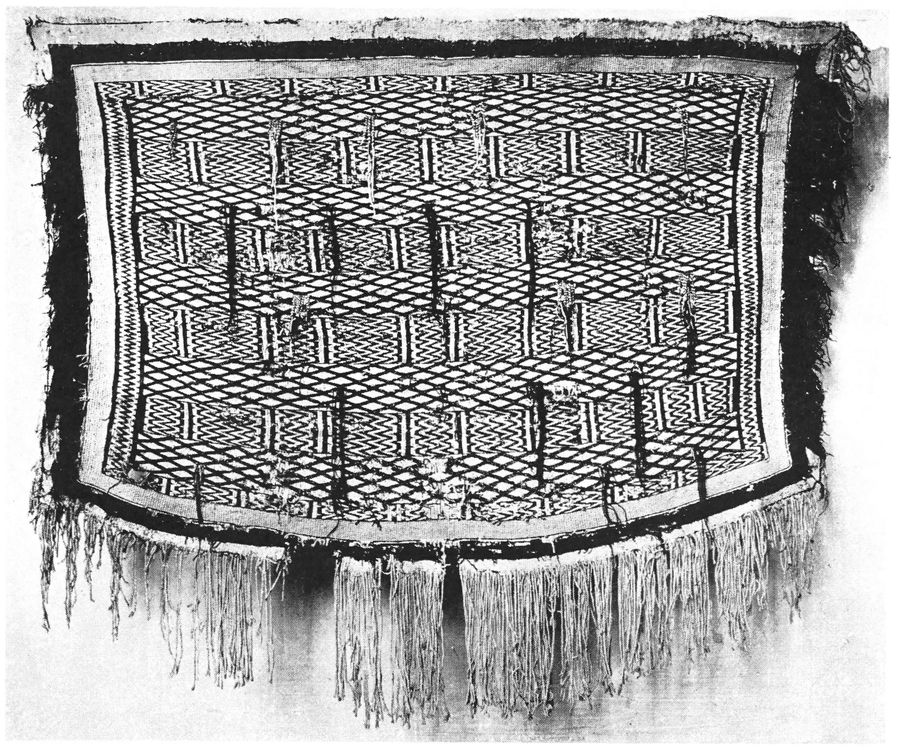
Plate X.
Chilkat Blanket.
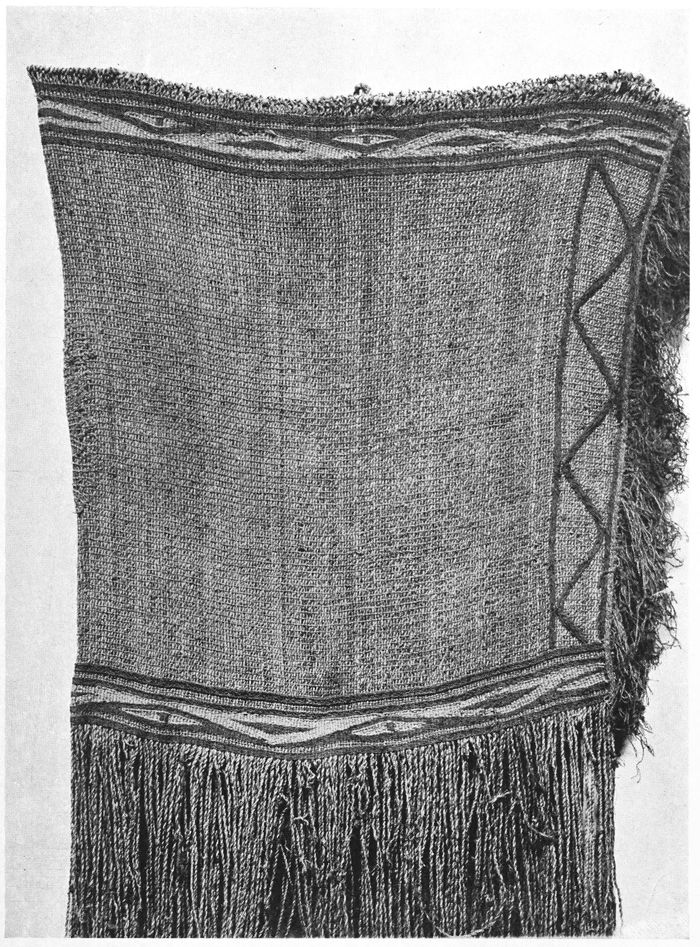
Plate XI.
Cedarbark Blanket, British Columbia.
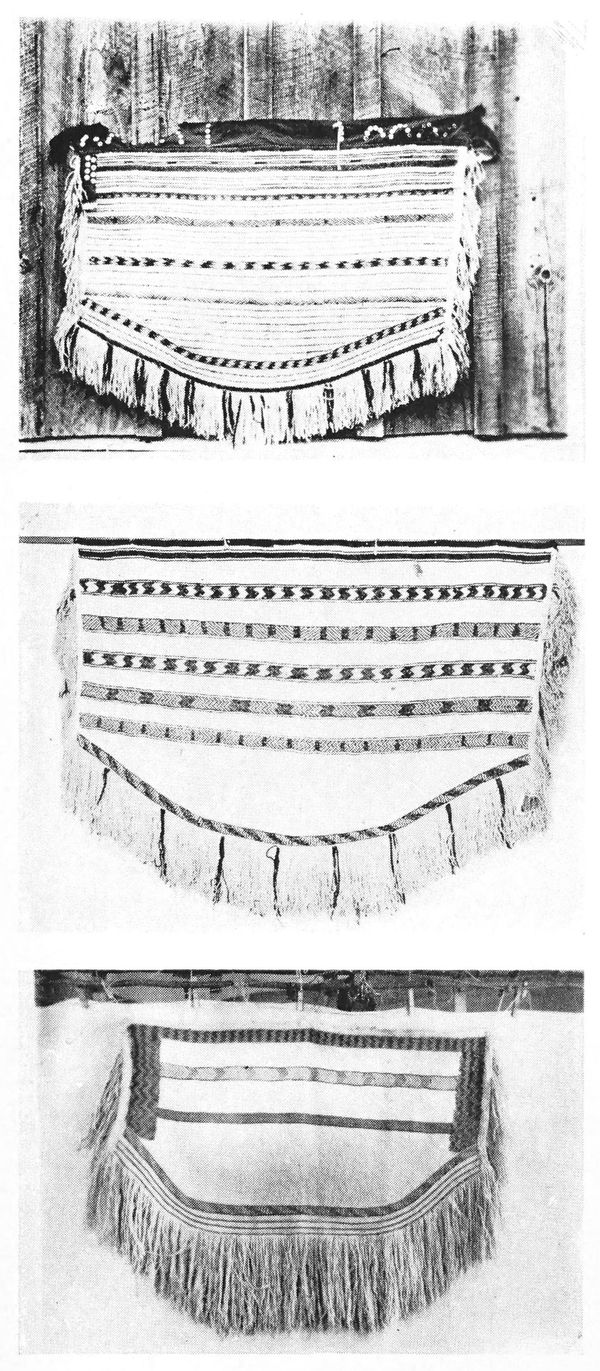
Plate XII.
Blankets of Mountain-goat Wool. Bella Coola, British Columbia.
It seems not unlikely that the symbolic style and the desire to cover the whole field with ornaments have developed exuberantly only recently. In early times geometric ornaments were probably more widely used than is the case now. We shall see presently that they are in extensive use in basketry.
A number of ancient blankets show that angular geometrical ornaments played an important part in earlier weaving. Plate X represents a blanket of mountain-goat wool, in the Ethnological Museum at Copenhagen, formerly belonging to the old collections in Leningrad. It is decorated entirely with geometrical designs arranged in horizontal bands. The same zig-zag pattern in short panels that occupies alternating bands in this blanket appears in a second ancient blanket (Pl. XI) which contains also curiously conventionalized faces and triangular designs. This is a cedar bark blanket in the British Museum transferred from the United Service Museum about 1868, collected at Nootka. It has a border in brown and yellow wool (?), consisting of obtuse triangles, assimilated to an eye design. A series of photographs of blankets in the hands of Dr. Newcombe of Victoria, British Columbia, shows that these types were in common use in Bella Coola (Pl. XII, see also p. 292).
Our consideration of the fixed formal elements found in this art prove that the principles of geometric ornamental form may be recognized even in this highly developed symbolic art; and that it is not possible to assign to each and every element that is derived from animal motives a significant function, but that many of them are employed regardless of meaning, and used for purely ornamental purposes.
The symbolic decoration is governed by rigorous formal principles. It appears that what we have called for the sake of convenience dissection and distortion of animal forms, is, in many cases, a fitting of animal motives into fixed ornamental patterns. We infer from a study of form and interpretation that there are certain purely geometric elements that have been utilized in the symbolic representation. Most important among these are the double curve which appears always as a filler in an oval field with flat base, and the slit which serves to separate distinct curves. The typical eye design is presumably related to the circle and dot and may have developed from the double tendency of associating geometrical motives with animal forms and of the other, of standardizing forms derived from animal motives as ornamental elements.
This art style can be fully understood only as an integral part of the structure of Northwest coast culture. The fundamental idea underlying the thoughts, feelings, and activities of these tribes is the value of rank which gives title to the use of privileges, most of which find expression in artistic activities or in the use of art forms. Rank and social position bestow the privilege to use certain animal figures as paintings or carvings on the house-front, on totem poles, on masks and on the utensils of every day life. Rank and social position give the right to tell certain tales referring to ancestral exploits; they determine the songs which may be sung. There are other obligations and privileges related to rank and social position, but the most outstanding feature is the intimate association between social standing and art forms. A similar relation, although not quite so intimate, prevails in the relation of religious activities and manifestations of art. It is as though the heraldic idea had taken hold of the whole life and had permeated it with the feeling that social standing must be expressed at every step by heraldry which, however, is not confined to space forms alone but extends over literary, musical and dramatic expression. Who can tell whether the association between social standing and the use of certain animal forms,—that is the totemic aspect of social life,—has given the prime impetus to the art development or whether the art impetus has developed and enriched totemic life? Our observations make it seem plausible that the particular symbolic development of art would not have occurred, if the totemic ideas had been absent and that we are dealing with the gradual intrusion of ever fuller animal motives into a well established conventionalized art. On the other hand it seems quite certain that the exuberance of totemic form has been stimulated by the value given to the art form. We may observe among all the tribes that high chiefs claim highly specialized art forms that are built up on the general background of totemic representation. In the south, there is clear evidence of the late exuberant development of the totemic, or perhaps better, crest idea, owing to the strong endeavor to raise by the possession of art forms the standing of the social units to which the individual belongs. The multiplicity of forms among the numerous small divisions of the Kwakiutl and the sporadic appearance of animal forms among the adjoining Salish are ample proof of these relations.
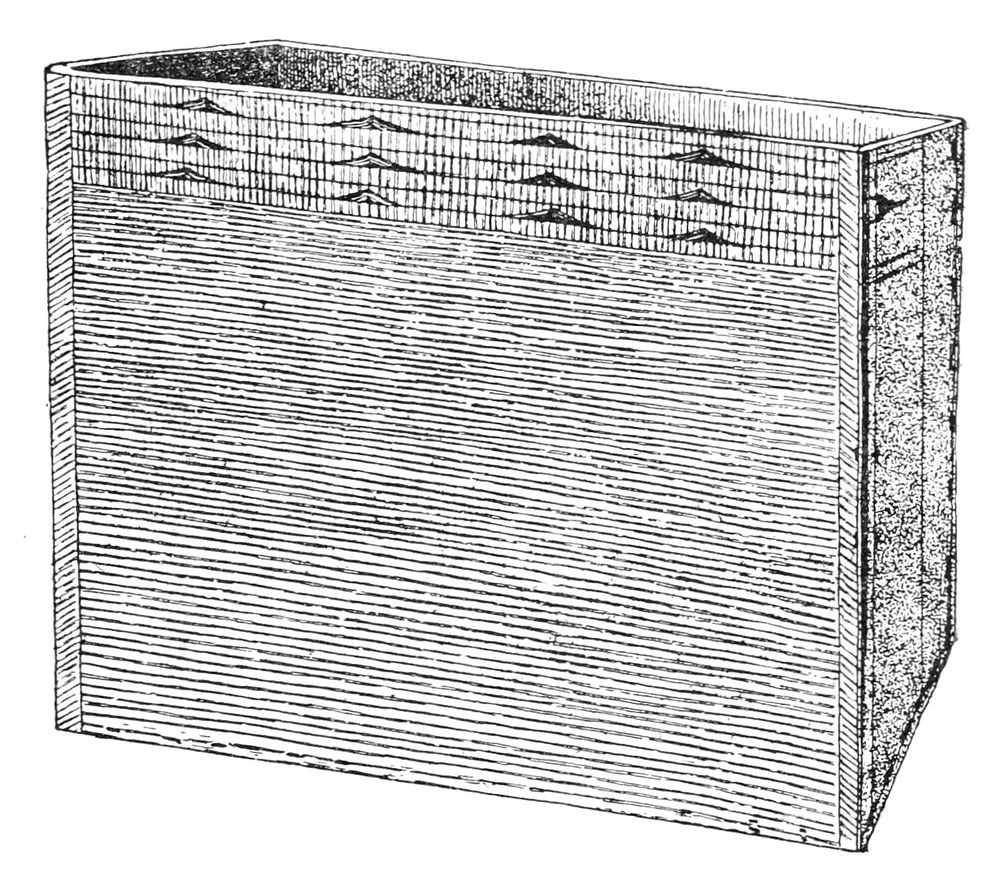
Fig. 291. Ancient type of Kwakiutl box.
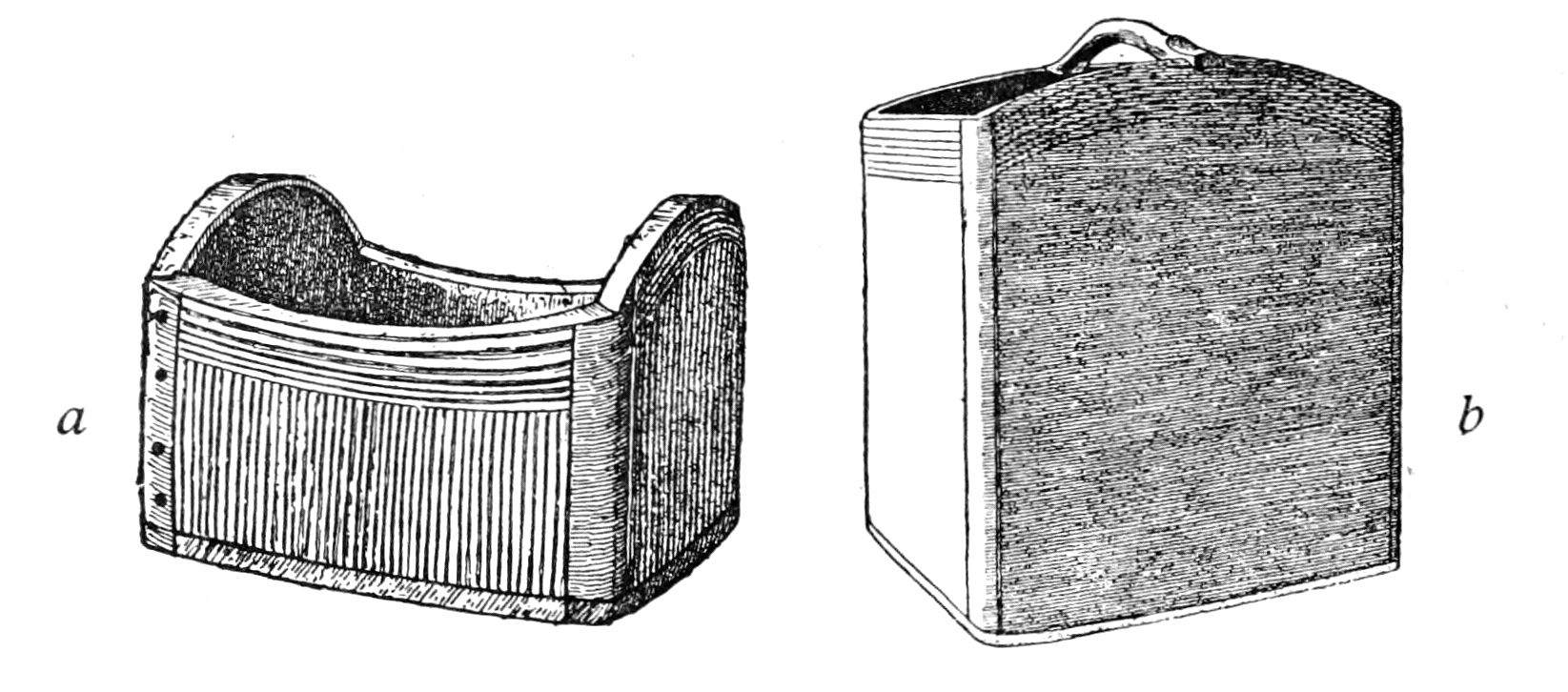
Fig. 292.
a
, Food tray;
b
, Bucket, Kwakiutl.
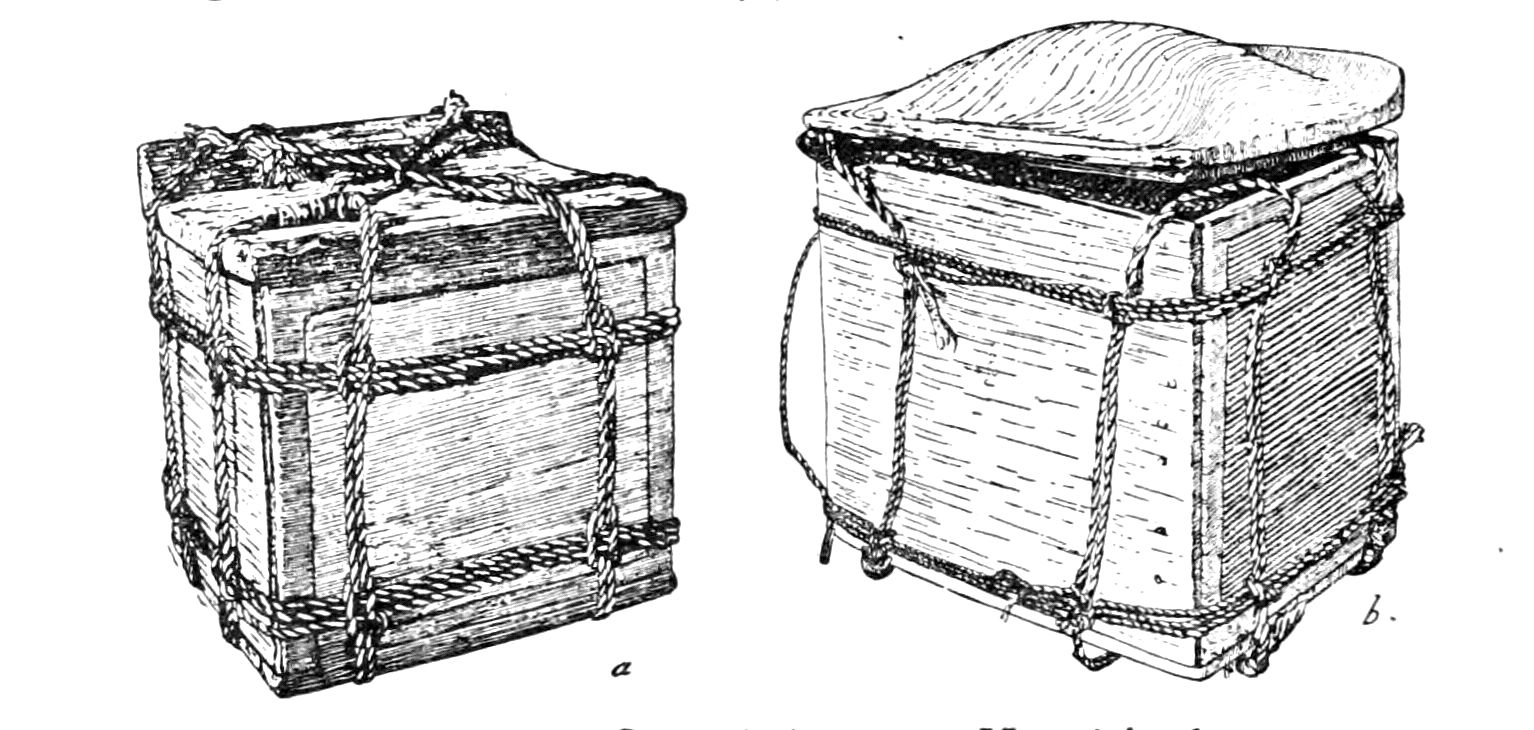
Fig. 293. Small boxes, Kwakiutl.
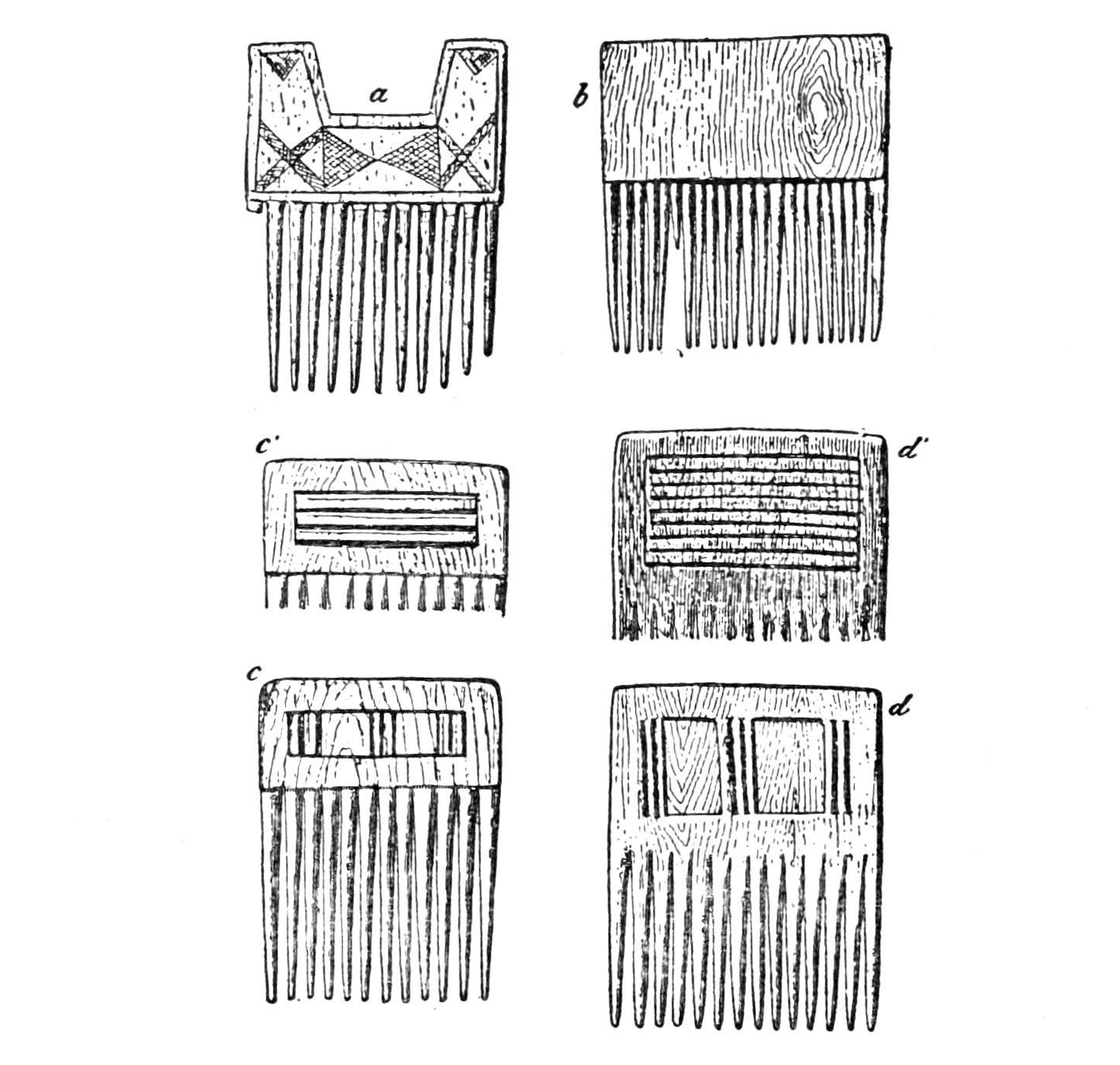
Fig. 294. Combs, Kwakiutl.
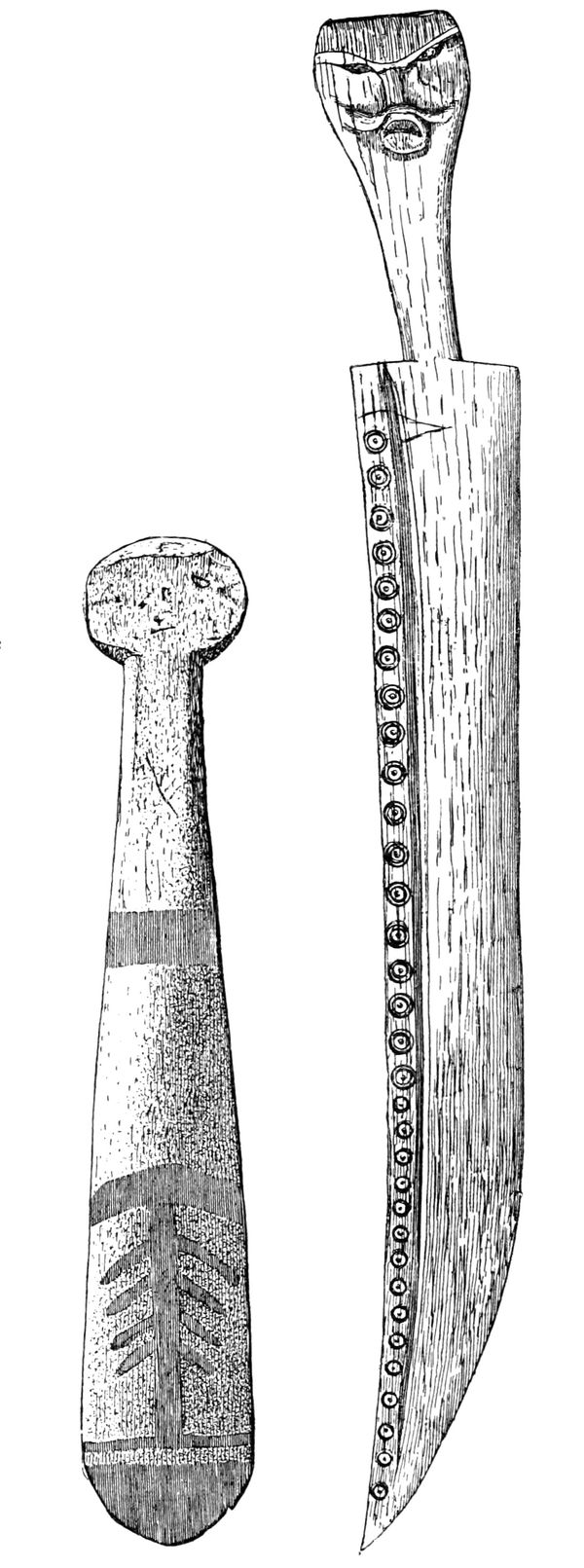
Fig. 295. Bone club and sword, Kwakiutl.
The style has undoubtedly its home in northern British Columbia and southern Alaska. The manufactures of the tribes of Vancouver Island show a far more extended use of geometrical ornamentation than those of the northern tribes. I am under the impression that these are survivals of an older style. Trays, boxes, and baskets of the Kwakiutl Indians are still decorated with geometrical patterns. A rattle used in a ceremony performed after the birth of twins (fig. 19, p. 31) bears a pattern consisting of angular fields. Ancient boxes found in caves are ornamented with a geometrical style more elaborate than that of modern times (fig. 291).
The small food trays, the sides of which are bent out of a single board, bear on the upper end a border pattern consisting of equidistant lines following the rim, while the body of the sides is ornamented with vertical lines (fig. 292 a). A similar border pattern is found on buckets (fig. 292 b). In boxes a border design is cut in, setting off the central field (fig. 293). Combs are decorated with geometrical motives most of which consist of a central rectangular field set off from the background by parallel lines or developed by a subdivision of the field. In one case triangles and crossing lines with hachure are used (fig. 294). On a bone sword the decoration consists of circles with center, a pattern that is widely distributed among the western Eskimo, the plateau tribes of the interior and in California (fig. 295). It will be noticed that the head carved at the end of this specimen does not conform at all to the style of art here discussed but rather agrees with the carving found in the region of the Gulf of Georgia and Puget Sound. Another specimen (fig. 295), differs still more from the style of the Northwest coast art and resembles that of the tribes of the interior.
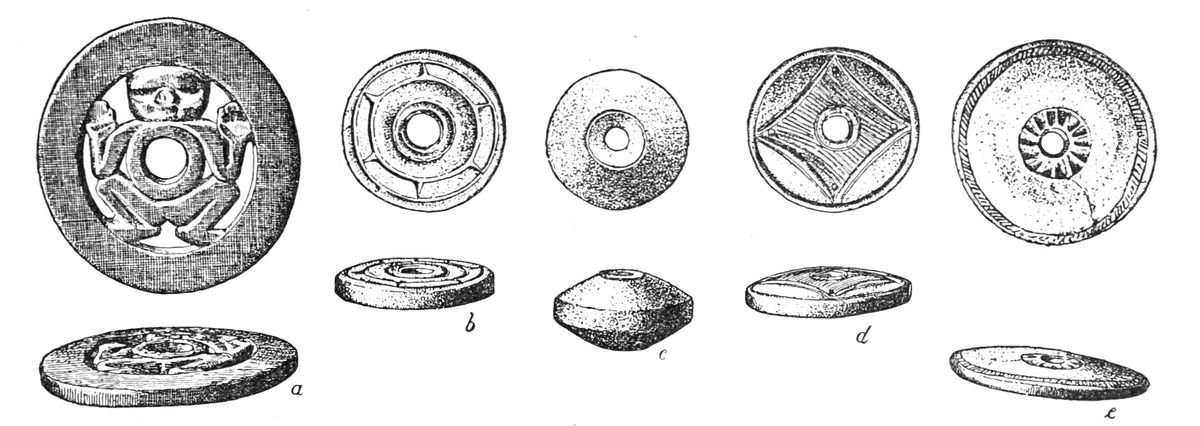
Fig. 296. Spindle whorls.
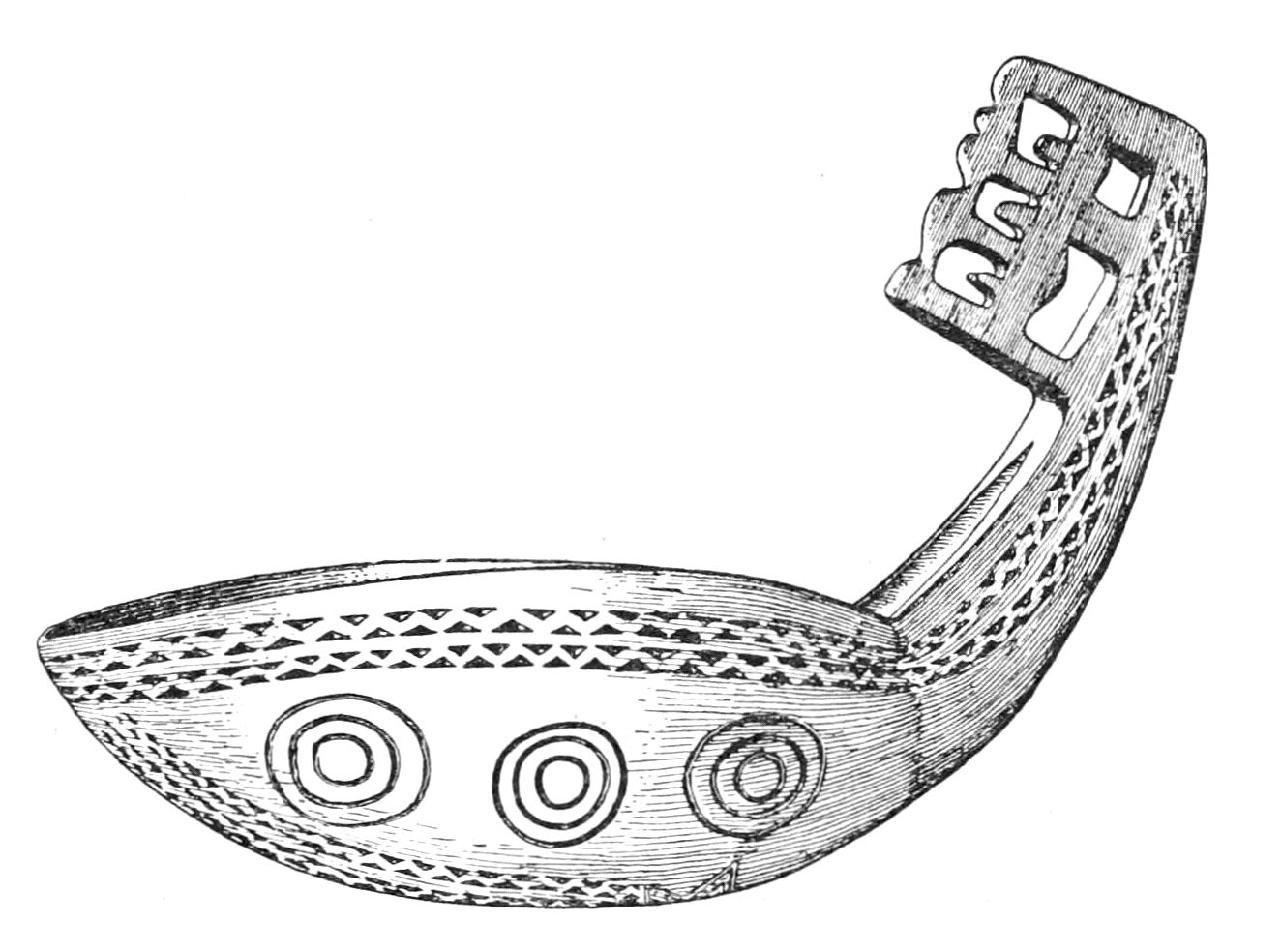
Fig. 297. Ladle made of big-horn-sheep horn, Columbia River.
In the art of the West coast of Vancouver Island, in a few ancient specimens of the Kwakiutl and particularly in the whole area of the Gulf of Georgia, a triangular motive analogous to the “Kerbschnitt” of northern Europe, plays an important role. It is found on the ancient Kwakiutl boxes previously referred to (fig. 291), and is a common decorative motive on clubs made of bone of whale (fig. 298). A related motive is found on spindle whorls (fig. 296). It is also found on representative wood carvings, as on the eagle design on a house post from the Fraser River Delta (Plate XIII p. 288). In the region still farther south, this ornament becomes more and more important, as may be seen on dishes and spoons from the Columbia River area. On these the circular design and central dot also occur (fig. 297).
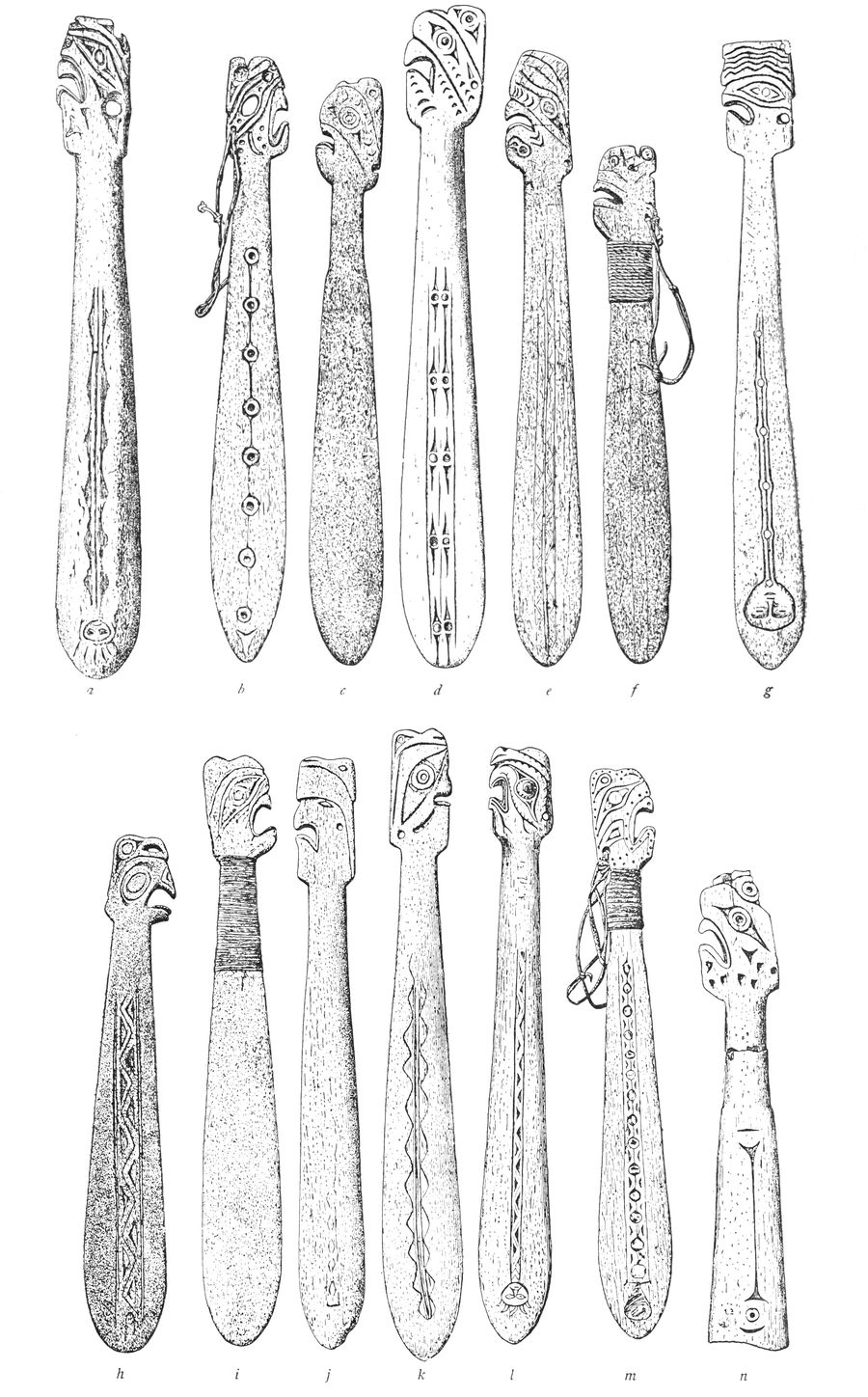
Fig. 298. Clubs made of bone of whale, Nootka.
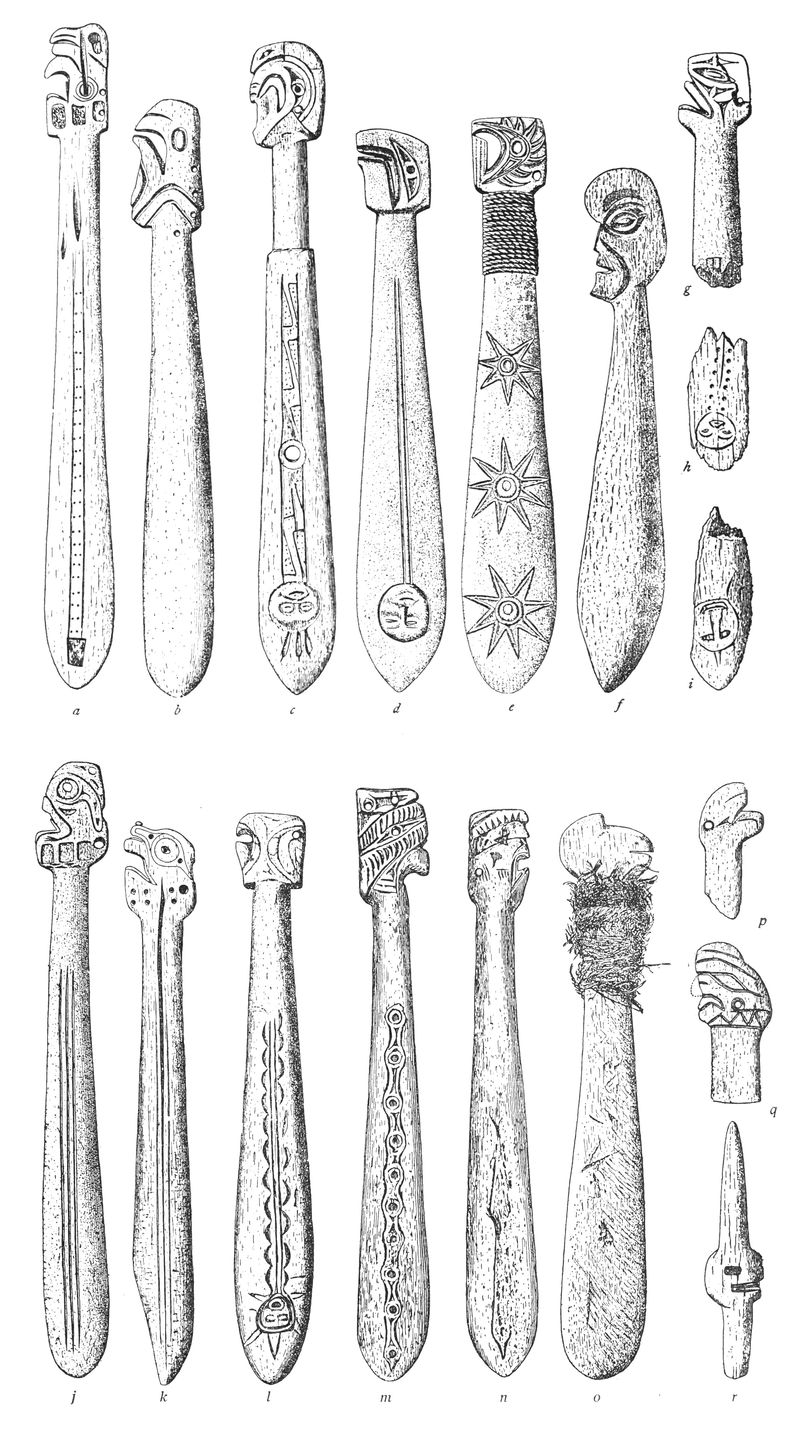
Fig. 299. Clubs made of bone of whale, Nootka and coast of Salish.
A number of ancient specimens prove the existence of a fixed art style in this region, representative, but differing in character from the style of the Northwest coast. This is best illustrated by a series of war clubs. The fundamental type is a blade of a lenticular cross section surmounted by a head resembling that of an eagle, which bears on its head a bird headdress not unlike what is used by the Nootka of modern times.[115] In all the specimens represented in figures 298 and 299 this fundamental form will be recognized, although in many cases the outlines are so crude that the elements of the composition are recognized with difficulty only. It is possible that in a number of these carvings it was not the intent to represent the eagle with bird headdress, but that the form is rather due to the compelling influence of a standardized form that determined the outlines of the subject of the representation. Common to these clubs is also the central ornamental line ending near the point in a circular ornament which is often given the form of a human head.
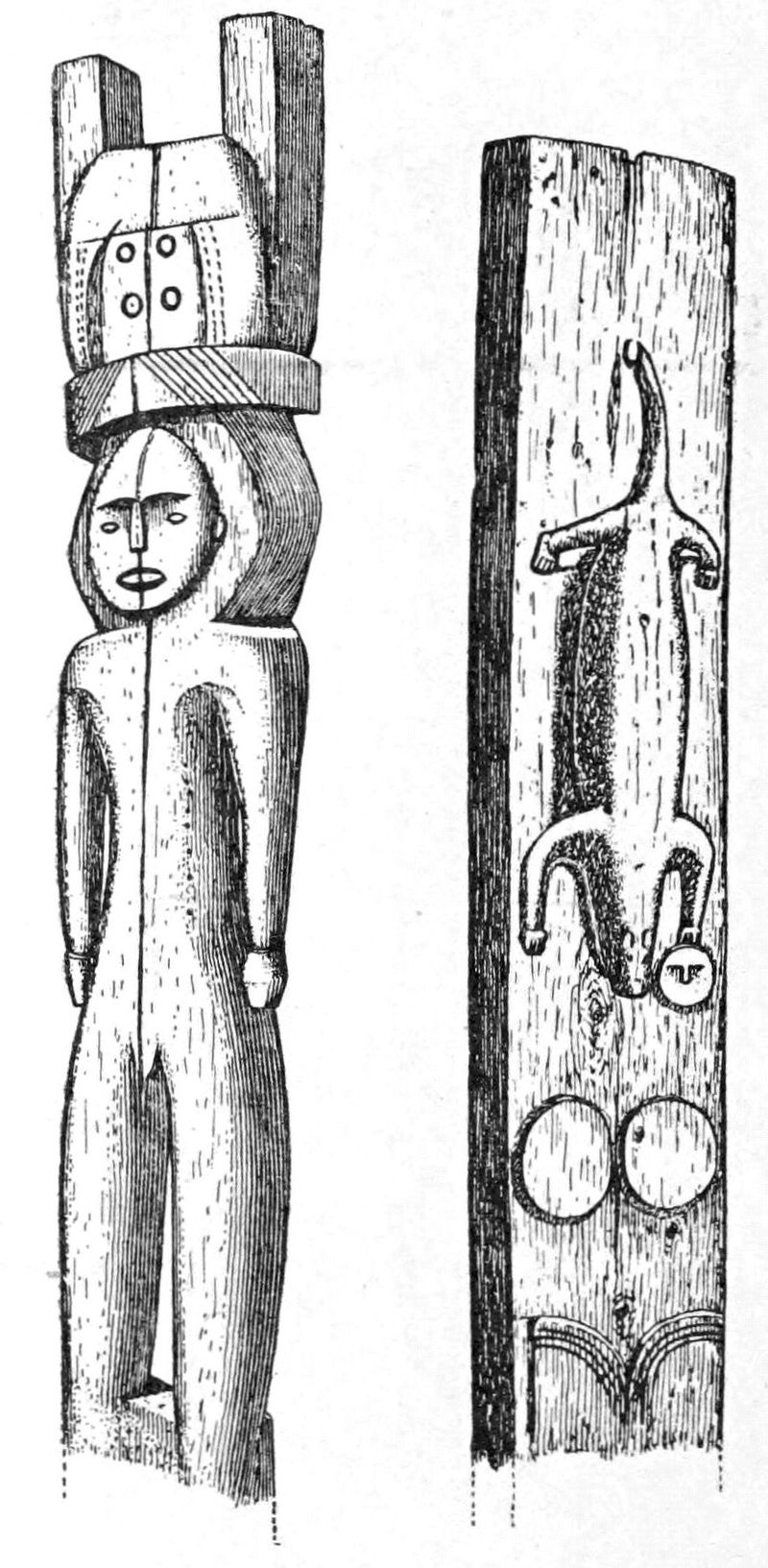
Fig. 300. House posts, Lower Fraser River.
Representations of animals in wood carving differ also in important features from those of the northern region. The tendency to ornament the whole body, the dislike of a plain background is not found here. If we are right in assuming that the fullest development of a rich ornamentation in the north is late, we might say that in the south the ornamentation has not yet encroached upon the whole background. The eye design, double curve, the slit design are foreign to this area. Instead of house posts carved in the round, we find heavy posts of rectangular cross section which bear on the front figures carved in the round or in high relief. Sometimes the post assumes geometrical forms. A characteristic trait of the human face in this region is the sharp angle setting off the forehead from the face. This is most pronounced in the carvings of the Puget Sound region (fig. 300 and Plate XIV).
On Puget Sound animal representations are used with great frequency in basketry, particularly as ornamental borders. In ancient times they were also applied to hats (fig. 301, see also fig. 72 p. 78). This style seems to be entirely missing in the north.
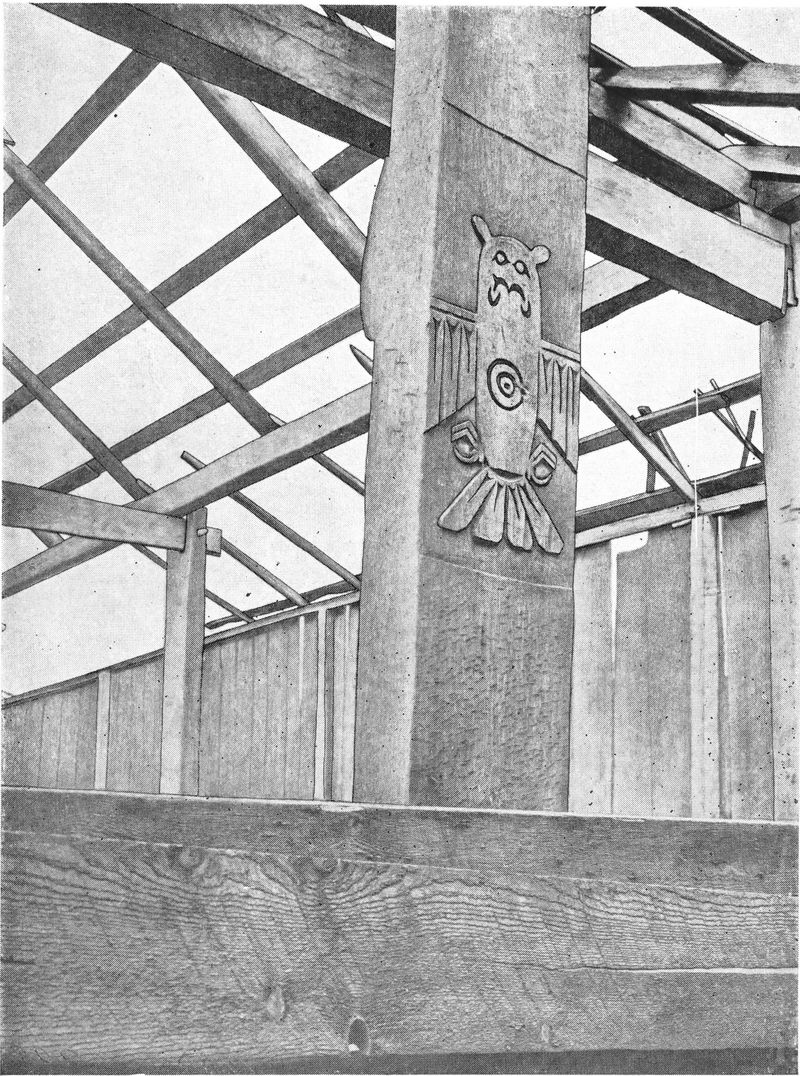
Plate XIII.
House Post near Eburne, Fraser River Delta, British Columbia.
At the present time the Kwakiutl apply the symbolic style in house paintings, house posts, and masks. The skill of the artist is not inferior to that found among the northern tribes, but the subject matter differs somewhat according to the difference in mythological concepts. The distortions in painting are, if anything, more daring than those of the Haida, but I have not observed to the same degree the tendency to interlock various animal forms, as is done on spoon handles and totem poles of the northern tribes. On totem poles so far as these occur, and on house posts the single figures are placed one on top of the other, but they remain separated. The masks are painted as elaborately as those of the northern tribes. Double masks and revolving attachments occur. In short, the decorative art of those objects that are strictly related to use in totemic and similar ceremonies, have the northern type, while objects of every day life tend to have geometric ornamentation. The use of animal forms on large dishes (see fig. 198, p. 208) is a characteristic trait of this region.
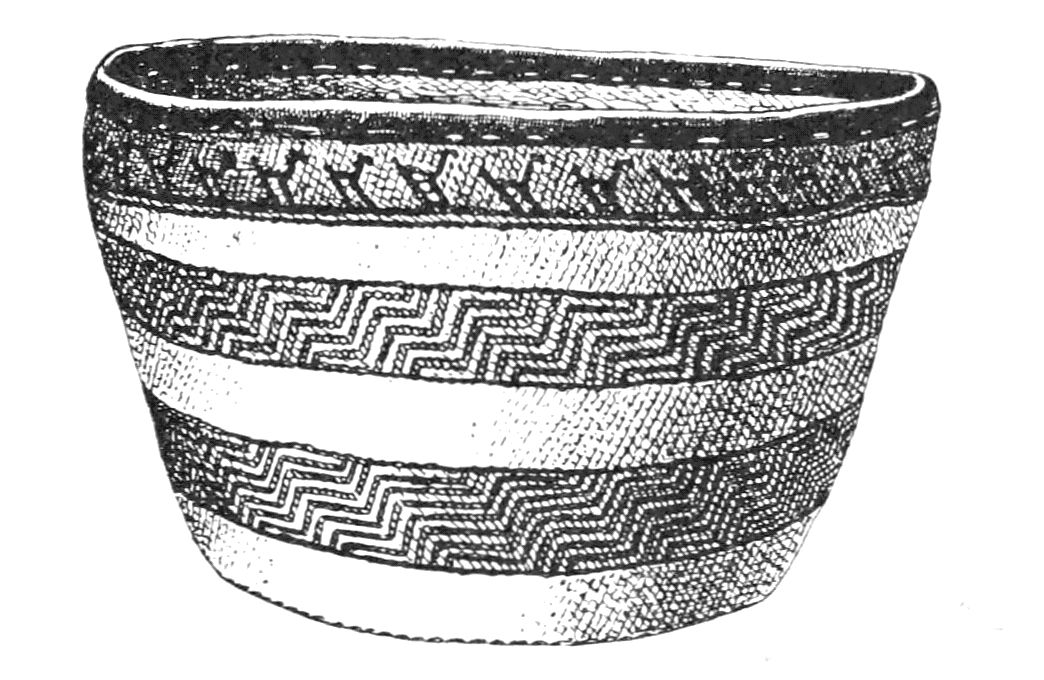
Fig. 301. Basket, Lower Chehalis.
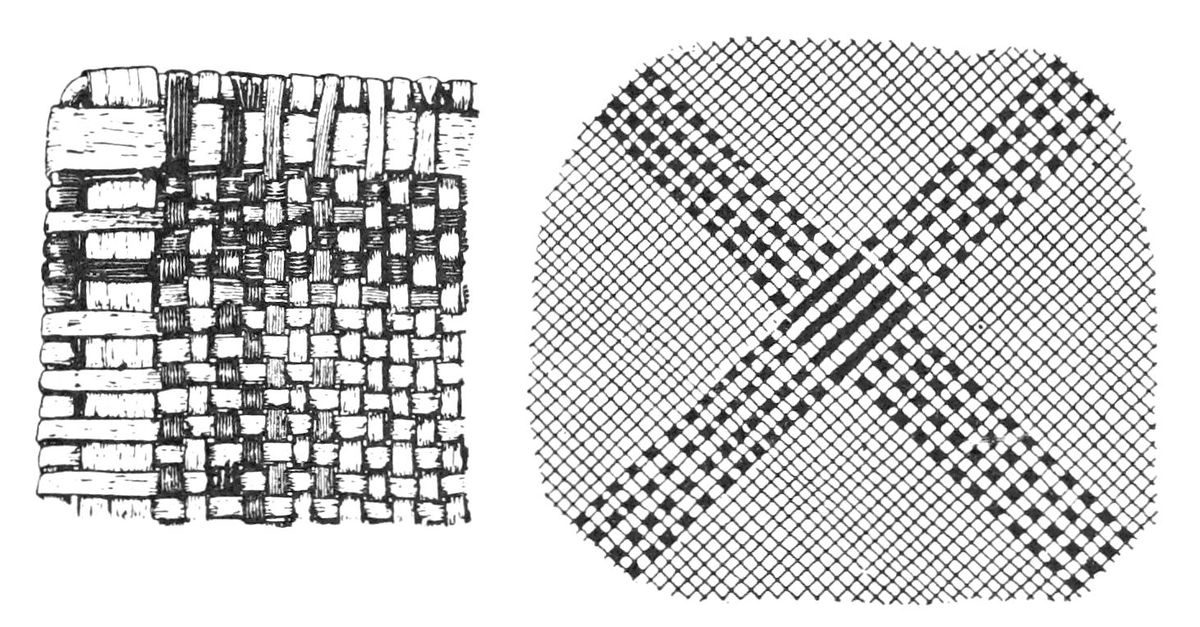
Fig. 302. Designs on matting, Kwakiutl.
Historical tradition confirms our view that the northern art type is of recent introduction among the Kwakiutl. In ancient times the walls of the houses were built of horizontal, overlapping boards that did not admit painting, except on separate planks. Old Indians claim that, until about 1860, the house posts were heavy planks with relief carving or painting,—like those known to us from Fraser River, and that only masks were of the same type as those now in use.
While realistic representations are rare among the northern tribes, they are found quite frequently among the Kwakiutl. They are principally caricatures that are made and exhibited for the purpose of ridiculing a rival. A head used in a ceremonial performance has been referred to before (fig. 156 p. 185).
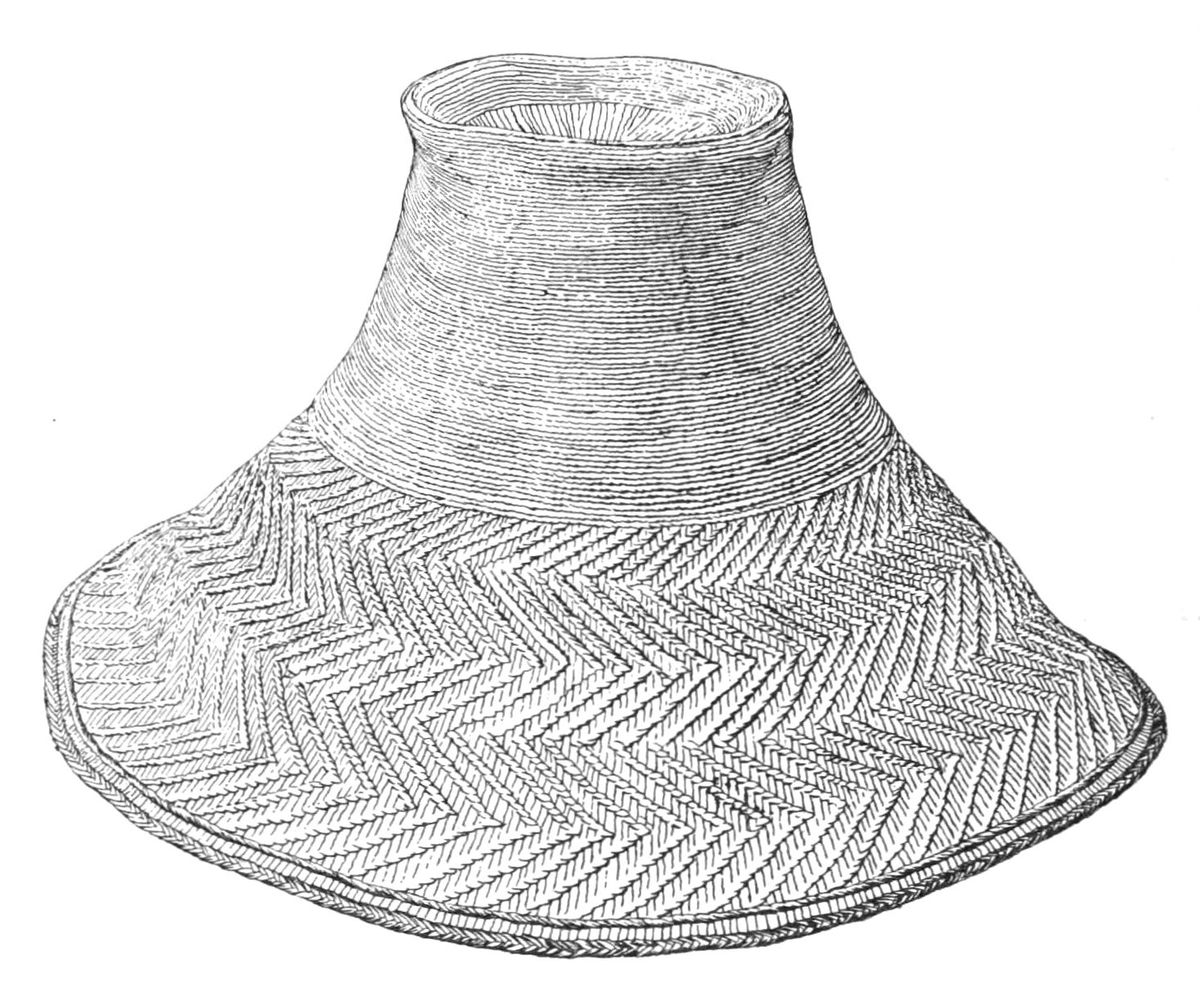
Fig. 303. Woven hat of spruce root, Kwakiutl.
I have stated that in basketry and matting geometrical ornamentation is used by all the tribes. It is the style of the woman’s art. On decorated mats checker designs are made in black and red on the background of natural color of cedar bark (fig. 302). More elaborate are the patterns which occur on spruce root weaving, particularly on hats. These are made by twining, and ornamental lines are developed by the occasional skipping of two woof strands. By this device lines are produced which appear raised over the surface of the plain weaving. The most frequent designs which are made in this way consist of a series of diamonds and of zig-zag lines. Sometimes these hats are also painted. In these the woven pattern disappears almost completely under the painted design (fig. 303).
On the coast of Alaska we find the highest development of the geometric style.
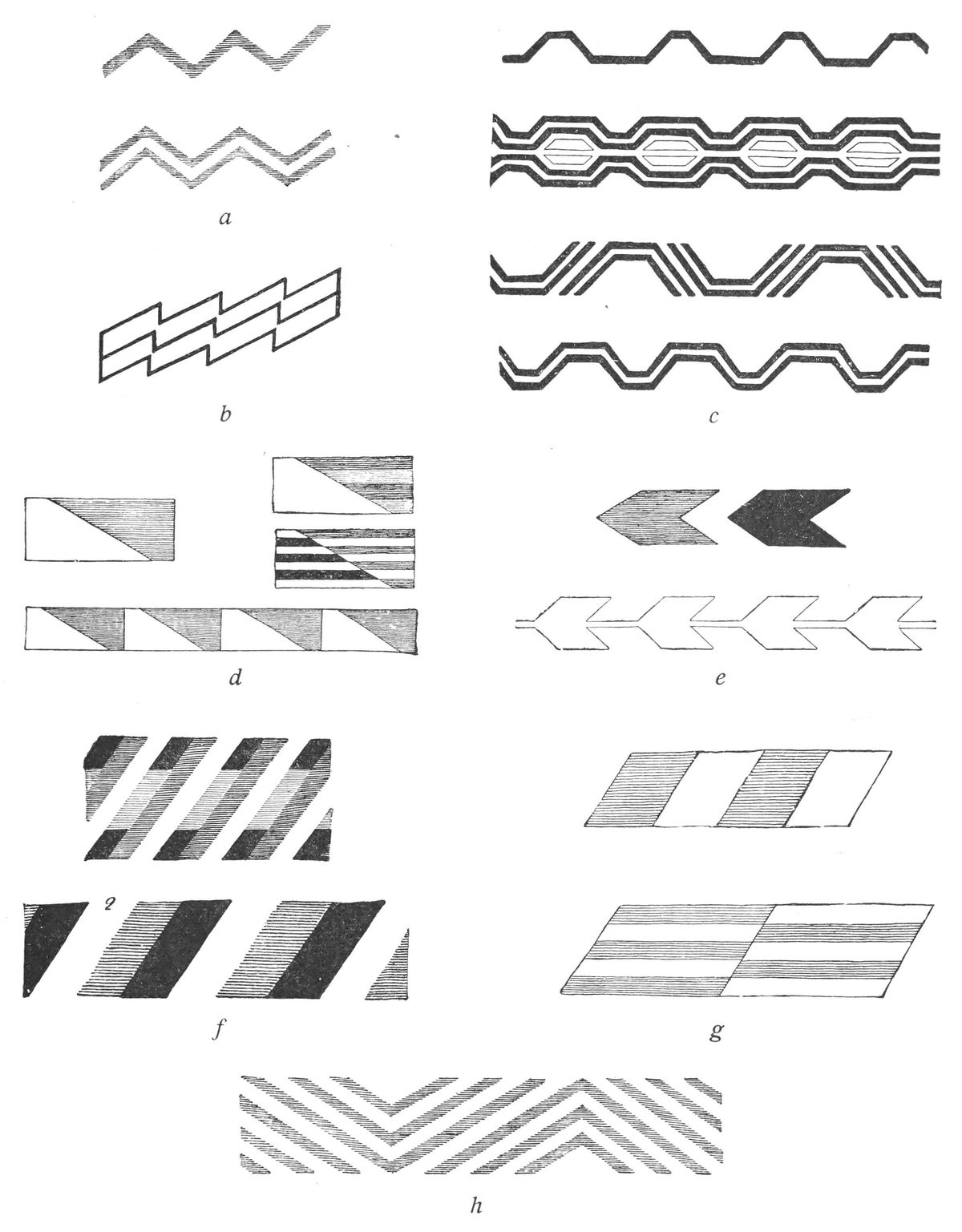
Fig. 304. Decorative designs from Tlingit basketry.
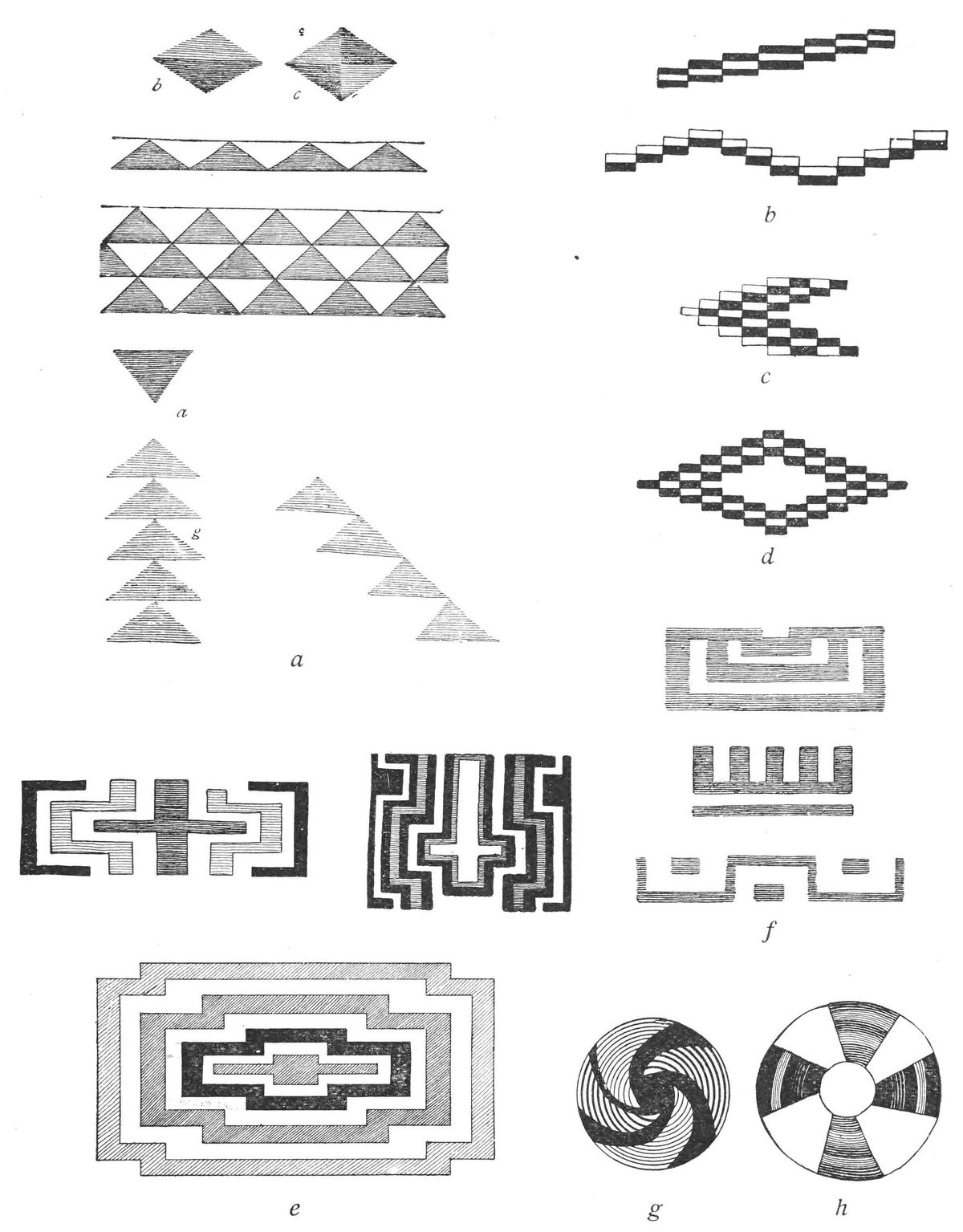
Fig. 305. Decorative designs from Tlingit basketry.
The patterns used on these baskets consist of angular forms, except on modern placques, and bear names.[116] From the way in which these are used we may infer that they have no symbolic significance. I give here a selection of these. Fig. 304 a, b, c, patterns consisting of zig-zag lines, represent in this order: the woodworm or the woodworm tracks (a), lightning (b), the butterfly (c). The rectangle divided by an oblique line, (d), represents tracks of the bear; the dark part of the rectangle may be interpreted as the sole of the foot; the light part of the rectangle as the claws. The design (e) is called the arrow; (f) the rainbow; (g) fire weed; and (h) the hood of the raven. Fig. 305 a shows various representations of the isosceles triangle, some of which are identical with the forms occurring in California. All of these are called head of the salmon-berry. The designs b, c, and d, are closely related; (b) is generally used on the narrow central band which separates two broad design bands; it is called “tying”. Flying geese are represented in (c); tracks of geese in (d). The complicated design in (e) is called “raven tail”; the relation between this name and the form is not clear; (f) shows a number of representations of the wave. Designs (g) and (h) are from circular placques; (g) represents the fern frond; (h) the porpoise. In the last named case the relation between form and name is obscure.
I have little doubt that the designs are closely related to the blanket patterns previously referred to and to the porcupine quill embroidery of the tribes of the interior. The design fig. 304 h, for instance, is found in identical form on the lowest stripe of the Bella Coola blanket on top of Plate XII. The arrangement of patterns in blocks on these blankets is also similar to the arrangement found in this type of basketry. In fact the technique is a kind of embroidery in which the decorative material is wrapped around the woof strand when the basket is being made. The materials used are grasses and fern stems of contrasting color.
The baskets are round, mostly with almost straight walls. The diameter is very nearly equal to the height. On the majority of baskets which are used for berrying and as general receptacles, the patterns are applied in horizontal bands. The rim of the basket is generally undecorated. The rim weave which holds the warp together, is in most cases quite insignificant and does not give a decorative effect. The only specimen of decorative band at the upper rim, with which I am familiar, has no color embroidery but has only a zig-zag decoration made by the process of twilling described before, similar to the pattern fig. 304 h. Most baskets are decorated by a broad band parallel to the rim, which consists of two wide stripes separated by a narrow one. These bands are placed at a short distance from the upper rim. (Plate XIV). The distance is often about equal to the width of the central band. The designs on the wide upper and lower bands are generally identical. The central dividing band is in most cases decorated with small elements arranged in zig-zag lines. In a fairly large number of cases, only the two outer bands are embroidered, while the central band remains undecorated. In a few cases the central band is reduced to a single undecorated line of stitches so that the impression is conveyed of a single broad band encircling the whole basket. In open work spoon baskets the central band is placed near the middle of the basket, while the outer bands are moved to the bottom and to the upper border. Although some of the designs are of such a character that they may be used as continuous horizontal bands, there is a marked tendency of dividing up the circumference into a number of panels which are separated by straight vertical lines.
A considerable number of the baskets decorated with three bands have either two or four “droppers”, and in a few cases the design of the “dropper” is repeated over the upper design. The number of repetitions of the design in the bands is quite irregular, some of the large designs are repeated only twice. When there are many repetitions of the design in the upper and lower band their distribution is generally quite independent, that is, the upper and lower design elements are not fitted the one over the other.
Unfortunately there is not enough porcupine embroidery available that will allow us to investigate in detail the relations between the patterns used in this industry and in basketry. The designs here described are akin to the geometrical basketry patterns of other parts of the Pacific slope and to designs occurring in bead embroidery. They are entirely foreign to the painting and carving described in the previous pages.
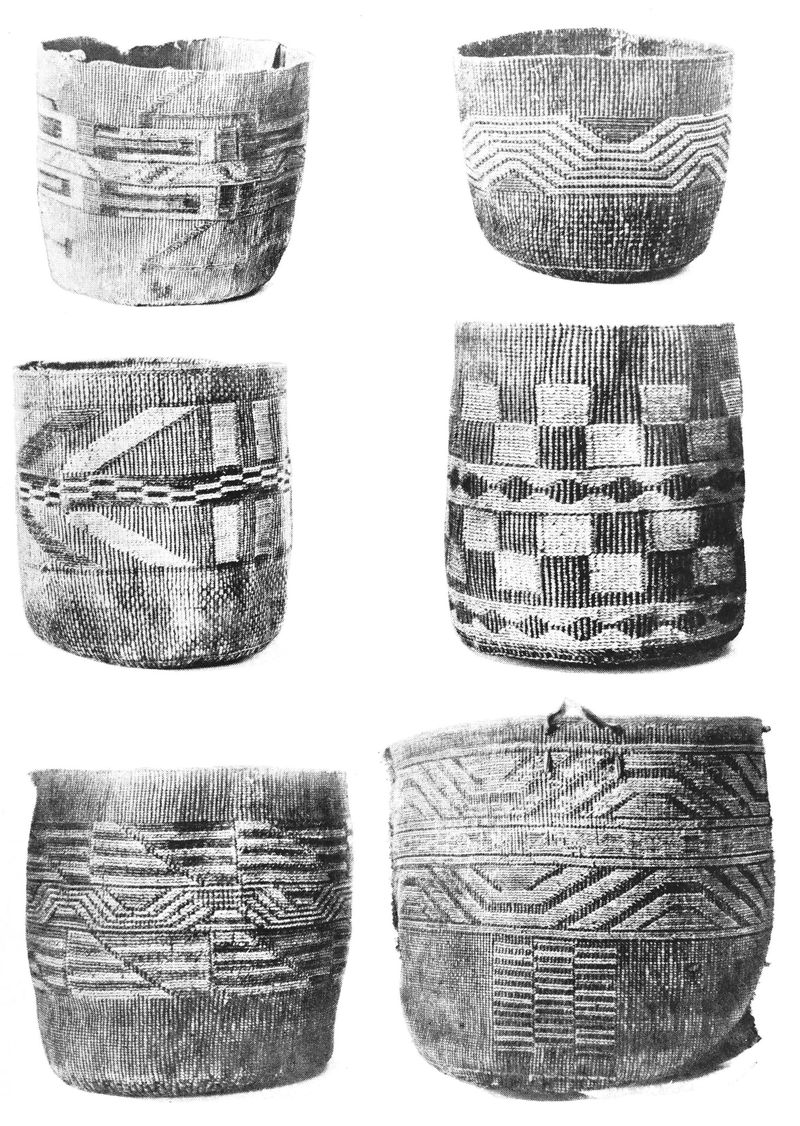
Plate XIV.
Tlingit Baskets.
Northwest Coast culture has exerted its influence over the tribes both of the north and south. The woodwork of the Columbia River region and of northern California has undoubtedly been stimulated by its example. Although the style changes materially, the technique of handling the wood and the relative abundance of wood carving indicates the interrelation of these cultures. Taken in conjunction with other features,—such as the peculiar type of correlation of wealth and rank and the extensive use of standards of value,—the historical relation seems firmly established. The art style of woodwork does not exhibit a close affinity to the North West Coast. We have shown that the older art of the Gulf of Georgia is quite distinct from that of the North West Coast. The further south we go the more meager become the vestiges of the symbolic style here treated.
In the north conditions are somewhat different. Even among the northern Tlingit tribes some types of masks may be observed that are conceptionally different from those found further south. They are characterized by the attachment of small animal figures to the face,—particularly on the forehead and cheeks. This usage is much more frequent among the Eskimo tribes.[117] Their masks tend to be flat and appear like plastic representations of their paintings and etchings: realistic forms of human or imaginary beings or of animals. They have adopted from the North West Coast the attachment of parts of the body to the face, while these parts,—such as hands and feet, retain their realistic character. The attachment of small animal forms to the face is quite frequent here. Its source may perhaps be found in the application of animal heads to carved objects, which is one of the principle features of the decorative art of the Alaskan Eskimo. It is exemplified in the needle cases shown in fig. 119, p. 125. The abundance of masks can hardly be understood unless we assume that the coast people of the south exerted a powerful influence over the Eskimo. The eastern Eskimo, among whom this influence is lacking, have few masks of quite a different type.
The relation of the North West Coast art to that of the adjoining plateaus of the interior deserves special consideration. The contrast between the two is striking. A few of the tribes that have adopted, partially at least, totemic ideas of the coast people, as the Lillooet, have taken over with it a moderate amount of carving. A few that have fallen more fully under the sway of the North West Coast culture, as the Bella Coola, Babine, and a few of the Alaskan tribes near the coast of southern Alaska, have also, to a great extent, adopted the art style of the coast.
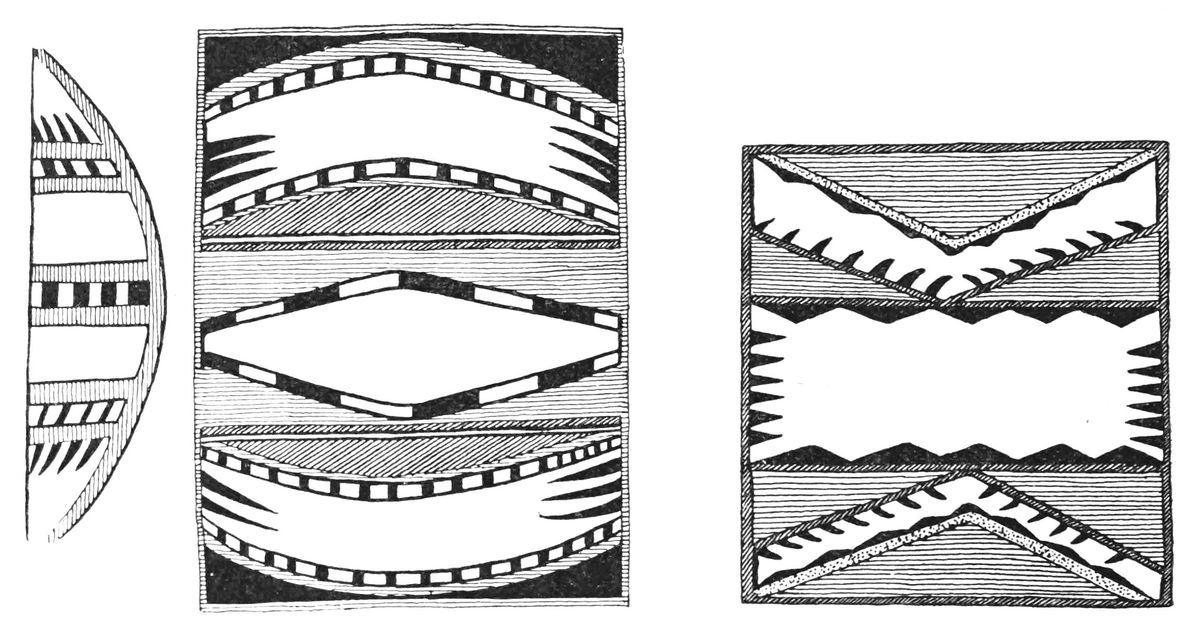
Fig. 306.
a
, Rawhide pouch, Salish or Chinook;
b
, Design from parfleche, Fort Colville, Washington.
As soon as we move farther inland we find an art that, in its essential characteristics, is subject to the Plains art. The style and decoration of the clothing are essentially those of the Plains. Rude pictography is used extensively. There is hardly any attempt to fit the pictographic representation to the decorative field that serves merely as the background on which the representative design is conveniently placed. Most of the geometric patterns that do occur are closely related to eastern forms. A rawhide pouch from the interior of British Columbia (fig. 28, p. 36) may serve as an example. On parfleches and rawhide pouches from Fort Colville and from Columbia River (fig. 306) we find the same designs that are characteristic of eastern paintings on rawhide (see figs. 144-146 pp. 170-172). Analogous forms are found in bone carvings from the Tahltan in Alaska (fig. 307). In the southern parts of the plateaus of British Columbia, simple lines and circles with center are the most common decorative pattern on bone and on wood. Representative sculpture is rare although a few ancient specimens have been found. The archaeological remains prove that at an early time the same art type prevailed in the Delta of Fraser River. The symbolism of the patterns is very weak, but seems analogous to that found in the east.

Fig. 307. Scraper of bone, Tahltan.
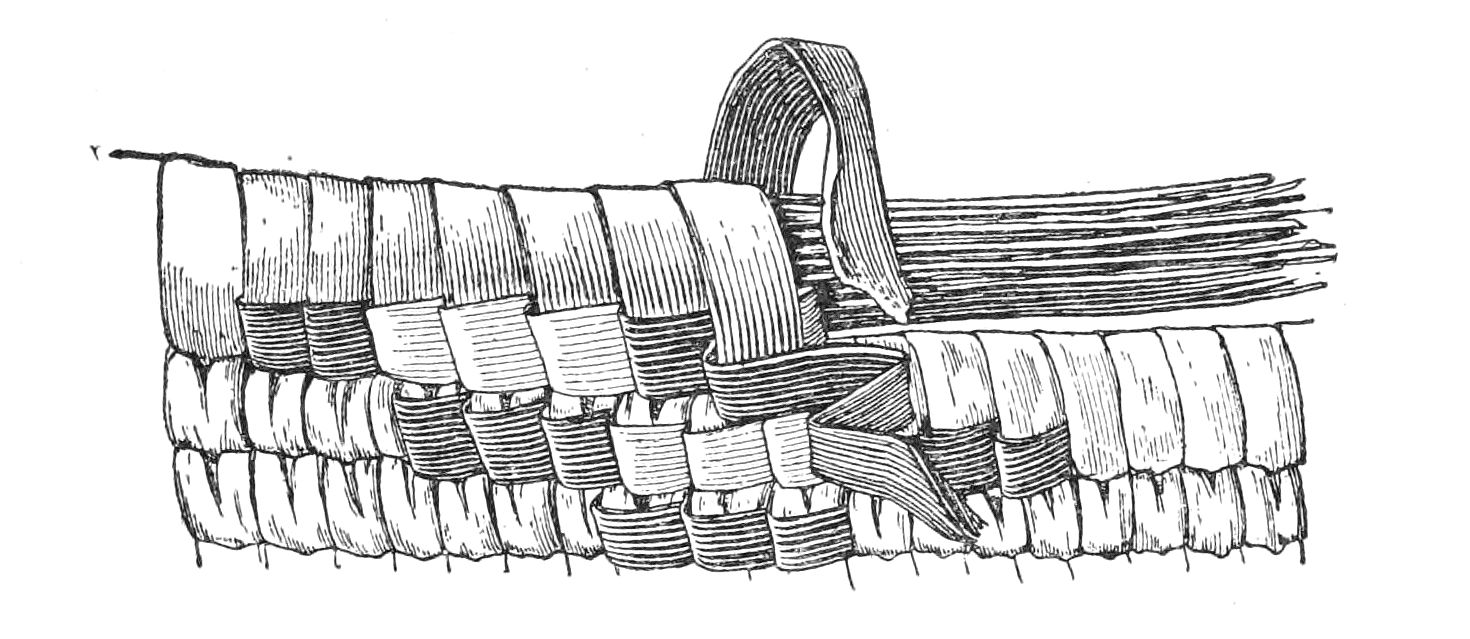
Fig. 308. Detail of imbricated basketry.
Decorative art is most highly developed in basketry. The basketry of the Coast tribes is made by twining or weaving, but the highly decorated basketry of the interior is exclusively of the coiled type. Only among the Sahaptin and other tribes to the southeast do we find elaborately decorated twined bags. The twined weaving of the interior of British Columbia is largely undecorated or bears a few lines set off in lighter color. The coiled weaving is decorated by imbrication, a method peculiar to that part of the plateaus extending from the Columbia River to Chilcotin (fig. 308). In this area a number of decorative art styles have developed. These appear most clearly on the burden baskets. The southern baskets are round and flaring, those of southern British Columbia are angular in cross section, those of the north oblong and of irregular form. The southern baskets are decorated all over with designs resembling Californian patterns. Those of the Thompson River have design areas set off against an undecorated background. The designs are made by imbrication and extend over the whole side of the basket, evenly on all sides. The Lillooet baskets are more flaring than those of the Thompson. The coils are wider and the decorative field is arranged in a different manner. The imbrication is confined to the upper two-thirds of the basket while the lower part remains undecorated, except that there are frequently two hangers on the wide sides which may be compared to the hangers on Tlingit baskets, described before. I am doubtful whether there is an historical connection between the two, notwithstanding their striking similarity. The Indians suggest that the hangers may have developed from the earlier use of birch bark baskets. These were often wrapped at the upper part with buckskin the lower portion of which hung down freely in fringes, so that the droppers would represent the fringes. Many of the Lillooet designs are large. (Plate XV).
The Chilcotin type differs from the preceding by the small size of the coil and a distinctive form, the narrow ends being higher than the middle of the long sides. The treatment of the decorative field is similar to that used by the Tlingit. The ornamentation consists of three bands; the upper and the lower ones wide, bearing the same kind of decorative design and the central one narrower and either undecorated or showing a design of a different character. Arrangements of this kind are used so frequently that is seems hardly justifiable to consider them as proof of an historical connection between Tlingit and Chilcotin basketry. We find similar arrangements for instance in the pouches of the Woodland Indians referred to on p. 175, figs. 149, 150.
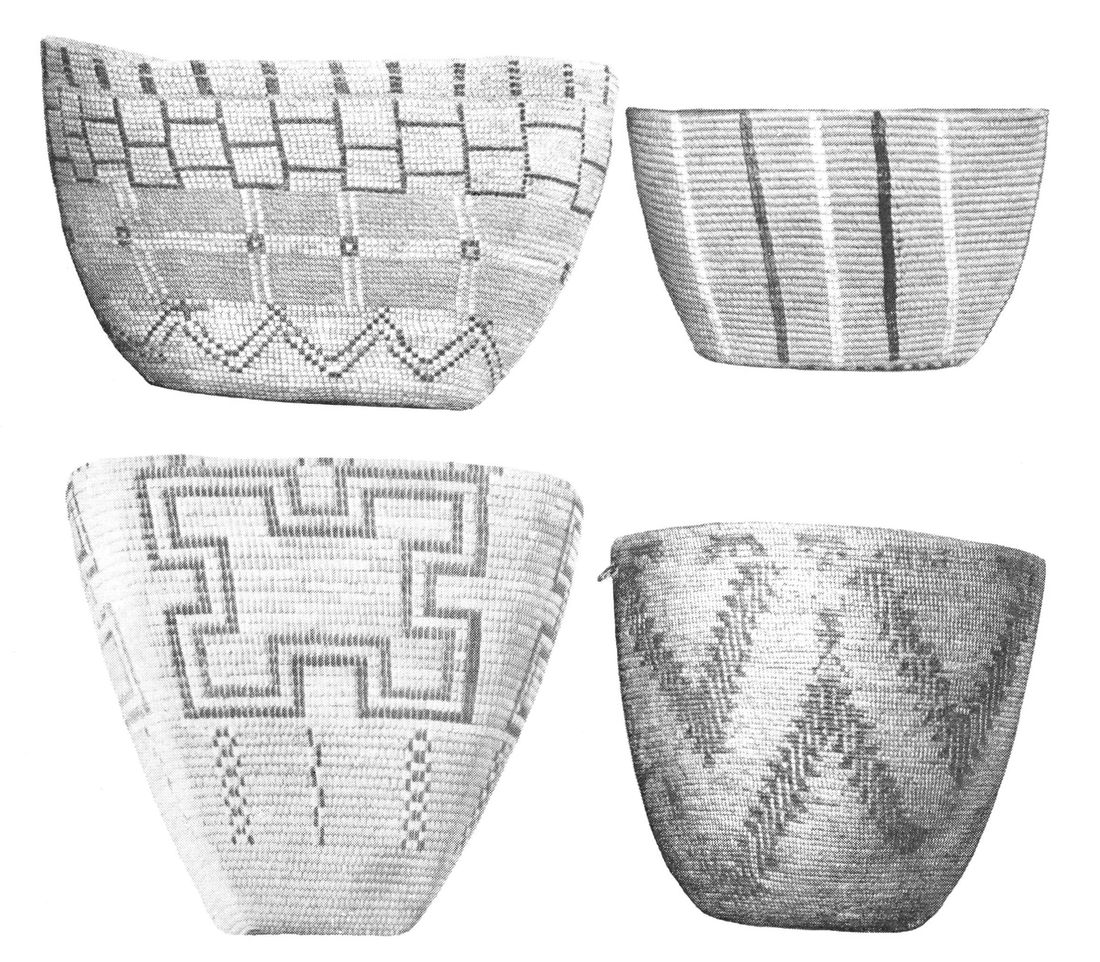
Plate XV.
Imbricated Baskets from British Columbia and Washington.