ART OF THE NORTH PACIFIC COAST OF NORTH AMERICA[100]
Reading edition
ART OF THE NORTH PACIFIC COAST OF NORTH AMERICA[100]
The general principles discussed in the preceding chapters, may now be elucidated by a discussion of the style of the decorative art of the Indians of the North Pacific Coast of North America.
Two styles may be distinguished: the man’s style expressed in the art of wood carving and painting and their derivatives; and the woman’s style which finds expression in weaving, basketry, and embroidery.
The two styles are fundamentally distinct. The former is symbolic, the latter formal. The symbolic art has a certain degree of realism and is full of meaning. The formal art has, at most, pattern names and no especially marked significance.
We shall discuss the symbolic art first. Its essential characteristics are an almost absolute disregard of the principles of perspective, emphasis of significant symbols and an arrangement dictated by the form of the decorative field.
While the Eskimo of Arctic America, the Chukchee and Koryak of Siberia, the Negroes and many other people use carvings in the round which serve no practical ends, but are made for the sake of representing a figure,—man, animal, or supernatural being,—almost all the work of the Indian artist of the region that we are considering serves at the same time a useful end. When making simple totemic figures, the artist is free to shape his subjects without adapting them to the forms of utensils, but owing to their large size, he is limited by the cylindrical form of the trunk of the tree from which they are carved. The native artist is almost always restrained by the shape of the object to which the decoration is applied.
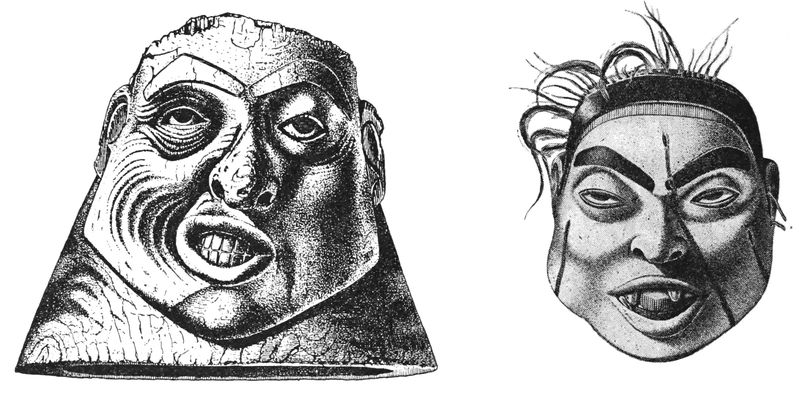
Fig. 154. Tlingit helmet. Fig. 155. Mask representing dying warrior, Tlingit.
The technical perfection of carvings and paintings, the exactness and daring of composition and lines prove that realistic representations are not beyond the powers of the artist. This may also be demonstrated by a few exquisite examples of realistic carvings. The helmet shown in fig. 154 is decorated with the head of an old man affected with partial paralysis. Undoubtedly this specimen must be considered a portrait head. Nose, eyes, mouth and the general expression, are highly characteristic. In a mask (fig. 155) representing a dying warrior, the artist has shown faithfully the wide lower jaw, the pentagonal face, and the strong nose of the Indian. The relaxing muscles of mouth and tongue, the drooping eyelids, and the motionless eyeballs, mark the agonies of death. Plate IX represents a recent carving, a human figure of rare excellence. Posture and drapery are free of all the formal characteristics of North West coast style. Only the treatment of the eye and the facial painting betray its ethnic origin. Here belongs also the realistic head previously referred to, made by the Kwakiutl Indians of Vancouver Island (fig. 156), which is used in a ceremony and intended to deceive the spectators who are made to believe that it is the head of a decapitated dancer.[101]
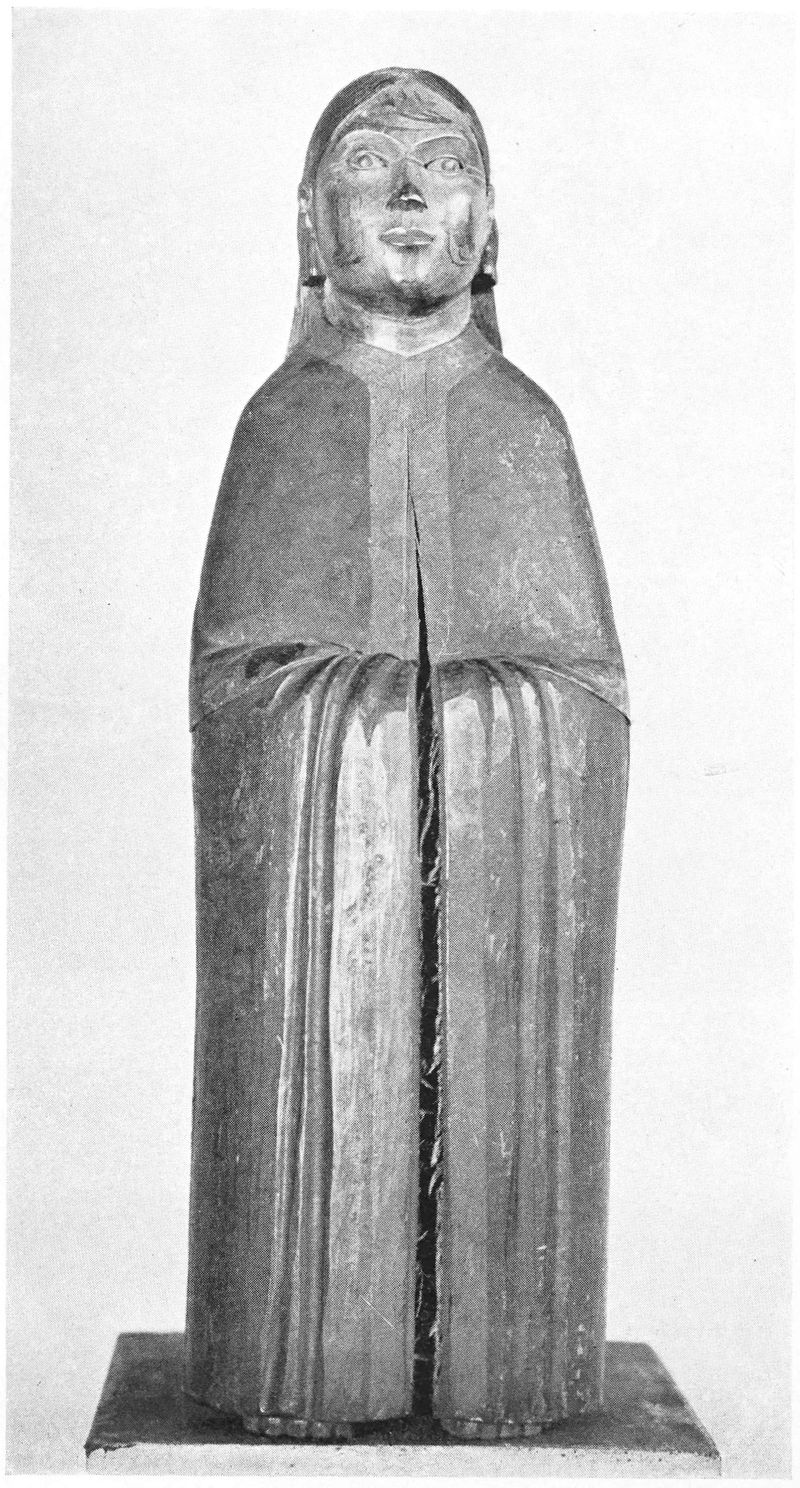
Plate IX.
Carved Figure, British Columbia.
When the artist desires realistic truth he is quite able to attain it. This is not often the case; generally the object of artistic work is decorative and the representation follows the principles developed in decorative art.
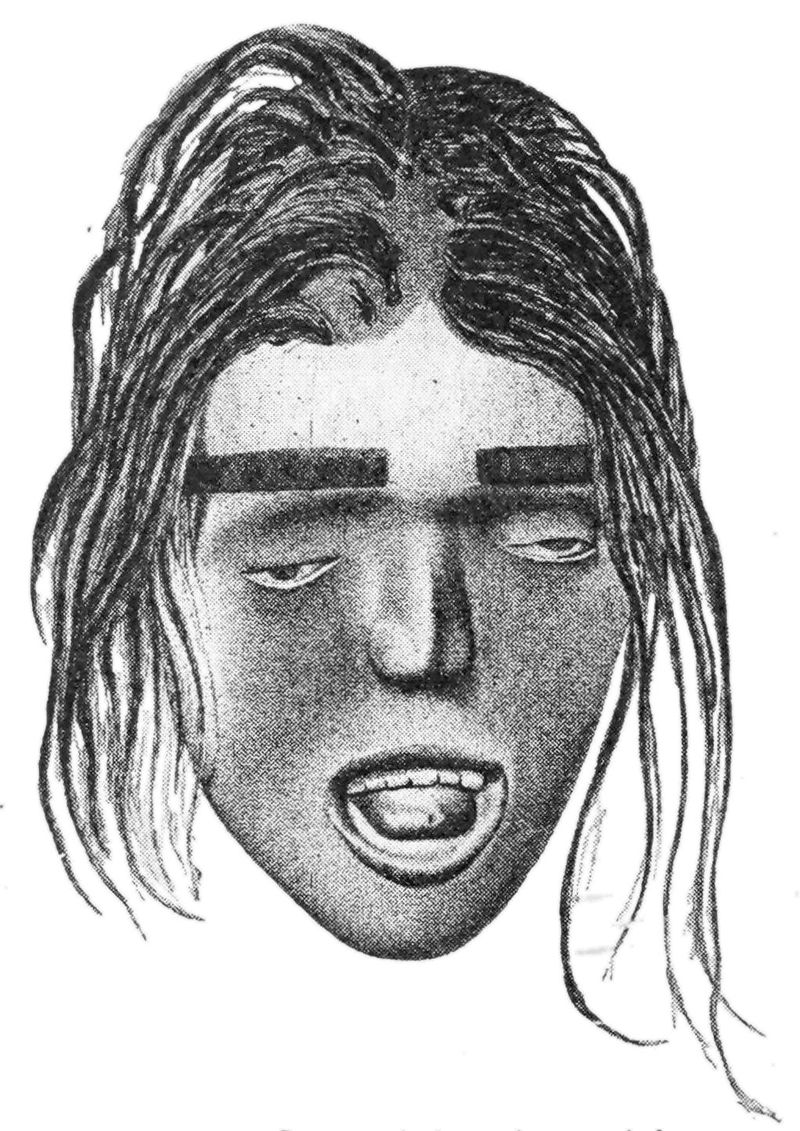
Fig. 156. Carved head used in ceremonial, Kwakiutl Indians.
When the form of the decorative field permits, the outline of the animal form is retained. The size of the head is generally stressed as against that of the body and of the limbs. Eyes and eyebrows, mouth and nose are given great prominence. In almost all cases the eyebrows have a standardized form, analogous to that in which the Indian likes to trim his own eyebrows,—with a sharp edge on the rim of the orbits, and a sharp angle in the upper border, the brows being widest at a point a little outward from the center, tapering to the outer and inner angles and ending quite abruptly at both ends. The eye is also standardized. In many cases it consists of two outer curves which indicate the borders of the upper and lower eyelids. A large inner circle represents the eyeball. The lip lines are always distinct and border a mouth which is given an extraordinary width. Generally the lips are opened wide enough to show the teeth or the tongue. Cheeks and forehead are much restricted in size. The trunk is not elaborated. The ears of animals rise over the forehead (fig. 157). These are almost always applied in reproductions of mammals and birds, while they are generally missing in those of the whale, killer-whale, shark and often also of the sculpin. The human ear is represented in its characteristic form, on a level with the eye (figs. 207 and 209, pp. 217, 218). Whales and fish often have round eyes, but exceptions occur (figs. 233, 234, 235, pp. 229-231).
For clear presentation of the principles of this art it seems advantageous to treat the symbolism and the adjustment of the animal form to the decorative field before taking up the purely formal elements.
Fig. 157 a is a figure from the model of a totem pole, which represents the beaver. Its face is treated somewhat like a human face, particularly the region around eyes and nose. The position of the ears, however, indicates an animal head. The two large incisors serve to identify the rodent par excellence,—the beaver. The tail is turned up in front of the body. It is ornamented by cross-hatchings which represent the scales on the beaver’s tail. In its forepaws it holds a stick. The nose is short and forms a sharp angle with the forehead. The nostrils are large and indicated by spirals. The large incisors, the tail with cross-hatchings, the stick, and the form of the nose are symbols of the beaver and the first two of these are sufficient characteristics of the animal.
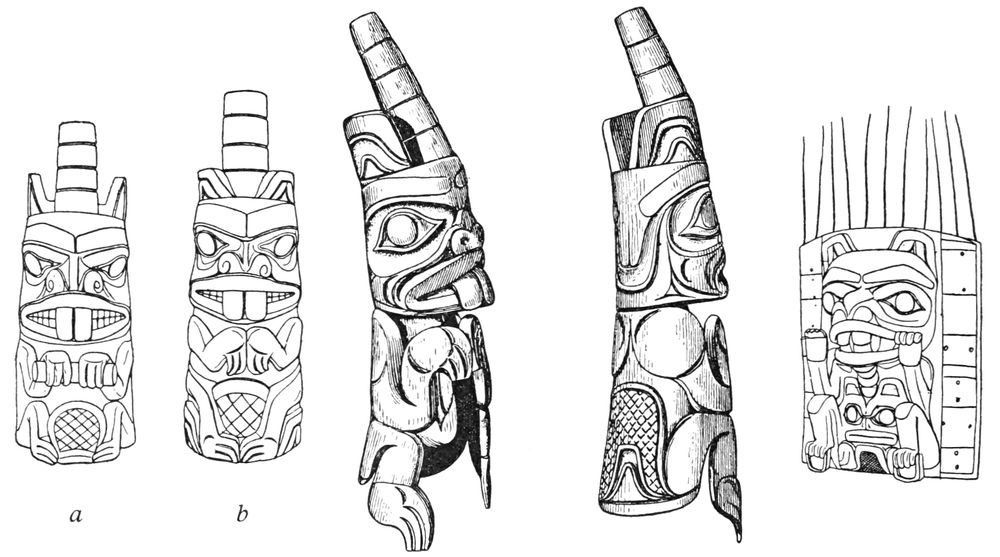
Fig. 157. Carvings representing the beaver from models of Haida totem poles carved in slate. Fig. 158. Carving from handle of spoon representing beaver, Tlingit. Fig. 159. Headdress representing beaver; a dragon-fly is shown on the chest of the beaver, Haida.
Fig. 157 b is another representation of a beaver from the model of a totem pole. It resembles the former one in all details, except that the stick is missing. The beaver is merely holding its three-toed forepaws raised to the chin. In other carvings the beaver is shown with four or five toes, but the symbols described here never vary.
On the handle of a spoon (fig. 158), the head and forepaws of the beaver are shown; and in its mouth are indicated an upper pair of incisors, all the other teeth being omitted. The scaly tail is shown on the back of the spoon. The nose differs from the one previously described only in the absence of the spiral development of the nostril. Its form and size agree with the preceding specimens.
In the centre of the front of a dancing headdress (fig. 159), a beaver is represented in squatting position. The symbols mentioned before will be recognized here. The face is human, but the ears, which rise over the forehead, indicate that an animal is meant. Two large pairs of incisors occupy the center of the open mouth. The tail, with cross-hatchings, is turned up in front of the body, and appears between the two hind legs. The forepaws are raised to the height of the mouth, but they do not hold a stick.[102] The nose is short, with large round nostrils and turns abruptly into the forehead. On the chest of the beaver another head is represented over which a number of small rings stretch upward. This animal represents the dragon-fly, which is symbolized by a large head and a slender segmented body.[103] Its feet extend from the corners of its mouth towards the haunches of the beaver. Its face resembles a human face; but the two ears, which rise over the eyebrows, indicate that an animal is meant. In many representations of the dragon-fly there are two pairs of wings attached to the head. Combinations of two animals similar to the present one are found frequently, as in figs. 165, 170 and 235.
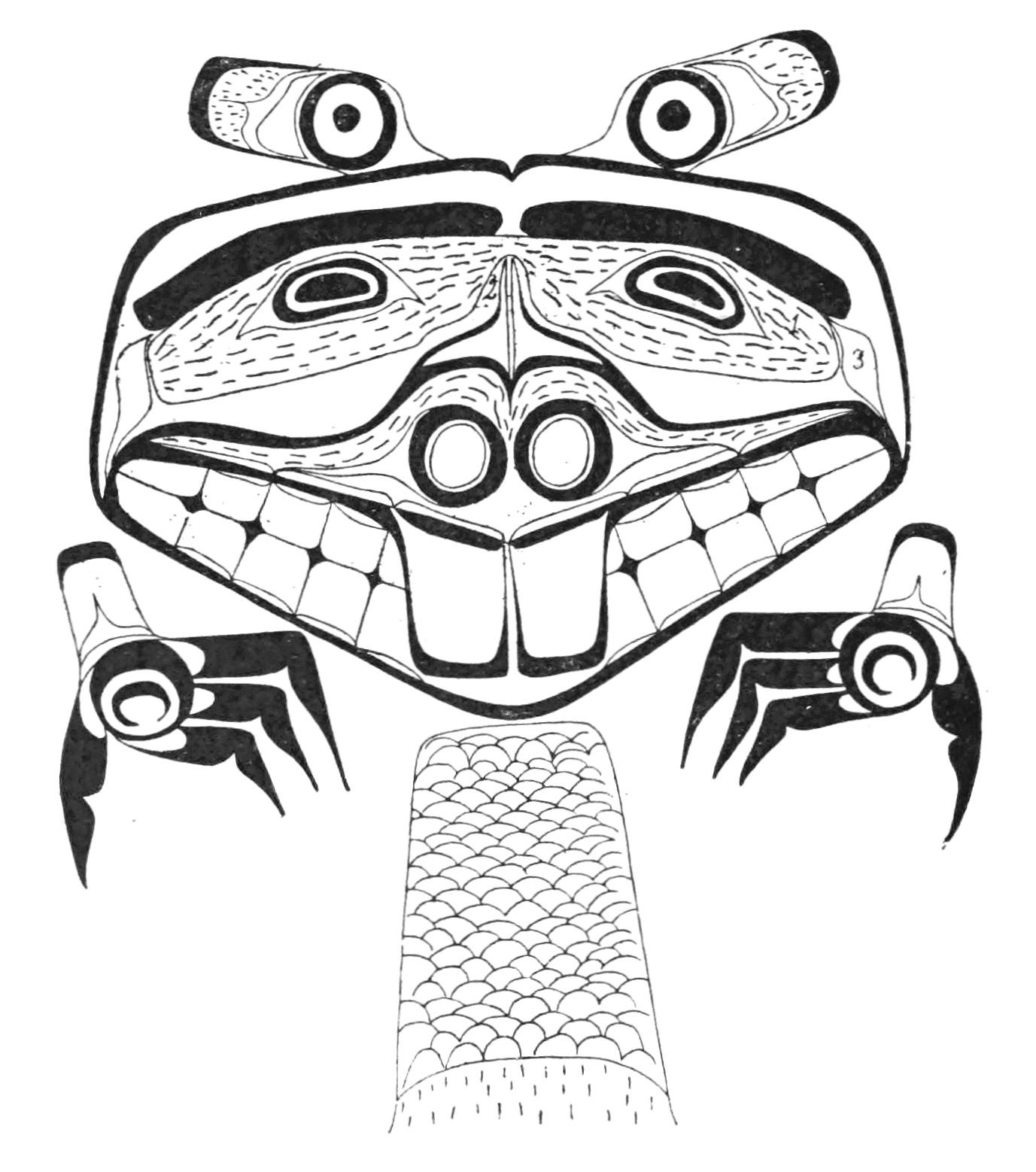
Fig. 160. Painting for a house-front placed over the door, representing the beaver, Kwakiutl Indians.
In a painting from a Kwakiutl house-front (fig. 160), which was made for me by an Indian from Fort Rupert, the large head with the incisors will be recognized. The scaly tail appears under the mouth. The broken lines (1) around the eyes, indicate the hair of the beaver. The design on each cheek (3) the bones of the face, the high point of the nose (2) its sudden turn. The nostrils are large and round as in the specimens described before. Under the corners of the mouth are the feet. The meaning of the two ornaments over the head is doubtful.
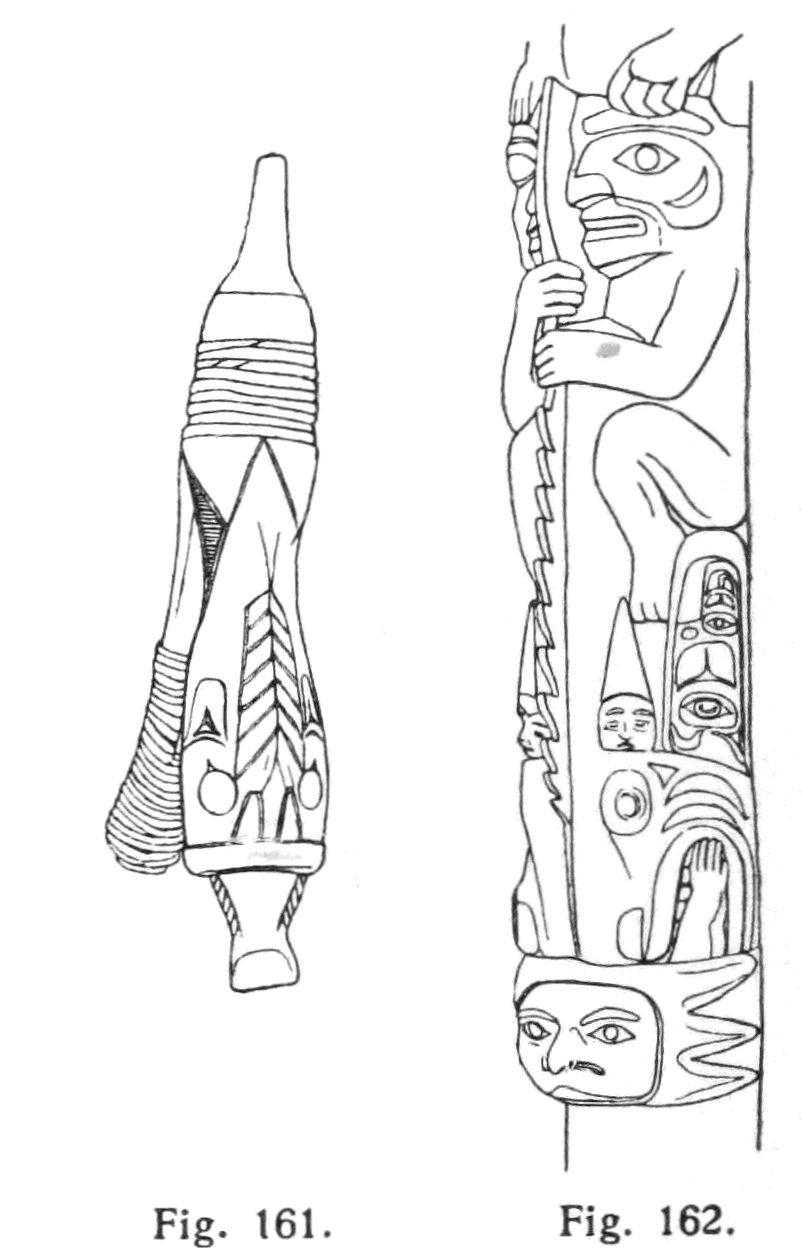
Fig. 161. Halibut hook with design representing a sculpin swallowing a fish, Tlingit.
Fig. 162. Part of a totem pole with design representing a sculpin, Tsimshian.
A carved halibut hook (fig. 161) is decorated with the design of the sculpin. The symbols of the fish are fins and tail, those of the sculpin, two spines rising over its mouth, and a joined dorsal fin. The sculpin is represented swallowing a fish, the tail of which protrudes from its mouth. The two spines appear immediately over the lips, their points being between the two eyes which are represented by two circles with small projections. The two pectoral fins are indicated over the eyes. The joined dorsal fin extends from the eyes upward toward the narrowest part of the body. The tail of the animal extends toward the place where point and shank of the hook are bound together by means of a strip of spruce root.
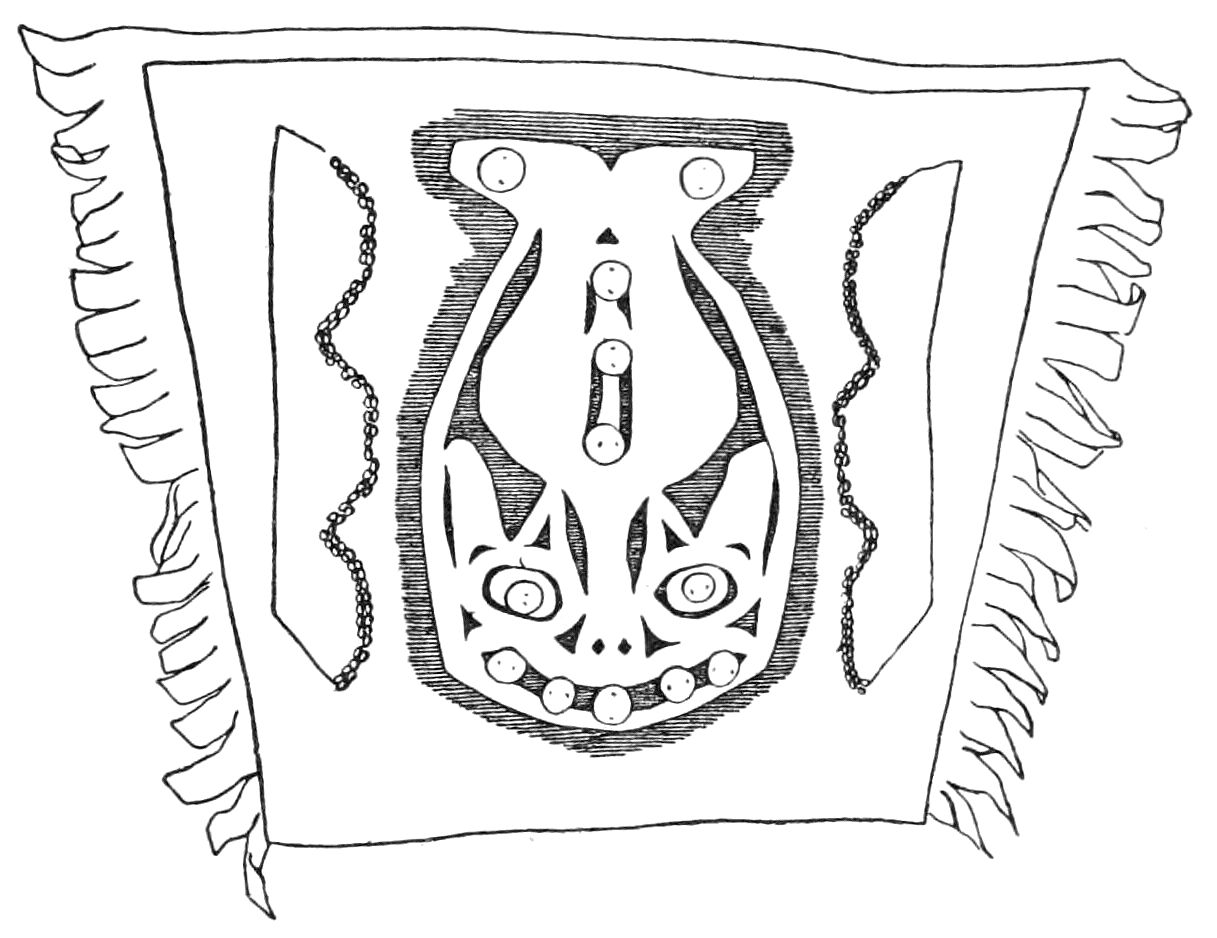
Fig. 163. Woolen legging with appliqué designs representing sculpin, Haida.
The same animal is represented in a slightly different way on the lower portion of a totem pole (fig. 162). The lowest figure is probably the sun, or perhaps a starfish. Its arms extend upward, and are held in the mouth by a sculpin, standing head downward, back forward, and tail extending upward. Two crescent-shaped ornaments above the corners of the mouth represent the gills of the fish. Above these are the pectoral fins. On the level of the pectoral fins towards the middle appear the symbols of the sculpin, two spines, the lower portions of which are decorated with small human faces. The round eyes are placed just under the spines. The dorsal fin commences at the height of the eyes, and merges into the tail which is clasped by a human figure cut in two by the fish tail. This carving is also characterized by two symbols,— —the two spines and the joined dorsal fin.
On a legging made of blue cloth (fig. 163) the sculpin is shown in red cloth appliqué. Its teeth, eyes, and dorsal fin are represented by buttons of abalone shell. Two small triangles cut out to the right and left of the mouth represent the gills. Immediately over the eyes, and extending toward the middle of the back, are the two spines, indicated by two slender triangular pieces of red cloth cut out in their middle parts. The pectoral fins are indicated by two broader pieces of red cloth extending from the eyes outward and upward toward the margin of the body of the fish, the dorsal fin by the long slits along the back of the animal. The species is characterized by the two spines which appear over the eyes.[104]
In facial paintings the sculpin is generally indicated by the two spines which are painted just over the lips (fig. 164).
Figs. 165-168 represent the hawk which is symbolized by an enormous hooked beak, curved backward so that its slender point touches the chin. In many cases the face of the bird is that of a human being, the nose being given the shape of the symbol of the hawk. It is extended in the form of a beak, and drawn back into the mouth, or merged into the face below the lower lip.
On the headdress, fig. 165, the upper, larger face is that of the hawk. The face in human; but the ears, which rise over the forehead, indicate that an animal is meant. The body is small, and is hidden behind the face of a sea-monster with bear’s head and flippers. The wings of the hawk are grasped by the arms of the sea-monster whose flippers may be seen over the arms.
Fig. 166 is the handle of a spoon on which is represented the head of a hawk, symbolized by its beak. The top of the spoon represents a man who is holding a small animal with a segmented body, which may represent the dragon-fly, although the head seems rather smaller than usual.[105]
In figs. 167 and 168 the same symbols of the hawk will be recognized. It is worth remarking that in most of these specimens the mouth is entirely separated from the beak and has the form of the toothed mouth of a mammal. A characteristic form of the hawk’s beak is shown in the facial painting fig. 169.
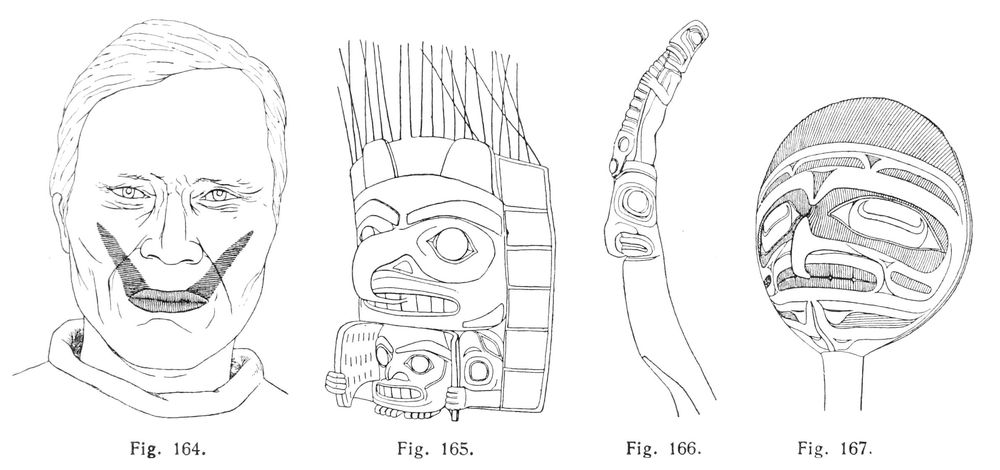
Fig. 164. Facial painting representing the sculpin, Haida.
Fig. 165. Headdress representing a hawk, Tsimshian.
Fig. 166. Handle of a spoon made of mountain-goat horn; lowest figure representing a hawk; upper figure representing a man holding a dragon-fly, probably Tsimshian.
Fig. 167. Rattle with design of a hawk, Tlingit.
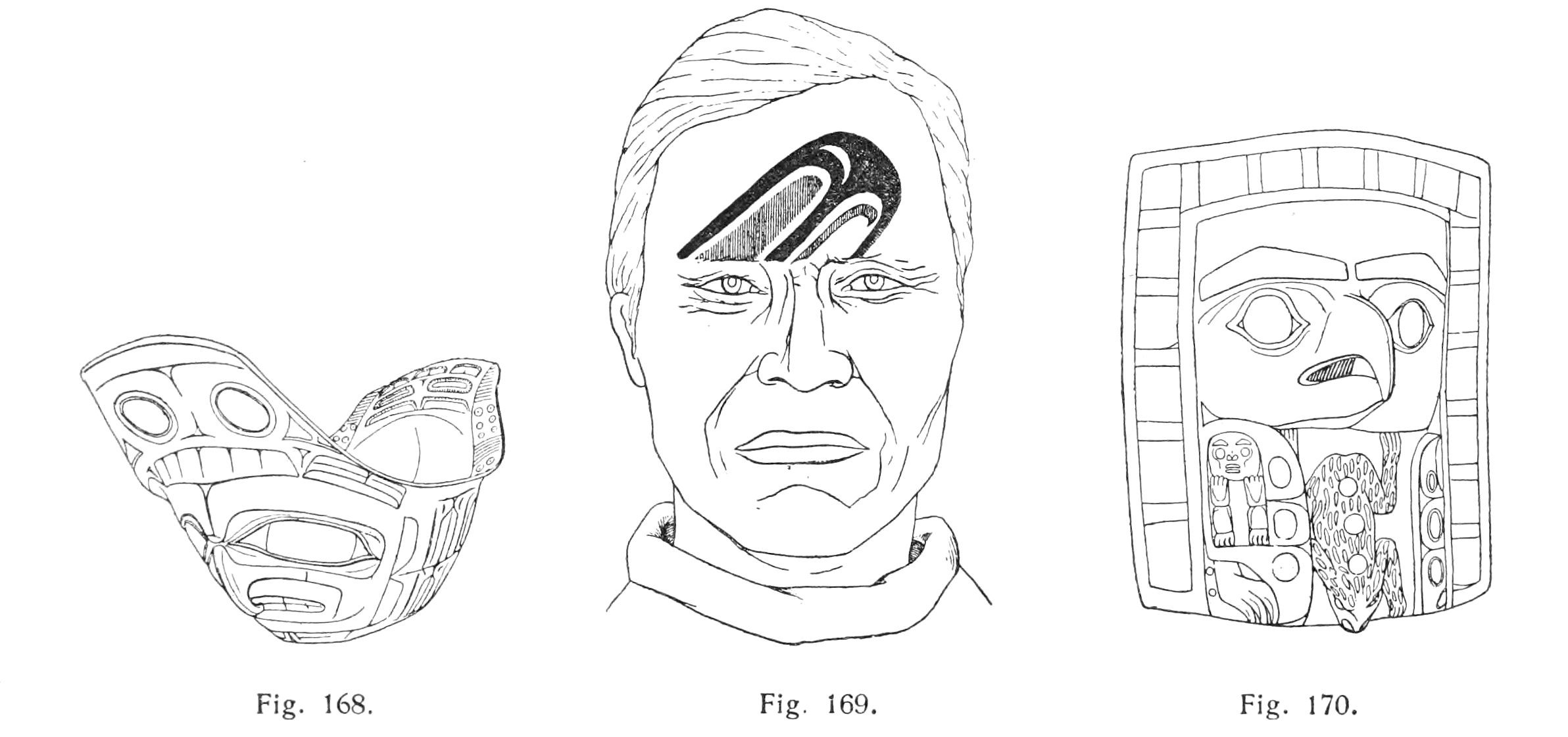
Fig. 168. Dish made of horn of big-horn-sheep, Tlingit.
Fig. 169. Facial painting representing hawk, Haida.
Fig. 170. Headdress representing an eagle bearing a frog on its chest, Tsimshian.
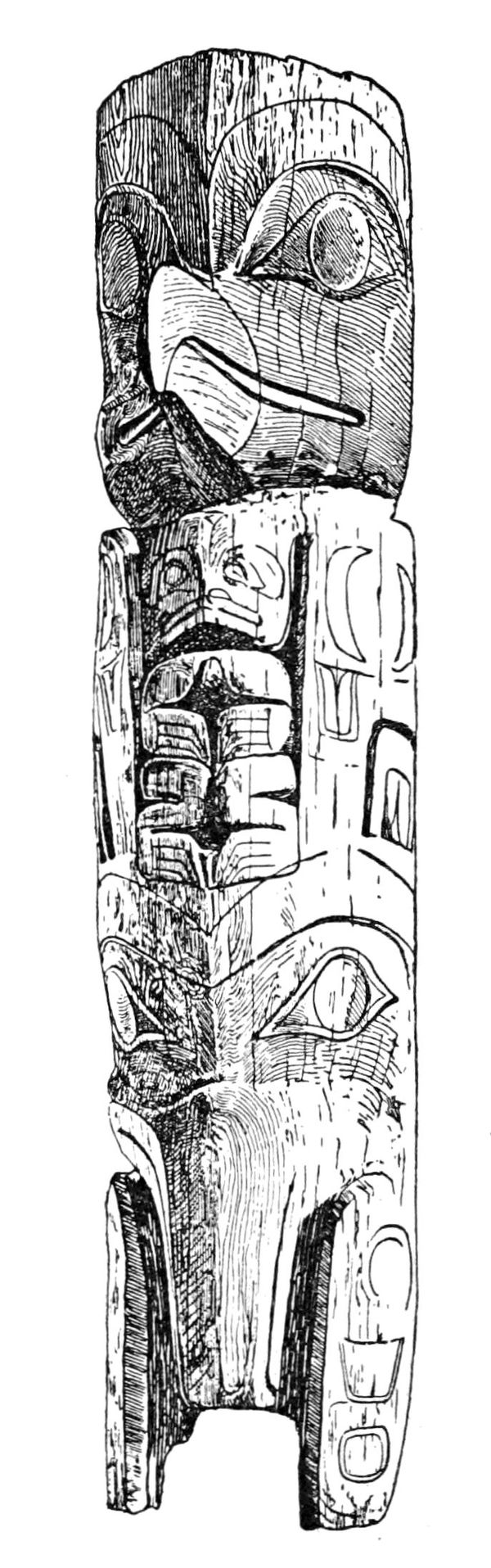
Fig. 171. Housepost representing eagle above, cormorant below, Haida.
Fig. 170, the front of a headdress representing the eagle, is quite similar to the forms of preceding series; but it differs from them in that the beak of the bird is not turned back so as to touch the face, but ends in a sharp point extending downward, and that there is no mammal mouth indicated. The wings of the eagle are shown extending from the border of its body inward. The shoulder joint is indicated by the head of a human figure which is ornamentally carved on the wings. The feet are seen at the sides of the lower border of the carving, under the wings. On the body of the eagle is a rather realistic carving of a toad. An eagle is also shown on top of the Haida house post (fig. 171). The wings are turned in in front of the body and the curves of the lower figures fit into the curved side.[106]
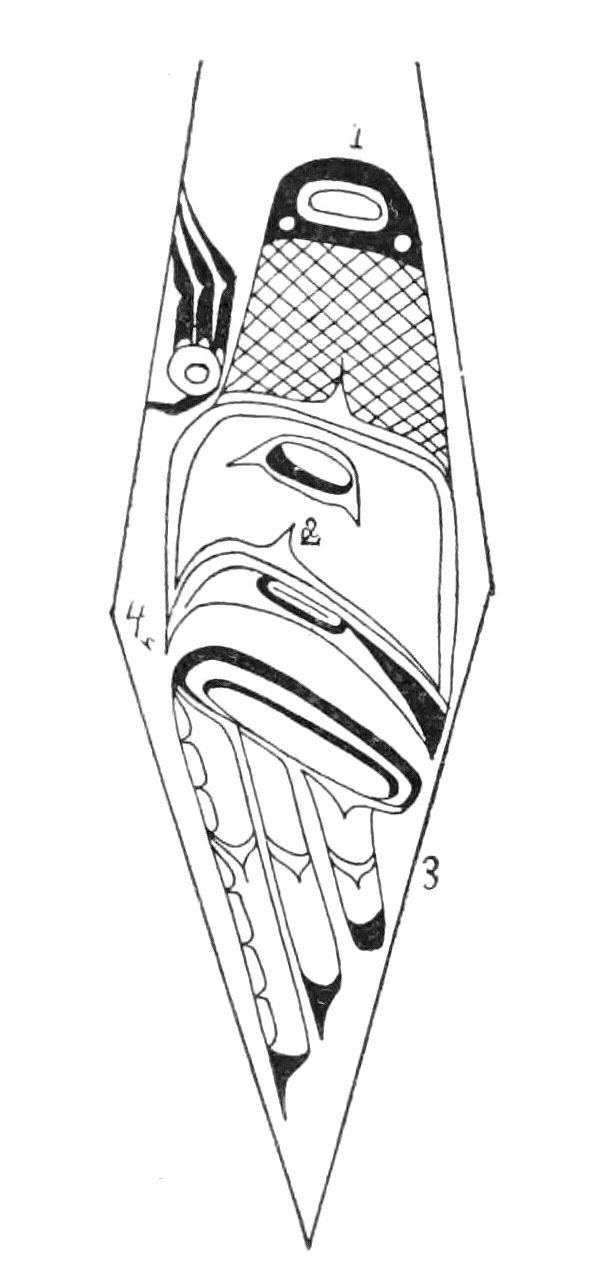
Fig. 172. Painting on paddle representing hawk, Kwakiutl.
In figs. 172 and 173 I give two representations of the hawk (or fish hawk) made by the Kwakiutl. The treatment is different from that of the Haida, but the sharply curved beak is found here also. On the paddle (fig. 172), (1) represents the eyebrow and ear, (2) the cheek, (3) the wing, (4) the beak. Fig. 173 is taken from a painting on a settee. On the back is shown a man with ears (4) over the head, like those of the Haida animals. (1) is the navel, (2) the wrinkles running down from the nose to the corners of the mouth, (3) is painting on the cheeks. The head of the hawk is placed on each side of the human figure. On the lower border of the settee is the lower jaw (5), over the eyes the feathers on the head (6), the eye next to the head on the side wing of the settee, is the shoulder joint. The bone of the wing is shown in (7), the long wing feather in (8), the feathers of the body in (9).
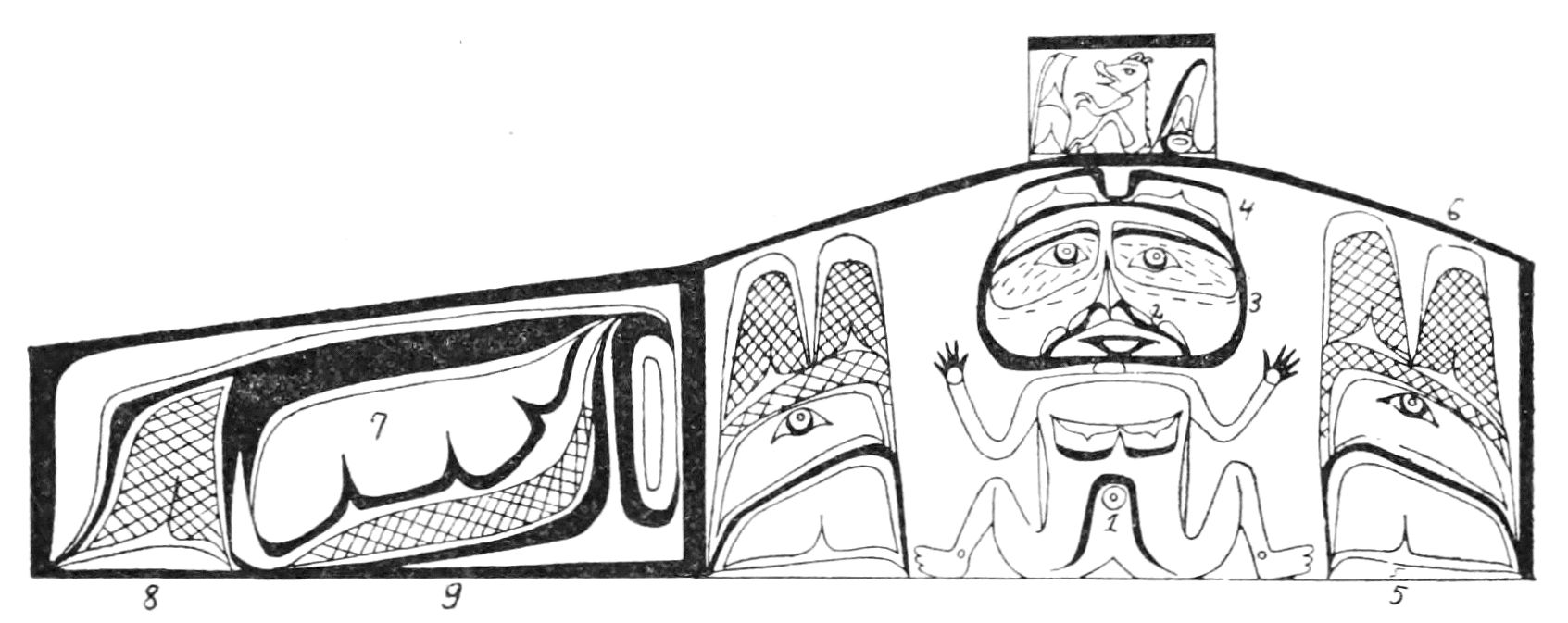
Fig. 173. Painting on back and one end of a settee representing man and hawk, Kwakiutl.
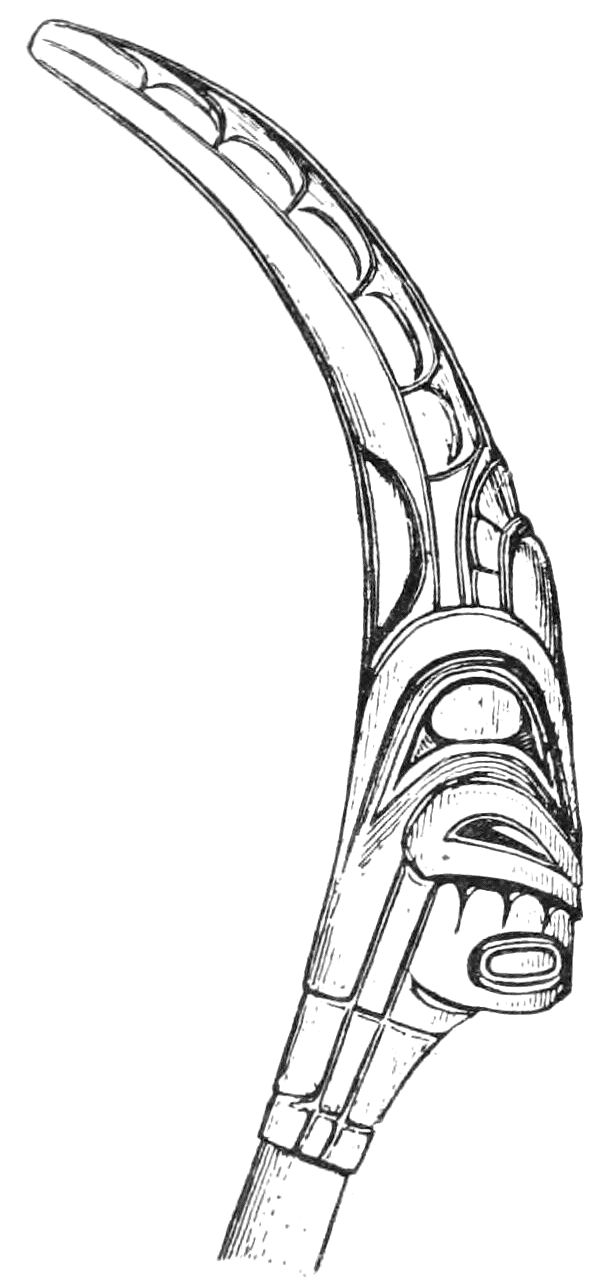
Fig. 174. Handle of spoon of mountain-goat horn representing dragon-fly.
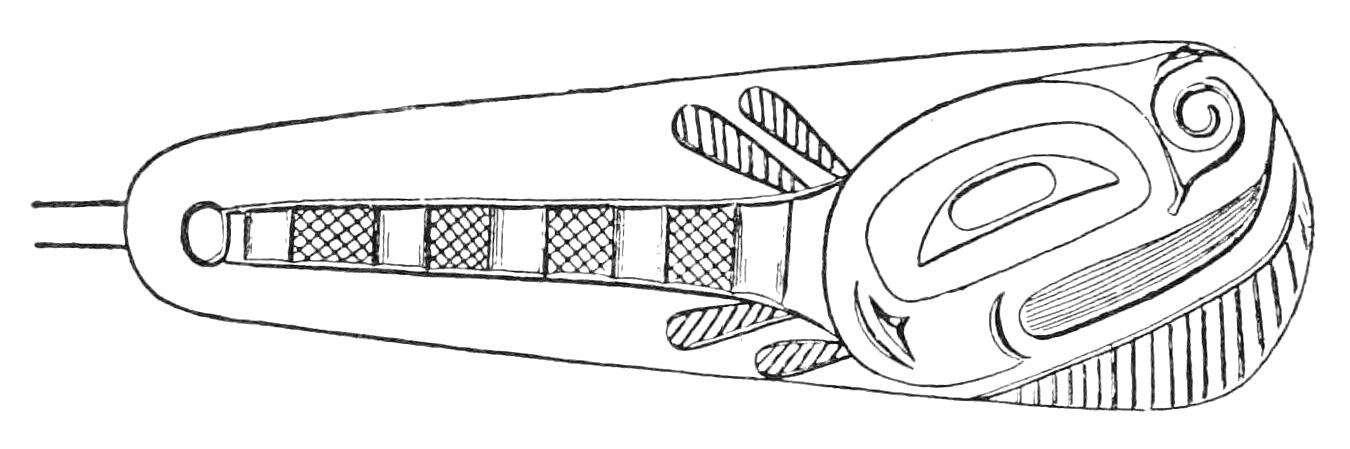
Fig. 175. Berry spoon with engraving representing dragon-fly.
The dragon-fly is represented with a large head, a long segmented body and two pairs of wings. The representation on the headdress, fig. 159, has been referred to before. The head is human but provided with animal ears. It has also been mentioned that the animal with segmented body in fig. 166 may be a dragon-fly, although it is lacking the wings. According to Edensaw, the spoon handle (fig. 174) also represents the dragon-fly. It has a strongly curved beak; wings are placed under the lower jaw and the segmented body forms the tip of the handle. A particularly good representation of a dragon-fly is found on the Haida berry spoon[107] (fig. 175). Attention should be called to the spiral proboscis on this specimen.
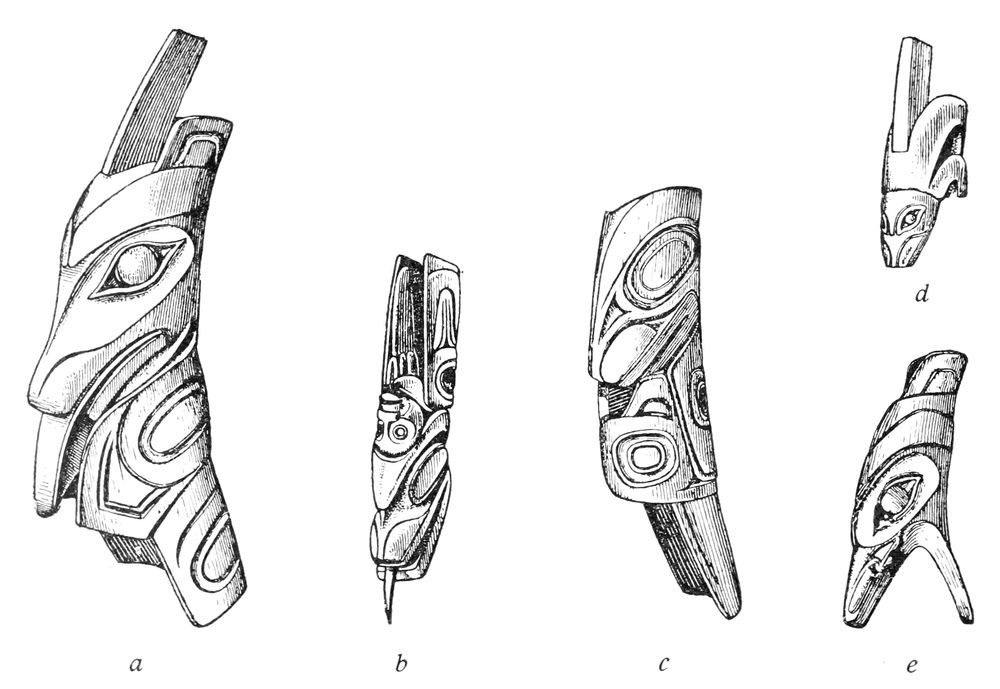
Fig. 176.
a
-
e
Carvings from handles of spoons of mountain-goat horn representing killer-whale, Tlingit.
The most important characteristic of the killer-whale as represented by the Haida is the long dorsal fin,—often with white circle or white stripe in the middle, and a face or eye indicating a joint at the base. The head is elongated, the mouth long and square in front. The nostril is large, high, and at the same time elongated. The distance from the mouth to the eyebrow is long and on totem poles and spoon handles the head is always so placed that the long snout points downward. When seen in profile the front of the face is square on account of the forward extension of the nose over the front part of the mouth. The eye is generally round but sometimes surrounded by elongated lid lines with sharp inner and outer corners. Sometimes the blow-hole is shown by a circular spot over the forehead. In fig. 176 are shown a few representations of the killer-whale as found on handles of spoons made of mountain-goat horn. In (a) and (b) the dorsal fin rises immediately over the head of the animal. The inverted face in (b) probably represents the blow-hole. In (a) and (c) the fins are folded forward; in the latter specimen the tail is turned up in front on the body. On the rattle (fig. 177) the characteristic large head with steep face appears. The mouth is set with large teeth; the eye is round. In front of the dorsal fin is a blow-hole. The Haida float (fig. 178) is abnormal in so far as it has a very small dorsal fin (see also fig. 182 d).
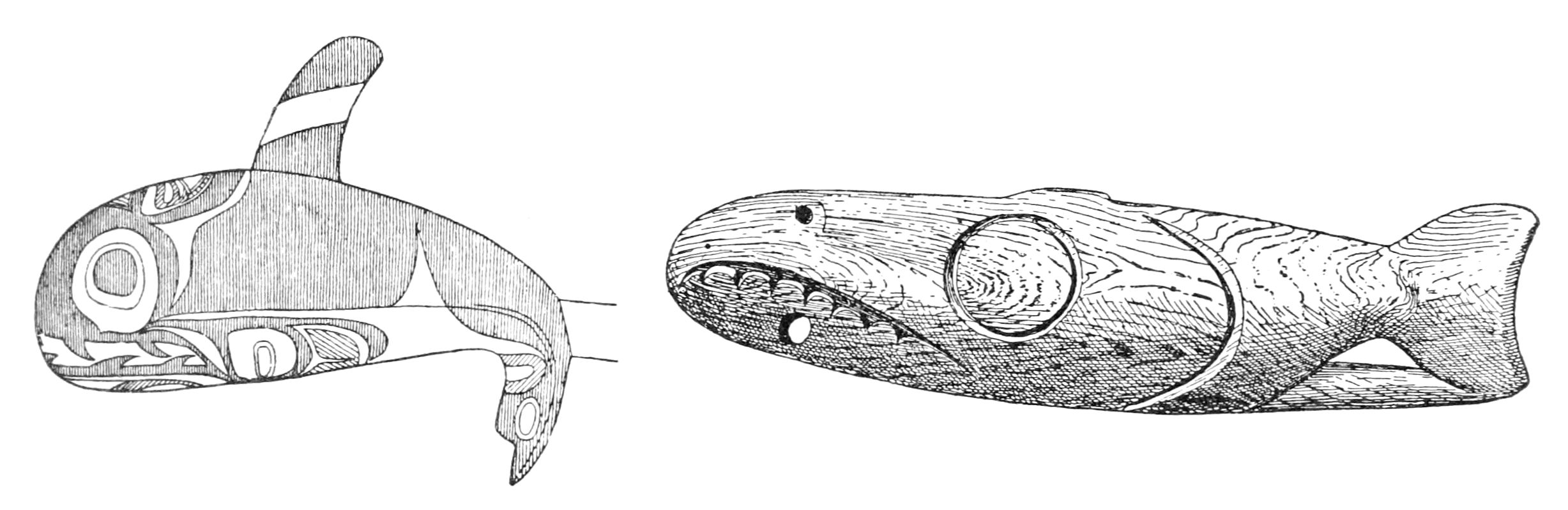
Fig. 177. Rattle representing killer-whale, Haida. Fig. 178. Wooden float representing killer-whale, Haida.
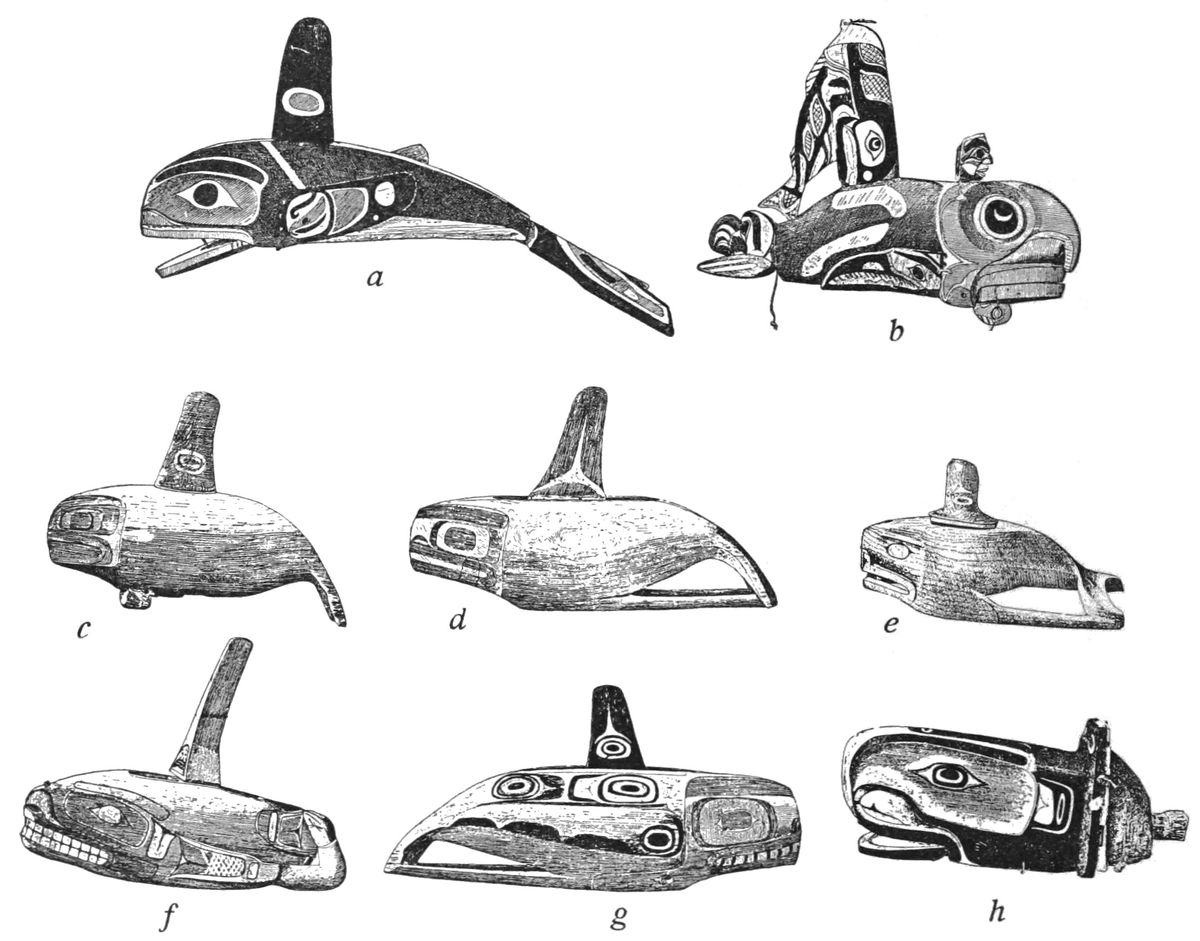
Fig. 179. Masks and dishes representing the killer-whale, Kwakiutl.
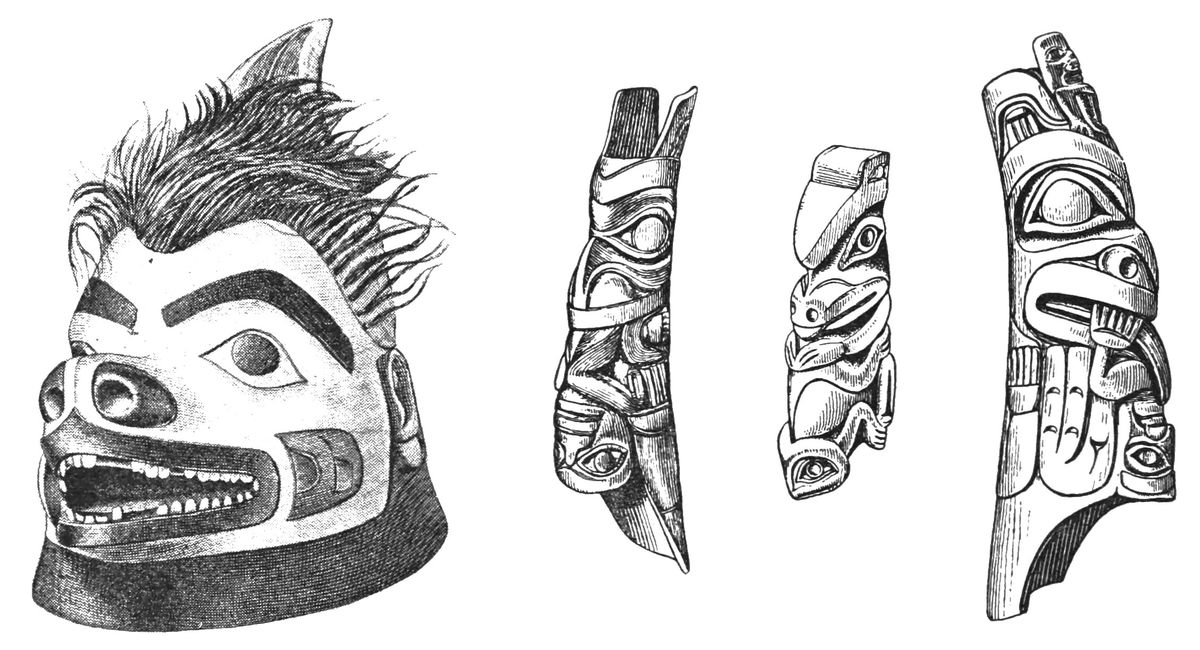
Fig. 180. Helmet representing the killer-whale, Tlingit. Fig. 181. Carvings from the handles of spoons of mountain-goat horn representing the bear.
A number of Kwakiutl masks and dishes representing the killer-whale are shown in fig. 179. Although there are some differences in the treatment of the animal, the main features are common to both tribes. All these specimens, except h, have the dorsal fin; the last named specimen shows the head only. The long, high nose is found in all except in c, d, e. The high, steep face is common to all of them. Fig. e, a large house dish,[108] is said to represent the They are emblems of the family of the houseowner.] whale. It will be noticed that b, c, d have round eyes while in a and h the regular oblong eye is used. In e and g the fundamental form of the eye is also round. Fig. 180 is a Tlingit helmet which is characterized as the killer-whale by the large mouth set with teeth, the sudden turn of the nose towards the forehead, the fin made of hide which rises over the crown of the head, and the fin which is painted on the left cheek. Ordinarily the killer-whale has no ears. In facial painting red under and on the lower jaw up to a line running from the angle of the jaw to a point a little below the lips, represents the throat of the killer-whale.
The bear is symbolized by a large mouth set with many teeth, often in the act of swallowing some animal. Very often the tongue protrudes. The nostrils are high and round, sometimes represented by spirals (see also figs. 157, 175). On totem poles and carved spoon handles they are similar to those of the killer-whale but do not extend quite so far backward. There is a sharp turn in the profile from the nose to the forehead. The paws are large (fig. 181).
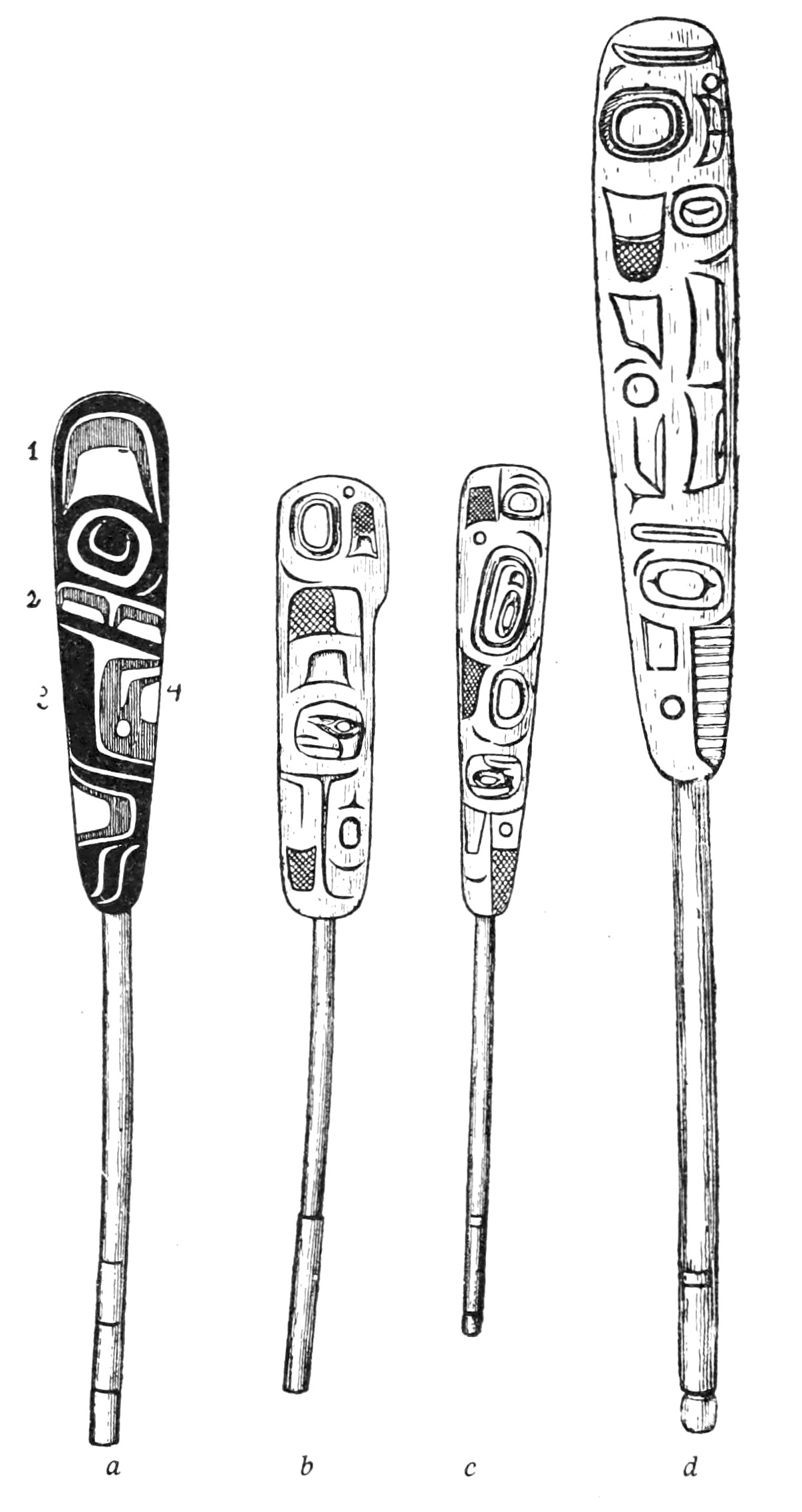
Fig. 182. Berry spoons representing bear;
a
,
b
, Tsimshian;
c
, Tlingit;
d
, representing killer-whale.
In fig. 182 three berry spoons are shown which, according to Charles Edensaw, represent the bear. Fig. 182 a is quite clear. At the end of the spoon is shown the head with an enormous ear (1), the size of which is determined by the form of the spoon. Two teeth are indicated by red curves (2). Under the mouth is a broad black curve, the foreleg (3), and to the right of it (4) the fore-paw. The lowest part represents the hindlegs. Fig. 182 b is not so clear. The face in the middle is the hip joint, under it, to the right, the thigh, to the left the paw with long claws. Edensaw considered the design over the hip joint as the tail, the end as the head, but I doubt the correctness of this interpretation. The end of the spoon looks more like the head of a sea-monster and the design over the hip joint like the fin. Fig. 182 c was also called a bear by the same informant, while 182 d was called a killer-whale. I place these side by side, because the formal agreement of the lower part is striking. The right half of the base of 182 c has the characteristic form of the dorsal fin of the killer-whale and corresponds to an analagous design in fig. 182 d. In both cases the inverted eye above the “fin” would be the joint. The rest of the design consists of eye and flipper elements that are not readily recognized. In 182 d the flat curves in the middle may be the body; in front to the left the fin, and over it eye and mouth. In 182 c the elements are still less clear. According to Edensaw there is no head, only a tail at the upper end of the spoon.
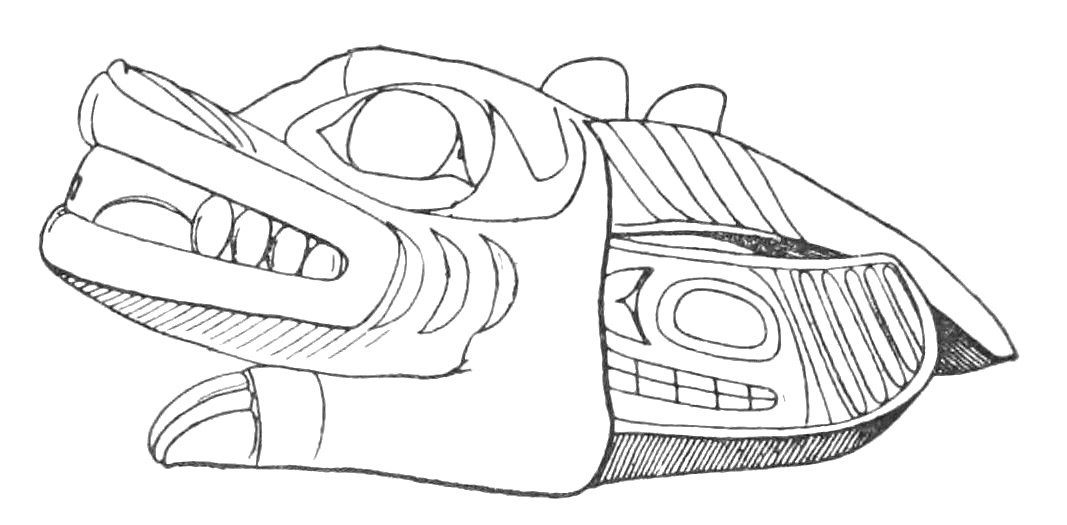
Fig. 183. Carving representing a sea-monster, Tlingit.
There are quite a number of representations of the sea-monster, the form of which is partly that of a bear and partly that of a killer-whale. In a number of cases the monster has a bear’s head (fig. 183) and body, but fins are attached to the elbows. In other cases the head is that of a killer-whale and the body that of a bear. In this form it appears on many horn spoon handles (fig. 184). In still other cases the characteristics of bear and killer-whale are intermingled in other ways.
The frog is characterized by a wide toothless mouth, a flat nose, and lack of a tail.
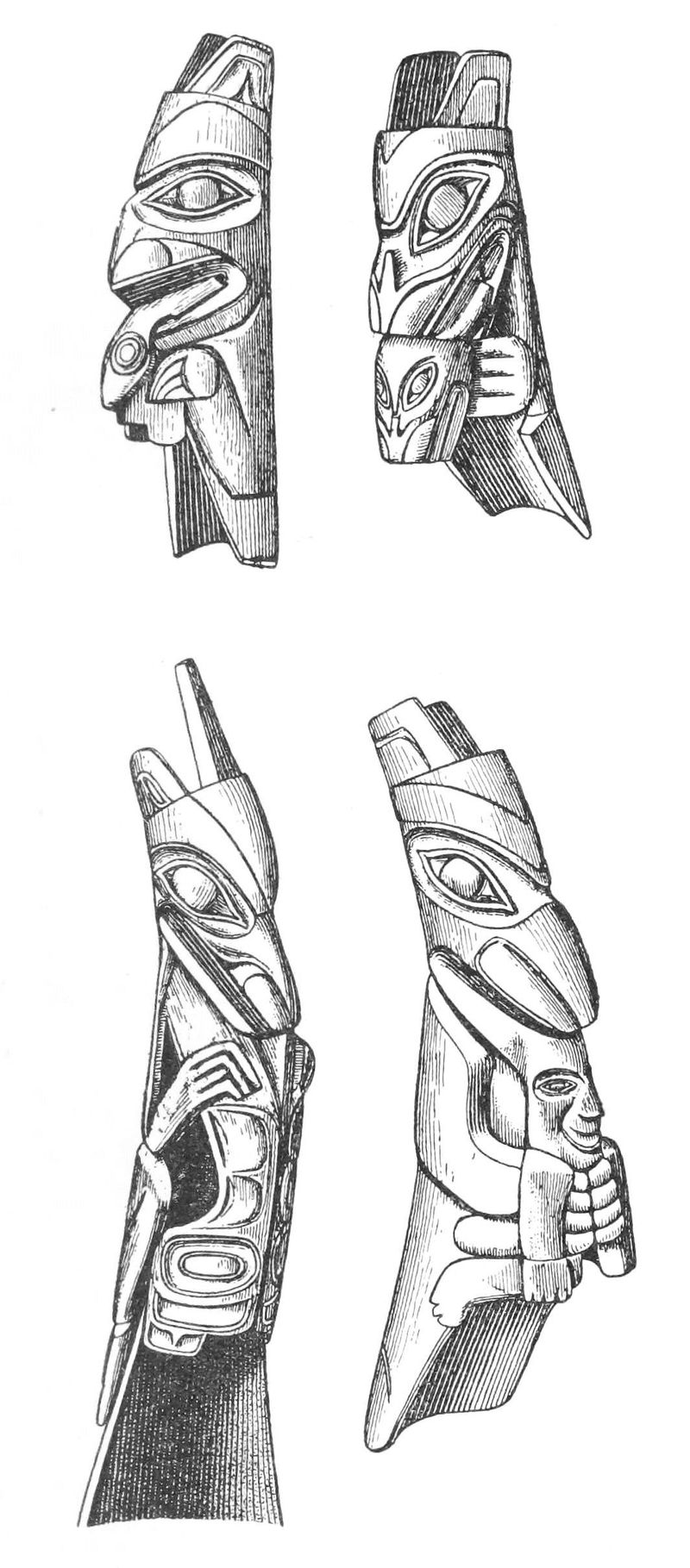
Fig. 184. Carvings from handles of spoons made of mountain-goat horn representing a sea-monster.
The following series (figs. 185-188) are representations of the dogfish or shark. When the whole body of this animal is represented, it is characterized by a heterocerc tail, a large mouth, the corners of which are drawn downward, a series of curved lines on each cheek which represent the gills, and a high tapering forehead imitating the inferior position of the mouth. It is often decorated with two circles (the nostrils), and a series of curved lines (wrinkles) similar to the gill lines on the cheeks.
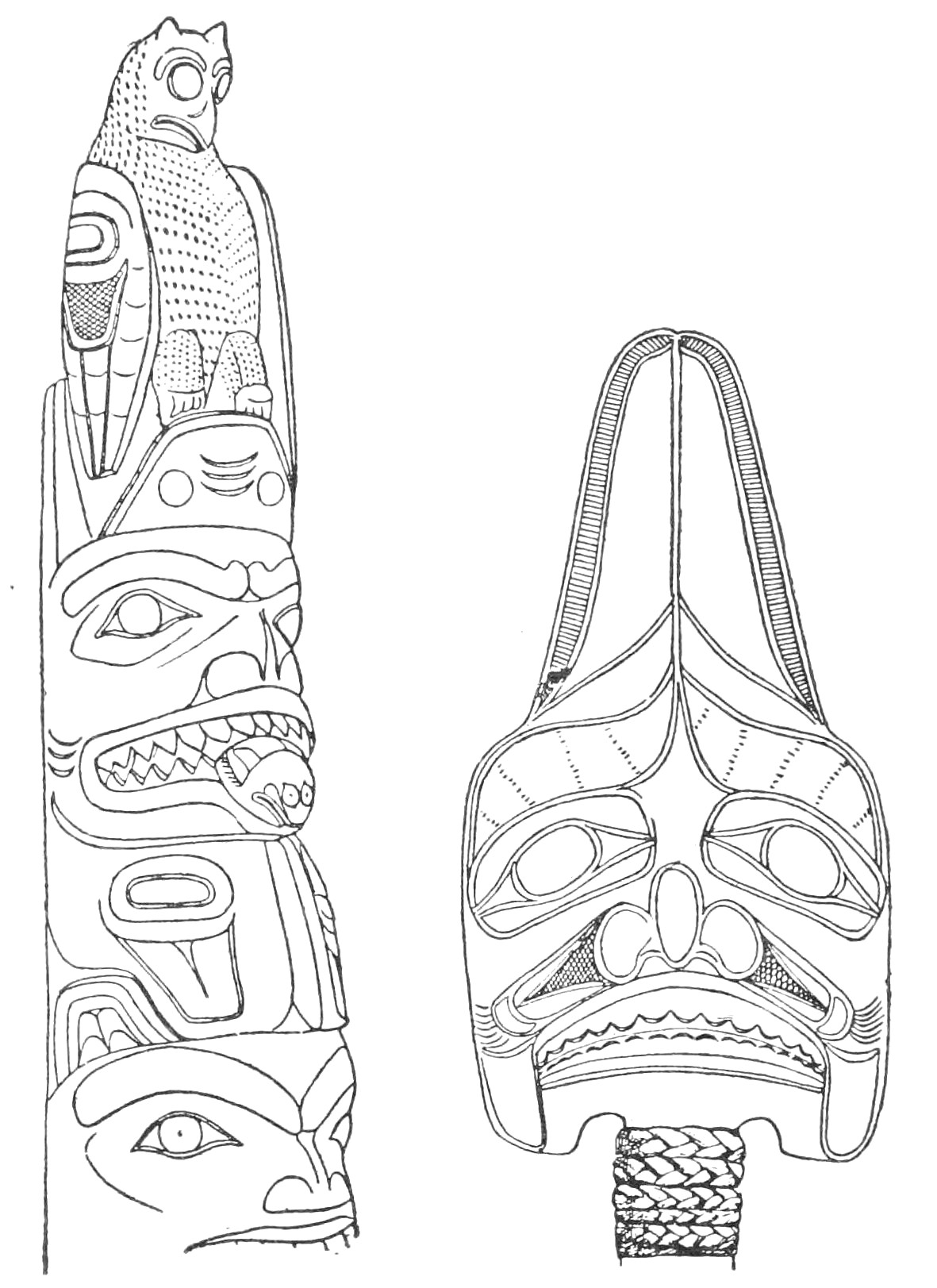
Fig. 185. Part of totem pole carved in slate representing shark surmounted by an eagle, Haida. Fig. 186. Handle of a dagger representing the head of a shark, Tlingit.
Fig. 185 represents a shark devouring a halibut, from the upper part of a totem pole. The head has the characteristic symbols, to which are added here the numerous sharp teeth that are found often, but not regularly, as symbols of the shark. The greater part of the body has been omitted, since the animal is sufficiently identified by the symbols found on the head; but under the chin will be noticed the two pectoral fins which identify it as a fish.
Fig. 186 is the handle of a copper dagger on which the mouth with depressed corners, the curved lines on the cheeks, and the ornament rising over the forehead, characterize the shark.
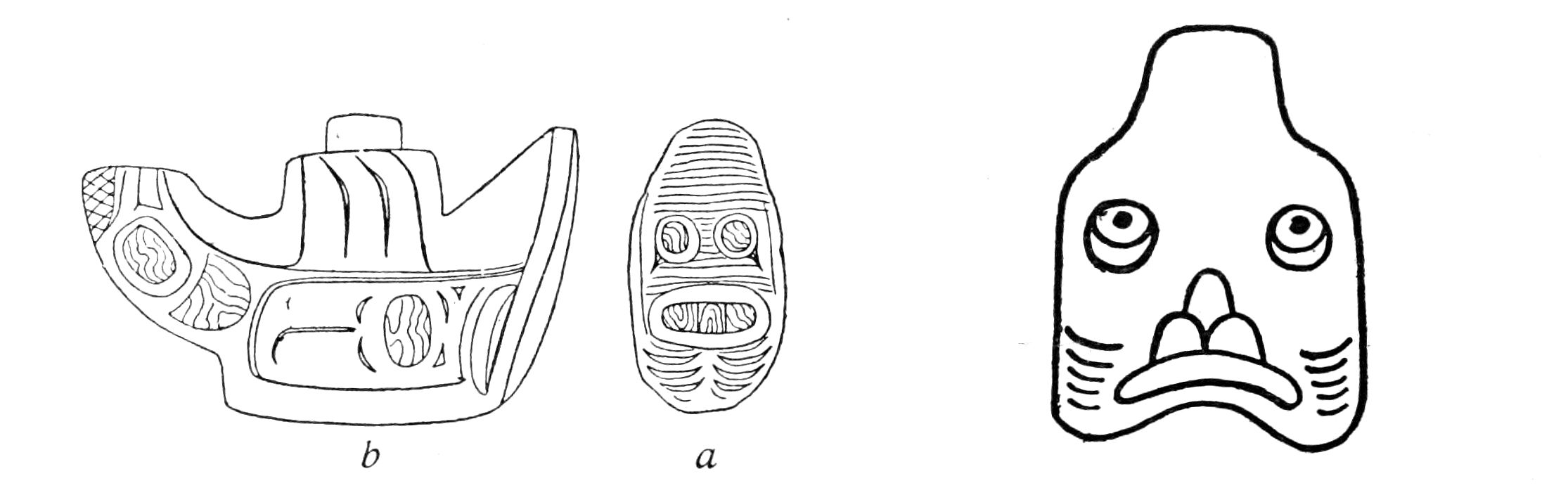
Fig. 187. Wooden pipe representing a shark, Tlingit. Fig. 188. Tattooing representing a shark, Haida.
A small pipe (fig. 187) has the form of a shark. The square end at the right hand side is the face of the animal (fig. 187). Eyes and mouth are inlaid with abalone shell. On account of the narrowness of the face, the three curved lines generally found on the cheeks are placed under the mouth. The forehead has the characteristic high form described before. The opposite end of the pipe shows the tail turned upward. On the sides are carved the pectoral fins, which extend over the body of the pipe.
Fig. 188 is a copy of a tattooing on the back of a Haida woman. Here we have only the outline of the head of a shark, again characterized by the peculiar, high forehead, the depressed corners of the mouth, and curved lines on each cheek.
The shark[109] (or dogfish) is found frequently on Haida carvings and paintings. It is rare among the southern tribes.
The ts’um’os, the personified snag, is represented in a form similar to the bear. According to Edensaw the form of the head is analogous to that of the bear but the corners of the mouth are drawn down like those of the dog-fish (fig. 189). This is contradicted by the representation of a third snag monster, in which the mouth is square like that of the bear. The region behind the mouth has, however, the characteristic curvature demanded by Edensaw. The fins of this being correspond to the concept of the sea-monster.
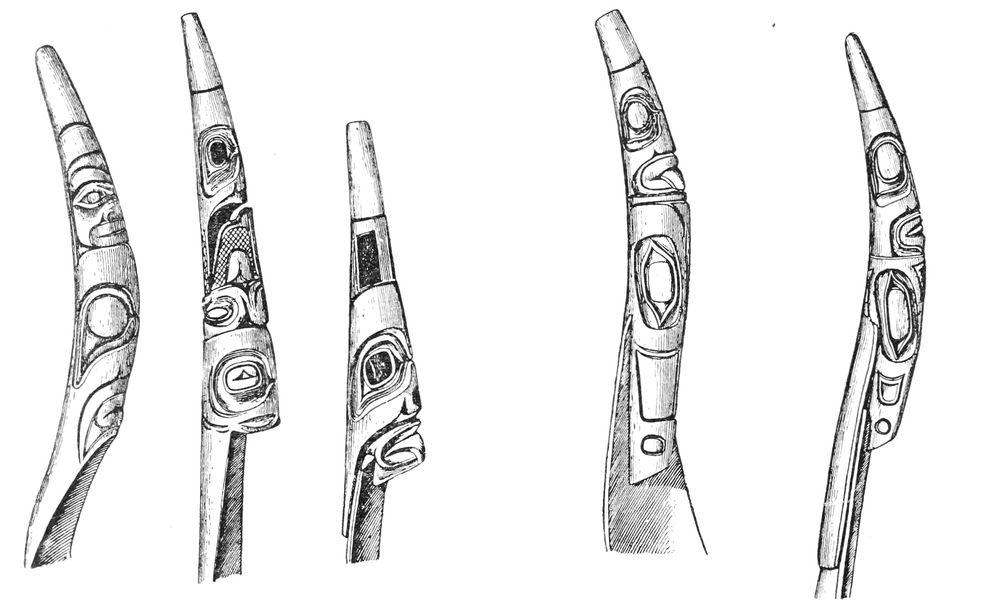
Fig. 189. Handles of spoons representing sea-monster, Haida. Fig. 190. Handles of spoons made of mountain-goat representing snail, Tlingit.
In fig. 190 are represented two spoon handles, representing, according to Edensaw, the snail. The characteristic feature seems to be the long snout with its sudden, angular turn. The conventional concept of the animal form with eye and nose is strikingly brought out in this instance.
Let us briefly recapitulate what we have thus far tried to show. Animals are characterized by their symbols, and the following series of symbols has been described in the preceding remarks:
1. Of the beaver: large incisors; large, round nose; scaly tail; and a stick held in the fore paws.
2. Of the sculpin: two spines rising over the mouth, and a continuous dorsal fin.
3. Of the hawk: large, curved beak the point of which is turned backward so that it touches the face.
4. Of the eagle: large, curved beak, the point of which is turned downward.
5. Of the killer-whale: large, long head; elongated large nostrils; round eye; large mouth set with teeth; blow-hole; and large dorsal fin.
6. Of the shark or dogfish: an elongated rounded cone rising over the forehead; mouth with depressed corners; a series of curved lines on the cheeks representing gills; two circles and curved lines on the ornament rising over the forehead representing nostrils and wrinkles; round eyes; numerous sharp teeth; and heterocerc tail.
7. Of the bear: large paws; and large mouth set with teeth; protruding tongue; large, round nose; and sudden turn from snout to forehead.
8. Of the sea-monster: bear’s head; bear’s paws with flippers attached; and gills and body of the killer-whale, with several dorsal fins; or other mixtures of bear and killer-whale type.
9. Of the dragon-fly: large head; segmented, slender body; and wings.
10. Of the frog: wide, toothless mouth; flat nose; and lack of tail.
11. Of the personified snag: like a bear with mouth depressed at the corners like that of the dogfish.
12. Of the snail: long snout with sudden downward turn.[110]
I have had occasion to examine the Kwakiutl in greater detail in regard to the symbols used in designating certain animals. One artist gave me a series of eye patterns together with the adjoining parts of the face and explained in what way each is characteristic of the animal in question. These are shown in figs. 191 and 192.
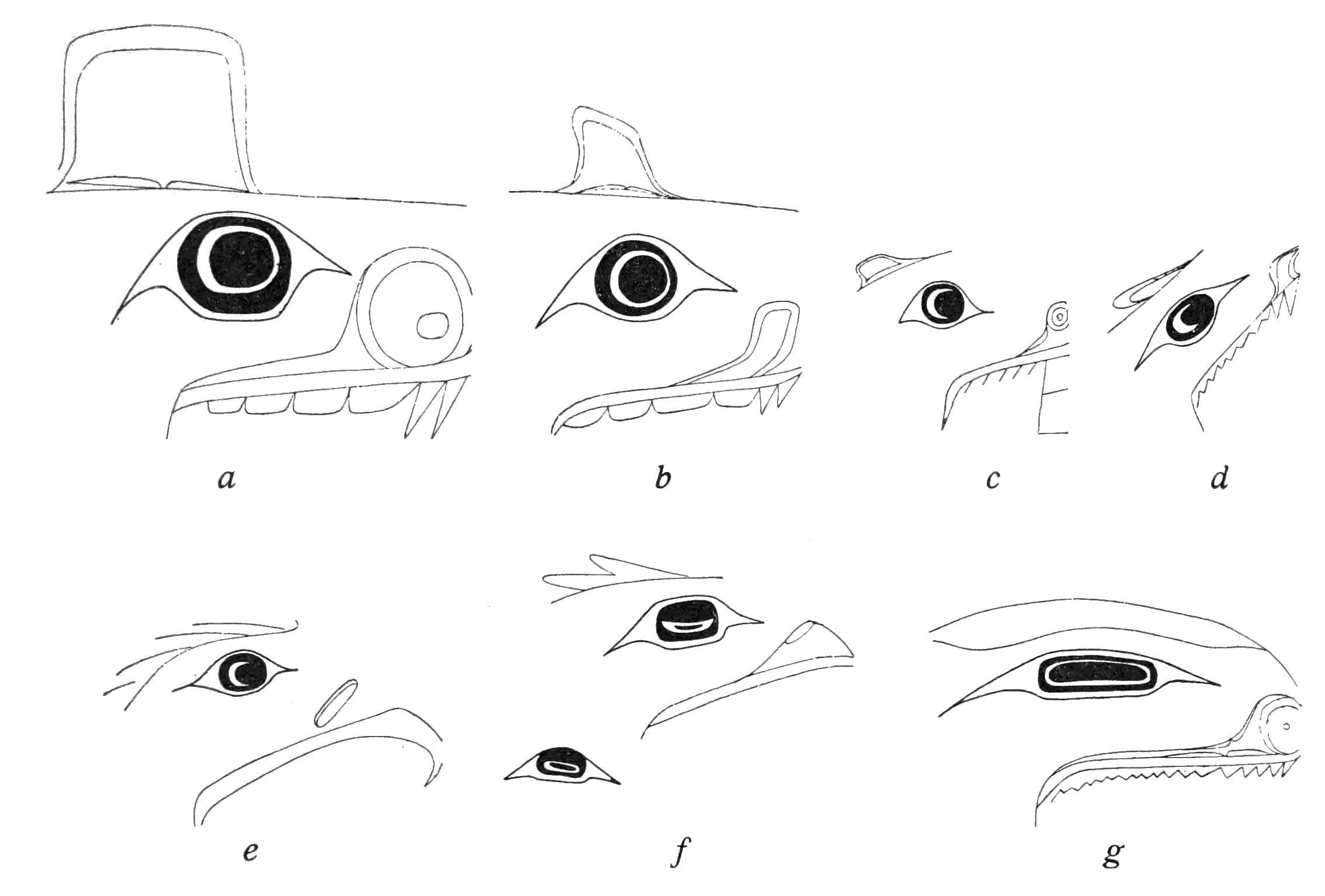
Fig. 191. Types of eyes of various animals, Kwakiutl;
a
, sea bear;
b
, grizzly bear;
c
, beaver;
d
, wolf;
e
, eagle;
f
raven;
g
, killer-whale.
The grizzly bear of the sea (a) has a large eye, the form of which is not definitely determined, a very large, round nostril, large teeth and a large ear. The grizzly bear (b) has a round eye with white rim, smaller than that of the grizzly bear of the sea. The nose is not round, but high, the teeth large but smaller than those of the grizzly bear of the sea. The ear is small and pointed. The beaver (c) has, besides the large incisors, a high, round nose and a very small ear. The wolf (d) has a slanting, long eye; the ear is laid down backward; he has many teeth. The eye of the eagle (e) has a white crescent behind the eyeball, the nostril is slanting and placed high up on the beak. The eye of the raven (f) is white in the center. The killer-whale (g) has a very large eyebrow, a long eye and face, long nose and a long mouth with many teeth. The whale (fig. 192 a) has a round eye and nose. The sea lion (b) has a round nose, large teeth, the eye near to the nose and a small ear. The frog (c) has an elongated eye, flat mouth and flat nose. The fabulous double-headed serpent (d) has a small eye like that of the wolf, a spiral nose and a spiral plume. The eyes of a man, of the woodman, and of the seaspirit who gives wealth, are shown in e, f, and g.
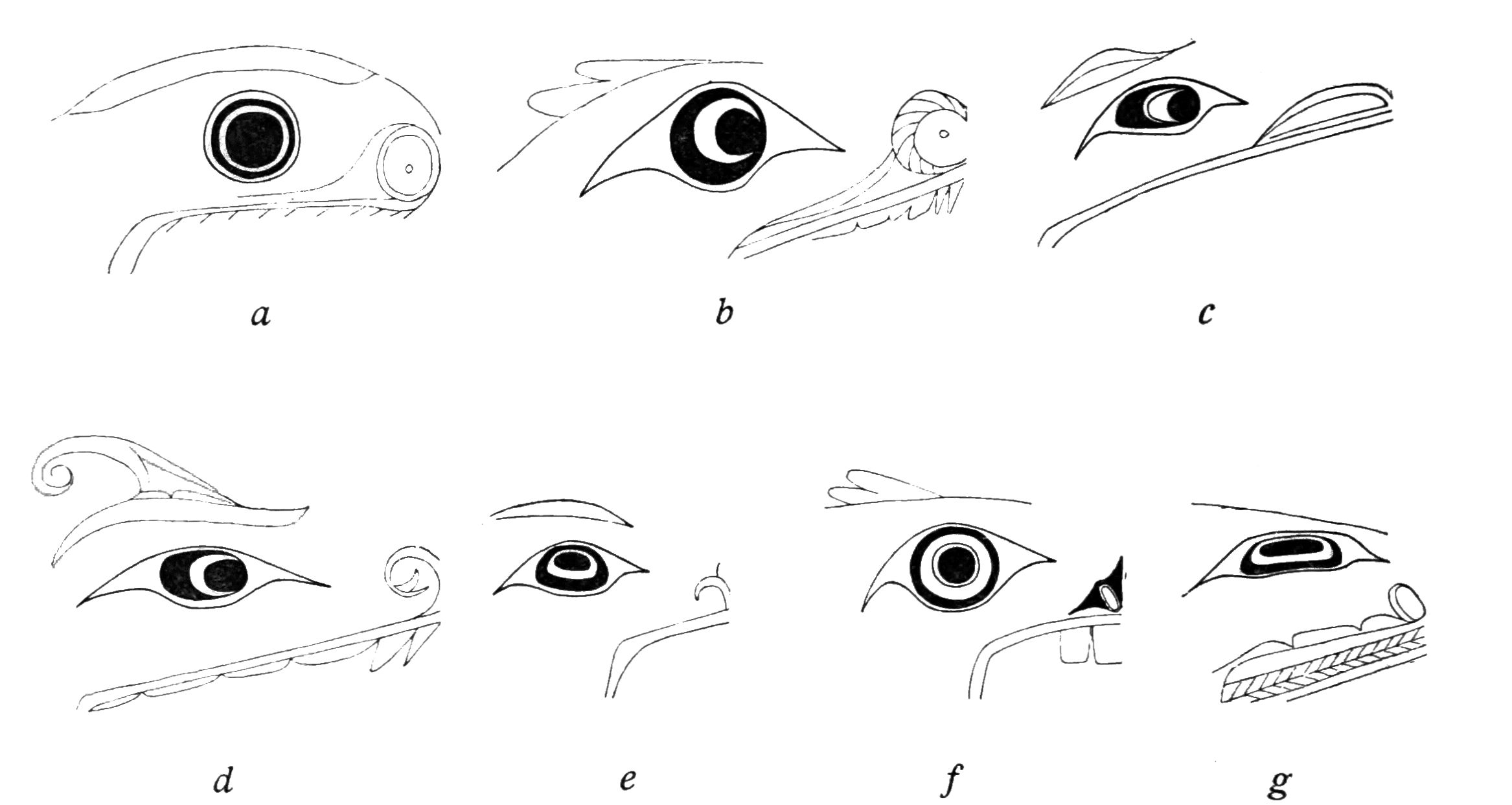
Fig. 192. Types of eyes of various
beings
, Kwakiutl,
a
, whale;
b
, sea lion;
c
, frog;
d
, double-headed serpent;
e
, man;
f
merman;
g
, spirit of the sea.
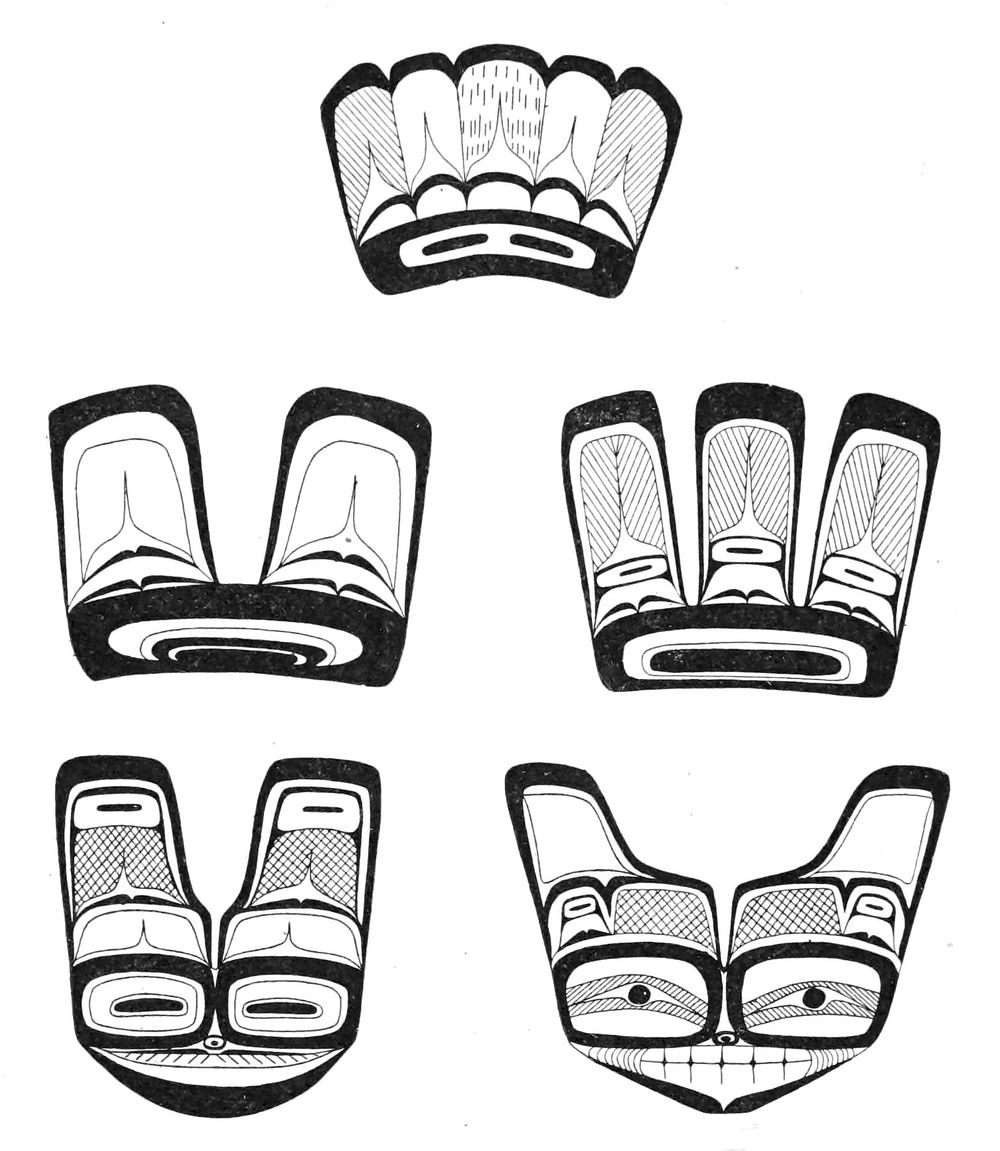
Fig. 193. Styles of tails, Kwakiutl; above bird; below sea mammals.
The Kwakiutl also claim as the standard for the bird’s tail, a joint with a single eye, although sometimes there may be two eyeballs enclosed in one eye. The rounded feathers (fig. 193) are also characteristics of the bird’s tail. The tail of the whale, killer-whale, and porpoise, on the other hand, has two joints and the flukes have double curvatures on the inner side.
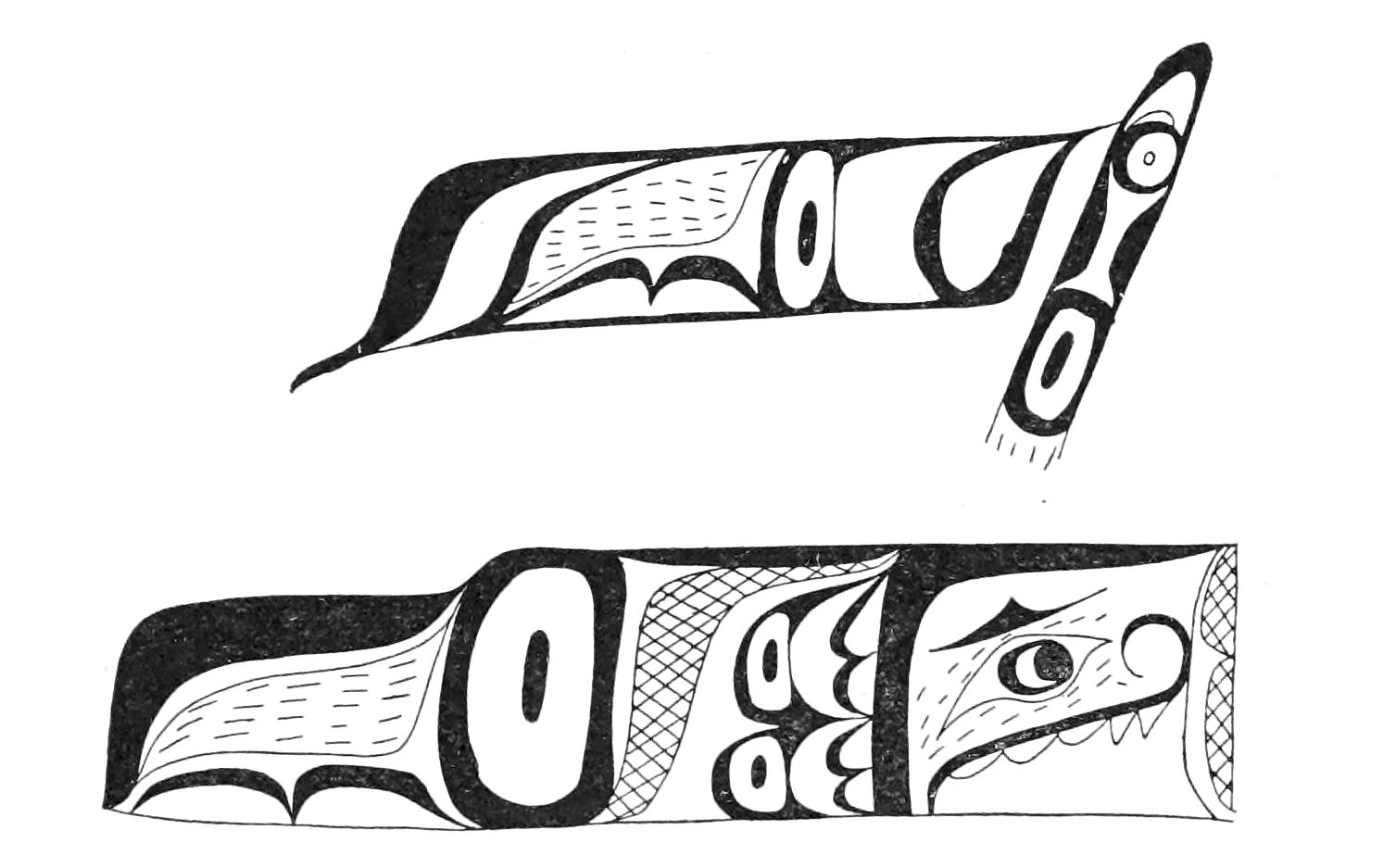
Fig. 194. Styles of wing designs and of fin designs, Kwakiutl; above, fin; below, wing.
The Kwakiutl also claim a definite distinction between the designs representing wing feathers and those representing fins, (fig. 194). The wing feathers should be pointed; the fin, on the other hand, has no point and is cut off square.
In figs. 195 and 196 are represented the characteristic elements of the halibut and of the wolf. These elements are supposed to be used by the Kwakiutl in the representation of these animals, selected according to the requirements of the decorative field. In the figures here reproduced they are given without any reference to the decorative field. Fig. 195 represents the halibut; (1) the mouth and over it the nose, (2) the eyes, (3) the bone of the top of the head and (4) the side of the head. In (5) are shown the gills; (6) and (8) represent the intestinal tract, and (7) is the part of the intestinal tract just under the neck; (9) is the collar bone, (10) the lateral fin, the bones of which are shown in (11). (12) is the clotted blood that is found in the dead halibut under the vertebral column; (13) represents the joint of the tail, (14) part of the bone in the tail, and (15) the tip of the tail.
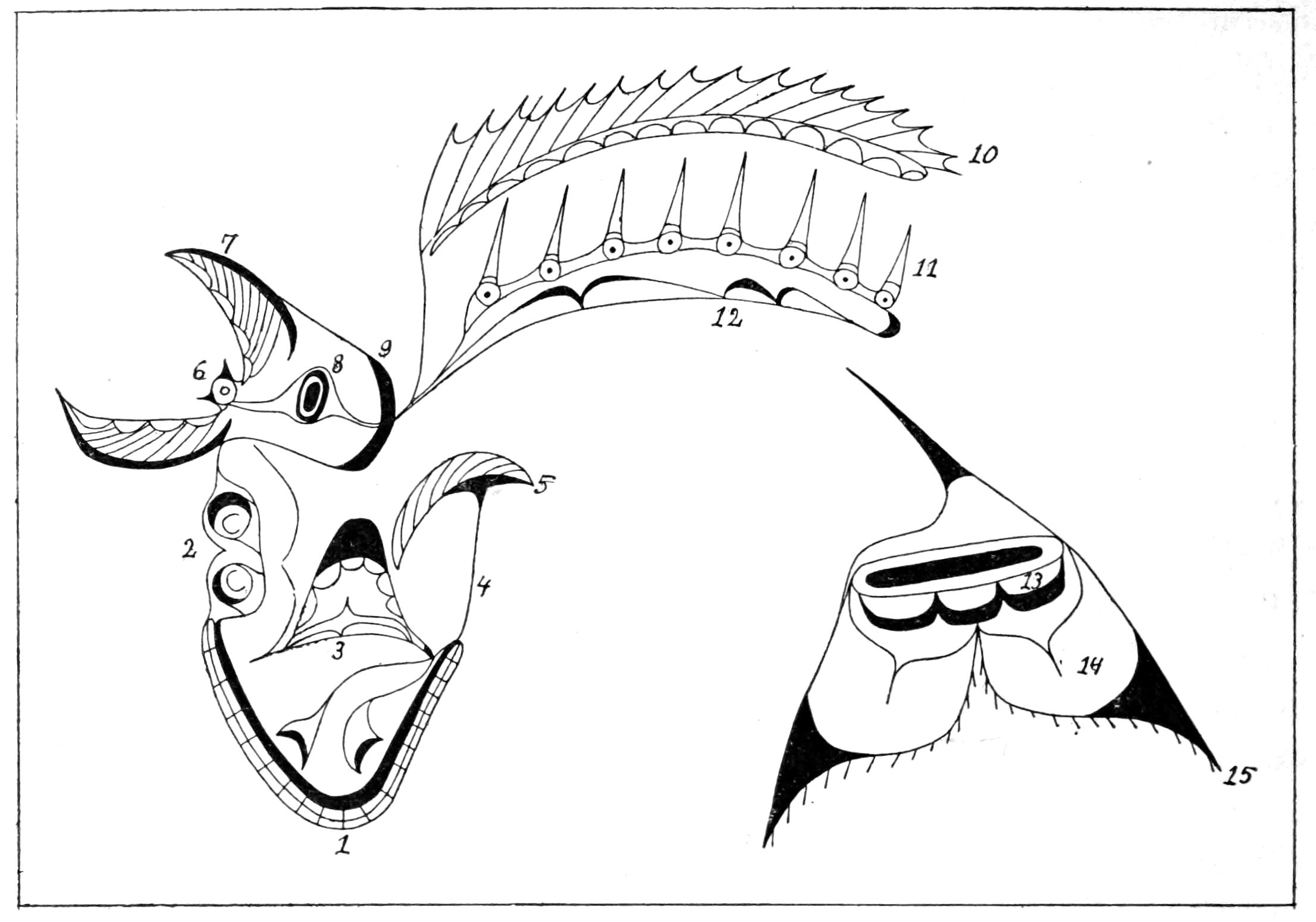
Fig. 195. Elements used in representing the halibut, Kwakiutl.
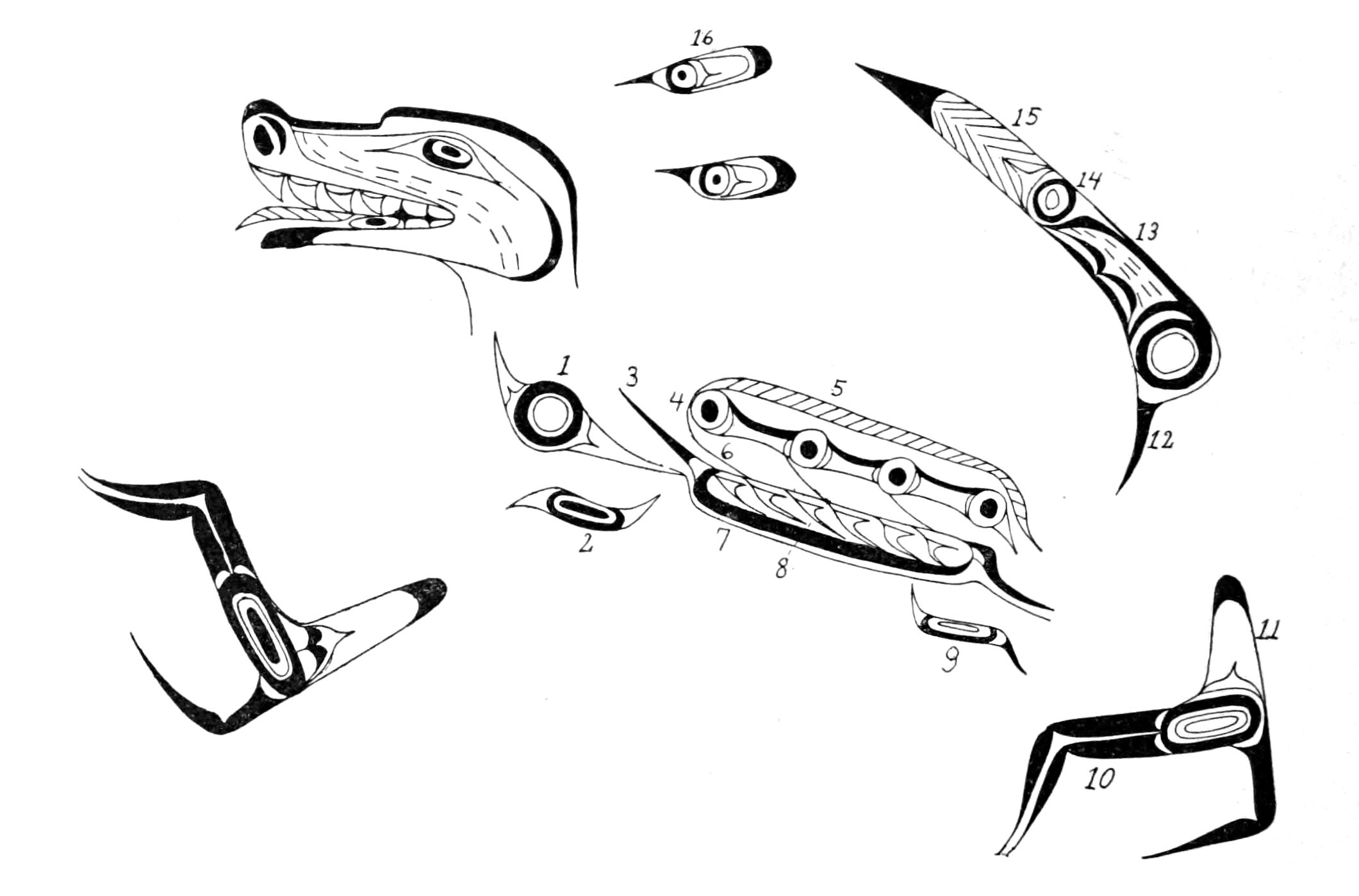
Fig. 196. Elements used in representing the wolf, Kwakiutl.
Fig. 196 represents, in the same way, the wolf. The head with the elevated nose is easily recognized. (1) represents the throat. (2) The humerus connected with the forearm is shown in the lower left hand side of the pattern; (3) represents the collarbone, the four circles (4) the backbone, (5) the back with hair. The three thin slanting lines (6) are the ribs, (7) the sternum and the hooks over it the intestinal tract, (9) is the hind leg, corresponding to (2), (10) the toes, (11) the foot, (12) connects the backbone with the tail. The thin lines (13) represent the hair of the tail, (14) is supposed to be a second joint in the tail, (15) the hairy tail, and (16) the ears.
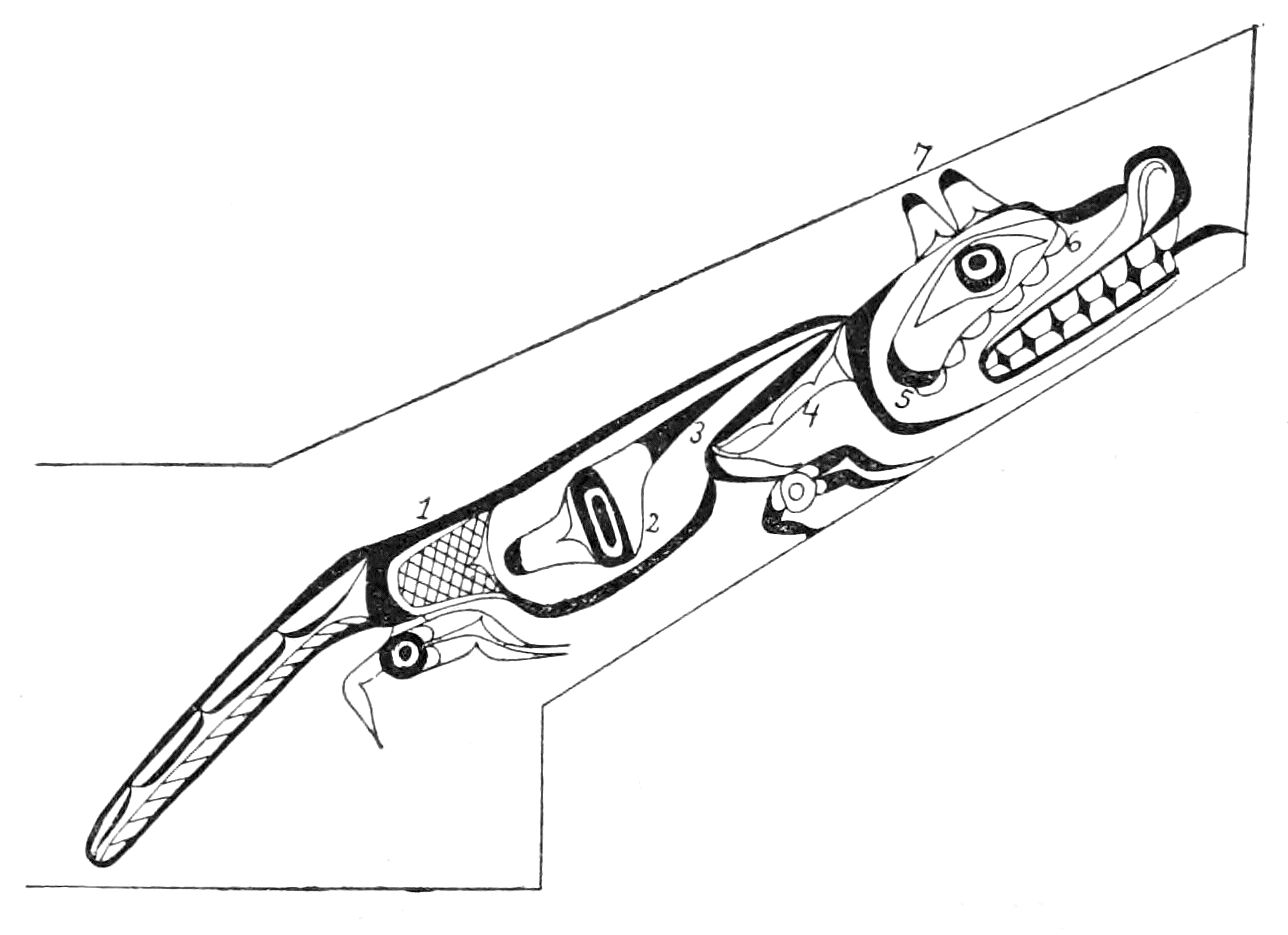
Fig. 197. Painting from bow of a canoe, representing the wolf.
Fig. 197 represents the wolf, a painting from the bow of a canoe. Here again the elevated nose of the wolf will be recognized. The hachure (1) represents the pelvis, (2) and (3) the intestinal tract, (4) the humerus, (5) the cheek, (6) the facial bones, and (7) the ear.
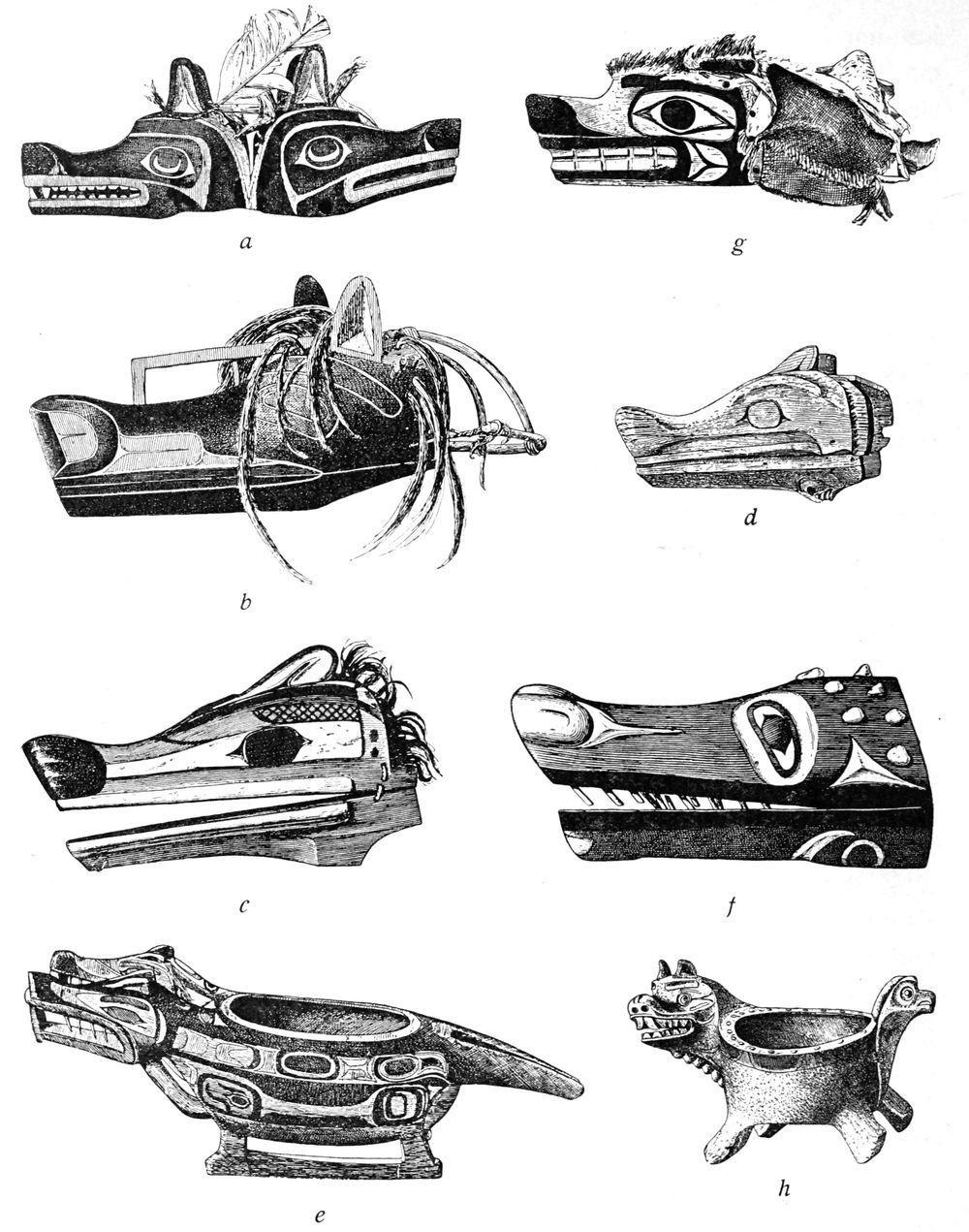
Fig. 198. Masks and dishes representing the wolf, Kwakiutl.
An examination of carved and painted specimens shows clearly that this description of symbols is theoretical rather than rigidly normative, for in many cases considerable freedom in their use may be observed. An example of this kind is presented by the wolf masks used by the Kwakiutl in the dance “Brought-Down-From-Above”[111] (fig. 198). Most of these have the slanting eye and pointed ears. In one specimen, however, the ear is pointed forward. The snout slants backward, the nose is high. The identity of treatment of the specimen shown in figs. d and f is interesting. The former was collected by Captain Adrian Jacobsen, 1884, and the latter by Captain Cook more than a hundred years earlier. The double mask, fig. a, resembles them in general shape, but the eye is treated quite differently and the ear, while narrow, is not pointed and the backward slant of the snout is not sufficiently pronounced. The double-headed wolf dish (e), has small reclining ears and long eyes. The ears of figs. c, d, e, are small and recline, but the eye of c and d is rounded.
The forms of animals used by the northern tribes vary considerably also. It is not safe to base our arguments on models or on objects made for the trade. I shall use, therefore, exclusively, older specimens which have been in use.
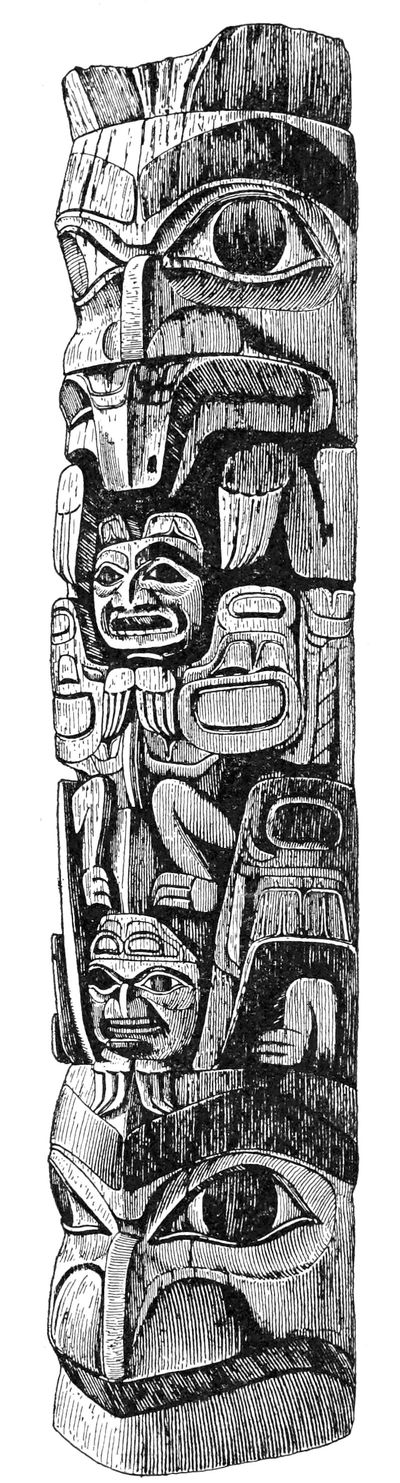
Fig. 199. House post, Haida.
Swanton[112] gives two interpretations of the Haida house post fig. 199. He had two informants; both explained the top figure as an eagle but they differed as to the meaning of the rest. The one claimed that the lower part of the pole represented the story of a woman being carried away by a killer-whale. The woman’s face shows just below the eagle’s beak, and the whale’s blow-hole is represented by a small face above the face of the killer-whale. The second informant, however, explained the large face at the bottom as that of a grizzly bear, presumably meaning thereby, the sea grizzly bear; and the small figure over it as the “sea ghost” which usually rides upon its back. The woman’s face he left unexplained. From an objective point of view, the face at the base of the pole appears as a grizzly bear’s face. Attached to it on each side are the ears and above these, the flippers. Just under the talons of the eagle is found the inverted tail of a fish or aquatic mammal, which presumably belongs to the figure at the bottom, although it seems rather small. It seems doubtful whether the upper face, to which belong the two hands just under it and the legs, in squatting position below the tail, is that of a woman because there ought to be a large labret in the lower lip. Furthermore, the face has animal ears so that it does not seem likely that the intention of the artist was to represent a woman.
It is true that in some other cases in which this same story is represented,[113] the person sitting on the back of the killer-whale has no labret, while in other cases it is shown. Obviously in this case the symbolism is not clear enough to enable an Indian who does not know the artist or who does not know the meaning of the carving, to interpret it correctly.
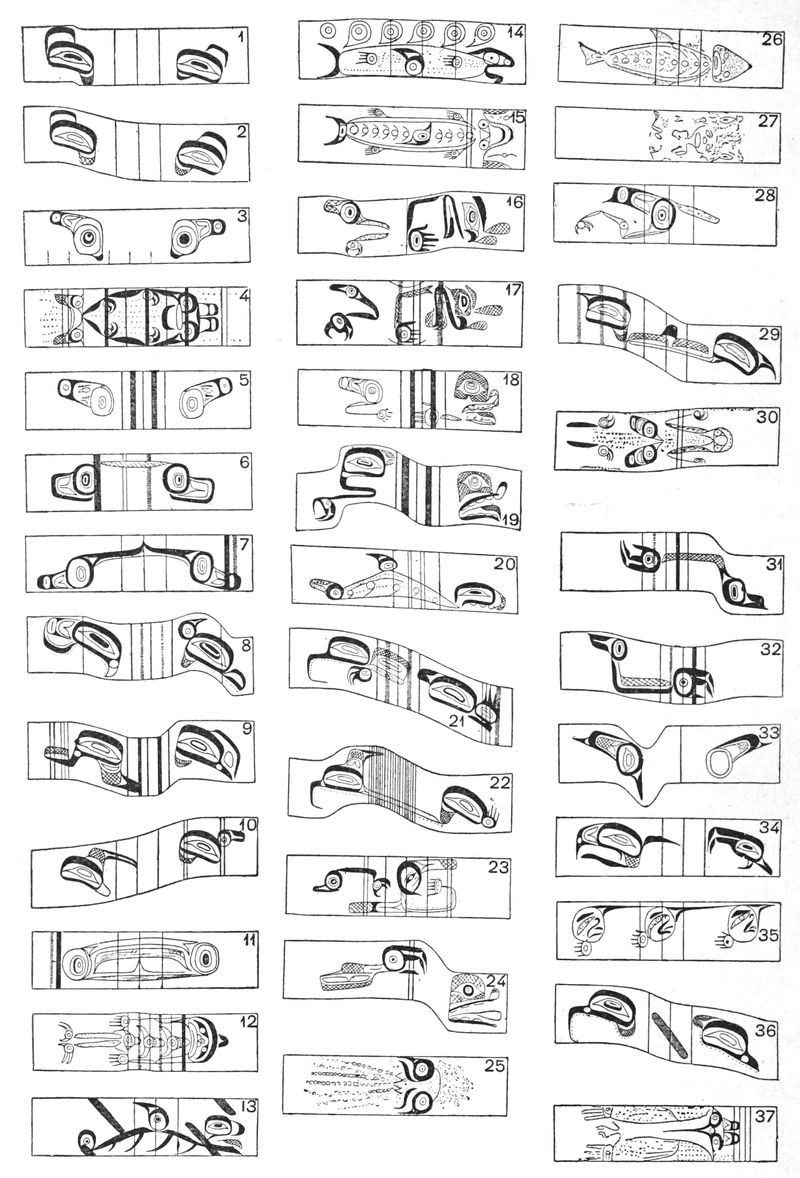
Fig. 200. Designs from a set of gambling sticks.
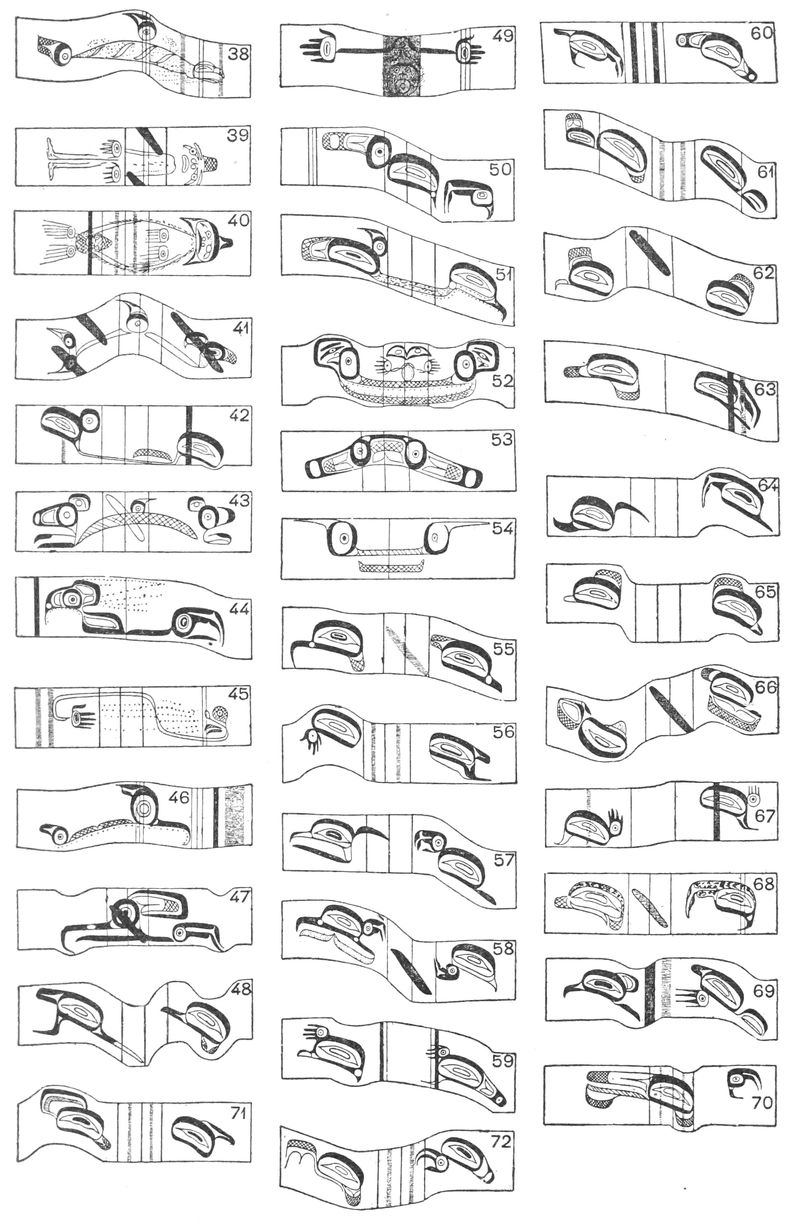
Fig. 201. Designs from a set of gambling sticks.
The uncertainty of interpretation becomes the greater the more fragmentary the figure. A set of gambling sticks which in 1897 I submitted to the best carver and painter (Charles Edensaw) among the Haida, could not be satisfactorily interpreted by him (figs. 200, 201). For example: Number 35 he recognized as a series of three dorsal fins without being able to tell to what animal they belonged. Number 36 he explained as a shoulder on the right, and a tail on the left, but he was unable to identify the particular animal. Number 37 he explained, hesitatingly, as a mosquito. For the following group he felt quite unable to give any satisfactory explanation.
The uncertainty of explanation appears particularly clearly in the interpretation of Chilkat blankets. I give here a few examples according to Lieutenant George T. Emmons.[114]
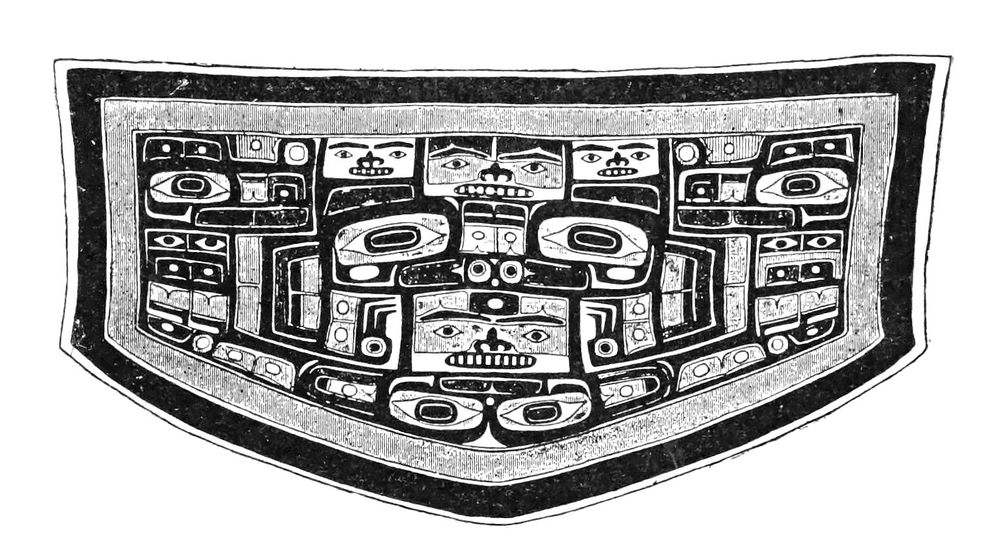
Fig. 202. Chilkat blanket.
The blanket shown in fig. 202 represents a bear with young. The large central figure represents the male bear; the two inverted eyes in the middle of the lower border, with the adjoining elongated designs with round tips, the hind quarters of the bear and the legs; the three heads in the middle of the upper margin, the female and the young bears. The central head in the middle of the upper margin was also explained as the forehead of the bear. The lateral panels represent each a young bear. The design along the lower border of the lateral panel is the freshwater stream on which the bear lives. According to John R. Swanton the blanket represents the sea grizzly bear. The explanation of the principal parts is the same as that given by Lieutenant Emmons, except that the three heads in the middle along the upper border were explained, the middle one as the top of the head, the lateral ones as ears. The wing designs which extend sideways from the border, cutting into the middle parts of the lateral panels, were explained as part of the forelegs, representing, probably, the fins which are believed to be attached to the arms of the sea grizzly bear. The two inverted eyes in the lower border, with the ornaments attached to the right and left of the eyes, were said to represent the hind legs.
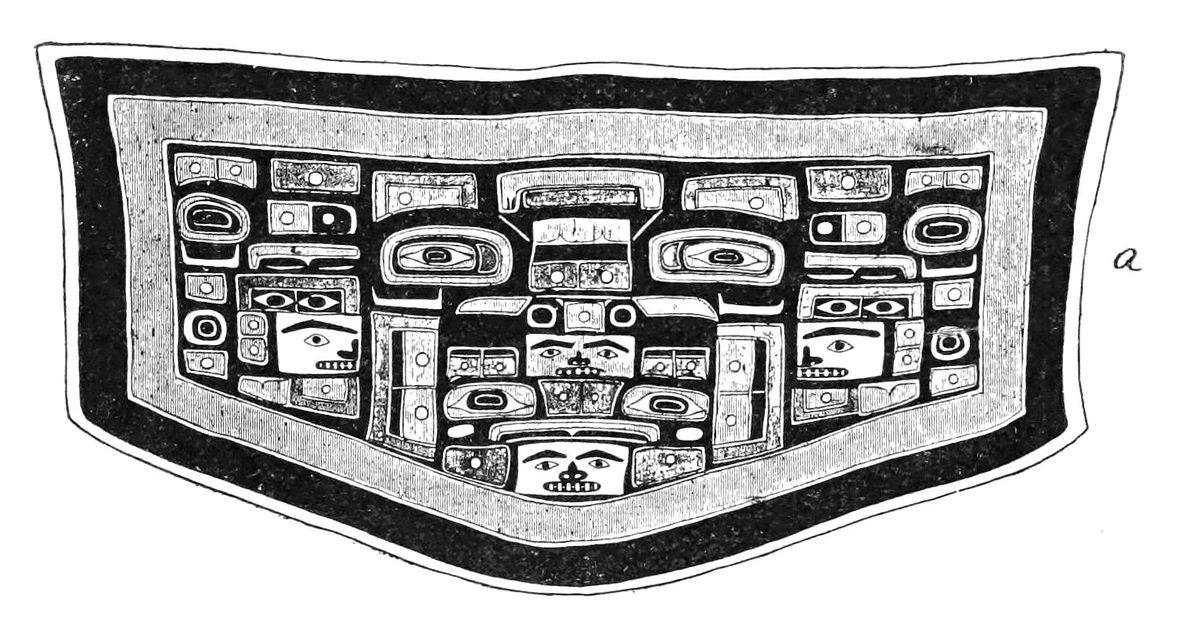
Fig. 203. Chilkat blanket.
The blanket shown in figure 203 represents, according to Emmons, a female wolf and young. The body of the wolf is given the form of a hawk; the two eyes and the wing designs between them, near the lower border of the blanket, being the face of the hawk. The double feather design over these eyes represents the hawk’s ears. The face in the center of the lower border of the blanket represents the body, the wing feather designs extending downward under the corners of the jaws of the wolf, the wings of the hawk. In the lateral panels the young wolf is shown sitting up. These designs represent probably at the same time, the sides and back of the wolf’s body. According to Swanton the blanket represents a young raven. The body of the raven is occupied by two profiles of ravens, represented by the two large eyes near the lower border of the blanket. The face in the centre of the lower border is the raven’s tail. The lateral wing designs extending downward from under the corners of the jaws of the large head, are the wings of the raven. The lateral panels represent two young ravens in profile.
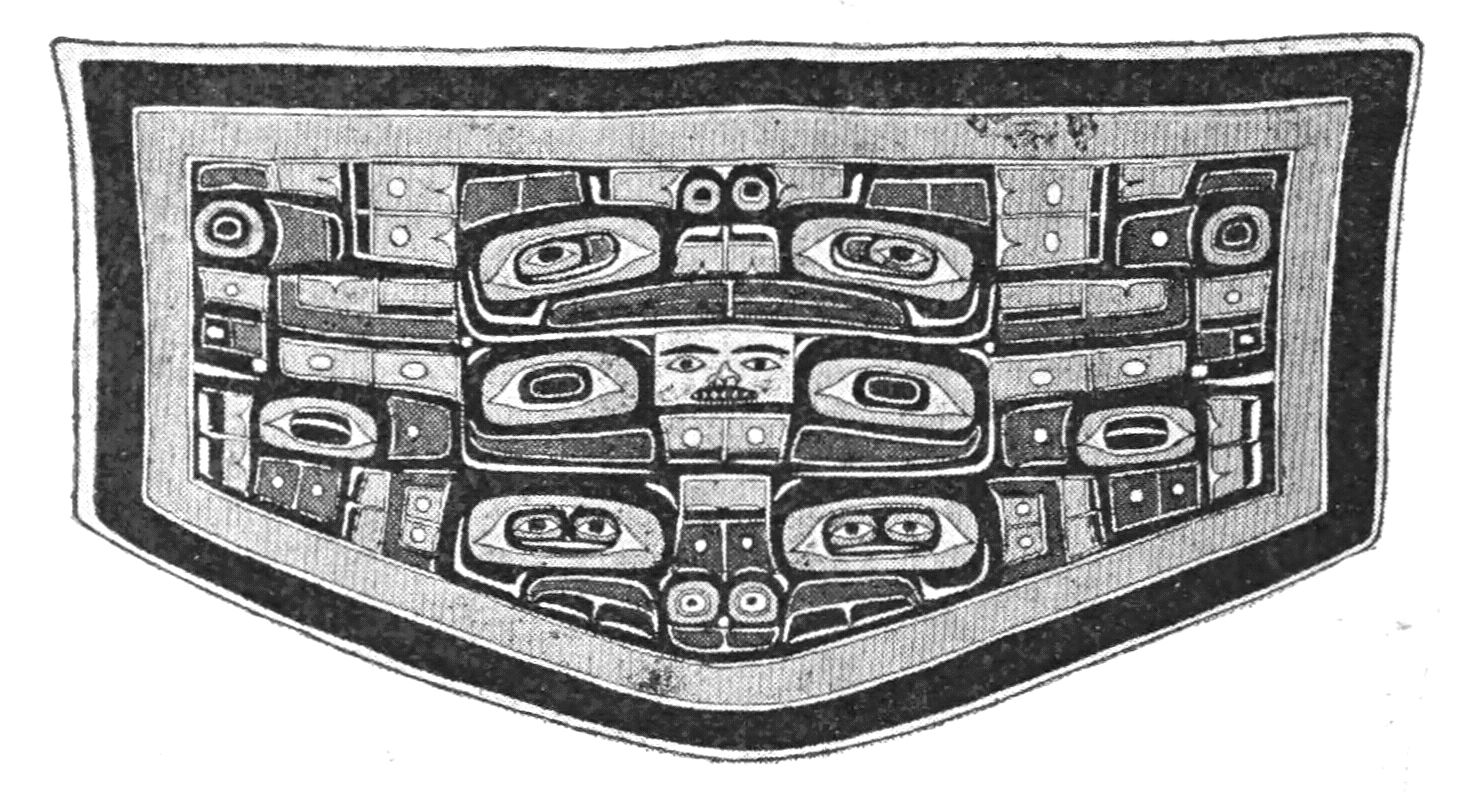
Fig. 204. Chilkat blanket.
The blanket shown in fig. 204 shows, according to Emmons, on top, a brown bear sitting up. On the body of the bear is a raven’s head. The hind-quarters are treated like a whale’s head. The eyes being at the same time the hip joints, the mouth the feet of the bear. He was given another explanation: the principal figure being explained as a whale, the head of which is below. The body, which is turned up, is treated as a raven’s head, and the tail as a bear’s head. The side panels are the sides and the back of these animals, but represent at the same time, an eagle in profile on top, and a raven in profile below. According to Swanton the design represents a halibut. The head is below. The whole large middle face represents the body; and the large face nearer the upper border, the tail. The wing designs in the lateral panels, next to the lowest head, are the small pectoral fins and the rest of the lateral fields, the continuous border fin.
The blanket in Fig. 103 (p. 108) represents, according to Emmons, a diving whale and the lateral fields a raven sitting. The head, with nostrils and mouth, is shown below. The central face represents the body. The eyes near the upper border are the flukes of the tail. The face designs at the sides of the body represent the fins. In the lateral panels is shown a raven sitting. According to Swanton the same blanket represents a wolf with young. The head is shown below. The hind legs and hip joints are represented by two large eyes and the adjoining ornaments along the upper border, the two dark segments just over the eye, being the feet. The face in the middle of the design represents, as usual, the body of the animal. The small eye design, with adjoining ear and wing feather designs, in the middle on each side of the body, are interpreted as foreleg and foot. The lateral panels are explained as representing each a young wolf sitting.
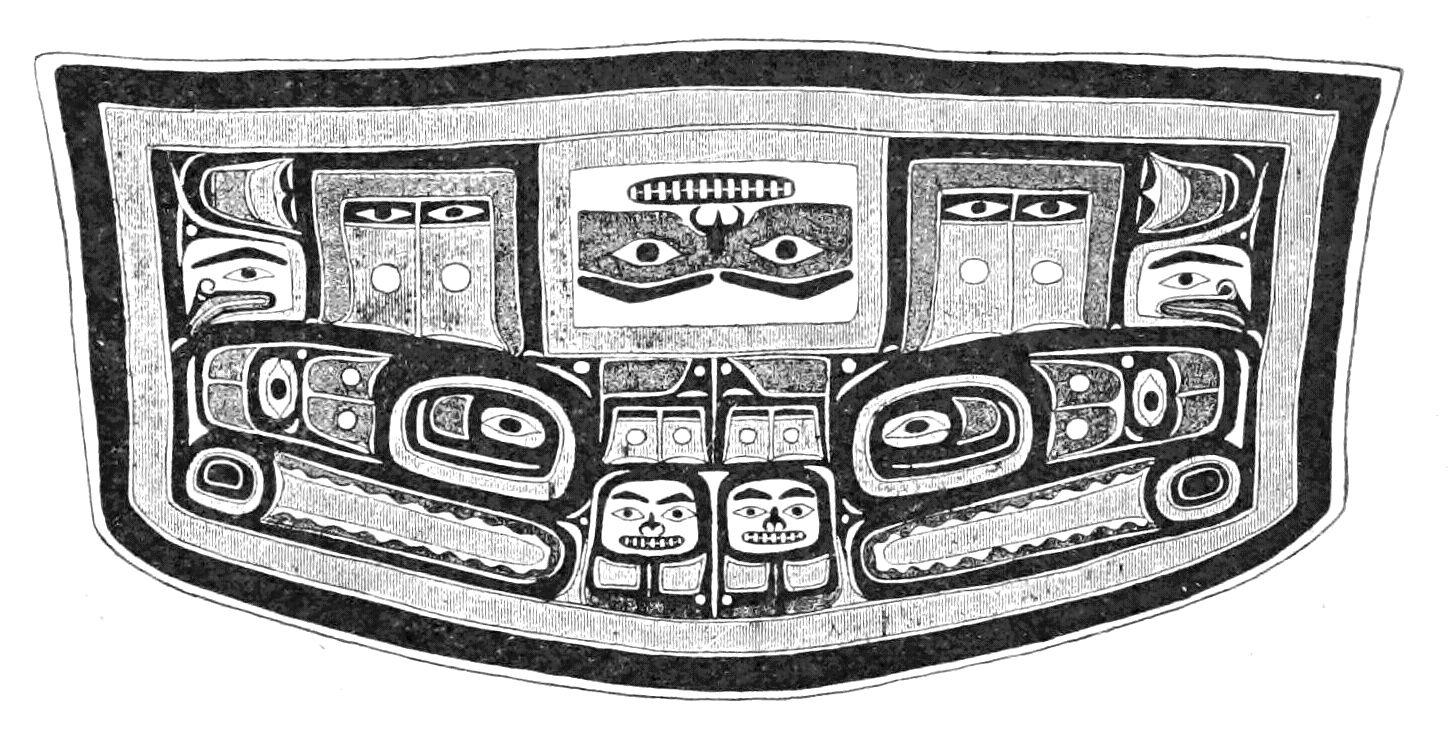
Fig. 205. Chilkat blanket.
There are also considerable discrepancies in the explanation of the blanket shown in fig. 205. According to Emmons it represents a killer-whale. In each lower corner is one half of the head with teeth; right in front of the teeth, the nostril; between the two halves of the head, in the lower border of the blanket, the tail. The inverted face in the middle of the upper border, represents the body. The large square designs containing the goggle design, on each side, are interpreted as water blown out from the blow-hole. One half of the dorsal fin is indicated by a small round wing feather design in each upper corner, the human face in profile under it, representing one half of the blow-hole. According to Swanton a spirit of the sea is represented. One half of the head is shown in each lower corner, the eye design in front of the tongue being interpreted as chin. The two faces in the middle of the lower border are explained as the young ones of this sea spirit; the flicker-feather designs over them, as the inner part of the body of the old animal; the inverted large face in the middle of the upper border, as its hat; the large square designs on each side of this face, containing the goggle designs, as the dorsal fin; the two human faces in profile near the upper corners, the young ones whose bodies are shown by the round feather design over the face. Still another explanation of the same pattern was given to me. In each lower corner is shown one half of the head of a killer-whale. Its food is represented by the eye design in front of the mouth. The tail is below in the middle; the two halves of the dorsal fin are just over the tail; the inverted face in the middle of the upper border is the chest; the adjoining square designs and the attached round feather design are the flippers. Accordingly the profile faces near the upper, outer corners should be the blow-holes.
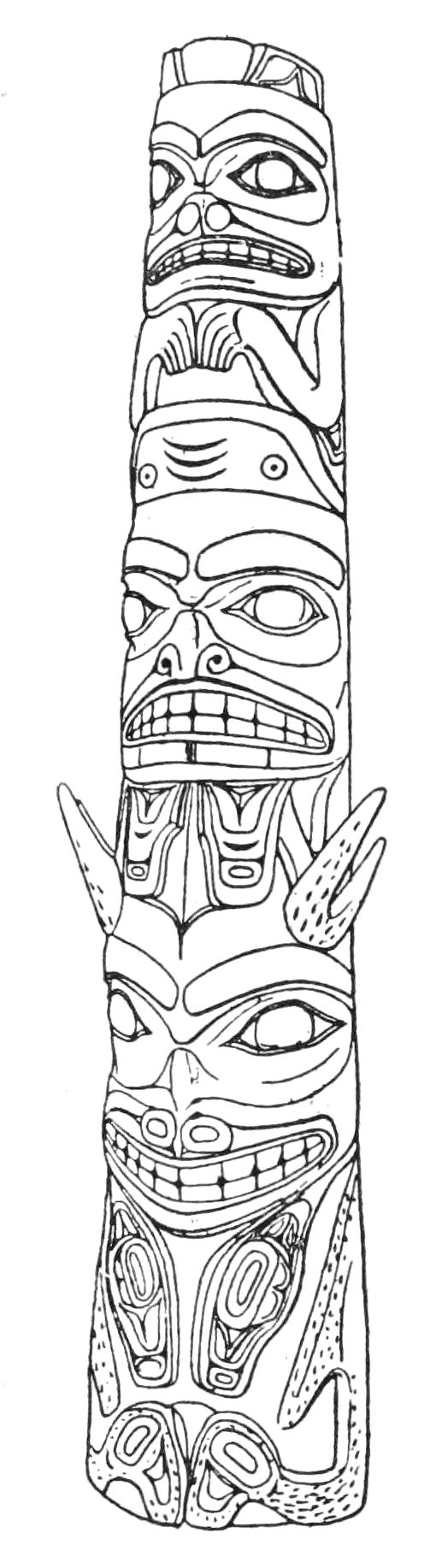
Fig. 206. Model of totem pole with three figures representing, from below upward; sculpin, dog-fish, and sea-monster; Haida.
These examples show clearly that there is ample room for the fancy of the interpreter. The symbols lend themselves to various explanations, which are presumably selected in accordance with totemic affiliations of the owner. Not all of them seem quite consistent with the best northwest coast usage; for instance, Swanton’s explanation of the last named blanket seems doubtful on account of the inverted position of the hat and the explanation of a single wing design as a body.
So far I have considered the symbols only in connection with their use in representing various animals. It now becomes necessary to inquire in what manner they are used to identify the animals. We have seen that in a number of the preceding cases entire animals were represented, and that they were identified by means of these symbols. However, the artist is allowed wide latitude in the selection of the form of the animal. Whatever its form may be, as long as the recognized symbols are present, its identity is established. We have mentioned before that the symbols are often applied to human faces, while the body of the figure has the characteristics of the animal.
We find this principle applied on the totem pole, fig. 206. Each of the three animals represented has a human face, to which are added characteristic symbols. In the top figure the ears indicate an animal; the arms, to which flippers are attached, the sea-monster (see fig. 183). The next figure below represents the shark. Originally a large lip with a labret was attached to it. This would indicate that a female shark is represented. Its symbols are the peculiar high snout which rises over its forehead, and the fins, which are placed under the chin. The body of the lowest figure which is shown under the face represents a fish; and the two large spines which rise over the eyebrows specify the sculpin.
In many cases the bodies of the animals are not represented and the essential symbols are applied to a purely human face. This style is found on masks and in facial paintings.
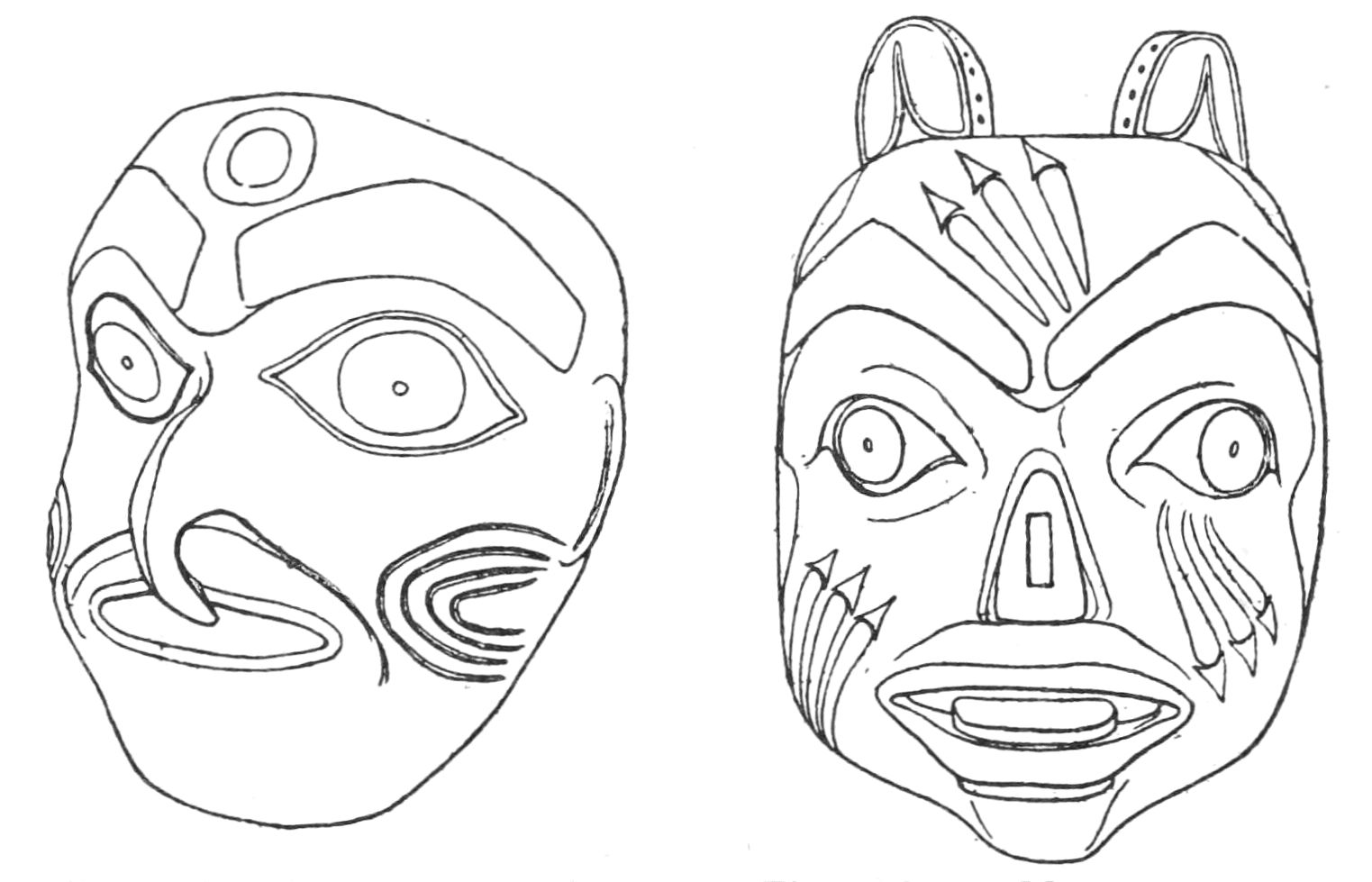
Fig. 207. Mask representing the hawk, Tlingit. Fig. 208. Mask with painting symbolizing the flicker, Tlingit.
Fig. 207 has a human face with human ears. Only the nose indicates that the mask is not intended to represent a human being. It is strongly curved, and drawn back into the mouth, thus symbolizing the hawk.
In fig. 208 we see the face of a woman with a moderately large labret. The ears, as explained before, are those of an animal. The nose, which has been lost, had undoubtedly the form of a bird’s beak. Thus the face was characterized as that of a bird. It was specified partly by the form of the beak, but principally by the ornaments painted in red and black on the cheeks and forehead. These represent the feathers of the red-winged flicker.
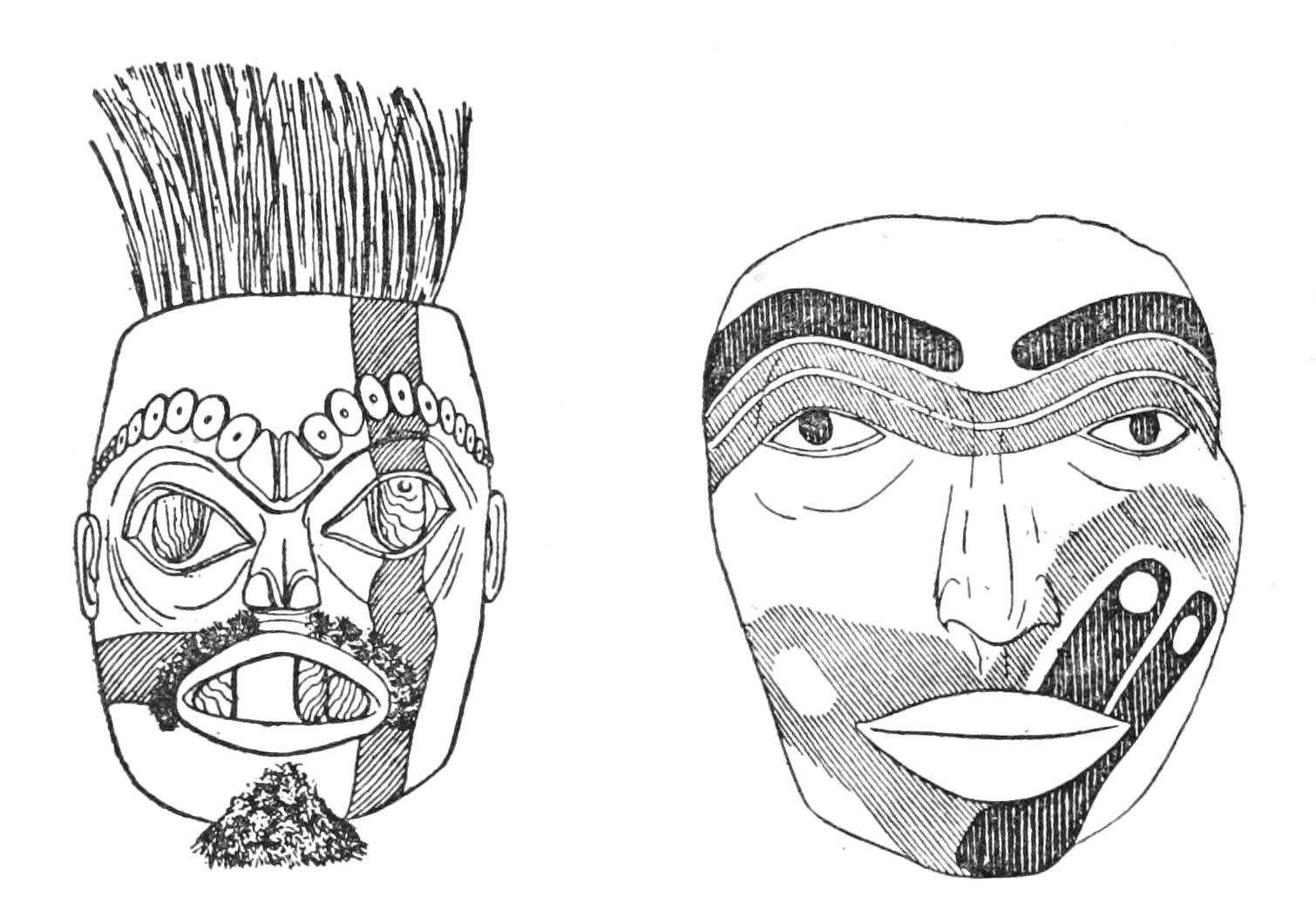
Fig. 209. Mask with eyebrows symbolizing the squid, Tlingit. Fig. 210. Mask with painting symbolizing the killer-whale, Tlingit.
A small mask representing a human face (fig. 209) has, in place of the eyebrows, two rows of circles, the sucking-cups of the squid. By means of this symbol the face is recognized as that of the squid.
In the same manner the mask fig. 210 is identified as the killer-whale by the two black ornaments painted on the left cheek and extending down to the chin. They represent the dorsal fin of the killer-whale.
These symbols are also used as facial paintings and body paintings by dancers, who are thus recognized as personifying the animal in question, or as belonging to the social group with which the animals are associated (see figs. 264, 265, pp. 250, 251). Sometimes these symbols are attached to the garments. To this class belongs the ornament (fig. 212), which represents the dorsal fin of a killer-whale and which is worn attached to the back part of the blanket.
Having thus become acquainted with a few of the symbols of animals, we will next investigate in what manner the native artist adapts the animal form to the object he intends to decorate. First of all, we will direct our attention to a series of specimens which show that he endeavors, whenever possible, to represent the whole animal on the object that he desires to decorate.
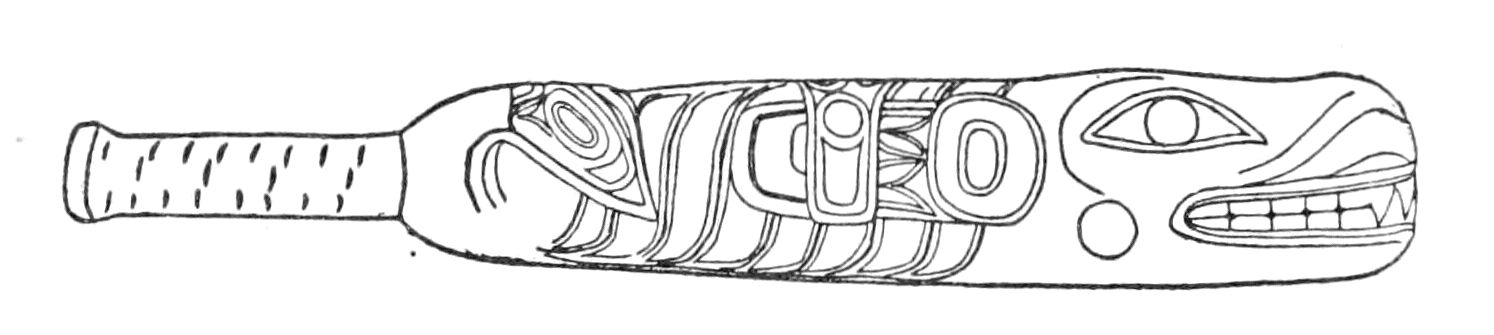
Fig. 211. Wood carving representing the killer-whale, Tlingit.
Fig. 211 is a club used for killing seals and halibut before they are landed in the canoe. The carving represents the killer-whale. The dorsal fin, the principal symbol of the killer-whale, cannot be omitted. If placed in an upright position on the club, the implement would assume an awkward shape. Therefore the artist bent it down along the side of the body, so that it covers the flipper. The tail of the whale would have interfered with the handle, and has been turned forward and lies flat over the back.
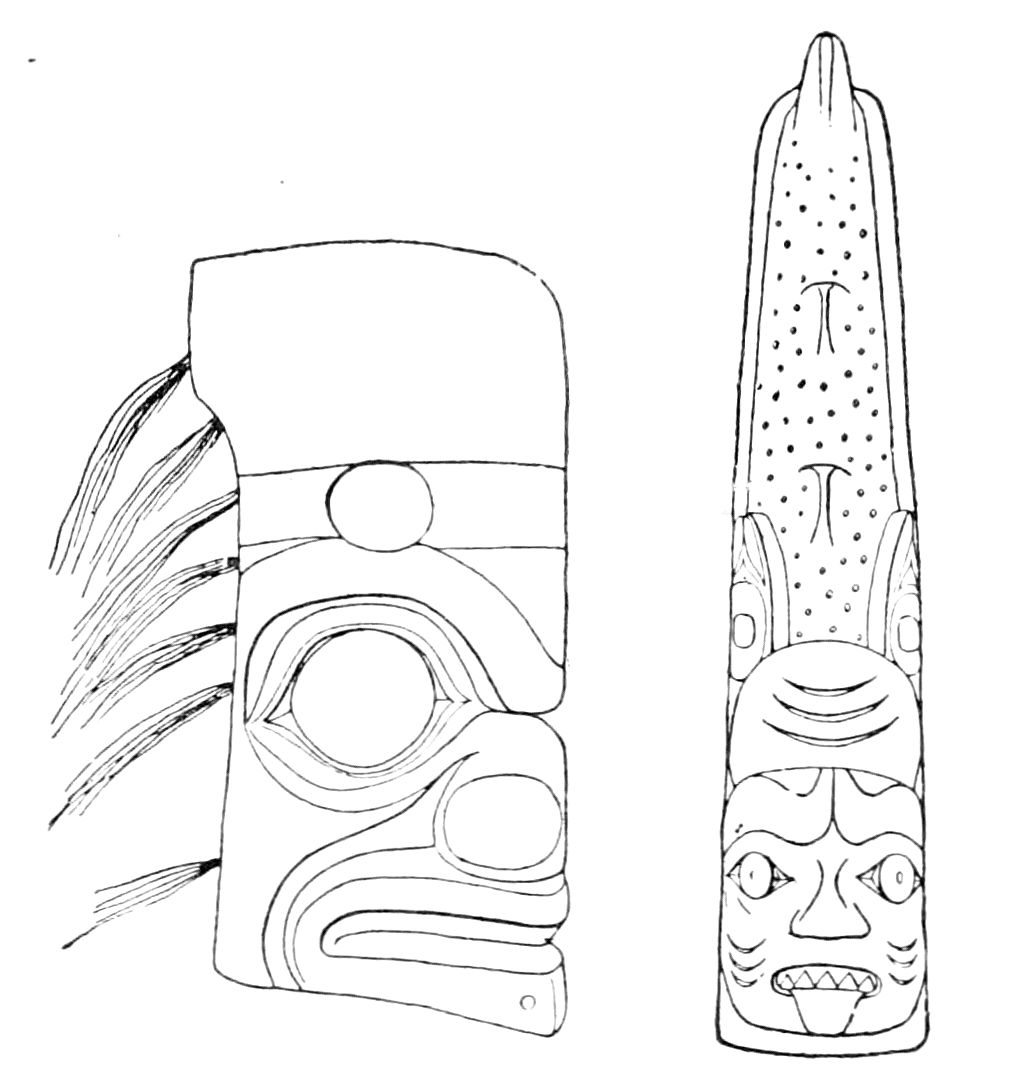
Fig. 212. Wood carving representing dorsal fin of the killer-whale, Tlingit. Fig. 213. Model of a totem pole representing a shark, Haida.
The distortion of the body has been carried still further in the handle of a spoon (fig. 176 a, p. 195) which represents the same animal. The large head of the whale, to which the flippers are attached is near the bowl of the spoon. The body has been twisted backward so that it is completely doubled up. Therefore, the surface pattern of the tail is carved on the back of the spoon, and the two projections just below the mouth are the two tips of the whale’s tail. The dorsal fin extends upward from the head of the whale, between the legs of the man who forms the tip of the handle.

Fig. 214. Speaker’s staff representing a shark, Tlingit.
Fig. 213 is a small totem pole representing the shark. The tip of its tail forms the top of the pole, while the face is placed at its lower end. Since most of the symbols of the shark are found on its face, it was necessary to bring the face into such a position as to be seen in front view, but the artist also desired to show the back of the fish. For this reason the head has been twisted around entirely, so that it appears in front view over the back of the fish. The flippers are made visible by having been pushed backward far beyond the place to which they properly belong.
The speaker’s staff (fig. 214), which also represents the shark, has been distorted in the same manner; but here the head has been turned round entirely, so that it faces the back of the fish. The pectoral fins are shown below the chin.
On the berry spoon (fig. 215) is an eagle whose head which is turned back completely. The small wing occupies the field under the head. The upper margin with geometrical decoration represents the body under which the hip joint, leg and feet are shown.
The changes of position and of the relative sizes of parts of the body, which result from such adaptations to the form of the object to be decorated, are still more far-reaching in the following specimens.

Fig. 215. Berry Spoon with design representing the eagle. Fig. 216. Halibut hook representing a beaver, Tlingit.
On a halibut hook (fig. 216) carved with a design of the beaver, the two incisors, the symbols of the beaver, have been moved to the same side of the mouth. In reality only one of the incisors is visible in profile, but being important symbols, both are shown.
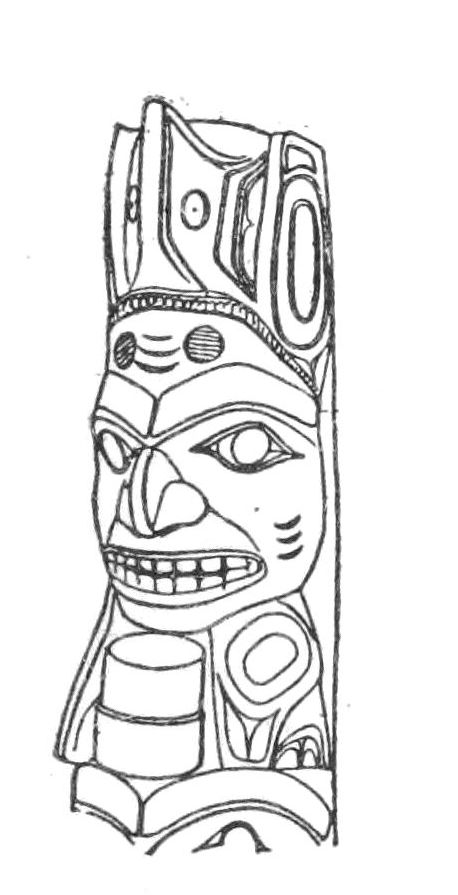
Fig. 217. Part of totem pole representing a shark, Haida.
Fig. 217 is a shark represented on the top of a totem pole. The head of the animal is shown in the form of a human face with the characteristic symbols. Under the chin are two flippers. The body must be considered turned upward; but it has been shortened so much that only the tail remains, which rises immediately above the face.
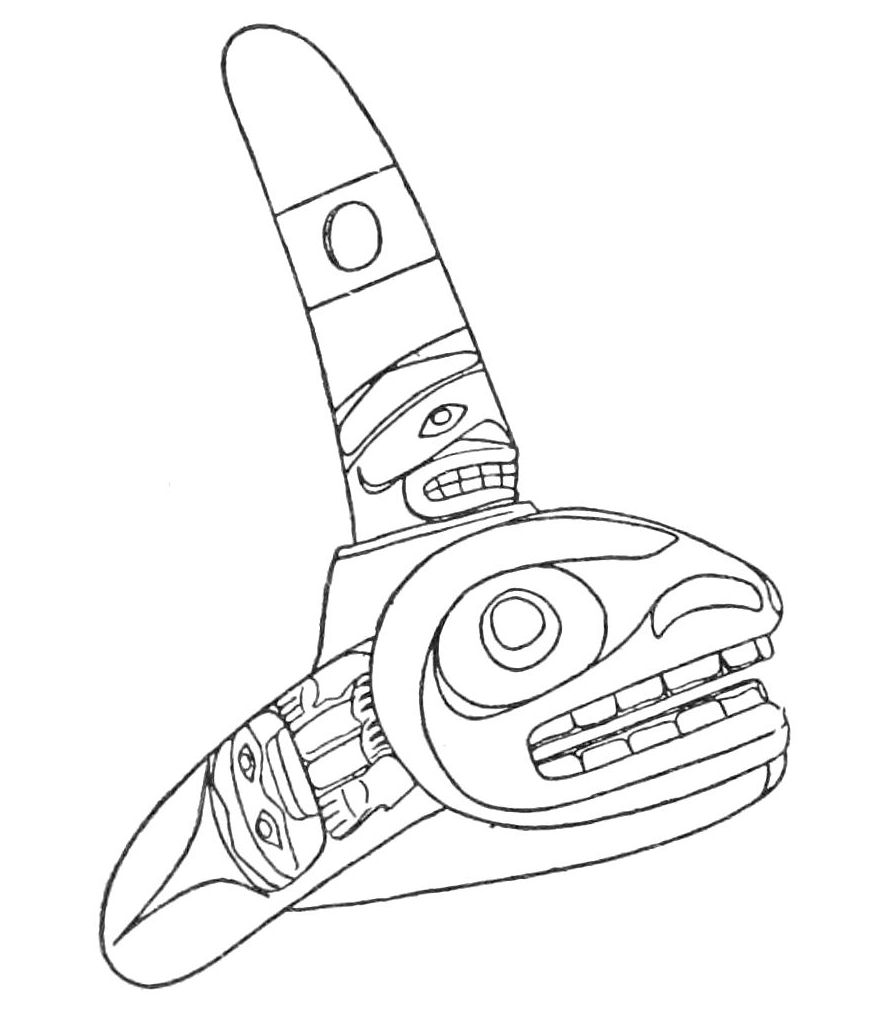
Fig. 218. Dancing-hat representing a killer-whale, Tsimshian.
On a wooden dancing-hat (fig. 218) the symbols of the killer-whale are attached to its head. Since the whole body has been omitted, the dorsal fin, the essential symbol, has been moved from the back to the head, and the flippers are attached to the head behind the eyebrows.
In all these cases the artist has taken great liberties with the form of the animal body, and has treated it so that the symbols become clearly visible. On the whole, he endeavors to represent the whole animal. When this is not possible, all its essential parts are shown. The insignificant parts are often omitted.
Far-reaching distortions result from the adjustment of the animal body to the decorative field and from the necessity of preserving its symbols.
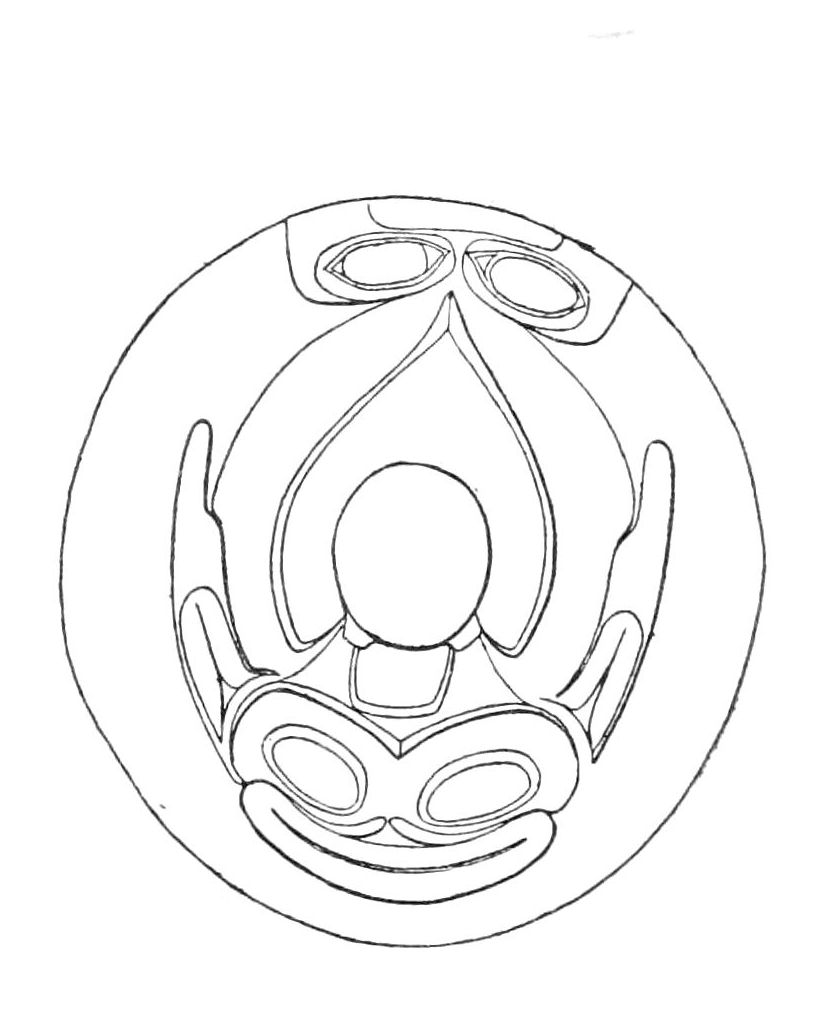
Fig. 219. Wooden hat with carving representing the sculpin.
Fig. 219 is the top view of a wooden hat on which is carved the figure of a sculpin. The animal is shown in top view, as though it were lying with its lower side on the hat. The dancing-hats of these Indians have the forms of truncated cones. To the top are attached a series of rings, mostly made of basketry, which indicate the social rank of the owner, each ring symbolizing a step in the social ladder. The top of the hat, therefore, does not belong to the decorative field, which is confined to the surface of the cone. The artist found it necessary, therefore, to open the back of the sculpin far enough to make room for the gap in the decorative field. He has done so by representing the animal as seen from the top, but split and distended in the middle, so that the top of the hat is located in the opening thus secured.
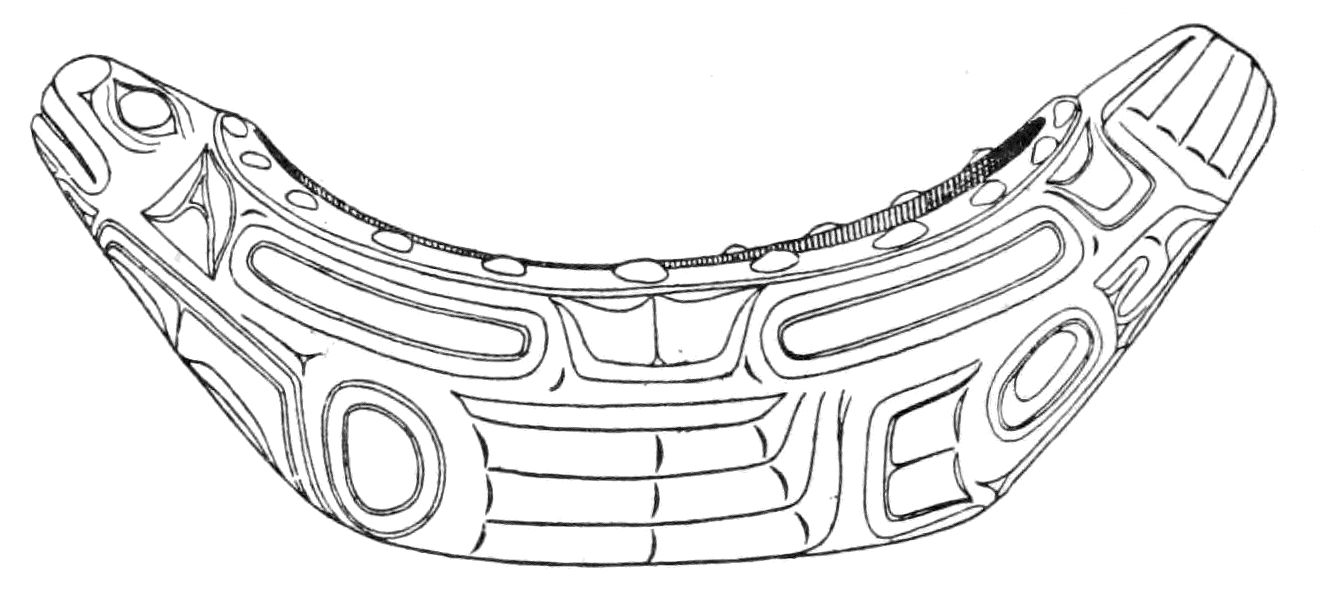
Fig. 220. Grease dish representing seal.
Fig. 220 represents a dish in the shape of a seal. The whole dish is carved in the form of the animal; but the bottom, which corresponds to the belly, is flattened, and the back is hollowed out so as to form the bowl of the dish. In order to gain a wider rim the whole back has been distended so that the animal becomes inordinately wide as compared to its length. The flippers are carved in their proper positions at the sides of the dish. The hind flippers are turned back, and join the tail closely. A similar method of representation is used in decorating small boxes. The whole box is considered as representing an animal. The front of the body is painted or carved on the box front; its sides, on the sides of the box; the hind side of the body, on the back of the box (see figs. 282 et seq., p. 270). The bottom of the box is the animal’s stomach; the top, or the open upper side, its back. These boxes are bent of a single piece of wood and are represented here unbent.
In the decoration of silver bracelets a similar principle is followed, but the problem differs somewhat from that offered in the decoration of square boxes. While in the latter case the four edges make a natural division between the four views of the animal,—front and right profile, back and left profile,—there is no such sharp line of division in the round bracelet, and there would be great difficulty in joining the four aspects artistically, two whole profiles offer no such difficulty. This is the method of representation adopted by the native artists (figs. 221; 255-257 p. 245). The animal is imagined cut in two from head to tail, so that the two halves cohere only at the tip of the nose and at the tip of the tail. The hand is put through this hole, and the animal now surrounds the wrist. In this position it is represented on the bracelet. The method adopted is therefore identical with the one applied in the hat (fig. 219), except that the central opening is much larger, and that the animal has been represented on a cylindrical surface, not on a conical one.
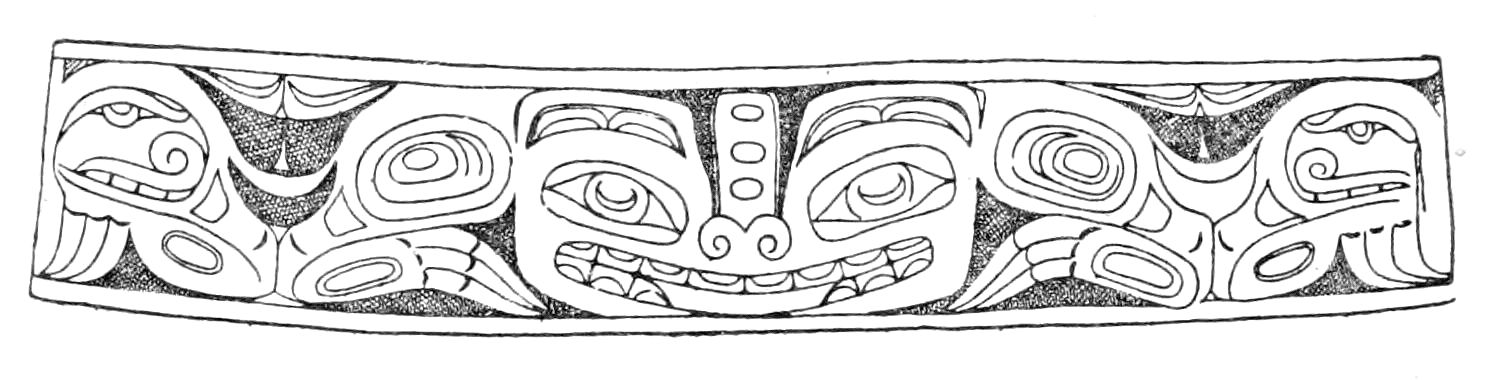
Fig. 221. Design on a bracelet representing a bear, Nass River Indians.
An examination of the head of the bear shown on the bracelet (fig. 221), makes it clear that this idea has been carried out rigidly. It will be noticed that there is a deep depression between the eyes, extending down to the nose. This shows that the head itself must not be considered a front view, but as consisting of two profiles which adjoin at mouth and nose, while they are not in contact with each other on a level with the eyes and forehead. The peculiar ornament rising over the nose of the bear, decorated with three rings, represents a hat with three rings which designate the rank of the bearer.
We have thus recognized that the representations of animals on dishes and bracelets (and we may include the design on the hat, fig. 219) must not be considered as perspective views, but as representing complete animals more or less distorted and split.
The transition from the bracelet to the painting or carving of animals on a flat surface is not a difficult one. The same principle is adhered to; and either the animals are represented as split in two so that the profiles are joined in the middle, or a front view of the head is shown with two adjoining profiles of the body. In the cases considered heretofore the animal was cut through and through from the mouth to the tip of the tail. These points were allowed to cohere, and the animal was stretched over a ring, a cone, or the sides of a prism. If we imagine the bracelet opened, and flattened in the manner in which it is shown in fig. 221, we have a section of the animal from mouth to tail, cohering only at the mouth, and the two halves spread over a flat surface. This is the natural development of the method here described when applied to the decoration of flat surfaces.
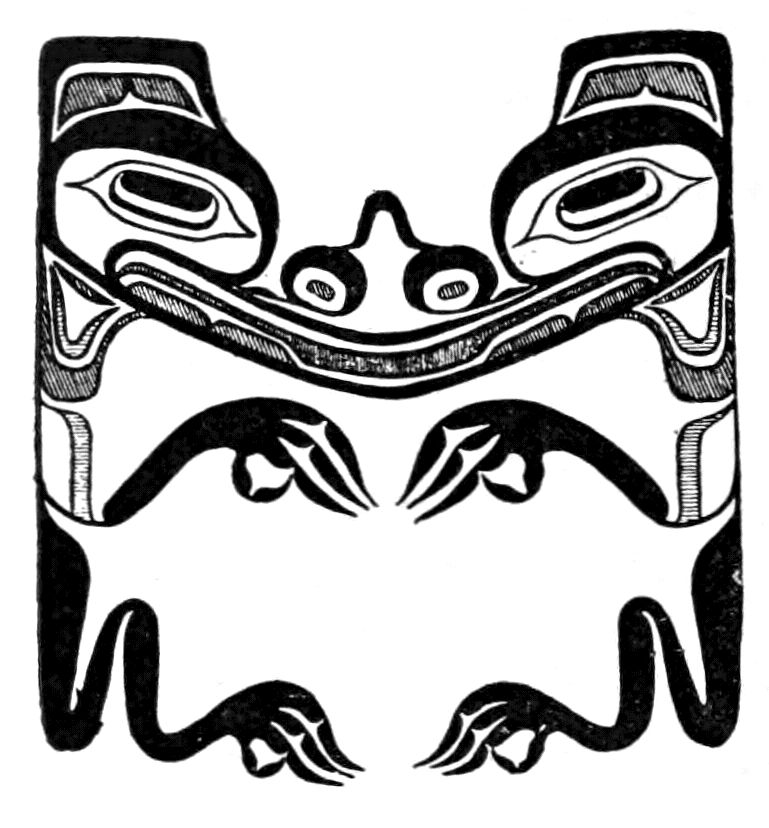
Fig. 222. Painting representing bear, Haida.
It is clear that on flat surfaces this method allows of modifications by changing the method of cutting. When the body of a long animal, such as that of a fish or of a standing quadruped, is cut in this manner, a design results which forms a long narrow strip. This mode of cutting is therefore mostly applied in the decoration of long bands. When the field that is to be decorated is more nearly square, this form is not favorable. In such cases a square design is obtained by cutting quadrupeds sitting on their haunches in the same manner as before, and unfolding the animal so that the two halves remain in contact at the nose and mouth, while the median line at the back is to the extreme right and to the extreme left.
Fig. 222 (a Haida painting) shows a design which has been obtained in this manner. It represents a bear. The enormous breadth of mouth observed in these cases is brought about by the junction of the two profiles of which the head consists.
This cutting of the head is brought out most clearly in the painting fig. 223, which also represents the bear. It is the painting on the front of a Tsimshian house, the circular hole in the middle of the design being the door of the house. The animal is cut from back to front, so that only the front part of the head coheres. The two halves of the lower jaw do not touch each other. The back is represented by the black outline on which the hair is indicated by fine lines. The Tsimshian call such a design “bears meeting”, as though two bears had been represented.
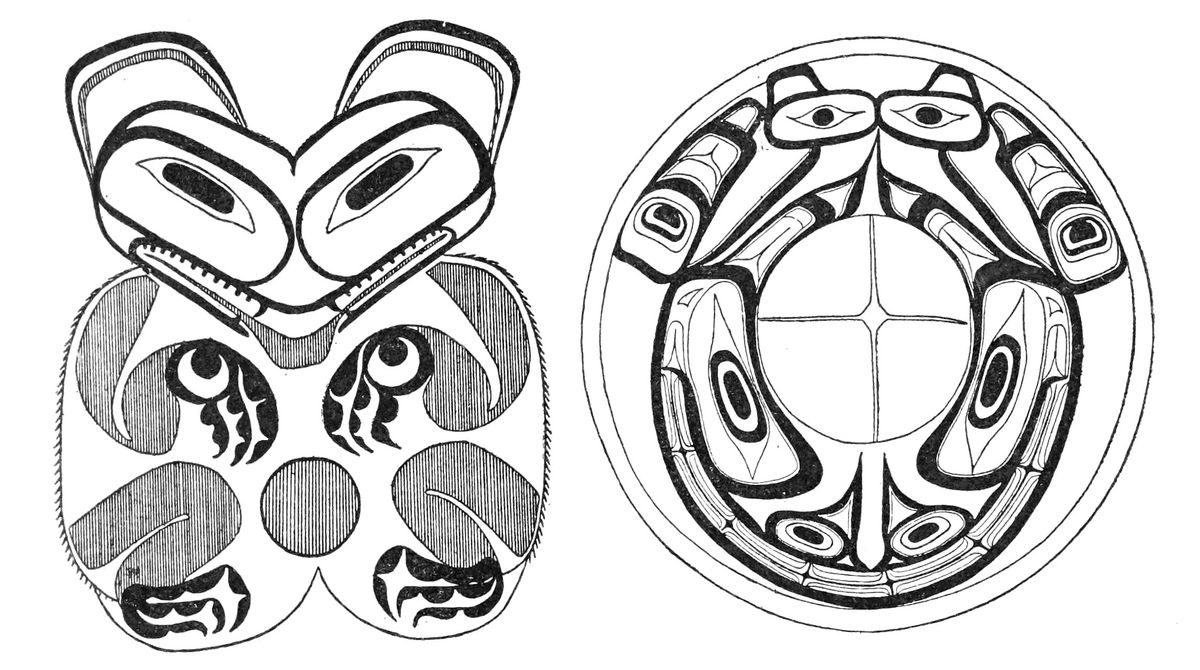
Fig. 223. Painting from a house-front representing a bear, Tsimshian. Fig. 224. Wooden hat painted with the design of a sculpin, Haida.
In a number of cases the designs painted on hats must also be explained as formed by the junction of two profiles. This is the case in the painted wooden hat (fig. 224), on which the design of a sculpin is shown. It will be noticed that only the mouth of the animal coheres, while the eyes are widely separated. The spines rise immediately over the mouth. The flippers are attached to the corners of the face, while the dorsal fin is split into halves, each half being joined to an eye.
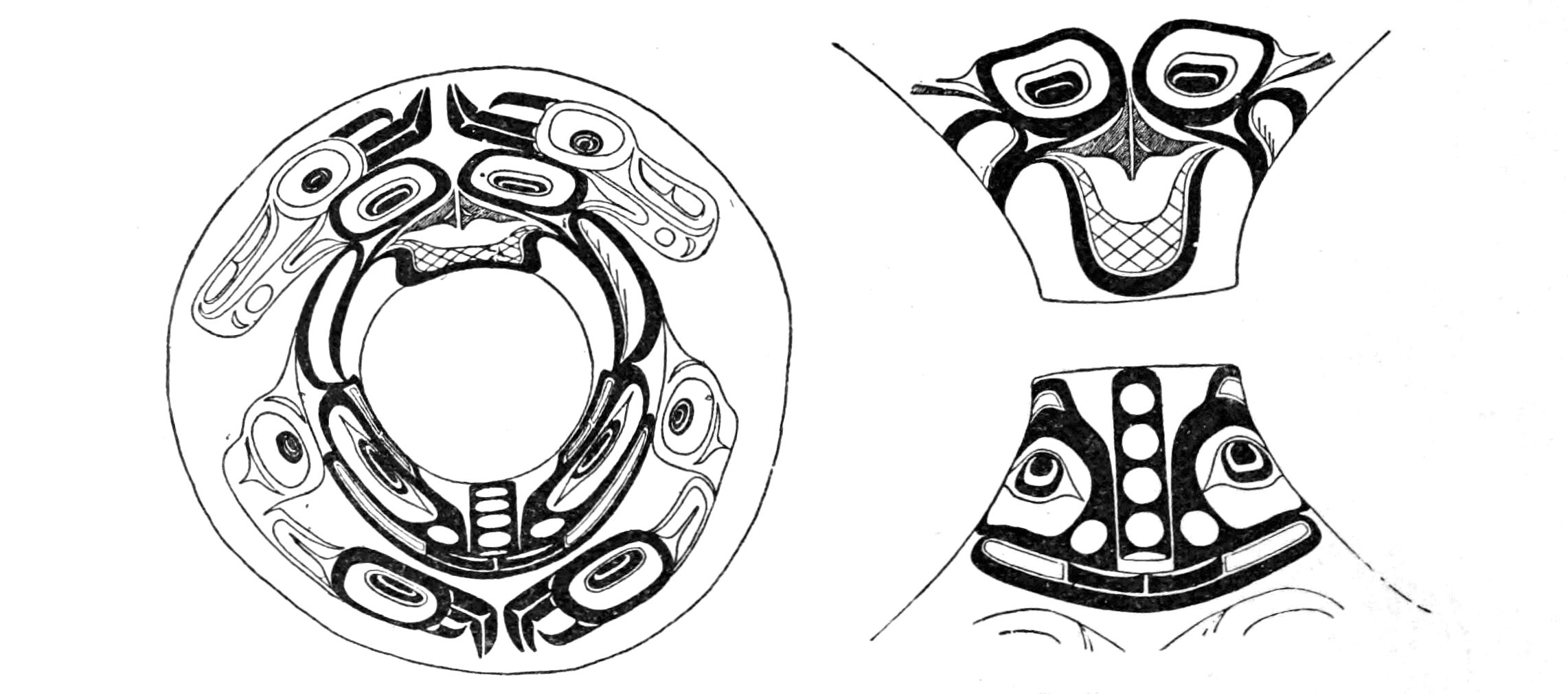
Fig. 225. Hat made of spruce roots painted with design of a beaver, Haida or Tsimshian.
The beaver (fig. 225) has been treated in the same manner. The head is split down to the mouth, over which rises the hat with four rings. The split has been carried back to the tail, which, however, is left intact, and turned up towards the centre of the hat. The importance of the symbols becomes very clear in this specimen. If the two large black teeth which are seen under the four rings, and the tail with the cross-hatchings, were omitted, the figure would represent the frog.
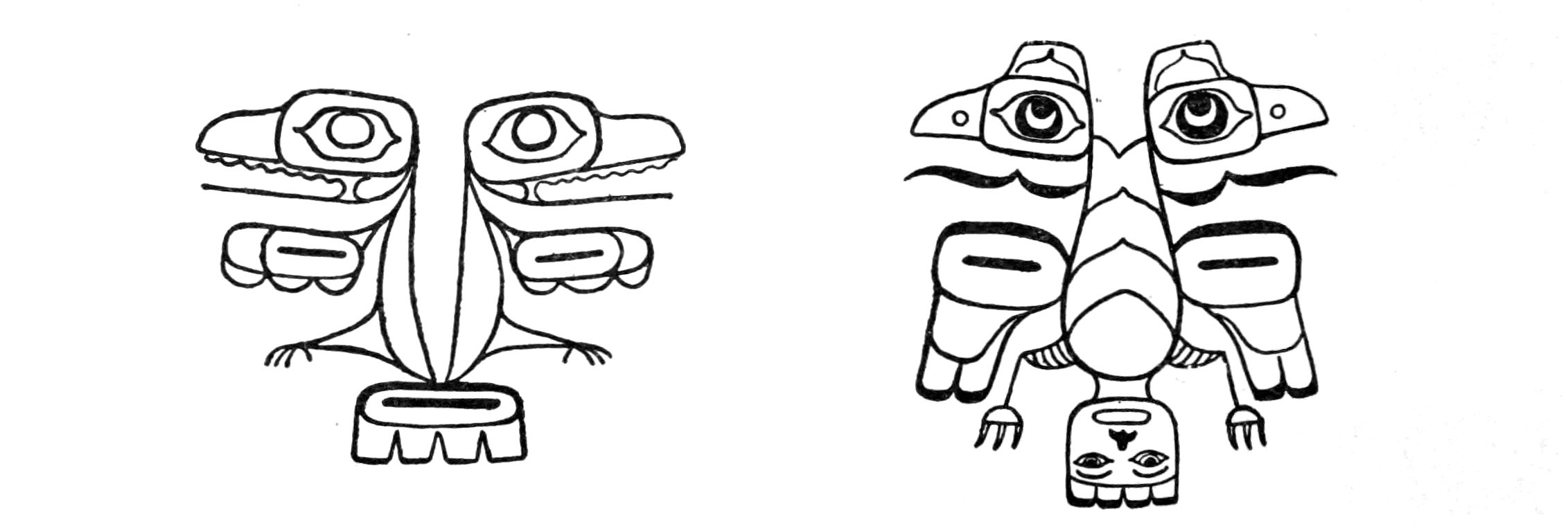
Fig. 226. Tattooing representing a duck, Haida. Fig. 227. Tattooing representing a raven, Haida.
In other designs the cut is made in the opposite direction from the one described heretofore. It passes from the chest to the back, and the animal is unfolded so that the two halves cohere along the middle line of the back. This has been done in the Haida tattooings figs. 226 and 227, the former representing the duck, the latter the raven. In both the tail is left intact. The duck has been split along the back so that the two halves of the body do not cohere except in their lowest portions, while the two halves of the raven are left in contact up to the head.
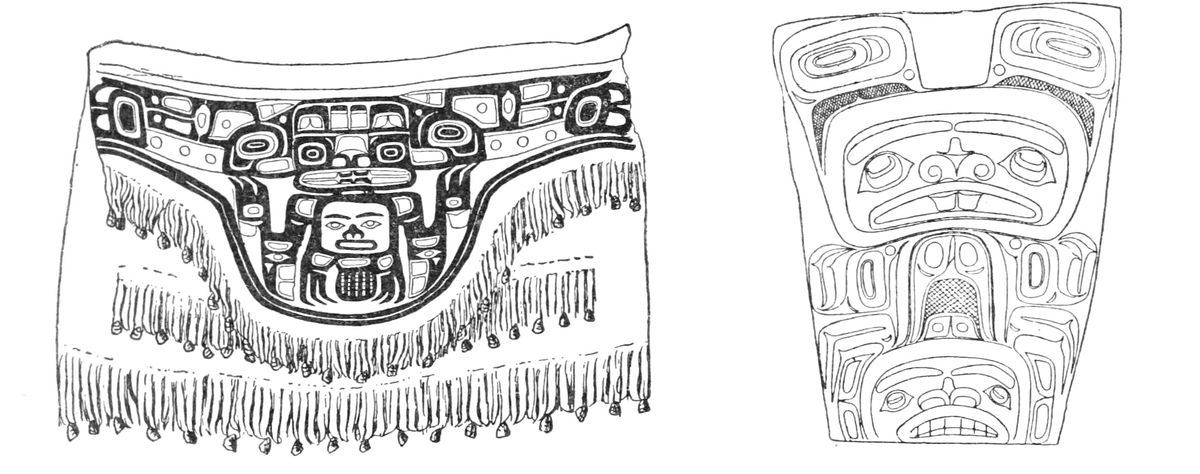
Fig. 228. Dancing-apron woven of mountain-goat wool, design representing a beaver, Tsimshian. Fig. 229. Painted legging with design representing a beaver sitting on a man’s head, Haida.
Fig. 228 is a dancing-apron woven from mountain-goat wool, and fastened to a large piece of leather, the fringes of which are set with puffin beaks. The woven design represents the beaver. Its symbols, the two pairs of incisors and the scaly tail, are clearly represented. While in most carvings and paintings the tail is turned upward in front of the body, it is hanging down here between the two feet. The meaning of the ornaments in the upper part of the apron to the right and to the left of the head is not quite clear to me, but, if they are significant at all, I believe they must be considered as the back of the body split and folded along the upper margin of the blanket. If this explanation is correct, we have to consider the animal cut into three pieces, one cut running along the sides of the body, the other one along the back.
Fig. 229 shows the design on a leather legging, a beaver squatting on a human head. In this specimen we observe that the proportions of the body have been much distorted owing to the greater width of the legging at its upper part. The head has been much enlarged in order to fill the wider portion of the decorative field.
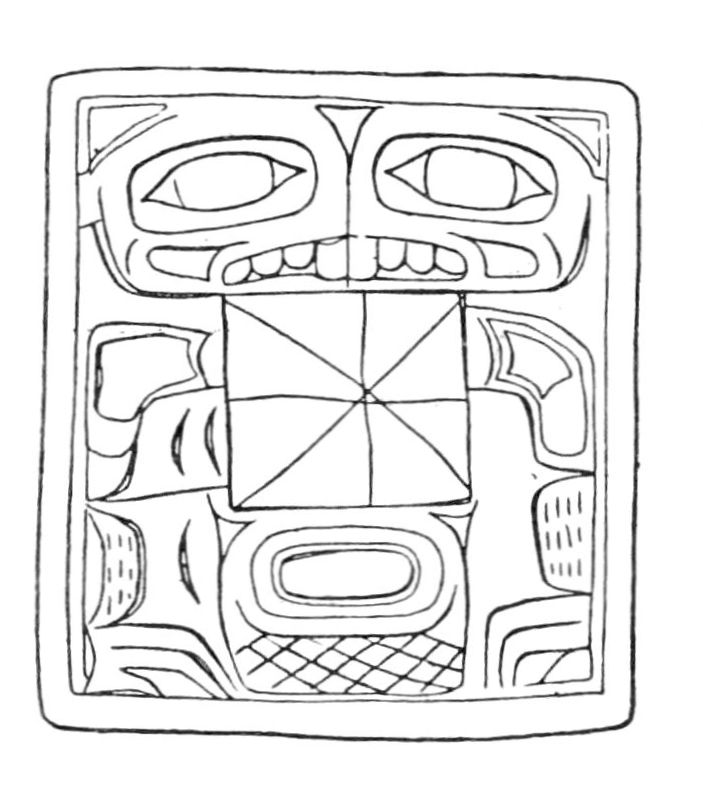
Fig. 230. Gambling-leather with engraved design representing a beaver, Tlingit.
The gambling-leather (fig. 230) is treated in a similar manner. It represents the beaver, and must probably be explained as the animal cut in two. The symbols,—the large incisors and a scaly tail,—appear here as in all other representations of the beaver, but the lower extremities have been omitted. It might seem that this design could be explained as well as a front view of the animal, but the deep depression between the two eyes is not in favor of this assumption. The head consists undoubtedly of two profiles, which join at the nose and mouth; but the cut has not been continued to the tail, which remains intact.
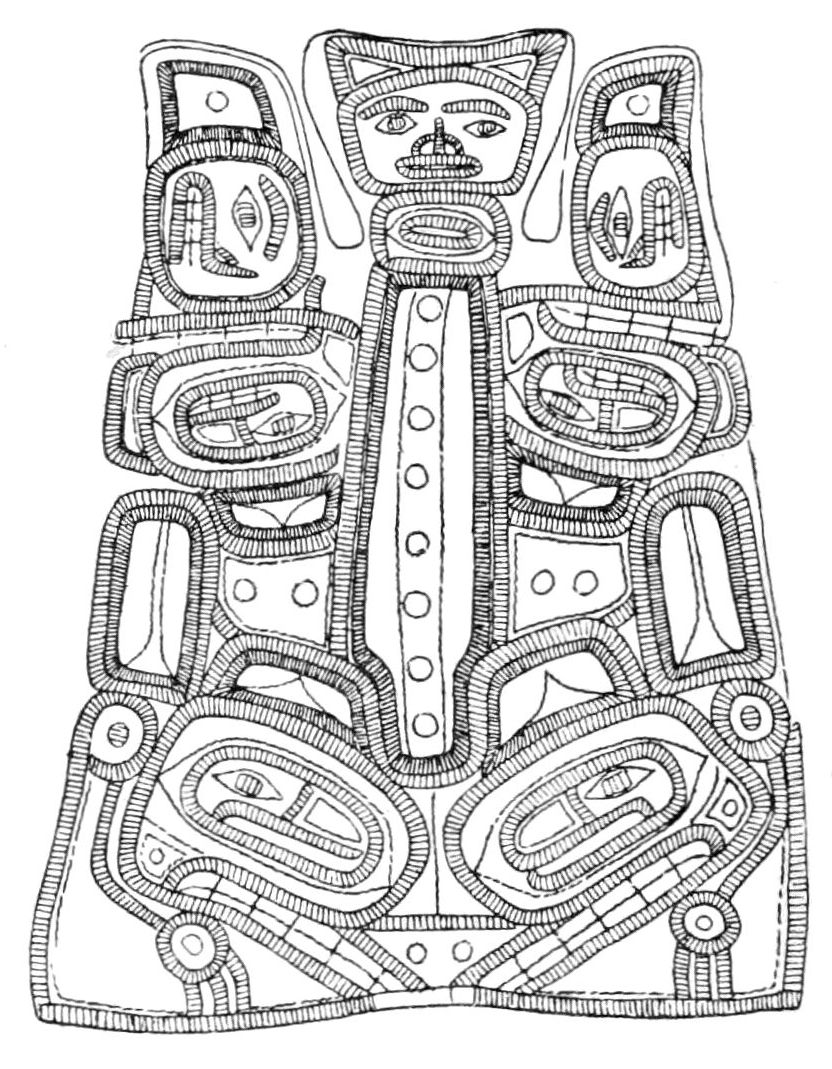
Fig. 231. Embroidered legging representing a sea-monster with a bear’s head and body of the killer, Haida.
Fig. 231 is one of a pair of leggings embroidered with quills on a piece of leather. The design, which represents the sea-monster described in fig. 183, must also be explained as a representation of the animal split along its lower side, and flattened. In the lower portion of the legging the two profiles are seen, which are joined on a level with the eyes, while the two mouths are separated. The nostrils are shown in the small triangle below the line connecting the two eyes. Owing to the shape of the legging, the arms are not attached to the body, but to the upper part of the head. They appear at the right and left borders of the legging, and are turned inward along the lower jaws, the three-toed paws touching the lower border. The fins, which are supposed to grow out of the upper part of the arms, adjoin the elbows, and are turned upward. Another pair of fins, which do not appear in most representations of this monster, are attached to the upper part of the back, and form the two flaps to the right and left of the upper margin. On the back we see a series of circles, which probably represent the dorsal fin. The tail occupies the centre of the upper margin. The smaller ornaments in the outside corners of the head, adjoining the mouth, probably represent the gills.
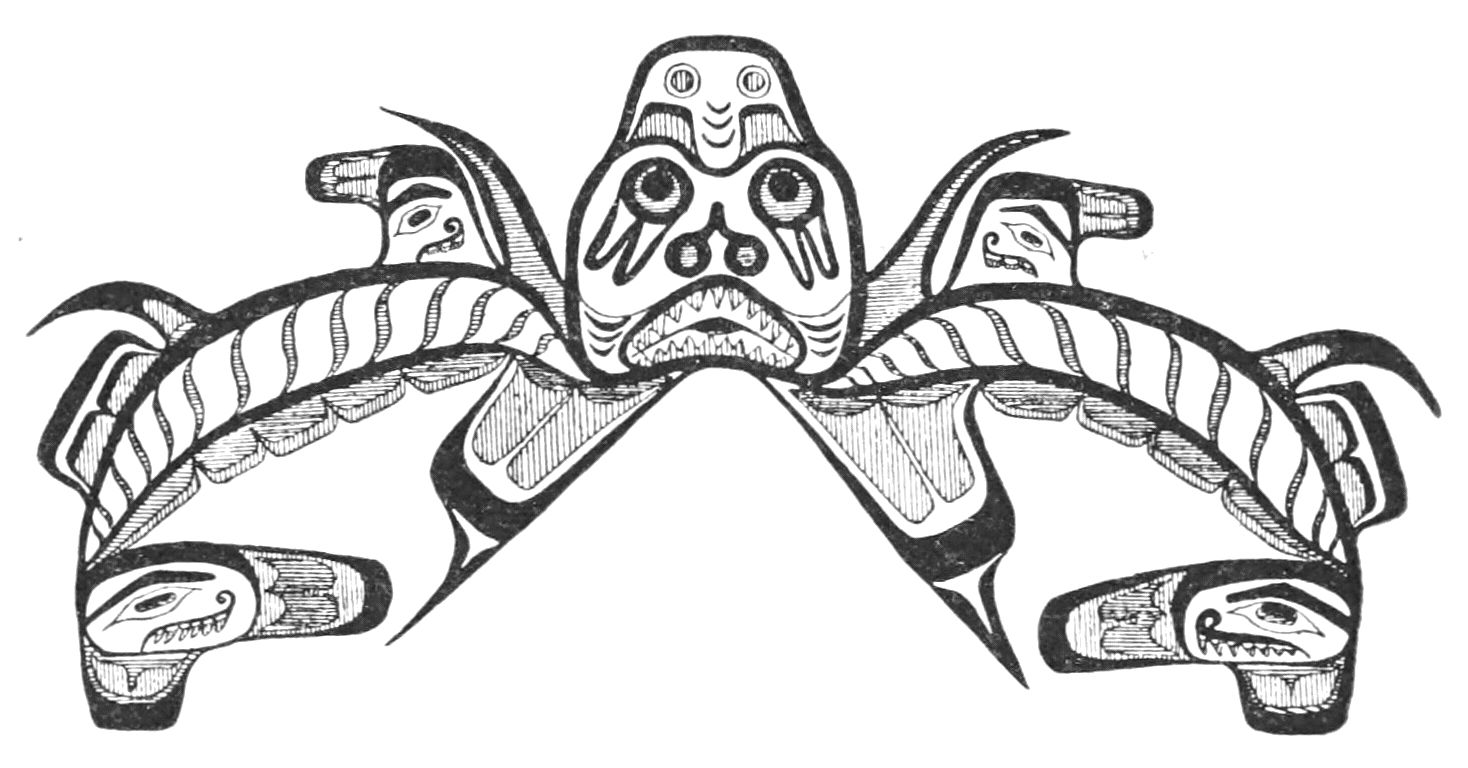
Fig. 232. Painting representing a dog-fish, Haida.
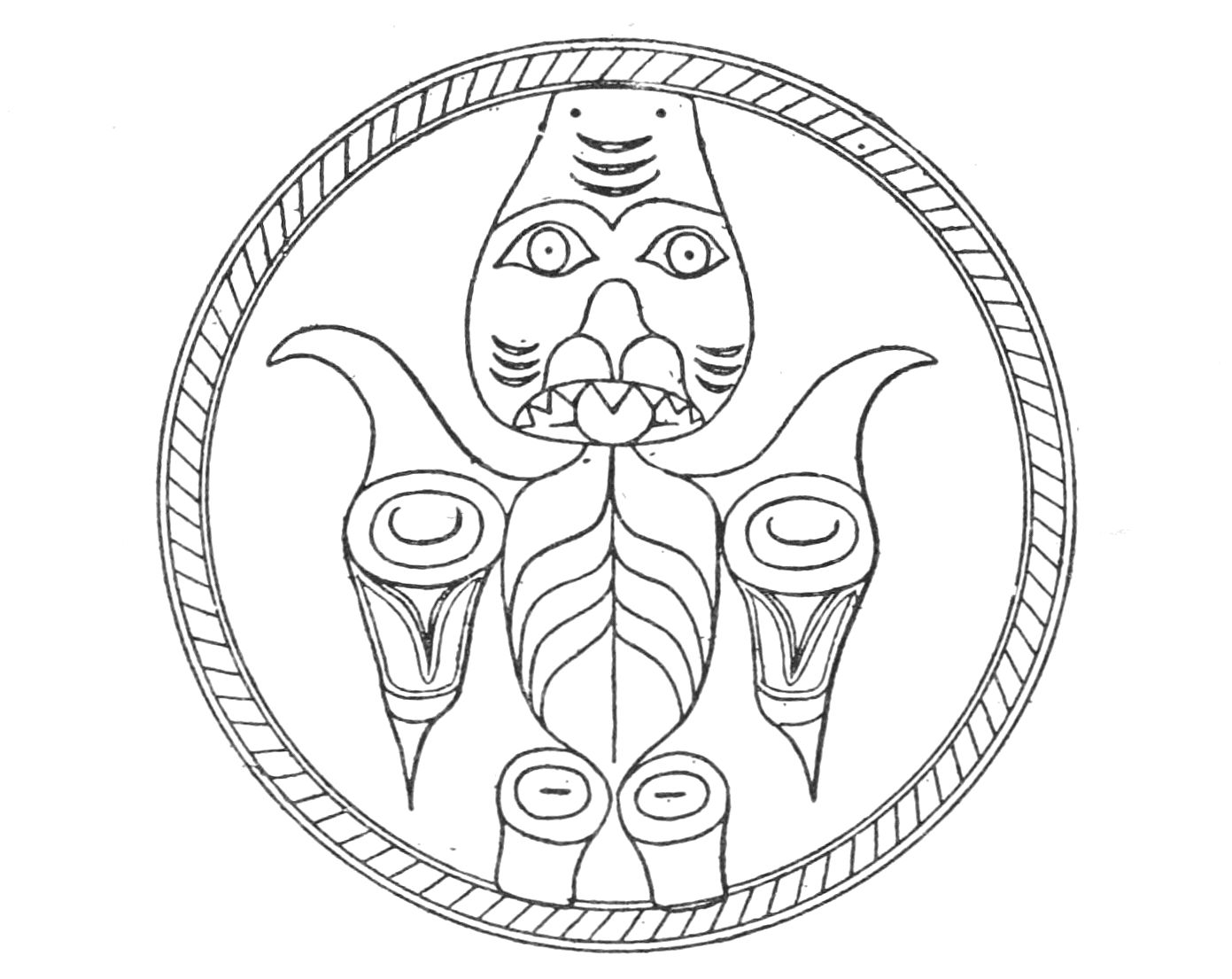
Fig. 233. Slate dish design representing a shark, Haida.
In the following figures we find a new cut applied. Figs. 232 and 233 represent the shark. I explained, when discussing the symbols of the shark, that in the front view of the animal the symbols are shown to best advantage. For this reason side views of the face of the shark are avoided, and in representing the whole animal a cut is made from the back to the lower side, and the two sides are unfolded, leaving the head in front view.
The painting (fig. 232) has been made in this manner, the two halves of the body being entirely separated from each other, and folded to the right and to the left. The heterocerc tail is cut in halves, and is shown at each end turned downward. The pectoral fins are unduly enlarged, in order to fill the vacant space under the head.
The shark which is shown in fig. 233 is treated in a slightly different manner. Again the head is left intact. The cut is made from back to chest, but the two halves of the animal are not separated. They cohere at the chest, and are unfolded in this manner, so that the pectoral fins and dorsal fins appear to the right and left of the body. The heterocerc tail is not clearly indicated in this specimen.
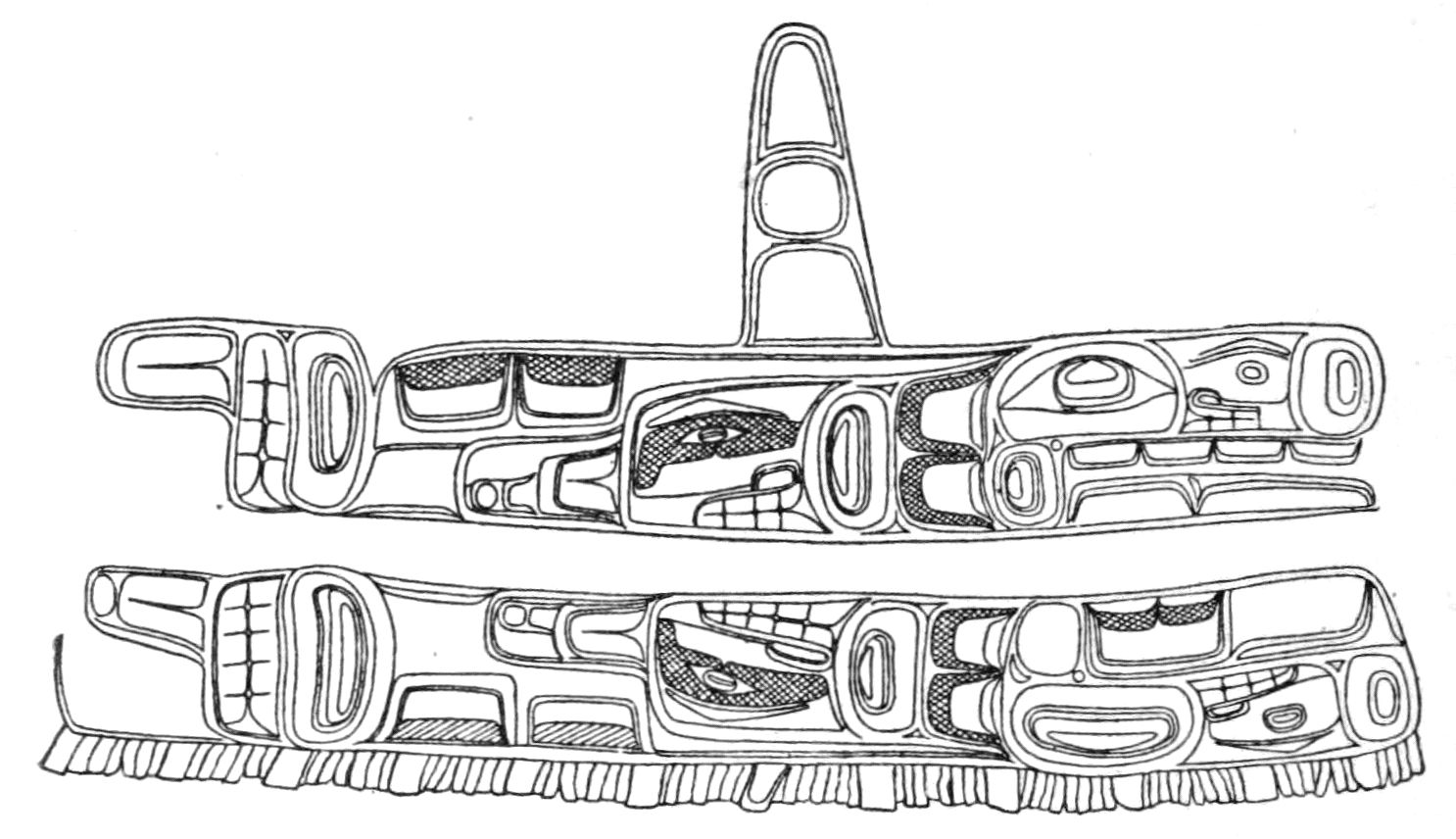
Fig. 234. Painting on edge of a blanket representing a killer-whale, Tlingit.
The method of section applied in fig. 234 is still different. The figure represents a painting on the border of a large skin blanket. The animal here represented is the killer-whale. The upper painting clearly represents the profile of the animal. The lower painting represents the other profile, so that both the right and the left halves are visible. Since there was no room for showing the dorsal fin on the lower painting, it is indicated by a curved line on one of the series of wider fringes at the lower border. It is remarkable that the tails in the two halves of the animal are not drawn symmetrically; but it is possible that this is due to a mistake on the part of the painter, because the design is repeated on the opposite border of the blanket in the same manner, but with symmetrical tails. The two halves of the body differ in details, but their main features are identical. The flipper is shown on a very large scale. It is attached immediately behind the head, and extends to a point near the tail. Its principal part is occupied by a face, in front of which an eye is shown.
Animals are represented by means of sections not only on flat surfaces, but also in round carvings in which one side cannot be shown. This is the case on all totem poles, for the rear side of the pole is not carved. Whenever all the symbols of the animal can be shown on the front of the totem pole, the animals are apparently represented in their natural position. But representations of animals, the symbols of which would be placed on the rear side of the totem pole, make it clear that the artist actually splits the animals along the rear of the totem pole, and extends this cut in such a way that the animal is spread along the curved front of the pole. This will become clear by a consideration of the following figures.
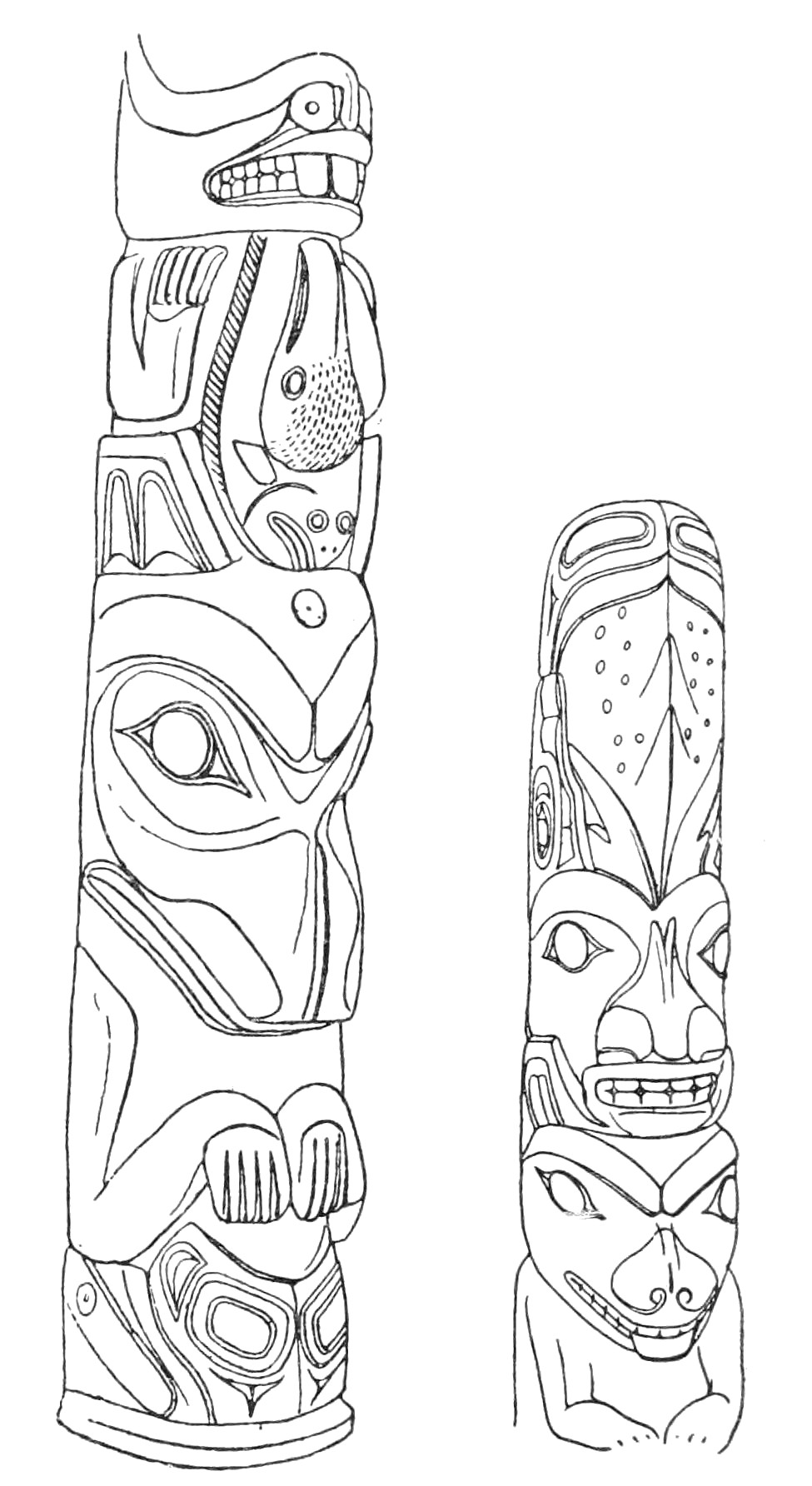
Fig. 235. Fig. 236.
Fig. 235. Model of totem pole representing a sea-monster, Haida. Fig. 236. Model of totem pole representing a sculpin, Haida.
Fig. 235 represents a sea-monster with a whale’s body and bear’s paws. It differs from the monster discussed before in that it has a whale’s head, and no fins attached to the fore paws. It has, however, one large dorsal fin. The blow-hole of the whale is shown over its eyebrows. The tail is turned up in front of the body, and the paws are raised in front of the chest. The dorsal fin will be recognized in the narrow strip, ornamented with a small ring, which slants downward from the elbow towards the tail. An ornament of this sort is shown on both sides of the carving. We see, therefore, that the dorsal fin has been split, and is turned down along each side of the body. This shows that the right and left margins of the carved portion of the totem pole must be considered as the medial line of the back, which has been split and pulled apart.
The sculpin on the totem pole (fig. 236) is treated in the same manner, but in this case the cut is made along the lower side of the animal. The head is turned upward, so that the front view of the face is seen when looking down upon the back of the fish. The spines rise over nose and eyebrows. The pectoral fins are shown over the eyebrows on the edge of the carved portion of the pole, while the hind portion of the lower part of the body occupies the upper part of the margin of the pole.
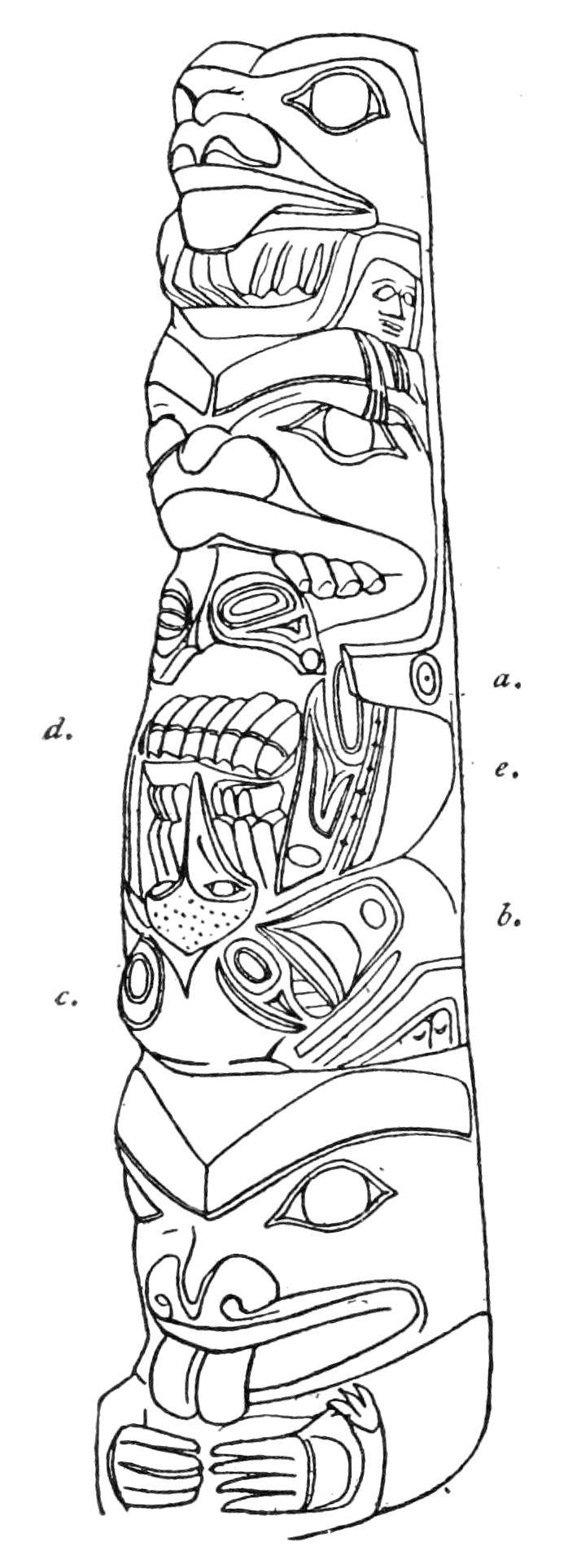
Fig. 237. Model of totem pole representing a sea-monster devouring a fish, Haida.
The exceedingly intricate central figure on the pole shown in fig. 237 must be explained in the same manner as fig. 235. We see here the sea-monster described before in fig. 183. It has a bear’s head. In each ear is placed a small human figure the hands of which grasp the eyelid of the monster, which they are lifting. The tail (c) is turned upward in front of the body, immediately over a beaver’s head which is the next lower figure on the column. The dorsal fin (a) has been split, and one-half of it is seen under the mouth of the bear, indicated by a projection which is decorated with a double circle. The fore paws of the animal (d) are raised in front of its chest, and appear under the mouth. The fins which are attached to them (b) are shown to the right and to the left of the tail. The animal is swallowing another being, but it is not clear what animal is meant. A fish tail and a hand are seen protruding from the mouth. The space between the fore paws and the tail of the sea-monster is occupied by an inverted bird, which will be seen clearly when the figure is reversed. Its head is shown with beak resting between the feet. The two wings (e) are extended, and reach from the fins of the fore arm of the monster to its dorsal fin. The particular point brought out by this figure is the same as that which I tried to explain in considering fig. 235; namely, that the two edges of the carved pole must be considered as the extended medial line of the back of the animal that is represented on the pole.
These carvings make it clear that in paintings on hats, such as shown in figs. 219, 224 and 225, and in flat figures, such as fig. 163, we must consider the outer rim of the figure as the distended sides of a cut made along the lower side of the body. All of these distortions and sections of animals may be explained by the necessity the artist felt of showing in his work all the symbols of the animal.
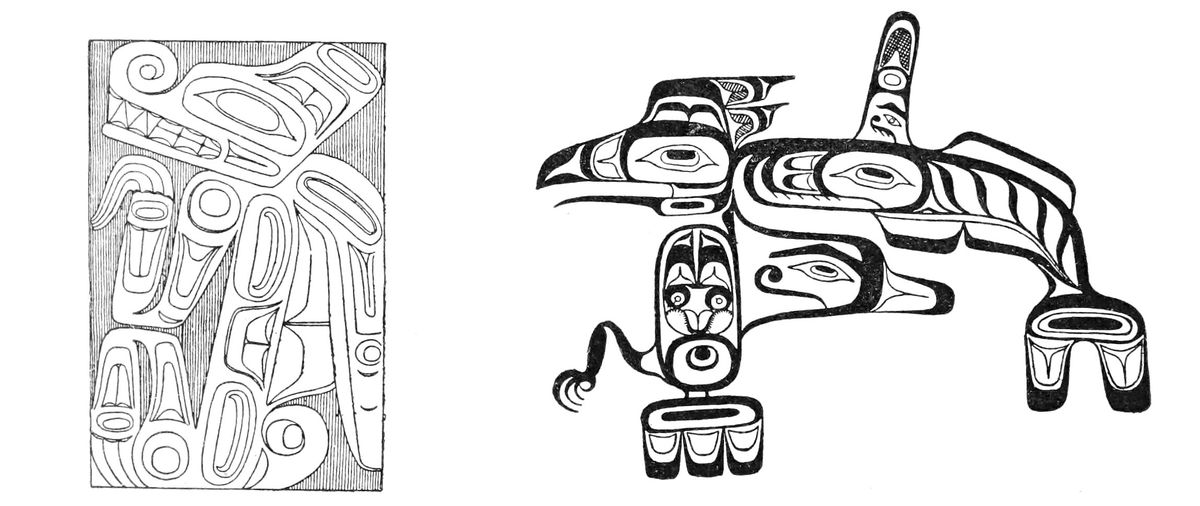
Fig. 238. Slate carving representing the sea-monster, Wasgo, Haida. Fig. 239. Tattooing representing the fabulous sea-monster, Ts’um’a´ks, Haida.
In most cases the symbols appear clearly in profiles of animals. For this reason the artist, when representing profiles, has not endeavored to show both sides of the body. I will give here a series of figures illustrating this point.
Fig. 238 represents the top of a box on which is carved the sea-monster Wasgo. It has a wolf’s head and body, and a large dorsal fin. It is able to hunt in the sea as well as on land. The artist has shown a profile of the animal with one foreleg and one hindleg, the tail curled up over the back. The dorsal fin, which in most representations of this animal stands out vertically from the body, has been laid down along the back in order to fit it into the decorative field.
Fig. 239 is a tattooing representing the sea-monster Ts’um’a´ks, which is sometimes described as having a raven’s body with a whale’s body attached to its head, and a fin attached to the raven’s back. It is shown in profile with one leg, the dorsal fin, and the tails of raven and whale, twisted around so as to be seen from the side. In other cases it is described as having a bear’s head with the mouth of a shark.
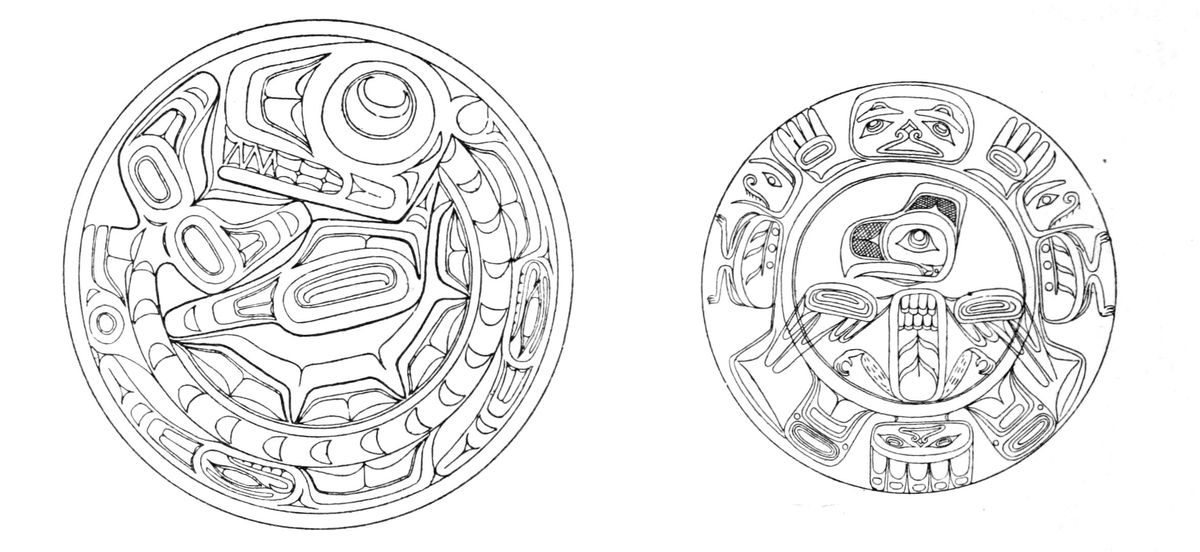
Fig. 240. Slate dish with design representing a killer-whale, Haida. Fig. 241. Drum painted with design of an eagle, Tsimshian.
In fig. 240, which represents the design on a circular slate dish, we see a good case of the adaptation of a profile to the decorative field. The design represents a killer-whale with two dorsal fins. The animal is bent around the rim of the dish so that the head touches the tail. The two dorsal fins are laid flat along the back, while the large flipper occupies the centre of the dish.
Fig. 241, which is the painting on the head of a drum, is a combination of front and side views. The head is turned sideways, while the body, the outstretched wings, and the feet are shown in front view. This method is found rarely in the art of the North Pacific coast, and, so far as I am aware, almost exclusively in representations of the eagle (see, however, fig. 239). The painting on the outer ring of the drum-head is difficult to explain. It will be noticed that the tail of the eagle occupies the lower centre of the ring. On top we see the front view of a human figure, the arms of which, of diminutive size, are placed near the lower corners of the face, while the hands are of very large size. The two sitting figures below the two hands probably represent the back of the man who is shown on top, but their connection with the peculiar fin-like figures on the lower portion of the painting is not clear.
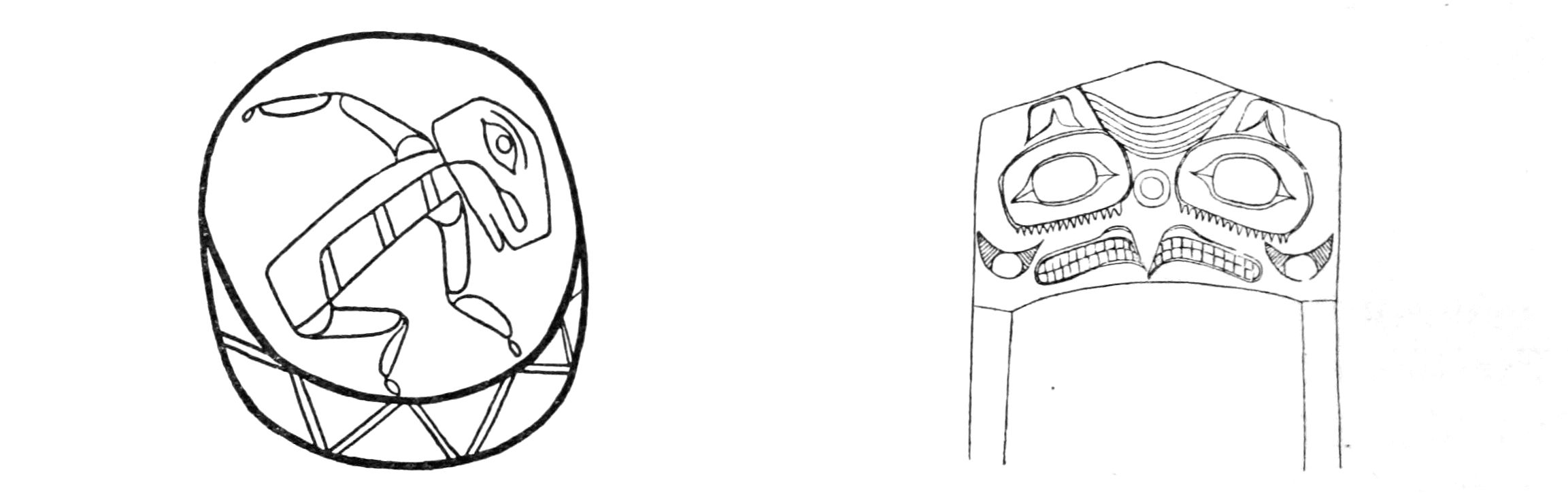
Fig. 242. Tattooing representing the moon, Haida. Fig. 243. Carving on the end of a food tray representing a hawk, Tlingit.
Fig. 242 is a tattooing representing the moon. In its lower portion the crescent will be seen. In the dark portion of the moon a semi-human figure is shown in profile, with one leg. One arm is extended downward, and one backward, as though he were lifting a heavy weight.
There are very few designs which can possibly be interpreted as full-face views of animals. I explained before that the face of the shark is always shown in this manner, because its symbols appear best in this position. The only other animal which is painted or carved on flat surfaces in full front view is the hawk or thunder-bird, whose symbol is the long beak which descends to the chin. A number of carvings representing the thunder-bird were given in figs. 165-168 (p. 191).
We find full-face representations of the thunder-bird frequently used on dishes, on which the beak is indicated by a long wedge which separates the mouth into two halves. It is, however, not certain whether the artists consider this face always as a full front view, because we often find (fig. 243) a depression between the two eyes, corresponding to the depression which I described before when referring to the joining of the profiles of animals. It may be that the long central wedge must be considered as the two halves of the long descending beak, which join in the middle. It might be expected, however, that in this case the beak would, at least sometimes, be carried on outward to the right and to the left below the chin, corresponding to one-half of the beak seen in fig. 166 (p. 191). I have not observed a single specimen in which this is the case, and therefore I am inclined to consider the carvings of thunder-birds on dishes as full front views.
This ornament may have originated in the following manner: Many grease and food dishes have the form of canoes. The canoe symbolizes that a canoe-load of food is presented to the guests; and that this view is probably correct is indicated by the fact that the host in his speeches sometimes refers to the canoe filled with food which he gives to his guests. The canoe form is often modified, and a whole series of types may be established forming the transition between canoe dishes and ordinary trays. Dishes of this sort always bear a conventionalized face at each short end, while the middle part is not decorated. This is analogous to the style of the decoration of the canoe. On the whole the decoration of the canoe is totemic. It may, however, be that the peculiar manner in which the beak of the hawk is represented has given rise to the prevalence of this decoration. The upper jaw of the hawk is always shown so that its point reaches the lower jaw and turns back into the mouth. When painted or carved in front view the beak is indicated by a narrow wedge-shaped strip in the middle of the face, the point of which touches the lower margin of the chin. The sharp bow and stern of a canoe with a profile of a face on each side, when represented on a level or slightly rounded surface, would assume the same shape. Therefore it may be that originally the middle line was not the beak of the hawk, but the foreshortened bow or stern of the canoe. This decoration is so uniform that the explanation given here seems to me probable.
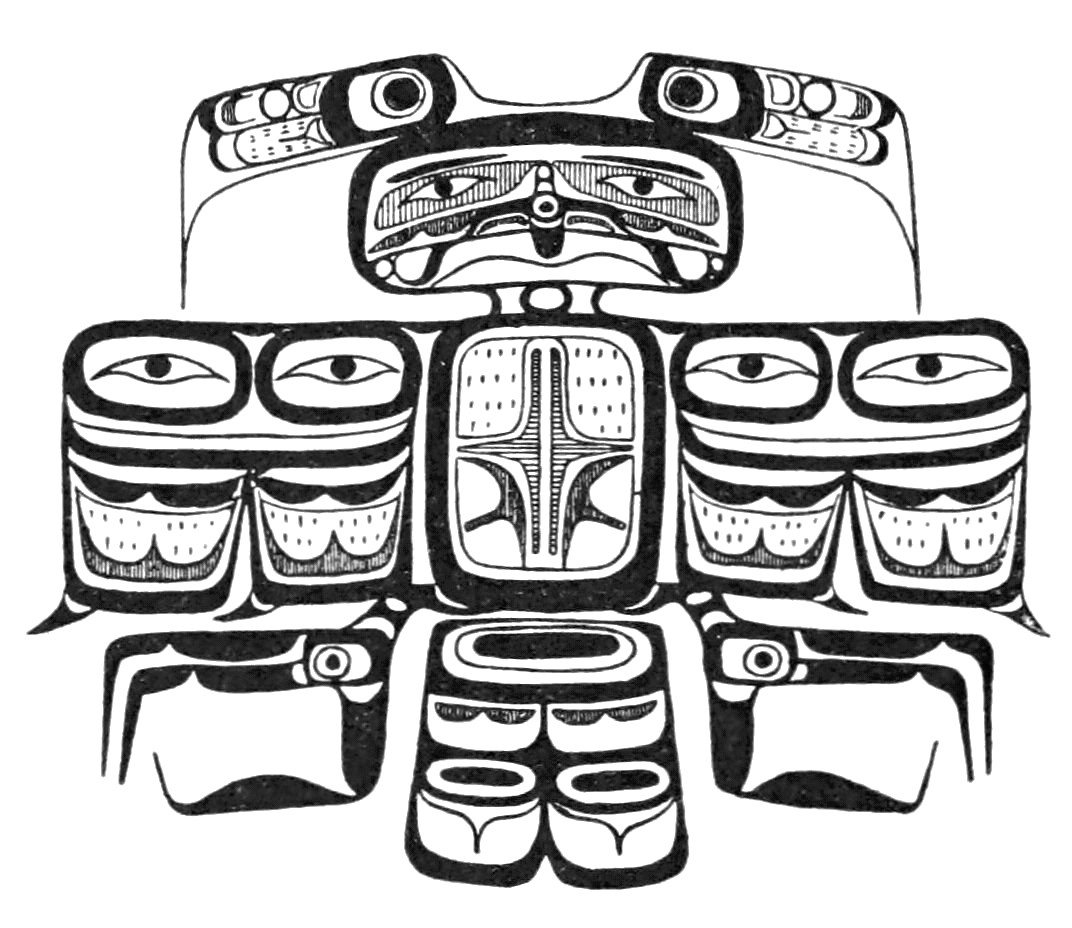
Fig. 244. Painting from a house-front representing thunder-bird, Kwakiutl.
In fig. 244 we see a painting representing a full front view of the thunder-bird. Its principal symbol is the long beak, which in front view appears like a long line descending from the nose over the mouth. In this case it is doubtful whether the body may be considered as being split along the back. Since the face is certainly represented in front view, it seems more likely that the animal is represented with spread wings, similar to the eagle in fig. 241.
I have described a number of dissections applied in representing various animals. Heretofore we have had cases only in which the dissections were rather simple. In many cases in which the adaptation of the animal form to the decorative field is more difficult, the sections and distortions are much more far-reaching than those described before.
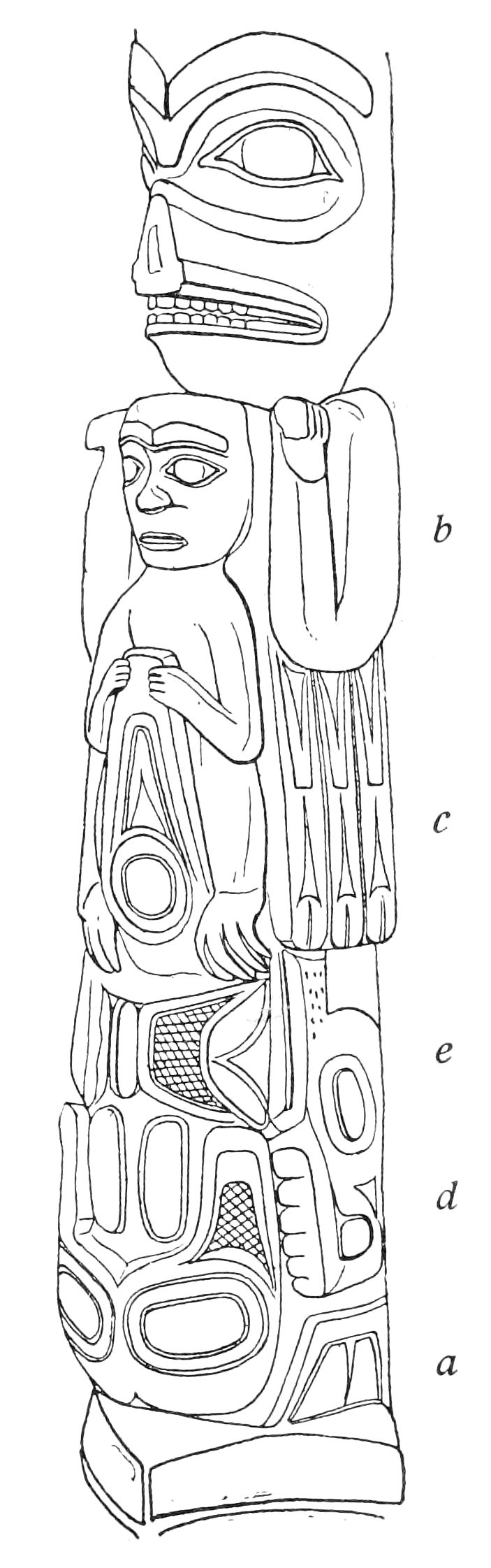
Fig. 245. Model of totem pole with design representing a killer-whale, Haida.
The cut that has been applied in the totem pole (fig. 245) is much more intricate than the preceding ones. The upper figure represents a bird which is shown in the form of a human being, to the arms of which wings are attached. Under this figure we find a representation of the killer-whale. The hind part of its body is more easily recognized than the head. A small human figure is seen riding on the dorsal fin. The tail (a), which appears at the lower margin of the figure, is turned backward over the back of the animal. We must therefore imagine that the head has been turned downward behind the human figure (b) riding on the dorsal fin (c). It would, therefore, lie on the back of the totem pole, which is not carved. Consequently, according to what was stated before, the artist has split and distended it so that the middle line appears at each edge of the carved portion of the pole. Thus the right half of the head (d) has been brought into view on the right side of the totem pole, and the left half on the left. This is the explanation of the whale’s head with its teeth, which is seen in our figure next to the tail, the lower jaw being omitted. The flipper (e) which adjoins the head, is laid over the back of the whale, immediately under the feet of the human being riding on the dorsal fin of the whale. The figure must therefore be explained in such a way that the animal is twisted twice, the tail being turned up over the back, and the head being first turned down under the stomach, then split and extended outward.
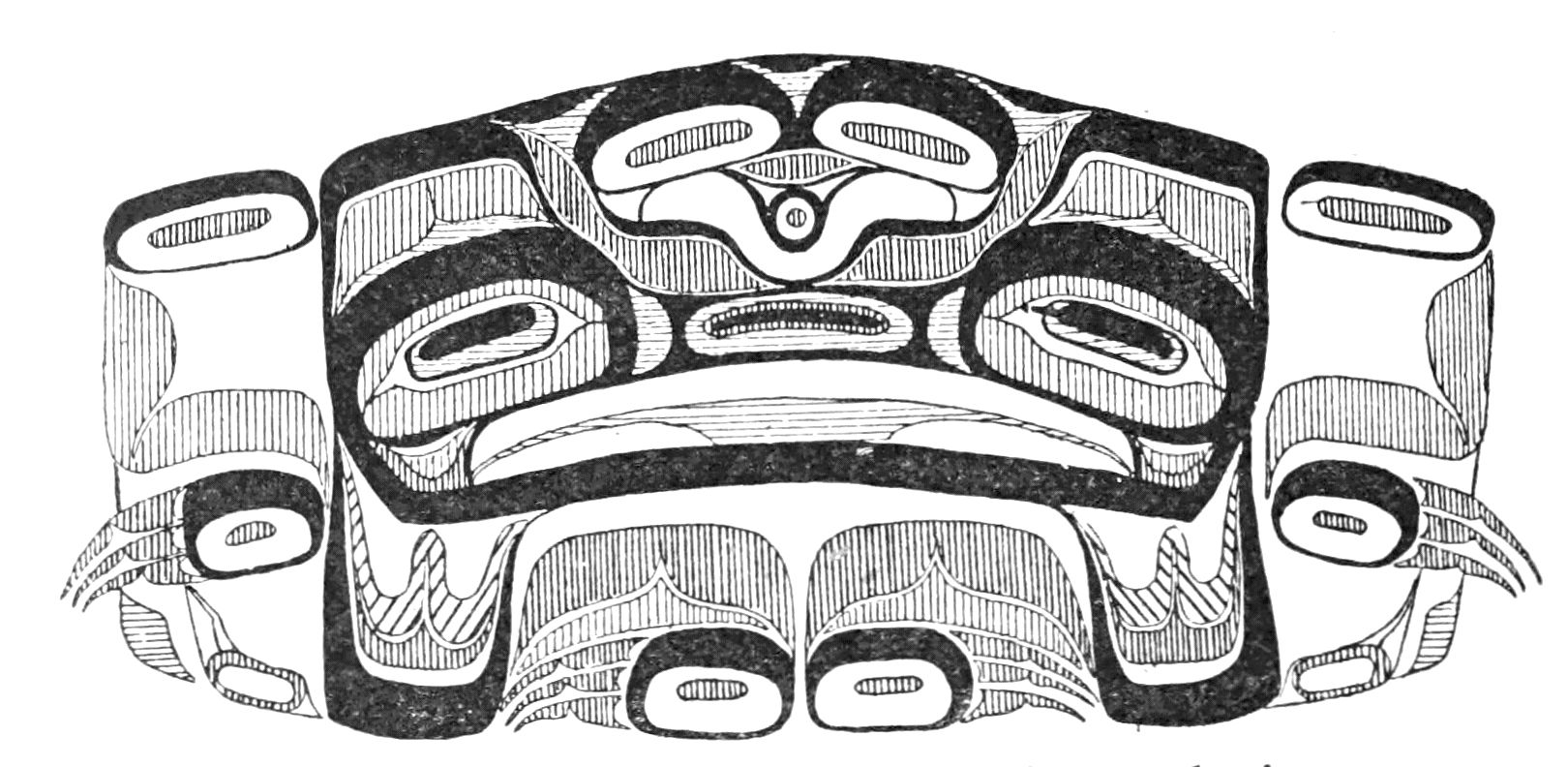
Fig. 246. Painting for a box front, design representing a frog, Haida.
Fig. 246 is a copy of a painting on the front of a box, made on paper with colored crayons by a Haida Indian named Wiha. It represents a frog. By far the greater portion of the box front is occupied by the head of the animal, which, according to what was said before, must be considered as consisting of two adjoining profiles. The symbol of the frog’s head is its toothless mouth. The two black portions extending downward from the lower corners of the face are two halves of the body. To these are joined the fore paws, which occupy the space below the mouth; the upper arm and fore arm being turned inward, the fore feet being turned outward under the arm. The hind legs occupy the lateral field on both sides of the head. They are not connected in any way with the body of the animal.
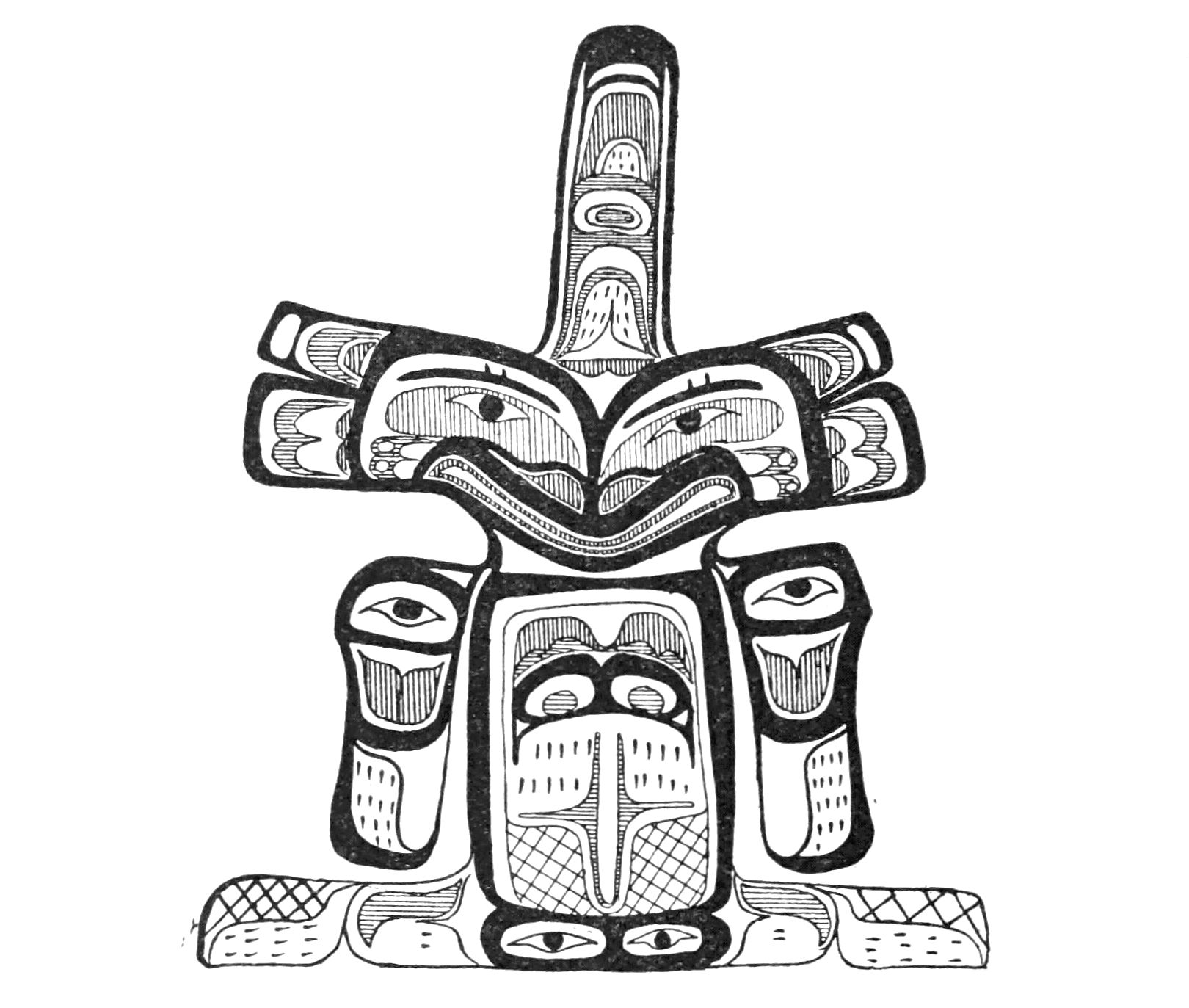
Fig. 247. Painting for a house-front, design representing a killer-whale, Kwakiutl.
In fig. 247 we find a novel representation of the killer-whale, which was given to me as illustrating the painting on a house of the Kwakiutl Indians. The sections that have been used here are quite complicated. First of all, the animal has been split along its whole back towards the front. The two profiles of the head have been joined, as described before. The painting on each side of the mouth represent gills, thus indicating that a water-animal is meant. The dorsal fin, which according to the methods described heretofore would appear on both sides of the body, has been cut off from the back before the animal was split, and appears now placed over the junction of the two profiles of the head. The flippers are laid along the two sides of the body with which they cohere only at one point each. The two halves of the tail have been twisted outward so that the lower part of the figure forms a straight line. This is done in order to fit it over the square door of the house.
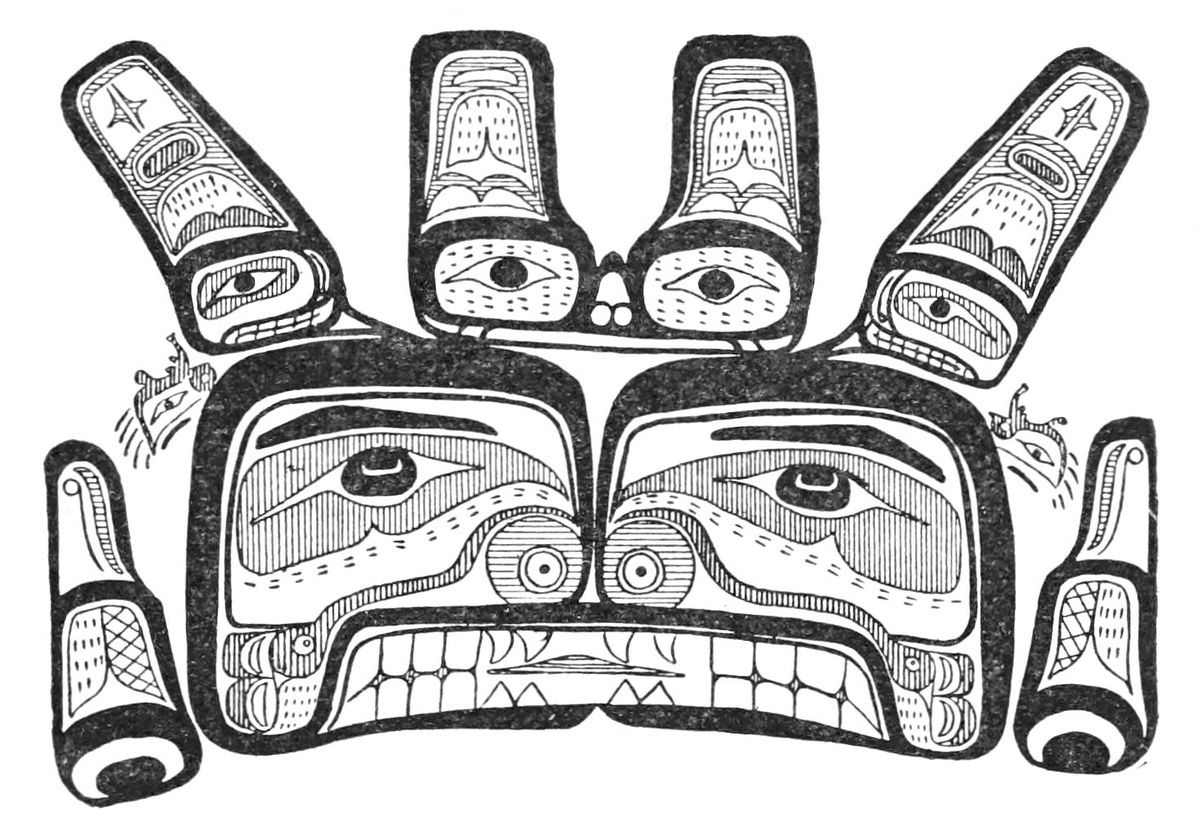
Fig. 248. Painting for a house-front with design representing a killer-whale, Kwakiutl.
In fig. 248 the same animal has been treated in still a different manner. The figure illustrates also the painting from a house-front of the Kwakiutl Indians. The central parts of the painting are the two profiles of the head of the killer-whale. The notch in the lower jaw indicates that it also has been cut, and joined in its central part. The cut on the upper part of the face has been carried down to the upper lip. The body has disappeared entirely. The cut of the head has, however, been carried along backward the whole length of the body as far as the root of the tail, which latter has been cut off, and appears over the junction of the two profiles of the head. The dorsal fin has been split, and the two halves are joined to the upper part of the head, from which they extend upward and outward. Immediately below them the two halves of the blow-hole are indicated by two small faces, the upper parts of which bear a semicircle each. The flippers are attached to the lower corners of the face. The painting on the face next to the mouth represents gills.
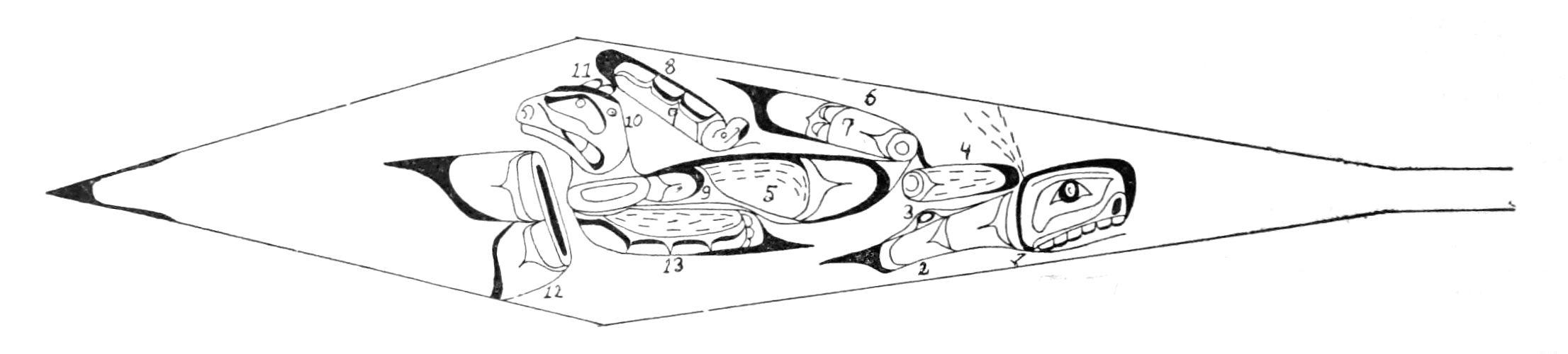
Fig. 249. Painting on a paddle representing porpoise and seal, Kwakiutl.
Fig. 249 is a complicated painting on a Kwakiutl paddle. It represents a porpoise and a seal combined; the porpoise turning to the right, the seal to the left, and both having a common body. At the right is seen the head of the porpoise and the short lines behind it, upward, represent the animal spouting. (1) is the neck, (2) the flipper, (3) a joint in the flipper, (4) and (5), (9) and (13) jointly representing the body of the porpoise, (5) is the stomach, (8) the dorsal fin of the porpoise, (9) is the backbone both of the porpoise and of the seal, (12) is the tail of the porpoise. The head of the seal is shown in (11), (10) represents the ears, although another pair of ears, like those of all animals, appear over the head. It has been stated before that (9) is the backbone of both seal and porpoise, (5) is the stomach of the seal, (13) its flippers, and (4) its tail.
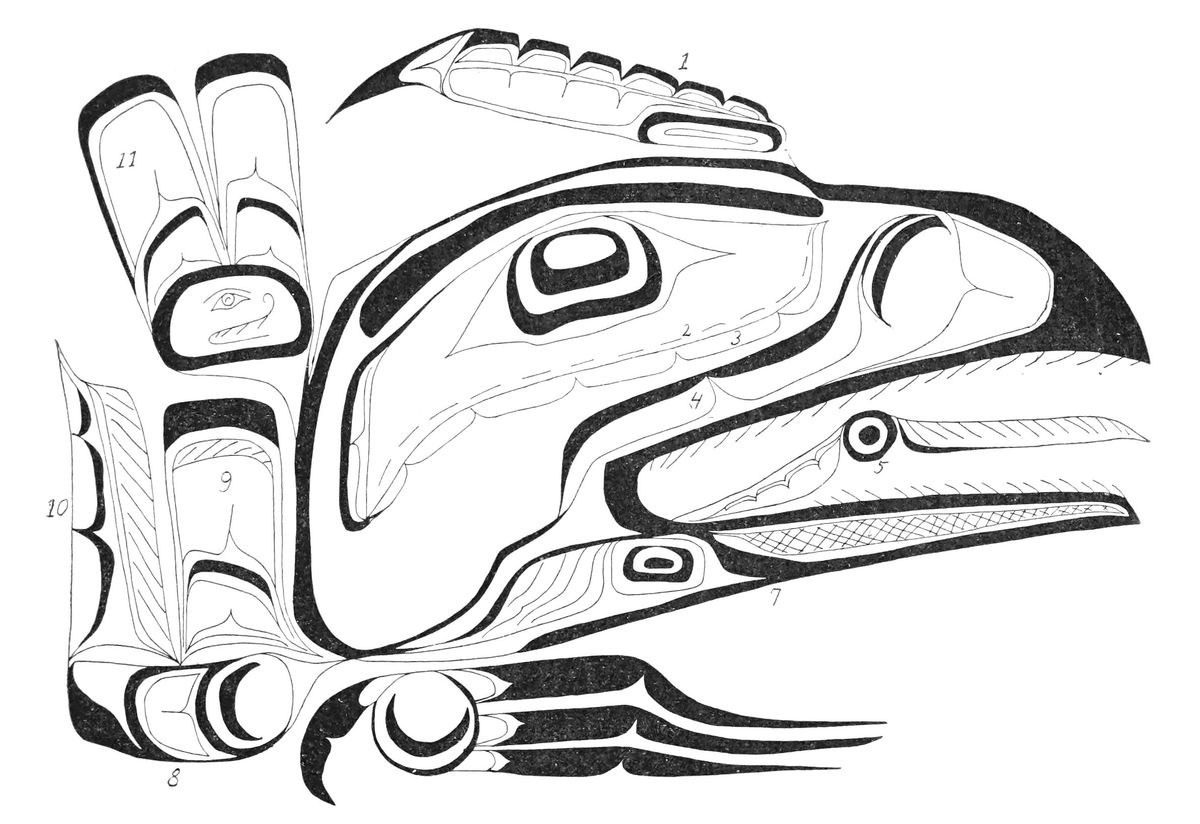
Fig. 250. Painting for a house-front representing a raven, Kwakiutl.
Fig. 250 represents the painting from a house-front showing a raven in profile. This painting appears on the right and left of the doorway; the beaks facing the door. (1) is the raised tuft on the head of the raven, (2) feathers, (3) the facial bones, (4) the skin over the beak, (5) is supposed to be a joint in the tongue, (6) the skin over the lower jaw, (7) the supposed joint at the base of the tongue, (8) represents the shoulder joint, (9) feathers, and (10) the long wing feathers. It will be noticed that the inner feathers (9) are rounded, while the wing feather has a sharp point, according to the standard requirements referred to on p. 205. (11) represents the tail with a single face as a joint, according to standard requirements.
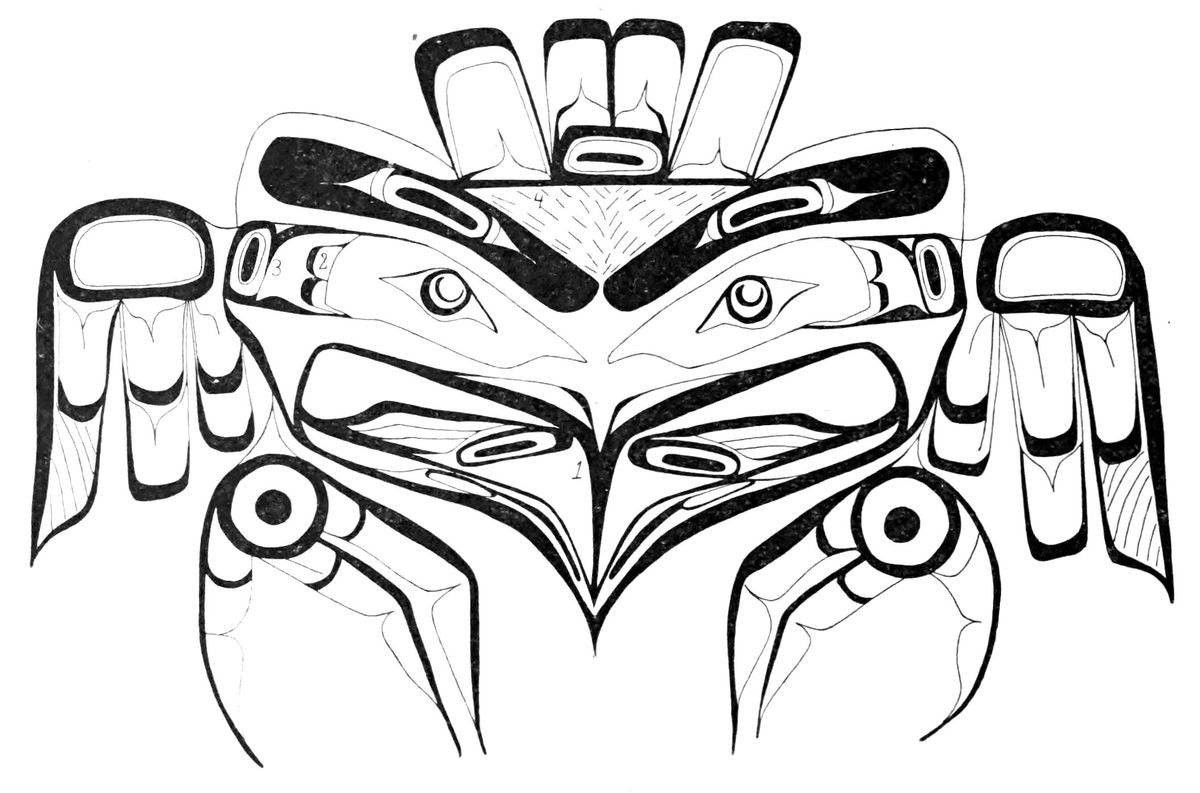
Fig. 251. Painting for a house-front representing a thunder-bird, Kwakiutl.
Fig. 251 is a design from a house-front, over the door, representing a thunder-bird. The design must be considered as consisting, more or less clearly, of two profiles. (1) represents the hooked nose, (2) the skull, (3) the ears, (4) the feathers over the heavy eyebrows. The tail rises over the head. It has the characteristic single joint. Rounded feathers are shown on the wings, right and left; the extreme long wing feather is sharply pointed. The feet, to the right and left of the face, are enormously enlarged. The circular eye design represents the joint to which three toes are attached.
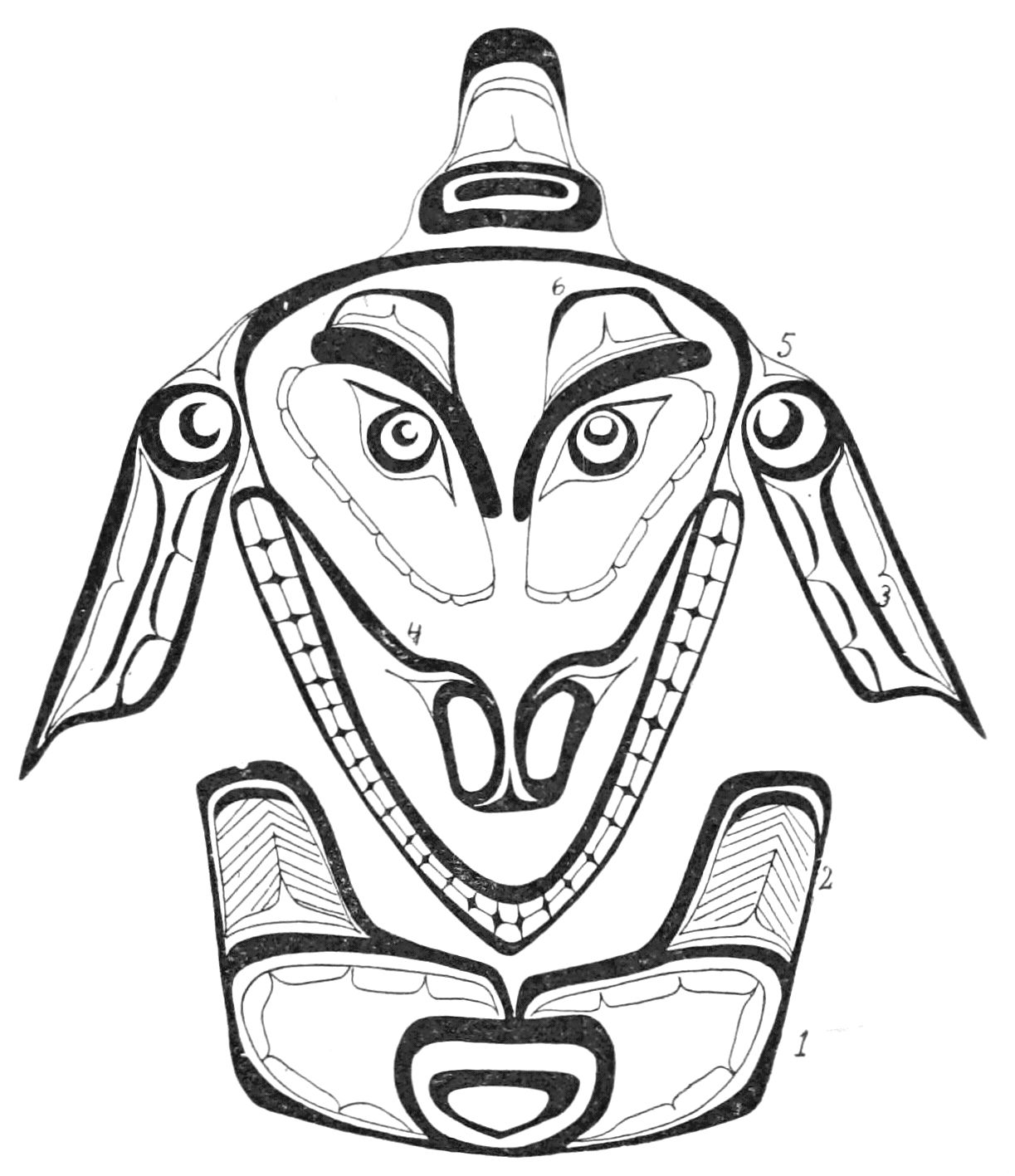
Fig. 252. Painting for a house-front representing a whale, Kwakiutl.
Fig. 252 represents another painting which is placed over the door of a Kwakiutl house-front. It represents a whale. In this specimen are found a number of deviations from the supposed standard. Below is the tail (1), with the flukes (2). While the double curvature on the inner side of the flukes is preserved, there is only one joint design instead of the normal two. The design (3) on each side represents the fins. According to the standard these ought to be round, but they are actually sharply pointed like wing feathers. This may be due to the prevailing tendency of showing the middle feathers as round, and letting the extreme lateral ones run into a long point which closes off the design more effectively than a round form would. Over the tail will be noticed the long mouth and the nose with its sudden turn. The line (4) indicates the strong curve which sets off the nose from the forehead. This is analogous to the treatment of the nose among the Haida. (5) represents the shoulder joint. The scallops under the eyes are the cheekbones. Over the eyes are the ears (6), over the forehead rises the dorsal fin with a single joint. Normally the eyes of the whale are round and the person who explained the design called particular attention to the fact that in this painting they had not the standard form.
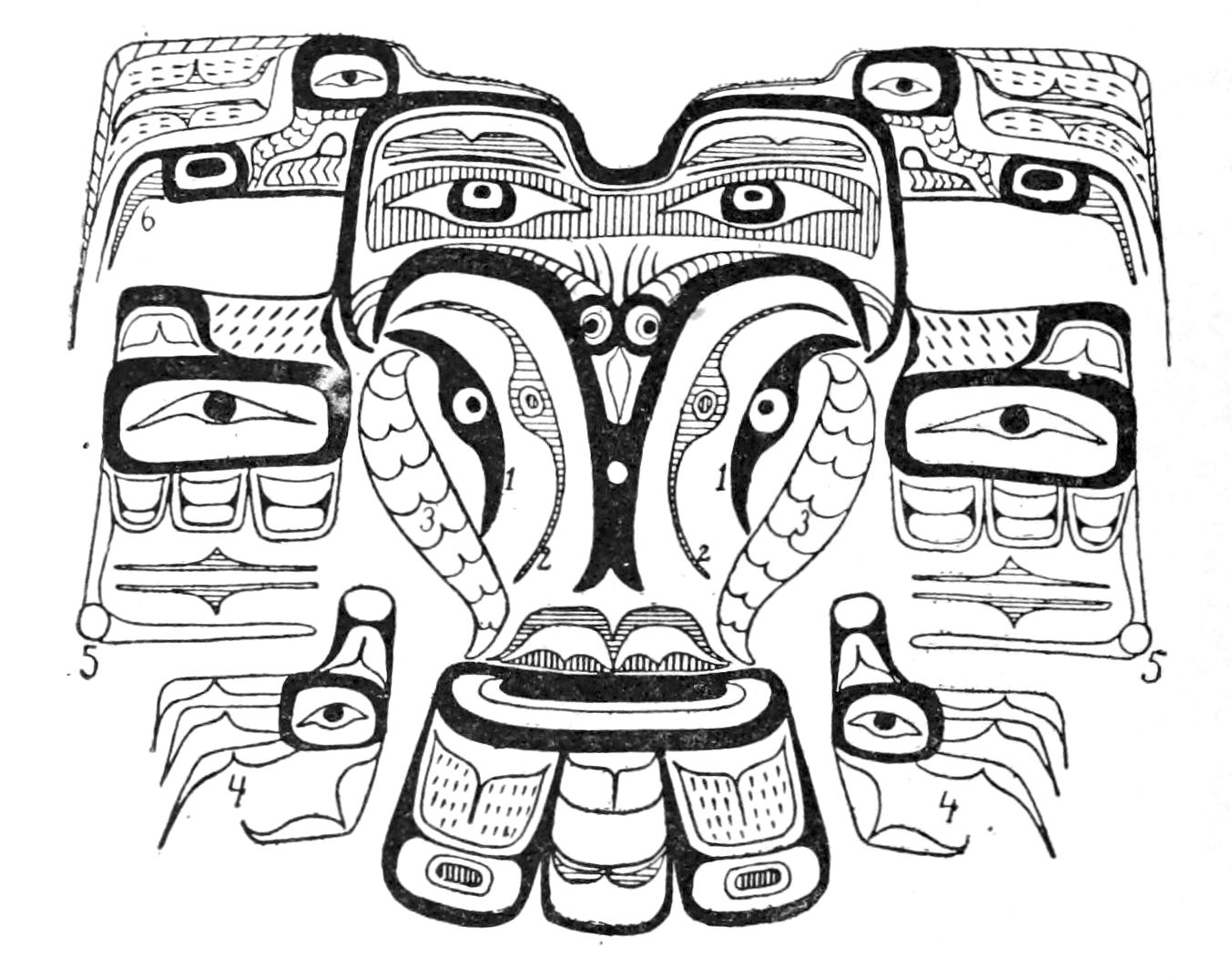
Fig. 253. Painting for a house-front representing a raven, Kwakiutl.
Fig. 253 is another house-painting of the Kwakiutl, representing the raven. The same principle as in fig. 251 has been adhered to by the artist. The central portion of the figure is occupied by the head of the raven split from its lower side upward so that the two halves cohere along the upper edge of the beak. The two halves of the head have been folded outward, so that the two halves of the tongues (2) and the two lower jaws (1) appear on each side of the central line. The two halves of the lower side of the body are shown extending in a curved line (3) from the corners of the mouth towards the tail, which latter has not been cut. The wings have been considerably reduced in size, and pulled upward so that they appear over each upper corner of the head. The legs (5) occupy the right and left lower parts of the painting, the feet (4) being disconnected from the thin legs.
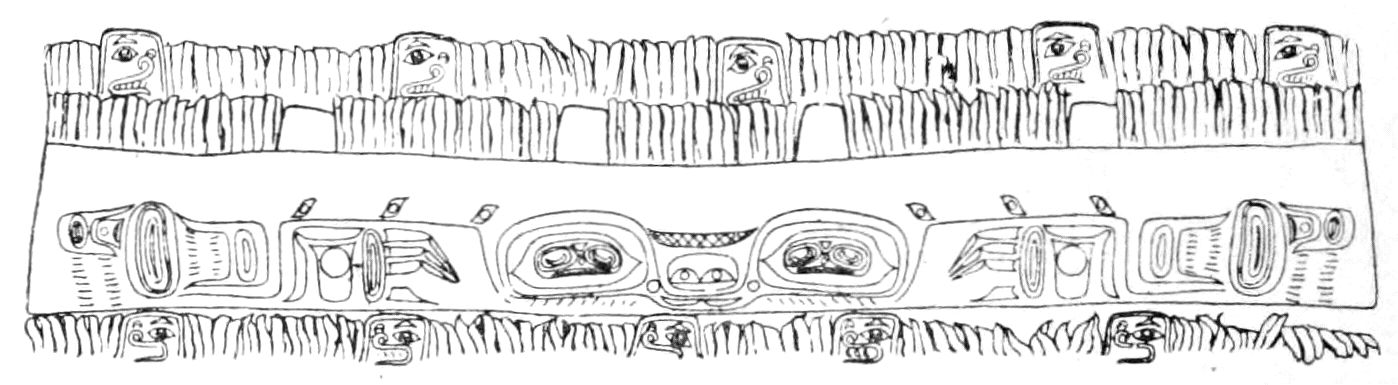
Fig. 254. Painting from the edge of a blanket representing a sea-monster, Northern British Columbia.
In fig. 254, which is a painting on the margin of a blanket, the sea-monster described in Fig. 183 (p. 199) is represented. The animal is shown here as split in two along its back; but all its parts, except the head, the paws, and the tail, are much reduced in size. The two enormous eyes, and between them the nose, will be readily recognized. The teeth are indicated by a series of slanting lines under each eye, but the lower jaws of both halves have been omitted. The whole body is represented by the thin line extending from the lower outer corner of the eyes upward, then along the upper margin of the painting, and downward again. The three dorsal fins are shown over this line,—one-half of each on each side of the back. The arms are indicated by two curves under the line indicating the back. The fin of the arm is shown under the fore arm. While all these are of small size, the paw which adjoins the fore arm is shown on a large scale, the claws turned towards the face. The line representing the body runs towards both ends of the painting along the lower margin until it is merged into the tail, one-half of which is shown on each side. In this specimen the proportions of the body are much more distorted than in any previous case.
The following series of figures are designs found on a number of silver bracelets. The animals represented on these are also shown very fragmentarily.
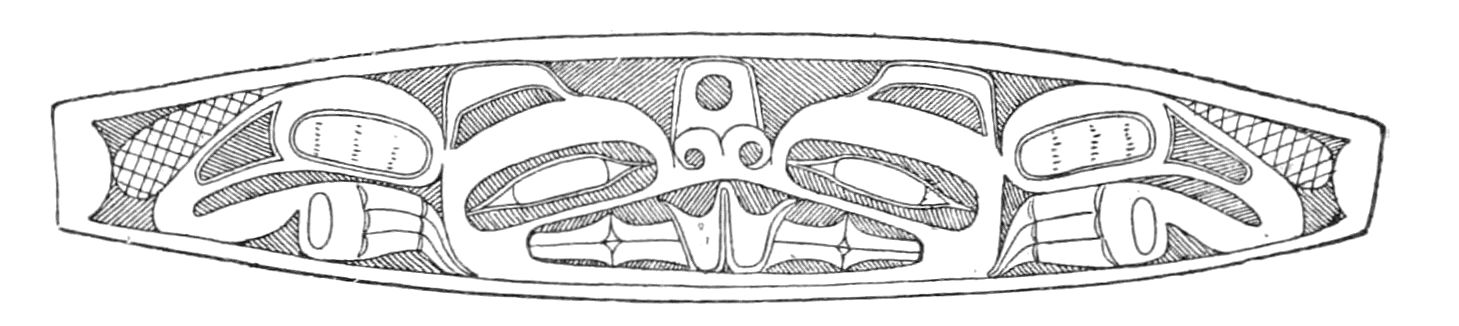
Fig. 255. Design on a silver bracelet representing a beaver, Haida.
In fig. 255 we see the beaver cut in two along its back. The face does not need any further explanation. The fore legs adjoin it on each side, the toes being turned inward; but the whole rest of the body has been omitted, except the two halves of the tail, which the artist was compelled to show, because they are symbols of the animal.
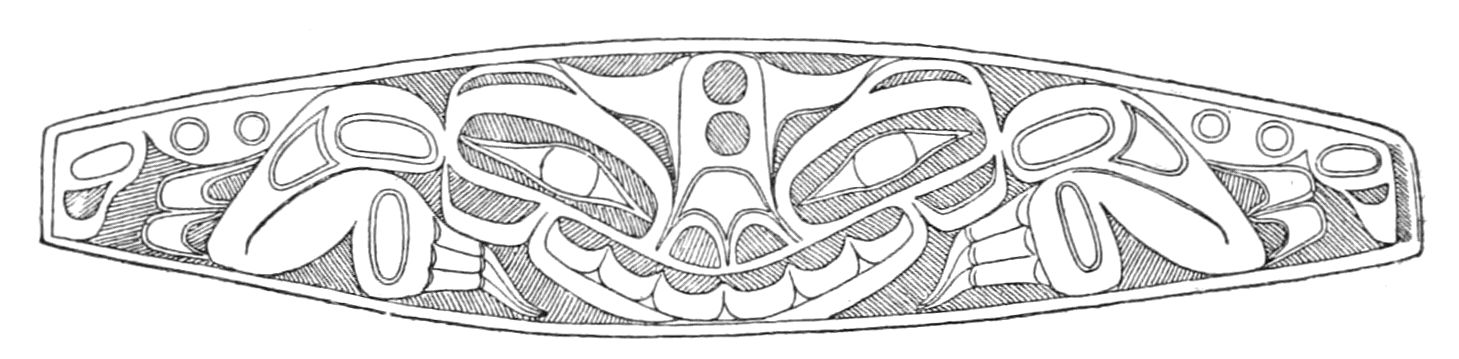
Fig. 256. Design on a silver bracelet representing a sea-monster, Haida.
In fig. 256 we recognize the sea-monster, with a bear’s head and a whale’s body. Here also by far the greater portion of the etching represents the head and fore arms of the monster. The fins, that are attached to the upper arms near the elbow, are shown on a rather small scale. The whole rest of the body is of small size, the two halves of the body, with the adjoining half of the tail, occupying only the outer upper margin of the bracelet. I am not quite clear whether the artist intended to represent the two halves of the dorsal fin by the curved ornament adjoining the hat which rises over the nose of the monster.
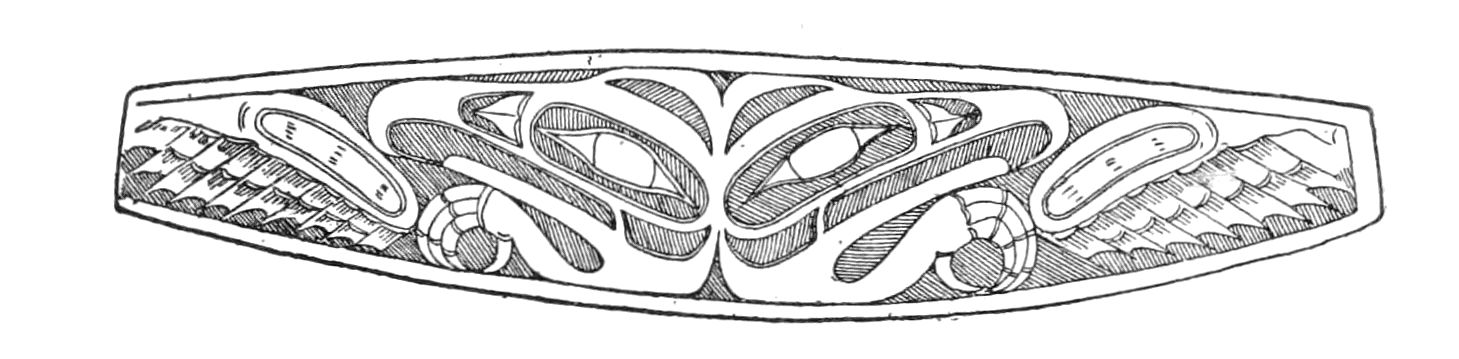
Fig. 257. Design on a silver bracelet representing a hawk, Haida.
The hawk which is shown in fig. 257 has been cut in a different manner, namely, from the beak backward, the two halves being then turned outward. The centre of the design is occupied by the two halves of the head, and the two talons which adjoin it. The wings are cut off from the body, and occupy the outer corners of the design.
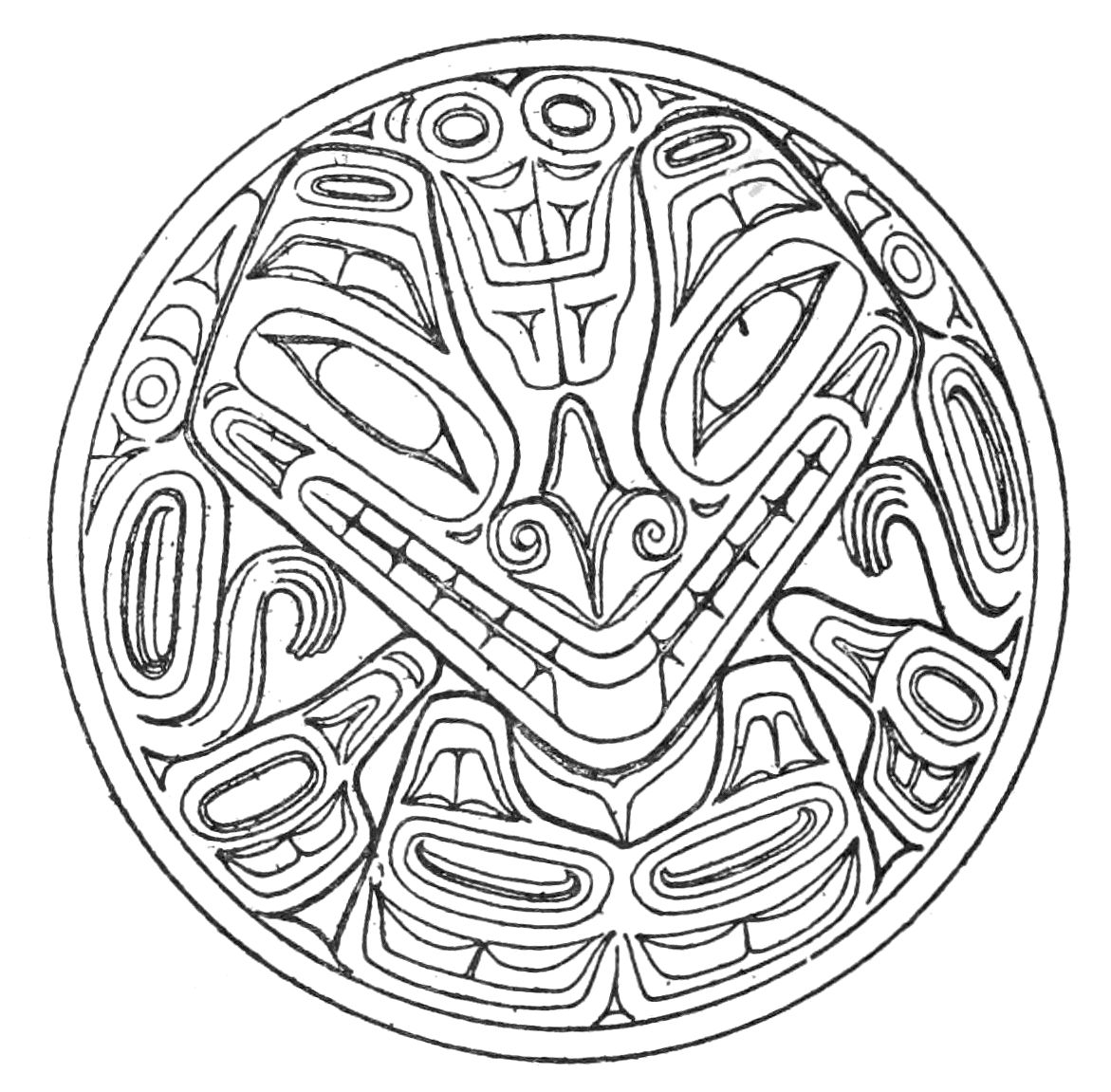
Fig. 258. Slate dish with design representing a sea-monster, Haida.
The designs on the following series of carvings are no less conventionalized. Fig. 258 is a sea-monster adjusted to a circular slate dish. The carving is perfectly symmetrical. The drawing appears asymmetrical because it has been taken from an eccentric point of view. Here also the centre is occupied by the head of the animal. The tail is seen under the lowest part of the mouth, turned upward in front of the body. The arms are shortened considerably. They are attached to the lower corners of the mouth, the paws touching the chin. The fins are joined to the upper part of the arms, and are turned upward so that they lie close to the sides of the face and about on a level with the ears. Attention is called again to the spiral nostrils.