Primitive Northwest.
Reading edition
Mr. C.W. Butterfield contributes an article on the Primitive Northwest, to last number of the American Antiquarian. He says that early in the seventeenth century French settlements, few in number, were scattered along the wooded shores of the river St. Lawrence in Canada. To the westward, upon the Ottowa river, and the Georgian bay, were the homes of Indian nations with whom these settlers had commercial relations, and among some of whom were located Jesuit missionaries. In the year 1615, Lake Huron was discovered. To it was given the name of the Fresh Sea (Mer Douce). But, as yet, no white man had set foot upon any portion of what now constitutes the States of Ohio, Indiana, Illinois, Michigan, Wisconsin, and Eastern Minnesota. And thereafter, for nearly a score of years this whole region remained, so far as the visitation of white men was concerned, an undiscovered country; and such it continued down to the year 1684. However, previous to this date, something had been learned by the French settlers upon the St. Lawrence, of this (to them) far off land; but the information has been obtained wholly from the Indians. This knowledge was of necessity crude and, to a considerable extent, uncertain. Such of it as has been preserved is properly treated of under the following heads: First, as to what had been gleaned concerning the physical aspects of the country; second, as to what had been brought to light relative to the various tribes inhabiting this region.
Previous to 1634, nothing had been learned of Lake Erie, Lake St. Clair, or Lake Michigan although it was understood there was some kind of a water-way connecting the Fresh Sea (Lake Huron) with Ontario. A little knowledge had been gained of a great body of fresh water lying beyond the "Mer Douce," "a grand lac," so called by the French—now known as Lake Superior. The length of this superior lake with that of the Fresh Sea (Lake Huron), the Indians declared was a journey of full thirty days in canoes. At the outlet of the great lake was what was described by the savages, as a considerable rapid, to which the French gave the name of "Sault de Gaston," the present Sault St. Marie, in the St. Mary's river, the stream, which, it is well known, flows from Lake Superior into Lake Huron.
Accounts also had been received from the Indians prior to the year last mentioned, of a lake of no great size, through which flowed a river discharging its waters into the Fresh Sea (Lake Huron). These were reports of Lake Winnebago and Fox river, in what is now the State of Wisconsin. As the French upon the St. Lawrence had no knowledge as yet of Lake Michigan, they imagined the location of this small lake, and its river was beyond, and to the northwest of Lake Huron and that they emptied into it; Green Bay into the head of which Fox river really flows, being (like Lake Michigan) wholly unknown to them.
It had further been reported by the Indians before this date that there was a mine of copper on an island in what has been mentioned as probably Lake Winnebago; doubtless, however, this island should have been located in Lake Superior. A specimen of native copper had as early as 1610, been exhibited by an Indian to an interested Frenchman upon the St. Lawrence, and an account given by him as to the rude method employed by the savages in melting that metal. But other islands besides the one containing the copper mine had been brought to the knowledge of the French settlers. A large one southeast of the "Sault de Gaston" being described, and two smaller ones, to the south of it. These islands were, it is suggested, the Great Manitoulin, Drummond, and Little Manitoulin, of the present day.
Dr. Leeds has said that spices were adulterated to a great extent, but only such substances were added as were purely non-poisonous. Mustards were never found to be pure. Vinegars were also highly adulterated. Competent officers, who shall be specialists, should be appointed in each State to examine manufactured and natural foods to detect adulteration. So far these examinations have been made by college professors. The State Boards of Health should take the matter in hand and see that it has the proper attention.
A French periodical, La Culture, gives the following simple method for testing the purity of water. In an ordinary quart bottle three parts filled with water dissolve a spoonful of pure white sugar, cork it well and put it in a warm place. If at the end of forty-eight hours the water becomes turbid and milky there can be no doubt of its impurity, but if it remains limpid it may be considered safely drinkable.
The Prairie Farmer AND Youth's Companion One Year, $3 for the two.
It is not required that both papers be sent to one address, nor to the same post-office.
Address Prairie Farmer Pub. Co., 150 Monroe Street, Chicago.
Political talk is generally very eloquent, but it lacks the insignificant element of truthfulness. A great deal of the buncombe of politics reminds us of the lines of Lord Neaves, not long since deceased:
[Transcriber's note: This is where the article ends in the original and the lines in question are not to be found in the rest of the periodical.]
PUBLISHERS' NOTICE.
THE PRAIRIE FARMER is printed and published by The Prairie Farmer Publishing Company, every Saturday, at No. 150 Monroe Street.
Subscription, $2.00 per year, in advance, postage prepaid. Subscribers wishing their addresses changed should give their old as well as new addresses.
Advertising, 25 cents per line on inside pages; 30 cents per line on last page—agate measure; 14 lines to the inch. No less charge than $2.00.
All Communications, Remittances, etc., should be addressed to The Prairie Farmer Publishing Company, Chicago, Ill.
Entered at the Chicago Office as Second-Class Matter.
CHICAGO, JANUARY 5, 1884.
[Transcriber's Note: Original location of Table of Contents.]
RENEW! RENEW!!
Remember that every yearly subscriber, either new or renewing, sending us $2, receives a splendid new map of the United States and Canada—58 × 41 inches—FREE. Or, if preferred, one of the books offered in another column. It is not necessary to wait until a subscription expires before renewing.
1841.1884.
The Prairie Farmer
PROSPECTUS FOR 1884.
SEE INDUCEMENTS OFFERED
SUBSCRIBE NOW.
For forty-three years The Prairie Farmer has stood at the front in agricultural journalism. It has kept pace with the progress and development of the country, holding its steady course through all these forty-three years, encouraging, counseling, and educating its thousands of readers. It has labored earnestly in the interest of all who are engaged in the rural industries of the country, and that it has labored successfully is abundantly shown by the prominence and prestige it has achieved, and the hold it has upon the agricultural classes.
Its managers are conscious from comparison with other journals of its class, and from the uniform testimony of its readers, that it is foremost among the farm and home papers of the country. It will not be permitted to lose this proud position; we shall spare no efforts to maintain its usefulness and make it indispensable to farmers, stock-raisers, feeders, dairymen, horticulturalists, gardeners, and all others engaged in rural pursuits. It will enter upon its forty-fourth year under auspices, in every point of view, more encouraging than ever before in its history. Its mission has always been, and will continue to be—
To discuss the most approved practices in all agricultural and horticultural pursuits.
To set forth the merits of the best breeds of domestic animals, and to elucidate the principles of correct breeding and management.
To further the work of agricultural and horticultural organization.
To advocate industrial education in the correct sense of the term.
To lead the van in the great contest of the people against monopolies and the unjust encroachments of capital.
To discuss the events and questions of the day without fear or favor.
To provide information concerning the public domain, Western soil, climate, water, railroads, schools, churches, and society.
To answer inquiries on all manner of subjects coming within its sphere.
To furnish the latest and most important industrial news at home and abroad.
To give full and reliable crop, weather, and market reports.
To present the family with pure, choice, and interesting literature.
To amuse and instruct the young folks.
To gather and condense the general news of the day.
To be, in brief, an indispensable and unexceptionable farm and home companion for the people of the whole country.
The style and form of the paper are now exactly what they should be. The paper used is of superior quality. The type is bold and clear. The illustrations are superb. The departments are varied and carefully arranged. The editorial force is large and capable. The list of contributors is greatly increased, and embraces a stronger array of talent than is employed on any similar paper in this country. We challenge comparison with any agricultural journal in the land.
The Prairie Farmer is designed for all sections of the country. In entering upon the campaign of 1884, we urge all patrons and friends to continue their good works in extending the circulation of our paper. On our part we promise to leave nothing undone that it is possible for faithful, earnest work—aided by money and every needed mechanical facility—to do to make the paper in every respect still better than it has ever been before.
SPECIAL NOTICE
To each Subscriber who will remit us $2.00 between now and February 1st, 1884, we will mail a copy of THE PRAIRIE FARMER for One Year, and one of our New Standard Time Commercial Maps of the United States and Canada—showing all the Counties, Railroads, and Principal Towns up to date. This comprehensive map embraces all the country from the Pacific Coast to Eastern New Brunswick, and as far north as the parallel of 52 deg., crossing Hudson's Bay. British Columbia; Manitoba, with its many new settlements; and the line of the Canadian Pacific Railway, completed and under construction, are accurately and distinctly delineated. It extends so far south as to include Key West and more than half of the Republic of Mexico. It is eminently adapted for home, school, and office purposes. The retail price of the Map alone is $2.00. Size, 58x41 inches. Scale, about sixty miles to one inch.
READ THIS.
Another Special Offer.
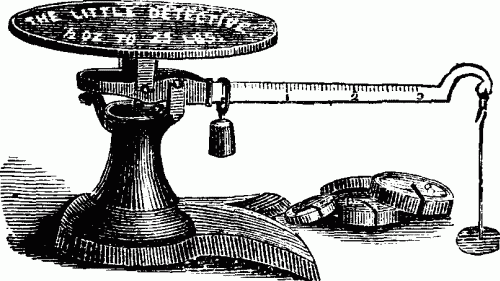
"The Little Detective."
Weighs 1-4 oz. to 25 lbs.
Every housekeeper ought to have this very useful scale. The weight of article bought or sold may readily be known. Required proportions in culinary operations are accurately ascertained. We have furnished hundreds of them to subscribers, and they give entire satisfaction. During January, 1884, to any person sending us THREE SUBSCRIBERS, at $2.00 each, we will give one of these scales, and to each of the three subscribers Ropp's Calculator, No. 1.
A meeting of farmers interested in ensilage will be held at 55 Beekman street, New York, Wednesday, January 23, at 12 o'clock. All interested in the subject are invited to attend.
The Iowa State Horticultural Society will hold its annual meeting at Des Moines, January 15-18. Prof. J.L. Budd, Ames, will forward programmes on application. The usual reductions in railway and hotel fares are expected.
Professor S.R. Thompson, Superintendent of the Nebraska Agricultural College farm, has been chosen to represent Nebraska at the meeting to be held at Washington, D.C., next week, for the purpose of taking action in regard to contagious diseases of cattle. He requests stock men and all others interested in the cattle industries of his State to correspond with him, and make such suggestions as they may think proper for guidance at the meeting.
Since its organization in 1853 to 1882 inclusive, the managers of the Illinois State Fair have offered the following amounts in premiums for live stock: Cattle, $70,406; horses and mules, $81,825; sheep, $24,450; swine, $25,320; poultry, $8,214;—total $210,215, which must be considered pretty substantial encouragement. The total offered in premiums for all classes of exhibits has been $303,961. Thus a little more than two thirds of the entire amount has been given to the breeders and importers of stock.
The officers of the Northwestern Dairymen's Association say that every indication warrants the conclusion that the coming convention at Mankato, Minn., commencing February 12, will prove the grandest success in the history of the association. A full array of the best dairy talent of the entire Northwest will be present. The purpose is both in the arrangement of the programme and in the conduct of the discussions, to make of the coming convention an institute for study and instruction which no intelligent and progressive farmer can afford to miss.
The Missouri State Board of Agriculture asks the aid of one competent man in every township in the State to give it estimates of crops, etc., in his vicinity. The aim is to give as full and reliable statistics for crop reports as it is possible to collect. The State provides but $1,250 for the general expenses of the Board, and it is thus dependent upon voluntary aid in the matter. The Board will defray all expenses of postage and stationery. Competent persons willing to undertake this work for the public good should address J.W. Sanborn, Secretary, Columbus, Mo. Such persons will receive, free, the monthly and annual reports of the Board.
In March of last year Secretary Fisher, of the Illinois State Board of Agriculture, submitted his report for 1882 to Gov. Hamilton. This report has just made its appearance. It has taken the State printer ten months to get the volume printed and bound for distribution, a work that any respectable job office in Chicago would have turned out in four weeks without any extra exertion. The report is valuable, of course, but it would have been worth a deal more had it appeared last April. Such papers as the report of Prof. Forbes, State Entomologist, for instance, might have been of immense benefit to the people of the State if the information it contains regarding noxious insects had reached them in early spring.