Field and Furrow.
Reading edition
Says the Iowa Register: One hundred bushels of corn will shrink to ninety in the crib, and to an extent more than that, depending on the openness of the crib and the honesty of the neighbors.
The agricultural editor of the New York Times says that no doubt many farmers who are intending to underdrain their farms would save money by employing an expert at the first to lay out the whole system and make a good beginning, and so avoid any possible mistake, which might cost ten dollars for every one paid for skilled advice.
The New York Times says that lime seems to be a preventive of rot in potatoes in the cellar. Some potatoes that were rotting and were picked out of a heap of forty or fifty bushels were put into a corner and well dusted with air-slaked lime. They stopped rotting at once, and the decayed parts are now dried up. There is no disagreeable smell about them.
Cincinnati Gazette: It is remarked that when young hogs are fed mainly on corn they stop growing at an early age and begin to grow fat; but that green food makes them thriftier and larger than dry grain. In fact, it is better to prevent all domestic animals from becoming very fat until they have attained a fair natural size, particularly breeding animals.
A member of the Elmira Farmers' Club recently expressed the opinion that bad results would always be found with wheat sown on land into which the green growth of any crop had just been turned, although it was believed that buckwheat was the worst green manure. All green growth incorporated with the soil near the time of seeding will in all cases be found prejudicial to wheat.
It is announced that Robert Clarke, of Cincinnati will have ready, in February, an extensive work on sorghum, containing the results of the latest experiments and experience of the most successful growers, as to the best varieties and their culture, and also the details of the latest and best machinery used in the economical manufacture of sirups and sugars therefrom. The work is by Prof. Peter Collier, whose name is a guarantee of the value of the book. It will be very fully illustrated.
A Michigan man writes the Michigan Farmer: I have noticed tarred twine and willows recommended for binding corn stalks. I think I can propose a better substitute than either for those who are using a twine binder: save the strings from straw stacks this winter. They are less trouble than grass and never slip. Tie a knot in the end of the twine with your knee on the bundle, then slip the other end through in the form of a bow, take off your knee and the spring of the bundle will draw the knot tight. Pull the bow and use again.
"Human labor," says Dr. Zellner, of Ashville, Ala., "is the most costly factor that enters into the production of cotton, and every consistent means should be adopted to dispense with it." And then the doctor, who has the reputation of having raised some of the finest samples ever grown in the South, describes how, by planting at proper distances, in checks five by three apart, one-half of the after labor of cultivating may be saved. About the same amount of plow work is said to be necessary, but not more than one-fourth as much work with the hoe as is required by cotton in drills.
Prof. J.W. Sanborn: "Deep tillage in times of drought of surface-rooted crops, like corn, is an erroneous practice, founded on erroneous views. 'Plowing out corn' not only involves too deep tillage in drought but adds to the mischief by severing the roots of corn, needed at such times. Our double-shovel plows work too deeply. Our true policy, in drought, for corn is frequent and shallow tillage. For this we now have after the corn gets beyond the smoothing harrow, no suitable implement on our markets, with a possible exception."
Correspondent New York Tribune: Of the use of oatmeal for cows mention is not often made in this country; but when spoken of it is always with praise. That it is better than corn meal there can be no doubt; it is richer in both albuminoids and fat; and the usefulness of these two nutriments, and especially the former, for making milk is shown not only by the results of numerous careful experiments, but by the acknowledged usefulness of oil-cake meal. Where this meal is used freely there would be less use for oatmeal; but under some circumstances it might be advantageously substituted for the bran in the favorite mixture for cows of Indian meal and bran.
The following paragraph appears in an English cotemporary: The introduction of a new industry connected with farming into Ireland will be hailed by everybody, and therefore we rejoice to learn that a company has been formed with the design of purchasing or renting nearly a million and a quarter acres of land in Ireland, and devoting them to beet culture, from which the sugar will be extracted in a manufactory erected on the land. The promoters of the new company expect that from the 120,000 acres which they propose cultivating they will produce 400,000 tons of sugar in the year. Immense quantities of sugar extracted from the beet-root are manufactured on the continent and imported into these countries, and there is no reason whatever why Ireland should not have her finger in the sugar pie.
In a paper before the Oxford (Ohio) Farmers' Club, on the subject "The Morality of the System of Grain Gambling," Mr. Wetmore said: There is a difference between speculation and investment. Putting money into an established industry is an investment. Putting it into a doubtful or untried business, with the hope of gaining much or risk of losing all, is speculation. The latter is infatuating as it increases the risk and yet turns to profit. Investments pay no high per cents. Speculations may pay much or lose all. Hence it is unsafe; and the farmer who makes his gains only by a yearly turn of his crops, should not try speculation, but may judiciously invest his surplus year by year in things of real value, as land or chattels. Invest the last dollar, but speculate only with loose change. No man can safely invest in a business with which he is not familiar.
A lawful wire fence in Georgia is described by legislative enactment as composed of not less than six horizontal strands of barbed wire tightly stretched from post to post. The first wire no more than four and a half nor less than three and a half inches from the ground; the second wire not more than nine and a half nor less than eight and a half inches from the ground; the third wire not more than fifteen and a half nor less than fourteen and a half inches from the ground; the fourth wire not more than twenty-two and a half nor less than twenty-one and a half inches from the ground; the fifth wire not more than thirty-two nor less than thirty-one inches from the ground; the sixth wire not over fifty-five nor less than fifty-three inches from the ground. Posts to be not over ten feet apart, and every alternate post to be securely set in the ground. Provided, a plank not less than ten inches wide shall be used instead of two strands of wire at bottom of fence, it is also required that a railing shall be placed at equal distance between the two top wires, which shall answer the same purpose as a wire, and to extend from post to post in like manner.
Correspondent Country Gentleman: I notice that your journal recently gave currency to the "saltpetre method" of extracting stumps, and W.H. White also recommends it in your columns. His method is to bore a hole in the stump in the fall of the year, fill in the hole with saltpetre, plug up till the following summer, then fill the hole with kerosene and fire the stump. It is alleged that the saltpetre and kerosene will so saturate the stump that it will be entirely consumed, roots and all. This recipe has been floating around the press for years. It is usually credited to the Scientific American, but that paper has several times denied its paternity. The uselessness of the process can easily be learned by trial. There are few more inflammable substances than pitch and turpentine. The roots of pine stumps are saturated with these, but it is impossible to burn them out. The addition of saltpetre would not help much. Yet there are seasons when the soil and air are so dry that hard wood stumps may be burned out without either saltpetre or kerosene. We had such a year in 1881, when corn and clover standing uncut in the field were burned. In some instances the curbing was burned out of wells during terrible forest fires that raged in Michigan. If tried in such a season the recipe would undoubtedly be successful. In any ordinary season it is "no good."
No matter how wretched a man may be, he is still a member of our common species, and if he possesses any of the common specie his acquaintance is worth having.
FARM MACHINERY, Etc.
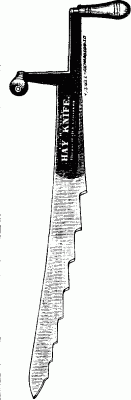
GREAT SAVING FOR FARMERS.
THE Lightning Hay Knife!
(Weymouth's Patent.)

Awarded "FIRST ORDER OF Merit" at Melbourne Exhibition, 1880.
Was awarded the first premium at the International Exhibition in Philadelphia, 1876, and accepted by the Judges as Superior to Any Other Knife in Use.
It is the BEST KNIFE in the world to cut fine feed from bale, to cut down mow or stack, to cut corn-stalks for feed, to cut peat, or for ditching in marshes, and has no equal for cutting ensilage from the silo. TRY IT.
IT WILL PAY YOU.
Manufactured only by HIRAM HOLT & CO., East Wilton, Me., U.S.A.
For sale by Hardware Merchants and the trade generally
SEDGWICK STEEL WIRE FENCE
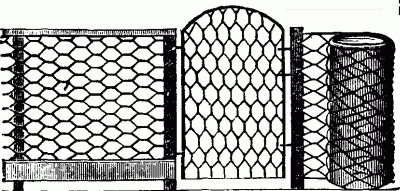
It is the only general-purpose Wire Fence in use, being a strong net work without barbs. It will turn dogs, pigs, sheep and poultry, as well as the most vicious stock, without injury to either fence or stock. It is just the fence for farms, gardens stock ranges, and railroads, and very neat for lawns, parks, school lots and cemeteries. Covered with rustproof paint (or galvanized) it will last a life time. It is superior to boards or barbed wire in every respect. We ask for it a fair trial, knowing it will wear itself into favor. The Sedgwick Gates, made of wrought iron pipe and steel wire, defy all competition in neatness, strength, and durability. We also make the best and cheapest all iron automatic or self-opening gate, also cheapest and neatest all iron fence. Best Wire Stretcher and Post Auger. For prices and particulars ask hardware dealers, or address, mentioning paper, SEDGWICK BROS. Manf'rs. Richmond. Ind.

CHICAGO SCALE CO.
2 TON WAGON SCALE, $40. 3 TON, $50.
4 Ton $60, Beam Box Included.
240 lb. FARMER'S SCALE, $5.
The "Little Detective," 1/4 oz. to 25 lb. $3.
300 OTHER SIZES. Reduced PRICE LIST FREE.
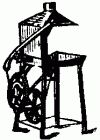
FORGES, TOOLS, &c.
BEST FORGE MADE FOR LIGHT WORK, $10,
40 lb. Anvil and Kit of Tools. $10.
Farmers save time and money doing odd jobs.
Blowers, Anvils, Vices & Other Articles
AT LOWEST PRICES, WHOLESALE & RETAIL.
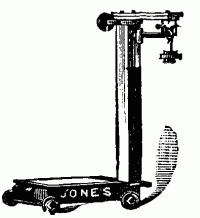
FIVE-TON
WAGON SCALES $60
All Iron and Steel, Double Brass Tare Beam. Jones he pays the freight. All sizes equally low, for free book, address
JONES OF BINGHAMTON, Binghamton, N.Y.
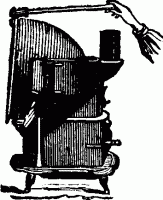
THE PROFIT FARM BOILER
is simple, perfect, and cheap; the BEST FEED COOKER; the only dumping boiler; empties its kettle in a minute. Over 5,000 in use; Cook your corn and potatoes, and save one-half the cost of pork Send for circular. D.R. SPERRY & CO., Batavia, Illinois.
FARM IMPLEMENTS, Etc.
THE CHICAGO DOUBLE HAY AND STRAW PRESS
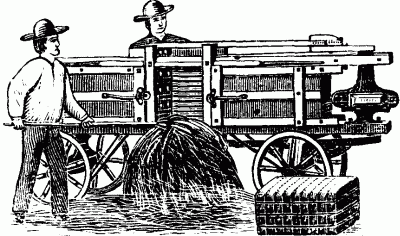
Guaranteed to load more Hay or Straw in a box car than any other, and bale at a less cost per ton. Send for circular and price list. Manufactured by the Chicago Hay Press Co., Nos. 3354 to 3358 State St., Chicago. Take cable car to factory. Mention this paper.
Sawing Made Easy
Monarch Lightning Sawing Machine!
Sent on 30 Days test Trial.
A Great Saving of Labor & Money.
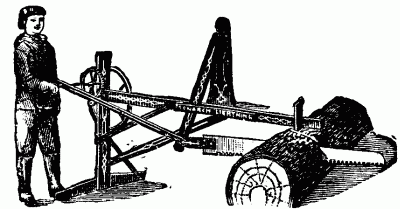
A boy 16 years old can saw logs FAST and EASY. Miles Murray, Portage, Mich. writes, "Am much pleased with the MONARCH LIGHTNING SAWING MACHINE. I sawed off a 30-inch log in 2 minutes." For sawing logs into suitable lengths for family stove-wood, and all sorts of log-cutting, it is peerless and unrivaled. Illustrated Catalogue, Free. AGENTS WANTED. Mention this paper. Address MONARCH MANUFACTURING CO., 163 N. Randolph St., Chicago, Ill.
BEST MARKET PEAR.
99,999 PEACH TREES All best varieties of new and old Strawberries, Currants, Grapes, Raspberries, etc.
EARLY CLUSTER
New Blackberry, early, hardy, good. Single hill yielded 13 quarts at one picking. Send for free Catalogue.
J.S. COLLINS, Moorestown, N.J.
CHAMPION BALING PRESSES.

A Ton per Hour. Run by two men and one team. Loads 10 to 15 tons in car.
Send for descriptive circular with prices, to Gehrt & Co., 216, 218 and 220 Maine St., Quincy, Ill.
"THE BEST IS THE CHEAPEST."
ENGINES, SAW MILLS, THRESHERS, HORSE POWERS,
(For all sections and purposes.) Write for Free Pamphlet and Prices to The Aultman & Taylor Co., Mansfield, Ohio.
NOW READY FOR DISTRIBUTION.
Volumes One and Two
of the
NATIONAL REGISTER NORMAN HORSES
The most reliable, concise, and exhaustive history of the horse in general, and by far the most complete and authentic one of the Norman horse in particular, ever published in the United States.
PRICES:
Volume I.........................................$ 2.00
Volume II........................................ 1.50
When the two volumes are sent in one package to one address, $3.00. Sent, postpaid, on receipt of price.
Address your orders to
PRAIRIE FARMER PUBLISHING CO., Chicago
THE MODERN HORSE DOCTOR.
CONTAINING Practical Observations on the Causes Nature and Treatment of Diseases and Lameness in Horses, by Geo. H. Dadd, M.D. Will be sent upon receipt of price, $1.50; or free to any sender of three subscribers to this paper, at $2 each, by
PRAIRIE FARMER PUBLISHING CO., Chicago.
MISCELLANEOUS.
DIAMONDS FREE!
We desire to make the circulation of our paper 250,000 during the next six months. To accomplish which we will give absolutely free a genuine first water Diamond Ring, and the Home Companion for one year, for only $2.00. Our reasons for making this unprecedented offer are as follows;
A newspaper with 200,000 subscribers can get 1c. per line per 1,000 of circulation for its advertising space, or $5,000 per issue more than it costs to produce and mail the paper. With but 10,000 or 20,000 subscribers, its advertising revenues do not pay expenses. Only the papers with mammoth circulations make fortunes for their owners, derived from advertising space. For these and other reasons, we regard 100,000 subscribers as being of more financial benefit to a paper than the paper is to the subscribers. With 100,000 or 200,000 bona-fide subscribers, we make $100,000 to $200,000 a year clear profit from advertising, above cost of publishing. Without a large circulation, we would lose money. Therefore, to secure a very large circulation, and thus receive high rates and large profits from advertising space, this only equitable plan of conducting business is adopted.
The first question to be answered is,—is the diamond pure—a genuine stone?
Our answer is YES.
The stone is GUARANTEED to be no Alaska Diamond, Rhine Pebble, or other imitation, but a
WARRANTED GENUINE AND PURE DIAMOND.
If it is not found so by the most careful and searching tests, we will refund the money, enter the subscriber's name on our list, and have the paper mailed to him free during its existence. To the publisher of this paper has been sent a guarantee from the manufacturing Jeweler, from whom we obtain these rings, that they are just as represented, so that readers may rely upon the promises being fulfilled to the letter.
The second question is, IS THE PAPER A DESIRABLE FAMILY JOURNAL? YES. It contains contributions from the first writers of the times: fiction, choice facts, intellectual food of the most interesting, instructive and refined character. It is one of the
LEADING PAPERS OF THE PROGRESSIVE WEST.
We are determined to make it the most desirable and reliable paper in the United States; will spare no effort or money to achieve that object. Sample Copies sent free on application. Remit by draft, express, or new postal note, to
THE HOME COMPANION. N.W. Cor. Fourth and Race Streets, Cincinnati, O.
Don't fail to name the paper in which you see this advertisement.
REMEMBER that $2.00 pays for The Prairie Farmer from this date to January 1, 1884; $2.00 pays for it from this date to January 1, 1885. For $2.00 you get it for one year and a copy of The Prairie Farmer County Map of the United States, free! This is the most liberal offer ever made by any first-class weekly agricultural paper in this country.