JOSEPH F. GLIDDEN.
Reading edition
The Barb-Wire Industry—Some Facts in its Early History not Generally Known—Its Growth.
Joseph Farwell Glidden, "the Father of the Barb-Wire Business" of this country, is now a hale and hearty man of seventy-one. He was born at Charleston, N.H. When about one year old the family came West, to Clarendon, Orleans county, New York, and engaged in farming. The young lad, besides mastering the usual branches taught in the common schools, gave some time to the higher mathematics and Latin, intending to take a college course, an idea that he finally abandoned. He taught in the district schools for a few terms. In 1842 he came to Illinois and purchased a quarter section of land a mile west of what is now the site of the pleasant and prosperous town of DeKalb. With the exception of three years his life since then has been passed upon this farm and at DeKalb. He has from time to time added to his homestead, his farm now embracing 800 acres. His land is under excellent cultivation, a considerable portion of it having been thoroughly tiled, and his farm buildings are first-class. Mr. Glidden has been twice married. Two children were born of the first union, both dying in infancy. By his second marriage he has one daughter, now the wife of a Chicago merchant.
JOSEPH FARWELL GLIDDEN.
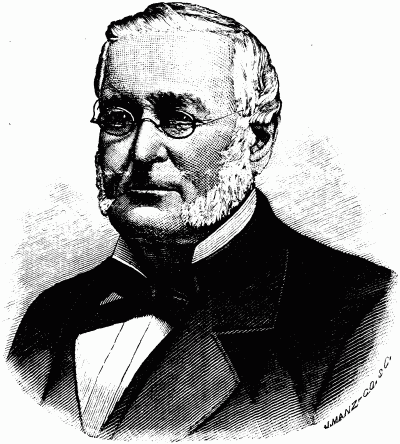
Mr. Glidden has held several local offices of trust and honor and enjoys in a marked degree the esteem and confidence of the citizens of his neighborhood and county. The rapid accumulation of property of late years, through his barb-wire patents and business, gave him the means to gratify his feelings of public spirit, and in consequence the town of DeKalb has benefited greatly at his hands. Its leading hotel and many other buildings are the work of his enterprise. Mr. Glidden has never lost the simple manners of the farm. He is unostentatious, quiet, genial, and at his hotel makes everybody feel as much at home as though enjoying the hospitalities of his private house. His kindly, firm, and intelligent face is well shown in the accompanying portrait, though, as is usually the case, the hand of the artist has touched his features more lightly than has the hand of time.
Few names are now more widely known among the land holders of the country than that of Joseph F. Glidden, the unpretending gentleman whose life we have briefly sketched. It was his fortune to seize upon an idea, and push it to development, which has not only given him fame and fortune, but which has enriched many others and saved many millions of dollars to the farmers of America. He has not only founded a mammoth industry, but he has revolutionized an economic system of the world. By his ingenuity and perseverance the fencing system of a pastoral continent has been reduced to a minimum of expense and simplicity. Not that he individually has accomplished all this, but as the patentee of the first really successful barb-wire fence, he laid the solid foundation for it all.
The first application for a patent for the Glidden barb was filed October 27, 1873. For some weeks previous to this date Mr. Glidden had had in his mind the idea of a barb of wire twisted about the main wire of the fence, leaving two projecting points on opposite sides. He made some of these by hand with the aid of pinchers and hammer. He strung two wires between two trees and twisted them together with a stick placed between them. A pair of cutting nippers was the next addition to his "kit" of tools. His next means for twisting the two wires together was the grindstone—attaching one end of the wire to shaft and crank, the others being fastened to the wall of the barn. And here, as in most things great and small in this world, woman furnished the motor power. The strong arm of the good helpmeet, Mrs. Glidden, turned the grindstone that twisted the first wire that made the first Glidden barb fence that kept stock at bay in Illinois or the world. Then followed a device for twisting and barbing, and the application of horse power. Business expanded, and steam took the place of the horse, and inventive genius modified and improved the entire machinery, it being estimated that at least the sum of $1,000,000 has been expended in bringing the machinery for barb-wire making to its present state of perfection.
At about the same time that Mr. Glidden was wrestling with his ideas and devices, Mr. I.L. Ellwood was experimenting to accomplish a like result with a thin band of metal, the barbs cut and curved outward from the strip. In the meantime Mr. Glidden had put up a few rods of his hand-made barb-wire along the roadside at his farm. And here again the good genius of woman enters upon the scene. One Sunday Mr. Ellwood and his wife were driving along this road and attracted by the wire fence stopped to examine it. Mrs. Ellwood, much to the chagrin of her husband, remarked: "This seems to me a better device than your own, don't it to you?" It did not then, for the remark disappointed and angered him. But it set him to thinking and before the next morning he was of the same opinion. The two men meeting the next day it did not take long to compromise and unite. Mr. Ellwood dropped his own plans and accepted a half interest in the Glidden patents, and assumed the management of the business end of the concern, in which position he developed ability and tact possessed by few business men in this country.
The barb-wire fence met an unexpected and general demand. We know of few things like it in the history of manufactures. From this small beginning, scarce ten years ago more than fifty large establishments are now turning out this wire to meet an ever insatiate demand. The establishment of I.L. Ellwood (making the Glidden wire) at DeKalb is the most complete and extensive of them all. The building is 800 feet in length, and is supplied with about 200 machines for twisting and barbing the wire. It gives, when running full force, employment to about 400 men, and turns out a car-load of wire each hour for ten hours per day, on an average, though this amount is considerably increased at certain times of the year. These figures, though not given us by Mr. Ellwood, we are satisfied do not overstate the production of this one factory. The progress of the barb-wire industry of the whole country is shown by the following record of the past nine seasons. In
1874 there were 10,000 lb made and sold. 1875 there were 600,000 lb made and sold. 1876 there were 2,840,000 lb made and sold. 1877 there were 12,863,000 lb made and sold. 1878 there were 26,655,000 lb made and sold. 1879 there were 50,337,000 lb made and sold. 1880 there were 80,500,000 lb made and sold. 1881 there were 120,000,000 lb made and sold. 1882 there were about 180,000,000 lb.
The record for 1883 is not yet made up, but will probably show a corresponding increase.
In 1876 Mr. Glidden disposed of his half interest in the concern of Glidden & Ellwood to the Washburn & Moen (wire) Manufacturing Company, of Massachusetts, receiving therefor $60,000 in cash and a royalty on the future goods manufactured, Mr. Ellwood retaining his interest. The new concern began the purchase of prior unused and conflicting patents involving itself in extensive litigation, but, sustained by the courts, soon gained control of almost the entire barb-wire business of the country. Nearly all wire-making companies are now running under license from the parent concern. The following is a list of the licensees of last year:
Pittsburg Hinge Co.—Limited, Beaver Falls, Pa.
H.B. Scutt & Co., Buffalo, N.Y.
Hawkeye Steel Barb Fence Co., Burlington, Iowa.
James Ayers and Alexander C. Decker, Bushnell, Ill.
Indiana Wire Fence Co., Crawfordsville, Ind.
Cedar Rapids Barb Wire Co., Cedar Rapids, Iowa.
Cincinnati Barbed Wire Fence Co., Cincinnati, Ohio.
Cleveland Barb Fence Co., Cleveland, Ohio.
Ohio Steel Barb Fence Co., Cleveland, Ohio.
Edwin A. Beers & Co., Chicago, Ill.
Crandal Manufacturing Co., Chicago, Ill.
Chicago Galvanized Wire Fence Co., Chicago, Ill.
Lyman Manufacturing Co., Chicago, Ill.
Daniel S. Marsh, Chicago, Ill.
Oscar F. Moore, Chicago, Ill.
National Wire Co., Chicago, Ill.
Herman E. Schnabel, Chicago, Ill.
Aaron K. Stiles and John W. Calkins, Chicago, Ill.
Thorn Wire Hedge Co., Chicago, Ill.
Baker Manufacturing Co., Des Moines, Iowa.
Superior Barbed Wire Co., DeKalb, Ill.
Jacob Haish, DeKalb, Ill.
Frentress Barbed Wire Fence Co., East Dubuque, Ill.
Grinnell Manufacturing Co., Grinnell, Iowa.
Janesville Barb Wire Co., Janesville, Wis.
Iowa Barb Wire Co., Johnstown, Pa.
William J. Adam, Joliet, Ill.
Lock Stitch Fence Co., Joliet, Ill.
Lambert & Bishop Wire Fence Co., Joliet, Ill.
Alfred Van Fleet & A.H. Shreffler, Joliet, Ill.
David G. Wells, Joliet, Ill.
Southwestern Barb Wire Co., Lawrence, Kan.
Arthur H. Dale, Leland, Ill.
Union Barb Wire Co., Lee, Ill.
Lockport Wire Fence Co., Lockport, Ill.
Norton & DeWitt, Lockport, Ill.
Iowa Barb Steel Wire Fence Co., Marshaltown, Iowa.
Omaha Barb Wire Co., Omaha, Neb.
H.B. Scutt & Co.—Limited, Pittsburg, Pa.
Missouri Wire Fence Co., St. Louis, Mo.
St. Louis Wire Fence Co., St. Louis, Mo.
J.H. Lawrence & Co., Sterling, Ill.
North Western Barb Wire Co., Sterling, Ill.
Novelty Manufacturing Co., Sterling, Ill.
Sandwich Enterprise Co., Sandwich, Ill.
Robinson & Hallidie, San Francisco, Cal.
The Hazard Manufacturing Co., Wilkes Barre, Pa.
Worcester Barb Fence Co., Worcester, Mass.
When Glidden & Ellwood first began the sale of the Glidden fence, which was confined to the vicinity of DeKalb, they received 25 cents per pound for the barbed wire. Since then, as production has increased and the facilities for manufacturing have been multiplied and perfected, the price has gradually dropped, until now a farm can be well fenced for forty-five cents, or less, per rod, and to the incalculable advantage of the country over fencing by posts and boards, hedges or rails, as any one may see by a simple dollar and cent comparison of materials at his own door.
Barb-wire has done much for the city of DeKalb. It has built its fine business blocks and residences, and it has peopled it with industrious, thrifty citizens. It has made a home market for many of the products of the country 'round about. It should give a new name, "Barb City," to the bustling, busy town. There are three concerns now making barb-wire at this point. The one spoken of is the largest. Next is that of Jacob Haish, an extensive establishment, turning out an excellent wire, and the Superior, run by Mr. Hiram Ellwood, Mr. Glidden having a considerable interest in it.
Mr. I.L. Ellwood is the owner of some 2,600 acres of land in the vicinity of DeKalb. Much of this land is naturally low and wet. The proprietor, with his accustomed energy and intelligence, has set vigorously to work to reclaim it. To this end he has already laid eighty miles of tile. He last year expended nearly $15,000 in this work. His poorest land is rapidly becoming his most productive. Mr. Ellwood has also turned his attention somewhat to horse-breeding, and he is now the owner of a fine stud of draft-horses, the equal of many better-known establishments of the kind in the State. Of his drainage operations we hope to speak more in detail in a future number.
Mr. Glidden told the writer that his first trial of his fence with stock was not undertaken without some misgivings. But he thought to himself, "It will stop them, at any rate, whether it kills them or not." So he took down an old board fence from one side of his barn-yard, and towards night when his stock came up, turned them into the yard as usual. The first animal to investigate the almost invisible barrier to freedom was a strong, heavy grade Durham cow. She walked along beside the wires for a little put her nose out and touched a barb, withdrew it and took a walk around the yard, approached the wires again and gave the barbs a lap with her tongue. This settled the matter, and she retired, convinced that the new-fangled fence was a success.
Barb-wire is now sent from this country to Mexico, South America, and Australia. It is also being manufactured in England under American auspices.
Mr. Glidden, associating with himself a Mr. Sanborn, a young man of push and enterprise, has opened up an extensive cattle ranch in Potter and Randall counties, Texas. They have fenced with wire a tract thirty miles long by about fifteen miles broad, and have now upon it 14,000 head of cattle. Two twisted No. 11 wires were used for this fence, and the posts are the best that could be procured. The wire was taken 200 miles on wagons. The total cost of the completed fence was about $36,000.
Messrs. Glidden & Ellwood put up the first barb-wire ever used by a railway company—the Northwestern. So great was the caution of the company that the manufacturers built it themselves, agreeing to remove it if it proved unsatisfactory. The railway folks feared it would injure stock, the damages for which they would be forced to pay. It is needless to say that the fence was not removed. More than one hundred railway companies are now using the Glidden wire, and it stretches along many thousands of miles of track.