Hive and Honey Hints.
Reading edition
Mr. Willingford, of Carlingford, Ontario, who had a crop of several tons of honey this year, has taken it to England for sale.
Manufacturers of tobacco, of pickles, of cakes and cookies, confectioners, and pork-packers are now using honey more extensively than ever in the preparation of their specialties.
A singular instance of bee-swarming occurred a short time ago in Singapore harbor, on board the British steamer Antonio, which at the time was lying entirely outside the shipping in the roads. A swarm of wild bees from the shore suddenly located themselves directly under the sternpost of a boat lying above the deck, and all attempts to drive them away proved unavailing, the chief officer being very severely stung in endeavoring to get rid of them. They held to their position for several days, and were eventually destroyed after the steamer had hauled alongside the wharf.
Rev. L.L. Langstroth recently said: When I commenced bee-keeping, a sting caused much swelling, but in time this trouble passed away. Several years passed, during which I handled no bees, and when I again attempted it, I found myself more susceptible to the poison than ever, but by continuing to work with the bees, disregarding the stings, my former indifference returned.
Ohio bee-keepers will discuss the following questions at the Columbus meeting on the 14-16: How to winter bees successfully. How many brood-frames are necessary in one hive? What can be done to prevent adulteration of honey? How to create a home market for honey. How many colonies can be kept in one locality? Can we do without separators? What shall we do with second swarms? Which is the most salable section—one-half, one, or two pounds? Which are best—deep or shallow frames? Is it advisable to have a standard-size frame for all bee-keepers?
Many are inquiring the proper way to let bees out on shares, so as to have both parties satisfied. I do not know any such way, for the most I have known in regard to letting bees out on shares resulted in both parties being dissatisfied. But it all depends on what the agreement is; and perhaps you had better have it down in writing. One case I have recently heard of, the agreement was to divide the profits. Well, it so happened that there was no profit, but there was a pretty big loss; and as no provision had been made for this state of affairs, each one felt disposed to put the loss on to the shoulders of the other. I decided it would be about fair to divide the loss; but very likely circumstances might make this not the right way after all. So says the editor of Gleanings. It strikes us that he is all right, but if he had said to bee-keepers "use the same common sense as to contracts that people do in other kinds of business," he would have covered the whole ground.
The Prairie Farmer AND Youth's Companion One Year, $3 for the two.
It is not required that both papers be sent to one address, nor to the same post-office.
Address Prairie Farmer Pub. Co., 150 Monroe Street, Chicago.
RAILROADS.

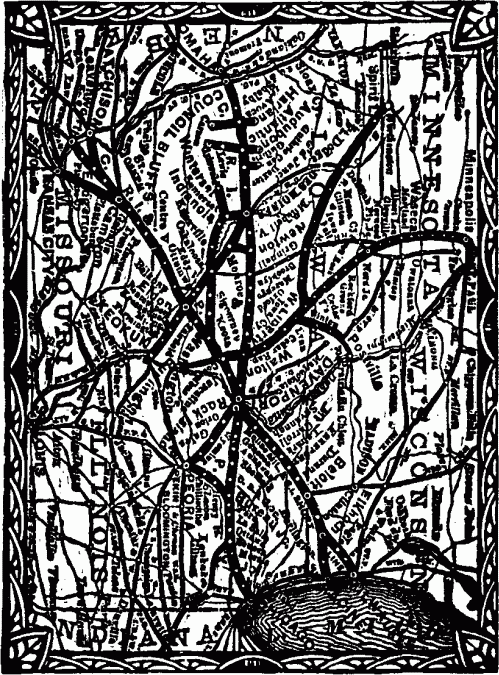
WHO IS UNACQUAINTED WITH THE GEOGRAPHY OF THIS COUNTRY WILL SEE BY EXAMINING THIS MAP THAT THE
CHICAGO, ROCK ISLAND & PACIFIC R'Y
By the central position of its line, connects the East and the West by the shortest route, and carries passengers, without change of cars, between Chicago and Kansas City, Council Bluffs, Leavenworth, Atchison, Minneapolis and St. Paul. It connects in Union Depots with all the principal lines of road between the Atlantic and the Pacific Oceans. Its equipment is unrivaled and magnificent, being composed of Most Comfortable and Beautiful Day Coaches, Magnificent Horton Reclining Chair Cars, Pullman's Prettiest Palace Sleeping Cars, and the Best Line of Dining Cars in the World. Three Trains between Chicago and Missouri River Points. Two Trains between Chicago and Minneapolis and St. Paul, via the Famous
"ALBERT LEA ROUTE."
A New and Direct Line, via Seneca and Kankakee, has recently been opened between Richmond Norfolk, Newport News, Chattanooga, Atlanta, Augusta, Nashville, Louisville, Lexington, Cincinnati Indianapolis and Lafayette, and Omaha, Minneapolis and St. Paul and intermediate points.
All Through Passengers Travel on Fast Express Trains.
Tickets for sale at all principal Ticket Offices in the United States and Canada.
Baggage checked through and rates of fare always as low as competitors that offer less advantages.
For detailed information, get the Maps and Folders of the
GREAT ROCK ISLAND ROUTE,
At your nearest Ticket Office, or address
R.R. CABLE, Vice-Pres. & Gen'l M'g'r,
E. ST. JOHN, Gen'l Tkt. & Pass. Agt.
CHICAGO.
Remember that $2.00 pays for The Prairie Farmer from this date to January 1, 1885: For $2.00 you get it for one year and a copy of The Prairie Farmer County Map of the United States, free! This is the most liberal offer ever made by any first-class weekly agricultural paper in this country.