Chapter II · CRANIOLOGY (continued 2)
Frederic Taber Cooper translation
Nevertheless, the maximum circumference still remains the linear index best adapted to represent the volume; indeed, the authorities take its proportional relation to the stature as representing the reciprocal degree of development between head and body at the different successive ages.
Here are the figures which Daffner gives in this connection:
DEVELOPMENT OF THE STATURE AND OF THE CEPHALIC PERIMETER FROM BIRTH TO THE AGE OF ELEVEN YEARS
Males Females
Number of subjects Age Stature in centimetres Cranial perimeter, centimetres Number of subjects Age Stature in centimetres Cranial perimeter, centimetres
65 At birth 51.17 34.58 65 At birth 50.27 34.23
11 1.55 74.18 46.74 10 1.39 77.20 46.45
30 2.43 85.32 48.03 30 2.45 83.48 47.23
53 3.34 91.88 49.20 49 3.43 89.97 47.73
112 4.43 96.64 49.55 81 4.50 96.07 48.37
244 5.42 103.21 50.21 208 5.40 100.61 48.76
234 6.41 106.49 50.73 179 6.37 104.92 49.87
30 7.30 114.47 51.66 25 7.36 117.36 50.38
28 8.38 112.10 51.97 24 8.41 121.58 50.72
27 9.40 128.41 52.38 30 9.40 126.76 51.10
21 10.34 129.12 52.24 28 10.40 130.00 51.08
20 11.42 135.84 52.50 31 11.46 137.04 51.42
DEVELOPMENT OF THE STATURE AND OF THE CEPHALIC PERIMETER BETWEEN THE YEARS OF 13 AND 22
Number of subjects Age Stature in centimetres Cranial perimeter, centimetres
13 13.39 147.92 52.83
24 14.50 149.21 53.53
20 15.38 163.55 54.34
41 16.43 162.53 53.34
35 17.36 167.93 55.89
26 18.35 171.65 54.91
15 19.40 172.97 55.48
6 20.05 173.97 56.50
342 21.02 168.08 55.37
171 22.22 168.08 55.62
One very important research made by Daffner is in reference to the maximums and minimums that are normal for each successive age. This is extremely useful for the purpose of diagnosing the morphological normality in relation to the age. He naturally bases his figures upon subjects studied by him personally, who altogether form an aggregate number of 2,230, and are not always sufficiently numerous when distributed according to their ages. Nevertheless, in the great majority of groups, especially those including the younger children, the number of subjects is sufficient and even superabundant.
At all events, Daffner's researches may serve as a valuable guide in the researches that lay the foundation for diagnosis; and every future investigator will find it an easier task, under such guidance, to make his own contribution to it and to correct those inaccuracies which (for certain epochs) are to be attributed to an insufficient number of subjects.
Daffner distinguishes, for each year, a maximum and a minimum both for the stature and for the cephalic perimeter; but since the person having the maximum stature does not always have the maximum cephalic perimeter, and vice versa, the author indicates, in connection with the maximum and minimum figures, the other of the two measurements which, as a matter of fact, corresponds to them in each given case.
INDIVIDUAL VARIATIONS
MAXIMUMS AND MINIMUMS OF STATURE AND OF CRANIAL CIRCUMFERENCE
Age Measurements S.—Stature Cc.—Cranial circumference Maximum (M.) and minimum (m.) in millimetres Measurements occurring in combination with the M. or m. measurements
Males from birth to the age of eleven years
At birth Cranial circumf. M. = 372 (S. = 625).
m. = 326 (S. = 500).
Stature M. = 550 (Cc. = 369, 365, 354).
m. = 480 (Cc. = 343, 341, 337).
1 year Cranial circumf. M. = 491
m. = 456
Stature M. = 805 (Cc. = 491).
m. = 680 (Cc. = 456).
2 years Cranial circumf. M. = 506 (S. = 855).
m. = 462 (S. = 800).
Stature M. = 920 (Cc. = 496).
m. = 785 (Cc. = 467).
3 years Cranial circumf. M. = 521
m. = 462 (S. = 915).
Stature M. = 995 (Cc. = 521, 501).
m. = 795 (Cc. = 472).
4 years Cranial circumf. M. = 530 (S. = 1035).
m. = 465 (S. = 900).
Stature M. = 1090 (Cc. = 510).
m. = 835 (Cc. = 499, 481).
5 years Cranial circumf. M. = 527 (S. = 1070).
m. = 481 (S. = 930).
Stature M. = 1173 (Cc. = 519).
m. = 920 (Cc. = 495).
6 years Cranial circumf. M. = 532 (S. = 1090).
m. = 481 (S. = 1045).
Stature M. = 1163 (Cc. = 517).
m. = 950 (Cc. = 495).
7 years Cranial circumf. M. = 541 (S. = 1232).
m. = 502 (S. = 1156, 1223).
Stature M. = 1276 (Cc. = 527).
m. = 1092 (Cc. = 514).
8 years Cranial circumf. M. = 542 (S. = 1207, 1292).
m. = 496 (S. = 1158).
Stature M. = 1375 (Cc. = 537).
m. = 1099 (Cc. = 497).
9 years Cranial circumf. M. = 548 (S. = 1333).
m. = 507 (S. = 1250).
Stature M. = 1383 (Cc. = 546).
m. = 1185 (Cc. = 522).
10 years Cranial circumf. M. = 553 (S. = 1303).
m. = 497 (S. = 1270).
Stature M. = 1372 (Cc. = 538).
m. = 1218 (Cc. = 534).
11 years Cranial circumf. M. = 543 (S. = 1350).
m. = 505 (S. = 1307).
Stature M. = 1466 (Cc. = 542).
m. = 1300 (Cc. = 513).
Note. ——- indicates that the number of subjects is abundant.
_____ indicates that the number of subjects is sufficient.
..... indicates that the number of subjects is scarce.
FEMALES FROM BIRTH TO THE AGE OF ELEVEN YEARS
Age Measurements S.—Stature Cc.—Cranial circumference Maximum (M.) and minimum (m.) in millimetres Measurements occurring in combination with the M. or m. measurements Observations
At birth. Cranial circumf. M. = 372 (S. = 500). (The most frequent S. was 500 mm. combined with CC. = 357, 337.)
m. = 324 (S. = 480).
Stature M. = 565 (Cc. = 355).
m. = 475 (Cc. = 333, 325).
1 year Cranial circumf. M. = 486 (S. = )
m. = 450 (S. = 750, 740).
Stature M. = 810 (Cc. = 486).
m. = 705 (Cc. = 455).
2 years Cranial circumf. M. = 495 (S. = 850).
m. = 448 (S. = 810).
Stature M. = 910 (Cc. = 491).
m. = 720 (Cc. = 464).
3 years Cranial circumf. M. = 501 (S. = 865).
m. = 457 (S. = 870).
Stature M. = 1015 (Cc. = 473).
m. = 810 (Cc. = 476).
4 years Cranial circumf. M. = 510 (S. = 1050).
m. = 455 (S. = 920, 870).
Stature M. = 1060 (Cc. = 507).
m. = 860 (Cc. = 461).
5 years Cranial circumf. M. = 515 (S. = 1035).
m. = 462 (S. = 905).
Stature M. = 1140 (Cc. = 492).
m. = 875 (Cc. = 481).
6 years Cranial circumf. M. = 522 (S. = 1020). (The maximum S. was found in a child of 6 years and 11 months; the next highest stature was 1177 mm., Cc. 512; another little girl of 6 years and 11 months had S. = 1099; Cc. = 507).
m. = 460 (S. = 965).
Stature M. = 1221 (Cc. = 516).
m. = 920 (Cc. = 489).
7 years. Cranial circumf. M. = 524 (S. = 1215).
m. = 479 (S. = 1185).
Stature M. = 1270 (Cc. = 513).
m. = 1058 (Cc. = 499).
8 years Cranial circumf. M. = 542 (S. = ).
m. = 484 (S. = ).
Stature M. = 1328 (Cc. = 542).
m. = 1082 (Cc. = 484).
9 years Cranial circumf. M. = 526 (S. = 1272).
m. = 493 (S. = 1306).
Stature M. = 1325 (Cc. = 520).
m. = 1173 (Cc. = 499).
10 years. Cranial circumf. M. = 533 (S. = 1291).
m. = 476 (S. = 1204).
Stature M. = 1403 (Cc. = 530).
m. = 1153 (Cc. = 506).
11 years. Cranial circumf. M. = 537 (S. = 1420). (The next higher S. was 1495, with a Cc. of 529).
m. = 478 (S. = 1284).
Stature M. = 1464 (Cc. = 512).
m. = 1255 (Cc. = 497).
EXTREMES BETWEEN THE AGES OF 13 AND 22 YEARS (The figures here given are less exact, because of the great scarcity of subjects)
Age Measurements S.—Stature Cc.—Cranial circumference Maximum (M.) and minimum (m.) in millimetres Measurements occurring in combination with the M. or m. measurements
13 years Cranial circumf. M. = 554 (S. = ).
m. = 492 (S. = ).
Stature M. = 1715 (Cc. = 554).
m. = 1345 (Cc. = 492).
14 years Cranial circumf. M. = 564 (S. = 1560).
m. = 515 (S. = 1555).
Stature M. = 1630 (Cc. = 537).
M. = 1405 (Cc. = 526).
15 years Cranial circumf. M. = 567 (S. = 1575).
m. = 526 (S. = 1570).
Stature M. = 1795 (Cc. = 566).
m. = 1450 (Cc. = 534).
16 years Cranial circumf. M. = 566 (S. = 1675).
m. = 519 (S. = 1460).
Stature M. = 1807 (Cc. = 561).
m. = 1330 (Cc. = 532).
17 years Cranial circumf. M. = 582 (S. = 1757).
m. = 507 (S. = 1610).
Stature M. = 1759 (Cc. = 560).
m. = 1561 (Cc. = 555).
18 years Cranial circumf. M. = 565 (S. = 1785).
m. = 522 (S. = 1702).
Stature M. = 1930 (Cc. = 557).
m. = 1604 (Cc. = 536).
19 years Cranial circumf. M. = 578 (S. = 1707).
m. = 541 (S. = 1693).
Stature M. = 1823 (Cc. = 545).
m. = 1637 (Cc. = 549).
20 years Cranial circumf. M. = 594 (S. = 1671).
m. = 551 (S. = 1780).
Stature M. = 1832 (Cc. = 560).
m. = 1629 (Cc. = 552).
21 years Cranial circumf. M. = 590 (S. = 1700).
m. = 512 (S. = 1590).
Stature M. = 1790 (Cc. = 581).
m. = 1570 (Cc. = 571).
22 years Cranial circumf. M. = 595 (S. = 1730).
m. = 510 (S. = 1650).
Stature M. = 1790 (Cc. = 576).
m. = 1570 (Cc. = 548).
Nomenclature Relating to Cranial Volume. Anomalies.—(In regard to the method of directly measuring or calculating the cranial capacity, and of taking and estimating the measurements of the skull, see the section on Technique.)
Limits.—The cranial capacity, according to Deniker, has normally such a wide range of oscillation that the minimum is fully doubled by the maximum, the limits being respectively 1,100 and 2,200 cubic centimetres—these figures, however, including men of genius. Furthermore, the mean average capacity oscillates between limits that change according to race—not only because the cerebral volume may of itself constitute an ethnic characteristic (superior and inferior races) with which the form of the forehead is usually associated, but also because the cranial volume bears a certain relation to the stature, which is another factor that varies with the race.
Deniker gives the following mean averages of oscillations:
Europeans from 1,500 to 1,600 cu. cm.
Negroes from 1,400 to 1,500 cu. cm.
Australians, Bushmen from 1,250 to 1,350 cu. cm.
The average difference of cranial capacity is 150 cubic centimetres less in woman than in man.
The following nomenclature for oscillations in cranial capacity was established by Topinard, based upon the figures and methods of Broca:
Macrocephalic crania from 1,950 cu. cm. upward
Large crania from 1,950 to 1,650 cu. cm.
Medium or ordinary crania from 1,650 to 1,450 cu. cm.
Small crania from 1,450 to 1,150 cu. cm.
Microcephalic crania from 1,150 cu. cm. downward
To-day, however, the terms macrocephalic and microcephalic have come to be reserved for pathological cases. Virchow has introduced the term nanocephalic to designate normal crania of very small dimensions; while Sergi has adopted a binomial nomenclature, calling them eumetopic microcephalics, which signifies possessed of a fine forehead: since, as we have seen, it is precisely the shape of the forehead which determines normality. And in place of macrocephalic, we have for very large normal crania the new term megalocephalic.
Pathological terminology includes the following nomenclature: macrocephaly, sub-macrocephaly, submicrocephaly, microcephaly.
Microcephaly may fall as low as 800 cubic centimetres; macrocephaly may rise as high as 3,000 cubic centimetres, and at these extremes the volume alone is sufficient to denote the anomaly. But in many cases the volume may fall within the limits of normality; in such cases it is the pathological form and an examination of the patient which lead to the use of the term submicrocephalic in preference to that of nanocephalic, etc.
The volume, taken by itself, if it is not at one of the extreme limits, is not sufficient to justify a verdict of abnormality.
The terms macro- and microcephalic are, in any case, quite generic, and simply indicate a morphological anomaly, which may include many widely different cases, such, for example, as rickets, hydrocephaly, pachycephaly, etc., all of which have in common the morphological characteristic of macrocephaly.
In rickets, for instance, macrocephaly may occur in conjunction with a normal or even supernormal intelligence (Leopardi). Microcephaly, on the contrary, could never occur combined with normal intelligence, since it is a sign indicative of atrophy of the cerebro-spinal axis and diminution or, as Brugia phrases it, dehumanization of the individuality.
Normal Children Abnormal "
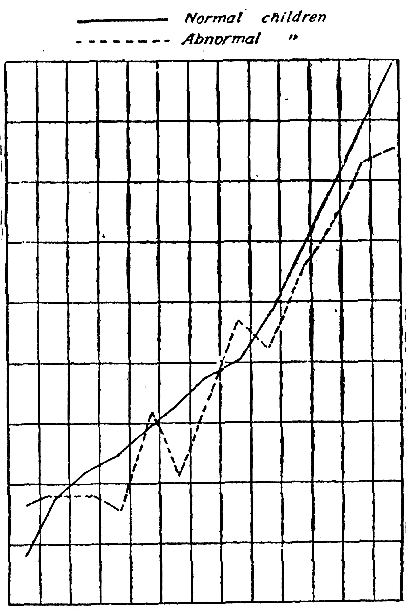
Fig. 82.—Growth of Cranial Circumference.
In all the widely varied series of pathological and degenerate individuals who are included under the generic names of "deficients" and "criminals," there is a notable percentage of crania that are abnormal both in volume and in form; the percentage of crania with normal dimensions is less than that of the crania which exceed or fall below such dimensions, and among these there is a preponderance of submicrocephalic crania: a morphological characteristic associated with a partial arrest of cerebral development, due to internal causes and manifested from the earliest period of infant life.
The accompanying chart (Fig. 82) demonstrates precisely this fact. It represents the growth of the cranium in normal and in abnormal children. The abnormal are at one time superior and at another inferior to the normal children; but their general average shows a definite inferiority to the normal. Lombroso established the fact that among adult criminals there is an inferiority of cranial development, frequently accompanied by a stature that is normal, or even in excess of normality.
Quite recently, Binet has called attention to a form of submicrocephaly acquired through external causes, which is of great interest from the pedagogic point of view. Blind children and those who are deaf-mutes have, up to the seventh or eighth year, a cranium of normal dimensions, but by the fourteenth or fifteenth year the volume is notably below the normal, and this stigma of inferiority remains permanently in the adults. This fact, which is of very general occurrence, is attributed by Binet to a deficiency of sensations, and consequently a deficiency of certain specific cerebral exercises.
This whole question has a fundamental interest for us as educators, because it affords an indirect proof that cerebral exercise develops the brain, or in other words, that education has a physical and morphological influence as well as a psychic one.
This question, coupled with that of the influence of alimentation upon the development of the head, leads to the conclusion that a two-fold nutriment is necessary for the normal development of man: material nutriment and nutriment of the spirit.
It follows that education must be considered from two different points of view: that of the progress of civilisation, and that of the perfectionment of the species.
In regard to variations of cranial volume, just as in the case of variations of stature, there are a number of different factors which may be summed up in such a way as to afford us certain determining characteristics of social caste. Delicate questions these, which we may sum up in a single question equally delicate, that lends itself to a vast amount of discussion; namely, what is the relation between the volume of the brain and the development of the intellect?
Individual Variations of Cerebral (and Cranial) Volume. Relation between the Development of the Cerebral Volume and the Development of the Intelligence.—The series of arguments in reference to the cerebral volume ought to be considered independently of the biological and biopathological factors which we have up to this point been considering; namely, race, sex, age, degeneration and disease.
That is to say, in normal individuals, other conditions being equal, volumetric differences of the brain may be met with, analogous to those other infinite individual variations, in which nature expresses her creative power, even while preserving unchanged the general morphology of the species.
It is due to this fact that the innumerable individuals of a race, while all bearing a certain resemblance to one another, are never any two of them identically alike.
Variations of this sort, which might be called biological individualisations, are in any case subject to the most diverse influences of environment, which concur in producing individual varieties.
This is in accordance with general laws which are applicable to any biological question whatever, but that in our case assume a special interest. There are certain men who have larger or smaller brains; and there are men of greater or of less intelligence. Is there a quantitative relation between these two manifestations, the morphological and the psychic?
Everyone knows that this is one of those complicated, much discussed questions that spread outside of the purely scientific circles and become one of the stock themes of debate among classes incompetent to judge; consequently it has been colored by popular prejudice, rather than by the light of science. It is well that persons of education should acquire accurate ideas upon the subject.
If the volume of the brain should be in proportion to the intellectual development, argues the general public, what sort of a head must Dante Alighieri have had? He would have had to be the most monstrous macrocephalic ever seen upon earth. And on the basis of this superficial observation, they wish to deny any quantitative relation whatever between brain and intelligence. And yet it is this same general public that keeps insisting: Woman has less intelligence than man, because she has a smaller brain.
A single glance up and down the zoological scale suffices to show that throughout the whole animal series a greater development of brain is accompanied by a correspondingly greater development of psychic activity; and that there is a conspicuous difference between the human brain and that of the higher animals (anthropoid apes), corresponding to the difference between the level of man's psychic development and that of the higher mammals; and this justifies the assertion that, as a general rule, there is a quantitative relation between the brain and the intellect.
This suggests the thought that the perfect development of this delicate instrument, the brain, demands a variety of harmonious material conditions, among others the volume, in order to render possible the conditions of psychic perfection.
From this premise, we may pass on to a more particularised study of the material conditions essential to the superior type of brain. The volume is the quantitative index; but the quality may be considered from various points of view, which may be grouped as follows:
I. The General Morphology of the Brain in reference to:
(a) The harmonious, relative volumetric proportions between the lobes of the brain (namely, the proportion between the frontal, parietal, temporal and occipital lobes). It was formerly believed that a superior brain ought to show a prevalence of the frontal lobes, since a lofty forehead is a sign of intellect; but it was afterward established that there is no direct relation between the development of the forehead and the development of the frontal lobes; a higher forehead results from a greater volume of the entire cranial contents; the superior brain, on the contrary, is that in which no one lobe prevails over another, but all of them preserve a reciprocal and perfect harmony of dimensions.
(b) The form, number and disposition of the cerebral convolutions, and of the folds of the internal passage (Sergio Sergi).
(c) The form, number and disposition of the cells in the cortical strata of the brain, and the proportion between the gray matter and the white, that is to say, between the cells and fibres; in short, the histological structure of the brain.
II. The Chemistry of the brain:
(a) The chemical composition of the substances constituting the brain, which may be more or less complicated. (Recent studies of the chemical evolution of living organisms have demonstrated that the atomic composition is far more complex in the higher organisms.)
(b) The intimate interchange of matter in the cerebral tissues, in connection with their nutrition.
(c) The chemical stimuli coming from the so-called glands of internal secretion (thyroid, etc.).
All these conditions concur in determining the quality of the cerebral tissues. In its ontogenetic evolution, for example, the brain does not merely increase in volume, and its development is not limited to attaining a definite morphology; but its intimate structure and its chemical composition as well must pass through various stages of transition before attaining their final state. We know, for example, that the myelination of the nerve fibres takes place upward from the spinal marrow toward the brain, and that the pyramidal tracts (voluntary motor tracts) are the last to myelinate, and hence the last to perform their functions in the child.
The consistence of the cerebral mass and its specific gravity also differ in childhood from that of the adult state. The evolution of the brain is therefore a very complex process; and this process may not be fully completed (for instance, it may be completed in volume, but not in form or chemical composition, etc.).
Consequently, just as in the case of volume, there may be various qualitative conditions, such as would produce organic inferiority.
But supposing that qualitatively the evolution has been accomplished normally, where there is greater cerebral volume, is there a correspondingly greater intellect?
At this point it is necessary to take into consideration another series of questions regarding the brain considered as a material organ, and having reference to the relation between the volume of the brain and that of the stature.
The brain must govern the nerves in all the active parts of the body, especially the striped muscles, which perform all voluntary movement. Consequently the cerebral volume must be in proportion, not only to the intellectuality, but also to the physical activity.
Evidently, a greater mass of body demands a greater nervous system to give it motive power.
The biological law is of a general nature: if the brain of a rat weighs 40 centigrams, that of an ox weighs 734 grams, and that of an elephant 4,896 grams.
"The absolute volume of the brain increases with the total volume of the body."
But this correspondence is not proportional. There are two facts that alter the proportions. One of these is that the mass of the body increases faster than the brain, throughout the biological series of species, so that the smaller the body the greater the proportional quantity of brain. Just the opposite from what was found to hold true for the absolute weight.
It may be affirmed as a biological law that "the relative volume of the brain increases as the size of the body diminishes." For instance, the tiny brain of a rat is a 43d part of the total volume of its body; the brain of an ox, on the contrary, is a 750th part. Consequently we may say that the little rat has relatively a far larger brain than the huge ox.
And the same thing holds true among men; those of small build have a proportionately larger brain than those of large build.
A second fact which alters the absolute proportion between the volume of brain and the volume of body has reference to the "functional capacity" of the active parts. The muscles which are capable of the best activity and the greatest agility are the ones more abundantly stimulated through their nerves than those which are capable only of slow and sluggish action. The same may be said of the organs of sensation; the more highly the sensibility is developed, the larger are the corresponding nerves, and consequently the greater is the corresponding quantity of cerebral cells. Accordingly the animal which is nimblest in its movements, and most capable of sensations has in proportion to this greater functional activity a greater cerebral volume. In this same way we may explain the enormous difference in relative brain volume between the extremely active, sensitive and intelligent little beast which we call the rat, and the sluggish and stupid animal which we call the ox. Consequently this functional activity has a correspondingly greater volume of brain, without a correspondingly greater volume of the various highly sensitized organs. In such a case it may be stated as a general law that "the relative volume of the brain is in direct proportion to the intelligence (or, more broadly, to the functional activity), while the absolute volume is in direct relation to the total mass of the body."
Man has a cerebral volume of 1,500 cubic centimetres, a volume equal to a fortieth part of the whole body. Consequently he has a brain twice the actual size of that of the ox, while considered in its relation to bodily bulk, he has more brain than the smallest rat (man = 1/40; rat = 1/43). A volume so far exceeding the proportions found in animals, is beyond doubt directly related to human intelligence.
Relation between Cerebral and Intellectual Development in Man.—This ends our examination of the generic question of the relation between cerebral volume and intellect.
Granting these biological principles, and wishing to apply them to normal man, let us go back to our first question: "Do persons of greater intelligence have a greater cerebral volume, and consequently a larger head?"
There is an extensive literature upon this question, the tendency of which is to decide it affirmatively.
Parchappe has made a comparative study between writers of recognized ability and simple manual workers, and has found that the former have a development of the head notably in excess of the latter.
Broca took measurements, in various hospitals, of the heads of physicians and male nurses, and found a greater development of head in the case of the physicians.
Lebon made a study of cranial measurements in men of letters, tradesmen, the nobility and domestic servants, and found the maximum development among the men of letters and the minimum among the servants. The tradesmen, who at all events are performing a work of social utility, stand next to the men of letters; while the aristocrats show some advantage over the domestics. Bajenoff took his measurements from famous persons on the one hand and from convicted assassins on the other, and found a greater head development among the former.
Enrico Ferri has made similar researches among soldiers who have had a high-school education and those who are uneducated, and has found a more developed cranium among the educated soldiers.
I also have made my own modest contribution to this important question, by seeking to determine the difference in cranial volume between the school-children who stand respectively at the head and foot of their class, and have found among children of the age of ten a mean cranial circumference of 527 millimetres for the more intelligent and of only 518 millimetres for the less intelligent.
Similar results were obtained by Binet in his researches among the elementary schools of Paris. He found among children of the age of twelve that the brightest had a mean cranial circumference of 540 millimetres and those at the foot of their class a mean of only 530 millimetres. The following table gives a parallel between these various cranial measurements:
CRANIAL MEASUREMENTS (in Millimetres)[39]
Binet Children in the elementary schools of Paris, from 11 to 13 years of age Montessori Children in the elementary schools of Rome, from 9 to 11 years of age
Measurements Binet's figures Montessori's figures
Pupils chosen for intelligence Pupils chosen as backward Difference Pupils chosen for intelligence Pupils chosen as backward Difference
Maximum circumference of cranium. 540 530 +10 527 518 +9
Length of cranium 181 177 +4 180 177 +3
Breadth of cranium 150.4 146.2 +4.2 143 140 +3
Height of cranium 123.3 124 -0.7 130 127 +3
Minimum frontal diameter. 104 102 +2 99 98 +1
Height of forehead 46 45.5 +0.5 57 56 +1
By calculating the cranial capacities according to Broca'a method, I obtained:
Cranial capacity in the best pupils chosen 1557 cu. cm.
the worst pupils chosen 1488 cu. cm.
From all these manifold researches above cited, we can reach no other conclusion than that individuals of greater intelligence have a larger quantity of brain; or else that individuals with a greater quantity of brain are more intelligent.
There is a subtle distortion of this principle, which many sociological anthropologists have taken as their starting-point, especially in Germany, in their attempt to establish a biological basis for the Schopenhauerian theories of Friedrich Nietzsche.
According to these, the persons who have acquired high social positions are biologically superior (possessing a greater cerebral mass), and the same may be said of conquering races as compared with the conquered. Differences in caste are to be explained in the same way, and on this ground nature sanctions the social inferiority of woman.
This is a question of the greatest importance, which merits a vast amount of discussion.
What Sort of Man is the Most Intelligent?—Straightway, a first serious objection suggests itself: What sort of persons are the most intelligent? Are they really those who have attained the higher academic degrees and the most eminent social positions? Consequently, is the Prime Minister more intelligent than the Assistant Secretary of State, and the latter more intelligent than the Head of a Department, and he again than the door-keeper?
Are literary productions and the acquisition of laurels reliable tests of intelligence? Is this man a doctor because he is more intelligent, and that man a hospital attendant because he is less intelligent?
It is evident that there exist in the social world certain privileges of caste, which may raise to the pinnacle of literary glory or to a clamorous notoriety certain persons who owe their rise to favoritism and trickery; or at least, so-called "literary fame" must be dependent upon the possibility of getting writings published, which another man perhaps would have had no way of bringing before the public so as to make them known and appreciated; just as, on the other hand, there are men of genius who are destined to feel their inborn intelligence suffocating under the cruel tyranny of existing economic conditions, which punish pauperism with obscurity and hold protection and favours at a distance.
A thousand various conditions of our social environment hinder powerful innate activities from finding expression and attaining elevated social positions. Now, when we start to measure these different categories of persons, shall we measure the more or the less fortunate individuals, those more or those less favoured by economic conditions of birth and environment, or shall we measure those persons who are actually the more and the less intelligent?
And even in school can we be sure that the child whom we judge the most intelligent is actually so? Studies in experimental psychology made in quite recent times of men whose works justify their being placed in the ranks of geniuses, have shown that these men of genius were never, in their school-days, either at the head of their class, or winners of any competitions. Consequently, we have not yet learned the means of judging intelligence.
If we stop to think of the way in which the intelligence of pupils was judged up to only a few years ago, according to pedagogic methods that were a remnant of the pietistic schools, this will help us to form some idea. The more intelligent ones were those best able to recite dogmatic truths from memory. And even to-day we have not advanced very far above that level.
As a general rule that pupil is considered the most intelligent who best succeeds in echoing his teacher and in modeling his own personality as closely as possible upon that of his preceptor.
This fact is so well known that it has come to be utilised as one of the clever tricks for obtaining higher marks even in university examinations, and for winning competitions; it is known that the prize is reserved for the student who can repeat most faithfully and proclaim most eloquently the master's own ideas.
Here is precisely one of the most fundamental problems offered by scientific pedagogy: how to diagnose the human intelligence, and distinguish the person who is intelligent from the person who is not. A difficult task, or rather a difficult problem.
The Influence of Economic Conditions upon the Development of the Brain.—Certain factors, due to environment, exert an influence upon the development of the cerebral volume; this fact opens up another whole series of interesting questions.
Among the factors due to environment, the leading place is held by nutrition, dependent upon economic conditions.
Niceforo contends that among the various social classes, those who can obtain the best nourishment have the greatest development of brain, and consequently of head. He offers in evidence the figures summarised in the following table:
CIRCUMFERENCE OF THE HEADS OF
Boys of the age of Rich Sons of small tradesmen and clerks Poor
11 years 534.9 529.7 524.8
12 years 537.1 530.3 524.9
13 years 537.8 532.4 528.6
14 years 545.4 533.3 528.4
In short, there is a gradation of cranial volume corresponding to the economic status in society. This is a condition easy to understand: we simply find repeated in this particular the same thing that we have already seen happen to the body as a whole; the organism in its entirety and consequently each separate part of it—if it is to develop in accordance with its special biological potentiality and so attain the limits of finality set for it—must receive nourishment. It is only natural that children who, during their period of growth, are deprived of sufficient and suitable nutrition should remain inferior in development to those who had the advantage of an abundance of the proper kind of food. The influence of the economic factor is indisputable. Consequently, reverting once more to the studies above cited, may we not conclude that the man of letters, the physician, the person of distinction have a greater development of head than the manual labourer, the hospital attendant, the illiterate, simply because it was their good fortune to obtain better nutriment, through belonging to the wealthy social classes?
The Influence of Exercise upon Cerebral Development.—The second interesting question is in reference to the influence which exercise may have upon the development of the brain. As early as 1861 Broca investigated this question in a classic work: De l'influence de l'éducation sur le volume et la forme de la tête ("The influence of education on the volume and form of the head"), in which he arrived at the following conclusion: that a suitable exercise (intellectual culture, education, hygiene) does have an influence on the development of the brain, in the same way as with any other organ, as, for example, the striped muscles, which gain in volume and strength and beauty of form through gymnastic exercise. "Consequently," exclaims Broca enthusiastically, "education not only has the power of rendering mankind better; it has also the marvellous power of rendering man superior to himself, of enlarging his brain and perfecting his form!"
"Popular education means the betterment of the race."
Accordingly we might say, relying on the above-mentioned studies, that the man of letters, the physician, the person of distinction have a more highly developed head than the manual workman, the hospital attendant and the illiterate, because they exercised their brain to a greater extent, and not because they were more intelligent. This, however, is a question which differs profoundly from that which we were previously considering, nutrition, because in this case exercise, in addition to developing the organ, gives its own actual and personal contribution to the intelligence.
Therefore, we are able to be creators of intelligence and of brain tissue, which in turn becomes the creative force of our civilisation. A system of instruction which, in place of over-straining the brain, should aid it to develop and perfect itself, stimulating it to a sort of auto-creation, would truly be, as Broca says, "capable of rendering man superior to himself." This is what is being sought by scientific pedagogy, which has already laid the foundation of "cerebral hygiene."
We are still very far to-day from realising this highest human ambition! We do not yet know the basic laws of the economy of forces that would lead to a stimulation of the human activities to the point of creation; on the contrary, we are still at a primitive period, in which many of the environing conditions interfere, to the point of preventing the human germ to attain its natural biological finality. In short, we know how to obtain artificially an arrest of development; but we have not yet learned the art of aiding and enriching nature!
The Influence of the Biological Factor upon Cerebral Development.—What conclusion ought we to reach from what has been said up to this point? Upon what does the cerebral volume depend, in all its individual variations, resting on the common biological bases of race, normality and sex? Is individual variation due solely to causes of environment, such as nutrition and exercise? And does it follow that it is not dependent upon biological potentialities more or less pronounced in separate individuals—in short, upon different degrees of intelligence?
In the presence of such a multiplicity of questions we must proceed, not to a selection but to a sum. Every biological phenomenon is the result of a number of factors. The development of the brain depends in precisely the same way as the development of the whole body or of a single muscle, upon the combined influence of biological factors determining the individual variability, and of factors of environment, principal among which are nutrition and exercise. A suitable diet aids growth, and so also does a rational exercise; but underlying all the rest, as a potential cause, is the biological factor which mysteriously assigns a certain predestination to each individual. The environment may combat, alter, and impede what nature "had written upon the fertilised ovum;" but we cannot forget that this scheme, pre-established by the natural order of life, is the principal factor among them all, the one which determines the "character of the individual."
Now, on the basis of this influence of the biological factor upon the cerebral development, we may affirm that: to greater intelligence there corresponds a brain more developed in volume. What gives us proof of this is the brain of the exceptional man—of men of genius, who frequently have heads of extraordinary volume.
Persons of high celebrity, and not those, for example, who have become known through some recent discovery in the field of positive science—since a piece of good fortune may coincide with a normal cranial volume—but the true creative geniuses who have left the deep imprint of themselves upon their immortal works, have generally had a cerebral volume that was truly gigantic: the poetic brain of the great Schiller weighed 1,785 grams, that of Cuvier, the naturalist, 1,829 grams, that of the great statesman, Cromwell, 2,231 grams, and lastly, that of Byron, 2,238 grams. The brain of the normal man weighs about 1,400 grams.
Consequently, these are extraordinary volumetric figures that could not be acquired, either by much eating, or by being educated according to the scientific means of the most advanced pedagogy; they are due to the extraordinary biological potentiality of the man of genius.
In these extraordinary heads the exceptional volume is combined with a characteristic form: they always have a more than normal development of the forehead. Even in the course of biological evolution, as we have already seen, in the higher species a greater cerebral volume has a correspondingly broader and more erect forehead. If we examine portraits of men of genius, what strikes us chiefly in them is the high and spacious brow, as though men of genius, in comparison with the rest of us, were representatives of a superior race. But if the portrait shows the face taken in profile, it will be easily observed that the direction of the forehead is not vertical, but even slightly recessive; that is, it preserves the characteristic male form, with the vault slightly inclined backward and the orbital arches slightly pronounced.
The Pretended Cerebral Inferiority of Woman.—One final argument, which is of interest to us, is the great question of the relation between cerebral volume and intelligence in woman. Because, as you know, there is a very widespread belief of long standing that is confirmed in the name of science: that woman is biologically, in other words totally, inferior, that the volume of her brain is condemned by nature to an inferiority against which nothing can prevail. Just as our perfected pedagogy, excellent alimentation and improved hygienic conditions could never endow a normal man with the brain of a genius, in the same way, so it is said, it is impossible ever to augment the size of the brain of woman, who is necessarily condemned to resign herself to remain in that state of social inferiority to which she is now reduced and from which she would in vain attempt to emancipate herself.
Names as famous as that of Lombroso[40] which are associated with the progress of positive science, lend the weight of their authority to this form of condemnation! And it is not easy to do away with this sort of prejudice, which has slowly been disseminated among the people under the guise of a scientific theory. But to-day there are scientists who have been impelled to make certain extremely minute, impartial and objective studies, without any preconception on the subject—such men as Messedaglia, Dubois, Lapique, Zanolli, and Manouvrier—who, by calculating the cerebral mass, at one time in comparison with the whole body, at another with the surface of the body, and still again with the various active or skeletal parts of the organism—have arrived at an opposite conclusion: namely, that they can demonstrate a greater development of brain in woman. Among these scientists it gives me pleasure to name before all others Manouvrier—one of the most gifted anthropologists of our day—who has devoted twenty years to an exceedingly minute study of this problem. Here in brief outline are his method of procedure and his conclusions. That the cerebral volume should be considered in its relation to the stature is a familiar principle; but a comparison between man and woman based solely upon such a proportion, continues to maintain the cerebral inferiority of woman. Have we, however, the right to compare a volumetric measure (the cerebral mass) with a linear measure (the stature)? Such a comparison is a mathematical error, as we have already technically proved. Accordingly we find that Manouvrier compares the brain with the mass of the whole body, its entire bulk; and he analyzes this entire bulk, considering separately its active parts, without troubling himself about their functional potentiality. He deduces from them certain figures and proportions; more than that, he forms a sort of index, which might be called the "index of sexual mass," between woman (minor mass) and man, reduced to a scale of 100—which may be summed up in an equation: man:100 = woman:the following percentual analyses:
Stature and weight of body 88.5
Weight of brain 90.0
Weight of skeleton (femur) 62.5
CO2 exhaled in twenty-four hours 64.5
Vital capacity (at age of eighteen) 72.6
Strength of hands 57.1
Strength of vertical traction 52.6
Hence it is evident, that, in comparison with her actual organic mass, woman differs from man far more than is indicated by the differences in stature and in bodily weight.
Instead of taking all these various separate mean measurements, let us take one single comprehensive mean resulting from them: woman:man = 80:100; there we have the proportion. Now, Manouvrier proceeds to reduce all the separate measurements of man from 100 to 80, and calculates how much brain man would lose if he were reduced to a mass having feminine limits; he finds that the loss would be 172 grams. Woman on the contrary has only 150 grams of brain less than man. Consequently the cerebral volume of woman is superior to that of man!
This is an anthropological superiority which is further revealed in the more perfected form of the cranium, insomuch as woman has an absolutely erect forehead and has no remaining traces of the supraorbital arches (characteristics of superiority in the species).
Thus, we have a contradiction between existing anthropological and social conditions: woman, whom anthropology regards as a being having the cranium of an almost superior race, continues to be relegated to an unquestioned social inferiority, from which it is not easy to raise her.
Who is Socially Superior?—But here again we may ask, as we did regarding the question of intelligence: What constitutes social superiority? And in our social environment who is superior and who is inferior?
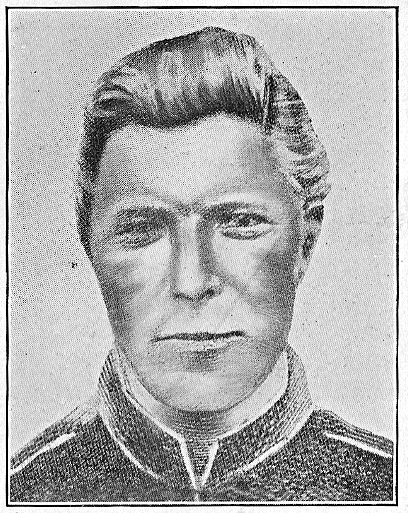
Fig. 83.—Leptoprosopic face.
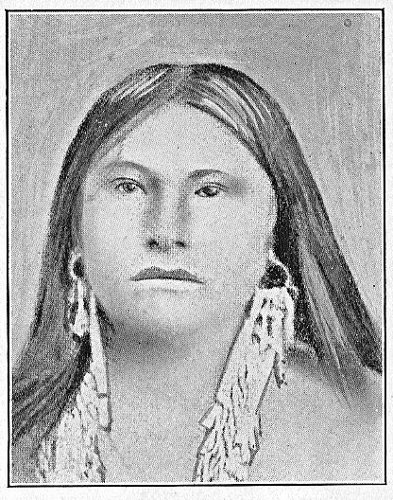
Fig. 84.—Chameprosopic face.
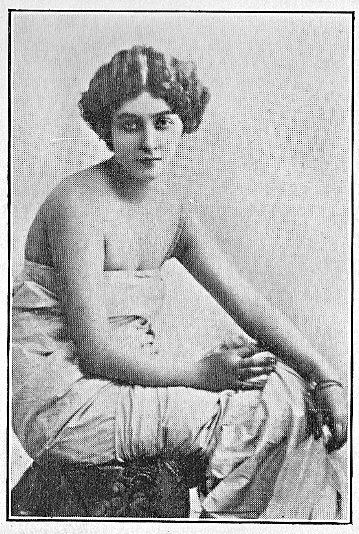
Fig. 85.—Lina Cavalieri.
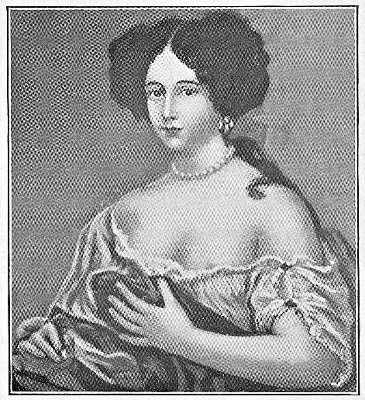
Fig. 86.—Maria Mancini.
Social superiority, like moral superiority, is the product of evolution. In primitive times when men, in order to live, were limited like animals to gathering the spontaneous fruit of the earth, according to the poetry of the biblical legend, and according to what sociology repeats to-day, the superior man was the one of largest stature, the giant. People paid him homage because he was the most imposing, without troubling themselves to ask whether, or not, he might be insane. In this way Saul was the first king. When the time came that men were no longer content to live on the spontaneous fruit of the earth, but were forced to till the soil, then a new victory was inaugurated, the victory of the more active and intelligent man. David killed Goliath. This great Bible story marks the moment when the superiority of man came to be considered under a more advanced and spiritual aspect. When the men who cultivated the earth began to feel the need of other neighbouring lands and became conquerors, then the soldier was evolved, until in the middle ages there resulted such a triumph of militarism that the nobles alone were conquerors in war; and the persons who to-day would be called superior, the men of intellect, the poets, were considered as feeble folk, despicable and effeminate. In our own times, now that the great conquests of the earth have been made and the victorious people consequently brought into harmony, the moment has come for conquering the environment itself, in order to wring from it new bread and new wealth. And this is the proud work of human intelligence which creates by aiding all the forces of nature and by triumphing over its environment; thus to-day it is the man of intelligence who is superior. But it seems as though a new epoch were in preparation, a truly human epoch, and as though the end had almost come of those evolutionary periods which sum up the history of the heroic struggles of humanity; an epoch in which an assured peace will promote the brotherhood of man, while morality and love will take their place as the highest form of human superiority. In such an epoch there will really be superior human beings, there will really be men strong in morality and in sentiment. Perhaps in this way the reign of woman is approaching, when the enigma of her anthropological superiority will be deciphered. Woman was always the custodian of human sentiment, morality and honour, and in these respects man always has yielded woman the palm.
Face and Visage
The Limits of the Face.—The face is that part of the head which remains when the cranial cavity is not considered. To attempt to separate accurately, in the skeleton, the facial from the cerebral portion would involve a lengthy anatomical description; for our purpose it is enough to grasp the general idea that the face is the portion situated beneath the forehead, bounded in front by the curves of the eyebrows, and in profile by a line passing in projection through the auricular foramen and the external orbital apophysis (Fig. 39, page (188)).
It is customary during life to consider the entire anterior portion of the head as constituting one single whole, bounded above by the line formed by the roots of the hair, and below by the chin. This portion includes actually not only the face but a portion of the cerebral cranium as well, namely, the forehead; it bears the name of the visage and is considered under this aspect only during life.
Human Characteristics of the Face.—One characteristic of the human cranium, as we have already seen (Fig. 40), as compared with animals, is the decrease in size of the face, and especially of the jaw-bones in inverse proportion to the increase of the cranial volume.
"Man," says Cuvier, "is of all living animals the one that has the largest cranium and the smallest face; and animals are stupider and more ferocious as they depart further from the human proportions."
In man, the cranium, assuming that graceful development which is characteristic of this superior species, surmounts the face, which recedes below the extreme frontal limit of the brain.
The different races of mankind, however, do not all of them attain so perfect a form; in some of them the face protrudes somewhat in advance of the extreme frontal limit, and in such cases we say that it is prognathous.
Thus the relations in the reciprocal development between cranium and face are different in animals and in man; as they also are in the various human races. Cuvier gives some idea of these proportions by comparing the European man with animals, by means of the following formulas which he has obtained by calculating approximately the square surface of a middle section of the head:
Cranium:face =
European man 4:1
(cranium four times the size of the face)
Orang-utan and chimpanzee 3:1
Lower monkeys 2:1
Carnivora 1:1
Ruminants 1:2
Hippopotamus 1:3
Horse 1:4
(the reverse of man)
Whale 1:20
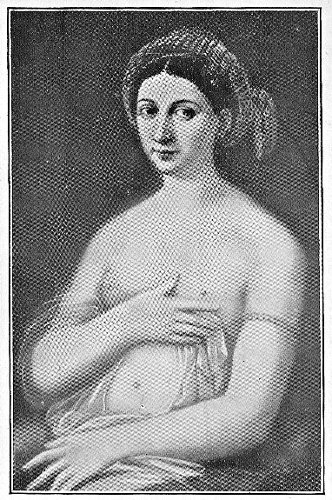
Fig. 87.—Portrait of the Fornarina (Raphael Sanzio) Rome: Barbarini gallery.
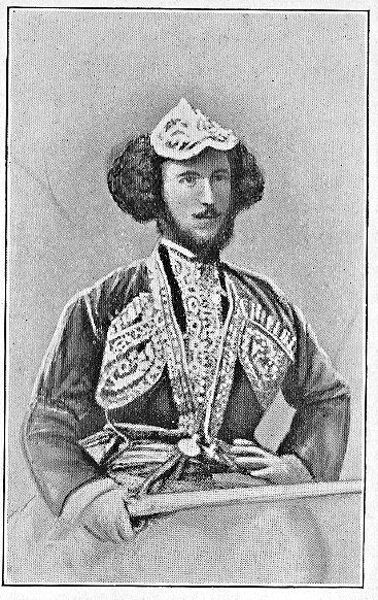
Fig. 88.—Triangular face.
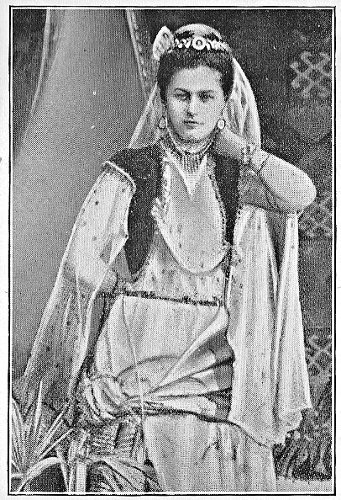
Fig. 89.—Ellipsoidal face.
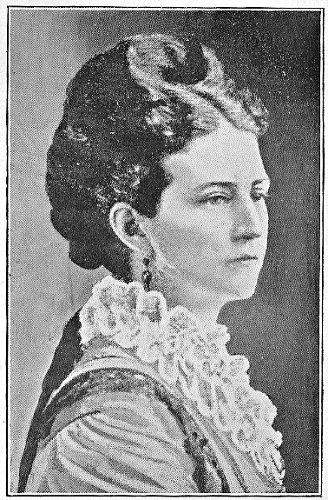
Fig. 90.—Long ovoid face.
But no general law, no systematic connection can be deduced from such relative proportions. They serve only to demonstrate a characteristic.
Upon this characteristic depends preeminently the beauty of the human visage. If we are considering the visage from its æsthetic aspect and wish to compare it with the muzzle of animals, we may say that in regard to its proportions it is as though the muzzle had been forced backward from its apex, while the cranium had swelled, through the increase of its vertical diameter. The muzzle is formed of the two jaws alone, on the upper of which the nose is located horizontally; there is neither forehead nor chin along the vertical line of the visage. As the jaws recede and the cranium augments, the forehead rises, the nose becomes vertical, and when the mandible has retreated beyond the frontal limit, the wide yawning mouth has been reduced in size, while a new formation has appeared below it—the chin. By this, I am trying merely to draw a comparison which I trust will be of service by suggesting a didactic method of illustrating the reduction of an animal's muzzle to human proportions. Whatever forms a part of the visage bears the morphological stamp of humanity: the forehead, the erect nose and the entire region of the mandible, which contains the principal beauty of the human face.
The narrow opening of the lips, mobile because so richly endowed with the muscles that unite in forming it, is quite truly the charming and gracious doorway of the organs of speech, which by shaping the internal thought into words are able to give it utterance; while the winning smile allures, captivates and consoles, thereby accomplishing an eminently social function; and sociability is inseparable from humanity.
The animal mouth, on the contrary, is the organ for seizing food, the organ of mastication, and, in felines, a weapon of offence and a means of destruction.
Tarde says: "The mandibles seem to shape themselves in accordance to the degree of intelligence; they become more finely modeled in proportion as the two social functions of speaking and smiling acquire a greater importance than the two individual functions of biting and masticating."
And Mantegazza says: "Cruelty has localised its imprint around the mouth, perhaps because killing and eating are two successive moments of the same event."
The Normal Visage
The visage is that part of the body which is preeminently human; being richly endowed with muscles, it represents the "mirror of the soul," through the expressions that it assumes according to the successive sentiments, passions and transitions of thought. The visage is a true mine of individual characteristics, by which different persons may be most easily and clearly distinguished from one another; while at the same time it bears the stamp of the most general characteristics of race, such as the form, the expression, the tone of complexion, etc., in consequence of which the face has hitherto held the first place in the classifications of the human races.
Even the peoples of ancient times, such as the Egyptians, made a physiognomical study of individual characteristics, founding a sort of empirical science that sought to read from the physiognomy the sentiments of the soul, the tendencies of character and the destiny of man. The visage also contains the greatest degree of attraction and charm, constituting that physical and spiritual beauty by which one person arouses in others feelings of sympathy and love. Oriental women cover their faces with thick veils through modesty, because the face reveals the entire feminine individuality, while the rest of the body reveals only the female of the human species, a quality common to all women.
The visage includes many important parts, which, by developing differently alter the physiognomy; the forehead, index of cerebral development, surmounts the face like a crown, revealing each individual's capacity for thought; furthermore, the visage contains all the organs of specific sense: sight, hearing, smell and taste, and hence all the "gateways of intelligence."
The organs of mastication, whose skeleton consists of the maxillaries and the zygomata which reinforce and anchor the upper maxillary, are the parts that constitute by far the greater portion of the facial mass. In fact, their limits (breadth between the two zygomata; breadth between the external angles of the mandible, chin) are the determining factors of the contour and general form of the face, which is completed by the soft tissues.
Forms of Face.—The first distinction in facial forms is that which is made between long or leptoprosopic faces and short or chameprosopic faces. Figs. 83 and 84 (facing page (258)) represent two faces having the same identical breadth between the zygomata or cheek-bones; the profound difference between them is due to their different height or length of visage.
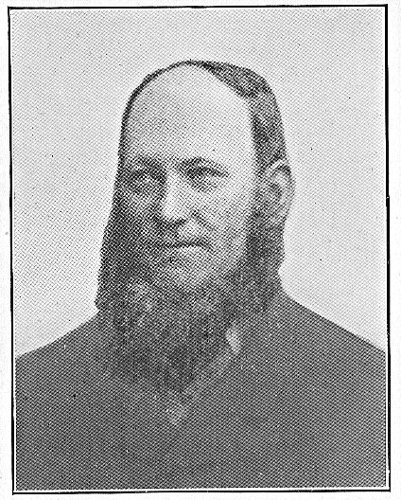
Fig. 91.—Tetragonal face (parallelepipedoidal).
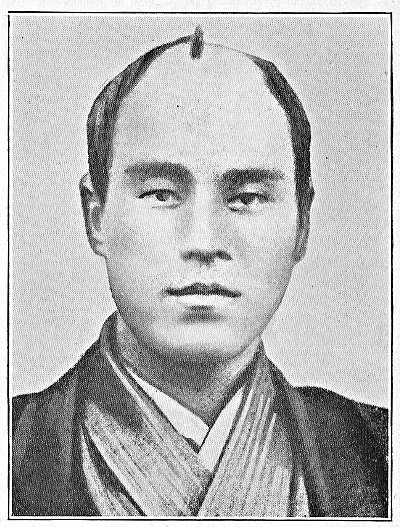
Fig. 92.—Pentagonal leptoprosopic face.
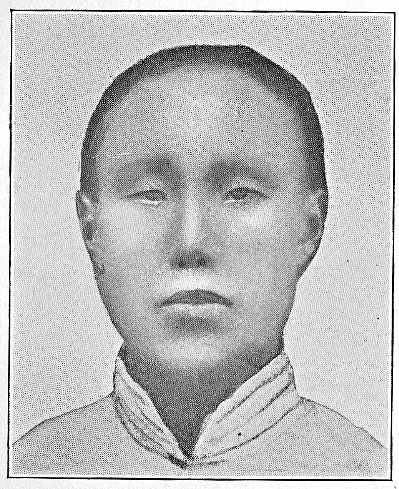
Fig. 93.—Pentagonal mesoprosopic face.
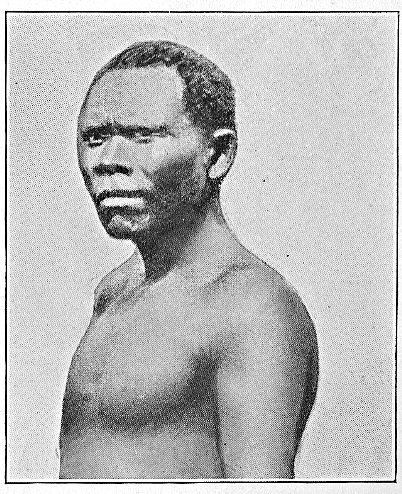
Fig. 94.—Face of inferior type prominence of the maxillary bones (prognathism).
The precise relation between height and breadth constitutes the index of visage, which is analogous to the index that we have already observed for the cranium.
Normally there is a correspondence in form between the cranium and the face; dolichocephalics are also leptoprosopic; and brachycephalics are chameprosopics; normally, also, mesaticephaly is found in conjunction with mesoprosopy; but owing to the phenomena of hybridism or pathological causes (rickets), it may also happen that such correspondence is wanting; and that we have instead, for instance, a leptoprosopic face with a brachycephalic cranium or vice versa.
Accordingly, long and short faces are characteristics of race almost as important as the cephalic index. But leptoprosopy and chamaeprosopy are not in themselves sufficient to determine the form of the face. On the contrary, in the case of living persons it is necessary also to take into consideration the contour of the visage, which contains characteristics relating to race, age and sex. The races which are held to be inferior have facial contours that are more or less angular; those that are held to be superior have, on the contrary, a rotundity of contour; men have a more angular facial contour, in comparison with that of women; while children have a contour of face that is distinctly rotund.
The angularities of the face are due to certain skeletal prominences, owing either to an excessive development of the zygomata (cheek-bones), or to a development of the maxillaries, which sometimes produce a salience of the lower corners of the mandible, and at others a prominence of the maxillary arch (prognathism).
Accordingly, the facial contours may be either rounded or angular, and that, too, independently of the facial type; because in either case the visage may be either long or short.
Depending upon the rounded facial contours, the visage may be distinguished as ellipsoidal or oval; we may meet with faces that are long, short or medium ellipsoids (leptoprosopic, chameprosopic, mesoprosopic faces), even to a point where the contour is almost circular: the orbicular face. Similarly, the oval faces may be classified as long, short and medium ovals. The so-called typical Roman visage is mesoprosopic, with an ellipsoidal contour. The faces of Cavalieri and of the Fornarina (Figs. 85, 87), celebrated for their beauty, are mesoprosopic ovals—and the exceptionally beautiful face of Maria Mancini is a mesoprosopic ellipse (Fig. 86).
Countenances with rounded and mesoprosopic contours belong to the Mediterranean race, and the more closely they come to the mean average of that type and to a fusion of contours, the more beautiful they are.
Faces with angular contours may be: triangular (due to prominence of the cheek-bones, or zygomata, and of the chin); tetragonal, further subdivided into quadrangular (chameprosopic) and parallelepipedoidal (leptoprosopic, due to prominence of zygomata and corners of mandible); and polygonal, which may be either pentagonal, formed by the protrusion of the zygomata, the angles of the mandible, and the chin; or hexagonal, formed by protrusion of the frontal nodules, the zygomata and the angles of the mandible.
There may occur, in certain types of face, a very notable prevalence of one part over another, so much so as to produce sharply differentiated and characteristic physiognomies. Thus, for example, a prevalence of forehead characterises the higher and superior type of the man of genius (compare the portrait of Bellini or of Darwin). On the other hand, a prevalence either of the cheek-bones, or the lower jaw, or the angles of the mandible, together with an accompanying powerful development of the masticatory muscles, produce three different types, all of them chameprosopic, which represent, in respect to the face, inferior racial types, differing from one another, but which are frequently met with (at least to a noticeable extent) even among our own people, as types of the lower-class face, precisely because of the preponderance of the coarser features.
Combined with the general type of face, there are certain specified particulars of form of the separate parts; as, for example, in the case of the ellipsoid or ovoid types of mesoprosopic face, which seem to have attained the most harmonic fusion of characteristics, and consequently the highest standard of beauty, the eyes are very large and almond-shaped (the Fornarina, Maria Mancini, Cavalieri); angular faces are characterised by a narrow, slanting eye, through all the degrees down to that of the Mongolian; faces of low type have an eye characterised less by its form than by its smallness. The nose also shows differences; it is long and narrow (leptorrhine) in the more leptoprosopic faces, and short, broad and fleshy (platyrrhine, flat-nosed) in chameprosopic faces, especially in the lower types; in mesoprosopic faces it assumes its proper proportions, and occurs as the last detail or crowning touch of harmony in the perfect faces of the above-mentioned women.
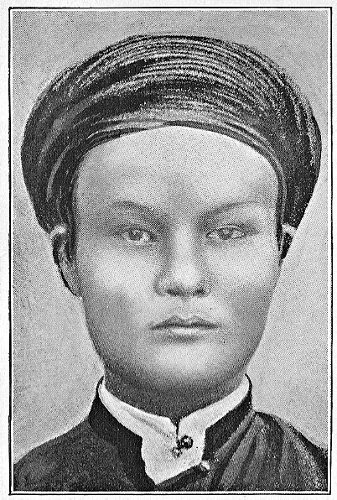
Fig. 95.—Hexagonal face.
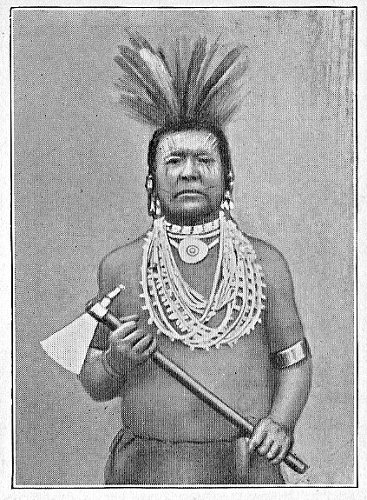
Fig. 96.—Tetragonal face (square).
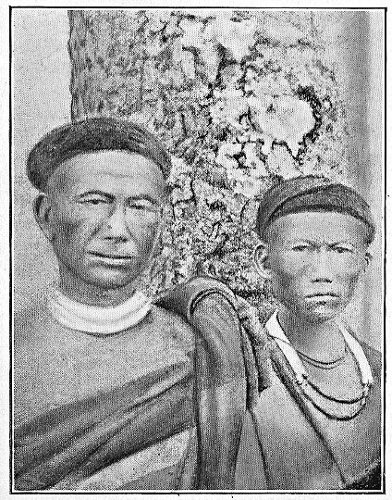
Fig. 97.—Faces of inferior type (cheek bones prominent).
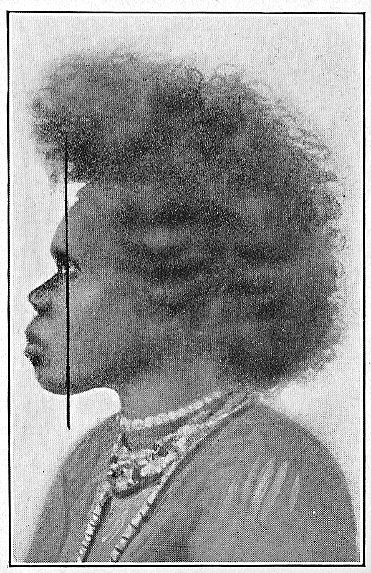
Fig. 98.
When one starts to make the first draft of an ornamental design, it often happens that the proportional relations are based upon certain geometric figures that might be called the skeleton of the ornamental design that is being constructed from them. Accordingly, when an artist wishes to judge of the harmony of proportions in a drawing, a painting, or a statue, he often reconstructs with his eye a geometrical design that no longer exists in the finished work, but that must have served in its construction. In short, there exist certain secret guiding lines and points which the eye of the observer must learn to recognise, to trace and to judge.
This is the way that we should proceed in studying the facial profile.
Let us take or assume a person with the head orientated (i.e., with the occipital point resting against a vertical wall, and the glance level). The line uniting the point of the tragus (the little triangular cartilage projecting from the auricular foramen), with the juncture between the nasal septum and the upper lip, ought, in the case of an æsthetically regular face, to be horizontal. We may call this line the line of orientation. If it proves not to be horizontal, but oblique, slanting either forward (long nose) or backward (short nose), this in itself denotes an irregularity which is plainly perceptible, even to the casual observer. But it is only in exceptional cases that this line is not horizontal; its horizontality constitutes the norm, in our hybrid races.
Naturally, it is horizontal only when the head is orientated in the manner above stated. Hence in normal cases its horizontality is an index of the orientation of the head. The orientated head is perfectly upright; and the line in question marks its level.
Everyone knows that this position of the head is known as that of "attention" and constitutes the position which formerly only soldiers, but now school children as well, must assume as a sign of salutation and respect toward their superiors. It is also the anthropologically normal attitude (as we may see in statuary). And it is a known fact that it is a position exceedingly difficult to assume intentionally with absolute accuracy.
In fact, it corresponds to an attitude which has to be called forth by some inward stimulus of emotion, and for this reason I would call it the "fundamental psychological line." The man who is conscious of his own dignity, or who hopes for his own redemption; the man who is free and independent involuntarily holds his head orientated.
It is not the vain man, or the proud man, or the dreamer, or the bureaucratic official, whose head assumes this involuntary horizontal level that is characteristic of the most profound sentiments known to humanity; persons of such types hold their heads slightly raised and the line shows a slight backward slant.
The man who is depressed and discouraged, the man who has never had occasion to feel the deep, intimate and sacred thrill of human dignity, has on the contrary, a more or less forward slant in the psychological line of orientation.
Look at Fig. 99, which shows a very attractive group of Ciociari or Neapolitan peasants.
The man, or rather the beardless youth who is just beginning to feel himself a man, and therefore hopes for independence, holds his head proudly level; but the very pretty woman seated beside him holds her head gracefully inclined forward. For that matter, this is woman's characteristically graceful attitude. She never naturally assumes, nor does the artist ever attribute to her the proud and lofty attitude of the level head. But this graceful pose is in reality nothing else than the pose of slavery. The woman who is beginning to struggle, the woman who begins to perceive the mysterious and potent voice of human conflict, and enters upon the infinite world of modern progress, raises up her head—and she is not for that reason any the less beautiful. Because beauty is enhanced, rather than taken away, by this attitude which to-day has begun to be assumed by all humanity: by the laborer, since the socialistic propaganda, and by woman in her feministic aspirations for liberty.
Similarly in the school, if we wish to induce little children to hold their heads in the position of orientation, all that is necessary is to instil into them a sense of liberty, of gladness and of hope. Whoever, upon entering a children's class-room, should see their heads assume the level pose as if from some internal stimulus of renewed life, could ask for no greater homage. This, and nothing else, is certainly what will form the great desire of the teacher of the future, who will rightly despise the trite and antiquated show of formal respect, but will seek to touch the souls of his pupils.
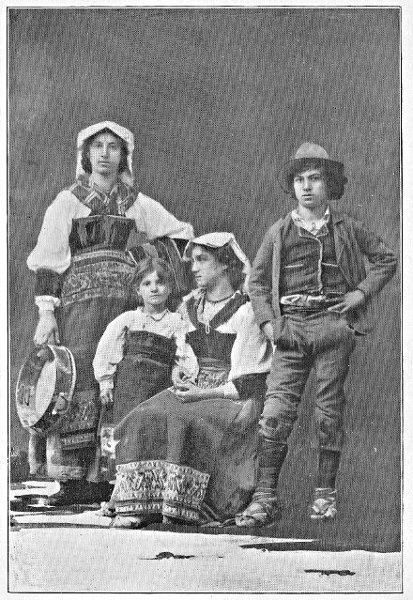
Fig. 99.—A group of Roman peasants.
To return to our lines, it follows that the level orientation is the true human position for the head; it ought never to be abased nor carried loftily, because man ought never to make himself either slave or master; it is the normal line, because it should be that of the accustomed attitudes; because man cannot normally be perpetually meditating, with his gaze upon the ground, as if forgetful of himself and of his social ties; nor can he forever gaze at the heavens, as though drawn upward by some supernal inspiration. The normal attitude is that of the thinking man, who cannot lean either in the one direction or the other, because he is so keenly conscious of being in close connection with all surrounding humanity; and he looks with horizontal gaze toward infinity, as though studying the path of common progress.
Now, if from the metopic point of the forehead, we drop an imaginary perpendicular to the line of orientation, it ought to form, in projection, a tangent to the point of attachment of the nostrils. Observe the two lines traced on the profile of Pauline Borghese.
This line, if prolonged, passes slightly within the extreme angle of the labial aperture, and forms the limit of the chin (see the portrait of Cavalieri, Fig. 101). In this case the profile is eurygnathous.
When the line does not pass in the aforesaid manner, but the facial profile protrudes beyond it, we have a case of prognathism, which may be total, when the whole face projects; maxillary when the mandibles project, nasal when it is only the nose that projects, and mental (or progeneism) when it is only the chin that protrudes.
Figures 98, 100 and 103 represent forms of normal prognathism (related to race, Figs. 98, 100), and of pathological prognathism (Fig. 103, form associated with microcephaly). These two microcephalic profiles call to mind the muzzle of an animal; there is no erect forehead, the orbital arch forming the upward continuance; the nose is very long and almost horizontal to the protruding jaw; the fleshy lips constitute in themselves the anterior apex of the visage; while the chin recedes far back beneath them.
But leaving aside these exceptional profiles, which serve by their very exaggeration to fix our conception of prognathism, let us examine the series of profiles in Fig. 100, which include some forms more or less peculiar, and others that are more or less customary, of prognathism; forms that serve to characterise the physiognomy.
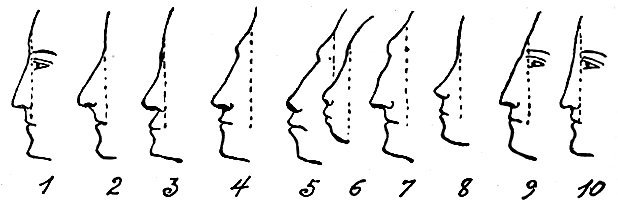
Fig. 100.—(1) Orthognathous face; (2) prognathism limited to the nasal region; (3) prognathism limited to the subnasal region; (4) total prognathism, including the three regions, supra-nasal, nasal and subnasal; (5) exaggerated total prognathism, accompanied by mandibular prognathism; (6) the same in a child; (7) very marked prognathism, but due entirely to the prominence of the supra-nasal section, resulting in an apparent orthognathism (male of tall stature); (8) opposite type to the preceding: pronounced prognathism not extending to the supra-nasal region (feminine type); (9) misunderstood Greek profile (incorrect) resulting in a notable prognathism; (10) correct Greek profile, i.e., conforming to that of Greek statues, and incompatible with prognathism.[41]
Manouvrier, analysing the forms of prognathism from the point of view of physiognomy and cerebral development, notes that varieties 4 and 5 seem to him to correspond to a more or less serious cerebral development; variety 2, very frequent in France and more particularly, according to the author, among the Jews, is not incompatible with a high cerebral inferiority. Variety 3, more frequent in the feminine sex, is found in conjunction, sometimes with a weakly skeletal system, and frequently with rickets and cretinism; nevertheless, Beethoven showed an approach to this profile.
Variety 4 indicates on the contrary an extremely vigorous development of the skeleton, with the qualities and defects commonly associated with great physical strength; variety 7 is regularly associated with tall stature; in fact, in this case the prognathism is determined by excessive development of the frontal bone-sockets.
It is this development, prevalent in the male sex, that renders subnasal prognathism much rarer in man. As a matter of fact, the feminine type of prognathism shown in No. 8 is not greater in degree than the male type, No. 7. Variety 9 shows us a form of prognathism in art, due to a false interpretation of the Greek profile; it is commonly believed that in the Greek profile the frontal line is a continuation of that along the bridge of the nose, and hence we frequently meet with commemorative medals, etc., bearing the monstrous profile shown in No. 9, with pronounced prognathism and receding forehead. The true Greek profile is shown in No. 10, but we can better analyse it by studying the profile of the Discobolus (Fig. 105) and of Antinoous (Fig. 106).
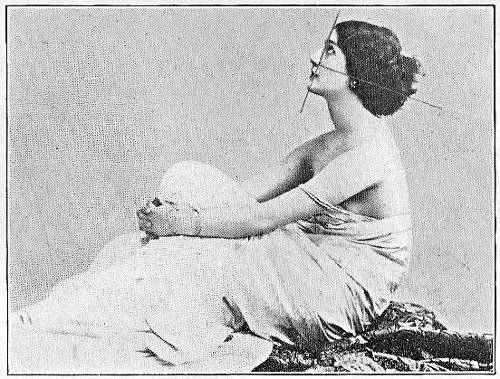
Fig. 101.
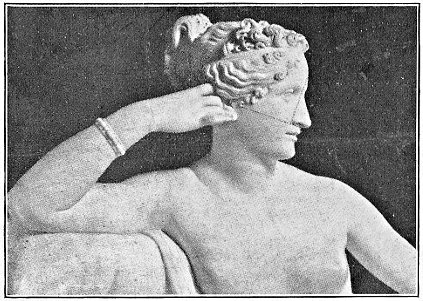
Fig. 102.—Head of Pauline Bonaparte Borghese (Rome, Borghese Museum).
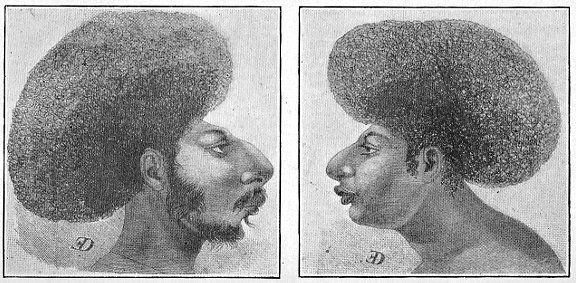
Fig. 103.—Profiles of microcephalics.
The lines of the facial angle have been traced upon the profile of the Discobolus, but the profile of Antinoous has been left untouched, in order that we may trace the same lines upon it in imagination, and thus judge of its perfect beauty (facing page (270)).
Let us first examine these two Greek profiles, without stopping to analyse their separate characteristics, but considering them from the more general point of view of the facial profile in general. Reverting, instead, for our analytical study to the schematic figure shown in Fig. 104, we see that it also shows the line of the facial profile, that of orientation and the vertical, and that these lines form certain right-angled triangles; the right angle MPA is not the facial angle, any more than the corresponding angle shown in the Discobolus is the facial angle. It is said that Greek art considered the right angle as the perfect facial angle; but that is not true. In order to obtain the facial angle it is necessary to draw a third line (MS) which extends from the metopic point to the point of attachment of the nasal septum to the upper lip; this is the line of the facial profile, and the angle MSA is the facial angle. It is never a right angle (see the Discobolus), but it approaches very closely to a right angle. Let us examine the triangle MPS, bounded by the vertical, the line of profile and the line of orientation; it is right-angled at P. Hence, the sum of its other two angles must be equal to one right angle; but the upper angle, corresponding to the nasal aperture, is of only 15°, and consequently the facial angle is 75°. The facial angle of the Discobolus also, like that of Antinoous, like that of the normal human visage, is 75°.
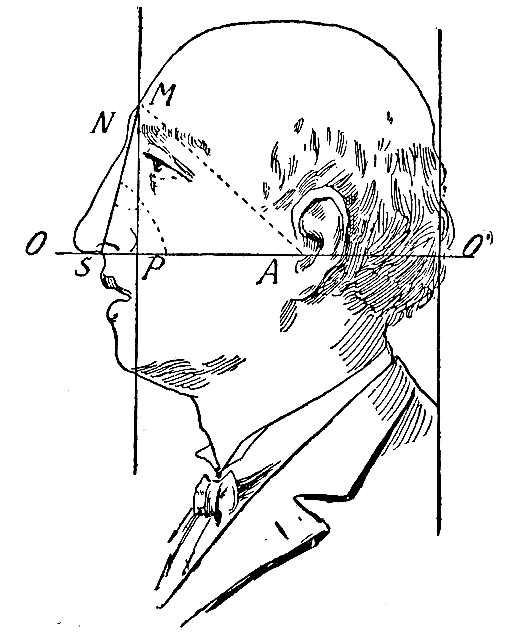
Fig. 104.
Examine further this Fig. 104; in it the line of the facial profile, extending from the metopion to the septo-labial point also passes through the point corresponding to the attachment of the base of the nose (nasion).
The figure is schematic; but anyone who will trace it in imagination upon the profile of Cavalieri, or on that of the seated woman in the group of Neopolitan peasants, or on any of the classic profiles known in art as the Roman profile, will find that the nasal line, connecting the supra- and subnasal points, coincides with the line drawn from the subnasal point to the metopion. But if we observe the Greek profile of the Discobolus, we shall find that the line of profile does not coincide with the base of the nose, but passes behind it.
This is the real characteristic difference between the Roman and the Greek profile: in the Greek profile, the root of the nose is attached further in front of the metopico-subnasal line, and this is due to the special form of the Greek forehead, which, instead of being slightly flattened at the glabella, as in the equally beautiful Roman forehead, is rounded to such a degree that the transverse section of the forehead follows a circular line. Hence, it results that the metopic region of the forehead is more prominent and the nose straight, and hence also the line of the forehead is a perceptible continuation of that of the nose (compare the Antinoous). This unique and essential difference between the Greek and the Roman profile has not hitherto been pointed out, so far as I am aware; it is indicated by just one of the facial lines, the one which forms an angle of 75° with the line of orientation. I had an opportunity to observe these differences in my study of the women of Latium, which I pursued side by side with a study of the statues in the museums of Rome, under the guidance of distinguished art specialists; nevertheless, they had none of them ever defined by mathematical lines the sole difference between the two classic types.
The habit of tracing these imaginary lines renders us far more keen in recognising any and every degree of prognathism, even the least perceptible, and any other imperfection of the profile, than the most complicated system of goniometry would make us. For instance, examine the profile of Pauline Borghese; it is certainly not prognathous, since the vertical line reveals a most impeccable orthognathism. But let us trace the nasal line: it meets the vertical line before reaching the metopic point; in order to meet it at this point, the nose would have had to be narrower from front to back; in that case the profile of Pauline Borghese would have been a perfect Roman profile; but the imperial stigma of the Napoleonic house deprived the beautiful princess of the privilege of perfect classic beauty.
In my studies of the women of Latium, in addition to the Greek and Roman forms of profile which are very frequent (the former distinguished by the morphological peculiarity of having no definite naso-frontal angle nor metopic flattening of the forehead) I found a third profile, less frequent yet quite characteristic, among the representatives of the Mediterranean (Eurafrican) race. It is worthy of note (Figs. 107, 108).
First of all, the forehead has a slight transverse depression along its middle line, and the mandible is slightly elongated; but if we draw our imaginary vertical line from the extreme forward point of the brow, we find that none of the forms of prognathism is involved, and that the auriculo-subnasal line is horizontal. This is the type that has been described by Sergi as Egyptian; and the young woman, shown in profile, really does suggest a reincarnation of the proud beauty of the daughters of Pharaoh; the somewhat fleshy lips and the form of the eyes, not almond-like, but very wide and horizontal, complete the characteristics of the type immortalised in Egyptian art.
In the normal profile two forms can be distinguished which are associated with the two general forms of leptoprosopic and chameprosopic face, and hence also with the dolichocephalic and brachycephalic forms of cranium. In the one case, the features are more elongated and seem to be more depressed laterally, with the result that the profile is more refined, the visage narrower, along the longitudinal line; in this case the profile is proopic (as, for example, in the aforesaid Egyptian profile and in the elongated ovoidal English face, Fig. 90); aristocratic faces of the finer type are proopic. On the other hand, broad faces are anteriorly flattened to such an extent that the flatness shows even in the profile: platyopic profile.
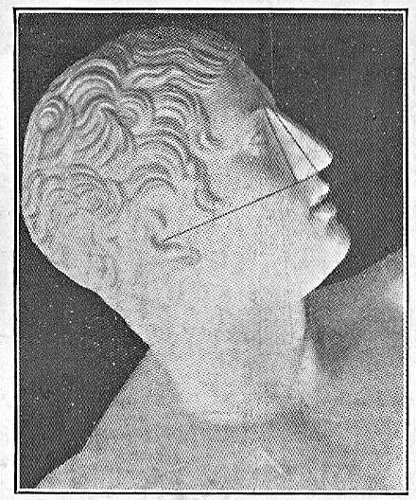
Fig. 105.—The Discobolus by Miron (Rome, Vatican Museum).
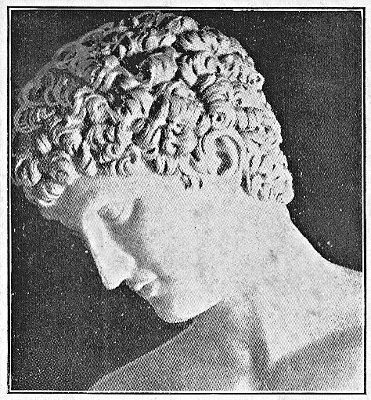
Fig. 106.—Head of statue known as the Capitoline Antinoous (Rome, Capitoline Museum).
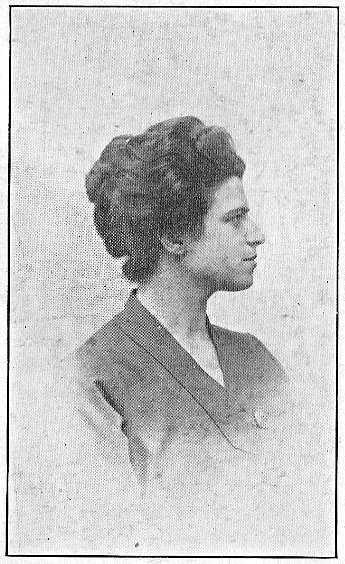
Fig. 107.
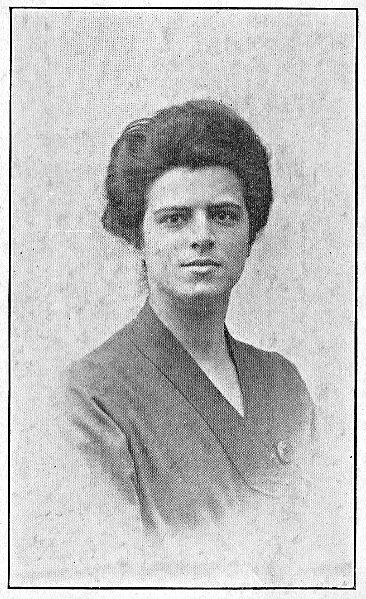
Fig. 108.
These general forms are associated with certain special forms of the separate organs.
Thus, for example, in proopic faces the palate is narrow, long and high; in platyopic faces, on the contrary, it is broad, low and flat; and the teeth corresponding to them may present a widely different appearance (long, narrow teeth; broad teeth).
Low Types and Abnormal Forms.—Low types, as we have already noted, depend upon the development of the face in its least noble parts (those of mastication); prominence of the cheek-bones and maxillary angles, great development of the upper and lower jaw (prognathism). These conditions are frequently accompanied by a low, narrow, or receding forehead, indicating a scanty cerebral development. Lombroso found a great prevalence of similar forms among criminals; but recent studies have disclosed the fact that such forms of facial development are in some way related to the environment in which the individual has developed, so much so that, on the basis of these morphological characteristics, we might almost succeed in delineating the physiognomies distinguishing the different social castes. In fact, while the aristocratic face is ellipsoidal and proopic, that of the peasant is characterised by a pronounced wideness between the cheek-bones, and that of the city labourer by a peculiar development in the height of the mandible. Thus the peasant has a broad face, and the city workman a somewhat elongated face, with very pronounced maxillary angles.
A real and important abnormality which indicates a deviation from every type of race or caste is facial asymmetry or plagioprosopy, analogous to plagiocephaly, and frequently associated with it.
It is necessary, however, in the case of the face, to distinguish instances of functional asymmetry, due to unequal innervation of the muscles in the two sides of the face; either from some cerebral cause, or from some local cause affecting the facial nerves. In such cases, the trophic state of the muscles and their contractibility being unequal, there is a resultant asymmetry, especially evident in the play of facial expression.
This form of asymmetry must necessarily be limited to the soft tissues and be due to a pathological cause; consequently it should not be confounded with the asymmetry due to a different skeletal development of the two sides of the face, an abnormality analogous to plagiocephaly, which is met with among degenerates as a stigma of congenital malformation. We owe to Brugia a most admirable method for demonstrating the high degrees of facial asymmetry which sometimes reach such an extreme point as to give the two halves the appearance of having formed parts of two different faces. This is precisely what Brugia shows by the aid of photography, uniting each half with a reversed print of itself, making the two prints coincide along the median line. The result is that every asymmetric face gives two other faces formed respectively from one of the two inequal halves, and presenting profoundly different aspects.
Other abnormalities are revealed by the facial profile. They are due either to total or partial prognathism (already analysed), or to orthognathism, where the facial angle equals or exceeds a right angle; such a profile occurs in cases of hydrocephaly or of macrocephaly in general, usually resulting from infantile arrest of development.
The Evolution of the Face.—The human countenance, that is so marvellously beautiful in our superior hybrid races, passes, during its embryonal life, through many forms that are very far removed from such perfection.
Figures 110, 111, and 112 represent the evolution of the face in animals and in man: and the complete evolution of a woman's face from the embryo during the first weeks of its formation to the attainment of old age.
The embryonal face, as may be seen even better in animals than in man, is surmounted by the brain divided and differentiated into its superimposed primitive vesicles; furthermore, it consists of one single, widespread cavity, at the sides of which may be discerned two diminutive vesicles or bulbs, which are offshoots of the brain and constitute the first rudiments of the eyes. In studying a more advanced stage of development, we may note in what constitutes the upper lip of this wide facial cavity, two nasal ducts or furrows, which are the first indications of the nose.
The principal differentiation which takes place in the face consists of the development from its two lateral walls on left and right, of two thin plates or laminæ that advance across the cavity itself, in its anterior portion, and proceed to unite in a median ridge, the raphe palati; this constitutes the formation of the palatine vault, which is destined permanently to divide the single cavity into two cavities—an upper or nasal, and a lower or buccal cavity. If this process of formation is not completed, the result is a grave abnormality, the cleft palate, popularly known in Italy as a "wolf's throat," and consisting in the fact that the nasal and buccal cavities to a greater or less extent open into each other; this abnormality, due to an arrest of embryonic development, is almost always accompanied by a hare-lip.
Simultaneously with the formation of the palatine vault, another and vertical septum is formed, which divides the upper cavity into two halves, right and left. This division, however, is limited to the anterior portion; the three cavities thus formed have no such division in the rear, but all three open into the gullet or œsophagus, which represents the only relic of the single original cavity.
The maxillary bones are formed in a manner analogous to that of the nasal and palatal septa, through extroversions destined to become ossified.
It is not until later that the external nose is formed (middle of the second month of embryonal life).
After this, the evolution of the embryo becomes evidently a perfectionment and a growth, rather than a transformation.
In the new-born child the face is extremely small in comparison with the cerebral cranium.
If we compare the head of an adult with that of an infant, and draw the well-known line of separation between the facial and the cerebral cranium, the difference in the reciprocal proportions between the two parts at once becomes apparent. The infant's face seems like a mere appendix to its cranium; and the mandible is especially small; in fact, very young children remain much of the time with their mouth open and the under lip drawn back behind the upper.
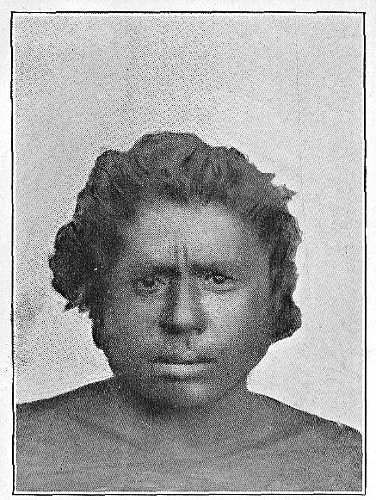
Fig. 109.—Face of inferior type. Prominence of angles of jaw (Gonia).
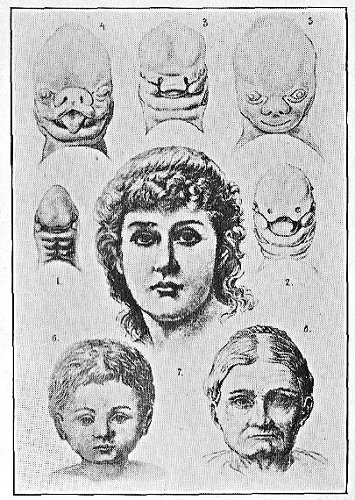
Fig. 110.
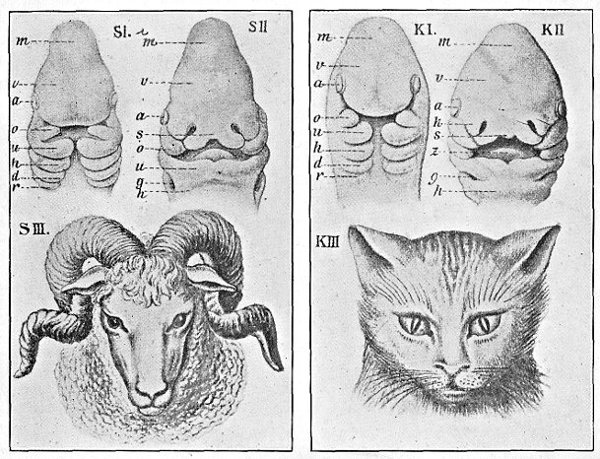
Fig. 111. Fig. 112.
a, eye; v, anterior brain; m, middle brain; s, frontal process; h, nasal septum; o, u, h, d, r, primitive embryonal formations, explained as being branchial (i.e., gill) arches; z, tongue; g, auditory fissure. Note the analogy between the different parts of the head in animals and in man; every species, however, has special embryonal characteristics.
Consequently, the growth of the face obeys laws and rhythms differing from those of the cranium, in comparison to which the face is destined to assume very different proportions by the time that the adult age is reached. The face grows much more than the cranium.
In its characteristic infantile form, the face is quite round (short and broad), and, when the child is plump, it often happens that at birth the face is broader than it is long. Seen in profile it is orthognathous, and this orthognathism endures throughout early infancy, because the profile still remains in retreat behind the plane of the protruding forehead; i.e., the facial angle exceeds a right angle, and the mandibular region is further back than the nasal (compare profile of infant).
In the course of growth it may be said in a general way that the facial index diminishes; that is, the numerical proportion between width and height becomes lowered as the face lengthens; while the facial angle changes from somewhat more than a right angle to a right angle, and finally to an acute angle of 75°.
In order to obtain an exact idea of the transformations of the face, children should have their pictures taken, full face and profile, on every birthday, as is already customary in England for the purposes of the carnet maternel, the "mother's note-book."
In the illustrations facing this page we have portraits of the same person taken at successive ages (Figs. 113, 114, 115, 116), i.e., at the age of six months, one year and a half, seven, and lastly twelve years; it will be seen that the face has steadily lengthened.
In this case the individual happens to be noticeably leptoprosopic; but observe the rotundity of the infantile face at the age of six months.
An analogous observation may be made in the case of the girl represented in Figs. 118 and 119, at the age of ten months and thirteen years respectively.
Even in the case of abnormal children the same law holds good; an examination of the three pictures of an incurable idiot boy, taken at the ages of six, eleven, and sixteen years (Figs. 121, 122, 123 facing page (276)), shows that the face, from being originally rotund has become elongated.[42]
We owe to Binet the most exact and complete studies that exist in anthropologic literature on the subject of the growth of the face. He has made a great number of facial measurements, both of children and young persons of the male sex, from four to eighteen years of age, taking the measurements at intervals of two years. The measurements chosen by Binet are all the possible distances that will serve to give the various widths of the face, the distance of the ear from the various points of the profile, and the heights of the various segments; namely (for an exact understanding of these measurements, see section on Technique), auriculo-mental diameter, auriculo-nasal diameter, auriculo-subnasal diameter, auriculo-ophryac diameter, auriculo-metopic diameter, frontal diameter, biauricular diameter, bizygomatic diameter, length of nose, length of chin, subnase-mental distance, height of forehead.[43]
Binet's conclusions are as follows: the growth of the whole head may be divided into three rhythms: that of the cerebral cranium, that of the face apart from the nose, and that of the nose.
If the total development of the cerebral cranium from the fourth to the eighteenth year shows a proportion of 12 per cent., the facial development shows an increase of 24 per cent. and that of the nose 39 per cent. Consequently the face increases twice as much as the cranium, and the nose three times as much. In the growth of the face, however, the transverse dimensions must be distinguished from the longitudinal dimensions, because the facial index varies greatly according to the age. The width of the face follows very nearly the same rhythm as the cranium, never exceeding the latter's proportional increase; the length of the face, on the contrary, follows the special rhythm of the growth of the face, which lengthens far more than it broadens.
If we consider the distances of the various points in the profile from the auricular foramen, we find that these distances show a greater increase in proportion as the points in question are further from the forehead and nearer to the chin.
The central section (the nose) and the mandible are the portions which contribute most largely to the increase in length of the face.
While in the case of the cranium there is a very slight, and often imperceptible puberal acceleration of growth, the puberal transformations of the head are, on the contrary, most notable in respect to the face.
The entire region of the upper and lower jaws, but more especially the lower, undergoes a maximum increase during the period of puberty.
In regard to the nose, its rapid growth begins at the time immediately preceding puberty; that is, it undergoes a prepuberal maximum increase. When a boy is about to complete his sexual development, the nose begins to gain in size.
The puberal growth of the mandible has long been a familiar fact, and bears a relation to the development of the sexual glands.
A special characteristic noted by Binet and by myself is that the height of the lower jaw in boys who have reached the prepuberal stage is greater in the boys who are least intelligent; just as in the case of these boys the nose is less leptorrhine and the face less broad. This means that at the period of puberty the most intelligent boys not only have a greater development of head, but also certain distinctive facial characteristics. They should have, for instance, a more ample forehead, a broader face, especially in the bizygomatic diameter (between the cheek-bones), and a leptorrhine nose (infantile leptorrhine type). The backward boys, on the contrary, have a longer face, accompanied by a higher mandible and a flat or "snub" nose. Here are the comparative figures:
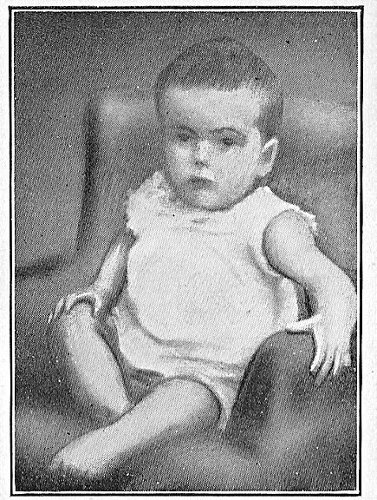
Fig. 113.—A child at six months.
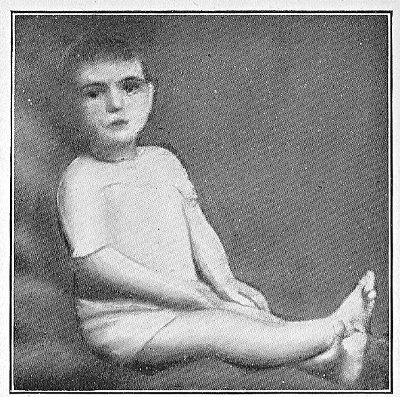
Fig. 114.—The same child at a year and a half.
Fig. 115.—A seven-year-old boy.
Fig. 116.—The same boy at the age of twelve.
FACIAL MEASUREMENTS
Binet Children from the elementary schools of Paris from 11 to 13 years of age Montessori Children from the elementary schools of Rome from 9 to 11 years of age
Measurements Binet's figures Montessori's figures
Brightest pupils Backward pupils Difference Brightest pupils Backward pupils Difference
Minimum frontal diameter 104 102 2 99 98 1
Height of forehead 46 45.5 0.5 57 56 1
Mento-subnasal distance 62 64.6 2.4 54 56 2
Bizygomatic diameter 124.8 122.9 1.9 109 107 2
Bigoniac diameter 93.5 92.1 1.4 87 86 1
COMPARATIVE FACIAL MEASUREMENTS OBTAINED FROM THE BRIGHTEST AND THE MOST BACKWARD PUPILS IN THE SCHOOLS OF ROME (MONTESSORI)
Measurements and indices in millimetres Brightest pupils Backward pupils Difference
Height of mandible 34 mm. 36 mm. 2 mm.
Length of nose 47 mm. 45 mm. 2 mm.
Width of nose 28 mm. 29 mm. 1 mm.
Nasal index 59 mm. 64 mm. 5 mm.
These results would seem to prove that there are high and low infantile types of face, analogous, let us say, to types of social caste; and in school life they correspond to the castes of the intelligent and the backward pupils.
Intelligent children tend to preserve the infantile form of face more intact (broad and short) or rather, if we extend our researches to pupils who have reached the prepuberal age, we may conclude that intelligent pupils develop according to the normal laws—the growth is confined to the nose; backward children invert the order of growth—the lower jaw is already enlarged before the nose has even begun the acceleration of puberal growth. This difference remains permanent in the adult, and we have in consequence low types of face characterised by a flat nose and heavy lower jaw.
Facial Expression.—The study of the human face cannot be limited to a consideration of the form alone; because what gives character to it is the expression. Internal thought, sensory impressions and all the various emotions produce responsive movements of the facial muscles, whose contractions determine those visible phenomena corresponding to the inner state of mind.
The teacher ought to understand facial expression, just as a physician must train himself to recognise the facies corresponding to various diseases and states of suffering. The study of expression ought to form a part of the study of psychology, but it also comes within the province of anthropology, because the habitual, life-long expressions of the face determine the wrinkles of old age, which are distinctly an anthropological characteristic.
The facial muscles may be divided into two zones: one of which comprises the frontal and ocular region, and the other the buccal region; corresponding to which are the two upper and lower branches of the frontal nerve.
Accordingly we may speak of a frontal or higher zone of expression and of an oral or lower zone.
The expressions of pure thought (attention, reflection) group themselves around the forehead; those of emotion, on the contrary, call forth a combined action of both zones, and frequently irradiate over the entire body. But as a general rule the man of higher intelligence has a greater intensity of frontal expression, and the man of low intelligence (uneducated men, peasants, and to a much greater degree, imbeciles, idiots, etc.) have a predominance of oral expression.
In children the frontal zone has slight mobility, and the oral zone has a preponderance of expression; infantile expression, however, is diffuse and exaggerated and is characterised by grimaces. Undoubtedly there are certain restraining powers, which develop in the course of time and serve to limit and definitely determine the facial expressions.
Fig. 117.—Profile of a child.
Fig.—118. A child of ten months.
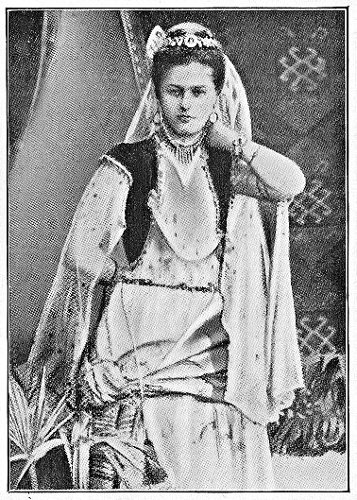
Fig. 119.—The same, 13 years old.
As for the mechanics of expression, they consist of the facial nerve, and the surface muscles stimulated by it, which are: the frontal muscle, which covers the entire forehead and merges above into the epicranial aponeurosis; the superciliary muscle extending transversely along the superciliary arch and concealed by the orbicular muscle of the eyelids (m. orbicularis palpebrarum), which surrounds the eye-socket like a ring; the pyramidal muscle (m. pyramidalis nasi), which is connected with the point of origin of the frontal muscle at the inner angle of the eyebrow, and separates below into four symmetrical fasciæ, two of which are attached to the ala or wing of the nose, and the other two to the upper lip.
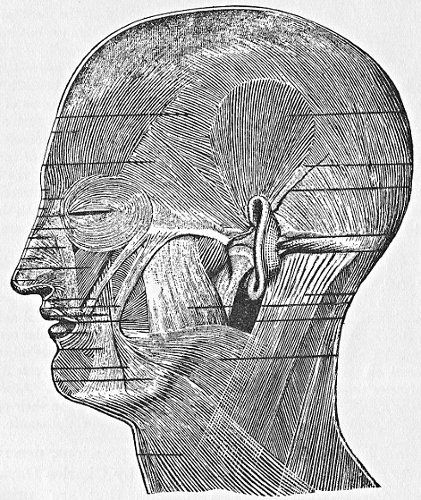
Fig. 120.—The Muscles of the Head and Face.
A group of very delicate muscles controlling the sensitive movements of the wings and septum of the nose (m. compressor narium, m. depressor alœ nasi, m. levator alœ nasi, anterior and posterior, and m. depressor septi) have their points of attachment around the nasal alœ (just above the upper incisor and canine teeth). There is a great wealth of muscles surrounding the mouth; no animal, not even the anthropoid ape, is equipped with so many muscles; it is due to them that the human mouth is able to assume such a great variety of positions. The greater number of these muscles are arranged like radii around the mouth; and there is one which, unlike the rest, surrounds the oral aperture like a ring.
The radiating muscles, descending from the sides of the nose down along the chin are: the levator muscle of the upper lip (m. levator labii superioris, starting from the bony margin below the infraorbital foramen); the levator muscle of the angle of the mouth (m. levator anguli oris, starting from the fossa of the upper maxilla); the large and small zygomatic muscles (starting from the anterior surface of the malar bones); the risorial muscle (m. risorius), the smallest of all the facial muscles, which has its origin in the soft surface tissues (aponeurosis parotido-masseterica); the depressor muscle of the mouth angle (m. depressor anguli oris, or m. triangularis) originating on the lower margin of the maxilla; the depressor muscle of the lower lip or quadratus muscle of the chin (m. quadratus labii inferioris or quadratus menti, also originating on the lower maxilla); the levator muscle of the chin (m. levator menti) between the two musculi quadrati, also has its origin in the lower maxilla; the buccinator muscle, hidden beneath the preceding, has its origin behind the molar teeth in the alveolar process of the two maxillæ, and extends horizontally, terminating in the two lips, in such a manner that its two fasciæ; partly cross, so that the upper fasciæ of the muscle starting from the mandible extend to the upper lip, and the lower fasciæ of the muscle starting from the maxilla extend to the lower lip. Consequently the contraction of this muscle stretches the angles of the mouth in a horizontal direction only; it is the most voluntary of all the muscles, and plays a greater part than the others in forced laughter; in consequence it robs this movement of its characteristic charm.