Chapter I · CERTAIN PRINCIPLES OF GENERAL BIOLOGY
Frederic Taber Cooper translation
In order to understand the practical researches that must be conducted for anthropological purposes, it is necessary to have an adequate preparation in the science of biology. The interpretation of the data that have to be gathered according to technical procedure, demands a training; and this training will form our subject in the theoretic part of the present volume. The limits, however, not only of the book itself, but of pedagogic anthropology as well, preclude anything more than a simple general outline; but this can be supplemented by those other branches of study which are either collateral to it or constitute its necessary basis (i.e., general biology, human anatomy and physiology, hygiene of environment, general anthropology, etc.).
The Material Substratum of Life The Synthetic Concept of the Individual in Biology
According to the materialistic theories of life, of which Haeckel is the most noted supporter, life was derived from a form of matter, protoplasm, which not only has a special chemical composition, but possesses further the property of a constant molecular movement of scission and redintegration; vital metabolism or interchange of matter, by which the molecules are constantly renewed at the expense of the environment.
It was Huxley who defined protoplasm as the physical basis of life; and, as a matter of fact, life does not exist without protoplasm.
But Schultze and Haeckel carried this doctrine further, to the point of maintaining that a minute particle of protoplasm was all that was needed to constitute life; and that such a particle could be formed naturally, whenever the surrounding conditions were favorable, like any other inorganic chemical substance; and in this way the materialists endeavoured, with great ingenuousness, to maintain the spontaneous origin of life. And when Haeckel thought that he had discovered the moneræ or living cells composed of a single particle of protoplasm, he held that these were the first species to have appeared on earth.
But the further researches of physiologists and the improvements in the technique of the microscope proved that protoplasm does not exist independently in nature; because living cells are always a combination of protoplasm and a nucleus. If the nucleus is extracted from a radiolarium, the latter mortifies, and the protoplasm also dies; if an amœba is severed in such a manner that one part contains nucleus and protoplasm and the other protoplasm alone, it will be found that the latter part mortifies and dies, while the first part continues to live. If an infusorium is divided in such a way that each of the separate sections contains a part of the nucleus and a part of the protoplasm, two living infusoria are developed similar to the original one. Experiments of this kind, to which Verworn has given high authority, serve to prove that life does not exist except in cells divisible into protoplasm and nucleus. Further discoveries confirm this theory, as for instance the presence of a nucleus in hemocytes or red blood corpuscles, which were formerly believed to be instances of anuclear cells; and the discovery of protoplasm in microbes, which had formerly been considered free nuclei.
Now, when we have an independent living cell, it represents an individual, which not only has, as a general feature, this primitive complexity of parts, but also certain special characteristics of form, of reaction to environment, etc., that mark the species to which this particular living creature belongs.
Accordingly, we cannot assert, without committing the error of confining ourselves to a generic detail, that life originates in protoplasm or in a combination divisible into protoplasm and nucleus; we should say that life originates in living individuals; since, aside from abstract speculation, there can be no other material substratum of life.
Such a doctrine is eminently synthetic, and opens the mind to new conceptions regarding the properties that characterise life.
Formerly when life was defined as a form of matter (protoplasm) subject to constant movement (metabolism), only a single general property had been stated; for that matter, even the stars consist of matter and movement; and, according to the modern theory of electrons, atoms are composed of little particles strongly charged with electricity and endowed with perennial motion. Accordingly, these are universal characteristics, and not peculiar to life; and metabolism may be regarded as a variation of such a property, which is provoked by, or at least associated with the phenomenon of life.
The properties which are really characteristic of life have been summed up by Laloy in two essential groups; final causes and limitations of mass, or, to use a term more appropriate to living organisms, limitations of form and size.
The term final causes refers to a series of phenomena that are met with only where there is life, and that tend toward a definite purpose or end. Living organisms take nutriment from their environment, to the end of assimilating it, that is, transforming it from an inert, indifferent substance into a substance that is a living part of themselves.
This phenomenon is undoubtedly one of the most characteristic. But there are still other forms of final cause, such for example as the transformation of the fertilised ovum into the fully developed individual, predetermined in its essential characteristics, such as form, dimensions, colour, activities, etc. There are ova that to all appearances are exactly alike; the human ovum itself is nothing more than a simple cell composed of protoplasm and nucleus, measuring only a tenth of a millimeter (= 1/250 inch); yet all these ovum cells produce living organisms of the utmost diversity; yet so definitely predetermined that, if we know to what species the ovum belongs, we are able to predict how many bones will compose the skeleton of the animal destined to develop from it, and whether this animal will fly or creep upon the ground, or rise to take a place among those who have made themselves the lords of the earth. Furthermore, knowing the phases of development, we may predetermine at what periods the successive transformations that lead step by step to the complete development of the individual will take place.
Another form of final cause is seen in the actions of living creatures, which reveal a self-consciousness; a consciousness that even in its most obscure forms guides them toward a destined end.
Thus, for example, even the infusoria that may be seen through a microscope in a drop of water, chasing hither and thither in great numbers, avoiding collision with one another, or contending over some particle of food, or rushing in a mass toward an unexpected ray of light, give us a keen impression of their possession of consciousness, a dim glimmering of self-will, which is the most elementary form of that phenomenon that manifests itself more and more clearly, from the metazoa upward, through the whole zoologic scale: the final cause of psychic action.
Again, in multicellular organisms there are certain continuous and so-called vital phenomena, which some physiologists attribute to cellular consciousness: for example, the leucocytes in the blood seem to obey a sort of glimmering consciousness when they rush to the encounter of any danger threatening the organism, and ingest microbes or other substances foreign to the blood; and it is also due to a phenomenon that cannot be explained by the physical laws of osmosis, that the erythrocytes or red blood corpuscles and the plasma in the blood never interchange sodium salts for those of potassium; and lastly the cells of each separate gland seem to select from the blood the special substances that are needed for the formation of their specific products: saliva, milk, the pancreatic juice, etc.
Still another manifestation of final cause is the tendency exhibited by each living individual to make a constant struggle for life, a struggle that depends upon a minimum expenditure of force for a maximum realisation of life, thanks to which life multiplies, invades its environment, adapts itself to it, and is transformed.
Another fundamental synthetic characteristic of life is the limitation of form and size that is a fixed and constant factor in the characteristics of each species; the body of the living individual cannot grow indefinitely.
Living creatures do not increase in quantity by the successive accumulation of matter, as is the case with inorganic bodies, but by reproduction, that is, the multiplication of individuals.
Through the phenomenon of reproduction, life has a share in the eternity of matter and of force, that is, in a universal phenomenon. But what distinguishes it is that the individual creatures produced by other living individuals form, each one of them, an indivisible element in which life manifests itself; and this element is morphologically fixed in the limits of its form and size.
The peculiarities which are attributed to the chemical action of protoplasm are of an analytic character, so far as they concern the fundamental characteristics of life. The constant interchange of matter, namely, metabolism, constitutes undoubtedly a phenomenon peculiar to living matter, protoplasm; but protoplasm does not exist apart from living organisms. And what constitutes its chief characteristic is that, when brought into contact with it, inert substances are assimilated, i.e., they become like it, or rather, are transformed into protoplasm; mineral salts such as the nitrates or nitrites of sodium and potassium are transformed in the case of plants into living plasma capable of germinating either into a rose bush or a plane tree or a palm, and inert organic substances such as bread or wine are transformed into human flesh and blood. So that the phenomenon of assimilation outweighs, as a characteristic of life, the molecular chemical action through which it is accomplished. Since metabolism does not occur in nature as a chemical phenomenon, and cannot be produced artificially, but is found only in the matter composing living organisms, it follows that life is the cause of this form of dynamic action, and not that this dynamic action is the cause of life.[4]
Even the latest theory, developed especially by Ludwig in Germany—that protoplasm contains a separate enzyme for each separate function appointed to a particular task—amounts to nothing more than an analysis of the living organism.
The Formation of Multicellular Organisms
We cannot say that the cell is the element of life, because, in an absolute sense, it is not alive; it lives only when it constitutes an individual. Even the brain cells, the muscular fibres, the leucocytes, etc., are cells; but they do not live independently; their life depends upon the living individual that contains them. We may, however, define the cell as the means, the morphological material, out of which all living organisms are formed: because, from the algæ to the orchids, from the cœlenterata up to man, all complex organisms are composed of an accumulation of those microscopic little bodies that we call cells.
The manner of union between the cells in the most primitive living colonies, whether vegetable or animal, is analogous to that followed in the segmentation of the ovum in its ontogenetic (i.e., individual) development.
But the manner of construction differs notably, as between animal and vegetable cells.
Vegetable cells, on the one hand, have a resistant and strongly protective membrane; animal cells, on the contrary, have either a very thin membrane or none at all. Vegetable cells, as though made venturesome by their natural protection, proceed to invade their environment in colonies—in other words, the cells dispose themselves in series of linear ramifications—witness the formation of primitive algæ; and analogously the expansion of the higher types of vegetation into their environment, with branches, leaves, etc. And just as though the vegetable cell acquired self-confidence because it is so well protected, it becomes stationary and strikes its roots into the soil.
To this same fact of cellular protection must be attributed the inferior sensibility and hence the permanent state of obscured consciousness in vegetable life.
This protection against the assaults of environment, and the consequent lack of sensibility, constitute from the outset an inferior stage of evolution.
Animal cells have an entirely different manner of forming themselves into colonies; acting as though they were afraid, they group themselves in the form of a little sphere, enclosing their environment within themselves, instead of reaching out to invade it; and subsequent developments of the animal cell consist in successive and complex invaginations, or formations of layers, one within another—instead of ramifications, after the manner of vegetable cells.
Accordingly, if we advance from that primitive animal type, the volvox, consisting of a simple group of cells arranged spherically, like an elastic rubber ball, to the cœlenterata, we meet with the phenomenon of the first invagination, producing an animal body consisting of two layers of cells and an internal cavity, communicating with the exterior by means of a pore or mouth. The two layers of cells promptly divide their task, the outer layer becoming protective and the inner nutritive; and in consequence of their different functions, the cells themselves alter, the outer layer acquiring a tougher consistency, while the inner remains soft in order to absorb whatever nutriment is brought by the water as it passes through the mouth. In this way, there is a division of labor, such that all the external cells protect not only themselves, but the whole organism; while the internal cells absorb nutriment not only for themselves but for the others. This is the simplest example of a process that becomes more and more complex in the formation of higher organisms; in adapting themselves to their work, the cells become greatly modified (formation of tissues) and perform services that are useful to the entire organism. And at the same time, because of the very fact that they have been differentiated, they become dependent upon the labors of others, for obtaining the means of subsistence. Similar laws seem to persist even at the present day in the formation of social organisms, in human society.
During the development of the embryo, all animals pass through similar phases; and to this man is no exception.
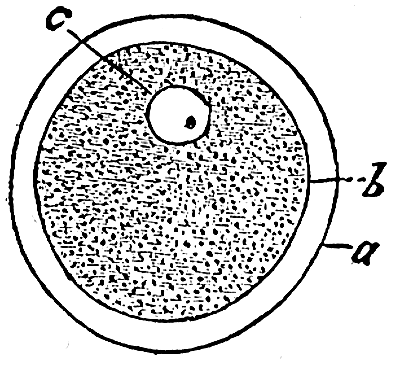
Fig. 1.—Human Ovum, Magnified. a. Vitelline membrane; b. Vitellus; c. Germinal Vesicle.
He traces his origin to an ovum-cell formed of protoplasm, nucleus and membrane, measuring only a tenth of a millimetre, yet vastly large in comparison with the spermatic cell destined to fertilise it by passing through one of the innumerable pores that render the dense membrane penetrable.
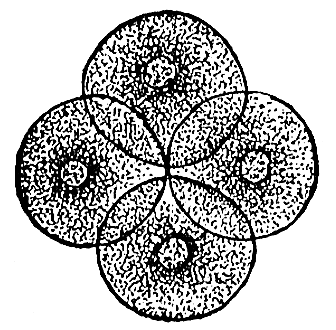
Fig. 2.—First Segmentation of a Fertilised Ovum.
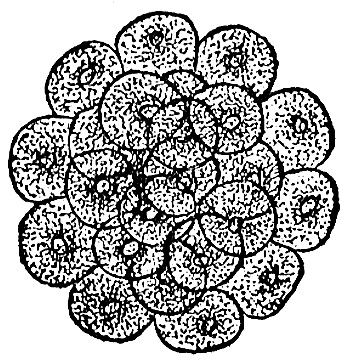
Fig. 3.—A Morula as seen from the Outside.
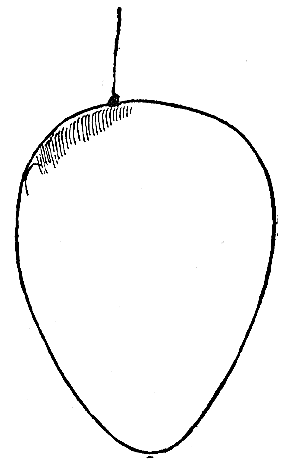
Fig. 4.—An Egg and Spermatozoon of the same Species, about to Fertilise It. Note the difference in the proportional size of the two cells.
After the ovum-cell is fertilised, it constitutes the first cell of the new being; that is, it contains potentially a man. But as seen through the microscope, it is really not materially anything more than a microscopic cell, undifferentiated, and in all things similar to other independent cells or to fertilised ovarian cells belonging to other animals. That which it contains, namely, man, often already predetermined not only in species, but in individual characteristics—as, for instance, in degenerative inferiority—is certainly not there in material form.
At an early stage of the embryo's development, it exhibits a form analogous to that of the volvox; namely, a hollow sphere, called the morula; and subsequently, by the process of invagination, two layers of cells, an inner and an outer, are formed, together with the first body cavity, destined to become the digestive cavity, and also a pore corresponding to the mouth.
This formation has received the name of gastrula (Fig. 10, facing page (72)), and the two layers of cells are known as the primary layers, otherwise called the ectoderm and the entoderm. To these a third intermediate layer is soon added, the mesoderm. These three layers consist of cells that are not perceptibly differentiated from one another; but potentially each and every one contains its own special final cause. In each of the three layers, invaginations take place, furrows destined to develop into the nervous system, the lungs, the liver, the various different glands, the generative organs; and during the progress of such modifications, corresponding changes take place in the elementary cells, which become differentiated into tissues. From the ectoderm are developed the nervous system and the skin tissues; from the entoderm, the digestive system with its associate glands (the liver, pancreas, etc.); from the mesoderm, the supporting tissues (bones and cartilage) and the muscles. But all these cells, even the most complex and specialised, as for example those of the cerebral cortex, the fibres of the striped muscles, the hepatic cells, etc., were originally embryonic cells—in other words, simple, undifferentiated, all starting on an equal footing. Yet every one of them had within it a predestined end that led it to occupy, as it multiplied in number, a certain appointed portion of the body, in order to perform the work, to which the profound alterations in its cellular tissues should ultimately adapt it.
Like children in the same school, these embryonic cells, all apparently just alike, contain certain dormant activities and destinies that are profoundly different. This unquestionably constitutes one of the properties of life, namely, the final cause; it is certainly associated intimately with metabolism and nutrition, considered as a means of development and not as a cause. Upon metabolism, however, depends the more or less complete attainment of the final cause of life. In man, for example, strength, health, beauty, on the one hand, degeneration on the other, stand in intimate relations with the nutrition of the embryo.[5]
The Theories of Evolution.—At the present day, there is a general popular understanding of the fundamental principles involved in the mechanical or materialistic theories of evolution which bear the names of Lamarck, Geffroy-Saint-Hilaire, and more especially the glorious name of Charles Darwin.
According to these theories, the environment is regarded as the chief cause of the evolution of organic forms. Charles Darwin, who formulated the best and most detailed theory of evolution, based it on the two principles of the variability of living organisms, and heredity, which transmits their characteristics from generation to generation. And in explanation of the underlying cause of evolution, he expounded the doctrines of the struggle for existence and the natural selection of such organic forms as succeeded to a sufficient degree in adapting themselves to their environment.
Whatever the explanation may be, the substantial fact remains of the variability of species and the successive and gradual transition from lower to higher forms. In this way, the higher animals and plants must have had as antecedents other forms of inferior species, of which they still bear more or less evident traces; and in applying these theories to the interpretation of the personalities of human degenerates, he frequently invoked the so-called principle of atavism, in order to explain the reappearance of atavistic traits that have been outgrown in the normal human being, certain anomalies of form more or less analogous to parallel forms in lower species of animals.
There are other theories of evolution less familiar than that of Darwin. Naegeli, for instance, attributes the variability of species to internal, rather than external causes—namely, to a spontaneous activity, implanted in life itself, and analogous to that which is witnessed in the development of an individual organism, from the primitive cell up to the final complete development; without, however, attributing to the progressive alterations in species that predestined final goal which heredity determines in the development of individual organisms.
The internal factor, namely life, is the primary cause of progress and the perfectionment of living creatures—while environment assumes a secondary importance, such as that of directing evolution, acting at one time as a stimulus toward certain determined directions of development; at another, permanently establishing certain useful characteristics; and still again, effacing such forms as are unfit.
In this way the external causes are associated with evolution, but with very different effects from those attributed to them by Darwin, who endowed them with the creative power to produce new organs and new forms of life.
Naegeli compared the internal forces to invested capital; it will draw a higher or lower rate of interest, according as its environment proves to be more or less favourable to earning a profit.
The most modern theory of evolution is that of De Vries, who, after having witnessed the spontaneous and unforeseen transformations of a certain plant, the Œnohtera Lamarckiana, without the intervention of any external phenomenon, admitted the possibility of the unexpected occurrence of other new forms, from a preexistent parent form—and to such phenomena he gave the name of mutations.
It is these mutations that create new species; the latter, although apparently unheralded, were already latent in the germ before they definitely burst into life. Consequently, new species are formed potentially in the germinating cells, through spontaneous activity.
The characteristics established by mutations are hereditary, and the species which result from them persist, provided their environment affords favourable conditions, better suited to them than to the preexisting parent form.
Accordingly new species are created unexpectedly. De Vries draws a distinction between mutations and variations, holding that the latter are dependent upon environment, and that in any case they constitute simple oscillations of form around the normal type determined in each species by mutation.
Species, therefore, cannot be transformed by external causes or environments, and the mechanism of transformation is not that of a succession of very gradual variations, which have given rise to the familiar saying: natura non facit saltus. On the contrary, what produces stable characteristics is a revolution prepared in a latent state, but unannounced in its final disclosure. A parallel to this is to be found, for example, in the phenomena of puberty in its relation to the evolution of the individual.
Now, when a species has once reached a fixed stability as regards its characteristics, it is immutable, after the analogy of an individual organism that has completed its development; henceforth its further evolution is ended. In such a case, the oscillations of variability are exceedingly limited, and adaptation to new environments is difficult; and while a species may offer the appearance of great strength (e.g., certain species of gigantic extinct animals), it runs the risk of dying out, because of a lower potentiality of adaptability; or, according to the theory of Rosa, it may even become extinct spontaneously.
Accordingly it is not the fixed species that continue the process of evolution. If we compare the tree of life to a plant, we may imagine evolution as soaring upward, sustained by roots far below; the new branches are not put forth by the old branches, but draw their sustenance from the original sources, from which the whole tree draws its life. When a branch matures and flowers, it may survive or it may wither but it cannot extend the growth of the tree.
Furthermore, the new branches are always higher up than the old ones; that which comes last is the highest of all.
Thus, the species which are the latest in acquiring a stable form are the highest up in the biological scale, because the privilege of carrying forward the process of evolution belongs to those species which have not yet become fixed. An apparent weakness, instability, an active capacity for adaptation, are consequently so many signs of superiority, as regards a potential power of evolution—just as the nudity and sensibility of animal cells, for example, are signs of superiority, as compared with vegetable cells—and of man, as compared with the lower animals.
In order to show that the inferiority of a species is in proportion to its precocity in attaining fixed characteristics, Rosa conceived the following striking comparison. Two animals are fleeing, along the same road, before an advancing flood. One of the two climbs to the top of a neighboring tree, the other continues in its flight toward a mountain. As the level of the water rises, it threatens to isolate and engulf the animal now stalled upon the tree; the other animal, still fleeing toward the heights, reaches, on the contrary, a higher and more secure position.
The animal on the tree stands for an inferior species that has earlier attained a fixed form; the other represents a higher species that has continued to evolve; but the animal upon the mountain never was on the tree at all, because, if he had mounted it and become caught there, he would have lost his chance of continuing on his way. In other words, the higher species never was the lower species, since the characteristics of the latter are already fixed.
Some eloquent comparisons might be drawn from the social life of to-day. We are all of us spurred on to choose as early as possible some form of employment that will place us in a secure and definite place at the great banquet of existence. The idea of continuing to follow an indefinite and uncertain path, leading upward toward the heights is far less attractive than the safe and comfortable shelter of the shady tree that rises by the wayside. The same law of inertia applies to every form of life. Biological evolution bears witness to it, in the forms of the different species; social evolution, in the forms of the professions and trades; the evolution of thought, in the forms of the different faiths. And whoever first halts in any path of life, the path of study, for instance, occupies a lower place than he who continues on his road.
The salaried clerk, armed only with his high-school certificate, has an assured income and the pleasures of family life, at a time when the physician, with an independent profession, is still struggling to establish a practice. But the obscure clerk will eventually hold a social position below that of the physician; his income will always be limited, while the physician may acquire a fortune. Now, the clerk, by adapting himself to his bureaucratic environment, has acquired certain well-defined characteristics; we might even say that he has become a representative type of the species, clerk. And the same will be true of the physician in his independent and brilliant life as high priest of humanity, scientist and man of wealth. Both men were high-school students, and now they are two widely different social types; but the physician never represented the type of clerk; or, in other words, he did not have to be a clerk before he could be a physician; on the contrary, if he had been a clerk, he never could have become a physician. It is somewhat after this fashion that we must conceive of the sequence of species in evolution. It follows that man never was an anthropoid ape, nor any other animal now living around us. Nor was the man of the white race ever at any time a negroid or a mongolian. Consequently, the theory is untenable which tries to explain certain morphological or psychic malformations of man, on the principle of atavism—because no one can inherit if he is not a descendant.
So, for example, reverting to our previous comparisons, if the animal on the mountain should climb a tree, or if the physician should become pedantic, this would not prove that the animal from the mountain was once upon a time the animal in the tree, nor that the physician recalled, by his eventual pedantry, certain bygone days when he was a clerk.
The theories of evolution seemed for a time to illumine and definitely indicate the origin of man. But this illusion has so far resulted only in relegating to still deeper darkness the truth that the biologists are seeking. We do not know of whom man is the son.
Even the earlier conceptions regarding the mechanics of evolution are essentially altered. The mystery of the origin of species, like that of the mutability of forms, has withdrawn from the forms that are already developed, and taken refuge in the germinal cells; these cells in which no differentiation is revealed, yet in which the future organism, in all its details, exists in a potential state; in which, we may even say, life exists independent of matter, are the real laboratorium vitæ. The individual, in developing, does nothing more than obey, by fulfilling the potentiality of the germs.
The direction of research has shifted from the individual to its germs. And just as the early Darwinian theories evolved a social ethics, seemingly based upon the facts of life, to serve as a guide in the struggle for existence, so in the same way, to-day, there has arisen from the modern theories a new sexual ethics, founded upon a biologic basis.
The Phenomena of Heredity.—The most interesting biological researches of to-day are in regard to the hereditary transmission of characteristics.
To-day the phenomena of heredity are no longer absolutely obscure, thanks to the studies of Mendel, who discovered some of its laws, which seemed to open up new lines of research prolific in results. Yet even now, although this field has been invaded by the most illustrious biologists of our time, among others, De Vries, Correns, Tschermack, Hurst, Russell, it is still in the state of investigation. Nevertheless, the general trend of researches relative to Mendel's laws is too important to permit of their enlightening first steps being neglected by Anthropology.
The first phenomena observed by Mendel, and the ones which led him to the discovery of the laws of heredity which bear his name, were revealed by a series of experiments conducted with peas.
Exposition of the Phenomena of Hybridism.—If two strains of peas are crossed, one of them having red flowers and the other white flowers, the result in the first generation is, that all the plants will have red flowers, precisely similar to those of one of the parent plants.
Accordingly, in hybridism, the characteristic of one of the parents completely hides that which is antagonistic to it in the other parent. We call this characteristic (in the case cited, the red flowers), dominant; in distinction to the other characteristic which is antagonistic to the first and overcome by it; namely, the recessive characteristic (in the present case, the white flowers). This is the law of prevalence, and constitutes Mendel's first law, which is stated as follows:
Mendel's First Law: "When antagonistic varieties or characteristics are crossed with each other, the products of the first generation are all uniform and equal to one of the two parents."
This result has been repeatedly reached in a host of researches, which have experimentally established this phenomenon as a law.
Thus, for example, if we cross a nettle having leaves with an indented margin, with a nettle having leaves with a smooth margin, the product of the first generation will all have leaves with indented margins, and apparently identical with the parent plant having indented margins, in other words, having the characteristic that has proved itself the dominant one (Russell).
These phenomena discovered by Mendel have been observed in many different species of plants, such as wheat, Indian corn, barley and beans.
They have also been verified in certain animals, such as mice, rats, rabbits, caveys, poultry, snails, silk-worms, etc. One of the most typical experiments was that of Cuénot, who, by crossing ordinary mice with jumping mice, obtained as a result a first generation composed wholly of normal mice; the characteristic of jumping was thus shown to be recessive.
Notwithstanding that the first generation is apparently in every way similar to the parent with the dominant character, there is in reality a difference.
Because, if we cross these hybrids together, we meet, in the second generation, with the following phenomenon: to every three individuals possessing the dominant character, one is born having the recessive character. To go back to Mendel's first example, that of the peas with red flowers (dominant) and with white flowers (recessive), we find, by crossing together the hybrids of the first generation, that for every three plants with red flowers, there is one plant with white flowers.
And similarly, the crossing of hybrid nettles with indented leaves will result in a second generation composed of three plants with indented leaves to every one with smooth-edged leaves (see Fig. 5).
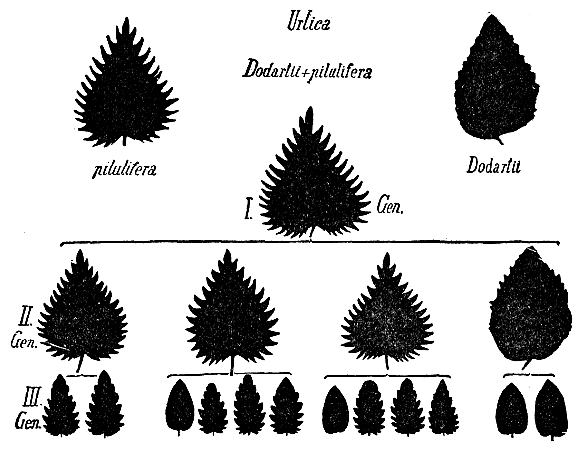
Fig. 5.
That is, the characteristics which belonged to the first two parents all survive, even though in a latent form, in the descendants; and they continue to differentiate themselves in well established proportions. In one offspring out of four, the characteristics of the grandfather, which have remained dormant in the father, once more reappear. This intermittent heredity of characteristics, that are passed from grandfather to grandson, overleaping the father, is one of the best-known laws of pathological heredity in man; and it is called atavistic heredity, to distinguish it from direct heredity, which denotes the transmission from parent to offspring. But no explanation had ever been found for this sort of phenomenon. Undoubtedly, it must be connected with the phenomena of Mendelism.
Accordingly, in the second generation Mendel's second law has been established, the law of disjunction, which is stated as follows:
Mendel's Second Law: "In the second generation obtained by reciprocal fertilisation of the first hybrids, three quarters of the offspring will exhibit the dominant character, and one quarter the recessive."
Mendel's Hypothesis, Designed to Explain the Phenomena of Heredity.—Mendel's great service is to have conceived a hypothesis that seems to have disclosed the key adapted to unlock all the secrets of heredity.
While the body of an individual is the resultant of forces so mutually exclusive that the appearance of one characteristic means the disappearance of its antagonist; in the development of the sexual cells the two antagonistic characters are distributed in equal proportion. That is to say, one-half of the male cells contain the dominant character, and one-half the recessive; and the same holds true for the female cells. The characters of the two parents, in other words, never merge in the reproductive cells, but are distributed in equal measure, independently of the question whether they are dominant or recessive. Thus for example: in the case already cited of the first hybrid generation of the peas with red flowers, in every one of the plants, without distinction, half the pollen has potentially the red character and half has the white; and in the same way the female cells have, half of them a red potentiality and half of them a white. Such hybrids of the first generation, therefore, although apparently similar to the parent with red flowers, differ in their germinative powers, which are not made apparent in the individual. And the same may be said of hybrid nettles with indented leaves, etc.
Granting Mendel's hypothesis, we have on the one hand pollen and on the other seed ready to come together in every manner included within the range of possible combinations; the individual is, in its characteristics, nothing else than the product of a combination which must necessarily manifest itself in accordance with the well-known mathematical laws of probability.
For instance, let us proceed to diagram the possible disposition of the sexual cells of the hybrids of peas, all of them having red flowers. In terms of percentage, they will give, out of every hundred, fifty red and fifty white.
P = pollen; O = ova; R = red, dominant; w = white, recessive:
The possible number of combinations between the pollen grains and the ova are four; namely, RR, Rw, wR, ww. But where a dominant characteristic encounters a recessive (Rw, wR), the recessive disappears, to make way in the individual for the dominant characteristic alone. The definitive result is three individuals of dominant character, to one of recessive character.
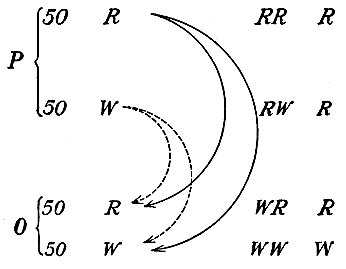
Fig. 6.
Nevertheless, the hybrids of dominant character are not all equal among themselves. Those belonging to the combination RR, indeed, are permanent in character and in all respects alike, and they reproduce the original red-flower progenitor. The other red-flower hybrids, belonging to the groups Rw and wR are, on the contrary, similar to the hybrids of the first generation and contain reproductive cells differentiated in character; such hybrids, if reciprocally fertilised, will again give three dominant offspring to every one recessive; that is, they will obey the law of disjunction. The hybrids belonging to the fourth group, on the contrary, are constant, like those of the first group, and are permanently of recessive character; and they will reproduce the original progenitor with white flowers.
The same results may be attained with nettles with smooth and indented leaves, and with all other types of plant and animal life that obey the laws of Mendelism.
The figure given actually represents the third generation of nettles; from a combination corresponding to RR, there result only indented leaves, and from another combination corresponding to our ww there result only smooth-edged leaves, and from the two mixed groups there come three offspring with indented leaves to every one with smooth leaves.
It is possible to represent, by means of a general diagram, the mathematical succession of characteristics in hybrids, after the following manner; denoting the dominant character by D, and the recessive by r.
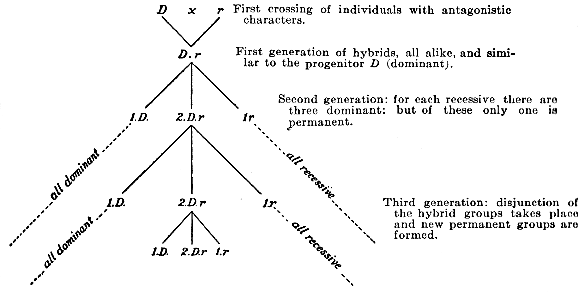
First crossing of individuals with antagonistic characters.
First generation of hybrids, all alike, and similar to the progenitor D (dominant).
Second generation: for each recessive there are three dominant: but of these only one is permanent.
Third generation: disjunction of the hybrid groups takes place and new permanent groups are formed.
Fig. 7.
In each successive generation, provided the fertilisation takes place only between uniform individuals, as indicated in the diagram, and as may be effected by actual experiment with plants, groups identical with the original progenitors will continue to be formed, through successive disjunction of the hybrids; the sexual phenomenon operating in obedience to the laws of probability.
An effective experiment, that anyone may repeat for himself, is the one originated by Darbishire. He took two boxes, typifying respectively the male and female organ, and placed in them black and white disks of equal size, so distributed that each box contained fifty disks of each colour. After mixing these disks very carefully, he proceeded to take at random one disk at a time alternately from each box; and he piled up each pair of disks in such a manner that the black ones should be on top and the white underneath. The result was that for every three black disks on top of the piles there was one white disk; but of the black groups one consisted of two black disks, while in the other two the lower disk was white. This is simply one of the many games dependent on the laws of probability.
Now, supposing that instead of one, there are two characteristics that are in antagonism; in that case, we have the occurrence of double hybridism (dihybridism).
Let us take the strains of peas already considered, but let us choose for observation the character of their seed. One of the plants has round seed and yellow cotyledons; and the other angular seed and green cotyledons. These two characteristics, therefore, are both inherent in the seed; condition of surface (rough, smooth), and colour (green, and yellow).
After fertilisation, Mendel's first law, that of the prevalence of the dominant character, will operate, and all the plants of the first generation will have round seed and yellow cotyledons. Hence these are the dominant characteristics, which we will represent by capital letters: R (round), Y (yellow), to distinguish them from the recessive characteristics, which we will designate with small letters: a (angular), and g (green).
According to Mendel's hypothesis, all these hybrids with round seed and yellow cotyledons, contain sexual cells of opposite potentialities, numerically equal and corresponding to the antagonistic characters of the parent plants. That is, they must have in their pollen grains and their ovarian cells all the possible combinations of their different potentialities.
They should produce in equal quantities:
pollen grains (P) with round seed and yellow cotyledons: R Y
" " green " R g
angular " yellow " a Y
" " green " a g
ovarian cells (O) with round " yellow " R Y
" " green " R g
angular " yellow " a Y
" " green " a g
The total number of combinations that may result is sixteen; that is, each one of the four combinations of pollen may unite with any one of the ovarian cells; thus constituting four groups of four. And these groups represent the combinations (of pollen and ova) capable of producing individuals:
R Y - R Y = R Y a Y - R Y = R Y
R Y - R g = R Y a Y - R g = R Y
R Y - a Y = R Y a Y - a Y = a Y
R Y - a g = R Y a Y - a g = a Y
R g - R Y = R Y a g - R Y = R Y
R g - R g = R g a g - R g = R g
R g - a Y = R Y a g - a Y = a Y
R g - a g = R g a g - a g = a g
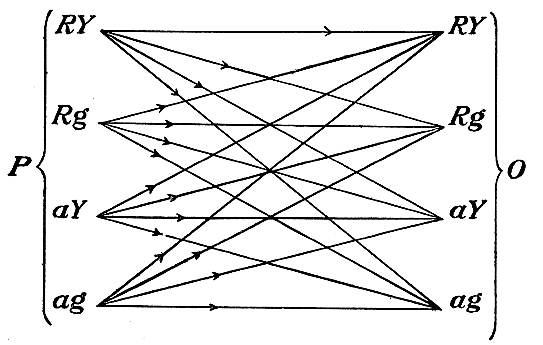
Fig. 8.
Every time that a dominant characteristic encounters a recessive one (R with a or Y with g), it overpowers and hides it: consequently the results of the different combinations are quite definitely limited as determining forms of different individuals. In fact, the results of the sixteen combinations are as follows:
R Y R Y
R Y R Y
R Y a Y
R Y a Y
R Y R Y
R g R g
R Y a Y
R g a g
That is to say, the only forms which occur are the following:
R Y, R g a Y, a g
whose relative probability of occurrence is:
R Y 9 times in 16 = 56.25%
R g 3 times in 16 = 18.75%
a Y 3 times in 16 = 18.75%
a g 1 time in 16 = 6.25%
Now, as a result of actual experiment, the forms obtained show the following relative percentage:
Results of experiments with plants according to the combinations and laws of probability
R Y 56.5% 56.25%
R g 19.75% 18.75%
a Y 18.2% 18.75%
a g 5.8% 6.25%
The correspondence between these figures is close enough to warrant the acceptance of Mendel's hypothesis as the true interpretation of the phenomena that are shown to take place within the sexual cells; the germinal cells of the hybrid contain potentialities belonging to one or the other only of the parents, and not to both; one-half of the cells contain one of these potentialities, and the other half the other potentiality.
But in the phenomena of hybridism, we have seen the results of another fact which determines Mendel's third law; the Law of the Independence of Characteristics.
That is, that while the original progenitors had angular seed and green cotyledons, and round seed and yellow cotyledons, certain hybrid plants inherited the round seed of the one and the green colour of the other; or the angular seed of the one and the yellow colour of the other. In the same way, it may happen, for example, that the colour of one plant may combine with the height of another, etc. That is, that each separate characteristic of the progenitor is independent and may combine with the characteristics of the other progenitor—even to the point of separating the colour from the form, as in the case cited.
What we find in hybrids, then, is not a separation into two types of generative cells, considered as united and complex entities; but every separate germ cell may break up into as many different potentialities as there are separate characteristics in the individual; and that, too, not only as regards the separate minute parts of the individual body, but, within the same organ, as regards the shape, colour, character of the surface, etc.
Such phenomena of Mendelism cannot as yet be generalised; yet it has already been established by a host of experiments that a great number of characteristics obey the laws of Mendel, such, for example, as the character of the hair or plumage; the gradations of colour, the abundance or absence of hair; physical malformations, such as cerebral hernia in poultry; the character of locomotion, as in the jumping mice: and even normal physiological attributes connected with the epoch of maturity in certain plants.
But the manner in which the dominant character asserts itself is not always uniform. There are times when a fusion of antagonistic characters takes place. Thus, for example, when two varieties of the mirabilis jalapa are crossed, one having red flowers and the other white, a fusion of the colours takes place in the first generation, and all the plants have pink flowers. In the second generation we get, for every plant with red flowers, two with pink flowers and one with white. That is, the law of disjunction has again asserted itself, but the individual hybrids merge their antagonistic attributes, which remain, nevertheless (as their differentiation proves), separate one from the other in the sexual cells.
Another phenomenon observed in individual hybrids is the intermingling of characteristics. For instance, there are cases where the flowers of a hybrid produced by a plant with red flowers and another with white are variegated with red and white stripes.
Accordingly, the transmission of antagonistic attributes through the individual may be divided into three different methods:
Transmission Exclusive.
By fusion.
By intermingling.
In the first case, the character of one of the parents is transmitted intact; in the second, the formation of a new characteristic results, constituting a form more or less nearly midway between those from which it comes and whose fusion it represents; in the third case (which is very rare and seems to obey Mendel's laws in quite an uncertain way), the result is a mosaic of the fundamental attributes.
Of special interest to us are the two first methods of hereditary transmission of characteristics. Even before Mendel's discoveries, anthropologists had observed that in the intermixture of races certain human attributes remained distinct while others merged. In the first case they called the individuals hybrids, and in the second case they called them metics. Take, for example, the colour of the skin when black and white merge in the so-called mulatto.
Other characteristics, instead of merging, intermingle, as for instance those that are internal or related to the skeleton, and those that are external or related to the soft tissues and the skin. It may happen, for example, that where one race has an elongated head and black hair and another has a round head and blond hair, the result of their union will be hybrids with elongated heads and blond hair or vice versa. Similarly, if one of the parents is tall of stature and fair complexioned, and the other of short stature with a dark skin, these characteristics may be interchanged in the hybrids. A very common occurrence, as regards the colour of the hair, is the fusion of blond and brunette into chestnut; while parents with chestnut hair may have either fair-haired or dark-haired children. In his book entitled Human Races and Varieties, Sergi says in regard to hybridism: "It is impossible to ignore human hybridism, which, for that matter, has been demonstrated under various forms by all the anthropologists; America, in itself alone, offers us a true example of experimental anthropology in regard to this phenomenon. Already the result of investigations shows that human hybridism is multiform among all the peoples of the earth; but what is best known of all is the exchange of external characteristics and their intermingling with the internal; that is, the combination of external characteristics of one type with internal characteristics of another type. It is easy, for instance, to find cases in which a certain colour of skin and hair, with the special qualities proper to them, are found combined with peculiarities of the skeleton that do not rightfully belong to types of that particular colouring, and vice versa; and this same phenomenon may be observed regarding certain separate attributes, and not all of them—such as the stature, or the face with its outer covering of soft tissues, or the shape of the skull alone.
"If we observe our European populations, that call themselves a white-skinned race, but whose whiteness has many different gradations, we are convinced of the great intermixture of characters, and, what is more, a varied mixture resulting in a great variety of individual types, consisting of characters differing widely from one another. It requires a very accurate and very minute analysis to distinguish the different elements that are found in the composition of ethnic characters in individuals and peoples. Undoubtedly these intermixtures and combinations of character differ in their constituent elements and in the number of such elements in the different nations, according to whether we study those of the south, or the centre, or the north of Europe; and this results from different degrees of association with mongrel races.
"But a more important fact, and one that seems to have escaped the attention of anthropologists, is the absence of fusion of internal and external characteristics in the product of such intermixture. We find only a positional relationship between the different ethnic elements, a syncretism or superposition of characteristics, and a consequent readiness to disunite and form other unions. This phenomenon has already been demonstrated in America, on a mass of evidence; but it is apparent also in Europe, among the peoples that are seemingly most homogeneous, if by careful observation we separate the characteristics that constitute the ethnic types; and not only the types, but the individuals belonging to the different peoples."
And in the following passage, Sergi expresses himself still more clearly:
"From my many observations, it follows, further, that human hybridism, or meticism, as others choose to call it, is a syncretism of distinct characteristics of great variety, and that these do not modify the skeletal structure or the internal characteristics, excepting by way of individual variation; it may happen that separate parts of the skeleton itself acquire characteristics peculiar to themselves. The stature, the chest formation, the proportion of the limbs, may all be in perfect correlation and be united with external characteristics of diverse forms, as for instance with different forms of cranium, or the cranium may be associated with different facial forms, and conversely. Furthermore, the forms adapted separately and in part in hybrid composition remain unvaried in their typical formation. The face retains its typical characteristics in spite of its union with different forms of cranium; and similarly the cranium preserves its architectural structure when combined with different types of face. The stature maintains its proportions in spite of combinations with diverse cranial and facial types, and in spite of varied colours of skin and hair."
The foregoing page, that I have borrowed from this masterly investigator, is most eloquent testimony that, in regard to the phenomena of hybridism, man also comes within the scope of Mendel's laws. There is something wonderful in the power of observation and intuition shown by Sergi, who, running counter to the convictions of the majority of anthropologists, arrived through these conclusions at a truth the key to which was destined to be discovered later on through studies, very far removed from anthropology, such as were pursued by the botanists Mendel and De Vries. While Mendel was led by his experiments to the discovery of the laws based upon his ingenious hypothesis, Sergi was drawn simply by observation to conclusions that to-day are confirmed by experience. And from difficult observations of single characteristics taken separately, Sergi demonstrated, in his ingenious studies, their persistence through innumerable generations; while, through the identification of separate characteristics, he achieved that brilliant analysis of the races which revealed to his anthropological insight that the European varieties of man originated among the peoples of Africa and Asia. Unquestionably, the laws of Mendel confirm what hitherto were considered, in the scientific world of Europe, simply as the individual hypotheses of Sergi, but which American anthropologists recognise and welcome as a scientific truth, brilliantly observed and expounded by the Italian anthropologist.
Thus, through single characteristics, through particularities, we may read the origins of races; and recognise which are the constant characteristics and which the transitory ones.
Accordingly, let us keep these principles in mind, as we proceed further in our investigation of the phenomena of heredity.
Mendel's laws, however much they may be discredited or illuminated by further experience, serve in the meanwhile to give an absolutely new conception of the individual and to shed light upon many obscure problems relating to heredity.
The individual is the product of a combination of germ potentialities, which, in the case of hybrids (and consequently always in the case of man, who is the product of racial intermixture), meet in accordance with the mathematical laws of probability. One might almost conceive of a formula, or, better yet, a calculation, in accordance with which the individual resulting from any given germs might be predetermined; if it were not for the fact that the calculations would become infinitely complicated through the multiplication of characteristics. With only ten pairs of characteristics it is already possible to form upward of 1024 kinds of germinal cells and these give rise to 1,000,000 different combinations.
Furthermore, through the law of dominant characteristics, the combinations of germs would produce in the descendants 1000 varieties distinguishable by their external appearance, and 60,000 differing only internally, that is, in their germinal cells.
There remains, however, one general principle: the individual contains not only his personal attributes, but also other attributes which belonged to his ancestors, and which are latent in him, and may reappear in his descendants. Consequently, if the individual is a hybrid, he must be interpreted not only through himself alone, but through the history of his family; and the characteristics which he may transmit are not those of his own body, but those of his origin.
The individual body is nothing more than a "temporary expression" of those germinal characteristics which have united to give it consistency; but the complex transmission of characteristics rests wholly with the germinal cells. The problem of heredity is transferred from the individual and from the series of individuals, who are simple and transitory products of combinations, to the sexual cells and their potentialities. And this is unquestionably an absolutely new scientific concept, and a revolutionary one as well, capable of drawing in its wake a lengthy evolution of thought. Since the germinal potentialities determine the single characteristics, they may be considered as the atoms of the biologist. "The field of investigation," says Bateson, "does not appear to differ greatly from that which was opened to the students of chemistry at the beginning of the discovery that chemical combinations are governed by definite laws.... In the same way that the chemist studies the properties of every chemical substance, the characteristics of organisms ought to be studied, and their composition determined." (First Report, p. 159.)
This brings us to two widely diverse facts that demand consideration: first, the subdivision of antagonistic characteristics in the germinal cells that form, so to speak, the atomic and chaotic substratum of characteristics—characteristics that combine according to the mathematical laws of probability; and, secondly, the dominance of characteristics, or else their fusion, which, independently of anything that may happen in the germinal cells, serves to determine and define the individual.
What sort of characteristics are the dominant ones?
According to the latest researches of Mendelism, the dominant characteristics are those acquired latest in the course of evolution, in other words, the youngest, or, if you prefer, the most highly evolved. Accordingly, in hybrids, the most perfected characteristics and forms are the ones that triumph in the end.
This is quite a new principle. Hitherto it was held that the pure species or race was the most perfect; and the hybrid or bastard was under a cloud of contempt. And, as a matter of fact, the first crossings of different races may result in some combinations lacking in harmony, and calculated to sanction the old-time conception of the æsthetic inferiority of the bastard.
But it is necessary to leave time for new generations and further crossings, in order that all of the more highly evolved characteristics may unite and end by triumphing in reciprocal harmony. This the followers of Mendel cannot yet give us, because it would require decades or centuries, according to the species, to produce experimentally such æsthetic forms of hybridism.
But in the human race we have an experiment already accomplished, which actually shows us the æsthetic triumph achieved in the region where the races have for the greatest length of time been crossed and recrossed, through the agency of the most ancient civilisation: the Europeans surpass in physical beauty the people of any other continent; and the Neo-Latin races, the most ancient hybrids of all, seem to be nearing the attainment of the greatest æsthetic perfection. In fact, when I was engaged in compiling an anthropological study of the population of Latium, in accordance with Sergi's principles, and was making a most minute examination of all the different characteristics and their prevalence, as a possible basis for a delineation of the fundamental racial types, I found that complete beauty is never granted to any one race, but distributed among different races: "as a result of my labours, I find perfect artistic proportion as to certain facial features, in a race having inferior hands and feet; and, vice versa, I find facial irregularities in the race having the smallest extremities, and the most artistically proportioned hands. What we now consider as standards of human beauty, and delight in bringing together artificially in a single figure in a work of art, are found in nature scattered and distributed among different races." (See Physical Characteristics of Young Women of Latium, p. 69.)
Upon the combination of all the different points of beauty in a single individual depend Quétélet's biological theories of the medial man (l'homme moyen), lately revived and extensively developed by Viola. The new importance acquired by the reconstruction of the medial man is due precisely to the fact that the new method of reconstructing him is by bringing together all the single characteristics taken separately and worked out mathematically according to the laws of individual variations that behave precisely like those of probability. (See Biometry and the Theory of the Medial Man.)
Viola considers, in its relation to the physiological laws of health, the combination in a single individual of the maximum number of average characteristics, which at the same time are the characteristics numerically prevalent in individuals (dominant characteristics?). The man who accumulates the greater number of average characteristics, escapes diseases and predisposition to disease; he is consequently sounder and more robust and handsomer. De Giovanni, on the contrary, through an ingenious conceit, bestows the name of morphological combination upon the union in a single individual, of parts that are mutually inharmonic and incapable of performing their normal functions together, in consequence of which such an individual's morphological personality is predisposed to special maladies.
Accordingly the meeting and union of germinative potentialities may be either more or less propitious; as for instance the result sometimes produced by the combination of a platyopic (broad) face and an aquiline and extremely leptorrhine (narrow) nose; in other words, combinations that are discordant from the æsthetic standpoint, but harmless as regards health; or again, there may be a lack of harmony between the internal organs, incompatible with a healthy constitution. There may even exist malformations due to the meeting of forms that clash violently; each of which parts may be quite normal, when considered by itself, but cannot adapt itself to the other parts with which it is united.
It is as though the dominant characteristic in respect to an organ had been overpowered by another, which ought on the contrary, in this special case, to have been recessive.
It is precisely on this question of the dominance of characteristics that the researches of the Mendelists are at present being expended. It has been observed in the course of experiments that there exist certain special correlations between potentialities, in consequence of which certain characteristics must always go together; as, for example, when two characteristics, having once been united, must continue to recur together, although they each exist separately. These laws, which are not yet clearly determined, may serve to explain the final harmony of the sum total of individual attributes.
But in general the dominance of characteristics is not absolute, but subject to many causes of variation, associated with environment. Thus, for example, just as a change in nutrition of a young plant will result in a different height, it is also possible in the mechanics of reproduction that the original relations of germs may be altered by external causes, and the dominant characteristics be made recessive.[6] Many deviations are attributable to the influences that act upon the germinative cells of hybrids, after the latter have already been determined in their potentiality; thus for example when certain germinal cells are less resistant during maturation; or again when combinations between potentialities are difficult to achieve. That is to say, there may exist certain phenomena associated with environment, thanks to which Mendel's natural laws concerning the dominance of characteristics may become inverted.
Another fact of great significance is this: that, in the course of extensive experimental plantings, for the purpose of verifying the laws of Mendel, a widespread sickliness and mortality occurred among cryptograms, at the expense of the plants of recessive character; which would go to prove that a lower power of resistance accompanies the appearance of recessive characteristics. The dominant characteristics accordingly are not only the most highly evolved, but they also possess a greater power of resistance. So that, to-day, the dominance of the strong tends through the workings of the phenomena of Mendelism, to do away, little by little, in the course of generations, with characteristics that are weak or antiquated. This has an important bearing upon human pathology, because it opens the way to hope for a possible regeneration in families branded with hereditary disease.
The germinal potentialities that contain beauty and strength seem predestined to that predominance which will achieve the triumph of life in the individual. To learn the laws of the union, in one individual and definitive unity, of the infinite dominant and recessive potentialities that must encounter one another in the mysterious labyrinth in which life is prepared—therein lies the greatest problem of the present day.
It is that which should constitute our guiding purpose.
Form and Types of Stature
The Form.—Fundamental Cannons regarding the Form.—Types of Stature, Macroscelia and Brachyscelia; their physiological Significance.—Types of Stature in relation to Race, Sex, and Age.
A few years ago, when anthropology first began to be studied, the skull was taken as the point of departure; because in the analytical study of the human body it represents the principal part. Indeed, the same thing was done by Lombroso, when he applied anthropology to the practice of psychiatry and later to the study of criminals. It is a matter of fact that degenerative stigmata of the gravest significance are to be found associated with the skull; and this he could not fail to take into account, because of its bearings upon criminal anthropology.
But to-day anthropology is reaching out into vaster fields of science and striving to develop in diverse directions, such as those of physiology and pathology; and revolting from the collection of degenerative details, it undertakes to study normal man in regard to his external form as related to his functional capacity, or else the man of abnormal constitution, who in his outward form reveals certain predispositions to illness; and starting on these lines, it proposes to investigate principally the metamorphoses of growth, through the successive periods of life.
From this new point of view, it is not any single malformation, but the individual as a whole in the exercise of his functions, who assumes first importance. The study of the cranium (formerly so important as to be the basis of a special science, craniology), becomes only one detail of the whole. As a matter of fact, the brain, which is what gives the cranium its importance, is not only the immediate organ of intelligence, but it is also the psychomotor organ; and as such exercises control over all the striped muscles, and is morphologically associated with the development and the functional powers of the whole body.
It follows that, the larger the body, the bigger brain it needs to control it, independently of the question of intelligence. Therefore the first point of departure should be eminently synthetic, and should include the morphological personality considered as a whole.
One of the properties of living bodies is that of attaining a determinate development, whose limits, both in regard to the quantity of its mass and the harmony of its form, are defined by that biological final cause which is implanted in the race and transmitted by heredity. Consequently every living creature has determinate limits: and these constitute a fundamental biological property.
The causality of such limits has not yet been determined by scientific research; nevertheless it is a phenomenon over which we must pause to meditate. If the philosopher pauses to contemplate the immensity of the ocean from the sea shore, marvelling that the interminable and impetuous movement of the waves should have such exact and definite limits that it cannot overpass by so much as a metre the extreme high-water line upon the beach, we may similarly pause to meditate upon the material limits that life assumes in its infinitely varied manifestations.
From the microbe to the mammal, from the lichen to the palm, all living creatures have inherited these limits, which permit the zoologist and the botanist to assign to each a measure as one of its descriptive attributes.
This is the first attribute which we must take into consideration in the study of anthropology: namely, the mass of the body, and together with the mass, its morphological entirety. The Italian vocabulary lacks any one word which quite expresses this idea, [and in this respect English is scarcely more fortunate[7]]. The stature which represents to us the most synthetic measure of the body in its entirety (a measure determined by the vertical linear distance between the level on which the individual's feet are placed, up to the top of his head as he stands erect), does not represent the entire body in the sense above indicated. It may rather be considered as a linear index of this entirety. The French language, on the contrary, possesses the word taille, which may be rendered in Italian by the word taglia [and in English by the word form[8]], provided that we understand it to signify the conception of the whole morphological personality.
No single measurement can express the form; the weight of the body, indeed, may give us a conception of the mass but not of the shape; and the latter, if it needs to be determined in all its limits, requires a series of measurements, mutually related, and signifying the reciprocal connection and harmony of the parts with the whole; in other words, a law. We may establish the following measurements as adapted to determine the form, in other words, as fundamental laws: the total stature, the sitting stature, the total spread of the arms, the circumference of the thorax, and the weight. Of these measures, the two of chief importance are the stature and the weight, because they express the linear index and the volumetric measure of the entire body. The other measurements, on the contrary, analyse this entirety in a sweeping way: thus, the sitting stature, in its relation to the total stature, indicates the reciprocal proportions between the bust and the lower limbs; the perimeter of the chest records the transverse and volumetric development of the bust; and the total spread of the arms denotes a detail that is highly characteristic in the case of man: the development of the upper limbs, which, while they correspond to organs of locomotion in the lower animals, assume in the case of man higher functions, as organs of labour and of mimic speech.
Such measurements constitute a law, because they are in constant mutual relationship, when the normal human organism has reached complete development. The stature, in fact, is equal to the total spread of the arms; the circumference of the thorax is equal to one-half the stature, and the sitting stature is slightly greater than the perimeter of the chest. As regards the weight, it cannot be in direct proportion to any linear measure; nevertheless, an empirical correspondence in figures has been noted that may be recorded solely for the purpose of aiding the memory: the normal adult man usually weighs as many kilograms as there are centimetres in his stature, over and above one metre (for instance, a man whose height is 1.60 metres will weigh 60 kilograms, etc.).
To make these laws easier to understand, we may resort to signs and formulæ. Thus, if we denote the stature by St, the total spread of the arms by Ts, the circumference of the thorax by Ct, the essential or sitting stature by Ss, and the weight by W, we may set down the following formulæ, which will result in practice in more or less obvious approximations:
St = Ts; Ct = St/2; Ct = Ss
And for the weight, the following wholly empirical formula:
W = Kg(St-1 m.).
Stature.—Among all the measurements relating to the form, the principal one is the stature. It has certain characteristics that are essentially human. What we understand by stature is the height of a living animal, when standing on its feet. Let us compare the stature of one of the higher mammals, a dog for instance, with that of man. The stature of the dog is determined essentially by the length of its legs, while the spinal column is supported in a horizontal position by the legs themselves. Such is the attitude of all the higher mammals, including the greater number of monkeys, notwithstanding that these latter are steadily tending to raise their spinal column in an oblique direction, in proportion to the lengthening of their forelimbs, which serve them as a support in walking—a form of locomotion half way between that of quadrupeds and of man. Man alone has permanently acquired an erect position, that renders the bust ( = sum of head and trunk) vertical, and leaves the upper limbs definitely free from any duty connected with locomotion, thus attaining the full measure of the human stature, which is the sum of the bust and the lower limbs. Thus, we may assert that one fundamental difference between man and animals consists in this: that in animals the spinal column does not enter into the computation of stature; while in man, on the contrary, it is included in its entirety. Consequently, in man the stature assumes a characteristic and fundamental importance, because part of it (that part relating to the bust) represents, as a linear index, all the organs of vegetative life and of life in its external relations.
If we examine the human skeleton in an erect position (Fig. 9), it shows us the varying importance of the different parts of its structure, according as they are destined to protect, or simply to sustain. At the top is the skull, an enclosed bony cavity; and this arrangement indicates that it is designed to contain and protect an organ of the highest importance. By means of the occipital foramen, this cavity communicates with the vertebral canal, also rigorously closed, that is formed by the successive juxtaposition of the vertebræ. Such protective formation is in accord with the high physiological significance and the delicate structure of the organs of the central nervous system, which represent the supreme control over physiological life and over the psychic activities of life in its external relations. Below the skull, the structure of the skeleton is profoundly altered; in fact, the framework of the thorax is a sort of bony cage open at the bottom; still, the external arrangement of the bones renders them highly protective to the organs they enclose, namely, the lungs and the heart—physiological centres, whose perpetual motion seems to symbolise the rhythm and consequently the continuity of life.
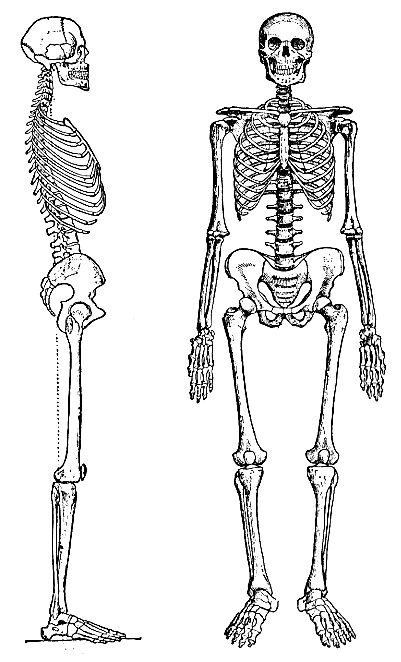
Fig. 9.
Continuing to descend, we come to a sort of hollow basin, the pelvis, which seems merely to contain, rather than protect, the abdominal organs: the intestines, kidneys, etc. Such a structure seems to be in accord with the minor physiological importance of these organs, whose function (digestion) is periodic and may be temporarily suspended, in defiance of physiological stimuli, without suspension of life. In the lower part of the skeleton, on the contrary, the arrangement between the soft and bony tissues is inverted: the long bones of the limbs constitute the inner part; and they are covered over with thick, striped muscles, organs of mechanical movement for the purpose of locomotion. Here the function of the skeleton is exclusively that of support, and in its mechanism it represents a series of levers.
Accordingly, the structure of the skeleton also shows us how the stature is composed of parts that differ profoundly in their physiological significance; life as a complete whole, the living man, is contained within the bust, which holds the organs of the individual, vegetative life; those of life in relation to its environment, and those of life in relation to the race, namely, the organs of reproduction.
Deprived of arms and legs, man could still live; the limbs are nothing more than appendages at the service of the bust, in all animals; they serve to transport the bust, that is, the part which constitutes the real living animal, which without the limbs would be as motionless as a vegetable, unable to go in pursuit of nourishment or to exercise sexual selection.
The embryos of different animals, of a dog, a bat, a rabbit and of man (as may be seen in Fig. 11) show that the fundamental part of the body is the spinal column, which limits and includes the whole animal in the process of formation.
If we next examine the embryonic development of man, as shown in Fig. 13, we may easily see how the limbs develop, at first as almost insignificant appendages of the trunk, remaining hidden within the curve of the spinal column; and even in an advanced stage of development (15th week), they still remain quite accessory parts in their relation to the whole.
Having established these very obvious principles, we may ask ourselves: of two men of equal stature, which is physiologically the more efficient? Evidently, that one of the two who has the shorter legs.
In other words, it is of fundamental importance to determine the reciprocal relation, in the stature, between the bust and the lower limbs, that is, between the height of the bust and the total height of the body.
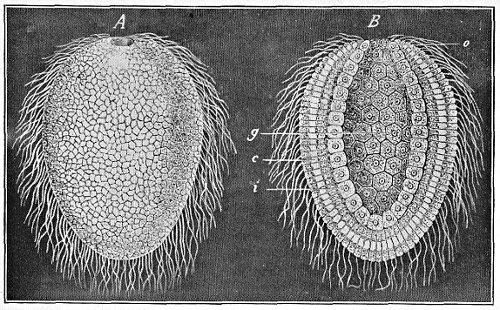
Fig. 10.—Gastrula of a sponge.
External surface. Internal section.
(Showing the inner and outer primary layers, and the mouth orifice.)
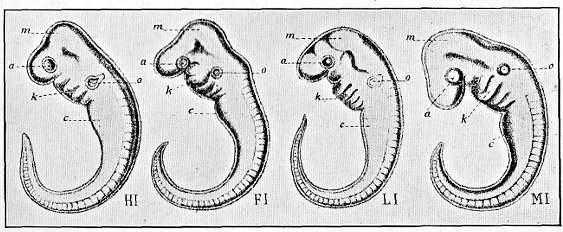
Fig. 11.
Dog. Bat. Rabbit. Man.
(From the work by E. Haeckel: Anthropogeny.)
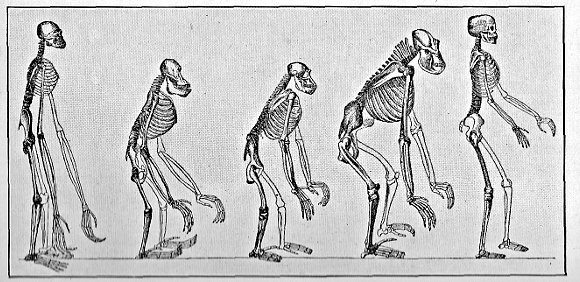
Fig. 12.
Four skeletons of anthropoid apes. Man.
The height of the bust was called by Collignon the essential stature, a name that indicates the biological significance of this measurement. It may, however, also be called the sitting stature, from the method of taking the measure, which equals the vertical distance from the level on which the individual is seated to the top of his head. The other is the total stature.
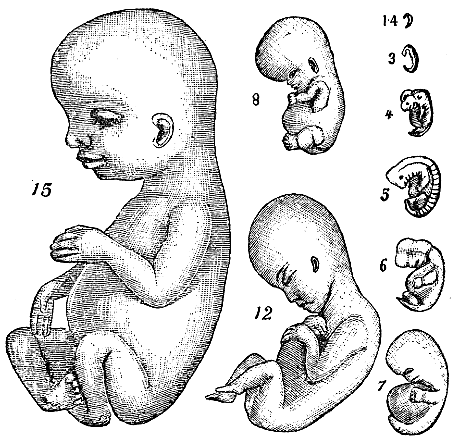
Fig. 13.
14 days, 3 weeks, 4 weeks, etc. (natural size).
Accordingly, in anthropology we may define the physiological efficiency of a man by the relation existing between his two statures, the total and the essential. If we reduce the total stature (which for the sake of brevity we will call simply the stature) to a scale of 100, we find that the essential stature very slightly exceeds 50, oscillating between 53-54; yet it may fall to 47 and even lower, or it may rise above 56. In such cases we have individuals of profoundly diverse types, whose diversity is essentially connected with the proportional differences between the several parts of their stature.
Hence, we may distinguish the type of stature; understanding by this, not a measure, but a ratio between measures, expressed by a number; that is, "the type of stature is the name given to the ratio between the essential stature and the total stature reduced to a scale of 100." The number resulting from this ratio, since it indicates the ratio itself, is called the index of stature (See "Technical Lessons: on the Manner of Obtaining and Calculating the Indexes"). Manouvrier has distinguished the type with short limbs and preponderant trunk, by the name of brachyscelous; and those of the opposite type, that is, with long legs, by the name of macroscelous; reserving the term mesatiscelous to designate the intermediate type.
These types differ not only in the reciprocal relation between the two statures, but in all the recognised laws of the form. The brachyscelous type has a circumference of chest in excess of half the stature, because the trunk is more greatly developed in all its dimensions; and the total weight of the body exceeds the normal proportion in relation to the stature. The contrary holds true of the macroscelous type; their trunk, being shorter, is also narrower, and the circumference of the chest can never equal one-half the stature, while the total weight of the body is below the normal.
Canons of Form
Passing next to a consideration of the total spread of the arms, since there is an evident correspondence between the upper and lower limbs, it follows that in the brachyscelous type the total spread is less than the stature, while in the macroscelous it surpasses it to a greater or less degree, according to the grade of type; the two types consequently differ in the level reached by the wrist, when the arms are allowed to hang along the sides of the body.
This is a very interesting fact to establish, since at one time it was held that excessive length of arm was an atavistic feature, in other words, an anthropoid reminder. To-day, since the old interpretation of the direct descent from species to species has been abandoned in the light of modern theories of biological evolution, we can no longer speak of atavistic revivals. It is true that the anthropoid apes, as may be seen in Fig. 13, have extremely long forelimbs, and that man is characterised by the shortness of his arms, free to perform work and obedient instruments of his brain. But if it happens that certain individual men have excessively long arms, even if they should coincide with an inferior capacity for work and social adaptation, such a simple coincidence must not be interpreted by the laws of cause and effect. The modern theories of evolution tend to admit between the anthropoid apes and man, only a common origin from lower animals not yet fixed in a determined species. So that in phylogenesis men are not considered as the children or grandchildren of apes, but rather their brothers or cousins of a more or less distant degree; and their resemblance must be attributed to a parallel evolution.
Consequently, it is not possible to speak of direct transmission of characters.
Therefore, we must interpret an excessive length of arm, or an excessive shortness, after the same fashion, namely, in its relation to the type of stature, or to the established canons of the form—in other words, as a detail of individual human types.
Let us sum up the three canons in the following table:
Mesatisceles Brachysceles Macrosceles
St = Ts St > Ts St < Ts
Ss = St/2 Ss > St/2 Ss < St/2
Ct = St/2 Ct > St/2 Ct < St/2
W = K(St-1 m.) W > K(St-1 m.) W < K(St-1 m.)
From these measurements are derived certain types of individuality which we may now describe in detail.
The brachyscelous type has an excess of bust, consequently a preponderance of vegetative life; the great development of the abdominal organs tends to make a person of this type a hearty eater, a man addicted to all the pleasures of the table; his big heart, abundantly irrigating the body, keeps his complexion constantly highly coloured, if not plethoric. We can almost see this man of big paunch, corpulent, with an ample chest, fat, ruddy, coarse, and jolly; an excess of nutriment and of blood-supply are favourable to the ready accumulation of adipose tissue, and as the body constantly grows heavier it steadily becomes more difficult for the undersized legs to support it; so that inevitably this man will tend to become sedentary, and he will select a well-spread table as his favourite spot for lingering. Whatever elements of the ideal the world contains, will escape the attention of this type of man, who is far more ready to understand and engage in commerce, which leads by a practical way to the solution of the material problems of life.
In the other type, on the contrary, the macroscelous, the organs of vegetative life are insufficient and the central nervous system is defective. Such a man feels, even though unconsciously, that the abdominal organs are incapable of assimilating sufficient nutriment, and that his lungs, unable to take in the needed quantity of oxygen, render his breathing labourious. His small heart is inadequate for circulating the blood through the whole body, which consequently retains an habitual pallor; while the nervous system is in a constant state of excitation. We can almost see this man, so tall and thin that he seems to be walking on stilts, with pallid, hollow cheeks and narrow chest, suffering from lack of appetite and from melancholia; nervous, incapable of steady productive work and prone to dream over empty visions of poetry and art. The man of this type is quite likely to devote his entire life to a platonic love, or to conceive the idea of crowning an ideal love by committing suicide; and so long as he lives he will never succeed in escaping from the anxieties of a life that has been an economic failure.
It is interesting to examine the types of stature from different points of view: such, for example, as the height of stature, the race, the sex, the age, the social conditions, the pathological deviations, etc.
The Types of Stature According to the Height of the Total Stature.—There exists between the bust and the limbs a primary relation of a mechanical nature, already well known, even before Manouvrier directed the attention of anthropologists to the types of stature. When one individual is very tall and another is very short, the consequence of this fact alone is that the taller of the two has much longer limbs as compared with the shorter. This is because, according to the general laws of mechanics, the bust grows less than the limbs and is subject to less variation.
But notwithstanding this general fact, other conditions intervene to determine the comparative relations between the two portions of the stature. Indeed, Manouvrier exhibits, within his own school, specimens of equal stature but of different types; and furthermore, he notes that the inhabitants of Polynesia are of tall stature and have a long bust, while negroes, who are also of tall stature, have a short bust.
Types of Stature According to Race.—Among the characteristics of racial types, present-day anthropology has included the reciprocal proportions between the two statures. This means that the medium type in the different races is not always contained within the same limits of fluctuation in regard to stature: but some races are brachyscelous, others are macroscelous, and still again others are mesatiscelous. The most brachyscelous race is the Mongolian, prevalent in the population of China; the most macroscelous is the Australian type that once peopled Tasmania. Other races, as for example the negroid, while in a measure macroscelous, approach nearer to the mesatiscelous type, characteristic of the population of Europe. Let us examine the psycho-ethnic characters of these various peoples. The Chinese are the founders of the most ancient of all oriental civilisations, and have established themselves in a vast empire, solid and stable in its proportions, as well as in the level of its civilisation. It would seem as though the Chinese people, having accomplished the enormous effort of raising themselves to a determined civic level, were no longer capable of advancement. Individually, they have a singularly developed spirit of discipline, and are the most enduring and faithful workers; it is well known that in America the Chinese Mongolian does not fear the competition of labourers of any other race, because no others can compete with him in parsimony, in simple living, and in unremitting toil.
The Tasmanians constituted a people that was considered as having the lowest grade of civilisation among all the races on earth. Even English domination failed to adapt them to a more advanced environment, and their race was consequently scattered and destroyed.
Accordingly, we find associated with extreme macroscelia (Tasmanians) an incapacity for civic evolution; and with the corresponding extreme of brachyscelia an insuperable limitation to civic progress. Consequently, the triumph of man upon earth cannot bear a direct relation to the volume of the bust, or in other words, we cannot assume that the man most favourably endowed on the physiological side is the one who has the largest proportion of viscera. As a matter of fact, the conquering race, the race which has set no limit to the territory of its empire nor to the progress of its civilisation, is composed of white men, whose type of stature is mesatiscelous, that is to say, representative of harmony between its parts. This conception will serve us in establishing a fundamental principle in morphological biology: namely, that perfectibility revolves around a centre, which represents a perfect equilibrium between the various parts constituting an organism. Hence, in order to determine the deviations of the individual type, we must always start from those central data, which represent, as the case may be, normality or perfection.
Even among the populations of Europe, and within the Italian people themselves, fluctuations occur in the degree of mesatiscelia, approaching to a greater or less degree the eccentric forms of brachyscelia or macroscelia; and such fluctuations are an attribute of race.
We should draw a distinction between a people and a race. The term race refers exclusively to a biological classification, and corresponds to the zoological species. On the other hand, we mean by a people a group of human individuals bound together by political ties. Peoples are always made up of a more or less profound intermixture of races. It is well known that one of the most interesting and difficult problems of ethnology is that of tracing out the original types of races in peoples that represent an intermixture centuries old. Without entering too deeply into this question, which lies outside of our present purpose, it will suffice to point out that in the people of Italy it is possible to trace types of races differing from one another, yet so closely related as to render them apparently so similar that they might almost be regarded as a single race.
Now, in an anthropological study of mine on the young women of Latium, I succeeded in tracing, within the confines of that region, different racial types that show corresponding differences in degrees of mesatiscelia. Thus, for example, in Castelli Romani there exists in an almost pure state a dark-haired race, short of stature, slender, elegantly modelled in figure and in profile, and showing within the limits of mesatiscelia a brachyscelous tendency, in contrast with another race, tall, fair, massive, of coarse build, which within the limits of mesatiscelia shows a macroscelous tendency, and which is found in almost pure groups around the locality of Orte, that is, on the boundaries of Umbria. It is interesting to note the importance of researches in ethnological anthropology conducted in small centres of habitation. If it is still possible to trace out groups even approaching racial purity, they will be found only in localities offering little facility to emigration and to the consequent intermixture of races. The fact that we still find in Castelli Romani types so nearly pure, is due to the isolation of this region, which up to yesterday was still in such primitive and rare communication with the capital as to permit of the survival of brigandage. On the contrary, in localities that have attained a higher civic advancement, and in which the inhabitants are placed in favourable economic and intellectual conditions, the facilities of travel and emigration will very soon effect an alteration in the anthropological characters of the race. Hence it would be impossible, in a cosmopolitan city like Rome, to accomplish any useful studies of the sort that I accomplished in the district of Latium, and which led me to conclude that in the small and slender race of Castelli Romani we may trace the descendants of the ancient conquerors of the world: descendants that belong to one variety of the great Mediterranean race, to whom we owe the historic civilisations of Egypt, Greece and Rome.
It would seem that this race, disembarking on the coast of Latium, must have driven back, among the Apennines, the other race, blond and massive, whose pure-blooded descendants are still found in numerical prevalence at Orte, an ancient mediæval town and a natural fortress from the remotest times, through its fortunate situation on the crown of a rocky height, that easily isolates it from the surrounding country (see the ancient history of the town of Orte).
Accordingly, within the limits of mesatiscelia, it appears that the race which in early times won the victory was the more brachyscelous, i.e., the one which had the larger bust, and consequently the larger brain and vital organs. In other words, within the limits of normality, brachyscelia is a physiologically favourable condition.
Variations of Type of Stature According to Social Conditions.—Independently of race, and from such a radically different point of view as that of the social condition, or adaptation to environment, we may still distinguish brachyscelous and macroscelous types. Brachysceles may readily be met with among the labouring classes, habituated from childhood to hard toil in a standing position, thus interfering with a free development of the long bones of the lower limbs; while the macroscelous type will be found among the aristocratic classes, whose members, spending much time sitting or reclining, give the long bones an opportunity to attain their growth (mechanical theories of stature). Without stopping to discuss the suggested causes of such differentiation in types, we may nevertheless point out that the brachyscelous type is eminently useful to society, constituting, one may say, the principal source of economic production, while the macroscelous and unproductive type settles comfortably down upon the other like a parasite. But the progress of the world is not due to the labouring class, but to the men of intellect, among whom the prevailing type is the medium, harmonic type, with mesatiscelous stature.
Types of Stature in Art.—The existence of these different individual types, which combine a definite relationship of the parts of stature with the complete image of a well-defined individuality, was long ago perceived by the eye, or rather by the delicate intuition of certain eminent artists. These immortalised their several ideals, investing now the one type and now the other with the genius of their art. Thus, for example, Rubens embodies in his Flemish canvases the brachyscelous type, robust and jovial, and usually represents him as a man of mighty appetite revelling in the pleasures of the table.
Botticelli, on the contrary, has idealised the macroscelous type, in frail, diaphanous, almost superhuman forms, that seem, as they approach, to walk, shadow-like, upon the heads of flowers, without bending them beneath their feet and without leaving any trace of their passage. Accordingly, these two great artists have admirably realised, not only the two opposite types of stature, but also the psychic and moral attributes that respectively belong to them. But it was not granted to these artists to achieve the supreme glory of representing perfect human beauty in unsurpassed and classic masterpieces. The art of Greece alone succeeded in embodying in statues which posterity must admire but cannot duplicate, the medial, normal type of the perfect man.
Variations of Stature According to Sex.—It is not always necessary to interpret the type of stature in the same sense. Even from an exclusively biological standpoint, it may lend itself to profoundly different interpretations.
Thus, for example, the type of stature varies normally according to the sex. Woman is more brachyscelous than man; but the degree of brachyscelia corresponds to a larger development of the lumbar segment of the spinal column, which corresponds to the functions of maternity.
In fact all the various segments of the spinal column show different proportions in the two sexes.
As we know, the spinal column consists of three parts; the cervical (corresponding to the neck), the thoracic (corresponding to the ribs), and the abdominal, including the os sacrum and the coccyx.
Now, Manouvrier, reducing the height of the spinal column to a scale of 100, expresses the relations of these different parts in the two sexes as follows:
Segments Men Women
Cervical 22.1 23.9
Thoracic 58.5 55.4
Lumbar 11.4 23.7
Sacro-coccygeal 7.9 6.7
In woman the thoracic segment is shorter and the abdominal is longer than in man; but the total sum in woman is relatively greater in proportion to the whole stature.
In a case like this we have no right to speak of a morphological or psychosocial superiority of type; nor would a fact of this sort have any weight, for example, in establishing the anthropological superiority of woman. Nevertheless, it may be asserted that, if the day comes when woman, having entered the ranks of social workers, shall prove that she is socially as useful as man, she will still be, in addition, the mother of the species, and for that reason preeminently the greater producer.
Now, it is beyond question that this indisputable superiority is in direct relation with the type of stature. But without insisting unduly on a point like this, we should note the connection between the brachyscelous type and the tendency shown by women to accumulate nutritive substances, adipose tissue; consequently, as compared with man, she is the more corpulent—as are all brachysceles as compared with macrosceles.
Types of Stature at Different Ages.—Another factor that influences the types of stature is the age; or rather, that biological force which we call growth.
Growth is not an augmentation of volume, but an alteration in form; it constitutes the ontogenetic evolution, the development of the individual. The child, as it grows, is transformed. If we compare the skeleton of a new-born child with that of an adult, we discover profound differences between the relative proportions of the different parts. The child's head is enormously larger than that of the adult in proportion to its stature; and similarly, the chest measure is notably greater in the child. If we wish to compare the fundamental measurements of the new-born infant with those of the adult, we get the following figures, on a basis of 100 for the total stature:
Adult Child at birth
Total stature = 100 Essential stature 52 68
Perimeter of thorax 50 70
Height of head 10 20
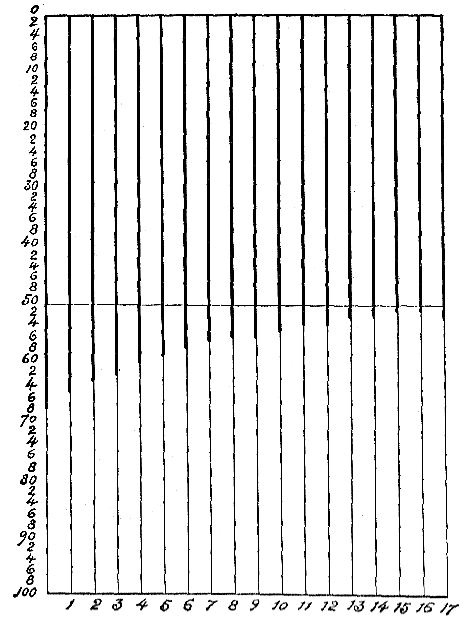
Fig. 14.
Accordingly, the child has to acquire, in the course of its growth, not only the dimensions of the adult, but the harmony of his forms; that is, it must reach not only certain determined limits of dimension, but also a certain type of beauty.