Chapter I · CERTAIN PRINCIPLES OF GENERAL BIOLOGY (continued 2)
Frederic Taber Cooper translation
Among the fundamental differences between the new-born child and the adult one of the first to be noted is the reciprocal difference of proportion between the two statures. The child is ultra-brachyscelous, that is, he presents a type of exaggerated brachyscelia, calling to mind the form of the human fœtus, in which the limbs appear as little appendages of the trunk. In the course of growth, a successive alteration takes place between the reciprocal proportions of the two parts, so that the lower limbs, growing faster than the bust, tend to approach the total length of the latter. Godin has noted that during the years before puberty the lower limbs acquire greater dimensions, as compared with the bust, than are found in the fully developed individual; in other words, at this period a rapid growth takes place in the long bones of the lower limbs, and accordingly at this period of his life the individual passes through a stage of the macroscelous type. Immediately after puberty, there begins, in turn, an increase in the size of the bust, which regains its normal excess over the lower limbs, thus attaining the definite normal type of the adult individual. After the age of 17 years, by which time these metamorphoses have been completed, the individual may increase in stature, but the proportions between the parts will remain unaltered. In Fig. 14 we have a graphic representation of the relative proportions between the height of the bust and the length of limbs at different ages, the total stature being in every case reduced to 100. The upper portion of the lines represents the bust, and the lower portion the limbs, while the transverse line corresponding to the number 50 indicates one-half of the total stature. From such a table, it is easy to see how the bust, enormously in excess of the limbs at birth, gradually loses its preponderance.
It was drawn up from the following figures calculated by me:
TYPES OF STATURE ACCORDING TO AGE IN YEARS
At birth 1 2 3 4 5 6 7 8 9 10 11 12 13 14 15 16 17
68 65 63 62 60 59 57 56 55 55 54 53 53 52 52 51 51 52
Godin furnishes the following figures, relating to the type of stature at the period preceding and following puberty:
RATIO OF SITTING STATURE TO TOTAL STATURE REDUCED TO SCALE OF 100 (GODIN)
Age 13½ 14 14½ 15 15½ 16 16½ 17 17½
Ratio 52 52 51 51 51 52 52 52 52
Hrdlicka has calculated the index of stature for a thousand white American children and a hundred coloured, of both sexes, and has obtained the following figures, some of which, based upon an adequate number of subjects, (10-13 years) are what were to be expected, while others, owing to the scarcity of subjects (under 6 and above 15 years) are far less satisfactory:
PROPORTION BETWEEN THE SITTING STATURE AND THE TOTAL STATURE (American Children)
Age in years Number of subjects of each age Males, white Females, white Number of subjects of each age Males, coloured Females, coloured
3 — — — 1 60.8 59.5
4 — — — 1 — 58.9
5 2 57.4 57.3 3 57.3 57.9
6 15 56.6 57.4 5 55.9 55.6
7 38 56.3 57.2 5 54.9 55.4
8 56 55.9 56.2 13 55.1 53.3
9 62 55.2 55.9 25 54.2 54.1
10 98 54.6 54.2 12 54.9 53.7
11 99 54.0 55.0 12 52.8 53.8
12 93 53.5 54.1 10 57.7 54.0
13 86 52.9 53.8 13 52.9 51.9
14 53 52.7 54.1 7 52.3 51.8
15 20 53.1 53.7 6 51.7 53.0
16 9 52.0 55.0 2 53.0 —
17 3 52.2 54.7 — — —
Which goes to prove (in spite of the inaccuracies due to the numerical scarcity of coloured subjects of any age) that the females are more brachyscelous than the males; and that the blacks are more macroscelous than the whites.
The above table of indices of stature was worked out by Hrdlicka from the following measurements:
SITTING STATURE
Age in years Males, white Females, white Males, coloured Females, coloured
3 — — 476 476
4 — — — 534
5 551 576 597 571
6 595 608 616 607
7 631 621 630 625
8 644 635 659 671
9 672 663 679 680
10 684 687 697 695
11 711 718 718 703
12 728 734 797 792
13 751 770 737 767
14 764 809 787 808
15 777 825 753 819
16 839 824 795 —
17 864 850 — —
TOTAL STATURE
Age in years Males, white Females, white Males, coloured Females, coloured
3 — — 783 839
4 — — — 906
5 961 1004 1044 985
6 1051 1060 1101 1091
7 1120 1086 1147 1127
8 1152 1130 1196 1260
9 1212 1187 1251 1257
10 1248 1267 1271 1295
11 1315 1304 1360 1307
12 1362 1357 1381 1467
13 1420 1431 1392 1477
14 1449 1495 1505 1559
15 1462 1535 1455 1545
16 1615 1498 1500 —
17 1654 — — —
18 — 1554 — —
The following chart, prepared by MacDonald, on the growth of the total stature and the sitting stature of male white children, born in America, gives a very clear idea of the rhythm of each of the two statures. The sitting stature increases quite slowly, and its greatest rate of growth is immediately after puberty (from 15 to 17 years) (Fig. 15)
Mac Donald.
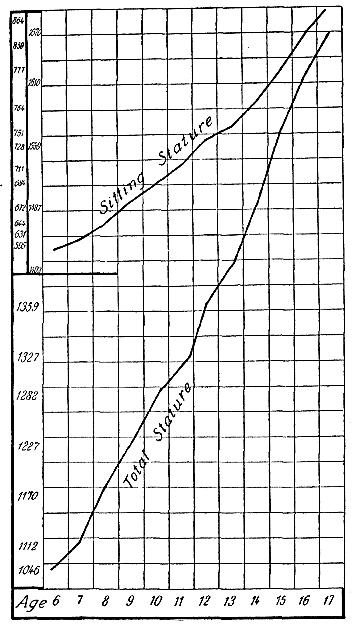
Fig. 15.
Lastly, in order to make this phenomenon still more clear, I have reproduced an illustration given by Stratz, consisting of a series of outlined bodies of children representing the proportions of the body at different stages of growth; and not only the proportions between the bust and the lower limbs, but also between the various component parts of the bust, as for instance the head and trunk. The transverse lines indicate the changes in the principal levels: the head, the mammary glands, and the bust (Fig. 16).
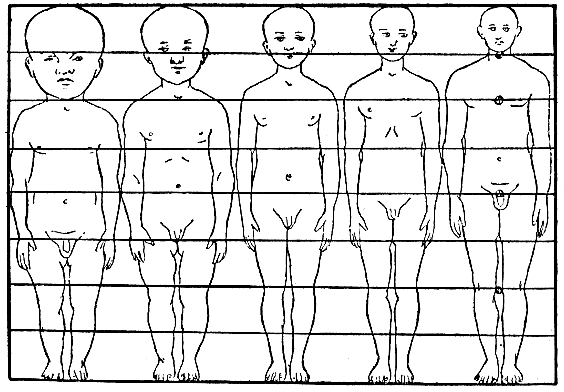
Fig. 16.
The different types of stature at different ages deserve our most careful consideration, yet not from the point of view already set forth regarding the different types in the fully developed individual. In the present case for instance, we cannot say of a youth of sixteen that, because he is macroscelous he is a weakling as compared with a boy of ten who is brachyscelous; nor that a new-born child represents the maximum physical potentiality, because he is ultra-brachyscelous. Our standards must be completely altered, when we come to consider the various types as stages of transition between two normal forms, representing the evolution from one to the other. At each age we observe not only different proportions between the two fundamental parts of the stature, but physiological characteristics as well, biological signs of predispositions to certain determined maladies, and psychological characteristics differing from one another, and each typical of a particular age. From the purely physical and morphological point of view, for example, a child from its birth up to its second year, the period of maximum brachyscelia and consequent visceral predominance, is essentially a feeding animal. After this begins the development of psychic life, until finally, just before the attainment of full normal proportions, the function of reproduction is established, entailing certain definite characteristics upon the adult man or woman. In accordance with its type of stature, we see that the child from its birth to the end of the first year shows a maximum development of the adipose system together with a preponderance of the digestive organs; while the adolescent, in the period preceding puberty, shows in accordance with his macroscelous type of stature, and reduction in the relative proportion of his visceral organs, a characteristic loss of flesh.
These evolutionary changes in the course of growth having been once established, it remains for us to consider the individual variations. The alterations observed at the various ages, or rather, the notable characteristics of each age, serve as so many fundamental charts of the normal average child; and we may consider each successive type of stature, from the new-born infant to the adult man, in the same light as we do the average type of the mature mesatiscelous type. In the case of the latter, we found that both above and below the medium stature, there were a host of individual types departing more or less widely from it, and tending toward brachyscelia on the one hand and toward macroscelia on the other, thus constituting the oscillations of type in the individual varieties. Similarly, in the case of the medium type of each successive age we may find brachyscelous or macroscelous individuals whose complex personal characteristics may be compared to those already observed in the adult, and may be summed up as follows: that the macroscele is a weakling; and that the brachyscele may be, according to the degree of variation, either a robust individual or an individual that has been arrested in his morphological development, and retained the type of a younger age.
Pedagogic Considerations.—From the above conclusion, we may deduce certain principles that can be profitably applied to pedagogy, especially in regard to some of the methods suited to our guidance in the physical education of children. Let us begin with the happy comparison drawn by Manouvrier, who describes an imaginary duel with swords between a macroscelous and a brachyscelous type. The duel, according to social conventions, must take place under equal conditions: hence the seconds take rigorous care in measuring the ground, the length of the swords, and determine the number of paces permitted to the duelists. But since they have forgotten the anthropologic side, the conditions are not entirely equal: by having a longer arm, the macroscele is in the same position as though he had a longer sword; and because he has a greater development of the lower limbs, the established number of strides will take him over a greater space of ground than his adversary. Consequently, the conditions as a matter of fact are so favourable to the macroscele, that is, to the weaker individual, that the latter has a greater chance of victory. The brachyscele might, to be sure, offset this by a different manœuvre depending on his superior agility; but both he and the macroscele were trained in the same identical method, which takes into consideration only the external factor, the arms of defence, and the immutable laws of chivalry.
Well, something quite similar happens in the duel of life, which is waged in school and in the outside social environment. We ignore individual differences, and concern ourselves solely with the means of education, considering that they are just, so long as they are equal for all. The fencing-master, if he had been an anthropologist, might have counteracted the probability that the stronger pupil would be beaten by the weaker, by advising the brachyscele always to choose a pistol in place of a sword, or by teaching him some manoeuvre entirely different from that which affords the macroscele a favourable preparation for fencing. And in the same way, it is the duty of the school-teacher to select the arms best adapted to lead his pupil on to victory.
That is, the teacher ought to make the anthropological study of the pupil precede his education; he should prepare him for whatever he is best adapted for, and should indicate to him the paths that are best for him to follow, in the struggle for existence.
But, aside from general considerations, we may point out that something very similar to the above-mentioned duel takes place in school when, in the course of gymnastic exercises, we make the children march, arranging them according to their total height. We expect them to march evenly and walk, not run, yet we do not trouble to ask whether their legs are of equal length. When we wish to know which of our pupils is the swiftest runner, we start them all together, macrosceles and brachysceles alike, neglecting to measure their lower limbs, the weight of their bodies, the circumference of their chests. Then we say "bravo!" to the macroscele, that is, the pupil who is most agile but at the same time the weakest, and we encourage him in a pride based upon a physiological inferiority. When we practise exercises of endurance, we find that certain children weary sooner, suffer from shortness of breath, and frequently drop out of the contest, in which the victory is reserved for others. The latter are the brachysceles, who have big lungs and a robust heart at their disposal. In this case we say "bravo!" to the brachysceles. Then we try to arouse a noble rivalry between the two types, encouraging emulation, and holding up before the brachyscele the example of the macroscele's agility, and before the macroscele the example of the brachyscele's endurance—and perhaps we reward the two types with different medals. Such decisions by the teacher evidently have no such foundation in justice as he supposes; the diverse abilities of the two types of children are associated with the constitution of their organisms. A modern teacher ought instead to subject the brachyscelous child to exercises adapted to develop his length of limb, and the macroscelous to gymnastics that will increase the development of his chest; and he will abstain from all praise, reward, exhortation and emulation, that have for their sole basis the pupil's complete anthropological inefficiency.
"The judgment passed by the teacher in assigning rewards and punishments is often an unconscious diagnosis of the child's anthropological personality."
Similar unconscious judgments are exceedingly widespread. Manouvrier gives a brilliant exposition of them in the course of his general considerations regarding the macroscelous and brachyscelous types. A brachyscelous ballet-dancer, all grace and endurance in her dancing, thanks to the strength of her lungs, can never be imitated in her movements by a macroscelous, angular woman, with legs ungracefully long. The latter, on the contrary, wrapped in a mantle, may become the incarnation of a stately matron, extending her long arms in majestic gestures. Yet it often happens that the stately actress envies and seeks to imitate the grace of the dancer, while the latter envies and emulates the grave dignity of the actress.
In any private drawing-room the same thing occurs, in the shape of different advantages distributed among persons of different types. There are some gestures that are inimitable because they are associated with a certain anthropologic personality. Every one in the world ought to do the things for which he is specially adapted. It is the part of wisdom to recognise what each one of us is best fitted for, and it is the part of education to perfect and utilise such predispositions. Because education can direct and aid nature, but can never transform her.
Manouvrier is constantly observing how the macroscelous and brachyscelous types are adapted to different kinds of social labour; thus, for example, the macroscele will make an excellent reaper, because of the wide sweep of his arms, and he is well adapted to be a tiller of the soil; while the brachyscele, on the contrary, will succeed admirably in employment that requires continuous and energetic effort, such as lifting weights, hammering on an anvil, or tending the work of a machine.
In the social evolution now taking place, the services of the macrosceles are steadily becoming less necessary; intensive modern labour requires the short, robust arm of the brachyscele. Such considerations ought not to escape the notice of the teacher, who sees in the boy the future man. He has the high mission of preparing the duelists of life for victory, by now correcting and again aiding the nature of each. And the first point of departure is undoubtedly to learn to know, in each case le physique du role.
Abnormal Types of Stature and General Principles of Biological Ethics
Abnormal types of stature in their relation to moral training.—Macroscelia and brachyscelia in pathologic individuals (De Giovanni's hyposthenic and hypersthenic types).—Types of stature in emotional criminals and in parasites.—Extreme types of stature among the extra-social classes: Nanism and gigantism.
Let us start from a picture traced in the course of the preceding lessons; the types of stature as related to race. The Chinese, being brachyscelous, ought to be hearty eaters; instead, they are the most sparing people on earth. Such parsimony, equally with religion and social morality, may be considered as a racial obligation. The whole life of the Chinese is founded upon duty: fidelity to religion, to the laws, to the spirit of discipline, to the spirit of sacrifice, which always finds the Chinese citizen ready to die for his ethics and for his country, are strong characteristics of these invincible men. Their whole education rests solely upon a mnemonic basis; and their laws, which are highly democratic, make it possible for anyone to rise to the highest circles, provided he can pass the competitive examinations. In other words, the laws aid in the natural selection of the really strong, and regard favouritism as a crime against the State. On such individual and national virtues is founded the survival of the race and of the massive empire. If to-morrow the Chinese should renounce his creed, become a glutton, a pleasure-seeker, and follow the instincts of nature, he would be advancing in mighty strides on the path that leads to death. Accordingly, what we call virtue may have a biologic basis, and represent the active force that tends to correct the defects of nature.
We can conceive of a type of man, whose life is associated with sacrifice; and whose path of evolution is necessarily limited, first because his personality is imperfect, secondly because a part of his individual energy is necessarily expended in conquering, or if you prefer, in correcting his own nature. Evolution ought to be free; but instead, such a type is necessarily in bondage to duty, which stops its progress. Accordingly, the civilisation of China remains the civilisation of China; it cannot invade the world.
The European on the contrary has no such racial virtues; whatever virtues he has are associated with transitory forms of civilisation, and are ready to succeed one another on the pathway of unlimited progress. The race can permit itself the luxury of not being virtuous on its own account; its biological conditions are so perfect, that they have reached the fullness of life. If virtue is the goal of the Chinese, happiness is the goal of the European. The race may indulge freely in the joys of living; and dedicate its efforts solely to the unlimited progress of social civilisation, and to the conquest of the entire earth.
The Tasmanian, on the other hand, sparing by nature, lacking sufficient development of the organs of vegetative life, avoids every form of civilisation, and precipitates himself, an unconscious victim, upon the road to death. His natural parsimony, the scantiness of his needs, have prevented him from ever feeling that spur toward struggle and conquest which has its basis in the necessities of life. Neither virtue, nor felicity, nor civilisation, nor survival were possible to that race, whose extermination began with the first contact with European civilisation. Hence we may draw up a table that will serve to make clear certain fundamental ideas that may prove useful guides along our pedagogic path:
Biological types Brachysceles Mesatisceles Macrosceles
Races and peoples Chinese. Europeans. Tasmanians.
Civilisation Stable civilisation, but limited. Changeable civilisation, with unlimited powers of evolution. Outside the pale of civilisation.
Psycho-moral types High ideal of virtue and sacrifice. Happiness. Insensibility.
We ought to strive for the supreme result of producing men who will be happy; always keeping clearly before us the idea that the happy man is the one who may be spared the effort of thinking of himself, and dedicate all his energies to the unlimited progress of human society. The preoccupation of virtue, the voluntary sacrifice are in any case forces turned back upon themselves, that expend upon the individual energies that are lost to the world at large; nevertheless, such standards of virtue are necessary for certain inferior types. There exist, besides, certain individuals in rebellion against society, outcasts whose lives depend upon the succor of the strong, or may be destroyed by their adverse intervention, but in any case have ceased to depend upon the will of the individuals themselves.
Between two inferior types the one with the better chances is the one with the larger chest development; apparently, in the case of biological deviations, melius est abundare quam deficere.
Accordingly, let us draw up a chart. Human perfectionment tends toward harmony. If we wish to represent this by some symbolic or intuitive sign, we could not do so by a mere line; because perfection is not reached by the quantitative increase of favourable parts; robustness, for instance, cannot be indefinitely increased by augmenting the degree of brachyscelia; nor can intelligence be increased by augmenting the volume of the head; but perfection is approached, in the race and in the individual, through a central harmony. It is accordingly in the direction of this centre that progress is made; and whoever departs furthest from this centre, departs furthest from perfection, becomes more eccentric, more untypical, and at the same time also loses the psycho-moral potentiality to attain the highest civic perfection.
In Fig. 17, we have a graphic representation in three concentric circles.
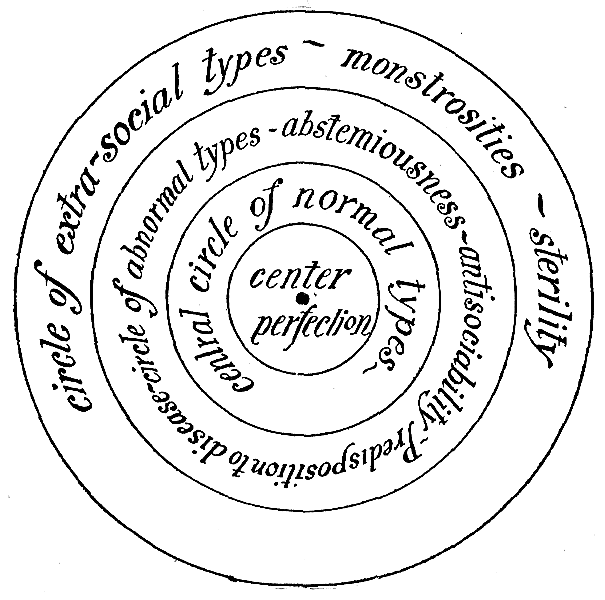
Fig. 17
Let us begin by considering the middle circle, that of the abnormals. Here we have inscribed, as psycho-moral and physio-pathological traits, abstemiousness, anti-social tendency, predisposition to disease. Abstemiousness represents a corrective, without which the individual tends toward an anti-social line of action and contracts diseases. Abstemiousness is present within the circle of abnormal human beings, as a more or less attainable ideal; but it must be regarded as the pedagogic goal, when the problem arises of educating an untypical class of individuals. In other words, there are certain abnormal individuals who, if they are not to turn out criminals, must exercise a violent corrective influence over their psycho-physical personality, and they must be trained to do so; for it is an influence unknown to the normal man, who not only has no inclination to commit a crime, but recoils from doing so, and on the contrary may arise to degrees of moral perfection that are inconceivable to the abnormal man. Consequently, in order to maintain a relatively healthy condition, certain abnormal individuals are constrained to submit themselves to a severe hygienic régime throughout their entire life; a régime useless to the normal man, who indulges naturally in all the pleasures which are consistent with the full measure of physical health, and which remain forever unknown, and unattainable, to the abnormal individual organically predisposed to disease.
Such self-restraint we may call the culte of virtue, a necessity only to certain categories of men; and we may also call it the virtue of inferior individuals. It applies and is limited almost wholly to the individual.
Meanwhile, there is the normal man's high standard of virtue, which is an indefinite progress toward moral perfection; but the path it follows lies wholly in the direction of society collectively, or toward the biological perfectionment of the species. In life's attainment of such a triumph, man both feels and is happy rather than virtuous.
The separation between the circles, or rather between the different categories of individuals, the normal and the abnormal, is not clear-cut. There always exist certain imperceptibly transitional forms, between normality and abnormality; and furthermore, since no one of us is ideally normal, no one who is not abnormal in some one thing, it follows that this "some one thing" must be corrected by the humbling practice of self-discipline. At the same time it is rare for a man to be abnormal in all parts of his personality; in such a case he would be outside the social pale, a monstrosity; the high, collective virtues can, therefore, even if in a limited degree, illuminate the moral life of the abnormals. St. Paul felt that it "is hard to kick against the pricks"; and the picciotto of the Camorra feels that he is obeying a society that protects the weak.
It is a question of degree. But such a conception must lead to a separation in school and in method of education, for the two categories of individuals.
Abnormal Types According to De Giovanni's Theory
Certain very important pathological types have been distinguished and established in Italy by De Giovanni, the Paduan clinical professor who introduced the anthropological method into clinical practice. Through his interesting studies, he has to-day fortunately revived the ancient theory of temperaments, explaining them on a basis of physio-pathological anthropology.
De Giovanni distinguishes two fundamental types; the one hyposthenic (weak), the other hypersthenic (over-excitable); these two types obey the following rules: morphologically considered, the hyposthenic type has a total spread of arms greater than the total stature and a chest circumference of less than half the stature: these data alone are enough to tell us that the type in question is macroscelous; as a matter of fact, the chest is narrow and the abdomen narrower still. De Giovanni says that, owing to the scant pulmonary and abdominal capacity the organs of vegetative life are inadequate; the heart is too small and unequal to its function of general irrigator of the organism; the circulation is consequently sluggish, as shown by the bluish network of veins, indicating some obstacle to the flow of blood.
The type is predominantly lymphatic, the muscles flaccid, with a tendency to develop fatty tissues, but very little muscular fibre; there is a predisposition to bronchial catarrh, but above all to pulmonary tuberculosis. This hyposthenic type, which corresponds to the lymphatic temperament of Greek medicine, is in reality a macroscelous type somewhat exceeding normal limits and therefore physiologically inefficient and feeble.
The following is De Giovanni's description:
Morphologically.—Deficient chest capacity, deficient abdominal capacity, disproportionate and excessive development of the limbs; insufficient muscularity.
Physiologically.—Insufficient respiration, and consequent scanty supply of oxygen (a form of chronic asphyxia of internal origin), insufficient circulation, because the small heart sends the blood through the arteries at too low a pressure; and this blood, insufficiently oxygenated, fails to furnish the tissues with their normal interchange of matter, and therefore the assimilative functions in general all suffer; finally, the venous blood is under an excessive pressure in the veins, the return flow to the heart is rendered difficult and there results a tendency to venous hyperemia (congestion of the veins), even in the internal organs. This is accompanied by what De Giovanni calls nervous erethism (in contradistinction to torpor), which amounts to an abnormal state of the central nervous system, causing predisposition to insanity and to various forms of neurasthenia (rapid exhaustion, irritability).
This type is especially predisposed to maladies of the respiratory system, subject to bronchial catarrh recurring annually, liable to attacks of bronchitis, pleurisy, and pneumonia, and easily falls victim to pulmonary tuberculosis.
Here are a few cases recorded by De Giovanni.[9] (It must be borne in mind that the total spread of the arms, Ts, ought to equal the total stature, St. The measurements are given in centimetres.)
F. M.—St 147; Ts 151.—Extremely frail; frequent attacks of hemorrhage of the nose; habitually pale and thin. Certain disproportions of the skeleton, hands and feet greatly enlarged; extreme development of the subcutaneous veins. Pulmonary tuberculosis.
A. M.—St 161; Ts 193.—Nervous erethism; from the age of twelve subject to laryngo-bronchial catarrh; every slight illness accompanied by fever; habitually thin. Pulmonary tuberculosis.
F. M.—St 150; Ts 150; Ct 67.—Lymphatic, torpid, almost chronic bloating of the abdomen. Enlargement of the glands; scars from chilblains on hands and feet. Primary tuberculosis of the glands, secondary tuberculosis of the lungs.
A. M.—St 172; Ts 179.—Extreme emaciation, heart singularly small. Chronic bronchial catarrh.
If it is important for us, as educators, to be acquainted with this type in the adult state, it ought to interest us far more during its ontogenesis, that is, during the course of its individual evolution.
Since, in the process of growth, man passes through different stages, due to alteration in the relative proportions of the different organs and parts, it follows that this hyposthenic type correspondingly alters its predisposition to disease. Its final state, manifested by various defects of development, gave unmistakable forewarnings at every period of growth.
In early infancy symptoms of rickets presented themselves, and then disappeared, like an unfulfilled threat: dentition was tardy or irregular; the head was large and with persistent nodules. This class, as a type, is weak, sickly, easily attacked by infectious diseases, tracoma, purulent otitis.
When the first period of growth is passed, glandular symptoms begin, with liability to sluggishness of the lymphatic glands (scrofula) or persistent swelling of the lymphatic ganglia of the neck. This is supplemented by bronchial catarrh, recurring year after year; finally intestinal catarrh follows, accompanied in most cases by loss of appetite.
Such conditions are influenced very slightly or not at all by medical treatment.
During the period of puberty, cardiopalmus (palpitation of the heart) is very likely to occur, often accompanied by frequent and abundant epistasis, or by the occurrence of slight fever in the evening, and by blood-stained expectorations, suggestive of tuberculosis. The patient is pale (oligohæmic), very thin, and shoots up rapidly (preponderant growth of the limbs); he is subject to muscular asthenia (weakness, exhaustibility of the muscles) and to various forms of nervous excitability.
These symptoms also (some of them so serious as to arouse fears, at one time of rickets and at another of tuberculosis), are all of them quite beyond the reach of medical treatment (tonics, etc.).
Now, a fact of the highest importance, discovered by De Giovanni, is that of spontaneous corrections, that is, the development of compensations within the organism, suited to mitigate the anomalous conditions of this type, and hence the possibility of an artificial intervention capable of calling forth such compensations. Such intervention cannot be other then pedagogic; and it should consist in a rational system of gymnastics, designed in one case to develop the heart, in another the chest, in another to modify the intestinal functions or to stimulate the material renewal of the body; while every form of overexertion must be rigorously avoided.
"I think that we should regard as an error not without consequences what may be seen any day in the gymnasiums of the public schools, where pupils differing in bodily aptitude, and with different gymnastic capacity and different needs are with little discernment subjected to the same identical exercises, for the same length of time.
"And day by day we see the results: there are some children who rebel outright against the required exercise which they fear and from which they cannot hope to profit, because it demands an effort beyond their strength. Some have even been greatly harmed; so that one after another they abandon these bodily exercises, which if they had been more wisely directed would assuredly have bettered their lot.
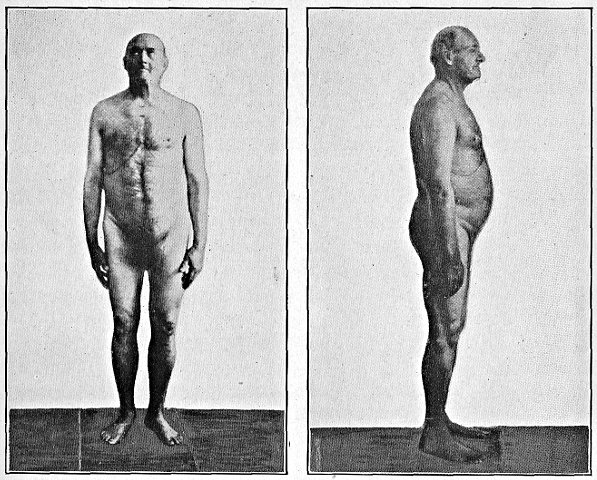
Fig. 18. Fig. 19.
Brachyscelous type (from Viola).
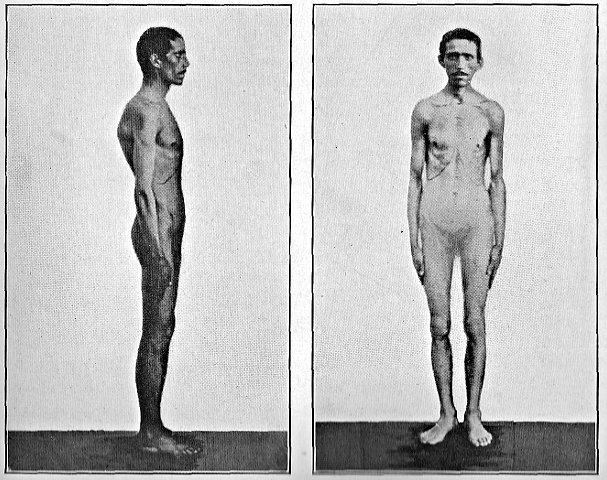
Fig. 20. Fig. 21.
Macroscelous type (from Viola).
"Experience also teaches that one pupil may be adapted to one kind of exercise and another to another kind. Accordingly a really physiological system of gymnastics requires that those movements and those exercises which are least easily performed should be practised according to special methods, until they have strengthened the less developed functions, without ever causing illness or producing harmful reactions.[10]"
So that the final results are an improvement in the morphological proportions of the organism, and consequently a correction and improvement in the relative liability to disease.
The other fundamental pathological type described by De Giovanni is the hypersthenic (second morphological combination), corresponding in part to the sanguine temperament of Greek medicine, and in part to the bilious temperament. In this type the total spread of the arms is generally less than the stature, and the perimeter of the chest notably exceeds one-half the stature. Consequently we are dealing with the brachyscelous type.
This type has a greatly developed thorax, a large heart, an excessive development of the intestines; hence he is a hearty eater, subject to an over-abundance of blood; he is over-nourished, the ruddy skin reveals an abundant circulation, there is an excess of adipose tissue and a good development of the striped muscles. Such a constitution accompanies an excitable, impulsive, violent disposition, and conduces to diseases of the heart. "This type is characterised in general by robustness and a liability to disorders of the central circulatory system."[11]
But there are still other forms of disease that await the individuals of this class, such for example as disorders affecting the interchange of organic matter (diabetes, gout, polysarcia = obesity) and attacks of an apoplectic nature. In the case of acute illness individuals of this class suffer from excess of blood and may be relieved by being bled. They are readily liable to bloody excretions.
Here are a few cases illustrating this morphological combination, which is characterised by an exorbitant chest development (it must be borne in mind that the circumference of the thorax, Ct, should equal one-half the stature, St).
P. A.—St 156; Ct 93.—Endocarditis; insufficient heart-action.
Z. C.—St 168; Ct 95.—Cerebral hyperemia of an apoplectic nature. Hypertrophy of the left ventricle of the heart. Polysarcous (gluttonous) eater.
B. G—St 166; Ct 104.—Diabetic, obese, subject to diabetic ischialgia (neuralgia), frequent recurrence of gravel in the urine. Tendency to excesses of the table.
D. G.—St 160; Ct 96.—Polysarcia, the first symptoms of which appeared in early youth. At the age of sixteen, suffered from all the discomforts of obesity. Shows atheroma (fatty degeneration) of the aorta, irregular heart-action, hypertrophy and enlargement of the heart.
In this brachyscelous type it may happen either that the whole trunk (that is, both the thoracic and abdominal cavities) is in excess, or else that the excessive development is confined to the abdomen. This latter case is very frequent, and may easily be found even in early childhood. Such children are hearty eaters, are very active and, for this reason, the pride and joy of their parents. Nevertheless, there are many signs that should give warning of constitutional defects; constant digestive disturbances (diarrhœa), frequent headaches, pains in the joints, apparently of a rheumatic character, tendency to pains in the liver which is excessively enlarged; excess of adipose tissue; a tendency to fall ill very easily, of maladies that are almost always happily overcome (but the truly robust person is not the one who recovers from illness, but the one who does not become ill), and finally an excessively lively disposition, irritability and above all, impulsiveness.
Such individuals ought, like the macrosceles, to live under the necessary and perpetual tyranny of a hygienic régime, adapted to correct or to diminish the morbid predispositions associated with the organism. A special dietetic, a regular hydrotherapic treatment, a moderate gymnastic exercise designed to direct the child's motive powers, and thus to prepare the man for that form of existence to which it is necessary for him to subject himself, if he does not wish to shorten his own life, or at least his period of activity—all these things are so many duties which the school ought in great part to assume.
In this way we have briefly considered the abnormal types of brachyscelia and macroscelia, which by their very constitution are predisposed to incur special and characteristic forms of disease, which may be avoided only by subjecting the organism to a special hygienic regimen. Men cannot all live according to the same rules.
Types of Stature in Criminals
In these latter times, some very recent researches have been made by applying De Giovanni's method to the anthropological study of criminals, especially through the labours of Dr. Boxich. He has found that the great majority of parasitic criminals, thieves for example, are macrosceles. They exhibit the stigmata already revealed by Lombroso: great length of the upper limbs, with elongated hands; furthermore, a narrow chest and a small heart, insufficient for its vital function; such individuals are singularly predisposed to pulmonary tuberculosis, and hence in their physical constitution they are already stamped as organisms of inferior biological value—having little endurance and almost no ability as producers—consequently they are forced to live as they can, that is like parasites, profiting by the work of others. On the contrary, the great majority of criminals of a violent character present the brachyscelous type: the thorax is greatly developed, the heart hypertrophic, the arterial circulation superabundant. This class of criminals, including a large proportion of murderers, have a special tendency to act from impulse, corresponding to their large heart which sends an excess of blood pulsing violently to the brain, obscuring the psychic functions; or, in the speech of the people, such a man has "lost his reason," "the light goes from the eyes when the blood goes to the brain."
Here are some notes regarding these two different types: we will select as measures of comparison the stature and the weight, bearing in mind that in the macrosceles the weight is scanty and that the opposite is true of the brachysceles, while normally there ought to be a pretty close correspondence between the weight in kilograms and the centimetres of stature over and above one metre.
Types of Non-violent Criminals (Parasites)
Case No. 24.—St. 168; Wt. 56. Farm steward, three years' sentence for theft. Pallid complexion, visible veins, scant muscles. Heart small and weak, pulse feeble and slow.
Case No. 34.—St. 175; Wt. 61. Baker, comfortable financial circumstances, has received a number of sentences for theft, amounting altogether to ten years. Is twenty-four years of age. Cyanosis of the extremities (bluish tinge, due to excessive venous circulation). Cardiac action feeble. Scant muscles.
Case No. 43.—St. 156; Wt. 51. Peasant. Straitened circumstances. Four years' sentence for theft. Rejected by the army board for defective chest measurement. Dark complexion. Extensive acne. Scant muscles. Bronchial catarrh. Has had hemoptysis (spitting of blood). Cardiac action weak. Pulse very feeble.
Case No. 52.—St. 173; Wt. 66. Book-binder. Prosperous circumstances. Four years' sentence or thereabouts, for theft; age, twenty-four. Conjunctivitis and blepharitis from early childhood. Frontal and parietal nodules prominent. Muscles scant; cardiac action weak; lymphatic glands of the neck enlarged.
The following is an example of the typical thief:[12]
St. 162; Wt. 46.—Exceedingly small heart, feeble cardiac action. Suffers from chronic bronchial catarrh. Cranial nodules very prominent. Began as a small child to steal in his own home, and since then has received sentence after sentence for theft, up to his present age of twenty-nine.
Types of Violent Criminals (Assault, Mayhem, Homicide)
Case No. 54.—St. 157; Wt. 62. Peasant. Good financial circumstances. Condemned to thirty years in prison for homicide. Well-developed muscles. Blood vessels congested. Strong heart action; the pulsation extends as far down as the epigastrium. Ample pulse.
Case No. 60.—St. 156; Wt. 70. Shoemaker. Bad financial circumstances. Condemned to fifteen years' imprisonment for homicide, after having been previously convicted three times for theft. The chest circumference exceeds one-half the stature by 11 centimetres. Subject to frequent pains in the head. Good muscles. Corpulent. Full pulse. (It should be noticed that the florid complexion, accompanying this type of stature, persists in spite of straitened circumstances!)
Case No. 85.—St. 168; Wt. 70. Turner in iron. Comfortable circumstances. Sentenced to thirty years in prison after one previous conviction for criminal assault. Ruddy complexion. Veins not visible. Abdomen very prominent. Gastrectasia (dilation of the stomach). Entire cardiac region protuberant. Laboured breathing. Cardiac action abundant.
Hence we perceive, in the etiology of crime, the importance of the organic factor, connected directly with the lack of harmony in the viscera and their functions, and consequently accompanied by special morbid predispositions.
As a result of this line of research, criminality and pathology are coming to be studied more and more in conjunction. For that matter, it was already observed by Lombroso that in addition to the various external malformations found in criminals, there were also certain anomalies of the internal organs, and a widespread and varied predisposition to disease. In short, his statistics reveal a prevalence of cardiac maladies and of tuberculosis in criminals, as well as a great frequency of diseases of the liver and the intestines.
Extreme or Infantile Types, Nanism and Gigantism, Extra-social Types
Whenever the disproportion between the bust and the limbs surpasses the extreme normal limits, the whole individual reveals a complex departure from type. Thus, for example, in connection with extreme brachyscelia, there exists a characteristic form of nanism (dwarfishness), called achondroplastic nanism, in which, although the bust is developed very nearly within normal limits, the limbs on the contrary are arrested in their growth so as to remain permanently nothing more than little appendages of the trunk. This calls to mind the fœtal form of the new-born child, and the resulting type, because of this morphological coincidence, is classed among the infantile types.
Achondroplastic nanism is associated with a pathological deformity due to fœtal rickets. It is not only the child after birth, but the fœtus also which, during its intrauterine life, may be subject to diseases. Rickets (always a localised disease, usually attacking some part of the skeleton) in this case fastens upon the enchondral cartilages of the long bones. As we know, the long bones are composed of a body or diaphysis and of extremities or articular heads, the epiphyses. Now, these different parts, which form in the adult a continuous whole, remain separate throughout the fœtal and the immediate post-natal period: so that the heads of the humerus and the femur, for example, in the case of the new-born child, are found to be joined to the diaphysis by cartilages (destined to ossify later on), which are the chief seat of growth of the bones in the direction of length. Well, in these cases of pre-natal rickets, the union of the bony segments takes place prematurely, and since the bones can hardly grow at all in length, they develop in thickness, and the result is that the limbs remain very short and stocky. Meanwhile the bust, the bones of which have in no way lost their power of growth, develops normally.
Now, these dwarfs, who have abundant intelligence, because they have the essential parts of stature in their favour, constituted the famous jesters of the mediæval courts, whose misfortune served to solace the leisure hours of royalty. Paolo Veronese went so far as to introduce a dwarf buffoon, of the achondroplastic type, into his famous painting, The Wedding at Cana.
Conversely, in connection with an exaggerated macroscelia, we have gigantism.
Ordinarily, a giant has a bust that is not greatly in excess of normal dimensions. The limbs, on the contrary, depart extremely from the normal limits, in an exaggerated growth in the direction of length: so much so that the bodies of giants present the appearance of small busts moving around on stilts.
Nevertheless, many different forms of gigantism occur. The pathology of this phenomenon is quite complex; but we can not concern ourselves with it here. It is a scientific problem of no immediate utility to our pedagogic problems. Dwarfs and giants, whatever their type and their pathological etiology, constitute extra-social individuals, who have been at all times excluded from any possibility of adaptation to useful labour, and employed, whether in the middle ages or in the twentieth century, to a greater or less extent as a source of amusement to normal beings, because of their grotesque appearance, either at court or in the theatres, or in moving pictures, or (in the case of giants) as figures suited to adorn princely or imperial gateways. These individuals are as completely independent of the social conditions of the environment in which they were born as if they were extraneous to humanity. In relation to the species, they are sterile.
From the biological side, a consideration of these types serves merely as an illustration of an important law: the essential part of the organism (the vertebral column) is less variable than the accessory parts (the limbs).
Summary of the Types of Stature
According to the relative development of bust and limbs we have distinguished three types, the macrosceles, the brachysceles and the mesatisceles, within their respective limits of oscillation.
Since the type of stature gives us a proportion between the different parts of an individual, it constitutes a fundamental criterion for a morphological judgment of the personality. That is, it leads to a diagnosis of the individual constitution, with which are associated not only the "character" but also certain predispositions to disease.
A knowledge of these types shows us the necessity we educators are under of taking into consideration the individual pupils, each of whom may have separate needs, tendencies and forms of development; and of demanding separate schools, in which even the methods of moral education must differ. Because men are not only not all adapted to the same forms of work, but they are not even all adapted to the same standards of morality. And since it is our duty to assume the task of aiding the biological development and the social adaptation of the new generations, it will also be part of our task to correct defective organisms, and at the same time to correct the types of mental and moral inferiority.
In the following chart we may summarise the points of view from which we have studied the types of stature:
SYNOPTIC CHART
Types of stature Macrosceles long legs, short bust.
Brachysceles short legs, long bust.
Variations in types of stature Normal Race Mongols (brachysceles).
Tasmanians (macrosceles).
Dark Mediterranean race (mesatisceles tending toward brachyscelia).
Blond race (mesatisceles tending toward macroscelia).
Sex Woman more brachyscelous.
Man more macroscelous.
Age Childhood brachyscelous.
Old age macroscelous.
Pathologically abnormal. De Giovanni's hyposthenic types Macrosceles predisposed to tuberculosis.
De Giovanni's hypersthenic types. Brachysceles predisposed predisposed to diseases of the heart.
Criminals. Macrosceles parasites.
Brachysceles violent.
Infantile types Achondroplastic nanism.
Gigantism.
Summary of the Scientific Principles Illustrated in the Course of our Discussion
Biological Laws.—a. Growth is not only an augmentation in volume, but also an evolution in form.
b. The more essential parts vary less than the accessory parts in the course of their transformations.
The Index.—The index is the mathematical relation between the measurements belonging to the same individual, and as such it gives us an idea of the form; since the form is determined by the relations between the various parts constituting the whole.
The Stature
While the figure and the type of stature tend to delineate the individual considered by himself, the different measurements considered separately may guide us in our study of individuals in their relation to the race and the environment.
Among the measurements of the form, we will limit ourselves to a study of the stature and the weight, which serve to give us respectively the linear index of development and the volumetric estimate of the body taken as a whole. We shall reserve the study of the other measurements, such as the total spread of the arms and the perimeter of the thorax, until we come to the analytical investigation of the separate parts of the body (limbs, thorax).
The stature is expressed by a linear measure determined by the distance intervening in a vertical direction between the plane on which the individual is standing in an erect position and the top of his head.
It follows that the stature is a measurement determined by the erect position; on the other hand, when a man is in a recumbent position, what we could determine would be the length of body, which is not identical with the stature.
In fact, a man on foot, resting his weight upon articulations that are elastic, and therefore compressible, is a little shorter than when he is recumbent.
If we examine the skeleton (see Fig. 9), we discover that the single synthetic measure that constitutes the stature results from a sum of parts that differ greatly from one another. To be specific, it is composed of the long and short bones of the lower limbs; of flat bones, such as the pelvis and the skull; of little spongy bones, such as the vertebræ; all of which bones and parts obey different laws in the course of their growth. Furthermore, intervening between these various bones are soft, elastic parts, known as the articulations, which, starting from below, succeed each other in the following order:
Calcaneo-astragaloid, between the calcaneus and the superimposed astragalus.
Tibio-astragaloid, between the astragalus and the superimposed tibia.
Of the knee, between the tibia and the femur.
Of the hip, between the femur and the os innominatum.
Sacro-iliac, between the os iliacum and the sacrum.
Sacro-vertebral, between the sacrum and the last lumbar vertebra.
Of the vertebræ, consisting of 23 intervertebral disks, that is to say interposed between the vertebræ, which include the following: 5 lumbar, 12 thoracic, 7 cervical.
Occipito-atloid, between the first cervical vertebra, called the atlas and the os occipitale of the cranium.
Accordingly, there are thirty articulations in all; and of these, 23 are the intervertebral disks, which constitute, taken together, a fourth part of the complex height of the vertebral column.
Furthermore, the height of the body cannot be considered simply the sum of the component parts, since these are not superimposed in a straight line. As a matter of fact, if we examine the vertebral column, we see that it is not straight as in the case of animals, but exhibits certain curves that are characteristic of the human species, and must be taken into consideration in their relation to the erect position. In fact, the vertebral column presents two curvatures, the one lumbar, and the other cervical, which together give it the form of an S. These curvatures are acquired along with the erect position, and are not innate; one of the points of difference between the skeleton of the new-born child and that of the adult is precisely this, that the former has a straight vertebral column.
A fact of no small importance to note, since in the course of growth a certain determined form of normal curve, and no other, ought to establish itself; otherwise, abnormal deviations in the vertebral column will become established. And for the very reason that it is plastic and destined to assume a curve, the vertebral column may very easily be forced into exaggerating or departing from its morphological destiny. In such a case, the resulting stature would be inferior to what it should normally have been.
Accordingly, the stature is the resultant of the sum of anatomical parts and of morphological conditions.
Hence it is a linear index not only of biological man, that is, of man considered in relation to his racial limitations; but also of social man, that is, of man as he has developed in the struggle for adaptation to his environment.
The limits of stature, according to race. Stature is an anthropological datum of great biological value, since it is a definite racial characteristic and is preserved from generation to generation by heredity. The first distinguishing trait of a race is the height of the body in its natural erect position. It is also the first characteristic that strikes us when a stranger comes toward us for the first time. And that is why we make it the leading descriptive trait: a person of tall, or of low stature. If, for a moment, we should picture to ourselves the legend of Noah's Ark—quite incredible, because emigration and embarkation of all the known species would have required more than a century of time (it is enough merely to think of the embarkation of the tortoises and the sloths!), and the necessity of an ark as big as a nation, what must inevitably have struck Noah and his sons would have been the stature of the individuals belonging to each separate species.
The stature is the linear index of the limit of mass.
Among the human races the variations in stature are included between fairly wide oscillations: coming down to facts, the average stature of the Akkas is 1.387 m. (4 ft. 6½ in.) for the males; and that of the Scotchmen of Galloway is 1.792 m. (5 ft. 10½ in.). Accordingly between the average heights of the two races that are considered as the extremes, there is a difference of 40 cm. (15¾ in.); but since the averages are obtained from a complex mass of normal measurements, some of which are above and others necessarily below the average itself, we may assert that the "normal human individuals" may differ in stature to an extent of more than half a metre; the oscillations of normal individuals on each side of the racial average being estimated at about 10 cm. (3.937 in.).
If we should see a little Akka 4 ft. 4 in. (1.33 m.) in height alongside of a Scotchman 6 ft. (1.83 m.) high we should say "a dwarf beside a giant." But such terms are pathological and should never be employed to indicate normal individualities. As a matter of fact dwarfs and giants are as a class extra-social and sterile; normal individuals, on the contrary, represent the physiopsychic characteristics of their respective races. Consequently we may say that normal people have a low stature, or a high stature; or if it is a question of extremely low stature (such as that of the Akkas) we may make use of the term pigmies or of the pigmy race, in speaking of such individuals. Sergi has proved the existence, among the prehistoric inhabitants of Europe, of various pigmy races.
In the field of anthropology the scientific terminology ought always to be based upon certain determined limits. The authorities indicate the normal extremes of individual stature, beyond which we pass over the into realm of pathology, incompatible with the survival of the species; and even in the pathological cases they determine the extreme limits, obtained from the individual monstrosities that have actually existed in the course of the centuries, and that seem to indicate the furthest limits attained by the human race.
Deniker, in summing up the principal authorities, assigns the following limits:
Statures less than 1.25 m. Normal statures, range of oscillations among the races Statures from 2 m. upward
Lowest individual extreme Exceptionally low individual stature Extreme low racial average Extreme high racial average Exceptionally high individual stature Highest individual extreme
Nanism 1.25 m. 1.35 m. Akkas 1.387 m. Scotchmen of Galloway 1.792 m. 1.90 m. 1.99 m. Gigantism
The pathological extremes that would seem to indicate the limits of stature compatible with human life would seem to be on the one hand the little female dwarf, Hilany Agyba of Sinai, described by Jaest and cited by Deniker,[13] 15 inches high (0.38 m.—the average length of the Italian child at birth is 0.50 m. = 19½ in.), and on the other, the giant Finlander, Caianus, cited by Topinard[14], 9 ft. 3½ in. in height (2.83); the two extremes of human stature would accordingly bear a ratio of 1:7. On the other hand, Quétélet[15] gives the two extremes as being relatively 1:6—namely, the Swedish giant who was one of the guardsmen of Frederick the Great, and was 2.523 m. tall (8 ft. 3 in.); and the dwarf cited by Buffon, 0.43 m. in height (16¾ in.).
When there is occasion for applying the terms tall or low stature to individuals of our own race, it is necessary at the same time to establish limits that will determine the precise meaning of such terms. Livi[16] gives as the average stature for Italians 1.65 m. (5 ft. 5 in.), and speaking authoritatively as the leading statistician in Anthropology, establishes the following limits:
STATURE OF ITALIANS (LIVI) Averages Determining The Terminology of Stature
1.60 m. and below, low statures. 1.65 m. and all between 1.60-1.70, mean statures 1.70 m. and above, tall statures.
The individual extremes among the low statures tend to approach the average stature of the Japanese race (1.55 m.), and those among the high statures approach the Anglo-Saxon average (the Scotch = 1.79 m.)
There is much to interest us in studying the distribution of statures in Italy.
In Livi's great charts, he has marked in blue those regions where the prevailing percentage of stature is high (1.70 m. and upward), and in red those where the low statures prevail (1.60 m. and below); and the varying intensity of colouration indicates the greater or lesser prevalence of the high or low statures.
Thus it becomes evident in one glance of the eye that tall statures prevail in northern Italy and low statures in the south; while the maximum of low stature (indicated by the most intense red) is found in the islands, and especially in Sardinia.
In the vicinity of the central districts of Italy (the Marches, Umbria, Latium) the two colours fade out; this indicates that here all notable prevalence of stature, either tall or low, ceases; consequently we have here, as the prevailing norm, the mean stature (1.65 m.).
Anyone wishing to analyse the natural distribution of stature, has only to study these charts by Livi, which are worked out with great minuteness. If a study of this sort, extending over the entire peninsula, seems too great an undertaking, it is at least advisable for a teacher to acquaint himself with the local distribution of stature; in order that when it becomes his duty to judge of the stature of pupils in his school he will have the necessary idea regarding the biological (racial) basis on which so important an anthropological datum can oscillate.
Livi's charts, based upon the male stature, correspond almost perfectly with my own regional charts based upon the average statures of the women of Latium. Both Livi and I find that in the region of Latium the tall statures prevail north of the Tiber, especially toward the confines of Umbria; while the lowest statures are found in the neighbourhood of the valley of the Tiber, toward the sea (Castelli Romani). That is to say, the stature becomes lower from north to south, and from the mountains toward the sea. Furthermore, there exist certain nuclei of pure race, such as at Orte and in Castelli Romani, where we may find the extremes of average stature, which for women are found to be 1.61 m. at Orte, and 1.47 m. at Castelli Romani; while the extreme individual statures, according to my figures, oscillate between 1.42 m. (Castelli) and 1.70 m. (Orte). It would be helpful to the teachers of Rome and Latium, if they would acquire some idea regarding the racial types of the district, by studying my work on the Physical Characteristics of the young Women of Latium, which is the only work on regional anthropology taken directly from life that so far exists in anthropologic literature.[17]
The Stature in Relation to Sex.—It is sufficient to point out that the stature varies normally between the sexes, so that the average figures differ by about 10 centimetres (nearly 4 in.) in the direction of a lower stature for woman.
Variations in Stature Through the Different Ages
Notwithstanding that growth is an evolution, it manifests itself also by an absolute augmentation of mass; and the linear index of such augmentation is given by the growth in stature, or by its variations at different ages.
This exceedingly important measurement ought to be taken in the case of all pupils; and undoubtedly in the course of time anthropometry will form a part of our school equipment; because, by following the increase of stature in a child, we follow his physical development.
In Chapter VII, in which the technique of the stature is discussed, there is a graphic representation of the annual increase of stature in the two sexes; the upper parabolic line refers to the male sex, and the lower one to the female. On the vertical line are marked the measures of growth, from the base upward, and on the horizontal line the ages. All the dotted vertical lines which rise from the horizontal, each corresponding to a successive year of life, and stop at the parabolic line, represent the relative proportion of stature from year to year; while the parabola which unites the extremities of such lines may be regarded as a line drawn tangent to the top of the head of an individual through the successive periods of his life.
If we analyse this table, we find that the greatest increase in stature takes place during the first year; in fact, a child which at birth has an average length of body of 0.50 m. for males, and 0.48 m. for females (the new-born child does not have stature, but only length of body, since it has not yet acquired an erect position) has by the end of the first year augmented the length of body by 20 centimetres, which gives an average length of 0.70 m. In no other year of life will the stature acquire so notable an increase; it is very important for mothers to watch the growth of the child during this first year of its life; and the following figures may be useful for comparison:
It will be seen that the maximum increase takes place during the first four months—especially in the first month (4 cm. = 1.57 in.) the rate diminishing from this point up to the fourth month (2 cm. = 0.78 in.), after which the monthly increase remains steadily at one centimetre (0.39 in.).
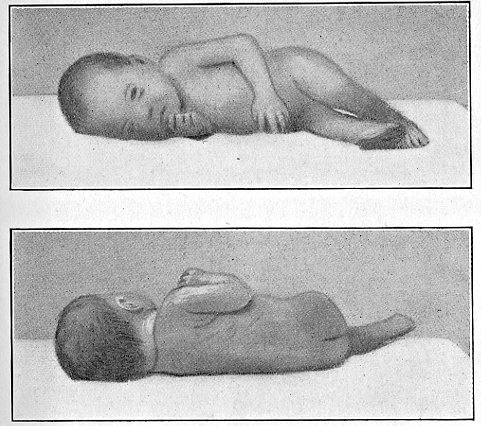
Fig. 22.—New-born child, seen from in front and from behind. (Stratz.)
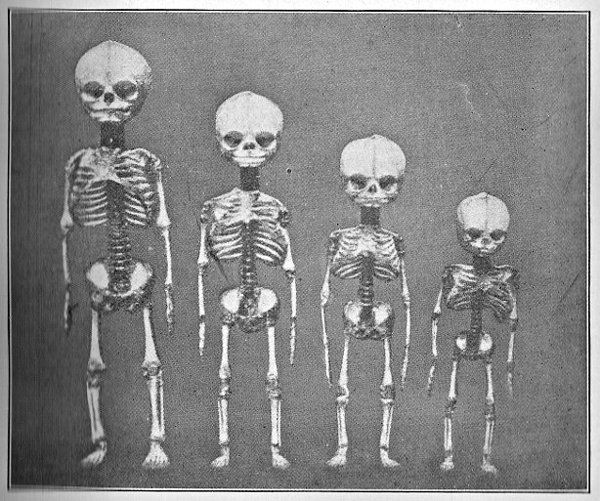
1 year. 8 months. 4 months. at birth.
Fig. 23—Skeleton of a child from birth to the age of one year.
GROWTH IN LENGTH OF BODY DURING THE FIRST YEAR OF LIFE
(From Figueira)
Age in months Length of body in metres Monthly increase
0 0.50 0
1 0.54 4
2 0.57 3
3 0.60 3
4 0.62 2
5 0.63 1
6 0.64 1
7 0.65 1
8 0.66 1
9 0.67 1
10 0.68 1
11 0.69 1
12 0.70 1
The same facts appear from the combination picture given by Stratz, showing an infant's skeleton at four-month intervals from birth to the end of the first year.
During the second year of life, the increase in stature is about one-half that of the preceding year, that is, about 10 cm. (4 in.), so that at the end of the second year the child attains a height of about 80 cm. (31½ in.). After this, the annual increase diminishes in intensity (see "Figures of the increase of stature according to Quétélet and other authors," in the technical part, Chapter VII), as is shown by the horizontal dotted lines, which, starting from a vertical line at points corresponding to the height of various statures, represent by the intervals of space between them the successive growth from year to year.
This increase is not regular, but proceeds by periodic impulses that in early childhood seem to recur at intervals of three years.
Thus for example the increase
between 0- 3 years of age is successively 20, 10, 6 cm.
between 3- 6 years of age is successively 7, 6, 5 cm.
between 6- 9 years of age is successively 7, 6, 5 cm.
between 9-12 years of age is successively 6, 4, 3 cm.
Accordingly we have a triennial rhythm, decreasing throughout the whole period of childhood; the maximum increase is in the first triennium, the second and third periods of three years correspond exactly, while the last period shows a lowered rate of increase.
At this point the period of approaching puberty begins (13 years for boys), after which the rate of increase becomes more rapid than it had been during the second or third period, attaining its maximum during the years 13-15; to be specific, the rate from 13 to 18 is successively 4, 8, 7, 5, 6, 3 cm.
When the period of puberty is ended (18 years), the rate of growth is much slower; in fact, during the two following years (18 to 20) it hardly attains one centimetre.
Nevertheless, the stature continues to increase up to the twenty-fifth year; according to Quétélet's figures, the average male stature at the age of eighteen is 1.70 m. (in Belgium) and at twenty-one it is 1.72 m.
From twenty-five to thirty-five the stature remains stable; this is the adult age, the full attainment of maturity; at the age of forty the period of involution insensibly begins, and after fifty in the case of women, and sixty in the case of men, the stature begins insensibly to decrease; a decrease which becomes more marked with the advance of age, corresponding to an anatomical diminution of the soft parts interposed between the bones in the sum of parts that make up the stature; more especially the intervertebral disks; and in connection with this phenomenon the vertebral column tends to become more curved.
According to Quétélet's figures, at the age of eighty the average male stature is 1.61 m. (5 ft. 3-2/5 in.), a stature corresponding to that of the age of sixteen.
Accordingly, the variations in stature throughout the different periods of life are neither a growth nor an evolution, but a parabolic curve, including evolution and involution. This curve represents the true human stature; the measurements taken successively from year to year representing nothing more than transitory episodes in the individual life.
Man, as he really is, we may represent by portraits taken successively from time to time, from his birth until his death; the occasional photograph which it is the custom to have taken represents nothing; following no rule, it seizes a fugitive instant in the life of an individual, who is never a fixed quantity but is constantly in transition during the whole course of his existence. So that the habit of taking a picture annually on a child's birthday is an excellent one if we wish to preserve a true likeness; and this practice is recommended in pedagogic anthropology, when it is desired to preserve the biographic history of the pupil.
It is interesting to study, side by side with the growth of stature and the marked rhythms and periods that constitute its laws, the phenomenon of general mortality in its relation to age.
Lexis gives the following curve of general mortality: the horizontal line marks the years and the vertical line the corresponding number of deaths, while the curved line shows the progress of mortality, and the highest points in the curve indicate the maximum mortality. It is highest of all during the first year and in general during early childhood, and is steadily lowered to a point corresponding to the ages from ten to thirteen, after which it rises again.
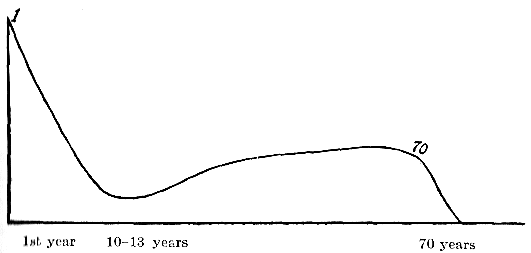
Fig. 24.—Curve of general mortality (Lexis).
Let us examine the curve up to this point, since it has a bearing upon our school work. We can prove that the maximum mortality corresponds to the maximum individual growth; in other words, an organism in rapid evolution is exposed to death, its powers of immunity to infective diseases are weakened; it constitutes what in medical parlance is known as a locus minoris resistentiæ.
In that period of calm in growth, which would seem to be a repose preceding the evolution of puberty, mortality is at the lowest; only to rise again rapidly during the period of puberty; while the rise becomes less rapid after the eighteenth year, notwithstanding that after that age mankind in general are exposed, in their struggle for existence, to many causes of death that did not exist during the preceding years. Toward the age of seventy the line of mortality attains another apex, because the age of normal death is reached; after which it drops precipitously because of the lack of survivors.
From these facts we may deduce certain very important principles that throw useful light upon pedagogy: there are certain ages at which even the strong are weak; and their weakness is of such a nature that it exposes the individual to death.
Now, whenever the phenomenon of mortality occurs it is always an indication of impoverishment in the survivors. For example, of every one person that dies, many persons have been ill who have recovered from their illness; but there are still many others who, although they did not actually fall ill, were weakened even though they passed through the peril unharmed.
In short, for each death, which represents a final disaster, there are many victims. And whenever there is a rise in the phenomenon of mortality in connection with any one age, it is our duty to give special attention to those individuals who are not only weak in themselves, but whom the social causes affecting them tend to weaken still more and push onward toward illness and death. Whenever there are many deaths, there are undoubtedly also many sufferers.
Now, in pedagogy we have no criterion to guide us in this matter of respecting the weaknesses characteristic of the various ages, as, for example, that of early infancy and of the age of puberty.
With the most cruel blindness we punish and discourage the lad who, having reached the age of puberty, no longer makes the progress in his studies that rendered him the brilliant champion during the period of physiological repose in his growth; and instead of regarding this as a psychic indication of a great physiological transformation that it is necessary to protect, we urge on the organism to enforced effort, without even suspecting that, in proportion to the degree of resistance of our pupil, we may be doing our share to induce in him a permanent weakness, or an arrest of development, or disease and death.
Our responsibility as educators is great, because we have the threads of life entrusted to our care; man represents a continuous transition through successive forms, and each following period has been prepared for by the one preceding.
Whenever we have the misfortune to concur in weakening a child, we touch that parabolic line traced in the graphic chart of stature, and standing as an index of the life of the body, and we give it a shock throughout its whole length; it may either be shattered or be brought down to a lower grade.
But the life of an individual does not contain merely that individual alone; the cycle of the stature with its violent period of puberty and the perfect physiological repose corresponding to the years from 25 to 36, or even 45, indicates the eternity of the individual in the species: his maturity for reproduction. Man in his progress through the different levels of height, as indicated on the graphic chart of stature, does not pass through them without reproducing himself, save in exceptional cases; he commences the ascent alone, but in his descent he attains the majesty of a creator who leaves behind him the immortal works of his own creation. Well, even the capacity of normal reproduction, and of begetting a strong species, is related to the normal cycle of life: whoever weakens a child and puts a strain upon the threads of its existence, starts a vibration that will be felt throughout posterity.
The parabolic cycle of stature shows us which is the most favourable period for the reproduction of the species; it is undoubtedly that period that stands at the highest apex of the curve, and at which the organism has reached an almost absolute peace, as if forgetful of itself, in order to provide for its eternity. When it has completed its period of evolution, during which the organism shows that it has not yet matured; and before the commencement of involution, in which period the organism is slowly preparing for departure—that is the moment when man may or rather ought to procreate his species.
Careful forethought not to produce immature or feeble fruit, will form part of the coming man's regard for his posterity. A new moral era is maturing, that is giving birth to a solidarity, not only between all living beings, but including also those future beings who are as yet unborn; but for whose existence the living man of to-day is preparing through his care of his own strength and his own virtue. To have intentionally begotten a son better than himself will be a proud victory for the man who has attained the higher sexual morality; and such pride will be no less keen than that of the artist, who by perfecting his marvelous talents has created a masterpiece.
The statistics collected by Quétélet demonstrate that "too precocious marriages either occasion sterility or produce children that have a smaller probability of living."
They prove furthermore that the number of children who die is largest in marriages contracted at the age of sixteen or earlier, and becomes lowest among the children born of marriages contracted between the years of 29 and 32. During these years also the parents are most fertile: as is shown by the following tables:
SANDLER'S FIGURES BASED ON THE FAMILIES OF ENGLISH PEERS
Age of parents at marriage Percentage of deaths of children before attaining marriageable age Average births to each marriage Percentage of births to each death
15 years 35 4.40 0.283
16-19 years 20 4.63 0.208
20-23 years 19 5.21 0.188
24-27 years 12 5.43 1.171
Age at the time of child's birth Percentage of deaths to each birth Average number of births in one year of marriage
16 years 0.44 0.46
17-20 years 0.43 0.50
21-24 years 0.42 0.52
25-28 years 0.41 0.55
29-32 years 0.40 0.59
The results of a recent research show that famous men have hardly ever been the first-born, and that the great majority were begotten of parents who were at the time between the ages of 25 and 36 years.
Variations of Stature with Age, According to the Sexes.—The general laws of the growth and involution of stature are pretty nearly the same for the two sexes. The female stature, beginning at birth, averages throughout life somewhat less than the male.
But since the development of puberty takes place earlier in woman than in man, the female child manifests the characteristic increase in stature at an earlier age than the male; consequently at that age (about eleven) she overtakes him, and for the time being both boy and girl are equal in stature. But as soon as the boy enters upon the period of puberty, he rapidly surpasses the girl, and his stature henceforth steadily maintains a superiority of about ten centimetres (nearly four inches), as is shown by the deviations between the two parabolic curves, representing the variations of stature in the two sexes. Even the involution of stature occurs precociously in women, as compared with man.
Variations in Stature due to Mechanical Causes of Adaptation to Environment
Variations due to Mechanical Causes. Transitory and Permanent Variations. Deformations.—The individual stature is not a fixed quantity at all hours of the day; but it varies by several millimetres under the influence of mechanical causes connected with the habits of daily life. In the morning we are slightly taller than at night (by a fraction of a centimetre): in consequence of remaining on foot a good deal of the time during the day, our stature is gradually lowered. This is contrary to the popular belief that "while we stand up our stature grows."
As a matter of fact, in the erect position the soft tissues that form part of the total stature are under constant pressure; but being elastic, they resume their previous proportions after prolonged rest in a horizontal position.
Consequently at night, especially if we have taken a long walk, or danced, we are shorter than in the morning after a long sleep; the act of stretching the limbs in the morning completes the work of restoring the articular cartilages to their proper limits of elasticity. Nevertheless, according to the mechanical theory accepted by Manouvrier, persons who are habituated from childhood to stand on foot much of the time (labourers) interfere with the free growth of the long bones in the direction of length and at the same time augment the growth in thickness; hence the skeleton is rendered definitely shorter in its segments as well as in its bones (i.e., a shallower pelvis, shorter limbs, etc.). The result is a stocky type with robust muscles: the europlastic type, which is found among labourers. On the contrary, a person who spends much time reclining on sofas among cushions, and taking abundant nutriment, is likely to tend toward the opposite extreme; bones long and slender, the skeleton tall in all its segments, the muscular system delicate; this is the macroplastic or aristocratic type. According to Manouvrier, when a person has a long, slow convalescence after a protracted infectious malady such as typhoid, recumbent much of the time and subjected to a highly nutritive diet, it may happen, especially if he has reached the period of puberty at which a rapid osteogenesis naturally takes place in the cartilages of the long bones, that he will not only become notably taller, but will even acquire the macroplastic type.
The macroplastic type is artistically more beautiful, but the europlastic type is physiologically more useful.
It is not only the erect position that tends to reduce the stature, but the sitting posture as well. In fact, whether the pelvis is supported by the lower limbs or by a chair, the intervertebral disks are in either case compressed by the weight of the bust as a whole. If, for example, children are obliged, during the period of growth, to remain long at a time in a sitting posture, the limbs may freely lengthen, while the bust is impeded in its free growth, and the result may be an artificial tendency toward macroscelia. This is why children are more inclined than adults to throw themselves upon the ground, to lie down, to cut capers, in other words to restore the elasticity of their joints, and overcome the compression of bones and cartilages. Accordingly, such variations of stature recur habitually and are transitory, and since they are associated with the customary attitudes of daily life, they are physiological.
But if special causes should aggravate such physiological conditions, and should recur so often as not to permit the cartilages to return completely to their original condition, in such a case permanent variations of stature might result, and even morphological deviations of the skeleton. For example, a porter who habitually carries heavy weights on his head, may definitely lower his stature; and in the case of a young boy, the interference with the growth of the long bones through compression exerted from above downward, may produce an actual arrest of development of the limbs and spinal column, presenting all the symptoms of rickets. Witness certain consequences of "child-labour" chief among which must be mentioned the deformities of the carusi [victims of child-labour, who from an early age toil up the succession of ladders, bearing heavy burdens of sulphur from the mines below.[18]] in the Sicilian sulphur mines.[19] As a general rule, all cramped positions that are a necessary condition of labour, if they surpass the limits of resistance and elasticity of the human frame, and especially if they operate during periods of life when the skeleton is in process of formation, result in deformities, and when the skeleton is deformed, the internal organs and hence the general functional powers of the whole organism, suffer even greater alteration.
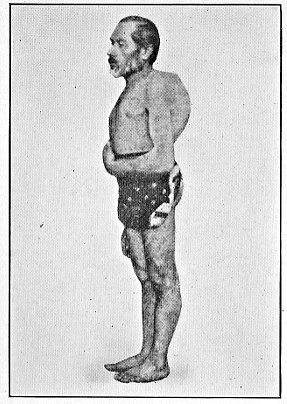
Fig. 25.—Vincenzo Militella of Lereata, a Sicilian caruso.
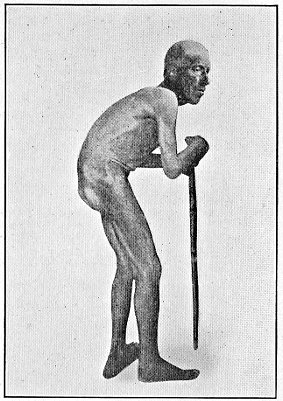
Fig. 26.—Aged field labourer.
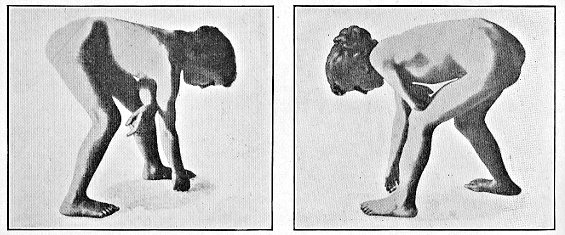
Fig. 27. Fig. 28.
Attitude of woman working in the rice fields as seen from the right and left sides.
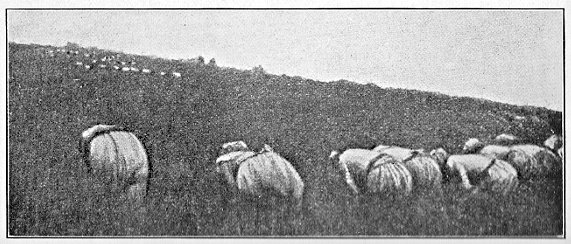
Fig. 29.—A gang of eight workers in the rice fields.
Consider the postures that miners must endure, or as Pieraccini phrases it, their "disastrous attitudes."
The transport galleries are ordinarily too low to permit a man of average height to walk erect; along these galleries little transport-wagons are run by hand, excepting where the carrying is done on the backs of the men themselves.
"Even in the front of the advance tunnels and in the galleries that are being worked, miners are to be seen in the most incongruous attitudes. These anomalous positions of the body maintained throughout long hours of toil react upon the functional action of the heart and lungs, upon the stomach and intestines in the proper performance of their tasks, and result in producing hernia, varicose veins and eventually deformities of the skeleton (vertebral column, thorax)."[20]
Field labourers also (Fig. 26) become permanently deformed, with diminution of stature, from remaining too long bent over in the act of hoeing or reaping. But a still more painful labour is that of the women in the rice fields during the period when the weeding is done.
The position necessitated by this work requires a strained and prolonged dorsal flexion of the vertebral column, accompanied by a strain on the lower dorsal nerves; great elasticity is required to endure a position so painful and so apt to induce lumbago; only young women can endure it, and even they become deformed, and suffer seriously from anemia, intestinal maladies and diseases of the uterus, which predispose them to abortion or sterility (Figs. 27, 28, 29).
Stone breakers also contract painful diseases and deformities from their work. They are constantly bowed over their task, performing a rhythmic, alternating movement of flexion, extension and torsion of the trunk upon itself, while at the same time there is a slight undulation in a backward and forward direction, accompanying the rising and falling of the arm holding the hammer. These movements of extension and flexion of the trunk involve the whole vertebral column, while the pelvis remains practically motionless. "At the end of the day they rise from their task bowed over and they walk home bowed over, holding the vertebral column rigid; any attempt to force the trunk into an erect position is extremely painful. In the morning they return to their work with their loins still aching." And among these stone breakers there are young men, some of them mere boys! And when we think that these injurious attitudes are coupled with malnutrition, we must realise the extent of the organic disaster that accompanies diminution of stature as a result of adaptation to labour.
We are naturally horrified at such conditions enforced upon a certain portion of humanity; and we pray for a time to come when machinery will have universally replaced human labour, in transportation, in stone-breaking, and in reaping, and when children will be spared from hard and deforming toil.
But how is it that while we are so sympathetic regarding conditions at a distance from us, we remain unconscious of similar conditions, that are close beside us, and of which we are the directors, the cruel enforcers, the masters?
In the near future, I hope that people will tell with amazement, as if citing a condition of inferior civilisation, how the school children, up to the opening of the twentieth century represented one category of those "deformed by prolonged and enforced labour in injurious positions!"
Such studies in school hygiene as deal with the type of school benches, designed to minimise the danger of deformities of the vertebral column in children—will, I hope, be regarded by the coming generations with the most utter amazement! And the school benches of to-day will find their place in museums, and people will go to look at them as if they were relics of bygone barbarism, just as we now visit the collections from old-time insane asylums, of series of complicated instruments of wood and iron that in bygone centuries were considered necessary for maintaining discipline among the insane.
What in the world would we say, if somebody should propose, in order to obviate the deformities and physiological injuries of labourers, that certain mechanisms should be applied to them individually for the purpose of diminishing the harm? Imagine a law being proposed, to the effect that all miners should be obliged to wear trusses, to keep their viscera from breaking loose, as a result of prolonged compression! What would we think of such reforms and such a path toward an orthopedic state of society?
Our way toward progress and higher civilisation is a very different one. To remove man from torturing toil that twists the bones and undermines the health—such is the goal that it is our duty to set before us!
For the deformed vertebral column is the extreme sign of a great accumulation of evils; the internal organs are correspondingly affected with disorders fatal to the entire organism; but even greater is the corresponding harm done to the human soul! What we want is not only that the bones shall not be thrown out of their eurhythmic harmony, but that the souls of the labourers shall be freed from the inhuman yoke of slavery (progress can consist solely in a radical alteration of the form of labour).
So far as concerns the school, which is not limited to a few categories of human beings, but is extended to all, by requirements of law, is it not possible for us to adopt a different attitude of mind?
The established fact that the pupils may even deform their skeletons in the course of their work, goes to prove that this work contains some error in principle that is fatal to successive generations; and so long as this principle is maintained, we may assert a priori that even if, with the help of school benches as complicated and as costly as orthopedic machines, we should succeed in checking the deformation of the vertebral column, we should fail to check the deformation of the soul. Because whoever is condemned to labour that deforms is a slave.
And as a matter of fact we employ coercive means, "rewards and punishments," to enforce upon children a condition that in their eyes amounts to serving their first sentence.
It is not the school bench, but the method that needs reforming; it is not the ligaments of the spinal column, but human life in evolution that we ought to respect, and lead toward the attainment of perfection! Amid the many banners of liberty that have been raised in these latter times, one is still missing—one which we ought to seize upon as the standard of our cause: the liberty of the new generation, which is groaning in the slavery of compulsory education, upon iron-bound benches, emblematic of chains!
I foresee, in a radical reform of pedagogic methods, the practical possibility of taking as guiding principles the individual liberty of the pupil and a reverential regard for life. And I affirm this all the more loudly, because I have applied such a method with indisputable success in the "Children's Houses," obtaining prodigious results in the health and happiness of the children, perfect discipline in the classes, marvelously rapid progress in studies, and a surprising awakening of souls, a passionate love for the work.
Variations Due to Adaptation in Connection with Causes of Various Kinds—Social, Physiological, Physical, Psychic, Pathological, Etc.
Physiology and Social Conditions.—Nutrition.—One of the effects of environment, of the highest importance in its relation to the development of stature, is nutrition. In order to attain the maximum development as biologically determined by heredity in a race, sufficient nutriment is the first necessity. It is a familiar fact that material or physiological life consists essentially in the exchange and renewal of matter, or in metabolism, which is also a renewal of vital force.
The living molecules are continually breaking up, thus expressing in an active form forces that had accumulated in a potential form, and eliminating the rejected matter; only to form again by means of new matter, containing potential forces. This breaking up and renewal constitutes the material of life, that never pauses in its molecular movement; the cessation of renewal of matter is death, that is, scission without reparation; consumption without renewal; and consequently a rapid disintegration of the body. Living matter consists in metabolism, and is consequently directly related to the nutritive substances which renew the elements necessary for continual redintegration.
We may disregard certain individual potentialities, of a purely biological nature, and that are capable of manifesting vital forces of varying degrees of intensity: but it may be asserted as beyond question that every living being, if he is to live according to his biological destiny, has need of sufficient nutrition. This is not the same as saving that the food determines the life of an individual in its final development, in the sense that by eating in excess one may attain the stature of a giant, or an imbecile become intelligent or a man of talent become a genius. We all bear within us, in that fertilised germ that constituted the first cell of our organism, predetermined biological conditions, on which depend the physical limits of our body, as well as those of our psychic individuality. But in order that this germ may develop in accordance with its potentiality, it is necessary that it shall obtain the requisite material from its environment. Because otherwise—and here the relation is direct—neither the volumetric development nor the morphological development can be accomplished, nor the psychic potentiality express itself; in other words, the stature will be undersized, in a body defrauded of the degree of beauty potential in the germ, and the muscular forces, in common with those of the brain, will remain at a level of development below that which nature had intended. Consequently, to deprive children of their requisite nutriment is stealing from life, it is a biological crime.
While we live, we must eat; and while we labour, that is, while we expend the vital forces, it is necessary to repair them. The schools should establish a system of luncheons for the pupils; this is a principle that has already been generally recognised and is already bearing fruit.
There was a time when a good appetite was regarded as a low material instinct; it was also the time when people sang the praises of spirituality, but actually indulged in banquets of Lucullian lavishness. The vice of the palate and the physiological need of nourishment were included under one and the same disdain.
To-day science has shed its light upon the true conception of nutrition and holds it to be the first necessity of life, and consequently the first social problem to be solved.
From this point of view, food is not a vulgar material thing, nor the dinner-table a place of debauchery. Indeed, there is nothing which affords better proof of immateriality than the act of eating. In fact, the necessity of eating is itself a proof that the matter of which our body is composed does not endure but passes like the fleeting moment. And if the substance of our bodies passes in this manner, if life itself is only a continual passing away of matter, what greater symbol of its immateriality and its spirituality is there than the dinner-table?
"... the bread is my flesh and the wine is my blood; do this in remembrance of what life really is."
Something similar to this is being accomplished to-day by science in regard to the sexual relations. We are accustomed to consider the sexual instincts as something contemptible, material and low, praising abstinence, and leaving these instincts wholly out of consideration in the course of education, as though they were something degrading, or even shameful. And undoubtedly our sexual abuses are shameful, and shameful also is the barbaric tolerance of the masses regarding prostitution, seduction, illegitimacy and the abandonment of new-born children. It is criminal abuse that makes us despise sexual relations, just as at one time excesses of the table made us despise nutrition. But the day will come when science will raise to the dignity of a new sexual morality the physiological function which to-day is considered material and shameful—and that comprehends the most sublime of human conceptions. In it are to be found the words which ancient races deposited in their religious tabernacles: creation, eternity, mystery. And in it are also to be found the most sublime conceptions of modern races: the destiny of humanity, the perfectionment of the human species.
Accordingly, we must to-day regard the serving of food in the schools as a necessity of the first order; but it is well, in introducing it into the schools, to surround it with that halo of gladness and of high moral significance that ought to accompany all manifestations of life. The hymn to bread, which is a human creation and a means of preserving the substance of the human body, ought to accompany the meals of our new generations of children. The child develops because the substance of his body passes away, and the meals that he eats symbolise all this: furthermore, they teach him to think of the vast labour accomplished by men who, unknown as individuals, cultivate the earth, reap the grain, grind the flour, and provide for all men and for all children. Where they are and who they are, we do not know; the bread bears neither their name nor their picture. Like an impersonal entity, like a god, humanity provides for all the needs of humanity: and this god is labour. If the child is destined some day to become himself a labourer, who produces and casts his products to humanity without knowing who is to receive his contribution toward providing for humanity, it is well that as he lifts his food to his lips he should realise that he is contracting a debt toward society at large, and that he must give because he takes; he must "forgive debts as his have been forgiven"; and since life is gladness, let him send forth a salutation to the universal producing power: "Our Father, give us our daily bread!"
The Providence of human labour rules over our entire life; it gives us everything that is necessary. The God of the Universe, in whose train come cataclysms, is not more terrible than the god, Humanity, that can give us War and Famine. While we give bread to the child, let us remember that man does not live by bread alone: because bread is only the material of his fleeting substance.
The system of furnishing meals in school constitutes a chapter of School Hygiene that cannot directly concern us. Nevertheless, there are three rules of this hygiene which should be borne in mind: Children should never, in any case, drink wine, alcoholic liquors, tea or coffee—in other words, stimulants, which are poisons to their childish organisms. On the other hand, children need sugar, because sugar has a great formative and plastic power; all young animals have sweetish flesh because their muscles, in the course of development, are extremely rich in sugar. The method of giving sugar to children should be as simple as possible, such, for instance, as is endorsed by the very successful English system of hygiene for children, which recommends freshly cooked fruits, sprinkled with sugar or served with a little syrup. But the substantial nourishment for young children should consist of soup or broth served hot, since heat is as essential as sugar for organisms in the course of evolution.
The English recommend soups made of cereals and gluten, in which it is never necessary to use soup stock, just as it is never necessary to use meat in children's diet.
That nutrition has a noteworthy influence upon growth, and therefore upon the definitive limits of stature, is exhaustively proved by statistics.
In his brilliant studies of the poorer classes, Niceforo has collected the following average statures:[21]
Age Stature (in centimetres)
Children
Rich Poor
7 years 120 116
8 years 126 122
9 years 129 123
10 years 134 128