Chapter VIII
Reading edition
RESULTS OF ATLANTIC CITY TESTS
Results on Various Woods. On the Atlantic City Fence all the tests made on yellow pine and cypress were found to be in an unsatisfactory condition for a report, for in every case the sap and small knots contained in such wood had a very bad effect upon the paint, causing peeling and scaling. The white pine panels were in very much better condition, and it was therefore decided to make the inspection entirely from the white pine panels and in the future to remove the yellow pine and the cypress panels from the fence and from the test. The Committee advised that all future tests be made on white pine, as it is obviously unfair to use anything but the highest grade wood for a paint test in which the desire is to determine the comparative wearing value of pigments.
Note.—Recent tests have shown that Cypress may be successfully painted when the priming coat of paint is thinned with Benzol (Solvent Naphtha).
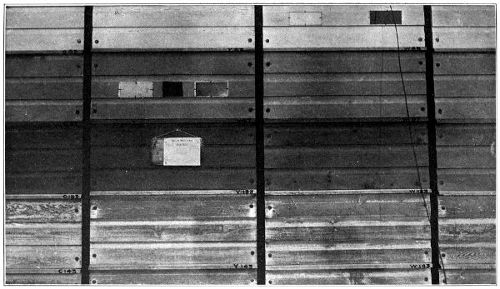
Panels on Atlantic City Fence Two Lower Sets of Panels are painted with Lithopone Paints. Rapid Failure shown
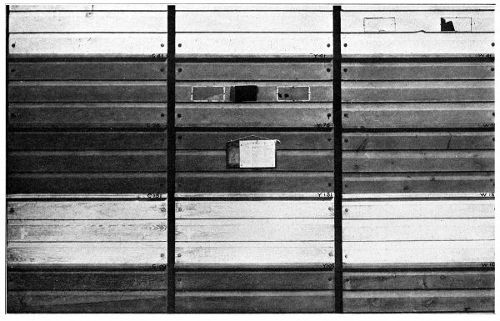
Panels on Atlantic City Fence
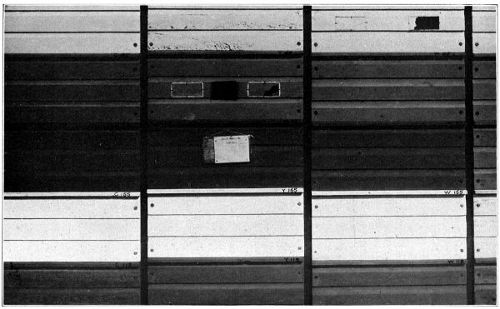
Panels on Atlantic City Fence Two Lower Sets of Panels are Painted with Combination Pigment Paints. Excellent Results shown
Paints Containing Lithopone. One of the most striking exhibitions of paint disintegration in the whole test was the failure of nearly all the lithopone formulas tested. At the time these formulas were suggested for the test, various European technical journals had advocated the use of lithopone in large percentage for paints to be used on exterior surfaces. Good results had been obtained in the northwestern section of Europe, with this pigment in certain mixtures, and the object of these lithopone tests at Atlantic City and Pittsburg was to determine whether satisfactory paints could be made of this pigment for exposure in this country. Failure of the tests, however, in nearly every case except where zinc oxide and whiting were mixed with the lithopone, indicated that pigments such as zinc and whiting are necessary in order to prevent the decomposition of lithopone pigment paints. The decay of lithopone paints after they are applied seems to start with rapid oxidation of the linseed oil, and this oxidation seems to continue in a progressive and even accelerated way; after six months’ exposure the surface of the paint being chalked to a great extent and showing rapid decomposition of the binder or vehicle. Inasmuch as lithopone is really an inert pigment, this rapid decomposition of its vehicle cannot be explained in the same way as the decomposition of the vehicle of pure white lead paints, where the alkaline nature of the lead is probably responsible for the formation of easily destroyed compounds. As complete failure had taken place in nearly every case where lithopone had been used, it was decided to condemn the lithopone panels on the fence, consisting of formulas 21 to 27, including panels 151 to 164 in white, panels 131 to 144 in yellow, and 109 to 122 in gray. These lithopone tests were later on replaced by new tests in 1909, which will be reported upon later in this book.
General Results. From these tests, the inspectors reached the unanimous conclusion that a paint made from any mixture of more than one white opaque pigment, either when used alone or in combination with small percentages of inert pigments, is far superior to any one single pigment paint. It was found that the straight white lead paints failed in every case, and this failure was so marked as to make it a conclusive demonstration of the unfitness of white lead along the Atlantic coast, when used without other pigments. Paints made with large percentages of white lead, however, gave excellent results.
Gypsum was found unsafe to use in any large proportion in a paint, because of its solubility and liability to percolate through the coating of linoxyn or dried film, thus destroying the surface of the paint. Whiting, or calcium carbonate, demonstrated that it could be used in moderate percentage with some efficiency, but it was evident that any great excess of this pigment must also be avoided on account of its tendency towards rapid chalking. Magnesium silicate, aluminum silicate, and silica are three inert pigments which proved to be of great value in strengthening and reinforcing paints, especially when they were used in small percentage. In the same way, black fixe and barytes, or barium sulphate, also appeared to be useful in strengthening a paint. As these two last named pigments are chemically the same but physically different, the use of both in a paint formula is considered advantageous, because of the differences in size and form of their particles.
Color Tests. It was the unanimous conclusion of all the inspectors that panels of all formulas which were tinted either gray or yellow were showing far superior wear and less chalking and checking than those which were painted in plain white. The reinforcing action of the tinting materials must be credited for this lengthening of the wear of such paints. Formulas 5, 6, 9, and 16, for instance, in the gray, were in most excellent condition, and in these formulas were used ochre, umber, bone-black, carbon-black, Venetian red and other inert bases. On the yellow panels, formulas 5, 6, 9, and 16 were also in very superior condition, and in these formulas chrome yellow and inert pigments were also used.
Some of the color tests included the priming of boards with white lead, zinc oxide, sublimed white lead, lithopone, and other single pigment paints. Over these priming coats was placed a high grade brilliant paranitraniline red. Fairly good results were obtained in every case, but especially when lithopone or zinc oxide was used as a priming base. These pigments seemed to have no effect upon the constitution of the para red.
Prussian blue, a colored pigment largely used, but one liable to react with certain paint pigments, was admixed with various paints applied to certain panels. This color was found in some cases to have faded materially, especially when mixed with alkaline pigments such as white lead. Sublimed white lead and zinc oxide, which are more inert in nature, did not have such action on Prussian blue, and the tinted bases of these pigments stood up in a remarkable manner. The greens which were tested were all in very good condition, with absence of fading, and showing only slight mildew.
Condensed Results of Inspection. The results of inspection as obtained by the fence committee[17] having in charge the inspection of the test, have been condensed into table form, and are presented on pages 130-131.
Second Annual Inspection of the Atlantic City Test Fence. After the original paints which had been applied to the Atlantic City Fence had been exposed for over two years, another inspection was made by a committee representing the Master Painters’ Association of Philadelphia and the Scientific Section of the Paint Manufacturers’ Association of the United States. A digest of the report of this committee[18] follows:
“The painted panels were all carefully inspected by the inspectors in the usual manner. With the aid of high-power magnifying glasses, checking was determined. The degree of chalking exhibited by the various paints was ascertained by rubbing a piece of black cloth across the surface of each paint. Close observance was made to determine scaling, peeling, cracking, gloss, color, and the other factors to be considered when examining a painted surface. From these observations it was possible for the inspectors to state whether a panel exhibited general good condition, general fair condition, or general poor condition.
CHART OF RESULTS—FIRST INSPECTION—ATLANTIC CITY TEST FENCE
For- mula No. Car- bon- ate Lead Zinc Ox- ide Sub- limed White Lead Zinc Lead White INERT PIGMENTS First Coat Sec- ond Coat Third Coat Aver- age Pa- nel No. Condition Hiding Power Color Hard- ness Checking Chalking Gloss Remarks
Calci- um Car- bon- ate Calci- um Sul- phate Mag- ne- sium Sili- cate Bari- um Sul- phate Silica Blanc Fixe
% % % % % % % % % %
1 30.0 70.0 610 987 664 754 1 Good Good Excellent 8 Very Slight High Like rubbed varnish work.
2 50.0 50.0 913 1066 948 976 3 Good Good Good 5 Hard Matt Moderate Med. High
3 20.0 50.0 20.0 10.0 912 914 786 871 5 Good Fair Good 4 Medium Slight
4 48.5 48.5 3.0 759 939 1047 915 7 Good Good Good 5 Very Slight Med. High
5 22.0 50.0 2.0 26.0 714 1000 709 808 9 Good Weak Good 8 1⁄2 Slight High Hard surface.
6 64.0 36.0 928 1189 863 993 11 Fairly Good Weak Good 8 Matt Good Surface rough.
7 37.0 63.0 763 972 891 875 13 Good Good Off Color 7 Slight High
8 38.0 48.0 14.0 786 910 767 821 15 Good Good Good 8 1⁄2 Slight High
9 73.0 2.0 25.0 716 1081 812 870 17 Fair Poor Good 9 Heavy Matt Medium High Peeling started.
10 44.0 46.0 5.0 5.0 861 1014 862 912 19 Good Fair Good 5 Some Med. High
11 50.0 50.0 822 959 918 900 21 Good Good Excellent 7 1⁄2 Med. Matt Some Med. High Some washing and discoloration.
12 60.0 34.0 6% Inert Pigments 862 965 734 854 23 Good Medium Good 4 Heavy Matt Bad Medium
13 27.0 60.0 3.0 10.0 916 1031 1121 1073 25 Good Good Good 4 Medium Fair
14 25.0 25.0 20.0 5.0 25.0 564 806 785 718 27 Bad Medium Good 5 Evident Some Medium Dead, spongy, surface. White incrustations.
15 20.0 40.0 30.0 10.0 935 1044 1359 1113 29 Good Medium Good 8 1⁄2 Coarse Matt Slight High
16 33.0 33.0 34.0 799 903 994 899 31 Fair Fair Good 7 1⁄2 Bad Slight Good White incrustations.
17 40.0 40.0 3.0 13.0 4.0 806 1016 884 902 33 Good Fair Good 4 Some Fair
18 75.0 25.0 788 1257 973 1006 145 Good Good Excellent 3 Hard Matt Moderate Medium
19 25.0 75.0 700 1183 1400 1094 147 Good Good Excellent 2 Hard Matt Slight Very Little
20 67.0 19.5 10.0 3.5 776 1063 877 905 149 Good Good Good 5 Very Little Medium
33 15.0 30.0 25.0 30.0 512 836 689 679 176 Fair Good Rough surface.
34 38.9 5 33.5 8 4.8 1 19.4 8 3.1 8 523 800 810 711 175 Good Medium Good 4 Evident Slight Egg Shell
35 37.5 1 25.8 7 7.8 4 20.3 6 8.4 2 450 893 724 689 180 Good Good Good 4 Matt Egg Shell
36 100.0 408 711 861 660 181 Bad Good Good 1 Very Apparent Bad Egg Shell Same as 177, but checking not so bad.
37 100.0 524 1065 828 806 182 Bad Good Good 1 Very Apparent Bad Egg Shell Same as 177 but wood shows more plainly.
38 100.0 555 888 794 746 177 Bad Good Good 1 Bad Bad Egg Shell Cracking and perishing evident.
39 100.0 550 941 916 802 178 Good Fair Good 6 Some Good
40 100.0 643 810 998 817 168 Good Good Good 2 Considerable Egg Shell
45 100.0 850 170 Fair Fair Good 9 Very Evident High
46 61.0 39.0 783 169 Fair Good Good 9 Some Good
47 100.0 730 172 Good Good 10 Apparent Good Indication of scaling.
“An inspection of the white lead paints on the fence indicated in every instance a rough, chalked, and disintegrated surface that seemed to be well worn, in some cases nearly to the wood. The strongly oxidizing air of the seacoast is probably responsible for the early decay of this pigment.
“It was observed that the combination type of paint showed better hiding power than white lead, over the black crosses placed on the priming coat of each panel, as a hiding power test.
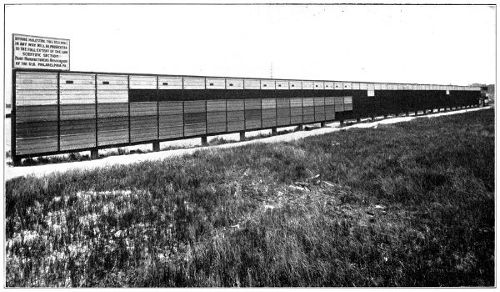
Front of Fence showing Present Rearrangement of Panels
TESTS INAUGURATED IN 1907 CHART OF RESULTS OF SECOND ANNUAL INSPECTION OF ATLANTIC CITY TEST FENCE, MAY, 1910
FORMULAS REPORT OF INSPECTION Pan- el Num- ber
For- mu- la Num- ber Basic Car- bon- ate White Lead Zinc Ox- ide Basic Sul- phate White Lead Zin Lead White inert pigments
Calci- um Car- bon- ate Calci- um Sul- phate Mag- ne- sium Sili- cate Bari- um Sul- phate Silica Blanc Fixe
CHALKING CHECKING GENERAL CONDITION REMARKS
% % % % % % % % % %
1 30 70 — — — — — — — — Very slight Very slight Good 1
2 50 50 — — — — — — — — Medium Slight Very good 3
3 20 50 20 — 10 — — — — — Medium Slight Good 5
4 48 .5 48 .5 — — 3 .0 — — — — — Very slight Slight Good 7
5 22 50 — — 2 — 26 — — — Slight Slight Good 9
6 — 64 — — — — — 36 — — Very slight Slight Good 11
7 37 63 — — — — — — — — Medium Slight Good 13
8 38 48 — — — — — — 14 — Slight Very slight Good 15
9 — 73 — — 2 — — — 25 — Very bad Deep, with scaling Poor 17
10 44 46 — — 5 — 5 — — — Heavy Deep Medium 19
11 50 50 — — — — — — — — Medium Medium Fair 21
12 60 34 — — — 6% Inert Pigment — Medium Deep Fair 23
13 — 27 60 — 3 — 10 — — — Medium Slight Very good 25
14 25 25 20 — 5 25 — — — — Medium Lateral Fair 27
15 20 40 — 30 10 — — — — — Slight Visible with naked eye Poor 29
16 33 33 — — — — — 34 — — Slight Slight Good 31
17 40 40 — — — — 3 13 — 4 Medium Slight Good 33
18 75 25 — — — — — — — — Medium Slight Very good 145
19 — 25 75 — — — — — — — Considerable Deep Good 147
20 67 .0 19 .5 — — 10 .0 — 3 .5 — — — Medium Slight Good 149
33 15 30 25 — — — — — 30 — Medium Slight Very good 176
34 38 .95 33 .58 4 .81 — 19 .48 — — 1 .59 1 .59 — Slight Slight lateral Good 175
35 37 .51 25 .87 7 .84 — 20 .36 — — 4 .21 4 .21 — Slight Lateral Good 180
36 100 — — — — — — — — — Considerable Heavy Fair Rough surface 181
37 100 — — — — — — — — — Considerable Heavy and deep Poor Rough surface 182
38 100 — — — — — — — — — More than Panel no. 182 Very deep Poor 177
39 — — — 100 — — — — — — Considerable Very slight Good 178
40 — — 100 — — — — — — — Heavy Slight Good 168
45 — 90 — — 10 — — — — — Slight Slight Good 170
46 — 61 — — — — — 39 — — Slight Medium Fair 169
47 — 100 — — — — — — — — None Very deep Poor 172
“There are no pigments possessing greater hiding properties when first used than white leads, but the lack of hiding power on the white lead panels after two years’ exposure was caused by the chalking away of the lead. The superior hiding power of the composite paints was due to the action of the other pigments in these combination paints in preventing the lead from chalking away.
“The Committee finds that the addition of a reasonable percentage of zinc oxide to white lead increases its durability and retards its chalking, renders it whiter, and forms a surface that presents a much better repainting condition. The combinations of white lead and zinc oxide on the Atlantic City Test Fence were in general good condition throughout.
“Corroded white lead, sublimed white lead, zinc oxide, and zinc lead are the standard white opaque pigments. They were all tested on the Atlantic City Fence and it was found that to use any one alone results in inferior protection to the wood. Barium sulphate, silica, asbestine, china clay, and calcium carbonate are the standard crystalline pigments. In the past, the overloading of paints with these crystalline or inert pigments has been the cause of the prejudice that painters have had against their use. It has been established beyond controversy, however, that the use of these pigments, in moderate percentage, combined with any of the standard opaque white pigments, such as white leads, zinc oxide, etc., undoubtedly results in better service from every standpoint and forms the most satisfactory white paint for general outside use. Some of the most perfect painted surfaces on the fence were those made on the above basis as reference to the charted report will show.”