Chapter XVII
Reading edition
THE SANITARY VALUE OF WALL PAINTS
Decoration and Sanitation. The proper decoration of the interior of dwellings and public buildings has become of even greater importance than the protection and decoration of exteriors. There is, moreover, an increasing demand for harmonious effects and the production of more sanitary conditions than have prevailed in the past. Up until a few years ago a great variety of wall papers of more or less pleasing appearance were almost exclusively used for the decoration of walls in the interior of buildings, and their application was commonly considered the most effective means of wall decoration. There seems to be no question, however, that the use of wall paper is steadily decreasing, and that the art of interior decoration is undergoing a transition to the almost universal use of paint.
Modern progress demands the maintenance of sanitary conditions for the benefit of the public welfare, and there is no doubt that from the standpoint of sanitation and hygiene, properly painted wall surfaces are far superior to papered walls. There is an abundance of evidence which shows that dust germs may easily be harbored, and thus disease transmitted from wall paper. In the tenement houses, which are common to the larger cities, and to a lesser extent in the dwellings found in smaller communities, where tenants are more or less transient, the continued maintenance of sanitary conditions presents a difficult problem. Infectious and epidemic illnesses generally leave behind bacilli of different types, which may find a culture medium in the fibrous and porous surfaces presented by wall paper, backed up as they invariably must be by starch, casein, or other organic pastes. Occasionally the restrictions of local boards of health provide in such events for proper fumigation, but too often no precautions are taken to destroy the disease germs which are caught in the dust which collects on wall paper. As a rule, both tenant and landlord are oblivious to all conditions which cannot be readily seen or detected. Burning sulphur, one of the most effective means of fumigation, will generally cause bleaching and consequent fading of the delicate colors used in printing the designs upon wall paper. Washing of the paper with antiseptic solutions will destroy its adhesiveness to the plaster and often cause bulging and general destruction.
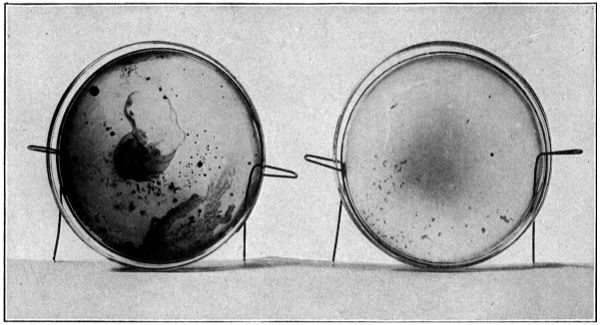
Heavy Colonies of Bacteria Developing in Agar Jelly Treated with Washings from Wall Paper Practically no Development of Bacterial Colonies in Agar Jelly Treated with Washings from Sanitary Wall Paint
Hospital Practice. In hospitals, where it is necessary to maintain sanitary conditions, the walls are invariably painted, and requirements should demand the use of paints which can be washed frequently, so that there will be no possibility of uncleanliness. Inquiry made of a prominent surgeon[38] connected with one of the large metropolitan hospitals substantiated the writer’s findings regarding the greater sanitary value of wall paints, and brought forth the information that in hospitals under construction provision had been made for the finishing of walls so that a hard, non-absorbent, and washable surface might be obtained. The same authority stated that the common practice, in apartments and tenements, of covering the old wall paper over with a layer of new each time a tenant moved in, should be condemned, and that from a hygienic standpoint the use of sanitary wall paints should be advocated in all dwellings as well as public buildings.
If such conditions are maintained in hospitals, where special attention is paid to sanitation, it would appear that similar precautions should be equally as necessary in public buildings and in dwellings—wherever, in fact, people congregate or live.
Sanitary Wall Paints. There have recently appeared in trade a number of wall paints composed of non-poisonous pigments ground in paint vehicles having valuable waterproofing and binding properties, and of a nature to produce the flat or semi-flat finish that has become so popular. Such paints produce a sanitary, waterproof surface, which permits of frequent washing. By their use it is possible to secure a more permanent and a wider range of tints than can be obtained with wall paper, as they are produced in a myriad of shades, tints and solid colors, from which any desired combination may be selected. On the border or on the body of walls decorated with such paints, attractive stencil designs, which bring out in relief the color combinations, may be applied.
For the decoration of chambers and living rooms, delicate French grays, light buffs, cream tints and ivory whites may be used, while in the library and other rooms richer and more solid colors, such as greens, reds, and blues, may be harmoniously combined.
Defects of Wall Paper. It recently occurred to the writer to investigate the conditions which obtain in many apartment houses in the larger cities. Inspection of a number of such places, in which wall paper had been exclusively used on the walls, showed generally bad conditions; bulging of the surfaces, caused by dampness in the walls, which had loosened up the binder, as well as peeling and dropping of the paper from the ceilings, were frequently observed. In many cases a shabby appearance was shown, accompanied by an odor which suggested decomposition of the paste binder used on the paper. The writer was impressed with the fact that such conditions could easily be avoided by the very simple expedient of using properly manufactured wall paints, which are so easily made dustproof and waterproof.
Samples of wall paper, which had been applied to plastered walls for a year or more, were obtained, and examination under the microscope showed a most uncleanly surface. Cultures were made of these samples, and bacilli of different types were developed in the culture medium in a short time.
Experimental Evidence. That the above conditions could not have existed, had proper wall paints been used, seemed doubtless, and suggested a carefully conducted experiment to prove the relative sanitary values of wall paper and wall paints. A large sheet of fibre board, such as is occasionally used to replace plastered walls, was painted on one side with a high-grade wall paint, three-coat work. A similar sheet was papered on one side with a clean, new wall paper. These test panels were placed where unsanitary conditions, such as dampness, foul odors, and a scarcity of air were present. After a short period of exposure, the panels were taken to the bacteriological laboratory and a small section of the painted surface, about two inches square, as well as a small section of the papered surface of similar size, were removed and used for making cultures. In each case the surface of the section under test was washed with 100 c.c. of distilled, sterilized water. The washings which dripped from the surface were collected in a graduated flask. One c.c. of the washings was used in each case, admixed with bouillon and again with agar-agar. The enormous development of bacteria in the bouillon, treated with the washings from the wall-papered surface, was sufficient evidence to convince one of the greater sanitary value of the wall paint, the washings from which gave a culture practically free from bacteria. The colonies of bacteria shown in the petri-dish test made of the washings from wall paper further supports these findings. It will be noticed that the tests made from the washings of the wall paint show practical absence of bacteria, and was clear, as was the bouillon-solution test of the paint. The washings from the wall paper showed active development of bacteria, both in the bouillon and agar tests.
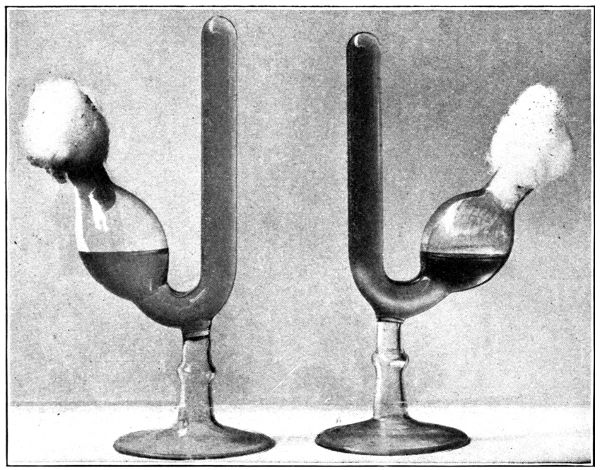
Development of Bacteria in Bouillon Solutions
Note Practical Freedom of Bacteria in Clear Bouillon Solution Treated with Washings from Sanitary Wall Paint Note Milky Appearance of Solution Due to Heavy Development of Bacteria in Bouillon Treated with Washings from Wall Paper
From the Conservation Standpoint: It would be of interest to sum up in figures the acreage and cordage of wood that annually is transformed into pulp for the manufacture of wall paper. Unfortunately, there are no available statistics on this subject. It is clear, however, that from the standpoint of conservation the use of wall paints should take precedence over the use of wall paper.