Woodcroft.
Reading edition
Woodcroft to be sold!—like a knell of doom the words fell on our ears—it could not be! Our dear old home, the only one we children had ever known, to be taken from us. We sat in the bright little sitting-room, blankly looking at one another, in dumb astonishment. Louise, who was always the thoughtful one, soon roused herself from the stupor which seemed to have come upon us all, and going over to the lounge, began comforting—as best she could, poor child—our gentle little mother, upon whom this blow had fallen most heavily. Presently she sat up, and in trembling tones told us, as we clustered at her knee, the particulars of our misfortune.
There were three of us—Louise, Cal and I, who rejoiced in the quaint cognomen of Pen, named for a rich, eccentric, old aunt, who had never left me any money because she never died.
“Now, Marmo, out with all the trouble and let us share it,” said matter-of-fact Cal. And then she told how, after papa’s sudden death a year before, she had discovered a mortgage to be on the place, small, but now due and no money to meet it; the creditor was pressing, and the home to be sold. We felt sad, but cheered her up, and talked over ways and means as never before.
“Even though he consents to renew it, where would the yearly interest money come from,” she wailed.
We urged her to lie down and rest, and, following Cal’s beckoning finger, tip-toed out of the room.
“Now, girls,” said she, “something’s got to be done, and we’ve got to do it.”
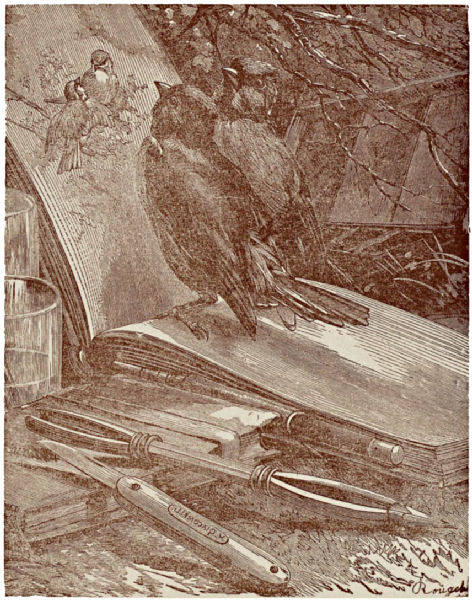
“A TRIBUTE TO YOUR GENIUS, LOU,” SAID I. “LIKE THE FAMOUS ARTIST OF OLD, WHO PAINTED CHERRIES SO NATURALLY, THE BIRDS FLEW DOWN AND PECKED AT THE CANVAS.”
One thing after another was proposed and rejected; we knew, if the home were sold, after the demands were met, there would be but a mere pittance left for four females to live on. Finally I broke in:
“Girls, my brain is not usually fertile, but a thought has been growing—we are all well educated, but teaching is out of the question, the supply is greater than the demand, but Lou, here, is skilled with pencil and brush, and Cal has a genius for contrivance; now why could you not paint and decorate some of the dainty trifles you often make as gifts, and sell them. I always did have a notion for cookery, which I shall proceed to put in practice, dismissing the servants.” Having delivered this little speech, I paused, breathless.
Cal clapped her hands, and Lou’s brown eyes glowed. “Pen, you little duck,” and Cal pounced on me in an excess of joy.
“But,” faltered Lou, “the mortgage.”
“I thought of that too—our lady-like Louise shall go to that crusty old creditor, and beg him to renew it, and with what you girls earn and what we save from the rent of the farm land (for we must live economically) we will pay him the interest promptly.” I will add, that she did that very thing, and completely won over the hard-hearted fellow with her sweet, earnest manner.
So to work we went, and the sitting-room was converted into a studio, littered with papers, books, gay ribbons and glue-pots. But some exquisite creations came out of that chaos. I had visited the aforesaid Aunt Pen the previous winter, in New York city, and at the American Specialty House had been enchanted with the many novel and beautiful pieces of decorated work. All would be entirely new in this part of the world, and our idea was, to take orders from the near towns for their Holiday trade. It was now only May and we would have plenty of time. Cal, who, with her brusque, honest ways, determined face, and curly, short hair, was our man of business, took samples of our work in to the various towns, receiving large orders in almost every instance.
Happy and busy as bees we worked, and began to feel quite important, as the pile grew high, of white boxes, filled with delicate satin souvenirs for wedding and birthdays, Christmas tokens of lovely design, little poems with dainty painted covers, blotters and thought books, beautifully decorated, all of which found ready sale. The little mother’s sad eyes began to brighten, and Cal would say:
“Marmo, we can take care of you almost as good as sons, can’t we?”
“God bless my daughters,” would be the reply.
Louise had established her studio under the old apple-tree one warm June day, and, running out to call her to lunch, I found she had gone down in the garden, but I saw the cutest, prettiest sight! I beckoned her to come softly. There, on her sketch-book, opened against the tree, and on which was a half-finished painting of birds, hopped around two brown sparrows, peeping and twittering as contentedly as possible. It was too cunning! as though they had recognized their portraits and felt at home.
“A tribute to your genius, Lou,” said I. “Like the famous artist of old, who painted cherries so naturally, the birds flew down and pecked at the canvas.”
“I fear I shall have to dispel the illusion, dear. I guess they were more eager to pick up some cake crumbs I left than to admire my work.”
Readers, you will be glad to know that the girls’ work continued successful, and that the “crusty old creditor” turned out a good friend, from sheer admiration of their pluck and courage.