PLANTS THAT EAT.
Reading edition
These plants are so constructed as to attract insects, capture them in various ways, and feed upon them. Perhaps the best known of the group is Venus’ Fly-Trap. The leaves vary from one to six inches long, and at the extremities are placed two blades, or claspers. On the inner walls of these claspers are placed six irritable hairs; the slightest touch from an insect on any one of which is sufficient to bring the two blades together with such rapidity as to preclude any possibility of the fly escaping.
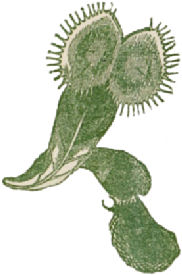
LEAVES OF THE FLY-TRAP OPENED AND CLOSED.
This plant readily discriminates between animal and other matter; thus, if a small stone or piece of wood be dropped into the trap, it will instantly close, but as soon as it has found out its mistake—and it only takes a few minutes—it begins to unfold its trap, and the piece of wood or stone falls out. On the other hand, should a piece of beef or a bluebottle fly be placed in it, it will remain firmly closed until all the matter is absorbed through the leaf. It will then unfold itself, and is ready for another meal.
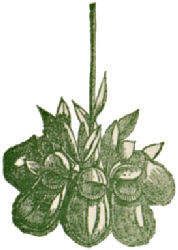
AUSTRALIAN PITCHER PLANT.
Another species is called the Vegetable Whiskey Shop, as it captures its victims by intoxication. The entire shop is shaped after the manner of a house, with the entrance projecting a little over the rim. Half-way round the brim of the cavity there are an immense number of honey glands, which the influence of the sun brings into active operation. This sweet acts as a lure to passing insects, and they are sure to alight on the outside edge and tap the nectar.
They, however, remain there but a brief period, as there is something more substantial inside the cavity in the shape of an intoxicating liquid, which is distilled by the plant. The way down to this beverage is straight, as the entrance is paved with innumerable fine hairs, all pointing to the bottom, and should the fly walk crooked its feet become entangled in them.
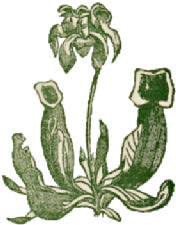
AMERICAN SIDE-SADDLE FLOWER.
When the fly has had its first sip, it does not stop and fly right out, as it could do, but it indulges until it comes staggering up and reaches that portion where the hairs begin; here its progress outward is stopped, owing to the points of the hairs being placed against it. The fly is now in a pitiable plight; it attempts to use its wings, but in doing so only hasten its destruction. It inevitably gets immersed in the liquid, and dies drunk.
Australian Pitcher Plant is a beautiful little object. Its pitchers are at the bottom of the principal stem of the plant.
One species distils an intoxicant of its own; but owing to its small orifice, it excludes the majority of insects, and admits but a select few. The individual pitchers somewhat resemble an inverted parrot’s bill, with a narrow leaf-like expansion running along the top. The color is light green, beautifully shaded with crimson. The inside of the pitcher is divided into three parts: The first, nearest the entrance, is studded with minute honey glands, and is called the attractive surface; a little farther down the inside, very minute hairs are situated with their extremities all pointing to the other chamber. This is the conducting surface.
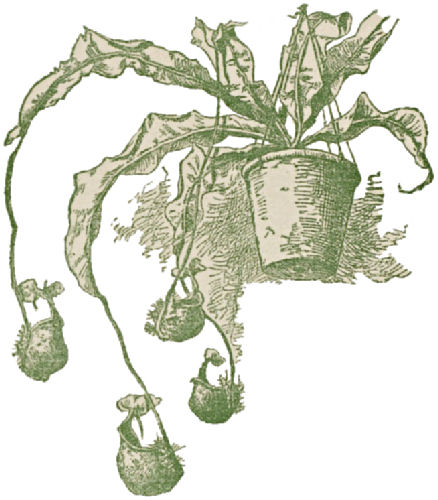
THE PITCHER PLANT OF MADAGASCAR.
Lastly, the small hairs give place to the longer ones, amid which are placed secreting pores, which give forth the intoxicating nectar. This is termed the detentive surface. When the pitcher has caught a sufficient number of insects, the nectar gives place to a substance which enables the plant more readily to digest its food.
Another variety is the Mosquito Catcher. It grows about one foot high, and the leaves, after reaching a certain height, divide into long, narrow spathes, covered with hairs, each coated with a bright gummy substance. This, during sunshine, gives to the plant a most magnificent appearance. If a plant be placed in a room where mosquitoes abound, all the troublesome pests will in a brief period be in its steady embrace.
It is most interesting to watch the method by which it secures its prey. Immediately the fly alights on the leaf, it may be that only one of its six legs stick to the sweet, viscid substance at the extremity of the hairs; but in struggling to free itself, it invariably touches with its legs or wings the contiguous hairs, and is immediately fixed.
These little hairs meantime are not idle; they slowly but surely curl round and draw their victim into the very center of the leaf, thus bringing it into contact with the very short hairs, which are placed there in order to facilitate the process of sucking the life-blood from the body.