EARTHEN VESSELS.
Reading edition
Spring time had come, with its blossoms and birds; and Mrs. Rossiter threw up the sash of the east window, and pushed open the blinds, and drew a long deep breath of morning air, and morning sunshine.
“I think, Bridget,” she said, “that we might venture to bring the house-plants out-doors to-day. There can hardly be another frost, this year.”
“Oh! may I help?” asked little Charley, “I’ll be very careful.”
“On that condition, that you be very careful, you may bring the little ones,” answered his mother.
The work progressed safely and rapidly for awhile. Geraniums, roses, fuchsias, heliotropes, and so following, came forth in profusion, many in bloom, and were placed in rows along the garden borders, ready to be transferred to the beds, for the summer. At last the little ones were all brought by Charley, and only larger ones remained.
“I’ll carry just this one big one,” he said to himself: “I’m stronger than mother thinks I am.” But the pot full of earth, was heavier than Charley had thought it, and before he reached the place to set it down it had grown very heavy indeed; and, glad to get it out of his aching arms as quickly as possible, he placed it on the curb so suddenly, that with a loud crash it parted in the middle and lay in pieces at his feet. Glancing quickly at his mother and seeing in her face impending reproach, he forestalled it by exclaiming:
“Well, that pot broke itself very easily. What’s it made of, any how?”
The mother couldn’t help but smile at this attempted shifting of the blame to the pot, but she answered, in a moment, gravely:
“The pot, Charley, was made of clay; the same weak material from which little boys are made; who, when they forget to obey their mothers, are as likely to meet disaster as the earthen pot.”
Charley didn’t care just then to discuss disobedient boys, so he turned at once to the subject of the pot.
“Made of clay,” he exclaimed, “well, I’d like to see a man make a thing like that of clay.”
“And so would I,” said sister Mary, who, from an upper window, had listened to the conversation.
“And so you shall, if I have no further reminders of this sort, that my children are made of the same unreliable material.”
That afternoon, the three, started for the pottery works. Mr. Sands, the proprietor, kindly received them, and fully explained all his processes. First he pointed out what seemed to Charley a heap of dry hard common dirt; taking a little piece of this he dipped it into a basin of water and then squeezing and pressing it in his hand it soon became soft, and plastic, so that it could be wrought to any shape. He then led the party to another room where a young man was engaged in thus softening large masses. He would first crumble the hard earth into fine pieces; then wet and pack it together into a “loaf,” so Charley called it, and then raising it over his head throw it again with all his might upon the table before him until it became soft and smooth through all its bulk. This, Mr. Sands said, was called “wedging the clay,” and that it was now ready for “throwing” into shape.
“Will it come into shape if you just throw it?” said Charley.
Mr. Sands laughed heartily at this, and answered, “come and see;” and taking up one of the softened “loaves,” to use Charley’s word for them, he led the way to the next room. The young man who had been “wedging” now followed and placed himself at a large wheel which was connected by a strap or belt with a table at which Mr. Sands seated himself.
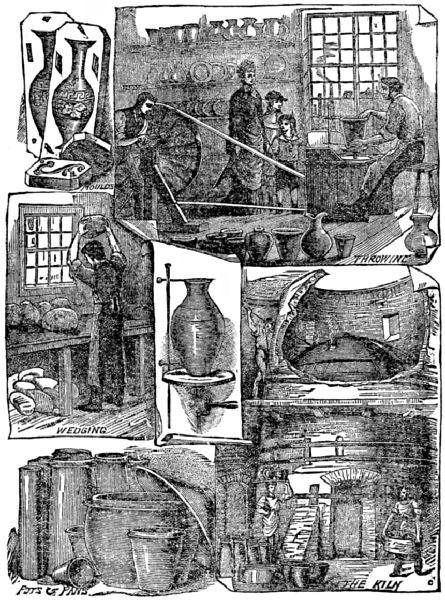
HOW POTS AND PANS ARE MADE.
Upon the table was another little table, round and low, and upon this Mr. Sands placed his “loaf.” Then the young man began to turn the wheel and the loaf began to spin round very rapidly. Mr. Sands next pressed his finger right through the middle of the clay, so farming the hole which we always see at the bottom of flower-pots. Then, as it spun round, he worked the clay gradually upwards and sloped it outwards, using both hands, and holding the edges with his fingers and thumbs.
Before Charley could express his surprise, the little roll of clay was changed into a flower-pot. With a square iron tool called a rib it was smoothed outside, and then the pot was lifted on a board. One after another followed till a long row was ready and they were carried off to be dried.
“How do you know when to leave off stretching it?” asked Mary of the potter.
He laughed, and pointed to a small iron gauge on the table. As soon as the pot reached this he knew he must leave off stretching it out. This iron is of course put higher or lower according to the size required.
“Now I’ll make you a pitcher, missie,” said the good-natured man, and with the same kind of clay, just rounding it a bit and giving a cunning little pinch to form the spout, he made quite a pretty jug.
“Where’s the handle?” asked Charley.
“Oh, that can’t go on yet, sir! We must wait till the jug is dry, for we could not press it tight enough to make it stick.”
Bread-pans and washing-pans are made in exactly the same way as flower-pots, being moulded by the hand into different forms. When the pots and pans leave the potter’s wheel they are taken, as we saw, to dry, and great care is required to keep them at a certain heat, for if the frost gets to them now they crack and are useless.
“Here’s a comical little pot!” exclaimed Charley, holding up a wee one.
“We call them long Toms,” said Mr. Sands. “They are mostly used by nursery-gardeners, because they take so little room.”
“How long do they take to dry?” asked Mary, looking longingly at her little jug.
“About a day; so we will leave your jug with the others, and go to the kiln to see how they will be burnt to-morrow.”
The kiln was round, with a big doorway, called a wicket.
The pots and pans are put inside, great care being taken that they should not touch each other, or they would stick like loaves of bread. Pans are first glazed with a mixture of blue or red lead. The fire is burning below, and there are holes to allow the flames to pass upwards amongst the pottery. When the kiln is full the wicket is bricked up and daubed over with road-mud.
“Fancy using such dirty stuff!” said Mary.
“The manure in it makes it stick, just as hair does in mortar. Clay would crack with the heat. So you see, dear, there’s nothing so dirty or so common that it may not be of some use in the world.”
“How do you know when they are cooked enough?” asked Charley.
“I’ll show you,” said Mr. Sands, and he immediately led us to a small door, which opened some way up the kiln.
“This is called the crown,” said Mr. Sands.
It was a flat surface, with four holes which showed the red heat below, and looked like little volcanoes in a good temper.
“Do you see those iron rods hanging like walking-sticks in the furnace?” asked our guide. “Well, those are called trials, and at the end of each is a lump of clay and glaze. If the glaze is burnt enough we suppose that the whole batch is done, but we sometimes make a mistake and spoil a lot.”
“What is done next?” asked Charley.
“If they are properly burnt, they are allowed to cool gradually, and are then ready for sale.”
By this time all were pretty well tired, and so they said good morning to Mr. Sands and went home.
“Mother,” said Charley, as they sat down to dinner, “I shall ask how it’s done oftener than ever, now, for I like going over factories. What’s to be the next one, I wonder.”
“Bread,” exclaimed Mary, as she cut a big slice for herself. “Shall it be bread, mother?”
“Yes, if you like, but I propose we go to see the flour made first. So the next place we explore will be a flour-mill.”
E. M. W.