"Being a Popular Description of Singular Races of Man" (continued 8)
Reading edition
Their habitual dwelling-place is upon the shore. They rarely penetrate the thick forests of the interior, where there is nothing to tempt them: for the wild hog, to which they sometimes give chase, is found only along the coasts where the forest is thinner and more straggling, or among the mangrove-bushes,—on the fruits of which these animals feed. Strange to say, the forest, though luxuriant in species, affords but few trees that bear edible fruits. The cocoa-palm—abundant in all other parts of the East-Indian territories, and even upon the Cocos Islands, that lie a little north of the Andamans—does not grow upon these mountain islands. Since the savages know nothing of cultivation, of course their dependence upon a vegetable diet would be exceedingly precarious. A few fruits and roots are eaten by them. The pandanus, above mentioned, bears a fine cone-shaped fruit, often weighing between thirty and forty pounds; and this, under the name of mellori, or “Nicobar breadfruit,” forms part of their food. But it requires a process of cooking, which, being quite unknown to the Andamaners, must make it to them a “bitter fruit” even when roasted in the ashes of their fires, which is their mode of preparing it. They eat also the fruit of the mangrove, and of some other trees—but these are not obtainable at all seasons, or in such quantity as to afford them a subsistence. They depend principally upon fish, which they broil in a primitive manner over a gridiron of bamboos, sometimes not waiting till they are half done. They especially subsist upon shell-fish, several kinds abounding on their coasts, which they obtain among the rocks after the tide has gone out. To gather these is the work of the women, while the men employ themselves in fishing or in the chase of the wild hog. The species of shell-fish most common are the murex tribulus, trochus telescopium, cypraea caurica, and mussels. They are dexterous in capturing other fish with their darts, which they strike down upon the finny prey, either from their rafts, or by wading up to their knees in the water. They also take fish by torchlight,—that is, by kindling dry grass, the blaze of which attracts certain species into the shallow water, where the fishers stand in wait for them.
When the fishery fails them, and the oysters and muscles become scarce, they are often driven to sad extremities, and will then eat anything that will sustain life,—lizards, insects, worms,—perhaps even human flesh. They are not unfrequently in such straits; and instances are recorded, where they have been found lying upon the shore in the last stages of starvation.
An instance of this kind is related in connection with the convict settlement of 1793. A coasting-party one day discovered two Andamaners lying upon the beach. They were at first believed to be dead, but as it proved, they were only debilitated from hunger: being then in the very last stages of famine. They were an old man and a boy; and having been carried at once to the fort, every means that humanity could suggest was used to recover them. With the boy this result was accomplished; but the old man could not be restored: his strength was too far gone; and he died, shortly after being brought to the settlement.
Two women or young girls were also found far gone with hunger; so far, that a piece of fish held out was sufficient to allure them into the presence of a boat’s crew that had landed on the shore. They were taken on board the ship, and treated with the utmost humanity. In a short time they got rid of all fears of violence being offered them; but seemed, at the same time, to be sensible of modesty to a great degree. They had a small apartment allotted to them; and though they could hardly have had any real cause for apprehension, yet it was remarked that the two never went to sleep at the same time: one always kept watch while the other slept! When time made them more familiar with the good intentions towards them, they became exceedingly cheerful, chattered with freedom, and were amused above all things at the sight of their own persons in a mirror. They allowed clothes to be put on them; but took them off again, whenever they thought they were not watched, and threw them away as a useless encumbrance! They were fond of singing; sometimes in a melancholy recitative, and sometimes in a lively key; and they often gave exhibitions of dancing around the deck, in the fashion peculiar to the Andamans. They would not drink either wine or any spirituous liquor; but were immoderately fond of fish and sugar. They also ate rice when it was offered to them. They remained, or rather were retained, several weeks on board the ship; and had become so smooth and plump, under the liberal diet they indulged in, that they were scarce recognisable as the half-starved creatures that had been brought aboard so recently. It was evident, however, that they were not contented. Liberty, even with starvation allied to it, appeared sweeter to them than captivity in the midst of luxury and ease. The result proved that this sentiment was no stranger to them: for one night, when all but the watchman were asleep, they stole silently through the captain’s cabin, jumped out of the stern windows into the sea, and swam to an island full half a mile distant from the ship! It was thought idle to pursue them; but, indeed, there was no intention of doing so. The object was to retain them by kindness, and try what effect might thus be produced on their wild companions, when they should return to them. Strange to say, this mode of dealing with the Andaman islanders has been made repeatedly, and always with the same fruitless result. Whatever may have been the original cause that interrupted their intercourse with the rest of mankind, they seem determined that this intercourse shall never be renewed.
When plenty reigns among them, and there has been a good take of fish, they act like other starved wretches; and yield themselves up to feasting and gorging, till not a morsel remains. At such times they give way to excessive mirth,—dancing for hours together, and chattering all the while like as many apes.
They are extremely fond of “tripping it on the light fantastic toe;” and their dance is peculiar. It is carried on by the dancers forming a ring, and leaping about, each at intervals saluting his own posteriors with a slap from his foot,—a feat which both the men and women perform with great dexterity. Not unfrequently this mode of salutation is passed from one to the other, around the the whole ring,—causing unbounded merriment among the spectators.
Their fashion of dress is, perhaps, the most peculiar of all known costumes. As to clothing, they care nothing about it,—the females only wearing a sort of narrow fringe around the waist,—not from motives of modesty, but simply as an ornament; and in this scant garment we have a resemblance to the liku of the Feegeeans. It can hardly be said, however, that either men or women go entirely naked; for each morning, after rising from his couch of leaves, the Andamaner plasters the whole of his body with a thick coat of mud, which he wears throughout the day. Wherever this cracks from getting dry by the sun, the place is patched or mended up with a fresh layer. The black mop upon his head is not permitted to wear its natural hue; but, as already mentioned, is coloured by means of a red ochreous earth, which is found in plenty upon the islands. This reddening of his poll is the only attempt which the Andamaner makes at personal adornment; for his livery of mud is assumed for a purpose of utility,—to protect his body from the numerous mosquitoes, and other biting insects, whose myriads infest the lowland coast upon which he dwells.
A startling peculiarity of these islanders is the unmitigated hostility which they exhibit, and have always exhibited, towards every people with whom they have, come in contact. It is not the white man alone whom they hate and harass; but they also murder the Malay, whose skin is almost as dark as their own. This would seem to contradict the hypothesis of a tradition of hostility preserved amongst them, and directed against white men who enslaved their ancestors; but, indeed, that story has been sufficiently refuted. A far more probable cause of their universal hatred is, that, at some period of their history, they have been grossly abused; so much so as to render suspicion and treachery almost an instinct of their nature.
In these very characteristic moral features we find another of those striking analogies that would seem to connect them with the negrillo races of the Eastern Archipelago; but, whether they are or are not connected with them, their appearance upon the Andaman is no greater mystery, than the solitary “fox-wolf” on the Falkland Islands, or the smallest wingless insect in some lone islet of the Ocean?
Chapter Seventeen.
The Patagonian Giants.
Who has not heard of the giants of Patagonia? From the days of Magellan, when they were first seen, many a tale has been told, and many a speculation indulged in about these colossal men: some representing them as very Titans, of twelve feet in height, and stout in proportion: that, when standing a little astride, an ordinary-sized man could pass between their legs without even stooping his head! So talked the early navigators of the Great South Sea.
Since the time when these people were first seen by Europeans, up to the present hour,—in all, three hundred and thirty years ago,—it is astonishing how little has been added to our knowledge of them; the more so, that almost every voyager who has since passed through the Straits of Magellan, has had some intercourse with them;—the more so, that Spanish people have had settlements on the confines of their country; and one—an unsuccessful one, however—in the very heart of it! But these Spanish settlements have all decayed, or are fast decaying; and when the Spanish race disappears from America,—which sooner or later it will most certainly do,—it will leave behind it a greater paucity of monumental record, than perhaps any civilised nation ever before transmitted to posterity.
Little, however, as we have learnt about the customs of the Patagonian people, we have at least obtained a more definite idea of their height. They have been measured. The twelve-feet giants can no longer be found; they never existed, except in the fertile imaginations of some of the old navigators,—whose embodied testimony, nevertheless, it is difficult to disbelieve. Other and more reliable witnesses have done away with the Titans; but still we are unable to reduce the stature of the Patagonians to that of ordinary men. If not actual giants, they are, at all events, very tall men,—many of them standing seven feet in their boots of guanaco-leather, few less than six, and a like few rising nearly to eight! These measurements are definite and certain; and although the whole number of the Indians that inhabit the plains of Patagonia may not reach the above standard there are tribes of smaller men called by the common name Patagonians,—yet many individuals certainly exist who come up to it.
If not positive giants, then, it is safe enough to consider the Patagonians as among the “tallest” of human beings,—perhaps the very tallest that exist, or ever existed, upon the face of the earth; and for this reason, if for no other, they are entitled to be regarded as an “odd people.” But they have other claims to this distinction; for their habits and customs, although in general corresponding to those of other tribes of American Indians, present us with many points that are peculiar.
It may be remarked that the Patagonian women, although not so tall as their men, are in the usual proportion observable between the sexes. Many of them are more corpulent than the men; and if the latter be called giants, the former have every claim to the appellation of giantesses!
We have observed, elsewhere, the very remarkable difference between the two territories, lying respectively north and south of the Magellan Straits,—the Patagonian on the north, and the Fuegian on the south. No two lands could exhibit a greater contrast than these,—the former with its dry sterile treeless plains,—the latter almost entirely without plains; and, excepting a portion of its eastern end, without one level spot of an acre in breadth; but a grand chaos of humid forest-clad ravines and snow-covered mountains. Yet these two dissimilar regions are only separated by a narrow sea-channel,—deep, it is true; but so narrow, that a cannon-shot may be projected from one shore to the other. Not less dissimilar are the people who inhabit these opposite shores; and one might fancy a strange picture of contrast presented in the Straits of Magellan: on some projecting bluff on the northern shore, a stalwart Patagonian, eight feet in height, with his ample guanaco skin floating from his shoulders, and his long spear towering ten feet above his head;—on the southern promontory, the dwarfed and shrivelled figure of a Fuegian,—scarce five feet tall,—with tiny bow and arrows in hand, and shivering under his patch of greasy sealskin!—and yet so near each other, that the stentorian voice of the giant may thunder in the ears of the dwarf; while the henlike cackle of the latter may even reach those of his colossal vis-à-vis!
Notwithstanding this proximity, there is no converse between them; for, unlike as are their persons, they are not more dissimilar than their thoughts, habits, and actions. The one is an aquatic animal, the other essentially terrestrial; and, strange to say, in this peculiarity the weaker creature has the advantage: since the Fuegian can cross in his bark canoe to the territory of his gigantic neighbour, while the latter has no canoe nor water-craft of any kind, and therefore never thinks of extending his excursions to the “land of fire,” excepting at one very narrow place where he has effected a crossing. In many other respects, more particularly detailed elsewhere,—in their natural dispositions and modes of life, these two peoples are equally dissimilar; and although learned craniologists may prove from their skulls, that both belong to one division of the human family, this fact proves also that craniology, like anatomy, is but a blind guide in the illustration of scientific truth,—whether the subject be the skull of a man or an animal. Despite all the revelations of craniologic skill, an Indian of Patagonia bears about the same resemblance to an Indian of Tierra del Fuego, as may be found between a bull and a bluebottle!
Before proceeding to describe the modes of life practised by the Patagonian giants, a word or two about the country they inhabit.
It may be generally described as occupying the whole southern part of South America,—from the frontier of the Spanish settlements to the Straits of Magellan,—and bounded east and west by the two great oceans. Now, the most southern Spanish (Buenos-Ayrean) settlement is at the mouth of Rio Negro; therefore, the Rio Negro—which is the largest river south of the La Plata—may be taken as the northern boundary of Patagonia. Not that the weak, vitiated Spanish-American extends his sway from the Atlantic to the Andes: on the contrary, the Indian aborigines, under one name or another, are masters of the whole interior,—not only to the north of the Rio Negro, but to the very shores of the Caribbean Sea! Yes, the broad inland of South America, from Cape Horn to the sea of the Antilles, is now, as it always has been, the domain of the Red Indian; who, so far from having ever been reduced by conquest, has not only resisted the power of the Spanish sword, and the blandishments of the Spanish cross; but at this hour is encroaching, with constant and rapid strides, upon the blood-stained territory wrested from him by that Christian conquest!
And this is the man who is so rapidly to disappear from the face of the earth! If so, it is not the puny Spaniard who is destined to push him off. If he is to disappear, it will be at such a time, that no Spaniard will be living to witness his extermination.
Let us take Patagonia proper, then, as bordered upon the north by the Rio Negro, and extending from the Atlantic to the Pacific. In that case it is a country of eight hundred miles in length, with a breadth of at least two hundred,—a country larger than either France or Spain. Patagonia is usually described as a continuation of the great plains, known as the “Pampas,” which extend from the La Plata River to the eastern slope of the Andes. This idea is altogether erroneous. It is true that Patagonia is a country of plains,—excepting that portion of it occupied by the Andes, which is, of course, a mountain tract, much of it resembling Tierra del Fuego in character more than Patagonia. Indeed, Patagonia proper can hardly be regarded as including this mountain strip: since the Patagonian Indians only inhabit the plains properly so called. These plains differ essentially from those of the Pampas. The latter are based upon a calcareous formation: and produce a rank, rich herbage,—here of gigantic thistles and wild artichokes,—there of tall grasses; and, still nearer the mountains, they are thinly covered with copses of low trees. The plains of Patagonia on the other hand, are of tertiary formation, covered all over with a shingly pebble of porphyry and basalt, and almost destitute of vegetation. Here and there are some tufts of scanty grass with a few stunted bushes in the valleys of the streams, but nothing that can be called a tree. A surface drear and arid, in places mottled with “salinas” or salt lakes; with fresh water only found at long intervals, and, when found, of scanty supply. There are many hilly tracts, but nothing that can be called mountains,—excepting the snow-covered Cordilleras in the west. The Patagonian plain is not everywhere of equal elevation: it rises by steps, as you follow it westward, beginning from the sea-level of the Atlantic shore; until, having reached the piedmont of the Andes, you still find yourself on a plain, but one which is elevated three thousand feet above the point from which you started. At all elevations, however, it presents the same sterile aspect; and you perceive that Patagonia is a true desert,—as much so as Atacama, in Peru, the desert of the Colorado in the north, the “barren grounds” of Hudson’s Bay, the Sahara and Kalahari, Gobi, or the steppe of Kaurezm. To the South-African deserts it bears a more striking resemblance than to any of the others,—a resemblance heightened by the presence of that most remarkable of birds,—the ostrich. Two species stalk over the plains of Patagonia,—the struthio rhea and struthio Darwinii. The former extends northward over the Pampas, but not southward to the Straits of Magellan; the latter reaches the Straits, but is never seen upon the Pampas. The ranges of both meet and overlap near the middle of the Patagonian plain.
In addition to the ostrich, there are other large birds that frequent the steppes of Patagonia. The great condor here crosses the continent, and appears upon the Atlantic shores. He perches upon the cliffs of the sea,—as well as those that overhang the inland streams,—and builds his nest upon the bare rock. Two species of polyborus, or vulture-eagles,—the “carrancha” and “chiniango,”—fly side by side with the condor; and the black turkey-vultures are also denizens of this desert land. The red puma, too, has his home here; the fox of Azara; and several species of hawks and eagles.
With the exception of the first-mentioned—the ostrich—all these beasts and birds are predatory creatures; and require flesh for their subsistence. Where do they get it? Upon what do they all prey? Surely not upon the ostrich: since this bird is bigger than any of the birds of prey, and able to defend itself even against the great condor. There are only one or two other species of birds upon which the eagles might subsist,—a partridge and two kinds of plover; but the vultures could not get a living out of partridges and plovers. Small quadrupeds are alike scarce. There are only two or three species; and very small creatures they are,—one a sort of mole, “terutero,” and several kinds of mice. The latter are, indeed, numerous enough in some places,—swarming over the ground in tracts so sterile, that it is difficult to understand upon what they subsist. But vultures do not relish food, which they require to kill for themselves. They are too indolent for that; and wherever they are found, there must be some source of supply,—some large quadrupeds to provide them with their favourite food,—carrion. Otherwise, in this desert land, how should the ravenous puma maintain himself?—how the vultures and vulture-eagles? and, above all, upon what does the Patagonian himself subsist,—a man of such great bulk, as naturally to require more than the ordinary amount of food? The answer to all these questions, then, is, that a quadruped does exist in the deserts of Patagonia; which, if it furnish not all these creatures with their full diet supplies, does a large proportion of it. This quadruped is the guanaco.
Before proceeding to give an account of the guanaco, let us paint the portrait of the Patagonian himself.
As already observed, he is nearly seven feet in height, without any exaggeration in the way of a hat. He wears none, but suffers his long black hair to hang loosely over his shoulders, or, more frequently, gathers it into a knot or club upon the crown of his head. To keep it from straggling into his eyes, he usually wears a narrow strap of guanaco skin around his forehead, or a plaited band of the hair of the same animal; but, although possessing ostrich-feathers at discretion, he rarely indulges in the fashion of wearing a plume,—he knows he is tall enough without one. Over his shoulders, and hanging nearly to his heels, he wears a loose mantle of guanaco skins; which is of sufficient width to wrap round his body, and meet over his breast,—should he feel cold enough to require it. But he is not of a chilly nature; and he often throws this mantle entirely aside to give him the freedom of his arms; or more generally ties a girdle round it, and leaves the upper part to fall back from his shoulders, and hang down over the girdle. This mantle—with the exception of a small pouch-like apron in front—is the only “garment,” the Patagonian wears upon his body; but his lower limbs have a covering of their own. These are encased in a sort of boots or mocassins,—but differing from all other boots and mocassins, in the fact of their being without soles! They are made of the same material as the mantle,—that is, of the skin of the guanaco,—but sometimes also of the skin of a horse’s shank,—for the Patagonian, like the Pampas Indian, is in possession of this valuable animal.
This soleless boot covers the leg all round from below the knee, passing over the top of the foot like a gaiter; it extends also around the heel, and a little under it, but not so far as the instep, thus leaving the greater part of the sole bare, and the toes peeping out in front! They are, in reality, nothing more or less than gaiters, but gaiters of guanaco skin, with the hair turned outward, and worn, not over a pair of boots or shoes, as gaiters usually are, but upon the naked shanks.
I have been thus particular in my description of the Patagonian chaussure; but you will understand my reasons, when I tell you that, from this trifling circumstance, not only has a vast territory of country, but the people who inhabit it, obtained the appellation by which both have long been known to the civilised world, that is, Patagonian.
When the sailors who accompanied Magellan first saw these colossal men, they noticed a peculiar circumstance in relation to their feet. The flaps, or “uppers,” of the gaiters, extending loosely across the tops of their feet, and exaggerated in breadth by the long hair that fringed out from their edges, gave to these Indians the appearance of having paws or “patas;” and the name patagones, or “duck-feet,” was given them by the sailors,—ever prone to the bestowal of a ludicrous epithet. This name, in a slightly altered form, they have borne ever since,—so that Patagonia means the country of the duck-footed men.
The gaiters of the Patagonians have their peculiar purpose. They are not worn merely for the sake of keeping the legs warm, but also as a protection against the thorny shrubs which in Patagonia, as in all desert lands, are exceedingly abundant.
The mantle and mocassins, then, constitute the Patagonian’s costume; and it does not differ so widely from that of his neighbour the Fuegian,—the chief points of difference being in the size and material.
Of course the guanaco skin is much larger than that of the common seal; and a good Patagonian cloak would furnish “doublets” for a whole tribe of the diminutive Fuegians. Perhaps his ample garment has something to do in producing the exaggerated accounts that have been given of the stature of the Patagonians. Certain it is, that a man thus apparelled, looks larger than he otherwise would do; and presents altogether a more imposing appearance. The Caffre, in his civet-cat “kaross,” and the Pawnee Indian, in his robe of shaggy buffalo-hide, loom very large upon karroo and prairie,—much larger in appearance than they really are. It is but natural, therefore, to suppose that the Patagonian, attired in his guanaco mantle, and seen against the sky, standing upon the summit of a conspicuous cliff, would present a truly gigantic appearance.
When first seen in this position he was on foot. It was in the year 1520,—before the Spaniards had set foot upon South-American soil,—and of course before the horse became naturalised to that continent. In less than thirty years afterward, he appeared upon these same cliffs bestriding a steed: for this noble animal had extended his range over the plains of America,—even at an earlier period than his European owner. When the Spaniards, in their after-attempts at conquering the Indians of the Pampas and those of the northern prairies, entered upon these great plains, they encountered, to their great astonishment, their red enemies upon horseback, brandishing long lances, and managing fiery chargers with a skill equal to their own!
Among the earliest tribes that obtained possession of the horse, were those of the Pampas: since the first of these animals that ran wild on the plains of America were those landed in the La Plata expedition of Mendoza,—whence they became scattered over the adjacent pampas of Buenos Ayres.
From the banks of the La Plata, the horse passed rapidly southward to the Straits of Magellan; and from that hour the Patagonian walked no more. With the exception of a spur,—usually a sharp stick of wood, upon his heel,—the only additional article of his “wear,” the horse has made no change in his costume, nor in the fashion of his toilet. He still paints his face, as Magellan first saw it,—with a white ring encircling one eye, and a black or red one around the other; with one half of his body coloured black, and a white sun delineated upon it, while the other half is white, forming the “ground” for a black moon! Scarce two individuals, however, wear the same escutcheon; for the fashion of having eyes, arms, and legs of two different colours—just as our ancestors used to wear their doublets and hose—is that followed by the Patagonians.
Notwithstanding this queer custom,—usually regarded as savage,—it would be unjust to call the Patagonian a savage. If we overlook the circumstance of his painting himself,—which, after all, is scarce more absurd than numberless practices of civilised life,—if we excuse him for too scantily covering the nakedness of his person, and relishing his food a little “underdone,” we find little else, either in his habits or his moral nature that would entitle him to be termed a savage. On the contrary, from all the testimony that can be obtained,—in all the intercourse which white men have had with him,—there is scarce an act recorded, that would hinder his claim to being considered as civilised as they. Honourable and amiable, brave and generous, he has ever proved himself; and never has he exhibited those traits of vindictive ferocity supposed to be characteristic of the untutored man. He has not even harboured malice for the wrongs done him by the unprincipled adventurer Magellan: who, in his treatment of these people, proved himself more of a savage than they. But the Patagonian restrained his vengeance; and apparently burying the outrage in oblivion, has ever since that time treated the white man with a generous and dignified friendship. Those who have been shipwrecked upon his solitary shores, have had no reason to complain of the treatment they have received at his hands. He is neither cannibal, nor yet barbarian,—but in truth a gentleman,—or, if you prefer it, a gentleman savage.
But how does this gentleman maintain himself? We have already seen that he is not a fisherman,—for he owns no species of boat; and without that his chances of capturing fish would be slight and uncertain. We have stated, moreover, that his country is a sterile desert; and so it is,—producing only the scantiest of herbage; neither plant, nor tree, that would furnish food; and incapable of being cultivated with any success. But he does not attempt cultivation,—he has no knowledge of it; nor is it likely he would feel the inclination, even if tempted by the most fertile soil. Neither is he pastoral in his habits: he has no flocks nor herds. The horse and dog are his only domestic animals; and these he requires for other purposes than food. The former enables him to pass easily over the wide tracts of his sterile land, and both assist him in the chase,—which is his true and only calling. One of the chief objects of his pursuit is the ostrich; and he eats the flesh of this fine desert bird. He eats it, whenever he can procure it; but he could not live solely upon such food: since he could not obtain it in sufficient quantity; and were this bird the only means he had for supplying his larder, he would soon be in danger of starvation. True, the ostrich lays a great many eggs, and brings forth a large brood of young; but there are a great many hungry mouths, and a great many large stomachs among the Patagonian people. The ostrich could never supply them all; and were it their only resource, the bird would soon disappear from the plains of Patagonia, and, perhaps, the race of Patagonian giants along with it.
Fortunately for the Patagonian, his country furnishes him with another kind of game, from which he obtains a more sufficient supply; and that is the guanaco. Behold yonder herd of stately creatures! There are several hundreds of them in all. Their bodies are covered with long, woolly hair of a reddish-brown colour. If they had antlers upon their heads, you might mistake them for stags,—for they are just about the size of the male of the red deer. But they have no horns; and otherwise they are unlike these animals,—in their long slender necks, and coat of woolly hair. They are not deer of any kind,—they are guanacos. These, then, are the herds of the Patagonian Indian; they are the game he chiefly pursues; and their flesh the food, upon which he is mainly subsisted.
I need not here give the natural history of the guanaco. Suffice it to say that it is one of the four (perhaps five) species of llamas or “camel-sheep” peculiar to the continent of South America,—the other three of which are the vicuña, the true llama, and the paco, or alpaca. The llama and alpaca are domesticated; but the vicuña, the most graceful of all, exists only in a wild state, like the guanaco. The four kinds inhabit the tablelands of the Andes, from Colombia to Chili; but the guanaco has extended its range across to the Atlantic side of the continent: this only in the territory south of the La Plata River. On the plains of Patagonia it is the characteristic quadruped: rarely out of sight, and usually seen in herds of twenty or thirty individuals; but sometimes in large droves, numbering as many as five hundred. There the puma—after the Indian of course—is its greatest enemy,—and the débris of his feast constitutes the food of the vultures and vulture-eagles,—thus accounting for the presence of these great birds in such a desert land.
The guanaco is among the shyest of quadrupeds; and its capture would be difficult to any one unacquainted with its habits. But these betray them to the skilled Patagonian hunter,—who is well acquainted with every fact in the natural history of the animal.
The Patagonian mode of capturing these creatures is not without many peculiarities in hunting practice. His first care is to find out their whereabouts: for the haunts which the guanacos most affect are not the level plains, where they might be seen from afar, but rather those places where the ground is hilly or rolling. There they are to be met with, ranged in extended lines along the sides of the hills, with an old male keeping watch upon the summit of some eminence that overlooks the flock. Should the sentinel espy any danger, or even suspect it, he gives the alarm by uttering a shrill, whistling cry, somewhat resembling a neigh. On hearing this well-known signal, the others at once take to flight, and gallop straight for the side of some other hill,—where they all halt in line, and stand waiting to see if they are followed. Very often the first intimation which the hunter has of their presence, is by hearing their strange signal of flight,—which may be described as a sort of triangular cross between squealing, neighing, and whistling.
Shy as they are, and difficult to be approached, they have the strange peculiarity of losing all their senses when put into confusion. On these occasions they behave exactly like a flock of sheep: not knowing which way to ran; now dashing to one side, then to the other, and often rushing into the very teeth of that danger from which they are trying to escape!
Knowing their stupidity in this respect, the Patagonian hunter acts accordingly. He does not go out to hunt the guanacos alone, but in company with others of his tribe, the hunting-party often comprising the whole tribe. Armed with their “chuzos,”—light cane spears of eighteen feet in length,—and mounted on their well-trained steeds, they sally forth from their encampment, and proceed to the favourite pasturing-ground of the guanacos. Their purpose is, if possible, to effect the “surround” of a whole herd; and to accomplish this, it is necessary to proceed with great skill and caution. The animals are found at length; and, by means of a deployment of dogs and horsemen, are driven towards some hill which may be convenient to the pasture. The instinct of the animal guiding it thither, renders this part of the performance easy enough. On reaching the hill, the guanacos dash onward, up to its summit; and there, halting in a compact crowd, make front towards their pursuers. These meanwhile have galloped into a circle,—surrounding the eminence on all sides; and, advancing upwards amidst loud yells and the yelping of their dogs, close finally around the herd, and rush forward to the attack.
The long chuzos do their work with rapidity; and, in a few minutes, numbers of the guanacos lie lifeless among the rocks. The dogs, with some men, form an outer circle of assailants; and should any guanacos escape through the line of horsemen, they are seized upon by the dogs, and pinned to the spot,—for it is another sheep-like trait in the character of this animal, that the moment a dog—even though he be the merest cur—seizes hold of it, it neither attempts further flight nor resistance, but remains “pinned” to the spot as if under a paralysis of terror. They sometimes give battle, however, though never to a dog; and their mode of assault is by kicking behind them,—not with their hoofs as horses do, but with the knee-joints, the hind legs being both raised at once. Among themselves the males fight terrible battles: biting each other with their teeth, and often inflicting cruel lacerations.
Strange to say, when the guanacos are found solitary, or only two or three together, they are far less shy than when assembled in large herds. At such times, the feeling of curiosity seems stronger than that of fear within them; and the hunter can easily approach within a dozen paces of one, by simply cutting a few capers, or holding up something that may be new to it,—such as a strip of coloured rag, or some showy article of any kind. It was by such devices that the Patagonian captured these creatures, before possession of the horse enabled him to effect their destruction in the more wholesale fashion of the “surround.”
By tumbling about over the ground, he was enabled to bring the game within reach,—not of his bow and arrows; nor yet of his long spear,—for he did not use it for such a purpose,—and, of course, not of a gun, for he never had heard of such a weapon. Within reach of what then? Of a weapon peculiarly his own,—a weapon of singular construction and deadly effect; which he knew how to employ before ever the white man came upon his shores, and which the Spaniards who dwell in the Pampas country have found both pride and profit in adopting. This weapon is the “bolas.”
It is simple and easily described. Two round stones,—the women make them round by grinding the one against the other,—two round stones are covered with a piece of guanaco raw hide, presenting very much the appearance of cricket-balls, though of unequal size,—one being considerably smaller than the other. Two thongs are cut; and one end of each is firmly attached to one of the balls.
The other ends of the thongs are knotted to each other; and when the strings are at full stretch, the balls will then be about eight feet apart,—in other words, each thong should be four feet in length. The bolas are now made, and ready for use. The chief difficulty in their manufacture lies in the rounding of the stones; which, as above observed, is the work of the women; and at least two days are required to grind a pair of bola-stones to the proper spherical shape. To handle them requires long practice; and this the Patagonian has had: for, ever since the young giant was able to stand upon his feet, he has been in the habit of playing with the bolas. They have been the toy of his childhood; and to display skill in their management has been the pride of his boyish days; therefore, on arriving at full maturity, no wonder he exhibits great dexterity in their use. He can then project them to a distance of fifty yards,—with such precision as to strike the legs of either man or quadruped, and with such force, that the thong not only whips itself around the object struck, but often leaves a deep weal in the skin and flesh. The mode of throwing them is well-known. The right hand only is used; and this grasps the thongs at their point of union, about halfway between the ends. The balls are then whirled in a circular motion around the head; and, when sufficient centrifugal power has been obtained, the weapon is launched at the object to be captured. The aim is a matter of nice calculation,—in which arm, eye, and mind, all bear a part,—and so true is this aim, in Patagonian practice, that the hunter seldom fails to bring down or otherwise cripple his game,—be it ostrich, cavy, or guanaco.
By these bolas, then, did the Patagonian hunter capture the guanaco and ostrich in times past; and by the same weapon does he still capture them: for he can use it even better on horseback than on foot. Either the bird or the quadruped, within fifty yards, has no chance of escape from his unerring aim.
The bolas, in some districts, have been improved upon by the introduction of a third ball; but this the Patagonian does not consider an improvement. Wooden balls are sometimes employed; and iron ones, where they can be had,—the last sort can be projected to the greatest distance.
The Patagonian takes the young guanacos alive; and brings them up in a state of domestication. The little creatures may often be observed, standing outside the tents of a Patagonian encampment,—either tied by a string, or held in hand by some “infant giant” of the tribe. It is not solely for the pleasure of making pets of them, that the young guanacos are thus cherished; nor yet to raise them for food. The object aimed at has a very different signification. These young guanacos are intended to be used as decoys: for the purpose of attracting their own relatives,—fathers, mothers, sisters, brothers, uncles, and aunts, even to the most distant thirty-second cousinship,—within reach of the terrible bolas!
This is effected by tying the innocent little creature to some bush,—behind which the hunter conceals himself,—and then imitating the mother’s call; which the Indian hunter can do with all the skill of a ventriloquist. The young captive responds with the plaintive cry of captivity,—the parents are soon attracted to the spot, and fall victims to their instinct of natural affection. Were it not for this, and similar stratagems adopted by the Patagonian hunter, he would pursue the guanaco in vain. Even with the help of his pack of dogs, and mounted upon the fleet Spanish horse, the guanaco cannot be hunted with success. Nature, in denying to these animals almost every means of defence, has also bestowed upon them a gift which enables them to escape from many kinds of danger. Of mild and inoffensive habits,—defenceless as the hare,—they are also possessed of a like swiftness. Indeed, there is perhaps no quadruped—not even the antelope—that can get over the ground as speedily as the guanaco or its kindred species the vicuña. Both are swift as the wind; and the eye, following either in its retreat over the level plain, or up the declivity of a hill, is deluded into the fancy that it is watching some great bird upon the wing.
There are certain seasons during which the guanaco is much more difficult to approach than at other times; but this is true of almost every species of animal,—whether bird or quadruped. Of course, the tame season is that of sexual intercourse, when even the wild beasts become reckless under the influence of passion. At other times the guanacos are generally very shy; and sometimes extremely so. It is not uncommon for a herd of them to take the alarm, and scamper off from the hunter, even before the latter has approached near enough to be himself within sight of them! They possess great keenness of scent, but it is the eye which usually proves their friend, warning them of the approach of an enemy—especially if that enemy be a man upon horseback—before the latter is aware of their proximity. Often a cloud of dust, rising afar off over the plain, is the only proof the hunter can obtain, that there was game within the range of his vision. It is a curious circumstance connected with hunting on these great plains,—both on the Pampas and in Patagonia,—that a man on foot can approach much nearer to any game than if he were mounted upon a horse. This is true not only in relation to the guanaco and ostrich, but also of the large Pampas deer (cervus campestris); and indeed of almost every animal that inhabits these regions. The reason is simple enough. All these creatures are accustomed to seeing their human enemy only on horseback: for “still hunting,” or hunting afoot, is rarely or never practised upon the plains. Not only that, but a man on foot, would be a rare sight either to an ostrich or guanaco; and they would scarce recognise him as an enemy! Curiosity would be their leading sentiment; and, being influenced by this, the hunter on foot can often approach them without difficulty. The Patagonian, knowing this peculiarity, not unfrequently takes advantage of it, to kill or capture both the bird and the quadruped.
This sentiment of the brute creation, on the plains of Patagonia, is directly the reverse of what may be observed in our own fields. The sly crow shows but little of this shyness, so long as you approach it on a horse’s back; but only attempt to steal up to it on foot,—even with a thick hawthorn hedge to screen you,—and every fowler knows how wary the bird can prove itself. Some people pronounce this instinct. If so, instinct and reason must be one and the same thing.
Besides hunting the guanaco, much of the Patagonian’s time is spent in the chase of the ostrich; and, to circumvent this shy creature, he adopts various ruses. The American ostrich, or more properly rhea, has many habits in common with its African congener. One of these is, when pursued it runs in a straight track, and, if possible, against the wind. Aware of this habit, the Patagonians pursue it on horseback,—taking the precaution to place some of their party in ambush in the direction which the bird is most likely to run. They then gallop hastily up to the line of flight, and either intercept the rhea altogether, or succeed in “hoppling” it with the bolas. The moment these touch its long legs, both are drawn suddenly together; and the bird goes down as if shot!
Drake and other voyagers have recorded the statement that the Patagonians attract the rhea within reach, by disguising themselves in a skin of this bird. This is evidently an untruth; and the error, whether wilful or otherwise, derives its origin from the fact, that a stratagem of the kind is adopted by the Bushmen of Africa to deceive the ostrich. But what is practicable and possible between a pigmy Bushman and a gigantic African ostrich, becomes altogether impracticable and improbable, when the dramatis persona are a gigantic Patagonian and an American rhea. Moreover, it is also worthy of remark, that the rhea of the Patagonian plains is not the larger of the two species of American ostrich, but the smaller one (rhea Darwinii), which has been lately specifically named after the celebrated naturalist. And justly does Mr Darwin merit the honour: since he was the first to give a scientific description of the bird. He was not the first, however,—as he appears himself to believe,—to discover its existence, or to give a record of it in writing. The old Styrian monk, Dobrizhoffer, two centuries before Mr Darwin was born, in his “History of the Abipones” clearly points to the fact that there were two distinct species of the “avestruz,” or South-American ostrich.
Mr Darwin, however, has confirmed Dobrizhoffer’s account; and brought both birds home with him; and he, who chooses to reflect upon the subject, will easily perceive how impossible it would be for a Patagonian to conceal his bulky corpus under the skin of a rhea Darwinii, or even that of its larger congener, the rhea Americana. The skin of either would be little more than large enough to form a cap for the colossus of the Patagonian plains.
In the more fertile parts of Patagonia, the large deer (cervus campestris) is found. These are also hunted by the Patagonian, and their flesh is esteemed excellent food; not, however, until it has lain several days buried underground,—for it requires this funereal process, to rid it of the rank, goat-like smell, so peculiar to the species. The mode of hunting this deer—at least that most likely to insure success—is by stealing forward to it on foot.
Sometimes a man may approach it, within the distance of a few yards,—even when there is no cover to shelter him,—by walking gently up to it. Of all the other quadrupeds of the Pampas,—and these plains are its favourite habitat,—the cervus campestris most dreads the horseman:—since its enemy always appears in that guise; and it has learnt the destructive power of both lazo and bolas, by having witnessed their effects upon its comrades. The hunter dismounted has no terrors for it; and if he will only keep lazo and bolas out of sight,—for these it can distinguish, as our crow does the gun,—he may get near enough to fling either one or the other with a fatal precision.
The “agouti” (cavia Patagonica) frequently furnishes the Patagonian with a meal. This species is a true denizen of the desert plains of Patagonia; and forms one of the characteristic features of their landscape. I need not describe its generic characters; and specifically it has been long known as the “Patagonian cavy.” Its habits differ very little from the other South-American animals of this rodent genus,—except that, unlike the great capivara, it does not affect to dwell near the water. It is altogether a denizen of dry plains, in which it burrows, and upon which it may be seen browsing, or hopping at intervals from one point to another, like a gigantic rabbit or hare. In fact, the cavies appear to be the South-American representatives of the hare family,—taking their place upon all occasions; and, though of many different species,—according to climate, soil, and other circumstances,—yet agreeing with the hares in most of their characteristic habits. So much do some of the species assimilate to these last, that colonial sportsmen are accustomed to give them the Old-World appellation of the celebrated swift-footed rodent. The Patagonian cavies are much larger than English hares,—one of them will weigh twenty-five pounds,—but, in other respects, there is a great deal of resemblance. On a fine evening, three or four cavies may be seen squatted near each other, or hopping about over the plains, one following the other in a direct line, as if they were all proceeding on the same errand! Just such a habit is frequently observed among hares and rabbits in a field of young corn or fallow.
The Patagonian boys and women often employ themselves in seeking out the ostriches’ nests, and robbing them of their eggs,—which last they find good eating. In the nests of the smaller species which we have already stated to be the most common in the Patagonian country,—they are not rewarded so liberally for their trouble. Only from sixteen to twenty eggs are hatched by the rhea Darwinii and about twenty-five to thirty by the rhea Americana. It will be seen, that this is far below the number obtained from the nest of the African ostrich (struthio camelus),—in which as many as sixty or seventy eggs are frequently found. It would appear, therefore, that the greater the size of the bird, belonging to this genus the greater the number of its brood. Both the American rheas follow the peculiar habit of the true ostrich: that is, several hens deposit their eggs in the same nest; and the male bird assists in the process of incubation. Indeed, in almost every respect—except size and general colour of plumage—the American and African ostriches resemble each other very closely; and there is no reason in the world why a pedantic compiler should have bestowed upon them distinct generic names. Both are true camel birds: both alike the offspring, as they are the ornament, of the desert land.
Another occupation in which the Patagonian engages—and which sometimes rewards him with a meal—is the snaring of the Pampas partridge (nothuria major). This is usually the employment of the more youthful giants; and is performed both on foot and on horseback. A small species of partridge is taken on foot; but the larger kind can be snared best from the back of a horse. The mode is not altogether peculiar to Patagonia: since it is also practised in other parts of America,—both north and south,—and the bustard is similarly captured upon the karoos of Africa. During the noon hours of the day, the performance takes place: that is, when the sun no longer casts a shadow. The locality of the bird being first ascertained, the fowler approaches it, as near as it will allow. He then commences riding round, and round, and round,—being all the while watched by the foolish bird, that, in constantly turning its head, appears to grow giddy, and loses all dread of danger. The Indian each moment keeps lessening his circle; or, in other words, approaches by a spiral line, continually closing upon its centre. His only weapon is a long light reed,—something like the common kind of cane fishing-rod, seen in the hands of rustic youth in our own country. On the end of this reed he has adjusted a stiff snare; the noose of which is made from the epidermis of an ostrich plume, or a piece of the split quill; and which, being both stiff and elastic, serves admirably for the purpose for which it is designed.
Having at length arrived within a proper distance to reach the beguiled bird, the boy softly stops his horse, bends gently sidewards, and, adroitly passing his noose over the neck of the partridge, jerks the silly creature into the air. In this way an Indian boy will capture a dozen of these birds in a few hours; and might obtain far more, if the sun would only stay all day in the zenith. But as the bright orb sinks westward, the elongated shadow of the horseman passes over the partridge before the latter is within reach of the snare; and this alarming the creature, causes it to take flight.
The Patagonian builds no house; nor does he remain long in one place at a time. The sterile soil upon which he dwells requires him to lead a nomade life; passing from place to place in search of game. A tent is therefore his home; and this is of the simplest kind: the tent-cloth consisting of a number of guanaco skins stitched together, and the poles being such as he can obtain from the nearest tract of thicket or chapparal. The poles are set bow-fashion in the ground, and over these the skin covering is spread,—one of the bent poles being left uncovered, to serve as a doorway. Most of the Patagonian’s time is occupied in procuring game: which, as we have seen, is his sole sustenance; and when he has any leisure moments, they are given to the care of his horse, or to the making or repairing his weapons for the chase. Above all, the bolas are his especial pride, and ever present with him. When not in actual use, they are suspended from his girdle, or tied sash-like around his waist,—the balls dangling down like a pair of tassels.
Only during his hours of sleep, is this national weapon ever out of the hands of the Patagonian giant. Had the wonderful giant of our nurseries been provided with such a sling, it is probable that little Jack would have found in him an adversary more difficult to subdue!
Chapter Eighteen.
The Fuegian Dwarfs.
The great continent of South America, tapering like a tongue to the southward, ends abruptly on the Straits of Magellan. These straits may be regarded as a sort of natural canal, connecting the Atlantic with the Pacific Ocean, winding between high rocky shores, and indented with numerous bays and inlets. Though the water is of great depth, the Straits themselves are so narrow that a ship passing through need never lose sight of land on either side; and in many places a shell, projected from an ordinary howitzer, would pitch clear across them from shore to shore! The country extending northward from these straits is, as already seen, called Patagonia; that which lies on their southern side is the famed “land of fire,” Tierra del Fuego.
The canal, or channel, of the Straits of Magellan does not run in a direct line from the Atlantic to the Pacific. On the contrary, a ship entering from the former, instead of passing due west, must first run in a south-west direction,—rather more south than west. This course will continue, until the ship is about halfway between the two oceans. She will then head almost at a right angle to her former course; and keep this direction—which is nearly due north-west—until she emerges into the Pacific.
It will thus be seen, that the Straits form an angle near their middle; and the point of land which projects into the vertex of this angle, and known to navigators as Cape Forward, is the most southern land of the American continent. Of course this is not meant to apply to the most southern point of American land,—since Tierra del Fuego must be considered as part of South America. The far-famed “Cape Horn” is the part of America nearest to the South Pole; and this is a promontory on one of the small elevated islands lying off the southern coast of Tierra del Fuego itself. Tierra del Fuego was for a long time regarded as a single island; though, even in the voyage of Magellan, several large inlets, that resembled channels, were observed running into the land; and it was suspected by that navigator, that these inlets might be passages leading through to the ocean. Later surveys have proved that the conjectures of the Spano-Portuguese voyager were well founded; and it is now known that instead of a single island, the country called Tierra del Fuego is a congeries of many islands, of different shapes and sizes,—separated from one another by deep and narrow channels, or arms of the sea, with an endless ramification of sounds and inlets. In the western part—and occupying more than three fourths of their whole territory—these close-lying islands are nothing else than mountains,—several of them rising five thousand feet above the level of the water; and stepping directly down to it, without any foothills intervening! Some of them have their lower declivities covered with sombre forests; while, farther up, nothing appears but the bare brown rocks, varied with blue glaciers, or mottled with masses of snow. The more elevated peaks are covered with snow that never melts; since their summits rise considerably above the snow-line of this cold region.
These mountain islands of Tierra del Fuego continue on to Cape Horn, and eastward to the Straits of Le Maire, and the bleak islet of Staaten Land. They may, in fact, be considered as the continuation of the great chain of the Andes, if we regard the intersecting channels—including that of Magellan itself—as mere clefts or ravines, the bottoms of which, lying below the level of the sea, have been filled with sea-water. Indeed, we may rationally take this view of the case: since these channels bear a very great resemblance to the stupendous ravines termed “barrancas” and “quebradas,” which intersect the Cordilleras of the Andes in other parts of South America,—as also in the northern division of the American continent.
Regarding the Straits of Magellan, then, and the other channels of Tierra del Fuego, as great water-barrancas, we may consider the Andes as terminating at Cape Horn itself, or rather at Staaten Land: since that island is a still more distant extension of this, the longest chain of mountains on the globe.
Another point may be here adduced, in proof of the rationality of this theory. The western, or mountainous part of Tierra del Fuego bears a strong resemblance to the western section of the continent,—that is, the part occupied by the Andes. For a considerable distance to the north of the Magellan Straits, nearly one half of the continental land is of a mountainous character. It is also indented by numerous sounds and inlets, resembling those of Tierra del Fuego; while the mountains that hang over these deep-water ravines are either timbered, or bare of trees and snow-covered, exhibiting glacier valleys, like those farther south. The whole physical character is similar; and, what is a still more singular fact, we find that in the western, or mountainous part of Patagonia, there are no true Patagonians; but that there, the water-Indians, or Fuegians, frequent the creeks and inlets.
Again, upon the east,—or rather north-east of Tierra del Fuego,—that angular division of it, which lies to the north of the Sebastian channel presents us with physical features that correspond more nearly with those of the plains of Patagonia; and upon this part we find tribes of Indians that beyond doubt are true Patagonians,—and not Fuegians, as they have been described. This will account for the fact that some navigators have seen people on the Fuegian side that were large-bodied men, clothed in guanaco skins, and exhibiting none of those wretched traits which characterise the Fuegians; while, on the other hand, miserable, stunted men are known to occupy the mountainous western part of Patagonia. It amounts to this,—that the Patagonians have crossed the Straits of Magellan; and it is this people, and not Fuegians, who are usually seen upon the champaign lands north of the Sebastian channel. Even the guanaco has crossed at the same place,—for this quadruped, as well as a species of deer, is found in the eastern division of Tierra del Fuego. Perhaps it was the camel-sheep—which appears to be almost a necessity of the Patagonian’s existence—that first induced these water-hating giants to make so extensive a voyage as that of crossing the Straits at Cape Orange!
At Cape Orange the channel is so narrow, one might fancy that the Patagonians, if they possessed one half the pedestrian stretch attributed to the giants of old, might have stepped from shore to shore without wetting their great feet!
Perhaps there are no two people on earth, living so near each other as the Patagonians and Fuegians, who are more unlike. Except in the colour of the skin and hair, there is hardly a point of resemblance between them. The former seems to hate the sea: at all events he never goes out upon, nor even approaches its shore, except in pursuit of such game as may wander that way. He neither dwells near, nor does he draw any portion of his subsistence from the waters of the great deep,—fish constituting no part of his food.
All this is directly the reverse with the Fuegian. The beach is the situation he chooses for his dwelling-place, and the sea or its shore is his proper element. He is more than half his time, either on it, or in it,—on it in his canoe, and in it, while wading among the tidal shoals in search of fish, mussels, and limpets, which constitute very nearly the whole of his subsistence.
It is very curious, therefore, while noting the difference between these two tribes of Indians, to observe how each confines its range to that part of the Magellanic land that appears best adapted to their own peculiar habits,—those of the Patagonian being altogether terrestrial, while those of the Fuegian are essentially aquatic.
We have stated elsewhere the limits of the Patagonian territory; and shown that, ethnologically speaking they do not occupy the whole northern shore of the Magellan Straits, but only the eastern half of it. Westward towards the Pacific the aspect of the land, on both sides of this famous channel, may be regarded as of the same character, though altogether different from that which is seen at the entrance, or eastern end.
West of Cape Negro on one side, and the Sebastian passage on the other, bleak mountain summits, with narrow wooded valleys intervening, become the characteristic features. There we behold an incongruous labyrinth of peaks and ridges, of singular and fantastic forms,—many of them reaching above the limits of perpetual snow,—which, in this cold climate descends to the height of four thousand feet. We have seen that these mountains are separated from each other,—not by plains, nor even valleys, in the ordinary understanding of the term; but by ravines, the steep sides of which are covered with sombre forests up to a height of one thousand five hundred feet above the level of the sea: at which point vegetation terminates with a uniformity as exact as that of the snow-line itself! These forests grow out of a wet, peaty soil,—in many places impassable on account of its boggy nature; and of this character is almost the whole surface of the different islands. The trees composing the forests are few in species,—those of the greatest size and numbers being the “winter’s bark” (drymys), of the order magnoliacae, a birch, and, more abundantly, a species of beech-tree, the fagus betuloides. These last-named trees are many of them of great size; and might almost be called evergreens: since they retain part of their foliage throughout the whole year; but it would be more appropriate to style them ever-yellows: since at no period do they exhibit a verdure, anything like the forests of other countries. They are always clad in the same sombre livery of dull yellow, rendering the mountain landscape around them, if possible, more dreary and desolate.
The forests of Tierra del Fuego are essentially worthless forests; their timber offering but a limited contribution to the necessities of man, and producing scarce any food for his subsistence.
Many of the ravines are so deep as to end, as already stated, in becoming arms or inlets of the sea; while others again are filled up with stupendous glaciers, that appear like cataracts suddenly arrested in their fall, by being frozen into solid ice! Most of these inlets are of great depth,—so deep that the largest ship may plough through them with safety. They intersect the islands in every direction,—cutting them up into numerous peninsulas of the most fantastic forms; while some of the channels are narrow sounds, and stretch across the land of Tierra del Fuego from ocean to ocean.
The “Land of Fire” is therefore not an island,—as it was long regarded,—but rather a collection of islands, terminated by precipitous cliffs that frown within gunshot of each other. Ofttimes vast masses of rock, or still larger masses of glacier ice, fall from these cliffs into the profound abysses of the inlets below; the concussion, as they strike the water, reverberating to the distance of miles; while the water itself, stirred to its lowest depths, rises in grand surging waves, that often engulf the canoe of the unwary savage.
“Tierra del Fuego” is simply the Spanish phrase for “Land of Fire.” It was so called by Magellan on account of the numerous fires seen at night upon its shores,—while he and his people were passing through the Straits. These were signal fires, kindled by the natives,—no doubt to telegraph to one another the arrival of those strange leviathans, the Spanish ships, then seen by them for the first time.
The name is inappropriate. A more fit appellation would be the “land of water;” for, certainly, in no part of the earth is water more abundant: both rain and snow supplying it almost continually. Water is the very plague of the island; it lies stagnant or runs everywhere,—forming swamps, wherever there is a spot of level ground, and rendering even the declivities of the mountains as spongy as a peat-bog.
The climate throughout the whole year is excessively cold; for, though the winter is perhaps not more rigorous than in the same latitude of a northern land, yet the summer is almost as severe as the winter; and it would be a misnomer to call it summer at all. Snow falls throughout the whole year; and even in the midsummer of Tierra del Fuego men have actually perished from cold, at no great elevation above the level of the sea!
Under these circumstances, it would scarce be expected that Tierra del Fuego should be inhabited,—either by men or animals of any kind; but no country has yet been reached, too cold for the existence of both. No part of the earth seems to have been created in vain; and both men and beasts are found dwelling under the chill skies of Tierra del Fuego.
The land-animals, as well as the birds, are few in species, as in numbers. The guanaco is found upon the islands; but whether indigenous, or carried across from the Patagonian shore, can never be determined: since it was an inhabitant of the islands long anterior to the arrival of Magellan. It frequents only the eastern side of the cluster,—where the ground is firmer, and a few level spots appear that might be termed plains or meadows. A species of deer inhabits the same districts; and besides these, there are two kinds of fox-wolves (canis Magellanicus and canis Azarae), three or four kinds of mice, and a species of bat.
Of water-mammalia there is a greater abundance: these comprising the whale, seals, sea-lions, and the sea-otter.
But few birds have been observed; only the white-tufted flycatcher, a large black woodpecker with scarlet crest, a creeper, a wren, a thrush, a starling, hawks, owls, and four or five kinds of finches.
The water-birds, like the water-mammalia, muster in greater numbers. Of these there are ducks of various kinds, sea-divers, and penguins, the albatross, and sheer-water, and, more beautiful than all, the “painted” or “Magellan goose.”
Reptiles do not exist, and insects are exceedingly rare. A few flies and butterflies are seen; but the mosquito—the plague of other parts of South America—does not venture into the cold, humid atmosphere of the Land of Fire.
We now arrive at the human inhabitants of this desolate region.
As might be expected, these exhibit no very high condition of either physical or mental development, but the contrary. The character of their civilisation is in complete correspondence with that of their dreary dwelling-place,—at the very bottom of the scale. Yes, at the very bottom, according to most ethnologists; even lower down than that of the Digger Indian, the Andaman islander, the Bushman of Africa, or the Esquimaux of the Arctic Ocean: in fact, any comparison of a Fuegian with the last-mentioned would be ridiculous, as regards either their moral or physical condition. Below the Esquimaux, the Fuegian certainly is, and by many a long degree.
In height, the tallest Fuegian stands about five feet,—not in his boots, for he wears none; but on his naked soles. His wife is just six inches shorter than himself—a difference which is not a bad proportion between the sexes, but in other respects they are much alike. Both have small, misshapen limbs, with large knee-caps, and but little calf; both have long masses of coarse tangled hair, hanging like bunches of black snakes over their shoulders; and both are as naked as the hour in which they were born,—unless we call that a dress,—that bit of stinking sealskin which is slung at the back, and covers about a fifth part of the whole body! Hairy side turned inward, it extends only from the nape of the neck to a few inches below the hollow of the back; and is fastened in front by means of a thong or skewer passing over the breast. It is rarely so ample as to admit of being “skewered;” and with this scanty covering, in rain and snow, frost and blow,—some one of which is continuously going on,—the shivering wretch is contented. Nay, more; if there should happen an interval of mild weather, or the wearer be at work in paddling his canoe, he flings this unique garment aside, as if its warmth were an incumbrance! When the weather is particularly cold, he shifts the sealskin to that side of his body which may chance to be exposed to the blast!
The Fuegian wears neither hat, nor shirt, waistcoat, nor breeches,—no shoes, no stockings,—nothing intended for clothing but the bit of stinking skin. His vanity, however, is exhibited, not in his dress, to some extent in his adornments. Like all savages and many civilised people, he paints certain portions of his person; and his “escutcheon” is peculiar. It would be difficult to detail its complicated labyrinth of “crossings” and “quarterings.” We shall content ourselves by stating that black lines and blotches upon a white ground constitute its chief characteristic. Red, too, is sometimes seen, of a dark or “bricky” colour. The black is simply charcoal; while the white-ground coat is obtained from a species of infusorial clay, which he finds at the bottom of the peaty streams, that pour down the ravines of the mountains. As additional ornaments, he wears strings of fish-teeth, or pieces of bone, about his wrists and ankles. His wife carries the same upon her neck; and both, when they can procure it, tie a plain band around the head, of a reddish-brown colour,—the material of which is the long hair of the guanaco. The “cloak,” already described, is sometimes of sea-otter instead of sealskin; and on some of the islands, where the deer dwells, the hide of that animal affords a more ample covering. In most cases, however, the size of the garment is that of a pocket handkerchief; and affords about as much protection against the weather as a kerchief would.
Though the Fuegian has abundance of hair upon his head, there is none, or almost none on any part of his body. He is beardless and whiskerless as an Esquimaux; though his features,—without the adornment of hair,—are sufficiently fierce in their expression.
He not only looks ferocious, but in reality is so,—deformed in mind, as he is hideous in person. He is not only ungrateful for kindness done, but unwilling to remember it; and he is cruel and vindictive in the extreme. Beyond a doubt he is a cannibal; not habitually perhaps, but in times of scarcity and famine,—a true cannibal, for he does not confine himself to eating his enemies, but his friends if need be,—and especially the old women of his tribe, who fall the first victims, in those crises produced by the terrible requirements of an impending starvation. Unfortunately the fact is too well authenticated to admit of either doubt or denial; and, even while we write, the account of a massacre of a ship’s crew by these hostile savages is going the rounds of the press,—that ship, too, a missionary vessel, that had landed on their shores with the humane object of ameliorating their condition.
Of course such unnatural food is only partaken of at long and rare intervals,—by many communities never,—and there is no proof that the wretched Fuegian has acquired an appetite for it: like the Feegee and some other savage tribes. It is to be hoped that he indulges in the horrid habit, only when forced to it by the necessities of extreme hunger.
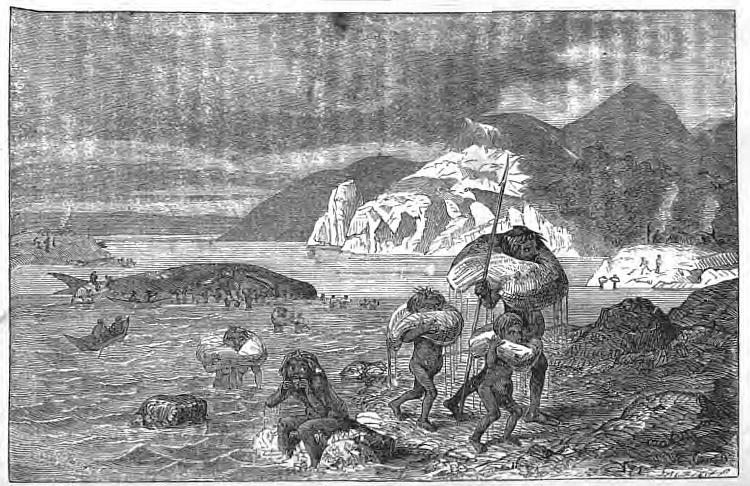
His ordinary subsistence is shell-fish; though he eats also the flesh of the seal and sea-otter; of birds, especially the penguin and Magellanic goose, when he can capture them. His stomach will not “turn” at the blubber of a whale,—when by good chance one of these leviathans gets stranded on his coast,—even though the great carcass be far gone in the stages of decomposition! The only vegetable diet in which he indulges is the berry of a shrub—a species of arbutus—which grows abundantly on the peaty soil; and a fungus of a very curious kind, that is produced upon the trunks of the beech-tree. This fungus is of a globular form, and pale-yellow colour. When young, it is elastic and turgid, with a smooth surface; but as it matures it becomes shrunken, grows tougher in its texture, and presents the pitted appearance of a honeycomb. When fully ripe, the Fuegians collect it in large quantities, eating it without cooking or other preparation. It is tough between the teeth; but soon changes into pulp, with a sweetish taste and flavour,—somewhat resembling that of our common mushroom.
These two vegetables—a berry and a cryptogamic plant—are almost the only ones eaten by the natives of Tierra del Fuego. There are others upon the island that might enable them to eke out their miserable existence: there are two especially sought after by such Europeans as visit this dreary land,—the “wild celery” (opium antarcticum), and the “scurvy grass” (cardamine antiscorbutica); but for these the Fuegian cares not. He even knows not their uses.
In speaking of other “odd people,” I have usually described the mode of building their house; but about the house of the Fuegian I have almost “no story to tell.” It would be idle to call that a house, which far more resembles the lair of a wild beast; and is, in reality, little better than the den made by the orang-outang in the forests of Borneo. Such as it is, however, I shall describe it.
Having procured a number of long saplings or branches,—not always straight ones,—the Fuegian sharpens them at one end by means of his mussel-shell knife; and then sticking the sharpened ends into the ground in a kind of circle, he brings the tops all together, and ties them in a bunch,—so as to form a rude hemispherical frame. Upon this he lays some smaller branches; and over these a few armfuls of long coarse grass, and the house is “built”. One side—that to leeward of the prevailing wind—is left open, to allow for an entrance and the escape of smoke. As this opening is usually about an eighth part of the whole circumference, the house is, in reality, nothing more than a shed or lair. Its furniture does not contradict the idea; but, on the contrary, only strengthens the comparison. There is no table, no chair, no bedstead: a “shake-down” of damp grass answers for all. There are no implements or utensils,—if we except a rude basket used for holding the arbutus berries, and a sealskin bag, in which the shell-fish are collected. A bladder, filled with water, hangs upon some forking stuck against the side: in the top of this bladder is a hole, from which each member of the family takes a “suck,” when thirst inclines them to drink!
The “tools” observable are a bow and arrow, the latter headed with flint; a fish spear with a forked point, made from a bone of the sea-lion; a short stick,—a woman’s implement for knocking the limpets from the rocks; and some knives, the blades of which are sharpened shells of the mussel,—a very large species of which is found along the coast. These knives are simply manufactured. The brittle edge of the shell—which is five or six inches in length—is first chipped off, and a new edge formed by grinding the shell upon the rocks. When thus prepared, it will cut not only the hardest wood, but even the bones of fish; and serves the Fuegian for all purposes.
Outside the hut, you may see the canoe,—near at hand too,—for the shieling of the Fuegian universally stands upon the beach. He never dwells in the interior of his island; and but rarely roams there,—the women only making such excursions as are necessary to procure the berry and the mushroom. The woods have no charms for him, except to afford him a little fuel; they are difficult to be traversed on account of the miry soil out of which the trees grow; and, otherwise, there is absolutely nothing to be found amidst their gloomy depths, that would in any way contribute to his comfort or sustenance. He is therefore essentially a dweller on the shore; and even there he is not free to come and go as he might choose. From the bold character of his coast, there are here and there long reaches, where the beach cannot be followed by land,—places where the water’s edge can only be reached, and the shell-fish collected, by means of some sort of navigable craft. For this purpose the Fuegian requires a canoe; and the necessity of his life makes him a waterman. His skill, however, both in the construction of his craft, and the management of it, is of a very inferior order,—infinitely inferior to that exhibited either by the Esquimaux or the Water-Indians of the North.
His canoe is usually made of the bark of a tree,—the birch already mentioned. Sometimes it is so rudely shaped, as to be merely a large piece of bark shelled from a single trunk, closed at each end, and tied tightly with thong of sealskin. A few cross-sticks prevent the sides from pressing inward; while as many stays of thong keep them from “bulging” in the contrary direction. If there are cracks in the bark, these are caulked with rushes and a species of resin, which the woods furnish.
With this rude vessel the Fuegian ventures forth, upon the numerous straits and inlets that intersect his land; but he rarely trusts himself to a tempestuous sea.
If rich or industrious, he sometimes becomes the possessor of a craft superior to this. It is also a bark canoe, but not made of a single “flitch.” On the contrary, there are many choice pieces used in its construction: for it is fifteen feet in length and three in width amidships. Its “build” also is better,—with a high prow and stern, and cross-pieces regularly set and secured at the ends. The pieces of bark are united by a stitching of thongs; and the seams carefully caulked so that no water can enter. In this vessel, the Fuegian may embark with his whole family,—and his whole furniture to boot,—and voyage to any part of his coast. And this in reality he does; for the “shanty” above described, is to him only a temporary home. The necessities of his life require him to be continually changing it; and a “removal,” with the building of a new domicile, is a circumstance of frequent recurrence.
Not unfrequently, in removing from one part of the coast to another, he finds it safer making a land journey, to avoid the dangers of the deep. In times of high wind, it is necessary for him to adopt this course,—else his frail bark might be dashed against the rocks and riven to pieces. In the land journey he carries the canoe along with him; and in order to do this with convenience, he has so contrived it, that the planks composing the little vessel can be taken apart, and put together again without much difficulty,—the seams only requiring to be freshly caulked. In the transport across land, each member of the family carries a part of the canoe: the stronger individuals taking the heavier pieces,—as the side and bottom planks,—while the ribs and light beams are borne by the younger and weaker.
The necessity of removal arises from a very natural cause. A few days spent at a particular place,—on a creek or bay,—even though the community be a small one, soon exhausts the chief store of food,—the mussel-bank upon the beach,—and, of course, another must be sought for. This may lie at some distance; perhaps can only be reached by a tedious, and sometimes perilous water-journey; and under these circumstances the Fuegian deems it less trouble to carry the mountain to Mahomet, than carry Mahomet so often to the mountain. The transporting his whole ménage, is just as easy as bringing home a load of limpets; and as to the building of a new house, that is a mere bagatelle, which takes little labour, and no more time than the erection of a tent. Some Fuegians actually possess a tent, covered with the skins of animals; but this a rare and exceptional advantage; and the tent itself of the rudest kind. The Fuegian has his own mode of procuring fire. He is provided with a piece of “mundic,” or iron pyrites, which he finds high up upon the sides of his mountains. This struck by a pebble will produce sparks. These he catches upon a tinder of moss, or the “punk” of a dead tree, which he knows how to prepare. The tinder once ignited, is placed within a roundish ball of dry grass; and, this being waved about in circles, sets the grass in a blaze. It is then only necessary to communicate the flame to a bundle of sticks; and the work is complete. The process, though easy enough in a climate where “punk” is plenty, and dry grass and sticks can be readily procured, is nevertheless difficult enough in the humid atmosphere of Tierra del Fuego,—where moss is like a wet sponge, and grass, sticks, and logs, can hardly be found dry enough to burn. Well knowing this, the Fuegian is habitually careful of his fire: scarce ever permitting it to go out; and even while travelling in his canoe, in search of a “new home,” side by side with his other “penates” he carries the fire along with him.
Notwithstanding the abundance of fuel with which his country provides him, he seems never to be thoroughly warm. Having no close walls to surround him, and no clothing to cover his body, he suffers almost incessantly from cold. Wherever met, he presents himself with a shivering aspect, like one undergoing a severe fit of the ague!
The Fuegians live in small communities, which scarce deserve the name of “tribes,” since they have no political leader, nor chief of any description. The conjuror—and they have him—is the only individual that differs in any degree from the other members of the community; but his power is very slight and limited; nor does it extend to the exercise of any physical force. Religion they have none,—at least, none more sacred or sanctified than a vague belief in devils and other evil spirits.
Although without leaders, they are far from being a peaceful people. The various communities often quarrel and wage cruel and vindictive war against one another; and were it not that the boundaries of each association are well-defined, by deep ravines and inlets of the sea, as well as by the impassable barriers of snow-covered mountains, these warlike dwarfs would thin one another’s numbers to a far greater extent than they now do,—perhaps to a mutual extermination. Fortunately the peculiar nature of their country hinders them from coming very often within fighting distance.
Their whole system of life is abject in the extreme. Although provided with fires, their food is eaten raw; and a fish taken from the water will be swallowed upon the instant—almost before the life is gone out of it. Seal and penguin flesh are devoured in the same manner; and the blubber of the whale is also a raw repast. When one of these is found dead upon the beach,—for they have neither the skill nor courage to capture the whale,—the lucky accident brings a season of rejoicing. A fleet of canoes—if it is to be reached only by water—at once paddle towards the place; or, if it be an overland journey, the whole community—man, woman, and child—start forth on foot. In an hour or two they may be seen returning to their hut village, each with a large “flitch” of blubber flapping over the shoulders, and the head just appearing above, through a hole cut in the centre of the piece,—just as a Mexican ranchero wears his “serape,” or a denizen of the Pampas his woollen “poncho.” A feast follows this singular procession.
Like the Esquimaux of the north, the Fuegian is very skilful in capturing the seal. His mode of capturing this creature, however, is very different from that employed by the “sealer” of the Arctic Seas; and consists simply in stealing as near as possible in his canoe, when he sees the animal asleep upon the surface, and striking it with a javelin,—which he throws with an unerring aim.
We have already observed that the principal subsistence of the Fuegian is supplied by the sea; and shell-fish forms the most important item of his food. These are mussels, limpets, oysters, and other kinds of shell-fish, and so many are annually consumed by a single family, that an immense heap of the shells may be seen not only in front of every hut, but all along the coast of the islands, above high-water mark,—wherever a tribe has made its temporary sojourn.
There is a singular fact connected with these conglomerations of shells, which appears to have escaped the observations of the Magellanic voyagers. It is not by mere accident they are thus collected in piles. There is a certain amount of superstition in the matter. The Fuegian believes that, were the shells scattered negligently about, ill-luck would follow; and, above all, if the emptied ones were thrown back into the sea: since this would be a warning of destruction that would frighten the living bivalves in their “beds,” and drive them away from the coast! Hence it is that the shell-heaps are so carefully kept together.
In collecting these shell-fish, the women are the chief labourers. They do not always gather them from the rocks, after the tide has gone out; though that is the usual time. But there are some species not found in shallow water, and therefore only to be obtained by diving to the bottom after them. Of this kind is a species of echinus, or “sea-urchin,” of the shape of an orange, and about twice the bulk of one,—the whole outside surface being thickly set with spines, or protuberances. These curious shell-fish are called “sea-eggs” by the sailor navigators; and constitute an important article of the food of the Fuegian. It is often necessary to dive for them to a great depth; and this is done by the Fuegian women, who are as expert in plunging as the pearl-divers of California or the Indian seas.
Fish is another article of Fuegian diet; and many kinds are captured upon their coasts, some of excellent quality. They sometimes obtain the fish by shooting them with their arrows, or striking them with a dart; but they have a mode of catching the finny creatures, which is altogether peculiar: that is to say, hunting them with dogs! The Fuegians possess a breed of small fox-like dogs, mean, wretched-looking curs, usually on the very verge of starvation,—since their owners take not the slightest care of them, and hardly ever trouble themselves about feeding them. Notwithstanding this neglect, the Fuegian dogs are not without certain good qualities; and become important auxiliaries to the Fuegian fisherman. They are trained to pursue the fish through the water, and drive them into a net, or some enclosed creek or inlet, shallow enough for them to be shot with the arrow. In doing this the dogs dive to the bottom; and follow the fish to and fro, as if they were amphibious carnivora, like the seals and otters. For this useful service the poor brutes receive a very inadequate reward,—getting only the bones as their portion. They would undoubtedly starve, were it not that, being left to shift for themselves, they have learnt how to procure their own food; and understand how to catch a fish now and then on their own account. Their principal food, however, consists in shell-fish, which they find along the shores, with polypi, and such other animal substances as the sea leaves uncovered upon the beach after the tide has retired. A certain kind of sea-weed also furnishes them with an occasional meal, as it does their masters,—often as hungry and starving as themselves.
In his personal habits no human being is more filthy than the Fuegian. He never uses water for washing purposes; nor cleans the dirt from his skin in any way. He has no more idea of putting water to such use, than he has of drowning himself in it; and in respect to cleanliness, he is not only below most other savages, but below the brutes themselves: since even these are taught cleanliness by instinct. But no such instinct exists in the mind of the Fuegian; and he lives in the midst of filth. The smell of his body can be perceived at a considerable distance; and Hotspur’s fop might have had reasonable grounds of complaint, had it been a Fuegian who came between the “wind and his nobility.” To use the pithy language of one of the old navigators, “The Fuegian stinks like a fox.”
Fairly examined, then, in all his bearings,—fairly judged by his habits and actions,—the Fuegian may claim the credit of being the most wretched of our race.
The End.
|
Chapter 1
| |
Chapter 2
| |
Chapter 3
| |
Chapter 4
| |
Chapter 5
| |
Chapter 6
| |
Chapter 7
| |
Chapter 8
| |
Chapter 9
| |
Chapter 10
| |
Chapter 11
| |
Chapter 12
| |
Chapter 13
| |
Chapter 14
| |
Chapter 15
| |
Chapter 16
| |
Chapter 17
| |
Chapter 18
|