"Being a Popular Description of Singular Races of Man" (continued 4)
Reading edition
In the portrait of the Feegeean you will expect something frightfully hideous,—knowing, as you already do, that he is an eater of human flesh,—a man of gigantic stature, swarthy skin, bloodshot eyes, gaunt, bony jaws, and terrific aspect. You will expect this man to be described as being naked,—or only with the skin of a wild beast upon his shoulders,—building no house, manufacturing no household or other utensils, and armed with a huge knotted club, which he is ever ready to use:—a man who dwells in a cavern, sleeps indifferently in the open air or under the shelter of a bush; in short, a true savage. That is the sort of creature you expect me to describe, and I confess that just such a physical aspect—just such a condition of personal hideousness—would be exactly in keeping with the moral deformity of the Feegeean. You would furthermore expect this savage to be almost devoid of intellectual power,—altogether wanting in moral sense,—without knowledge of right and wrong,—without knowledge of any kind,—without ideas. It seems but natural you should look for such characteristics in a cannibal.
The portrait I am about to paint will disappoint you. I do not regret it, since it enables me to bring forward another testimony that man in his original nature is not a being of such desperate wickedness. That simple and primitive state, which men glibly call savage, is not the condition favourable to cannibalism. I know that it is to such people that the habit is usually ascribed, but quite erroneously. The Andaman islander has been blamed with it simply becauses he chances to go naked, and looks, as he is, hungry and emaciated. The charge is proved false. The Bushman of South Africa has enjoyed a similar reputation. It also turns out to be a libel. The Carib long lived under the imputation, simply because he presented a fierce front to the Spanish tyrant, who would have enslaved him; and we have heard the same stigma cast upon a dozen other tribes, the lowest savages being usually selected; in other words, those whose condition appeared the most wretched. In such cases the accusation has ever been found, upon investigation, to be erroneous.
In the most primitive state in which man appears upon the earth, he is either without social organisation altogether, or if any do exist, it is either patriarchal of republican. Neither of these conditions is favourable to the development of vice,—much less the most horrible of all vices.
It will not do to quote the character of the Bushman, or certain other of the low tribes, to refute this statement. These are not men in their primitive state ascending upward, but a condition altogether the reverse. They are the decaying remnants of some corrupt civilisation, sinking back into the dust out of which they were created.
No—and I am happy to say it—man, as he originally came from the hands of the Creator, has no such horrid propensity as cannibalism. In his primitive state he has never been known to practise it,—except when the motives have been such as have equally tempted men professing the highest civilisation,—but this cannot be considered cannibalism. Where that exists in its true unmitigated form,—and unhappily it does so,—the early stages of social organisation must have been passed; the republican and patriarchal forms must both have given place to the absolute and monarchical. This condition of things is absolutely necessary, before man can obtain sufficient power to prey upon his fellow-man to the extent of eating him. There can be no “cannibal” without a “king.”
So far from the Feegeean cannibals being savages, according to the ordinary acceptation of the term, they are in reality the very reverse. If we adhere to the usual meaning of the word civilisation, understanding by it a people possessing an intelligent knowledge of arts, living in well-built houses, fabricating fine goods, tilling their lands in a scientific and successful manner, practising the little politenesses and accomplishments of social life,—if these be the criteria of civilisation, then it is no more than the truth to say that the standard possessed by the Feegee islanders is incomparably above that of the lower orders of most European nations.
It is startling to reflect—startling as sad—that a people possessed of such intellectual power, and who have ever exercised it to a wonderful extent, in arts, manufactures, and even in the accomplishing of their own persons, should at the same time exhibit moral traits of such an opposite character. An atrocious cruelty,—an instinct for oppression, brutal and ferocious,—a heart pitiless as that of the fiend himself,—a hand ever ready to strike the murderous blow, even though the victim be a brother,—lips that lie in every word they speak,—a tongue ever bent on barbaric boasting,—a bosom that beats only with sentiments of treachery and abject cowardice,—these are the revolting characteristics of the Feegeean. Dark as is his skin, his soul is many shades darker.
It is time, however, to descend to a more particular delineation of this man-eating monster; and first, we shall give a description of his personal appearance.
The Feegeeans are above the average height of Europeans or white men: men of six feet are common among them, though few reach the height of six feet six. Corpulent persons are not common, though large and muscular men abound. Their figure corresponds more nearly to that of the white man than any other race known. The proportions of their limbs resemble those of northern Europeans, though some are narrower across the loins. Their chests are broad and sinewy, and their stout limbs and short, well-set necks are conspicuous characters. The outline of the face is a good oval; the mouth large, with white teeth regularly arranged—ah! those horrid teeth!—the nose is well-shaped, with full nostrils; yet quite distinct, as are the lips also, from the type of the African negro. Indeed, with the exception of their colour, they bear very little resemblance to the negro,—that is, the thick-lipped, flat-nosed negro of our fancy; for there are negro tribes in Africa whose features are as fine as those of the Feegeeans, or even as our own. In colour of skin the Feegeean is nearly, if not quite, as dark as the negro; but it may be remarked that there are different shades, as there are also among pure Ethiopians. In the Feegee group there are many men of mulatto colour, but these are not of the original Feegee stock. They are either a mixed offspring with the Tonga islander, or pure-bred Tonga islanders themselves who for the past two hundred years have been insinuating themselves into the social compact of the Feegeeans. These light-coloured people are mostly found on the eastern or windward side of the Feegee group,—that is, the side towards Tonga itself,—and the trade-winds will account for their immigration, which was at first purely accidental. They at present play a conspicuous part in the affairs of the Feegeeans, being in favour with the kings and great chiefs, partly on account of their being better sailors than the native Feegeeans, and partly on account of other services which these tyrants require them to perform. In some arts the Tongans are superior to the Feegeeans, but not in all. In pottery, wood-carving, making of mats or baskets, and the manufacture of the tapa cloth, the Feegeeans stand unrivalled over all the Pacific Ocean.
We need say no more of the Tongans here; they are elsewhere described. Those dwelling in Feegee are not all fixed there for life. Some are so, and these are called Tonga-Feegeeans; the others are only visitors, giving their services temporarily to the Feegeean chiefs, or occupied in ship-building,—in constructing those great war canoes that have been the astonishment of South-Sea voyagers, and which Feegee sends forth from her dockyards in the greatest perfection. These, when finished by the Tongan strangers, are used to carry them back to their own islands, that lie about three hundred miles to the windward (southeast).
But to continue the portrait of the Feegeean. We have touched almost every part of it except the hair; but this requires a most elaborate limning, such as the owner himself gives it. In its natural state the head of the Feegeean is covered by a mass of black hair, long, frizzled, and bushy, sometimes encroaching on the forehead, and joined by whiskers to a thick, round, or pointed beard, to which moustaches are often added. Black is, of course, the natural colour of the hair, but it is not always worn of this hue. Other colours are thought more becoming; and the hair, both of the men and women, is dyed in a variety of ways, lime burning it to a reddish or whitey-brown shade. A turmeric-yellow, or even a vermilion-red are not uncommon colours; but all these keep varying, according to the change of fashions at court!
Commodore Wilkes, who has given a good deal of his time to an exploration of the Feegee Islands, states that the Feegee hair, in its natural condition, is straight, and not “frizzled,” as described above—he says that the frizzling is the work of the barber; but the Commodore is altogether mistaken in this idea. Thousands of Feegeeans, whose hair was never touched by a barber, nor dressed even by themselves, exhibit this peculiarity. We regret to add that this is only one of a thousand erroneous statements which the Commodore has made during his gigantic exploration. He may have been excellent at his own speciality of making soundings and laying down charts; but on all matters pertaining to natural history or ethnology, the worthy Commodore appears to have been purblind, and, indeed, his extensive staff of naturalists of every kind have produced far less than might have been expected from such excellent opportunities as they enjoyed. The observation of the Commodore will not stand the test of time, and cannot be depended upon as safe guides, excepting in those cases where he was an actual eye-witness. About his truthful intentions there can be no doubt whatever.
Of one very peculiar performance among the Feegees he appears to have had actual demonstration, and as he has described this with sufficient minuteness, we shall copy his account; though, after what we have said, we should apologise largely for the liberty. The performance referred to is that of “barberising” a barbarian monarch, and may be taken as a proof of high civilisation among the Feegees. It will be seen that, with the exception of the tabooed fingers, there is not much difference between a barber of Bond Street and an artist of like calling in the Cannibal Islands.
“The chiefs in particular,” writes Commodore Wilkes, “pay great attention to the dressing of their heads, and for this purpose all of them have barbers, whose sole occupation is the care of their masters’ heads. These barbers are called a-vu-ni-ulu. They are attached to the household of the chiefs in numbers of from two to a dozen. The duty is held to be of so sacred a nature, that their hands are tabooed from all other employment, and they are not even permitted to feed themselves. To dress the head of a chief requires several hours. The hair is made to spread out from the head, on every side, to a distance that is often eight inches. The beard, which is also carefully nursed, often reaches the breast, and when a Feegeean has these important parts of his person well dressed, he exhibits a degree of conceit that is not a little amusing.
“In the process of dressing the hair it is well anointed with oil, mixed with a carbonaceous black, until it is completely saturated. The barber then takes the hairpin, which is a long and slender rod, made of tortoise-shell or bone, and proceeds to twitch almost every separate hair. This causes it to frizzle and stand erect. The bush of hair is then trimmed smooth by singeing it, until it has the appearance of an immense wig. When this has been finished, a piece of tapa, so fine as to resemble tissue-paper, is wound in light folds around it, to protect the hair from the dew or dust. This covering, which has the look of a turban, is called sala, and none but the chiefs are allowed to wear it; any attempt to assume this head-dress by a kai-si, or common person, would be immediately punished with death. The sala, when taken proper care of, will last three weeks or a month, and the hair is not dressed except when it is removed; but the high chiefs and dandies seldom allow a day to pass without changing the sala and having the hair put in order.”
With this account, we conclude our description of the Feegeean’s person. His costume is of the simplest kind, and easily described. With the men it is merely a strip of “tapa” or “malo” cloth passed several times round the waist, and the ends left to hang down in front. The length of the hanging ends determines the rank of the wearer, and only in the case of kings or great chiefs are they allowed to touch the ground. A turban of the finest tapa cloth among the great mop of hair is another badge of rank, worn only by kings and chiefs; and this head-dress, which adds greatly to the dignified appearance of the wearer, is not always coiffed in the same fashion, but each chief adapts it to his own or the prevailing taste of the court. The dress of the women is a mere waist-belt, with a fringe from six to ten inches in length. It is worn longer after they have become wives, sometimes reaching near the knee, and forming a very picturesque garment. It is called the “liku,” and many of them are manufactured with surprising skill and neatness, the material being obtained from various climbing plants of the forest. Under the “liku” the women are tattooed, and there only. Their men, on the contrary, do not undergo the tattoo; but on grand occasions paint their faces and bodies in the most fanciful colours and patterns.
The kings and some chiefs suspend from their necks shell ornaments—often as large as a dining-plate—that down upon the breast. Some, instead of this, wear a necklace of whales’ teeth, carved to resemble claws, and bearing a very close resemblance to the necklaces of the Prairie Indians, made of the claws of the grizzly bear. Another kind of necklace—perhaps more appropriate to the Feegee—is a string of human teeth; and this kind is not unfrequently worn by these ferocious dandies.
It must not be supposed that the scantiness of the Feegeean costume arises from poverty or stinginess on the part of the wearer. Nothing of the kind. It is simply because such is the fashion of the time. Were it otherwise, he could easily supply the materials, but he does not wish it otherwise. His climate is an eternal summer, and he has no need to encumber his body with extraneous clothing. With the exception of the turban upon his head, his king is as naked as himself.
You may suppose that the Feegeeans have but little notions of modesty; but, strange as it may appear, this is in reality not one of their failings. They regard the “malo” and “liku” as the most modest of garments; and a man or woman seen in the streets without these scanty coverings would be in danger of being clubbed to death!
It must be acknowledged that they are not altogether depraved—for in this respect they present the most astounding anomaly. Certain virtues are ascribed to them, and as I have painted only the dark side of their character, it is but fair to give the other. Indeed, it is a pleasure to do this—though there is not enough of the favourable to make any great alteration in the picture. The whole character is so well described by one of the most acute observers who has yet visited the South Seas—the Wesleyan missionary Williams—that we borrow the description.
“The aspect of the Feegeean,” says Mr Williams, “with reference to his mental character, so far from supporting the decision which would thrust him almost out of mankind, presents many points of great interest, showing that, if an ordinary amount of attention were bestowed on him, he would take no mean rank in the human family, to which, hitherto, he has been a disgrace. Dull, barren stupidity forms no part of his character. His feelings are acute, but not lasting; his emotions easily roused, but transient; he can love truly, and hate deeply; he can sympathise with thorough sincerity, and feign with consummate skill; his fidelity and loyalty are strong and enduring, while his revenge never dies, but waits to avail itself of circumstances, or of the blackest treachery, to accomplish its purpose. His senses are keen, and so well employed, that he often excels the white man in ordinary things. Tact has been called ‘ready cash,’ and of this the native of Feegee has a full share, enabling him to surmount at once many difficulties, and accomplish many tasks, that would have ‘fixed’ an Englishman. Tools, cord, or packing materials, he finds directly, where the white man would be at a loss for either; and nature seems to him but a general store for his use, where the article he wants is always within reach.
“In social diplomacy the Feegeean is very cautious and clever. That he ever paid a visit merely en passant, is hard to be believed. If no request leaves his lips, he has brought the desire, and only waits for a good chance to present it now, or prepare the way for its favourable reception at some other time. His face and voice are all pleasantness; and he has the rare skill of finding out just the subject on which you most like to talk, or sees at once whether you desire silence. Barely will he fail to read your countenance; and the case must be urgent indeed which obliges him to ask a favour when he sees a frown. The more important he feels his business the more earnestly he protests that he has none at all; and the subject uppermost in his thoughts comes last to his lips, or is not even named; for he will make a second, or even a third visit, rather than risk a failure through precipitancy. He seems to read other men by intuition, especially where selfishness or lust are prominent traits. If it serves his purpose, he will study difficult and peculiar characters, reserving the results for future use; if afterwards he wish to please them, he will know how, and if to annoy them, it will be done most exactly.
“His sense of hearing is acute, and by a stroke of his nail he judges the ripeness of fruits, or soundness of various substances.”
From what source the Feegeean has sprung is purely a matter of conjecture. He has no history,—not even a tradition of when his ancestors first peopled the Archipelago in which we now find him. Of his race we have not a much clearer knowledge. Speculation places him in the same family as the “Papuan Negro,” and he has some points of resemblance to this race, in the colour and frizzled hair; but there is as much difference between the wretched native of West Australia and the finely-developed Feegeean as there is between the stunted Laplander and the stalwart Norwegian; nor is the coarse rough skin of the true Papuan to be recognised in the smooth, glossy epidermis of the Feegee Islander. This, however, may be the result of better living; and certainly among the mountain-tribes of the Feegees, who lead lives of greater privation and hardship, the approach to the Papuan appearance is observable. It is hardly necessary to add that the Feegeean is of a race quite distinct from that known as the Polynesian or South-Sea Islander. This last is different not only in form, complexion, and language, but also in many important mental characteristics. It is to this race the Tongans belong, and its peculiarities will be sketched in treating of that people.
Were we to enter upon a minute description of the manners and customs of the Feegees,—of their mode of house and canoe building,—of their arts and manufactures, for they possess both,—of their implements of agriculture and domestic use,—of their weapons of war,—their ceremonies of religion and court etiquette,—our task would require more space than is here allotted to us: it would in fact be as much as to describe the complete social economy of a civilised nation; and a whole volume would scarce suffice to contain such a description. In a sketch like the present, the account of these people requires to be given in the most condensed and synoptical form, and only those points can be touched upon that may appear of the greatest interest.
It must be remembered that the civilisation of the Feegees—of course, I allude to their proficiency in the industrial arts—is entirely an indigenous growth. They have borrowed ideas from the Tongans,—as the Tongans have also from them,—but both are native productions of the South Sea, and not derived from any of the so-called great centres of civilisation. Such as have sprung from these sources are of modern date, and make but a small feature in the panorama of Feegeean life. The houses they build are substantial, and suitable to their necessities. We cannot stay to note the architecture minutely. The private dwellings are usually about twenty-five feet long by fifteen in breadth, the interior forming one room, but with a sort of elevated divan at the end, sometimes screened with beautiful “tapa” curtains, and serving as the dormitory.
The ground-plan of the house is that of an oblong square,—or, to speak more properly, a parallelogram. The walls are constructed of timber,—being straight posts of cocoa-palm, tree-fern, bamboo, or breadfruit,—the spaces between closely warped or otherwise filled in with reeds of cane or calamus. The thatch is of the leaves of the wild or cultivated sugar-cane,—sometimes of a pandanus,—thickly laid on, especially near the eaves, where it is carefully cropped, exposing an edge of from one to two feet in thickness. The roof has four faces,—that is, it is a “hip roof.” It is made with a very steep pitch, and comes down low, projecting fer over the heads of the upright timbers. This gives a sort of shaded veranda all around the house, and throws the rain quite clear of the walls. The ridge-pole is a peculiar feature; it is fastened to the ridge of the thatch by strong twisted ropes, that give it an ornamental appearance; and its carved ends project at both gables, or rather, over the “hip roofs,” to the length of a foot, or more; it is further ornamented by white shells, those of the cyprea ovula being most used for the purpose. The Feegee house presents altogether a picturesque and not inelegant appearance. The worst feature is the low door. There are usually two of them, neither in each house being over three feet in height. The Feegee assigns no reason why his door is made so low; but as he is frequently in expectation of a visitor, with a murderous bludgeon in his grasp, it is possible this may have something to do with his making the entrance so difficult.
The houses of the chiefs, and the great council-house, or temple,—called the “Bure,”—are built precisely in the same style; only that both are larger, and the doors, walls, and ridge-poles more elaborately ornamented. The fashionable style of decoration is a plaiting of cocoa-fibre, or “sinnet,” which is worked and woven around the posts in regular figures of “relievo.”
The house described is not universal throughout all the group. There are many “orders” of architecture, and that prevailing in the Windward Islands is different from the style of the Leeward, and altogether of a better kind. Different districts have different forms. In one you may see a village looking like an assemblage of wicker baskets, while in another you might fancy it a collection of rustic arbours. A third seems a collection oblong hayricks, with holes in their sides; while, in a fourth these ricks are conical.
It will be seen that, with this variety in housebuilding, it would be a tedious task to illustrate the complete architecture of Feegeeans. Even Master Kuskin himself would surrender it up in despair.
Equally tedious would it be to describe the various implements or utensils which a Feegee house contains. The furniture is simple enough. There are neither chairs, tables, nor bedsteads. The bed is a beautiful mat spread on the däis, or divan; and in the houses of the rich the floors are covered with a similar carpet. These mats are of the finest texture, far superior to those made elsewhere. The materials used are the Hibiscus tiliaceus, Pandanus odoratissimus, and a species of rush. They are in great abundance in every house,—even the poorest person having his mat to sit or lie upon; and it is they that serve for the broad-spreading sails of the gigantic canoes. In addition to the mats, plenty of tapa cloth may be seen, and baskets of every shape and size,—the wicker being obtained from the rattan (flagellaria), and other sources. One piece of furniture deserves especial mention,—this is the pillow upon which the Feegee lord lays his head when he goes to sleep. It presents but little claim to the appellation of a downy pillow; since it is a mere cylinder of hard polished wood, with short arched pedestals to it, to keep it firmly in its place. Its object is to keep the great frizzled mop from being tossed or disarranged, during the hours of repose; and Feegeean vanity enables the owner of the mop to endure this flinty bolster with the most uncomplaining equanimity. If he were possessed of the slightest spark of conscience, even this would be soft, compared with any pillow upon which he might rest his guilty head.
In addition to the baskets, other vessels meet the eye. These are of pottery, as varied in shape and size as they are in kind. There are pots and pans, bowls, dishes, cups and saucers, jars and bottles,—many of them of rare and curious designs,—some red, some ornamented with a glaze obtained from the gum of the kauri pine,—for this tree is also an indigenous production of the Feegee Islands. Though no potter’s wheel is known to the Feegees, the proportions of their vessels are as just and true, and their polish as complete, as if Stafford had produced them. There are cooking-pots to be seen of immense size. These are jars formed with mouths wide enough to admit the largest joint. I dare not mention the kind of joint that is frequently cooked in those great caldrons. Ugh! the horrid pots!
Their implements are equally varied and numerous,—some for manufacturing purposes, and others for agriculture. The latter are of the simplest kind. The Feegee plough is merely a pointed stick inserted deeply into the ground, and kept moving about till a lump of the soil is broken upward. This is crushed into mould, first by a light club, and afterwards pulverised with the fingers. The process is slow, but fast enough for the Feegeean, whose farm is only a garden. He requires no plough, neither bullocks nor horses. With taro-roots and sweet potatoes that weigh ten pounds each, yams and yaqonas over one hundred, and plantains producing bunches of a hundred and fifty fruits to the single head, why need he trouble himself by breaking up more surface? His single acre yields him as much vegetable wealth as fifty would to an English farmer!
It is not to be supposed that he has it all to himself; no, nor half of it either; nor yet the fifth part of it. At least four fifths of his sweat has to be expended in tax or tithe; and this brings us to the form of his government. We shall not dwell long upon this subject. Suffice it to say that the great body of the people are in a condition of abject serfdom,—worse than slavery itself. They own nothing that they can call their own,—not their wives,—not their daughters,—not even their lives! All these may be taken from them at any hour. There is no law against despoiling them,—no check upon the will and pleasure of their chiefs or superiors; and, as these constitute a numerous body, the poor canaille have no end of ruffian despoilers. It is an everyday act for a chief to rob, or club to death, one of the common people! and no unfrequent occurrence to be himself clubbed to death by his superior, the king! Of these kings there are eight in Feegee,—not one, as the old song has it; but the words of the ballad will apply to each of them with sufficient appropriateness. Any one of them will answer to the character of “Musty-fusty-shang?”
These kings have their residences on various islands, and the different parts of the group are distributed somewhat irregularly under their rule. Some islands, or parts of islands, are only tributary to them; others connected by a sort of deferential alliance; and there are communities quite independent, and living under the arbitrary sway of their own chieftains. The kings are not all of equal power or importance; but in this respect there have been many changes, even during the Feegeean historical period,—which extends back only to the beginning of the present century. Sometimes one is the most influential, sometimes another; and in most cases the pre-eminence is obtained by him who possesses the greatest amount of truculence and treachery. He who is most successful in murdering his rivals, and ridding himself of opposition, by the simple application of the club, usually succeeds in becoming for the time head “king of the Cannibal Islands.” I do not mean that he reigns over the whole Archipelago. No king has yet succeeded in uniting all the islands under one government. He only gets so far as to be feared everywhere, and to have tributary presents, and all manner of debasing compliments offered to him. These kings have all their courts and court etiquette, just as their “royal brothers” elsewhere; and the ceremonials observed are quite as complicated and degrading to the dignity of man.
The punishment for neglecting their observance is rather more severe in Feegee than elsewhere. For a decided or wilful non-compliance, the skull of the delinquent is frequently crushed in by the club of his majesty himself,—even in presence of a full “drawing-room.” Lesser or accidental mistakes, or even the exhibition of an ungraceful gaucherie, are punished by the loss of a finger: the consequence of which is, that in Feegee there are many fingers missing! Indeed, a complete set is rather the exception than the rule. If a king or great chief should chance to miss his foot and slip down, it is the true ton for all those who are near or around him to fall likewise,—the crowd coming down, literally like a “thousand of bricks!”
I might detail a thousand customs to show how far the dignity of the human form is debased and disgraced upon Feegee soil; but the subject could be well illustrated nearer home. Flunkeyism is a fashion unfortunately not confined to the Feegeean archipelago; and though the forms in which it exhibits itself there may be different, the sentiment is still the same. It must ever appear where men are politically unequal,—wherever there is a class possessed of hereditary privileges.
I come to the last,—the darkest feature in the Feegeean character,—the horrid crime and custom of cannibalism. I could paint a picture, and fill up the details with the testimony of scores of eyewitnesses,—a picture that would cause your heart to weep. It is too horrid to be given here. My pen declines the office; and, therefore, I must leave the painful story untold.
Chapter Eight.
The Tongans, or Friendly Islanders.
It is a pleasure to pass out of the company of the ferocious Feegees into that of another people, which, though near neighbours of the former, are different from them in almost every respect,—I mean the Tongans, or Friendly Islanders. This appellation scarce requires to be explained. Every one knows that it was bestowed upon them by the celebrated navigator Cook,—who although not the actual discoverer of the Tonga group, was the first who thoroughly explored these islands, and gave any reliable account of them to the civilised world. Tasman, who might be termed the “Dutch Captain Cook,” is allowed to be their discoverer, so long ago as 1643; though there is reason to believe that some of the Spanish explorers from Peru may have touched at these islands before his time. Tasman, however, has fixed the record of his visit, and is therefore entitled to the credit of the discovery,—as he is also to that of Australia, New Zealand, Van Diemen’s Land, and other now well-known islands of the South-western Pacific. Tasman bestowed upon three of the Tonga group the names—Amsterdam, Rotterdam, and Middleburgh; but, fortunately, geographers have acted in this matter with better taste than is their wont; and Tasman’s Dutch national titles have fallen into disuse,—while the true native names of the islands have been restored to the map. This is what should be done with other Pacific islands as well; for it is difficult to conceive anything in worse taste than such titles as the Caroline and Loyalty Isles, Prince William’s Land, King George’s Island, and the ten thousand Albert and Victoria Lands which the genius of flattery, or rather flunkeyism, has so liberally distributed over the face of the earth. The title of Friendly Isles, bestowed by Cook upon the Tonga archipelago, deserves to live; since it is not only appropriate, but forms the record of a pleasant fact,—the pacific character of our earliest intercourse with these interesting people.
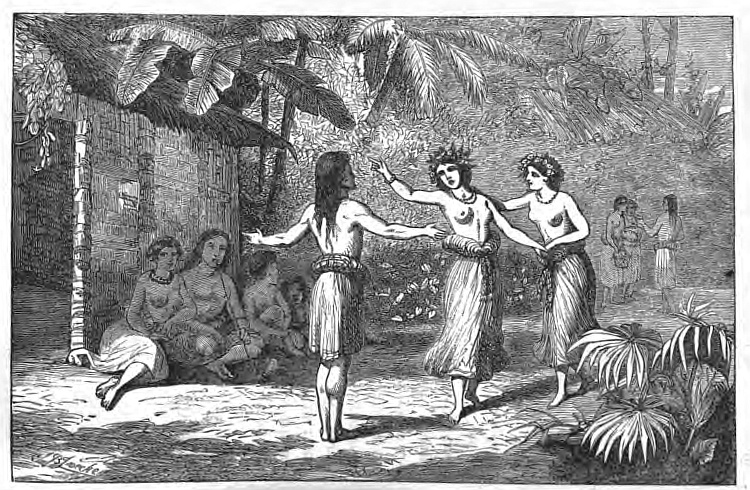
It may be here remarked, that Mr Wylde and other superficial map-makers have taken a most unwarrantable liberty with this title. Instead of leaving it as bestowed by the great navigator,—applicable to the Tonga archipelago alone,—they have stretched it to include that of the Samoans, and—would it be believed—that of the Feegees? It is hardly necessary to point out the extreme absurdity of such a classification: since it would be difficult to find two nationalities much more unlike than those of Tonga and Feegee. That they have many customs in common, is due (unfortunately for the Tongans) to the intercourse which proximity has produced; but in an ethnological sense, white is not a greater contrast to black, nor good to evil, than that which exists between a Tongan and a Feegeean. Cook never visited the Feegee archipelago,—he only saw some of these people while at Tongataboo, and heard of their country as being a large island. Had he visited that island,—or rather that group of over two hundred islands,—it is not at all likely he would have seen reason to extend to them the title which the map-makers have thought fit to bestow. Instead of “Friendly Islands,” he might by way of contrast have called them the “Hostile Isles,” or given them that—above all others most appropriate, and which they truly deserve to bear—that old title celebrated in song! the “Cannibal Islands.” An observer so acute as Cook could scarce have overlooked the appropriateness of the appellation.
The situation of the Tonga, or Friendly Isles, is easily registered in the memory. The parallel of 20 degrees south, and the meridian of 175 degrees west, very nearly intersect each other in Tofoa, which may be regarded as the central island of the group. It will thus be seen that their central point is 5 degrees east and 2 degrees south of the centre of the Feegeean archipelago, and the nearest islands of the two groups are about three hundred miles apart.
It is worthy of observation, however, that the Tonga Isles have the advantage, as regards the wind. The trades are in their favour; and from Tonga to Feegee, if we employ a landsman’s phraseology, it is “down hill,” while it is all “up hill” in the contrary direction. The consequence is, that many Tongans are constantly making voyages to the Feegee group,—a large number of them having settled there (as stated elsewhere),—while but a limited number of Feegeeans find their way to the Friendly Islands. There is another reason for this unequally-balanced migration: and that is, that the Tongans are much bolder and better sailors than their western neighbours; for although fer excel any other South-Sea islanders in the art of building their canoes (or ships as they might reasonably be called), yet they are as far behind many others in the art of sailing them.
Their superiority in ship-building may be attributed, partly, to the excellent materials which these islands abundantly afford; though this is not the sole cause. However much we may deny to the Feegeeans the possession of moral qualities, we are at the same time forced to admit their great intellectual capacity,—as exhibited in the advanced state of their arts and manufactures. In intellectual capacity, however, the Friendly Islanders are their equals; and the superiority of the Feegeeans even in “canoe architecture” is no longer acknowledged. It is true the Tongans go to the Feegee group for most of their large double vessels; but that is for the reasons already stated,—the greater abundance and superior quality of the timber and other materials produced there. In the Feegee “dockyards,” the Tongans build for themselves; and have even improved upon the borrowed pattern.
This intercourse,—partaking somewhat of the character of an alliance,—although in some respects advantageous to the Friendly Islanders, may be regarded, upon the whole, as unfortunate for them. If it has improved their knowledge in arts and manufactures, it has far more than counterbalanced this advantage by the damage done to their moral character. It is always much easier to make proselytes to vice than to virtue,—as is proved in this instance: for his intercourse with the ferocious Feegee has done much to deteriorate the character of the Tongan. From that source he has imbibed a fondness for war and other wicked customs; and, in all probability, had this influence been permitted to continue uninterrupted for a few years longer, the horrid habit of cannibalism—though entirely repugnant to the natural disposition of the Tongans—would have become common among them. Indeed, there can be little doubt that this would have been the ultimate consequence of the alliance; for already its precursors—human sacrifices and the vengeful immolation of enemies—had made their appearance upon the Friendly Islands. Happily for the Tongan, another influence—that of the missionaries—came just in time to avert this dire catastrophe; and, although this missionary interference has not been the best of its kind, it is still preferable to the paganism which it has partially succeeded in subduing.
The Tongan archipelago is much less extensive than that of the Feegees,—the islands being of a limited number, and only five or six of them of any considerable size. Tongataboo, the largest, is about ninety miles in circumference. From the most southern of the group Eoo, to Yavan at the other extremity, it stretches, northerly or northeasterly, about two hundred miles, in a nearly direct line. The islands are all, with one or two exceptions, low-lying, their surface being diversified by a few hillocks or mounds, of fifty or sixty feet in height, most of which have the appearance of being artificial. Some of the smaller islets, as Kao, are mountains of some six hundred feet elevation, rising directly out of the sea; while Tofoa, near the eastern edge of the archipelago, presents the appearance of an elevated tableland. The larger number of them are clothed with a rich tropical vegetation, both natural and cultivated, and their botany includes most of the species common to the other islands of the South Sea. We find the cocoa, and three other species of palm, the pandanus, the breadfruit in varieties, as also the useful musacaae,—the plantain, and banana. The ti-tree (Dracaena terminalis), the paper-mulberry (Brousonetia papyrifera), the sugar-cane, yams of many kinds, the tree yielding the well-known turmeric, the beautiful casuarina, and a hundred other sorts of plants, shrubs, or trees, valuable for the product of their roots or fruits, their sap and pith, of their trunks and branches, their leaves and the fibrous material of their bark.
As a scenic decoration to the soil, there is no part of the world where more lovely landscapes are produced by the aid of a luxuriant vegetation. They are perhaps not equal in picturesque effect to those of the Feegee group,—where mountains form an adjunct to the scenery,—but in point of soft, quiet beauty, the landscapes of the Tonga Islands are not surpassed by any others in the tropical world; and with the climate they enjoy—that of an endless summer—they might well answer to the description of the “abode of the Blessed.” And, indeed, when Tasman first looked upon these islands, they perhaps merited the title more than any other spot on the habitable globe; for, if any people on this earth might be esteemed happy and blessed, surely it was the inhabitants of these fair isles of the far Southern Sea. Tasman even records the remarkable fact, that he saw no arms among them,—no weapons of war! and perhaps, at that time, neither the detestable trade nor its implements were known to them. Alas! in little more than a century afterwards, this peaceful aspect was no longer presented. When the great English navigator visited these islands, he found the war-club and spear in the hands of the people, both of Feegee pattern, and undoubtedly of the same ill-omened origin.
The personal appearance of the Friendly Islanders differs not a great deal from that of the other South-Sea tribes or nations. Of course we speak only of the true Polynesians of the brown complexion, without reference to the black-skinned islanders—as the Feegees and others of the Papuan stock. The two have neither resemblance nor relationship to one another; and it would not be difficult to show that they are of a totally distinct origin. As for the blacks, it is not even certain that they are themselves of one original stock; for the splendidly-developed cannibal of Feegee presents very few features in common with the wretched kangaroo-eater of West Australia. Whether the black islanders (or Melanesians as they have been designated) originally came from one source, is still a question for ethnologists; but there can be no doubt as to the direction whence they entered upon the colonisation of the Pacific. That was certainly upon its western border, beyond which they have not made much progress: since the Feegeean archipelago is at the present time their most advanced station to the eastward. The brown or Polynesian races, on the contrary, began their migrations from the eastern border of the great ocean—in other words, they came from America; and the so-called Indians of America are, in my opinion, the progenitors, not the descendants, of these people of the Ocean world. If learned ethnologists will give their attention to this view of the subject, and disembarrass their minds of that fabulous old fancy, about an original stock situated somewhere (they know not exactly where) upon the steppes of Asia, they will perhaps arrive at a more rational hypothesis about the peopling of the so-called new worlds, both the American and Oceanic. They will be able to prove—what might be here done if space would permit—that the Polynesians are emigrants from tropical America, and that the Sandwich Islanders came originally from California, and not the Californians from the island homes of Hawaii.
It is of slight importance here how this question may be viewed. Enough to know that the natives of the Tonga group bear a strong resemblance to those of the other Polynesian archipelagos—to the Otaheitans and New Zealanders, but most of all to the inhabitants of the Samoan or Navigators’ Islands, of whom, indeed, they may be regarded as a branch, with a separate political and geographical existence. Their language also confirms the affinity, as it is merely a dialect of the common tongue spoken by all the Polynesians.
Whatever difference exists between the Tongans and other Polynesians in point of personal appearance, is in favour of the former. The men are generally regarded as the best-looking of all South-Sea Islanders, and the women among the fairest of their sex. Many of them would be accounted beautiful in any part of the world; and as a general rule, they possess personal beauty in a fer higher degree than the much-talked-of Otaheitans.
The Tongans are of tall stature—rather above than under that of European nations. Men of six feet are common enough; though few are seen of what might be termed gigantic proportions. In fact, the true medium size is almost universal, and the excess in either direction forms the exception. The bulk of their bodies is in perfect proportion to their height. Unlike the black Feegeeans—who are often bony and gaunt—the Tongans possess well-rounded arms and limbs; and the hands and feet, especially those of the women, are small and elegantly shaped.
To give a delineation of their features would be a difficult task—since these are so varied in different individuals, that it would be almost impossible to select a good typical face. Indeed the same might be said of nearly every nation on the face of the earth; and the difficulty will be understood by your making an attempt to describe some face that will answer for every set of features in a large town, or even a small village; or still, with greater limitation, for the different individuals of a single family. Just such a variety there will be found among the faces of the Friendly Islanders, as you might note in the inhabitants of an English town or county; and hence the difficulty of making a correct likeness. A few characteristic points, however, may be given, both as to their features and complexion. Their lips are scarcely ever of a thick or negro form; and although the noses are in general rounded at the end, this rule is not universal;—many have genuine Roman noses, and what may be termed a full set of the best Italian features. There is also less difference between the sexes in regard to their features than is usually seen elsewhere—those of the women being only distinguished by their less size.
The forms of the women constitute a more marked distinction; and among the beauties of Tonga are many that might be termed models in respect to shape and proportions. In colour, the Tongans are lighter than most other South-Sea Islanders. Some of the better classes of women—those least exposed to the open air—show skins of a light olive tint; and the children of all are nearly white after birth. They become browner less from age than exposure to the sun; for, as soon as they are able to be abroad, they scarce ever afterwards enter under the shadow of a roof, except during the hours of night.
The Tongans have good eyes and teeth; but in this respect they are not superior to many other Oceanic tribes—even the black Feegeeans possessing both eyes and “ivories” scarce surpassed anywhere. The Tongans, however, have the advantage of their dusky neighbours in the matter of hair—their heads being clothed with a luxuriant growth of true hair. Sometimes it is quite straight, as among the American Indians, but oftener with a slight wave or undulation, or a curl approaching, but never quite arriving at the condition of “crisp.”
His hair in its natural colour is jet black; and it is to be regretted that the Tongans have not the good taste to leave it to its natural hue. On the contrary, their fashion is to stain it of a reddish-brown, a purple or an orange. The brown is obtained by the application of burnt coral, the purple from a vegetable dye applied poultice-fashion to the hair, and the orange is produced by a copious lathering of common turmeric,—with which the women also sometimes anoint their bodies, and those of their children. This fashion of hair-dyeing is also common to the Feegees, and whether they obtained it from the Tongans, or the Tongans from them, is an unsettled point. The more probable hypothesis would be, that among many other ugly customs, it had its origin in Feegee-land,—where, however, the people assign a reason for practising it very different from the mere motive of ornament. They allege that it also serves a useful purpose, in preventing the too great fructification of a breed of parasitic insects,—that would otherwise find—the immense mop of the frizzly Feegeean a most convenient dwelling-place, and a secure asylum from danger. This may have had something to do with the origin of the custom; but once established for purposes of utility, it is now confirmed, and kept up by the Tongans as a useless ornament. Their taste in the colour runs exactly counter to that of European fashionables. What a pity it is that the two could not make an exchange of hair! Then both parties, like a pair of advertisements in the “Times,” would exactly fit each other.
Besides the varied fashion in colours, there is also great variety in the styles in which the Tongans wear their hair. Some cut it short on one side of their head, leaving it at full length on the other; some shave a small patch, or cut off only a single lock; while others—and these certainly display the best taste—leave it to grow out in all its full luxuriance. In this, again, we find the European fashion reversed, for the women are those who wear it shortest. The men, although they are not without beard, usually crop this appendage very close, or shave it off altogether,—a piece of shell, or rather a pair of shells, serving them for a razor.
The mode is to place the thin edge of one shell underneath the hair,—just as a hair-cutter does his comb,—and with the edge of the other applied above, the hairs are rasped through and divided. There are regular barbers for this purpose, who by practice have been rendered exceedingly dexterous in its performance; and the victim of the operation alleges that there is little or no pain produced,—at all events, it does not bring the tears to his eyes, as a dull razor often does with us poor thin-skinned Europeans!
The dress of the Tongans is very similar to that of the Otaheitans, so often described and well-known; but we cannot pass it here without remarking a notable peculiarity on the part of the Polynesian people, as exhibited in the character of their costume. The native tribes of almost all other warm climates content themselves with the most scant covering,—generally with no covering at all, but rarely with anything that may be termed a skirt. In South America most tribes wear the “guayuco,”—a mere strip around the loins, and among the Feegees the “malo” or “masi” of the men, and the scant “liku” of the women are the only excuse for a modest garment. In Africa we find tribes equally destitute of clothing, and the same remark will apply to the tropical countries all around the globe. Here, however, amongst a people dwelling in the middle of a vast ocean,—isolated from the whole civilised world, we find a natural instinct of modesty that does credit to their character, and is even in keeping with that character, as first observed by voyagers to the South Seas. Whatever acts of indelicacy may be alleged against the Otaheitans, this has been much exaggerated by their intercourse with immoral white men; but none of such criminal conduct can be charged against the natives of the Friendly Isles. On the contrary, the behaviour of these, both among themselves and in presence of European visitors, has been ever characterised by a modesty that would shame either Regent Street or Ratcliffe Highway.
A description of the national costume of the Tongans, though often given, is not unworthy of a place here; and we shall give it as briefly as a proper understanding of it will allow. There is but one “garment” to be described, and that is the “pareu,” which will be better understood, perhaps, by calling it a “petticoat.” The material is usually of “tapa” cloth,—a fabric of native manufacture, to be described hereafter,—and the cutting out is one of the simplest of performances, requiring neither a tailor for the men, nor a dressmaker for the other sex, for every one can make their own pareu. It needs only to clip a piece of “tapa” cloth in the form of an “oblong square”—an ample one, being about two yards either way. This is wrapped round the body,—the middle part against the small of the back,—and then both ends brought round to the front are lapped over each other as far as they will go, producing, of course, a double fold of the cloth. A girdle is next tied around the waist,—usually a cord of ornamental plait; and this divides the piece of tapa into body and skirt. The latter is of such a length as to stretch below the calf of the leg,—sometimes down to the ankle,—and the upper part or body would reach to the shoulders, if the weather required it, and often does when the missionaries require it. But not at any other time: such an ungraceful mode of wearing the pareu was never intended by the simple Tongans, who never dreamt of there being any immodesty in their fashion until told of it by their puritanical preceptors!
Tongan-fashion, the pareu is a sort of tunic, and a most graceful garment to boot; Methodist fashion, it becomes a gown or rather a sleeveless wrapper that resembles a sack. But if the body part is not to be used in this way, how, you will ask, is it to be disposed of? Is it allowed to hang down outside, like the gown of a slattern woman, who has only half got into it? No such thing. The natural arrangement is both simple and peculiar; and produces, moreover, a costume that is not only characteristic but graceful to the eye that once becomes used to it. The upper half of the tapa cloth is neatly folded or turned, until it becomes a thick roll; and this roll, brought round the body, just above the girdle, is secured in that position. The swell thus produced causes the waist to appear smaller by contrast; and the effect of a well-formed bust, rising above the roll of tapa cloth, is undoubtedly striking and elegant. In cold weather, but more especially at night, the roll is taken out, and the shoulders are then covered; for it is to be observed that the pareu, worn by day as a dress, is also kept on at night as a sleeping-gown, more especially by those who possess only a limited wardrobe. It is not always the cold that requires it to be kept on at night. It is more used, at this time, as a protection against the mosquitoes, that abound amidst the luxuriant vegetation of the Tongan Islands.
The “pareu” is not always made of the “tapa” cloth. Fine mats, woven from the fibres of the screw-pine (pandanus), are equally in vogue; and, upon festive occasions, a full-dress pareu is embellished with red feather-work, adding greatly to the elegance and picturesqueness of its appearance. A coarser and scantier pareu is to be seen among the poorer people, the material of which is a rough tapa, fabricated from the bark of the breadfruit, and not unfrequently this is only a mere strip wrapped around the loins; in other words, a “malo,” “maro,” or “maso,”—as it is indifferently written in the varied orthography of the voyagers. Having described this only and unique garment, we have finished with the costume of the Tongan Islanders, both men and women,—for both wear the pareu alike. The head is almost universally uncovered; and no head-dress is ever worn unless a cap of feathers by the great chiefs, and this only upon rare and grand occasions. It is a sort of chaplet encircling the head, and deeper in front than behind. Over the forehead the plumes stand up to a height of twelve or fifteen inches, gradually lowering on each side as the ray extends backward beyond the ears. The main row is made with the beautiful tail-plumes of the tropic bird Phaeton aetherus, while the front or fillet part of the cap is ornamented with the scarlet feathers of a species of parrot.
The head-dress of the women consists simply of fresh flowers: a profusion of which—among others the beautiful blossoms of the orange—is always easily obtained. An ear-pendant is also worn,—a piece of ivory of about two inches in length, passed through two holes, pierced in the lobe of the ear for this purpose. The pendant hangs horizontally, the two holes balancing it, and keeping it in position. A necklace also of pearl-shells, shaped into beads, is worn. Sometimes a string of the seeds of the pandanus is added, and an additional ornament is an armlet of mother-o’-pearl, fashioned into the form of a ring. Only the men tattoo themselves; and the process is confined to that portion of the body from the waist to the thighs, which is always covered with the pareu. The practice of tattooing perhaps first originated in the desire to equalise age with youth, and to hide an ugly physiognomy. But the Tongan Islander has no ugliness to conceal, and both men and women have had the good taste to refrain from disfiguring the fair features which nature has so bountifully bestowed upon them. The only marks of tattoo to be seen upon the women are a few fine lines upon the palms of their hands; nor do they disfigure their fair skins with the hideous pigments so much in use among other tribes, of what we are in the habit of terming savages.
They anoint the body with a fine oil procured from the cocoanut, and which is also perfumed by various kinds of flowers that are allowed to macerate in the oil; but this toilet is somewhat expensive, and is only practised by the better classes of the community. All, however, both rich and poor, are addicted to habits of extreme cleanliness, and bathing in fresh water is a frequent performance. They object to bathing in the sea; and when they do so, always finish the bath by pouring fresh water over their bodies,—a practice which they allege prevents the skin from becoming rough, which the sea-water would otherwise make it.
House architecture in the Tongan Islands is in rather a backward state. They have produced no Wrens nor Inigo Joneses; but this arises from a natural cause. They have no need for great architects,—scarce any need for houses either,—and only the richer Tongans erect any dwelling more pretentious than a mere shed. A few posts of palm-trunks are set up, and upon these are placed the cross-beams, rafters, and roof. Pandanus leaves, or those of the sugar-cane, form the thatch; and the sides are left open underneath. In the houses of the chiefs and more wealthy people there are walls of pandanus mats, fastened to the uprights; and some of these houses are of considerable size and neatly built. The interiors are kept scrupulously clean,—the floors being covered with beautiful mats woven in coloured patterns, and presenting all the gay appearance of costly carpeting. There are neither chairs nor tables. The men sit tailor-fashion, and the women in a reclining posture, with both limbs turned a little to one side and backwards. A curious enclosure or partition is formed by setting a stiff mat, of about two feet width, upon its edge,—the roll at each end steadying it and keeping it in an upright position.
The utensils to be observed are dishes, bowls, and cups,—usually of calabash or cocoa-shells,—and an endless variety of baskets of the most ingenious plait and construction. The “stool-pillow” is also used; but differing from that of the Feegees in the horizontal piece having a hollow to receive the head. Many kinds of musical instruments may be seen,—the Pandean pipes, the nose-flute, and various kinds of bamboo drums, all of which have been minutely described by travellers. I am sorry to add that war-clubs and spears for a similar purpose are also to be observed conspicuous among the more useful implements of peace. Bows and arrows, too, are common; but these are only employed for shooting birds and small rodents, especially rats, that are very numerous and destructive to the crops.
For food, the Tongans have the pig,—the same variety as is so generally distributed throughout the Oceanic Islands. It is stated that the Feegeeans obtained this animal from the Friendly Isles; but I am of opinion that in this case the benefit came the other way, as the Sus Papua is more likely to have entered the South Sea from its leeward rather than its windward side. In all likelihood the dog may have been derived from the eastern edge; but the pigs and poultry would seem to be of western origin,—western as regards the position of the Pacific.
The principal food of the Friendly Islanders, however, is of a vegetable nature, and consists of yams, breadfruit, taro, plantains, sweet potatoes, and, in fact, most of those roots and fruits common to the other islands of the Pacific. Fish also forms an important article of their food. They drink the “kava,” or juice of the Piper methisticum—or rather of its roots chewed to a pulp; but they rarely indulge to that excess observed among the Feegees, and they are not over fond of the drink, except as a means of producing a species of intoxication which gives them a momentary pleasure. Many of them, especially the women, make wry faces while partaking of it; and no wonder they do, for it is at best a disgusting beverage.
The time of the Tongan Islanders is passed pleasantly enough, when there is no wicked war upon hand. The men employ themselves in cultivating the ground or fishing; and here the woman is no longer the mere slave and drudge—as almost universally elsewhere among savage or even semi-civilised nations. This is a great fact, which tells a wondrous tale—which speaks trumpet-tongued to the credit of the Tongan Islander. Not only do the men share the labour with their more delicate companions, but everything else—their food, conversation, and every enjoyment of life. Both partake alike—eat together, drink together, and join at once in the festive ceremony. In their grand dances—or balls as they might more properly be termed—the women play an important part; and these exhibitions, though in the open air, are got up with an elegance and éclat that would not disgrace the most fashionable ballroom in Christendom. Their dances, indeed, are far more graceful than anything ever seen either at “Almacks” or the “Jardin Mabille.”
The principal employment of the men is in the cultivation of their yam and plantain grounds, many of which extend to the size of fields, with fences that would almost appear to have been erected as ornaments. These are of canes, closely set, raised to the height of six feet—wide spaces being left between the fences of different owners to serve as roads for the whole community. In the midst of these fields stand the sheds, or houses, surrounded by splendid forms of tropic vegetation, and forming pictures of a softly beautiful character.
The men also occupy themselves in the construction of their canoes,—to procure the large ones, making a voyage as already stated, to the Feegee Islands, and sometimes remaining absent for several years.
These, however, are usually professional boat-builders, and form but a very small proportion of the forty thousand people who inhabit the different islands of the Tongan archipelago.
The men also occasionally occupy themselves in weaving mats and wicker baskets, and carving fancy toys out of wood and shells; but the chief part of the manufacturing business is in the hands of the women—more especially the making of the tapa cloth, already so often mentioned. An account of the manufacture may be here introduced, with the proviso, that it is carried on not only by the women of the Feegee group, but by those of nearly all the other Polynesian Islands. There are slight differences in the mode of manufacture, as well as in the quality of the fabric; but the account here given, both of the making and dyeing, will answer pretty nearly for all.
The bark of the malo-tree, or “paper-mulberry,” is taken off in strips, as long as possible, and then steeped in water, to facilitate the separation of the epidermis, which is effected by a large volute shell. In this state it is kept for some time, although fit for immediate use. A log, flattened on the upper side, is so fixed as to spring a little, and on this the strips of bark—or masi, as it is called—are beaten with an iki, or mallet, about two inches square, and grooved longitudinally on three of its sides. Two lengths of the wet masi are generally beaten together, in order to secure greater strength—the gluten which they contain being sufficient to keep their fibres united. A two-inch strip can thus be beaten out to the width of a foot and a half; but the length is at the same time reduced. The pieces are neatly lapped together with the starch of the taro, or arrowroot, boiled whole; and thus reach a length of many yards. The “widths” are also joined by the same means laterally, so as to form pieces of fifteen or thirty feet square; and upon these, the ladies exhaust their ornamenting skill. The middle of the square is printed with a red-brown, by the following process:—Upon a convex board, several feet long, are arranged parallel, at about a finger-width apart, thin straight slips of bamboo, a quarter of an inch wide. By the side of these, curved pieces, formed of the midrib of cocoanut leaflets, are arranged. On the board thus prepared the cloth is laid, and rubbed over with a dye obtained from the lauci (Aleurites triloba). The cloth of course, takes the dye upon those parts which receive pressure, being supported by the slips beneath; and thus shows the same pattern in the colour employed. A stronger preparation of the same dye, laid on with a sort of brush, is used to divide the square into oblong compartments, with large round or radiated dots in the centre. The kesa, or dye, when good, dries bright. Blank borders, two or three feet wide, are still left on two sides of the square; and to elaborate the ornamentation of these, so as to excite applause, is the pride of every lady. There is now an entire change of apparatus. The operator works on a plain board; the red dye gives place to a jet black; the pattern is now formed of a strip of banana-leaf placed on the upper surface of the cloth. Out of the leaf is cut the pattern—not more than an inch long—which the lady wishes to print upon the border, and holds by her first and middle finger, pressing it down with the thumb. Then taking a soft pad of cloth steeped in the dye, in her right hand, she rubs it firmly over the stencil, and a sharp figure is made. The practised fingers of the operator move quickly, but it is, after all, a tedious process.
I regret to add, that the men employ themselves in an art of less utility: the manufacture of war weapons—clubs and spears—which the people of the different islands, and even those of the same, too often brandish against one another. This war spirit is entirely owing to their intercourse with the ferocious Feegees, whose boasting and ambitious spirit they are too prone to emulate. In fact, their admiration of the Feegee habits is something surprising; and can only be accounted for by the fact, that while visiting these savages and professed warriors, the Tongans have become imbued with a certain fear of them. They acknowledge the more reckless spirit of their allies, and are also aware that in intellectual capacity the black men are not inferior to themselves. They certainly are inferior in courage, as in every good moral quality; but the Tongans can hardly believe this, since their cruel and ferocious conduct seems to give colour to the contrary idea. In fact, it is this that inspires them with a kind of respect, which has no other foundation than a vague sense of fear. Hence they endeavour to emulate the actions that produce this fear, and this leads them to go to war with one another.
It is to be regretted that the missionaries have supplied them with a motive. Their late wars are solely due to missionary influence,—for Methodism upon the Tongan Islands has adopted one of the doctrines of Mahomet, and believes in the faith being propagated by the sword! A usurper, who wishes to be king over the whole group, has embraced the Methodist form of Christianity, and linked himself with its teachers,—who offer to aid him with all their influence; and these formerly peaceful islands now present the painful spectacle of a divided nationality,—the “Christian party,” and the “Devil’s party.” The object of conquest on the part of the former is to place the Devil’s party under the absolute sovereignty of a despot, whose laws will be dictated by his missionary ministers. Of the mildness of these laws we have already some specimens, which of course extend only to the “Christianised.” One of them, which refers to the mode of wearing the pareu, has been already hinted at,—and another is a still more off-hand piece of legislation: being an edict that no one hereafter shall be permitted to smoke tobacco, under pain of a most severe punishment.
When it is considered that the Tongan Islander enjoys the “weed” (and grows it too) more than almost any other smoker in creation, the severity of the “taboo” may be understood. But it is very certain, if his Methodist majesty were once firmly seated on his throne, bluer laws than this would speedily be proclaimed. The American Commodore Wilkes found things in this warlike attitude when he visited the Tongan Islands; but perceiving that the right was clearly on the side of the “Devil’s party,” declined to interfere; or rather, his interference, which would have speedily brought peace, was rejected by the Christian party, instigated by the sanguinary spirit of their “Christian” teachers. Not so, Captain Croker, of Her Britannic Majesty’s service, who came shortly after. This unreflecting officer—loath to believe that royalty could be in the wrong—at once took side with the king and Christians, and dashed headlong into the affair. The melancholy result is well-known. It ended by Captain Croker leaving his body upon the field, alongside those of many of his brave tars; and a disgraceful retreat of the Christian party beyond the reach of their enemies.
This interference of a British war-vessel in the affairs of the Tongan Islanders, offers a strong contrast to our conduct when in presence of the Feegees. There we have the fact recorded of British officers being eyewitnesses of the most horrid scenes,—wholesale murder and cannibalism,—with full power to stay the crime and full authority to punish it,—that authority which would have been freely given them by the accord and acclamation of the whole civilised world,—and yet they stood by, in the character of idle spectators, fearful of breaking through the delicate icy line of non-intervention!
A strange theory it seems, that murder is no longer murder, when the murderer and his victim chance to be of a different nationality from our own! It is a distinction too delicate to bear the investigation of the philosophic mind; and perhaps will yet yield to a truer appreciation of the principles of justice. There was no such squeamishness displayed when royalty required support upon the Tongan Islands; nor ever is there when self-interest demands it otherwise. Mercy and justice may both fail to disarrange the hypocritical fallacy of non-intervention; but the principle always breaks down at the call of political convenience.
Chapter Nine.
The Turcomans.
Asia has been remarkable, from the earliest times, for having a large population without any fixed place of residence, but who lead a nomade or wandering life. It is not the only quarter of the globe where this kind of people are found: as there are many nomade nations in Africa, especially in the northern division of it; and if we take the Indian race into consideration, we find that both the North and South-American continents have their tribes of wandering people. It is in Asia, nevertheless, that we find this unsettled mode of life carried out to its greatest extent,—it is there that we find those great pastoral tribes,—or “hordes,” as they have been termed,—who at different historical periods have not only increased to the numerical strength of large nationalities, but have also been powerful enough to overrun adjacent empires, pushing their conquests even into Europe itself. Such were the invasions of the Mongols under Zenghis Khan, the Tartars under Timour, and the Turks, whose degenerate descendants now so feebly hold the vast territory won by their wandering ancestors.
The pastoral life, indeed, has its charms, that render it attractive to the natural disposition of man, and wherever the opportunity offers of following it, this life will be preferred to any other. It affords to man an abundant supply of all his most prominent wants, without requiring from him any very severe exertion, either of mind or body; and, considering the natural indolence of Asiatic people, it is not to be wondered at that so many of them betake themselves to this mode of existence. Their country, moreover, is peculiarly favourable to the development of a pastoral race. Perhaps not one third of the surface of the Asiatic continent is adapted to agriculture. At least one half of it is occupied by treeless, waterless plains, many of which have all the characters of a desert, where an agricultural people could not exist, or at all events, where their labour would be rewarded by only the most scant and precarious returns.
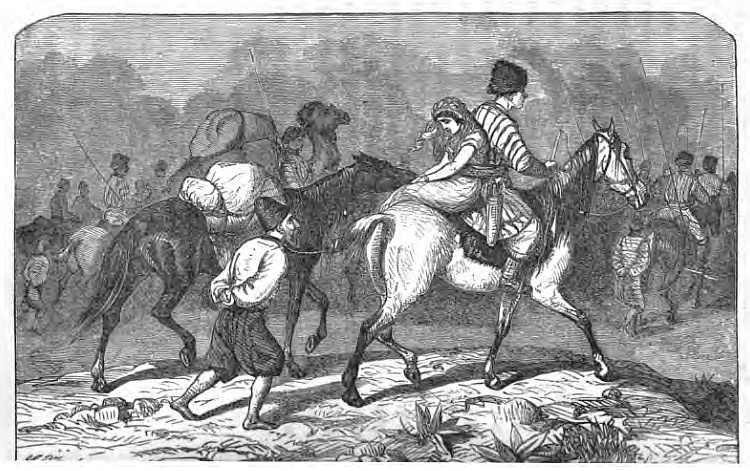
Even a pastoral people in these regions would find but a sorry subsistence, were they confined to one spot; for the luxurious herbage which, for the most part, characterises the great savanna plains of America, is either altogether wanting upon the steppes of Asia, or at best very meagre and inconstant. A fixed abode is therefore impossible, except in the most fertile tracts or oases: elsewhere, the nomad life is a necessity arising from the circumstances of the soil.
It would be difficult to define exactly the limits of the territory occupied by the wandering races in Asia; but in a general way it may be said that the whole central portion of the continent is thus peopled: indeed, much more than the central portion,—for, if we except the rich agricultural countries of Hindostan and a small portion of Persia, Arabia, and Turkey, the whole of Asia is of this character. The countries known as Balk and Bokara, Yarkand and Khiva, with several others of equal note, are merely the central points of oases,—large towns, supported rather by commerce than by the produce of agriculture, and having nomad tribes dwelling within sight of their walls. Even the present boundaries of Asiatic Turkey, Arabia and Persia, contain within them a large proportion of nomadic population; and the same is true of Eastern Poland and Russia in Europe. A portion of the Affghan and Belochee country is also inhabited by nomad people.
These wandering people are of many different types and races of men; but there is a certain similarity in the habits and customs of all: as might be expected from the similar circumstances in which they are placed.
It is always the more sterile steppes that are thus occupied; and this is easily accounted for: where fertile districts occur the nomad life is no longer necessary. Even a wandering tribe, entering upon such a tract, would no longer have a motive for leaving it, and would soon become attached to the soil,—in other words, would cease to be wanderers; and whether they turned their attention to the pursuit of agriculture, or not, they would be certain to give up their tent-life, and fix themselves in a permanent abode. This has been the history of many Asiatic tribes; but there are many others, again, who from time immemorial, have shown a repugnance to the idea of fixing themselves to the soil. They prefer the free roving life which the desert enables them to indulge in; and wandering from place to place as the choice of pasture guides them, occupy themselves entirely in feeding their flocks and herds,—the sole means of their subsistence. These never have been, and never could be, induced to reside in towns or villages.
Nor is it that they have been driven into these desert tracts to seek shelter from political oppression,—as is the case with some of the native tribes of Africa and America. On the contrary, these Asiatic nomads are more often the aggressors than the objects of aggression. It is rather a matter of choice and propensity with them: as with those tribes of the Arabian race,—known as “Bedouins.”
The proportion of the Asiatic wandering population to those who dwell in towns, or fixed habitations, varies according to the nature of the country. In many extensive tracts, the former greatly exceed the latter; and the more sterile steppes are almost exclusively occupied by them. In general, they acknowledge the sovereignty of some of the great powers,—such as the empires of China, Russia, and Turkey, the kingdom of Persia, or that of several powerful khans, as those of Khiva and Bokara; but this sovereignty is, for the most part, little more than nominal, and their allegiance is readily thrown off, whenever they desire it. It is rarely so strong, as to enable any of the aforesaid powers to draw a heavy tribute from them; and some of the more warlike of the wandering tribes are much courted and caressed,—especially when their war services are required. In general they claim an hereditary right to the territories over which they roam, and pay but little heed to the orders of either king, khan, or emperor.
As already stated, these wandering people are of different races; in fact, they are of nearly all the varieties indigenous to the Asiatic continent; and a whole catalogue of names might be given, of which Mongols, Tartars, Turcomans, Usbecks, Kirghees, and Calmucks, are perhaps the most generally known. It has been also stated that in many points they are alike; but there are also many important particulars in which they differ,—physical, moral, and intellectual. Some of the “hordes,” or tribes, are purely pastoral in their mode of life, and of mild and hospital dispositions, exceedingly fond of strangers, and kind to such as come among them. Others again are averse to all intercourse with others, than those of their own race and religion, and are shy, if not inhospitable, when visited by strangers. But there is a class of a still less creditable character,—a large number of tribes that are not only inhospitable, and hostile to strangers, but as ferocious and bloodthirsty as any savages in Africa, America, or the South-Sea Islands.
As a fair specimen of this class we select the Turcomans; in fact, they may be regarded as its type; and our description henceforward may be regarded as applying particularly to these people.
The country of the Turcomans will be found upon the map without difficulty; but to define its exact boundary would be an impossibility, since none such exists. Were you to travel along the whole northern frontier of Persia, almost from the gates of Teheran to the eastern frontier of the kingdom,—or even further towards Balk,—you would be pretty sure of hearing of Turcoman robbers, and in very great danger of being plundered by them,—which last misfortune would be of less importance, as it would only be the prelude to your being either murdered on the spot, or carried off by them into captivity. In making this journey along the northern frontier of Persia, you would become acquainted with the whereabouts of the Turcoman hordes; or rather you would discover that the whole north part of Persia,—a good broad band of it extending hundreds of miles into its interior,—if not absolutely in possession of the Turcomans, is overrun and plundered by them at will. This, however, is not their home,—it is only their “stamping-ground,”—the home of their victims. Their place of habitual residence lies further to the north, and is defined with tolerable accuracy by its having the whole eastern shore of the Caspian Sea for its western border, while the Amou River (the ancient Oxus) may be generally regarded as the limit of their range towards the east. Some tribes go still further east than the Amou; but those more particularly distinguished for their plundering habits dwell within the limits described,—north of the Elburz Mountains, and on the great steppe of Kaurezm, where they are contiguous to the Usbeck community of Khiva.
The whole of this immense territory, stretching from the eastern shore of the Caspian to the Amou and Aral Sea, may be characterised as a true desert. Here and there oases exist, but none of any importance, save the country of Khiva itself: and even that is but a mere irrigated strip, lying on both banks of the Oxus. Indeed, it is difficult to believe that this territory of Khiva, so insignificant in superficial extent, could have been the seat of a powerful empire, as it once was.
The desert, then, between the Caspian Sea and the Oxus River may be regarded as the true land of the Turcomans, and is usually known as Turcomania. It is to be remembered, however, that there are some kindred tribes not included within the boundaries of Turcomania—for the Turkistan of the geographers is a country of much larger extent; besides, an important division of the Turcoman races are settlers, or rather wanderers in Armenia. To Turcomania proper, then, and its inhabitants, we shall confine our remarks.
We shall not stay to inquire into the origin of the people now called Turcomans. Were we to speculate upon that point, we should make but little progress in an account of their habits and mode of living. They are usually regarded as of Tartar origin, or of Usbeck origin, or of Mongolian race; and in giving this account of them, I am certain that I add very little to your knowledge of what they really are. The truth is, that the words Tartar and Mongol and some half-dozen other titles, used in relation to the Asiatic races, are without any very definite signification,—simply because the relative distinctions of the different nations of that continent are very imperfectly known; and learned ethnologists are river loath to a confession of limited knowledge. One of this class, Mr Latham,—who requires only a few words of their language to decide categorically to what variety of the human race a people belongs,—has unfortunately added to this confusion by pronouncing nearly everybody Mongolian: placing the proud turbaned Turk in juxtaposition with the squat and stunted Laplander! Of course this is only bringing us back to the old idea, that all men are sprung from a single pair of first parents,—a doctrine, which, though popular, is difficult to reconcile with the rational knowledge derived from ethnological investigation.
It matters little to our present purpose from what original race the Turcoman has descended: whether he be a true Turk, as some regard him, or whether he is a descendant of the followers of the Great Khan of the Tartars. He possesses the Tartar physiognomy to a considerable extent—some of the tribes more than others being thus distinguished,—and high cheek-bones, flat noses, small oblique eyes, and scanty beards, are all characteristics that are very generally observed. Some of these peculiarities are more common among the women than the men—many of the latter being tall, stout, and well-made, while a large number may be seen who have the regular features of a Persian. Perhaps it would be safest to consider the present Turcoman tribes as not belonging to a pure stock, but rather an admixture of several; and their habit of taking slaves from other nations, which has for a long time existed among them, would give probability to this idea. At all events, without some such hypothesis, it is difficult to account for the wonderful variety, both in feature and form, that is found among them. Their complexion is swarthy, in some cases almost brown as that of an American Indian; but constant exposure to the open air, in all sorts of weather, has much to do in darkening the hue of their skin. The newborn children are nearly as white as those of the Persians; and their young girls exhibit a ruddy brunette tint, which some consider even more pleasing than a perfectly white complexion.
The costume of the Turcoman, like that of most Oriental nations, is rich and picturesque. The dress of the men varies according to rank. Some of the very poorer people wear nothing but a short woollen tonic or shirt, with a pair of coarse woollen drawers. Others, in place of this shirt, are clad in a longer garment, a sort of robe or wrapper, like a gentleman’s dressing-gown, made of camel’s-hair cloth, or some coarse brown woollen staff. But the true Turcoman costume, and that worn by all who can afford it, consists of a garment of mixed silk and cotton,—the baronnee,—which descends below the knee, and though open in front, is made to button over the breast quite up to the neck. A gay sash around the waist adds to the effect; and below the skirt are seen trowsers of cotton or even silk. Cloth wrappers around the legs serve in the place of boots or gaiters; and on the feet are worn slippers of Persian fashion, with socks of soft Koordish leather.
As the material of which the baronnee is made is of good quality—a mixture of silk and cotton—and as the fabric is always striped or checkered in colours of red, blue, purple, and green, the effect produced is that of a certain picturesqueness. The head-dress adds to this appearance—being a high fur cap, with truncated top, the fur being that beautiful kind obtained from the skins of the Astracan lamb, well-known in commerce. These caps are of different colours, either black, red, or grey. Another style of head-dress much worn is a round-topped or helmet-shaped cap, made of quilted cotton-stuff; but this kind, although in use among the Turcomans, is a more characteristic costume of their enemies, the “Koords,” who wear it universally.
The “jubba” is a kind of robe generally intended to go over the other garments, and is usually of woollen or camel’s-hair cloth. It is also made like a dressing-gown, with wide sleeves,—tight, however, around the wrist. It is of ample dimensions, and one side is lapped over the other across the front, like a double-breasted coat. The “jubba” is essentially a national garment.
The dress of the women is exceedingly picturesque. It is thus minutely described by a traveller:—
“The head-dress of these women is singular enough: most of them wear a lofty cap, with a broad crown, resembling that of a soldier’s cap called a shako. This is stuck upon the back of the head; and over it is thrown a silk handkerchief of very brilliant colours, which covers the top, and falls down on each side like a veil. The front of this is covered with ornaments of silver and gold, in various shapes; more frequently gold coins, mohrs, or tomauns, strung in rows, with silver bells or buttons, and chains depending from them; hearts and other fanciful forms, with stones set in them. The whole gives rather the idea of gorgeous trappings for a horse, than ornaments for a female.
“The frames of these monstrous caps are made of light chips of wood, or split reeds, covered with cloth; and when they do not wear these, they wrap a cloth around their heads in the same form; and carelessly throw another, like a veil over it. The veil or curtain above spoken of covers the mouth; descending to the breast. Earrings are worn in the ears; and their long hair is divided, and plaited into four parts, disposed two on each side; one of which falls down behind the shoulders and one before, and both are strung with a profusion of gold ornaments, agates, cornelians, and other stones, according to the means and quality of the wearer. The rest of their dress consists of a long, loose vest or shirt, with sleeves, which covers the whole person down to the feet, and is open at the breast, in front, but buttons or ties close up to the neck: this is made of silk or cotton-stuff, red, blue, green, striped red, and yellow, checked, or various-coloured: underneath this, are the zere-jameh, or drawers, also of silk or cotton; and some wear a short peerahn or shirt of the same. This, I believe, is all; but in the cold weather they wear, in addition, jubbas, or coats like those of the men, of striped stuff made of silk and cotton; on their feet they generally wear slippers like those of the Persian women.”
The tents, or “portable houses” of the Turcomans—as their movable dwellings rather deserve to be called—differ from most structures of the kind in use elsewhere. They are thus described by the same intelligent traveller:—
“The portable wooden houses of the Turcomans have been referred to by several writers; but I am not aware that any exact description of their structure has been given. The frame is curiously constructed of light wood, disposed in laths of about an inch broad by three quarters thick, crossing one another diagonally, but at right angles, about a foot asunder, and pinned at each crossing with thongs of raw hide, so as to be movable; and the whole framework may be closed up or opened in the manner of those toys for children that represent a company of soldiers, and close or expand at will, so as to form open or close column.
“One or more pieces thus constructed being stretched out, surround a circular space of from fifteen to twenty feet diameter; and form the skeleton of the walls,—which are made firm by bands of hair or woollen ropes, hitched round the end of each rod, to secure it in its position. From the upper ends of these, rods of a similar kind, bent near the wall end into somewhat less than a right angle, are so disposed that the longer portions slope to the centre, and being tied with ropes, form the framework of a roof. Over this is thrown a covering of black numud, leaving in the centre a large hole to give vent to the smoke, and light to the dwelling. Similar numuds are wrapped round the walls; and outside of these, to keep all tight, is bound another frame, formed of split reeds or cane, or of very light and tough wood, tied together with strong twine, the pieces being perpendicular. This is itself secured by a strong, broad band of woven hair-stuff, which firmly unites. The large round opening at top is covered, as occasion requires, by a piece of numud, which is drawn off or on by a strong cord, like a curtain. If the wind be powerful, a stick is placed to leeward, which supports the fabric.
“In most of these houses they do not keep a carpet or numud constantly spread; but the better classes use a carpet shaped somewhat in the form of a horseshoe, having the centre cut out for the fireplace, and the ends truncated, that those of inferior condition, or who do not choose to take off their boots, may sit down upon the ground. Upon this carpet they place one or two other numuds, as may be required, for guests of distinction. When they have women in the tent, a division of split reeds is made for their convenience; but the richer people have a separate tent for their private apartments.
“The furniture consists of little more than camels and horses; joals, or bags in which their goods are packed, and which are often made of a very handsome species of worsted velvet carpet, of rich patterns; the swords, guns, spears, bows and arrows, and other implements of the family, with odds and ends of every description, may be seen hung on the ends of the wooden rods, which form very convenient pins for the purpose. Among some tribes all the domestic utensils are made of wood,—calleeoons, trays for presenting food, milk-vessels, etc: among others, all these things are formed of clay or metal. Upon the black tops of the tents may frequently be seen large white masses of sour curd, expressed from buttermilk, and set to dry as future store; this, broken down and mixed with water, forms a very pleasant acidulous drink, and is used as the basis of that intoxicating beverage called kimmiz. The most common and most refreshing drink which they offer to the weary and over-heated traveller in the forenoon is buttermilk, or sour curds and water; and, indeed, a modification of this, with some other simple sherbets, are the only liquors presented at their meals.
“Such are the wooden houses of the Turcomans, one of which just makes a camel’s load. There are poorer ones, of a less artificial construction, the framework of which is formed of reeds.
“The encampment is generally square, enclosing an open space, or forming a broad street, the houses being ranged on either side, with their doors towards each other. At these may always be seen the most picturesque groups, occupied with their various domestic duties, or smoking their simple wooden calleeoons. The more important encampments are surrounded by a fence of reeds, which serve to protect the flocks from petty thefts.”
It is now our place to inquire how the Turcomans occupy their time. We have already described them as a pastoral and nomadic people; and, under ordinary circumstances, their employment consists in looking after their flocks. In a few of the more fertile oases they have habitations, or rather camps, of a more permanent character, where they cultivate a little corn or barley, to supply them with the material for bread; but these settlements, if they deserve the name, are only exceptional; and are used chiefly as a kind of head-quarters, where the women and property are kept, while the men themselves are absent on their thieving expeditions. More generally their herds are kept on the move, and are driven from place to place at short intervals of a few weeks or even days. The striking and pitching of their tents gives them employment; to which is added that of milking the cattle, and making the cheese and butter. The women, moreover, fill up their idle hours in weaving the coarse blankets, or “numuds,” in plaiting mats, and manufacturing various articles of dress or household use. The more costly parts of their costume, however, are not of native manufacture: these are obtained by trade. The men alone look after the camels and horses, taking special care of the latter.