"Being a Popular Description of Singular Races of Man" (continued 6)
Reading edition
Chapter Twelve.
The Pehuenches, or Pampas Indians.
The vast plain known as the “Pampas” is one of the largest tracts of level country upon the face of the earth. East and west it stretches from the mouth of the Rio de la Plata to the foothills of the Andes mountains. It is interrupted on the north by a series of mountains and hill country, that cross from the Andes to the Paraguay River, forming the Sierras of Mendoza, San Luis, and Cordova; while its southern boundary is not so definitely marked, though it may be regarded as ending at the Rio Negro, where it meets, coming up from the south, the desert plains of Patagonia.
Geologically, the Pampas (or plains, as the word signifies, in the language of the Peruvian Indians) is an alluvial formation,—the bed of an ancient sea,—upheaved by some unknown cause to its present elevation, which is not much above the ocean-level. It is not, therefore, a plateau or “tableland,” but a vast natural meadow. The soil is in general of a red colour, argillaceous in character, and at all points filled with marine shells and other testimonies that the sea once rolled over it. It is in the Pampas formation that many of the fossil monsters have been found,—the gigantic megatherium, the colossal mylodon, and the giant armadillo (glyptodon), with many other creatures, of such dimensions as to make it a subject of speculation how the earth could have produced food enough for their maintenance.
In giving to the Pampas the designation of a vast meadow, do not suffer yourself to be misled by this phrase,—which is here and elsewhere used in rather a loose and indefinite manner. Many large tracts in the Pampas country would correspond well enough to this definition,—both as regards their appearance and the character of the herbage which covers them; but there are other parts which bear not the slightest resemblance to a meadow. There are vast tracts thickly covered with tall thistles,—so tall as to reach to the head of a man mounted on horseback, and so thickly set, that neither man nor horse could enter them without a path being first cleared for them.
Other extensive tracts are grown over with tall grass so rank as to resemble reeds or rushes more than grass; and an equally extensive surface is timbered with small trees, standing thinly and without underwood, like the fruit-trees in an orchard. Again, there are wide morasses and extensive lakes, many of them brackish, and some as salt as the sea itself. In addition to these, there are “salinas,” or plains of salt,—the produce of salt lakes, whose waters have evaporated, leaving a stratum of pure salt often over a foot in thickness, and covering their beds to an extent of many square leagues. There are some parts, too, where the Pampas country assumes a sterile and stony character,—corresponding to that of the great desert of Patagonia. It is not correct therefore, to regard the Pampas as one unbroken tract of meadow. In one character alone is it uniform in being a country without mountains,—or any considerable elevations in the way of ridges or hills,—though a few scattered sierras are found both on its northern and southern edges.
The Thistle Pampas, as we take the liberty of naming them, constitute perhaps the most curious section of this great plain; and not the less so that the “weed” which covers them is supposed not to be an indigenous production, but to have been carried there by the early colonists. About this, however, there is a difference of opinion. No matter whence sprung, the thistles have flourished luxuriantly, and at this day constitute a marked feature in the scenery of the Pampas. Their position is upon the eastern edge of the great plain, contiguous to the banks of the La Plata; but from this river they extend backwards into the interior, at some points to the distance of nearly two hundred miles. Over this vast surface they grow so thickly that, as already mentioned, it is not possible for either man or horse to make way through them. They can only be traversed by devious paths—already formed by constant use, and leading through narrow lanes or glades, where, for some reason, the thistles do not choose to grow. Otherwise they cannot be entered even by cattle. These will not, unless compelled, attempt penetrating such an impervious thicket; and if a herd driven along the paths should chance to be “stampeded” by any object of terror, and driven to take to the thistles, scarce a head of the whole flock can ever afterwards be recovered. Even the instincts of the dumb animals do not enable them to find their way out again; and they usually perish, either from thirst, or by the claws of the fierce pumas and jaguars, which alone find themselves at home in the labyrinthine “cardonales.” The little viscacha contrives to make its burrow among them, and must find subsistence by feeding upon their leaves and seed, since there is no other herbage upon the ground,—the well-armed thistle usurping the soil, and hindering the growth of any other plants. It may be proper to remark, however, that there are two kinds of these plants, both of which cover large tracts of the plain. One is a true thistle, while the other is a weed of the artichoke family, called by the Spanish Americans “cardoon.” It is a species of Cardunculus. The two do not mingle their stalks, though both form thickets in a similar manner and often in the same tract of country. The cardoon is not so tall as the thistle; and, being without spines, its “beds” are more easily penetrated; though even among these, it would be easy enough to get entangled and lost.
It is proper to remark here, that these thistle-thickets do not shut up the country all the year round. Only for a season,—from the time they have grown up and “shoot,” till their tall ripened stalks wither and fall back to the earth, where they soon moulder into decay. The plains are then open and free to all creatures,—man among the rest,—and the Gaucho, with his herds of horses, horned cattle, and sheep, or the troops of roving Indians, spread over and take possession of them.
The young thistles now present the appearance of a vast field of turnips; and their leaves, still tender, are greedily devoured by both cattle and sheep. In this condition the Pampas thistles remain during their short winter; but as spring returns, they once more “bristle” up, till, growing taller and stouter, they present a chevaux-de-frise that at length expels all intruders from their domain.
On the western selvage of this thistle tract lies the grass-covered section of the Pampas. It is much more extensive than that of the “cardonales,”—having an average width of three hundred miles, and running longitudinally throughout the whole northern and southern extension of the Pampas. Its chief characteristic is a covering of coarse grass,—which at different seasons of the year is short or tall, green, brown, or yellowish, according to the different degrees of ripeness. When dry, it is sometimes fired,—either by design or accident,—as are also the withered stems of the thistles; and on these occasions a conflagration occurs, stupendous in its effects,—often extending over vast tracts, and reducing everything to black ashes. Nothing can be more melancholy to the eye than the aspect of a burnt pampa.
The grass section is succeeded by that of the “openings,” or scanty forests, already mentioned; but the trees in many places are more closely set; assuming the character of thickets, or “jungles.” These tracts end among the spurs of the Andes,—which, at some points, are thrown out into the plain, but generally rise up from it abruptly and by a well-defined border.
The marshes and bitter lakes above mentioned are the produce of numerous streams, which have their rise in the Great Cordillera of the Andes, and run eastward across the Pampas. A few of these, that trend in a southerly direction, reach the Atlantic by means of the two great outlets,—the “Colorado” and “Negro.” All the others—and “their name is legion”—empty their waters into the morasses and lakes, or sink into the soil of the plains, at a greater or less distance from the Cordillera, according to the body of water they may carry down. Evaporation keeps up the equilibrium.
Who are the dwellers upon the Pampas? To whom does this vast pasture-ground belong? Whose flocks and herds are they that browse upon it?
You will be told that the Pampas belong to the republic of Buenos Ayres, or rather to the “States of the Argentine Confederation,”—that they are inhabited by a class of citizens called “Gauchos,” who are of Spanish race, and whose sole occupation is that of herdsmen, breeders of cattle and horses,—men famed for their skill as horsemen, and for their dexterity in the use of the “lazo” and “bolas,”—two weapons borrowed from the aboriginal races.
All this is but partially true. The proprietorship of this great plain was never actually in the hands of the Buenos-Ayrean government, nor in those of their predecessors,—the Spaniards. Neither has ever owned it—either by conquest or otherwise:—no further than by an empty boast of ownership; for, from the day when they first set foot upon its borders to the present hour, neither has ever been able to cross it, or penetrate any great distance into it, without a grand army to back their progress. But their possession virtually ceased at the termination of each melancholy excursion; and the land relapsed to its original owners. With the exception of some scanty strips along its borders, and some wider ranges, thinly occupied by the half-nomade Gauchos, the Pampas are in reality an Indian territory, as they have always been; and the claim of the white man is no more than nominal,—a mere title upon the map. It is not the only vast expanse of Spanish American soil that never was Spanish.
The true owners of the Pampas, then, are the red aborigines,—the Pampas Indians; and to give some account of these is now our purpose.
Forming so large an extent, it is not likely it should all belong to one united tribe,—that would at once elevate them into the character of a nation. But they are not united. On the contrary, they form several distinct associations, with an endless number of smaller subdivisions or communities,—just in the same way as it is among their prairie cousin of the north. They may all, however, be referred to four grand tribal associations or nationalities,—the Pehuenches, Puelches, Picunches, and Ranqueles.
Some add the Puilliches, who dwell on the southern rim of the Pampas; but these, although they extend their excursions over a portion of the great plain, are different from the other Pampas Indians in many respects,—altogether a braver and better race of men, and partaking more of the character of the Patagonians,—both in point of physique and morale,—of which tribes, indeed, they are evidently only a branch. In their dealings with white men, when fairly treated, these have exhibited the same noble bearing which characterises the true Patagonian. I shall not, therefore, lower the standard—neither of their bodies nor their minds—by classing them among “Pampas Indians.”
Of these tribes—one and all of them—we have, unfortunately, a much less favourable impression; and shall therefore be able to say but little to their credit.
The different names are all native. Puelches means the people living to the east, from “puel,” east, and che, people. The Picunches derive this appellation, in a similar fashion, from “picun,” signifying the north. The Pehuenches are the people of the pine-tree country, from “pehuen,” the name for the celebrated “Chili pine” (Araucaria); and the Ranqueles are the men who dwell among the thistles, from ranquel, a thistle.
These national appellations will give some idea of the locality which each tribe inhabits. The Ranqueles dwell, not among the thistles,—for that would be an unpleasant residence, even to a red-skin; but along the western border of this tract. To the westward of them, and up into the clefts of the Cordilleras extends the country of the Pehuenches; and northward of both lies the land of the Picunches. Their boundary in that direction should be the frontiers of the quasi-civilised provinces of San Luis and Cordova, but they are not; for the Picunche can at will extend his plundering forays as far north as he pleases: even to dovetailing them into the similar excursions of his Guaycuru kinsmen from the “Gran Chaco” on the north.
The Puelche territory is on the eastern side of the Pampas, and south from Buenos Ayres. At one time these people occupied the country to the banks of the La Plata; and no doubt it was they who first met the Spaniards in hostile array. Even up to a late period their forays extended almost to Buenos Ayres itself; but Rosas, tyrant as he may have been, was nevertheless a true soldier, and in a grand military expedition against them swept their country, and inflicted such a terrible chastisement upon both them and the neighbouring tribes, as they had not suffered since the days of Mendoza. The result has been a retirement of the Puelche frontier to a much greater distance from Buenos Ayres; but how long it may continue stationary is a question,—no longer than some strong arm—such as that of Rosas—is held threateningly over them.
It is usual to inquire whence come a people; and the question has been asked of the Pampas Indians. It is not difficult to answer. They came from the land of Arauco. Yes, they are the kindred of that famed people whom the Spaniards could never subdue,—even with all their strength put forth in the effort. They are near kindred too,—the Pehuenches especially,—whose country is only separated from that of the Araucanians by the great Cordillera of Chili; and with whom, as well as the Spaniards on the Chilian side, they have constant and friendly intercourse.
But it must be admitted, that the Araucanians have had far more than their just meed of praise. The romantic stories, in that endless epic of the rhymer Ercilla, have crept into history; and the credulous Molina has endorsed them: so that the true character of the Araucanian Indian has never been understood. Brave he has shown himself, beyond doubt, in defending his country against Spanish aggression; but so, too, has the Carib and Guaraon,—so, too, has the Comanche and Apache, the Yaqui of Sonora, the savage of the Mosquito shore, the Guaycuru of the Gran Chaco, and a score of other Indian tribes,—in whose territory the Spaniard has never dared to fix a settlement. Brave is the Araucanian; but, beyond this, he has few virtues indeed. He is cruel in the extreme,—uncivil and selfish,—filthy and indolent,—a polygamist in the most approved fashion,—a very tyrant over his own,—in short, taking rank among the beastliest of semi-civilised savages,—for it may be here observed, that he is not exactly what is termed a savage: that is, he does not go naked, and sleep in the open air. On the contrary, he clothes himself in stuff of his own weaving,—or rather, that of his slave-wives,—and lives in a hut which they build for him. He owns land, too,—beautiful fields,—of which he makes no use: except to browse a few horses, and sheep, and cattle. For the rest, he is too indolent to pursue agriculture; and spends most of his time in drinking chicha, or tyrannising over his wives. This is the heroic Araucanian who inhabits the plains and valleys of Southern Chili.
Unfortunately, by passing to the other side of the Andes, he has not improved his manners. The air of the Pampas does not appear to be conducive to virtue; and upon that side of the mountains it can scarce be said to exist,—even in the shape of personal courage. The men of the pines and thistles seem to have lost this quality, while passing through the snows of the Cordilleras, or left it behind them, as they have also left the incipient civilisation of their race. On the Pampas we find them once more in the character of the true savage: living by the chase or by plunder; and bartering the produce of the latter for the trappings and trinkets of personal adornment, supplied them by the unprincipled white trader. Puelches and Picunches, Pehuenches and Ranqueles, all share this character alike,—all are treacherous, quarrelsome, and cowardly.
But we shall now speak more particularly of their customs and modes of life, and we may take the “pine people” as our text,—since these are supposed to be most nearly related to the true Araucanians,—and, indeed, many of their “ways” are exactly the same as those of that “heroic nation.”
The “people of the pines” are of the ordinary stature of North-American Indians, or of Europeans; and their natural colour is a dark coppery hue. But it is not often you can see them in their natural colour: for the Pampas Indians, like nearly all the aboriginal tribes, are “painters.” They have pigments of black and white, blue, red, and yellow,—all of which they obtain from different coloured stones, found in the streams of the Cordilleras. “Yama,” they call the black stone; “colo,” the red; “palan,” the white; and “codin,” the blue; the yellow they obtain from a sort of argillaceous earth. The stones of each colour they submit to a rubbing or grinding process, until a quantity of dust is produced; which, being mixed with suet, constitutes the paint, ready for being laid on.
The Pampas Indians do not confine themselves to any particular “escutcheon.” In this respect their fancy is allowed a wide scope, and their fashions change. A face quite black, or red, is a common countenance among them; and often may be seen a single band, of about two inches in width, extending from ear to ear across the eyes and nose. On war excursions they paint hideous figures: not only on their own faces and bodies, but on their trappings, and even upon the bodies of their horses,—aiming to render themselves as appalling as possible in the sight of their enemies. The same trick is employed by the warriors of the prairies, as well as in many other parts of the world. Under ordinary circumstances, the Pampas Indian is not a naked savage. On the contrary, he is well clad; and, so far from obtaining the material of his garments from the looms of civilised nations, he weaves it for himself,—that is, his wives weave it; and in such quantity that he has not only enough for his own “wear,” but more than enough, a surplus for trade. The cloth is usually a stuff spun and woven from sheep’s wool. It is coarse, but durable; and in the shape of blankets or “ponchos,” is eagerly purchased by the Spanish traders. Silver spurs, long, pointed knives, lance-heads, and a few other iron commodities, constitute the articles of exchange, with various ornamental articles, as beads, rings, bracelets, and large-headed silver bodkins to fasten their cloaks around the shoulders of his “ladies.” Nor is he contented with mere tinsel, as other savages are,—he can tell the difference between the real metal and the counterfeit, as well as the most expert assayer; and if he should fancy to have a pair of silver spurs, not even a Jew peddler could put off upon him the plated “article.” In this respect the Araucanian Indian has been distinguished, since his earliest intercourse with Europeans; and his Pampas kindred are equally subtle in their appreciation.
The Pampas Indian, when well dressed, has a cloak upon his shoulders of the thick woollen stuff already described. It is usually woven in colours; and is not unlike the “poncho” worn by the “gauchos” of Buenos Ayres, or the “serape” of the Mexicans. Besides the cloak, his dress consists of a mere skirt,—also of coloured woollen stuff, being an oblong piece swathed around his loins, and reaching to the knee. A sash or belt—sometimes elaborately ornamented—binds the cloth around the waist. Boots of a peculiar construction complete the costume. These are manufactured in a very simple manner. The fresh skin taken from a horse’s hind leg is drawn on—just as if it were a stocking—until the heel rests in that part which covered the hock-joint of the original wearer. The superfluous portion is then trimmed to accommodate itself as a covering for the foot; and the boot is not only finished, but put on,—there to remain until it is worn out, and a new one required! If it should be a little loose at first, that does not matter. The hot sun, combined with the warmth of the wearer’s leg, soon contracts the hide, and brings it to “fit like a glove.” The head is often left uncovered; but as often a sort of skullcap or helmet of horse-skin is worn; and not unfrequently a high, conical hat of palm fibre. This last is not a native production, but an importation of the traders. So also is a pair of enormous rings of brass, which are worn in the ears; and are as bulky as a pair of padlocks. In this costume, mounted on horseback with his long lance in hand, the Pampas Indian would be a picturesque, object; and really is so, when clean; but that is only on the very rarest occasions,—only when he has donned a new suit. At all other times, not only his face and the skin of his body, but every rag upon his back, are covered with grease and filth,—so as to produce an effect rather “tatterdemalion” than picturesque.
The “squaw” is costumed somewhat differently. First, she has a long “robe,” which covers her from neck to heels, leaving only her neck and arms bare. The robe is of red or blue woollen stuff of her own weaving. This garment is the “quedeto.” A belt, embroidered with beads, called “quepique,” holds it around the waist, by means of a large silver buckle. This belt is an article, of first fashion. Over the shoulders hangs the “iquilla,” which is a square piece of similar stuff,—but usually of a different dye; and which is fastened in front by a pin with a large silver head, called the “tupo.” The shock of thick, black hair—after having received the usual anointment of mare’s tallow, the fashionable hair-oil of the Pampas Indians—is kept in its place by a sort of cap or coiffure, like a shallow dish inverted, and bristling all over with trader’s beads. To this a little bell is fastened; or sometimes a brace of them are worn as earrings. These tinkle so agreeably in the ears of the wearer, that she can scarce for a moment hold her head at rest, but keeps rocking it from side to side, as a Spanish coquette would play with her fan.
In addition to this varied wardrobe, the Pampas belle carries a large stock of bijouterie,—such as beads and bangles upon her neck, rings and circlets upon her arms, ankles, and fingers; and, to set her snaky locks in order, she separates them by means of a stiff brush, made from the fibrous roots of a reed. She is picturesque enough, but never pretty. Nature has given the Araucanian woman a plain face; and all the adornment in the world cannot hide its homeliness.
The Pehuenche builds no house. He is a true nomade, and dwells in a tent, though one of the rudest construction. As it differs entirely from the tent of the prairie Indians, it may be worth while describing it.
Its framework is of reeds,—of the same kind as are used for the long lances so often mentioned; and which resemble bambusa canes. They grow in plenty throughout the Pampas, especially near the mountains,—where they form impenetrable thickets on the borders of the marshy lakes. Any other flexible poles will serve as well, when the canes are not “handy.”
The poles being procured, one is first bent into a semicircle, and in this shape both ends are stuck into the ground, so as to form an arch about three feet in height. This arch afterwards becomes the doorway or entrance to the tent. The remaining poles are attached to this first one at one end, and at right angles; and being carried backward with a slight bend, their other ends are inserted into the turf. This forms the skeleton of the tent; and its covering is a horse-skin, or rather a number of horse-skins stitched together, making a sort of large tarpaulin. The skins are sewed with the sinews of the horse or ox,—which are first chewed by the women, until their fibres become separated like hemp, and are afterwards spun by them into twine.
The tent is not tall enough to admit of a man standing erect; and in it the Pehuenche crouches, whenever it snows, rains, or blows cold. He has sheep-skins spread to sleep upon, and other skins to serve as bed-clothes,—all in so filthy a condition, that but for the cold, he might find it far more comfortable to sleep in the open air. He never attempts to sweep out this miserable lair; but when the spot becomes very filthy, he “takes up his sticks” and shifts his penates to a fresh “location.” He is generally, however, too indolent to make a “remove,”—until the dirt has accumulated so as to “be in the way.”
The Pampas Indian is less of a hunter than most other tribes of savages. He has less need to be,—at least, in modern days; for he is in possession of three kinds of valuable domestic animals, upon which he can subsist without hunting,—horses, horned cattle, and sheep. Of course, these are of colonial origin. He hunts, nevertheless, for amusement, and to vary his food. The larger ostrich (rhea Americana), the guanaco, and the great “gama” stag of the Pampas (cervus campestris) are his usual game. These he captures with the bolas,—which is his chief implement for the chase. In the flesh of the stag he may find a variety, but not a delicacy. Its venison would scarce tempt a Lucullian palate,—since even the hungriest Gaucho will not eat it. It is a large beast, often weighing above three hundred pounds; and infecting the air with such a rank odour, that dogs decline to follow it in the chase. This odour is generated in a pair of glands situated near the eyes; and it has the power of projecting it at will,—just as skunks and polecats when closely chased by an enemy. If these glands are cut out immediately after the animal is killed, the flesh tastes well enough: otherwise it is too rank to be eatable. The Indians cure it of the “bad smell” by burying it for several days in the ground; which has the effect of “sweetening” it, while at the same time it makes it more tender.
But the Pampas Indian does not rely upon the chase for his subsistence. He is a small grazier in his way; and is usually accompanied in his wanderings by a herd of horned cattle and sheep. He has also his stud of horses; which furnish the staple of his food,—for whenever he hungers, a horse is “slaughtered.” Strictly speaking, it is not a horse, for it is the mare that is used for this purpose. In no part of the Pampas region,—not even in the white settlement,—are the mares used for riding. It would be considered derogatory to the character of either Gaucho or Indian to mount a mare; and these are kept only for breeding purposes. Not that the Indian is much of a horse-breeder. He keeps up his stock in quite another way,—by stealing. The same remark will apply to the mode by which he recruits his herds of horned cattle, and his flocks of sheep. The last he values only for their wool; out of which his garments are woven; and which has replaced the scantier fleece of the vicuna and guanaco,—the material used by him in days gone by.
From whom does he steal these valuable animals,—and in such numbers as almost to subsist upon them? That is a question that can be easily answered; though it is not exact language to say that he steals them. Rather say that he takes them, by main force and in open daylight,—takes them from the Creole Spaniard,—the Gaucho and estanciero. Nay, he does not content himself always with four-footed plunder; but often returns from his forays with a crowd of captives,—women and children, with white skins and ruddy cheeks,—afterwards to be converted into his drudges and slaves. Not alone to the frontier does he extend these plundering expeditions; but even into the heart of the Spanish settlements,—to the estancias of grandees, and the gates of fortified towns; and, strange as it may read, this condition of things has been in existence, not for years, but, at intervals, extending over a century!
But what may read stranger still—and I can vouch for it as true—is, that white men actually purchase this plunder from him,—not the human part of it, but the four-footed and the furniture,—for this, too, sometimes forms part of his booty. Yes, the surplus, of which the Indian can make no use or cares nothing about,—more especially the large droves of fine horses, taken from the Spaniards of Buenos Ayres,—are driven through the passes of the Cordilleras, and sold to the Spaniards of Chili! the people of one province actually encouraging the robbery of their kindred race in another! The very same condition of things exists in North America. The Comanche, steals, or rather takes, from the white settler of Tamaulipas and New Leon,—the Apache rieves from the white settler of Chihuahua and Sonora: both sell to the white settlers, who dwell along the banks of the Rio del Norte! And all these settlers are of one race,—one country,—one kindred! These things have hitherto been styled cosas de Mexico. Their signification may be extended to South America: since they are equally cosas de las Pampas.
We are not permitted to doubt the truth of these appalling facts,—neither as regards the nefarious traffic, nor the captive women and children. At this very hour, not less than four thousand individuals of Spanish-Mexican race are held captives by the prairie tribes; and when Rosas swept the Pampas, he released fifteen hundred of similar unfortunates from their worse than Egyptian taskmasters,—the Puelches!
With such facts as these before our eyes, who can doubt the decline of the Spanish power? the utter enfeeblement of that once noble race? Who can contradict the hypothetical prophecy—more than once offered in these pages—that if the two races be left to themselves, the aboriginal, before the lapse of a single century, will once more recover the soil; and his haughty victor be swept from the face of the American continent?
Nor need such a change be too keenly regretted. The Spanish occupation of America has been an utter failure. It has served no high human purpose, but the contrary. It has only corrupted and encowardiced a once brave and noble race; and, savage as may be the character of that which would supplant it, still that savage has within him the elements of a future civilisation.
Not so the Spaniard. The fire of his civilisation has blazed up with a high but fitful gleam. It has passed like the lightning’s flash. Its sparks have fallen and died out,—never to be rekindled again.
Chapter Thirteen.
The Yamparicos, or Root-Diggers.
It is now pretty generally known that there are many deserts in North America,—as wild, waste, and inhospitable as the famed Sahara of Africa. These deserts occupy a large portion of the central regions of that great continent—extending, north and south, from Mexico to the shores of the Arctic Sea; and east and west for several hundred miles, on each side of the great vertebral chain of the Rocky Mountains. It is true that in the vast territory thus indicated, the desert is not continuous; but it is equally true that the fertile stripes or valleys that intersect it, bear but a very small proportion to the whole surface. Many tracts are there, of larger area than all the British Islands, where the desert is scarce varied by an oasis, and where the very rivers pursue their course amidst rocks and barren sands, without a blade of vegetation on their banks. Usually, however, a narrow selvage of green—caused by the growth of cotton woods, willows, and a few humbler plants—denotes the course of a stream,—a glad sight at all times to the weary and thirsting traveller.
These desert wastes are not all alike, but differ much in character. In one point only do they agree,—they are all deserts. Otherwise they exhibit many varieties,—both of aspect and nature. Some of them are level plains, with scarce a hill to break the monotony of the view: and of this character is the greater portion of the desert country extending eastward from the Rocky Mountains to about 100 degrees of west longitude. At this point the soil gradually becomes more fertile,—assuming the character of timbered tracts, with prairie opening between,—at length terminating in the vast, unbroken forests of the Mississippi.
This eastern desert extends parallel with the Rocky Mountains,—throughout nearly the whole of their length,—from the Rio Grande in Mexico, northward to the Mackenzie River. One tract of it deserves particular mention. It is that known as the llano estacado, or “staked plain,” It lies in North-western Texas, and consists of a barren plateau, of several thousand square miles in extent, the surface of which is raised nearly a thousand feet above the level of the surrounding plains. Geologists have endeavoured to account for this singular formation, but in vain. The table-like elevation of the Llano estacado still remains a puzzle. Its name, however, is easier of explanation. In the days of Spanish supremacy over this part of Prairie-land, caravans frequently journeyed from Santa Fé in New Mexico, to San Antonio in Texas. The most direct route between these two provincial capitals lay across the Llano estacado; but as there were neither mountains nor other landmarks to guide the traveller, he often wandered from the right path,—a mistake that frequently ended in the most terrible suffering from thirst, and very often in the loss of life. To prevent such catastrophes, stakes were set up at such intervals as to be seen from one another, like so many “telegraph posts;” and although these have long since disappeared, the great plain still bears the name, given to it from this circumstance.
Besides the contour of surface, there are other respects in which the desert tracts of North America differ from one another. In their vegetation—if it deserves the name—they are unlike. Some have no vegetation whatever; but exhibit a surface of pure sand, or sand and pebbles; others are covered with a stratum of soda, of snow-white colour, and still others with a layer of common salt, equally white and pure. Many of these salt and soda “prairies”—as the trappers term them—are hundreds of square miles in extent. Again, there are deserts of scoria, of lava, and pumice-stone,—the “cut-rock prairies” of the trappers,—a perfect contrast in colour to the above mentioned. All these are absolutely without vegetation of any sort.
On some of the wastes—those of southern latitudes,—the cactus appears of several species, and also the wild agave, or “pita” plant; but these plants are in reality but emblems of the desert itself. So, also, is the yucca, which thinly stands over many of the great plains, in the south-western part of the desert region,—its stiff, shaggy foliage in no way relieving the sterile landscape, but rather rendering its aspect more horrid and austere.
Again, there are the deserts known as “chapparals,”—extensive jungles of brush and low trees, all of a thorny character; among which the “mezquite” of several species (mimosas and acacias), the “stink-wood” or creosote plant (kaeberlinia), the “grease-bush” (obione canescens), several kinds of prosopis, and now and then, as if to gratify the eye of the tired traveller, the tall flowering spike of the scarlet fouquiera. Further to the north—especially throughout the upper section of the Great Salt Lake territory—are vast tracts, upon which scarce any vegetation appears, except the artemisia plant, and other kindred products of a sterile soil.
Of all the desert tracts upon the North-American continent, perhaps none possesses greater interest for the student of cosmography than that known as the “Great Basin.” It has been so styled from the fact of its possessing a hydrographic system of its own,—lakes and rivers that have no communication with the sea; but whose waters spend themselves within the limits of the desert itself, and are kept in equilibrium by evaporation,—as is the case with many water systems of the continents of the Old World, both in Asia and Africa.
The largest lake of the “Basin” is the “Great Salt Lake,”—of late so celebrated in Mormon story: since near its southern shore the chief city of the “Latter-day Saints” is situated. But there are other large lakes within the limits of the Great Basin, both fresh and saline,—most of them entirely unconnected with the Great Salt Lake, and some of them having a complete system of waters of their own. There are “Utah” and “Humboldt,” “Walker’s” and “Pyramid” lakes, with a long list of others, whose names have been but recently entered upon the map, by the numerous very intelligent explorers employed by the government of the United States.
Large rivers, too, run in all directions through this central desert, some of them falling into the Great Salt Lake, as the “Bear” river, the “Weber,” the “Utah,” from Utah Lake,—upon which the Mormon metropolis stands,—and which stream has been absurdly baptised by these free-living fanatics as the “Jordan?” Other rivers are the “Timpanogos,” emptying into Lake Utah; the “Humboldt,” that runs to the lake of that name; the “Carson” river; besides many of lesser note.
The limits assigned to the Great Basin are tolerably well-defined. Its western rim is the Sierra Nevada, or “snowy range” of California; while the Rocky and Wahsatch mountains are its boundaries on the east. Several cross-ranges, and spurs of ranges, separate it from the system of waters that empty northward into the Columbia River of Oregon; while upon its southern edge there is a more indefinite “divide” between it and the great desert region of the western “Colorado.” Strictly speaking, the desert of the Great Basin might be regarded as only a portion of that vast tract of sterile, and almost treeless soil, which stretches from the Mexican state of Sonora to the upper waters of Oregon; but the deserts of the Colorado on the south, and those of the “forks” of the Columbia on the north, are generally treated as distinct territories; and the Great Basin, with the limits already assigned, is suffered to stand by itself. As a separate country, then, we shall here consider it.
From its name, you might fancy that the Great Basin was a low-lying tract of country. This, however, is far from being the case. On the contrary, nearly all of it is of the nature of an elevated tableland, even its lakes lying several thousand feet above the level of the sea. It is only by its “rim,” of still more elevated mountain ridges, that it can lay claim to be considered as a “basin;” but, indeed, the name—given by the somewhat speculative explorer, Fremont—is not very appropriate, since later investigations show that this rim is in many places neither definite nor regular,—especially on its northern and southern sides, where the “Great Basin” may be said to be badly cracked, and even to have some pieces chipped out of its edge.
Besides the mountain chains that surround it, many others run into and intersect it in all directions. Some are spurs of the main ranges; while others form “sierras”—as the Spaniards term them—distinct in themselves. These sierras are of all shapes and of every altitude,—from the low-lying ridge scarce rising above the plain, to peaks and summits of over ten thousand feet in elevation. Their forms are as varied as their height. Some are round or dome-shaped; others shoot up little turrets or “needles;” and still others mount into the sky in shapeless masses,—as if they had been flung upon the earth, and upon one another, in some struggle of Titans, who have left them lying in chaotic confusion. A very singular mountain form is here observed,—though it is not peculiar to this region, since it is found elsewhere, beyond the limits of the Great Basin, and is also common in many parts of Africa. This is the formation known among the Spaniards as mesas, or “table-mountains,” and by this very name it is distinguished among the colonists of the Cape.
The Llano estacado, already mentioned, is often styled a “mesa,” but its elevation is inconsiderable when compared with the mesa mountains that occur in the regions west of the great Rocky chain,—both in the Basin and on the deserts of the Colorado. Many of these are of great height,—rising several thousand feet above the general level; and, with their square truncated table-like tops, lend a peculiar character to the landscape.
The characteristic vegetation of the Great Basin is very similar to that of the other central regions of the North-American continent. Only near the banks of the rivers and some of the fresh-water lakes, is there any evidence of a fertile soil; and even in these situations the timber is usually scarce and stunted. Of course, there are tracts that are exceptional,—oases, as they are geographically styled. Of this character is the country of the Mormons on the Jordan, their settlements on the Utah and Bear Rivers, in Tuilla and Ogden valleys, and elsewhere at more remote points. There are also isolated tracts on the banks of the smaller streams and the shores of lakes not yet “located” by the colonist; and only frequented by the original dwellers of the desert, the red aborigines. In these oases are usually found cottonwood-trees, of several distinct species,—one or other of which is the characteristic, vegetation on nearly every stream from the Mississippi to the mountains of California.
Willows of many species also appear; and now and then, in stunted forms, the oak, the elm, maples, and sycamores. But all these last are very rarely encountered within the limits of the desert region. On the mountains, and more frequently in the mountain ravines pines of many species—some of which produce edible cones—grow in such numbers as to merit the name of forests, of greater or less extent. Among these, or apart from them, may be distinguished the darker foliage of the cedar (Juniperus) of several varieties, distinct from the juniperus virginiana of the States.
The arid plains are generally without the semblance of vegetation. When any appears upon them, it is of the character of the “chapparal,” already described; its principal growth being “tornilla,” or “screw-wood,” and other varieties of mezquite; all of them species of the extensive order of the leguminosae, and belonging to the several genera of acacias, mimosas, and robinias. In many places cactacae appear of an endless variety of forms; and some,—as the “pitahaya” (cereus giganteus), and the “tree” and “cochineal” cacti (opuntias),—of gigantesque proportions. These, however, are only developed to their full size in the regions further south,—on the deserts of the Colorado and Gila,—where also the “tree yuccas” abound, covering tracts of large extent, and presenting the appearance of forests of palms.
Perhaps the most characteristic vegetation of the Great Basin—that is, if it deserve the name of a vegetation—is the wild sage, or artemisia. With this plant vast plains are covered, as far as the eye can reach; not presenting a hue of green, as the grass prairies do, but a uniform aspect of greyish white, as monotonous as if the earth were without a leaf to cover it. Instead of relieving the eye of the traveller, the artemisia rather adds to the dreariness of a desert landscape,—for its presence promises food neither to man nor horse, nor water for them to drink, but indicates the absence of both. Upon the hill-sides also is it seen, along the sloping declivities of the sierras, marbling the dark volcanic rocks with its hoary frondage.
More than one species of this wild sage occurs throughout the American desert: there are four or five kinds, differing very considerably from each other, and known to the trappers by such names as “wormwood,” “grease-bush,” “stink-plant,” and “rabbit-bush.” Some of the species attain to a considerable height,—their tops often rising above the head of the traveller on horseback,—while another kind scarce reaches the knee of the pedestrian.
In some places the plains are so thickly covered with this vegetation, that it is difficult for either man or horse to make way through them,—the gnarled and crooked branches twisting into each other and forming an impenetrable wattle. At other places, and especially where the larger species grow, the plants stand apart like apple-trees in an orchard, and bear a considerable resemblance to shrubs or small trees.
Both man and horse refuse the artemisia as food; and so, too, the less fastidious mule. Even a donkey will not eat it. There are animals, however,—both birds and beasts, as will be seen hereafter,—that relish the sage-plant; and not only eat of it, but subsist almost exclusively on its stalks, leaves, and berries.
The denizens of the Great Basin desert—I mean its human denizens—are comprehended in two great families of the aboriginal race,—the Utahs and Snakes, or Shoshonees. Of the white inhabitants—the Mormons and trap-settlers—we have nothing to say here. Nor yet much respecting the above-mentioned Indians, the Utahs and Snakes. It will be enough for our purpose to make known that these two tribes are distinct from each other,—that there are many communities or sub-tribes of both,—that each claims ownership of a large tract of the central region, lying between the Rocky Mountains and the Sierra Nevada; and that their limits are not coterminal with those of the Great Basin: since the range of the Snakes extends into Oregon upon the north, while that of the Utahs runs down into the valley of the Rio del Norte upon the south. Furthermore, that both are in possession of the horse,—the Utahs owning large numbers,—that both are of roving and predatory habits, and quite as wicked and warlike as the generality of their red brethren.
They are also as well to do in the world as most Indians; but there are many degrees in their “civilisation,” or rather in the comforts of their life, depending upon the situation in which they may be placed. When dwelling upon a good “salmon-stream,” or among the rocky mountain “parks,” that abound in game, they manage to pass a portion of the year in luxuriant abundance. In other places, however, and at other times, their existence is irksome enough,—often bordering upon actual starvation.
It may be further observed, that the Utahs and Snakes usually occupy the larger and more fertile oases of the desert,—wherever a tract is found of sufficient size to subsist a community. With this observation I shall dismiss both these tribes; for it is not of them that our present sketch is intended to treat.
This is specially designed for a far odder people than either,—for the Yamparicos, or “Root-diggers;” and having described their country, I shall now proceed to give some account of themselves.
It may be necessary here to remark that the name “Diggers,” has of late been very improperly applied,—not only by the settlers of California, but by some of the exploring officers of the United States government. Every tribe or community throughout the desert, found existing in a state of special wretchedness, has been so styled; and a learned ethnologist (!), writing in the “Examiner,” newspaper, gravely explains the name, by deriving it from the gold-diggers of California! This “conceit” of the London editor is a palpable absurdity,—since the Digger Indians were so designated, long before the first gold-digger of California put spade into its soil. The name is of “trapper” origin; bestowed upon these people from the observation of one of their most common practices,—viz, the digging for roots, which form an essential portion of their subsistence. The term “yamparico,” is from a Spanish source, and has a very similar meaning to that of “Root-digger.” It is literally “Yampa-rooter,” or “Yampa-root eater,” the root of the “yampa” (anethum graviolens) being their favourite food. The true “Diggers” are not found in California west of the Sierra Nevada; though certain tribes of ill-used Indians in that quarter are called by the name. The great deserts extending between the Nevada and the Rocky Mountains are their locality; and their limits are more or less cotemporaneous with those of the Shoshonees or Snakes, and the Utahs,—of both of which tribes they are supposed to be a sort of outcast kindred. This hypothesis, however, rests only on a slight foundation: that of some resemblance in habits and language, which are very uncertain criteria where two people dwell within the same boundaries,—as, for instance, the whites and blacks in Virginia. In fact, the language of the Diggers can scarce be called a language at all: being a sort of gibberish like the growling of a dog, eked out by a copious vocabulary of signs: and perhaps, here and there, by an odd word from the Shoshonee or Utah,—not unlikely, introduced by the association of the Diggers with these last-mentioned tribes.
In the western and southern division of the Great Basin, the Digger exists under the name of Paiute, or more properly, Pah-Utah,—so-called from his supposed relationship with the tribe of the Utahs. In some respects the Pah-Utahs differ from the Shoshokee, or Snake-Diggers; though in most of their characteristic habits they are very similar to each other. There might be no anomaly committed by considering them as one people; for in personal appearance and habits of life the Pah-Utah, and the “Shoshokee”—this last is the national appellation of the yampa-eater,—are as like each other as eggs. We shall here speak however, principally of the Shoshokees: leaving it to be understood, that their neighbours the “Paiutes” will equally answer the description.
Although the Shoshokees, as already observed, dwell within the same limits as their supposed kindred the Shoshonees, they rarely or never associate with the latter. On the contrary, they keep well out of their way,—inhabiting only those districts of country where the larger Shoshonee communities could not dwell. The very smallest oasis, or the tiniest stream, affords all the fertility that is required for the support of a Digger family; and rarely are these people found living more than one, or at most, two or three families together. The very necessity of their circumstances precludes the possibility of a more extensive association; for on the deserts where they dwell, neither the earth nor the air, nor yet the water, affords a sufficient supply of food to support even the smallest “tribe.” Not in tribes, then, but in single families, or little groups of two or three, do the Digger Indians dwell,—not in the larger and more fertile valleys, but in those small and secluded; in the midst of the sage-plains, or more frequently in the rocky defiles of the mountains that stand thickly over the “Basin.”
The Shoshokee is no nomade, but the very reverse. A single and isolated mountain is often the abode of his group or family; and beyond this his wanderings extend not. There he is at home, knowing every nook and rat-hole in his own neighbourhood; but as ignorant of the world beyond as the “sand-rats” themselves,—whose pursuit occupies the greater portion of his time.
In respect to his “settled” mode of life, the Shoshokee offers a striking contrast to the Shoshonee. Many of the latter are Indians of noble type,—warriors who have tamed the horse, and who extend their incursions, both hunting and hostile, into the very heart of the Rocky Mountains,—up their fertile valleys, and across their splendid “parks,” often bringing back with them the scalps of the savage and redoubtable Blackfeet.
Far different is the character of the wretched Shoshokee,—the mere semblance of a human being,—who rarely strays out of the ravine in which he was brought forth; and who, at sight of a human face—be it of friend or enemy—flies to his crag or cave like a hunted beast!
The Pah-Utah Diggers, however, are of a more warlike disposition; or rather a more wicked and hostile one,—hostile to whites, or even to such other Indians as may have occasion to travel through the deserts they inhabit. These people are found scattered throughout the whole southern and south-western portion of the Great Basin,—and also in the north-western part of the Colorado desert,—especially about the Sevier River, and on several of the tributaries of the great Colorado itself of the west It was through this part of the country that the caravans from California to New Mexico used to make their annual “trips,”—long before Alta Calafornia became a possession of the United States,—and the route by which they travelled is known as the Spanish trail. The object of these caravans was the import of horses, mules, and other animals,—from the fertile valleys of the San Joaquin and Sacramento rivers, to the more sterile settlements of New Mexico. Several kinds of goods were also carried into these interior countries.
This Spanish trail was far from running in a direct line. The sandy, waterless plain—known more particularly as the Colorado desert—could not be crossed with safety, and the caravan-route was forced far to the north; and entered within the limits of the Great Basin—thus bringing it through the county inhabited by the Pah-Utah Diggers. The consequence was, that these savages looked out annually for its arrival; and, whenever an opportunity offered, stole the animals that accompanied it, or murdered any of the men who might be found straggling from the main body. When bent on such purposes, these Diggers for a time threw aside their solitary habits,—assembling in large bands of several hundred each, and following the caravan travellers, like wolves upon the track of a gang of buffaloes. They never made their attacks upon the main body, or when the white men were in any considerable force. Only small groups who had lagged behind, or gone too rashly in advance, had to fear from these merciless marauders,—who never thought of such a thing as making captives, but murdered indiscriminately all who fell into their hands. When horses or mules were captured, it was never done with the intention of keeping them to ride upon. Scarcely ever do the Pah-Utahs make such a use of the horse. Only for food were these stolen or plundered from their owners; and when a booty of this kind was obtained, the animals were driven to some remote defile among the mountains, and there slaughtered outright. So long as a morsel of horse or mule flesh remained upon the bones, the Diggers kept up a scene of feasting and merriment—precisely similar to the carnivals of the African Bushmen, after a successful foray upon the cattle of the Dutch settlers near the Cape. Indeed there is such a very striking resemblance between the Bushmen of Africa and these Digger Indians of North America; that, were it not for the distinction of race, and some slight differences in personal appearance, they might pass as one people. In nearly every habit and custom, the two people resemble each other; and in many mental characteristics they appear truly identical.
The Pah-Utah Diggers have not yet laid aside their hostile and predatory habits. They are at the present hour engaged in plundering forays,—acting towards the emigrant trains of Californian adventurers just as they did towards the Spanish caravans. But they usually meet with a very different reception from the more daring Saxon travellers, who constitute the “trains” now crossing their country; and not unfrequently a terrible punishment is the reward of their audacity. For all that, many of the emigrants, who have been so imprudent as to travel in small parties, have suffered at their hands, losing not only their property, but their lives; since hundreds of the bravest men have fallen by the arrows of these insignificant savages! Even the exploring parties of the United States government, accompanied by troops, have been attacked by them; and more than one officer has fallen a victim to their Ishmaelitish propensities.
It is not in open warfare that there is any dread of them. The smallest party of whites need not fear to encounter a hundred of them at once; but their attacks are made by stealth, and under cover of the night; and, as soon as they have succeeded in separating the horses or other animals from the travellers’ camp, they drive them off so adroitly that pursuit is impossible. Whenever a grand blow has been struck—that is, a traveller has been murdered—they all disappear as if by magic; and for several days after not one is to be seen, upon whom revenge might be taken. The numerous “smokes,” rising up out of the rocky defiles of the mountains, are then the only evidence that human beings are in the neighbourhood of the travellers’ camp.
The Digger is different from other North-American Indians,—both in physical organisation and intellectual character. So low is he in the scale of both, as to dispute with the African Bushman, the Andaman Islander, and the starving savage of Tierra del Fuego, the claim to that point in the transition, which is supposed to separate the monkey from the man. It has been variously awarded by ethnologists, and I as one have had my doubts, as to which of the three is deserving of the distinction. Upon mature consideration, however, I have come to the conclusion that the Digger is entitled to it.
This miserable creature is of a dark-brown or copper colour,—the hue so generally known as characteristic of the American aborigines. He stands about five feet in height,—often under but rarely over this standard,—and his body is thin and meagre, resembling that of a frog stretched upon a fish-hook. The skin that covers it—especially that of an old Digger—is wrinkled and corrugated like the hide of an Asiatic rhinoceros,—with a surface as dry as parched buck-skin. His feet, turned in at the toes,—as with all the aborigines of America,—have some resemblance to human feet; but in the legs this resemblance ends. The lower limbs are almost destitute of calves, and the knee-pans are of immense size,—resembling a pair of pads or callosities, like those upon goats and antelopes. The face is broad and angular, with high cheek-bones; the eyes small, black, and sunken, and sparkle in their hollow sockets, not with true intelligence, but that sort of vivacity which may often be observed in the lower animals, especially in several species of monkeys. Throughout the whole physical composition of the Digger, there is only one thing that appears luxuriant,—and that is his hair. Like all Indians he is amply endowed in this respect, and long, black tresses—sometimes embrowned by the sun, and matted together with mud or other filth—hang over his naked shoulders. Generally he crops them.
In the summer months, the Digger’s costume is extremely simple,—after the fashion of that worn by our common parents, Adam and Eve. In winter, however, the climate of his desert home is rigorous in the extreme,—the mountains over his head, and the plains under his feet, being often covered with snow. At this season he requires a garment to shelter his body from the piercing blast; and this he obtains by stitching together a few skins of the sage-hare, so as to form a kind of shirt or body-coat. He is not always rich enough to have even a good coat of this simple material; and its scanty skirt too often exposes his wrinkled limbs to the biting frost.
Between the Digger and his wife, or “squaw,” there is not much difference either in costume or character. The latter may be distinguished, by being of less stature, rather than by any feminine graces in her physical or intellectual conformation. She might be recognised, too, by watching the employment of the family; for it is she who does nearly all the work, stitches the rabbit-skin shirt, digs the “yampa” and “kamas” roots, gathers the “mezquite” pods, and gets together the larder of “prairie crickets.” Though lowest of all American Indians in the scale of civilisation, the Digger resembles them all in this,—he regards himself as lord and master, and the woman as his slave.
As already observed, there is no such thing as a tribe of Diggers,—nothing of the nature of a political organisation; and the chief of their miserable little community—for sometimes there is a head man—is only he who is most regarded for his strength. Indeed, the nature of their country would not admit of a large number of them living together. The little valleys or “oases”—that occur at intervals along the banks of some lone desert stream,—would not, any one of them, furnish subsistence to more than a few individuals,—especially to savages ignorant of agriculture,—that is, not knowing how to plant or sow. The Diggers, however, if they know not how to sow, may be said to understand something about how to reap, since root-digging is one of their most essential employments,—that occupation from which they have obtained their distinctive appellation, in the language of the trappers.
Not being agriculturists, you will naturally conclude that they are either a pastoral people, or else a nation of hunters. But in truth they are neither one nor the other. They have no domestic animal,—many of them not even the universal dog; and as to hunting, there is no large game in their country. The buffalo does not range so far west; and if he did, it is not likely they could either kill or capture so formidable a creature; while the prong-horned antelope, which does inhabit their plains, is altogether too swift a creature, to be taken by any wiles a Digger might invent. The “big-horn,” and the black and white-tailed species of deer, are also too shy and too fleet for their puny weapons; and as to the grizzly bear, the very sight of one is enough to give a Digger Indian the “chills.”
If, then, they do not cultivate the ground, nor rear some kind of animals, nor yet live by the chase, how do these people manage to obtain subsistence? The answer to this question appears a dilemma,—since it has been already stated, that their country produces little else than the wild and worthless sage plant.
Were we speaking of an Indian of tropical America, or a native of the lovely islands of the great South Sea, there would be no difficulty whatever in accounting for his subsistence,—even though he neither planted nor sowed, tended cattle, nor yet followed the chase. In these regions of luxuriant vegetation, nature has been bountiful to her children; and, it may be almost literally alleged that the loaf of bread grows spontaneously on the tree. But the very reverse is the case in the country of the Digger Indian. Even the hand of cultivation could scarce wring a crop from the sterile soil; and Nature has provided hardly one article that deserves the name of food.
Perhaps you may fancy that the Digger is a fisherman; and obtains his living from the stream, by the side of which he makes his dwelling. Not even this is permitted to him. It is true that his supposed kindred, the Shoshonees, occasionally follow the occupation of fishermen upon the banks of the Great Snake River,—which at certain seasons of the year swarms with the finest salmon; but the poor Digger has no share in the finny spoil. The streams, that traverse his desert home, empty their waters into the briny bosom of the Great Salt Lake,—a true Dead Sea, where neither salmon, nor any other fish could live for an instant.
How then does the Digger obtain his food? Is he a manufacturer,—and perforce a merchant,—who exchanges with some other tribe his manufactured goods for provisions and “raw material?” Nothing of the sort. Least of all is he a manufacturer. The hare-skin shirt is his highest effort in the line of textile fabrics; and his poor weak bow, and flint-tipped arrows, are the only tools he is capable of making. Sometimes he is even without these weapons; and may be seen with another,—a long stick, with a hook at one end,—the hook itself being the stump of a lopped branch, with its natural inclination to that which forms the stick. The object and purpose of this simple weapon we shall presently describe.
The Digger’s wife may be seen with a weapon equally simple in its construction. This is also a stick—but a much shorter one—pointed at one end, and bearing some resemblance to a gardener’s “dibble.” Sometimes it is tipped with horn,—when this can be procured,—but otherwise the hard point is produced by calcining it in the fire. This tool is essentially an implement of husbandry,—as will presently appear.
Let us now clear up the mystery, and explain how the Digger maintains himself. There is not much mystery after all. Although, as already stated, his country produces nothing that could fairly be termed food, yet there are a few articles within his reach upon which a human being might subsist,—that is, might just keep body and soul together. One of these articles is the bean, or legume of the “mezquite” tree, of which there are many kinds throughout the desert region. They are known to Spanish Americans as algarobia trees; and, in the southern parts of the desert, grow to a considerable size,—often attaining the dimension of twenty to twenty-five feet in height.
They produce a large legume, filled with seeds and a pulp of sweetish-acid taste,—similar to that of the “honey-locust.” These beans are collected in large quantities, by the squaw of the Digger, stowed away in grass-woven baskets, or sometimes only in heaps in a corner of his cave, or hovel, if he chance to have one. If so, it is a mere wattle of artemisia, thatched and “chinked” with grass.
The mezquite seeds, then, are the bread of the Digger; but, bad as is the quality, the supply is often far behind the demands of his hungry stomach. For vegetables, he has the “yampa” root, an umbelliferous plant, which grows along the banks of the streams. This, with another kind, known as “kamas” or “quamash” (Camassia esculenta), is a spontaneous production; and the digging for these roots forms, at a certain season of the year, the principal occupation of the women. The “dibble-like” instrument already described is the root-digger. The roots here mentioned, before being eaten, have to undergo a process of cooking. The yampa is boiled in a very ingenious manner; but this piece of ingenuity is not native to the Shoshokees, and has been obtained from their more clever kindred, the Snakes. The pot is a wooden one; and yet they can boil meat in it, or make soup if they wish! Moreover, it is only a basket, a mere vessel of wicker-work! How, then, can water be boiled in it? If you had not been already told how it is done, it would no doubt puzzle you to find out.
But most likely you have read of a somewhat similar vessel among the Chippewa Indians,—especially the tribe known as the “Assineboins,” or stone boilers—who cook their fish or flesh in pots made of birch-bark. The phrase stone boilers will suggest to you how the difficulty is got over. The birch-bark pot is not set over fire; but stones are heated and thrown into it,—of course already filled with water. The hot stones soon cause the water to simmer, and fresh ones are added until it boils, and the meat is sufficiently cooked. By just such a process the “Snakes” cook their salmon and deer’s flesh,—their wicker pots being woven of so close a texture that not even water can pass through the interstices.
It is not often, however, that, the Digger is rich enough to have one of these wicker pots,—and when he has, he is often without anything to put into it.
The kamas roots are usually baked in a hole dug in the earth, and heated by stones taken from the fire. It requires nearly two days to bake them properly; and then, when taken out of the “oven,” the mass bears a strong resemblance to soft glue or size, and has a sweet and rather agreeable taste,—likened to that of baked pears or quinces.
I have not yet specified the whole of the Digger’s larder. Were he to depend altogether on the roots and seeds already mentioned, he would often have to starve,—and in reality he often does starve,—for, even with the additional supplies which his sterile soil scantily furnishes him, he is frequently the victim of famine.
There may be a bad season of the mezquite-crop, and the bears—who are as cunning “diggers” as he—sometimes destroy his “plantations” of yampa and kamas. He finds a resource, however, in the prairie cricket, an insect—or reptile, you may call it—of the gryllus tribe, of a dark-brown colour, and more like a bug than any other crawler. These, at certain seasons of the year, make their appearance upon the desert plains, and in such numbers that the ground appears to be alive with them. An allied species has of late years become celebrated: on account of a visit paid by vast numbers of them to the Mormon plantations; where, as may be remembered, they devastated the crops,—just as the locusts do in Africa,—causing a very severe season of famine among these isolated people. It may be remembered also, that flocks of white birds followed the movements of these American locusts,—preying upon them, and thinning their multitudinous hosts.
These birds were of the gull genus (Larus), and one of the most beautiful of the species. They frequent the shores and islands of the rivers of Prairie-land, living chiefly upon such insects as are found in the neighbourhood of their waters. It was but natural, therefore, they should follow the locusts, or “grasshoppers,” as the Mormons termed them; but the pseudo-prophet of these deluded people could not suffer to pass such a fine opportunity of proving his divine inspiration: which he did by audaciously declaring that the birds were “heaven-born,” and had been sent by the Almighty (in obedience to a prayer from him, the prophet) to rid the country of the pest of the grasshoppers!
These prairie crickets are of a dark-brown colour,—not unlike the gryllus migratorius of Africa, and with very similar habits. When settled thickly upon the ground, the whole surface assumes a darkish hue, as if covered with crape; and when they are all in motion,—creeping to and fro in search of their food,—a very singular effect is produced. At this time they do not take to wing; though they attempt to get out of the way, by making short hops from place to place, and crawling with great rapidity. Notwithstanding their efforts to escape, hundreds of them are “squashed” beneath the foot of the pedestrian, or hoofs of the traveller’s horse.
These crickets, with several bug-like insects of different species, furnish the Digger with an important article of food. It may appear a strange provender for a human stomach; but there is nothing unnatural about it,—any more than about the eating of shrimps or prawns; and it will be remembered that the Bushmen, and many other tribes of South Africa eat the gryllus migratorius; while, in the northern part of that same continent, many nations regard them as a proper article of food. Though some writers have asserted, that it was the legume of the locust-tree (an acacia) which was eaten by Saint John the Baptist in the wilderness, it is easily proved that such was not the case. That his food was the locust (gryllus migratorius) and wild honey, is strictly and literally true; and at the present day, were you to visit the “wilderness” mentioned by the Apostle, you might see people living upon “locusts and wild honey,” just as they did eighteen hundred years ago.
The Diggers cook their crickets sometimes by boiling them in the pots aforementioned, and sometimes by “roasting.” They also mix them with the mezquite seeds and pulp,—the whole forming a kind of plum-pudding, or “cricket-pasty,”—or, as it is jocosely termed by the trappers, “cricket-cake.”
Their mode of collecting the grasshoppers is not without some display of ingenuity. When the insects are in abundance, there is not much difficulty in obtaining a sufficient supply; but this is not always the case. Sometimes they appear very sparsely upon the plains; and, being nimble in their movements, are not easily laid hold of. Only one could be taken at a time; and, by gleaning in this way, a very limited supply would be obtained. To remedy this, the Diggers have invented a somewhat ingenious contrivance for capturing them wholesale,—which is effected in the following manner:—When the whereabouts of the grasshoppers has been discovered, a round hole—of three or four feet in diameter, and of about equal depth—is scooped out in the centre of the plain. It is shaped somewhat after the fashion of a kiln; and the earth, that has been taken out, is carried out of the way.
The Digger community then all turn out—men, women, and children—and deploy themselves into a wide circle, enclosing as large a tract as their numbers will permit. Each individual is armed with a stick, with which he beats the sage-bushes, and makes other violent demonstrations: the object being to frighten the grasshoppers, and cause them to move inward towards the pit that has been dug. The insects, thus beset, move as directed,—gradually approaching the centre,—while the “beaters” follow in a circle constantly lessening in circumference. After a time the crickets, before only thinly scattered over the plain,—grow more crowded as the space becomes contracted; until at length the surface is covered with a black moving swarm; and the beaters, still pressing upon them, and driving them onward, force the whole body pellmell over the edges of the pit.
Bunches of grass, already provided are now flung over them, and upon that a few shovelfuls of earth or sand; and then—horrible to relate!—a large pile of artemisia stalks is heaped upon the top and set on fire! The result is that, in a few minutes, the poor grasshoppers are smoked to death, and parched at the same time—so as to be ready for eating, whenever the débris of the fire has been removed.
The prairie cricket is not the only article of the flesh-meat kind, found in the larder of the Digger. Another animal furnishes him with an occasional meal. This is the “sage-hare,” known to hunters as the “sage-rabbit,” but to naturalists as the lepus artemisia. It is a very small animal,—less in size than the common rabbit,—though it is in reality a true hare. It is of a silvery, or whitish-grey colour—which adapts it to the hue of the artemisia bushes on the stalks and berries of which it feeds.
It is from the skins of this animal, that the Digger women manufacture the rabbit-skin shirts, already described. Its flesh would not be very agreeable to a European palate,—even with the addition of an onion,—for it has the sage flavour to such a degree, as to be as bitter as wormwood itself. An onion with it would not be tasted! But tastes differ, and by the Digger the flesh of the sage-hare is esteemed one of the nicest delicacies. He hunts it, therefore, with the greatest assiduity; and the chase of this insignificant animal is to the Digger, what the hunt of the stag, the elephant, or the wild boar, is to hunters of a more pretentious ambition.
With his bow and arrows he frequently succeeds in killing a single hare; but this is not always so easy,—since the sage-hare, like all of its kind, is shy, swift, and cunning. Its colour, closely resembling the hue of the artemisia foliage, is a considerable protection to it; and it can hide among these bushes, where they grow thickly—as they generally do—over the surface of the ground.
But the Digger is not satisfied with the scanty and uncertain supply, which his weak bow and arrows would enable him to obtain. As in the case of the grasshoppers, he has contrived a plan for capturing the sage-hares by wholesale.
This he accomplishes by making a “surround,” and driving the animals, not into a pit, but into a pound. The pound is constructed something after the same fashion as that used by the Chippewas, and other northern Indians, for capturing the herds of reindeer; in other words, it is an enclosure, entered by a narrow mouth—from the jaws of which mouth, two fences are carried far out into the plain, in a gradually diverging direction. For the deer and other large animals, the fences of the pound—as also those of the funnel that conducts to it, require to be made of strong stakes, stockaded side by side; but this work, as well as the timber with which to construct it, is far beyond the reach of the Digger. His enclosure consists of a mere wattle of artemisia stalks and branches, woven into a row of those already standing—with here and there a patching of rude nets, made of roots and grass. The height is not over three feet; and the sage-hare might easily spring over it; but the stupid creature, when once “in the pound,” never thinks of looking upward; but continues to dash its little skull against the wattle, until it is either “clubbed” by the Digger, or impaled upon one of his obsidian arrows.
Other quadrupeds, constituting a portion of the Digger’s food, are several species of “gophers,” or sand-rats, ground-squirrels, and marmots. In many parts of the Great Basin, the small rodents abound: dwelling between the crevices of rocks, or honeycombing the dry plains with their countless burrows. The Digger captures them by various wiles. One method is by shooting them with blunt arrows; but the more successful plan is, by setting a trap at the entrance to their earthen caves. It is the “figure of 4 trap,” which the Digger employs for this purpose, and which he constructs with ingenuity,—placing a great many around a “warren,” and often taking as many as fifty or sixty “rats” in a single day!
In weather too cold for the gophers to come out of their caves, the Digger then “digs” for them: thus further entitling him to his special appellation.
That magnificent bird, the “cock of the plains,” sometimes furnishes the Digger with “fowl” for his dinner. This is a bird of the grouse family (tetrao urophasianus), and the largest species that is known,—exceeding in size the famed “cock of the woods” of northern Europe. A full-fledged cock of the plains is as large as an eagle; and, unlike most of the grouse kind, has a long, narrow body. His plumage is of a silvery grey colour—produced by a mottle of black and white,—no doubt, given him by a nature to assimilate him to the hue of the artemisia,—amidst which he habitually dwells, and the berries of which furnish him with most of his food.
He is remarkable for two large goitre-like swellings on the breast, covered with a sort of hair instead of feathers; but, though a fine-looking large bird, and a grouse too, his flesh is bitter and unpalatable—even more so than that of the sage-hare. For all that, it is a delicacy to the Digger, and a rare one; for the cock of the plains is neither plentiful, nor easily captured when seen.
There are several other small animals—both quadrupeds and birds—inhabiting Digger-land, upon which an occasional meal is made. Indeed, the food of the Digger is sufficiently varied. It is not in the quality but the quantity he finds most cause of complaint: for with all his energies he never gets enough. In the summer season, however, he is less stinted. Then the berries of the buffalo-bush are ripe; and these, resembling currants, he collects in large quantities,—placing his rabbit-skin wrapper under the bush, and shaking down the ripe fruit in showers. A mélange of prairie crickets and buffalo-berries is esteemed by the Digger, as much as would be the best specimen of a “currant-cake” in any nursery in Christendom!
The Digger finds a very curious species of edible bug, which builds its nest on the ledges of the cliffs,—especially those that overhang a stream. These nests are of a conical or pine-apple shape, and about the size of this fruit.
This bug,—not yet classified or described by entomologists,—is of a dark-brown colour, about the size of the ordinary cockroach; and when boiled is considered a proper article of food,—not only by the unfastidious Diggers, but by Indians of a more epicurean goût.
Besides the yampa and kamas, there are several other edible roots found in the Digger country. Among others may be mentioned a species of thistle (circium virginiarum),—the root of which grows to the size of an ordinary carrot, and is almost as well flavoured. It requires a great deal of roasting, or boiling, before it is sufficiently cooked to be eaten.
The kooyah is another article of food still more popular among Digger gourmands. This is the root of the Valeriana edulis. It is of a bright-yellow colour, and grows to a considerable size. It has the characteristic odour of the well-known plant; but not so strong as in the prepared substance of valerian. The plant itself does not grow in the arid soil of the desert, but rather in the rich fertile bottoms of the streams, or along the shores of marshy lakes,—in company with the kamas and yampa. It is when these roots are in season, that the Shoshokees most frequent such localities; and, indeed, this same season is the time when all other articles of Digger food are plenteous enough,—the summer. The winter months are to him the “tight times.”
In some parts of the desert country, as already observed, grow species of pines, with edible cones,—or rather edible seeds which the cones contain. These seeds resemble nuts, and are about the size of the common filberts.
More than one species of pine produces this sort of food; but in the language of the Spanish Californians and New Mexicans, they are all indifferently termed piñon, and the seeds simply piñones, or “piñons.” Where these are within the reach of the Digger,—as they are in some districts,—he is then well provided for; since the piñons, when roasted, not only form an agreeable and nutritious article of food, but can be stored up as a winter stock,—that will keep for a considerable time, without danger of spoiling, or growing too stale.
Such is the commissariat of the Digger Indian; and, poor in quality though it be, there are times when he cannot obtain a sufficient supply of it. At such times he has recourse to food of a still meaner kind,—to roots, scarce eatable, and even to the seeds of several species of grass! Worms, grubs, the agama comuta, or “horned-frog of the prairies,” with other species of lizards, become his sole resource; and in the search and capture of these he occupies himself from morning to night.
It is in this employment that he finds use for the long sapling, with the hooked end upon it,—the hook being used for dragging the lizards out of clefts in the rocks, within which they have sought shelter. In the accomplishment of this, the Digger displays an adroitness that astonishes the traveller: often “jerking” the reptile out of some dark crevice within which it might be supposed to have found a retreat secure from all intruders.
Many other curious habits might be related of this abject and miserable race of human beings; but perhaps enough has been detailed, to secure them a place in the list of our “odd people.”
Chapter Fourteen.
The Guaraons, or Palm-Dwellers.
Young reader, I may take it for granted that you have heard of the great river Orinoco,—one of the largest rivers not only of South America, but in the world. By entering at its mouth, and ascending to its source, you would have to make a journey of about one thousand five hundred miles; but this journey, so far from being direct, or in a straight line, would carry you in a kind of spiral curve,—very much like the figure 6, the apex of the figure representing the mouth of the river. In other words, the Orinoco, rising in the unexplored mountains of Spanish Guiana, first runs eastward; and then, having turned gradually to every point of the compass, resumes its easterly course, continuing in this direction till it empties its mighty flood into the Atlantic Ocean.
Not by one mouth, however. On the contrary, long before the Orinoco approaches the sea, its channel separates into a great many branches (or “caños,” as they are called in the language of the country), each of which, slowly meandering in its own course, reaches the coast by a separate mouth, or “boca.” Of these caños there are about fifty, embracing within their ramifications a “delta” nearly half as large as England! Though they have all been distinguished by separate names, only three or four of them are navigable by ships of any considerable size; and, except to the few pilots whose duty it is to conduct vessels into that main channel of the river, the whole delta of the Orinoco may be regarded as a country still unexplored, and almost unknown. Indeed, the same remark might be made of the whole river, were it not for the magnificent monument left by the great traveller Von Humboldt,—whose narrative of the exploration of the Orinoco is, beyond all comparison, the finest book of travels yet given to the world. To him are we chiefly indebted for our knowledge of the Orinoco; since the Spanish nation, who, for more than three centuries, have held undisputed possession of this mighty stream, have left us scarce a line about it worth either credit or record.
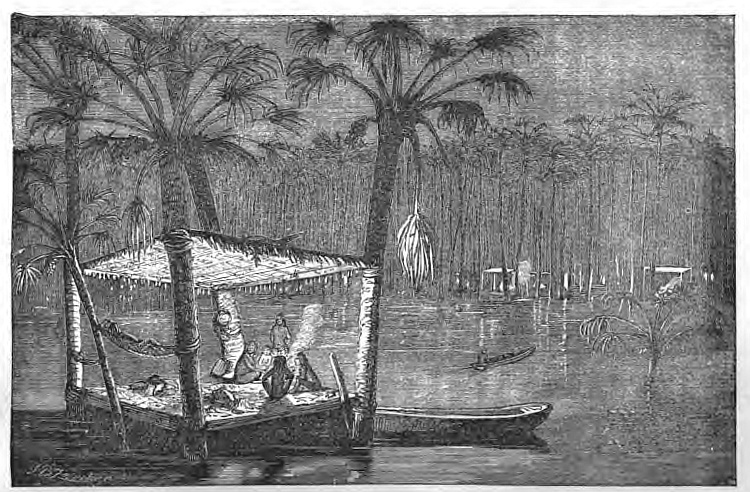
It is now more than half a century, since the date of Humboldt’s “Personal Narrative;” and yet, strange to say, during all that period, scarce an item has been added to our knowledge of the Orinoco, beyond what this scientific traveller had already told us. Indeed, there is not much to say: for there has been little change in the river since then,—either in the aspect of nature, or the condition of man. What change there has been possesses rather a retrograde, than a progressive character. Still, now, as then, on the banks of the Orinoco, we behold a languid commerce,—characteristic of the decaying Spano-American race,—and the declining efforts of a selfish and bigoted missionary zeal, whose boasted aim of “christianising and civilising” has ended only in producing a greater brutalisation. After three centuries of paternosters and bell-ringing, the red savage of the Orinoco returns to the worship of his ancestral gods,—or to no worship at all,—and for this backsliding he can, perhaps, give a sufficient reason.
Pardon me, young reader, for this digression. It is not my purpose to discuss the polemical relations of those who inhabit the banks of the Orinoco; but to give you some account of a very singular people who dwell near its mouth,—upon the numerous canos, already mentioned as constituting its delta. These are the “Guaraons,”—a tribe of Indians,—usually considered as a branch of the Great Carib family, but forming a community among themselves of seven or eight thousand souls; and differing so much from most other savages in their habits and mode of life, as fairly to entitle them to the appellation of an “Odd People.”
The Orinoco, like many other large rivers, is subject to a periodical rise and fall; that is, once every year, the river swells to a great height above its ordinary level. The swelling or “flood” was for a long time supposed to proceed from the melting of snow upon the Cordilleras of the Andes,—in which mountains several of the tributaries of the Orinoco have their rise. This hypothesis, however, has been shown to be an incorrect one: since the main stream of the Orinoco does not proceed from the Andes, nor from any other snowcapped mountains; but has its origin, as already stated, in the sierras of Guiana. The true cause of its periodical rising, therefore, is the vast amount of rain which falls within the tropics; and this is itself occasioned by the sun’s course across the torrid zone, which is also the cause of its being periodical or “annual.” So exact is the time at which these rains fall, and produce the floods of the Orinoco, that the inhabitants of the river can tell, within a few days, when the rising will commence, and when the waters will reach their lowest!
The flood season very nearly corresponds to our own summer,—the rise commencing in April, and the river being at its maximum height in August,—while the minimum is again reached in December. The height to which the Orinoco rises has been variously estimated by travellers: some alleging it to be nearly one hundred feet; while others estimate it to be only fifty, or even less! The reason of this discrepancy may be, that the measurements have been made at different points,—at each of which, the actual height to which the flood attains, may be greater or less than at the others. At any one place, however, the rise is the same—or very nearly so—in successive years. This is proved by observations made at the town of Angostura,—the lowest Spanish settlement of any importance upon the Orinoco. There, nearly in front of the town, a little rocky islet towers up in the middle of the river; the top of which is just fifty feet above the bed of the stream, when the volume of water is at its minimum. A solitary tree stands upon the pinnacle of this rock; and each year, when the water is in full flood, the tree alone is visible,—the islet being entirely submerged. From this peculiar circumstance, the little islet has obtained the name of “Orinocometer,” or measurer of the Orinoco.
The rise here indicated is about fifty feet; but it does not follow from this, that throughout its whole course the river should annually rise to so great a height. In reality it does not.
At Angostura, as the name imports, the river is narrowed to less than half its usual width,—being there confined between high banks that impinge upon its channel. Above and below, it widens again; and, no doubt, in proportion to this widening will the annual rise be greater or less. In fact, at many places, the width of the stream is no longer that of its ordinary channel; but, on the contrary, a vast “freshet” or inundation, covering the country for hundreds of miles,—here flooding over immense marshes or grassy plains, and hiding them altogether,—there flowing among forests of tall trees, the tops of which alone project above the tumult of waters! These inundations are peculiarly observable in the delta of the Orinoco,—where every year, in the months of July and August, the whole surface of the country becomes changed into a grand fresh-water sea: the tops of the trees alone rising above the flood, and proclaiming that there is land at the bottom.
At this season the ordinary channels, or caños, would be obliterated; and navigation through them become difficult or impossible, but for the tree-tops; which, after the manner of “buoys” and signal-marks, serve to guide the pilots through the intricate mazes of the “bocas del Orinoco.”
Now it is this annual inundation, and the semi-submergence of these trees under the flood, that has given origin to the peculiar people of whom we are about to speak,—the Guaraons; or, perhaps, we should rather say, from these causes have arisen their strange habits and modes of life which entitle them to be considered an “odd people.”
During the period of the inundation, if you should sail up the southern or principal caño of the Orinoco,—known as the “boca de navios,” or “ships’ mouth,”—and keep your face to the northward, you would behold the singular spectacle of a forest growing out of the water! In some places you would perceive single trees, with the upper portion of their straight, branchless trunks rising vertically above the surface, and crowned by about a dozen great fan-shaped leaves, radiating outwards from their summits. At other places, you would see many crowded together, their huge fronds meeting, and forming close clumps, or “water groves,” whose deep-green colour contrasts finely as it flings its reflection on the glistening surface below.
Were it night,—and your course led you through one of the smaller canos in the northern part of the delta,—you would behold a spectacle yet more singular, and more difficult to be explained; a spectacle that astounded and almost terrified the bold navigators, who first ventured to explore these intricate coasts.—You would not only perceive a forest, growing out of the water; but, high up among the tops of the trees, you would behold blazing fires,—not the conflagration of the trees themselves, as if the forest were in flames,—but fires regularly built, glowing as from so many furnaces, and casting their red glare upwards upon the broad green leaves, and downwards upon the silvery surface of the water!
If you should chance to be near enough to these fires, you would see cooking utensils suspended over them; human forms, both, of men and women seated or squatting around them; other human forms, flitting like shadows among the tops of the trees; and down below, upon the surface of the water, a fleet of canoes (periaguas), fastened with their mooring-ropes to the trunks. All this would surprise you,—as it did the early navigators,—and, very naturally, you would inquire what it could mean. Fires apparently suspended in the air! human beings moving about among the tops of the trees, talking, laughing, and gesticulating! in a word, acting just as any other savages would do,—for these human beings are savages,—amidst the tents of their encampment or the houses of their village. In reality it is a village upon which you are gazing,—a village suspended in the air,—a village of the Guaraon Indians!
Let us approach nearer; let us steal into this water village—for it would not be always safe to enter it, except by stealth—and see how its singular habitations are constructed, as also in what way their occupants manage to get their living. The village under our observation is now,—at the period of inundation,—nearly a hundred miles from shore, or from any dry land: it will be months before the waters can subside; and, even then, the country around will partake more of the nature of a quagmire, than of firm soil; impassable to any human being,—though not to a Guaraon, as we shall presently see. It is true, the canoes, already mentioned, might enable their owners to reach the firm shores beyond the delta; and so they do at times; but it would be a voyage too long and too arduous to be made often,—as for the supply of food and other daily wants,—and it is not for this purpose the canoes are kept. No: these Guaraons visit terra firma only at intervals; and then for purposes of trade with a portion of their own and other tribes who dwell there; but they permanently reside within the area of the inundated forests; where they are independent, not only of foreign aggression, but also for their supply of all the necessaries of life. In these forests, whether flooded or not, they procure everything of which they stand in need,—they there find, to use an old-fashioned phrase, “meat, drink, washing, and lodging.” In other words: were the inundation to continue forever, and were the Guaraons entirely prohibited from intercourse with the dry land, they could still find subsistence in this, their home upon the waters.