"Being a Popular Description of Singular Races of Man" (continued 2)
Reading edition
Each of these limbs again forks into several branches or spurs,—the whole system forming a figure that may be said to bear some resemblance to a genealogical tree containing the pedigree of four or five generations.
It is only with one of the bifurcations of the right or eastern sierra that this sketch has to do. On reaching the latitude of 7 degrees north, this chain separates itself into two wings, which, after diverging widely to the east and west, sweep round again towards each other, as if desirous to be once more united. The western wing advances boldly to this reunion; but the eastern, after vacillating for a time, as if uncertain what course to take, turns its back abruptly on its old comrade, and trends off in a due east direction, till it sinks into insignificance upon the promontory of Paria.
The whole mass of the sierra, however, has not been of one mind; for, at the time of its indecision, a large spur detaches itself from the main body, and sweeps round, as if to carry out the union with the left wing advancing from the west. Although they get within sight of each other, they are not permitted to meet,—both ending abruptly before the circle is completed, and forming a figure bearing a very exact resemblance to the shoe of a racehorse. Within this curving boundary is enclosed a vast valley,—as large as the whole of Ireland,—the central portion of which, and occupying about one third of its whole extent, is a sheet of water, known from the days of the discovery of America, as the Lake of Maracaibo.
It obtained this appellation from the name of an Indian cazique, who was met upon its shores by the first discoverers; but although this lake was known to the earliest explorers of the New World,—although it lies contiguous to many colonial settlements both on the mainland and the islands of the Caribbean Sea,—the lake itself and the vast territory that surrounds it, remain almost as unknown and obscure as if they were situated among the central deserts of Africa.
And yet the valley of Maracaibo is one of the most interesting portions of the globe,—interesting not only as a terra incognita, but on account of the diversified nature of its scenery and productions. It possesses a fauna of a peculiar kind, and its flora is one of the richest in the world, not surpassed,—perhaps not equalled,—by that of any other portion of the torrid zone. To give a list of its vegetable productions would be to enumerate almost every species belonging to tropical America. Here are found the well-known medicinal plants,—the sassafras and sarsaparilla, guaiacum, copaiva, cinchona, and cuspa, or Cortex Angosturae; here are the deadly poisons of barbasco and mavacure, and alongside them the remedies of the “palo sano,” and mikania guaco. Here likewise grow plants and trees producing those well-known dyes of commerce, the blue indigo, the red arnotto, the lake-coloured chica, the brazilletto, and dragon’s-blood; and above all, those woods of red, gold, and ebon tints, so precious in the eyes of the cabinet and musical-instrument makers of Europe.
Yet, strange to say, these rich resources lie, like treasures buried in the bowels of the earth, or gems at the bottom of the sea, still undeveloped. A few small lumbering establishments near the entrance of the lake,—here and there a miserable village, supported by a little coast commerce in dyewoods, or cuttings of ebony,—now and then a hamlet of fishermen,—a “hato” of goats and sheep; and at wider intervals, a “ganaderia” of cattle, or a plantation of cocoa-trees (cocale), furnish the only evidence that man has asserted his dominion over this interesting region. These settlements, however, are sparsely distributed, and widely distant from one another. Between them stretch broad savannas and forests,—vast tracts, untitled and even unexplored,—a very wilderness, but a wilderness rich in natural resources.
The Lake of Maracaibo is often, though erroneously, described as an arm of the sea. This description only applies to the Gulf of Maracaibo, which is in reality a portion of the Caribbean Sea. The lake itself is altogether different, and is a true fresh-water lake, separated from the gulf by a narrow neck or strait. Within this strait—called “boca,” or mouth—the salt water does not extend, except during very high tides or after long-continued nortes (north winds), which have the effect of driving the sea-water up into the lake, and imparting to some portions of it a saline or brackish taste. This, however, is only occasional and of temporary continuance; and the waters of the lake, supplied by a hundred streams from the horseshoe sierra that surrounds it, soon return to their normal character of freshness.
The shape of Lake Maracaibo is worthy of remark. The main body of its surface is of oval outline,—the longer diameter running north and south,—but taken in connection with the straits which communicate with the outer gulf, it assumes a shape somewhat like that of a Jew’s-harp, or rather of a kind of guitar, most in use among Spanish Americans, and known under the name of “mandolin” (or “bandolon”). To this instrument do the natives sometimes compare it.
Another peculiarity of Lake Maracaibo, is the extreme shallowness of the water along its shores. It is deep enough towards the middle part; but at many points around the shore, a man may wade for miles into the water, without getting beyond his depth. This peculiarity arises from the formation of the valley in which it is situated. Only a few spurs of the sierras that surround it approach near the edge of the lake. Generally from the bases of the mountains, the land slopes with a very gentle declination,—so slight as to have the appearance of a perfectly horizontal plain,—and this is continued for a great way under the surface of the water. Strange enough, however, after getting to a certain distance from the shore, the shoal water ends as abruptly as the escarpment of a cliff, and a depth almost unfathomable succeeds,—as if the central part of the lake was a vast subaqueous ravine, bounded on both sides by precipitous cliffs. Such, in reality, is it believed to be.
A singular phenomenon is observed in the Lake Maracaibo, which, since the days of Columbus, has not only puzzled the Curious, but also the learned and scientific, who have unsuccessfully attempted to explain it. This phenomenon consists in the appearance of a remarkable light, which shows itself in the middle of the night, and at a particular part of the lake, near its southern extremity. This light bears some resemblance to the ignis fatuus of our own marshes; and most probably is a phosphorescence of a similar nature, though on a much grander scale,—since it is visible at a vast distance across the open water. As it is seen universally in the same direction, and appears fixed in one place, it serves as a beacon for the fishermen and dye-wood traders who navigate the waters of the lake,—its longitude being precisely that of the straits leading outward to the gulf. Vessels that have strayed from their course, often regulate their reckoning by the mysterious “Farol de Maracaibo” (Lantern of Maracaibo),—for by this name is the natural beacon known to the mariners of the lake.
Various explanations have been offered to account for this singular phenomenon, but none seem to explain it in a satisfactory manner. It appears to be produced by the exhalations that arise from an extensive marshy tract lying around the mouth of the river Zulia, and above which it universally shows itself. The atmosphere in this quarter is usually hotter than elsewhere, and supposed to be highly charged with electricity; but whatever may be the chemical process which produces the illumination, it acts in a perfectly silent manner. No one has ever observed any explosion to proceed from it, or the slightest sound connected with its occurrence.
Of all the ideas suggested by the mention of Lake Maracaibo, perhaps none are so interesting as those that relate to its native inhabitants, whose peculiar habits and modes of life not only astonished the early navigators, but eventually gave its name to the lake itself and to the extensive province in which it is situated. When the Spanish discoverers, sailing around the shores of the gulf, arrived near the entrance of Lake Maracaibo, they saw, to their amazement, not only single houses, but whole villages, apparently floating upon the water! On approaching nearer, they perceived that these houses were raised some feet above the surface, and supported by posts or piles driven into the mud at the bottom. The idea of Venice—that city built upon the sea, to which they had been long accustomed—was suggested by these superaqueous habitations; and the name of Venezuela (Little Venice) was at once bestowed upon the coast, and afterwards applied to the whole province now known as the Republic of Venezuela.
Though the “water villages” then observed have long since disappeared, many others of a similar kind were afterwards discovered in Lake Maracaibo itself, some of which are in existence to the present day. Besides here and there an isolated habitation, situated in some bay or “laguna,” there are four principal villages upon this plan still in existence, each containing from fifty to a hundred habitations. The inhabitants of some of these villages have been “Christianised,” that is, have submitted to the teaching of the Spanish missionaries; and one in particular is distinguished by having its little church—a regular water church—in the centre, built upon piles, just as the rest of the houses are, and only differing from the common dwellings in being larger and of a somewhat more pretentious style. From the belfry of this curious ecclesiastical edifice a brazen bell may be heard at morn and eve tolling the “oracion” and “vespers,” and declaring over the wide waters of the lake that the authority of the Spanish monk has replaced the power of the cazique among the Indians of the Lake Maracaibo. Not to all sides of the lake, however, has the cross extended its conquest. Along its western shore roams the fierce unconquered Goajiro, who, a true warrior, still maintains his independence; and even encroaches upon the usurped possessions both of monk and “militario.”
The water-dweller, however, although of kindred race with the Goajiro, is very different, both in his disposition and habits of life. He is altogether a man of peace, and might almost be termed a civilised being,—that is, he follows a regular industrial calling, by which he subsists. This is the calling of a fisherman, and in no part of the world could he follow it with more certainty of success, since the waters which surround his dwelling literally swarm with fish.
Lake Maracaibo has been long noted as the resort of numerous and valuable species of the finny tribe, in the capture of which the Indian fisherman finds ample occupation. He is betimes a fowler,—as we shall presently see,—and he also sometimes indulges, though more rarely, in the chase, finding game in the thick forests or on the green savannas that surround the lake, or border the banks of the numerous “riachos” (streams) running into it. On the savanna roams the graceful roebuck and the “venado,” or South-American deer, while along the river banks stray the capibara and the stout tapir, undisturbed save by their fierce feline enemies, the puma and spotted jaguar.
But hunting excursions are not a habit of the water Indian, whose calling, as already observed, is essentially that of a fisherman and “fowler,” and whose subsistence is mainly derived from two kinds of water-dwellers, like himself—one with fins, living below the surface, and denominated fish; another with wings, usually resting on the surface, and known as fowl. These two creatures, of very different kinds and of many different species, form the staple and daily food of the Indian of Maracaibo.
In an account of his habits we stall begin by giving a description of the mode in which he constructs his singular dwelling.
Like other builders he begins by selecting the site. This must be a place where the water is of no great depth; and the farther from the shore he can find a shallow spot the better for his purpose, for he has a good reason for desiring to get to a distance from the shore, as we shall presently see. Sometimes a sort of subaqueous island, or elevated sandbank, is found, which gives him the very site he is in search of. Having pitched upon the spot, his next care is to procure a certain number of tree-trunks of the proper length and thickness to make “piles.” Not every kind of timber will serve for this purpose, for there are not many sorts that would long resist decay and the wear and tear of the water insects, with which the lake abounds. Moreover, the building of one of these aquatic houses, although it be only a rude hut, is a work of time and labour, and it is desirable therefore to make it as permanent as possible. For this reason great care is taken in the selection of the timber for the “piles.”
But it so chances that the forests around the lake furnish the very thing itself, in the wood of a tree known to the Spanish inhabitants as the “vera,” of “palo sano,” and to the natives as “guaiac.” It is one of the zygophyls of the genus Guaiacum, of which there are many species, called by the names of “iron-wood” or “lignum-vitae;” but the species in question is the tree lignum-vitae (Guaiacum arboreum), which attains to a height of 100 feet, with a fine umbrella-shaped head, and bright orange flowers. Its wood is so hard, that it will turn the edge of an axe, and the natives believe that if it be buried for a sufficient length of time under the earth it will turn to iron! Though this belief is not literally true, as regards the iron, it is not so much of an exaggeration as might be supposed. The “palo de fierro,” when buried in the soil of Maracaibo or immersed in the waters of the lake, in reality does undergo a somewhat similar metamorphose; in other words, it turns into stone; and the petrified trunks of this wood are frequently met with along the shores of the lake. What is still more singular—the piles of the water-houses often become petrified, so that the dwelling no longer rests upon wooden posts, but upon real columns of stone!
Knowing all this by experience, the Indian selects the guaiac for his uprights, cuts them of the proper length; and then, launching them in the water, transports them to the site of his dwelling, and fixes them in their places.
Upon this a platform is erected, out of split boards of some less ponderous timber, usually the “ceiba,” or “silk-cotton tree” (Bombax ceiba), or the “cedro negro” (Cedrela odorata) of the order Meliaceae. Both kinds grow in abundance upon the shores of the lake,—and the huge trunks of the former are also used by the water Indian for the constructing of his canoe.
The platform, or floor, being thus established, about two or three feet above the surface of the water, it then only remains to erect, the walls and cover them over with a roof. The former are made of the slightest materials,—light saplings or bamboo poles,—usually left open at the interstices. There is no winter or cold weather here,—why should the walls be thick? There are heavy rains, however, at certain seasons of the year, and these require to be guarded against; but this is not a difficult matter, since the broad leaves of the “enea” and “vihai” (a species of Heliconia) serve the purpose of a roof just as well as tiles, slates, or shingles. Nature in these parts is bountiful, and provides her human creatures with a spontaneous supply of every want. Even ropes and cords she furnishes, for binding the beams, joists, and rafters together, and holding on the thatch against the most furious assaults of the wind. The numerous species of creeping and twining plants (“llianas” or “sipos”) serve admirably for this purpose. They are applied in their green state, and when contracted by exsiccation draw the timbers as closely together as if held by spikes of iron. In this manner and of such materials does the water Indian build his house.
Why he inhabits such a singular dwelling is a question that requires to be answered. With the terra firma close at hand, and equally convenient for all purposes of his calling, why does he not build his hut there? So much easier too of access would it be, for he could then approach it either by land or by water; whereas, in its present situation, he can neither go away from his house or get back to it without the aid of his “periagua” (canoe). Moreover, by building on the beach, or by the edge of the woods, he would spare himself the labour of transporting those heavy piles and setting them in their places,—a work, as already stated, of no ordinary magnitude. Is it for personal security against human enemies,—for this sometimes drives a people to seek singular situations for their homes? No; the Indian of Maracaibo has his human foes, like all other people; but it is none of these that have forced him to adopt this strange custom. Other enemies? wild beasts? the dreaded jaguar, perhaps? No, nothing of this kind. And yet it is in reality a living creature that drives him to this resource,—that has forced him to flee from the mainland and take to the water for security against its attack,—a creature of such small dimensions, and apparently so contemptible in its strength, that you will no doubt smile at the idea of its putting a strong man to flight,—a little insect exactly the size of an English gnat, and no bigger, but so formidable by means of its poisonous bite, and its myriads of numbers, as to render many parts of the shores of Lake Maracaibo quite uninhabitable. You guess, no doubt, the insect to which I allude? You cannot fail to recognise it as the mosquito? Just so; it is the mosquito I mean, and in no part of South America do these insects abound in greater numbers, and nowhere are they more bloodthirsty than upon the borders of this great fresh-water sea. Not only one species of mosquito, but all the varieties known as “jejens,” “zancudos,” and “tempraneros,” here abound in countless multitudes,—each kind making its appearance at a particular hour of the day or night,—“mounting guard” (as the persecuted natives say of them) in turn, and allowing only short intervals of respite from their bitter attacks.
Now, it so happens, that although the various kinds of mosquitoes are peculiarly the productions of a marshy or watery region,—and rarely found where the soil is high and dry,—yet as rarely do they extend their excursions to a distance from the land. They delight to dwell under the shadow of leaves, or near the herbage of grass, plants, or trees, among which they were hatched. They do not stray far from the shore, and only when the breeze carries them do they fly out over the open water. Need I say more? You have now the explanation why the Indians of Maracaibo build their dwellings upon the water. It is simply to escape from the “plaga de moscas” (the pest of the flies).
Like most other Indians of tropical America, and some even of colder latitudes, those of Maracaibo go naked, wearing only the guayueo, or “waist-belt.” Those of them, however, who have submitted to the authority of the monks, have adopted a somewhat more modest garb,—consisting of a small apron of cotton or palm fibre, suspended from the waist, and reaching down to their knees.
We have already stated, that the water-dwelling Indian is a fisherman, and that the waters of the lake supply him with numerous kinds of fish of excellent quality. An account of these, with the method employed in capturing them, may not prove uninteresting.
First, there is the fish known as “liza,” a species of skate. It is of a brilliant silvery hue, with bluish corruscations. It is a small fish, being only about a foot in length, but is excellent to eat, and when preserved by drying, forms an article of commerce with the West-Indian islands. Along the coasts of Cumana and Magarita, there are many people employed in the pesca de liza (skate-fishery); but although the liza is in reality a sea fish, it abounds in the fresh waters of Maracaibo, and is there also an object of industrial pursuit. It is usually captured by seines, made out of the fibres of the cocui aloe (agave cocuiza), or of cords obtained from the unexpanded leaflets of the moriche palm (Mauritia flexuosa), both of which useful vegetable products are indigenous to this region. The roe of the liza, when dried in the sun, is an article in high estimation, and finds its way into the channels of commerce.
A still more delicate fish is the “pargo.” It is of a white colour tinged with rose; and of these great numbers are also captured. So, too, with the “doncella,” one of the most beautiful species, as its pretty name of “doncella” (young maiden) would indicate. These last are so abundant in some parts of the lake, that one of its bays is distinguished by the name of Laguna de Doncella.
A large, ugly fish, called the “vagre,” with an enormous head and wide mouth, from each side of which stretches a beard-like appendage, is also an object of the Indian’s pursuit. It is usually struck with a spear, or killed by arrows, when it shows itself near the surface of the water. Another monstrous creature, of nearly circular shape, and full three feet in diameter, is the “carite,” which is harpooned in a similar fashion.
Besides these there is the “viegita,” or “old-woman fish,” which itself feeds upon lesser creatures of the finny tribe, and especially upon the smaller species of shell-fish. It has obtained its odd appellation from a singular noise which it gives forth, and which resembles the voice of an old woman debilitated with extreme age.
The “dorado,” or gilded fish—so called on account of its beautiful colour—is taken by a hook, with no other bait attached than a piece of white rag. This, however, must be kept constantly in motion, and the bait is played by simply paddling the canoe over the surface of the lake, until the dorado, attracted by the white meteor, follows in its track, and eventually hooks itself.
Many other species of fish are taken by the water-Indians, as the “lebranche” which goes in large “schools,” and makes its breeding-place in the lagunas and up the rivers, and the “guabina,” with several kinds of sardines that find their way into the tin boxes of Europe; for the Maracaibo fisherman is not contented with an exclusive fish diet. He likes a little “casava,” or maize-bread, along with it; besides, he has a few other wants to satisfy, and the means he readily obtains in exchange for the surplus produce of his nets, harpoons, and arrows.
We have already stated that he is a fowler. At certain seasons of the year this is essentially his occupation. The fowling season with him is the period of northern winter, when the migratory aquatic birds come down from the boreal regions of Prince Rupert’s Land to disport their bodies in the more agreeable waters of Lake Maracaibo. There they assemble in large flocks, darkening the air with their myriads of numbers, now fluttering over the lake, or, at other times, seated on its surface silent and motionless. Notwithstanding their great numbers, however, they are too shy to be approached near enough for the “carry” of an Indian arrow, or a gun either; and were it not for a very cunning stratagem which the Indian has adopted for their capture, they might return again to their northern haunts without being minus an individual of their “count.”
But they are not permitted to depart thus unscathed. During their sojourn within the limits of Lake Maracaibo their legions get considerably thinned, and thousands of them that settle down upon its inviting waters are destined never more to take wing.
To effect their capture, the Indian fowler, as already stated, makes use of a very ingenious stratagem. Something similar is described as being practised in other parts of the world; but in no place is it carried to such perfection as upon the Lake Maracaibo.
The fowler first provides himself with a number of large gourd-shells of roundish form, and each of them at least as big as his own skull. These he can easily obtain, either from the herbaceous squash (Cucurbita lagenaris) or from the calabash tree (Crescentia cujete), both of which grow luxuriantly on the shores of the lake. Filling his periagua with these, he proceeds out into the open water to a certain distance from the land, or from his own dwelling. The distance is regulated by several considerations. He must reach a place which, at all hours of the day, the ducks and other waterfowl are not afraid to frequent; and, on the other hand, he must not go beyond such a depth as will bring the water higher than his own chin when wading through it. This last consideration is not of so much importance, for the water Indian can swim almost as well as a duck, and dive like one, if need be; but it is connected with another matter of greater importance—the convenience of having the birds as near as possible, to save him a too long and wearisome “wade.” It is necessary to have them so near, that at all hours they may be under his eye.
Having found the proper situation, which the vast extent of shoal water (already mentioned) enables him to do, he proceeds to carry out his design by dropping a gourd here and another there, until a large space of surface is covered by these floating shells. Each gourd has a stone attached to it by means of a string, which, resting upon the bottom, brings the buoy to an anchor, and prevents it from being drifted into the deeper water or carried entirely away.
When his decoys are all placed, the Indian paddles back to his platform dwelling, and there, with watchful eye, awaits the issue. The birds are at first shy of these round yellow objects intruded upon their domain; but, as the hours pass, and they perceive no harm in them, they at length take courage and venture to approach. Urged by that curiosity which is instinctive in every creature, they gradually draw nigher and nigher, until at length they boldly venture into the midst of the odd objects and examine them minutely. Though puzzled to make out what it is all meant for, they can perceive no harm in the yellow globe-shaped things that only bob about, but make no attempt to do them any injury. Thus satisfied, their curiosity soon wears off, and the birds no longer regarding the floating shells as objects of suspicion, swim freely about through their midst, or sit quietly on the water side by side with them.
But the crisis has now arrived when it is necessary the Indian should act, and for this he speedily equips himself. He first ties a stout rope around his waist, to which are attached many short strings or cords. He then draws over his head a large gourd-shell, which, fitting pretty tightly, covers his whole skull, reaching down to his neck. This shell is exactly similar to the others already floating on the water, with the exception of having three holes on one side of it, two on the same level with the Indian’s eyes, and the third opposite his mouth, intended to serve him for a breathing-hole.
He is now ready for work; and, thus oddly accoutred, he slips quietly down from his platform, and laying himself along the water, swims gently in the direction of the ducks.
He swims only where the water is too shallow to prevent him from crouching below the surface; for were he to stand upright, and wade,—even though he were still distant from them,—the shy birds might have suspicions about his after-approaches.
When he reaches a point where the lake is sufficiently deep, he gets upon his feet and wades, still keeping his shoulders below the surface. He makes his advance very slowly and warily, scarce raising a ripple on the surface of the placid lake, and the nearer he gets to his intended victims he proceeds with the greater caution.
The unsuspecting birds see the destroyer approach without having the slightest misgiving of danger. They fancy that the new comer is only another of those inanimate objects by their side—another gourd-shell drifting out upon the water to join its companions. They have no suspicion that this wooden counterfeit—like the horse of Troy—is inhabited by a terrible enemy.
Poor things! how could they? A stratagem so well contrived would deceive more rational intellects than theirs; and, in fact, having no idea of danger, they perhaps do not trouble themselves even to notice the new arrival.
Meanwhile the gourd has drifted silently into their midst, and is seen approaching the odd individuals, first one and afterwards another, as if it had some special business with each. This business appears to be of a very mysterious character; and in each case is abruptly brought to a conclusion, by the duck making a sudden dive under the water,—not head foremost, according to its usual practice, but in the reverse way, as if jerked down by the feet, and so rapidly that the creature has not time to utter a single “quack.”
After quite a number of individuals have disappeared in this mysterious manner, the others sometimes grow suspicious of the moving calabash, and either take to wing, or swim off to a less dangerous neighbourhood; but if the gourd performs its office in a skilful manner, it will be seen passing several times to and fro between the birds and the water village before this event takes place. On each return trip, when far from the flock, and near the habitations, it will be seen to rise high above the surface of the water. It will then be perceived that it covers the skull of a copper-coloured savage, around whose hips may be observed a double tier of dead ducks dangling by their necks from the rope upon his waist, and forming a sort of plumed skirt, the weight of which almost drags its wearer back into the water.
Of course a capture is followed by a feast; and during the fowling season of the year the Maracaibo Indian enjoys roast-duck at discretion. He does not trouble his head much about the green peas, nor is he particular to have his ducks stuffed with sage and onions; but a hot seasoning of red pepper is one of the indispensible ingredients of the South-American cuisine; and this he usually obtains from a small patch of capsicum which he cultivates upon the adjacent shore; or, if he be not possessed of land, he procures it by barter, exchanging his fowls or fish for that and a little maize or manioc flour, furnished by the coast-traders.
The Maracaibo Indian is not a stranger to commerce. He has been “Christianised,”—to use the phraseology of his priestly proselytiser,—and this has introduced him to new wants and necessities. Expenses that in his former pagan state were entirely unknown to him, have now become necessary, and a commercial effort is required to meet them. The Church must have its dues. Such luxuries as being baptised, married, and buried, are not to be had without expense, and the padre takes good care that none of these shall be had for nothing. He has taught his proselyte to believe that unless all these rites have been officially performed there is pot the slightest chance for him in the next world; and under the influence of this delusion, the simple savage willingly yields up his tenth, his fifth, or, perhaps it would be more correct to say, his all. Between fees of baptism and burial, mulcts for performance of the marriage rite, contributions towards the shows and ceremonies of dias de fiesta, extravagant prices for blessed beads, leaden crucifixes, and images of patron saints, the poor Christianised Indian is compelled to part with nearly the whole of his humble gains; and the fear of not being able to pay for Christian burial after death, is often one of the torments of his life.
To satisfy the numerous demands of the Church, therefore, he is forced into a little action in the commercial line. With the water-dweller of Maracaibo, fish forms one of the staples of export trade,—of course in the preserved state, as he is too distant from any great town or metropolis to be able to make market of them while fresh. He understands, however, the mode of curing them,—which he accomplishes by sun-drying and smoking,—and, thus prepared, they are taken off his hands by the trader, who carries them all over the West Indies, where, with boiled rice, they form the staple food of thousands of the dark-skinned children of Ethiopia.
The Maracaibo Indian, however, has still another resource, which occasionally supplies him with an article of commercial export. His country—that is, the adjacent shores of the lake—produces the finest caoutchouc. There the India-rubber tree, of more than one species, flourishes in abundance; and the true “seringa,” that yields the finest and most valuable kind of this gummy juice, is nowhere found in greater perfection than in the forests of Maracaibo. The caoutchouc of commerce is obtained from many other parts of America, as well as from other tropical countries; but as many of the bottles and shoes so well-known in the india-rubber shops, are manufactured by the Indians of Maracaibo, we may not find a more appropriate place to give an account of this singular production, and the mode by which it is prepared for the purposes of commerce and manufacture.
As already mentioned, many species of trees yield india-rubber, most of them belonging either to the order of the “Morads,” or Euphorbiaceae. Some are species of ficus, but both the genera and species are too numerous to be given here. That which supplies the “bottle india-rubber” is a euphorbiaceous plant,—the seringa above mentioned,—whose proper botanical appellation is Siphonia elastica. It is a tall, straight, smooth-barked tree, having a trunk of about a foot in diameter, though in favourable situations reaching to much larger dimensions. The process of extracting its sap—out of which the caoutchouc is manufactured—bears some resemblance to the tapping of sugar-maples in the forests of the north.
With his small hatchet, or tomahawk, the Indian cuts a gash in the bark, and inserts into it a little wedge of wood to keep the sides apart. Just under the gash, he fixes a small cup-shaped vessel of clay, the clay being still in a plastic state, so that it may be attached closely to the bark. Into this vessel the milk-like sap of the seringa soon commences to run, and keeps on until it has yielded about the fifth of a pint. This, however, is not the whole yield of a tree, but only of a single wound; and it is usual to open a great many gashes, or “taps,” upon the same trunk, each being furnished with its own cup or receiver. In from four to six hours the sap ceases to run.
The cups are then detached from the tree, and the contents of all, poured into a large earthen vessel, are carried to the place where the process of making the caoutchouc is to take place,—usually some dry open spot in the middle of the forest, where a temporary camp has been formed for the purpose.
When the dwelling of the Indian is at a distance from where the india-rubber tree grows,—as is the case with those of Lake Maracaibo,—it will not do to transport the sap thither. There must be no delay after the cups are filled, and the process of manufacture must proceed at once, or as soon as the milky juice begins to coagulate,—which it does almost on the instant.
Previous to reaching his camp, the “seringero” has provided a large quantity of palm-nuts, with which he intends to make a fire for smoking the caoutchouc. These nuts are the fruit of several kinds of palms, but the best are those afforded by two magnificent species,—the “Inaja” (Maximiliana regia), and the “Urucuri” (Attalea excelsa).
A fire is kindled of these nuts; and an earthen pot, with a hole in the bottom, is placed mouth downward over the pile. Through the aperture now rises a strong pungent smoke.
If it is a shoe that is intended to be made, a clay last is already prepared, with a stick standing out of the top of it, to serve as a handle, while the operation is going on. Taking the stick in his hand, the seringero dips the last lightly into the milk, or with a cup pours the fluid gently over it, so as to give a regular coating to the whole surface; and then, holding it over the smoke, he keeps turning it, jack-fashion, till the fluid has become dry and adhesive. Another dip is then given, and the smoking done as before; and this goes on, till forty or fifty different coats have brought the sides and soles of the shoe to a proper thickness. The soles, requiring greater weight, are, of course, oftener dipped than the “upper leather.”
The whole process of making the shoe does not occupy half an hour; but it has afterwards to receive some farther attention in the way of ornament; the lines and figures are yet to be executed, and this is done about two days after the smoking process. They are simply traced out with a piece of smooth wire, or oftener with the spine obtained from some tree,—as the thorny point of the bromelia leaf.
In about a week the shoes are ready to be taken from the last; and this is accomplished at the expense and utter ruin of the latter, which is broken into fragments, and then cleaned out. Water is used sometimes to soften the last, and the inner surface of the shoe is washed after the clay has been taken out.
Bottles are made precisely in the same manner,—a round ball, or other shaped mass of clay, serving as the mould for their construction. It requires a little more trouble to get the mould extracted from the narrow neck of the bottle.
It may be remarked that it is not the smoke of the palm-nuts that gives to the india-rubber its peculiar dark colour; that is the effect of age. When freshly manufactured, it is still of a whitish or cream colour; and only attains the dark hue after it has been kept for a considerable time.
We might add many other particulars about the mode in which the Indian of Maracaibo employs his time, but perhaps enough has been said to show that his existence is altogether an odd one.
Chapter Four.
The Esquimaux.
The Esquimaux are emphatically an “odd people,” perhaps the oddest upon the earth. The peculiar character of the regions they inhabit has naturally initiated them into a system of habits and modes of life different from those of any other people on the face of the globe; and from the remoteness and inaccessibility of the countries in which they dwell, not only have they remained an unmixed people, but scarce any change has taken place in their customs and manners during the long period since they were first known to civilised nations.
The Esquimaux people have been long known and their habits often described. Our first knowledge of them was obtained from Greenland,—for the native inhabitants of Greenland are true Esquimaux,—and hundreds of years ago accounts of them were given to the world by the Danish colonists and missionaries—and also by the whalers who visited the coasts of that inhospitable land. In later times they have been made familiar to us through the Arctic explorers and whale-fishers, who have traversed the labyrinth of icy islands that extend northward from the continent of America. The Esquimaux may boast of possessing the longest country in the world. In the first place, Greenland is theirs, and they are found along the western shores of Baffin’s Bay. In North America proper their territory commences at the straits of Belle Isle, which separate Newfoundland from Labrador, and thence extends all around the shore of the Arctic Ocean, not only to Behring’s Straits, but beyond these, around the Pacific coast of Russian America, as far south as the great mountain Saint Elias. Across Behring’s Straits they are found occupying a portion of the Asiatic coast, under the name of Tchutski, and some of the islands in the northern angle of the Pacific Ocean are also inhabited by these people, though under a different name. Furthermore, the numerous ice islands which lie between North America and the Pole are either inhabited or visited by Esquimaux to the highest point that discovery has yet reached.
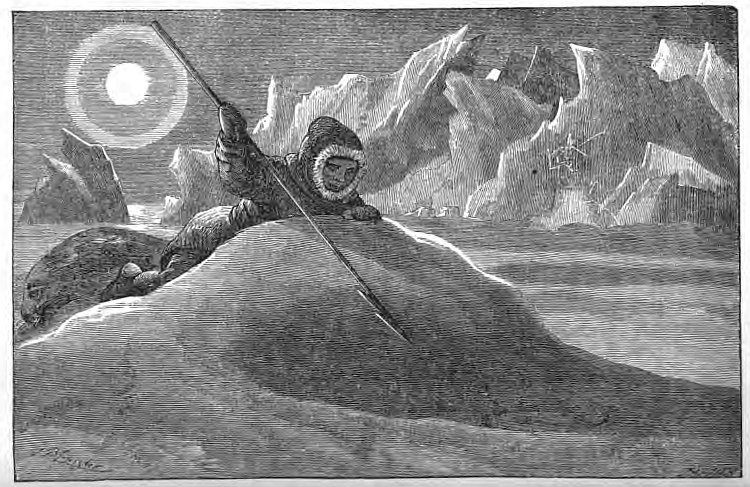
There can be little doubt that the Laplanders of northern Europe, and the Samoyedes, and other littoral peoples dwelling along the Siberian shores, are kindred races of the Esquimaux; and taking this view of the question, it may be said that the latter possess all the line of coast of both continents facing northward; in other words, that their country extends around the globe—though it cannot be said (as is often boastingly declared of the British empire) that “the sun never sets upon it;” for, over the “empire” of the Esquimaux, the sun not only sets, but remains out of sight of it for months at a time.
It is not usual, however, to class the Laplanders and Asiatic Arctic people with the Esquimaux. There are some essential points of difference; and what is here said of the Esquimaux relates only to those who inhabit the northern coasts and islands of America, and to the native Greenlanders.
Notwithstanding the immense extent of territory thus designated, notwithstanding the sparseness of the Esquimaux population, and the vast distances by which one little tribe or community is separated from another, the absolute similarity in their habits, in their physical and intellectual conformation, and, above all, in their languages, proves incontestably that they are all originally of one and the same race.
Whatever, therefore, may be said of a “Schelling,” or native Greenlander, will be equally applicable to an Esquimaux of Labrador, to an Esquimaux of the Mackenzie River or Behring’s Straits, or we might add, to a Khadiak islander, or a Tuski of the opposite Asiatic coast; always taking into account such differences of costume, dialect, modes of life, etc, as may be brought about by the different circumstances in which they are placed. In all these things, however, they are wonderfully alike; their dresses, weapons, boats, houses, and house implements, being almost the same in material and construction from East Greenland to the Tchutskoi Noss.
If their country be the longest in the world, it is also the narrowest. Of course, if we take into account the large islands that thickly stud the Arctic Ocean, it may be deemed broad enough; but I am speaking rather of the territory which they possess on the continents. This may be regarded as a mere strip following the outline of the coast, and never extending beyond the distance of a day’s journey inland. Indeed, they only seek the interior in the few short weeks of summer, for the purpose of hunting the reindeer, the musk-ox, and other animals; after each excursion, returning again to the shores of the sea, where they have their winter-houses and more permanent home. They are, truly and emphatically, a littoral people, and it is to the sea they look for their principal means of support. But for this source of supply, they could not long continue to exist upon land altogether incapable of supplying the wants even of the most limited population.
The name Esquimaux—or, as it is sometimes written, “Eskimo,”—like many other national appellations, is of obscure origin. It is supposed to have been given to them by the Canadian voyageurs in the employ of the Hudson’s Bay Company, and derived from the words Ceux qui miaux (those who mew), in relation to their screaming like cats. But the etymology is, to say the least, suspicious. They generally call themselves “Inuit” (pronounced enn-oo-eet), a word which signifies “men;”—though different tribes of them have distinct tribal appellations.
In personal appearance they cannot be regarded as at all prepossessing—though some of the younger men and girls, when cleansed of the filth and grease with which their skin is habitually coated, are far from ill-looking. Their natural colour is not much darker than that of some of the southern nations of Europe—the Portuguese, for instance—and the young girls often have blooming cheeks, and a pleasing expression of countenance. Their faces are generally of a broad, roundish shape, the forehead and chin both narrow and receding, and the cheeks very prominent, though not angular. On the contrary, they are rather fat and round. This prominence of the cheeks gives to their nose the appearance of being low and flat; and individuals are often seen with such high cheeks, that a ruler laid from one to the other would not touch the bridge of the nose between them!
As they grow older their complexion becomes darker, perhaps from exposure to the climate. Very naturally, too, both men and women grow uglier, but especially the latter, some of whom in old age present such a hideous aspect, that the early Arctic explorers could not help characterising them as witches.
The average stature of the Esquimaux is far below that of European nations, though individuals are sometimes met with nearly six feet in height. These, however, are rare exceptions; and an Esquimaux of such proportions would be a giant among his people. The more common height is from four feet eight inches to five feet eight; and the women are still shorter, rarely attaining the standard of five feet. The shortness of both men and women appears to be a deficiency in length of limb, for their bodies are long enough; but, as the Esquimaux is almost constantly in his canoe, or “kayak,” or upon his dog-sledge, his legs have but little to do, and are consequently stunted in their development.
A similar peculiarity is presented by the Comanche, and other Indians of the prairies, and also in the Guachos and Patagonian Indians, of the South-American Pampas, who spend most of their time on the backs of their horses.
The Esquimaux have no religion, unless we dignify by that name a belief in witches, sorcerers, “Shamans,” and good or evil spirits, with, some confused notion of a good and bad place hereafter. Missionary zeal has been exerted among them almost in vain. They exhibit an apathetic indifference to the teachings of Christianity.
Neither have they any political organisation; and in this respect they differ essentially from most savages known, the lowest of whom have usually their chiefs and councils of elders. This absence of all government, however, is no proof of their being lower in the scale of civilisation than other savages; but, perhaps, rather the contrary, for the very idea of chiefdom, or government, is a presumption of the existence of vice among a people, and the necessity of coercion and repression. To one another these rude people are believed to act in the most honest manner; and it could be shown that such was likewise their behaviour towards strangers until they were corrupted by excessive temptation. All Arctic voyagers record instances of what they term petty theft, on the part of certain tribes of Esquimaux,—that is, the pilfering of nails, hatchets, pieces of iron-hoops, etc,—but it might be worth while reflecting that these articles are, in the eyes of the Esquimaux, what ingots of gold are are to Europeans, and worth while inquiring if a few bars of the last-mentioned metal were laid loosely and carelessly upon the pavements of London, how long they would be in changing their owners? Theft should be regarded along with the amount of temptation; and it appears even in these recorded cases that only a few of the Esquimaux took part in it. I apprehend that something more than a few Londoners would be found picking up the golden ingots. How many thieves have we among us, with no greater temptation than a cheap cotton kerchief?—more than a few, it is to be feared.
In truth, the Esquimaux are by no means the savages they have been represented. The only important point in which they at all assimilate to the purely savage state is in the filthiness of their persons, and perhaps also in the fact of their eating much of their food (fish and flesh-meat) in a raw state. For the latter habit, however, they are partially indebted to the circumstances in which they are placed—fires or cookery being at times altogether impossible. They are not the only people who have been forced to eat raw flesh; and Europeans who have travelled in that inhospitable country soon get used to the practice, at the same time getting quite cured of their dégoût for it.
It is certainly not correct to characterise the Esquimaux as mere savages. On the contrary, they may be regarded as a civilised people, that is, so far as civilisation is permitted by the rigorous climate in which they live; and it would be safe to affirm that a colony of the most polished people in Europe, established as the Esquimaux are, and left solely to their own resources, would in a single generation exhibit a civilisation not one degree higher than that now met with among the Esquimaux. Indeed, the fact is already established: the Danish and Norwegian colonists of West Greenland, though backed by constant intercourse with their mother-land, are but little more civilised than the “Skellings,” who are their neighbours.
In reality, the Esquimaux have made the most of the circumstances in which they are placed, and continue to do so. Among them agriculture is impossible, else they would long since have taken to it. So too is commerce; and as to manufactures, it is doubtful whether Europeans could excel them under like circumstances. Whatever raw material their country produces, is by them both strongly and neatly fabricated, as indicated by the surprising skill with which they make their dresses, their boats, their implements for hunting and fishing; and in these accomplishments—the only ones practicable under their hyperborean heaven—they are perfect adepts. In such arts civilised Europeans are perfect simpletons to them, and the theories of fireside speculators, so lately promulgated in our newspapers, that Sir John Franklin and his crew could not fail to procure a living where the simple Esquimaux were able to make a home, betrayed only ignorance of the condition of these people. In truth, white men would starve, where the Esquimaux could live in luxurious abundance, so far superior to ours is their knowledge both of fishing and the chase. It is a well-recorded fact, that while our Arctic voyagers, at their winter stations, provided with good guns, nets, and every appliance, could but rarely kill a reindeer or capture a seal, the Esquimaux obtained both in abundance, and apparently without an effort; and we shall presently note the causes of their superiority in this respect.
The very dress of the Esquimaux is a proof of their superiority over other savages. At no season of the year do they go either naked, or even “ragged.” They have their changes to suit the seasons,—their summer dress, and one of a warmer kind for winter. Both are made in a most complicated manner; and the preparation of the material, as well as the manner by which it is put together, prove the Esquimaux women—for they are alike the tailors and dressmakers—to be among the best seamstresses in the world.
Captain Lyon, one of the most observant of Arctic voyagers, has given a description of the costume of the Esquimaux of Savage Island, and those of Repulse Bay, where he wintered, and his account is so graphic and minute in details, that it would be idle to alter a word of his language. His description, with slight differences in make and material, will answer pretty accurately for the costume of the whole race.
“The clothes of both sexes are principally composed of fine and well-prepared reindeer pelts; the skins of bears, seals, wolves, foxes, and marmottes, are also used. The sealskins are seldom employed for any part of the dress except boots and shoes, as being more capable of resisting water, and of far greater durability than other leather.
“The general winter dress of the men is an ample outer coat of deer-skin, having no opening in front, and a large hood, which is drawn over the head at pleasure. This hood is invariably bordered with white fur from the thighs of the deer, and thus presents a lively contrast to the dark face which it encircles. The front or belly part of the coat is cut off square with the upper part of the thighs, but behind it is formed into a broad skirt, rounded at the lower end, which reaches to within a few inches of the ground. The lower edges and tails of these dresses are in some cases bordered with bands of fur of an opposite colour to the body; and it is a favourite ornament to hang a fringe of little strips of skin beneath the border. The embellishments give a very pleasing appearance to the dress. It is customary in blowing weather to tie a piece of skin or cord tight round the waist of the coat; but in other cases the dress hangs loose.
“Within the covering I have just described is another, of precisely the same form; but though destitute of ornaments of leather, it has frequently little strings of beads hanging to it from the shoulders or small of the back. This dress is of thinner skin, and acts as a shirt, the hairy part being placed near the body: it is the indoors habit. When walking, the tail is tied up by two strings to the back, so that it may not incommode the legs. Besides these two coats, they have also a large cloak, or, in fact, an open deer-skin, with sleeves: this, from its size, is more frequently used as a blanket; and I but once saw it worn by a man at the ship, although the women throw it over their shoulders to shelter themselves and children while sitting on the sledge.
“The trowsers, which are tightly tied round the loins, have no waistbands, but depend entirely by the drawing-string; they are generally of deer-skin, and ornamented in the same manner as the coats. One of the most favourite patterns is an arrangement of the skins of deer’s legs, so as to form very pretty stripes. As with the jackets, there are two pair of these indispensables, reaching no lower than the knee-cap, which is a cause of great distress in cold weather, as that part is frequently severely frost-bitten; yet, with all their experience of this bad contrivance, they will not add an inch to the established length.
“The boots reach to the bottom of the breeches, which hang loosely over them. In these, as in other parts of the dress, are many varieties of colour, material, and pattern, yet in shape they never vary. The general winter boots are of deer-skin; one having the hair next the leg, and the other with the fur outside. A pair of soft slippers of the same kind are worn between the two pair of boots, and outside of all a strong sealskin shoe is pulled to the height of the ankle, where it is tightly secured by a drawing-string. For hunting excursions, or in summer when the country is thawed, one pair of boots only is worn. They are of sealskin, and so well sewed and prepared without the hair, that although completely saturated, they allow no water to pass through them. The soles are generally of the tough hide of the walrus, or of the large seal called Oö-ghïoo, so that the feet are well protected in walking over rough ground. Slippers are sometimes worn outside. In both cases the boots are tightly fastened round the instep with a thong of leather. The mittens in common use are of deer-skin, with the hair inside; but, in fact, every kind of skin is used for them. They are extremely comfortable when dry; but if once wetted and frozen again, in the winter afford as little protection to the hands as a case of ice would do. In summer, and in fishing, excellent sealskin mittens are used, and have the same power of resisting water as the boots of which I have just spoken. The dresses I have just described are chiefly used in winter. During the summer it is customary to wear coats, boots, and even breeches, composed of the prepared skins of ducks, with the feathers next the body. These are comfortable, light, and easily prepared. The few ornaments in their possession are worn by the men. These are some bandeaus which encircle the head, and are composed of various-coloured leather, plaited in a mosaic pattern, and in some cases having human hair woven in them, as a contrast to the white skins. From the lower edge foxes’ teeth hang suspended, arranged as a fringe across the forehead. Some wear a musk-ox tooth, a bit of ivory, or a small piece of bone.
“The clothing of the women is of the same materials as that of the men, but in shape almost every part is different from the male dress. An inner jacket is worn next the skin, and the fur of the other is outside. The hind-flap, or tail, is of the same form before described, but there is also a small flap in front, extending about halfway down the thigh. The coats have each an immense hood, which, as well as covering the head, answers the purpose of a child’s cradle for two or three years after the birth of an infant. In order to keep the burden of the child from drawing the dress tight across the throat, a contrivance, in a great measure resembling the slings of a soldier’s knapsack, is affixed to the collar or neck part, whence it passes beneath the hood, crosses, and, being brought under the arms, is secured on each side the breast by a wooden button. The shoulders of the women’s coat have a bag-like space, for the purpose of facilitating the removal of the child from the hood round to the breast without taking it out of the jacket.
“A girdle is sometimes worn round the waist: it answers the double purposes of comfort and ornament; being composed of what they consider valuable trinkets, such as foxes’ bones (those of the rableeaghioo), or sometimes of the ears of deer, which hang in pairs to the number of twenty or thirty, and are trophies of the skill of the hunter, to whom the wearer is allied. The inexpressibles of the women are in the some form as those of the men, but they are not ornamented by the same curious arrangement of colours; the front part is generally of white, and the back of dark fur. The manner of securing them at the waist is also the same; but the drawing-strings are of much greater length, being suffered to hang down by one side, and their ends are frequently ornamented with some pendent jewel, such as a grinder or two of the musk-ox, a piece of ivory, a small ball of wood, or a perforated stone.
“The boots of the fair sex are, without dispute, the most extraordinary part of their equipment, and are of such an immense size as to resemble leather sacks, and to give a most deformed, and, at the same time, ludicrous appearance to the whole figure, the bulky part being at the knee; the upper end is formed into a pointed flap, which, covering the front of the thigh, is secured by a button or knot within the waistband of the breeches.
“Some of these ample articles of apparel are composed with considerable taste, of various-coloured skins; they also have them of parchment,—seals’ leather. Two pairs are worn; and the feet have also a pair of sealskin slippers, which fit close, and are tightly tied round the ankle.
“Children have no kind of clothing, but lie naked in their mothers’ hoods until two or three years of age, when they are stuffed into a little dress, generally of fawn-skin, which has jacket and breeches in one, the back part being open; into these they are pushed, when a string or two closes all up again. A cap forms an indispensable part of the equipment, and is generally of some fantastical shape; the skin of a fawn’s head is a favourite material in the composition, and is sometimes seen with the ears perfect; the nose and holes for the eyes lying along the crown of the wearer’s head, which in consequence, looks like that of an animal.”
The same author also gives a most graphic description of the curious winter dwellings of the Esquimaux, which on many parts of the coast are built out of the only materials to be had,—ice and snow! Snow for the walls and ice for the windows! you might fancy the house of the Esquimaux to be a very cold dwelling; such, however, is by no means its character.
“The entrance to the dwellings,” says Captain Lyon, “was by a hole, about a yard in diameter, which led through a low-arched passage of sufficient breadth for two to pass in a stooping posture, and about sixteen feet in length; another hole then presented itself, and led through a similarly-shaped, but shorter passage, having at its termination a round opening, about two feet across. Up this hole we crept one step, and found ourselves in a dome about seven feet in height, and as many in diameter, from whence the three dwelling-places, with arched roofs, were entered. It must be observed that this is the description of a large hut, the smaller ones, containing one or two families, have the domes somewhat differently arranged.
“Each dwelling might be averaged at fourteen or sixteen feet in diameter by six or seven in height, but as snow alone was used in their construction, and was always at hand, it might be supposed that there was no particular size, that being of course at the option of the builder. The laying of the arch was performed in such a manner as would have satisfied the most regular artist, the key-piece on the top, being a large square slab. The blocks of snow used in the buildings were from four to six inches in thickness, and about a couple of feet in length, carefully pared with a large knife. Where two families occupied a dome, a seat was raised on either side, two feet in height. These raised places were used as beds, and covered in the first place with whalebone, sprigs of andromeda, or pieces of sealskin, over these were spread deer-pelts and deer-skin clothes, which had a very warm appearance. The pelts were used as blankets, and many of them had ornamental fringes of leather sewed round their edges.
“Each dwelling-place was illumined by a broad piece of transparent fresh-water ice, of about two feet in diameter, which formed part of the roof, and was placed over the door. These windows gave a most pleasing light, free from glare, and something like that which is thrown through ground glass. We soon learned that the building of a house was but the work of an hour or two, and that a couple of men—one to cut the slabs and the other to lay them—were labourers sufficient.
“For the support of the lamps and cooking apparatus, a mound of snow is erected for each family; and when the master has two wives or a mother, both have an independent place, one at each end of the bench.
“I find it impossible to attempt describing everything at a second visit, and shall therefore only give an account of those articles of furniture which must be always the same, and with which, in five minutes, any one might be acquainted. A frame, composed of two or three broken fishing-spears, supported in the first place a large hoop of wood or bone, across which an open-meshed, and ill-made net was spread or worked for the reception of wet or damp clothes, skins, etc, which could be dried by the heat of the lamp. On this contrivance the master of each hut placed his gloves on entering, first carefully clearing them of snow.
“From the frame above mentioned, one or more coffin-shaped stone pots were suspended over lamps of the same material, crescent-shaped, and having a ridge extending along their back; the bowl part was filled with blubber, and the oil and wicks were ranged close together along the edge. The wicks were made of moss and trimmed by a piece of asbestos, stone, or wood; near at hand a large bundle of moss was hanging for a future supply. The lamps were supported by sticks, bones, or pieces of horn, at a sufficient height to admit an oval pot of wood or whalebone beneath, in order to catch any oil that might drop from them. The lamps varied considerably in size, from two feet to six inches in length, and the pots were equally irregular, holding from two or three gallons to half a pint. Although I have mentioned a kind of scaffolding, these people did not all possess so grand an establishment, many being contented to suspend their pot to a piece of bone stuck in the wall of the hut. One young woman was quite a caricature in this way: she was the inferior wife of a young man, whose senior lady was of a large size, and had a corresponding lamp, etc, at one corner; while she herself, being short and fat, had a lamp the size of half a dessert-plate, and a pot which held a pint only.
“Almost every family was possessed of a large wooden tray, resembling those used by butchers in England; its offices, however, as we soon perceived, were more various, some containing raw flesh of seals and blubber, and others, skins, which were steeping in urine. A quantity of variously-sized bowls of whalebone, wood, or skin, completed the list of vessels, and it was evident that they were made to contain anything.”
The Esquimaux use two kinds of boats,—the “oomiak” and “kayak.” The oomiak is merely a large species of punt, used exclusively by the women; but the kayak is a triumph in the art of naval architecture, and is as elegant as it is ingenious. It is about twenty-five feet in length, and less than two in breadth of beam. In shape it has been compared to a weaver’s shuttle, though it tapers much more elegantly than this piece of machinery. It is decked from stem to stern, excepting a circular hole very nearly amidships, and this round hatchway is just large enough to admit the body of an Esquimaux in a sitting posture. Around the rim of the circle is a little ridge, sometimes higher in front than at the back, and this ridge is often ornamented with a hoop of ivory. A flat piece of wood runs along each side of the frame, and is, in fact, the only piece of any strength in a kayak. Its depth in the centre is four or five inches, and its thickness about three fourths of an inch; it tapers to a point at the commencement of the stem and stern projections. Sixty-four ribs are fastened to this gunwale piece; seven slight rods run the whole length of the bottom and outside the ribs. The bottom is rounded, and has no keel; twenty-two little beams or cross-pieces keep the frame on a stretch above, and one strong batten runs along the centre, from stem to stern, being, of course, discontinued at the seat part. The ribs are made of ground willow, also of whalebone, or, if it can be procured, of good-grained wood. The whole contrivance does not weigh over fifty or sixty pounds; so that a man easily carries his kayak on his head, which, by the form of the rim, he can do without the assistance of his hands.
An Esquimaux prides himself in the neat appearance of his boat, and has a warm skin placed in its bottom to sit on. His posture is with the legs pointed forward, and he cannot change his position without the assistance of another person; in all cases where a weight is to be lifted, an alteration of stowage, or any movement to be made, it is customary for two kayaks to lie together; and the paddle of each being placed across the other, they form a steady double boat. An inflated seal’s bladder forms, invariably, part of the equipage of a canoe, and the weapons are confined in their places by small lines of whalebone, stretched tightly across the upper covering, so as to receive the points or handles of the spears beneath them. Flesh is frequently stowed within the stem or stern, as are also birds and eggs; but a seal, although round, and easily made to roll, is so neatly balanced on the upper part of the boat as seldom to require a lashing. When Esquimaux are not paddling, their balance must be nicely preserved, and a trembling motion is always observable in the boat. The most difficult position for managing a kayak is when going before the wind, and with a little swell running. Any inattention would instantly; by exposing the broadside, overturn this frail vessel. The dexterity with which they are turned, the velocity of their way, and the extreme elegance of form of the kayaks, render an Esquimaux of the highest interest when sitting independently, and urging his course towards his prey.
“The paddle is double-bladed, nine feet three inches in length, small at the grasp, and widening to four inches at the blades, which are thin, and edged with ivory for strength as well as ornament.
“The next object of importance to the boat is the sledge, which finds occupation during at least three fourths of the year. A man who possesses both this and a canoe is considered a person of property. To give a particular description of the sledge would be impossible, as there are no two actually alike; and the materials of which they are composed are as various as their form. The best are made of the jaw-bones of the whale, sawed to about two inches in thickness, and in depth from six inches to a foot. These are the runners, and are shod with a thin plank of the same material; the side-pieces are connected by means of bones, pieces of wood, or deers’ horns, lashed across, with a few inches space between each, and they yield to any great strain which the sledge may receive. The general breadth of the upper part of the sledge is about twenty inches; but the runners lean inwards, and therefore at bottom it is rather greater. The length of bone sledges is from four feet to fourteen. Their weight is necessarily great; and one of moderate size, that is to say, about ten or twelve feet, was found to be two hundred and seventeen pounds. The skin of the walrus is very commonly used during the coldest part of the winter, as being hard-frozen, and resembling an inch board, with ten times the strength, for runners. Another ingenious contrivance is, by casing moss and earth in seal’s skin, so that by pouring a little water, a round hard bolster is easily formed. Across all these kinds of runners there is the same arrangement of bones, sticks, etc, on the upper part; and the surface which passes over the snow is coated with ice, by mixing snow with fresh water, which assists greatly in lightening the load for the dogs, as it slides forwards with ease. Boys frequently amuse themselves by yoking several dogs to a small piece of seal’s skin, and sitting on it, holding by the traces. Their plan is then to set off at full speed, and he who bears the greatest number of bumps before he relinquishes his hold is considered a very fine fellow.
“The Esquimaux possess various kinds of spears, but their difference is chiefly in consequence of the substances of which they are composed, and not in their general form.
“One called kä-të-tëek, is a large and strong-handled spear, with an ivory point made for despatching any wounded animal in the water. It is never thrown, but has a place appropriated for it on the kayak.
“The oonak is a lighter kind than the former; also ivory-headed. It has a bladder fastened to it, and has a loose head with a line attached; this being darted into an animal, is instantly liberated from the handle which gives the impetus. Some few of these weapons are constructed of the solid ivory of the unicorn’s horn, about four feet in length, and remarkably well-rounded and polished.
“Ip-pöo-töo-yöo, is another kind of hand-spear, varying but little from the one last described. It has, however, no appendages.
“The Noôgh-wït is of two kinds; but both are used for striking birds, young animals, or fish. The first has a double fork at the extremity, and there are three other barbed ones at about half its length, diverging in different directions, so that if the end pair should miss, some of the centre ones might strike. The second kind has only three barbed forks at the head. All the points are of ivory, and the natural curve of the walrus tusk favours and facilitates their construction.
“Amongst the minor instruments of the ice-hunting are a long bone feeler for plumbing any cracks through which seals are suspected of breathing, and also for trying the safety of the road. Another contrivance is occasionally used with the same effect as the float of a fishing-line. Its purpose it to warn the hunter, who is watching a seal-hole, when the animal rises to the surface, so that he may strike without seeing, or being seen, by his prey. This is a most delicate little rod of bone or ivory, of about a foot in length, and the thickness of a fine knitting-needle. At the lower end is a small knob like a pin’s head, and the upper extremity has a fine piece of sinew tied to it, so as to fasten it loosely to the side of the hole. The animal, on rising, does not perceive so small an object hanging in the water, and pushes it up with his nose, when the watchful Esquimaux, observing his little beacon in motion, strikes down, and secures his prize.
“Small ivory pegs or pins are used to stop the holes made by the spears in the animal’s body; thus the blood, a great luxury to the natives, is saved.
“The same want of wood which renders it necessary to find substitutes in the construction of spears, also occasions the great variety of bows. The horn of the musk-ox, thinned horns of deer, or other bony substances, are as frequently used or met with as wood, in the manufacture of these weapons, in which elasticity is a secondary consideration. Three or four pieces of horn or wood are frequently joined together in one bow,—the strength lying alone in a vast collection of small plaited sinews; these, to the number of perhaps a hundred, run down the back of the bow, and being quite tight, and having the spring of catgut, cause the weapon, when unstrung, to turn the wrong way; when bent, their united strength and elasticity are amazing. The bowstring is of fifteen to twenty plaits, each loose from the other, but twisted round when in use, so that a few additional turns will at any time alter its length. The general length of the bows is about three feet and a half.
“The arrows are short, light, and formed according to no general rule as to length or thickness. A good one has half the shaft of bone, and a head of hard slate, or a small piece of iron; others have sharply-pointed bone heads: none are barbed. Two feathers are used for the end, and are tied opposite each other, with the flat sides parallel. A neatly-formed case contains the bow and a few arrows. Sealskin is preferred for this purpose, as more effectually resisting the wet than any other. A little bag, which is attached to the side, contains a stone for sharpening, and some spare arrow-heads carefully wrapped up in a piece of skin.
“The bow is held in a horizontal position, and though capable of great force, is rarely used at a greater distance than from twelve to twenty yards.”
Their houses, clothing, sledges, boats, utensils, and arms, being now described, it only remains to be seen in what manner these most singular people pass their time, how they supply themselves with food, and how they manage to support life during the long dark winter, and the scarce less hospitable summer of their rigorous clime. Their occupations from year to year are carried on with an almost unvarying regularity, though, like their dresses, they change according to the season.
Their short summer is chiefly employed in hunting the reindeer, and other quadrupeds,—for the simple reason that it is at this season that these appear in greatest numbers among them, migrating northward as the snow thaws from the valleys and hill-sides. Not but that they also kill the reindeer in other seasons, for these animals do not all migrate southward on the approach of winter, a considerable number remaining all the year upon the shores of the Arctic Sea, as well as the islands to the north of them. Of course, the Esquimaux kills a reindeer when and where he can; and it may be here remarked, that in no part of the American continent has the reindeer been trained or domesticated as among the Laplanders and the people of Russian Asia. Neither the Northern Indians (Tinné) nor the Esquimaux have ever reached this degree in domestic civilisation, and this fact is one of the strongest points of difference between the American Esquimaux and their kindred races in the north of Asia. One tribe of true Esquimaux alone hold the reindeer in subjection, viz the Tuski, already mentioned, on the Asiatic shore; and it might easily be shown that the practice reached them from the contiguous countries of northern Asia. The American Esquimaux, like those of Greenland, possess only the dog as a domesticated animal; and him they have trained to draw their sledges in a style that exhibits the highest order of skill, and even elegance. The Esquimaux dog is too well-known to require particular description. He is often brought to this country in the return ships of Arctic whalers and voyagers; and his thick, stout body covered closely with long stiff hair of a whitish or yellowish colour, his cocked ears and smooth muzzle, and, above all, the circle-like curling of his bushy tail, will easily be remembered by any one who has ever seen this valuable animal.
In summer, then, the Esquimaux desert their winter houses upon the shore, and taking with them their tents make an excursion into the interior. They do not go far from the sea—no farther than is necessary to find the valleys browsed by the reindeer, and the fresh-water lakes, which, at this season, are frequented by flocks of swans, geese of various kinds, ducks, and other aquatic birds. Hunting the reindeer forms their principal occupation at this time; but, of course, “all is fish that comes into the net” of an Esquimaux; and they also employ themselves in capturing the wild fowl and the fresh-water fish, in which these lakes abound. With the wild fowl it is the breeding and moulting season, and the Esquimaux not only rob them of their eggs, but take large numbers of the young before they are sufficiently fledged to enable them to fly, and also the old ones while similarly incapacitated from their condition of “moult.” In their swift kayaks which they have carried with them on their heads, they can pursue the fluttering flocks over any part of a lake, and overtake them wherever they may go. This is a season of great plenty in the larder of the Inuit.
The fresh-water fish are struck with spears out of the kayaks, or, when there is ice on the water strong enough to bear the weight of a man, the fish are captured in a different manner. A hole is broken in the ice, the broken fragments are skimmed off and cast aside, and then the fisherman lets down a shining bauble—usually the white tooth of some animal—to act as a bait. This he keeps bobbing about until the fish, perceiving it afar off through the translucent water, usually approaches to reconnoitre, partly from curiosity, but more, perhaps, to see if it be anything to eat. When near enough the Esquimaux adroitly pins the victim with his fish spear, and lands it upon the ice. This species of fishing is usually delivered over to the boys—the time of the hunters being too valuable to be wasted in waiting for the approach of the fish to the decoy, an event of precarious and uncertain occurrence.
In capturing the reindeer, the Esquimaux practises no method very different from that used by “still hunters” in other parts of America. He has to depend alone upon his bow and arrows, but with these poor weapons he contrives to make more havoc among a herd of deer than would a backwoods hunter with his redoubtable rifle. There is no mystery about his superior management. It consists simply in the exhibition of the great strategy and patience with which he makes his approaches, crawling from point to point and using every available cover which the ground may afford.
But all this would be of little avail were it not for a ruse which he puts in practice, and which brings the unsuspecting deer within reach of his deadly arrows. This consists in a close imitation of the cries of the animal, so close that the sharp-eared creature itself cannot detect the counterfeit, but, drawing nearer and nearer to the rock or bush from which the call appears to proceed, falls a victim to the deception. The silent arrow makes no audible sound; the herd, if slightly disturbed at seeing one of their number fall, soon compose themselves, and go on browsing upon the grass or licking up the lichen. Another is attracted by the call, and another, who fall in their turn victims either to their curiosity or the instinct of amorous passions.
For this species of hunting, the bow far excels any other weapon; even the rifle is inferior to it.
Sometimes the Esquimaux take the deer in large numbers, by hunting them with dogs, driving the herd into some defile or cul de sac among the rocks, and then killing them at will with their arrows and javelins. This, however, is an exceptional case, as such natural “pounds” are not always at hand. The Indians farther south construct artificial enclosures; but in the Esquimaux country there is neither time nor material for such elaborate contrivances.
The Esquimaux who dwell in those parts frequented by the musk-oxen, hunt these animals very much as they do the reindeer; but killing a musk bull, or cow either, Is a feat of far grander magnitude, and requires more address than shooting a tiny deer.
I have said that the Esquimaux do not, even in these hunting excursions, stray very far into the interior. There is a good reason for their keeping close to the seashore. Were they to penetrate far into the land they would be in danger of meeting with their bitter foemen, the Tinné Indians, who in this region also hunt reindeer and musk-oxen. War to the knife is the practice between these two races of people, and has ever been since the first knowledge of either. They often meet in conflict upon the rivers inland, and these conflicts are of so cruel and sanguinary a nature as to imbue each with a wholesome fear of the other. The Indians, however, dread the Esquimaux more than the latter fear them; and up to a late period took good care never to approach their coasts; but the musket and rifle have now got into the hands of some of the northern tribes, who avail themselves of these superior weapons, not only to keep the Esquimaux at bay, but also to render them more cautious about extending their range towards the interior.
When the dreary winter begins to make its appearance, and the reindeer grow scarce upon the snow-covered plains, the Esquimaux return to their winter villages upon the coast. Quadrupeds and birds no longer occupy their whole attention, for the drift of their thoughts is now turned towards the inhabitants of the great deep. The seal and the walrus are henceforth the main objects of pursuit. Perhaps during the summer, when the water was open, they may have visited the shore for the purpose of capturing that great giant of the icy seas—a whale. If so, and they have been successful in only one or two captures, they may look forward to a winter of plenty—since the flesh of a full-grown whale, or, better still, a brace of such ample creatures, would be sufficient to feed a whole tribe for months.
They have no curing process for this immense carcass; they stand in need of none. Neither salt nor smoking is required in their climate. Jack Frost is their provision curer, and performs the task without putting them either to trouble or expense. It is only necessary for them to hoist the great flitches upon scaffolds, already erected for the purpose, so as to keep the meat from the wolves, wolverines, foxes, and their own half-starved dogs. From their aerial larder they can cut a piece of blubber whenever they feel hungry, or they have a mind to eat, and this mind they are in so long as a morsel is left.
Their mode of capturing a whale is quite different from that practised by the whale-fishers. When the huge creature is discovered near, the whole tribe sally forth, and surround it in their kayaks; they then hurl darts into its body, but instead of these having long lines attached to them, they are provided with sealskins sewed up air-tight and inflated, like bladders. When a number of these become attached to the body of the whale, the animal, powerful though he be, finds great difficulty in sinking far down, or even progressing rapidly through the water. He soon rises to the surface, and the sealskin buoys indicate his whereabouts to the occupants of the kayaks, who in their swift little crafts, soon dart up to him again, and shoot a fresh volley into his body. In this way the whale is soon “wearied out,” and then falls a victim to their larger spears, just as in the case where a capture is made by regular, whalers.
I need scarcely add that a success of this kind is hailed as a jubilee of the tribe, since it not only brings a benefit to the whole community, but is also a piece of fortune of somewhat rare occurrence.
When no whales have been taken, the long, dark winter may justly be looked forward to with some solicitude; and it is then that the Esquimaux requires to put forth all his skill and energies for the capture of the walrus or the seal—the latter of which may be regarded as the staff of his life, furnishing him not only with food, but with light, fuel, and clothing for his body and limbs.
Of the seals that inhabit the Polar Seas there are several species; but the common seal (Calocephalus vitulina) and the harp-seal (Calocephalus Groenlandicus) are those most numerous, and consequently the principal object of pursuit.
The Esquimaux uses various stratagems for taking these creatures, according to the circumstances in which they may be encountered; and simpletons as the seals may appear, they are by no means easy of capture. They are usually very shy and suspicious, even in places where man has never been seen by them. They have other enemies, especially in the great polar bear; and the dread of this tyrant of the icy seas keeps them ever on the alert. Notwithstanding their watchfulness, however, both the bear and the biped make great havoc among them, and each year hundreds of thousands of them are destroyed.
The bear, in capturing seals, exhibits a skill and cunning scarce excelled by that of the rational being himself. When this great quadruped perceives a seal basking on the edge of an ice-field, he makes his approaches, not by rushing directly towards it, which he well knows would defeat his purpose. If once seen by the seal, the latter has only to betake himself to the water, where it can soon sink or swim beyond the reach of the bear. To prevent this, the bear gets well to leeward, and then diving below the surface, makes his approaches under water, now and then cautiously raising his head to get the true bearings of his intended victim. After a number of these subaqueous “reaches,” he gets close in to the edge of the floe in such a position as to cut off the seal’s retreat to the water. A single spring brings him on the ice, and then, before the poor seal has time to make a brace of flounders, it finds itself locked in the deadly embrace of the bear. When seals are thus detected asleep, the Esquimaux approaches them in his kayak, taking care to paddle cautiously and silently. If he succeed in getting between them and the open water, he kills them in the ordinary way—by simply knocking them on the snout with a club, or piercing them with a spear. Sometimes, however, the seal goes to sleep on the surface of the open water. Then the approach is made in a similar manner by means of the kayak, and the animal is struck with a harpoon. But a single blow does not always kill a seal, especially if it be a large one, and the blow has been ill-directed. In such cases the animal would undoubtedly make his escape, and carry the harpoon along with it, which would be a serious loss to the owner, who does not obtain such weapons without great difficulty. To prevent this, the Esquimaux uses a contrivance similar to that employed in the capture of the whale,—that is, he attaches a float or buoy to his harpoon by means of a cord, and this so impedes the passage of the seal through the water, that it can neither dive nor swim to any very great distance. The float is usually a walrus bladder inflated in the ordinary way, and wherever the seal may go, the float betrays its track, enabling the Esquimaux to follow it in his shuttle-shaped kayak, and pierce it again with a surer aim.
In winter, when the sea is quite covered with ice, you might fancy that the seal-fishery would be at an end, for the seal is essentially a marine animal; and although it can exist upon the ice or on dry land, it could not subsist there. Access to the water it must have, in order to procure its food, which consists of small fish and molluscs. Of course, when the ice forms on the surface, the seal is in its true element—the water underneath—but when this ice becomes, as it often does, a full yard in thickness, extending over hundreds of miles of the sea, how then is the seal to be got at? It could not be reached at all; and at such a season the Esquimaux people would undoubtedly starve, were it not for a habit peculiar to this animal, which, happily for them, brings it within their reach.
Though the seal can live under water like a fish, and probably could pass a whole winter under the ice without much inconvenience, it likes now and then to take a little fresh air, and have a quiet nap upon the upper surface in the open air. With this design it breaks a hole through the ice, while the latter is yet thin, and this hole it keeps carefully open during the whole winter, clearing out each new crust as it forms. No matter to what thickness the ice may attain, this hole always forms a breathing-place for the seal, and a passage by which he may reach the upper surface, and indulge himself in—his favourite siesta in the open air. Knowing this habit, the Esquimaux takes advantage of it to make the seal his captive. When the animal is discovered on the ice, the hunter approaches with the greatest stealth and caution. This is absolutely necessary: for if the enemy is perceived, or makes the slightest noise, the wary seal flounders rapidly into his hole, and is lost beyond redemption. If badly frightened, he will not appear for a long time, denying himself his open air exercise until the patience of his persecutor is quite worn out, and the coast is again clear.
In making his approaches, the hunter uses all his art, not only taking advantage of every inequality—such as snow-drifts and ice-hillocks—to conceal himself; but he also practises an ingenious deception by dressing himself in the skin of a seal of like species, giving his body the figure of the animal, and counterfeiting its motions, by floundering clumsily over the ice, and oscillating his head from side to side, just as seals are seen to do.
This deception often proves successful, when the hunter under any other shape would in vain endeavour to get within striking distance of his prey. When seals are scarce, and the supply greatly needed, the Esquimaux often lies patiently for hours together on the edge of a seal-hole waiting for the animal to come up. In order to give it time to get well out upon the ice, the hunter conceals himself behind a heap of snow, which he has collected and piled up for the purpose. A float-stick, ingeniously placed in the water of the breathing-hole, serves as a signal to tell when the seal is mounting through his trap-like passage, the motion of the stick betraying its ascent. The hunter then gets himself into the right attitude to strike, and summons all his energies for the encounter.