"Being a Popular Description of Singular Races of Man" (continued 5)
Reading edition
Their flocks present a considerable variety of species. Besides horses, cattle, and sheep, they own many camels, and they have no less than three distinct varieties of this valuable animal in their possession,—the dromedary with two humps, and the common camel. The third sort is a cross breed—or “mule”—between these two. The dromedary is slightly made, and swifter than either of the others, but it is not so powerful as either; and being inferior as a beast of burden, is least cared for by the Turcomans. The one-humped camel is in more general use, and a good one will carry a load of six or seven hundred pounds with ease. The mule camel is more powerful than either of its parents, and also more docile and capable of greater endurance. It grows to a very large size, but is low in proportion to its bulk, with stout, bony legs, and a large quantity of coarse, shaggy hair on its haunch, shoulders, neck, and even on the crown of its head, which gives it a strange, somewhat fantastic appearance. Its colour varies from light grey to brown, though it is as often nearly black. This kind of camel will carry a load of from eight hundred to a thousand pounds.
The Turcoman sheep are of the large-tailed breed,—their tails often attaining enormous dimensions. This variety of sheep is a true denizen of the desert, the fat tail being unquestionably a provision of nature against seasons of hunger,—just as in the single protuberance, or “hump,” upon the camel.
The horse of the Turcoman is the animal upon which he sets most value. The breed possessed by him is celebrated over all Eastern Asia, as that of the Arab is in the West. They cannot be regarded, however, as handsome horses, according to the true standard of “horse beauty;” but the Turcoman cares less for this than for other good qualities. In point of speed and endurance they are not excelled, if equalled, by the horses of any other country.
Their size is that of the common horse, but they are very different in make. Their bodies are long in proportion to the bulk of carcass; and they do not appear to possess sufficient compactness of frame. Their legs are also long, generally falling off in muscular development below the knee-joint; and they would appear to an English jockey too narrow in the counter. They have also long necks, with large heavy heads. These are the points which are generally observed in the Turcoman horses; but it is to be remarked, that it is only when in an under-condition they look so ungraceful; and in this condition their owners are accustomed to keep them, especially when they have any very heavy service to perform. Feeding produces a better shape, and brings them much nearer to the look of a well-bred English horse.
Their powers of endurance are indeed, almost incredible: when trained for a chappow, or plundering expedition, they will carry their rider and provisions for seven or eight days together, at the rate of twenty or even thirty fursungs—that is, from eighty to one hundred miles—a day. Their mode of training is more like that of our pugilistic and pedestrian performers, than that adopted for race-horses. When any expedition of great length, and requiring the exertion of much speed, is in contemplation, they commence by running their horses every day for many miles together; they feed them sparingly on barley alone, and pile numuds upon them at night to sweat them, until every particle of fat has been removed, and the flesh becomes hard and tendonous. Of this they judge by the feel of the muscles, particularly on the crest, at the back of the neck, and on the haunches; and when these are sufficiently firm and hard, they say in praise of the animal, that “his flesh is marble.” After this sort of training, the horse will proceed with expedition and perseverance, for almost any length of time, without either falling off in condition or knocking up, while horses that set out fat seldom survive. They are taught a quick walk, a light trot, or a sort of amble, which carries the rider on easily, at the rate of six miles an hour; but they will also go at a round canter, or gallop, for forty or fifty miles, without ever drawing bridle or showing the least symptom of fatigue. Their yaboos, or galloways, and large ponies are fully as remarkable, if not superior, to their horses, in their power of sustaining fatigue; they are stout, compact, spirited beasts, without the fine blood of the larger breeds, but more within the reach of the poorer classes, and consequently used in by far greater numbers than the superior and more expensive horses.
“It is a common practice of the Turcomans to teach their horses to fight with their heels, and thus assist their masters in the time of action. At the will of their riders they will run at and lay hold with their teeth of whatever man or animal may be before them. This acquirement is useful in the day of battle and plunder, for catching prisoners and stray cattle, but it at the same time renders them vicious and dangerous to be handled.”
In addition to the flocks and herds, the Turcomans possess a breed of very large fierce dogs, to assist them in keeping their cattle. These are also necessary as watch-dogs, to protect the camp from thieves as well as more dangerous enemies to their peace; and so well-trained are those faithful creatures, that it would be impossible for either friend or enemy to approach a Turcoman camp without the inmates being forewarned in time. Two or three of these dogs may always be seen lying by the entrance of each tent; and throughout the night several others keep sentry at the approaches to the camp.
Other breeds of dogs owned by them are used for hunting,—for these wild wanderers sometimes devote their hours to the chase. They have two sorts,—a smooth-skinned dog, half hound half pointer, that hunts chiefly by the scent; and a greyhound, of great swiftness, with a coat of long, silky hair, which they make use of in coursing,—hares and antelopes being their game.
They have a mode of hunting—also practised by the Persians—which is peculiar. It should rather be termed hawking than hunting, as a hawk is employed for the purpose. It is a species of falcon denominated “goork,” and is trained not only to dash at small game, such as partridges and bustards, but upon antelopes and even the wild ass that is found in plenty upon the plains of Turcomania. You will wonder how a bird, not larger than the common falcon, could capture such game as this but it will appear simple enough when the method has been explained. The “goork” is trained to fly at the quadruped, and fix its claws in one particular place,—that is, upon the frontlet, just between the eyes. When thus attached, the bird, instead of closing its wings and remaining at rest, keeps them constantly in motion, flapping them over the eyes of the quadruped. This it does, no doubt, to enable it to retain its perch; while the unfortunate animal, thus assailed, knows not in what direction to run, and is soon overtaken by the pursuing sportsmen, and either speared or shot with the bow and arrow.
Wild boars are frequently hunted by the Turcomans; and this, like everything else with these rude centaurs, is performed on horseback. The bow and arrow is but a poor weapon when employed against the thick, tough hide of the Hyrcanian boar (for he is literally the Hyrcanian boar), and of course the matchlock would be equally ineffective. How, then, does the Turcoman sportsman manage to bag this bristly game? With all the ease in the world. It costs him only the effort of galloping his horse close up to the side of the boar after he has been brought to by the dogs, and then suddenly wheeling the steed. The latter, well-trained to the task, without further prompting, goes through the rest of the performance, which consists in administering to the boar such a slap with his iron-shod heel, as to prostrate the porcine quadruped, often killing it on the instant!
Such employments and such diversions occupy only a small portion of the Turcoman’s tune. He follows another calling of a far less creditable character, which unfortunately he regards as the most honourable occupation of his life. This is the calling of the robber. His pastoral pursuits are matters of only secondary consideration. He only looks to them as a means of supplying his daily wants,—his food and the more necessary portion of his clothing; but he has other wants that may be deemed luxuries. He requires to keep up his stock of horses and camels, and wishes to increase them. He needs costly gear for his horse, and costly garments for himself—and he is desirous of being possessed of fine weapons, such as spears, swords, bows, matchlocks, daggers, and pistols. His most effective weapons are the spear and sword, and these are the kinds he chiefly uses.
His spear consists of a steel head with four flutes, and edges very sharp, fixed upon a slender shaft of from eight to ten feet in length. In using it he couches it under the left arm, and directs it with the right hand, either; straightforward, or to the right or left; if to the right, the butt of the shaft lies across the hinder part of the saddle; if to the left, the forepart of the spear rests on the horse’s neck. The Turcomans manage their horses with the left hand, but most of these are so well broken as to obey the movement of the knee, or the impulse of the body. When close to their object, they frequently grasp the spear with both hands, to give greater effect to the thrust. The horse, spurred to the full speed of a charge, in this way, offers an attack no doubt very formidable in appearance, but perhaps less really dangerous than the other, in which success depends so greatly on skill and address. The Turcomans are all sufficiently dexterous with the sword, which is almost universally formed in the curved Persian fashion, and very sharp; they also wear a dagger at the waist-belt. Firearms are as yet little in use among them; they possess a few, taken from the travellers they have plundered, and procure a few more occasionally from the Russians by the way of Bokara. Some use bows and arrows, but they are by no means so dexterous as their ancestors were in the handling of those weapons.
Mounted, then, upon his matchless steed, and armed with spear and sword, the Turcoman goes forth to practise his favourite profession,—that of plunder. He does not go alone, nor with a small number of his comrades, either. The number depends altogether on the distance or danger of the expedition; and where these are considered great, a troop of five hundred, or even a thousand, usually proceed together upon their errand.
You will be inquiring to what point they direct themselves,—east, west, north, or south? That altogether depends upon who may be their enemies for the time, for along with their desire for booty, there is also mixed up something like a sentiment of hostility. In this respect, however, the Turcoman is a true Ishmaelite, and in lack of other victim he will not hesitate to plunder the people of a kindred race. Indeed, several of the Turcoman tribes have long been at war with one another; and their animosity is quite as deadly among themselves as when directed against strangers to their race. The butt, however, of most of the Turcoman expeditions is the northern part of Persia,—Korassan in particular. It is into this province that most of their great forays are directed, either against the peaceful citizens of the Persian towns and villages, or as often against the merchant caravans that are constantly passing between Teheran and the cities of the east,—Mushed, Balkh, Bokara, Herat, and Kelat. I have already stated that these forays are pushed far into the interior of Persia; and the fact of Persia permitting such a state of things to continue will perhaps surprise you; but you would not be surprised were you better acquainted with the condition of that kingdom. From historic associations, you believe Persia to be a powerful nation; and so it once was, both powerful and prosperous. That day is past; and at the present hour, this decaying monarchy is not only powerless to maintain order within its own borders, but is even threatened with annihilation from those very nomad races that have so often given laws to the great empires of Asia. Even at this moment, the more powerful Tartar Khans turn a longing look towards the tottering throne of Nadir Shah; and he of Khiva has more than once made a feint at invasion. But the subject is too extensive to be discussed here. It is only introduced to explain with what facility a few hundreds of Turcoman robbers can enter and harass the land. We find a parallel in many other parts of the world,—old as well as new. In the latter, the northern provinces of Mexico, and the southern countries of La Plata and Paraguay, are in just such a condition: the weak, worn-out descendants of the Spanish conquerors on one side, well representing the remnants of the race of Nadir Shah; while, on the other, the Turcoman is type enough of the Red Indian. The comparison, however, is not just to the latter. He, at least, is possessed of courage and prowess; while the Turcoman, notwithstanding his propensities for plunder, and the bloodthirsty ferocity of his character, is as arrant a coward as ever carried lance. Even the Persian can cope with him, when fairly matched; and the merchant caravans,—which are usually made up of true Turks, and other races possessing a little “pluck,” are never attacked, unless when outnumbered in the ratio of three to one.
For all this, the whole northern portion of the Persian kingdom is left to the mercy of these desert-robbers. The towns and villages have each their large fortress, into which the people retire whenever the plunderers make their appearance, and there dwell till the latter have ridden away,—driving off their flocks and herds to the desert fastnesses. Even the poor farmer is obliged to build a fortress in the middle of his fields, to which he may retire upon the occasion of any sudden alarm, and his labourers till the ground with their swords by their sides, and their matchlocks lying near!
These field fortresses of Korassan are altogether so curious, both as to construction and purpose, that we cannot pass them without a word of description. They are usually placed in some conspicuous place, at a convenient distance from all parts of the cultivated tract. They are built of mud, and raised to a height of fifteen or twenty feet, of a circular form,—bearing some resemblance to the well-known round towers of Ireland. A small aperture is left open at the bottom, through which those seeking shelter may just squeeze their bodies, and this being barricaded inside, the defence is complete. From the top—which can be reached easily on the inside—the farmer and his labourers can use their matchlocks with effect; but they are never called upon to do so,—as the cowardly freebooter takes good care to give the mud tower a wide birth. He has no weapons by which he might assail it; and, moreover, he has no time for sieges: since an hour’s delay might bring him into danger from the force that is fast approaching. His only thought is to keep on his course, and sweep off such cattle, or make prisoners of such people as he may chance to find unwarned and unarmed. Now and then he ventures upon an attack—where there is much booty to tempt him, and but a weak force to defend it. His enemies,—the hated “Kuzzilbashes,” as he calls the Persians,—if defeated, have no mercy to expect from him. All who resist are killed upon the spot, and often torture is the mode of their death; but if they can be made prisoners, the desert-robber prefers letting them live, as a captive is to him a more valuable consideration than the death of an enemy. His prisoner, once secured, knows tolerably well what is to follow. The first thing the Turcoman does is to bind the victim’s hands securely behind his back; he then puts a long halter around his neck, attaching the other end of it to the tail of his horse, and in this fashion the homeward march commences. If the poor pedestrian does not keep pace with the horse, he knows what he may expect,—to be dragged at intervals along the ground, and perhaps torn to pieces upon the rocks. With this horrid fate before his fancy, he makes efforts almost superhuman to keep pace with the troop of his inhuman captors: though well aware that they are leading him off into a hopeless bondage.
At night, his feet are also tied; and, thrown down upon the earth, he is covered with a coarse “numud.” Do not fancy that this is done to screen him from the cold: the object is very different indeed. The numud is placed over him in order that two of his captors may sleep upon its edges—one on each side of him—thus holding him down, and frustrating any chance of escape.
On arriving at the robber-camp, the captive is not kept long in suspense as to his future fate. His owner—for he is now in reality a slave—wants a new word, or a piece of silken cloth, or a camel, or some other article of luxury. That he can obtain either at Khiva or Bokara, in exchange for his slave; and therefore the new captive—or captives, as the chance may be—is marched off to the ready market. This is no isolated nor rare incident. It is one of everyday occurrence; and it is a noted fact, that of the three hundred thousand people who constitute the subjects of the Khivan Khan, nearly one half are Persian slaves obtained from the robbers of Turcomania!
The political organisation of the Turcomans is of the patriarchal character. From necessity they dwell in small communities that are termed “teers,” the literal signification of which is “arrows,”—though for what reason they are so styled does not appear. Perhaps it is on account of the rapidity of their movements: for, in hostile excursions, or moving from place to place, they proceed with a celerity that may be compared to arrows.
Over each tribe or teer there is a chief, similar to the “sheik” of the Arab tribes,—and indeed, many of their customs offer a close analogy to those of the wandering Bedouins of Arabia and Egypt, and the Kabyles of Morocco and the Algerine provinces. The circumstances of life—almost alike to both—could not fail to produce many striking resemblances.
The Turcoman tribes, as already observed, frequently go to war with each other, but they oftener unite to rob the common enemy,—the caravan or the Persian village. In these mere plundering expeditions they go in such numbers as the case may require; but when called forth to take side in anything like a national war, they can muster to the strength of many thousands; and then indeed, they become terrible,—even to the most potent sovereigns of Central Asia, by whom much diplomacy is employed to enlist them on one side or the other. It matters little to them what the cause be,—he who can promise them the largest booty in cattle or slaves is sure to have the help of their spears and swords.
The Turcomans are not Pagans,—that is, they are not professedly so,—though, for all the regard which they pay to religious observances, they might as well be termed true Infidels. They profess a religion, however, and that is Mohametanism in its worst and most bigoted form,—the “Sunnite.” The Persians, as is well-known, hold the milder Sheean doctrines; and as the votaries of the two, in most countries where both are practised, cordially hate each other, so it is between Turcomans and Persians. The former even scorn the Persian creed, calling its followers “Infidel” dogs, or Kuzzilbashes; and this bigoted rancour gives them a sort of plausible excuse for the hostile attitude which they hold towards them.
Taking them upon the whole, the Turcomans may be looked upon as true savages,—savages dressed in silk instead of in skins.
Chapter Ten.
The Ottomacs, or Dirt-Eaters.
On the banks of the Orinoco, a short distance above the point where that mighty river makes its second great sweep to the eastward, dwells a remarkable people,—a tribe of savages that, even among savages, are remarkable for many peculiar and singular customs. These are the Ottomacs.
They have been long known,—and by the narratives of the early Spanish missionaries, rendered notorious,—on account of some curious habits; but although the missionaries have resided among them, and endeavoured to bring them within “sound of the bell,” their efforts have met with a very partial and temporary success; and at this present hour, the Ottomacs are as savage in their habits; and as singular in their customs, as they were in the days of Columbus.
The Ottomacs are neither a stunted nor yet a weak race of men. Their bodies are strong, and their arms and limbs stout and muscular; but they are remarkably ill-featured, with an expression of countenance habitually stern and vindictive.
Their costume is easily described, or rather cannot be described at all, since they have none. Both, sexes go entirely naked,—if we except a little belt of three or four inches in width, made from cotton or the bark of trees, and called the guayuco, which they wear around the waist,—but even this is worn from no motives of modesty.
What they regard in the light of a costume is a coat of paint, and about this they are as nice and particular as a Parisian dandy. Talk about “blooming up” a faded belle for the ballroom, or the time spent by an exquisite in adjusting the tie of his cravat! these are trifles when compared with the lengthy and elaborate toilette of an Ottomac lady or gentleman.
The greater part of a day is often spent by them in a single dressing, with one or two helpers to assist in the operation; and this is not a tattooing process, intended to last for a lifetime, but a costume certain to be disfigured, or entirely washed off, at the first exposure to a heavy shower of rain. Add to this, that the pigments which are used for the purpose are by no means easily obtained: the vegetable substances which furnish them are scarce in the Ottomac country; and it costs one of these Indians the produce of several days of his labour to purchase sufficient paint to give his whole skin a single “coat.” For this reason the Ottomac paints his body only on grand occasions,—contenting himself at ordinary times with merely staining his face and hair.
When an Ottomac wishes to appear in “full dress” he first gives himself a “priming” of red. This consists of the dye called “annotto,” which is obtained from the fruit pulp of the Bixa orellana, and which the Indians knew how to prepare previous to their intercourse with Europeans. Over this red ground is then formed a lattice-work of lines of black, with a dot in the centre of every little square or diamond. The black dye is the “caruto,” also a vegetable pigment, obtained from the Genipa Americana. If the gentleman be rich enough to possess a little “chica” which is a beautiful lake-coloured red,—also the produce of a plant,—the Bignoni, chica, he will then feel all the ecstatic delight of a fashionable dandy who possesses a good wardrobe; and, with half a pound of turtle-oil rubbed into his long black tresses, he will regard himself as dressed “within an inch of his life.” It is not always, however, that he can afford the chica,—for it is one of the costliest materials of which a South-American savage can manufacture his suit.
The Ottomac takes far less trouble in the building of his house. Very often he builds none; but when he wishes to guard his body from the rays of the sun, or the periodical rains, he constructs him a slight edifice—a mere hut—out of saplings or bamboos, with a thatch of palm-leaves.
His arms consist of the universal bow and arrows, which he manages with much dexterity; and he has also a harpoon which he employs in killing the manatee and the alligator. He has, besides, several other weapons, to aid him in the chase and fishing,—the latter of which forms his principal employment as well as his chief source of subsistence.
The Ottomac belongs to one of those tribes of Indians termed by the Spanish missionaries Indios andantes, that is “wandering,” or “vagabond Indians,” who instead of remaining in fixed and permanent villages, roam about from place to place, as necessity or inclination dictates. Perhaps this arises from the peculiarity of the country which they inhabit: for the Indios andantes do not live in the thick forests, but upon vast treeless savannas, which stretch along the Orinoco above its great bend. In these tracts the “juvia” trees (bertholletia and lecythys), which produce the delicious “Brazil-nuts”—and other plants that supply the savage spontaneously with food, are sparsely found; and as the savannas are annually inundated for several months, the Ottomac is forced, whether he will or no, to shift his quarters and try for subsistence elsewhere. When the inundations have subsided and the waters become settled enough to permit of fishing, the Ottomac “winter” is over, and he can obtain food in plenty from the alligators, the manatees, the turtles, the toninas or dolphins, and other large fish that frequent the great stream upon which he dwells. Of these the manatee is the most important in the eyes of the Ottomac—as it is the largest in size, and consequently furnishes him with the greatest amount of meat.
This singular semi-cetaceous creature is almost too well-known to require description. It is found in nearly all the large rivers of tropical America, where it feeds upon the grass and aquatic plants growing along their banks. It is known by various names, according to the place and people. The Spaniards call it vaca marina, or “sea-cow,” and the Portuguese peixe hoi, or “fish-ox,”—both being appellations equally inappropriate, and having their origin in a slight resemblance which there exists between the animal’s “countenance” and that of an ox.
The West Indian name is the one we though the true orthography is manati, not manatee, since the word is of Indian origin. Some writers deny this, alleging that it is a derivative from the Spanish word “mano,” a hand, signifying, therefore, the fish with hands,—in allusion to the rudimentary hands which form one of its distinguishing characteristics. This is the account of the historian Oviedo, but another Spanish missionary, Father Gili, offers a more correct explanation of the name,—in fact, he proves, what is neither more nor less than the simple truth, that “manati” was the name given to this animal by the natives of Hayti and Cuba,—where a species is also found,—and the word has no reference whatever to the “hands” of the creature. The resemblance to the Spanish word which should signify “handed,” is merely an accidental circumstance; and, as the acute Humboldt very justly remarks, according to the genius of the Spanish language, the word thus applied would have been written manudo, or manon, and not manati.
The Indians have almost as many different names for this creature as there are rivers in which it is found; but its appellation in the “lingo ageral” of the great Amazon valley, is “juarua.” Among the Ottomacs it is called the “apoia.” It may be safely affirmed that there are several species of this amphibious animal in the rivers of tropical America; and possibly no one of them is identical with that of the West Indies. All have hitherto been regarded as belonging to the same species, and described under the scientific title of Manatus Americanus—a name given to the American manati, to distinguish it from the “lamantin” of Africa, and the “dugong” of the East-Indian seas. But the West-Indian species appears to have certain characteristic differences, which shows that it is a separate one, or, at all events, a variety. It is of much larger size than those of the South-American rivers generally are—though there also a large variety is found, but much rarer than those commonly captured by the fishermen. The West-Indian manati has nails well developed upon the outer edge of its fins, or forearms; while those on the other kinds are either not seen at all, or only in a very rudimentary state. That there are different species, may be deduced from the accounts of the natives, who employ themselves in its capture: and the observations of such people are usually more trustworthy than the speculations of learned anatomists. The Amazon fishermen all agree in the belief that there are three kinds of manati in the Amazon and its numerous tributaries, that not only differ greatly in size—from seven to twenty feet long—and in weight, from four hundred to two thousand pounds,—but also in the colour of their skin, and the shape of their tails and fins. The species found in the Orinoco, and called “apoia” by the Ottomacs, is usually about twelve feet in length, and weighs from five hundred to eight hundred pounds; but now and then a much larger individual is captured, perhaps owing to greater age, or other accidental circumstance. Humboldt heard of one that weighed eight thousand pounds; and the French naturalist D’Orbigny speaks of one killed in the Bolivian waters of the Amazon that was twenty feet in length. This size is often attained by the Manatus Americanus of Cuba and Hayti.
The manati is shaped somewhat like a large seal, and has certain resemblances to a fish. Its body is of an oval oblong, with a large, flat, rounded tail, set horizontally, and which serves as a rudder to direct its course in the water. Just behind its shoulders appear, instead of fins, a pair of flippers, which have a certain resemblance to hands set on to the body without arms. Of these it avails itself, when creeping out against the bank, and the female also uses them in carrying her young. The mammae (for it must be remembered that this creature is a mammiferous animal) are placed just below and behind the flippers. The muzzle is blunt, with thick lips,—the upper projecting several inches beyond the lower, and covered with a delicate epidermis: showing evidently that it avails itself of this prominence—which possesses a keen sense of touch—just as the elephant of his proboscis. The lips are covered with bristles, or beard, which impart a kind of human-like expression to the animal’s countenance,—a circumstance more observable in the “dugongs” of the Oriental waters. “Woman fish,” too, these have been called, and no doubt such creatures, along with the seals and walruses, have given rise to many a story of sirens and mermaids. The “cow-face,” however, from which the manati obtains its Spanish and Portuguese epithets, is the most characteristic; and in its food we find a still greater analogy to the bovine quadruped with which it is brought in comparison. Beyond this the resemblance ceases. The body is that of a seal; but instead of being covered with hair, as the cetaceous animal, the manati has a smooth skin that resembles india-rubber more than anything else. A few short hairs are set here and there, but they are scarce observable. The colour of the manati is that of lead, with a few mottlings of a pinkish-white hue upon the belly; but in this respect there is no uniformity. Some are seen with the whole under-parts of a uniform cream colour.
The lungs of this animal present a peculiarity worthy of being noted. They are very voluminous,—being sometimes three feet in length, and of such a porous and elastic nature as to be capable of immense extension. When blown out, they present the appearance of great swimming bladders; and it is by means of this capacity for containing air that the manati is enabled to remain so long under water,—though, like the true cetaceae, it requires to come at intervals to the surface to obtain breath.
The flesh of the manati is eaten by all the tribes of Indians who can procure it,—though by some it is more highly esteemed than by others. It was once much relished in the colonial settlements of Guiana and the West Indies, and formed a considerable article of commerce; but in these quarters manatis have grown scarce,—from the incessant persecution of the fishermen. The flesh has been deemed unwholesome by some, and apt to produce fevers; but this is not the general opinion. It has a greater resemblance to pork than beef,—though it be the flesh of a cow,—and is very savoury when fresh, though neither is it bad eating when salted or dried in the sun. In this way it will keep for several months; and it has always been a stock article with the monks of the South-American missions,—who, in spite of its mammiferous character, find it convenient, during the days of Lent, to regard it as a fish! The skin of the manati is of exceeding thickness,—on the back an inch and a half at least, though it becomes thinner as it approaches the under-parts of the body. It is cut into slips which serve various purposes, as for shields, cordage, and whips. “These whips of manati leather,” Bays Humboldt, “are a cruel instrument of punishment for the unhappy slaves, and even for the Indians of the missions, though, according to the laws, the latter ought to be treated as freemen.”
Another valuable commodity obtained from this animal is oil, known in the missions as manati-butter (manteca de manati). This is produced by the layer of pure fat, of an inch and a half in thickness, which, lying immediately under the skin, envelops the whole body of the animal. The oil is used for lamps in the mission churches; but among the Indians themselves it is also employed in the cuisine,—as it has not that fetid smell peculiar to the oil of whales and salt-water cetaceae.
The food of the manati is grass exclusively, which it finds on the banks of the lakes and rivers it frequents. Of this it will eat an enormous quantity; and its usual time of browsing is at night,—though this habit may have arisen from its observance of the fact, that night is the safest time to approach the shore. In those places, where is has been left undisturbed, it may be often seen browsing by day.
I have been thus particular in my account of this animal, because it is more nearly connected with the history of Ottomac habits than perhaps that of any other tribe of South-American Indians,—the Guamos alone excepted, who may themselves be regarded as merely a branch of the Ottomac family. Though, as already remarked, all the tribes who dwell upon manati rivers pursue this creature and feed upon its flesh, yet in no other part of South America is this species of fishery so extensively or so dexterously carried on as among the Ottomacs and Guamos,—the reason being, that, amidst the great grassy savannas which characterise the Ottomac country, there are numerous streams and lagoons that are the favourite haunts of this herbivorous animal. In one river in particular, so great a number are found that it has been distinguished by the appellation of the Rio de Manatis (river of manatis). The manati, when undisturbed, is gregarious in its habits, going in troops (or “herds,” if we preserve the analogy) of greater or less numbers, and keeping the young “calves” in the centre, which the mothers guard with the tenderest affection. So attached are the parents to their young, that if the calf be taken, the mother can be easily approached; and the devotion is reciprocated on the filial side; since in cases where the mother has been captured and dragged ashore, the young one has often been known to follow the lifeless body up to the very bank!
As the manati plays such an important part in the domestic economy of the Ottomacs, of course the capturing of this animal is carried on upon the grandest scale among these people, and, like the “harvest of turtle-eggs,” hereafter to be described, the manati fishery has its particular season. Some writers have erroneously stated this season as being the period of inundation, and when the water is at its maximum height. This is quite contrary to the truth; since that period, both on the Amazon and Orinoco rivers, is just the time when all kinds of fishing is difficult and precarious. Then is the true winter,—the “blue months” of the South-American river Indians; and it is then, as will presently be seen, that the Ottomac comes nearest the point of starvation,—which he approaches every year of his life.
There are manati and other kinds of fish taken at all times of the year; but the true season of the manati-fishing is when the waters of the great flood have considerably subsided, and are still continuing to diminish rapidly. When the inundation is at its height, the manati passes out of the channel current of the great river, and in search of grass it finds its way into the lakes and surrounding marshes, remaining there to browse along their banks. When the flood is rapidly passing away from it, it begins to find itself a “little out of its element,” and just then is the time when it is most easily captured.
Sometimes the Indians assemble in a body with their canoes, forming a large fleet; and, proceeding to the best haunts of the “cow-fish,” carry on the fishery in a wholesale manner. The monks of the missions also head the tame tribes on these expeditions,—as they do when collecting the eggs of the turtle,—and a regular systematic course is carried on under the eye of discipline and authority. A camp is formed at some convenient place on the shore. Scaffolds are erected for sun-drying the flesh and skins; and vessels and other utensils brought upon the ground to render the fat into oil. The manatis that have been captured are all brought in the canoes to this central point, and delivered up to be “flensed,” cured, and cooked. There is the usual assemblage of small traders from Angostura and other ports on the lower Orinoco, who come to barter their Indian trinkets for the manteca de manati in the same manner as it will presently be seen they trade for the manteca de tortugas. I need not add that this is a season of joy and festivity, like the wine-gatherings and harvest-homes of the European peasantry.
The mode of capturing the manati is very similar to that employed by the Esquimaux in taking the seal, and which has been elsewhere described. There is not much danger in the fishery, for no creature could be more harmless and inoffensive than this. It makes not the slightest attempt either at defence or retaliation,—though the accident sometimes occurs of a canoe being swamped or drawn under water,—but this is nothing to the Ottomac Indian, who is almost as amphibious as the manati itself.
At the proper hour the fisherman starts off in search of the manati. His fishing-boat is a canoe hollowed from a single trunk, of that kind usually styled a “dugout.” On perceiving the cow-fish resting upon the surface of the water, the Ottomac paddles towards it, observing the greatest caution; for although the organs of sight and hearing in this animal are, externally, but very little developed, it both hears and sees well; and the slightest suspicious noise would be a signal for it to dive under, and of course escape.
When near enough to insure a good aim, the Ottomac hurls his harpoon into the animal’s body; which, after piercing the thick hide, sticks fast. To this harpoon a cord is attached, with a float, and the float remaining above water indicates the direction in which the wounded animal now endeavours to get off. When it is tired of struggling, the Indian regains the cord; and taking it in, hand over hand, draws up his canoe to the side of the fish. If it be still too lively, he repeatedly strikes it with a spear; but he does not aim to kill it outright until he has got it “aboard.” Once there, he ends the creature’s existence by driving a wooden plug into its nostrils, which in a moment deprives it of life.
The Ottomac now prepares himself to transport the carcass to his home; or, if fishing in company, to the common rendezvous. Perhaps he has some distance to take it, and against a current; and he finds it inconvenient to tow such a heavy and cumbrous article. To remedy this inconvenience, he adopts the expedient already mentioned, of placing the carcass in his canoe. But how does he get it there? How can a single Indian of ordinary strength raise a weight of a thousand pounds out of the water, and lift it over the gunwale of his unsteady craft? It is in this that he exhibits great cunning and address: for instead of raising the carcass above the canoe, he sinks the canoe below the carcass, by first filling the vessel nearly full of water; and then, after he has got his freight aboard, he bales out the water with his gourd-shell. He at length succeeds in adjusting his load, and then paddles homeward with his prize.
On arriving at his village,—if it be to the village he takes it,—he is assisted in transporting the load by others of his tribe; but he does not carry it to his own house,—for the Ottomacs are true socialists, and the produce both of the chase and the fishery is the common property of all. The chief of the village, seated in front of his hut, receives all that is brought home, and distributes it out to the various heads of families,—giving to each in proportion to the number of mouths that are to be fed.
The manati is flayed,—its thick hide, as already observed, serving for many useful purposes; the strata of fat, or “blubber,” which lies beneath is removed, to be converted into oil; and finally, the flesh, which is esteemed equal to pork, both in delicacy and flavour, is cut into thin slices, either to be broiled and eaten at the time, or to be preserved for a future occasion, not by salt, of which the Ottomac is entirely ignorant, but by drying in the sun and smoking over a slow fire. Fish and the flesh of the alligator are similarly “cured;” and when the process is carefully done, both will keep for months.
The alligator is captured in various ways: sometimes by a baited hook with a strong cord attached,—sometimes he is killed by a stab of the harpoon spear, and not unfrequently is he taken by a noose slipped over his paw, the Ottomac diving fearlessly under him and adjusting the snare.
Some of the Indian tribes will not eat the musky flesh of the alligator; but the Ottomacs are not thus particular. Indeed, these people refuse scarce any article of food, however nasty or disagreeable; and it is a saying among their neighbours—the Indians of other tribes—that “nothing is too loathsome for the stomach of an Ottomac.”
Perhaps the saying will be considered as perfectly true when we come to describe a species of food which these people eat, and which, for a long time, has rendered them famous—or rather infamous—under the appellation of “dirt-eaters.” Of them it may literally be said that they “eat dirt,” for such, in reality, is one of their customs.
This singular practice is chiefly resorted to during those months in the year when the rivers swell to their greatest height, and continue full. At this time all fishing ceases, and the Ottomac finds it difficult to obtain a sufficiency of food. To make up for the deficiency, he fills his stomach with a kind of unctuous clay, which he has already stored up for the emergency, and of which he eats about a pound per diem! It does not constitute his sole diet, but often for several days together it is the only food which passes his lips! There is nothing nourishing in it,—that has been proved by analysis. It merely fills the belly,—producing a satiety, or, at least, giving some sort of relief from the pangs of hunger. Nor has it been observed that the Ottomac grows thin or unhealthy on this unnatural viand: on the contrary, he is one of the most robust and healthy of American Indians.
The earth which the Ottomac eats goes by the name of poya. He does not eat clay of every kind: only a peculiar sort which he finds upon the banks of streams. It is soft and smooth to the touch, and unctuous, like putty. In its natural state it is of a yellowish-grey colour; but, when hardened before the fire, it assumes a tinge of red, owing to the oxide of iron which is in it.
It was for a long time believed that the Ottomac mixed this clay with cassava and turtle-oil, or some other sort of nutritive substance. Even Father Gumilla—who was credulous enough to believe almost anything—could not “swallow” the story of the clay in its natural state, but believed that it was prepared with some combination of farinha or fat. This, however, is not the case. It is a pure earth, containing (according to the analysis of Vauquelin) silex and alumina, with three or four per cent of lime!
This clay the Ottomac stores up, forming it into balls of several inches in diameter; which; being slightly hardened before the fire, he builds into little pyramids, just as cannon-balls are piled in an arsenal or fortress. When the Ottomac wishes to eat of the poya, he softens one of the balls by wetting it; and then, scraping off as much as he may require for his meal, returns the poya to its place on the pyramid.
The dirt-eating does not entirely end with the falling of the waters. The practice has begot a craving for it; and the Ottomac is not contented without a little poya, even when more nutritious food may be obtained in abundance.
This habit of eating earth is not exclusively Ottomac. Other kindred tribes indulge in it, though not to so great an extent; and we find the same unnatural practice among the savages of New Caledonia and the Indian archipelago. It is also common on the west coast of Africa. Humboldt believed it to be exclusively a tropical habit. In this the great philosopher was in error, since it is known to be practised by some tribes of northern Indians on the frigid banks of the Mackenzie River.
When the floods subside, as already stated, the Ottomac lives better. Then he can obtain both fish and turtles in abundance. The former he captures, both with hooks and nets, or shoots with his arrows, when they rise near the surface.
The turtles of the Ottomac rivers are of two kinds the arau and terecay. The former is the one most sought after, as being by far the largest. It is nearly a yard across the back, and weighs from fifty to a hundred pounds. It is a shy creature, and would be difficult to capture, were it not for a habit it has of raising its head above the surface of the water, and thus exposing the soft part of its throat to the Indian’s arrow. Even then an arrow might fail to kill it; but the Ottomac takes care to have the point well coated with curare poison, which in a few seconds does its work, and secures the death of the victim.
The terecay is taken in a different and still more ingenious manner. This species, floating along the surface, or even when lying still, presents no mark at which a shaft can be aimed with the slightest chance of success. The sharpest arrow would glance off its flat shelly back as from a surface of steel. In order, therefore, to reach the vitals of his victim, the Indian adopts an expedient, in which he exhibits a dexterity and skill that are truly remarkable.
He aims his shaft, not at the turtle, but up into the air, describing by its course a parabolic curve, and so calculating its velocity and direction that it will drop perpendicularly, point foremost, upon the back of the unsuspecting swimmer, and pierce through the shell right into the vital veins of its body!
It is rare that an Indian will fail in hitting such a mark; and, both on the Orinoco and Amazon, thousands of turtles are obtained in this manner.
The great season of Ottomac festivity and rejoicing, however, is that of the cosecha de tortugas, or “turtle-crop.” As has been already observed, in relation to the manati fishery, it is to him what the harvest-home is to the nations of northern Europe, or the wine-gathering to those of the south; for this is more truly the character of the cosecha. It is then that he is enabled, not only to procure a supply of turtle-oil with which to lubricate his hair and skin, but he obtains enough of this delicious grease wherewith to fry his dried slices of manati and a surplus for sale to the turtle-traders from the Lower Orinoco. In this petty commerce no coin is required; harpoon spears, and arrow-heads of iron, rude knives, and hatchets; but, above all, a few cakes of annotto, chica, and caruto, are bartered in exchange for the turtle-oil. The thick hide of the manati,—for making slave-whips,—the spotted skin of the jaguar, and some other pelts which the chase produces, are also items of his export trade.
The pigments above mentioned have already been procured by the trader, as the export articles of commerce of some other tribe.
The turtle-oil is the product of the eggs of the larger species,—the arau,—known simply by the name tortuga, or turtle. The eggs of the terecay would serve equally as well; but, from a difference in the habit of this animal, its eggs cannot be obtained in sufficient quantity for oil-making. There is no such thing as a grand “cosecha,” or crop of them—for the creature is not gregarious, like its congener, but each female makes her nest apart from the others, in some solitary place, and there brings forth her young brood. Not but that the nests of the terecay are also found and despoiled of their eggs,—but this only occurs at intervals; and as the contents of a single nest would not be sufficient for a “churning,” no “butter” can be made of them. They are, therefore, gathered to be used only as eggs, and not as butter.
The arau, on the other hand, although not gregarious under ordinary circumstances, becomes pre-eminently so during the “laying season.” Then all the turtles in the Orinoco and its tributaries collect into three or four vast gangs—numbering in all over a million of individuals—and proceed to certain points of rendezvous which they have been in the habit of visiting from time immemorial. These common breeding-places are situated between the cataracts of the river and the great bend, where it meets the Apure; and are simply broad beaches of sand, rising with a gentle slope from the edge of the water, and extending for miles along the bank. There are some small rookeries on tributary streams, but the three most noted are upon the shores of the main river, between the points already indicated. That frequented by the Ottomacs is upon an island, at the mouth of the Uruana River, upon which these people principally dwell.
The laying season of the arau turtle varies in the different rivers of tropical America,—occurring in the Amazon and its tributaries at a different period from that of the Orinoco. It is regulated by the rise, or rather the fall of the inundations; and takes place when the waters, at their lowest stage, have laid bare the low sand-banks upon the shores. This occurs (in the Orinoco) in March, and early in this month the great assemblages are complete. For weeks before, the turtles are seen, in all parts of the river near the intended breeding-places, swimming about on the surface, or basking along the banks. As the sun grows stronger, the desire of depositing their eggs increases,—as though the heat had something to do with their fecundation. For some time before the final action, the creatures may be seen ranged in a long line in front of the breeding-place, with their heads and necks held high above the water; as if contemplating their intended nursery, and calculating the dangers to which they may be exposed. It is not without reason that they may dwell upon these. Along the beach stalks the lordly jaguar, waiting to make a meal of the first that may set his foot on terra firma, or to fill his stomach with the delicious “new-laid” eggs. The ugly alligator, too, is equally friand of a gigantic omelette; and not less so the “garzas” (white cranes), and the “zamuros” (black vultures), who hover in hundreds in the air. Here and there, too, may be observed an Indian sentinel, keeping as much as possible out of sight of the turtles themselves, but endeavouring to drive off all other enemies whose presence may give them fear. Should a canoe or boat appear upon the river, it is warned by these sentinels to keep well off from the phalanx of the turtles,—lest these should be disturbed or alarmed,—for the Indian well knows that if anything should occur to produce a panic among the araus, his cosecha would be very much shortened thereby.
When at length the turtles have had sun enough to warm them to the work, they crawl out upon the dry sand-beach, and the laying commences. It is at night that the operation is carried on: for then their numerous enemies—especially the vultures—are less active. Each turtle scoops out a hole, of nearly a yard in diameter and depth; and having therein deposited from fifty to one hundred eggs, it covers them up with the sand, smoothing the surface, and treading it firmly down. Sometimes the individuals are so crowded as to lay in one another’s nests, breaking many of the eggs, and causing an inextricable confusion; while the creaking noise of their shells rubbing against each other may be heard afar off, like the rushing of a cataract. Sometimes a number that have arrived late, or have been slow at their work, continue engaged in it till after daybreak, and even after the Indians have come upon the ground—whose presence they no longer regard. Impelled by the instinct of philo-progenitiveness, these “mad turtles,” as the Indians call them, appear utterly regardless of danger, and make no effort to escape from it; but are turned over on their backs, or killed upon the spot without difficulty.
The beach being now deserted by the turtles, the egg-gatherers proceed to their work. As there are usually several tribes, who claim a share in the cosecha, the ground is measured out, and partitioned among them. The regularity with which the nests are placed, and the number of eggs in each being pretty nearly the same, an average estimate of the quantity under a given surface is easily made. By means of a pointed stick thrust into the sand, the outline of the deposit is ascertained—usually running along the beach in a strip of about thirty yards in breadth.
When the allotments are determined, the work of oil-making begins,—each tribe working by itself, and upon the social system. The covering of sand is removed, and the eggs placed in baskets, which are then emptied into large wooden troughs, as a common receptacle. The canoes, drawn up on the sand, are frequently made to do duty as troughs. When a sufficient number of eggs have been thrown in, they are broken and pounded together, and whipped about, as if intended for a gigantic omelette. Water is added; and then the mixture is put into large caldrons, and boiled until the oil comes to the top; after which it is carefully skimmed off and poured into earthen jars (“botigas,”) provided by the traders.
It takes about two weeks to complete the operations, during which time many curious scenes occur. The sand swarms with young turtles about as big as a dollar, which have been prematurely hatched; and have contrived to crawl out of the shell. These are chased in all directions, and captured by the little naked Ottomacs, who devour them “body, bones, and all,” with as much gusto as if they were gooseberries. The cranes and vultures, and young alligators too, take a part in this by-play—for the offspring of the poor arau has no end of enemies.
When the oil is all boiled and bottled, the trader displays his tempting wares, and makes the best market he can; and the savage returns to his palm-hut village,—taking with him the articles of exchange and a few baskets of eggs, which he has reserved for his own eating; and so ends the cosecha de tortugas.
It is in this season that the Ottomac indulges most in good living, and eats the smallest quantity of dirt. The waters afford him abundance of fish and turtle-flesh, beef from the sea-cow, and steaks from the tail of the alligator. He has his turtle and manati-butter, in which to fry all these dainties, and also to lubricate his hair and skin.
He can dress, too, “within an inch of his life,” having obtained for his oil a fresh supply of the precious pigments. He indulges, moreover, in fits of intoxication, caused by a beverage made from maize or manioc root; but oftener produced by a species of snuff which he inhales into his nostrils. This is the niopo, manufactured from the leaves of a mimosa, and mixed with a kind of lime, which last is obtained by burning a shell of the genus helix, that is found in the waters of the Orinoco. The effect of the niopo resembles that produced by chewing betel, tobacco, opium, or the narcotic coca of Peru. When freely taken, a species of intoxication or rather mania is produced; but this snuff and its effects are more minutely described elsewhere. It is here introduced because, in the case of the Ottomac, the drug often produces most baneful consequences. During the continuance of his intoxication the Ottomac is quarrelsome and disorderly. He picks a hole in the coat of his neighbour; but if there chance to be any “old sore” between him and a rival, the vindictive feeling is sure to exhibit itself on these occasions; and not unfrequently ends in an encounter, causing the death of one or both of the combatants. These duels are not fought either with swords or pistols, knives, clubs, nor any similar weapons. The destruction of the victim is brought about in a very different manner; and is the result of a very slight scratch which he has received during the fight from the nail of his antagonist. That a wound of so trifling a nature should prove mortal would be something very mysterious, did we not know that the nail which inflicted that scratch has been already enfiltrated with curare,—one of the deadliest of vegetable poisons, which the Ottomac understands how to prepare in its most potent and virulent form.
Should it ever be your unfortunate fate therefore, to get into a “scrimmage” with an Ottomac Indian, you must remember to keep clear of his “claws!”
Chapter Eleven.
The Comanches, or Prairie Indians.
Young reader, I need scarce tell you that the noblest of animals—the horse—is not indigenous to America. You already know that when Columbus discovered the New World, no animal of the horse kind was found there; and yet the geologist has proved incontestably that at one time horses existed in the New World,—at a period too, geologically speaking, not very remote. The fossilised bones examined by one of the most accomplished of modern travellers—Dr Darwin—establish this truth beyond a doubt.
The horse that at present inhabits America, though not indigenous, has proved a flourishing exotic. Not only in a domestic state has he increased in numbers, but he has in many places escaped from the control of man, and now runs wild upon the great plains both of North and South America. Although you may find in America almost every “breed” of horses known in Europe, yet the great majority belong to two very distinct kinds. The first of these is the large English horse, in his different varieties, imported by the Anglo-Americans, and existing almost exclusively in the woodland territory of the United States. The second kind is the Andalusian-Arab,—the horse of the Spanish conquerors,—a much smaller breed than the English-Arabian, but quite equal to him in mettle and beauty of form. It is the Andalusian horse that is found throughout all Spanish America,—it is he that has multiplied to such a wonderful extent,—it is he that has “run wild.”
That the horse in his normal state is a dweller upon open plains, is proved by his habits in America,—for in no part where the forest predominates is he found wild,—only upon the prairies of the north, and the llanos and pampas of the south, where a timbered tract forms the exception.
He must have found these great steppes congenial to his natural disposition,—since, only a very short time after the arrival of the Spaniards in the New World, we find the horse a runaway from civilisation,—not only existing in a wild state upon the prairies, but in possession of many of the Indian tribes.
It would be an interesting inquiry to trace the change of habits which the possession of the horse must have occasioned among these Arabs of the Western world. However hostile they may have been to his European rider, they must have welcomed the horse as a friend. No doubt they admired the bold, free spirit of the noble animal so analogous to their own nature. He and they soon became inseparable companions; and have continued so from that time to the present hour. Certain it is that the prairie, or “horse Indians” of the present day, are in many respects essentially different from the staid and stoical sons of the forest so often depicted in romances; and almost equally certain is it, that the possession of the horse has contributed much to this dissimilarity. It could not be otherwise. With the horse new habits were introduced,—new manners and customs,—new modes of thought and action. Not only the chase, but war itself, became a changed game,—to be played in an entirely different manner.
We shall not go back to inquire what these Indians were when afoot. It is our purpose only to describe what they are now that they are on horseback. Literally, may we say on horseback; for, unless at this present writing they are asleep, we may safely take it for granted they are upon the backs of their horses,—young and old of them, rich and poor,—for there is none of them so poor as not to be the master of a “mustang” steed.
In “Prairie-land” every tribe of Indians is in possession of the horse. On the north the Crees, Crows, and Blackfeet, the Sioux, Cheyennes, and Arapahoes; on the plains of the Platte, the Kansas, and Osage, we find the Pawnees, the Kansas, and Osages,—all horse Indians. West of the great mountain range, the Apache is mounted: so likewise the Utah, the Navajo, and the Snake, or Shoshonee,—the latter rather sparingly. Other tribes, to a greater or less degree, possess this valuable animal; but the true type of the “horse Indian” is to be found in the Comanche, the lord of that wide domain that extends from the Arkansas to the Rio Grande. He it is who gives trouble to the frontier colonists of Texas, and equally harasses the Spanish settlements of New Mexico; he it is who carries his forays almost into the heart of New Spain,—even to the gates of the populous Durango.
Regarding the Comanche, then, as the type of the horse Indians, we shall speak more particularly of him. Allowing for some slight difference in the character of his climate and country, his habits and customs will be found not very dissimilar to those of the other tribes who make the prairie their home.
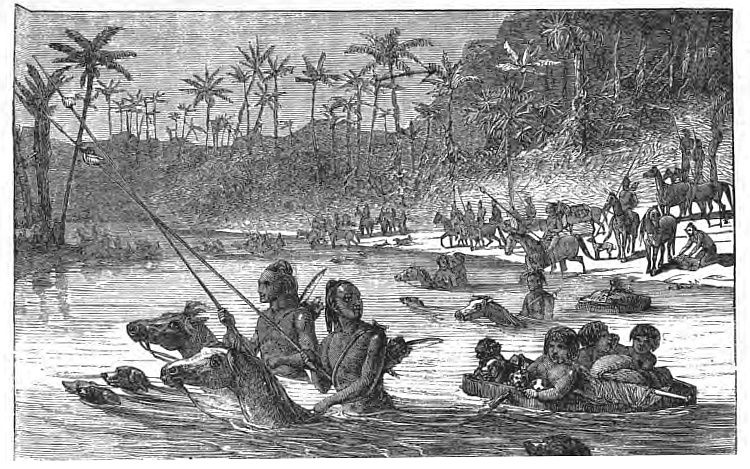
To say that the Comanche is the finest horseman in the world would be to state what is not the fact. He is not more excellent in this accomplishment than his neighbour and bitter foeman, the Pawnee,—no better than the “vaquero” of California, the “ranchero” of Mexico, the “llanero” of Venezuela, the “gaucho” of Buenos Ayres, and the horse Indians of the “Gran Chaco” of Paraguay, of the Pampas, and Patagonia. He is equal, however, to any of these, and that is saying enough,—in a word, that he takes rank among the finest horsemen in the world.
The Comanche is on horseback almost from the hour of infancy,—transferred, as it were, from his mother’s arms to the withers of a mustang. When able to walk, he is scarce allowed to practise this natural mode of progression, but performs all his movements on the back of a horse. A Comanche would no more think of making a journey afoot—even if it were only to the distance of a few hundred yards—than he would of crawling upon his hands and knees. The horse, ready saddled and bridled, stands ever near,—it differs little whether there is either saddle or bridle,—and flinging himself on the animal’s back, or his neck, or his croup, or hanging suspended along his side, the Indian guides him to the destined spot, usually at a rapid gallop. It is of no consequence to the rider how fast the horse may be going: it will not hinder him from mounting, or dismounting at will. At any time, by clutching the mane, he can spring upon the horse’s shoulders,—just as may be often seen in the arena of the circus.
The horse Indian is a true type of the nomadic races,—a dweller in tents, which his four-footed associate enables him to transport from place to place with the utmost facility. Some of the tribes, however, and even some of the Comanches, have fixed residences, or “villages,” where at a certain season of the year they—or rather their women—cultivate the maize, the pumpkin, the melon, the calabash, and a few other species of plants,—all being vegetable products indigenous to their country. No doubt, before the arrival of Europeans, this cultivation was carried on more extensively than at present; but the possession of the horse has enabled the prairie tribes to dispense with a calling which they cordially contemn: the calling of the husbandman.
These misguided savages, one and all, regard agricultural pursuits as unworthy of men; and wherever necessity compels them to practise them, the work falls to the lot of the women and slaves,—for be it known that the Comanche is a slave-owner; and holds in bondage not only Indians of other tribes, but also a large number of mestizoes and whites of the Spanish race, captured during many a sanguinary raid into the settlements of Mexico! It would be easy to show that it is this false pride of being hunters and warriors, with its associated aversion for an agricultural life, that has thinned the numbers of the Indian race—far more than any persecution they have endured at the hands of the white man. This it is that starves them, that makes unendurable neighbours of them, and has rendered it necessary in some instances to “civilise them off the face of the earth.”
But they are not yet all civilised from off the face of the earth; nor is it their destiny to disappear so readily as short-seeing prophets have declared. Their idle habits and internecine wars have done much to thin their numbers,—far more than the white man’s hostility,—but wherever the white man has stepped in and put a stop to their tribal contentions,—wherever he has succeeded in conquering their aversion to industrial pursuits,—the Indian is found not only to hold his ground, but to increase rapidly in numbers. This is the case with many tribes,—Greeks, Choctaws, and Cherokees,—so that I can promise you, young reader, that by the time you get to be an old man, there will be as many Indians in the world as upon that day when Columbus first set his foot upon “Cat” Island.
You will be inquiring how the horse could render the prairie Indian more independent of agriculture? The answer is simple. With this valuable auxiliary a new mode of subsistence was placed within his reach. An article of food, which he had hitherto been able to obtain only in a limited quantity, was now procurable in abundance,—the flesh of the buffalo.
The prairies of North America have their own peculiarities. They are not stocked with large droves of ruminant animals, as the plains of Southern Africa,—where the simplest savage may easily obtain a dinner of flesh-meat. A few species of deer, thinly distributed,—all swift, shy animals,—the prong-horn antelope, still swifter and shyer,—and the “big-horn,” shyest of all,—were the only ruminants of Prairie-land, with the exception of the great bison, or buffalo, as he is generally called. But even this last was not so easily captured in those days. The bison, though not a swift runner, is yet more than a match for the biped man; and though the Indian might steal upon the great drove, and succeed in bringing down a few with his arrows, it was not always a sure game. Moreover, afoot, the hunter could not follow the buffalo in its grand migrations,—often extending for hundreds of miles across plains, rivers, and ravines. Once mounted, the circumstances became changed. The Indian hunter could not only overtake the buffalo, but ride round him at will, and pursue him, if need be, to the most distant parts of Prairie-land. The result, therefore, of the introduction of the horse was a plentiful supply of buffalo-meat, or, when that failed, the flesh of the horse himself,—upon which two articles of diet the prairie Indian has almost exclusively subsisted ever since.
The Comanche has several modes of hunting the buffalo. If alone, and he wishes to make a grand coup, he will leave his horse at a distance,—the animal being trained to remain where his master has left him. The hunter then approaches the herd with great caution, keeping to leeward,—lest he might be “winded” by the old sentinel bulls who keep watch. Should there be no cover to shelter the approach of the hunter, the result would be that the bulls would discover him; and, giving out their bellow of alarm, cause the others to scamper off.
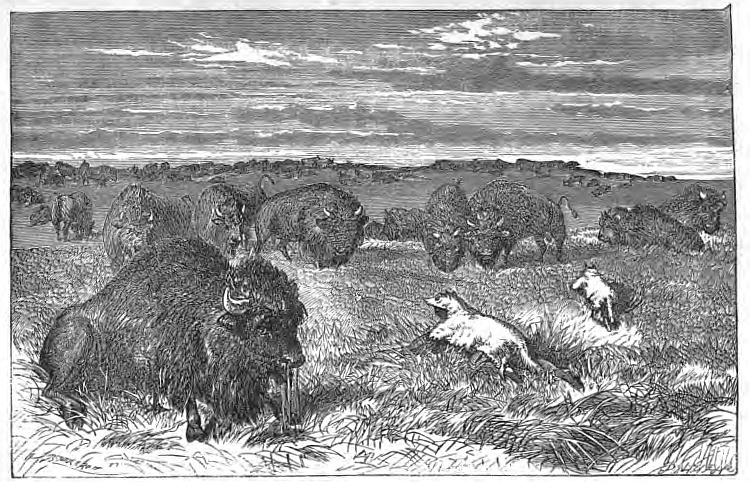
To guard against this, the Indian has already prepared himself by adopting a ruse,—which consists in disguising himself in the skin of a buffalo, horns and all complete, and approaching the herd, as if he were some stray individual that had been left behind, and was just on the way to join its fellows. Even the motions of the buffalo, when browsing, are closely imitated by the red hunter; and, unless the wind be in favour of his being scented by the bulls, this device will insure the success of a shot. Sometimes the skin of the large whitish-grey wolf is used in this masquerade with equal success. This may appear singular, since the animal itself is one of the deadliest enemies of the buffalo: a large pack of them hanging on the skirts of every herd, and patiently waiting for an opportunity to attack it. But as this attack is only directed against the younger calves,—or some disabled or decrepit individual who may lag behind,—the strong and healthy ones have no fear of the wolves, and permit them to squat upon the prairie within a few feet of where they are browsing! Indeed, they could not hinder them, even if they wished: as the long-legged wolf in a few springs can easily get out of the way of the more clumsy ruminant; and, therefore, does not dread the lowering frontlet of the most shaggy and ill-tempered bull in the herd.
Of course the hunter, in the guise of a wolf, obtains the like privilege of close quarters; and, when he has arrived at the proper distance for his purpose, he prepares himself for the work of destruction. The bow is the weapon he uses,—though the rifle is now a common weapon in the hands of many of the horse Indians. But the bow is preferred for the species of “still hunting” here described. The first crack of a rifle would scatter the gang, leaving the hunter perhaps only an empty gun for his pains; while an arrow at quarters is equally as deadly in its effect; and, being a silent weapon, no alarm is given to any of the buffaloes, except that one which has felt the deadly shaft passing through its vitals.
Often the animal thus shot—even when the wound is a mortal one—does not immediately fall; but sinks gradually to the earth, as if lying down for a rest. Sometimes it gets only to its knees, and dies in this attitude; at other times it remains a long while upon its legs, spreading its feet widely apart, as if to prop itself up, and then rocking from side to side like a ship in a ground-swell, till at last, weakened by loss of blood, it yields its body to the earth. Sometimes the struggles of a wounded individual cause the herd to “stampede,” and then the hunter has to content himself with what he may already have shot; but not unfrequently the unsuspicious gang keeps the ground till the Indian has emptied his quiver. Nay, longer than that: for it often occurs that the disguised buffalo or wolf (as the case may be) approaches the bodies of those that have fallen, recovers some of his arrows, and uses them a second time with like deadly effect! For this purpose it is his practice, if the aim and distance favour him, to send his shaft clear through the body of the bison, in order that the barb may not hinder it from being extracted on the other side! This feat is by no means of uncommon occurrence among the buffalo-hunters of the prairies.
Of course, a grand wholesale slaughter of the kind just described is not an everyday matter; and can only be accomplished when the buffaloes are in a state of comparative rest, or browsing slowly. More generally they detect the dangerous counterfeit in time to save their skins; or else keep moving too rapidly for the hunter to follow them on foot. His only resource, then, is to ride rapidly up on horseback, fire his arrows without dismounting, or strike the victim with his long lance while galloping side by side with it. If in this way he can obtain two or three fat cows, before his horse becomes blown, or the herd scatters beyond his reach, he considers that he has had good success.
But in this kind of chase the hunter is rarely alone: the whole tribe takes part in it; and, mounted on their well-trained mustangs, often pursue the buffalo gangs for, an hour or more, before the latter can get off and hide themselves in the distance, or behind the swells of the prairie. The clouds of dust raised in a mêlée of this kind often afford the buffalo a chance of escaping,—especially when they are running with the wind.
A “buffalo surround” is effected by a large party of hunters riding to a great distance; deploying themselves into a circle around the herd; and then galloping inward with loud yells. The buffaloes, thus attacked on all sides, become frightened and confused, and are easily driven into a close-packed mass, around the edges of which the mounted hunters wheel and deliver their arrows, or strike those that try to escape, with their long spears. Sometimes the infuriated bulls rush upon the horses, and gore them to death; and the hunters, thus dismounted, often run a narrow risk of meeting with the same fate,—more than a risk, for not unfrequently they are killed outright. Often are they obliged to leap up on the croup of a companion’s horse, to get out of the way of danger; and many instances are recorded where a horseman, by the stumbling of his horse, has been pitched right into the thick of the herd, and has made his escape by mounting on the backs of the bulls themselves, and leaping from one to another until he has reached clear ground again.
The buffalo is never captured in a “pound,” as large mammalia are in many countries. He is too powerful a creature to be imprisoned by anything but the strongest stockade fence; and for this the prairie country does not afford materials. A contrivance, however, of a somewhat similar character is occasionally resorted to by various tribes of Indians. When it is known that the buffaloes have become habituated to range in any part of the country, where the plain is intersected by deep ravines,—cañons, or barrancas, as they are called,—then a grand battue is got up by driving the animals pellmell over the precipitous bluffs, which universally form the sides of these singular ravines. To guide the herd to the point where it is intended they should take the fatal leap, a singular contrivance is resorted to. This consists in placing two rows of objects—which appear to the buffalo to be human beings—in such a manner that one end of each row abuts upon the edge of the precipice, not very distant from the other, while the lines extend far out into the plain, until they have diverged into a wide and extensive funnel. It is simply the contrivance used for guiding animals into a pound; but, instead of a pair of close log fences, the objects forming these rows stand at a considerable distance apart; and, as already stated, appear to the not very discriminating eye of the buffalo to be human beings. They are in reality designed to resemble the human form in a rude fashion; and the material out of which they are constructed is neither more nor less than the dung of the buffaloes themselves,—the bois de vache, as it is called, by the Canadian trappers, who often warm their shins, and roast their buffalo ribs over a fire of this same material.
The decoy being thus set, the mounted hunters next make a wide sweep around the prairie,—including in their deployment such gangs of buffaloes as may be browsing between their line and the mouth of the funnel. At first the buffaloes are merely guided forward, or driven slowly and with caution,—as boys in snow-time often drive larks toward their snares. When the animals, however, have entered between the converging lines of mock men, a rush, accompanied by hideous yells, is made upon them from behind: the result of which is, that they are impelled forward in a headlong course towards the precipice.
The buffalo is, at best, but a half-blind creature. Through the long, shaggy locks hanging over his frontlet he sees objects in a dubious light, or not at all. He depends more on his scent than his sight; but though he may scent a living enemy, the keenness of his organ does not warn him of the yawning chasm that opens before him,—not till it is too late to retire: for although he may perceive the fearful leap before taking it, and would willingly turn on his track, and refuse it, he finds it no longer possible to do so. In fact, he is not allowed time for reflection. The dense crowd presses from behind, and he is left no choice, except that of springing forward or suffering himself to be tumbled over upon his head. In either case it is his last leap; and, frequently, the last of a whole crowd of his companions.
With such persecutions, I need hardly say that the buffaloes are becoming scarcer every year; and it is predicted that at no distant period this really valuable mammal will be altogether extinct. At present their range is greatly contracted within the wide boundaries which it formerly occupied. Going west from the Mississippi,—at any point below the mouth of the Missouri,—you will not meet with buffalo for the first three hundred miles; and, though the herds formerly ranged to the south and west of the Rio Grande, the Comanches on the banks of that river no longer know the buffalo, except by their excursions to the grand prairie far to the north of their country. The Great Slave Lake is the northern terminus of the buffalo range; and westward the chain of the Rocky Mountains; but of late years stray herds have been observed at some points west of these,—impelled through the passes by the hunter-pressure of the horse Indians from the eastward. Speculators have adopted several ingenious and plausible reasons to account for the diminution of the numbers of the buffalo. There is but one cause worth assigning,—a very simple one too,—the horse.
With the disappearance of the buffalo,—or perhaps with the thinning of their numbers,—the prairie Indians may be induced to throw aside their roving habits. This would be a happy result both for them and their neighbours; though it is even doubtful whether it might follow from such a circumstance. No doubt some change would be effected in their mode of life; but unfortunately these Bedouins of the Western world can live upon the horse, even if the buffalo were entirely extirpated. Even as it is, whole tribes of them subsist almost exclusively upon horse-flesh, which they esteem and relish more than any other food. But this resource would, in time, also fail them; for they have not the economy to raise a sufficient supply for the demand that would occur were the buffaloes once out of the way: since the caballadas of wild mustangs are by no means so easy to capture as the “gangs” of unwieldy and lumbering buffaloes.
It is to be hoped, however, that before the horse Indians have been put to this trial, the strong arm of civilisation shall be extended over them, and, withholding them from those predatory incursions, which they annually make into the Mexican settlements, will induce them to dismount, and turn peaceably to the tillage of the soil,—now so successfully practised by numerous tribes of their race, who dwell in fixed and flourishing homes upon the eastern border of the prairies.
At this moment, however, the Comanches are in open hostility with the settlers of the Texan frontier. The lex talionis is in active operation while we write, and every mail brings the account of some sanguinary massacre, or some act of terrible retaliation. The deeds of blood and savage cruelty practised alike by both sides—whites as well as Indians—have had their parallel, it is true, but they are not the less revolting to read about. The colonists have suffered much from these Ishmaelites of the West,—these lordly savages, who regard industry as a dishonourable calling; and who fancy that their vast territory should remain an idle hunting-ground, or rather a fortress, to which they might betake themselves during their intervals of war and plundering. The colonists have a clear title to the land,—that title acknowledged by all right-thinking men, who believe the good of the majority must not be sacrificed to the obstinacy of the individual, or the minority,—that title which gives the right to remove the dwelling of the citizen,—his very castle,—rather than that the public way be impeded. All admit this right; and just such a title has the Texan colonist to the soil of the Comanche. There may be guilt in the mode of establishing the claim,—there may have been scenes of cruelty, and blood unnecessarily spilt,—but it is some consolation to know that there has occurred nothing yet to parallel in cold-blooded atrocity the annals of Algiers, or the similar acts committed in Southern Africa. The crime of smoke-murder is yet peculiar to Pellisier and Potgieter.
In their present outbreak, the Comanches have exhibited but a poor, short-sighted policy. They will find they have committed a grand error in mistaking the courageous colonists of Texas for the weak Mexicans,—with whom they have long been at war, and whom they have almost invariably conquered. The result is easily told: much blood may be shed on both sides, but it is sure to end as all such contests do; and the Comanche, like the Caffre, must “go to the wall.” Perhaps it is better that things should be brought to a climax,—it will certainly be better for the wretched remnant of the Spano-Americans dwelling along the Comanche frontiers,—a race who for a hundred years have not known peace.
As this long-standing hostility with the Mexican nation has been a predominant feature in the history of the Comanche Indian, it is necessary to give some account of how it is usually carried on. There was a time when the Spanish nation entertained the hope of Christianising these rude savages,—that is, taming and training them to something of the condition to which they have brought the Aztec descendants of Montezuma,—a condition scarce differing from slavery itself. As no gold or silver mines had been discovered in Texas, it was not their intention to make mine-labourers of them; but rather peons, or field-labourers, and tenders of cattle,—precisely as they had done, and were still doing, with the tribes of California. The soldier and the sword had proved a failure,—as in many other parts of Spanish America,—in fact, everywhere, except among the degenerated remnants of monarchical misrule found in Mexico, Bogota, and Peru. In these countries was encountered the débris of a declining civilisation, and not, as is generally believed, the children of a progressive development; and of course they gave way,—as the people of all corrupted monarchies must in the end.
It was different with the “Indios bravos,” or warrior tribes, still free and independent,—the so-called savages. Against these the soldier and the sword proved a complete failure; and it therefore became necessary to use the other kind of conquering power,—the monk and his cross. Among the Comanches this kind of conquest had attained a certain amount of success. Mission-houses sprung up through the whole province of Texas,—the Comanche country,—though the new neophytes were not altogether Comanches, but rather Indians of other tribes who were less warlike. Many Comanches, however, became converts; and some of the “missiones” became establishments on a grand scale,—each having, according to Spanish missionary-fashion, its “presidio,” or garrison of troops, to keep the new believers within sound of the bell, and to hunt and bring them back, whenever they endeavoured to escape from that Christian vassalage for which they had too rashly exchanged their pagan freedom.
All went well, so long as Spain was a power upon the earth, and the Mexican viceroyalty was rich enough to keep the presidios stocked with troopers. The monks led as jolly a life as their prototypes of “Bolton Abbey in the olden time.” The neophytes were simply their slaves, receiving, in exchange for the sweat of their brow, baptism, absolution, little pewter crucifixes, and various like valuable commodities.
But there came a time when they grew tired of the exchange, and longed for their old life of roving freedom. Their brethren had obtained the horse; and this was an additional attraction which a prairie life presented. They grew tired of the petty tricks of the Christian superstition,—to their view less rational than their own,—they grew tired of the toil of constant work, the childlike chastisements inflicted, and sick of the sound of that ever-clanging clapper,—the bell. In fine, they made one desperate effort, and freed themselves forever.
The grand establishment of San Saba, on the river of the same name, fell first. The troops were abroad on some convert-hunting expedition. The Comanches entered the fort,—their tomahawks and war-clubs hidden under their great robes of buffalo-hide: the attack commenced, and ended only with the annihilation of the settlement.
One monk alone escaped the slaughter,—a man renowned for his holy zeal. He fled towards San Antonio, pursued by a savage band. A large river coursed across the route it was necessary for him to take; but this did not intercept him: its waters opened for a moment, till the bottom was bare from bank to bank. He crossed without wetting his feet. The waves closed immediately behind him, offering an impassable barrier to his pursuers, who could only vent their fury in idle curses! But the monk could curse too. He had, perhaps, taken some lessons at the Vatican; and, turning round, he anathematised every “mother’s son” of the red-skinned savages. The wholesale excommunication produced a wonderful effect. Every one of the accursed fell back where he stood, and lay face upward upon the plain, dead as a post! The monk, after baptising the river “Brazos de Dios” (arm of God), continued his flight, and reached San Antonio in safety,—where he duly detailed his miraculous adventure to the credulous converts of Bejar, and the other missions.
Such is the supposed origin of the name Brazos de Dios, which the second river in Texas bears to this day. It is to be remarked, however, that the river crossed by the monk was the present Colorado, not the Brazos: for, by a curious error of the colonists, the two rivers have made an exchange of titles!
The Comanches—freed from missionary rule, and now equal to their adversaries by possession of the horse—forthwith commenced their plundering expeditions; and, with short intervals of truce,—periods en paz,—have continued them to the present hour. All Northern and Western Texas they soon recovered; but they were not content with territory: they wanted horses and cattle and chattels, and white wives and slaves; and it would scarce be credited, were I to state the number of these they have taken within the last half-century. Nearly every year they have been in the habit of making an expedition to the Mexican settlements of the provinces Tamaulipas, New Leon, and Chihuahua,—every expedition a fresh conquest over their feeble and corrupt adversaries. On every occasion they have returned with booty, consisting of horses, cattle, sheep, household utensils, and, sad to relate, human captives. Women and children only do they bring back,—the men they kill upon sight. The children may be either male or female,—it matters not which, as these are to be adopted into their tribe, to become future warriors; and, strange to relate, many of these, when grown up, not only refuse to return to the land of their birth, but prove the most bitter and dangerous foes to the people from whom they have sprung! Even the girls and women, after a period, become reconciled to their new home, and no longer desire to leave it. Some, when afterwards discovered and ransomed by their kindred, have refused to accept the conditions, but prefer to continue the savage career into which misfortune has introduced them! Many a heartrending scene has been the consequence of such apparently unnatural predilections.
You would wonder why such a state of things has been so long submitted to by a civilised people; but it is not so much to be wondered at. The selfishness that springs from constant revolutions has destroyed almost every sentiment of patriotism in the Mexican national heart; and, indeed, many of these captives are perhaps not much worse off under the guardianship of the brave Comanches than they would have been, exposed to the petty tyranny and robber-rule that has so long existed in Mexico. Besides, it is doubtful whether the Mexican government, with all her united strength, could retake them. The Comanche country is as inaccessible to a regular army as the territory of Timbuctoo; and it will give even the powerful republic of the north no small trouble to reduce these red freebooters to subjection. Mexico had quite despaired of being able to make an effort; and in the last treaty made between her and the United States, one of the articles was a special agreement on the part of the latter to restrain the Comanches from future forays into the Mexican states, and also cause them to deliver up the Mexican captives then in the hands of the Indians!
It was computed that their number at the time amounted to four thousand! It is with regret I have to add, that these unfortunates are still held in bondage. The great republic, too busy with its own concerns, has not carried out the stipulations of the treaty; and the present Comanche war is but the result of this criminal negligence. Had energetic measures been adopted at the close of the Mexico-American war, the Comanche would not now be harrying the settlers of Texas.
To prove the incapacity of the Mexicans to deal with this warlike race, it only needs to consider the present condition of the northern Mexican states. One half the territory in that extensive region has returned to the condition of a desert. The isolated “ranchos” have been long since abandoned,—the fields are overgrown with weeds,—and the cattle have run wild or been carried off by the Comanches. Only the stronger settlements and large fortified haciendas any longer exist; and many of these, too, have been deserted. Where children once played in the security of innocence,—where gaily-dressed cavaliers and elegant ladies amused themselves in the pleasant dia de campo, such scenes are no longer witnessed. The rancho is in ruins,—the door hangs upon its hinge, broken and battered, or has been torn off to feed the camp-fire of the savage; the dwelling is empty and silent, except when the howling wolf or coyote wakes up the echoes of its walls.
About ten years ago, the proud governor of the state of Chihuahua—one of the most energetic soldiers of the Mexican republic—had a son taken captive by the Comanches. Powerful though this man was, he knew it was idle to appeal to arms; and was only too contented to recover his child by paying a large ransom! This fact, more than a volume of words, will illustrate the condition of unhappy Mexico.
The Comanche leads a gay, merry life,—he is far from being the Indian of Cooper’s description. In scarcely any respect does he resemble the sombre son of the forest. He is lively, talkative, and ever ready for a laugh. His butt is the Mexican presidio soldier, whom he holds in too just contempt. He is rarely without a meal. If the buffalo fails him, he can draw a steak from his spare horses, of which he possesses a large herd: besides, there are the wild mustangs, which he can capture on occasions. He has no work to do except war and hunting: at all other times he has slaves to wait upon him, and perform the domestic drudgery. When idle, he sometimes bestows great pains upon his dress,—which is the usual deer-skin tunic of the prairie Indian, with mocassins and fringed leggings. Sometimes a head-dress of plumes is worn; sometimes one of the skin of the buffalo’s skull, with the horns left on! The robe of buffalo pelt hangs from his shoulders, with all the grandeur of a toga; but when he proceeds on a plundering expedition, all these fripperies are thrown aside, and his body appears naked from the waist to the ears. Then only the breech-clout is worn, with leggings and mocassins on his legs and feet. A coat of scarlet paint takes the place of the hunting-shirt,—in order to render his presence more terrific in the eyes of his enemy. It needs not this. Without any disguise, the sight of him is sufficiently horrifying,—sufficiently suggestive of “blood and murder.”