THE DRAGON AT HIDE-AND-SEEK By G. K. CHESTERTON
Reading edition
39
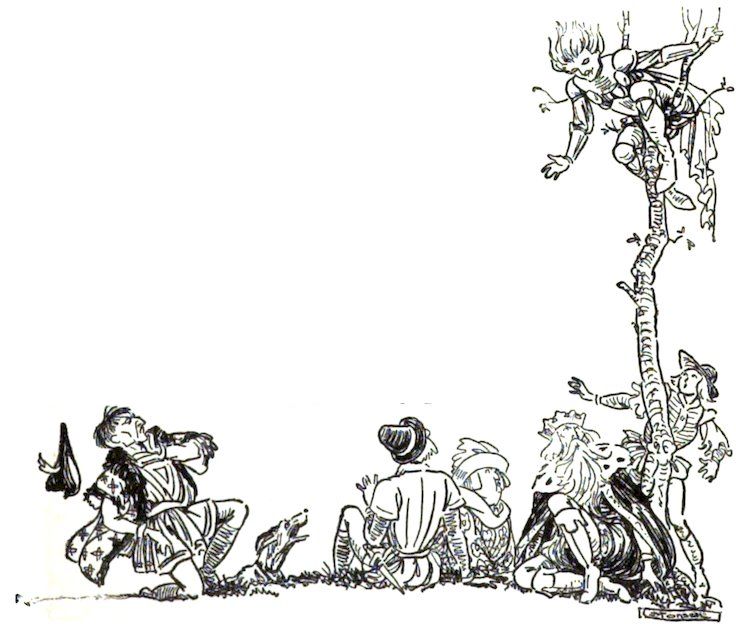
Once upon a time there was a knight who was an outlaw, that is a man hiding from the king and everybody else; and one who lived so wild and lawless a life, in being hunted from one hiding-place to another, that he had great difficulty in going to church every Sunday. Although his ordinary way of life was full of fighting, and burning, and breaking down doors, and therefore looked a little careless, he had been very carefully brought up, and it was obviously a very serious thing that he should be late for church. But he was so clever and daring in his way of getting from one place to another without being caught, that he generally managed it somehow. And it was often a considerable disturbance to the congregation when he came with a great crash flying in through the big stained-glass window and smashing it to atoms, having been patiently hanging on a gargoyle outside for half an hour; or, when he dropped suddenly out of the belfry, where he 40had been hiding in one of the big bells, and alighted almost on the heads of the worshippers. Nor were they better pleased when he preferred to dig a hole in the churchyard and crawl under the church-wall, coming up suddenly under a lifted paving-stone in the middle of the nave or the chancel. They were too well-behaved, of course, to notice the incident during the service; and the more just among them admitted that even outlaws must get to church somehow; but it caused a certain amount of talk in the town, and the history of the knight and his wonderful way of hiding everywhere and anywhere was by this time familiar to the whole countryside. At last this knight, who was called Sir Laverok, began to feel so sure of his power of escaping and hiding, whenever he wanted to, that he would come into the market-place in the most impudent manner when any great business was being transacted, such as the elections of the guilds, or even to the coronation of the king, to whom he addressed some well-chosen words of advice about his public duties, in a loud voice from the chimney-pot of an adjoining house. Often when the king and his lords were out hunting, or even when they were in camp during a great war, they would look up and see Sir Laverok perched like a bird on a tree above their heads, and ever ready with friendly counsels and almost fatherly good wishes. But though they pursued him with emotions of uninterrupted rage, lasting over several months, they were never able to discover what were the holes and corners in which he hid himself. They were forced to admit that his talent for disappearing into undiscovered places was of the highest order, and that in a children’s game of Hide-and-Seek he would have covered himself with everlasting glory; but they all felt that a fugitive from justice should be strictly forbidden to cultivate genius of this kind.
41Now it was just about this time that there fell upon the whole of that country an enormous calamity far worse than any war or pestilence. It was of a kind which we have very few chances of experiencing nowadays; though in the other matter of wars and diseases our opportunities are still wide and varied. There had appeared in the wilderness, to the north of that country, a monster of huge size and horrible habits and disposition; a monster who might have been called for the sake of simplicity, a dragon, only he had feet like an elephant, but a hundred times bigger, with which he used to stamp and crush everything to a flat and fine paste before he licked it up with a tongue as long and large as the Great Sea Serpent; and his great jaws opened wide like a whale’s, only that they could have swallowed a shoal of whales as if they were whitebait. No weapons or missiles seemed to be of any avail against him; for his skin was plated with iron of incredible thickness. 42Indeed, some declared that he was entirely composed of iron, and that he had been made out of that material by a magician who lived beyond the wilderness, where such crafts and spells were more seriously studied. Indeed, it was hinted by some that the land of the magicians was in every way in advance of their own, and well worthy of emulation; and that if anyone objected that this marvellous machinery had no apparent effect except in killing people and destroying beautiful things, he should be rebuked as one lacking in enterprise and a larger outlook upon the future. But those who said this, commonly said it before they had actually met the new animal; and it was noticed that after meeting him they seldom uttered these thoughts, or, indeed, any other.
43
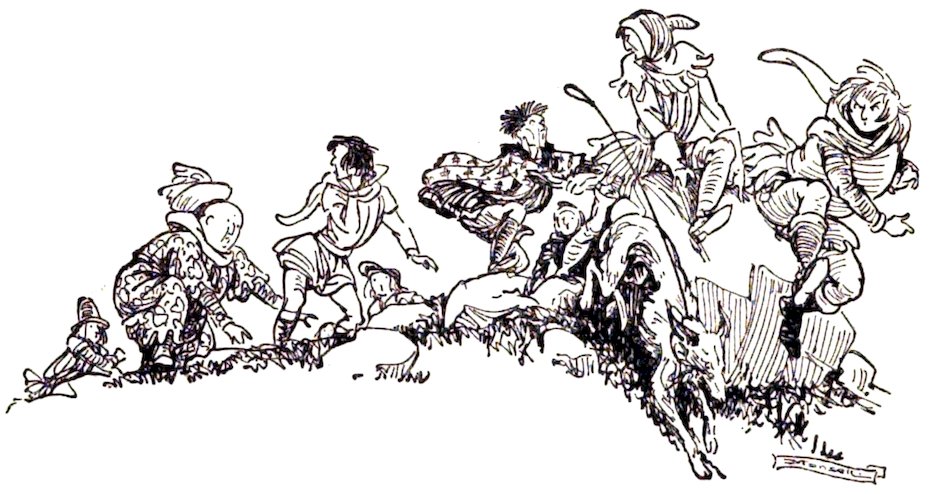
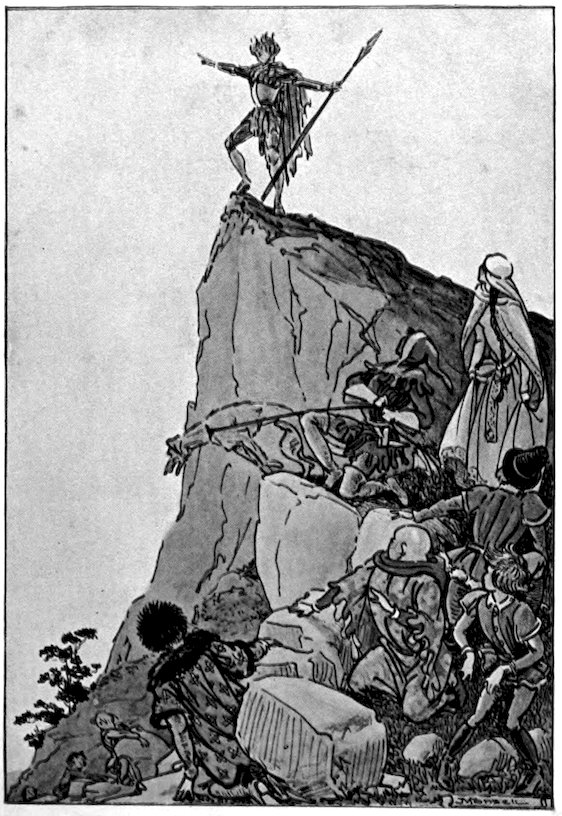
The monster may have been made of iron, and his nerves and muscles may have been, as some said, made like an arrangement of wheels and wires, but he was most unmistakably alive; and proved it by having a hearty appetite and an evident enjoyment of life. He trampled and devoured first, all the fortifications of the frontier, and then the castles and the larger towns of the interior; and by the time that he was marching towards the capital, the king and his courtiers were all climbing to the tops of towers, and everybody else to the tops of trees. These precautions proved inadequate in practical experience; in very practical experience. So long as the monster could be seen twenty miles away like a marching mountain, already fantastic in outline, but still blue or purple with distance, and there was no other sign of him except a slight shaking of the houses as in a mild earthquake, these conjectures and expedients could be debated copiously, if not always calmly. But when the creature came near enough for his habits to be closely studied, it was clear that he could tread down trees like grass, and flatten out castles like houses of cards. It became more and more the fashion to seek out less showy and more secluded country resorts; the whole population, led by magistrates, merchants, and all its natural leaders, fleeing with startling rapidity to the mountains and concealing themselves in holes and caverns, which they blocked behind them with big rocks. Even this was not very successful; the monster proceeded to scale the mountains with the gaiety of a goat, to kick the rocky barricades to pieces, letting in daylight on the cowering company within; and many of them were able to recognise the familiar shape of the long and curling tongue of the intelligent creature, exploring their retreat and coiling and twisting and darting about in a very playful and sportive manner. Those who had not found any hole to 44crawl into, and who were clinging in crowds to the crags higher up the hill, were at this moment, however, surprised with a sight that almost took their thoughts for an instant off the universal peril. On the highest crag of all, above their heads, had appeared suddenly the figure of Sir Laverok with his old spear in his hand, with his sword girt around his ragged armour, and the wind waving about his wild hair that was the colour of flame. In all that huddling crowd it was only the man in hiding who stood out conspicuous; and only the man fleeing from justice who did not flee.
“I am not afraid,” he said in answer to their wild cries. “You know I have a trick of finding my way to places of safety. And as it happens, I know a castle to which I shall retreat, and to which the dragon can never come.”
“But my good Sir,” said the Chancellor, pausing in the act of trying to creep into a rabbit-burrow, “the dragon can grind castles to powder with his heel. I regret to say that he showed not the least embarrassment even in approaching the Law Courts.”
“I know of a castle which he cannot reach,” said Sir Laverok.
“The offensive animal,” said the Lord Chamberlain, poking his head for a moment out of a hole in the ground, “actually entered the king’s private chamber without knocking.”
“I know of a private chamber that he cannot enter,” replied the outlaw knight.
“It is very doubtful,” came the muffled voice of the Lord High Admiral from somewhere underground, “whether we shall even be safe in any of the caverns.”
45“I know a cavern where I shall be safe,” said Sir Laverok.
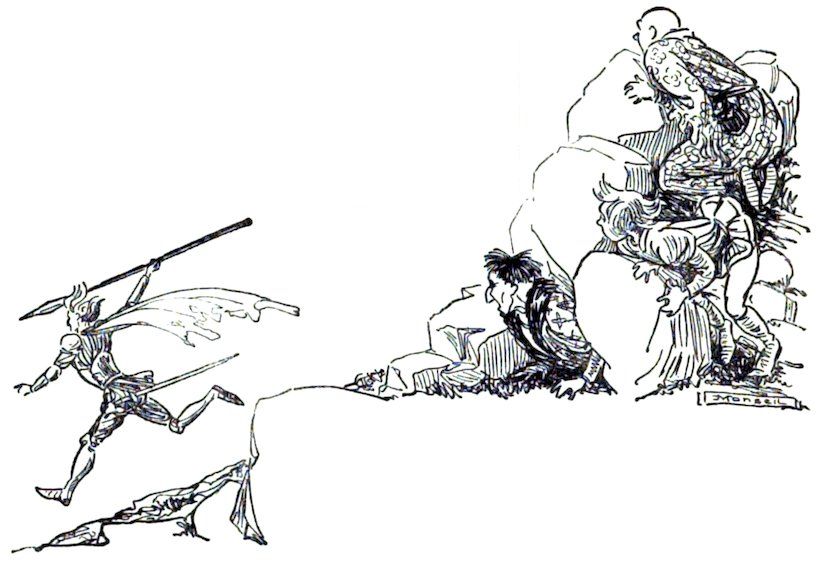
At the foot of the steep slope to which they clung spread a large plateau like a plain; and over this bare tableland, at the moment, the monster was prowling up and down like a polar bear, considering what he would destroy next. Every time he turned his head towards them, the crowds clambered a little higher up the hill; but they soon saw, to their astonishment, that Sir Laverok was not climbing up, but climbing down. He dropped from the last overhanging rock, and rushed out upon the plain against the monster; when he came within a short distance, the knight gave one wild leap and threw his spear like a thunderbolt.
What happened in the flash of that thunderbolt nobody in the crowd seemed to know. Those who knew them best were of opinion that they all shut their eyes tight, and most probably fell flat on their faces. Others say that the monster stamped his foot upon his enemy with so stunning a shock that a cloud of dust rolled up to the clouds of heaven, and for a moment hid the whole scene. Others, 46again, explained that the vast immeasurable bulk of the monster had come between them and the victim. Anyhow, it is certain that when that vast bulk turned once more and began swaying and lurching backwards and forwards on its lonely prowl, no sign of the victim could be seen. Probably he had been stamped to mire as everything else had been. But if it were conceivable that he had indeed escaped, as he had boasted, it was hard to say where; as there did not seem to be anywhere for him to escape to. And the authorities in the holes and caves could not but regret that they had not condemned him to be burned as a wizard instead of hanged as a rebel, whenever they should have put the final touch to the sentence by carrying it into effect. They comforted themselves in the cave by the reflection that at least no hasty capture or premature execution had yet put it out of their power to rectify the mistake; but for the moment it seemed clear that their chances either of hanging or burning the gentleman were further off than ever.
Just at that moment, however, there was a new interruption. It so happened that the king’s third daughter was standing in the crowd on the slope; for all the elder members of the royal family were enjoying a temporary and semi-official retirement from the cares of state at the bottom of a dry well on the other side of the mountain range. But she had been unable or unwilling to travel with the extreme rapidity which they had had the presence of mind to exhibit; for she was rather an absent-minded person, wholly without aptitude for practical politics. She was called the Princess Philomel, and was a dreamy sort of person, with long hair and blue eyes that were like the blue 47of distant horizons, and she was commonly very silent; but she had watched the adventure of the vanishing outlaw with more interest than she commonly showed in anything; and she startled everybody at this stage by breaking her silence and calling out in a clear voice:
“Yes; he has found his fairy castle where no dragon can come.”
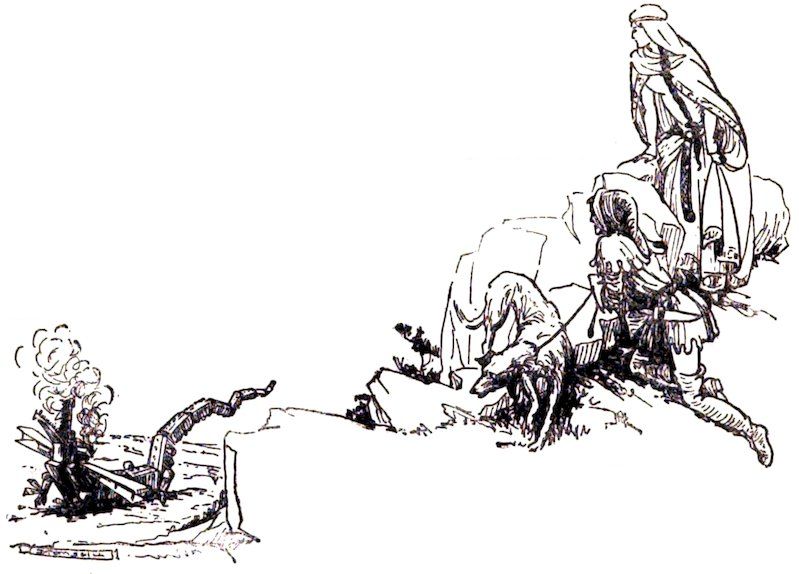
The more dignified Councillors of State were just venturing to put their noses above ground in order to remonstrate respectfully against the breach of etiquette, when everybody’s attention was again distracted to the monster, who was behaving in an even more extraordinary way than usual. Instead of pacing backwards and forwards with a certain pomposity as he had done before, he was bounding to and fro, taking totally unnecessary leaps into the air and clawing in a most uncomfortable and inconsequent fashion.
“What is the matter with him now?” enquired the Master of the Buckhounds, who was something of a student of animal life, and would, under other circumstances, have been much interested in the phenomenon.
“The monster is angry,” replied the Princess Philomel in 48the same absolute if abstracted fashion. “He is angry because the knight has reached the magic chamber and cannot be found.”
If the monster was indeed exhibiting anger, it would seem that his anger had an element of self-reproach. For he was evidently clawing and scratching at himself rather in the manner of a dog hunting a flea, but much more savagely.
“Can he be killing himself?” asked the Lord Chancellor hopefully. “I am the keeper of the King’s conscience, and not, of course, the keeper of the dragon’s. But it seems possible that his conscience, if once aroused, would find in retrospect some legitimate ground for remorse.”
“Nonsense,” said the Chamberlain, “why should he kill himself?”
“If it comes to that,” answered the other, “why should he fight himself, as he seems to be doing?”
“Because,” answered the Princess, “Sir Laverok has at last reached the cavern where he is safe.”
But even as she spoke, a further and final change seemed to pass over the monster. For a moment it looked as if he had turned into two or three different monsters, for the different parts of him were behaving in different ways. One hind leg rested as calmly on the earth as the column of a temple, while the other was kicking wildly up behind and thrashing the air like the sail of a windmill. One eye was standing out of the head in hideous prominence, and rolling round and round like a catherine-wheel of fury, while the other was already closed with the placid expression of a cow who had gone to sleep. Then the next moment both eyes were closed, and both feet stationary, and the whole 49monster, with a deprecating expression, turned his back and began to retreat towards the plains at an amiable and ambling trot.
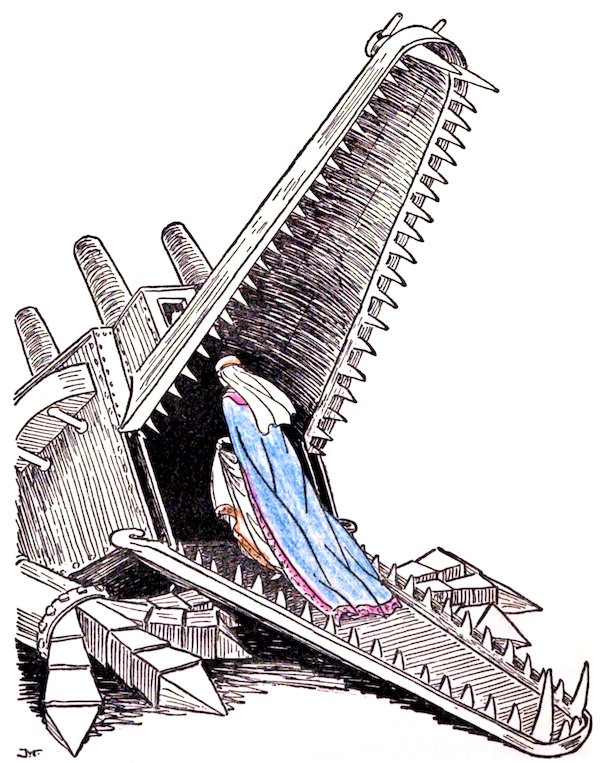
The Princess surprised them by walking inside.
50Thus began the last phase of the celebrated Dragon of the Wilderness, which was more of a mystery than his wildest massacres and deeds of destruction. He interfered with nobody; he stood politely on one side for people to pass; he even succeeded, with some signs of reluctance, in becoming a vegetarian and subsisting entirely upon grass. But when the ultimate goal of his pilgrimage was discovered, the surprise was even more general. The wondering and still doubtful crowds that followed him across that country became gradually convinced of the incredible idea that he intended to go to church. Moreover, he approached the sacred edifice in a far more tactful and unobtrusive and respectful way than Sir Laverok had done in the old days, when he broke windows and tore up pavements in his indiscriminating excess of punctuality. Finally, the monster surprised them most of all by kneeling down and opening his mouth very wide with an ingratiating expression; and the Princess surprised them still more by walking inside.
Something in the way in which she did it revealed to the more thoughtful among them the fact that Sir Laverok had been inside the animal all the time. It is unnecessary to repeat here the explanations which gradually enlightened them about the inner truth of the story or the inner machinery of the dragon. This exact and scientific narrative is also addressed only to the thoughtful. And these will have no difficulty in guessing that a magnificent marriage ceremony took place in the interior of the dragon, which was treated as a temporary chapel while within the precincts 51of the consecrated building. They may even form some notion of what was meant when the Princess, who was given to oracular remarks, said, “The whole world will behave differently when heroes find their hiding-place in the world.” But it must be confessed that those learned men, the Chancellor and the Chamberlain, could make very little of it.
52