MAGIC CASEMENTS By MADELEINE NIGHTINGALE
Reading edition
From Tony’s house the ground slopes north, east, and south, for the house stands upon the spur of a ridge, and away on the left the long range of the Downs shoulder the sky, whilst on the right, miles northward, you can see Blackdown and Hascombe and on a clear day even Leith Hill and Newlands Corner. But due east a little steep hill road wanders away by gorse-strewn commons and under great spreading Sussex oaks, where you meet no one save perhaps a milch goat, trailing its long chain amongst the wayside bushes, or a cow or two wandered from their pasturage and “feeding their way home,” as the natives say. And this is, perhaps, Tony’s favourite walk. I am not quite sure why he so especially loves it, but I think, maybe, it is because that way lies the Silver Wood. For in the Silver Wood there once befell him a great and wonderful adventure; and the happening of it was in this wise:
It was early May, but the May of a backward year, and only the larches were in “proper green” (as Tony put it), though here and there a silver birch was shaking out her smallest crumpled leaves, and all about the commons and 104in the roadside hedges white bushes of blackthorn shone, and the old mushroom man had told Tony this was “blackthorn winter.” Then came two blazing days of unexpected summer, and on the second night, just as the clock in the hall struck one, Tony had wakened suddenly into moonlight bright as day and a world become, as it seemed, half Heaven by reason of the music with which it was filled.
“What is it? Oh, what is it?” he whispered, and for an hour lay quivering with the wonder of it, until at last he could bear no longer the loveliness all alone, and, slipping out of bed, crept along the dark passage and scratched softly at his mother’s door. This scratching was an invention of his own, because, as he once explained, “The mice scratch and it doesn’t wake them, so if they are really asleep I won’t disturb them, and if they aren’t, why, they’ll know it’s me.” To-night, his father’s voice answered, prompt and wide awake. “That you, Tony? Come along!” He had crouched down under an eiderdown, and all three had listened until at last the chorus died down into silence, a cock from the valley crew welcome to the coming dawn, and a cow in the byre at the back of the house lowed as if in answer. Then Tony’s father had picked him up by the scruff of his pyjamas like a kitten, gathered him in his arms, and carried him back to bed.
“It’s the nightingales, old man,” said he, “and now to sleep and I’ll tell you all about them in the morning.”
Accordingly, next day, seated in his father’s study, whilst outside the sun shone and beckoned with long beams through the wafting curtains, he heard how Philomel, the nightingale, had come back from his winter quarters in Egypt or Syria or Northern Africa, and was last night 105voicing his return; how he loves dense coverts, and how skilfully he hides his nest; how the eggs are five in number, and of a brownish shade; and how, as he grows busy with the feeding and rearing of his young, his song decreases until at the end of the season, just before he leaves our shores, so hoarse has his voice become that he cannot sing at all, but only croak. And lastly, how he sings by day as well as night; only, because a thousand other birds are singing too, one scarcely recognizes him.
Tony had listened, interested and attentive; but when the instruction was over, a book had been taken down from its shelf, and verses more wonderful than Tony had ever heard before—as wonderful, indeed, as the nightingale’s songs themselves—were read to him in the wonderful way and wonderful voice which only his father had. “And that’s what John Keats thought about ’em, Tony, my son. Some day you shall tell me what you think. But, there, off with you into the sunshine, and perhaps they’ll sing for you again to-night.” So did his father finish.
And Tony had gone, but now all the careful facts of the bird’s self and habits had drifted from his mind, and there remained to him only snatches of the poem John Keats had written and some dim realization of its glory and its joy.
In the afternoon he had borrowed the volume, going through the poem stanza by stanza, finding great portions which he in no way understood, but fastening, nevertheless, on the lines that most fascinated him, reading them again and again, until they were unmistakably his own.
“The same that oft-times hath
Charm’d magic casements, opening on the foam
Of perilous seas, in faery lands forlorn.”
106
It was a fortnight later when the adventure happened. After the few hot days, the wind had swung anew into the north, and there had followed an extraordinarily cold week, at the end of which Summer asserted herself firmly, and upon this particular afternoon the air was quite sleepily warm.
The blackthorn had all blown away, and on the wayside banks only here and there a last primrose peeped out lonelily from its clump of green leaves, a little sorrowful it seemed, for the many brothers and sisters drooped and faded on their stalks at its side. The gorse was blazing though, all the oak-trees were green, and down in the woods there would be bluebells. Five or six larks carolled noisily overhead and Tony, too, was singing as he walked. He had his bow-and-arrow in case he saw buffalo, and over his back was slung a scout’s bag. For after tea the prairie nights got chilly, and he needed wood-chips for a fire in his wigwam at the bottom of the garden. He strode with large strides, but silently as befitted an Apache brave (though, for that matter, he cared little that over by Blackdown 107the Sioux were encamped. Were not the young men of his own tribe within call, should he need them, which was unlikely? Trust an Apache to keep or at any rate extricate himself from danger).
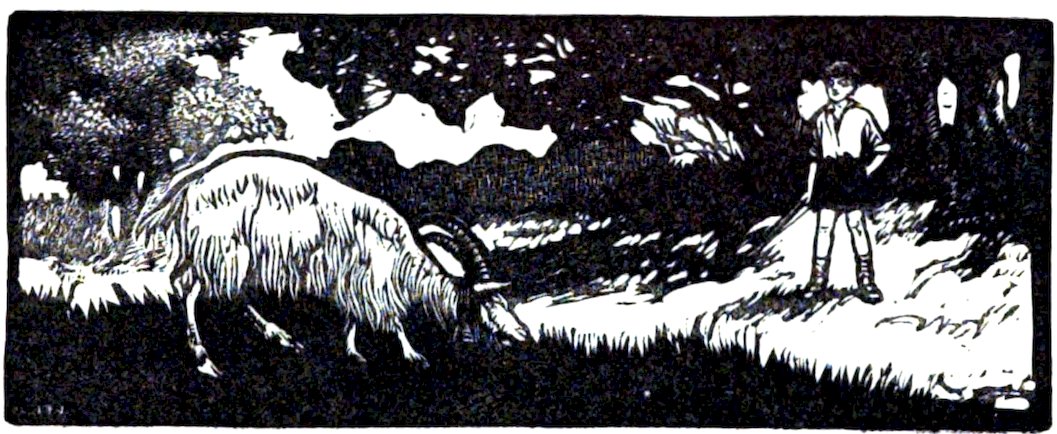
At the bottom of the hill he left the road and struck across the common. A large white goat was cropping grass down in the dip, and he paused to watch it critically.
“A strayed broncho!” said he. “And a fine one, too. I wish I had my lariat.” Then he slid his head through his bow, dropped the arrow in its quiver, climbed the stile of the Silver Wood, and promptly forgetting all about Indians, became himself again. For in the woods the flowers, shut out somewhat from the sun, are often weeks later than those of the hedgerows and open fields, and here everywhere was carpeted with primroses and dog violets, and the white stars of the wood anemone.
Tony gave a little crow of delight.
“Oh, I do like it!” he said aloud.
108Then he threw back his head and stared up into the trees, for somewhere above him he thought he heard a voice say, “So do I.” Nor was he mistaken. Astride a big branch that spread out half-way up the oak-trunk sat a small grey man, and Tony recognized him at once. It was the Woodcutter.
“Hello,” said Tony.
“Hello,” said the Woodcutter, and went on with his work, chopping away with his axe at the bough on which he was perched. But as he chopped at wood between the tree-stem and himself, Tony felt a little anxious.
“You mustn’t do that, Woodcutter,” he said. “When the bough breaks——”
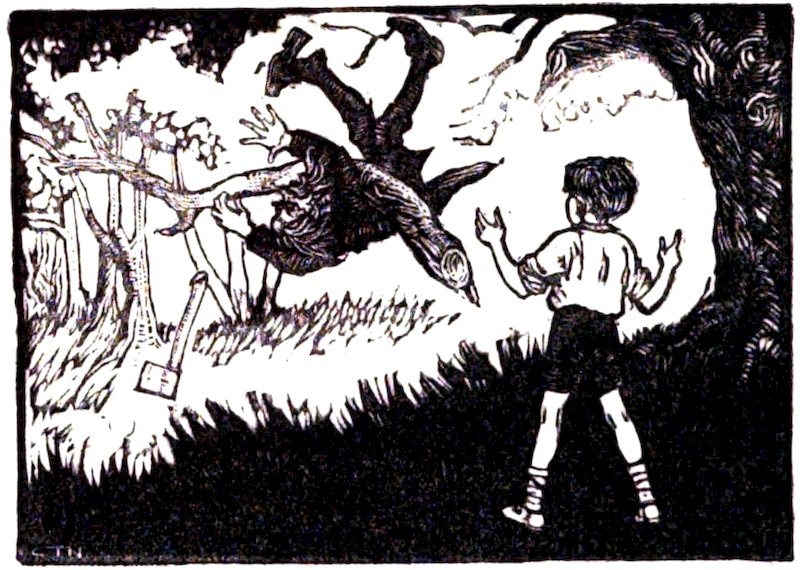
“The cradle will fall,” finished the Woodcutter; and even as he spoke the branch cracked loudly. “’Ware heads!” he shouted; and down it came, he with it, almost at Tony’s feet.
Tony sprang back in some alarm. He stepped forward again, however, almost immediately, to help the little man to his feet; but the Woodcutter, rather pettishly, motioned him away and proceeded leisurely to brush from his clothes the dirt, grass ends, and dried leaves which clung to them.
“Did it hurt you?” Tony asked, with much feeling.
The little man snorted.
“Try it yourself,” he said tartly.
“Well, I did warn you not to cut between the trunk and you,” Tony said presently, a little nettled by the other’s ungraciousness.
“It makes no difference where I cut,” the Woodcutter returned rather dolefully. “I fall just the same. Look at 109my head.” He turned sideways, and Tony saw that the back of it bulged in two enormous bumps.
“That’s why I can’t wear a hat. You see, they never quite go down before the next bump bumps them.”
“I’m so sorry,” Tony said gently. “But I can’t help thinking that if only you didn’t cut——”
“Oh, don’t say it all over again,” the Woodcutter cried irritably. “If you’re behind, you fall after; if you’re before you fall with. And after all, it’s soonest over if you fall with.”
Tony looked a little bewildered.
“I don’t see why you should fall after,” he said at last.
“You must if you haven’t fallen before,” retorted the other.
Tony considered awhile.
“But that’s a joke,” he remarked at last.
“Oh, is it!” said the Woodcutter indignantly. “Try it. You’ll soon see.”
Tony shook his head. “No, thank you,” he said, and then, “I didn’t mean that kind of joke.”
The little man grunted.
“I don’t think it’s any kind of joke,” he said huffily, and Tony, hopeless of explaining, changed the subject.
“Why did you cut such a beautiful branch?” He fingered the bright green leaves regretfully.
“It’s for my windows—wood-windows you know. Every wood has windows.”
“Windows?” Tony spoke doubtfully, but he pricked his ears as the little man went on.
“Yes. Windows. Magic casements.”
Tony’s heart began to beat faster.
110
“For the nightingale? Their magic casements, I mean?”
The Woodcutter stared at him.
“Yes, of course,” he said. “Whose else?”
“I didn’t understand ... that you make them for yourself, I mean,” Tony said slowly. “Can I come and watch?”
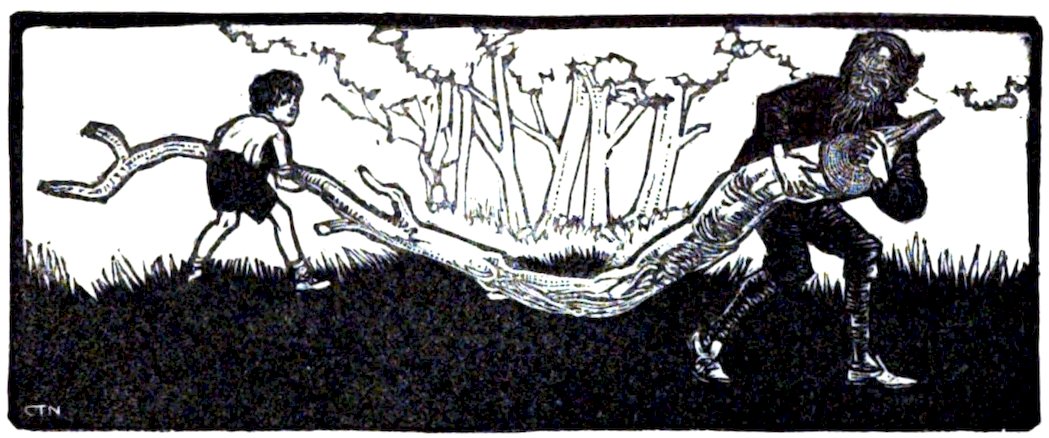
The Woodcutter motioned him to shoulder one end of the bough, and raising the other himself, started off down the slope.
“You don’t altogether,” he said.
“Don’t altogether what?”
“Make them yourself. The material is there. You only need to use it.”
“Yes,” returned Tony after a pause, “I think I see that.”
“And that’s why it had to be specially beautiful,” he went on; “to fit in with the music, I suppose.”
The Woodcutter grunted assent and then plodded on in silence.
111Now when you have climbed the stile of the Silver Wood, the path, all grass and primroses and violets, runs steeply down for 100 yards or so, and crosses in the dip a little brushwood bridge that spans the boggy bed of a small stream. On the other side you rise again, and almost at once on the left a lane turns at right angles, leading straightly through a plantation of silver birches. If you follow this, you come shortly into meadows, for the wood is narrow here. Fifty yards farther is another lane, cut through great oaks, and one trunk, topped and lonely, lies right across the way. Both these the Woodcutter passed by. The third lane is narrower, and the branches of the trees on either hand spread and so intermingle that, when they are in full summer foliage, the path beneath is dim and cool like the tunnels through the corn and bracken that the rabbits use. To-day, however, since the oak-buds had only just uncurled their crinkly leaves, the sun lay all along it, flecking and dappling it in a pattern of light and shade. And above was the same pattern, but fashioned of the leaves themselves against the sky. The Woodcutter halted for a moment. “Listen!” he said, and far away ahead, very faint and muffled, Tony heard a whistle, thin and sweet and repeated several times. Then came a little burst of gurgling song that set his shoulders wriggling with delight. And then all was still again.
“It’s a nightingale!” he cried.
The Woodcutter nodded.
“They love the quiet and lonely places, where no one goes. But we’ll go, you and I, Tony o’ Dreams, and we’ll build a window there for them to charm.”
Tony stared, for it seemed to him odd that a little rough-clothed, 112rough-handed Woodcutter should be speaking in the language of a poet. “Do you know Keats, then?” he asked, and paused, ashamed of his astonishment.
The Woodcutter smiled.
“That’s not just John Keats,” he said, “it’s everyone, boy—everyone, that is, who looks and feels.”
“But John Keats wrote it,” Tony persisted.
“Yes, but Keats only gathered what grows for all of us; gathered and thought on it and put it into words. It’s ours as well as his. That’s why we love it so.”
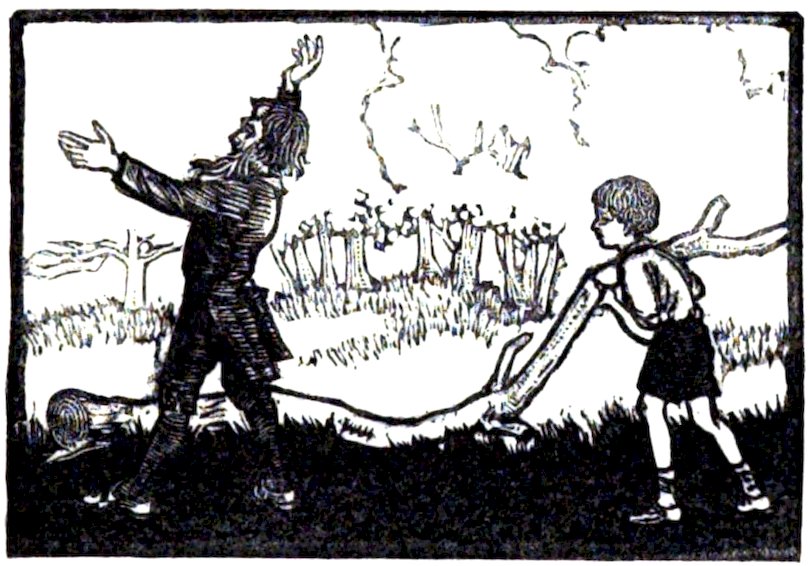
Tony pondered this very seriously.
“Suppose”—he said—“suppose I gathered something and thought on it; could I ever put it into words—into words, I mean, like those?”
The Woodcutter did not answer at once, and Tony waited patiently, listening as he walked to the soft pad of their feet on the grass, the pipe of an occasional chaffinch, 113the coo of a wood-pigeon, the quiet stir of the trees and the rustle of a rabbit here and there amongst the undergrowth.
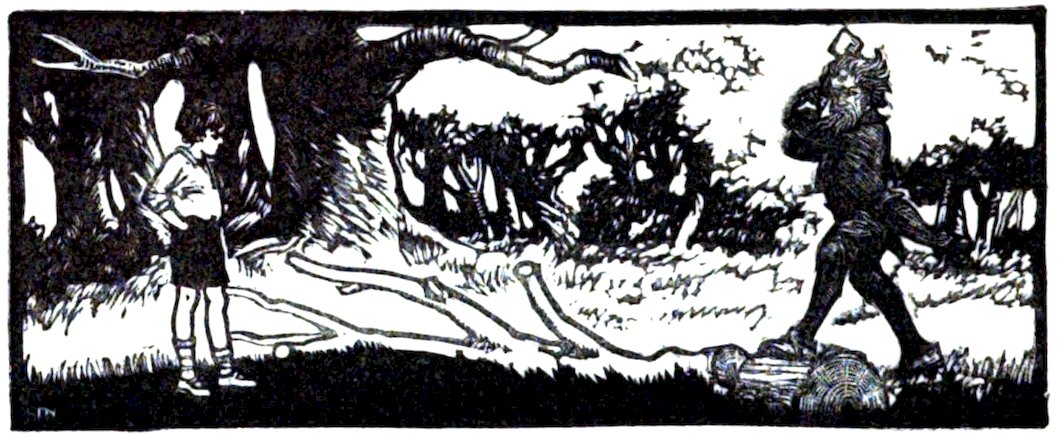
“I dare say,” the little man said at last. “Maybe, they’d come to you somewhere, somehow, as they came to him. I cannot tell.” He lowered his end of the branch and suddenly flung his arms wide.
“Listen!” he cried. “Can you hear?”
Tony regarded the strange little figure wonderingly.
“I can hear. Yes. Lots of things,” he answered after a while. “The trees and the wind, and the birds and the rabbits; and ... sometimes I think I can hear the clouds and the flowers and the sunshine. But I can’t quite tell what they say.”
“Listen then,” said the Woodcutter again; “listen to them, and one day perhaps you will understand the language, so that their words shall come to be your own.”
He raised the bough again and trudged off, and Tony, absorbed in his own thoughts, followed in silence until the whistle of another nightingale, quite near at hand, roused him.
114The lane now had dwindled to a narrow path, and on either hand all tangled round the grey lichened trunks of the trees was so dense an undergrowth of bramble, honeysuckle, and little springing birches that he and his companion seemed shut out from all the world. But far ahead, at the path’s end, a little patch of white gleamed like a pool in a green field.
The Woodcutter pointed to it.
“See!” he cried. “A magic casement! I must frame the sky.”
In a moment he had his branch flat upon the ground and was chopping vigorously, measuring, tenoning, fitting, until—so swiftly as to seem indeed magical—the magic casement was complete. Tony laid hands upon one side of its square frame to help bear it to its destination, but the Woodcutter shook his head.
“The nightingales know me,” he said, “but I must go 115alone. When it is fixed, perhaps for you also the charm will charm. Wait.”
And so Tony waited, sitting by the side of the path on a mat of new white wood-chips with his back against a tree.
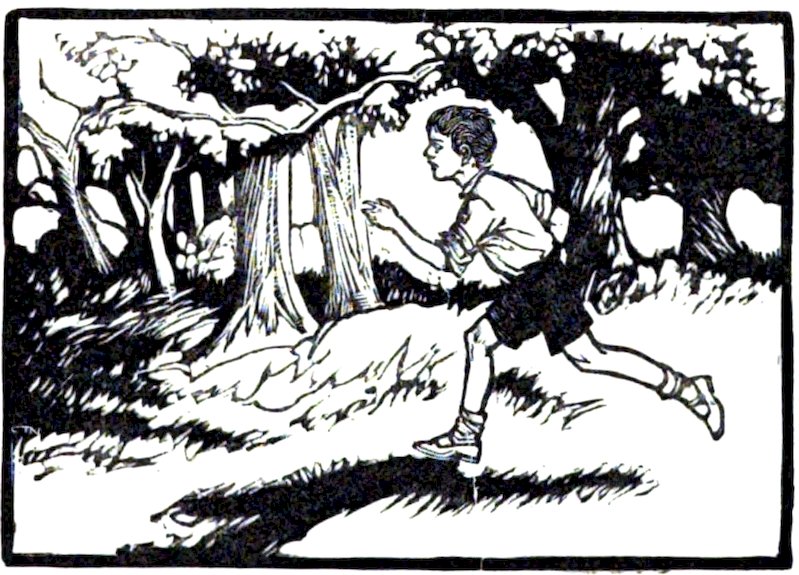
Then quite suddenly the nightingales called him. Springing to his feet, and flinging away his bow and quiver because they hindered him, he raced down the path as fast as his legs could carry him.
At the end of it, round the little patch of sky, was the magic casement exactly as the Woodcutter had made it; but the Woodcutter was gone. There was no one here now but himself and the nightingales; and the nightingales, as they had sung that night when he heard them first, were singing all together, so that the very air was quivering with music. For fully a minute Tony stood quiet, quivering too, his hand on the window-sill, almost afraid to look. And then he looked, and knew that it was all right. For him also the charm had charmed. For in front of him stretched long, shining sands and beyond them a great sea. And the sea was all spangled with wave crests that 116the moonlight caught. And across both sands and sea a silver way ran, broad and straight, to the horizon and then onward endlessly into the beyond. But sometimes as he looked the bright silver of it blurred for a moment as the spray-scud drove across it like a cloud. Some of the spray drove inland too, for Tony’s face grew moist with it, and when he touched his lips and fingers with his tongue the taste of them was like salt.
“The same that oft-times hath
Charm’d magic casements, opening on the foam
Of perilous seas, in faery lands forlorn.”
he chanted softly.
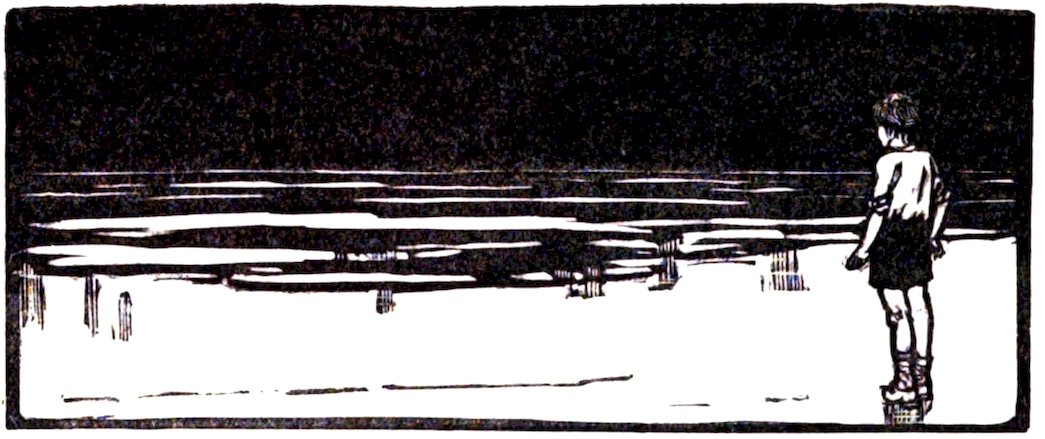
Then he clambered upon the sill, balanced for a moment or two with his legs dangling, dropped through, and set off slowly across the lonely sands. Far ahead he could see, in the moonlight, line after line of breakers and, a little nearer, the ebbing, flowing ripple of their fringe. Here and there about the shore were strewn great rocks, which, as he approached, towered jet black against the violet sky and threw shadows as black as themselves upon the sands below. Some had little pools around their base, and at one of them he stopped, doffed shoes and stockings, and, standing with his tired feet cool in the soft water, stared thoughtfully across this new and wonderful sea that he had found.
“Perilous?” he said at last. “The billows don’t roar very angrily, and it’s too beautiful to be perilous, I think.”
“Ah, but you’re thinking backwards way, Master Tony; it’s perilous just because it is so beautiful.”
Tony jumped. He had felt himself so utterly alone, and yet the voice sounded at his very elbow. Then he stared 117in amazement, for at his side stood a little old woman in a mob cap and a long grey cloak, half dusty, half sheeny, as cobwebs are. In her hand she carried a kind of wand with a bright end to it which shone just like a star.
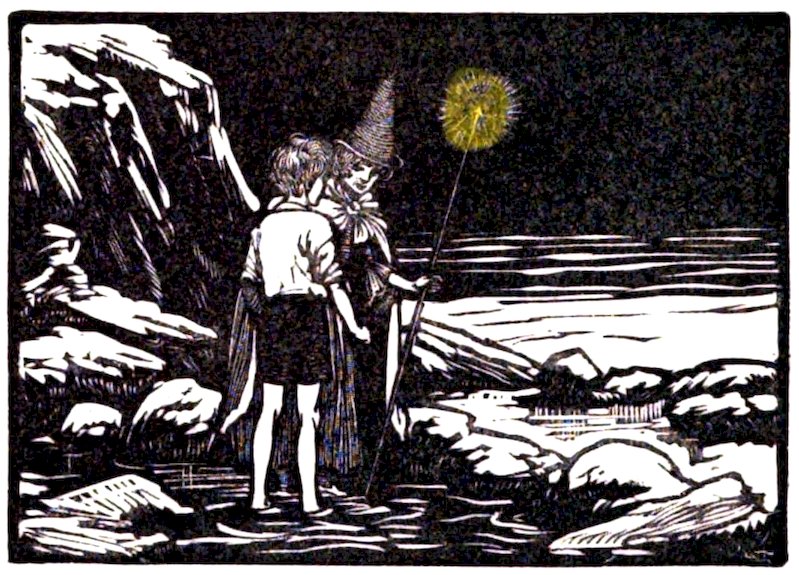
“Are you the Queen Moon?” he asked her, remembering his Keats; but she burst into a laugh and began to dance with most astonishing agility, wetting him all over as she splashed the water with her long, sharp-toed shoes.
“Queen Moon, indeed!” cried she, and pointed to the sky. “Not I! Don’t you see? The Queen Moon is on her throne, clustered about with all her starry fays.” She shook her wand in his face. “As for this! Did you think it was a star? Look! It’s an elf-stone! Turn your coat, Tony, turn your coat! I’m a fairy.”
Tony had often heard of elf-stones, and once his father had seen one. A cow had been found dead in the pasture, and the old cowman had brought up to the house a little 118bright piece of flint, triangular and barbed on each side like an arrow head. “’Tis elf-shot she be, surely, and never a mark on her to show,” he had said. “But there ’twas, alongside—the fairies’ arrow-point.” And the old fellow had begged that he might keep it, hanging it round his neck as an amulet against a like fate falling on himself. Here, sure enough, was the flint just as Tony had pictured it. He took the wand rather gingerly and examined it, giving it back to her at last, with a little laugh. “I’m not afraid of fairies,” he said stoutly. “So I won’t need to turn my coat. But who are you, then? Queen Mab?”
“No, nor yet Queen Mab,” she retorted, mimicking his accent; “just Mistress Mab, an it please you.”
She dropped a little curtsey and her grey cloak spread out all about the water and dripped a hundred tiny silver rivulets as she rose again to her small height.
“But everyone says Queen,” he persisted.
“Everyone is wrong, then,” she answered, and paused and heaved a sigh.
“And yet,” she went on, “Queen Mab it is, perhaps—Queen by courtesy. But Queen only of men’s dreams.”
Tony made a low bow, stepped out of his pool and dropped upon one knee.
“Then,” said he, “at least you are my Queen.”
“And why?”
“Because,” he said, rather red and shy, “because of my name, you see. Tony o’ Dreams, they call me. So I must be your knight, mustn’t I?”
“I see,” she said gently, and both were silent, she as well as he, gazing seaward to the fringe of foam. Suddenly she laid her hand upon his shoulder.
119“Well then, small knight,” she cried, “and what of the perilous seas?”
Tony shivered. “I’m not afraid,” he said, “only ... they are so beautiful. Must all that’s beautiful be perilous too?”
“But of course! Perilous—to be adventured—to be tried and made your own!”
“Oh but perilous? Does perilous mean that?” he asked quickly.
“Why, yes—what else?”
Tony pondered.
“I thought quite differently,” he said at last. “I thought it meant dangerous.”
She caught him up almost before the words were out of his mouth. “Ah, no! Not dangerous. Beauty—real beauty is safer, surer than all other things in all the world. Remember that, Tony, now and always. Come, will you sail these perilous seas with me for faery lands, so lost, so lost—for faery lands forlorn?”
He looked at her without speaking, and suddenly she began to sing:
“Away, away and away we go,
Away by ourselves, away!
For it’s somewhere hid ’twixt the sea and sky
That the long-lost lands of faery lie,
And I know if we sail there, you and I,
We shall find them one fine day.”
As she ended, the moon slid behind a cloud, and in the sudden darkness she tugged his hand.
120“Fly, Tony! Spread your wings and fly!” she cried, “lest we grow old and tired before we come there.”
Eagerly he stretched out his arms, straining up on tiptoe. In a moment the ground was gone from beneath his feet and, lightly as a bird, he was gliding onward through the air, the scud wet upon his face again and the sweet salt smell of the sea growing stronger and stronger as he breathed.
He shut his eyes the better to enjoy the delight of it, and it seemed quite a long time later when Queen Mab pulled his arm again to rouse him.
“Now you can hear the billows,” she said.
Listening, he caught the rhythmic roar of them deep down below, and clutched her hand more tightly for the thoughts they raised.
“You’re frightened!” she jeered.
“No,” he answered simply. “I love it. That’s all.”
“Come, then, and we’ll sail.”
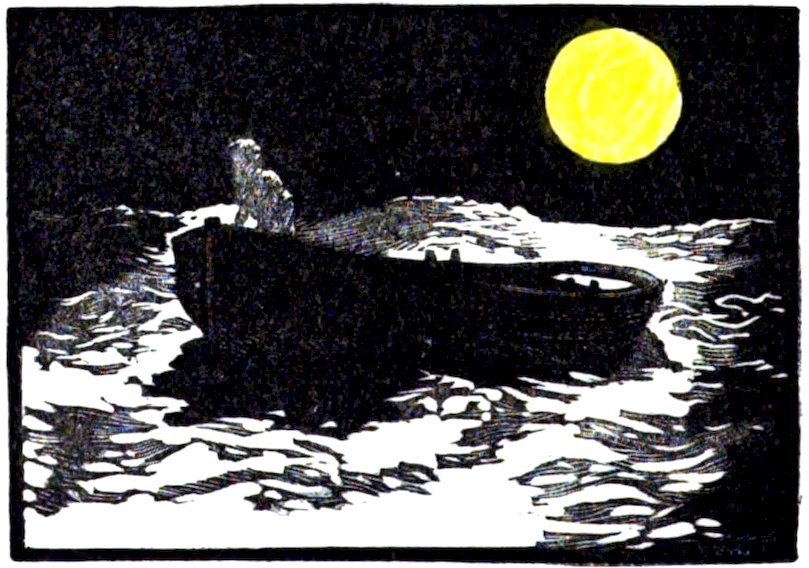
They began to drop rapidly, and just as Tony’s feet touched ground the moon came out again and showed him the foam-fringe of the sea curling and glistening round his ankles. A yard or so away, quivering in water almost deep enough to float her, lay a little boat in which Queen Mab already sat.
“Push off, Sir Tony Knight,” she said, “and spring aboard.”
He pushed and clambered, falling perhaps rather clumsily over the gunwale, but picking himself up without so much as a rub of his bruised elbows and settling the oars in the rowlocks neatly, as a Cornishman’s son should.
“That’s right, Tony! Pull! Pull hard!” his companion 121whispered. “For on these faery seas, most often whilst we strive it is that the winds blow us where we will.”
Tony looked back at her over his shoulder.
“I am pulling,” he said. “But only a very little, I think. The boat moves of itself.”
She leaned forward and pinched his cheek.
“And what is the wind but your spirit,” she demanded, “decked in a lovelier name?”
He shook his head.
“I don’t understand, Queen Mab,” he said, but went on pulling long even strokes as his father had taught him, until the soft creak-creak of the rowlocks and the drip of the water from the blades made a sleepy music, and he fell to humming softly to keep himself awake. Even this, it seemed, began to fail, and shipping his oars, he turned at last to his companion to tell her how tired he was and to ask whether it would be unknightly if for two minutes he should curl up at the bottom of the boat and sleep his sleepiness away.
And then he rubbed his eyes in amazement and all his sleepiness passed as completely as the spray scud passed across the moonshine, for her seat was empty and he was all alone.
“Queen Mab!” he shouted. “Queen Mab! Ahoy!” But there was no answer except the roar of the surf far behind him, and the lap of the water against the sides of the boat. A little tremor took him, and clambering to the bows he knelt there, staring ahead. Then he stretched out both his hands and spoke:
“Oh, faery lands—faery lands forlorn. It wasn’t I that lost you, was it? If it was, I’m sorry, but I’ve come to find 122you now. Don’t hide yourselves away from me too long.”
And all in a moment it was day again and the sun was shining. And when he stared—out of the horizon, it seemed—rose a long low bank of green. At first he thought it was faery land itself coming towards him in answer to his call. Then he realized it was a great wave, and with a rush came back the memory of a certain day last year. He was in his uncle’s yacht. A storm had overtaken them and, huddled behind a hatch, he had sat with his father, listening to the shrieks of the wind and the deafening rattle of every stay and rope the little vessel carried, and wondering whether it was really he who sat there, or some boy in a book. And how, poking his head round the hatch, he had seen just such a wall of green water rushing down upon him then. The yacht had buried her nose in it and the green had sluiced along the deck on either side, churning as it went, and poured over the stern. In just such a way did his own little boat now bury her nose, only not her nose merely, but the boat and he and all went in. And the water parted itself into a square opening, and as he tumbled through—lo and behold, it was the magic casement; and here was the wood again, and it wasn’t the bottom of the sea at all, but just his heap of wood-chips from which he picked himself up, a little dazed and confused. And the magic casement slid away from him along its “verdurous glooms and winding mossy way,” until it was once more only a pale patch of light where the path’s end touched the sky.
His bow and quiver hung in a bramble just where he had flung them when he raced away, and he gazed at them 123a long while before he gathered and slung them on his back.
A nightingale whistled somewhere to the left. He waited for its burst of song, standing listening with his head flung back. Up the path the magic casement seemed to beckon him, but as the music ended he knew suddenly that he was tired and hungry.
“Oh, nightingales!” he cried, “I know! I know! And beyond, the seas are very perilous. I shall come again. But, you see, I’m not a very valiant knight. Even as it was, I failed. I was so tired, I stopped rowing and almost fell asleep. And now I’m tireder than ever. And perhaps I was nearly there.”
He blinked furiously because his tiredness made his eyes blur a little, and he was afraid he might think he was crying.
“I—I shall shoot buffalo on my way home,” he said. Then he filled his scout’s bag with the white wood-chips and set off.
124