A THING TO BE EXPLAINED By LAURENCE HOUSMAN
Reading edition
When Professor Braintree and his granddaughter Elfrida took a walk together, there was only one thing in which they were alike: they both took short steps. But even when they thus agreed, they did it for different reasons: he because he was so old, she because she was so small. And in that point of likeness, which had two such different reasons at the back of it, you get a picture of their characters—they were as different as different could be, and yet they got on together. It may have been that each had a way of appearing to pay attention while the other talked, and so made good company together; or it may simply have been that Elfrida liked him because he was so old, and that he liked Elfrida because she was so young; it is a great relief, at times, to get away from yourself by being with something quite different.
As they walked together Elfrida’s voice seemed to come up to him out of the ground, and his voice seemed to her to come from the trees; yet it was really just the other way, for he had his mind in the ground, and she had her mind in the trees; and his words were pebbles of wisdom, dug up by long experience and worth a great deal, and hers were like loose fluttering leaves blown down from the trees, and worth nothing because they meant nothing, except that she was happy at being alive. The Professor wasn’t happy at being alive; but he didn’t want to die, all the same.
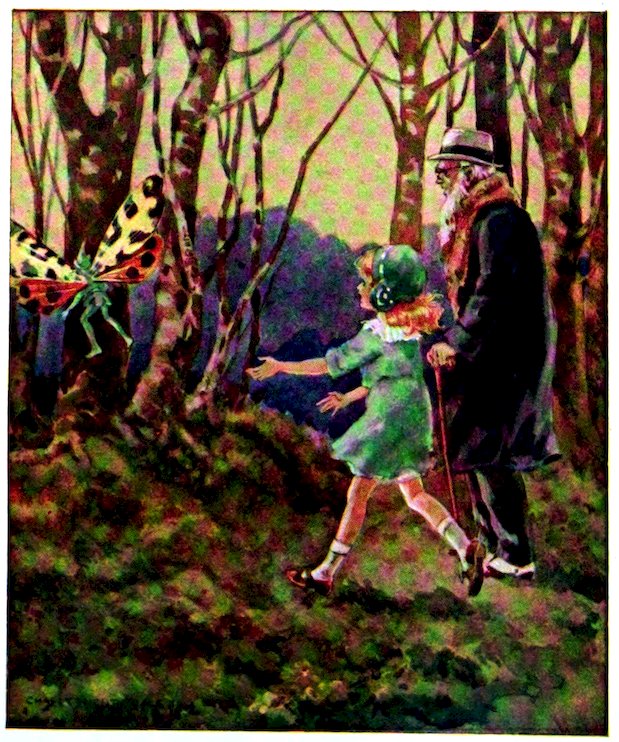
140And all this time they had been taking short steps together, going through the wood, and each looking at things in their own way, and having their own names for them.
“Oh, Grandpapa!” cried Elfrida suddenly. “Did you see? That was a fairy!”
“No, it wasn’t, my dear, it was a tiger-moth. Its proper name is—you wouldn’t remember its proper name if I told you.”
“Does it have babies?” inquired Elfrida.
“No, my dear, it has eggs; but we don’t eat them.”
But Elfrida had seen something which seemed to her much bigger than a tiger-moth, and the thought of eggs disappointed her.
“Do fairies only have eggs?” she asked anxiously.
“Fairies don’t have anything,” replied her grandfather: “they don’t exist. They only live in story-books. When you come back to London you shall begin to learn natural history; then you won’t think about fairies any more.”
“But Grandpapa,” said Elfrida, “how do you know there are no fairies?”
“Because,” said he, “if there were fairies I should have discovered them.”
From which remark the reader will perceive that though a very wise and learned, he was also a very conceited old man.
Perhaps he had a right to be, for he was one of the most celebrated living scientists of his day, though his day is now over; and he had discovered a great many things about nature—animal nature, and bird nature, and insect nature—that had never been discovered before. He was 141so great that correspondents, writing to him from all over the world, had to put after his name the magic letters O.M., which is the Buddhist word for God, I believe, but in our language means something a little different.
He was rich, and he lived in a large house on the borders of Richmond Park, where his study looked out upon trees. And in it he had microscopes and spectrographs, and dictaphones, and a lot of other instruments which, if I tried to name them, I should get wrong. But they helped him to hear things, and see things, and know things more minutely than they had ever been heard or seen or known before. It was said that he was the only man in the world as yet who had been able to see an atom, and hear the sound of an electron; and as these are about a million times smaller than anything you or I have ever seen, and make less noise than the smallest flea when it is dead, it is no wonder he should have thought that, if there were fairies, he would have discovered them.
All the same, if this is a true story, Professor Braintree was wrong. But it does not follow that he was mad, though to his dying day he believed that if it was true mad he must have been.
And now, having taken all these short steps to be in the Professor’s whereabouts, we can get on with the story. The next day he went back to his house at Richmond, leaving Elfrida with her relatives. She was to return three days later. And grandfather and grandchild, being parted, each made the best of their time; but they no longer kept step together, as news from Elfrida will presently tell.
The Professor, from the moment of his return, was kept very busy with his correspondence, which had got into 142arrears—so busy, in fact, that when on the evening of the second day a letter arrived from Elfrida he had not time to open it, and so it came about that he did not read it till the morning of her arrival.
The Professor was working at his microscope when his secretary, Miss Tuckey, came in with the letters, last night’s and this morning’s. He had been seeing wonderful things in it; but when he looked up he saw nothing distinctly, for his eyes were feeble, and a large glass case of stuffed birds standing in the window appeared only as a haze of colour until he put on one of his two pairs of spectacles, those which he used for looking at things from a distance. Then he saw that Miss Tuckey had a smut on her nose, and told her so; for he very much liked being on the spot himself and correcting others, and did not mind being rude about it.
Miss Tuckey wiped the smut off her nose, and giving him his letters waited to receive instructions. For that he had to put on his reading-glasses; and once more Miss Tuckey became a blur, and could have had as many smuts as she liked on her nose without his seeing one of them. This changing of glasses always took up a great deal of his day; but to-day it was going to matter rather more than usual, which is why I mention it.
Having, in about half an hour, disposed of all his business letters, he came at last to Elfrida’s. It was in a pink envelope, and it had a scent of violets; and as he opened it and unfolded the letter, a green leaf dropped out—just an ordinary green leaf from a tree. He took it up and examined it, and knew it at once. “What is she sending me this botanical specimen for, I wonder?” he said. “A 143leaf of the hornbeam, Carpinus betulus, if I am not mistaken.”
Then he looked at the letter, but Elfrida’s handwriting, which at the best of times was bad, when she was excited became almost unreadable—by him, at any rate.
Handing it over to Miss Tuckey, he told her to read it to him, and this is what she read:
“Dearest Grandpapa,
“I am coming back to-morrow. I have had a lovely time. So did Benjy; we went everywhere together, but he always would go into the water, and I had to stay out.
[“Benjy is the dog, I believe,” explained the Professor.]
“That was wrong of him, wasn’t it? To-day in the wood I saw a tree full of fairies; it was wonderful. Benjy was barking at them, and they didn’t mind. But when I came they all climbed up and hid behind the leaves; and I waited till one came out again—quite close I was then. If I’d had a butterfly net I could have caught him easily. And I send you a leaf off the tree, so as to show you it was a real one, and not what you call my ‘imagination.’
[The Professor made a dry noise; it couldn’t be called a laugh. “Oh!” said he, “so that’s what the botanical specimen is for.... Yes?” Miss Tuckey went on reading.]
“Please keep it till I come, then I will tell you all about it.”
144
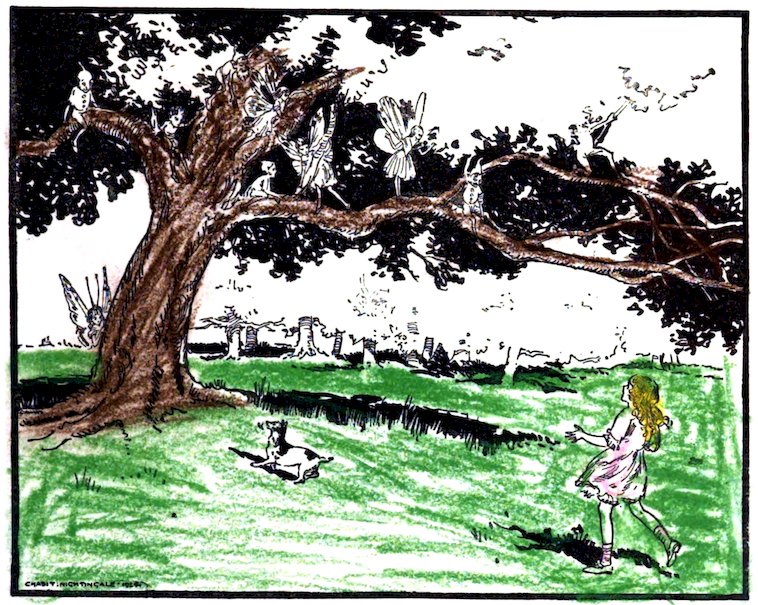
“I saw a tree full of fairies.”
145The Professor gave an uncomfortable wriggle, and rubbed the back of his neck.
“Miss Tuckey,” he said, “I wish you would not leave that door open! There’s a dreadful draught at my back.”
“It isn’t open, sir,” replied Miss Tuckey.
“Well, there’s a draught somewhere—quite a wind! It seemed to come all of a sudden. And there! it has blown Miss Elfrida’s leaf away, that was here only a moment ago. Put the screen round me; then perhaps I shan’t feel it.”
Miss Tuckey went and arranged the screen, and while she did so he drew out his writing materials and began to settle to his morning’s work. “Is that all the letter?” he asked.
“Yes, sir, except she sends her love.”
Then for a moment he remembered the leaf, and looked to see where it had fallen. But it was nowhere in sight, and being of no importance, in another moment he had forgotten it.
Miss Tuckey made final arrangements for his comfort: she put his papers in order and within reach, then made up the fire, and because the sun was shining drew down the green venetian blinds, so that the room remained in pleasant gloom. Then she put the electric reading-lamp and the telephone by his side, and having switched on the light, which he preferred, left him to his work.
This so absorbed him that he was entirely unaware of being looked at. Some people feel it instinctively, others don’t. But perhaps it needs to be the eye of a human being. We should not, perhaps, know that a cow was looking at 146us; and if a flea looked at us, still less; a queen very likely would not know that she was being looked at by a cat.
But this wasn’t a cat, or a cow, or a flea; it was something quite different. Those who have seen anything like it before will, perhaps, recognize it from my description: and how could I describe it if I had not seen it myself?
If we sat where the Professor was sitting, this is how it would appear to us: first, over the far end of the writing-table, a pair of strange eyes rather prominent, polished, shining. Dark and bird-like they stared at him out of a small green face, that looked funny but wasn’t human. Out of the head sprouted two long horns that curved and waved like feelers, this way and that, and the rest was all of a piece. The creature was a curious mixture of beetle, bird, and grasshopper; it had a cover, but it did not wear clothes; its colour from head to foot was bright green.
With great interest and curiosity it stood looking at the Professor, but apparently without understanding; and presently, as if to get a nearer view of him, it moved slowly round the writing-table till it stood opposite to him.
The Professor, seeing nothing, hearing nothing, paid no attention. The only noise in the room was the soft scratching of a quill pen.
Presently the creature smacked its lips, and began making a soft jabber to itself, not much louder than the whip of leaves on a window-pane. If you have heard a starling nibbling its beak on a fine spring day—that is the sort of sound the creature made.
The Professor, thinking that he heard something he ought not to hear, looked up through his reading-glasses, and could not believe his eyes.
147This, of course, must be the fault of the glasses, for it was quite impossible that he should see in front of him a small green figure with eyes in its head, which appeared to be resting claw-like fingers upon his writing-table, while dancing up and down upon its toes, and looking altogether rather pleased with itself and rather puzzled at him.
So in great haste the Professor changed his glasses, and looked again. To his horror and consternation the creature was still there.
The Professor at once took up the scientific attitude. Though it was a great shock to him for his eyes to be seeing something which could not be there, it was still capable of explanation.
“Dear me, now!” he said to himself. “This is most extraordinary. Let me think! How many cups of green tea did I have this morning?”
And hardly had he put the question than the creature spoke—made a noise, that is to say:
“Sik-sik-sik-sik-sik-sik-sik!”
It sounded like a blackbird flying away through the trees.
“Six, I believe it was,” said the Professor; then he started. “Did that thing speak?”
And immediately, if speaking it can be called, the thing spoke again, and having begun, went on, paying very little attention to him:
“Chwee-e-weet! Chick-a-wee! Chick-a-wee! Chip-chip-chip-chick-a-wee!”
This persistence of the hallucination made the Professor realize that the situation was serious. “I must be ill!” he 148said to himself, made a dive for the telephone, and rang up without pause, till the exchange heard him.
“Station 1228, please—yes, 1, double 2, 8!”
And as he said it, that creature, that figment of his imagination, took up and repeated the sound.
“Two-eight! two-eight! Eight-eight-eight-eight-eight!”
This was not like a blackbird, it was like a nightingale. The Professor was getting more and more frightened; to be in such a state of health was terrible. Then, to his relief, a voice came down the telephone.
“Is Doctor Locum——?” he began. “Oh, is that you, Doctor? Will you come and see me at once?... Braintree, Professor Braintree. Yes—most urgent. I’m afraid I’ve—broken down.”
The Doctor had not quite caught him. “No, no, not a blood-vessel—worse! Do come at once! Don’t lose a moment.... What?”
But the Doctor had already gone, presumably was upon his way.
“What? what? what? what? what?”
It was that thing talking again! The Professor fixed it with a stare which tried to be sensible. He knew that it did not exist. Why, then, must he go on seeing it, hearing it? He made a great effort of will: shut it out of his sight, diverted his attention, went back to his writing. He dipped his pen.
The horrible little creature watched him, imitated him, leaned over, dipped its finger in the inkpot, and flipped the ink over his paper.
149In his terror, to avoid thinking himself mad, the Professor was magnanimous. “There! I did that!” he said.
He looked across; the creature had disappeared. Willpower was having its effect.
But scarcely had he begun to congratulate himself on that fact, when over his shoulder came the horned head.
He started away from it in irrepressible disgust. “Get out!” he cried.
The creature made a dive, and disappeared again. Once more he began to feel relief, when suddenly from a corner of the room he heard it tapping at the typewriter, and as it tapped it imitated the sound. It sounded almost, but not quite, like: “Peter Piper picked a peck of pickled peppercorns.” But it couldn’t be actually those words: words, no! If he began actually hearing it say words—sentences with a meaning—the state of his mind would be worse than ever.
The Professor picked up his penwiper and threw it; and sportively, as though it were playing a game with him, the green imp ducked and disappeared.
A moment later it had hold of him by the toe. The Professor gave a despairing howl, and sprang up into his chair. Another of his senses was gone; not only did he see and hear this thing which did not exist—he had felt it as well. “If this goes on much longer,” he said to himself, “I shall go stark, staring mad.”
But even as he spoke the imp’s active and ever-shifting interest had gone elsewhere. Twisting and pirouetting across the room, it came suddenly on the case of stuffed birds standing in the window, and stopped, transfixed with astonishment.
150
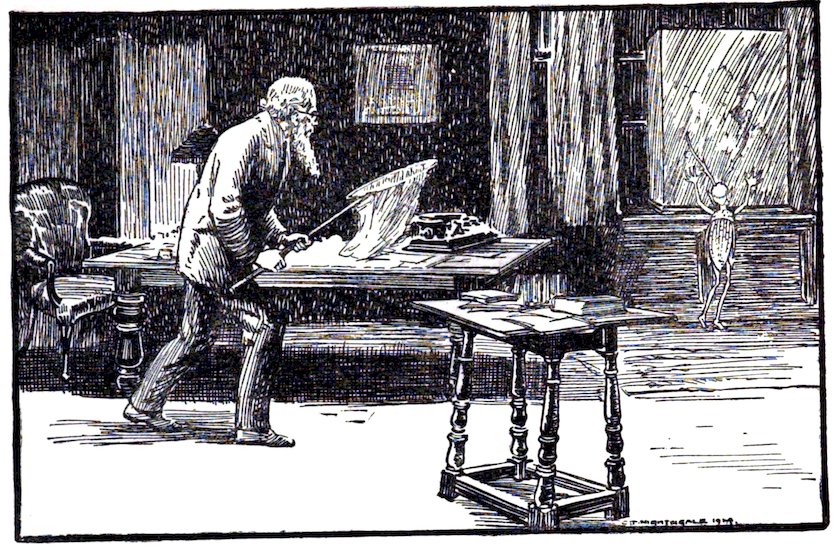
Net in hand, the Professor advanced.
151Then it tapped upon the glass case, and after a close scrutiny began trying, with bird-like sounds and a flapping motion of the hands, to coax the occupants back to life.
The Professor stood and listened spellbound; this was getting worse and worse, for now the creature was showing sympathy; it was saying things that meant something.
“Chick-a-wake! Weet-weet! Oh, why? Tickle ’em up! Two-to-eat! Two-to-eat! Eat-eat-eat! Quick, quick! Josaphat! Josaphat! Drink-and-eat! Wake-up!”
This advance of the green imp in the direction of speech had upon the Professor only the effect of making his own mind descend into the depth. The more sane, the more understanding this creature of his imagination appeared to be, the more obviously was he himself the victim of a delusion. He knew, he knew for certain, that such a thing could not really exist. And yet by the evidence of all his senses it did.
And then, all at once, he got a bright idea; granted that it was an illusion, of which momentarily he was the victim, then, perhaps, all that was necessary was to adapt himself to the fantasy, while its power was upon him; to play up to it, to behave as though it were real, to do as he would do if a hornet, or a beetle, or a butterfly, or a bat had got into the room; to catch it and kill it, and make a specimen of it. If he could only reduce it to the condition of a specimen, he left quite sure that the hallucination would go and the scientific balance of his mind be restored.
And there, close at hand, lay the means, the instrument with which to experiment—a large green butterfly net on a bamboo cane, standing in the corner rack behind him.
152The creature was still looking into the case of stuffed birds; it had its back to him. Net in hand, the Professor advanced cautiously, intent on capture. Catching sight of his reflection in the glass the imp turned and fled; it jumped on to the writing-table, jumped on to the back of his chair, jumped over the screen and vanished.
There came a knock at the door. Miss Tuckey entered.
“I beg your pardon,” she said. “I thought I heard—something. Did you call, sir?”
The Professor stood, butterfly net in hand, rather at a loss how to account for himself. He was not going to tell Miss Tuckey that he was mad, whatever he might have to tell the Doctor.
“No, no,” he said, giving the net a flourish as he spoke. “I was only just practising. As a matter of fact, a butterfly has got into the room—a rare one, I think—and I was trying to catch it. I fancy that now it has gone behind that screen—will you look, Miss Tuckey?... Will you drive it out? Don’t be afraid; it won’t bite you.”
Miss Tuckey smiled to herself at the idea of being afraid of a butterfly; the Professor did say curious things sometimes, old age had made him a little eccentric.
She went behind the screen; the Professor stood expectant, very much interested. Miss Tuckey had pulled out her handkerchief, and was flapping it. “No,” she said, “I don’t think anything’s here.”
“Oh, thank you, it doesn’t matter, then,” said the Professor. “By the way, I’m expecting the Doctor. Will you send him up when he comes?”
Miss Tuckey departed, and he was alone again—alone with his hallucination. Clearly, she had seen nothing. He 153wondered whether it was still there, waiting for him to treat it as though it were real.
He advanced cautiously, and peeped. Then suddenly at his back he heard the cry of the spring peewit. “Peweet! Peweet! Just-look-at-me! Just-look-at-me!” And there was the green imp bounding and tumbling, as ready for a game of catch-as-catch-can as a young flea on the first of March; and if you have ever tried to catch one on that day you know the difficulty.
The Professor never had, so knew nothing about it; but now was his opportunity: a weapon was in his hand, and the net of it was large and the handle of it was long. And so for a few moments you have the degrading spectacle of an eminent scientist, and an O.M., pursuing on the material plane something which he did not really believe to exist.
But the pursuit was soon over. The imp was too agile, the pace too killing; and the Professor in his stumbling course managed to knock over a great many things he did not intend to. He stopped exhausted, put down the net, and began to pick up his scattered papers.
The imp, imitative, seeing him thus occupied, made a playful addition to his task by scattering more.
At this the Professor thoroughly lost his temper. “Hallucination,” he cried, “you are a perfect nuisance!”
As he spoke he opened a small chest and, to get them out of harm’s way, began bundling the papers into it.
With a sportive dive, the imp plunged into the chest and scattered them out again. It was clear that he regarded this merely as a game; and the green butterfly net had given him his excuse.
154
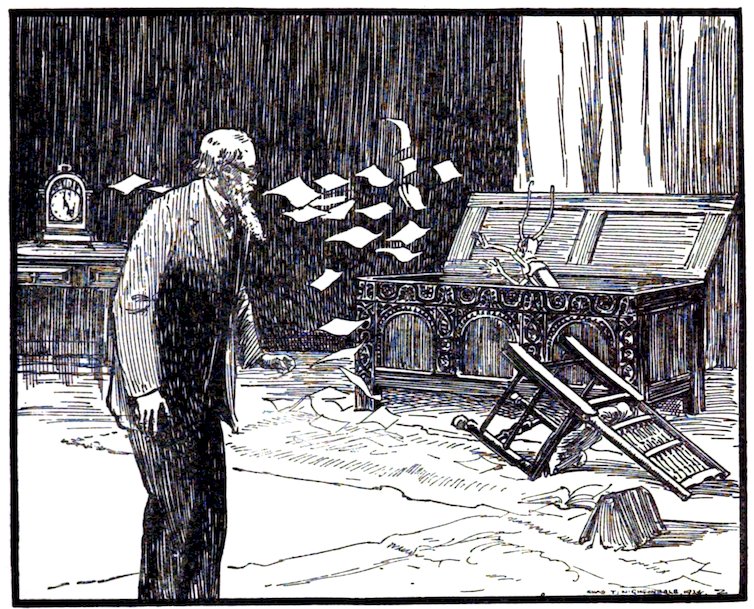
The imp made a playful addition to his task.
155But it gave him nothing else; for on this last bit of exasperating frivolity the Professor slammed down the lid and locked it. And there was the Tree-imp safely boxed inside.
It took him a minute or two to realize his triumph; it was, indeed, a little difficult to know on what lines to take it. Had the locking of the box, with the hallucination inside, disposed of the hallucination? Or was it still there?
His doubt was solved almost at once, for from the inside of the chest the hallucination had once more become audible.
“What? What? Oh, I say! Let it out! Let it out! Quick, quick! Oh, why?” The voice was a little plaintive, a little anxious, but it had not yet begun seriously to complain. Then followed a pause.
The Professor stood considering; he had the key; going across to his writing-table, he laid it down. The chest continued to give forth sound: first a tapping on the lid, then a renewed chatter, which gradually grew faint.
The Professor drew a firm breath, and with a big effort of will took up his pen and tried to resume his writing: but the interest of the thing held him. The little secluded voice took on a more lamentable accent, but faint like a kettle trying to sing under a tea-cosy.
“I say! I say! Pick it out! Pick it out! What? What? Oh, why?... What?... Oh, why?... Oh!... Oh!... Oh!”
The sound was now so faint the Professor himself could no longer hear it; but for a little while it still went on. Once more from inside the chest came audibly that question so often repeated, “Oh, why?” Then all was still.
The Professor sat resolutely holding his pen, collecting 156his thoughts, trying not to listen, but listening still. And though he assured himself that his mind really had recovered its balance at last, he gave a sharp start when there came a knock at the door and the Doctor entered.
The Doctor, with an encouraging smile, greeted him in the correct tone of professional optimism. “How are you, Professor? Nothing very serious, I hope?”
The Professor, in no hurry to give himself away, held himself in. He was now feeling a little aggrieved at the shock he had experienced.
“Doctor, before I say anything, I want you to examine me,” he said.
The Doctor examined him, questioned him as to diet and sleep, felt his pulse, took his temperature, looked at his tongue, and then assured him that he found nothing the matter with him except old age.
“Am I mad?” inquired the Professor.
“Certainly not,” said the Doctor.
“You won’t send me to a lunatic asylum, if I tell you something you can’t believe?”
“I will not, I promise you,” replied the Doctor.
“I can’t believe it myself,” said the Professor.
“Then why talk about it?” said the Doctor.
“Because——” The Professor looked at the locked chest, then he said:
“I was sitting here writing, Doctor, and suddenly I glanced up, and there I saw a horrid little green thing looking at me—with eyes.”
“Yes, it would have eyes, if it was looking at you,” said the Doctor.
“Very curious eyes, Doctor—like a young bird’s and it 157had horns, and—well, there it was, you know. At first I didn’t believe it, I thought it was green tea.”
So the story started, and so, up to a certain point, it went on, as we know it: the Professor telling quite truthfully all that had happened, till he came to the point where he had upset his papers. “I was still picking them up,” he said, “when you came in.”
“Well?” said the Doctor, “and then——”
The Professor looked at the key, and he looked at the chest. No, he could not risk it: he could not risk having it proved that the thing he could not believe was really true.
“Then,” he said, “it disappeared.”
“And you haven’t seen it since?”
“No.”
“Nor heard it?”
“I have not——. That is, no.”
“Well, then, that is all right,” said the Doctor encouragingly.
But the Professor wasn’t happy. “I hope so,” he said doubtfully, and then, in more detail, began to explain himself.
“Doctor, I haven’t explained to you the shock it was to me. It was that terrible moment when I thought there might be something in it after all. At that moment I saw all my life’s work disappear. All my science, all my philosophy gone! Everything I had written—worth nothing! It was terrible. If it were true,” he said after a pause, “I think I should have to kill myself.”
The Doctor soothed him: told him to work less, take walks, go early to bed, drink less green tea, and then, after writing him a prescription, took his comfortable leave.
158The Doctor’s visit had undoubtedly done the Professor good; but no sooner was the Doctor’s back turned than he went and stood by the chest and listened.
He listened for a long time and heard nothing. Then he stooped and tapped.
“Is anyone——? Is anything there?” he said.
There was no answer.
Much relieved, he went back to his work-table, and was just settling down again when his eye fell upon the key.
Twice he took hold of it, and twice laid it down again.
“No, I will not,” he said.
And that being decided, his mind recovered its accustomed balance, and he fell to work again.
The clock had just struck twelve, when the door quietly opened and in came Elfrida.
Now it so happened that, that day, Elfrida was dressed all in green—even the cap on her head was green, and it had a green feather in it, sticking out. And so, as Elfrida came softly up to him, seeing something green moving it gave him a dreadful start, till a second look at her over the top of his glasses reassured him.
“Effie! Why Effie, my dear,” he cried, “what a start you gave me!”
Elfrida nodded and laughed, and, wise in her way, said, “You thought I was a fairy.”
“No, I didn’t,” cried the Professor. “I thought you were an hallucination.”
“What’s that?” inquired Elfrida.
“Something that’s not real, my dear.”
Then Elfrida kissed him. “I’m real!” she said, and the 159Professor thanked God for it, feeling that an uncomfortable incident was well over.
All at once Elfrida began, very excited.
“Oh! you got my letter, Grandpapa, didn’t you? And you got my present, too?”
“I got your letter, my dear. What present?”
“Why, the leaf that came off the tree that had fairies in it.”
“Oh, yes, I got it, my dear; but I’m afraid I’ve lost it.”
Elfrida didn’t mind his losing the leaf; but she was very excited about the fairies.
“And you do believe what I told you,” she cried, “don’t you, Grandpapa? It was true; I saw them. You must believe that!”
“Well, I don’t know,” said the Professor wisely. “One isn’t sure of everything one sees. At least, I’m not now.”
But Elfrida was now only attending to herself, for she had much to say.
“Grandpapa, if you could only make people know there are fairies, wouldn’t it be wonderful?”
“I suppose it would, my dear.”
“And Grandpapa, if you were able to find one for them, wouldn’t that be the wonderfullest thing of all?”
“Would it, my dear?”
The Professor was listening; he was almost beginning to think.
“Why, yes; for then they’d think you ever such a great person—much greater than you are now. To make the whole world think differently—just think of that!”
“But, my dear, if people—people who’ve read all my 160books—were told that Professor Braintree believed in fairies, they would laugh.”
“You’d laugh too: but you could laugh longer than they would—because you’d have discovered it. Why, it would be like a miracle, Grandpapa. People would begin to love fairies again then.”
The Professor was really thinking now, thinking hard; but all he said was: “Well, perhaps. Green isn’t my favourite colour, though.”
This caused Elfrida to pay attention. “It’s funny your saying that,” she remarked. “The fairy I saw was green.”
“Was it, my dear?”
“And it had long horns, and its mouth and eyes were like a young bird’s; and when I tried to catch it, it made a noise at me—just like a bird—a nice bird.”
The Professor was now having shocks again, but all he said was: “Did it say, ‘Sick, sick, sick, sick’?”
“No,” replied Elfrida, and then, giving a vivid imitation of the very sound he had heard, “It just went ‘Chewee! chewee!’—like that.”
The Professor sat with his eyes staring out of his head: then he hadn’t been so mad after all! But not to be was almost worse.
Elfrida looked at him in great surprise. “But, Grandpapa,” she cried, “if you found one, you wouldn’t be afraid of it, would you? I wasn’t!”
That was a wise word of Elfrida’s; it came a little late, but it converted him.
“My dear,” he said, “would you like to see that—that thing again?”
“Why, yes!” cried Elfrida.
161“Green, and with horns and eyes? Hear it again?”
Elfrida was joyfully prepared even for that.
“Well,” he said, giving her the key, “there’s no accounting for tastes!”
He had quite made up his mind now, and did not wait to let himself think again.
“You see that chest?” he went on. “Well, that is the key to it. Go and open it, and tell me what you find.”
Elfrida took the key; she was rather solemn about it, for the Professor’s manner impressed her. She crossed the room, opened the chest, and looked in. While she did so, there was much more excitement in the Professor’s demeanour than in hers.
For a while she stood looking in, seeing nothing. Then she uttered a little cry, and stooped, and picked up something. She held it out in her hand. “Why, it’s the leaf,” she cried, “the leaf of that tree what I sent you! Oh, dear!”
This was quite unexpected to both of them.
“The leaf, you say?” replied the Professor. “Bring it here.”
Elfrida brought it.
“And it’s all withered and dead!” she cried, holding it up for his inspection.
The Professor looked at it with curious eyes, and was no longer afraid.
“So it is, to be sure!” he said. “Quite withered and dead. Well, put it down, my dear, and be off with you. I must get on with my work.”
“Where shall I put it?” inquired Elfrida.
“Put it in the waste-paper basket, my dear. That’s right. Now run away!”
162
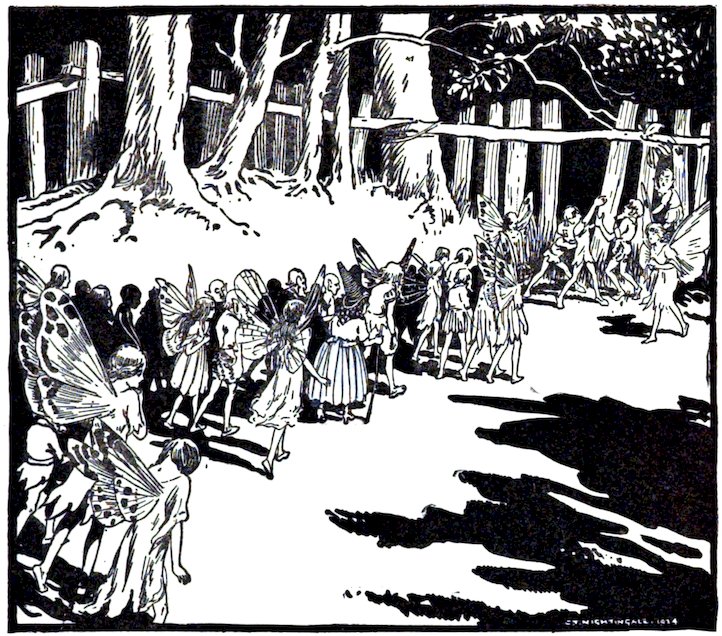
Coming through the palings was a long string of little figures.
163And so the dead leaf dropped to its repose on a bed of scrapped science-siftings. And though Elfrida did not quite know what she had done, she felt sad about it, and with head bent and hands straight down, as though convicted of some act of deep disgrace, she turned and walked softly out of the room.
As the door closed behind her, the Professor stooped down, and took a good long look into the waste-paper basket. Then, with a deep sigh of relief, he took up his pen and went on with his work.
But that night—no, it was the night after—something happened.
Quite suddenly Elfrida woke and sat up; in her sleep she had remembered something. She remembered how, that morning, she had seen the maid emptying her pan on the dust-heap in a corner of the garden behind the house, a pan full of torn papers, and litter, and sweepings—the sort of things which were emptied there every day.
Why Elfrida should so suddenly remember it, and be woken up by it, she did not know.
She was quite awake, quite dreadfully awake. The moon was shining through the blind. She got up, went across and lifted it, and looked out.
There was the garden, softly paved with the silver of moonlight, so silver that it looked like frost. And out beyond, over the wooden palings, lay Richmond Park.
And there, coming through the palings were little figures, a long string of them, crossing the garden and going in the direction of the dust-heap.
164
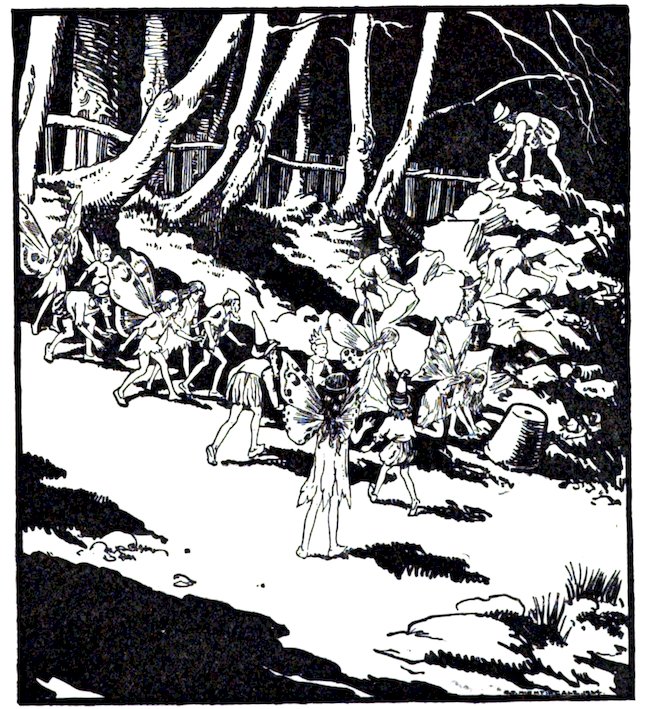
They were searching the dust-heap.
Presently she saw that they were searching it, turning it 165over this way and that. And then it seemed as if they had found something.
What she saw next, she never told anybody but me; and she only told me because she knew that I would believe it.
“It was like a funeral!” she said. “They had all put on black, and as they walked they flapped with their hands, and swung their heads from side to side as if they were so sorry about something. And in the middle they had something that they carried, like the thing that carries dead people. And they brought it to the palings, and pushed it through, and then got through themselves; and after that they took it right away into Richmond Park, over the grass and through the trees, till I couldn’t see them any more.”
“Do you think,” she asked, when she had quite finished her story, “do you think it could have been—that leaf?”
I did think—that it was possible.
“And that it had a fairy in it?”
“Well, yes, that would account for it, wouldn’t it? That would explain.”
“Then the fairy must have been dead,” she said sadly.
Yes, I had to own that it seemed like it.
“Did I kill the fairy, by sending it in the letter, do you think?”
“No, I don’t think you did, my dear,” I replied. “Fairies don’t die like that; they die of shock.”
“What kind of shock?” she asked. “When I shock Auntie, she doesn’t die of it.”
“When people don’t believe in them,” I said.
166