LUCY By WALTER DE LA MARE
Reading edition
Once upon a time there were three sisters, the Misses MacKnackery—or, better still, the Miss MacKnackeries. They lived in a large, white, square mansion called Stoneyhouse; and their names were Euphemia, Tabitha, and Jean Elspeth. They were known over Scotland for miles and miles, from the Tay to the Grampians—from the Tay to the Grumpy Ones, as a cousin who did not like Euphemia and Tabitha used to say.
Stoneyhouse had been built by the Miss MacKnackeries’s grandfather, Mr. Angus MacKnackery, who, from being a poor boy with scarcely a bawbee in his breeches pocket, had risen up to be a wealthy manufacturer of the best Scotch burlap, which is a kind of sacking. He made twine, too, for tying up parcels. He would have made almost anything to make money. But at last, when he was sixty-six, he felt he would like to be a gentleman living in the country with a large garden to walk about in, flowers in beds, cucumbers in frames, and one or two cows for milk, cream, and butter.
So he sold his huge, smoky works and warehouse, and all the twine and burlap, hemp, jute, and whalebone still in it, for £80,000. With this £80,000 he built Stoneyhouse, purchased some fine furniture and some carriages and horses, and invested what was over.
Jean Elspeth, when she was learning sums, and when 167she had come to Interest—having sometimes heard her father and mother speak of her grandfather and of his fortune, and how he had invested it—just to please her governess, Miss Gimp, thought she would make a sum of it. So she wrote down in her rather straggly figures in an exercise book:
£80,000 @ £4 per centum per annum
= £80,000 × 4 ÷ 100 = £52,000.
It was the first really enjoyable sum she had ever done. And yet Miss Gimp was a little put about when Jean Elspeth showed it to her father. Still, Mr. MacKnackery, senior, had been a really rich man, and regretted that the gentleman who bought his factory never could afterwards make such fine burlap as himself, nor even such admirable twine.
He lived to be eighty, and then he died, leaving his money to his son, Robert Duncan Donald David, Jean Elspeth’s father. And when he died, his dear wife Euphemia Tabitha being dead too, he left all that was over of the £80,000 (for, alas and alas! he had lost a good part of it) to his three daughters: Euphemia, Tabitha, and Jean Elspeth.
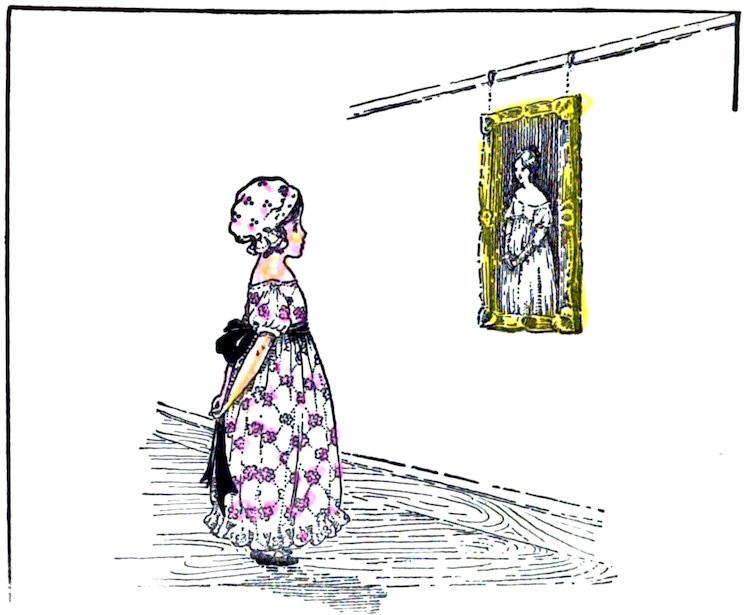
When Jean Elspeth was old enough to breakfast with the family in the big dining-room with the four immense windows, she used to sit opposite the portraits of her grandfather, her father, and her mother. They hung in heavy handsome gilt frames on the wall opposite the windows. And while in her high chair she gobbled up her porridge—and gobbled it up quickly, not so much because she liked 168it as because she hated being put in the corner for not eating it—she would sit and look at them.
Her grandfather’s was by far the largest of the three portraits, and it hung in the very middle of the lofty wall, under the moulded ceiling. He was a stout and imposing man, with bushy whiskers and cold bright blue eyes. The thumb and first finger of his right hand held a fine thick Albert watch-chain, which the painter had painted so skilfully that you could see it was eighteen-carat gold at a single glance. So he hung, for ever boldly gazing.
What was more, her grandfather always looked exactly as if he was on the point of taking out his watch to see the time; and Jean Elspeth had the odd notion that, if he ever did succeed in so doing, its hands would undoubtedly point to a quarter to twelve. But she could no more have told you why, than she could tell you why she used to count each spoonful of her porridge, or why she felt happier when the last spoonful was an odd number.
The portrait of her father was that of a man much less stout and imposing than her grandfather. He was dark, and smiling, and he had no whiskers. But Jean Elspeth had loved him dearly, and each morning when she had finished her breakfast (and if nobody was looking) she would give a tiny little secret wave of the spoon towards him, as if he might be pleased at seeing her empty plate.
On the other side of her grandfather’s portrait hung a picture of her mother. And the odd thing about this picture was that, if you looked long enough, you could not help seeing—as if it were almost the ghost of Jean Elspeth—her very own small face, peeping out of the paint at you, just like a tiny little green marmoset out of a cage all 169to itself in the Zoo. Jean Elspeth had discovered this when she was only seven; but Euphemia and Tabitha had never noticed it at all.
They knew they were far less like their mother (who had been a Miss Reeks MacGillicuddy of Kelso) than their grandfather, and they were exceedingly proud of that. As for Jean Elspeth, they didn’t think she was like any of the family at all. Indeed, Euphemia had more than once remarked that Jean Elspeth had “no deegnity,” and Tabitha that “she micht just as weel ha’ been a changeling.” Even 170now, when they were elderly ladies, they always treated her as if she were still not very far from being a child, though, after all, Jean Elspeth was only five years younger than Tabitha.
But then, how different she was in looks! For while Tabitha had a long pale face a little like a horse, with mouse-colored hair and green-grey eyes, Jean Elspeth was dark and small, with red in her cheek and a tip to her nose. And while Tabitha’s face changed very little, Jean Elspeth’s was like a dark little glancing pool on an April morning. Sometimes it looked almost centuries older than either of her sisters’, and then, again, sometimes it looked simply no age at all.
It depended on what she was doing—whether she was sitting at seven o’clock dinner on Great Occasions, when the Bults and the McGaskins, and Dr. Menzies were guests, or merely basking idly in the sunshine at her bedroom window. Jean Elspeth would sometimes, too, go wandering off by herself over the hills a mile or two away from the house. And then she looked not a minute older than looks an elf-child, or a whinchat, perched with his white eyebrow on a fuzz-bush near a lichenous half-hidden rock among the heather.
However sad, too, she looked, she never looked grim. And even though (at dinner parties) she parted her hair straight down the middle, and smoothed the sides over as sleek as satin, she simply could not look what is called “superior.” Besides, she had lips that were the colour of cherries, and curious quick hands that she was sometimes compelled to clasp together lest they should talk even more rapidly than her tongue.
171Now in Stoneyhouse nobody—except perhaps the tweeny-maid and the scullery-maid, Sally and Nancy McGullie, who were cousins—ever talked much. It was difficult even to tell exactly how wise and sagacious and full of useful knowledge Euphemia and Tabitha were, simply because they so seldom opened their mouths, except at meals. And never to sing.
This, maybe, was because it is impossible to keep order if everybody’s tongue keeps wagging. It wastes time, too, for only very few people can work hard and talk hard both at the same time. And in Stoneyhouse everything was in apple-pie order (except the beds), and nobody ever wasted any time.
And yet, although time was never wasted, nobody seemed to be very much the better off for any that was actually “saved.” Nobody had ever managed to pack some of it up in neat brown-paper parcels, or to put it in a bank as Mr. MacKnackery, senior, had put his money, or to pour it into jars like home-made jam. It just went. And in Stoneyhouse (until, at least, Euphemia one morning received a certain letter) it went very very slowly. The big hands of its clocks seemed to be envious of the little ones. They crept like shadows. And between their “tick” and their “tock” at times yawned a huge hole, as dark as a cellar. So, at least, Jean Elspeth fancied.
172
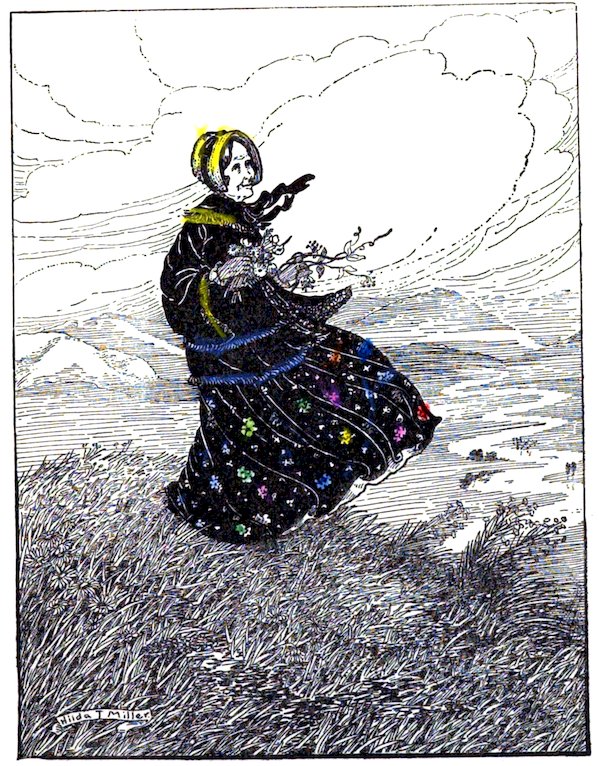
Jean Elspeth would sometimes go wandering off by herself over the hills.
One glance at Stoneyhouse, even from the outside, would tell you how orderly it was. The four high white walls, with their large square slate roof fixed firmly on top of them, stood stiff as bombardiers on extremely solid foundations, and they on even solider rock. No tree dared cast a shadow upon them, no creeper crept. The glossy windows, 173with their straight lines of curtains behind them, just stared down on you as if they said, “Find the faintest speck or smear or flaw in us if you can!” And you hadn’t the courage even to try.
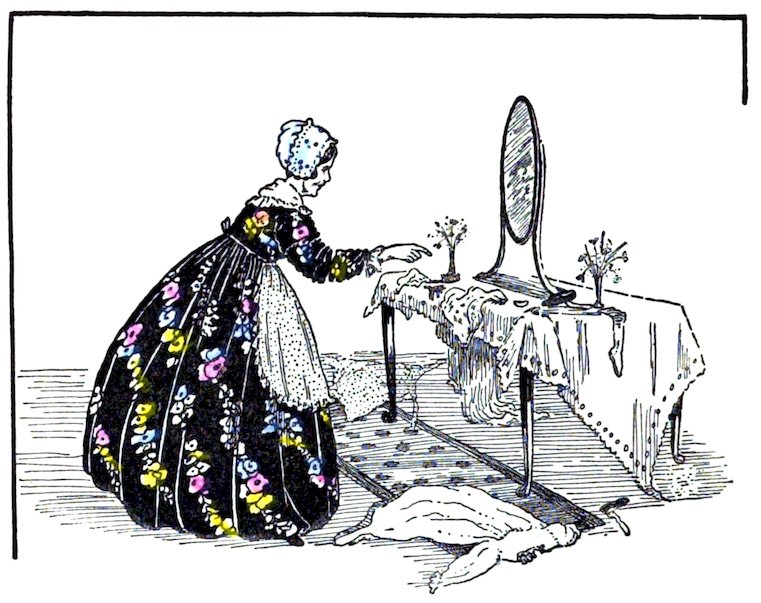
It was just so inside. Everything was in its place. Not only the great solid pieces of substantial furniture which Mr. MacKnackery had purchased with his burlap money—wardrobes, coffers, presses, four-posters, chests-of-drawers, sideboards, tables, sofas, chairs—but even all the little things, bead-mats, footstools, candle-snuffers, boottrees, 174ornaments, knick-knacks, Euphemia’s silks and Tabitha’s water-colours. There was a place for everything, and everything was in its place. Yes, and kept there.
Except in Jean Elspeth’s room. She could never learn to be tidy, not even in her sums. She was constantly taking things out, and either forgetting to put them away again, or putting them away again in their wrong places. And do you suppose she blamed herself for this? Not at all. When she lost anything and had been looking for it for hours and hours—a book, or a brooch, or a ribbon, or a shoe—she would say to herself, laughing all over, “Well now, there! That Lucy must have hidden it!” And presently there it would be, right in the middle of her dressing-table or under a chair, as if it had been put back there just for fun.
And who was this “Lucy”? There couldn’t be a more difficult question; and Jean Elspeth had never attempted to answer it. It was one of those questions she never even asked herself, at least, not out loud. This, perhaps, was because she hated the thought of hurting anybody’s feelings. As if Lucy—but, never mind!
It was Lucy, at any rate, who so unfortunately came into that dreadful talk over the porridge on the morning when the fatal letter came to Euphemia. It arrived just like any other letter. The butler, with his mouth as closely shut as usual, laid it beside Euphemia’s plate. Judging from its large white envelope, nobody could possibly have thought it was as deadly as a poison and sharper than a serpent’s tooth. Euphemia opened it, too, just as usual—with her long, lean forefinger, and her eyebrows lifted a little under 175her grey front of hair. And then she read it, and turned to ice.
It was from her lawyer, or rather from her Four Lawyers, for they all shared the same office, and at the foot of the letter one of them had signed all their four names. It was a pitch-black letter—a thunderbolt. It said at the beginning that the Miss MacKnackeries must expect in future to be less well off than they had been in the past, and it said at the end that they were ruined.
You see, Euphemia’s grandfather had lent what remained of his £80,000 (after building Stoneyhouse and buying furniture, cucumber-seed, horses, cows, and so on) to the British Government, for the use of the British nation. The British Government of that day put the money into what were called the Consolidated Funds. And to show how much obliged they were to Mr. MacKnackery for the loan of it, they used every year to pay him interest on it—so many shillings for every hundred pounds. Not so much as £4 per centum, as Jean Elspeth had put down in her sum, but as much as they could afford—and that was at least 1,000,000 bawbees. There couldn’t have been a safer money-box; nor could Mr. MacKnackery’s income have “come in” more regularly if it had come in by clockwork. So far the British Government resembled Stoneyhouse itself.
But the Miss MacKnackeries’s father was not only a less imposing man than their grandfather, he had been much less careful of his money. He delighted in buying things and giving presents, and the more he spent the more he wanted to spend. So he had gradually asked for his 176money back from the British Government, using some of it and lending the rest to persons making railways and gasworks in foreign parts, and digging up gold and diamonds, and making scent out of tar, and paint which they said would never wear off or change colour, and everything like that.
These persons paid him for helping them like this a good deal more than the Consolidated Funds could pay. But then gasworks are not always so safe as the British nation. It is what is called a speculation to lend gentlemen money to help them to dig up diamonds or to make waterworks in Armenia, which means that you cannot be perfectly sure of getting it back again. Often and often, indeed, the Miss MacKnackeries’s father had not got his money back.
And now—these long years after his death—the worst had befallen. The Four Lawyers had been suddenly compelled to tell the Miss MacKnackeries that nearly every bit left of their grandfather’s savings was gone; that their bright gold had vanished like the glinting mists of a June morning. They had for some time been accustomed to growing less and less rich; but that’s a very different thing from becoming desperately poor. It is the difference between a mouse with a fat slice of cheese and a mouse without a crumb.
Euphemia, before opening the letter, had put on her pince-nez. As she read, the very life seemed to ebb out of her countenance, leaving it cold and grey. She finished it to the last word, then with a trembling hand took the glasses off her nose and passed the letter to Tabitha. Tabitha could still read without spectacles. Her light 177eyes passed rapidly to and fro across the letter, then she, too, put it down, her face not pale, but red and a little swollen. “It is the end, Euphemia,” she said.
Jean Elspeth was sitting that morning with her back to the portraits, and at the moment was gently munching a slice of dry toast and Scotch marmalade (made by the Miss MacKnackeries’s cook, Mrs. O’Phrump). She had been watching a pied wagtail flitting after flies across the smooth shorn lawn on the white stone terrace. Then her gaze had wandered off to the blue outline of the lovely distant hills, the Grumpy Ones, and her mind had slid into a kind of day-dream.
Into the very middle of this day-dream had broken the sound of Tabitha’s words, “It is the end, Euphemia”; and it was as if a trumpet had uttered them.
She looked round in dismay, and saw her sisters, Euphemia and Tabitha, sitting there in their chairs at the table, as stiff and cold as statues of stone. Not only this, which was not so very unusual, but they both of them looked extremely unwell. Then she noticed the letter. And she knew at once that this must be the serpent that had suddenly bitten her sisters’ minds. The blood rushed up into her cheeks, and she said—feeling more intensely sorry for them both than she could possibly express—“Is there anything wrong, Euphemia?”
And Euphemia, in a voice Jean Elspeth would certainly not have recognized if she had heard it from outside the door, replied, “You may well ask it.” And then in a rush Jean Elspeth remembered her strange dream of the night before, and at once went blundering on: “Well, you know, Euphemia, I had a dream last night, all dark and awful, 178and, in it, there was Lucy looking out of a crooked window over some water. And she said to me——”
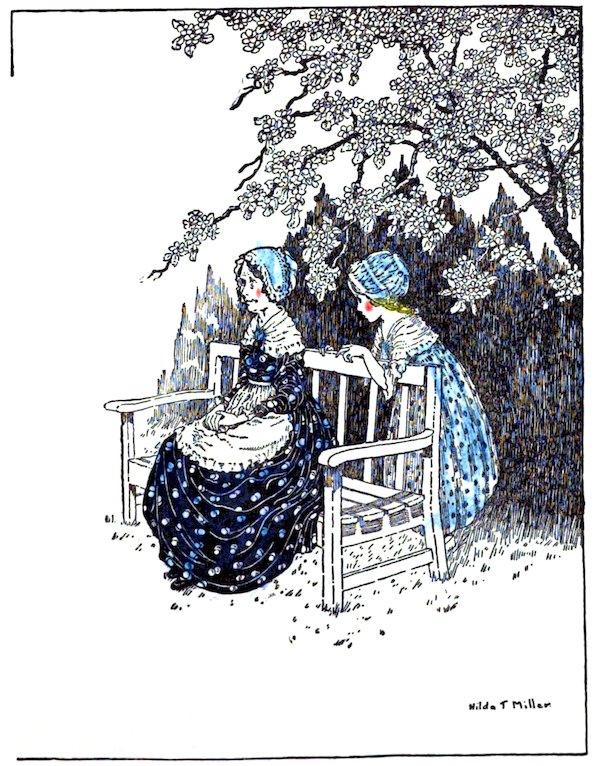
She knew that Lucy was somewhere close beside her.
179But Tabitha interrupted her: “I think, Elspeth, neither myself nor Euphemia at this moment wish to hear what Lucy, as you call her, said in your dream. We have received exceedingly bad news this morning, that intimately concerns not only Tabitha and me, but even yourself also. And this is no time for frivolity.” And it sounded even more tragic in her Scots tongue.
Jean Elspeth had not meant to be frivolous. She had hoped merely, and if but for a moment, to turn her sisters’ minds away from this dreadful news that had come with the postman, and to explain what her dream had seemed to promise. But no. It was just her way. Whenever she said anything to her sisters, anything that came from the very bottom of her heart, she always made a muddle of it. It sounded as small and meaningless as the echo of a grasshopper’s chirrup against a bare stone wall. They would look at her out of their green-grey eyes, down their long pale noses, with an expression either grim or superior, or both. Of course, too, at such a moment, any mention of Lucy was a dreadfully silly mistake. Even at the best of times they despised Jean Elspeth for such “childishness,” and now it must seem like a hideous joke.
For there never was and there never could be any real Lucy. It was only a name. And yet Jean Elspeth still longed to find any word of hope or comfort that would bring back a little colour into poor Euphemia’s cheeks, and make her look a little less like an image in marble. But no word came. She had even failed to hear what her sisters were saying. At last she could bear herself no longer.
180
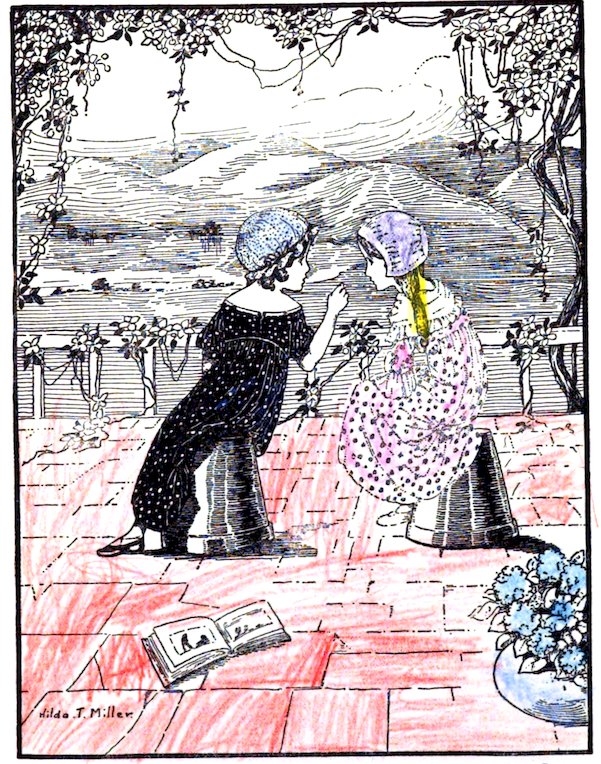
She would sometimes sit on one flower-pot, and she would put another flower-pot for Lucy.
181“I am sure, Euphemia, that you would like to talk the letter over with Tabitha in quiet, and that you will tell me if I can be of any help, I think I will go out into the garden.”
Euphemia bowed her head. And though, by trying to move it with as little noise as possible, Jean Elspeth made her heavy chair give a loud screech on the polished floor, she managed to escape at last.
It was a cold, clear spring morning, and the trees in the distance were just tipped with their new green buds. The gardeners were already mapping out their rows of plants in the herbaceous borders, in preparation for the summer. There never was a garden “kept” so well. The angles of the flower-beds on the lawn—diamonds and lozenges, octagons, squares, and oblongs—were as sharp as if they had been cut out of cardboard with a pair of scissors. Not a blade of grass was out of place.
If even one little round pebble pushed up a shoulder in the gravel path, up came an immense heavy roller and ground him back into his place. As for a weed, let but one poke her blunt green nose above the black mould, she would soon see what happened.
The bright light from the sky streamed down upon the house, and every single window in the high white wall of it seemed to be scornfully watching Jean Elspeth as she made her way down to a little straight green seat under the terrace. Here, at least, she was out of their sight.
She sat down, folded her hands in her lap, and looked straight in front of her. She always so sat when she was in trouble. In vain she tried to compose and fix her mind and to think. It was impossible. For she had not been 182there more than a moment or two before she knew that Lucy was haunting somewhere close beside her. So close and so much on purpose, as it were, that it was almost as if she wanted to whisper something in her ear.
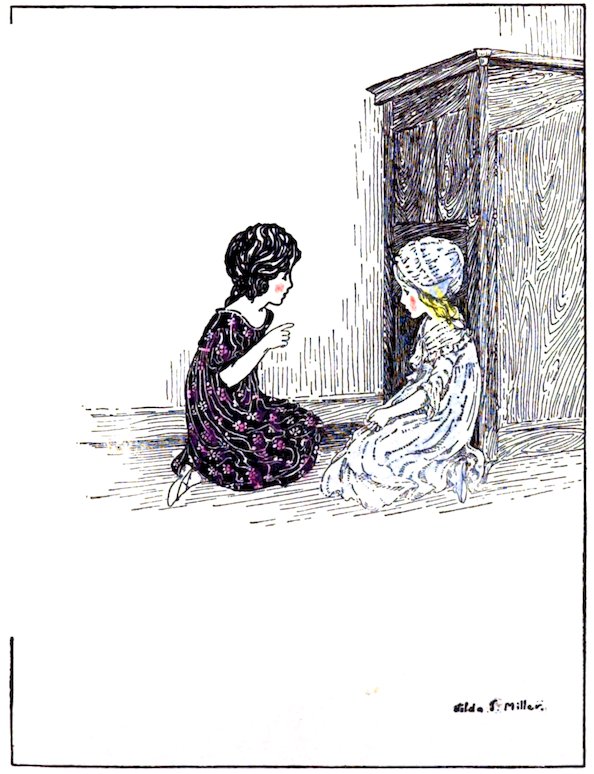
She was sitting in a corner by the large cupboard.
183Now it has been said that Lucy was only a name. Yet, after all, she was a little more than that. Years and years ago, when Jean Elspeth was only seven, she “sort of” made Lucy up. It was simply because there was no one else to play with, for Tabitha was five years older, and at least fifty-five times more sensible and intelligent and grown-up. So Jean Elspeth had just pretended.
In those days she would sometimes sit on one flower-pot on the long hot or windy terrace, and she would put another flower-pot for Lucy. And they would talk, or rather she would talk, and Lucy would look. Or sometimes they sat together in a corner of the great bare nursery. And sometimes Jean Elspeth would pretend she was holding Lucy’s hand when she fell asleep.
And the really odd thing was that the less in those days she tried to “pretend,” the more Lucy came. And though Jean Elspeth had never seen her with what is called her naked eye, she must have seen her with some other kind of eye, for she knew that her hair and skin were fairer than the fairest of flax, and that she was dressed in very light and old-fashioned clothes, though she could not say how old-fashioned.
Another queer thing was that Lucy always seemed to come and appear entirely out of nothing, and entirely of herself, when anything very odd or unexpected or sad or very beautiful happened, and sometimes just before they happened. That had been why she had told Euphemia her 184dream of the night before. For though everything else in the dream had been dark and dismal, and the water had roared furiously over its rocks, breaking into foam like snow, and Jean Elspeth had been shaken with terror, Lucy herself appearing at the window had been more beautiful than moonlight and comforting as a star.
It was a pity, of course, that Jean Elspeth had ever so much as mentioned Lucy at all. But that had been years and years ago and then she could not really help doing so. For Tabitha had crept up behind her one morning—it was on her eighth birthday—while she was sitting in a corner by the large cupboard, with her back to the nursery door, and had overheard her talking to someone.
“Aha! little Miss Toad-in-the-hole; and who are you talking to?” Tabitha had asked.
Jean Elspeth had turned cold all over. “Nobody,” she said.
“Oh, Nobody is it? Then you just tell me Nobody’s name,” said Tabitha.
And Jean Elspeth had refused. Unfortunately, she had been wearing that morning a high-waisted frock, with sleeves that came down only to the elbow, and though Tabitha, with nips and pinches of her bare skinny arm could not make Jean Elspeth cry, she had at least made her tell.
“Oh, so its name’s Lucy, is it?” said Tabitha. “You horrid little frump. Then you tell her from me that if I catch her anywhere about, I’ll scratch her eyes out.”
After another pinch or two, and a good “ring-of-the-bells” at Jean Elspeth’s plait, Tabitha had gone downstairs to her father.
185“Papa,” she said, “I am sorry to interrupt you, but I think poor Elspeth must be ill or in a fever. She is ‘rambling.’ Had we better give her some Gregory’s powder, or some castor-oil, do you think?”
Mr. MacKnackery had been worried that morning by a letter about a gold mine, something like that which poor Euphemia so many years afterwards was to receive from the Four Lawyers, though it was less worrying than that. But when he was worried he at once tried to forget his worry. Indeed, even at sight of what looked like an ugly letter, he would begin softly whistling and smiling. So it was almost with a sigh of relief that he pushed the uncomfortable letter into a drawer and climbed the stairs to the nursery.
And when Jean Elspeth, after crying a little as she sat on his knee, had told him about Lucy, he merely smiled out of his dark eyes, and, poking his finger and thumb into a waistcoat pocket, had pulled out, just as if it had been waiting there especially for this occasion, a tiny little gold locket with a picture of a moss-rose inside, which he asked Jean Elspeth to give to Lucy the very next time she came again. “My dear,” he had said, “I have my Lucy, too, though I never, never talk about her. I keep her ‘for best.’”
As for Tabitha, he thanked her most gratefully that morning at luncheon for having been so thoughtful about her sister. “But I fear, my child,” he said, “you must be fretting yourself without need. And for fretting there is nothing so good as Gregory’s powder. So I have asked Alison to mix a good dose for you at bedtime, and if you are very generous, perhaps Jenny would like to lick the spoon.”
186The very moment he turned his face away, with as dreadful a grimace as she could manage, Tabitha had put out her long pale tongue at Jean Elspeth—which was about as much use as it would have been to put out her tongue for their old doctor—Dr. Menzies—after he had gone out of the room.
Whenever Jean Elspeth thought of those far-away years she always began to day-dream. And whenever she began to day-dream Lucy was sure to seem more real to her than at any other time. The gravel path, the green lawn, the distant hills vanished away before her eyes. She was lost as if in a region of light and happiness. There she was happy awhile. But cold spattering rain-drops on her cheeks soon called her back to herself. A dark cloud had come over the world, and for the first time a dark dread came into her mind of what Euphemia’s letter might mean.
She turned sharply on the little green seat almost as if she had been caught trespassing. And at that instant she could have vowed that she actually saw—this time with her real naked eye—a child standing and looking at her a few paces beyond. It was mere make-believe, of course; but what most surprised Jean Elspeth was that there should be such a peculiar smile on the child’s face—as if she was saying: “Never mind, my dear; whatever happens, whatever they say, I am going to be with you more than ever before. You just see!”
And then, not for the first time in her life Jean Elspeth felt almost ashamed of having a phantom friend. When they were all in such trouble, was it quite fair to Euphemia and Tabitha? Was it even quite right? She actually went so far as to turn away in the opposite direction, and would 187have hastened straight back to the house if, at that moment, she had not heard a small, curious fluttering behind her. She turned her head on her shoulder, but it was to find only that a robin had stolen in on her to share her company, and was now eyeing her with his bead-black eye from his perch on the green seat which she had but just vacated.
For lunch that day the butler brought in a small soup-tureen of porridge. When he had attended to each of the ladies, and had withdrawn, Euphemia explained to Jean Elspeth precisely what the lawyer’s letter meant. It was a long letter, not only about the gentlemen who had failed to find water enough for their waterworks in Armenia, but also about some other gentlemen in Madagascar whose crops of manioc and caoutchouc had almost as suddenly failed. Jean Elspeth did not quite grasp the details: she did not quite understand why the lawyers had ever taken such a fancy to caoutchouc: but she did perfectly understand Euphemia’s last sentence: “So you see, Elspeth, we are ruined!”
And would you believe it? Once more Jean Elspeth said the wrong thing. Or rather it was her voice that was wrong. Far away in it was the sound as of a bugle bugling at break of day. “And does that mean, Euphemia, that we shall have to leave Stoneyhouse?”
“It means,” said Tabitha tartly, “that Stoneyhouse may have to leave us.”
“In either case we are powerless,” added Euphemia. And the tone in which Euphemia uttered these words—sitting there straight and erect, with her long white face, in her sleek grey silk morning gown with its pattern of tiny 188mauve flowers—brought tears, not to Jean Elspeth’s eyes, but to somewhere deep down inside her. It was as if somebody was drawing water out of the very well of her heart.
“It is the disgrace,” said Tabitha. “To have to turn our backs, to run away. We shall be the talk, the laughingstock of the county.”
“Laugh at us because we are ruined!” cried Jean Elspeth.
But this time Tabitha ignored her. “This is the house,” she said, “our noble grandfather built for us. And here I will die, unless I am positively driven out of it by these systematic blood-suckers.”
“Tabitha!” cried Euphemia. “Surely we should not demean ourselves so far even as to call them by their right name.”
“Systematic blood-suckers,” cried Tabitha fiercely. “I will sell the very rings off my fingers rather than be an exile from the house where I was born. And he—he at least shall never witness the ruin into which our father’s folly has betrayed us.”
She rose from her seat, and mounting on one of the maroon damask chairs that, unless guests were present, were accustomed to stand in a demure row along the wall, she succeeded, after one or two vain attempts, in turning the immense gilt portrait of her grandfather with its face to the wall.
Then tears really came into Jean Elspeth’s eyes. But they were tears of anger rather than of pity. “I think,” she said, “that is being intensely unkind to father.”
“By this time,” said Tabitha sternly, “I should have supposed that you would have given up the notion that you 189are capable of thinking. What right have you to defend your father, pray, simply because you take after him?”
Jean Elspeth made no answer. Her father continued to smile down at her from his nail—though it was not a very good portrait, because the painter had been unable to get the hair and the waistcoat quite right. And if—even at this unhappy moment—Jean Elspeth had had her porridge spoon in her hand, she would certainly have given it a little secret wave in his direction.
But he was not to smile down for very long. The Miss MacKnackeries’s grandfather continued to hang with his face to the wall. But the two other portraits, together with the wardrobes, coffers, presses, sideboards, bead-mats, bureaus, and even the Indian work-boxes, were all taken off in a few weeks, to be sold for what they would fetch. And Euphemia now, instead of five, wore but one ring, and that of turquoises.
In a month all the servants, from the butler to Sally McGullie, and all the gardeners were gone. Mrs. O’Phrump alone remained—first because she was too stout to be likely to be comfortable in any new place, and next, because she was not greedy about wages. That was all. Just Mrs. O’Phrump and the gardener’s boy, Tom Piper, whose mother lived in the village, and who slept at home. But he was a lazy boy, was Tom Piper, and when he was not fast asleep in the tool-shed, he was dreaming in the deserted orchard.
It was extraordinary to be alive and to be living in so empty a house. The echoes! Why, if you but walked alone down a corridor, you heard your own footsteps tap-tapping after you all the way down. If by yourself, in 190“your ain, ain company,” you but laughed out in a room, it was like being the silver clapper of a huge hollow bell. All Stoneyhouse seemed empty now; and yet perhaps the emptiest place of all was the coach-house.
And then the stables. It was simply astonishing how quickly stray oats, that had fallen by chance into the crannies, sprang up green among the cobblestones in front of their walls. And if for a little while you actually stood in the stables beside one of the empty mangers, the note of a bird was like the sound of a hundred. And you could almost see ghostly horses with their dark eyes looking round at you out of their long narrow heads, as if to say: “So this is what you have done with us!”
Not that Jean Elspeth had very much time to linger over such experiences. Somehow, she seemed to have grown even smaller in the empty house. But she was ten times more active. And, though she tried not to be selfish by showing it, she was more than ten times happier. Between Jean Elspeth herself and the eagle-surmounted gateposts, indeed, she now secretly confessed that she had always hated Stoneyhouse. How very odd, then, that the moment it ceased to be a place in which any fine personage would care to stay a moment, she began to be friends with it. She began to pity it.
No doubt Tabitha was right. Their grandfather would assuredly have “turned in his grave,” in her own words, at the sound of those enormous vans, those hideous pantechnicons, as their wheels ground down the gravel in the lingering twilight evenings. And yet, after all, that grandfather had been born—a fact that very much shocked Tabitha, whenever her father had smilingly related it—that 191grandfather had been born in a two-roomed cottage so minute that, if only you could have got it through the windows, it would have fitted quite comfortably into the great dining-room at Stoneyhouse.
There was not a single bawbee then in his breeches pocket, and having been such a good man, as both Euphemia and Tabitha agreed, he did not need a bawbee now. Would he then—once the pantechnicons were out of the way—would he, thought Jean Elspeth, have been so very miserable to see all this light in the house and to hear all these charming echoes?
There were other advantages, too. It was easy to sweep the dining-room now; and much easier to dust it. There was peace in its vacancy, and it was not stagnant. And one day, more out of kindness than curiosity, after busily whisking over its gilt frame with her feather cornice-broom, Jean Elspeth climbed on to a chair, and, tilting it, looked in at the portrait. A spider had spun its web in one corner, but otherwise (it was almost disappointing) the picture was unchanged. Nor had Mr. MacKnackery yet taken his watch out of his pocket even though (for his three granddaughters at any rate) the time was now, so to speak, long past twelve.
Jean Elspeth had had ridiculous thoughts like these as long as she could remember. But now they came swarming into her mind like midsummer bees into a hive. Try as she might, she could not keep them all to herself, and though on this account alone Tabitha seemed to dislike her more than ever, Euphemia seemed sometimes to wish for her company. But then, Euphemia was by no means well. She had begun to stoop a little, and sometimes did not hear 192what was said to her. To watch her visibly grow older like this gave Jean Elspeth dreadful anxiety. Still, in most things she confessed to herself almost every dawn, looking down from her upper window, she was far far happier than when Stoneyhouse stood in all its glory.
Indeed, there was no time to be anything else; and even if there had been a complete cupboard full of neat packages of time saved, she would have used them all up in a week. Euphemia, being so poorly, did very little. She helped to make the beds and to do the mending. Only the mending, for, fortunately, the making of any new clothes would be unnecessary for years and years to come; they had so many old ones. Tabitha did what she could manage of the lighter work, but although she had a quick tongue, she had slow, clumsy hands. And it is quite certain, though nobody, of course, would have been so unkind as to say so, that she would never have got even as low wages as Sally McGullie, if she had been in need of a place.
Mrs. O’Phrump did the cooking; but sat on one chair in the kitchen for so many hours together that she became almost like a piece of furniture—the heaviest piece in the house. For the cooking of water-porridge and potatoes does not require very much time, and that was pretty much all that the Miss MacKnackeries had to eat, except for the eggs from Jean Elspeth’s three Cochin-Chinas. And Mrs. O’Phrump needed most of these, as there was so much of her to sustain. As for the apples and pears in the orchard, since Mrs. O’Phrump was too stout to stoop to make dumplings, Jean Elspeth, having two wonderful rows of small sharp teeth, shared these with Tom Piper—though he had all the stomach-aches.
193All the rest of the work fell to Jean Elspeth. She slaved from morning till night. And to slave the more merrily, she had taught herself to whistle. She never asked herself why she was so happy. And no doubt it was chiefly by contrast of having been so cramped-in, and kept-under, and miserable in days gone by.
Still, certain things did now happen in Stoneyhouse that had not happened before, and some of these may have helped. For one thing, Jean Elspeth had always dreaded “company.” Dressing-up made her feel awkward. The simplest stranger made her shy. She would have much preferred to say Boh to a goose. None came now, except Dr. Menzies, who of his kindness sometimes called to feel Euphemia’s pulse and look at her tongue.
Jean Elspeth, too, had never liked servants, not because they were servants, but because Euphemia and Tabitha seemed to think that they oughtn’t to be talked to much. Just given their orders. Now Jean Elspeth could easily have given everything else in the world: but not orders. And if there ever had been an interesting creature in Stoneyhouse, even though she was so stupid in some things, it was Sally McGullie.
Then, again, Jean Elspeth, being by nature desperately untidy, never showed it now. For it’s all but impossible to be untidy in a room that contains only a table and three chairs!
194
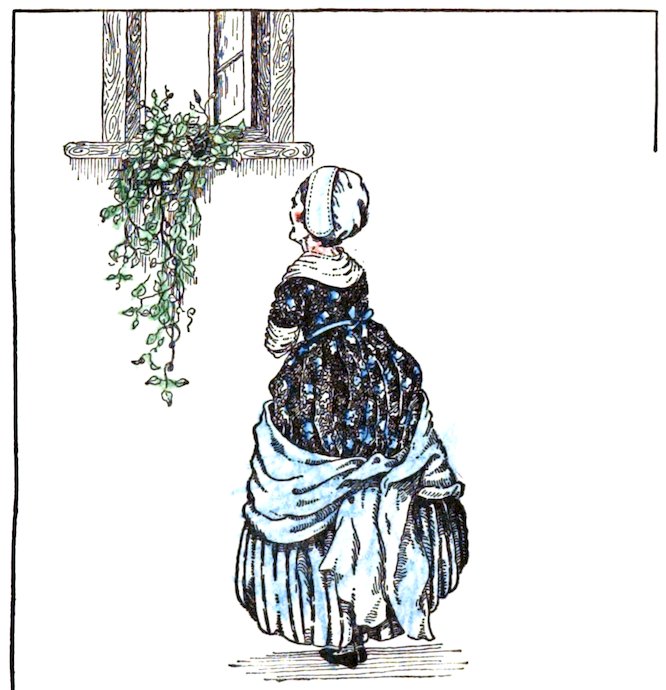
There hung within it a marvellous bush of Traveller’s Joy.
Then, yet again, Jean Elspeth, before the gentlemen in Armenia and Madagascar had been disappointed in their waterworks and caoutchouc, had had very little to do. She was scarcely even allowed to read. For Tabitha was convinced that most reading was a waste of time, if not worse. 195And somehow, improving books had never the least bit improved Jean Elspeth. But now she had so many things to do that it was a perfect joy to fit them all in (like the pieces of a puzzle). And the perfectest joy of all was to scramble into her truckle bed, which had formerly been Sally McGullie’s bed, and, with a tallow candle stuck by its own grease to the left hand knob, to read and read and read.
The hours she spent like this, with no living company but mice and moths and bats and scritch-owls! When her upper parts in the winter were cold, she put her skirt over the quilt. One thin blanket, indeed, is not much comfort on cold nights, when one is lying up North there, almost in positive view of the Grumpy Ones. And for her feet, she used to boil some water in a kettle and fill a wine bottle.
This, of course, broke a good many bottles; and it was an odd thing that until there was only one left, Tabitha (whose feet were like slabs of ice) refused to think of such a vulgarity. And then she changed her mind. And medicine-bottles are too small.
Apart from all this, queer things now happened in Stoneyhouse. Little things, but entrancing. The pantechnicon men, for example, had broken a window on a lower staircase as they were heaving down old Mr. MacKnackery’s best wardrobe. A pair of robins in the springtime noticed this hole, and decided to build their nest in a nook of the cornice. Jean Elspeth (with her tiny whistling) was accepted as the bosom friend of the whole family.
There was too a boot cupboard, one too far from the kitchen for Mrs. O’Phrump to use. Its window had been left open. And when, by chance, Jean Elspeth looked in 196one sunny afternoon, there hung within it a marvellous bush of Traveller’s Joy, rather pale in leaf, but actually flowering there; and even a butterfly sipping of its nectar. After that, not a day passed more but she would peep in at this delicate green visitor, and kiss her hand. It was, too, an immense relief to Jean Elspeth to have said goodbye for ever to lots of things in the house that seemed to her to have been her enemies ever since she was a child.
She wandered up into rooms she had never seen before, and looked out of windows whose views had never before lain under her eyes. Nor did she cease to day-dream, but indulged in just tiny ones, that may come and go, like swifts, between two ticks of a clock. And although, of course, Tabitha strongly disapproved of much that delighted Jean Elspeth now, there was not nearly so much time in which to tell her so.
Besides, Jean Elspeth was more useful in that great barracks of a place than ten superior parlourmaids would have been. She was more like a little steam-engine than a maiden lady. And, like a steam-engine, she refused to be angry; she refused to sulk; and she usually refused to answer back. But when nowadays she did answer back, her tongue had a sting to it at least as sharp (though never so venomous) as that of the busy bee.
And last, but not least, there was the outside of the house. As soon as ever Mr. McPhizz and his undergardeners had departed with their shears and knives and edging-irons and mowing-machines, wildness had begun to creep into the garden. Wind and bird carried in seeds from the wilderness, and after but two summers, the trim barbered lawns sprang up into a marvellous meadow of 197daisies and buttercups, dandelions, meadowsweet and fools’ parsley, and then seeding dock and thistle and feathery grasses. Toadflax, bindweed, convolvulus crept across the terrace; Hosts of the Tiny blossomed between the stones. Moss, too, in mats and cushions of a green livelier than the emerald, or even than a one-night-old beech-leaf. Rain stains now softly coloured the white walls, as if a stranger had come in the night and begun to paint pictures there. And the roses, in their now hidden beds, rushed back as fast as ever they could to bloom like their wild-briar sisters again.
And not only green things growing. Jean Elspeth would tiptoe out to see complete little families of rabbits nibbling their breakfast or supper of dandelion leaves on the very flagstones under the windows. Squirrels nutted; moles burrowed; hedgehogs came beetle-hunting; mice of every tiny size scampered and twinkled and danced and made merry.
As for the birds—birds numberless! And of so many kinds and colours and notes that she had to sit up half the night looking out their names in the huge bird-book her father had given her on her eleventh Christmas. This was the one treasure she had saved from the pantechnicon men. She had wrapped it up in two copies of The Scotsman, and hidden it in the chimney. She felt a little guilty over it at times, but none the less determined that the Four Lawyers should never hear of that.
It was strange, exceedingly strange, to be so happy; and Jean Elspeth sometimes could hardly contain herself, she was so much ashamed of it in the presence of her sisters. Still, she drew the line, as they say, at Lucy.
198And that was the strangest, most curious thing of all. After the dreadful shock of the Four Lawyers’ letter, after the torment and anxiety and horror, the pantechnicons and the tradespeople, poor Tabitha and Euphemia—however brave their faces and stiff their backs—had drooped within, like flowers in autumn nipped by frost. In their pride, too, they had renounced even the friends who would have been faithful to them in their trouble.
They shut themselves up in themselves more than ever, like birds in cages. They scarcely ever even looked from the windows. It was only on Sundays they went out of doors. Euphemia, too, had sometimes to keep to her bed. And Jean Elspeth would cry to herself, “Oh, my dear, oh, my dear!” at sight of Tabitha trailing about the house with a large duster and so little to dust. To see her sipping at her water-porridge as if she were not in the least hungry, and as if it was the daintiest dish in Christendom, was like having a knife stuck in one’s very breast.
Yet, such was Tabitha’s “strength of mind” and hardihood, Jean Elspeth never dared to comfort her, to cheer her up, to wave her spoon by so much as a quarter of an inch in her direction.
In these circumstances it had seemed to Jean Elspeth it would be utterly unfair to share Lucy’s company, even in her hidden mind. It would be like stealing a march, as they say. It would be cheating. At any rate, it might hurt their feelings. They would see, more stark than ever before, how desolate they were. They would look up and realize by the very light in her eyes that her old playmate had not deserted her. No. She could wait. There was plenty of time. She would keep her wishes down. And 199the little secret door of her mind should be left, not, as it once was, wide open, but just ajar.
How, she could not exactly say. And yet, in spite of all this, Lucy herself, just as if she were a real live ghost, seemed to be everywhere. If in her scrubbing Jean Elspeth happened to glance up out of the window, as like as not that fair gentle face would be stealthily smiling in. If some moonlight night she leaned for a few precious sweet cold moments over her bedroom sill, as like as not that pale phantom would be seen wandering, shadowless, amid the tall whispering weeds and grasses of the lawn.
Spectres and ghosts, of course, may be the most forbidding company. But Lucy was nothing but gaiety and grace. The least little glimpse of her was like hearing a wild bird singing—even the Southern nightingale, though without those long, bubbling, grievous notes, that seem to darken the darkness. Having this ghost, then, for company, how ever much she tried not to heed it, all that Jean Elspeth had to do in order just to play fair—and she did it with all her might—was not to look for Lucy, and not to show that she saw her, when there she was, plain to be seen, before her very eyes. And when at last she realized her plot was succeeding, that Lucy was gone from her, her very heart seemed to come into her mouth.
And so the years went by. And the sisters became older and older, and Stoneyhouse older and older too. Walls, fences, stables, coach-house, hen-house, and little lodge crept on steadily to rack and ruin. Tabitha kept more and more to herself, and the sisters scarcely spoke at mealtimes.
Then at last Euphemia fell really ill; and everything else for a while went completely out of Jean Elspeth’s life 200and remembrance. She hadn’t a moment even to lean from her window or to read in her bed. It was unfortunate, of course, that Euphemia’s bedroom was three stair-flights up. Jean Elspeth’s legs grew very tired of climbing those long ladders, and Tabitha could do little else than sit at the window and knit—knit the wool of worn-out shawls and stockings into new ones. So she would stay for hours together, never raising her eyes to glance over the pair of horn-rimmed spectacles that had belonged to her grandfather, and now straddled her own lean nose. Dr. Menzies, too, was an old man now, and could visit them but seldom.
Jean Elspeth seldom even went to bed. She sat on a chair in Euphemia’s room and snatched morsels of sleep, as a hungry dog snatches at bits of meat on a butcher’s tray. It was on such a night as this, nodding there in her chair, that, after having seemed to fall into a long narrow nightmare hole of utter cold and darkness, and to have stayed there for centuries without light or sound, she was suddenly roused by Euphemia’s voice.
It was not Euphemia’s usual voice, and the words were following one another much more rapidly than usual, like sheep and lambs running through a gate. Daybreak was at the window. And in this first chill eastern light Euphemia was sitting up in bed—a thing she had been unable to do for weeks. And she was asking Jean Elspeth to tell her who the child was that was now standing at the end of her bed.
Euphemia described her, too—“A fair child with straight hair. And she is carrying a bundle of gorse, with its prickles and flowers wide open. I can smell the almond 201smell. And she keeps on looking and smiling first at me, and then at you. Don’t you see, Elspeth? Tell her, please, to go away. Tell her I don’t want to be happy like that. She is making me afraid. Tell her to go away at once, please.”
Jean Elspeth sat there shivering, like a snail in its shell. The awful thing was to know this visitor must be Lucy, and yet not to be able to see her—not a vestige, nothing but the iron bed and the bedpost, and Euphemia sitting there, gazing. How, then, could she tell Lucy to go away?
She hastened across the room, and took Euphemia’s cold hands in hers. “You are dreaming, Euphemia. I see nothing. And if it is a pleasant dream, why banish it away?”
“No,” said Euphemia, in the same strange, low, clear voice. “It is not a dream. You are deceiving me, Elspeth. She has come only to mock at me. Send her away!”
And Jean Elspeth, gazing into her sister’s wide light eyes, that now seemed deeper than the deepest well that ever was on earth, was compelled to answer her.
“Please, please Euphemia, do not think of it any more. There is nothing to fear—nothing at all. Why, it sounds like Lucy—that old silly story; do you remember? But I have not seen her myself for ever so long. I couldn’t while you were ill.”
The lids closed gently down over the wide eyes, but Euphemia still held tight to Jean Elspeth’s work-roughened hand. “Never mind, then,” she whispered, “if that is all. I had no wish to take her away from you, Elspeth. Keep close to me. One thing, we are happier now, you and I.”
202
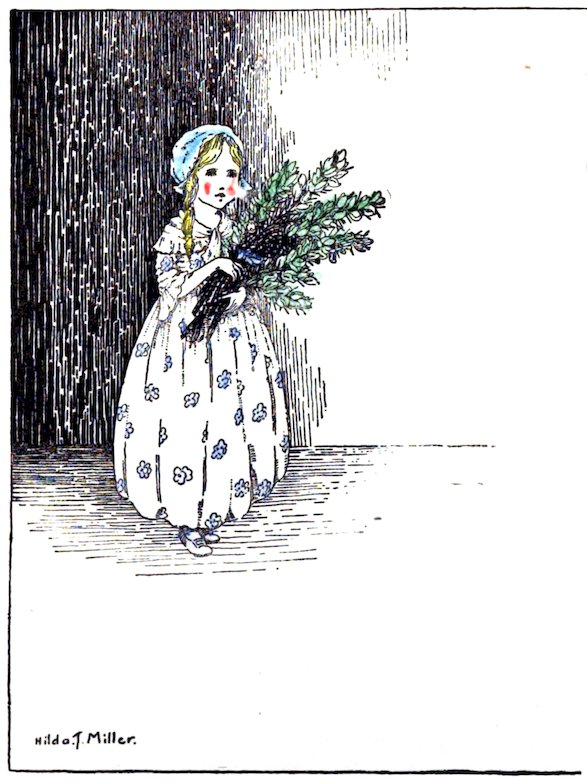
A fair child with straight hair.
203“Oh, Euphemia, do you mean that?” said Jean Elspeth, peering closer.
“Well,” Euphemia replied; and it was as if there were now two voices speaking: the old Euphemia’s and the low, even, dreamlike voice. “I mean it. There is plenty of air now—a different place. And I hope your friend will come as often as she pleases. There’s room for us all.”
And with that word “room,” and the grim smile that accompanied it, all the old Euphemia seemed to have come back again, though a moment after she had dropped back upon her pillow and appeared to be asleep.
Seeing her thus still once more, Jean Elspeth very, very cautiously turned her head. The first rays of the sun were on the window. Not the faintest scent of almond was borne to her nostrils on the air. There was no sign at all of any company. A crooked frown had settled on her forehead. She was cold through and through, and her body ached, but she tried to smile, and almost imperceptibly lifted a finger just as if it held a teaspoon, and she was waving it in her own old secret childish way to her father’s portrait on the wall.
Now and again after that Jean Elspeth watched the same absent far-away look steal over Euphemia’s face, and the same smile, dour and grim, and yet happy—like still, deep water under waves. It was almost as if Euphemia were amused at having stolen Lucy away.
“You see, my dear,” she said suddenly to Jean Elspeth one morning, as if after a long talk, “it only proves that we all go the same way home.”
“Euphemia, please do not say that,” whispered Jean Elspeth.
204“But why not?” said Euphemia. “So it is. And she almost laughing out loud at me. The hussy!”...
None of their old friends knew when Euphemia died, so it was only Dr. Menzies and his sister who came to Stoneyhouse for the funeral. And though Jean Elspeth would now have been contented to do all the work in the house and to take care of Tabitha and her knitting into the bargain, they persuaded her at last that this would be impossible. And so, one blazing hot morning, having given a little parting gift to Tom Piper and wept a moment or two on Mrs. O’Phrump’s ample shoulder, Jean Elspeth climbed with Tabitha into a cab, and that evening found herself hundreds of miles away from Stoneyhouse, in the two upper rooms set apart for the two ladies by Sally McGullie, who had married a fisherman and was now Mrs. John Jones.
Jean Elspeth could not have imagined a life so different. It was as if she had simply been pulled up by the roots. Whenever Tabitha could spare her—and that was seldom now—she would sit at her window looking on the square stone harbour and the sea, or in a glass shelter on its narrow front. But now that time stretched vacantly before her, and she was at liberty if she pleased to “pretend” whenever she wished, and to fall into day-dreams one after another, just as they might happen to come, it was just life’s queer way that she could scarcely picture Lucy now, even with her inward eye, and never with her naked one.
It was, too, just the way of this odd world that she should pine and long for Stoneyhouse beyond words to tell. She felt sometimes she must die—suffocate—of homesickness, 205and would frown at the grey moving sea, as if that alone were the enemy who was keeping her away from it. Not only this, but she saved up in a tin money-box every bawbee which she could spare of the little money the Four Lawyers had managed to save from the caoutchouc. And all for one distant purpose.
And at length, years and years afterwards, she told Mrs. Jones that she could bear herself no longer, that—like the cat in the fairy-tale—she must pay a visit, and must go alone....
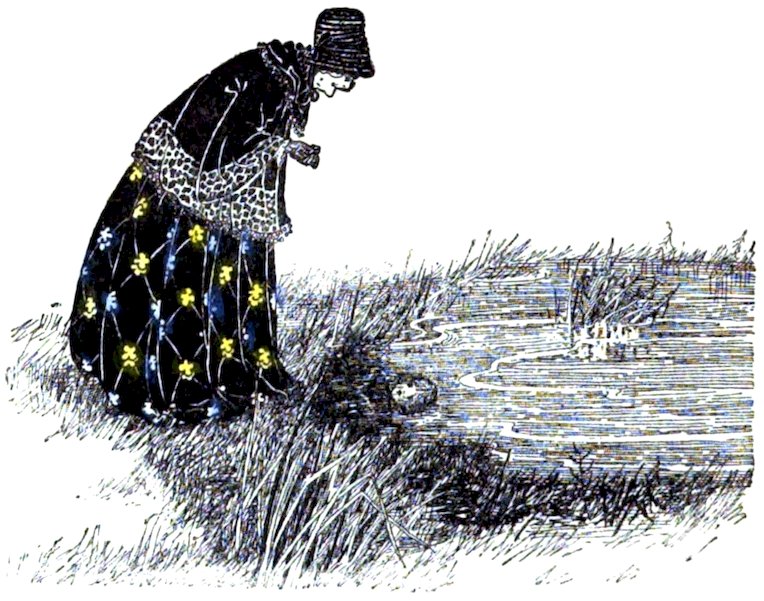
It was on an autumn afternoon, about five o’clock, and long shadows were creeping across the grasses of the forsaken garden, when Jean Elspeth came into sight again of Stoneyhouse, and found herself standing some little distance from the gaunt familiar walls by a small pond that had formed itself in a hollow of the garden. Her father had delighted in water, and, making use of a tiny stream that coursed near by, had made a jetting fountain and a fishpond. The fountain having long ceased to flow and the pond having become choked with water-weeds, the stream had pushed its way out across the hollows, and had made itself this dank dark resting-place. You might almost have thought it was trying to copy Jean Elspeth’s life in Sally Jones’s seaside cottage. On the other hand, the windows of the great house did not stare so fiercely now; they were blurred and empty, like the eyes of a man walking in his sleep. One of the chimney-stacks had toppled down, and creepers had rambled all over the wide expanse of the walls.
Jean Elspeth, little old woman that she now was, in her small black bonnet and a beaded mantle that had belonged 206to Euphemia, stood there drinking the great still scene in, as a dry sponge drinks salt water.
And after hesitating for some little time, she decided to venture nearer. She pushed her way through the matted wilderness of the garden, crossed the terrace, and presently peered in through one of the dingy dining-room windows. Half a shutter had by chance been left unclosed. When her eyes were grown accustomed to the gloom within, she discovered that the opposite wall was now quite empty. The portrait of her grandfather must have slowly ravelled through its cord. It had fallen face upwards on to the boards beneath.
It saddened her to see this. She had left the picture hanging there simply because she felt sure that Euphemia would so have wished it to hang. But though she wearied herself out seeking to find entry into the house, in order, at least, to lean her grandfather up again against the wall, it was in vain. The doors were rustily bolted; the lower windows tight shut. And it was beginning to be twilight when she found herself once more beside the dark-watered pond.
All this while she had been utterly alone. It had been a dreadful and sorrowful sight to see the great house thus decaying, and all this neglect. Yet she was not unhappy, for it seemed with its trees and greenery in this solitude to be uncomplaining and at peace. And so, too, was she. It was as if her whole life had just vanished and flitted away like a dream leaving merely her body standing there in the evening light under the boughs of the heavy chestnut-tree overhead.
And then by chance, in that still hush, her eyes wandered 207to the surface of the water at her feet, and there fixed themselves, her whole mind in a sudden confusion. For by some strange freak of the cheating dusk, she saw gazing back at her from under a squat old crape bonnet, with Euphemia’s cast-off beaded mantle on the shoulders beneath it, a face not in the least like that of the little old woman inside them, but a face, fair and smiling, as of one eternally young and happy and blessed—Lucy’s. She gazed and gazed, in the darkening evening. A peace beyond understanding enwrapt her spirit. It was by far the oddest thing that had ever happened to Jean Elspeth in all the eighty years of her odd, long life on earth.
208