Book 3 — THE SYSTEM OF THE WORLD. (continued 2)
Andrew Motte translation
If from the moon's orbit (p. 449) we descend to the earth's surface, those forces will be diminished in the ratio of the distances and 1; and therefore the force LM will then become 38604600 times less than the force of gravity. But this force acting equally every where upon the earth, will scarcely effect any change on the motion of the sea, and therefore may be neglected in the explication of that motion. The other force TM, in places where the sun is vertical, or in their nadir, is triple the quantity of the force ML, and therefore but 12868200 times less than the force of gravity.
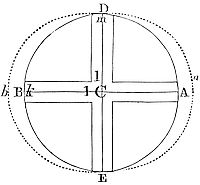
Suppose now ADBE to represent the spherical surface of the earth, aDbE the surface of the water overspreading it, C the centre of both, A the place to which the sun is vertical, B the place opposite; D, E, places at 90 degrees distance from the former; ACEmlk a right angled cylindric canal passing through the earth's centre. The force TM in any place is as the distance of the place from the plane DE, on which a line from A to C insists at right angles, and therefore in the part of the canal which is represented by EClm is of no quantity, but in the other part AClk is as the gravity at the several heights; for in descending towards the centre of the earth, gravity is (by Prop. LXXIII) every where as the height; and therefore the force TM drawing the water upwards will diminish its gravity in the leg AClk of the canal in a given ratio: upon which account the water will ascend in this leg, till its defect of gravity is supplied by its greater height; nor will it rest in an equilibrium till its total gravity becomes equal to the total gravity in EClm, the other leg of the canal. Because the gravity of every particle is as its distance from the earth's centre, the weight of the whole water in either leg will increase in the duplicate ratio of the height; and therefore the height of the water in the leg AClk will be to the height thereof in the leg ClmE in the subduplicate ratio of the number 12868201 to 12868200, or in the ratio of the number 25623053 to the number 25623052, and the height of the water in the leg EClm to the difference of the heights, as 25623052 to 1. But the height in the leg EClm is of 19615800 Paris feet, as has been lately found by the mensuration of the French; and, therefore, by the preceding analogy, the difference of the heights comes out inches of the Paris foot; and the sun's force will make the height of the sea at A to exceed the height of the same at E by 9 inches. And though the water of the canal ACEmlk be supposed to be frozen into a hard and solid consistence, yet the heights thereof at A and E, and all other intermediate places, would still remain the same.
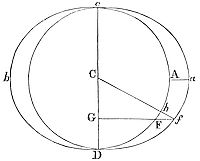
Let Aa (in the following figure) represent that excess of height of 9 inches at A, and hf the excess of height at any other place h; and upon DC let fall the perpendicular fG, meeting the globe of the earth in F; and because the distance of the sun is so great that all the right lines drawn thereto may be considered as parallel, the force TM in any place f will be to the same force in the place A as the sine FG to the radius AC. And, therefore, since those forces tend to the sun in the direction of parallel lines, they will generate the parallel heights Ff, Aa, in the same ratio; and therefore the figure of the water Dfaeb will be a spheroid made by the revolution of an ellipsis about its longer axis ab. And the perpendicular height fh will be to the oblique height Ff as fG to fC, or as FG to AC: and therefore the height fh is to the height Aa in the duplicate ratio of FG to AC, that is, in the ratio of the versed sine of double the angle DCf to double the radius, and is thence given. And hence to the several moments of the apparent revolution of the sun about the earth we may infer the proportion of the ascent and descent of the waters at any given place under the equator, as well as of the diminution of that ascent and descent, whether arising from the latitude of places or from the sun's declination; viz., that on account of the latitude of places, the ascent and descent of the sea is in all places diminished in the duplicate ratio of the co-sines of latitude; and on account of the sun's declination, the ascent and descent under the equator is diminished in the duplicate ratio of the co-sine of declination. And in places without the equator the half sum of the morning and evening ascents (that is, the mean ascent) is diminished nearly in the same ratio.
Let S and L respectively represent the forces of the sun and moon placed in the equator, and at their mean distances from the earth; R the radius; T and V the versed sines of double the complements of the sun and moon's declinations to any given time; D and E the mean apparent diameters of the sun and moon: and, supposing F and G to be their apparent diameters to that given time, their forces to raise the tides under the equator will be, in the syzygies ; in the quadratures, . And if the same ratio is likewise observed under the parallels, from observations accurately made in our northern climates we may determine the proportion of the forces L and S; and then by means of this rule predict the quantities of the tides to every syzygy and quadrature.
At the mouth of the river Avon, three miles below Bristol (p. 450 to 453), in spring and autumn, the whole ascent of the water in the conjunction or opposition of the luminaries (by the observation of Sturmy) is about 45 feet, but in the quadratures only 25. Because the apparent diameters of the luminaries are not here determined, let us assume them in their mean quantities, as well as the moon's declination in the equinoctial quadratures in its mean quantity, that is, °; and the versed sine of double its complement will be 1682, supposing the radius to be 1000. But the declinations of the sun in the equinoxes and of the moon in the syzygies are of no quantity, and the versed sines of double the complements are each 2000. Whence those forces become L + S in the syzygies, and in the quadratures; respectively proportional to the heights of the tides of 45 and 25 feet, or of 9 and 5 paces. And, therefore, multiplying the extremes and the means, we have , or .
But farther; I remember to have been told that in summer the ascent of the sea in the syzygies is to the ascent thereof in the quadratures as about 5 to 4. In the solstices themselves it is probable that the proportion may be something less, as about 6 to 5; whence it would follow that L is = [for then the proportion is ]. Till we can more certainly determine the proportion from observation, let us assume ; and since the heights of the tides are as the forces which excite them, and the force of the sun is able to raise the tides to the height of nine inches, the moon's force will be sufficient to raise the same to the height of four feet. And if we allow that this height may be doubled, or perhaps tripled, by that force of reciprocation which we observe in the motion of the waters, and by which their motion once begun is kept up for some time, there will be force enough to generate all that quantity of tides which we really find in the ocean.
Thus we have seen that these forces are sufficient to move the sea. But, so far as I can observe, they will not be able to produce any other effect sensible on our earth; for since the weight of one grain in 4000 is not sensible in the nicest balance; and the sun's force to move the tides is 12868200 less than the force of gravity; and the sum of the forces of both moon and sun, exceeding the sun's force only in the ratio of to 1, is still 2032890 times less than the force of gravity; it is evident that both forces together are 500 times less than what is required sensibly to increase or diminish the weight of any body in a balance. And, therefore, they will not sensibly move any suspended body; nor will they produce any sensible effect on pendulums, barometers, bodies swimming in stagnant water, or in the like statical experiments. In the atmosphere, indeed, they will excite such a flux and reflux as they do in the sea, but with so small a motion that no sensible wind will be thence produced.
If the effects of both moon and sun in raising the tides (p. 454), as well as their apparent diameters, were equal among themselves, their absolute forces would (by Cor. XIV, Prop. LXVI) be as their magnitudes. But the effect of the moon is to the effect of the sun as about to 1; and the moon's diameter less than the sun's in the ratio of to , or of 45 to 16. Now the force of the moon is to be increased in the ratio of the effect directly, and in the triplicate ratio of the diameter inversely. Whence the force of the moon compared with its magnitude will be to the force of the sun compared with its magnitude in the ratio compounded of to 1, and the triplicate of 45 to 46 inversely, that is, in the ratio of about to 1. And therefore the moon, in respect of the magnitude of its body, has an absolute centripetal force greater than the sun in respect of the magnitude of its body in the ratio to to 1, and is therefore more dense in the same ratio.
In the time of 27d. 7h. 43', in which the moon makes its revolution about the earth, a planet may be revolved about the sun at the distance of 18,954 diameters of the sun from the sun's centre, supposing the mean apparent diameter of the sun to be ; and in the same time the moon may be revolved about the earth at rest, at the distance of 30 of the earth's diameters. If in both cases the number of diameters was the same, the absolute circum-terrestrial force would (by Cor. II, Prop. LXXII) be to the absolute circum-solar force as the magnitude of the earth to the magnitude of the sun. Because the number of the earth's diameters is greater in the ratio of 30 to 18,954, the body of the earth will be less in the triplicate of that ratio, that is, in the ratio of to 1. Wherefore the earth's force, for the magnitude of its body, is to the sun's force, for the magnitude of its body, as to 1; and consequently the earth's density to the sun's will be in the same ratio. Since, then, the moon's density is to the sun's density as to 1, the moon's density will be to the earth's density as to , or as 23 to 16. Wherefore since the moon's magnitude is to the earth's magnitude as about 1 to , the moon's absolute centripetal force will be to the earth's absolute centripetal force as about 1 to 29, and the quantity of matter in the moon to the quantity of matter in the earth in the same ratio. And hence the common centre of gravity of the earth and moon is more exactly determined than hitherto has been done; from the knowledge of which we may now infer the moon's distance from the earth with greater accuracy. But I would rather wait till the proportion of the bodies of the moon and earth one to the other is more exactly defined from the phænomena of the tides, hoping that in the mean time the circumference of the earth may be measured from more distant stations than any body has yet employed for this purpose.
Thus I have given an account of the system of the planets. As to the fixed stars, the smallness of their annual parallax proves them to be removed to immense distances from the system of the planets: that this parallax is less than one minute is most certain; and from thence it follows that the distance of the fixed stars is above 360 times greater than the distance of Saturn from the sun. Such as reckon the earth one of the planets, and the sun one of the fixed stars, may remove the fixed stars to yet greater distances by the following arguments: from the annual motion of the earth there would happen an apparent transposition of the fixed stars, one in respect of another, almost equal to their double parallax: but the greater and nearer stars, in respect of the more remote, which are only seen by the telescope, have not hitherto been observed to have the least motion. If we should suppose that motion to be but less than 20'', the distance of the nearer fixed stars would exceed the mean distance of Saturn by above 2000 times. Again; the disk of Saturn, which is only 17'' or 18'' in diameter, receives but about of the sun's light; for so much less is that disk than the whole spherical surface of the orb of Saturn. Now if we suppose Saturn to reflect about of this light, the whole light reflected from its illuminated hemisphere will be about of the whole light emitted from the sun's hemisphere; and, therefore, since light is rarefied in the duplicate ratio of the distance from the luminous body, if the sun was times more distant than Saturn, it would yet appear as lucid as Saturn now does without its ring, that is, something more lucid than a fixed star of the first magnitude. Let us, therefore, suppose that the distance from which the sun would shine as a fixed star exceeds that of Saturn by about 100,000 times, and its apparent diameter will be 7v. 16vi. and its parallax arising from the annual motion of the earth 13'''': and so great will be the distance, the apparent diameter, and the parallax of the fixed stars of the first magnitude, in bulk and light equal to our sun. Some may, perhaps, imagine that a great part of the light of the fixed stars is intercepted and lost in its passage through so vast spaces, and upon that account pretend to place the fixed stars at nearer distances; but at this rate the remoter stars could be scarcely seen. Suppose, for example, that of the light perish in its passage from the nearest fixed stars to us; then will twice perish in its passage through a double space, thrice through a triple, and so forth. And, therefore, the fixed stars that are at a double distance will be 16 times more obscure, viz., 4 times more obscure on account of the diminished apparent diameter; and, again, 4 times more on account of the lost light. And, by the same argument, the fixed stars at a triple distance will be 9 × 4 × 4, or 144 times more obscure; and those at a quadruple distance will be 16 × 4 × 4 × 4, or 1024 times more obscure; but so great a diminution of light is no ways consistent with the phænomena and with that hypothesis which places the fixed stars at different distances.
The fixed stars being, therefore, at such vast distances from one another (p. 460, 461), can neither attract each other sensibly, nor be attracted by our sun. But the comets must unavoidably be acted on by the circum-solar force; for as the comets were placed by astronomers above the moon, because they were found to have no diurnal parallax, so their annual parallax is a convincing proof of their descending into the regions of the planets. For all the comets which move in a direct course, according to the order of the signs, about the end of their appearance become more than ordinarily slow, or retrograde, if the earth is between them and the sun; and more than ordinarily swift if the earth is approaching to a heliocentric opposition with them. Whereas, on the other hand, those which move against the order of the signs, towards the end of their appearance, appear swifter than they ought to be if the earth is between them and the sun; and slower, and perhaps retrograde, if the earth is in the other side of its orbit. This is occasioned by the motion of the earth in different situations. If the earth go the same way with the comet, with a swifter motion, the comet becomes retrograde; if with a slower motion, the comet becomes slower, however; and if the earth move the contrary way, it becomes swifter; and by collecting the differences between the slower and swifter motions, and the sums of the more swift and retrograde motions, and comparing them with the situation and motion of the earth from whence they arise, I found, by means of this parallax, that the distances of the comets at the time they cease to be visible to the naked eye are always less than the distance of Saturn, and generally even less than the distance of Jupiter.
The same thing may be collected from the curvature of the way of the comets (p. 462). These bodies go on nearly in great circles while their motion continues swift; but about the end of their course, when that part of their apparent motion which arises from the parallax bears a greater proportion to their whole apparent motion, they commonly deviate from those circles; and when the earth goes to one side, they deviate to the other; and this deflection, because of its corresponding with the motion of the earth, must arise chiefly from the parallax; and the quantity thereof is so considerable, as, by my computation, to place the disappearing comets a good deal lower than Jupiter. Whence it follows, that, when they approach nearer to us in their perigees and perihelions, they often descend below the orbits of Mars and the inferior planets.
Moreover, this nearness of the comets is confirmed by the annual parallax of the orbit, in so far as the same is pretty nearly collected by the supposition that the comets move uniformly in right lines. The method of collecting the distance of a comet according to this hypothesis from four observations (first attempted by Kepler, and perfected by Dr. Wallis and Sir Christopher Wren) is well known; and the comets reduced to this regularity generally pass through the middle of the planetary region. So the comets of the year 1607 and 1618, as their motions are defined by Kepler, passed between the sun and the earth; that of the year 1664 below the orbit of Mars; and that in 1680 below the orbit of Mercury, as its motion was defined by Sir Christopher Wren and others. By a like rectilinear hypothesis, Hevelius placed all the comets about which we have any observations below the orbit of Jupiter. It is a false notion, therefore, and contrary to astronomical calculation, which some have entertained, who, from the regular motion of the comets, either remove them into the regions of the fixed stars, or deny the motion of the earth; whereas their motions cannot be reduced to perfect regularity, unless we suppose them to pass through the regions near the earth in motion; and these are the arguments drawn from the parallax, so far as it can be determined without an exact knowledge of the orbits and motions of the comets.
The near approach of the comets is farther confirmed from the light of their heads (p. 463, 465); for the light of a celestial body, illuminated by the sun, and receding to remote parts, is diminished in the quadruplicate proportion of the distance; to wit, in one duplicate proportion on account of the increase of the distance from the sun; and in another duplicate proportion on account of the decrease of the apparent diameter. Hence it may be inferred, that Saturn being at a double distance, and having its apparent diameter nearly half of that of Jupiter, must appear about 16 times more obscure; and that, if its distance were 4 times greater, its light would be 256 times less; and therefore would be hardly perceivable to the naked eye. But now the comets often equal Saturn's light, without exceeding him in their apparent diameters. So the comet of the year 1668, according to Dr. Hooke's observations, equalled in brightness the light of a fixed star of the first magnitude; and its head, or the star in the middle of the coma, appeared, through a telescope of 15 feet, as lucid as Saturn near the horizon; but the diameter of the head was only 25'' that is, almost the same with the diameter of a circle equal to Saturn and his ring. The coma or hair surrounding the head was about ten times as broad; namely, min. Again; the least diameter of the hair of the comet of the year 1682, observed by Mr. Flamsted with a tube of 16 feet and measured with the micrometer, was 2' 0''; but the nucleus, or star in the middle, scarcely possessed the tenth part of this breadth, and was therefore only 11'' or 12'' broad; but the light and clearness of its head exceeded that of the year 1680, and was equal to that of the stars of the first or second magnitude. Moreover, the comet of the year 1665, in April, as Hevelius informs us, exceeded almost all the fixed stars in splendor, and even Saturn itself, as being of a much more vivid colour; for this comet was more lucid than that which appeared at the end of the foregoing year and was compared to the stars of the first magnitude. The diameter of the coma was about 6'; but the nucleus, compared with the planets by means of a telescope, was plainly less than Jupiter, and was sometimes thought less, sometimes equal to the body of Saturn within the ring. To this breadth add that of the ring, and the whole face of Saturn will be twice as great as that of the comet, with a light not at all more intense; and therefore the comet was nearer to the sun than Saturn. From the proportion of the nucleus to the whole head found by these observations, and from its breadth, which seldom exceeds 8' or 12', it appears that the stars of the comets are most commonly of the same apparent magnitude as the planets; but that their light may be compared oftentimes with that of Saturn, and sometimes exceeds it. And hence it is certain that in their perihelia their distances can scarcely be greater than that of Saturn. At twice that distance, the light would be four times less, which besides by its dim paleness would be as much inferior to the light of Saturn as the light of Saturn is to the splendor of Jupiter: but this difference would be easily observed. At a distance ten times greater, their bodies must be greater than that of the sun; but their light would be 100 times fainter than that of Saturn. And at distances still greater, their bodies would far exceed the sun; but, being in such dark regions, they must be no longer visible. So impossible is it to place the comets in the middle regions between the sun and fixed stars, accounting the sun as one of the fixed stars; for certainly they would receive no more light there from the sun than we do from the greatest of the fixed stars.
So far we have gone without considering that obscuration which comets suffer from that plenty of thick smoke which encompasseth their heads, and through which the heads always shew dull as through a cloud; for by how much the more a body is obscured by this smoke, by so much the more near it must be allowed to come to the sun, that it may vie with the planets in the quantity of light which it reflects; whence it is probable that the comets descend far below the orbit of Saturn, as we proved before from their parallax. But, above all, the thing is evinced from their tails, which must be owing either to the sun's light reflected from a smoke arising from them, and dispersing itself through the æther, or to the light of their own heads.
In the former case we must shorten the distance of the comets, lest we be obliged to allow that the smoke arising from their heads is propagated through such a vast extent of space, and with such a velocity of expansion, as will seem altogether incredible; in the latter case the whole light of both head and tail must be ascribed to the central nucleus. But, then, if we suppose all this light to be united and condensed within the disk of the nucleus, certainly the nucleus will by far exceed Jupiter itself in splendor, especially when it emits a very large and lucid tail. If, therefore, under a less apparent diameter, it reflects more light, it must be much more illuminated by the sun, and therefore much nearer to it. So the comet that appeared Dec. 12 and 15, O.S. Anno 1679, at the time it emitted a very shining tail, whose splendor was equal to that of many stars like Jupiter, if their light were dilated and spread through so great a space, was, as to the magnitude of its nucleus, less than Jupiter (as Mr. Flamsted observed), and therefore was much nearer to the sun: nay, it was even less than Mercury. For on the 17th of that month, when it was nearer to the earth, it appeared to Cassini through a telescope of 35 feet a little less than the globe of Saturn. On the 8th of this month, in the morning, Dr. Halley saw the tail, appearing broad and very short, and as if it rose from the body of the sun itself, at that time very near its rising. Its form was like that of an extraordinary bright cloud; nor did it disappear till the sun itself began to be seen above the horizon. Its splendor, therefore, exceeded the light of the clouds till the sun rose, and far surpassed that of all the stars together, as yielding only to the immediate brightness of the sun itself. Neither Mercury, nor Venus, nor the moon itself, are seen so near the rising sun. Imagine all this dilated light collected together, and to be crowded into the orbit of the comet's nucleus which was less than Mercury; by its splendor, thus increased, becoming so much more conspicuous, it will vastly exceed Mercury, and therefore must be nearer to the sun. On the 12th and 15th of the same month, this tail, extending itself over a much greater space, appeared more rare; but its light was still so vigorous as to become visible when the fixed stars were hardly to be seen, and soon after to appear like a fiery beam shining in a wonderful manner. From its length, which was 40 or 50 degrees, and its breadth of 2 degrees, we may compute what the light of the whole must be.
This near approach of the comets to the sun is confirmed from the situation they are seen in when their tails appear most resplendent; for when the head passes by the sun, and lies hid under the solar rays, very bright and shining tails, like fiery beams, are said to issue from the horizon; but afterwards, when the head begins to appear, and is got farther from the sun, that splendor always decreases, and turns by degrees into a paleness like to that of the milky way, but much more sensible at first; after that vanishing gradually. Such was that most resplendent comet described by Aristotle, Lib. 1, Meteor. 6. "The head thereof could not be seen, because it set before the sun, or at least was hid under the sun's rays; but the next day it was seen as well as might be; for, having left the sun but a very little way, it set immediately after it; and the scattered light of the head obscured by the too great splendour (of the tail) did not yet appear. But afterwards (says Aristotle), when the splendour of the tail was now diminished (the head of), the comet recovered its native brightness. And the splendour of its tail reached now to a third part of the heavens (that is, to 60°). It appeared in the winter season, and, rising to Orion's girdle, there vanished away." Two comets of the same kind are described by Justin, Lib. 37, which, according to his account, "shined so bright, that the whole heaven seemed to be on fire; and by their greatness filled up a fourth part of the heavens, and by their splendour exceeded that of the sun." By which last words a near position of these bright comets and the rising or setting sun is intimated (p. 494, 495). We may add to these the comet of the year 1101 or 1106, "the star of which was small and obscure (like that of 1680); but the splendour arising from it extremely bright, reaching like a fiery beam to the east and north," as Hevelius has it from Simeon, the monk of Durham. It appeared at the beginning of February about the evening in the south-west. From this and from the situation of the tail we may infer that the head was near the sun. Matthew Paris says, "it was about one cubit from the sun; from the third [or rather the sixth] to the ninth hour sending out a long stream of light." The comet of 1264, in July, or about the solstice, preceded the rising sun, sending out its beams with a great light towards the west as far as the middle of the heavens; and at the beginning it ascended a little above the horizon: but as the sun went forwards it retired every day farther from the horizon, till it passed by the very middle of the heavens. It is said to have been at the beginning large and bright, having a large coma, which decayed from day to day. It is described in Append. Matth. Paris, Hist. Ang. after this manner: "An. Christi 1265, there appeared a comet so wonderful, that none then living had ever seen the like; for, rising from the east with a great brightness, it extended itself with a great light as far as the middle of the hemisphere towards the west." The Latin original being somewhat barbarous and obscure, it is here subjoined. Ab oriente enim cum magno fulgore surgens, usque ad medium hemisphærii versus occidentem, omnia perlucide pertrahebat.
"In the year 1401 or 1402, the sun being got below the horizon, there appeared in the west a bright and shining comet, sending out a tail upwards, in splendor like a flame of fire, and in form like a spear, darting its rays from west to east. When the sun was sunk below the horizon, by the lustre of its own rays it enlightened all the borders of the earth, not permitting the other stars to shew their light, or the shades of night to darken the air, because its light exceeded that of the others, and extended itself to the upper part of the heavens, flaming," &c., Hist. Byzant. Duc. Mich. Nepot. From the situation of the tail of this comet, and the time of its first appearance, we may infer that the head was then near the sun, and went farther from him every day; for that comet continued three months. In the year 1527, Aug. 11, about four in the morning, there was seen almost throughout Europe a terrible comet in Leo, which continued flaming an hour and a quarter every day. It rose from the east, and ascended to the south and west to a prodigious length. It was most conspicuous to the north, and its cloud (that is, its tail) was very terrible; having, according to the fancies of the vulgar, the form of an arm a little bent holding a sword of a vast magnitude. In the year 1618, in the end of November, there began a rumour, that there appeared about sun-rising a bright beam, which was the tail of a comet whose head was yet concealed within the brightness of the solar rays. On Nov. 24, and from that time, the comet itself appeared with a bright light, its head and tail being extremely resplendent. The length of the tail, which was at first 20 or 30 deg., increased till December 9, when it arose to 75 deg., but with a light much more faint and dilute than at the beginning. In the year 1668, March 5, N. S., about 7 in the evening, P. Valent. Estancius, being in Brazil, saw a comet near the horizon in the south-west. Its head was small, and scarcely discernible, but its tail extremely bright and refulgent, so that the reflection of it from the sea was easily seen by those who stood upon the shore. This great splendor lasted but three days, decreasing very remarkably from that time. The tail at the beginning extended itself from west to south, and in a situation almost parallel to the horizon, appearing like a shining beam 23 deg. in length. Afterwards, the light decreasing, its magnitude increased till the comet ceased to be visible; so that Cassini, at Bologna, saw it (Mar. 10, 11, 12) rising from the horizon 32 deg. in length. In Portugal it is said to have taken up a fourth part of the heavens (that is, 45 deg.), extending itself from west to east with a notable brightness; though the whole of it was not seen, because the head in this part of the world always lay hid below the horizon. From the increase of the tail it is plain that the head receded from the sun, and was nearest to it at the beginning, when the tail appeared brightest.
To all these we may add the comet of 1680, whose wonderful splendor at the conjunction of the head with the sun was above described. But so great a splendor argues the comets of this kind to have really passed near the fountain of light, especially since the tails never shine so much in their opposition to the sun; nor do we read that fiery beams have ever appeared there.
Lastly, the same thing is inferred (p. 466, 467) from the light of the heads increasing in the recess of the comets from the earth towards the sun, and decreasing in their return from the sun towards the earth; for so the last comet of the year 1665 (by the observation of Hevelius), from the time that it was first seen, was always losing of its apparent motion, and therefore had already passed its perigee; yet the splendor of its head was daily increasing, till, being hid by the sun's rays, the comet ceased to appear. The comet of the year 1683 (by the observation of the same Hevelius), about the end of July, when it first appeared, moved at a very slow rate, advancing only about 40 or 45 minutes in its orbit in a day's time. But from that time its diurnal motion was continually upon the increase till September 4, when it arose to about 5 degrees; and therefore in all this interval of time the comet was approaching to the earth. Which is likewise proved from the diameter of its head measured with a micrometer; for, August the 6th, Hevelius found it only 6' 5'', including the coma; which, September 2, he observed 9' 7''. And therefore its head appeared far less about the beginning than towards the end of its motion, though about the beginning, because nearer to the sun, it appeared far more lucid than towards the end, as the same Hevelius declares. Wherefore in all this interval of time, on account of its recess from the sun, it decreased in splendor, notwithstanding its access towards the earth. The comet of the year 1618, about the middle of December, and that of the year 1680, about the end of the same month, did both move with their greatest velocity, and were therefore then in their perigees; but the greatest splendor of their heads was seen two weeks before, when they had just got clear of the sun's rays; and the greatest splendor of their tails a little more early, when yet nearer to the sun. The head of the former comet, according to the observations of Cysatus, Dec. 1, appeared greater than the stars of the first magnitude; and, Dec. 16 (being then in its perigee), of a small magnitude, and the splendor or clearness was much diminished. Jan. 7, Kepler, being uncertain about the head, left off observing. Dec. 12, the head of the last comet was seen and observed by Flamsted at the distance of 9 degrees from the sun, which a star of the third magnitude could hardly have been. December 15 and 17, the same appeared like a star of the third magnitude, its splendor being diminished by the bright clouds near the setting sun. Dec. 26, when it moved with the greatest swiftness, and was almost in its perigee, it was inferior to Os Pegasi, a star of the third magnitude. Jan. 3, it appeared like a star of the fourth; Jan. 9, like a star of the fifth. Jan. 13, it disappeared, by reason of the brightness of the moon, which was then in its increase. Jan. 25, it was scarcely equal to the stars of the seventh magnitude. If we take equal times on each hand of the perigee, the heads placed at remote distances would have shined equally before and after, because of their equal distances from the earth. That in one case they shined very bright, and in the other vanished, is to be ascribed to the nearness of the sun in the first case, and his distance in the other; and from the great difference of the light in these two cases we infer its great nearness in the first of them; for the light of the comets uses to be regular, and to appear greatest when their heads move the swiftest, and are therefore in their perigees, excepting in so far as it is increased by their nearness to the sun.
From these things I at last discovered why the comets frequent so much the region of the sun. If they were to be seen in the regions a great way beyond Saturn, they must appear oftener in these parts of the heavens that are opposite to the sun; for those which are in that situation would be nearer to the earth, and the interposition of the sun would obscure the others: but, looking over the history of comets, I find that four or five times more have been seen in the hemisphere towards the sun than in the opposite hemisphere; besides, without doubt, not a few which have been hid by the light of the sun; for comets descending into our parts neither emit tails, nor are so well illuminated by the sun, as to discover themselves to our naked eyes, till they are come nearer to us than Jupiter. But the far greater part of that spherical space, which is described about the sun with so small an interval, lies on that side of the earth which regards the sun, and the comets in that greater part are more strongly illuminated, as being for the most part nearer to the sun: besides, from the remarkable eccentricity of their orbits, it comes to pass that their lower apsides are much nearer to the sun than if their revolutions were performed in circles concentric to the sun.
Hence also we understand why the tails of the comets, while their heads are descending towards the sun, always appear short and rare, and are seldom said to have exceeded 15 or 20 deg. in length; but in the recess of the heads from the sun often shine like fiery beams, and soon after reach to 40, 50, 60, 70 deg. in length, or more. This great splendor and length of the tails arises from the heat which the sun communicates to the comet as it passes near it. And thence, I think, it may be concluded, that all the comets that have had such tails have passed very near the sun.
Hence also we may collect that the tails arise from the atmospheres of the heads (p. 487 to 488): but we have had three several opinions about the tails of comets; for some will have it that they are nothing else but the beams of the sun's light transmitted through the comets' heads, which they suppose to be transparent; others, that they proceed from the refraction which light suffers in passing from the comet's head to the earth; and, lastly, others, that they are a sort of clouds or vapour constantly rising from the comets' heads, and tending towards the parts opposite to the sun. The first is the opinion of such as are yet unacquainted with optics; for the beams of the sun are not seen in a darkened room, but in consequence of the light that is reflected from them by the little particles of dust and smoke which are always flying about in the air; and hence it is that in air impregnated with thick smoke they appear with greater brightness, and are more faintly and more difficultly seen in a finer air; but in the heavens, where there is no matter to reflect the light, they are not to be seen at all. Light is not seen as it is in the beams, but as it is thence reflected to our eyes; for vision is not made but by rays falling upon the eyes, and therefore there must be some reflecting matter in those parts where the tails of comets are seen; and so the argument turns upon the third opinion; for that reflecting matter can be no where found but in the place of the tail, because otherwise, since all the celestial spaces are equally illuminated by the sun's light, no part of the heavens could appear with more splendor than another. The second opinion is liable to many difficulties. The tails of comets are never seen variegated with those colours which ever use to be inseparable from refraction; and the distinct transmission of the light of the fixed stars and planets to us is a demonstration that the æther or celestial medium is not endowed with any refractive power. For as to what is alledged that the fixed stars have been sometimes seen by the Egyptians environed with a coma or capillitium because that has but rarely happened, it is rather to be ascribed to a casual refraction of clouds, as well as the radiation and scintillation of the fixed stars to the refractions both of the eyes and air; for upon applying a telescope to the eye, those radiations and scintillations immediately disappear. By the tremulous agitation of the air and ascending vapours, it happens that the rays of light are alternately turned aside from the narrow space of the pupil of the eye; but no such thing can have place in the much wider aperture of the object-glass of a telescope; and hence it is that a scintillation is occasioned in the former case which ceases in the latter; and this cessation in the latter case is a demonstration of the regular transmission of light through the heavens without any sensible refraction. But, to obviate an objection that may be made from the appearing of no tail in such comets as shine but with a faint light, as if the secondary rays were then too weak to affect the eyes, and for this reason it is that the tails of the fixed stars do not appear, we are to consider that by the means of telescopes the light of the fixed stars may be augmented above an hundred fold and yet no tails are seen; that the light of the planets is yet more copious without any tail, but that comets are seen sometimes with huge tails when the light of their heads is but faint and dull; for so it happened in the comet of the year 1680, when in the month of December it was scarcely equal in light to the stars of the second magnitude, and yet emitted a notable tail, extending to the length of 40°, 50°, 60°, or 70°, and upwards; and afterwards, on the 27th and 28th of January, the head appeared but as a star of the seventh magnitude; but the tail (as was said above), with a light that was sensible enough, though faint, was stretched out to 6 or 7 degrees in length, and with a languishing light that was more difficultly seen, even to 12° and upwards. But on the 9th and 10th of February, when to the naked eye the head appeared no more, I saw through a telescope the tail of 2° in length. But farther; if the tail was owing to the refraction of the celestial matter, and did deviate from the opposition of the sun, according as the figure of the heavens requires, that deviation, in the same places of the heavens, should be always directed towards the same parts: but the comet of the year 1680, December 28d. P. M. at London, was seen in Pisces, 8° 41', with latitude north 28° 6', while the sun was in Capricorn 18° 26'. And the comet of the year 1577, December 29, was in Pisces 8° 41', with latitude north 28° 40'; and the sun, as before, in about Capricorn 18° 26'. In both cases the situation of the earth was the same, and the comet appeared in the same place of the heavens; yet in the former case the tail of the comet (as well by my observations as by the observations of others) deviated from the opposition of the sun towards the north by an angle of degrees, whereas in the latter there was (according to the observation of Tycho) a deviation of 21 degrees towards the south. The refraction, therefore, of the heavens being thus disproved, it remains that the phænomena of the tails of comets must be derived from some reflecting matter. That vapours sufficient to fill such immense spaces may arise from the comet's atmospheres, may be easily understood from what follows.
It is well known that the air near the surface of our earth possesses a space about 1200 times greater than water of the same weight; and therefore a cylindric column of air 1200 feet high is of equal weight with a cylinder of water of the same breadth, and but one foot high. But a cylinder of air reaching to the top of the atmosphere is of equal weight with a cylinder of water about 33 feet high; and therefore if from the whole cylinder of air the lower part of 1200 feet high is taken away, the remaining upper part will be of equal weight with a cylinder of water 32 feet high. Wherefore at the height of 1200 feet, or two furlongs, the weight of the incumbent air is less, and consequently the rarity of the compressed air greater, than near the surface of the earth in the ratio of 33 to 32. And, having this ratio, we may compute the rarity of the air in all places whatsoever (by the help of Cor. Prop. XXII, Book II), supposing the expansion thereof to be reciprocally proportional to its compression; and this proportion has been proved by the experiments of Hooke and others. The result of the computation I have set down in the following table, in the first column of which you have the height of the air in miles, whereof 4000 make a semi-diameter of the earth; in the second the compression of the air, or the incumbent weight; in the third its rarity or expansion, supposing gravity to decrease in the duplicate ratio of the distances from the earth's centre. And the Latin numeral characters are here used for certain numbers of ciphers, as 0,xvii 1224 for 0,000000000000000001224, and 26956 xv for 26956000000000000000.
AIR's
Height. Compression. Expansion.
0 33 1
5 17,8515 1,8486
10 9,6717 3,4151
20 2,852 11,571
40 0,2525 136,83
400 0,xvii 1224 26956 xv
4000 0,cv. 4465 73907 cii
40000 0,cxcii 1628 20263 clxxxix
400000 0,ccx 7895 41798 ccvii
4000000 0,ccxii 9878 33414 ccix
Infinite. 0,ccxii 6041 54622 ccix
But from this table it appears that the air, in proceeding upwards, is rarefied in such manner, that a sphere of that air which is nearest to the earth, of but one inch in diameter, if dilated with that rarefaction which it would have at the height of one semi-diameter of the earth, would fill all the planetary regions as far as the sphere of Saturn, and a great, way beyond; and at the height of ten semi-diameters of the earth would fill up more space than is contained in the whole heavens on this side the fixed stars, according to the preceding computation of their distance. And though, by reason of the far greater thickness of the atmospheres of comets, and the great quantity of the circum-solar centripetal force, it may happen that the air in the celestial spaces, and in the tails of comets, is not so vastly rarefied, yet from this computation it is plain that a very small quantity of air and vapour is abundantly sufficient to produce all the appearances of the tails of comets; for that they are indeed of a very notable rarity appears from the shining of the stars through them. The atmosphere of the earth, illuminated by the sun's light, though but of a few miles in thickness, obscures and extinguishes the light not only of all the stars, but even of the moon itself; whereas the smallest stars are seen to shine through the immense thickness of the tails of comets, likewise illuminated by the sun, without the least diminution of their splendor.
Kepler ascribes the ascent of the tails of comets to the atmospheres of their heads, and their direction towards the parts opposite to the sun to the action of the rays of light carrying along with them the matter of the comets' tails; and without any great incongruity we may suppose that, in so free spaces, so fine a matter as that of the æther may yield to the action of the rays of the sun's light, though those rays are not able sensibly to move the gross substances in our parts, which are clogged with so palpable a resistance. Another author thinks that there may be a sort of particles of matter endowed with a principle of levity as well as others are with a power of gravity; that the matter of the tails of comets may be of the former sort, and that its ascent from the sun may be owing to its levity; but, considering the gravity of terrestrial bodies is as the matter of the bodies, and therefore can be neither more nor less in the same quantity of matter, I am inclined to believe that this ascent may rather proceed from the rarefaction of the matter of the comets' tails. The ascent of smoke in a chimney is owing to the impulse of the air with which it is entangled. The air rarefied by heat ascends, because its specific gravity is diminished, and in its ascent carries along with it the smoke with which it is engaged. And why may not the tail of a comet rise from the sun after the same manner? for the sun's rays do not act any way upon the mediums which they pervade but by reflection and refraction; and those reflecting particles heated by this action, heat the matter of the æther which is involved with them. That matter is rarefied by the heat which it acquires, and because by this rarefaction the specific gravity, with which it tended towards the sun before, is diminished, it will ascend therefrom like a stream, and carry along with it the reflecting particles of which the tail of the comet is composed; the impulse of the sun's light, as we have said, promoting the ascent.
But that the tails of comets do arise from their heads (p. 488), and tend towards the parts opposite to the sun, is farther confirmed from the laws which the tails observe; for, lying in the planes of the comets' orbits which pass through the sun, they constantly deviate from the opposition of the sun towards the parts which the comets' heads in their progress along those orbits have left; and to a spectator placed in those planes they appear in the parts directly opposite to the sun; but as the spectator recedes from those planes, their deviation begins to appear, and daily becomes greater. And the deviation, cæteris paribus, appears less when the tail is more oblique to the orbit of the comet, as well as when the head of the comet approaches nearer to the sun; especially if the angle of deviation is estimated near the head of the comet. Farther; the tails which have no deviation appear straight, but the tails which deviate are likewise bended into a certain curvature; and this curvature is greater when the deviation is greater, and is more sensible when the tail, cæteris paribus, is longer; for in the shorter tails the curvature is hardly to be perceived. And the angle of deviation is less near the comet's head, but greater towards the other end of the tail, and that because the lower side of the tail regards the parts from which the deviation is made, and which lie in a right line drawn out infinitely from the sun through the comet's head. And the tails that are longer and broader, and shine with a stronger light, appear more resplendent and more exactly defined on the convex than on the concave side. Upon which accounts it is plain that the phænomena of the tails of comets depend upon the motions of their heads, and by no means upon the places of the heavens in which their heads are seen; and that, therefore, the tails of the comets do not proceed from the refraction of the heavens, but from their own heads, which furnish the matter that forms the tail; for as in our air the smoke of a heated body ascends either perpendicularly, if the body is at rest, or obliquely if the body is moved obliquely, so in the heavens, where all the bodies gravitate towards the sun, smoke and vapour must (as we have already said) ascend from the sun, and either rise perpendicularly, if the smoking body is at rest, or obliquely, if the body, in the progress of its motion, is always leaving those places from which the upper or higher parts of the vapours had risen before. And that obliquity will be less where the vapour ascends with more velocity, to wit, near the smoking body, when that is near the sun; for there the force of the sun by which the vapour ascends is stronger. But because the obliquity is varied, the column of vapour will be incurvated; and because the vapour in the preceding side is something more recent, that is, has ascended something more lately from the body, it will therefore be something more dense on that side, and must on that account reflect more light, as well as be better defined; the vapour on the other side languishing by degrees, and vanishing out of sight.
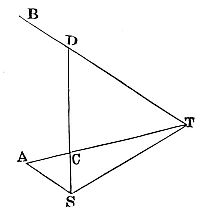
But it is none of our present business to explain the causes of the appearances of nature. Let those things which we have last said be true or false, we have at least made out, in the preceding discourse, that the rays of light are directly propagated from the tails of comets in right lines through the heavens, in which those tails appear to the spectators wherever placed; and consequently the tails must ascend from the heads of the comets towards the parts opposite to the sun. And from this principle we may determine anew the limits of their distances in manner following. Let S represent the sun, T the earth, STA the elongation of a comet from the sun, and ATB the apparent length of its tail; and because the light is propagated from the extremity of the tail in the direction of the right, line TB, that extremity must lie somewhere in the line TB. Suppose it in D, and join DS cutting TA in C. Then, because the tail is always stretched out towards the parts nearly opposite to the sun, and therefore the sun, the head of the comet, and the extremity of the tail, lie in a right line, the comet's head will be found in C. Parallel to TB draw SA, meeting the line TA in A, and the comet's head C must necessarily be found between T and A, because the extremity of the tail lies somewhere in the infinite line TB; and all the lines SD which can possibly be drawn from the point S to the line TB must cut the line TA somewhere between T and A. Wherefore the distance of the comet from the earth cannot exceed the interval TA, nor its distance from the sun the interval SA beyond, or ST on this side the sun. For instance: the elongation of the comet of 1680 from the sun, Dec. 12, was 9°, and the length of its tail 35° at least. If, therefore, a triangle TSA is made, whose angle T is equal to the elongation 9°, and angle A equal to ATB, or to the length of the tail, viz., 35°, then SA will be to ST, that is, the limit of the greatest possible distance of the comet from the sun to the semi-diameter of the orbis magnus, as the sine of the angle T to the sine of the angle A, that is, as about 3 to 11. And therefore the comet at that time was less distant from the sun than by of the earth's distance from the sun, and consequently either was within the orb of Mercury, or between that orb and the earth. Again, Dec. 21, the elongation of the comet from the sun was °, and the length of its tail 70°. Wherefore as the sine of ° to the sine of 70°, that is, as 4 to 7, so was the limit of the comet's distance from the sun to the distance of the earth from the sun, and consequently the comet had not then got without the orb of Venus. Dec. 28, the elongation of the comet from the sun was 55°, and the length of its tail 56°; and therefore the limit of the comet's distance from the sun was not yet equal to the distance of the earth from the same, and consequently the comet had not then got without the earth's orbit. But from its parallax we find that its egress from the orbit happened about Jan. 5, as well as that it had descended far within the orbit of Mercury. Let us suppose it to have been in its perihelion Dec. the 8th, when it was in conjunction with the sun; and it will follow that in the journey from its perihelion to its exit out of the earth's orbit it had spent 28 days; and consequently that in the 26 or 27 days following, in which it ceased to be farther seen by the naked eye, it had scarcely doubled its distance from the sun; and by limiting the distances of other comets by the like arguments, we come at last to this conclusion,—that all comets, during the time in which they are visible by us, are within the compass of a spherical space described about the sun as a centre, with a radius double, or at most triple, of the distance of the earth from the sun.
And hence it follows that the comets, during the whole time of their appearance unto us, being within the sphere of activity of the circum-solar force, and therefore agitated by the impulse of that force, will (by Cor. 1, Prop. XII, Book I, for the same reason as the planets) be made to move in conic sections that have one focus in the centre of the sun, and by radii drawn to the sun, to describe areas proportional to the times; for that force is propagated to an immense distance, and will govern the motions of bodies far beyond the orbit of Saturn.
There are three hypotheses about comets (p. 466); for some will have it that they are generated and perish as often as they appear and vanish; others, that they come from the regions of the fixed stars, and are seen by us in their passage through the system of our planets; and, lastly, others, that they are bodies perpetually revolving about the sun in very eccentric orbits. In the first case, the comets, according to their different velocities, will move in conic sections of all sorts; in the second, they will describe hyperbolas, and in either of the two will frequent indifferently all quarters of the heavens, as well those about the poles as those towards the ecliptic; in the third, their motions will be performed in ellipses very eccentric, and very nearly approaching to parabolas. But (if the law of the planets is observed) their orbits will not much decline from the plane of the ecliptic; and, so far as I could hitherto observe, the third case obtains; for the comets do, indeed, chiefly frequent the zodiac, and scarcely ever attain to a heliocentric latitude of 40°. And that they move in orbits very nearly parabolical, I infer from their velocity; for the velocity with which a parabola is described is every where to the velocity with which a comet or planet may be revolved about the sun in a circle at the same distance in the subduplicate ratio of 2 to 1 (by Cor. VII, Prop. XVI); and, by my computation, the velocity of comets is found to be much about the same. I examined the thing by inferring nearly the velocities from the distances, and the distances both from the parallaxes and the phænomena of the tails, and never found the errors of excess or defect in the velocities greater than what might have arose from the errors in the distances collected after that manner. But I likewise made use of the reasoning that follows.
Supposing the radius of the orbis magnus to be divided into 1000 parts: let the numbers in the first column of the following table represent the distance of the vertex of the parabola from the sun's centre, expressed by those parts: and a comet in the times expressed in col. 2, will pass from its perihelion to the surface of the sphere which is described about the sun as a centre with the radius of the orbis magnus; and in the times expressed in col. 3, 4, and 5, it will double, triple, and quadruple, that its distance from the sun.
TABLE I.
The distance of a comet's perihelion from the Sun's centre. The time of a comet's passage from its perihelion to a distance from the sun equal to
The radii of the orbis magnus. To its double. To its triple. To its Quadruple.
d. h. ' '' d. h. ' '' d. h. ' '' d. h. ' ''
0 27 11 12 77 16 28 142 17 14 219 17 30
5 27 16 07 77 23 14
10 27 21 00 78 06 24
20 28 06 40 78 20 13 144 03 19 221 08 54
40 29 01 32 79 23 34
80 30 13 25 82 04 56
160 33 05 29 86 10 26 153 16 08 232 12 20
320 37 13 46 93 23 38
640 37 09 49 105 01 28
1280 106 06 35 200 06 43 297 03 46
2560 147 22 31 300 06 03
[This table, here corrected, is made on the supposition that the earth's diurnal motion is just 59', and the measure of one minute loosely 0,2909, in respect of the radius 1000. If those measures are taken true, the true numbers of the table will all come out less. But the difference, even when greatest, and to the quadruple of the earth’s distance from the sun, amounts only to 16h. 55'.]
The time of a comet's ingress into the sphere of the orbis magnus, or of its egress from the same, may be inferred nearly from its parallax, but with more expedition by the following
TABLE II.
The apparent elongation of a comet from the sun. Its apparent diurnal motion in its own orbit. Its distance from the earth in parts whereof the radius of the orbis magnus contains 1000.
Direct. Retrog.
60° 2° 18' 00° 20' 1000
65 2 33 00 35 845
70 2 55 00 57 684
72 3 07 01 09 618
74 3 23 01 25 551
76 3 43 01 45 484
78 4 10 02 12 416
80 4 57 02 49 347
82 5 45 03 47 278
84 7 18 05 20 209
86 10 27 08 19 140
88 18 37 16 39 70
90 Infi'ite Infi'ite 00
The ingress of a comet into the sphere of the orbis magnus, or its egress from the same, happens at the time of its elongation from the sun, expressed in col. 1, against its diurnal motion. So in the comet of 1681, Jan. 4, O.S. the apparent diurnal motion in its orbit was about 3° 5', and the corresponding elongation °; and the comet had acquired this elongation from the sun Jan. 4, about six in the evening. Again, in the year 1680, Nov. 11, the diurnal motion of the comet that then appeared was about °; and the corresponding elongation happened Nov. 10, a little before midnight. Now at the times named these comets had arrived at an equal distance from the sun with the earth, and the earth was then almost in its perihelion. But the first table is fitted to the earth's mean distance from the sun assumed of 1000 parts; and this distance is greater by such an excess of space as the earth might describe by its annual motion in one day's time, or the comet by its motion in 16 hours. To reduce the comet to this mean distance of 1000 parts, we add those 16 hours to the former time, and subduct them from the latter; and thus the former becomes Jan. 4d. 10h. afternoon; the latter Nov. 10, about six in the morning. But from the tenor and progress of the diurnal motions it appears that both comets were in conjunction with the sun between Dec. 7 and Dec. 8; and from thence to Jan. 4d. 10h. afternoon on one side, and to Nov. 10d. 6h. of the morning on the other, there are about 28 days. And so many days (by Table 1) the motions in parabolic trajectories do require.
But though we have hitherto considered those comets as two, yet, from the coincidence of their perihelions and agreement of their velocities, it is probable that in effect they were but one and the same; and if so, the orbit of this comet must have either been a parabola, or at least a conic section very little differing from a parabola, and at its vertex almost in contact with the surface of the sun. For (by Tab. 2) the distance of the comet from the earth, Nov. 10, was about 360 parts, and Jan. 4, about 630. From which distances, together with its longitudes and latitudes, we infer the distance of the places in which the comet was at those times to have been about 280: the half of which, viz., 140, is an ordinate to the comet's orbit, cutting off a portion of its axis nearly equal to the radius of the orbis magnus, that is, to 1000 parts. And, therefore, dividing the square of the ordinate 140 by 1000, the segment of the axis, we find the latus rectum 19, 16, or in a round number 20; the fourth part whereof, 5, is the distance of the vertex of the orbit from the sun's centre. But the time corresponding to the distance of 5 parts in Tab. 1 is 27d. 16h. 7'. In which time, if the comet moved in a parabolic orbit, it would have been carried from its perihelion to the surface of the sphere of the orbis magnus described with the radius 1000, and would have spent the double of that, time, viz., 55d. in the whole course of its motion within that sphere: and so in fact it did; for from Nov. 10d. 6h. of the morning, the time of the comet's ingress into the sphere of the orbis magnus, to Jan. 4d. 10h. afternoon, the time of its egress from the same, there are 55d. 16h. The small difference of in this rude way of computing is to be neglected, and perhaps may arise from the comet's motion being some small matter slower, as it must have been if the true orbit in which it was carried was an ellipsis. The middle time between its ingress and egress was December 8d. 2h. of the morning; and therefore at this time the comet ought to have been in its perihelion. And accordingly that very day, just before sunrising, Dr. Halley (as we said) saw the tail short and broad, but very bright, rising perpendicularly from the horizon. From the position of the tail it is certain that the comet had then crossed over the ecliptic, and got into north latitude, and therefore had passed by its perihelion, which lay on the other side of the ecliptic, though it had not yet come into conjunction with the sun; and the comet [see more of this famous comet, p. 475 to 486] being at this time between its perihelion and its conjunction with the sun, must have been in its perihelion a few hours before; for in so near a distance from the sun it must have been carried with great velocity, and have apparently described almost half a degree every hour.
By like computations I find that the comet of 1618 entered the sphere of the orbis magnus December 7, towards sun-setting; but its conjunction with the sun was Nov. 9, or 10, about 28 days intervening, as in the preceding comet; for from the size of the tail of this, in which it was equal to the preceding, it is probable that this comet likewise did come almost into a contact with the sun. Four comets were seen that year of which this was the last. The second, which made its first appearance October 31, in the neighbourhood of the rising sun, and was soon after hid under the sun's rays, I suspect to have been the same with the fourth, which emerged out of the sun's rays about Nov. 9. To these we may add the comet of 1607, which entered the sphere of the orbis magnus Sept. 14, O.S. and arrived at its perihelion distance from the sun about October 19, 35 days intervening. Its perihelion distance subtended an apparent angle at the earth of about 23 degrees, and was therefore of 390 parts. And to this number of parts about 34 days correspond in Tab. 1. Farther; the comet of 1665 entered the sphere of the orbis magnus about March 17, and came to its perihelion about April 16, 30 days intervening. Its perihelion distance subtended an angle at the earth of about seven degrees, and therefore was of 122 parts: and corresponding to this number of parts, in Tab. 1, we find 30 days. Again; the comet of 1682 entered the sphere of the orbis magnus about Aug. 11, and arrived at its perihelion about Sep. 16, being then distant from the sun by about 350 parts, to which, in Tab. 1, belong days. Lastly; that memorable comet of Regiomontanus, which in 1472 was carried through the circum-polar parts of our northern hemisphere with such rapidity as to describe 40 degrees in one day, entered the sphere of the orbis magnus Jan 21, about the time that it was passing by the pole, and, hastening from thence towards the sun, was hid under the sun's rays about the end of Feb., whence it is probable that 30 days, or a few more, were spent between its ingress into the sphere of the orbis magnus and its perihelion. Nor did this comet truly move with more velocity than other comets, but owed the greatness of its apparent velocity to its passing by the earth at a near distance.
It appears, then, that the velocity of comets (p. 471), so far as it can be determined by these rude ways of computing, is that very velocity with which parabolas, or ellipses near to parabolas, ought to be described; and therefore the distance between a comet and the sun being given, the velocity of the comet is nearly given. And hence arises this problem.
PROBLEM.
The relation betwixt the velocity of a comet and its distance from the sun's centre being given, the comet's trajectory is required.
If this problem was resolved, we should thence have a method of determining the trajectories of comets to the greatest accuracy; for if that relation be twice assumed, and from thence the trajectory be twice computed, and the error of each trajectory be found from observations, the assumption may be corrected by the Rule of False, and a third trajectory may thence be found that will exactly agree with the observations. And by determining the trajectories of comets after this method, we may come, at last, to a more exact knowledge of the parts through which those bodies travel, of the velocities with which they are carried, what sort of trajectories they describe, and what are the true magnitudes and forms of their tails according to the various distances of their heads from the sun; whether, after certain intervals of time, the same comets do return again, and in what periods they complete their several revolutions. But the problem may be resolved by determining, first, the hourly motion of a comet to a given time from three or more observations, and then deriving the trajectory from this motion. And thus the invention of the trajectory, depending on one observation, and its hourly motion at the time of this observation, will either confirm or disprove itself; for the conclusion that is drawn from the motion only of an hour or two and a false hypothesis, will never agree with the motions of the comets from beginning to end. The method of the whole computation is this.
LEMMA I.
To cut two right lines OR, TP, given in position, by a third right line RP, so as TRP may be a right angle; and, if another right line SP is drawn to any given point S, the solid contained under this line SP, and the square of the right line OR terminated at a given point O, may be of a given magnitude.
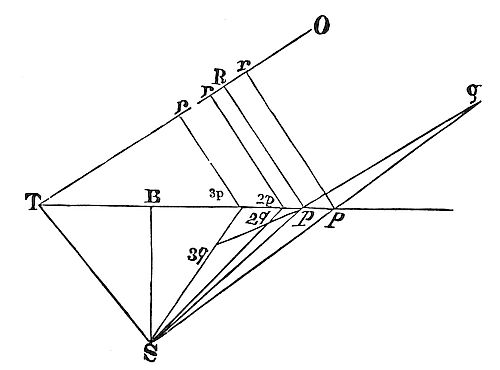
It is done by linear description thus. Let the given magnitude of the solid be M2 × N; from any point r of the right line OR erect the perpendicular rp meeting TP in p. Then through the point Sp draw the line Sq equal to . In like manner draw three or more right lines S2q, S3q, &c.; and a regular line q2q3q, drawn through all the points q2q3q, &c., will cut the right line TP in the point P, from which the perpendicular PR is to be let fall. Q.E.F.
By trigonometry thus. Assuming the right line TP as found by the preceding method, the perpendiculars TR, SB, in the triangles TPR, TPS, will be thence given; and the side SP in the triangle SBP, as well as the error . Let this error, suppose D, be to a new error, suppose E, as the error 2p2q 3p3q to the error 2p3p; or as the error 2p2q D to the error 2pP; and this new error added to or subducted from the length TP, will give the correct length TP E. The inspection of the figure will shew whether we are to add to or subtract; and if at any time there should be use for a farther correction, the operation may be repeated.
By arithmetic thus. Let us suppose the thing done, and let TP + e be the correct length of the right line TP as found out by delineation; and thence the correct lengths of the lines OR, BP, and SP, will be , BP + e, and Whence, by the method of converging series, we have , &c., = , &c. For the given co-efficients , , putting , , , and carefully observing the signs, we find , and . Whence, neglecting the very small term , e comes out equal to -G. If the error is not despicable, take .
And it is to be observed that here a general method is hinted at for solving the more intricate sort of problems, as well by trigonometry as by arithmetic, without those perplexed computations and resolutions of affected equations which hitherto have been in use.
LEMMA II.
To cut three right lines given in position by a fourth right line that shall pass through a point assigned in any of the three, and so as its intercepted parts shall be in a given ratio one to the other.
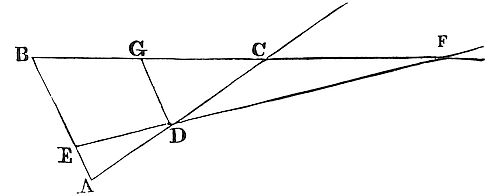
Let AB, AC, BC, be the right lines given in position, and suppose D to be the given point in the line AC. Parallel to AB draw DG meeting BC in G; and, taking GF to BG in the given ratio, draw FDE; and FD will be to DE as FG to BG. Q.E.F.
By trigonometry thus. In the triangle CGD all the angles and the side CD are given, and from thence its remaining sides are found; and from the given ratios the lines GF and BE are also given.
LEMMA III.
To find and represent by a linear description the hourly motion of a comet to any given time.
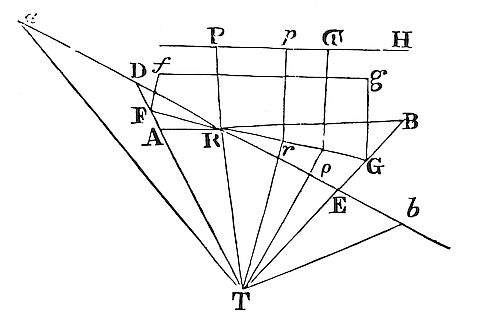
From observations of the best credit, let three longitudes of the comet be given, and, supposing ATR, RTB, to be their differences, let the hourly motion be required to the time of the middle observation TR. By Lem. II, draw the right line ARB, so as its intercepted parts AR, RB, may be as the times between the observations; and if we suppose a body in the whole time to describe the whole line AB with an equal motion, and to be in the mean time viewed from the place T, the apparent motion of that body about the point R will be nearly the same with that of the comet at the time of the observation TR.
The same more accurately.
Let Ta, Tb, be two longitudes given at a greater distance on one side and on the other; and by Lem. II draw the right line aRb so as its intercepted parts aR, Rb may be as the times between the observations aTR, RTb. Suppose this to cut the lines TA, TB, in D and E; and because the error of the inclination TRa increases nearly in the duplicate ratio of the time between the observations, draw FRG, so as either the angle DRF may be to the angle ARF, or the line DF to the line AF, in the duplicate ratio of the whole time between the observations aTB to the whole time between the observations ATB, and use the line thus found FG in place of the line AB found above.
It will be convenient that the angles ATR, RTB, aTA, BTb, be no less than of ten or fifteen degrees, the times corresponding no greater than of eight or twelve days, and the longitudes taken when the comet moves with the greatest velocity; for thus the errors of the observation will bear a less proportion to the differences of the longitudes.
LEMMA IV.
To find the longitudes of a comet to any given times.
It is done by taking in the line FG the distances Rr, , proportional to the times, and drawing the lines Tr, . The way of working by trigonometry is manifest.
LEMMA V.
To find the latitudes.
On TF, TR, TG, as radiuses, at right angles erect Ff, RP, Gg, tangents of the observed latitudes; and parallel to fg draw PH. The perpendiculars rp, , meeting PH, will be the tangents of the sought latitudes to Tr and as radiuses.
PROBLEM I.
From the assumed ratio of the velocity to determine the trajectory of a comet.
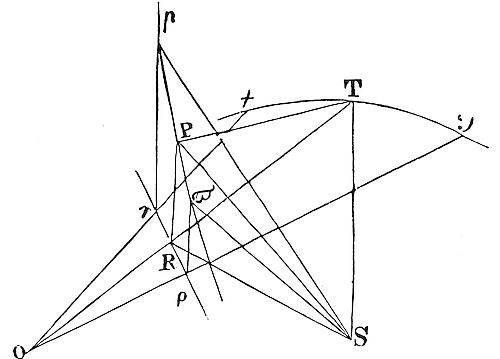
Let S represent the sun; t, T, , three places of the earth in its orbit at equal distances; p, P, , as many corresponding places of the comet in its trajectory, so as the distances interposed betwixt place and place may answer to the motion of one hour; pr, PR, , perpendiculars let fall on the plane of the ecliptic, and the vestige of the trajectory in this plane. Join Sp, SP, , SR, ST, tr, TR, , TP, and let tr, , meet in O, TR will nearly converge to the same point O, or the error will be inconsiderable. By the premised lemmas the angles rOR, , are given, as well as the ratios pr to tr, PR to TR, and to . The figure is likewise given both in magnitude and position, together with the distance ST, and the angles STR, PTR, STP. Let us assume the velocity of the comet in the place P to be to the velocity of a planet revolved about the sun in a circle, at the same distance SP, as V to 1; and we shall have a line to be determined, of this condition, that the space , described by the comet in two hours, may be to the space (that is, to the space which the earth describes in the same time multiplied by the number V) in the subduplicate ratio of ST, the distance of the earth from the sun, to SP, the distance of the comet from the sun; and that the space pP, described by the comet in the first hour, may be to the space , described by the comet in the second hour, as the velocity in p to the velocity in P; that is, in the subduplicate ratio of the distance SP to the distance Sp, or in the ratio of 2Sp to SP + Sp; for in this whole work I neglect small fractions that can produce no sensible error.
In the first place, then, as mathematicians, in the resolution of affected equations, are wont, for the first essay, to assume the root by conjecture, so, in this analytical operation, I judge of the sought distance TR as I best can by conjecture. Then, by Lem. II. I draw , first supposing rR equal to , and again (after the ratio of SP to Sp is discovered) so as rR may be to as 2SP to SP + Sp, and I find the ratios of the lines , , and OR, one to the other. Let M be to as OR to ; and because the square of is to the square of as ST to SP, we shall have, ex æquo, OR2 to M2 as ST to SP, and therefore the solid OR2 × SP equal to the given solid M2 × ST; whence (supposing the triangles STP, PTR, to be now placed in the same plane) TR, TP, SP, PR, will be given, by Lem. I. All this I do, first by delineation in a rude and hasty way; then by a new delineation with greater care; and, lastly, by an arithmetical computation. Then I proceed to determine the position of the lines , , with the greatest accuracy, together with the nodes and inclination of the plane to the plane of the ecliptic; and in that plane I describe the trajectory in which a body let go from the place P in the direction of the given right line would be carried with a velocity that is to the velocity of the earth as to . Q.E.F.
PROBLEM II.
To correct the assumed ratio of the velocity and the trajectory thence found.
Take an observation of the comet about the end of its appearance, or any other observation at a very great distance from the observations used before, and find the intersection of a right line drawn to the comet, in that observation with the plane , as well as the comet's place in its trajectory to the time of the observation. If that intersection happens in this place, it is a proof that the trajectory was rightly determined; if otherwise, a new number V is to be assumed, and a new trajectory to be found; and then the place of the comet in this trajectory to the time of that probatory observation, and the intersection of a right line drawn to the comet with the plane of the trajectory, are to be determined as before; and by comparing the variation of the error with the variation of the other quantities, we may conclude, by the Rule of Three, how far those other quantities ought to be varied or corrected, so as the error may become as small as possible. And by means of these corrections we may have the trajectory exactly, providing the observations upon which the computation was founded were exact, and that we did not err much in the assumption of the quantity V; for if we did, the operation is to be repeated till the trajectory is exactly enough determined. Q.E.F.
END OF THE SYSTEM OF THE WORLD.