Book 1 — SECTION VIII.
Andrew Motte translation
Of the invention of orbits wherein bodies will revolve, being acted upon by any sort of centripetal force.
PROPOSITION XL. THEOREM XIII.
If a body, acted upon by any centripetal force, is any how moved, and another body ascends or descends in a right line, and their velocities be equal in any one case of equal altitudes, their velocities will be also equal at all equal altitudes.
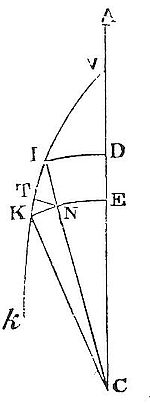
Let a body descend from A through D and E, to the centre C; and let another body move from V in the curve line VIKk. From the centre C, with any distances, describe the concentric circles DI, EK, meeting the right line AC in D and E, and the curve VIK in I and K. Draw IC meeting KE in N, and on IK let fall the perpendicular NT; and let the interval DE or IN between the circumferences of the circles be very small; and imagine the bodies in D and I to have equal velocities. Then because the distances CD and CI are equal, the centripetal forces in D and I will be also equal. Let those forces be expressed by the equal lineolæ DE and IN; and let the force IN (by Cor. 2 of the Laws of Motion) be resolved into two others, NT and IT. Then the force NT acting in the direction of the line NT perpendicular to the path ITK of the body will not at all affect or change the velocity of the body in that path, but only draw it aside from a rectilinear course, and make it deflect perpetually from the tangent of the orbit, and proceed in the curvilinear path ITKk. That whole force, therefore, will be spent in producing this effect; but the other force IT, acting in the direction of the course of the body, will be all employed in accelerating it, and in the least given time will produce an acceleration proportional to itself. Therefore the accelerations of the bodies in D and I, produced in equal times, are as the lines DE, IT (if we take the first ratios of the nascent lines DE, IN, IK, IT, NT); and in unequal times as those lines and the times conjunctly. But the times in which DE and IK are described, are, by reason of the equal velocities (in D and I) as the spaces described DE and IK, and therefore the accelerations in the course of the bodies through the lines DE and IK are as DE and IT, and DE and IK conjunctly; that is, as the square of DE to the rectangle IT into IK. But the rectangle IT × IK is equal to the square of IN, that is, equal to the square of DE; and therefore the accelerations generated in the passage of the bodies from D and I to E and K are equal. Therefore the velocities of the bodies in E and K are also equal: and by the same reasoning they will always be found equal in any subsequent equal distances. Q.E.D.
By the same reasoning, bodies of equal velocities and equal distances from the centre will be equally retarded in their ascent to equal distances. Q.E.D.
COR. 1. Therefore if a body either oscillates by hanging to a string, or by any polished and perfectly smooth impediment is forced to move in a curve line; and another body ascends or descends in a right line, and their velocities be equal at any one equal altitude, their velocities will be also equal at all other equal altitudes. For by the string of the pendulous body, or by the impediment of a vessel perfectly smooth, the same thing will be effected as by the transverse force NT. The body is neither accelerated nor retarded by it, but only is obliged to leave its rectilinear course.
COR. 2. Suppose the quantity P to be the greatest distance from the centre to which a body can ascend, whether it be oscillating, or revolving in a trajectory, and so the same projected upwards from any point of a trajectory with the velocity it has in that point. Let the quantity A be the distance of the body from the centre in any other point of the orbit; and let the centripetal force be always as the power of the quantity A, the index of which power n - 1 is any number n diminished by unity. Then the velocity in every altitude A will be as , and therefore will be given. For by Prop. XXXIX, the velocity of a body ascending and descending in a right line is in that very ratio.
PROPOSITION XLI. PROBLEM XXVIII.
Supposing a centripetal force of any kind, and granting the quadratures of curvilinear figures, it is required to find as well the trajectories in which bodies will move, as the times of their motions in the trajectories found.
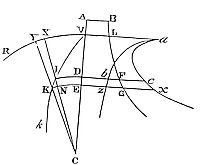
Let any centripetal force tend to the centre C, and let it be required to find the trajectory VIKk. Let there be given the circle VR, described from the centre C with any interval CV; and from the same centre describe any other circles ID, KE cutting the trajectory in I and K, and the right line CV in D and E. Then draw the right line CNIX cutting the circles KE, VR in N and X, and the right line CKY meeting the circle VR in Y. Let the points I and K he indefinitely near; and let the body go on from V through I and K to k; and let the point A be the place from whence another body is to fall, so as in the place D to acquire a velocity equal to the velocity of the first body in I. And things remaining as in Prop. XXXIX, the lineola IK, described in the least given time will be as the velocity, and therefore as the right line whose square is equal to the area ABFD, and the triangle ICK proportional to the time will be given, and therefore KN will be reciprocally as the altitude IC; that is (if there be given any quantity Q, and the altitude IC be called A), as . This quantity call Z, and suppose the magnitude of Q to be such that in some case may be to Z as IK to KN, and then in all cases will be to Z as IK to KN, and ABFD to ZZ as IK2 to KN2, and by division ABFD - ZZ to ZZ as IN2 to KN2, and therefore to Z, or as IN to KN; and therefore A × KN will be equal to . Therefore since YX × XC is to A × KN as CX2, to AA, the rectangle XY × XC will be equal to . Therefore in the perpendicular DF let there be taken continually Db, Dc equal to , respectively, and let the curve lines ab, ac, the foci of the points b and c, be described: and from the point V let the perpendicular Va be erected to the line AC, cutting off the curvilinear areas VDba, VDca, and let the ordinates Ez, Ex, be erected also. Then because the rectangle Db × IN or DbzE is equal to half the rectangle A × KN, or to the triangle ICK; and the rectangle Dc × IN or DcxE is equal to half the rectangle YX × XC, or to the triangle XCY; that is, because the nascent particles DbzE, ICK of the areas VDba, VIC are always equal; and the nascent particles DcxE, XCY of the areas VDca, VCX are always equal: therefore the generated area VDba will be equal to the generated area VIC, and therefore proportional to the time; and the generated area VDca is equal to the generated sector VCX. If, therefore, any time be given during which the body has been moving from V, there will be also given the area proportional to it VDba; and thence will be given the altitude of the body CD or CI; and the area VDca, and the sector VCX equal thereto, together with its angle VCI. But the angle VCI, and the altitude CI being given, there is also given the place I, in which the body will be found at the end of that time. Q.E.I.
COR. 1. Hence the greatest and least altitudes of the bodies, that is, the apsides of the trajectories, may be found very readily. For the apsides are those points in which a right line IC drawn through the centre falls perpendicularly upon the trajectory VIK; which comes to pass when the right lines IK and NK become equal; that is, when the area ABFD is equal to ZZ.
COR. 2. So also the angle KIN, in which the trajectory at any place cuts the line IC, may be readily found by the given altitude IC of the body: to wit, by making the sine of that angle to radius as KN to IK; that is, as Z to the square root of the area ABFD.
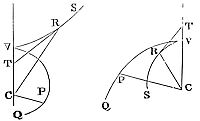
COR. 3. If to the centre C, and the principal vertex V, there be described a conic section VRS; and from any point thereof, as R, there be drawn the tangent RT meeting the axis CV indefinitely produced in the point T; and then joining CR there be drawn the right line CP, equal to the abscissa CT, making an angle VCP proportional to the sector VCR; and if a centripetal force, reciprocally proportional to the cubes of the distances of the places from the centre, tends to the centre C; and from the place V there sets out a body with a just velocity in the direction of a line perpendicular to the right line CV; that body will proceed in a trajectory VPQ, which the point P will always touch; and therefore if the conic section VRS be an hyperbola, the body will descend to the centre; but if it be an ellipsis, it will ascend perpetually, and go farther and farther off in infinitum. And, on the contrary, if a body endued with any velocity goes off from the place V, and according as it begins either to descend obliquely to the centre, or ascends obliquely from it, the figure VRS be either an hyperbola or an ellipsis, the trajectory may be found by increasing or diminishing the angle VCP in a given ratio. And the centripetal force becoming centrifugal, the body will ascend obliquely in the trajectory VPQ, which is found by taking the angle VCP proportional to the elliptic sector VRC, and the length CP equal to the length CT, as before. All these things follow from the foregoing Proposition, by the quadrature of a certain curve, the invention of which, as being easy enough, for brevity's sake I omit.
PROPOSITION XLII. PROBLEM XXIX.
The law of centripetal force being given, it is required to find the motion of a body setting out from a given place, with a given velocity, in the direction of a given right line.
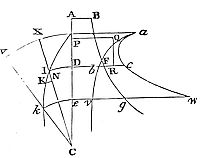
Suppose the same things as in the three preceding propositions; and let the body go off from the place I in the direction of the little line, IK, with the same velocity as another body, by falling with an uniform centripetal force from the place P, may acquire in D; and let this uniform force be to the force with which the body is at first urged in I, as DR to DF. Let the body go on towards k; and about the centre C, with the interval Ck, describe the circle ke, meeting the right line PD in e, and let there be erected the lines eg, ev, ew, ordinately applied to the curves BFg, abv, acw. From the given rectangle PDRQ and the given law of centripetal force, by which the first body is acted on, the curve line BFg is also given, by the construction of Prop. XXVII, and its Cor. 1. Then from the given angle CIK is given the proportion of the nascent lines IK, KN; and thence, by the construction of Prob. XXVIII, there is given the quantity Q, with the curve lines abv, acw; and therefore, at the end of any time Dbve, there is given both the altitude of the body Ce or Ck, and the area Dcwe, with the sector equal to it XCy, the angle ICk, and the place k, in which the body will then be found. Q.E.I.
We suppose in these Propositions the centripetal force to vary in its recess from the centre according to some law, which any one may imagine at pleasure; but at equal distances from the centre to be everywhere the same.
I have hitherto considered the motions of bodies in immovable orbits. It remains now to add something concerning their motions in orbits which revolve round the centres of force.
SECTION IX.
Of the motion of bodies in moveable orbits; and of the motion of the apsides.
PROPOSITION XLIII. PROBLEM XXX.
It is required to make a body move in a trajectory that revolves about the centre of force in the same manner as another body in the same trajectory at rest.
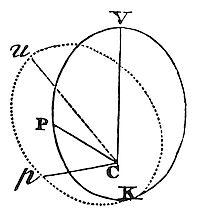
In the orbit VPK, given by position, let the body P revolve, proceeding from V towards K. From the centre C let there be continually drawn Cp, equal to CP, making the angle VCp proportional to the angle VCP; and the area which the line Cp describes will be to the area VCP, which the line CP describes at the same time, as the velocity of the describing line Cp to the velocity of the describing line CP; that is, as the angle VCp to the angle VCP, therefore in a given ratio, and therefore proportional to the time. Since, then, the area described by the line Cp in an immovable plane is proportional to the time, it is manifest that a body, being acted upon by a just quantity of centripetal force may revolve with the point p in the curve line which the same point p, by the method just now explained, may be made to describe an immovable plane. Make the angle VCu equal to the angle PCp, and the line Cu equal to CV, and the figure uCp equal to the figure VCP, and the body being always in the point p, will move in the perimeter of the revolving figure uCp, and will describe its (revolving) arc up in the same time that the other body P describes the similar and equal arc VP in the quiescent figure VPK. Find, then, by Cor. 5, Prop. VI., the centripetal force by which the body may be made to revolve in the curve line which the point p describes in an immovable plane, and the Problem will be solved. Q.E.F.
PROPOSITION XLIV. THEOREM XIV.
The difference of the forces, by which two bodies may be made to move equally, one in a quiescent, the other in the same orbit revolving, is in a triplicate ratio of their common altitudes inversely.
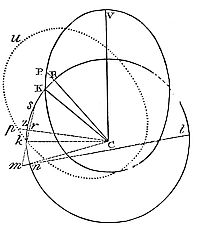
Let the parts of the quiescent orbit VP, PK be similar and equal to the parts of the revolving orbit up, pk; and let the distance of the points P and K be supposed of the utmost smallness. Let fall a perpendicular kr from the point k to the right line pC, and produce it to m, so that mr may be to kr as the angle VCp to the angle VCP. Because the altitudes of the bodies PC and pC, KC and kC, are always equal, it is manifest that the increments or decrements of the lines PC and pC are always equal; and therefore if each of the several motions of the bodies in the places P and p be resolved into two (by Cor. 2 of the Laws of Motion), one of which is directed towards the centre, or according to the lines PC, pC, and the other, transverse to the former, hath a direction perpendicular to the lines PC and pC; the motions towards the centre will be equal, and the transverse motion of the body p will be to the transverse motion of the body P as the angular motion of the line pC to the angular motion of the line PC; that is, as the angle VCp to the angle VCP. Therefore, at the same time that the body P, by both its motions, comes to the point K, the body p, having an equal motion towards the centre, will be equally moved from p towards C; and therefore that time being expired, it will be found somewhere in the line mkr, which, passing through the point k, is perpendicular to the line pC; and by its transverse motion will acquire a distance from the line pC, that will be to the distance which the other body P acquires from the line PC as the transverse motion of the body p to the transverse motion of the other body P. Therefore since kr is equal to the distance which the body P acquires from the line PC, and mr is to kr as the angle VCp to the angle VCP, that is, as the transverse motion of the body p to the transverse motion of the body P, it is manifest that the body p, at the expiration of that time, will be found in the place m. These things will be so, if the bodies p and P are equally moved in the directions of the lines pC and PC, and are therefore urged with equal forces in those directions, But if we take an angle pCn that is to the angle pCk as the angle VCp to the angle VCP, and nC be equal to kC, in that case the body p at the expiration of the time will really be in n; and is therefore urged with a greater force than the body P, if the angle nCp is greater than the angle kCp, that is, if the orbit upk, move either in consequentia or in antecedentia, with a celerity greater than the double of that with which the line CP moves in consequentia; and with a less force if the orbit moves slower in antecedentia. And the difference of the forces will be as the interval mn of the places through which the body would be carried by the action of that difference in that given space of time. About the centre C with the interval Cn or Ck suppose a circle described cutting the lines mr, mn produced in s and t, and the rectangle mn × mt will be equal to the rectangle mk × ms, and therefore mn will be equal to . But since the triangles pCk, pCn, in a given time, are of a given magnitude, kr and mr, and their difference mk, and their sum ms, are reciprocally as the altitude pC, and therefore the rectangle mk × ms is reciprocally as the square of the altitude pC. But, moreover, mt is directly as , that is, as the altitude pC. These are the first ratios of the nascent lines; and hence , hat is, the nascent lineola mn, and the difference of the forces proportional thereto, are reciprocally as the cube of the altitude pC. Q.E.D.
COR. 1. Hence the difference of the forces in the places P and p, or K and k, is to the force with which a body may revolve with a circular motion from R to K, in the same time that the body P in an immovable orb describes the arc PK, as the nascent line mn to the versed sine of the nascent arc RK, that is, as to , or as mk × ms to the square of rk; that is, if we take given quantities F and G in the same ratio to one another as the angle VCP bears to the angle VCp, as GG - FF to FF. And, therefore, if from the centre C, with any distance CP or Cp, there be described a circular sector equal to the whole area VPC, which the body revolving in an immovable orbit has by a radius drawn to the centre described in any certain time, the difference of the forces, with which the body P revolves in an immovable orbit, and the body p in a movable orbit, will be to the centripetal force, with which another body by a radius drawn to the centre can uniformly describe that sector in the same time as the area VPC is described, as GG - FF to FF. For that sector and the area pCk are to one another as the times in which they are described.
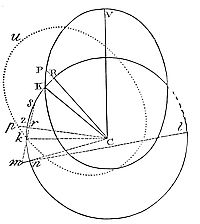
COR. 2. If the orbit VPK be an ellipsis, having its focus C, and its highest apsis V, and we suppose the ellipsis upk similar and equal to it, so that pC may be always equal to PC, and the angle VCp be to the angle VCP in the given ratio of G to F; and for the altitude PC or pC we put A, and 2R for the latus rectum of the ellipsis, the force with which a body may be made to revolve in a movable ellipsis will be as , and vice versa. Let the force with which a body may revolve in an immovable ellipsis be expressed by the quantity , and the force in V will be . But the force with which a body may revolve in a circle at the distance CV, with the same velocity as a body revolving in an ellipsis has in V, is to the force with which a body revolving in an ellipsis is acted upon in the apsis V, as half the latus rectum of the ellipsis to the semi-diameter CV of the circle, and therefore is as ; and the force which is to this, as GG - FF to FF, is as : and this force (by Cor. 1 of this Prop.) is the difference of the forces in V, with which the body P revolves in the immovable ellipsis VPK, and the body p in the movable ellipsis upk. Therefore since by this Prop. that difference at any other altitude A is to itself at the altitude CV as to , the same difference in every altitude A will be as . Therefore to the force , by which the body may revolve in an immovable ellipsis VPK add the excess , and the sum will be the whole force by which a body may revolve in the same time in the movable ellipsis upk.
COR. 3. In the same manner it will be found, that, if the immovable orbit VPK be an ellipsis having its centre in the centre of the forces C, and there be supposed a movable ellipsis upk, similar, equal, and concentrical to it; and 2R be the principal latus rectum of that ellipsis, and 2T the latus transversum, or greater axis; and the angle VCp be continually to the angle VCP as G to F; the forces with which bodies may revolve in the immovable and movable ellipsis, in equal times, will be as and respectively.
COR. 4. And universally, if the greatest altitude CV of the body be called T, and the radius of the curvature which the orbit VPK has in V, that is, the radius of a circle equally curve, be called R, and the centripetal force with which a body may revolve in any immovable trajectory VPK at the place V be called , and in other places P be indefinitely styled X; and the altitude CP be called A, and G be taken to F in the given ratio of the angle VCp to the angle VCP; the centripetal force with which the same body will perform the same motions in the same time, in the same trajectory upk revolving with a circular motion, will be as the sum of the forces .
COR. 5. Therefore the motion of a body in an immovable orbit being given, its angular motion round the centre of the forces may be increased or diminished in a given ratio; and thence new immovable orbits may be found in which bodies may revolve with new centripetal forces.
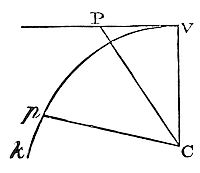
COR. 6. Therefore if there be erected the line VP of an indeterminate length, perpendicular to the line CV given by position, and CP be drawn, and Cp equal to it, making the angle VCp having a given ratio to the angle VCP, the force with which a body may revolve in the curve line Vpk, which the point p is continually describing, will be reciprocally as the cube of the altitude Cp. For the body P, by its vis inertiæ alone, no other force impelling it, will proceed uniformly in the right line VP. Add, then, a force tending to the centre C reciprocally as the cube of the altitude CP or Cp, and (by what was just demonstrated) the body will deflect from the rectilinear motion into the curve line Vpk. But this curve Vpk is the same with the curve VPQ found in Cor. 3, Prop. XLI, in which, I said, bodies attracted with such forces would ascend obliquely.
PROPOSITION XLV. PROBLEM XXXI.
To find the motion of the apsides in orbits approaching very near to circles.
This problem is solved arithmetically by reducing the orbit, which a body revolving in a movable ellipsis (as in Cor. 2 and 3 of the above Prop.) describes in an immovable plane, to the figure of the orbit whose apsides are required; and then seeking the apsides of the orbit which that body describes in an immovable plane. But orbits acquire the same figure, if the centripetal forces with which they are described, compared between themselves, are made proportional at equal altitudes. Let the point V be the highest apsis, and write T for the greatest altitude CV, A for any other altitude CP or Cp, and X for the difference of the altitudes CV - CP; and the force with which a body moves in an ellipsis revolving about its focus C (as in Cor. 2), and which in Cor. 2 was as , that is as, , by substituting T - X for A, will become as . In like manner any other centripetal force is to be reduced to a fraction whose denominator is A3, and the numerators are to be made analogous by collating together the homologous terms. This will be made plainer by Examples.
EXAMPLE 1. Let us suppose the centripetal force to be uniform, and therefore as or, writing T - X for A in the numerator, as . Then collating together the correspondent terms of the numerators, that is, those that consist of given quantities, with those of given quantities, and those of quantities not given with those of quantities not given, it will become RGG - RFF + TFF to T3 as - FFX to 3TTX + 3TXX - X3, or as -FF to -3TT + 3TX - XX. Now since the orbit is supposed extremely near to a circle, let it coincide with a circle; and because in that case R and T become equal, and X is infinitely diminished, the last ratios will be, as RGG to T2, so -FF to -3TT, or as GG to TT, so FF to 3TT; and again, as GG to FF, so TT to 3TT, that is, as 1 to 3; and therefore G is to F, that is, the angle VCp to the angle VCP, as 1 to . Therefore since the body, in an immovable ellipsis, in descending from the upper to the lower apsis, describes an angle, if I may so speak, of 180 deg., the other body in a movable ellipsis, and therefore in the immovable orbit we are treating of, will in its descent from the upper to the lower apsis, describe an angle VCp of deg. And this comes to pass by reason of the likeness of this orbit which a body acted upon by an uniform centripetal force describes, and of that orbit which a body performing its circuits in a revolving ellipsis will describe in a quiescent plane. By this collation of the terms, these orbits are made similar; not universally, indeed, but then only when they approach very near to a circular figure. A body, therefore revolving with an uniform centripetal force in an orbit nearly circular, will always describe an angle of deg., or 103 deg., 55 m., 23 sec., at the centre; moving from the upper apsis to the lower apsis when it has once described that angle, and thence returning to the upper apsis when it has described that angle again; and so on in infinitum.
EXAM. 2. Suppose the centripetal force to be as any power of the altitude A, as, for example, , or ; where n - 3 and n signify any indices of powers whatever, whether integers or fractions, rational or surd, affirmative or negative. That numerator An or being reduced to an indeterminate series by my method of converging series, will become , &c. And conferring these terms with the terms of the other numerator RGG - RFF + TFF - FFX, it becomes as RGG - RFF + TFF to Tn, so -FF to , &c. And taking the last ratios where the orbits approach to circles, it becomes as RGG to Tn, so -FF to , or as GG to , so FF to ; and again, GG to FF, so to , that is, as 1 to n; and therefore G is to F, that is the angle VCp to the angle VCP, as 1 to . Therefore since the angle VCP, described in the descent of the body from the upper apsis to the lower apsis in an ellipsis, is of 180 deg., the angle VCp, described in the descent of the body from the upper apsis to the lower apsis in an orbit nearly circular which a body describes with a centripetal force proportional to the power , will be equal to an angle of deg., and this angle being repeated, the body will return from the lower to the upper apsis, and so on in infinitum. As if the centripetal force be as the distance of the body from the centre, that is, as or , n will be equal to 4, and equal to 2; and therefore the angle between the upper and the lower apsis will be equal to deg., or 90 deg. Therefore the body having performed a fourth part of one revolution, will arrive at the lower apsis, and having performed another fourth part, will arrive at the upper apsis, and so on by turns in infinitum. This appears also from Prop. X. For a body acted on by this centripetal force will revolve in an immovable ellipsis, whose centre is the centre of force. If the centripetal force is reciprocally as the distance, that is, directly as or , n will be equal to 2; and therefore the angle between the upper and lower apsis will be deg., or 127 deg., 16 min., 45 sec.; and therefore a body revolving with such a force, will by a perpetual repetition of this angle, move alternately from the upper to the lower and from the lower to the upper apsis for ever. So, also, if the centripetal force be reciprocally as the biquadrate root of the eleventh power of the altitude, that is, reciprocally as , and, therefore, directly as , or as , n will be equal to , and deg. will be equal to 360 deg.; and therefore the body parting from the upper apsis, and from thence perpetually descending, will arrive at the lower apsis when it has completed one entire revolution; and thence ascending perpetually, when it has completed another entire revolution, it will arrive again at the upper apsis; and so alternately for ever.
EXAM. 3. Taking m and n for any indices of the powers of the altitude, and b and c for any given numbers, suppose the centripetal force to be as , that is, as or (by the method of converging series above-mentioned) as , &c. and comparing the terms of the numerators, there will arise RGG - RFF + TFF to bTm + cTn as -FF to -mbTm - 1 - ncTn - 1 , &c. And taking the last ratios that arise when the orbits come to a circular form, there will come forth GG to bTm - 1 + cTn - 1 as FF to mbTm - 1 + ncTn - 1; and again, GG to FF as bTm - 1 + cTn - 1 to mbTn - 1 + ncTn - 1. This proportion, by expressing the greatest altitude CV or T arithmetically by unity, becomes, GG to FF as b + c to mb + nc, and therefore as 1 to . Whence G becomes to F, that is, the angle VCp to the angle VCP, as 1 to . And therefore since the angle VCP between the upper and the lower apsis, in an immovable ellipsis, is of 180 deg., the angle VCp between the same apsides in an orbit which a body describes with a centripetal force, that is, as , will be equal to an angle of deg. And by the same reasoning, if the centripetal force be as , the angle between the apsides will be found equal to deg. After the same manner the Problem is solved in more difficult cases. The quantity to which the centripetal force is proportional must always be resolved into a converging series whose denominator is A3. Then the given part of the numerator arising from that operation is to be supposed in the same ratio to that part of it which is not given, as the given part of this numerator RGG - RFF + TFF - FFX is to that part of the same numerator which is not given. And taking away the superfluous quantities, and writing unity for T, the proportion of G to F is obtained.
COR. 1. Hence if the centripetal force be as any power of the altitude, that power may be found from the motion of the apsides; and so contrariwise. That is, if the whole angular motion, with which the body returns to the same apsis, be to the angular motion of one revolution, or 360 deg., as any number as m to another as n, and the altitude called A; the force will be as the power of the altitude A; the index of which power is . This appears by the second example. Hence it is plain that the force in its recess from the centre cannot decrease in a greater than a triplicate ratio of the altitude. A body revolving with such a force, and parting from the apsis, if it once begins to descend, can never arrive at the lower apsis or least altitude, but will descend to the centre, describing the curve line treated of in Cor. 3, Prop. XLI. But if it should, at its parting from the lower apsis, begin to ascend never so little, it will ascend in infinitum, and never come to the upper apsis; but will describe the curve line spoken of in the same Cor., and Cor. 6, Prop. XLIV. So that where the force in its recess from the centre decreases in a greater than a triplicate ratio of the altitude, the body at its parting from the apsis, will either descend to the centre, or ascend in infinitum, according as it descends or ascends at the beginning of its motion. But if the force in its recess from the centre either decreases in a less than a triplicate ratio of the altitude, or increases in any ratio of the altitude whatsoever, the body will never descend to the centre, but will at some time arrive at the lower apsis; and, on the contrary, if the body alternately ascending and descending from one apsis to another never comes to the centre, then either the force increases in the recess from the centre, or it decreases in a less than a triplicate ratio of the altitude; and the sooner the body returns from one apsis to another, the farther is the ratio of the forces from the triplicate ratio. As if the body should return to and from the upper apsis by an alternate descent and ascent in 8 revolutions, or in 4, or 2, or ; that is, if m should be to n as 8, or 4, or 2, or to 1, and therefore , be , or , or , or ; then the force will be as , or , or , or ; that is, it will be reciprocally as , or , or , or . If the body after each revolution returns to the same apsis, and the apsis remains unmoved, then m will be to n as 1 to 1, and therefore will be equal to , or ; and therefore the decrease of the forces will be in a duplicate ratio of the altitude; as was demonstrated above. If the body in three fourth parts, or two thirds, or one third, or one fourth part of an entire revolution, return to the same apsis; m will be to n as or or or to 1, and therefore is equal to , or or , or ; and therefore the force is either reciprocally as or , or directly as or . Lastly if the body in its progress from the upper apsis to the same upper apsis again, goes over one entire revolution and three deg. more, and therefore that apsis in each revolution of the body moves three deg. in consequentia; then m will be to n as 363 deg. to 360 deg. or as 121 to 120, and therefore will be equal to , and therefore the centripetal force will be reciprocally as , or reciprocally as very nearly. Therefore the centripetal force decreases in a ratio something greater than the duplicate; but approaching times nearer to the duplicate than the triplicate.
COR. 2. Hence also if a body, urged by a centripetal force which is reciprocally as the square of the altitude, revolves in an ellipsis whose focus is in the centre of the forces; and a new and foreign force should be added to or subducted from this centripetal force, the motion of the apsides arising from that foreign force may (by the third Example) be known; and so on the contrary. As if the force with which the body revolves in the ellipsis be as ; and the foreign force subducted as cA, and therefore the remaining force as ; then (by the third Example) b will be equal to 1, m equal to 1, and n equal to 4; and therefore the angle of revolution between the apsides is equal to deg. Suppose that foreign force to be 357,45 parts less than the other force with which the body revolves in the ellipsis; that is, c to be ; A or T being equal to 1; and then will be or 180,7623, that is, 180 deg., 45 min., 44 sec. Therefore the body, parting from the upper apsis, will arrive at the lower apsis with an angular motion of 180 deg., 45 min., 44 sec., and this angular motion being repeated, will return to the upper apsis; and therefore the upper apsis in each revolution will go forward 1 deg., 31 min., 28 sec. The apsis of the moon is about twice as swift.
So much for the motion of bodies in orbits whose planes pass through the centre of force. It now remains to determine those motions in eccentrical planes. For those authors who treat of the motion of heavy bodies used to consider the ascent and descent of such bodies, not only in a perpendicular direction, but at all degrees of obliquity upon any given planes; and for the same reason we are to consider in this place the motions of bodies tending to centres by means of any forces whatsoever, when those bodies move in eccentrical planes. These planes are supposed to be perfectly smooth and polished, so as not to retard the motion of the bodies in the least. Moreover, in these demonstrations, instead of the planes upon which those bodies roll or slide, and which are therefore tangent planes to the bodies, I shall use planes parallel to them, in which the centres of the bodies move, and by that motion describe orbits. And by the same method I afterwards determine the motions of bodies performed in curve superficies.
SECTION X.
Of the motion of bodies in given superficies, and of the reciprocal motion of funependulous bodies.
PROPOSITION XLVI. PROBLEM XXXII.
Any kind of centripetal force being supposed, and the centre of force, and any plane whatsoever in which the body revolves, being given, and the quadratures of curvilinear figures being allowed; it is required to determine the motion of a body going off from a given place, with a given velocity, in the direction of a given right line in that plane.
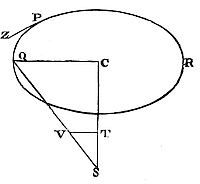
Let S be the centre of force, SC the least distance of that centre from the given plane, P a body issuing from the place P in the direction of the right line PZ, Q the same body revolving in its trajectory, and PQR the trajectory itself which is required to be found, described in that given plane. Join CQ, QS, and if in QS we take SV proportional to the centripetal force with which the body is attracted towards the centre S, and draw VT parallel to CQ, and meeting SC in T; then will the force SV be resolved into two (by Cor. 2, of the Laws of Motion), the force ST, and the force TV; of which ST attracting the body in the direction of a line perpendicular to that plane, does not at all change its motion in that plane. But the action of the other force TV, coinciding with the position of the plane itself, attracts the body directly towards the given point C in that plane; and therefore causes the body to move in this plane in the same manner as if the force ST were taken away, and the body were to revolve in free space about the centre C by means of the force TV alone. But there being given the centripetal force TV with which the body Q revolves in free space about the given centre C, there is given (by Prop. XLII) the trajectory PQR which the body describes; the place Q, in which the body will be found at any given time; and, lastly, the velocity of the body in that place Q. And so è contra. Q.E.I.
PROPOSITION XLVII. THEOREM XV.
Supposing the centripetal force to be proportional to the distance of the body from the centre; all bodies revolving in any planes whatsoever will describe ellipses, and complete their revolutions in equal times; and those which move in right lines, running backwards and forwards alternately, will complete their several periods of going and returning in the same times.
For letting all things stand as in the foregoing Proposition, the force SV, with which the body Q revolving in any plane PQR is attracted towards the centre S, is as the distance SQ; and therefore because SV and SQ, TV and CQ are proportional, the force TV with which the body is attracted towards the given point C in the plane of the orbit is as the distance CQ. Therefore the forces with which bodies found in the plane PQR are attracted towards the point C, are in proportion to the distances equal to the forces with which the same bodies are attracted every way towards the centre S; and therefore the bodies will move in the same times, and in the same figures, in any plane PQR about the point C, as they would do in free spaces about the centre S; and therefore (by Cor. 2, Prop. X, and Cor. 2, Prop. XXXVIII.) they will in equal times either describe ellipses in that plane about the centre C, or move to and fro in right lines passing through the centre C in that plane; completing the same periods of time in all cases. Q.E.D.
SCHOLIUM.
The ascent and descent of bodies in curve superficies has a near relation to these motions we have been speaking of. Imagine curve lines to be described on any plane, and to revolve about any given axes passing through the centre of force, and by that revolution to describe curve superficies; and that the bodies move in such sort that their centres may be always found in those superficies. If those bodies reciprocate to and fro with an oblique ascent and descent, their motions will be performed in planes passing through the axis, and therefore in the curve lines, by whose revolution those curve superficies were generated. In those cases, therefore, it will be sufficient to consider the motion in those curve lines.
PROPOSITION XLVIII. THEOREM XVI.
If a wheel stands upon the outside of a globe at right angles thereto, and revolving about its own axis goes forward in a great circle, the length of the curvilinear path which any point, given in the perimeter of the wheel, hath described since the time that it touched the globe (which curvilinear path we may call the cycloid or epicycloid), will be to double the versed sine of half the arc which since that time has touched the globe in passing over it, as the sum of the diameters of the globe and the wheel to the semi-diameter of the globe.
PROPOSITION XLIX. THEOREM XVII.
If a wheel stand upon the inside of a concave globe at right angles thereto, and revolving about its own axis go forward in one of the great circles of the globe, the length of the curvilinear path which any point, given in the perimeter of the wheel, hath described since it touched the globe, will be to the double of the versed sine of half the arc which in all that time has touched the globe in passing over it, as the difference of the diameters of the globe and the wheel to the semi-diameter of the globe.
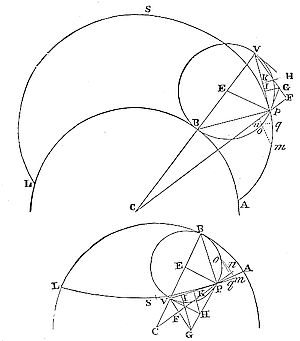
Let ABL be the globe, C its centre, BPV the wheel insisting thereon, E the centre of the wheel, B the point of contact, and P the given point in the perimeter of the wheel. Imagine this wheel to proceed in the great circle ABL from A through B towards L, and in its progress to revolve in such a manner that the arcs AB, PB may be always equal one to the other, and the given point P in the perimeter of the wheel may describe in the mean time the curvilinear path AP. Let AP be the whole curvilinear path described since the wheel touched the globe in A, and the length of this path AP will be to twice the versed sine of the arc as 2CE to CB. For let the right line CE (produced if need be) meet the wheel in V, and join CP, BP, EP, VP; produce CP, and let fall thereon the perpendicular VF. Let PH, VH, meeting in H, touch the circle in P and V, and let PH cut VF in G, and to VP let fall the perpendiculars GI, HK. From the centre C with any interval let there be described the circle nom, cutting the right line CP in n, the perimeter of the wheel BP in o, and the curvilinear path AP in m; and from the centre V with the interval Vo let there be described a circle cutting VP produced in q.
Because the wheel in its progress always revolves about the point of contact B, it is manifest that the right line BP is perpendicular to that curve line AP which the point P of the wheel describes, and therefore that the right line VP will touch this curve in the point P. Let the radius of the circle nom be gradually increased or diminished so that at last it become equal to the distance CP; and by reason of the similitude of the evanescent figure Pnomq, and the figure PFGVI, the ultimate ratio of the evanescent lineolæ Pm, Pn, Po, Pq, that is, the ratio of the momentary mutations of the curve AP, the right line CP, the circular arc BP, and the right line VP, will be the same as of the lines PV, PF, PG, PI, respectively. But since VF is perpendicular to CF, and VH to CV, and therefore the angles HVG, VCF equal; and the angle VHG (because the angles of the quadrilateral figure HVEP are right in V and P) is equal to the angle CEP, the triangles VHG, CEP will be similar; and thence it will come to pass that as EP is to CE so is HG to HV or HP, and so KI to KP, and by composition or division as CB to CE so is PI to PK, and doubling the consequents as CB to 2CE so PI to PV, and so is Pq to Pm. Therefore the decrement of the line VP, that is, the increment of the line BV - VP to the increment of the curve line AP is in a given ratio of CB to 2CE, and therefore (by Cor. Lem. IV) the lengths BV - VP and AP, generated by those increments, are in the same ratio. But if BV be radius, VP is the cosine of the angle BVP or , and therefore BV - VP is the versed sine of the same angle, and therefore in this wheel, whose radius is , BV - VP will be double the versed sine of the arc . Therefore AP is to double the versed sine of the arc as 2CE to CB. Q.E.D.
The line AP in the former of these Propositions we shall name the cycloid without the globe, the other in the latter Proposition the cycloid within the globe, for distinction sake.
COR. 1. Hence if there be described the entire cycloid ASL, and the same be bisected in S, the length of the part PS will be to the length PV (which is the double of the sine of the angle VBP, when EB is radius) as 2CE to CB, and therefore in a given ratio.
COR. 2. And the length of the semi-perimeter of the cycloid AS will be equal to a right line which is to the diameter of the wheel BV as 2CE to CB.
PROPOSITION L. PROBLEM XXXIII.
To cause a pendulous body to oscillate in a given cycloid.
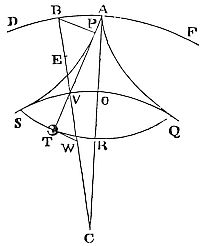
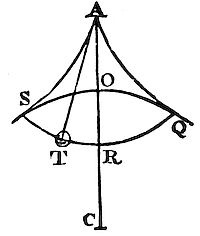
Let there be given within the globe QVS described with the centre C, the cycloid QRS, bisected in R, and meeting the superficies of the globe with its extreme points Q and S on either hand. Let there be drawn CR bisecting the arc QS in O, and let it be produced to A in such sort that CA may be to CO as CO to CR. About the centre C, with the interval CA, let there be described an exterior globe DAF; and within this globe, by a wheel whose diameter is AO, let there be described two semi-cycloids AQ, AS, touching the interior globe in Q and S, and meeting the exterior globe in A. From that point A, with a thread APT in length equal to the line AR, let the body T depend, and oscillate in such manner between the two semi-cycloids AQ, AS, that, as often as the pendulum parts from the perpendicular AR, the upper part of the thread AP may be applied to that semi-cycloid APS towards which the motion tends, and fold itself round that curve line, as if it were some solid obstacle, the remaining part of the same thread PT which has not yet touched the semi-cycloid continuing straight. Then will the weight T oscillate in the given cycloid QRS. Q.E.F.
For let the thread PT meet the cycloid QRS in T, and the circle QOS in V, and let CV be drawn; and to the rectilinear part of the thread PT from the extreme points P and T let there be erected the perpendiculars BP, TW, meeting the right line CV in B and W. It is evident, from the construction and generation of the similar figures AS, SR, that those perpendiculars PB, TW, cut off from CV the lengths VB, VW equal the diameters of the wheels OA, OR. Therefore TP is to VP (which is double the sine of the angle VBP when is radius) as BW to BV, or AO + OR to AO, that is (since CA and CO, CO and CR, and by division AO and OR are proportional), as CA + CO to CA, or, if BV be bisected in E, as 2CE to CB. Therefore (by Cor. 1, Prop. XLIX), the length of the rectilinear part of the thread PT is always equal to the arc of the cycloid PS, and the whole thread APT is always equal to the half of the cycloid APS, that is (by Cor. 2, Prop. XLIX), to the length AR. And therefore contrariwise, if the string remain always equal to the length AR, the point T will always move in the given cycloid QRS. Q.E.D.
COR. The string AR is equal to the semi-cycloid AS, and therefore has the same ratio to AC the semi-diameter of the exterior globe as the like semi-cycloid SR has to CO the semi-diameter of the interior globe.
PROPOSITION LI. THEOREM XVIII.
If a centripetal force tending on all sides to the centre C of a globe, be in all places as the distance of the place from the centre, and by this force alone acting upon it, the body T oscillate (in the manner above described) in the perimeter of the cycloid QRS; I say, that all the oscillations, how unequal soever in themselves, will be performed in equal times.
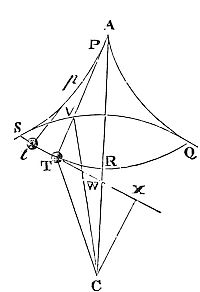
For upon the tangent TW infinitely produced let fall the perpendicular CX, and join CT. Because the centripetal force with which the body T is impelled towards C is as the distance CT, let this (by Cor. 2, of the Laws) be resolved into the parts CX, TX, of which CX impelling the body directly from P stretches the thread PT, and by the resistance the thread makes to it is totally employed, producing no other effect; but the other part TX, impelling the body transversely or towards X, directly accelerates the motion in the cycloid. Then it is plain that the acceleration of the body, proportional to this accelerating force, will be every moment as the length TX, that is (because CV, WV, and TX, TW proportional to them are given), as the length TW, that is (by Cor. 1, Prop. XLIX) as the length of the arc of the cycloid TR. If therefore two pendulums APT, Apt, be unequally drawn aside from the perpendicular AR, and let fall together, their accelerations will be always as the arcs to be described TR, tR. But the parts described at the beginning of the motion are as the accelerations, that is, as the wholes that are to be described at the beginning, and therefore the parts which remain to be described, and the subsequent accelerations proportional to those parts, are also as the wholes, and so on. Therefore the accelerations, and consequently the velocities generated, and the parts described with those velocities, and the parts to be described, are always as the wholes; and therefore the parts to be described preserving a given ratio to each other will vanish together, that is, the two bodies oscillating will arrive together at the perpendicular AR. And since on the other hand the ascent of the pendulums from the lowest place R through the same cycloidal arcs with a retrograde motion, is retarded in the several places they pass through by the same forces by which their descent was accelerated; it is plain that the velocities of their ascent and descent through the same arcs are equal, and consequently performed in equal times; and, therefore, since the two parts of the cycloid RS and RQ lying on either side of the perpendicular are similar and equal, the two pendulums will perform as well the wholes as the halves of their oscillations in the same times. Q.E.D.
COR. The force with which the body T is accelerated or retarded in any place T of the cycloid, is to the whole weight of the same body in the highest place S or Q as the arc of the cycloid TR is to the arc SR or QR.
PROPOSITION LII. PROBLEM XXXIV.
To define the velocities of the pendulums in the several places, and the times in which both the entire oscillations, and the several parts of them are performed.
About any centre G, with the interval GH equal to the arc of the cycloid RS, describe a semi-circle HKM bisected by the semi-diameter GK. And if a centripetal force proportional to the distance of the places from the centre tend to the centre G, and it be in the perimeter HIK equal to the centripetal force in the perimeter of the globe QOS tending towards its centre, and at the same time that the pendulum T is let fall from the highest place S, a body, as L, is let fall from H to G; then because the forces which act upon the bodies are equal at the beginning, and always proportional to the spaces to be described TR, LG, and therefore if TR and LG are equal, are also equal in the places T and L, it is plain that those bodies describe at the beginning equal spaces ST, HL, and therefore are still acted upon equally, and continue to describe equal spaces.
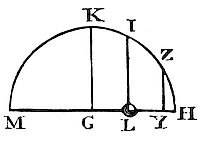
Therefore by Prop. XXXVIII, the time in which the body describes the arc ST is to the time of one oscillation, as the arc HI the time in which the body H arrives at L, to the semi-periphery HKM, the time in which the body H will come to M. And the velocity of the pendulous body in the place T is to its velocity in the lowest place R, that is, the velocity of the body H in the place L to its velocity in the place G, or the momentary increment of the line HL to the momentary increment of the line HG (the arcs HI, HK increasing with an equable flux) as the ordinate LI to the radius GK, or as to SR. Hence, since in unequal oscillations there are described in equal time arcs proportional to the entire arcs of the oscillations, there are obtained from the times given, both the velocities and the arcs described in all the oscillations universally. Which was first required.
Let now any pendulous bodies oscillate in different cycloids described within different globes, whose absolute forces are also different; and if the absolute force of any globe QOS be called V, the accelerative force with which the pendulum is acted on in the circumference of this globe, when it begins to move directly towards its centre, will be as the distance of the pendulous body from that centre and the absolute force of the globe conjunctly, that is, as CO × V. Therefore the lineola HY, which is as this accelerated force CO × V, will be described in a given time; and if there be erected the perpendicular YZ meeting the circumference in Z, the nascent arc HZ will denote that given time. But that nascent arc HZ is in the subduplicate ratio of the rectangle GHY, and therefore as . Whence the time of an entire oscillation in the cycloid QRS (it being as the semi-periphery HKM, which denotes that entire oscillation, directly; and as the arc HZ which in like manner denotes a given time inversely) will be as GH directly and inversely; that is, because GH and SR are equal, as , or (by Cor. Prop. L.) as . Therefore the oscillations in all globes and cycloids, performed with what absolute forces soever, are in a ratio compounded of the subduplicate ratio of the length of the string directly, and the subduplicate ratio of the distance between the point of suspension and the centre of the globe inversely, and the subduplicate ratio of the absolute force of the globe inversely also. Q.E.I.
COR. 1. Hence also the times of oscillating, falling, and revolving bodies may be compared among themselves. For if the diameter of the wheel with which the cycloid is described within the globe is supposed equal to the semi-diameter of the globe, the cycloid will become a right line passing through the centre of the globe, and the oscillation will be changed into a descent and subsequent ascent in that right line. Whence there is given both the time of the descent from any place to the centre, and the time equal to it in which the body revolving uniformly about the centre of the globe at any distance describes an arc of a quadrant. For this time (by Case 2) is to the time of half the oscillation in any cycloid QRS as 1 to .
COR. 2. Hence also follow what Sir Christopher Wren and M. Huygens have discovered concerning the vulgar cycloid. For if the diameter of the globe be infinitely increased, its spherical superficies will be changed into a plane, and the centripetal force will act uniformly in the direction of lines perpendicular to that plane, and this cycloid of our's will become the same with the common cycloid. But in that case the length of the arc of the cycloid between that plane and the describing point will become equal to four times the versed sine of half the arc of the wheel between the same plane and the describing point, as was discovered by Sir Christopher Wren. And a pendulum between two such cycloids will oscillate in a similar and equal cycloid in equal times, as M. Huygens demonstrated. The descent of heavy bodies also in the time of one oscillation will be the same as M. Huygens exhibited.
The propositions here demonstrated are adapted to the true constitution of the Earth, in so far as wheels moving in any of its great circles will describe, by the motions of nails fixed in their perimeters, cycloids without the globe; and pendulums, in mines and deep caverns of the Earth, must oscillate in cycloids within the globe, that those oscillations may be performed in equal times. For gravity (as will be shewn in the third book) decreases in its progress from the superficies of the Earth; upwards in a duplicate ratio of the distances from the centre of the Earth; downwards in a simple ratio of the same.
PROPOSITION LIII. PROBLEM XXXV.
Granting the quadratures of curvilinear figures, it is required to find the forces with which bodies moving in given curve lines may always perform their oscillations in equal times.
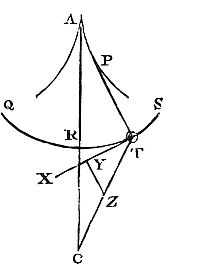
Let the body T oscillate in any curve line STRQ, whose axis is AR passing through the centre of force C. Draw TX touching that curve in any place of the body T, and in that tangent TX take TY equal to the arc TR. The length of that arc is known from the common methods used for the quadratures of figures. From the point Y draw the right line YZ perpendicular to the tangent. Draw CT meeting that perpendicular in Z, and the centripetal force will be proportional to the right line TZ. Q.E.I.
For if the force with which the body is attracted from T towards C be expressed by the right line TZ taken proportional to it, that force will be resolved into two forces TY, YZ, of which YZ drawing the body in the direction of the length of the thread PT, does not at all change its motion; whereas the other force TY directly accelerates or retards its motion in the curve STRQ. Wherefore since that force is as the space to be described TR, the accelerations or retardations of the body in describing two proportional parts (a greater and a less) of two oscillations, will be always as those parts, and therefore will cause those parts to be described together. But bodies which continually describe together parts proportional to the wholes, will describe the wholes together also. Q.E.D.
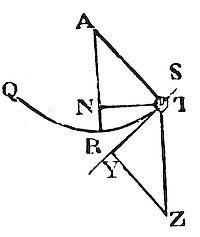
COR. 1. Hence if the body T, hanging by a rectilinear thread AT from the centre A, describe the circular arc STRQ, and in the mean time be acted on by any force tending downwards with parallel directions, which is to the uniform force of gravity as the arc TR to its sine TN, the times of the several oscillations will be equal. For because TZ, AR are parallel, the triangles ATN, ZTY are similar; and therefore TZ will be to AT as TY to TN; that is, if the uniform force of gravity be expressed by the given length AT, the force TZ, by which the oscillations become isochronous, will be to the force of gravity AT, as the arc TR equal to TY is to TN the sine of that arc.
COR. 2. And therefore in clocks, if forces were impressed by some machine upon the pendulum which preserves the motion, and so compounded with the force of gravity that the whole force tending downwards should be always as a line produced by applying the rectangle under the arc TR and the radius AR to the sine TN, all the oscillations will become isochronous.
PROPOSITION LIV. PROBLEM XXXVI.
Granting the quadratures of curvilinear figures, it is required to find the times in which bodies by means of any centripetal force will descend or ascend in any curve lines described in a plane passing through the centre of force.
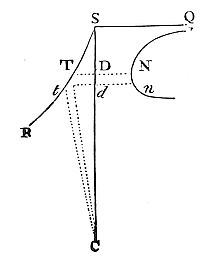
Let the body descend from any place S, and move in any curve STtR given in a plane passing through the centre of force C. Join CS, and let it be divided into innumerable equal parts, and let Dd be one of those parts. From the centre C, with the intervals CD, Cd, let the circles DT, dt be described, meeting the curve line STtR in T and t. And because the law of centripetal force is given, and also the altitude CS from which the body at first fell, there will be given the velocity of the body in any other altitude CT (by Prop. XXXIX). But the time in which the body describes the lineola Tt is as the length of that lineola, that is, as the secant of the angle tTC directly, and the velocity inversely. Let the ordinate DN, proportional to this time, be made perpendicular to the right line CS at the point D, and because Dd is given, the rectangle Dd × DN, that is, the area DNnd, will be proportional to the same time. Therefore if PNn be a curve line in which the point N is perpetually found, and its asymptote be the right line SQ standing upon the line CS at right angles, the area SQPND will be proportional to the time in which the body in its descent hath described the line ST; and therefore that area being found, the time is also given. Q.E.I.
PROPOSITION LV. THEOREM XIX.
If a body move in any curve superficies, whose axis passes through the centre of force, and from the body a perpendicular be let fall upon the axis; and a line parallel and equal thereto be drawn from any given point of the axis; I say, that this parallel line will describe an area proportional to the time.
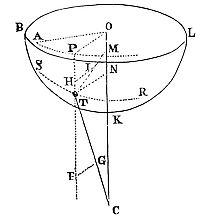
Let BKL be a curve superficies, T a body revolving in it, STR a trajectory which the body describes in the same, S the beginning of the trajectory, OMK the axis of the curve superficies, TN a right line let fall perpendicularly from the body to the axis; OP a line parallel and equal thereto drawn from the given point O in the axis; AP the orthographic projection of the trajectory described by the point P in the plane AOP in which the revolving line OP is found; A the beginning of that projection, answering to the point S; TC a right line drawn from the body to the centre; TG a part thereof proportional to the centripetal force with which the body tends towards the centre C; TM a right line perpendicular to the curve superficies; TI a part thereof proportional to the force of pressure with which the body urges the superficies, and therefore with which it is again repelled by the superficies towards M; PTF a right line parallel to the axis and passing through the body, and GF, IH right lines let fall perpendicularly from the points G and I upon that parallel PHTF. I say, now, that the area AOP, described by the radius OP from the beginning of the motion, is proportional to the time. For the force TG (by Cor. 2, of the Laws of Motion) is resolved into the forces TF, FG; and the force TI into the forces TH, HI; but the forces TF, TH, acting in the direction of the line PF perpendicular to the plane AOP, introduce no change in the motion of the body but in a direction perpendicular to that plane. Therefore its motion, so far as it has the same direction with the position of the plane, that is, the motion of the point P, by which the projection AP of the trajectory is described in that plane, is the same as if the forces TF, TH were taken away, and the body were acted on by the forces FG, HI alone; that is, the same as if the body were to describe in the plane AOP the curve AP by means of a centripetal force tending to the centre O, and equal to the sum of the forces FG and HI. But with such a force as that (by Prop. 1) the area AOP will be described proportional to the time. Q.E.D.
COR. By the same reasoning, if a body, acted on by forces tending to two or more centres in any the same right line CO, should describe in a free space any curve line ST, the area AOP would be always proportional to the time.
PROPOSITION LVI. PROBLEM XXXVII.
Granting the quadratures of curvilinear figures, and supposing that there are given both the law of centripetal force tending to a given centre, and the curve superficies whose axis passes through that centre; it is required to find the trajectory which a body will describe in that superficies, when going off from a given place with a given velocity, and in a given direction in that superficies.
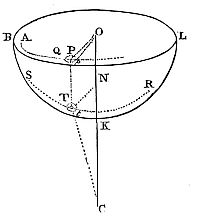
The last construction remaining, let the body T go from the given place S, in the direction of a line given by position, and turn into the trajectory sought STR, whose orthographic projection in the plane BDO is AP. And from the given velocity of the body in the altitude SC, its velocity in any other altitude TC will be also given. With that velocity, in a given moment of time, let the body describe the particle Tt of its trajectory, and let Pp be the projection of that particle described in the plane AOP. Join Op, and a little circle being described upon the curve superficies about the centre T with the interval Tt let the projection of that little circle in the plane AOP be the ellipsis pQ. And because the magnitude of that little circle Tt, and TN or PO its distance from the axis CO is also given, the ellipsis pQ will be given both in kind and magnitude, as also its position to the right line PO. And since the area POp is proportional to the time, and therefore given because the time is given, the angle POp will be given. And thence will be given p the common intersection of the ellipsis and the right line Op, together with the angle OPp, in which the projection APp of the trajectory cuts the line OP. But from thence (by conferring Prop. XLI, with its 2d Cor.) the manner of determining the curve APp easily appears. Then from the several points P of that projection erecting to the plane AOP, the perpendiculars PT meeting the curve superficies in T, there will be given the several points T of the trajectory. Q.E.I.
SECTION XI.
Of the motions of bodies tending to each other with centripetal forces.
I have hitherto been treating of the attractions of bodies towards an immovable centre; though very probably there is no such thing existent in nature. For attractions are made towards bodies, and the actions of the bodies attracted and attracting are always reciprocal and equal, by Law III; so that if there are two bodies, neither the attracted nor the attracting body is truly at rest, but both (by Cor. 4, of the Laws of Motion), being as it were mutually attracted, revolve about a common centre of gravity. And if there be more bodies, which are either attracted by one single one which is attracted by them again, or which all of them, attract each other mutually, these bodies will be so moved among themselves, as that their common centre of gravity will either be at rest, or move uniformly forward in a right line. I shall therefore at present go on to treat of the motion of bodies mutually attracting each other; considering the centripetal forces as attractions; though perhaps in a physical strictness they may more truly be called impulses. But these propositions are to be considered as purely mathematical; and therefore, laying aside all physical considerations, I make use of a familiar way of speaking, to make myself the more easily understood by a mathematical reader.
PROPOSITION LVII. THEOREM XX.
Two bodies attracting each other mutually describe similar figures about their common centre of gravity, and about each other mutually.
For the distances of the bodies from their common centre of gravity are reciprocally as the bodies; and therefore in a given ratio to each other: and thence, by composition of ratios, in a given ratio to the whole distance between the bodies. Now these distances revolve about their common term with an equable angular motion, because lying in the same right line they never change their inclination to each other mutually. But right lines that are in a given ratio to each other, and revolve about their terms with an equal angular motion, describe upon planes, which either rest with those terms, or move with any motion not angular, figures entirely similar round those terms. Therefore the figures described by the revolution of these distances are similar. Q.E.D.
PROPOSITION LVIII. THEOREM XXI.
If two bodies attract each other mutually with forces of any kind, and in the mean time revolve about the common centre of gravity; I say, that, by the same forces, there may be described round either body unmoved a figure similar and equal to the figures which the bodies so moving describe round each other mutually.
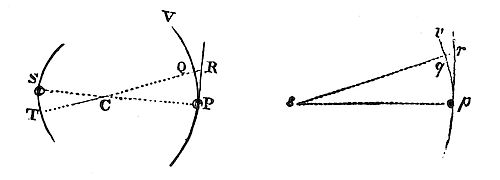
Let the bodies S and P revolve about their common centre of gravity C, proceeding from S to T, and from P to Q. From the given point s let there be continually drawn sp, sq, equal and parallel to SP, TQ; and the curve pqv, which the point p describes in its revolution round the immovable point s, will be similar and equal to the curves which the bodies S and P describe about each other mutually; and therefore, by Theor. XX, similar to the curves ST and PQV which the same bodies describe about their common centre of gravity C; and that because the proportions of the lines SC, CP, and SP or sp, to each other, are given.
CASE 1. The common centre of gravity C (by Cor. 4, of the Laws of Motion) is either at rest, or moves uniformly in a right line. Let us first suppose it at rest, and in s and p let there be placed two bodies, one immovable in s, the other movable in p, similar and equal to the bodies S and P. Then let the right lines PR and pr touch the curves PQ and pq in P and p, and produce CQ and sq to R and r. And because the figures CPRQ, sprq are similar, RQ will be to rq as CP to sp, and therefore in a given ratio. Hence if the force with which the body P is attracted towards the body S, and by consequence towards the intermediate point the centre C, were to the force with which the body p is attracted towards the centre s, in the same given ratio, these forces would in equal times attract the bodies from the tangents PR, pr to the arcs PQ, pq, through the intervals proportional to them RQ, rq; and therefore this last force (tending to s) would make the body p revolve in the curve pqv, which would become similar to the curve PQV, in which the first force obliges the body P to revolve; and their revolutions would be completed in the same times. But because those forces are not to each other in the ratio of CP to sp, but (by reason of the similarity and equality of the bodies S and s, P and p and the equality of the distances SP, sp) mutually equal, the bodies in equal times will be equally drawn from the tangents; and therefore that the body p may be attracted through the greater interval rq, there is required a greater time, which will be in the subduplicate ratio of the intervals; because, by Lemma X, the spaces described at the very beginning of the motion are in a duplicate ratio of the times. Suppose, then the velocity of the body p to be to the velocity of the body P in a subduplicate ratio of the distance sp to the distance CP, so that the arcs pq, PQ, which are in a simple proportion to each other, may be described in times that are in a subduplicate ratio of the distances; and the bodies P, p, always attracted by equal forces, will describe round the quiescent centres C and s similar figures PQV, pqv, the latter of which pqv is similar and equal to the figure which the body P describes round the movable body S. Q.E.D.
CASE 2. Suppose now that the common centre of gravity, together with the space in which the bodies are moved among themselves, proceeds uniformly in a right line; and (by Cor. 6, of the Laws of Motion) all the motions in this space will be performed in the same manner as before; and therefore the bodies will describe mutually about each other the same figures as before, which will be therefore similar and equal to the figure pqv. Q.E.D.
COR. 1. Hence two bodies attracting each other with forces proportional to their distance, describe (by Prop. X) both round their common centre of gravity, and round each other mutually concentrical ellipses; and, vice versa, if such figures are described, the forces are proportional to the distances.
COR. 2. And two bodies, whose forces are reciprocally proportional to the square of their distance, describe (by Prop. XI, XII, XIII), both round their common centre of gravity, and round each other mutually, conic sections having their focus in the centre about which the figures are described. And, vice versa, if such figures are described, the centripetal forces are reciprocally proportional to the squares of the distance.
COR. 3. Any two bodies revolving round their common centre of gravity describe areas proportional to the times, by radii drawn both to that centre and to each other mutually.
PROPOSITION LIX. THEOREM XXII.
The periodic time of two bodies S and P revolving round their common centre of gravity C, is to the periodic time of one of the bodies P revolving round the other S remaining unmoved, and describing a figure similar and equal to those which the bodies describe about each other mutually, in a subduplicate ratio of the other body S to the sum of the bodies S + P.
For, by the demonstration of the last Proposition, the times in which any similar arcs PQ and pq are described are in a subduplicate ratio of the distances CP and SP, or sp, that is, in a subduplicate ratio of the body S to the sum of the bodies S + P. And by composition of ratios, the sums of the times in which all the similar arcs PQ and pq are described, that is, the whole times in which the whole similar figures are described are in the same subduplicate ratio. Q.E.D.
PROPOSITION LX. THEOREM XXIII.
If two bodies S and P, attracting each other with forces reciprocally proportional to the squares of their distance, revolve about their common centre of gravity; I say, that the principal axis of the ellipsis which either of the bodies, as P, describes by this motion about the other S, will be to the principal axis of the ellipsis, which the same body P may describe in the same periodical time about the other body S quiescent, as the sum of the two bodies S + P to the first of two mean proportionals between that sum and the other body S.
For if the ellipses described were equal to each other, their periodic times by the last Theorem would be in a subduplicate ratio of the body S to the sum of the bodies S + P. Let the periodic time in the latter ellipsis be diminished in that ratio, and the periodic times will become equal; but, by Prop. XV, the principal axis of the ellipsis will be diminished in a ratio sesquiplicate to the former ratio; that is, in a ratio to which the ratio of S to S + P is triplicate; and therefore that axis will be to the principal axis of the other ellipsis as the first of two mean proportionals between S + P and S to S + P. And inversely the principal axis of the ellipsis described about the movable body will be to the principal axis of that described round the immovable as S + P to the first of two mean proportionals between S + P and S. Q.E.D.
PROPOSITION LXI. THEOREM XXIV.
If two bodies attracting each other with any kind of forces, and not otherwise agitated or obstructed, are moved in any manner whatsoever, those motions will be the same as if they did not at all attract each other mutually, but were both attracted with the same forces by a third body placed in their common centre of gravity; and the law of the attracting forces will be the same in respect of the distance of the bodies from the common centre, as in respect of the distance between the two bodies.
For those forces with which the bodies attract each other mutually, by tending to the bodies, tend also to the common centre of gravity lying directly between them; and therefore are the same as if they proceeded from an intermediate body. Q.E.D.
And because there is given the ratio of the distance of either body from that common centre to the distance between the two bodies, there is given, of course, the ratio of any power of one distance to the same power of the other distance; and also the ratio of any quantity derived in any manner from one of the distances compounded any how with given quantities, to another quantity derived in like manner from the other distance, and as many given quantities having that given ratio of the distances to the first. Therefore if the force with which one body is attracted by another be directly or inversely as the distance of the bodies from each other, or as any power of that distance; or, lastly, as any quantity derived after any manner from that distance compounded with given quantities; then will the same force with which the same body is attracted to the common centre of gravity be in like manner directly or inversely as the distance of the attracted body from the common centre, or as any power of that distance; or, lastly, as a quantity derived in like sort from that distance compounded with analogous given quantities. That is, the law of attracting force will be the same with respect to both distances. Q.E.D.
PROPOSITION LXII. PROBLEM XXXVIII.
To determine the motions of two bodies which attract each other with forces reciprocally proportional to the squares of the distance between them, and are let fall from given places.
The bodies, by the last Theorem, will be moved in the same manner as if they were attracted by a third placed in the common centre of their gravity; and by the hypothesis that centre will be quiescent at the beginning of their motion, and therefore (by Cor. 4, of the Laws of Motion) will be always quiescent. The motions of the bodies are therefore to be determined (by Prob. XXV) in the same manner as if they were impelled by forces tending to that centre; and then we shall have the motions of the bodies attracting each other mutually. Q.E.I.
PROPOSITION LXIII. PROBLEM XXXIX.
To determine the motions of two bodies attracting each other with forces reciprocally proportional to the squares of their distance, and going off from given places in given directions with given velocities.
The motions of the bodies at the beginning being given, there is given also the uniform motion of the common centre of gravity, and the motion of the space which moves along with this centre uniformly in a right line, and also the very first, or beginning motions of the bodies in respect of this space. Then (by Cor. 5, of the Laws, and the last Theorem) the subsequent motions will be performed in the same manner in that space, as if that space together with the common centre of gravity were at rest, and as if the bodies did not attract each other, but were attracted by a third body placed in that centre. The motion therefore in this movable space of each body going off from a given place, in a given direction, with a given velocity, and acted upon by a centripetal force tending to that centre, is to be determined by Prob. IX and XXVI, and at the same time will be obtained the motion of the other round the same centre. With this motion compound the uniform progressive motion of the entire system of the space and the bodies revolving in it, and there will be obtained the absolute motion of the bodies in immovable space. Q.E.I.
PROPOSITION LXIV. PROBLEM XL.
Supposing forces with which bodies mutually attract each other to increase in a simple ratio of their distances from the centres; it is required to find the motions of several bodies among themselves.
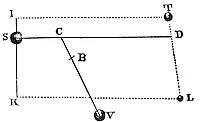
Suppose the first two bodies T and L to have their common centre of gravity in D. These, by Cor. 1, Theor. XXI, will describe ellipses having their centres in D, the magnitudes of which ellipses are known by Prob. V.
Let now a third body S attract the two former T and L with the accelerative forces ST, SL, and let it be attracted again by them. The force ST (by Cor. 2, of the Laws of Motion) is resolved into the forces SD, DT; and the force SL into the forces SD and DL. Now the forces DT, DL, which are as their sum TL, and therefore as the accelerative forces with which the bodies T and L attract each other mutually, added to the forces of the bodies T and L, the first to the first, and the last to the last, compose forces proportional to the distances DT and DL as before, but only greater than those former forces: and therefore (by Cor. 1, Prop. X, and Cor. 1, and 8, Prop. IV) they will cause those bodies to describe ellipses as before, but with a swifter motion. The remaining accelerative forces SD and DL, by the motive forces SD × T and SD × L, which are as the bodies attracting those bodies equally and in the direction of the lines TI, LK parallel to DS, do not at all change their situations with respect to one another, but cause them equally to approach to the line IK; which must be imagined drawn through the middle of the body S, and perpendicular to the line DS. But that approach to the line IK will be hindered by causing the system of the bodies T and L on one side, and the body S on the other, with proper velocities, to revolve round the common centre of gravity C. With such a motion the body S, because the sum of the motive forces SD × T and SD × L is proportional to the distance CS, tends to the centre C, will describe an ellipsis round the same centre C; and the point D, because the lines CS and CD are proportional, will describe a like ellipsis over against it. But the bodies T and L, attracted by the motive forces SD × T and SD × L, the first by the first, and the last by the last, equally and in the direction of the parallel lines TI and LK, as was said before, will (by Cor. 5 and 6, of the Laws of Motion) continue to describe their ellipses round the movable centre D, as before. Q.E.I.
Let there be added a fourth body V, and, by the like reasoning, it will be demonstrated that this body and the point C will describe ellipses about the common centre of gravity B; the motions of the bodies T, L, and S round the centres D and C remaining the same as before; but accelerated. And by the same method one may add yet more bodies at pleasure. Q.E.I.
This would be the case, though the bodies T and L attract each other mutually with accelerative forces either greater or less than those with which they attract the other bodies in proportion to their distance. Let all the mutual accelerative attractions be to each other as the distances multiplied into the attracting bodies; and from what has gone before it will easily be concluded that all the bodies will describe different ellipses with equal periodical times about their common centre of gravity B, in an immovable plane. Q.E.I.
PROPOSITION LXV. THEOREM XXV.
Bodies, whose forces decrease in a duplicate ratio of their distances from their centres, may move among themselves in ellipses; and by radii drawn to the foci may describe areas proportional to the times very nearly.
In the last Proposition we demonstrated that case in which the motions will be performed exactly in ellipses. The more distant the law of the forces is from the law in that case, the more will the bodies disturb each other's motions; neither is it possible that bodies attracting each other mutually according to the law supposed in this Proposition should move exactly in ellipses, unless by keeping a certain proportion of distances from each other. However, in the following cases the orbits will not much differ from ellipses.
CASE 1. Imagine several lesser bodies to revolve about some very great one at different distances from it, and suppose absolute forces tending to every one of the bodies proportional to each. And because (by Cor. 4, of the Laws) the common centre of gravity of them all is either at rest, or moves uniformly forward in a right line, suppose the lesser bodies so small that the great body may be never at a sensible distance from that centre; and then the great body will, without any sensible error, be either at rest, or move uniformly forward in a right line; and the lesser will revolve about that great one in ellipses, and by radii drawn thereto will describe areas proportional to the times; if we except the errors that may be introduced by the receding of the great body from the common centre of gravity, or by the mutual actions of the lesser bodies upon each other. But the lesser bodies may be so far diminished, as that this recess and the mutual actions of the bodies on each other may become less than any assignable; and therefore so as that the orbits may become ellipses, and the areas answer to the times, without any error that is not less than any assignable. Q.E.O.