Book 2 — BOOK II.
Andrew Motte translation
OF THE MOTION OF BODIES.
SECTION I.
Of the motion of bodies that are resisted in the ratio of the velocity.
PROPOSITION I. THEOREM I.
If a body is resisted in the ratio of its velocity, the motion lost by resistance is as the space gone over in its motion.
For since the motion lost in each equal particle of time is as the velocity, that is, as the particle of space gone over, then, by composition, the motion lost in the whole time will be as the whole space gone over. Q.E.D.
COR. Therefore if the body, destitute of all gravity, move by its innate force only in free spaces, and there be given both its whole motion at the beginning, and also the motion remaining after some part of the way is gone over, there will be given also the whole space which the body can describe in an infinite time. For that space will be to the space now described as the whole motion at the beginning is to the part lost of that motion.
LEMMA I.
Quantities proportional to their differences are continually proportional.
Let A be to A - B as B to B - C and C to C - D, &c., and, by conversion, A will be to B as B to C and C to D, &c. Q.E.D.
PROPOSITION II. THEOREM II.
If a body is resisted in the ratio of its velocity, and moves, by its vis insita only, through a similar medium, and the times be taken equal, the velocities in the beginning of each of the times are in a geometrical progression, and the spaces described in each of the times are as the velocities.
CASE 1. Let the time be divided into equal particles; and if at the very beginning of each particle we suppose the resistance to act with one single impulse which is as the velocity, the decrement of the velocity in each of the particles of time will be as the same velocity. Therefore the velocities are proportional to their differences, and therefore (by Lem. 1, Book II) continually proportional. Therefore if out of an equal number of particles there be compounded any equal portions of time, the velocities at the beginning of those times will be as terms in a continued progression, which are taken by intervals, omitting every where an equal number of intermediate terms. But the ratios of these terms are compounded of the equal ratios of the intermediate terms equally repeated, and therefore are equal. Therefore the velocities, being proportional to those terms, are in geometrical progression. Let those equal particles of time be diminished, and their number increased in infinitum, so that the impulse of resistance may become continual; and the velocities at the beginnings of equal times, always continually proportional, will be also in this case continually proportional. Q.E.D.
CASE 2. And, by division, the differences of the velocities, that is, the parts of the velocities lost in each of the times, are as the wholes; but the spaces described in each of the times are as the lost parts of the velocities (by Prop. 1, Book I), and therefore are also as the wholes. Q.E.D.
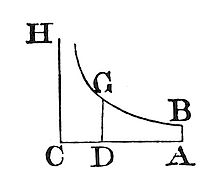
COROL. Hence if to the rectangular asymptotes AC, CH, the hyperbola BG is described, and AB, DG be drawn perpendicular to the asymptote AC, and both the velocity of the body, and the resistance of the medium, at the very beginning of the motion, be expressed by any given line AC, and, after some time is elapsed, by the indefinite line DC; the time may be expressed by the area ABGD, and the space described in that time by the line AD. For if that area, by the motion of the point D, be uniformly increased in the same manner as the time, the right line DC will decrease in a geometrical ratio in the same manner as the velocity; and the parts of the right line AC, described in equal times, will decrease in the same ratio.
PROPOSITION III. PROBLEM I.
To define the motion of a body which, in a similar medium, ascends or descends in a right line, and is resisted in the ratio of its velocity, and acted upon by an uniform force of gravity.
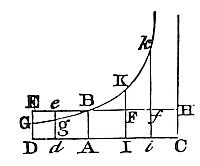
The body ascending, let the gravity be expounded by any given rectangle BACH; and the resistance of the medium, at the beginning of the ascent, by the rectangle BADE, taken on the contrary side of the right line AB. Through the point B, with the rectangular asymptotes AC, CH, describe an hyperbola, cutting the perpendiculars DE, de, in G, g; and the body ascending will in the time DGgd describe the space EGge; in the time DGBA, the space of the whole ascent EGB; in the time ABKI, the space of descent BFK; and in the time IKki the space of descent KFfk; and the velocities of the bodies (proportional to the resistance of the medium) in these periods of time will be ABED, ABed, O, ABFI, ABfi respectively; and the greatest velocity which the body can acquire by descending will be BACH.
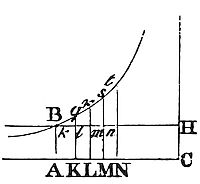
For let the rectangle BACH be resolved into innumerable rectangles Ak, Kl, Lm, Mn, &c., which shall be as the increments of the velocities produced in so many equal times; then will 0, Ak, Al, Am, An, &c., be as the whole velocities, and therefore (by supposition) as the resistances of the medium in the beginning of each of the equal times. Make AC to AK, or ABHC to ABkK, as the force of gravity to the resistance in the beginning of the second time; then from the force of gravity subduct the resistances, and ABHC, KkHC, LlHC, MmHC, &c., will be as the absolute forces with which the body is acted upon in the beginning of each of the times, and therefore (by Law I) as the increments of the velocities, that is, as the rectangles Ak, Kl, Lm, Mn, &c., and therefore (by Lem. 1, Book II) in a geometrical progression. Therefore, if the right lines Kk, Ll, Mm, Nn, &c., are produced so as to meet the hyperbola in q, r, s, t, &c., the areas ABqK, KqrL, LrsM, MstN, &c., will be equal, and therefore analogous to the equal times and equal gravitating forces. But the area ABqK (by Corol. 3, Lem. VII and VIII, Book I) is to the area Bkq as Kq to , or AC to , that is, as the force of gravity to the resistance in the middle of the first time. And by the like reasoning, the areas qKLr, rLMs, sMNt, &c., are to the areas qklr, rlms, smnt, &c., as the gravitating forces to the resistances in the middle of the second, third, fourth time, and so on. Therefore since the equal areas BAKq, qKLr, rLMs, sMNt, &c., are analogous to the gravitating forces, the areas Bkq, qklr, rlms, smnt, &c., will be analogous to the resistances in the middle of each of the times, that is (by supposition), to the velocities, and so to the spaces described. Take the sums of the analogous quantities, and the areas Bkq, Blr, Bms, Bnt, &c., will be analogous to the whole spaces described; and also the areas ABqK, ABrL, ABsM, ABtN, &c., to the times. Therefore the body, in descending, will in any time ABrL describe the space Blr, and in the time LrtN the space rlnt. Q.E.D. And the like demonstration holds in ascending motion.
COROL. 1. Therefore the greatest velocity that the body can acquire by falling is to the velocity acquired in any given time as the given force of gravity which perpetually acts upon it to the resisting force which opposes it at the end of that time.
COROL. 2. But the time being augmented in an arithmetical progression, the sum of that greatest velocity and the velocity in the ascent, and also their difference in the descent, decreases in a geometrical progression.
COROL. 3. Also the differences of the spaces, which are described in equal differences of the times, decrease in the same geometrical progression.
COROL. 4. The space described by the body is the difference of two spaces, whereof one is as the time taken from the beginning of the descent, and the other as the velocity; which [spaces] also at the beginning of the descent are equal among themselves.
PROPOSITION IV. PROBLEM II.
Supposing the force of gravity in any similar medium to be uniform, and to tend perpendicularly to the plane of the horizon; to define the motion of a projectile therein, which suffers resistance proportional to its velocity.
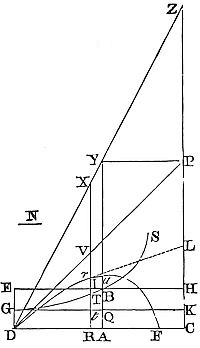
Let the projectile go from any place D in the direction of any right line DP, and let its velocity at the beginning of the motion be expounded by the length DP. From the point P let fall the perpendicular PC on the horizontal line DC, and cut DC in A, so that DA may be to AC as the resistance of the medium arising from the motion upwards at the beginning to the force of gravity; or (which comes to the same) so that the rectangle under DA and DP may be to that under AC and CP as the whole resistance at the beginning of the motion to the force of gravity. With the asymptotes DC, CP describe any hyperbola GTBS cutting the perpendiculars DG, AB in G and B; complete the parallelogram DGKC, and let its side GK cut AB in Q. Take a line N in the same ratio to QB as DC is in to CP; and from any point R of the right line DC erect RT perpendicular to it, meeting the hyperbola in T, and the right lines EH, GK, DP in I, t, and V; in that perpendicular take Vr equal to , or which is the same thing, take Rr equal to ; and the projectile in the time DRTG will arrive at the point r describing the curve line DraF, the locus of the point r; thence it will come to its greatest height a in the perpendicular AB; and afterwards ever approach to the asymptote PC. And its velocity in any point r will be as the tangent rL to the curve. Q.E.I.
For N is to QB as DC to CP or DR to RV, and therefore RV is equal to , and Rr is equal to . Now let the time be expounded by the area RDGT and (by Laws, Cor. 2), distinguish the motion of the body into two others, one of ascent, the other lateral. And since the resistance is as the motion, let that also be distinguished into two parts proportional and contrary to the parts of the motion: and therefore the length described by the lateral motion will be (by Prop. II, Book II) as the line DR, and the height (by Prop. III, Book II) as the area DR × AB - RDGT, that is, as the line Rr. But in the very beginning of the motion the area RDGT is equal to the rectangle DR × AQ, and therefore that line Rr will then be to DR as AB - AQ or QB to N, that is, as CP to DC; and therefore as the motion upwards to the motion lengthwise at the beginning. Since, therefore, Rr is always as the height, and DR always as the length, and Rr is to DR at the beginning as the height to the length, it follows, that Rr is always to DR as the height to the length; and therefore that the body will move in the line DraF, which is the locus of the point r. Q.E.D.
COR. 1. Therefore Rr is equal to ; and therefore if RT be produced to X so that RX may be equal to , that is, if the parallelogram ACPY be completed, and DY cutting CP in Z be drawn, and RT be produced till it meets DY in X; Xr will be equal to , and therefore proportional to the time.
COR. 2. Whence if innumerable lines CR, or, which is the same, innumerable lines ZX, be taken in a geometrical progression, there will be as many lines Xr in an arithmetical progression. And hence the curve DraF is easily delineated by the table of logarithms.
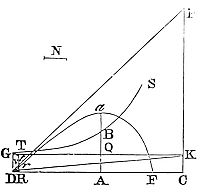
COR. 3. If a parabola be constructed to the vertex D, and the diameter DG produced downwards, and its latus rectum is to 2 DP as the whole resistance at the beginning of the notion to the gravitating force, the velocity with which the body ought to go from the place D, in the direction of the right line DP, so as in an uniform resisting medium to describe the curve DraF, will be the same as that with which it ought to go from the same place D in the direction of the same right line DP, so as to describe a parabola in a non-resisting medium. For the latus rectum of this parabola, at the very beginning of the motion, is ; and Vr is or . But a right line, which, if drawn, would touch the hyperbola GTS in G, is parallel to DK, and therefore Tt is , and N is . And therefore Vr is equal to , that is (because DR and DC, DV and DP are proportionals), to ; and the latus rectum comes out , that is (because QB and CK, DA and AC are proportional), , and therefore is to 2DP as DP × DA to CP × AC; that is, as the resistance to the gravity. Q.E.D.
COR. 4. Hence if a body be projected from any place D with a given velocity, in the direction of a right line DP given by position, and the resistance of the medium, at the beginning of the motion, be given, the curve DraF, which that body will describe, may be found. For the velocity being given, the latus rectum of the parabola is given, as is well known. And taking 2DP to that latus rectum, as the force of gravity to the resisting force, DP is also given. Then cutting DC in A, so that GP × AC may be to DP × DA in the same ratio of the gravity to the resistance, the point A will be given. And hence the curve DraF is also given.
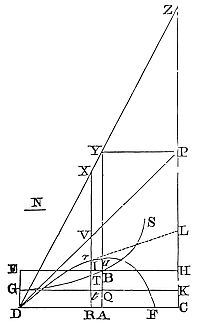
COR. 5. And, on the contrary, if the curve DraF be given, there will be given both the velocity of the body and the resistance of the medium in each of the places r. For the ratio of CP × AC to DP × DA being given, there is given both the resistance of the medium at the beginning of the motion, and the latus rectum of the parabola; and thence the velocity at the beginning of the motion is given also. Then from the length of the tangent L there is given both the velocity proportional to it, and the resistance proportional to the velocity in any place r.
COR. 6. But since the length 2DP is to the latus rectum of the parabola as the gravity to the resistance in D; and, from the velocity augmented, the resistance is augmented in the same ratio, but the latus rectum of the parabola is augmented in the duplicate of that ratio, it is plain that the length 2DP is augmented in that simple ratio only; and is therefore always proportional to the velocity; nor will it be augmented or diminished by the change of the angle CDP, unless the velocity be also changed.
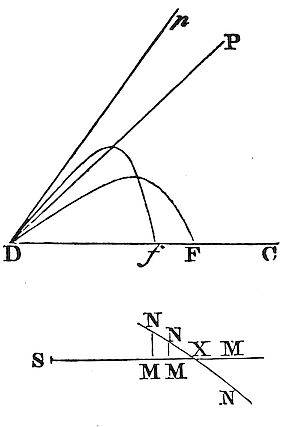
COR. 7. Hence appears the method of determining the curve DraF nearly from the phenomena, and thence collecting the resistance and velocity with which the body is projected. Let two similar and equal bodies be projected with the same velocity, from the place D, in different angles CDP, CDp; and let the places F, f, where they fall upon the horizontal plane DC, be known. Then taking any length for DP or Dp suppose the resistance in D to be to the gravity in any ratio whatsoever, and let that ratio be expounded by any length SM. Then, by computation, from that assumed length DP, find the lengths DF, Df; and from the ratio , found by calculation, subduct the same ratio as found by experiment; and let the difference be expounded by the perpendicular MN. Repeat the same a second and a third time, by assuming always a new ratio SM of the resistance to the gravity, and collecting a new difference MN. Draw the affirmative differences on one side of the right line SM, and the negative on the other side; and through the points N, N, N, draw a regular curve NNN, cutting the right line SMMM in X, and SX will be the true ratio of the resistance to the gravity, which was to be found. From this ratio the length DF is to be collected by calculation; and a length, which is to the assumed length DP as the length DF known by experiment to the length DF just now found, will be the true length DP. This being known, you will have both the curve line DraF which the body describes, and also the velocity and resistance of the body in each place.
SCHOLIUM.
But, yet, that the resistance of bodies is in the ratio of the velocity, is more a mathematical hypothesis than a physical one. In mediums void of all tenacity, the resistances made to bodies are in the duplicate ratio of the velocities. For by the action of a swifter body, a greater motion in proportion to a greater velocity is communicated to the same quantity of the medium in a less time; and in an equal time, by reason of a greater quantity of the disturbed medium, a motion is communicated in the duplicate ratio greater; and the resistance (by Law II and III) is as the motion communicated. Let us, therefore, see what motions arise from this law of resistance.
SECTION II.
Of the motion of bodies that are resisted in the duplicate ratio of their velocities.
PROPOSITION V. THEOREM III.
If a body is resisted in the duplicate ratio of its velocity, and moves by its innate force only through a similar medium; and the times be taken in a geometrical progression, proceeding from less to greater terms: I say, that the velocities at the beginning of each of the times are in the same geometrical progression inversely; and that the spaces are equal, which are described in each of the times.
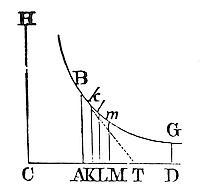
For since the resistance of the medium is proportional to the square of the velocity, and the decrement of the velocity is proportional to the resistance: if the time be divided into innumerable equal particles, the squares of the velocities at the beginning of each of the times will be proportional to the differences of the same velocities. Let those particles of time be AK, KL, LM, &c., taken in the right line CD; and erect the perpendiculars AB, Kk, Ll, Mm, &c., meeting the hyperbola BklmG, described with the centre C, and the rectangular asymptotes CD, CH, in B, k, l, m, &c.; then AB will be to Kk as CK to CA, and, by division, AB - Kk to Kk as AK to CA, and alternately, AB - Kk to AK as Kk to CA; and therefore as AB × Kk to AB × CA. Therefore since AK and AB × CA are given, AB - Kk will be as AB × Kk; and, lastly, when AB and Kk coincide, as AB2. And, by the like reasoning, Kk - Ll, Ll - Mm, &c., will be as Kk2, Ll2, &c. Therefore the squares of the lines AB, Kk, Ll, Mm, &c., are as their differences; and, therefore, since the squares of the velocities were shewn above to be as their differences, the progression of both will be alike. This being demonstrated it follows also that the areas described by these lines are in a like progression with the spaces described by these velocities. Therefore if the velocity at the beginning of the first time AK be expounded by the line AB, and the velocity at the beginning of the second time KL by the line Kk and the length described in the first time by the area AKkB, all the following velocities will be expounded by the following lines Ll, Mm, &c. and the lengths described, by the areas Kl, Lm, &c. And, by composition, if the whole time be expounded by AM, the sum of its parts, the whole length described will be expounded by AMmB the sum of its parts. Now conceive the time AM to be divided into the parts AK, KL, LM, &c. so that CA, CK, CL, CM, &c. may be in a geometrical progression; and those parts will be in the same progression, and the velocities AB, Kk, Ll, Mm, &c., will be in the same progression inversely, and the spaces described Ak, Kl, Lm, &c., will be equal. Q.E.D.
COR. 1. Hence it appears, that if the time be expounded by any part AD of the asymptote, and the velocity in the beginning of the time by the ordinate AB, the velocity at the end of the time will be expounded by the ordinate DG; and the whole space described by the adjacent hyperbolic area ABGD; and the space which any body can describe in the same time AD, with the first velocity AB, in a non-resisting medium, by the rectangle AB × AD.
COR. 2. Hence the space described in a resisting medium is given, by taking it to the space described with the uniform velocity AB in a non-resisting medium, as the hyperbolic area ABGD to the rectangle AB × AD.
COR. 3. The resistance of the medium is also given, by making it equal, in the very beginning of the motion, to an uniform centripetal force, which could generate, in a body falling through a non-resisting medium, the velocity AB in the time AC. For if BT be drawn touching the hyperbola in B, and meeting the asymptote in T, the right line AT will be equal to AC, and will express the time in which the first resistance, uniformly continued, may take away the whole velocity AB.
COR. 4. And thence is also given the proportion of this resistance to the force of gravity, or any other given centripetal force.
COR. 5. And, vice versa, if there is given the proportion of the resistance to any given centripetal force, the time AC is also given, in which a centripetal force equal to the resistance may generate any velocity as AB; and thence is given the point B, through which the hyperbola, having CH, CD for its asymptotes, is to be described: as also the space ABGD, which a body, by beginning its motion with that velocity AB, can describe in any time AD, in a similar resisting medium.
PROPOSITION VI. THEOREM IV.
Homogeneous and equal spherical bodies, opposed by resistances that are in the duplicate ratio of the velocities, and moving on by their innate force only, will, in times which are reciprocally as the velocities at the beginning, describe equal spaces, and lose parts of their velocities proportional to the wholes.
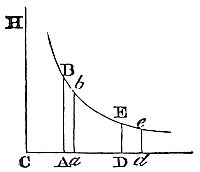
To the rectangular asymptotes CD, CH describe any hyperbola BbEe, cutting the perpendiculars AB, ab, DE, de in B, b, E, e; let the initial velocities be expounded by the perpendiculars AB, DE, and the times by the lines Aa, Dd. Therefore as Aa is to Dd, so (by the hypothesis) is DE to AB, and so (from the nature of the hyperbola) is CA to CD; and, by composition, so is Ca to Cd. Therefore the areas ABba, DEed, that is, the spaces described, are equal among themselves, and the first velocities AB, DE are proportional to the last ab, de; and therefore, by division, proportional to the parts of the velocities lost, AB - ab, DE - de. Q.E.D.
PROPOSITION VII. THEOREM V.
If spherical bodies are resisted in the duplicate ratio of their velocities, in times which are as the first motions directly, and the first resistances inversely, they will lose parts of their motions proportional to the wholes, and will describe spaces proportional to those times and the first velocities conjunctly.
For the parts of the motions lost are as the resistances and times conjunctly. Therefore, that those parts may be proportional to the wholes, the resistance and time conjunctly ought to be as the motion. Therefore the time will be as the motion directly and the resistance inversely. Wherefore the particles of the times being taken in that ratio, the bodies will always lose parts of their motions proportional to the wholes, and therefore will retain velocities always proportional to their first velocities. And because of the given ratio of the velocities, they will always describe spaces which are as the first velocities and the times conjunctly. Q.E.D.
COR. 1. Therefore if bodies equally swift are resisted in a duplicate ratio of their diameters, homogeneous globes moving with any velocities whatsoever, by describing spaces proportional to their diameters, will lose parts of their motions proportional to the wholes. For the motion of each globe will be as its velocity and mass conjunctly, that is, as the velocity and the cube of its diameter; the resistance (by supposition) will be as the square of the diameter and the square of the velocity conjunctly; and the time (by this proposition) is in the former ratio directly, and in the latter inversely, that is, as the diameter directly and the velocity inversely; and therefore the space, which is proportional to the time and velocity is as the diameter.
COR. 2. If bodies equally swift are resisted in a sesquiplicate ratio of their diameters, homogeneous globes, moving with any velocities whatsoever, by describing spaces that are in a sesquiplicate ratio of the diameters, will lose parts of their motions proportional to the wholes.
COR. 3. And universally, if equally swift bodies are resisted in the ratio of any power of the diameters, the spaces, in which homogeneous globes, moving with any velocity whatsoever, will lose parts of their motions proportional to the wholes, will be as the cubes of the diameters applied to that power. Let those diameters be D and E; and if the resistances, where the velocities are supposed equal, are as Dn and En; the spaces in which the globes, moving with any velocities whatsoever, will lose parts of their motions proportional to the wholes, will be as and . And therefore homogeneous globes, in describing spaces proportional to and , will retain their velocities in the same ratio to one another as at the beginning.
COR. 4. Now if the globes are not homogeneous, the space described by the denser globe must be augmented in the ratio of the density. For the motion, with an equal velocity, is greater in the ratio of the density, and the time (by this Prop.) is augmented in the ratio of motion directly, and the space described in the ratio of the time.
COR. 5. And if the globes move in different mediums, the space, in a medium which, cæteris paribus, resists the most, must be diminished in the ratio of the greater resistance. For the time (by this Prop.) will be diminished in the ratio of the augmented resistance, and the space in the ratio of the time.
LEMMA II.
The moment of any genitum is equal to the moments of each of the generating sides drawn into the indices of the powers of those sides, and into their co-efficients continually.
I call any quantity a genitum which is not made by addition or subduction of divers parts, but is generated or produced in arithmetic by the multiplication, division, or extraction of the root of any terms whatsoever; in geometry by the invention of contents and sides, or of the extremes and means of proportionals. Quantities of this kind are products, quotients, roots, rectangles, squares, cubes, square and cubic sides, and the like. These quantities I here consider as variable and indetermined, and increasing or decreasing, as it were, by a perpetual motion or flux; and I understand their momentaneous increments or decrements by the name of moments; so that the increments may be esteemed as added or affirmative moments; and the decrements as subducted or negative ones. But take care not to look upon finite particles as such. Finite particles are not moments, but the very quantities generated by the moments. We are to conceive them as the just nascent principles of finite magnitudes. Nor do we in this Lemma regard the magnitude of the moments, but their first proportion, as nascent. It will be the same thing, if, instead of moments, we use either the velocities of the increments and decrements (which may also be called the motions, mutations, and fluxions of quantities), or any finite quantities proportional to those velocities. The co-efficient of any generating side is the quantity which arises by applying the genitum to that side.
Wherefore the sense of the Lemma is, that if the moments of any quantities A, B, C, &c., increasing or decreasing by a perpetual flux, or the velocities of the mutations which are proportional to them, be called a, b, c, &c., the moment or mutation of the generated rectangle AB will be aB + bA; the moment of the generated content ABC will be aBC + bAC + cAB; and the moments of the generated powers , , , , , , , , , will be 2aA, , , , , , , , , respectively; and, in general, that the moment of any power , will be . Also, that the moment of the generated quantity will be ; the moment of the generated quantity will be ; and the moment of the generated quantity or will be ; and so on. The Lemma is thus demonstrated.
CASE 1. Any rectangle, as AB, augmented by a perpetual flux, when, as yet, there wanted of the sides A and B half their moments and , was into , or ; but as soon as the sides A and B are augmented by the other half moments, the rectangle becomes into , or . From this rectangle subduct the former rectangle, and there will remain the excess aB + bA. Therefore with the whole increments a and b of the sides, the increment aB + bA of the rectangle is generated. Q.E.D.
CASE 2. Suppose AB always equal to G, and then the moment of the content ABC or GC (by Case 1) will be gC + cG, that is (putting AB and aB + bA for G and g), aBC + bAC + cAB. And the reasoning is the same for contents under ever so many sides. Q.E.D.
CASE 3. Suppose the sides A, B, and C, to be always equal among themselves; and the moment aB + bA, of , that is, of the rectangle AB, will be 2aA; and the moment aBC + bAC + cAB of , that is, of the content ABC, will be . And by the same reasoning the moment of any power is . Q.E.D.
CASE 4. Therefore since into A is 1, the moment of drawn into A, together with drawn into a, will be the moment of 1, that is, nothing. Therefore the moment of , or of , is . And generally since into is 1, the moment of drawn into together with into will be nothing. And, therefore, the moment of or will be . Q.E.D.
CASE 5. And since into is , the moment of drawn into will be a (by Case 3); and, therefore, the moment of will be or . And, generally, putting equal to , then will be equal to , and therefore equal to , and equal to , or ; and therefore is equal to b, that is, equal to the moment of . Q.E.D.
CASE 6. Therefore the moment of any generated quantity is the moment of drawn into , together with the moment of drawn into , that is, ; and that whether the indices m and n of the powers be whole numbers or fractions, affirmative or negative. And the reasoning is the same for contents under more powers. Q.E.D.
COR. 1. Hence in quantities continually proportional, if one term is given, the moments of the rest of the terms will be as the same terms multiplied by the number of intervals between them and the given term. Let A, B, C, D, E, F, be continually proportional; then if the term C is given, the moments of the rest of the terms will be among themselves as -2A, -B, D, 2E, 3F.
COR. 2. And if in four proportionals the two means are given, the moments of the extremes will be as those extremes. The same is to be understood of the sides of any given rectangle.
COR. 3. And if the sum or difference of two squares is given, the moments of the sides will be reciprocally as the sides.
SCHOLIUM.
In a letter of mine to Mr. J. Collins, dated December 10, 1672, having described a method of tangents, which I suspected to be the same with Slusius's method, which at that time was not made public, I subjoined these words: This is one particular, or rather a Corollary, of a general method, which extends itself, without any troublesome calculation, not only to the drawing of tangents to any curve lines, whether geometrical or mechanical, or any how respecting right lines or other curves, but also to the resolving other abstruser kinds of problems about the crookedness, areas, lengths, centres of gravity of curves, &c.; nor is it (as Hudden's method de Maximis & Minimis) limited to equations which are free from surd quantities. This method I have interwoven with that other of working in equations, by reducing them to infinite series. So far that letter. And these last words relate to a treatise I composed on that subject in the year 1671. The foundation of that general method is contained in the preceding Lemma.
PROPOSITION VIII. THEOREM VI.
If a body in an uniform medium, being uniformly acted upon by the force of gravity, ascends or descends in a right line; and the whole space described be distinguished into equal parts, and in the beginning of each of the parts (by adding or subducting the resisting force of the medium to or from the force of gravity, when the body ascends or descends) you collect the absolute forces; I say, that those absolute forces are in a geometrical progression.
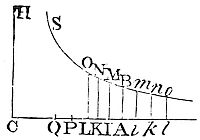
For let the force of gravity be expounded by the given line AC; the force of resistance by the indefinite line AK; the absolute force in the descent of the body by the difference KC; the velocity of the body by a line AP, which shall be a mean proportional between AK and AC, and therefore in a subduplicate ratio of the resistance; the increment of the resistance made in a given particle of time by the lineola KL, and the contemporaneous increment of the velocity by the lineola PQ; and with the centre C, and rectangular asymptotes CA, CH, describe any hyperbola BNS meeting the erected perpendiculars AB, KN, LO in B, N and O. Because AK is as AP2, the moment KL of the one will be as the moment 2APQ of the other, that is, as AP × KC; for the increment PQ of the velocity is (by Law II) proportional to the generating force KC. Let the ratio of KL be compounded with the ratio KN, and the rectangle KL × KN will become as AP × KC × KN; that is (because the rectangle KC × KN is given), as AP. But the ultimate ratio of the hyperbolic area KNOL to the rectangle KL × KN becomes, when the points K and L coincide, the ratio of equality. Therefore that hyperbolic evanescent area is as AP. Therefore the whole hyperbolic area ABOL is composed of particles KNOL which are always proportional to the velocity AP; and therefore is itself proportional to the space described with that velocity. Let that area be now divided into equal parts, as ABMI, IMNK, KNOL, &c., and the absolute forces AC, IC, KC, LC, &c., will be in a geometrical progression. Q.E.D. And by a like reasoning, in the ascent of the body, taking, on the contrary side of the point A, the equal areas ABmi, imnk, knol, &c., it will appear that the absolute forces AC, iC, kC, lC, &c., are continually proportional. Therefore if all the spaces in the ascent and descent are taken equal, all the absolute forces lC, kC, iC, AC, IC, KC, LC, &c., will be continually proportional. Q.E.D.
COR. 1. Hence if the space described be expounded by the hyperbolic area ABNK, the force of gravity, the velocity of the body, and the resistance of the medium, may be expounded by the lines AC, AP, and AK respectively; and vice versa.
COR. 2. And the greatest velocity which the body can ever acquire in an infinite descent will be expounded by the line AC.
COR. 3. Therefore if the resistance of the medium answering to any given velocity be known, the greatest velocity will be found, by taking it to that given velocity in a ratio subduplicate of the ratio which the force of gravity bears to that known resistance of the medium.
PROPOSITION IX. THEOREM VII.
Supposing what is above demonstrated, I say, that if the tangents of the angles of the sector of a circle, and of an hyperbola, be taken proportional to the velocities, the radius being of a fit magnitude, all the time of the ascent to the highest place will be as the sector of the circle, and all the time of descending from the highest place as the sector of the hyperbola.
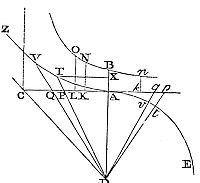
To the right line AC, which expresses the force of gravity, let AD be drawn perpendicular and equal. From the centre D with the semi-diameter AD describe as well the quadrant AtE of a circle, as the rectangular hyperbola AVZ, whose axis is AK, principal vertex A, and asymptote DC. Let Dp, DP be drawn; and the circular sector AtD will be as all the time of the ascent to the highest place; and the hyperbolic sector ATD as all the time of descent from the highest place; if so be that the tangents Ap, AP of those sectors be as the velocities.
CASE 1. Draw Dvq cutting off the moments or least particles tDv and qDp, described in the same time, of the sector ADt and of the triangle ADp. Since those particles (because of the common angle D) are in a duplicate ratio of the sides, the particle tDv will be as , that is (because tD is given), as . But is , that is, , or ; and qDp is . Therefore tDv, the particle of the sector, is as ; that is, as the least decrement pq of the velocity directly, and the force Ck which diminishes the velocity, inversely; and therefore as the particle of time answering to the decrement of the velocity. And, by composition, the sum of all the particles tDv in the sector ADt will be as the sum of the particles of time answering to each of the lost particles pq of the decreasing velocity Ap, till that velocity, being diminished into nothing, vanishes; that is, the whole sector ADt is as the whole time of ascent to the highest place. Q.E.D.
CASE 2. Draw DQV cutting off the least particles TDV and PDQ of the sector DAV, and of the triangle DAQ; and these particles will be to each other as DT2 to DP2, that is (if TX and AP are parallel), as DX2 to DA2 or TX2 to AP2; and, by division, as DX2 - TX2 to DA2 - AP2. But, from the nature of the hyperbola, DX2 - TX2 is AD2; and, by the supposition, AP2 is AD × AK. Therefore the particles are to each other as AD2 to AD2 - AD × AK; that is, as AD to AD - AK or AC to CK: and therefore the particle TDV of the sector is ; and therefore (because AC and AD are given) as ; that is, as the increment of the velocity directly, and as the force generating the increment inversely; and therefore as the particle of the time answering to the increment. And, by composition, the sum of the particles of time, in which all the particles PQ of the velocity AP are generated, will be as the sum of the particles of the sector ATD; that is, the whole time will be as the whole sector. Q.E.D.
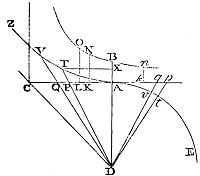
COR. 1. Hence if AB be equal to a fourth part of AC, the space which a body will describe by falling in any time will be to the space which the body could describe, by moving uniformly on in the same time with its greatest velocity AC, as the area ABNK, which expresses the space described in falling to the area ATD, which expresses the time. For since AC is to AP as AP to AK, then (by Cor. 1, Lem. II, of this Book) LK is to PQ as 2AK to AP, that is, as 2AP to AC, and thence LK is to as AP to or AB; and KN is to AC or AD as AB to CK; and therefore, ex æquo, LKNO to DPQ as AP to CK. But DPQ was to DTV as CK to AC. Therefore, ex æquo, LKNO is to DTV as AP to AC; that is, as the velocity of the falling body to the greatest velocity which the body by falling can acquire. Since, therefore, the moments LKNO and DTV of the areas ABNK and ATD are as the velocities, all the parts of those areas generated in the same time will be as the spaces described in the same time; and therefore the whole areas ABNK and ADT, generated from the beginning, will be as the whole spaces described from the beginning of the descent. Q.E.D.
COR. 2. The same is true also of the space described in the ascent. That is to say, that all that space is to the space described in the same time, with the uniform velocity AC, as the area ABnk is to the sector ADt.
COR. 3. The velocity of the body, falling in the time ATD, is to the velocity which it would acquire in the same time in a non-resisting space, as the triangle APD to the hyperbolic sector ATD. For the velocity in a non-resisting medium would be as the time ATD, and in a resisting medium is as AP, that is, as the triangle APD. And those velocities, at the beginning of the descent, are equal among themselves, as well as those areas ATD, APD.
COR. 4. By the same argument, the velocity in the ascent is to the velocity with which the body in the same time, in a non-resisting space, would lose all its motion of ascent, as the triangle ApD to the circular sector AtD; or as the right line Ap to the arc At.
COR. 5. Therefore the time in which a body, by falling in a resisting medium, would acquire the velocity AP, is to the time in which it would acquire its greatest velocity AC, by falling in a non-resisting space, as the sector ADT to the triangle ADC: and the time in which it would lose its velocity Ap, by ascending in a resisting medium, is to the time in which it would lose the same velocity by ascending in a non-resisting space, as the arc At to its tangent Ap.
COR. 6. Hence from the given time there is given the space described in the ascent or descent. For the greatest velocity of a body descending in infinitum is given (by Corol. 2 and 3, Theor. VI, of this Book); and thence the time is given in which a body would acquire that velocity by falling in a non-resisting space. And taking the sector ADT or ADt to the triangle ADC in the ratio of the given time to the time just now found, there will be given both the velocity AP or Ap, and the area ABNK or ABnk, which is to the sector ADT, or ADt, as the space sought to the space which would, in the given time, be uniformly described with that greatest velocity found just before.
COR. 7. And by going backward, from the given space of ascent or descent ABnk or ABNK, there will be given the time ADt or ADT.
PROPOSITION X. PROBLEM III.
Suppose the uniform force of gravity to tend directly to the plane of the horizon, and the resistance to be as the density of the medium and the square of the velocity conjunctly: it is proposed to find the density of the medium in each place, which shall make the body move in any given curve line; the velocity of the body and the resistance of the medium in each place.
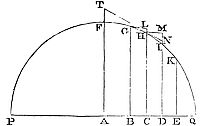
Let PQ be a plane perpendicular to the plane of the scheme itself; PFHQ a curve line meeting that plane in the points P and Q; G, H, I, K four places of the body going on in this curve from F to Q; and GB, HC, ID, KE four parallel ordinates let fall from these points to the horizon, and standing on the horizontal line PQ at the points B, C, D, E; and let the distances BC, CD, DE, of the ordinates be equal among themselves. From the points G and H let the right lines GL, HN, be drawn touching the curve in G and H, and meeting the ordinates CH, DI, produced upwards, in L and N: and complete the parallelogram HCDM. And the times in which the body describes the arcs GH, HI, will be in a subduplicate ratio of the altitudes LH, NI, which the bodies would describe in those times, by falling from the tangents; and the velocities will be as the lengths described GH, HI directly, and the times inversely. Let the times be expounded by T and t, and the velocities by and ; the decrement of the velocity produced in the time t will be expounded by . This decrement arises from the resistance which retards the body, and from the gravity which accelerates it. Gravity, in a falling body, which in its fall describes the space NI, produces a velocity with which it would be able to describe twice that space in the same time, as Galileo has demonstrated; that is, the velocity : but if the body describes the arc HI, it augments that arc only by the length or ; and therefore generates only the velocity . Let this velocity be added to the before-mentioned decrement, and we shall have the decrement of the velocity arising from the resistance alone, that is, . Therefore since, in the same time, the action of gravity generates, in a falling body, the velocity , the resistance will be to the gravity as to or as to .
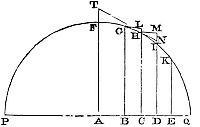
Now for the abscissas CB, CD, CE, put -o, o, 2o. For the ordinate CH put P; and for MI put any series Qo + Ro2 + So3 +, &c. And all the terms of the series after the first, that is, Ro2 + So3 +, &c., will be NI; and the ordinates DI, EK, and BG will be P - Qo - Ro2 - So3 -, &c., P - 2Qo - 4Ro2 - 8So3 -, &c., and P + Qo - Ro2 + So3 -, &c., respectively. And by squaring the differences of the ordinates BG - CH and CH - DI, and to the squares thence produced adding the squares of BC and CD themselves, you will have oo + QQoo - 2QRo3 +, &c., and oo + QQoo + 2QRo3 +, &c., the squares of the arcs GH, HI; whose roots , and are the arcs GH and HI. Moreover, if from the ordinate CH there be subducted half the sum of the ordinates BG and DI, and from the ordinate DI there be subducted half the sum of the ordinates CH and EK, there will remain Roo and Roo + 3So3, the versed sines of the arcs GI and HK. And these are proportional to the lineolæ LH and NI, and therefore in the duplicate ratio of the infinitely small times T and t: and thence the ratio is or ; and , by substituting the values of , GH, HI, MI and NI just found, becomes . And since 2NI is 2Roo, the resistance will be now to the gravity as to 2Roo, that is, as to 4RR.
And the velocity will be such, that a body going off therewith from any place H, in the direction of the tangent HN, would describe, in vacuo, a parabola, whose diameter is HC, and its latus rectum or .
And the resistance is as the density of the medium and the square of the velocity conjunctly; and therefore the density of the medium is as the resistance directly, and the square of the velocity inversely; that is, as directly and inversely; that is, as Q.E.I.
COR. 1. If the tangent HN be produced both ways, so as to meet any ordinate AF in will be equal to , and therefore in what has gone before may be put for . By this means the resistance will be to the gravity as 3S × HT to 4RR × AC; the velocity will be as , and the density of the medium will be as .
COR. 2. And hence, if the curve line PFHQ be defined by the relation between the base or abscissa AC and the ordinate CH, as is usual, and the value of the ordinate be resolved into a converging series, the Problem will be expeditiously solved by the first terms of the series; as in the following examples.
EXAMPLE 1. Let the line PFHQ be a semi-circle described upon the diameter PQ, to find the density of the medium that shall make a projectile move in that line.
Bisect the diameter PQ in A; and call AQ, n; AC, a; CH, e; and CD, o; then DI2 or AQ2 - AD2 = nn - aa - 2ao - oo, or ee - 2ao - oo; and the root being extracted by our method, will give , &c. Here put nn for ee + aa, and DI will become , &c.
Such series I distinguish into successive terms after this manner: I call that the first term in which the infinitely small quantity o is not found; the second, in which that quantity is of one dimension only; the third, in which it arises to two dimensions; the fourth, in which it is of three; and so ad infinitum. And the first term, which here is e, will always denote the length of the ordinate CH, standing at the beginning of the indefinite quantity o. The second term, which here is , will denote the difference between CH and DN; that is, the lineola MN which is cut off by completing the parallelogram HCDM; and therefore always determines the position of the tangent HN; as, in this case, by taking MN to HM as to o, or a to e. The third term, which here is , will represent the lineola IN, which lies between the tangent and the curve; and therefore determines the angle of contact IHN, or the curvature which the curve line has in H. If that lineola IN is of a finite magnitude, it will be expressed by the third term, together with those that follow in infinitum. But if that lineola be diminished in infinitum, the terms following become infinitely less than the third term, and therefore may be neglected. The fourth term determines the variation of the curvature; the fifth, the variation of the variation; and so on. Whence, by the way, appears no contemptible use of these series in the solution of problems that depend upon tangents, and the curvature of curves.
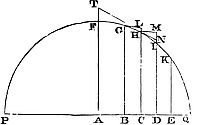
Now compare the series &c., with the series P - Qo - Roo - So3 - &c., and for P, Q, R and S, put e, , and , and for put or ; and the density of the medium will come out as ; that is (because n is given), as or , that is, as that length of the tangent HT, which is terminated at the semi-diameter AF standing perpendicularly on PQ: and the resistance will be to the gravity as 3a to 2n, that is, as 3AC to the diameter PQ of the circle; and the velocity will be as . Therefore if the body goes from the place F, with a due velocity, in the direction of a line parallel to PQ, and the density of the medium in each of the places H is as the length of the tangent HT, and the resistance also in any place H is to the force of gravity as 3AC to PQ, that body will describe the quadrant FHQ of a circle. Q.E.I.
But if the same body should go from the place P, in the direction of a line perpendicular to PQ, and should begin to move in an arc of the semi-circle PFQ, we must take AC or a on the contrary side of the centre A; and therefore its sign must be changed, and we must put -a for +a. Then the density of the medium would come out as . But nature does not admit of a negative density, that is, a density which accelerates the motion of bodies; and therefore it cannot naturally come to pass that a body by ascending from P should describe the quadrant PF of a circle. To produce such an effect, a body ought to be accelerated by an impelling medium, and not impeded by a resisting one.
EXAMPLE 2. Let the line PFQ be a parabola, having its axis AF perpendicular to the horizon PQ, to find the density of the medium, which will make a projectile move in that line.
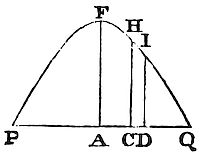
From the nature of the parabola, the rectangle PDQ is equal to the rectangle under the ordinate DI and some given right line; that is, if that right line be called b; PC, a; PQ, c; CH, e; and CD, o; the rectangle a + o into c - a - o or ac - aa - 2ao + co - oo, is equal to the rectangle b into DI, and therefore DI is equal to . Now the second term of this series is to be put for Qo, and the third term for Roo. But since there are no more terms, the co-efficient S of the fourth term will vanish; and therefore the quantity , to which the density of the medium is proportional, will be nothing. Therefore, where the medium is of no density, the projectile will move in a parabola; as Galileo hath heretofore demonstrated. Q.E.I.
EXAMPLE 3. Let the line AGK be an hyperbola, having its asymptote NX perpendicular to the horizontal plane AK, to find the density of the medium that will make a projectile move in that line.
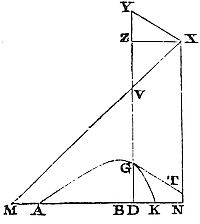
Let MX be the other asymptote, meeting the ordinate DG produced in V; and from the nature of the hyperbola, the rectangle of XV into VG will be given. There is also given the ratio of DN to VX, and therefore the rectangle of DN into VG is given. Let that be bb: and, completing the parallelogram DNXZ, let BN be called a; BD, o; NX, c; and let the given ratio of VZ to ZX or DN be . Then DN will be equal to a - o, VG equal to , VZ equal to , and GD or NX - VZ - VG equal to . Let the term be resolved into the converging series , &c., and GD will become equal to &c. The second term of this series is to be used for Qo; the third , with its sign changed for Ro2; and the fourth , with its sign changed also for So3, and their coefficients , and are to be put for Q, R, and S in the former rule. Which being done, the density of the medium will come out as , or , that is, if in VZ you take VY equal to VG, as . For aa and are the squares of XZand ZY. But the ratio of the resistance to gravity is found to be that of 3XY to 2YG; and the velocity is that with which the body would describe a parabola, whose vertex is G, diameter DG, latus rectum . Suppose, therefore, that the densities of the medium in each of the places G are reciprocally as the distances XY, and that the resistance in any place G is to the gravity as 3XY to 2YG; and a body let go from the place A, with a due velocity, will describe that hyperbola AGK. Q.E.I.
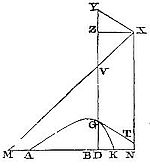
EXAMPLE 4. Suppose, indefinitely, the line AGK to be an hyperbola described with the centre X, and the asymptotes MX, NX, so that, having constructed the rectangle XZDN, whose side ZD cuts the hyperbola in G and its asymptote in V, VG may be reciprocally as any power DNn of the line ZX or DN, whose index is the number n: to find the density of the medium in which a projected body will describe this curve.
For BN, BD, NX, put A, O, C, respectively, and let VZ be to XZ or DN as d to e, and VG be equal to ; then DN will be equal to A - O, , , and GD or NX - VZ - VG equal to . Let the term be resolved into an infinite series , &c., and GD will be equal to , &c. The second term of this series is to be used for Qo, the third for Roo, the fourth for . And thence the density of the medium , in any place G, will be and therefore if in VZ you take VY equal to n × VG, that density is reciprocally as XY. For A2 and are the squares of XZ and ZY. But the resistance in the same place G is to the force of gravity as to 4RR, that is, as XY to . And the velocity there is the same wherewith the projected body would move in a parabola, whose vertex is G, diameter GD, and latus rectum or . Q.E.I.
SCHOLIUM.
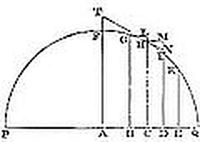
In the same manner that the density of the medium comes out to be as , in Cor. 1, if the resistance is put as any power Vn of the velocity V, the density of the medium will come out to be as . And therefore if a curve can be found, such that the ratio of to or of to may be given; the body, in an uniform medium, whose resistance is as the power Vn of the velocity V, will move in this curve. But let us return to more simple curves.
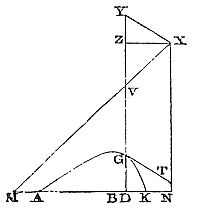
Because there can be no motion in a parabola except in a non-resisting medium, but in the hyperbolas here described it is produced by a perpetual resistance; it is evident that the line which a projectile describes in an uniformly resisting medium approaches nearer to these hyperbolas than to a parabola. That line is certainly of the hyperbolic kind, but about the vertex it is more distant from the asymptotes, and in the parts remote from the vertex draws nearer to them than these hyperbolas here described. The difference, however, is not so great between the one and the other but that these latter may be commodiously enough used in practice instead of the former. And perhaps these may prove more useful than an hyperbola that is more accurate, and at the same time more compounded. They may be made use of, then, in this manner.
Complete the parallelogram XYGT, and the right line GT will touch the hyperbola in G, and therefore the density of the medium in G is reciprocally as the tangent GT, and the velocity there as ; and the resistance is to the force of gravity as GT to .
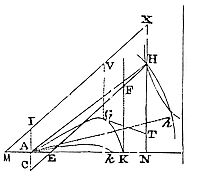
Therefore if a body projected from the place A, in the direction of the right line AH, describes the hyperbola AGK and AH produced meets the asymptote NX in H, and AI drawn parallel to it meets the other asymptote MX in I; the density of the medium in A will be reciprocally as AH, and the velocity of the body as , and the resistance there to the force of gravity as AH to . Hence the following rules are deduced.
RULE 1. If the density of the medium at A, and the velocity with which the body is projected remain the same, and the angle NAH be changed, the lengths AH, AI, HX will remain. Therefore if those lengths, in any one case, are found, the hyperbola may afterwards be easily determined from any given angle NAH.
RULE 2. If the angle NAH, and the density of the medium at A, remain the same, and the velocity with which the body is projected be changed, the length AH will continue the same; and AI will be changed in a duplicate ratio of the velocity reciprocally.
RULE 3. If the angle NAH, the velocity of the body at A, and the accelerative gravity remain the same, and the proportion of the resistance at A to the motive gravity be augmented in any ratio; the proportion of AH to AI will be augmented in the same ratio, the latus rectum of the above-mentioned parabola remaining the same, and also the length proportional to it; and therefore AH will be diminished in the same ratio, and AI will be diminished in the duplicate of that ratio. But the proportion of the resistance to the weight is augmented, when either the specific gravity is made less, the magnitude remaining equal, or when the density of the medium is made greater, or when, by diminishing the magnitude, the resistance becomes diminished in a less ratio than the weight.
RULE 4. Because the density of the medium is greater near the vertex of the hyperbola than it is in the place A, that a mean density may be preserved, the ratio of the least of the tangents GT to the tangent AH ought to be found, and the density in A augmented in a ratio a little greater than that of half the sum of those tangents to the least of the tangents GT.
RULE 5. If the lengths AH, AI are given, and the figure AGK is to be described, produce HN to X, so that HX may be to AI as n + 1 to 1; and with the centre X, and the asymptotes MX, NX, describe an hyperbola through the point A, such that AI may be to any of the lines VG as XVn to XIn.
RULE 6. By how much the greater the number n is, so much the more accurate are these hyperbolas in the ascent of the body from A, and less accurate in its descent to K; and the contrary. The conic hyperbola keeps a mean ratio between these, and is more simple than the rest. Therefore if the hyperbola be of this kind, and you are to find the point K, where the projected body falls upon any right line AN passing through the point A, let AN produced meet the asymptotes MX, NX in M and N, and take NK equal to AM.
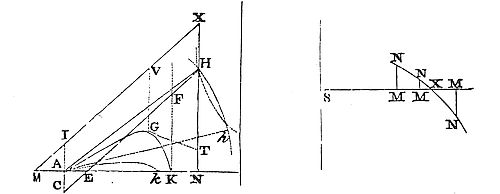
RULE 7. And hence appears an expeditious method of determining this hyperbola from the phenomena. Let two similar and equal bodies be projected with the same velocity, in different angles HAK, hAk, and let them fall upon the plane of the horizon in K and k; and note the proportion of AK to Ak. Let it be as d to e. Then erecting a perpendicular AI of any length, assume any how the length AH or Ah, and thence graphically, or by scale and compass, collect the lengths AK, Ak (by Rule 6). If the ratio of AK to Ak be the same with that of d to e, the length of AH was rightly assumed. If not, take on the indefinite right line SM, the length SM equal to the assumed AH; and erect a perpendicular MN equal to the difference of the ratios drawn into any given right line. By the like method, from several assumed lengths AH, you may find several points N; and draw through them all a regular curve NNXN, cutting the right line SMMM in X. Lastly, assume AH equal to the abscissa SX, and thence find again the length AK; and the lengths, which are to the assumed length AI, and this last AH, as the length AK known by experiment, to the length AK last found, will be the true lengths AI and AH, which were to be found. But these being given, there will be given also the resisting force of the medium in the place A, it being to the force of gravity as AH to . Let the density of the medium be increased by Rule 4, and if the resisting force just found be increased in the same ratio, it will become still more accurate.
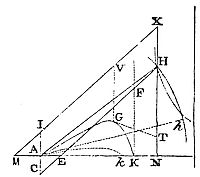
RULE 8. The lengths AH, HX being found; let there be now required the position of the line AH, according to which a projectile thrown with that given velocity shall fall upon any point K. At the points A and K, erect the lines AC, KF perpendicular to the horizon; whereof let AC be drawn downwards, and be equal to AI or . With the asymptotes AK, KF, describe an hyperbola, whose conjugate shall pass through the point C; and from the centre A, with the interval AH, describe a circle cutting that hyperbola in the point H; then the projectile thrown in the direction of the right line AH will fall upon the point K. Q.E.I. For the point H, because of the given length AH, must be somewhere in the circumference of the described circle. Draw CH meeting AK and KF in E and F; and because CH, MX are parallel, and AC, AI equal, AE will be equal to AM, and therefore also equal to KN. But CE is to AE as FH to KN, and therefore CE and FH are equal. Therefore the point H falls upon the hyperbolic curve described with the asymptotes AK, KF whose conjugate passes through the point C; and is therefore found in the common intersection of this hyperbolic curve and the circumference of the described circle. Q.E.D. It is to be observed that this operation is the same, whether the right line AKN be parallel to the horizon, or inclined thereto in any angle; and that from two intersections H, h, there arise two angles NAH, NAh; and that in mechanical practice it is sufficient once to describe a circle, then to apply a ruler CH, of an indeterminate length, so to the point C, that its part FH, intercepted between the circle and the right line FK, may be equal to its part CE placed between the point C and the right line AK.
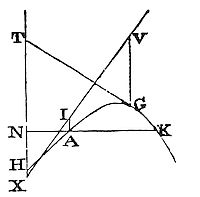
What has been said of hyperbolas may be easily applied to parabolas. For if a parabola be represented by XAGK, touched by a right line XV in the vertex X, and the ordinates IA, VG be as any powers XIn, XVn, of the abscissas XI, XV; draw XT, GT, AH, whereof let XT be parallel to VG, and let GT, AH touch the parabola in G and A: and a body projected from any place A, in the direction of the right line AH, with a due velocity, will describe this parabola, if the density of the medium in each of the places G be reciprocally as the tangent GT. In that case the velocity in G will be the same as would cause a body, moving in a non-resisting space, to describe a conic parabola, having G for its vertex, VG produced downwards for its diameter, and for its latus rectum. And the resisting force in G will be to the force of gravity as GT to . Therefore if NAK represent an horizontal line, and both the density of the medium at A, and the velocity with which the body is projected, remaining the same, the angle NAH be any how altered, the lengths AH, AI, HX will remain; and thence will be given the vertex X of the parabola, and the position of the right line XI; and by taking VG to IA as XVn to XIn, there will be given all the points G of the parabola, through which the projectile will pass.
SECTION III.
Of the motions of bodies which are resisted partly in the ratio of the velocities, and partly in the duplicate of the same ratio.
PROPOSITION XI. THEOREM VIII.
If a body be resisted partly in the ratio and partly in the duplicate ratio of its velocity, and moves in a similar medium by its innate force only; and the times be taken in arithmetical progression; then quantities reciprocally proportional to the velocities, increased by a certain given quantity, will be in geometrical progression.
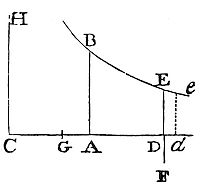
With the centre C, and the rectangular asymptotes CADd and CH, describe an hyperbola BEe, and let AB, DE, de, be parallel to the asymptote CH. In the asymptote CD let A, G be given points; and if the time be expounded by the hyperbolic area ABED uniformly increasing, I say, that the velocity may be expressed by the length DF, whose reciprocal GD, together with the given line CG, compose the length CD increasing in a geometrical progression.
For let the areola DEed be the least given increment of the time, and Dd will be reciprocally as DE, and therefore directly as CD. Therefore the decrement of , which (by Lem. II, Book II) is , will be also as or , that is, as . Therefore the time ABED uniformly increasing by the addition of the given particles EDde, it follows that decreases in the same ratio with the velocity. For the decrement of the velocity is as the resistance, that is (by the supposition), as the sum of two quantities, whereof one is as the velocity, and the other as the square of the velocity; and the decrement of is as the sum of the quantities and , whereof the first is itself, and the last is as : therefore is as the velocity, the decrements of both being analogous. And if the quantity GD reciprocally proportional to , be augmented by the given quantity CG; the sum CD, the time ABED uniformly increasing, will increase in a geometrical progression. Q.E.D.
COR. 1. Therefore, if, having the points A and G given, the time be expounded by the hyperbolic area ABED, the velocity may be expounded by the reciprocal of GD.
COR. 2. And by taking GA to GD as the reciprocal of the velocity at the beginning to the reciprocal of the velocity at the end of any time ABED, the point G will be found. And that point being found the velocity may be found from any other time given.
PROPOSITION XII. THEOREM IX.
The same things being supposed, I say, that if the spaces described are taken in arithmetical progression, the velocities augmented by a certain given quantity will be in geometrical progression.
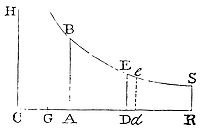
In the asymptote CD let there be given the point R, and, erecting the perpendicular RS meeting the hyperbola in S, let the space described be expounded by the hyperbolic area RSED; and the velocity will be as the length GD, which, together with the given line CG, composes a length CD decreasing in a geometrical progression, while the space RSED increases in an arithmetical progression.
For, because the increment EDde of the space is given, the lineola Dd, which is the decrement of GD, will be reciprocally as ED, and therefore directly as CD; that is, as the sum of the same GD and the given length CG. But the decrement of the velocity, in a time reciprocally proportional thereto, in which the given particle of space DdeE is described, is as the resistance and the time conjunctly, that is, directly as the sum of two quantities, whereof one is as the velocity, the other as the square of the velocity, and inversely as the velocity; and therefore directly as the sum of two quantities, one of which is given, the other is as the velocity. Therefore the decrement both of the velocity and the line GD is as a given quantity and a decreasing quantity conjunctly; and, because the decrements are analogous, the decreasing quantities will always be analogous; viz., the velocity, and the line GD. Q.E.D.
COR. 1. If the velocity be expounded by the length GD, the space described will be as the hyperbolic area DESR.
COR. 2. And if the point G be assumed any how, the point G will be found, by taking GR to GD as the velocity at the beginning to the velocity after any space RSED is described. The point G being given, the space is given from the given velocity: and the contrary.
COR. 3. Whence since (by Prop. XI) the velocity is given from the given time, and (by this Prop.) the space is given from the given velocity; the space will be given from the given time: and the contrary.
PROPOSITION XIII. THEOREM X.
Supposing that a body attracted downwards by an uniform gravity ascends or descends in a right line; and that the same is resisted partly in the ratio of its velocity, and partly in the duplicate ratio thereof: I say, that, if right lines parallel to the diameters of a circle and an hyperbola, be drawn through the ends of the conjugate diameters, and the velocities be as some segments of those parallels drawn from a given point, the times will be as the sectors of the areas cut off by right lines drawn from the centre to the ends of the segments; and the contrary.
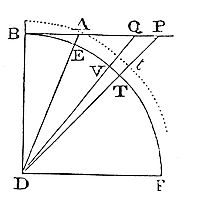
CASE 1. Suppose first that the body is ascending, and from the centre D, with any semi-diameter DB, describe a quadrant BETF of a circle, and through the end B of the semi-diameter DF draw the indefinite line BAP, parallel to the semi-diameter DF. In that line let there be given the point A, and take the segment AP proportional to the velocity. And since one part of the resistance is as the velocity, and another part as the square of the velocity, let the whole resistance be as AP2 + 2BAP. Join DA, DP, cutting the circle in E and T, and let the gravity be expounded by DA2, so that the gravity shall be to the resistance in P as DA2 to AP2 + 2BAP; and the time of the whole ascent will be as the sector EDT of the circle.
For draw DVQ, cutting off the moment PQ, of the velocity AP, and the moment DTV of the sector DET answering to a given moment of time; and that decrement PQ of the velocity will be as the sum of the forces of gravity DA2 and of resistance AP2 + 2BAP, that is (by Prop. XII, Book II, Elem.), as DP2. Then the area DPQ, which is proportional to PQ, is as DP2, and the area DTV, which is to the area DPQ as DT2 to DP2, is as the given quantity DT2. Therefore the area EDT decreases uniformly according to the rate of the future time, by subduction of given particles DTV, and is therefore proportional to the time of the whole ascent. Q.E.D.
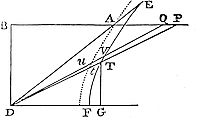
CASE 2. If the velocity in the ascent of the body be expounded by the length AP as before, and the resistance be made as AP2 + 2BAP, and if the force of gravity be less than can be expressed by DA2; take BD of such a length, that AB2 - BD2 may be proportional to the gravity, and let DF be perpendicular and equal to DB, and through the vertex F describe the hyperbola FTVE, whose conjugate semi-diameters are DB and DF, and which cuts DA in E, and DP, DQ in T and V; and the time of the whole ascent will be as the hyperbolic sector TDE.
For the decrement PQ. of the velocity, produced in a given particle of time, is as the sum of the resistance AP2 + 2BAP and of the gravity AB2 - BD2, that is, as BP2 - BD2. But the area DTV is to the area DPQ as DT2 to DP2; and, therefore, if GT be drawn perpendicular to DF, as GT2 or GD2 - DF2 to BD2, and as GD2 to BP2, and, by division, as DF2 to BP2 - BD2. Therefore since the area DPQ is as PQ, that is, as BP2 - BD2, the area DTV will be as the given quantity DF2. Therefore the area EDT decreases uniformly in each of the equal particles of time, by the subduction of so many given particles DTV, and therefore is proportional to the time. Q.E.D.
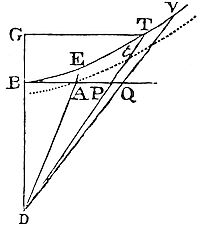
CASE 3. Let AP be the velocity in the descent of the body, and AP2 + 2BAP the force of resistance, and BD2 - AB2 the force of gravity, the angle DBA being a right one. And if with the centre D, and the principal vertex B, there be described a rectangular hyperbola BETV cutting DA, DP, and DQ produced in E, T, and V; the sector DET of this hyperbola will be as the whole time of descent.
For the increment PQ of the velocity, and the area DPQ proportional to it, is as the excess of the gravity above the resistance, that is, as BD2 - AB2 - 2BAP - AP2 or BD2 - BP2. And the area DTV is to the area DPQ as DT2 to DP2; and therefore as GT2 or GD2 - BD2 to BP2, and as GD2 to BD2, and, by division, as BD2 to BD2 - BP2. Therefore since the area DPQ is as BD2 - BP2, the area DTV will be as the given quantity BD2. Therefore the area EDT increases uniformly in the several equal particles of time by the addition of as many given particles DTV, and therefore is proportional to the time of the descent. Q.E.D.
COR. If with the centre D and the semi-diameter DA there be drawn through the vertex A an arc At similar to the arc ET, and similarly subtending the angle ADT, the velocity AP will be to the velocity which the body in the time EDT, in a non-resisting space, can lose in its ascent, or acquire in its descent, as the area of the triangle DAP to the area of the sector DAt; and therefore is given from the time given. For the velocity in a non-resisting medium is proportional to the time, and therefore to this sector; in a resisting medium, it is as the triangle; and in both mediums, where it is least, it approaches to the ratio of equality, as the sector and triangle do.
SCHOLIUM.
One may demonstrate also that case in the ascent of the body, where the force of gravity is less than can be expressed by DA2 or AB2 + BD2, and greater than can be expressed by AB2 - DB2, and must be expressed by AB2. But I hasten to other things.
PROPOSITION XIV. THEOREM XI.
The same things being supposed, I say, that the space described in the ascent or descent is as the difference of the area by which the time is expressed, and of some other area which is augmented or diminished in an arithmetical progression; if the forces compounded of the resistance and the gravity be taken in a geometrical progression.
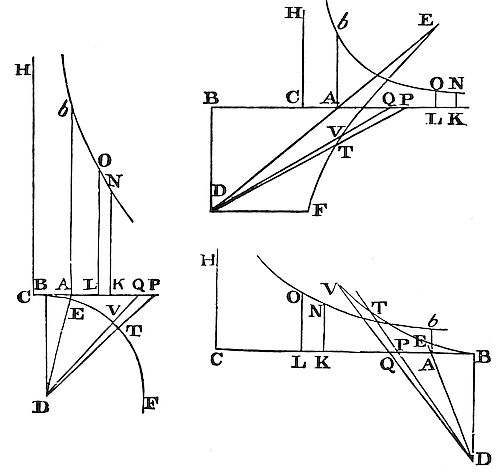
Take AC (in these three figures) proportional to the gravity, and AK to the resistance; but take them on the same side of the point A, if the body is descending, otherwise on the contrary. Erect Ab, which make to DB as DB2 to 4BAC: and to the rectangular asymptotes CK, CH, describe the hyperbola bN; and, erecting KN perpendicular to CK, the area AbNK will be augmented or diminished in an arithmetical progression, while the forces CK are taken in a geometrical progression. I say, therefore, that the distance of the body from its greatest altitude is as the excess of the area AbNK above the area DET.
For since AK is as the resistance, that is, as AP2 × 2BAP; assume any given quantity Z, and put AK equal to ; then (by Lem. II of this Book) the moment KL of AK will be equal to or , and the moment KLON of the area AbNK will be equal to or .
CASE 1. Now if the body ascends, and the gravity be as AB2 + BD2 BET being a circle, the line AC, which is proportional to the gravity, will be , and DP2 or AP2 + 2BAP + AB2 + BD2 will be AK × Z + AC × Z or CK × Z; and therefore the area DTV will be to the area DPQ as DT2 or DB2 to CK × Z.
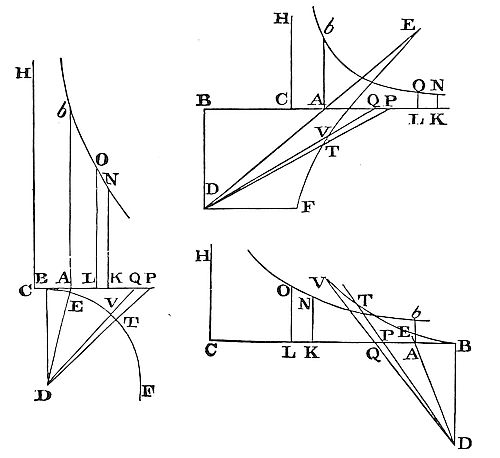
CASE 2. If the body ascends, and the gravity be as AB2 - BD2, the line AC will be , and DT2 will be to DP2 as DF2 or DB2 to BP2 - BD2 or AP2 + 2BAP + AB2 - BD2, that is, to AK × Z + AC × Z or CK × Z. And therefore the area DTV will be to the area DPQ as DB2 to CK × Z.
CASE 3. And by the same reasoning, if the body descends, and therefore the gravity is as BD2 - AB2, and the line AC becomes equal to ; the area DTV will be to the area DPQ as DB2 to CK × Z: as above.
Since, therefore, these areas are always in this ratio, if for the area DTV, by which the moment of the time, always equal to itself, is expressed, there be put any determinate rectangle, as BD × m, the area DPQ, that is, , will be to BD × m as CK × Z to BD2. And thence PQ × BD3 becomes equal to 2BD × m × CK × Z, and the moment KLON of the area AbNK, found before, becomes . From the area DET subduct its moment DTV or BD × m, and there will remain . Therefore the difference of the moments, that is, the moment of the difference of the areas, is equal to ; and therefore as the velocity AP; that is, as the moment of the space which the body describes in its ascent or descent. And therefore the difference of the areas, and that space, increasing or decreasing by proportional moments, and beginning together or vanishing together, are proportional. Q.E.D.
COR. If the length, which arises by applying the area DET to the line BD, be called M; and another length V be taken in that ratio to the length M, which the line DA has to the line DE; the space which a body, in a resisting medium, describes in its whole ascent or descent, will be to the space which a body, in a non-resisting medium, falling from rest, can describe in the same time, as the difference of the aforesaid areas to ; and therefore is given from the time given. For the space in a non-resisting medium is in a duplicate ratio of the time, or as V2; and, because BD and AB are given, as . This area is equal to the area and the moment of M is m; and therefore the moment of this area is . But this moment is to the moment of the difference of the aforesaid areas DET and AbNK, viz., to , as to , or as into DET to DAP; and, therefore, when the areas DET and DAP are least, in the ratio of equality. Therefore the area and the difference of the areas DET and AbNK, when all these areas are least, have equal moments; and are therefore equal. Therefore since the velocities, and therefore also the spaces in both mediums described together, in the beginning of the descent, or the end of the ascent, approach to equality, and therefore are then one to another as the area , and the difference of the areas DET and AbNK; and moreover since the space, in a non-resisting medium, is perpetually as , and the space, in a resisting medium, is perpetually as the difference of the areas DET and AbNK; it necessarily follows, that the spaces, in both mediums, described in any equal times, are one to another as that area , and the difference of the areas DET and AbNK. Q.E.D.
SCHOLIUM.
The resistance of spherical bodies in fluids arises partly from the tenacity, partly from the attrition, and partly from the density of the medium. And that part of the resistance which arises from the density of the fluid is, as I said, in a duplicate ratio of the velocity; the other part, which arises from the tenacity of the fluid, is uniform, or as the moment of the time; and, therefore, we might now proceed to the motion of bodies, which are resisted partly by an uniform force, or in the ratio of the moments of the time, and partly in the duplicate ratio of the velocity. But it is sufficient to have cleared the way to this speculation in Prop. VIII and IX foregoing, and their Corollaries. For in those Propositions, instead of the uniform resistance made to an ascending body arising from its gravity, one may substitute the uniform resistance which arises from the tenacity of the medium, when the body moves by its vis insita alone; and when the body ascends in a right line, add this uniform resistance to the force of gravity, and subduct it when the body descends in a right line. One might also go on to the motion of bodies which are resisted in part uniformly, in part in the ratio of the velocity, and in part in the duplicate ratio of the same velocity. And I have opened a way to this in Prop. XIII and XIV foregoing, in which the uniform resistance arising from the tenacity of the medium may be substituted for the force of gravity, or be compounded with it as before. But I hasten to other things.
SECTION IV.
Of the circular motion of bodies in resisting mediums.
LEMMA III.
Let PQR be a spiral cutting all the radii SP, SQ, SR, &c., in equal angles. Draw the right line PT touching the spiral in any point P, and cutting the radius SQ in T; draw PO, QO perpendicular to the spiral, and meeting in O, and join SO. I say, that if the points P and Q approach and coincide, the angle PSO will become a right angle, and the ultimate ratio of the rectangle TQ × 2PS to PQ2 will be the ratio of equality.
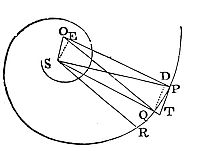
For from the right angles OPQ, OQR, subduct the equal angles SPQ, SQR, and there will remain the equal angles OPS, OQS. Therefore a circle which passes through the points OSP will pass also through the point Q. Let the points P and Q coincide, and this circle will touch the spiral in the place of coincidence PQ, and will therefore cut the right line OP perpendicularly. Therefore OP will become a diameter of this circle, and the angle OSP, being in a semi-circle, becomes a right one. Q.E.D.
Draw QD, SE perpendicular to OP, and the ultimate ratios of the lines will be as follows: TQ to PD as TS or PS to PE, or 2PO to 2PS; and PD to PQ as PQ to 2PO; and, ex æquo perturbatè, to TQ to PQ as PQ to 2PS. Whence PQ2 becomes equal to TQ × 2PS. Q.E.D.
PROPOSITION XV. THEOREM XII.
If the density of a medium in each place thereof be reciprocally as the distance of the places from an immovable centre, and the centripetal force be in the duplicate ratio of the density; I say, that a body may revolve in a spiral which cuts all the radii drawn from that centre in a given angle.
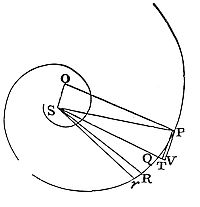
Suppose every thing to be as in the foregoing Lemma, and produce SQ to V so that SV may be equal to SP. In any time let a body, in a resisting medium, describe the least arc PQ, and in double the time the least arc PR; and the decrements of those arcs arising from the resistance, or their differences from the arcs which would be described in a non-resisting medium in the same times, will be to each other as the squares of the times in which they are generated; therefore the decrement of the arc PQ, is the fourth part of the decrement of the arc PR. Whence also if the area QSr be taken equal to the area PSQ, the decrement of the arc PQ will be equal to half the lineola Rr; and therefore the force of resistance and the centripetal force are to each other as the lineola and TQ which they generate in the same time. Because the centripetal force with which the body is urged in P is reciprocally as SP2, and (by Lem. X, Book I) the lineola TQ, which is generated by that force, is in a ratio compounded of the ratio of this force and the duplicate ratio of the time in which the arc PQ is described (for in this case I neglect the resistance, as being infinitely less than the centripetal force), it follows that TQ × SP2, that is (by the last Lemma), , will be in a duplicate ratio of the time, and therefore the time is as ; and the velocity of the body, with which the arc PQ is described in that time, as or , that is, in the subduplicate ratio of SP reciprocally. And, by a like reasoning, the velocity with which the arc QR is described, is in the subduplicate ratio of SQ reciprocally. Now those arcs PQ and QR are as the describing velocities to each other; that is, in the subduplicate ratio of SQ to SP, or as SQ to ; and, because of the equal angles SPQ, SQr, and the equal areas PSQ, QSr, the arc PQ is to the arc Qr as SQ to SP. Take the differences of the proportional consequents, and the arc PQ will be to the arc Rr as SQ to , or . For the points P and Q coinciding, the ultimate ratio of to is the ratio of equality. Because the decrement of the arc PQ arising from the resistance, or its double Rr, is as the resistance and the square of the time conjunctly, the resistance will be as . But PQ was to Rr as SQ to , and thence becomes as , or as . For the points P and Q coinciding, SP and SQ coincide also, and the angle PVQ becomes a right one; and, because of the similar triangles PVQ, PSO, PQ becomes to as OP to . Therefore is as the resistance, that is, in the ratio of the density of the medium in P and the duplicate ratio of the velocity conjunctly. Subduct the duplicate ratio of the velocity, namely, the ratio , and there will remain the density of the medium in P, as . Let the spiral be given, and, because of the given ratio of OS to OP, the density of the medium in P will be as . Therefore in a medium whose density is reciprocally as SP the distance from the centre, a body will revolve in this spiral. Q.E.D.