Book 2 — BOOK II. (continued 2)
Andrew Motte translation
COR. 1. The velocity in any place P, is always the same wherewith a body in a non-resisting medium with the same centripetal force would revolve in a circle, at the same distance SP from the centre.
COR. 2. The density of the medium, if the distance SP be given, is as , but if that distance is not given, as . And thence a spiral may be fitted to any density of the medium.
COR. 3. The force of the resistance in any place P is to the centripetal force in the same place as to OP. For those forces are to each other as and TQ, or as and , that is, as and PQ, or and OP. The spiral therefore being given, there is given the proportion of the resistance to the centripetal force; and, vice versa, from that proportion given the spiral is given.
COR. 4. Therefore the body cannot revolve in this spiral, except where the force of resistance is less than half the centripetal force. Let the resistance be made equal to half the centripetal force, and the spiral will coincide with the right line PS, and in that right line the body will descend to the centre with a velocity that is to the velocity, with which it was proved before, in the case of the parabola (Theor. X, Book I), the descent would be made in a non-resisting medium, in the subduplicate ratio of unity to the number two. And the times of the descent will be here reciprocally as the velocities, and therefore given.
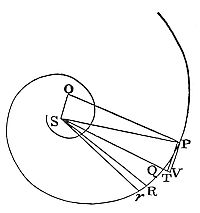
COR. 5. And because at equal distances from the centre the velocity is the same in the spiral PQR as it is in the right line SP, and the length of the spiral is to the length of the right line PS in a given ratio, namely, in the ratio of OP to OS; the time of the descent in the spiral will be to the time of the descent in the right line SP in the same given ratio, and therefore given.
COR. 6. If from the centre S, with any two given intervals, two circles are described; and these circles remaining, the angle which the spiral makes with the radius PS be any how changed; the number of revolutions which the body can complete in the space between the circumferences of those circles, going round in the spiral from one circumference to another, will be as , or as the tangent of the angle which the spiral makes with the radius PS; and the time of the same revolutions will be as , that is, as the secant of the same angle, or reciprocally as the density of the medium.
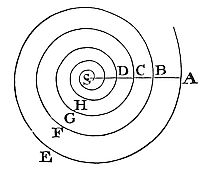
COR. 7. If a body, in a medium whose density is reciprocally as the distances of places from the centre, revolves in any curve AEB about that centre, and cuts the first radius AS in the same angle in B as it did before in A, and that with a velocity that shall be to its first velocity in A reciprocally in a subduplicate ratio of the distances from the centre (that is, as AS to a mean proportional between AS and BS) that body will continue to describe innumerable similar revolutions BFC, CGD, &c., and by its intersections will distinguish the radius AS into parts AS, BS, CS, DS, &c., that are continually proportional. But the times of the revolutions will be as the perimeters of the orbits AEB, BFC, CGD, &c., directly, and the velocities at the beginnings A, B, C of those orbits inversely; that is as , , . And the whole time in which the body will arrive at the centre, will be to the time of the first revolution as the sum of all the continued proportionals , , , going on ad infinitum, to the first term ; that is, as the first term to the difference of the two first , or as to AB very nearly. Whence the whole time may be easily found.
COR. 8. From hence also may be deduced, near enough, the motions of bodies in mediums whose density is either uniform, or observes any other assigned law. From the centre S, with intervals SA, SB, SC, &c., continually proportional, describe as many circles; and suppose the time of the revolutions between the perimeters of any two of those circles, in the medium whereof we treated, to be to the time of the revolutions between the same in the medium proposed as the mean density of the proposed medium between those circles to the mean density of the medium whereof we treated, between the same circles, nearly: and that the secant of the angle in which the spiral above determined, in the medium whereof we treated, cuts the radius AS, is in the same ratio to the secant of the angle in which the new spiral, in the proposed medium, cuts the same radius: and also that the number of all the revolutions between the same two circles is nearly as the tangents of those angles. If this be done every where between every two circles, the motion will be continued through all the circles. And by this means one may without difficulty conceive at what rate and in what time bodies ought to revolve in any regular medium.
COR. 9. And although these motions becoming eccentrical should be performed in spirals approaching to an oval figure, yet, conceiving the several revolutions of those spirals to be at the same distances from each other, and to approach to the centre by the same degrees as the spiral above described, we may also understand how the motions of bodies may be performed in spirals of that kind.
PROPOSITION XVI. THEOREM XIII.
If the density of the medium in each of the places be reciprocally as the distance of the places from the immoveable centre, and the centripetal force be reciprocally as any power of the same distance, I say, that the body may revolve in a spiral intersecting all the radii drawn from that centre in a given angle.
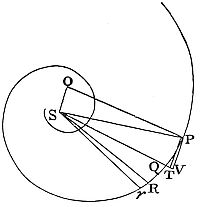
This is demonstrated in the same manner as the foregoing Proposition. For if the centripetal force in P be reciprocally as any power of the distance SP whose index is n + 1; it will be collected, as above, that the time in which the body describes any arc PQ, will be as ; and the resistance in P as , or as , and therefore as , that is, is a given quantity), reciprocally as . And therefore, since the velocity is reciprocally as , the density in P will be reciprocally as SP.
COR. 1. The resistance is to the centripetal force as to OP.
COR. 2. If the centripetal force be reciprocally as SP3, will be = 0; and therefore the resistance and density of the medium will be nothing, as in Prop. IX, Book I.
COR. 3. If the centripetal force be reciprocally as any power of the radius SP, whose index is greater than the number 3, the affirmative resistance will be changed into a negative.
SCHOLIUM.
This Proposition and the former, which relate to mediums of unequal density, are to be understood of the motion of bodies that are so small, that the greater density of the medium on one side of the body above that on the other is not to be considered. I suppose also the resistance, cæteris paribus, to be proportional to its density. Whence, in mediums whose force of resistance is not as the density, the density must be so much augmented or diminished, that either the excess of the resistance may be taken away, or the defect supplied.
PROPOSITION XVII. PROBLEM IV.
To find the centripetal force and the resisting force of the medium, by which a body, the law of the velocity being given, shall revolve in a given spiral.
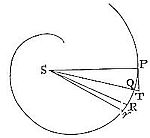
Let that spiral be PQR. From the velocity, with which the body goes over the very small arc PQ, the time will be given; and from the altitude TQ, which is as the centripetal force, and the square of the time, that force will be given. Then from the difference RSr of the areas PSQ and QSR described in equal particles of time, the retardation of the body will be given; and from the retardation will be found the resisting force and density of the medium.
PROPOSITION XVIII. PROBLEM V.
The law of centripetal force being given, to find the density of the medium in each of the places thereof, by which a body may describe a given spiral.
From the centripetal force the velocity in each place must be found; then from the retardation of the velocity the density of the medium is found, as in the foregoing Proposition.
But I have explained the method of managing these Problems in the tenth Proposition and second Lemma of this Book; and will no longer detain the reader in these perplexed disquisitions. I shall now add some things relating to the forces of progressive bodies, and to the density and resistance of those mediums in which the motions hitherto treated of, and those akin to them, are performed.
SECTION V.
Of the density and compression of fluids; and of hydrostatics.
THE DEFINITION OF A FLUID.
A fluid is any body whose parts yield to any force impressed on it, by yielding, are easily moved among themselves.
PROPOSITION XIX. THEOREM XIV.
All the parts of a homogeneous and unmoved fluid included in any unmoved vessel, and compressed on every side (setting aside the consideration of condensation, gravity, and all centripetal forces), will be equally pressed on every side, and remain in their places without any motion arising from that pressure.
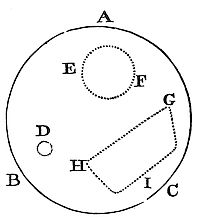
CASE 1. Let a fluid be included in the spherical vessel ABC, and uniformly compressed on every side: I say, that no part of it will be moved by that pressure. For if any part, as D, be moved, all such parts at the same distance from the centre on every side must necessarily be moved at the same time by a like motion; because the pressure of them all is similar and equal; and all other motion is excluded that does not arise from that pressure. But if these parts come all of them nearer to the centre, the fluid must be condensed towards the centre, contrary to the supposition. If they recede from it, the fluid must be condensed towards the circumference; which is also contrary to the supposition. Neither can they move in any one direction retaining their distance from the centre, because for the same reason, they may move in a contrary direction; but the same part cannot be moved contrary ways at the same time. Therefore no part of the fluid will be moved from its place. Q.E.D.
CASE 2. I say now, that all the spherical parts of this fluid are equally pressed on every side. For let EF be a spherical part of the fluid; if this be not pressed equally on every side, augment the lesser pressure till it be pressed equally on every side; and its parts (by Case 1) will remain in their places. But before the increase of the pressure, they would remain in their places (by Case 1); and by the addition of a new pressure they will be moved, by the definition of a fluid, from those places. Now these two conclusions contradict each other. Therefore it was false to say that the sphere EF was not pressed equally on every side. Q.E.D.
CASE 3. I say besides, that different spherical parts have equal pressures. For the contiguous spherical parts press each other mutually and equally in the point of contact (by Law III). But (by Case 2) they are pressed on every side with the same force. Therefore any two spherical parts not contiguous, since an intermediate spherical part can touch both, will be pressed with the same force. Q.E.D.
CASE 4. I say now, that all the parts of the fluid are every where pressed equally. For any two parts may be touched by spherical parts in any points whatever; and there they will equally press those spherical parts (by Case 3), and are reciprocally equally pressed by them (by Law III). Q.E.D.
CASE 5. Since, therefore, any part GHI of the fluid is inclosed by the rest of the fluid as in a vessel, and is equally pressed on every side; and also its parts equally press one another, and are at rest among themselves; it is manifest that all the parts of any fluid as GHI, which is pressed equally on every side, do press each other mutually and equally, and are at rest among themselves. Q.E.D.
CASE 6. Therefore if that fluid be included in a vessel of a yielding substance, or that is not rigid, and be not equally pressed on every side, the same will give way to a stronger pressure, by the Definition of fluidity.
CASE 7. And therefore, in an inflexible or rigid vessel, a fluid will not sustain a stronger pressure on one side than on the other, but will give way to it, and that in a moment of time; because the rigid side of the vessel does not follow the yielding liquor. But the fluid, by thus yielding, will press against the opposite side, and so the pressure will tend on every side to equality. And because the fluid, as soon as it endeavours to recede from the part that is most pressed, is withstood by the resistance of the vessel on the opposite side, the pressure will on every side be reduced to equality, in a moment of time, without any local motion: and from thence the parts of the fluid (by Case 5) will press each other mutually and equally, and be at rest among themselves. Q.E.D.
COR. Whence neither will a motion of the parts of the fluid among themselves be changed by a pressure communicated to the external superficies, except so far as either the figure of the superficies may be somewhere altered, or that all the parts of the fluid, by pressing one another more intensely or remissly, may slide with more or less difficulty among themselves.
PROPOSITION XX. THEOREM XV.
If all the parts of a spherical fluid, homogeneous at equal distances from the centre, lying on a spherical concentric bottom, gravitate towards the centre of the whole, the bottom will sustain the weight of a cylinder, whose base is equal to the superficies of the bottom, and whose altitude is the same with that of the incumbent fluid.
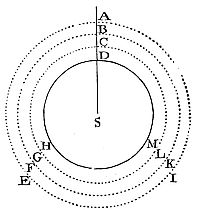
Let DHM be the superficies of the bottom, and AEI the upper superficies of the fluid. Let the fluid be distinguished into concentric orbs of equal thickness, by the innumerable spherical superficies BFK, CGL: and conceive the force of gravity to act only in the upper superficies of every orb, and the actions to be equal on the equal parts of all the superficies. Therefore the upper superficies AE is pressed by the single force of its own gravity, by which all the parts of the upper orb, and the second superficies BFK, will (by Prop. XIX), according to its measure, be equally pressed. The second superficies BFK is pressed likewise by the force of its own gravity, which, added to the former force, makes the pressure double. The third superficies CGL is, according to its measure, acted on by this pressure and the force of its own gravity besides, which makes its pressure triple. And in like manner the fourth superficies receives a quadruple pressure, the fifth superficies a quintuple, and so on. Therefore the pressure acting on every superficies is not as the solid quantity of the incumbent fluid, but as the number of the orbs reaching to the upper surface of the fluid; and is equal to the gravity of the lowest orb multiplied by the number of orbs: that is, to the gravity of a solid whose ultimate ratio to the cylinder above-mentioned (when the number of the orbs is increased and their thickness diminished, ad infinitum, so that the action of gravity from the lowest superficies to the uppermost may become continued) is the ratio of equality. Therefore the lowest superficies sustains the weight of the cylinder above determined. Q.E.D. And by a like reasoning the Proposition will be evident, where the gravity of the fluid decreases in any assigned ratio of the distance from the centre, and also where the fluid is more rare above and denser below. Q.E.D.
COR. 1. Therefore the bottom is not pressed by the whole weight of the incumbent fluid, but only sustains that part of it which is described in the Proposition; the rest of the weight being sustained archwise by the spherical figure of the fluid.
COR. 2. The quantity of the pressure is the same always at equal distances from the centre, whether the superficies pressed be parallel to the horizon, or perpendicular, or oblique; or whether the fluid, continued upwards from the compressed superficies, rises perpendicularly in a rectilinear direction, or creeps obliquely through crooked cavities and canals, whether those passages be regular or irregular, wide or narrow. That the pressure is not altered by any of these circumstances, may be collected by applying the demonstration of this Theorem to the several cases of fluids.
COR. 3. From the same demonstration it may also be collected (by Prop. XIX), that the parts of a heavy fluid acquire no motion among themselves by the pressure of the incumbent weight, except that motion which arises from condensation.
COR. 4. And therefore if another body of the same specific gravity, incapable of condensation, be immersed in this fluid, it will acquire no motion by the pressure of the incumbent weight: it will neither descend nor ascend, nor change its figure. If it be spherical, it will remain so, notwithstanding the pressure; if it be square, it will remain square; and that, whether it be soft or fluid; whether it swims freely in the fluid, or lies at the bottom. For any internal part of a fluid is in the same state with the submersed body; and the case of all submersed bodies that have the same magnitude, figure, and specific gravity, is alike. If a submersed body, retaining its weight, should dissolve and put on the form of a fluid, this body, if before it would have ascended, descended, or from any pressure assume a new figure, would now likewise ascend, descend, or put on a new figure; and that, because its gravity and the other causes of its motion remain. But (by Case 5, Prop. XIX) it would now be at rest, and retain its figure. Therefore also in the former case.
COR. 5. Therefore a body that is specifically heavier than a fluid contiguous to it will sink; and that which is specifically lighter will ascend, and attain so much motion and change of figure as that excess or defect of gravity is able to produce. For that excess or defect is the same thing as an impulse, by which a body, otherwise in equilibrio with the parts of the fluid, is acted on; and may be compared with the excess or defect of a weight in one of the scales of a balance.
COR. 6. Therefore bodies placed in fluids have a twofold gravity; the one true and absolute, the other apparent, vulgar, and comparative. Absolute gravity is the whole force with which the body tends downwards; relative and vulgar gravity is the excess of gravity with which the body tends downwards more than the ambient fluid. By the first kind of gravity the parts of all fluids and bodies gravitate in their proper places; and therefore their weights taken together compose the weight of the whole. For the whole taken together is heavy, as may be experienced in vessels full of liquor; and the weight of the whole is equal to the weights of all the parts, and is therefore composed of them. By the other kind of gravity bodies do not gravitate in their places; that is, compared with one another, they do not preponderate, but, hindering one another's endeavours to descend, remain in their proper places, as if they were not heavy. Those things which are in the air, and do not preponderate, are commonly looked on as not heavy. Those which do preponderate are commonly reckoned heavy, in as much as they are not sustained by the weight of the air. The common weights are nothing else but the excess of the true weights above the weight of the air. Hence also, vulgarly, those things are called light which are less heavy, and, by yielding to the preponderating air, mount upwards. But these are only comparatively light and not truly so, because they descend in vacuo. Thus, in water, bodies which, by their greater or less gravity, descend or ascend, are comparatively and apparently heavy or light; and their comparative and apparent gravity or levity is the excess or defect by which their true gravity either exceeds the gravity of the water or is exceeded by it. But those things which neither by preponderating descend, nor, by yielding to the preponderating fluid, ascend, although by their true weight they do increase the weight of the whole, yet comparatively, and in the sense of the vulgar, they do not gravitate in the water. For these cases are alike demonstrated.
COR. 7. These things which have been demonstrated concerning gravity take place in any other centripetal forces.
COR. 8. Therefore if the medium in which any body moves be acted on either by its own gravity, or by any other centripetal force, and the body be urged more powerfully by the same force; the difference of the forces is that very motive force, which, in the foregoing Propositions, I have considered as a centripetal force. But if the body be more lightly urged by that force, the difference of the forces becomes a centrifugal force, and is to be considered as such.
COR. 9. But since fluids by pressing the included bodies do not change their external figures, it appears also (by Cor. Prop. XIX) that they will not change the situation of their internal parts in relation to one another; and therefore if animals were immersed therein, and that all sensation did arise from the motion of their parts, the fluid will neither hurt the immersed bodies, nor excite any sensation, unless so far as those bodies may be condensed by the compression. And the case is the same of any system of bodies encompassed with a compressing fluid. All the parts of the system will be agitated with the same motions as if they were placed in a vacuum, and would only retain their comparative gravity; unless so far as the fluid may somewhat resist their motions, or be requisite to conglutinate them by compression.
PROPOSITION XXI. THEOREM XVI.
Let the density of any fluid be proportional to the compression, and its parts be attracted downwards by a centripetal force reciprocally proportional to the distances from the centre: I say, that, if those distances be taken continually proportional, the densities of the fluid at the same distances will be also continually proportional.
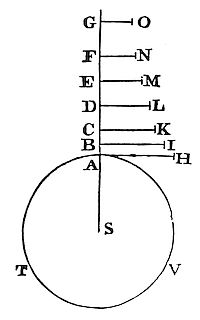
Let ATV denote the spherical bottom of the fluid, S the centre, SA, SB, SC, SD, SE, SF, &c., distances continually proportional. Erect the perpendiculars AH, BI, CK, DL, EM, FN, &c., which shall be as the densities of the medium in the places A, B, C, D, E, F; and the specific gravities in those places will be as , , , &c., or, which is all one, as , , , &c. Suppose, first, these gravities to be uniformly continued from A to B, from B to C, from C to D, &c., the decrements in the points B, C, D, &c., being taken by steps. And these gravities drawn into the altitudes AB, BC, CD, &c., will give the pressures AH, BI, CK, &c., by which the bottom ATV is acted on (by Theor. XV). Therefore the particle A sustains all the pressures AH, BI, CK, DL, &c., proceeding in infinitum; and the particle B sustains the pressures of all but the first AH; and the particle C all but the two first AH, BI; and so on: and therefore the density AH of the first particle A is to the density BI of the second particle B as the sum of all AH + BI + CK + DL, in infinitum, to the sum of all BI + CK + DL, &c. And BI the density of the second particle B is to CK the density of the third C, as the sum of all BI + CK + DL, &c., to the sum of all CK + DL, &c. Therefore these sums are proportional to their differences AH, BI, CK, &c., and therefore continually proportional (by Lem. 1 of this Book); and therefore the differences AH, BI, CK, &c., proportional to the sums, are also continually proportional. Wherefore since the densities in the places A, B, C, &c., are as AH, BI, CK, &c., they will also be continually proportional. Proceed intermissively, and, ex æquo, at the distances SA, SC, SE, continually proportional, the densities AH, CK, EM will be continually proportional. And by the same reasoning, at any distances SA, SD, SG, continually proportional, the densities AH, DL, GO, will be continually proportional. Let now the points A, B, C, D, E, &c., coincide, so that the progression of the specific gravities from the bottom A to the top of the fluid may be made continual; and at any distances SA, SD, SG, continually proportional, the densities AH, DL, GO, being all along continually proportional, will still remain continually proportional. Q.E.D.
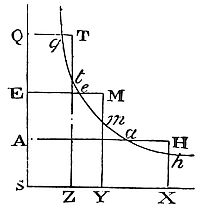
COR. Hence if the density of the fluid in two places, as A and E, be given, its density in any other place Q may be collected. With the centre S, and the rectangular asymptotes SQ, SX, describe an hyperbola cutting the perpendiculars AH, EM, QT in a, e, and q, as also the perpendiculars HX, MY, TZ, let fall upon the asymptote SX, in h, m, and t. Make the area YmtZ to the given area YmhX as the given area EeqQ to the given area EeaA; and the line Zt produced will cut off the line QT proportional to the density. For if the lines SA, SE, SQ are continually proportional, the areas EeqQ, EeaA will be equal, and thence the areas YmtZ, XhmY, proportional to them, will be also equal; and the lines SX, SY, SZ, that is, AH, EM, QT continually proportional, as they ought to be. And if the lines SA, SE, SQ, obtain any other order in the series of continued proportionals, the lines AH, EM, QT, because of the proportional hyperbolic areas, will obtain the same order in another series of quantities continually proportional.
PROPOSITION XXII. THEOREM XVII.
Let the density of any fluid be proportional to the compression, and its parts be attracted downwards by a gravitation reciprocally proportional to the squares of the distances from the centre: I say, that if the distances be taken in harmonic progression, the densities of the fluid at those distances will be in a geometrical progression.
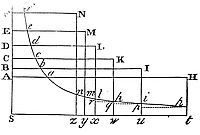
Let S denote the centre, and SA, SB, SC, SD, SE, the distances in geometrical progression. Erect the perpendiculars AH, BI, CK, &c., which shall be as the densities of the fluid in the places A, B, C, D, E, &c., and the specific gravities thereof in those places will be as , , , &c. Suppose these gravities to be uniformly continued, the first from A to B, the second from B to C, the third from C to D, &c. And these drawn into the altitudes AB, BC, CD, DE, &c., or, which is the same thing, into the distances SA, SB, SC, &c., proportional to those altitudes, will give , , , &c., the exponents of the pressures. Therefore since the densities are as the sums of those pressures, the differences AH - BI, BI - CK, &c., of the densities will be as the differences of those sums , , &c. With the centre S, and the asymptotes SA, Sx, describe any hyperbola, cutting the perpendiculars AH, BI, CK, &c., in a, b, c, &c., and the perpendiculars Ht, Iu, Kw, let fall upon the asymptote Sx, in h, i, k; and the differences of the densities tu, uw, &c., will be as , , &c. And the rectangles tu × th, uw × ui, &c., or tp, uq, &c., as , , &c., that is, as Aa, Bb, &c. For, by the nature of the hyperbola, SA is to AH or St as th to Aa, and therefore is equal to Aa. And, by a like reasoning, is equal to Bb, &c. But Aa, Bb, Cc, &c., are continually proportional, and therefore proportional to their differences Aa - Bb, Bb - Cc, &c., therefore the rectangles tp, uq, &c., are proportional to those differences; as also the sums of the rectangles tp + uq, or tp + uq + wr to the sums of the differences Aa - Cc or Aa - Dd. Suppose several of these terms, and the sum of all the differences, as Aa - Ff, will be proportional to the sum of all the rectangles, as zthn. Increase the number of terms, and diminish the distances of the points A, B, C, &c., in infinitum, and those rectangles will become equal to the hyperbolic area zthn, and therefore the difference Aa - Ff is proportional to this area. Take now any distances, as SA, SD, SF, in harmonic progression, and the differences Aa - Dd, Dd - Ff will be equal; and therefore the areas thlx, xlnz, proportional to those differences will be equal among themselves, and the densities St, Sx, Sz, that is, AH, DL, FN, continually proportional. Q.E.D.
COR. Hence if any two densities of the fluid, as AH and BI, be given, the area thiu, answering to their difference tu, will be given; and thence the density FN will be found at any height SF, by taking the area thnz to that given area thiu as the difference Aa - Ff to the difference Aa - Bb.
SCHOLIUM.
By a like reasoning it may be proved, that if the gravity of the particles of a fluid be diminished in a triplicate ratio of the distances from the centre; and the reciprocals of the squares of the distances SA, SB, SC, &c., be taken in an arithmetical progression, the densities AH, BI, CK, &c., will be in a geometrical progression. And if the gravity be diminished in a quadruplicate ratio of the distances, and the reciprocals of the cubes of the distances be taken in arithmetical progression, the densities AH, BI, CK, &c., will be in geometrical progression. And so in infinitum. Again; if the gravity of the particles of the fluid be the same at all distances, and the distances be in arithmetical progression, the densities will be in a geometrical progression as Dr. Halley has found. If the gravity be as the distance, and the squares of the distances be in arithmetical progression, the densities will be in geometrical progression. And so in infinitum. These things will be so, when the density of the fluid condensed by compression is as the force of compression; or, which is the same thing, when the space possessed by the fluid is reciprocally as this force. Other laws of condensation may be supposed, as that the cube of the compressing force may be as the biquadrate of the density; or the triplicate ratio of the force the same with the quadruplicate ratio of the density: in which case, if the gravity be reciprocally as the square of the distance from the centre, the density will be reciprocally as the cube of the distance. Suppose that the cube of the compressing force be as the quadrato-cube of the density; and if the gravity be reciprocally as the square of the distance, the density will be reciprocally in a sesquiplicate ratio of the distance. Suppose the compressing force to be in a duplicate ratio of the density, and the gravity reciprocally in a duplicate ratio of the distance, and the density will be reciprocally as the distance. To run over all the cases that might be offered would be tedious. But as to our own air, this is certain from experiment, that its density is either accurately, or very nearly at least, as the compressing force; and therefore the density of the air in the atmosphere of the earth is as the weight of the whole incumbent air, that is, as the height of the mercury in the barometer.
PROPOSITION XXIII. THEOREM XVIII.
If a fluid be composed of particles mutually flying each other, and the density be as the compression, the centrifugal forces of the particles will be reciprocally proportional to the distances of their centres. And, vice versa, particles flying each other, with forces that are reciprocally proportional to the distances of their centres, compose an elastic fluid, whose density is as the compression.
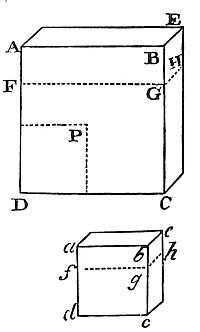
Let the fluid be supposed to be included in a cubic space ACE, and then to be reduced by compression into a lesser cubic space ace; and the distances of the particles retaining a like situation with respect to each other in both the spaces, will be as the sides AB, ab of the cubes; and the densities of the mediums will be reciprocally as the containing spaces AB3, ab3. In the plane side of the greater cube ABCD take the square DP equal to the plane side db of the lesser cube: and, by the supposition, the pressure with which the square DP urges the inclosed fluid will be to the pressure with which that square db urges the inclosed fluid as the densities of the mediums are to each other, that is, as ab3 to AB3. But the pressure with which the square DB urges the included fluid is to the pressure with which the square DP urges the same fluid as the square DB to the square DP, that is, as AB2 to ab2. Therefore, ex æquo, the pressure with which the square DB urges the fluid is to the pressure with which the square db urges the fluid as ab to AB. Let the planes FGH, fgh, be drawn through the middles of the two cubes, and divide the fluid into two parts. These parts will press each other mutually with the same forces with which they are themselves pressed by the planes AC, ac, that is, in the proportion of ab to AB: and therefore the centrifugal forces by which these pressures are sustained are in the same ratio. The number of the particles being equal, and the situation alike, in both cubes, the forces which all the particles exert, according to the planes FGH, fgh, upon all, are as the forces which each exerts on each. Therefore the forces which each exerts on each, according to the plane FGH in the greater cube, are to the forces which each exerts on each, according to the plane fgh in the lesser cube, as ab to AB, that is, reciprocally as the distances of the particles from each other. Q.E.D.
And, vice versa, if the forces of the single particles are reciprocally as the distances, that is, reciprocally as the sides of the cubes AB, ab; the sums of the forces will be in the same ratio, and the pressures of the sides DB, db as the sums of the forces; and the pressure of the square DP to the pressure of the side DB as ab2 to AB2. And, ex æquo, the pressure of the square DP to the pressure of the side db as ab3 to AB3; that is, the force of compression in the one to the force of compression in the other as the density in the former to the density in the latter. Q.E.D.
SCHOLIUM.
By a like reasoning, if the centrifugal forces of the particles are reciprocally in the duplicate ratio of the distances between the centres, the cubes of the compressing forces will be as the biquadrates of the densities. If the centrifugal forces be reciprocally in the triplicate or quadruplicate ratio of the distances, the cubes of the compressing forces will be as the quadrato-cubes, or cubo-cubes of the densities. And universally, if D be put for the distance, and E for the density of the compressed fluid, and the centrifugal forces be reciprocally as any power Dn of the distance, whose index is the number n, the compressing forces will be as the cube roots of the power , whose index is the number n + 2; and the contrary. All these things are to be understood of particles whose centrifugal forces terminate in those particles that are next them, or are diffused not much further. We have an example of this in magnetical bodies. Their attractive virtue is terminated nearly in bodies of their own kind that are next them. The virtue of the magnet is contracted by the interposition of an iron plate, and is almost terminated at it: for bodies further off are not attracted by the magnet so much as by the iron plate. If in this manner particles repel others of their own kind that lie next them, but do not exert their virtue on the more remote, particles of this kind will compose such fluids as are treated of in this Proposition. If the virtue of any particle diffuse itself every way in infinitum, there will be required a greater force to produce an equal condensation of a greater quantity of the fluid. But whether elastic fluids do really consist of particles so repelling each other, is a physical question. We have here demonstrated mathematically the property of fluids consisting of particles of this kind, that hence philosophers may take occasion to discuss that question.
SECTION VI.
Of the motion and resistance of funependulous bodies.
PROPOSITION XXIV. THEOREM XIX.
The quantities of matter in funependulous bodies, whose centres of oscillation are equally distant from the centre of suspension, are in a ratio compounded of the ratio of the weights and the duplicate ratio of the times of the oscillations in vacuo.
For the velocity which a given force can generate in a given matter in a given time is as the force and the time directly, and the matter inversely. The greater the force or the time is, or the less the matter, the greater velocity will be generated. This is manifest from the second Law of Motion. Now if pendulums are of the same length, the motive forces in places equally distant from the perpendicular are as the weights: and therefore if two bodies by oscillating describe equal arcs, and those arcs are divided into equal parts; since the times in which the bodies describe each of the correspondent parts of the arcs are as the times of the whole oscillations, the velocities in the correspondent parts of the oscillations will be to each other as the motive forces and the whole times of the oscillations directly, and the quantities of matter reciprocally: and therefore the quantities of matter are as the forces and the times of the oscillations directly and the velocities reciprocally. But the velocities reciprocally are as the times, and therefore the times directly and the velocities reciprocally are as the squares of the times; and therefore the quantities of matter are as the motive forces and the squares of the times, that is, as the weights and the squares of the times. Q.E.D.
COR. 1. Therefore if the times are equal, the quantities of matter in each of the bodies are as the weights.
COR. 2. If the weights are equal, the quantities of matter will be as the squares of the times.
COR. 3. If the quantities of matter are equal, the weights will be reciprocally as the squares of the times.
COR. 4. Whence since the squares of the times, cæteris paribus, are as the lengths of the pendulums, therefore if both the times and quantities of matter are equal, the weights will be as the lengths of the pendulums.
COR. 5. And universally, the quantity of matter in the pendulous body is as the weight and the square of the time directly, and the length of the pendulum inversely.
COR. 6. But in a non-resisting medium, the quantity of matter in the pendulous body is as the comparative weight and the square of the time directly, and the length of the pendulum inversely. For the comparative weight is the motive force of the body in any heavy medium, as was shewn above; and therefore does the same thing in such a non-resisting medium as the absolute weight does in a vacuum.
COR. 7. And hence appears a method both of comparing bodies one among another, as to the quantity of matter in each; and of comparing the weights of the same body in different places, to know the variation of its gravity. And by experiments made with the greatest accuracy, I have always found the quantity of matter in bodies to be proportional to their weight.
PROPOSITION XXV. THEOREM XX.
Funependulous bodies that are, in any medium, resisted in the ratio of the moments of time, and funependulous bodies that move in a non-resisting medium of the same specific gravity, perform their oscillations in a cycloid in the same time, and describe proportional parts of arcs together.
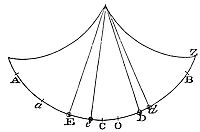
Let AB be an arc of a cycloid, which a body D, by vibrating in a non-resisting medium, shall describe in any time. Bisect that arc in C, so that C may be the lowest point thereof; and the accelerative force with which the body is urged in any place D, or d or E, will be as the length of the arc CD, or Cd, or CE. Let that force be expressed by that same arc; and since the resistance is as the moment of the time, and therefore given, let it be expressed by the given part CO of the cycloidal arc, and take the arc Od in the same ratio to the arc CD that the arc OB has to the arc CB: and the force with which the body in d is urged in a resisting medium, being the excess of the force Cd above the resistance CO, will be expressed by the arc Od, and will therefore be to the force with which the body D is urged in a non-resisting medium in the place D, as the arc Od to the arc CD; and therefore also in the place B, as the arc OB to the arc CB. Therefore if two bodies D, d go from the place B, and are urged by these forces; since the forces at the beginning are as the arc CB and OB, the first velocities and arcs first described will be in the same ratio. Let those arcs be BD and Bd, and the remaining arcs CD, Od, will be in the same ratio. Therefore the forces, being proportional to those arcs CD, Od, will remain in the same ratio as at the beginning, and therefore the bodies will continue describing together arcs in the same ratio. Therefore the forces and velocities and the remaining arcs CD, Od, will be always as the whole arcs CB, OB, and therefore those remaining arcs will be described together. Therefore the two bodies D and d will arrive together at the places C and O; that which moves in the non-resisting medium, at the place C, and the other, in the resisting medium, at the place O. Now since the velocities in C and O are as the arcs CB, OB, the arcs which the bodies describe when they go farther will be in the same ratio. Let those arcs be CE and Oe. The force with which the body D in a non-resisting medium is retarded in E is as CE, and the force with which the body d in the resisting medium is retarded in e, is as the sum of the force Ce and the resistance CO, that is, as Oe; and therefore the forces with which the bodies are retarded are as the arcs CB, OB, proportional to the arcs CE, Oe; and therefore the velocities, retarded in that given ratio, remain in the same given ratio. Therefore the velocities and the arcs described with those velocities are always to each other in that given ratio of the arcs CB and OB; and therefore if the entire arcs AB, aB are taken in the same ratio, the bodies D and d will describe those arcs together, and in the places A and a will lose all their motion together. Therefore the whole oscillations are isochronal, or are performed in equal times; and any parts of the arcs, as BD, Bd, or BE, Be, that are described together, are proportional to the whole arcs BA, Ba. Q.E.D.
COR. Therefore the swiftest motion in a resisting medium does not fall upon the lowest point C, but is found in that point O, in which the whole arc described Ba, is bisected. And the body, proceeding from thence to a, is retarded at the same rate with which it was accelerated before in its descent from B to O.
PROPOSITION XXVI. THEOREM XXI.
Funependulous bodies, that are resisted in the ratio of the velocity, have their oscillations in a cycloid isochronal.
For if two bodies, equally distant from their centres of suspension, describe, in oscillating, unequal arcs, and the velocities in the correspondent parts of the arcs be to each other as the whole arcs; the resistances, proportional to the velocities, will be also to each other as the same arcs. Therefore if these resistances be subducted from or added to the motive forces arising from gravity which are as the same arcs, the differences or sums will be to each other in the same ratio of the arcs; and since the increments and decrements of the velocities are as these differences or sums, the velocities will be always as the whole arcs; therefore if the velocities are in any one case as the whole arcs, they will remain always in the same ratio. But at the beginning of the motion, when the bodies begin to descend and describe those arcs, the forces, which at that time are proportional to the arcs, will generate velocities proportional to the arcs. Therefore the velocities will be always as the whole arcs to be described, and therefore those arcs will be described in the same time. Q.E.D.
PROPOSITION XXVII. THEOREM XXII.
If funependulous bodies are resisted in the duplicate ratio of their velocities, the differences between the times of the oscillations in a resisting medium, and the times of the oscillations in a non-resisting medium of the same specific gravity, will be proportional to the arcs described in oscillating nearly.
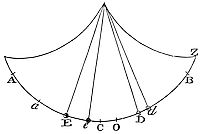
For let equal pendulums in a resisting medium describe the unequal arcs A, B; and the resistance of the body in the arc A will be to the resistance of the body in the correspondent part of the arc B in the duplicate ratio of the velocities, that is, as AA to BB nearly. If the resistance in the arc B were to the resistance in the arc A as AB to AA, the times in the arcs A and B would be equal (by the last Prop.). Therefore the resistance AA in the arc A, or AB in the arc B, causes the excess of the time in the arc A above the time in a non-resisting medium; and the resistance BB causes the excess of the time in the arc B above the time in a non-resisting medium. But those excesses are as the efficient forces AB and BB nearly, that is, as the arcs A and B. Q.E.D.
COR. 1. Hence from the times of the oscillations in unequal arcs in a resisting medium, may be known the times of the oscillations in a non-resisting medium of the same specific gravity. For the difference of the times will be to the excess of the time in the lesser arc above the time in a non-resisting medium as the difference of the arcs to the lesser arc.
COR. 2. The shorter oscillations are more isochronal, and very short ones are performed nearly in the same times as in a non-resisting medium. But the times of those which are performed in greater arcs are a little greater, because the resistance in the descent of the body, by which the time is prolonged, is greater, in proportion to the length described in the descent than the resistance in the subsequent ascent, by which the time is contracted. But the time of the oscillations, both short and long, seems to be prolonged in some measure by the motion of the medium. For retarded bodies are resisted somewhat less in proportion to the velocity, and accelerated bodies somewhat more than those that proceed uniformly forwards; because the medium, by the motion it has received from the bodies, going forwards the same way with them, is more agitated in the former case, and less in the latter; and so conspires more or less with the bodies moved. Therefore it resists the pendulums in their descent more, and in their ascent less, than in proportion to the velocity; and these two causes concurring prolong the time.
PROPOSITION XXVIII. THEOREM XXIII.
If a funependulous body, oscillating in a cycloid, be resisted in the ratio of the moments of the time, its resistance will be to the force of gravity as the excess of the arc described in the whole descent above the arc described in the subsequent ascent to twice the length of the pendulum.
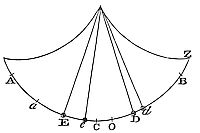
Let BC represent the arc described in the descent, Ca the arc described in the ascent, and Aa the difference of the arcs: and things remaining as they were constructed and demonstrated in Prop. XXV, the force with which the oscillating body is urged in any place D will be to the force of resistance as the arc CD to the arc CO, which is half of that difference Aa. Therefore the force with which the oscillating body is urged at the beginning or the highest point of the cycloid, that is, the force of gravity, will be to the resistance as the arc of the cycloid, between that highest point and lowest point C, is to the arc CO; that is (doubling those arcs), as the whole cycloidal arc, or twice the length of the pendulum, to the arc Aa. Q.E.D.
PROPOSITION XXIX. PROBLEM VI.
Supposing that a body oscillating in a cycloid is resisted in a duplicate ratio of the velocity: to find the resistance in each place.
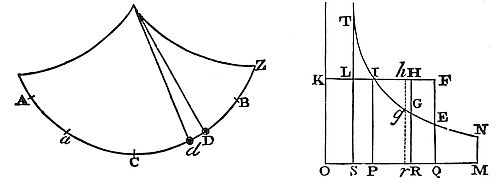
Let Ba be an arc described in one entire oscillation, C the lowest point of the cycloid, and CZ half the whole cycloidal arc, equal to the length of the pendulum; and let it be required to find the resistance of the body in any place D. Cut the indefinite right line OQ in the points O, S, P, Q, so that (erecting the perpendiculars OK, ST, PI, QE, and with the centre O, and the asymptotes OK, OQ, describing the hyperbola TIGE cutting the perpendiculars ST, PI, QE in T, I, and E, and through the point I drawing KF, parallel to the asymptote OQ, meeting the asymptote OK in K, and the perpendiculars ST and QE in L and F) the hyperbolic area PIEQ may be to the hyperbolic area PITS as the arc BC, described in the descent of the body, to the arc Ca described in the ascent; and that the area IEF may be to the area ILT as OQ to OS. Then with the perpendicular MN cut off the hyperbolic area PINM, and let that area be to the hyperbolic area PIEQ as the arc CZ to the arc BC described in the descent. And if the perpendicular RG cut off the hyperbolic area PIGR, which shall be to the area PIEQ as any arc CD to the arc BC described in the whole descent, the resistance in any place D will be to the force of gravity as the area to the area PINM.
For since the forces arising from gravity with which the body is urged in the places Z, B, D, a, are as the arcs CZ, CB, CD, Ca and those arcs are as the areas PINM, PIEQ, PIGR, PITS; let those areas be the exponents both of the arcs and of the forces respectively. Let Dd be a very small space described by the body in its descent: and let it be expressed by the very small area RGgr comprehended between the parallels RG, rg; and produce rg to h, so that GHhg and RGgr may be the contemporaneous decrements of the areas IGH, PIGR. And the increment , or , of the area will be to the decrement RGgr, or Rr × RG, of the area PIGR, as to RG; and therefore as to OR × GR or OP × PI, that is (because of the equal quantities OR × HG, OR × HR - OR × GR, ORHK - OPIK, PIHR and PIGR + IGH), as to OPIK. Therefore if the area be called Y, and RGgr the decrement of the area PIGR be given, the increment of the area Y will be as PIGR - Y.
Then if V represent the force arising from the gravity, proportional to the arc CD to be described, by which the body is acted upon in D, and R be put for the resistance, V - R will be the whole force with which the body is urged in D. Therefore the increment of the velocity is as V - R and the particle of time in which it is generated conjunctly. But the velocity itself is as the contemporaneous increment of the space described directly and the same particle of time inversely. Therefore, since the resistance is, by the supposition, as the square of the velocity, the increment of the resistance will (by Lem. II) be as the velocity and the increment of the velocity conjunctly, that is, as the moment of the space and V - R conjunctly; and, therefore, if the moment of the space be given, as V - R; that is, if for the force V we put its exponent PIGR, and the resistance R be expressed by any other area Z, as PIGR - Z.
Therefore the area PIGR uniformly decreasing by the subduction of given moments, the area Y increases in proportion of PIGR - Y, and the area Z in proportion of PIGR - Z. And therefore if the areas Y and Z begin together, and at the beginning are equal, these, by the addition of equal moments, will continue to be equal; and in like manner decreasing by equal moments, will vanish together. And, vice versa, if they together begin and vanish, they will have equal moments and be always equal; and that, because if the resistance Z be augmented, the velocity together with the arc Ca, described in the ascent of the body, will be diminished; and the point in which all the motion together with the resistance ceases coming nearer to the point C, the resistance vanishes sooner than the area Y. And the contrary will happen when the resistance is diminished.
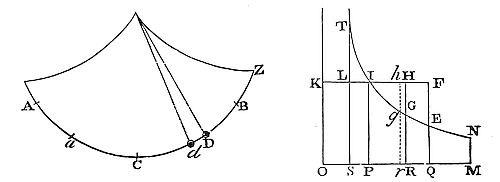
Now the area Z begins and ends where the resistance is nothing, that is, at the beginning of the motion where the arc CD is equal to the arc CB, and the right line RG falls upon the right line QE; and at the end of the motion where the arc CD is equal to the arc Ca, and RG falls upon the right line ST. And the area Y or begins and ends also where the resistance is nothing, and therefore where and IGH are equal; that is (by the construction), where the right line RG falls successively upon the right lines QE and ST. Therefore those areas begin and vanish together, and are therefore always equal. Therefore the area is equal to the area Z, by which the resistance is expressed, and therefore is to the area PINM, by which the gravity is expressed, as the resistance to the gravity. Q.E.D.
COR. 1. Therefore the resistance in the lowest place C is to the force of gravity as the area to the area PINM.
COR. 2. But it becomes greatest where the area PIHR is to the area IEF as OR to OQ. For in that case its moment (that is, PIGR - Y) becomes nothing.
COR. 3. Hence also may be known the velocity in each place, as being in the subduplicate ratio of the resistance, and at the beginning of the motion equal to the velocity of the body oscillating in the same cycloid without any resistance.
However, by reason of the difficulty of the calculation by which the resistance and the velocity are found by this Proposition, we have thought fit to subjoin the Proposition following.
PROPOSITION XXX. THEOREM XXIV.
If a right line aB be equal to the arc of a cycloid which an oscillating body describes, and at each of its points D the perpendiculars DK be erected, which shall be to the length of the pendulum as the resistance of the body in the corresponding points of the arc to the force of gravity; I say, that the difference between the arc described in the whole descent and the arc described in the whole subsequent ascent drawn into half the sum of the same arcs will be equal to the area BKa which all those perpendiculars take up.
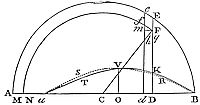
Let the arc of the cycloid, described in one entire oscillation, be expressed by the right line aB, equal to it, and the arc which would have been described in vacuo by the length AB. Bisect AB in C, and the point C will represent the lowest point of the cycloid, and CD will be as the force arising from gravity, with which the body in D is urged in the direction of the tangent of the cycloid, and will have the same ratio to the length of the pendulum as the force in D has to the force of gravity. Let that force, therefore, be expressed by that length CD, and the force of gravity by the length of the pendulum; and if in DE you take DK in the same ratio to the length of the pendulum as the resistance has to the gravity, DK will be the exponent of the resistance. From the centre C with the interval CA or CB describe a semi-circle BEeA. Let the body describe, in the least time, the space Dd; and, erecting the perpendiculars DE, de, meeting the circumference in E and e, they will be as the velocities which the body descending in vacuo from the point B would acquire in the places D and d. This appears by Prop. LII, Book I. Let therefore, these velocities be expressed by those perpendiculars DE, de; and let DF be the velocity which it acquires in D by falling from B in the resisting medium. And if from the centre C with the interval CF we describe the circle FfM meeting the right lines de and AB in f and M, then M will be the place to which it would thenceforward, without farther resistance, ascend, and df the velocity it would acquire in d. Whence, also, if Fg represent the moment of the velocity which the body D, in describing the least space Dd, loses by the resistance of the medium; and CN be taken equal to Cg; then will N be the place to which the body, if it met no farther resistance, would thenceforward ascend, and MN will be the decrement of the ascent arising from the loss of that velocity. Draw Fm perpendicular to df, and the decrement Fg of the velocity DF generated by the resistance DK will be to the increment fm of the same velocity, generated by the force CD, as the generating force DK to the generating force CD. But because of the similar triangles Fmf, Fhg, FDC, fm is to Fm or Dd as CD to DF; and, ex æquo, Fg to Dd as DK to DF. Also Fh is to Fg as DF to CF; and, ex æquo perturbatè, Fh or MN to Dd as DK to CF or CM; and therefore the sum of all the MN × CM will be equal to the sum of all the Dd × DK. At the moveable point M suppose always a rectangular ordinate erected equal to the indeterminate CM, which by a continual motion is drawn into the whole length Aa; and the trapezium described by that motion, or its equal, the rectangle , will be equal to the sum of all the MN × CM, and therefore to the sum of all the Dd × DK, that is, to the area BKVTa Q.E.D.
COR. Hence from the law of resistance, and the difference Aa of the arcs Ca, CB, may be collected the proportion of the resistance to the gravity nearly.
For if the resistance DK be uniform, the figure BKTa will be a rectangle under Ba and DK; and thence the rectangle under and Aa will be equal to the rectangle under Ba and DK, and DK will be equal to . Wherefore since DK is the exponent of the resistance, and the length of the pendulum the exponent of the gravity, the resistance will be to the gravity as to the length of the pendulum; altogether as in Prop. XXVIII is demonstrated.
If the resistance be as the velocity, the figure BKTa will be nearly an ellipsis. For if a body, in a non-resisting medium, by one entire oscillation, should describe the length BA, the velocity in any place D would be as the ordinate DE of the circle described on the diameter AB. Therefore since Ba in the resisting medium, and BA in the non-resisting one, are described nearly in the same times; and therefore the velocities in each of the points of Ba are to the velocities in the correspondent points of the length BA nearly as Ba is to BA, the velocity in the point D in the resisting medium will be as the ordinate of the circle or ellipsis described upon the diameter Ba; and therefore the figure BKVTa will be nearly an ellipsis. Since the resistance is supposed proportional to the velocity, let OV be the exponent of the resistance in the middle point O; and an ellipsis BRVSa described with the centre O, and the semi-axes OB, OV, will be nearly equal to the figure BKVTa, and to its equal the rectangle Aa × BO. Therefore Aa × BO is to OV × BO as the area of this ellipsis to OV × BO; that is, Aa is to OV as the area of the semi-circle to the square of the radius, or as 11 to 7 nearly; and, therefore, is to the length of the pendulum as the resistance of the oscillating body in O to its gravity.
Now if the resistance DK be in the duplicate ratio of the velocity, the figure BKVTa will be almost a parabola having V for its vertex and OV for its axis, and therefore will be nearly equal to the rectangle under and OV. Therefore the rectangle under and Aa is equal to the rectangle , and therefore OV is equal to ; and therefore the resistance in O made to the oscillating body is to its gravity as to the length of the pendulum.
And I take these conclusions to be accurate enough for practical uses. For since an ellipsis or parabola BRVSa falls in with the figure BKVTa in the middle point V, that figure, if greater towards the part BRV or VSa than the other, is less towards the contrary part, and is therefore nearly equal to it.
PROPOSITION XXXI. THEOREM XXV.
If the resistance made to an oscillating body in each of the proportional parts of the arcs described be augmented or diminished in a given ratio, the difference between the arc described in the descent and the arc described in the subsequent ascent will be augmented or diminished in the same ratio.
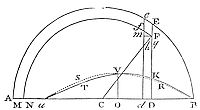
For that difference arises from the retardation of the pendulum by the resistance of the medium, and therefore is as the whole retardation and the retarding resistance proportional thereto. In the foregoing Proposition the rectangle under the right line and the difference Aa of the arcs CB, Ca, was equal to the area BKTa. And that area, if the length aB remains, is augmented or diminished in the ratio of the ordinates DK; that is, in the ratio of the resistance and is therefore as the length aB and the resistance conjunctly. And therefore the rectangle under Aa and is as aB and the resistance conjunctly, and therefore Aa is as the resistance. Q.E.D.
COR. 1. Hence if the resistance be as the velocity, the difference of the arcs in the same medium will be as the whole arc described: and the contrary.
COR. 2. If the resistance be in the duplicate ratio of the velocity, that difference will be in the duplicate ratio of the whole arc: and the contrary.
COR. 3. And universally, if the resistance be in the triplicate or any other ratio of the velocity, the difference will be in the same ratio of the whole arc: and the contrary.
COR. 4. If the resistance be partly in the simple ratio of the velocity, and partly in the duplicate ratio of the same, the difference will be partly in the ratio of the whole arc, and partly in the duplicate ratio of it: and the contrary. So that the law and ratio of the resistance will be the same for the velocity as the law and ratio of that difference for the length of the arc.
COR. 5. And therefore if a pendulum describe successively unequal arcs, and we can find the ratio of the increment or decrement of this difference for the length of the arc described, there will be had also the ratio of the increment or decrement of the resistance for a greater or less velocity.
GENERAL SCHOLIUM.
From these propositions we may find the resistance of mediums by pendulums oscillating therein. I found the resistance of the air by the following experiments. I suspended a wooden globe or ball weighing ounces troy, its diameter London inches, by a fine thread on a firm hook, so that the distance between the hook and the centre of oscillation of the globe was feet. I marked on the thread a point 10 feet and 1 inch distant from the centre of suspension; and even with that point I placed a ruler divided into inches, by the help whereof I observed the lengths of the arcs described by the pendulum. Then I numbered the oscillations in which the globe would lose part of its motion. If the pendulum was drawn aside from the perpendicular to the distance of 2 inches, and thence let go, so that in its whole descent it described an arc of 2 inches, and in the first whole oscillation, compounded of the descent and subsequent ascent, an arc of almost 4 inches, the same in 164 oscillations lost part of its motion, so as in its last ascent to describe an arc of inches. If in the first descent it described an arc of 4 inches, it lost part of its motion in 121 oscillations, so as in its last ascent to describe an arc of inches. If in the first descent it described an arc of 8, 16, 32, or 64 inches, it lost part of its motion in 69, , , oscillations, respectively. Therefore the difference between the arcs described in the first descent and the last ascent was in the 1st, 2d, 3d, 4th, 5th, 6th cases, , , 1, 2, 4, 8 inches respectively. Divide those differences by the number of oscillations in each case, and in one mean oscillation, wherein an arc of , , 15, 30 60, 120 inches was described, the difference of the arcs described in the descent and subsequent ascent will be , , , , , parts of an inch, respectively. But these differences in the greater oscillations are in the duplicate ratio of the arcs described nearly, but in lesser oscillations something greater than in that ratio; and therefore (by Cor. 2, Prop. XXXI of this Book) the resistance of the globe, when it moves very swift, is in the duplicate ratio of the velocity, nearly; and when it moves slowly, somewhat greater than in that ratio.
Now let V represent the greatest velocity in any oscillation, and let A, B, and C be given quantities, and let us suppose the difference of the arcs to be . Since the greatest velocities are in the cycloid as the arcs described in oscillating, and in the circle as the chords of those arcs; and therefore in equal arcs are greater in the cycloid than in the circle in the ratio of the arcs to their chords; but the times in the circle are greater than in the cycloid, in a reciprocal ratio of the velocity; it is plain that the differences of the arcs (which are as the resistance and the square of the time conjunctly) are nearly the same in both curves: for in the cycloid those differences must be on the one hand augmented, with the resistance, in about the duplicate ratio of the arc to the chord, because of the velocity augmented in the simple ratio of the same; and on the other hand diminished, with the square of the time, in the same duplicate ratio. Therefore to reduce these observations to the cycloid, we must take the same differences of the arcs as were observed in the circle, and suppose the greatest velocities analogous to the half, or the whole arcs, that is, to the numbers , 1, 2, 4, 8, 16. Therefore in the 2d, 4th, and 6th cases, put 1, 4, and 16 for V; and the difference of the arcs in the 2d case will become = A + B + C; in the 4th case, = 4A + 8B + 16C; in the 6th case, = 16A + 64B + 256C. These equations reduced give A = 0,0000916, B = 0,0010847, and C = 0,0029558. Therefore the difference of the arcs is as : and therefore since (by Cor. Prop. XXX, applied to this case) the resistance of the globe in the middle of the arc described in oscillating, where the velocity is V, is to its weight as to the length of the pendulum, if for A, B, and C you put the numbers found, the resistance of the globe will be to its weight as to the length of the pendulum between the centre of suspension and the ruler, that is, to 121 inches. Therefore since V in the second case represents 1, in the 4th case 4, and in the 6th case 16, the resistance will be to the weight of the globe, in the 2d case, as 0,0030345 to 121; in the 4th, as 0,041748 to 121; in the 6th, as 0,61705 to 121.
The arc, which the point marked in the thread described in the 6th case, was of , or inches. And therefore since the radius was 121 inches, and the length of the pendulum between the point of suspension and the centre of the globe was 126 inches, the arc which the centre of the globe described was inches. Because the greatest velocity of the oscillating body, by reason of the resistance of the air, does not fall on the lowest point of the arc described, but near the middle place of the whole arc, this velocity will be nearly the same as if the globe in its whole descent in a non-resisting medium should describe inches, the half of that arc, and that in a cycloid, to which we have above reduced the motion of the pendulum; and therefore that velocity will be equal to that which the globe would acquire by falling perpendicularly from a height equal to the versed sine of that arc. But that versed sine in the cycloid is to that arc as the same arc to twice the length of the pendulum 252, and therefore equal to 15,278 inches. Therefore the velocity of the pendulum is the same which a body would acquire by falling, and in its fall describing a space of 15,278 inches. Therefore with such a velocity the globe meets with a resistance which is to its weight as 0,61705 to 121, or (if we take that part only of the resistance which is in the duplicate ratio of the velocity) as 0,56752 to 121.
I found, by an hydrostatical experiment, that the weight of this wooden globe was to the weight of a globe of water of the same magnitude as 55 to 97: and therefore since 121 is to 213,4 in the same ratio, the resistance made to this globe of water, moving forwards with the above-mentioned velocity, will be to its weight as 0,56752 to 213,4, that is, as 1 to . Whence since the weight of a globe of water, in the time in which the globe with a velocity uniformly continued describes a length of 30,556 inches, will generate all that velocity in the falling globe, it is manifest that the force of resistance uniformly continued in the same time will take away a velocity, which will be less than the other in the ratio of 1 to , that is, the part of the whole velocity. And therefore in the time that the globe, with the same velocity uniformly continued, would describe the length of its semi-diameter, or inches, it would lose the part of its motion.
I also counted the oscillations in which the pendulum lost part of its motion. In the following table the upper numbers denote the length of the arc described in the first descent, expressed in inches and parts of an inch; the middle numbers denote the length of the arc described in the last ascent; and in the lowest place are the numbers of the oscillations. I give an account of this experiment, as being more accurate than that in which only part of the motion was lost. I leave the calculation to such as are disposed to make it.
First descent 2 4 8 16 32 64
Last ascent 3 6 12 24 48
Numb. of oscill. 374 272
I afterward suspended a leaden globe of 2 inches in diameter, weighing ounces troy by the same thread, so that between the centre of the globe and the point of suspension there was an interval of feet, and I counted the oscillations in which a given part of the motion was lost. The first of the following tables exhibits the number of oscillations in which part of the whole motion was lost; the second the number of oscillations in which there was lost part of the same.
First descent 1 2 4 8 16 32 64
Last ascent 7 14 28 56
Numb. of oscill. 226 228 193 140 53 30
First descent 1 2 4 8 16 32 64
Last ascent 3 6 12 24 48
Numb. of oscill. 510 518 420 318 204 121 70
Selecting in the first table the 3d, 5th, and 7th observations, and expressing the greatest velocities in these observations particularly by the numbers 1, 4, 16 respectively, and generally by the quantity V as above, there will come out in the 3d observation , in the 5th observation , in the 7th observation . These equations reduced give A = 0,001414, B = 0,000297, C = 0,000879. And thence the resistance of the globe moving with the velocity V will be to its weight ounces in the same ratio as to 121 inches, the length of the pendulum. And if we regard that part only of the resistance which is in the duplicate ratio of the velocity, it will be to the weight of the globe as to 121 inches. But this part of the resistance in the first experiment was to the weight of the wooden globe of ounces as to 121; and thence the resistance of the wooden globe is to the resistance of the leaden one (their velocities being equal) as into 0,002217 to into 0,000659, that is, as to 1. The diameters of the two globes were and 2 inches, and the squares of these are to each other as and 4, or and 1, nearly. Therefore the resistances of these equally swift globes were in less than a duplicate ratio of the diameters. But we have not yet considered the resistance of the thread, which was certainly very considerable, and ought to be subducted from the resistance of the pendulums here found. I could not determine this accurately, but I found it greater than a third part of the whole resistance of the lesser pendulum; and thence I gathered that the resistances of the globes, when the resistance of the thread is subducted, are nearly in the duplicate ratio of their diameters. For the ratio of to , or to 1 is not very different from the duplicate ratio of the diameters to 1.
Since the resistance of the thread is of less moment in greater globes, I tried the experiment also with a globe whose diameter was inches. The length of the pendulum between the point of suspension and the centre of oscillation was inches, and between the point of suspension and the knot in the thread inches. The arc described by the knot at the first descent of the pendulum was 32 inches. The arc described by the same knot in the last ascent after five oscillations was 28 inches. The sum of the arcs, or the whole arc described in one mean oscillation, was 60 inches. The difference of the arcs 4 inches. The part of this, or the difference between the descent and ascent in one mean oscillation, is of an inch. Then as the radius to the radius , so is the whole arc of 60 inches described by the knot in one mean oscillation to the whole arc of inches described by the centre of the globe in one mean oscillation; and so is the difference to a new difference 0,4475. If the length of the arc described were to remain, and the length of the pendulum should be augmented in the ratio of 126 to , the time of the oscillation would be augmented, and the velocity of the pendulum would be diminished in the subduplicate of that ratio; so that the difference 0,4475 of the arcs described in the descent and subsequent ascent would remain. Then if the arc described be augmented in the ratio of to , that difference 0,4475 would be augmented in the duplicate of that ratio, and so would become 1,5295. These things would be so upon the supposition that the resistance of the pendulum were in the duplicate ratio of the velocity. Therefore if the pendulum describe the whole arc of inches, and its length between the point of suspension and the centre of oscillation be 126 inches, the difference of the arcs described in the descent and subsequent ascent would be 1,5295 inches. And this difference multiplied into the weight of the pendulous globe, which was 208 ounces, produces 318,136. Again; in the pendulum above-mentioned, made of a wooden globe, when its centre of oscillation, being 126 inches from the point of suspension, described the whole arc of inches, the difference of the arcs described in the descent and ascent was into . This multiplied into the weight of the globe, which was ounces, produces 49,396. But I multiply these differences into the weights of the globes, in order to find their resistances. For the differences arise from the resistances, and are as the resistances directly and the weights inversely. Therefore the resistances are as the numbers 318,136 and 49,396. But that part of the resistance of the lesser globe, which is in the duplicate ratio of the velocity, was to the whole resistance as 0,56752 to 0,61675, that is, as 45,453 to 49,396; whereas that part of the resistance of the greater globe is almost equal to its whole resistance; and so those parts are nearly as 318,136 and 45,453, that is, as 7 and 1. But the diameters of the globes are and ; and their squares and are as 7,438 and 1, that is, as the resistances of the globes 7 and 1, nearly. The difference of these ratios is scarce greater than may arise from the resistance of the thread. Therefore those parts of the resistances which are, when the globes are equal, as the squares of the velocities, are also, when the velocities are equal, as the squares of the diameters of the globes.
But the greatest of the globes I used in these experiments was not perfectly spherical, and therefore in this calculation I have, for brevity's sake, neglected some little niceties; being not very solicitous for an accurate calculus in an experiment that was not very accurate. So that I could wish that these experiments were tried again with other globes, of a larger size, more in number, and more accurately formed; since the demonstration of a vacuum depends thereon. If the globes be taken in a geometrical proportion, as suppose whose diameters are 4, 8, 16, 32 inches; one may collect from the progression observed in the experiments what would happen if the globes were still larger.
In order to compare the resistances of different fluids with each other, I made the following trials. I procured a wooden vessel 4 feet long, 1 foot broad, and 1 foot high. This vessel, being uncovered, I filled with spring water, and, having immersed pendulums therein, I made them oscillate in the water. And I found that a leaden globe weighing ounces, and in diameter inches, moved therein as it is set down in the following table; the length of the pendulum from the point of suspension to a certain point marked in the thread being 126 inches, and to the centre of oscillation inches.
The arc described in the first descent, by a point marked in the thread was inches. 64 32 16 8 4 2 1
The arc described in the last ascent was inches. 48 24 12 6 3
The difference of the arcs, proportional to the motion lost, was inches. 16 8 4 2 1
The number of the oscillations in water. 3 7
The number of the oscillations in air. 287 535
In the experiments of the 4th column there were equal motions lost in 535 oscillations made in the air, and in water. The oscillations in the air were indeed a little swifter than those in the water. But if the oscillations in the water were accelerated in such a ratio that the motions of the pendulums might be equally swift in both mediums, there would be still the same number of oscillations in the water, and by these the same quantity of motion would be lost as before; because the resistance is increased, and the square of the time diminished in the same duplicate ratio. The pendulums, therefore, being of equal velocities, there were equal motions lost in 535 oscillations in the air, and in the water; and therefore the resistance of the pendulum in the water is to its resistance in the air as 535 to . This is the proportion of the whole resistances in the case of the 4th column.
Now let AV + CV2 represent the difference of the arcs described in the descent and subsequent ascent by the globe moving in air with the greatest velocity V; and since the greatest velocity is in the case of the 4th column to the greatest velocity in the case of the 1st column as 1 to 8; and that difference of the arcs in the case of the 4th column to the difference in the case of the 1st column as to , or as to 4280; put in these cases 1 and 8 for the velocities, and and 4280 for the differences of the arcs, and A + C will be = 85, and 8A + 64C = 4280 or A + 8C = 535; and then by reducing these equations, there will come out 7C = 449 and C = 64 and A = 21; and therefore the resistance, which is as , will become as 13. Therefore in the case of the 4th column, where the velocity was 1, the whole resistance is to its part proportional to the square of the velocity as 13 or 61 to 48; and therefore the resistance of the pendulum in water is to that part of the resistance in air, which is proportional to the square of the velocity, and which in swift motions is the only part that deserves consideration, as 61 to 48 and 535 to 1 conjunctly, that is, as 571 to 1. If the whole thread of the pendulum oscillating in the water had been immersed, its resistance would have been still greater; so that the resistance of the pendulum oscillating in the water, that is, that part which is proportional to the square of the velocity, and which only needs to be considered in swift bodies, is to the resistance of the same whole pendulum, oscillating in air with the same velocity, as about 850 to 1, that is as, the density of water to the density of air, nearly.
In this calculation we ought also to have taken in that part of the resistance of the pendulum in the water which was as the square of the velocity; but I found (which will perhaps seem strange) that the resistance in the water was augmented in more than a duplicate ratio of the velocity. In searching after the cause, I thought upon this, that the vessel was too narrow for the magnitude of the pendulous globe, and by its narrowness obstructed the motion of the water as it yielded to the oscillating globe. For when I immersed a pendulous globe, whose diameter was one inch only, the resistance was augmented nearly in a duplicate ratio of the velocity. I tried this by making a pendulum of two globes, of which the lesser and lower oscillated in the water, and the greater and higher was fastened to the thread just above the water, and, by oscillating in the air, assisted the motion of the pendulum, and continued it longer. The experiments made by this contrivance proved according to the following table.
Arc descr. in first descent 16 8 4 2 1
Arc descr. in last ascent 12 6 3
Diff. of arcs, proport. to motion lost 4 2 1
Number of oscillations 34 53
In comparing the resistances of the mediums with each other, I also caused iron pendulums to oscillate in quicksilver. The length of the iron wire was about 3 feet, and the diameter of the pendulous globe about of an inch. To the wire, just above the quicksilver, there was fixed another leaden globe of a bigness sufficient to continue the motion of the pendulum for some time. Then a vessel, that would hold about 3 pounds of quicksilver, was filled by turns with quicksilver and common water, that, by making the pendulum oscillate successively in these two different fluids, I might find the proportion of their resistances; and the resistance of the quicksilver proved to be to the resistance of water as about 13 or 14 to 1; that is, as the density of quicksilver to the density of water. When I made use of a pendulous globe something bigger, as of one whose diameter was about or of an inch, the resistance of the quicksilver proved to be to the resistance of the water as about 12 or 10 to 1. But the former experiment is more to be relied on, because in the latter the vessel was too narrow in proportion to the magnitude of the immersed globe; for the vessel ought to have been enlarged together with the globe. I intended to have repeated these experiments with larger vessels, and in melted metals, and other liquors both cold and hot; but I had not leisure to try all: and besides, from what is already described, it appears sufficiently that the resistance of bodies moving swiftly is nearly proportional to the densities of the fluids in which they move. I do not say accurately; for more tenacious fluids, of equal density, will undoubtedly resist more than those that are more liquid; as cold oil more than warm, warm oil more than rain-water, and water more than spirit of wine. But in liquors, which are sensibly fluid enough, as in air, in salt and fresh water, in spirit of wine, of turpentine, and salts, in oil cleared of its fæces by distillation and warmed, in oil of vitriol, and in mercury, and melted metals, and any other such like, that are fluid enough to retain for some time the motion impressed upon them by the agitation of the vessel, and which being poured out are easily resolved into drops, I doubt not but the rule already laid down may be accurate enough, especially if the experiments be made with larger pendulous bodies and more swiftly moved.
Lastly, since it is the opinion of some that there is a certain æthereal medium extremely rare and subtile, which freely pervades the pores of all bodies; and from such a medium, so pervading the pores of bodies, some resistance must needs arise; in order to try whether the resistance, which we experience in bodies in motion, be made upon their outward superficies only, or whether their internal parts meet with any considerable resistance upon their superficies, I thought of the following experiment I suspended a round deal box by a thread 11 feet long, on a steel hook, by means of a ring of the same metal, so as to make a pendulum of the aforesaid length. The hook had a sharp hollow edge on its upper part, so that the upper arc of the ring pressing on the edge might move the more freely; and the thread was fastened to the lower arc of the ring. The pendulum being thus prepared, I drew it aside from the perpendicular to the distance of about 6 feet, and that in a plane perpendicular to the edge of the hook, lest the ring, while the pendulum oscillated, should slide to and fro on the edge of the hook: for the point of suspension, in which the ring touches the hook, ought to remain immovable. I therefore accurately noted the place to which the pendulum was brought, and letting it go, I marked three other places, to which it returned at the end of the 1st, 2d, and 3d oscillation. This I often repeated, that I might find those places as accurately as possible. Then I filled the box with lead and other heavy metals that were near at hand. But, first, I weighed the box when empty, and that part of the thread that went round it, and half the remaining part, extended between the hook and the suspended box; for the thread so extended always acts upon the pendulum, when drawn aside from the perpendicular, with half its weight. To this weight I added the weight of the air contained in the box. And this whole weight was about of the weight of the box when filled with the metals. Then because the box when full of the metals, by extending the thread with its weight, increased the length of the pendulum, I shortened the thread so as to make the length of the pendulum, when oscillating, the same as before. Then drawing aside the pendulum to the place first marked, and letting it go, I reckoned about 77 oscillations before the box returned to the second mark, and as many afterwards before it came to the third mark, and as many after that before it came to the fourth mark. From whence I conclude that the whole resistance of the box, when full, had not a greater proportion to the resistance of the box, when empty, than 78 to 77. For if their resistances were equal, the box, when full, by reason of its vis insita, which was 78 times greater than the vis insita of the same when empty, ought to have continued its oscillating motion so much the longer, and therefore to have returned to those marks at the end of 78 oscillations. But it returned to them at the end of 77 oscillations.