Book 1 — SECTION VIII. (continued 3)
Andrew Motte translation
SCHOLIUM.
The attractions of sphærical bodies being now explained, it comes next in order to treat of the laws of attraction in other bodies consisting in like manner of attractive particles; but to treat of them particularly is not necessary to my design. It will be sufficient to subjoin some general propositions relating to the forces of such bodies, and the motions thence arising, because the knowledge of these will be of some little use in philosophical inquiries.
SECTION XIII.
Of the attractive forces of bodies which are not of a sphærical figure.
PROPOSITION LXXXV. THEOREM XLII.
If a body be attracted by another, and its attraction be vastly stronger when it is contiguous to the attracting body than when they are separated from one another by a very small interval; the forces of the particles of the attracting body decrease, in the recess of the body attracted, in more than a duplicate ratio of the distance of the particles.
For if the forces decrease in a duplicate ratio of the distances from the particles, the attraction towards a sphærical body being (by Prop. LXXIV) reciprocally as the square of the distance of the attracted body from the centre of the sphere, will not be sensibly increased by the contact, and it will be still less increased by it, if the attraction, in the recess of the body attracted, decreases in a still less proportion. The proposition, therefore, is evident concerning attractive spheres. And the case is the same of concave sphærical orbs attracting external bodies. And much more does it appear in orbs that attract bodies placed within them, because there the attractions diffused through the cavities of those orbs are (by Prop. LXX) destroyed by contrary attractions, and therefore have no effect even in the place of contact. Now if from these spheres and sphærical orbs we take away any parts remote from the place of contact, and add new parts any where at pleasure, we may change the figures of the attractive bodies at pleasure; but the parts added or taken away, being remote from the place of contact, will cause no remarkable excess of the attraction arising from the contact of the two bodies. Therefore the proposition holds good in bodies of all figures. Q.E.D.
PROPOSITION LXXXVI. THEOREM XLIII.
If the forces of the particles of which an attractive body is composed decrease, in the recess of the attractive body, in a triplicate or more than a triplicate ratio of the distance from the particles, the attraction will be vastly stronger in the point of contact than when the attracting and attracted bodies are separated from each other, though by never so small an interval.
For that the attraction is infinitely increased when the attracted corpuscle comes to touch an attracting sphere of this kind, appears, by the solution of Problem XLI, exhibited in the second and third Examples. The same will also appear (by comparing those Examples and Theorem XLI together) of attractions of bodies made towards concavo-convex orbs, whether the attracted bodies be placed without the orbs, or in the cavities within them. And by adding to or taking from those spheres and orbs any attractive matter any where without the place of contact, so that the attractive bodies may receive any assigned figure, the Proposition will hold good of all bodies universally. Q.E.D.
PROPOSITION LXXXVII. THEOREM XLIV.
If two bodies similar to each other, and consisting of matter equally attractive, attract separately two corpuscles proportional to those bodies, and in a like situation to them, the accelerative attractions of the corpuscles towards the entire bodies will be as the accelerative attractions of the corpuscles towards particles of the bodies proportional to the wholes, and alike situated in them.
For if the bodies are divided into particles proportional to the wholes, and alike situated in them, it will be, as the attraction towards any particle of one of the bodies to the attraction towards the correspondent particle in the other body, so are the attractions towards the several particles of the first body, to the attractions towards the several correspondent particles of the other body; and, by composition, so is the attraction towards the first whole body to the attraction towards the second whole body. Q.E.D.
COR. 1. Therefore if, as the distances of the corpuscles attracted increase, the attractive forces of the particles decrease in the ratio of any power of the distances, the accelerative attractions towards the whole bodies will be as the bodies directly, and those powers of the distances inversely. As if the forces of the particles decrease in a duplicate ratio of the distances from the corpuscles attracted, and the bodies are as A3 and B3, and therefore both the cubic sides of the bodies, and the distance of the attracted corpuscles from the bodies, are as A and B; the accelerative attractions towards the bodies will be as and , that is, as A and B the cubic sides of those bodies. If the forces of the particles decrease in a triplicate ratio of the distances from the attracted corpuscles, the accelerative attractions towards the whole bodies will be as and , that is, equal. If the forces decrease in a quadruplicate ratio, the attractions towards the bodies will be as and , that is, reciprocally as the cubic sides A and B. And so in other cases.
COR. 2. Hence, on the other hand, from the forces with which like bodies attract corpuscles similarly situated, may be collected the ratio of the decrease of the attractive forces of the particles as the attracted corpuscle recedes from them; if so be that decrease is directly or inversely in any ratio of the distances.
PROPOSITION LXXXVIII. THEOREM XLV.
If the attractive forces of the equal particles of any body be as the distance of the places from the particles, the force of the whole body will tend to its centre of gravity; and will be the same with the force of a globe, consisting of similar and equal matter, and having its centre in the centre of gravity.
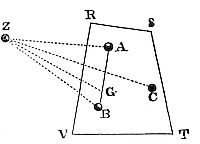
Let the particles A, B, of the body RSTV attract any corpuscle Z with forces which, supposing the particles to be equal between themselves, are as the distances AZ, BZ; but, if they are supposed unequal, are as those particles and their distances AZ, BZ, conjunctly, or (if I may so speak) as those particles drawn into their distances AZ, BZ respectively. And let those forces be expressed by the contents under A × AZ, and B × BZ. Join AB, and let it be cut in G, so that AG may be to BG as the particle B to the particle A; and G will be the common centre of gravity of the particles A and B. The force A × AZ will (by Cor. 2, of the Laws) be resolved into the forces A × GZ and A × AG; and the force B × BZ into the forces B × GZ and B × BG. Now the forces A × AG and B × BG, because A is proportional to B, and BG to AG, are equal, and therefore having contrary directions destroy one another. There remain then the forces A × GZ and B × GZ. These tend from Z towards the centre G, and compose the force ; that is, the same force as if the attractive particles A and B were placed in their common centre of gravity G, composing there a little globe.
By the same reasoning, if there be added a third particle C, and the force of it be compounded with the force tending to the centre G, the force thence arising will tend to the common centre of gravity of that globe in G and of the particle C; that is, to the common centre of gravity of the three particles A, B, C; and will be the same as if that globe and the particle C were placed in that common centre composing a greater globe there; and so we may go on in infinitum. Therefore the whole force of all the particles of any body whatever RSTV is the same as if that body, without removing its centre of gravity, were to put on the form of a globe. Q.E.D.
COR. Hence the motion of the attracted body Z will be the same as if the attracting body RSTV were sphærical; and therefore if that attracting body be either at rest, or proceed uniformly in a right line, the body attracted will move in an ellipsis having its centre in the centre of gravity of the attracting body.
PROPOSITION LXXXIX. THEOREM XLVI.
If there be several bodies consisting of equal particles whose forces are as the distances of the places from each, the force compounded of all the forces by which any corpuscle is attracted will tend to the common centre of gravity of the attracting bodies; and will be the same as if those attracting bodies, preserving their common centre of gravity, should unite there, and be formed into a globe.
This is demonstrated after the same manner as the foregoing Proposition.
COR. Therefore the motion of the attracted body will be the same as if the attracting bodies, preserving their common centre of gravity, should unite there, and be formed into a globe. And, therefore, if the common centre of gravity of the attracting bodies be either at rest, or proceed uniformly in a right line, the attracted body will move in an ellipsis having its centre in the common centre of gravity of the attracting bodies.
PROPOSITION XC. PROBLEM XLIV.
If to the several points of any circle there tend equal centripetal forces, increasing or decreasing in any ratio of the distances; it is required to find the force with which a corpuscle is attracted, that is, situate any where in a right line which stands at right angles to the plane of the circle at its centre.
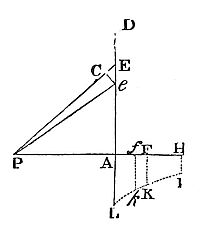
Suppose a circle to be described about the centre A with any interval AD in a plane to which the right line AP is perpendicular; and let it be required to find the force with which a corpuscle P is attracted towards the same. From any point E of the circle, to the attracted corpuscle P, let there be drawn the right line PE. In the right line PA take PF equal to PE, and make a perpendicular FK, erected at F, to be as the force with which the point E attracts the corpuscle P. And let the curve line IKL be the locus of the point K. Let that curve meet the plane of the circle in L. In PA take PH equal to PD, and erect the perpendicular HI meeting that curve in I; and the attraction of the corpuscle P towards the circle will be as the area AHIL drawn into the altitude AP. Q.E.I.
For let there be taken in AE a very small line Ee. Join Pe, and in PE, PA take PC, Pf equal to Pe. And because the force, with which any point E of the annulus described about the centre A with the interval AE in the aforesaid plane attracts to itself the body P, is supposed to be as FK; and, therefore, the force with which that point attracts the body P towards A is as ; and the force with which the whole annulus attracts the body P towards A is as the annulus and conjunctly; and that annulus also is as the rectangle under the radius AE and the breadth Ee, and this rectangle (because PE and AE, Ee and CE are proportional) is equal to the rectangle PE × CE or PE × Ff; the force with which that annulus attracts the body P towards A will be as PE × Ff and conjunctly; that is, as the content under Ff × FK AP, or as the area FKkf drawn into AP. And therefore the sum of the forces with which all the annuli, in the circle described about the centre A with the interval AD, attract the body P towards A, is as the whole area AHIKL drawn into AP. Q.E.D.
COR. 1. Hence if the forces of the points decrease in the duplicate ratio of the distances, that is, if FK be as , and therefore the area AHIKL as ; the attraction of the corpuscle P towards the circle will be as ; that is, as .
COR. 2. And universally if the forces of the points at the distances D be reciprocally as any power Dn of the distances; that is, if FK be as and therefore the area AHIKL as ; the attraction of the corpuscle P towards the circle will be as .
COR. 3. And if the diameter of the circle be increased in infinitum, and the number n be greater than unity; the attraction of the corpuscle P towards the whole infinite plane will be reciprocally as , because the other term vanishes.
PROPOSITION XCI. PROBLEM XLV.
To find the attraction of a corpuscle situate in the axis of a round solid, to whose several points there tend equal centripetal forces decreasing in any ratio of the distances whatsoever.
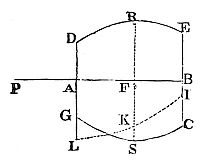
Let the corpuscle P, situate in the axis AB of the solid DECG, be attracted towards that solid. Let the solid be cut by any circle as RFS, perpendicular to the axis; and in its semi-diameter FS, in any plane PALKB passing through the axis, let there be taken (by Prop. XC) the length FK proportional to the force with which the corpuscle P is attracted towards that circle. Let the locus of the point K be the curve line LKI, meeting the planes of the outermost circles AL and BI in L and I; and the attraction of the corpuscle P towards the solid will be as the area LABI. Q.E.I.
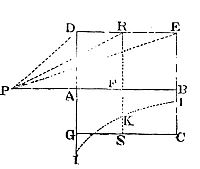
COR. 1. Hence if the solid be a cylinder described by the parallelogram ADEB revolved about the axis AB, and the centripetal forces tending to the several points be reciprocally as the squares of the distances from the points; the attraction of the corpuscle P towards this cylinder will be as . For the ordinate FK (by Cor. 1, Prop. XC) will be as . The part 1 of this quantity, drawn into the length AB, describes the area 1 × AB; and the other part , drawn into the length PB describes the area 1 into (as may be easily shewn from the quadrature of the curve LKI); and, in like manner, the same part drawn into the length PA describes the area 1 into , and drawn into AB, the difference of PB and PA, describes 1 into , the difference of the areas. From the first content 1 × AB take away the last content 1 into , and there will remain the area LABI equal to 1 into . Therefore the force, being proportional to this area, is as .
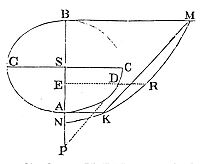
COR. 2. Hence also is known the force by which a spheroid AGBC attracts any body P situate externally in its axis AB. Let NKRM be a conic section whose ordinate ER perpendicular to PE may be always equal to the length of the line PD, continually drawn to the point D in which that ordinate cuts the spheroid, From the vertices A, B, of the spheroid, let there be erected to its axis AB the perpendiculars AK, BM, respectively equal to AP, BP, and therefore meeting the conic section in K and M; and join KM cutting off from it the segment KMRK. Let S be the centre of the spheroid, and SC its greatest semi-diameter; and the force with which the spheroid attracts the body P will be to the force with which a sphere described with the diameter AB attracts the same body as is to . And by a calculation founded on the same principles may be found the forces of the segments of the spheroid.
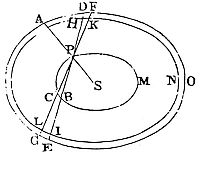
COR. 3. If the corpuscle be placed within the spheroid and in its axis, the attraction will be as its distance from the centre. This may be easily collected from the following reasoning, whether the particle be in the axis or in any other given diameter. Let AGOF be an attracting spheroid, S its centre, and P the body attracted. Through the body P let there be drawn the semi-diameter SPA, and two right lines DE, FG meeting the spheroid in D and E, F and G; and let PCM, HLN be the superficies of two interior spheroids similar and concentrical to the exterior, the first of which passes through the body P, and cuts the right lines DE, FG in B and C; and the latter cuts the same right lines in H and I, K and L. Let the spheroids have all one common axis, and the parts of the right lines intercepted on both sides DP and BE, FP and CG, DH and IE, FK and LG, will be mutually equal; because the right lines DE, PB, and HI, are bisected in the same point, as are also the right lines FG, PC, and KL. Conceive now DPF, EPG to represent opposite cones described with the infinitely small vertical angles DPF, EPG, and the lines DH, EI to be infinitely small also. Then the particles of the cones DHKF, GLIE, cut off by the spheroidical superficies, by reason of the equality of the lines DH and EI, will be to one another as the squares of the distances from the body P, and will therefore attract that corpuscle equally. And by a like reasoning if the spaces DPF, EGCB be divided into particles by the superficies of innumerable similar spheroids concentric to the former and having one common axis, all these particles will equally attract on both sides the body P towards contrary parts. Therefore the forces of the cone DPF, and of the conic segment EGCB, are equal, and by their contrariety destroy each other. And the case is the same of the forces of all the matter that lies without the interior spheroid PCBM. Therefore the body P is attracted by the interior spheroid PCBM alone, and therefore (by Cor. 3, Prop. LXXII) its attraction is to the force with which the body A is attracted by the whole spheroid AGOD as the distance PS to the distance AS. Q.E.D.
PROPOSITION XCII. PROBLEM XLVI.
An attracting body being given, it is required to find the ratio of the decrease of the centripetal forces tending to its several points.
The body given must be formed into a sphere, a cylinder, or some regular figure, whose law of attraction answering to any ratio of decrease may be found by Prop. LXXX, LXXXI, and XCI. Then, by experiments, the force of the attractions must be found at several distances, and the law of attraction towards the whole, made known by that means, will give the ratio of the decrease of the forces of the several parts; which was to be found.
PROPOSITION XCIII. THEOREM XLVII.
If a solid be plane on one side, and infinitely extended on all other sides, and consist of equal particles equally attractive, whose forces decrease, in the recess from the solid, in the ratio of any power greater than the square of the distances; and a corpuscle placed towards either part of the plane is attracted by the force of the whole solid; I say that the attractive force of the whole solid, in the recess from its plane superficies, will decrease in the ratio of a power whose side is the distance of the corpuscle from the plane, and its index less by 3 than the index of the power of the distances.
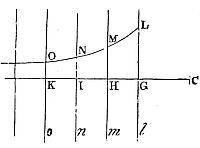
CASE 1. Let LGl be the plane by which the solid is terminated. Let the solid lie on that hand of the plane that is towards I, and let it be resolved into innumerable planes mHM, nIN, oKO, &c., parallel to GL. And first let the attracted body C be placed without the solid. Let there be drawn CGHI perpendicular to those innumerable planes, and let the attractive forces of the points of the solid decrease in the ratio of a power of the distances whose index is the number n not less than 3. Therefore (by Cor. 3, Prop. XC) the force with which any plane mHM attracts the point C is reciprocally as . In the plane mHM take the length HM reciprocally proportional to , and that force will be as HM. In like manner in the several planes lGL, nIN, oKO, &c., take the lengths GL, IN, KO, &c., reciprocally proportional to , , , &c., and the forces of those planes will be as the lengths so taken, and therefore the sum of the forces as the sum of the lengths, that is, the force of the whole solid as the area GLOK produced infinitely towards OK. But that area (by the known methods of quadratures) is reciprocally as , and therefore the force of the whole solid is reciprocally as . Q.E.D.
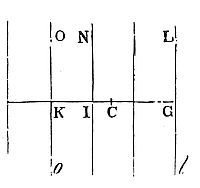
CASE 2. Let the corpuscle C be now placed on that hand of the plane lGL that is within the solid, and take the distance CK equal to the distance CG. And the part of the solid LGloKO terminated by the parallel planes lGL, oKO, will attract the corpuscle C, situate in the middle, neither one way nor another, the contrary actions of the opposite points destroying one another by reason of their equality. Therefore the corpuscle C is attracted by the force only of the solid situate beyond the plane OK. But this force (by Case 1) is reciprocally as , that is, (because CG, CK are equal) reciprocally as . Q.E.D.
COR. 1. Hence if the solid LGIN be terminated on each side by two infinite parallel places LG, IN, its attractive force is known, subducting from the attractive force of the whole infinite solid LGKO the attractive force of the more distant part NIKO infinitely produced towards KO.
COR. 2. If the more distant part of this solid be rejected, because its attraction compared with the attraction of the nearer part is inconsiderable, the attraction of that nearer part will, as the distance increases, decrease nearly in the ratio of the power .
COR. 3. And hence if any finite body, plane on one side, attract a corpuscle situate over against the middle of that plane, and the distance between the corpuscle and the plane compared with the dimensions of the attracting body be extremely small; and the attracting body consist of homogeneous particles, whose attractive forces decrease in the ratio of any power of the distances greater than the quadruplicate; the attractive force of the whole body will decrease very nearly in the ratio of a power whose side is that very small distance, and the index less by 3 than the index of the former power. This assertion does not hold good, however, of a body consisting of particles whose attractive forces decrease in the ratio of the triplicate power of the distances; because, in that case, the attraction of the remoter part of the infinite body in the second Corollary is always infinitely greater than the attraction of the nearer part.
SCHOLIUM.
If a body is attracted perpendicularly towards a given plane, and from the law of attraction given, the motion of the body be required; the Problem will be solved by seeking (by Prop. XXXIX) the motion of the body descending in a right line towards that plane, and (by Cor. 2, of the Laws) compounding that motion with an uniform motion performed in the direction of lines parallel to that plane. And, on the contrary, if there be required the law of the attraction tending towards the plane in perpendicular directions, by which the body may be caused to move in any given curve line, the Problem will be solved by working after the manner of the third Problem.
But the operations may be contracted by resolving the ordinates into converging series. As if to a base A the length B be ordinately applied in any given angle, and that length be as any power of the base ; and there be sought the force with which a body, either attracted towards the base or driven from it in the direction of that ordinate, may be caused to move in the curve line which that ordinate always describes with its superior extremity; I suppose the base to be increased by a very small part O, and I resolve the ordinate into an infinite series &c., and I suppose the force proportional to the term of this series in which is of two dimensions, that is, to the term . Therefore the force sought is as , or, which is the same thing, as . As if the ordinate describe a parabola, m being = 2, and n = 1, the force will be as the given quantity , and therefore is given. Therefore with a given force the body will move in a parabola, as Galileo has demonstrated. If the ordinate describe an hyperbola, m being = 0 - 1, and n = 1, the force will be as or ; and therefore a force which is as the cube of the ordinate will cause the body to move in an hyperbola. But leaving this kind of propositions, I shall go on to some others relating to motion which I have not yet touched upon.
SECTION XIV.
Of the motion of very small bodies when agitated by centripetal forces tending to the several parts of any very great body.
PROPOSITION XCIV. THEOREM XLVIII.
If two similar mediums be separated from each other by a space terminated on both sides by parallel planes, and a body in its passage through that space be attracted or impelled perpendicularly towards either of those mediums, and not agitated or hindered by any other force; and the attraction be every where the same at equal distances from either plane, taken towards the same hand of the plane; I say, that the sine of incidence upon either plane will be to the sine of emergence from the other plane in a given ratio.
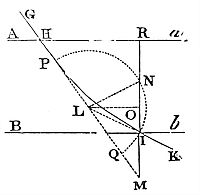
CASE 1. Let Aa and Bb be two parallel planes, and let the body light upon the first plane Aa in the direction of the line GH, and in its whole passage through the intermediate space let it be attracted or impelled towards the medium of incidence, and by that action let it be made to describe a curve line HI, and let it emerge in the direction of the line IK. Let there be erected IM perpendicular to Bb the plane of emergence, and meeting the line of incidence GH prolonged in M, and the plane of incidence Aa in R; and let the line of emergence KI be produced and meet HM in L. About the centre L, with the interval LI, let a circle be described cutting both HM in P and Q, and MI produced in N; and, first, if the attraction or impulse be supposed uniform, the curve HI (by what Galileo has demonstrated) be a parabola, whose property is that of a rectangle under its given latus rectum and the line IM is equal to the square of HM; and moreover the line HM will be bisected in L. Whence if to MI there be let fall the perpendicular LO, MO, OR will be equal; and adding the equal lines ON, OI, the wholes MN, IR will be equal also. Therefore since IR is given, MN is also given, and the rectangle NMI is to the rectangle under the latus rectum and IM, that is, to HM2 in a given ratio. But the rectangle NMI is equal to the rectangle PMQ, that is, to the difference of the squares ML2, and PL2 or LI2; and HM2 hath a given ratio to its fourth part ML2; therefore the ratio of ML2 - LI2 to ML2 is given, and by conversion the ratio of LI2 to ML2, and its subduplicate, the ratio of LI to ML. But in every triangle, as LMI, the sines of the angles are proportional to the opposite sides. Therefore the ratio of the sine of the angle of incidence LMR to the sine of the angle of emergence LIR is given. Q.E.D.
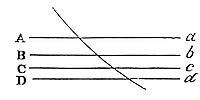
CASE 2. Let now the body pass successively through several spaces terminated with parallel planes AabB, BbcC, &c., and let it be acted on by a force which is uniform in each of them separately, but different in the different spaces; and by what was just demonstrated, the sine of the angle of incidence on the first plane Aa is to the sine of emergence from the second plane Bb in a given ratio; and this sine of incidence upon the second plane Bb will be to the sine of emergence from the third plane Cc in a given ratio; and this sine to the sine of emergence from the fourth plane Dd in a given ratio; and so on in infinitum; and, by equality, the sine of incidence on the first plane to the sine of emergence from the last plane in a given ratio. Let now the intervals of the planes be diminished, and their number be infinitely increased, so that the action of attraction or impulse, exerted according to any assigned law, may become continual, and the ratio of the sine of incidence on the first plane to the sine of emergence from the last plane being all along given, will be given then also. Q.E.D.
PROPOSITION XCV. THEOREM XLIX.
The same things being supposed, I say, that the velocity of the body before its incidence is to its velocity after emergence as the sine of emergence to the sine of incidence.
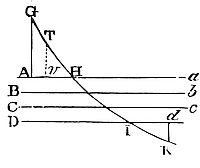
Make AH and Id equal, and erect the perpendiculars AG, dK meeting the lines of incidence and emergence GH, IK, in G and K. In GH take TH equal to IK, and to the plane Aa let fall a perpendicular Tv. And (by Cor. 2 of the Laws of Motion) let the motion of the body be resolved into two, one perpendicular to the planes Aa, Bb, Cc, &c., and another parallel to them. The force of attraction or impulse, acting in directions perpendicular to those planes, does not at all alter the motion in parallel directions; and therefore the body proceeding with this motion will in equal times go through those equal parallel intervals that lie between the line AG and the point H, and between the point I and the line dK; that is, they will describe the lines GH, IK in equal times. Therefore the velocity before incidence is to the velocity after emergence as GH to IK or TH, that is, as AH or Id to vH, that is (supposing TH or IK radius), as the sine of emergence to the sine of incidence. Q.E.D.
PROPOSITION XCVI. THEOREM L.
The same things being supposed, and that the motion before incidence is swifter than afterwards; I say, that if the line of incidence be inclined continually, the body will be at last reflected, and the angle of reflexion will be equal to the angle of incidence.
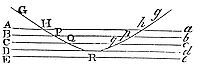
For conceive the body passing between the parallel planes Aa, Bb, Cc, &c., to describe parabolic arcs as above; and let those arcs be HP, PQ, QR, &c. And let the obliquity of the line of incidence GH to the first plane Aa be such that the sine of incidence may be to the radius of the circle whose sine it is, in the same ratio which the same sine of incidence hath to the sine of emergence from the plane Dd into the space DdeE; and because the sine of emergence is now become equal to radius, the angle of emergence will be a right one, and therefore the line of emergence will coincide with the plane Dd. Let the body come to this plane in the point R; and because the line of emergence coincides with that plane, it is manifest that the body can proceed no farther towards the plane Ee. But neither can it proceed in the line of emergence Rd; because it is perpetually attracted or impelled towards the medium of incidence. It will return, therefore, between the planes Cc, Dd, describing an arc of a parabola QRq, whose principal vertex (by what Galileo has demonstrated) is in R, cutting the plane Cc in the same angle at q, that it did before at Q; then going on in the parabolic arcs qp, ph, &c., similar and equal to the former arcs QP, PH, &c., it will cut the rest of the planes in the same angles at p, h, &c., as it did before in P, H, &c., and will emerge at last with the same obliquity at h with which it first impinged on that plane at H. Conceive now the intervals of the planes Aa, Bb, Cc, Dd, Ee, &c., to be infinitely diminished, and the number infinitely increased, so that the action of attraction or impulse, exerted according to any assigned law, may become continual; and, the angle of emergence remaining all along equal to the angle of incidence, will be equal to the same also at last. Q.E.D.
SCHOLIUM.
These attractions bear a great resemblance to the reflexions and refractions of light made in a given ratio of the secants, as was discovered by Snellius; and consequently in a given ratio of the sines, as was exhibited by Des Cartes. For it is now certain from the phenomena of Jupiter's satellites, confirmed by the observations of different astronomers, that light is propagated in succession, and requires about seven or eight minutes to travel from the sun to the earth. Moreover, the rays of light that are in our air (as lately was discovered by Grimaldus, by the admission of light into a dark room through a small hole, which I have also tried) in their passage near the angles of bodies, whether transparent or opaque (such as the circular and rectangular edges of gold, silver and brass coins, or of knives, or broken pieces of stone or glass), are bent or inflected round those bodies as if they were attracted to them; and those rays which in their passage come nearest to the bodies are the most inflected, as if they were most attracted; which thing I myself have also carefully observed. And those which pass at greater distances are less inflected; and those at still greater distances are a little inflected the contrary way, and form three fringes of colours.
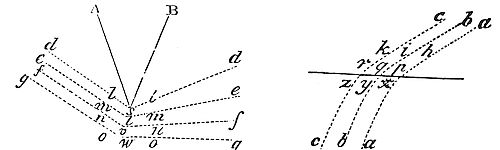
In the figure s represents the edge of a knife, or any kind of wedge AsB; and gowog, fnunf, emtme, dlsld, are rays inflected towards the knife in the arcs owo, nvn, mtm, lsl; which inflection is greater or less according to their distance from the knife. Now since this inflection of the rays is performed in the air without the knife, it follows that the rays which fall upon the knife are first inflected in the air before they touch the knife. And the case is the same of the rays falling upon glass. The refraction, therefore, is made not in the point of incidence, but gradually, by a continual inflection of the rays; which is done partly in the air before they touch the glass, partly (if I mistake not) within the glass, after they have entered it; as is represented in the rays ckzc, biyb, ahxa, falling upon r, q, p, and inflected between k and z, i and y, h and x. Therefore because of the analogy there is between the propagation of the rays of light and the motion of bodies, I thought it not amiss to add the following Propositions for optical uses; not at all considering the nature of the rays of light, or inquiring whether they are bodies or not; but only determining the trajectories of bodies which are extremely like the trajectories of the rays.
PROPOSITION XCVII. PROBLEM XLVII.
Supposing the sine of incidence upon any superficies to be in a given ratio to the sine of emergence; and that the inflection of the paths of those bodies near that superficies is performed in a very short space, which may be considered as a point; it is required to determine such a superficies as may cause all the corpuscles issuing from any one given place to converge to another given place.
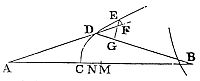
Let A be the place from whence the corpuscles diverge; B the place to which they should converge; CDE the curve line which by its revolution round the axis AB describes the superficies sought; D, E, any two points of that curve; and EF, EG, perpendiculars let fall on the paths of the bodies AD, DB. Let the point D approach to and coalesce with the point E; and the ultimate ratio of the line DF by which AD is increased, to the line DG by which DB is diminished, will be the same as that of the sine of incidence to the sine of emergence. Therefore the ratio of the increment of the line AD to the decrement of the line DB is given; and therefore if in the axis AB there be taken any where the point C through which the curve CDE must pass, and CM the increment of AC be taken in that given ratio to CN the decrement of BC, and from the centres A, B, with the intervals AM, BN, there be described two circles cutting each other in D; that point D will touch the curve sought CDE, and, by touching it any where at pleasure, will determine that curve. Q.E.I.
COR. 1. By causing the point A or B to go off sometimes in infinitum, and sometimes to move towards other parts of the point C, will be obtained all those figures which Cartesius has exhibited in his Optics and Geometry relating to refractions. The invention of which Cartesius having thought fit to conceal, is here laid open in this Proposition.
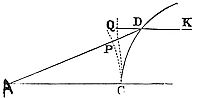
COR. 2. If a body lighting on any superficies CD in the direction of a right line AD, drawn according to any law, should emerge in the direction of another right line DK; and from the point C there be drawn curve lines CP, CQ, always perpendicular to AD, DK; the increments of the lines PD, QD, and therefore the lines themselves PD, QD, generated by those increments, will be as the sines of incidence and emergence to each other, and è contra.
PROPOSITION XCVIII. PROBLEM XLVIII.
The same things supposed; if round the axis AB any attractive superficies be described as CD, regular or irregular, through which the bodies issuing from the given place A must pass; it is required to find a second attractive superficies EF, which may make those bodies converge to a given place B.
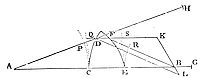
Let a line joining AB cut the first superficies in C and the second in E, the point D being taken any how at pleasure. And supposing the sine of incidence on the first superficies to the sine of emergence from the same, and the sine of emergence from the second superficies to the sine of incidence on the same, to be as any given quantity M to another given quantity N; then produce AB to G, so that BG may be to CE as M - N to N; and AD to H, so that AH may be equal to AG; and DF to K, so that DK may be to DH as N to M. Join KB, and about the centre D with the interval DH describe a circle meeting KB produced in L, and draw BF parallel to DL; and the point F will touch the line EF, which, being turned round the axis AB, will describe the superficies sought. Q.E.F.
For conceive the lines CP, CQ to be every where perpendicular to AD, DF, and the lines ER, ES to FB, FD respectively, and therefore QS to be always equal to CE; and (by Cor. 2, Prop. XCVII) PD will be to QD as M to N, and therefore as DL to DK, or FB to FK; and by division as DL - FB or PH - PD - FB to FD or FQ - QD; and by composition as PH - FB to FQ, that is (because PH and CG, QS and CE, are equal), as CE + BG - FR to CE - FS. But (because BG is to CE as M - N to N) it comes to pass also that CE + BG is to CE as M to N; and therefore, by division, FR is to FS as M to N; and therefore (by Cor. 2, Prop. XCVII) the superficies EF compels a body, falling upon it in the direction DF, to go on in the line FR to the place B. Q.E.D.
SCHOLIUM.
In the same manner one may go on to three or more superficies. But of all figures the sphærical is the most proper for optical uses. If the object glasses of telescopes were made of two glasses of a sphærical figure, containing water between them, it is not unlikely that the errors of the refractions made in the extreme parts of the superficies of the glasses may be accurately enough corrected by the refractions of the water. Such object glasses are to be preferred before elliptic and hyperbolic glasses, not only because they may be formed with more ease and accuracy, but because the pencils of rays situate without the axis of the glass would be more accurately refracted by them. But the different refrangibility of different rays is the real obstacle that hinders optics from being made perfect by sphærical or any other figures. Unless the errors thence arising can be corrected, all the labour spent in correcting the others is quite thrown away.