ORDER UNGULATA. (continued 3)
Reading edition
The period of gestation seems to be about the same as that of the domestic cow, and the greatest number of calves are born in the summer.
SIZE.—I cannot speak personally, for I regret now that I took no measurements in the days when I was acquainted with these magnificent animals, but the experiences of others I give as follows:—
Sir Walter Elliot gives—
Ft. In.
Nose to root of tail 9 6½
Height at shoulder (over 18 hands!) 6 1½
Height at rump 5 3
Tail 2 10½
Length of dorsal ridge 3 4
Height of dorsal ridge 0 4½
Head from muzzle to top of frontal ridge 2 1¾
Breadth of forehead 1 3½
Ear 0 10½
Circumference of horn at base 1 7½
Distance between the points of the horns 2 1
I give the measurements of two fine heads:—
Ft. In. Ft. In.
From tip to tip round the outer edge and across the forehead 6 2 6 11
Across the sweep 2 9 3 2½
Circumference at base 1 7 1 5
Between tips 1 7 1 10½
The following careful measurements are recorded by Mr. Blyth ('J. A. S. B.,' vol. xi., 1842, p. 588), and were furnished to him by Lieut. Tickell from the recently-killed animal, in order to assist in the setting up of the specimen in the Asiatic Museum:—
Ft. In.
A string passed along the back to root of tail 8 8½
From frontal ridge to tip of muzzle 2 0
Horns apart anteriorly at base 1 0½
Tip to tip of horns 2 3¼
From nose to centre of eye 1 0¾
Eye to root of horn 0 4¼
Eye to base of ears 0 6
Humerus, &c. 1 11¼
Radius 2 8
Metacarpus 0 9¾
Pastern, &c., and hoof 0 7¼
Pelvis 1 4½
Femur 1 7¼
Tibia and fibula 1 10
Metatarsus 1 4
Pastern to end of hoof 0 7½
Height perpendicularly, about 5 9
Length of dorsal ridge 2 5½
Tail, root to tip of hairs 3 1¾
Circumference of head behind horns 3 11
Circumference of neck behind ears 4 0½
Circumference of chest 8 8
Circumference of muzzle 1 9¼
Circumference of forearm close to axilla 1 11¼
Circumference of thigh close to body 3 0¾
Circumference of thigh close above hock 1 6
I feel tempted to let my pen run away with me into descriptions of the exciting scenes of the past in the chase of this splendid creature—the noblest quarry that the sportsman can have, and the one that calls forth all his cunning and endurance. As I lately remarked in another publication, I know of no other animal of which the quest calls forth the combined characteristics of the ibex, the stag and the tiger-hunter. Some of my own experiences I have described in 'Seonee;' but let those who wish to learn the poetry of the thing read the glowing, yet not less true pages of Colonel Walter Campbell's 'Old Forest Ranger;' and for clear practical information, combined also with graphic description, the works of Captain J. Forsyth and Mr. G. P. Sanderson ('The Highlands of Central India' and 'Thirteen years among the Wild Beasts').
The gaur prefers hilly ground, though it is sometimes found on low levels. It is extremely shy and retiring in its habits, and so quick of hearing that extreme care has to be taken in stalking to avoid treading on a dry leaf or stick. I know to my cost that the labour of hours may be thrown away by a moment of impatience. In spite of all the wondrous tales of its ferocity, it is as a rule a timid, inoffensive animal. Solitary bulls are sometimes dangerous if suddenly come upon. I once did so, and the bull turned and dashed up-hill before I could get a shot, whereas a friend of mine, to whom a similar thing occurred a few weeks before, was suddenly charged, and his gun-bearer was knocked over. The gaur seldom leaves its jungles, but I have known it do so on the borders of the Sonawani forest, in order to visit a small tank at Untra near Ashta, and the cultivation in the vicinity suffered accordingly.
Hitherto most attempts to rear this animal when young have failed. It is said not to live over the third year. Though I offered rewards for calves for my collection, I never succeeded in getting one. I have successfully reared most of the wild animals of the Central provinces, but had not a chance of trying the bison.
NO. 465. GAVÆUS FRONTALIS. The Mithun or Gayal.
NATIVE NAMES.—Gayal, Gavi or Gabi, Gabi-bichal (male), Gabi-gai (female); Bunerea-goru in Chittagong and Assam; Mithun.
HABITAT.—The hilly tracts east of the Brahmaputra, at the head of the Assam valley, the Mishmi hills, in hill Tipperah, Chittagong, and then southwards through Burmah to the hills bordering on the Koladyne river.
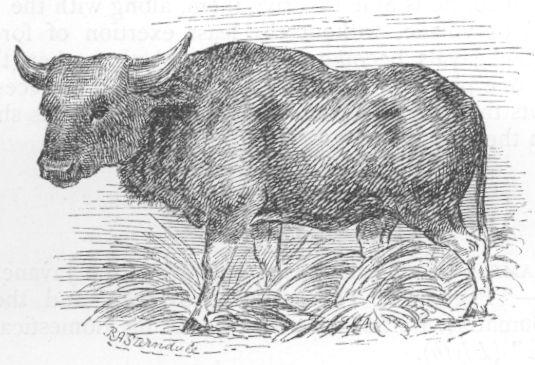
Gavæus frontalis.
DESCRIPTION.—Very like the gaur at first sight, but more clumsy looking; similarly coloured, but with a small dewlap; the legs are white as in the last species. In the skull the forehead is not concave as in the gaur, but flat, and if anything rather convex. The back has a dorsal ridge similar to that of the gaur.
The gayal is of a much milder disposition than the gaur, and is extensively domesticated, and on the frontiers of Assam is considered a valuable property by the people. The milk is rich and the flesh good. There are purely domesticated mithuns bred in captivity, but according to many writers the herds are recruited from the wild animals, which are tempted either to interbreed, or are captured and tamed. In Dr. F. Buchanan Hamilton's MS. (see Horsfield's 'Cat. Mammalia, E. I. C. Mus.') the following account is given: "These people (i.e. the inhabitants of the frontiers) have tame gayals, which occasionally breed, but the greater part of their stock is bred in the woods and caught; after which, being a mild animal, it is easily domesticated. The usual manner employed to catch the full-grown gayal is to surround a field of corn with a strong fence. One narrow entrance is left, in which is placed a rope with a running noose, which secures the gayal by the neck as he enters to eat the corn; of ten so caught perhaps three are hanged by the noose running too tight, and by the violence of their struggling. Young gayals are caught by leaving in the fence holes of a size sufficient to admit a calf, but which excludes the full-grown gayal; the calves enter by these holes, which are then shut by natives who are watching, and who secure the calves. The gayal usually goes in herds of from twenty to forty, and frequents dry valleys and the sides of hills covered with forest." Professor Garrod, in his Ungulata in Cassell's Natural History, quotes the following account from Mr. Macrae concerning the way in which the Kookies of the Chittagong hill regions catch the wild gayal: "On discovering a herd of wild gayals in the jungle they prepare a number of balls, the size of a man's head, composed of a particular kind of earth, salt and cotton. They then drive their tame gayals towards the wild ones, when the two herds soon meet and assimilate into one, the males of the one attaching themselves to the females of the other, and vice versâ. The Kookies now scatter their balls over such parts of the jungles as they think the herd most likely to pass, and watch its motions. The gayals, on meeting these balls as they pass along, are attracted by their appearance and smell, and begin to lick them with their tongues, and, relishing the taste of the salt and the particular earth composing them, they never quit the place till all the balls are consumed. The Kookies, having observed the gayals to have once tasted their balls, prepare a sufficient supply of them to answer the intended purpose, and as the gayals lick them up they throw down more; and it is to prevent their being so readily destroyed that the cotton is mixed with the earth and the salt. This process generally goes on for three changes of the moon or for a month and a-half, during which time the tame and the wild gayals are always together, licking the decoy balls, and the Kookie, after the first day or two of their being so, makes his appearance at such a distance as not to alarm the wild ones. By degrees he approaches nearer and nearer, until at length the sight of him has become so familiar that he can advance to stroke his tame gayals on the back and neck without frightening the wild ones. He next extends his hand to them and caresses them also, at the same time giving them plenty of his decoy balls to lick. Thus, in the short space of time mentioned, he is able to drive them, along with the tame ones, to his parrah or village, without the least exertion of force; and so attached do the gayals become to the parrah, that when the Kookies migrate from one place to another, they always find it necessary to set fire to the huts they are about to abandon, lest the gayals should return to them from the new grounds."
NO. 466. GAVÆUS SONDAICUS. The Burmese Wild Ox.
NATIVE NAME.—Tsoing, Burmese; Banteng of the Javanese.
HABITAT.—"Pegu, the Tenasserim provinces, and the Malayan peninsula, Sumatra, Borneo and Java; being domesticated in the island of Bali" (Blyth).
DESCRIPTION.—This animal resembles the gaur in many respects, and it is destitute of a dewlap, but the young and the females are bright chestnut. The bulls become black with age, excepting always the white stockings and a white patch on each buttock.
SIZE.—About the same as the last two species.
This animal has bred in captivity, and has also interbred with domestic cattle. Blyth says he saw in the Zoological Gardens of Amsterdam a bull, cow, and calf in fine condition. "The bull more especially has an indication of a hump, which, however, must be specially looked for to be noticed, and he has a broad and massive neck like the gaur, but no raised spinal ridge, nor has either of these species a deep dewlap like the gayal" ('Cat. Mamm. Burmah'). The banteng cow is much slighter in build, and has small horns that incline backwards, and she retains her bright chestnut colour permanently.
GENUS POEPHAGUS—THE YAK.
Somewhat smaller than the common ox, with large head; nose hairy, with a moderate sized bald muffle between nostrils; broad neck without dewlap; cylindrical horns; no hump or dorsal ridge, and long hair on certain parts of the body. Requires an intensely cold climate.
NO. 467. POEPHAGUS GRUNNIENS. The Yak or Grunting Ox.
NATIVE NAMES.—Yak, Bubul, Soora-goy, Dong, in Thibet; Bun-chowr, Hindi; Brong-dong, Thibetan.
HABITAT.—The high regions of Thibet and Ladakh, the valley of the Chang Chenmo, and the slopes of the Kara Koram mountains (Kinloch).
DESCRIPTION.—"In size it is somewhat less than the common or domestic ox. The head is large, and the neck proportionally broad, without any mane or dewlap, having a downward tendency; the horns are far apart, placed in front of the occipital ridge, cylindrical at the base, from which they rise obliquely outward and forward two-thirds of their length, when they bend inward with a semi-circular curve, the points being directed to each other from the opposite sides; the muffle is small; the border of the nostrils callous; the ears short and hairy. At the withers there is a slight elevation, but no protuberance or hump, as in the Indian ox. The dorsal ridge not prominent; body of full dimensions; rump and hinder parts proportionally large; limbs rather small and slender; hoofs smooth, square, and well defined, not expanded as in the musk-ox; anterior false hoofs small, posterior large; tail short, not reaching beyond the houghs, naked for some inches at the root, very bushy, lax, and expanded in the middle; colour black throughout, but varying in tint according to the character of the hairy covering; this, on the anterior parts, the neck, shoulders, back, and sides, is short, soft, and of a jet-black colour, but long, shaggy, pendulous, and shining on the sides of the anterior extremities, and from the medial part of the abdomen over the thighs to the hinder parts" (Horsfield, 'Cat. Mam. Ind. Mus.').
GENUS BUBALUS—THE BUFFALOS.
Horns very large, depressed and sub-trigonal at the base, attached to the highest line of the frontals, inclining upwards and backwards, conical towards the tip and bending upwards; muffle large, square. No hump or dorsal ridge; thirteen pairs of ribs; hoofs large.
NO. 468. BUBALUS ARNI. The Wild Buffalo (Jerdon's No. 239).
NATIVE NAMES.—Arna (male), Arni (female), Arna-bhàinsa, Jangli-bhains, Hindi; Mung, Bhagulpore; Gera-erumi, Gondi; Karbo of the Malays; Moonding of the Sundanese.
HABITAT.—In the swampy terai at the foot of the hills from Oude to Bhotan, in the plains of Lower Bengal as far west as Tirhoot, in Assam and in Burmah, in Central India from Midnapore to Rajpore, and thence nearly to the Godavery; also in Ceylon.
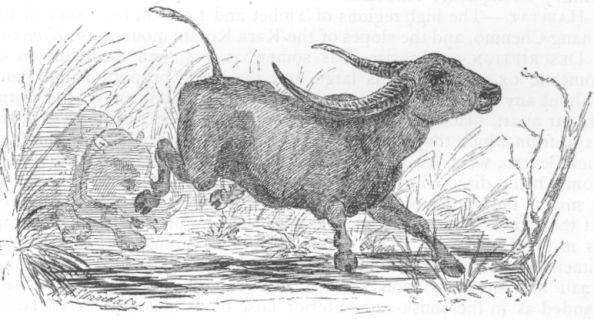
Bubalus arni.
DESCRIPTION.—This animal so closely resembles the common domesticated buffalo that it seems hardly necessary to attempt a description. The wild one may be a trifle larger, but every one in India is familiar with the huge, ungainly, stupid-looking creature, with its bulky frame, black and almost hairless body, back-sweeping horns, and long narrow head.
SIZE.—A large male will stand 19 hands at the shoulder and measure 10¼ feet from nose to root of tail, which is short, reaching only to the hocks. Horns vary greatly, but the following are measurements of large pairs: In the British Museum are a pair without the skull. These horns measure 6 feet 6 inches each, which would give, when on the head, an outer curve measurement of nearly 14 feet. Another pair in the British Museum measure on the skull 12 feet 2 inches from tip to tip and across the forehead, but these horns do not exactly correspond in length and shape.
The buffalo never ascends mountains like the bison, but keeps to low and swampy ground and open grass plains, living in large herds, which occasionally split up into smaller ones during the breeding season in autumn. The female produces one, or sometimes two in the summer, after a period of gestation of ten months.
Forsyth doubts their interbreeding with the domestic race, but I see no reason for this. The two are identically the same, and numerous instances have been known of the latter joining herds of their wild brethren; and I have known cases of the domestic animal absconding from a herd and running wild. Such a one was shot by a friend of mine in a jungle many miles from the haunts of men, but yet quite out of the range of the wild animal. Probably it had been driven from a herd. Domestic buffalo bulls are much used in the Central provinces for carrying purposes. I had them yearly whilst in camp, and noticed that one old bull lorded it over the others, who stood in great awe of him; at last one day there was a great uproar; three younger animals combined, and gave him such a thrashing that he never held up his head again. In a feral state he would doubtless have left the herd and become a solitary wanderer. Dr. Jerdon, in his 'Mammals of India,' says: "Mr. Blyth states it as his opinion that, except in the valley of the Ganges and Burrampooter, it has been introduced and become feral. With this view I cannot agree, and had Mr. Blyth seen the huge buffalos I saw on the Indrawutty river (in 1857), he would, I think, have changed his opinion. They have hitherto not been recorded, south of Raepore, but where I saw them is nearly 200 miles south. I doubt if they cross the Godavery river.
"I have seen them repeatedly, and killed several in the Purneah district. Here they frequent the immense tracts of long grass abounding in dense, swampy thickets, bristling with canes and wild roses; and in these spots, or in the long elephant-grass on the bank of jheels, the buffalos lie during the heat of the day. They feed chiefly at night or early in the morning, often making sad havoc in the fields, and retire in general before the sun is high. They are by no means shy (unless they have been much hunted), and even on an elephant, without which they could not be successfully hunted, may often be approached within good shooting distance. A wounded one will occasionally charge the elephant, and, as I have heard from many sportsmen, will sometimes overthrow the elephant. I have been charged by a small herd, but a shot or two as they are advancing will usually scatter them."
The buffalo is, I should say, a courageous animal—at least it shows itself so in the domesticated state. A number of them together will not hesitate to charge a tiger, for which purpose they are often used to drive a wounded tiger out of cover. A herdsman was once seized by a man-eater one afternoon a few hundred yards from my tent. His cows fled, but his buffalos, hearing his cries, rushed up and saved him.
The attachment evinced by these uncouth creatures to their keepers was once strongly brought to my notice in the Mutiny. In beating up the broken forces of a rebel Thakoor, whom we had defeated the previous day, I, with a few troopers, ran some of them to bay in a rocky ravine. Amongst them was a Brahmin who had a buffalo cow. This creature followed her master, who was with us as a prisoner, for the whole day, keeping at a distance from the troops, but within call of her owner's voice. When we made a short halt in the afternoon, the man offered to give us some milk; she came to his call at once, and we had a grateful draught, the more welcome as we had had nothing to eat since the previous night. That buffalo saved her master's life, for when in the evening the prisoners were brought up to court martial and sentenced to be hanged, extenuating circumstances were urged for our friend with the buffalo, and he was allowed to go, as I could testify he had not been found with arms in his hands; and I had the greatest pleasure in telling him to be off, and have nothing more to do with rebel Thakoors. Jerdon says the milk of the buffalo is richer than that of the cow. I doubt this. I know that in rearing wild animals buffalos' milk is better than cows' milk, which is far too rich, and requires plentiful dilution with water.
There is a very curious little animal allied to the buffalo, of which we have, or have had, a specimen in the Zoological Gardens at Alipore—the Anoa depressicornis; it comes from the Island of Celebes, and seems to link the buffalo with the deer. It is black, with short wavy hair.
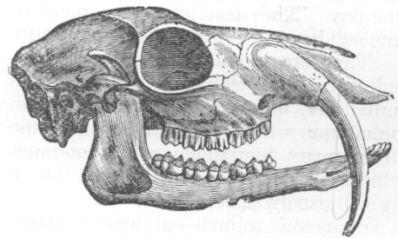
Skull of Musk Deer.
Before passing on to the true Cervidæ I must here place an animal commonly called a deer, and generally classed as such—the musk-deer according to some naturalists. There is no reason, save an insufficient one, that this creature should be so called and classed, there being much evidence in favour of its alliance to the antelopes. In the first place it has a gall bladder, which the Cervidæ have not, with the exception, according to Dr. Crisp, of the axis ('P. Z. S.'). On the other hand it has large canine tusks like the muntjacs, deerlets, and water-deer, and, as these are all aberrant forms of the true Cervidæ, there is no reason why the same character should not be developed in the antelopes. Its hair is more of the goat than the deer, and the total absence of horns removes a decided proof in favour of one or the other. The feet are more like some of the Bovidæ than the generality of deer, with the exception, perhaps, of Rangifer (the reindeer), the toes being very much cloven and capable of grasping the rocky ground on which it is found. A very eminent authority, however, Professor Flower, is in favour of placing the musk-deer with the Cervidæ, and he instances the absence of horns as in favour of this opinion, for in none of the Bovidæ are the males hornless. There are many other points also, such as the fawns being spotted, some intestinal peculiarities, and the molar and premolar teeth being strictly cervine, which strengthen him in his opinion. (See article on the structure and affinities of the musk-deer, 'P. Z. S.' 1879, p. 159.)
GENUS MOSCHUS—THE MUSK DEER.
Canines in both sexes, very long and slender in the male; no horns; feet much cloven, with large false hoofs that touch the ground; the medium metacarpals fused into a solid cannon bone; in the skull the intermaxillaries join the nasals; hinder part of tarsus hairy; fur thick, elastic, and brittle; muffle large; no eye, feet, or groin-pits; a large gland or præputial bag under the stomach in the males, which contains the secretion known in commerce as "musk."
NO. 469. MOSCHUS MOSCHIFERUS. The Musk Deer.
NATIVE NAMES.—Kastura, Hindi; Rous, Roos, and Kasturé, in Kashmir; La-lawa, Thibetan; Rib-jo, Ladakhi; Bena in Kunawur (Jerdon); Mussuck-naba', Pahari (Kinloch).
HABITAT.—Throughout the Himalayas at elevations above 8000 feet, extending also through Central and Northern Asia as far as Siberia.
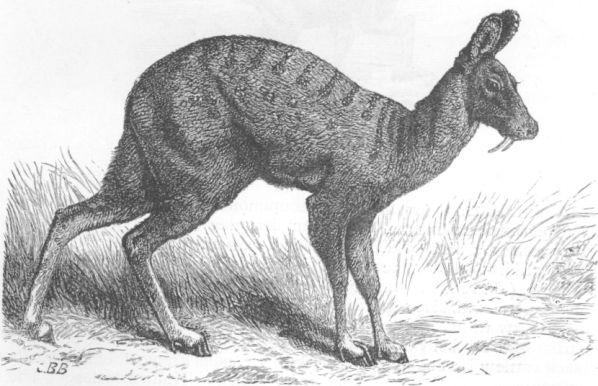
Moschus moschiferus.
DESCRIPTION.—It is difficult to describe the colour of this animal, for it so constantly changes; and, as I do not know the creature personally, I think it better to give the recorded opinions of three writers who have had personal experience. Markham describes it as a dark speckled brownish-grey, nearly black on the hind-quarters, edged down the inside with reddish-yellow; the throat, belly, and legs lighter grey. Leith Adams ('P. Z. S.' 1858, p. 528) says: "Some are very dark on the upper parts, with black splashes on the back and hips; under-parts white or a dirty white. Others are of a yellowish-white all over the upper parts, with the belly and inner sides of the thighs white. A brownish-black variety is common, with a few white spots arranged longitudinally on the back—the latter I found were young." Kinloch writes: "The prevailing colour is brownish-grey, varying in shade on the back, where it is darkest, so as to give the animal a mottled or brindled appearance."
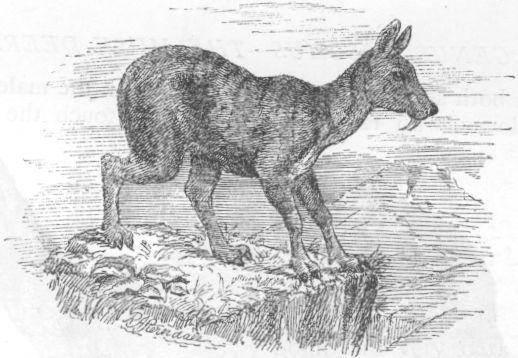
Moschus moschiferus.
SIZE.—Length, about 3 feet; height, 22 inches.
The musk-deer is a forest-loving animal, keeping much to one locality. It bounds with amazing agility over the steepest ground, and is wonderfully sure-footed over the most rocky hills. It ruts in winter, produces one or two young, which are driven off in about six weeks' time by the mother to shift for themselves. They begin to produce at an early age—within a year. The musk bag is an abdominal or præputial gland which secretes about an ounce of musk, worth from ten to fifteen rupees. It is most full in the rutting season; in the summer, according to Leith Adams, it hardly contains any. The musk does not seem to affect the flavour of the meat, which is considered excellent.
CERVIDÆ—THE DEER.
Of the horned ruminants these are the most interesting. In all parts of the world, Old and New, save the great continental island of Australia, one or other kind of stag is familiar to the people, and is the object of the chase. The oldest writings contain allusions to it, and it is frequently mentioned in the Scriptures.
"Like as the hart desireth the water brooks,"
sang David. It is bound up in history and romance, and the chase of it in England is to this day a royal pastime.
However, to come back from the poetry of the thing to dry scientific details, I must premise that the two main distinctions of the Cervidæ, as separating them from the Bovidæ, are horns which are not persistent, but annually shed, and the absence of a gall bladder, which is present in nearly all the Bovidæ. The deer also, with one exception (the reindeer, Rangifer tarandus) have horns only in the males.
Regarding the shedding of these horns, it is supposed that the operation is connected with the sexual functions. It is a curious fact that castration has a powerful effect on this operation; if done early no horns appear; if later in life, the horns become persistent and are not shed.
Captain James Forsyth (in his 'Highlands of Central India'), was of opinion that the Sambar does not shed its horns annually, and states that this also is the opinion of native shikaris in Central India. This, however, requires further investigation. I certainly never heard of such a theory amongst them, nor noticed the departure from the normal state.
There have been several classifications of the Cervidæ, but I think the most complete and desirable one is that of Sir Victor Brooke (see 'P. Z. S.' 1878, p. 883), which I shall endeavour to give in a condensed form. Dr. Gray's classification was based on three forms of antlers and the shape of the tail. But Sir Victor Brooke's is founded on more reliable osteological details. As I before stated in my introductory remarks on the Ruminantia, the first and fourth digits, there being no thumb, are but rudimentary, the metacarpal bones being reduced to mere splints; the digital phalanges are always in the same place, and bear the little false hoofs, which are situated behind and a little above the large centre ones, but the metacarpal splint is not always in the same place; it may either be annexed to the phalanges, or widely separated from them and placed directly under the carpus. The position of these splints is an important factor in the classification of the Cervidæ into two divisions, distinguished by Sir Victor Brooke as the Plesiometacarpals, in which the splint is near the carpus, and the Telemetacarpals, in which the splint is far from the carpus, and articulated with the digital phalanges. All the known species of deer can be classified under these two heads; and it is a significant fact that this pedal division is borne out by certain cranial peculiarities discovered by Professor Garrod, and also, to a certain extent, by an arrangement of hair-tufts on the tarsus and metatarsus. In the Old World deer, which are with few exceptions Plesiometacarpi, those which have these tufts have them above the middle of the metatarsus, and those of the New World, which are, with one exception, Telemetacarpi, have them, when present, below the middle of the metatarsus.
There is also another character in addition to the cranial one before alluded to, which was also noticed by Professor Garrod. The first cranial peculiarity is that in Telemetacarpi, as a rule, the vertical plate developed from the lower surface of the vomer is prolonged sufficiently downwards and backwards to become anchylosed to the horizontal plate of the palatals, forming a septum completely dividing the nasal cavity into two chambers. In the Plesiometacarpi this vertical plate is not sufficiently developed to reach the horizontal plate of the palatals. The second cranial peculiarity is that in the Old World deer (Plesiometacarpi), the ascending rami of the premaxillæ articulate with the nasals with one or two exceptions, whereas in the New World deer (Telemetacarpi), with one or two exceptions, the rami of the premaxillæ do not reach the nasals. It will thus be seen that the osteological characters of the head and feet agree in a singularly fortunate manner, and, when taken in connection with the external signs afforded by the metatarsal tufts, prove conclusively the value of the system. In India we have to deal exclusively with the Plesiometacarpi, our nearest members of the other division being the Chinese water-deer (Hydropotes inermis), and probably Capreolus pygargus from Yarkand, the horns of a roebuck in velvet attached to a strip of skin having been brought down by the Mission to that country in 1873-74.
Now comes the more difficult task of subdividing these sections into genera—a subject which has taxed the powers of many naturalists, and which is still in a far from perfect state. To all proposed arrangements some exception can be taken, and the following system is not free from objection, but it is on the whole the most reliable; and this system is founded on the form of the antler, which runs from a single spike, as in the South American Coassus, to the many branches of the red deer (Cervus elaphas); and all the various changes on which we found genera are in successive stages produced in the red deer, which we may accept as the highest development; for instance, the stag in its first year develops but a single straight "beam" antler, when it is called a "brocket," and it is the same as the South American brocket (Coassus). On this being shed the next spring produces a small branch from the base of this beam, called the brow antler, which is identical almost with the single bifurcated horn of the Furcifer from Chili. The stag is then technically known as a "spayad." In the third year an extra front branch is formed, known as the tres-tine. The antler then resembles the rusine type, of which our sambar stag is an example. In the fourth year the top of the main beam throws out several small tines called "sur-royals," and the brow antler receives an addition higher up called the "bez-tine." The animal is then a "staggard." In the fifth year the "sur-royals" become more numerous, and the whole antler heavier in the "stag," whose next promotion is to that of "great hart" of ten or more points. The finest heads are found in the German forests. Sir Victor Brooke alludes to some in the hunting Schloss of Moritzburg of the 15th to 17th century, of enormous size, bearing from 25 to 50 points—50 inches round the outside curve, 10 inches in circumference round the smallest part of the beam, and of one of which the spread between the coronal tines is 74 inches. Professor Garrod mentions one as having sixty-six points, and states that Lord Powerscourt has in his possession a pair with forty-five tines. The deer with which we have to deal range from the elaphine, or red deer type, to the simple bifurcated antler of the muntjac, which consists of a beam and brow antler only. We then come to the rusine type of three points only—brow, tres, and royal tines, and of this number are also the spotted and hog deer of India, but the arrangement of the tines is different; and following the rusine type comes the rucervine, in which the tres and royal tines break out into points—the tres-tine usually bifurcate, and the royal with two, three or more points. The arrangements of the main limbs of the horns is strictly rusine—that is to say, the external and anterior tine is equal to or shorter than the royal tine, whereas it is the reverse in the axis (spotted deer), and therefore this genus should come between the two. Even in the sambar and axis there is a tendency to throw out abnormal tines. There are many examples in the Indian Museum, and I possess a magnificent head which bears a large abnormal tine on one horn, and a faint inclination in the corresponding spot on the other horn to do likewise. I have no doubt, had the animal lived another year, the second extra tine would have been developed. Professor Garrod has three phases of the rucervine type, which he calls the normal, the intermediate, and the extreme. The first has both branches of the beam, tres and royal of equal size (ex. Schomburgk's deer); the second has the tres-tine larger than the royal (ex. our swamp deer); and the extreme type is that in which the royal is represented merely by a snag, the whole horn being bent forward (ex. the Burmese Panolia Eldii). The true cervine type of horn I have already described in its progress from youth to age. The Kashmir and Sikim stags are the representatives of this form in India. In Japan there is an intermediate form in Cervus sika which has no bez-tine.
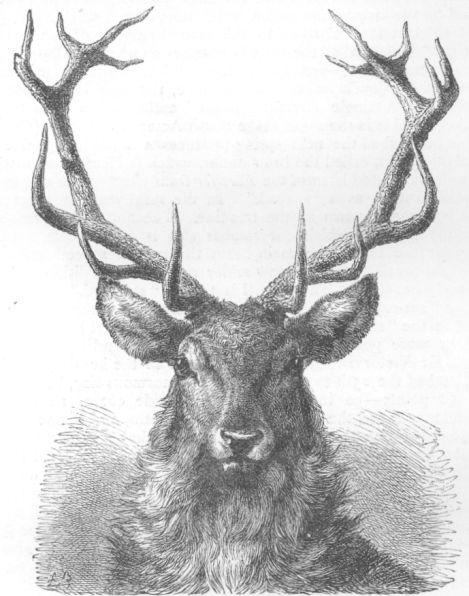
Stag with Horns matured.
Deer have large eye-pits, but no groin-pits; feet-pits in all four, or sometimes only in the hind feet. The female has four mammæ.
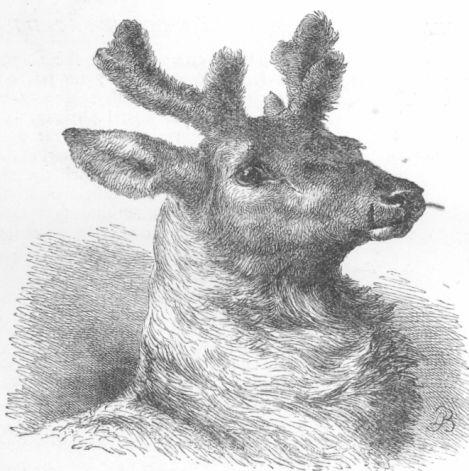
Stag with Horns in velvet.
At the time of reproduction of the antlers a strong determination of blood to the head takes place, enlarging the vessels, and a fibro-cartilaginous substance is formed, which grows rapidly, and takes the form of the antler of the species. The horns in their early stage are soft and full of blood-vessels on the surface, covered with a delicate skin, with fine close-set hairs commonly called the velvet.
"As the horns ossify the periosteal veins become enlarged, grooving the external surface; the arteries are enclosed by hard osseus tubercles at the base of the horns, which coalesce and render them impervious, and, the supply of nutriment being thus cut off, the envelopes shrivel up and fall off, and the animals perfect the desquamation by rubbing their horns against trees, technically called 'burnishing.'"—Jerdon.
We now begin with the simplest form of tine we have, viz. with one basal snag only.
GENUS CERVULUS—THE MUNTJACS OR RIB-FACED DEER.
Of small size, slightly higher at the croup than at the shoulders; short tail; large pits in hind feet; no groin-pits; no tuft on the metatarsus. This genus is specially characterised, according to Sir Victor Brooke, by the absence of the lateral digital phalanges on all four feet; the proximal ends of the metacarpals are however present; horns situated on high pedicles of bone, covered with hair, continued down the face in two longitudinal ridges, between which the skin is ridged or puckered; horns small, composed of a single beam with a basal snag; skull with a very large, deep sub-orbital pit; forehead concave; large canine tusks in the upper jaw; moderate, moist muffle.
NO. 470. CERVULUS MUNTJAC vel AUREUS. The Muntjac or Rib-faced Deer (Jerdon's No. 223).
NATIVE NAMES.—Kakur, Bherki, Jangli-bakra, Hindi; Maya Bengali; Ratwa, in Nepal; Karsiar, Bhotia; Siku or Suku, Lepcha; Gutra, Gutri, Gondi; Bekra or Baikur, Mahrathi; Kankuri, Canarese; Kuka-gori, Telegu; Gee, Burmese; Kidang, Javanese; Muntjac, Sundanese; Kijang, Malayan of Sumatra; Welly or Hoola-mooha, Singhalese.
HABITAT.—India, Burmah, Ceylon, the Malay peninsula, Sumatra, Java, Hainan, Banka and Borneo.
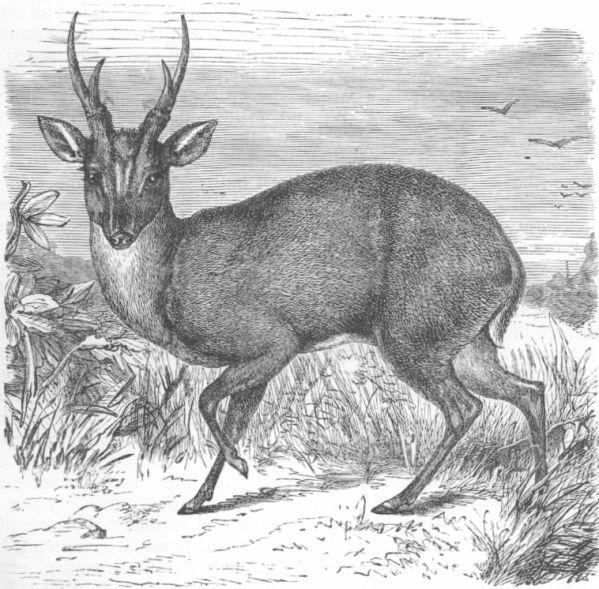
Cervulus aureus.
DESCRIPTION.—Between the facial ridges the creases are dark brown, with a dark line running up the inside of each frontal pedestal; all the rest of the head and upper parts a bright rufous bay; chin, throat, inside of hind-legs, and beneath tail, white; some white spots in front of the fetlocks of all four legs; fore-legs from the shoulder downwards, the legs under the tarsal joints, and a line in front of hind-legs, dark blackish-brown. The doe is a little smaller, and has little black bristly knobs where the horns of the buck are.
SIZE.—Head and body, about 3½ feet; tail, 7 inches; height, 26 to 28 inches. Jerdon gives the size of the horn 8 to 10 inches, but in this he doubtless included the pedicle, which is about 5 inches, and the horns, from 2 to 5 inches. Of the only specimen I have at present in my collection the posterior measurement from cranium to tip of horn is 6½ inches, of which the bony pedicle is 3 inches.
It is a question whether we should separate the Indian from the Malayan animal. The leading authority of the day on the Cervidæ, Sir Victor Brooke, was of opinion some time back (see 'P. Z. S.,' 1874, p. 38), that the species were identical. He says: "In a large collection of the skins, skulls, and horns of this species, which I have received from all parts of India and Burmah, and in a considerable number of living specimens which I have examined, I have observed amongst adult animals so much difference in size and intensity of coloration that I have found it impossible to retain the muntjac of Java and Sumatra as a distinct species. The muntjacs from the south of India are, as a rule, smaller than those from the north, as is also the case with the axis and Indian antelope. But even this rule is subject to many exceptions. I have received from Northern India perfectly adult, and even slightly aged, specimens of both muntjac and axis inferior in size to the average as presented by these species in Southern India. These small races are always connected with particular areas, and are doubtless the result of conditions sufficiently unfavourable to prevent the species reaching the full luxuriance of growth and beauty of which it is capable, though not sufficiently rigorous to prevent its existence." In a later article on the Cervidæ, written four years afterwards, he seems, however, to qualify his opinion in the following words: "This species appears to attain a larger size in Java, Sumatra, and Borneo than it does on the mainland; and I think it not improbable that persistent race characters may eventually be found distinguishing the muntjac of these islands from that of British India."
The rib-face is a retiring little animal, and is generally found alone, or at times in pairs. Captain Baldwin mentions four having been seen together at one time, and General McMaster mentions three; but these are rare cases.
It is very subtle in its movements, carrying its head low, and creeping, as Hodgson remarks, like a weasel under tangled thickets and fallen timber. In captivity I have found it to be a coarse feeder, and would eat meat of all kinds greedily.
Its canine teeth are very long and sharp, and have a certain amount of play in the socket, but I am unable to state whether they are ever used for any purpose, whether of utility or defence. Its call is a hoarse, sharp bark, whence it takes its name of barking deer. What Jerdon says about the length of its tongue is true; it can certainly lick a good portion of its face with it.
For excellent detailed accounts of this little deer I must refer my readers to Kinloch's 'Large Game Shooting,' and a letter by "Hawkeye," quoted by McMaster's 'Notes on Jerdon.' My space here will not allow of my quoting largely or giving personal experience, but both the above articles, as well as Captain Baldwin's notice, nearly exhaust the literature on this subject in a popular way.
The next development of antler is the rusine type, in which the main beam divides at the top into two branches, making with the basal tine a horn of three points only.
GENUS RUSA—THE RUSINE DEER.
Antlers with a brow tine, the beam bifurcating into a tres and royal tine; muffle large; lachrymal fossa large and deep; ante-orbital vacuity very large; rudimentary canines in both sexes, except in the hog deer; tail of moderate length; no feet-pits. The males heavily maned.
NO. 471. RUSA ARISTOTELIS. The Sambar (Jerdon's No. 220).
NATIVE NAMES.—Sambar or Samhar, Hindi; Jerai and Jerao in the Himalayas; Maha in the Terai; Meru, Mahrathi; Ma-oo, Gondi; Kadavi or Kadaba, Canarese; Kannadi, Telegu; Ghous or Gaoj, Eastern Bengal, the female Bholongi (Jerdon); Schap, Burmese (Blyth); Gona-rusa, Singhalese (Kellaart).
HABITAT.—Throughout India from the Himalayas to Cape Comorin; through Assam round to the east of the Bay of Bengal, down through Burmah to the Malay peninsula; it is also found in Ceylon.
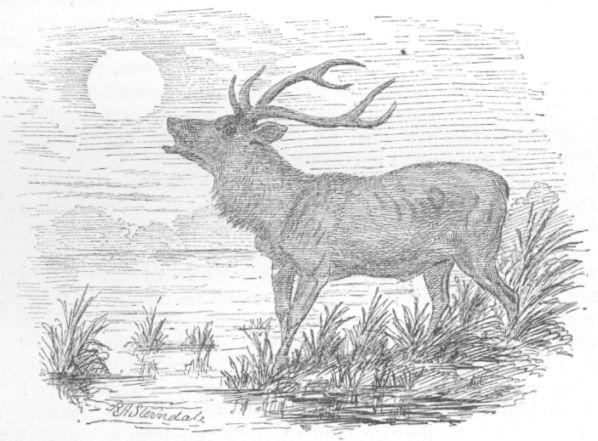
Rusa Aristotelis.
DESCRIPTION.—The sambar stag is a grand animal, with fine erect carriage, heavily maned neck, and with massive horns of the rusine type. In size it is considerably larger than the red deer, and, though its horns are not so elegant, it is in its tout ensemble quite as striking an animal. In colour it is dark brown, somewhat slaty in summer; the chin, inside of limbs and tail, and a patch on the buttocks yellowish or orange yellow. The head of the sambar is very fine; the eye large and full, with immense eye-pits, which can be almost reversed or greatly dilated during excitement. The ears are large and bell-shaped, and the throat surrounded by a shaggy mane—truly a noble creature. The female and young are lighter.
SIZE.—A large stag will stand 14 hands at the withers, the length of the body being from 6 to 7 feet; tail about a foot; ears 7 to 8 inches. The average size of horns is about 3 feet, but some are occasionally found over 40 inches. Jerdon says: "some are recorded 4 feet along the curvature; the basal antler 10 to 12 inches or more." A very fine pair, with skull, in my own collection, which I value much, show the following measurements: right horn, 45 inches; left horn, 43 inches; brow antler from burr to tip, 18¼ inches circumference; just above the burr, 9 inches; circumference half-way up the beam, 7¼ inches. On the right horn underneath the tres-tine is an abnormal snag 9 inches long. The left horn has an indication of a similar branch, there being a small point, which I have no doubt would have been more fully developed had the animal lived another year.
I have had no experience of deer-shooting in the regions inhabited by the Kashmir and Sikim stags, which are approximate to our English red deer; but no sportsman need wish for a nobler quarry than a fine male sambar.
As I write visions of the past rise before me—of dewy mornings ere the sun was up; the fresh breeze at daybreak, and the waking cry of the koel and peacock, or the call of the painted partridge; then, as we move cautiously through the jungle that skirts the foot of the rocky range of hills, how the heart bounds when, stepping behind a sheltering bush, we watch the noble stag coming leisurely up the slope! How grand he looks!—with his proud carriage and shaggy, massive neck, sauntering slowly up the rise, stopping now and then to cull a berry, or to scratch his sides with his wide, sweeping antlers, looming large and almost black through the morning mists, which have deepened his dark brown hide, reminding one of Landseer's picture of 'The Challenge.' Stalking sambar is by far the most enjoyable and sportsmanlike way of killing them, but more are shot in battues, or over water when they come down to drink. According to native shikaris the sambar drinks only every third day, whereas the nylgao drinks daily; and this tallies with my own experience—in places where sambar were scarce I have found a better chance of getting one over water when the footprints were about a couple of days old. An exciting way of hunting this animal is practised by the Bunjaras, or gipsies of Central India. They fairly run it to bay with dogs, and then spear it. I have given in 'Seonee' a description of the modus operandi.
When wounded or brought to bay the sambar is no ignoble foe; even a female has an awkward way of rearing up and striking out with her fore-feet. A large hind in my collection at Seonee once seriously hurt the keeper in this manner.
Those who have read 'The Old Forest Ranger,' by Colonel Campbell, have read in it one of the finest descriptions of the stalking of this noble animal. I almost feel tempted to give it a place here; but it must give way to an extract from a less widely known, though as graphic a writer, "Hawkeye," whose letters to the South of India Observer deserve a wider circulation. I cannot find space for more than a few paragraphs, but from them the reader may judge how interesting the whole article is:—
"The hill-side we now are on rapidly falls towards the river below, where it rushes over a precipice, forming a grand waterfall, beautiful to behold. The hill-side is covered with a short, scrubby rough-leafed plant, about a foot and a-half high. Bending low, we circle round the shoulder of the slope, beyond the wood. The quick eye of the stalker catches sight of a hind's ears, at the very spot he hoped for. The stag must be nigh.
"Down on all-fours we move carefully along, the stalker keenly watching the ears. A short distance gained, and the hind detects the movement of our heads. At the same moment the upper tines of the stag's antlers are in sight; he lies to the right of the hind, about 120 yards distant, hidden by an inequality of the ground. Be still, oh beating heart! Be quiet, oh throbbing pulse! Steady, oh shaky hand, or all your toil is vain! Onward, yet only a few paces! Be not alarmed, oh cautious hind! We care not for you. Crouching still lower, we gain ground; the head and neck of our noble quarry are in sight; the hind still gazes intensely. Presently she elongates her neck in a most marvellous manner. We still gain. On once more we move, when up starts the hind. We know that in another moment she will give the warning bell, and all will vanish. The time for action has arrived. We alter our position in a second, bring the deadly weapon to bear on the stag; quickly draw a steady bead, hugging the rifle with all our might, and fire! The hinds flash across our vision like the figures in a magic lantern, and the stag lies weltering in his couch."
GENUS AXIS.
Horns of the rusine type, but with the tres-tine longer than the royal or posterior tine; beam much bent; horns paler and smoother than in the sambar; large muffle and eye-pits; canines moderate; feet-pits in the hind-feet only; also groin-pits; tail of moderate length; skin spotted with white; said to possess a gall-bladder.
NO. 472. AXIS MACULATUS. The Spotted Deer (Jerdon's No. 221).
NATIVE NAMES.—Chital, Chitra, Chritri-jhank (the male), Hindi; Chatidah in Bhagulpore; Boro-khotiya, Bengali at Rungpore; Buriya, in Gorukpore; Saraga, Canarese; Dupi, Telegu; Lupi, Gondi (Jerdon); Tic-mooha, Singhalese (Kellaart); Sarga, Jati, Mikka, Canarese (Sanderson).
HABITAT.—Throughout India, with the exception of the Punjab; nor is it found, I believe, in the countries east of the Bay of Bengal. It is however obtained in Ceylon, where it has been classed by Kellaart as a distinct species, A. oryzeus.
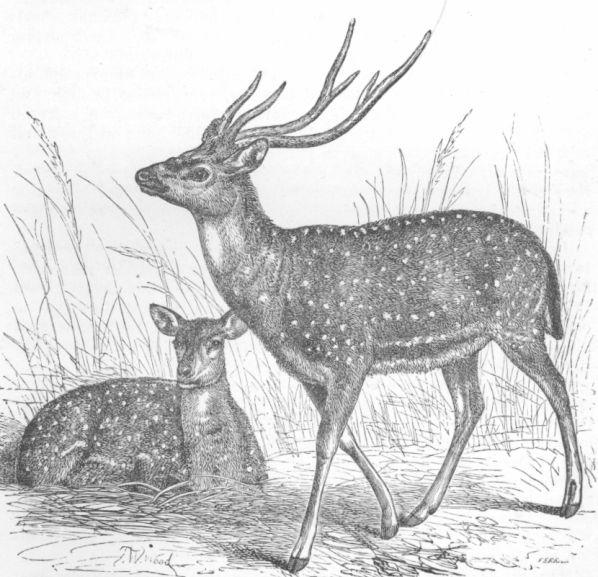
Axis maculatus.
DESCRIPTION.—General colour like that of the English fallow deer, yellowish or rufous fawn, spotted with white; the spots on the sides low down assuming an elongated shape, forming lines; a dark dorsal stripe from nape to tail; head brownish, unspotted; muzzle dark; ears dark externally, white within; chin, throat, and under-parts whitish, as also the inside of limbs and tail; the horns frequently throw out snags on the brow antler.
SIZE.—Length, 4½ to 5 feet. Height at shoulder, 36 to 38 inches. I regret I cannot give accurate measurements just now of horns, as I am writing on board ship, with all my specimens and most of my books boxed up, but I should say 30 inches an average good horn. Jerdon does not give any details.
This deer is generally found in forests bordering streams. I have never found it at any great distance from water; it is gregarious, and is found in herds of thirty and forty in favourable localities. Generally spotted deer and lovely scenery are found together, at all events in Central India. The very name chital recalls to me the loveliest bits of the rivers of the Central provinces, the Nerbudda, the Pench, the Bangunga, and the bright little Hirrie. Where the bamboo bends over the water, and the kouha and saj make sunless glades, there will be found the bonny dappled hides of the fairest of India's deer. There is no more beautiful sight in creation than a chital stag in a sun-flecked dell when—
"Ere his fleet career he took The dewdrops from his flanks he shook; Like crested leader, proud and high, Toss'd his beam'd frontlet to the sky; A moment gazed adown the dale, A moment snuff'd the tainted gale, A moment listen'd to the cry That thicken'd as the chase drew nigh; Then, as the headmost foes appeared, With one brave bound the copse he clear'd."
Here I may fitly quote again from "Hawkeye," whose descriptions are charming: "Imagine a forest glade, the graceful bamboo arching overhead, forming a lovely vista, with here and there bright spots and deep shadows—the effect of the sun's rays struggling to penetrate the leafy roof of nature's aisle. Deep in the solitude of the woods see now the dappled herd, and watch the handsome buck as he roams here and there in the midst of his harem, or, browsing amongst the bushes, exhibits his graceful antlers to the lurking foe, who by patient woodcraft has succeeded in approaching his unsuspecting victim; observe how proudly he holds himself, as some other buck of less pretensions dares to approach the ladies of the group; see how he advances, as on tiptoe, all the hair of his body standing on end, and with a thundering rush drives headlong away this bold intruder, and then comes swaggering back! But, hark—a twig has broken! Suddenly the buck wheels round, facing the quarter whence the sound proceeded. Look at him now, and say, is he not a quarry well worth the hunter's notice?
"With head erect, antlers thrown back, his white throat exposed, his tail raised, his whole body gathered together, prepared to bound away into the deep forest in the twinkling of an eye, he stands a splendid specimen of the cervine tribe. We will not kill him; we look and admire! A doe suddenly gives that imperceptible signal to which I have formerly alluded, and the next moment the whole herd has dashed through the bamboo alleys, vanishing from sight—a dappled hide now and again gleaming in the sunlight as its owner scampers away to more distant haunts."
Jerdon is a follower of Hodgson, who was of opinion that there are two species of spotted deer—a larger and smaller, the latter inhabiting Southern India; but there is no reason for adopting this theory; both Blyth, Gray, and others have ignored this, and the most that can be conceded is that the southern animal is a variety owing to climatic conditions. Multiplication of species is a thing to be avoided of all naturalists—I have, therefore, not separated them. McMaster too writes: "I cannot agree with Jerdon that there are two species of spotted deer." And he had experience in Southern India as well as in other parts. He states that the finest chital he ever came across were found in the forests in Goomsoor, where, he adds, "as in every other part of Orissa, both spotted deer and sambar are, I think, more than usually large."
NO. 473. AXIS PORCINUS. The Hog Deer (Jerdon's No. 222).
NATIVE NAMES.—Para, Hindi; Jerdon also gives Khar-laguna, Nepal Terai; Sugoria also in some parts. Nuthurini-haran in some parts of Bengal; Weel-mooha, Singhalese (Kellaart).
HABITAT.—Throughout India, though scarce in the central parts; it is abundant in Assam and Burmah, and is also found in Ceylon, but is stated not to occur in Malabar.
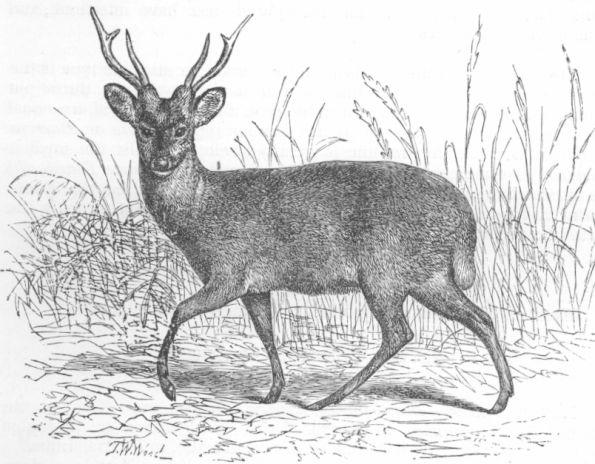
Axis porcinus.
DESCRIPTION.—"Light chestnut or olive-brown, with an eye-spot; the margin of the lips, the tail beneath, limbs within, and abdomen, white—in summer many assume a paler and more yellow tint, and get a few white spots, and the old buck assumes a dark slaty colour; the horns resemble those of a young spotted deer, with both the basal and upper tines very small, the former pointing directly upwards at a very acute angle, and the latter directed backwards and inwards, nearly at a right angle, occasionally pointing downwards" (Jerdon). McMaster says: "I can corroborate Jerdon's statement that the young of this deer are beautifully spotted; but, although I have seen many specimens, dead and alive, and still more of the skins while I was in Burmah, I do not remember having remarked the few white spots which he says many of them assume in summer." The fawns lose their spots at about six months.
SIZE.—Length, 42 to 44 inches; tail, 8 inches; height, 27 to 28. Average length of horns, 15 to 16 inches.
This animal is seldom found in forest land; it seems to prefer open grass jungle, lying sheltered during the day in thick patches, and lies close till almost run upon by beaters or elephants. Its gait is awkward, with some resemblance to that of a hog carrying its head low; it is not speedy, and can easily be run down by dogs in the open. McMaster writes: "Great numbers of these deer are each season killed by Burmans, being mobbed with dogs." The meat is fair. Hog deer are not gregarious like chital; they are usually solitary, though found occasionally in pairs.
The horns are shed about April, and the rutting season is September and October. This species and the spotted deer have interbred, and the hybrid progeny survived.
The next stage from the rusine to the cervine or elaphine type is the rucervine. In this the tres-tine, as well as the royal tine, throw out branches, and in the normal rucervine type the tres and royal are equal as in Schomburgk's deer, but in the extreme type, Panolia or Rucervus Eldii of Burmah, the tres-tine is greatly developed, whilst the royal is reduced to a mere snag. The Indian swamp-deer (Rucervus Duvaucelli) is intermediate, both tres and royal tines are developed, but the former is much larger than the royal. In none of the rucervine forms is the bez-tine produced.
GENUS RUCERVUS.
Horns as above; muzzle pointed. Canines in males only.
NO. 474. RUCERVUS DUVAUCELLI. The Swamp-Deer (Jerdon's No. 219).
NATIVE NAMES.—Bara-singha, Hindi; Baraya and Maha in the Nepal Terai; Jhinkar in Kyarda Doon; Potiyaharan at Monghyr (Jerdon); Goen or Goenjak (male), Gaoni (female), in Central India.
HABITAT.—"In the forest lands at the foot of the Himalayas, from the Kyarda Doon to Bhotan. It is very abundant in Assam, inhabiting the islands and churs of the Berhampooter, extending down the river in suitable spots to the eastern Sunderbunds. It is also stated to occur near Monghyr, and thence extends sparingly through the great forest tract of Central India" (Jerdon's 'Mamm. Ind.'). I have found it in abundance in the Raigarh Bichia tracts of Mundla, at one time attached to the Seonee district, but now I think incorporated in the new district of Balaghat. In the open valleys, studded with sal forest, of the Thanwur, Halone, and Bunjar tributaries of the Nerbudda, may be found bits reminding one of English parks, with noble herds of this handsome deer. It seems to love water and open country. McMaster states that it is found in the Golcondah Zemindary near Daraconda.
DESCRIPTION.—Smaller and lighter than the sambar. Colour rich light yellow or chestnut in summer, yellowish-brown in winter, sometimes very light, paler below and inside the limbs, white under the tail. The females are lighter; the young spotted.
SIZE.—Height, about 44 to 46 inches; horns, about 36 inches. They have commonly from twelve to fourteen points, but Jerdon states he has seen them with seventeen.
Like the spotted deer this species is gregarious; one writer, speaking of them in Central India, says: "The plain stretched away in gentle undulations towards the river, distant about a mile, and on it were three large herds of bara singhas feeding at one time; the nearest was not more than five hundred yards away from where I stood. There must have been at least fifty of them—stags, hinds, and fawns, feeding together in a lump, and outside the herd grazed three most enormous stags" ('Indian Sporting Review,' quoted by Jerdon).
NO. 475. RUCERVUS vel PANOLIA ELDII. The Brown Antlered or Eld's Deer.
NATIVE NAMES.—Thamin, in Burmah; Sungrai or Sungnaie, in Munipur, Eastern Himalayas, Terai, Munipur, Burmah, Siam, and the Malay peninsula.
DESCRIPTION.—In body similar to the last, but with much difference in the horns, the tres-tine being greatly developed at the expense of the royal, which gives the antlers a forward cast; the brow-tine is also very long. In summer it is a light rufous brown, with a few faint indications of white spots; the under-parts and insides of ears nearly white; the tail short and black above. It is said to become darker in winter instead of lighter as in the last species.
SIZE.—Height from 12 to 13 hands.
This deer, which is identical with Cervus frontalis and Hodgson's Cervus dimorpha, and which was discovered in 1838 by Captain Eld, has been well described by Lieutenant R. C. Beavan. The following extracts have been quoted by Professor Garrod; the full account will be found in the 'Journal of the Asiatic Society of Bengal.' The food of this species seems to consist of grass and wild paddy. "In habits they are very wary and difficult of approach, especially the males. They are also very timid and easily startled. The males, however, when wounded and brought to bay with dogs, get very savage, and charge vigorously. On being disturbed they invariably make for the open instead of resorting to the heavy jungle, like hog deer and sambar. In fact the thamyn is essentially a plain-loving species; and although it will frequent tolerably open tree-jungle for the sake of its shade, it will never venture into dense and matted underwood. When first started the pace of the thamyn is great. It commences by giving three or four large bounds, like the axis or spotted deer, and afterwards settles down into a long trot, which it will keep up for six or seven miles on end when frequently disturbed."
The next phase of development of which we have examples in India is the true cervine or elaphine type of horn in which the brow-tine is doubled by the addition of the bez; the royal is greatly enlarged at the expense of the tres-tine, and breaks out into the branches known as the sur-royals.
GENUS CERVUS.
Horns as above, muzzle pointed, muffle large and broad, with a hairy band above the lip; hair coarse, and usually deep brown, with a light and sometimes almost white disc or patch round the tail, which is very short; eye-pits moderate.
NO. 476. CERVUS CASHMIRIANUS. The Kashmir Stag (Cervus Wallichii of Jerdon, No. 217).
NATIVE NAMES.—Hangul or Honglu in Kashmir; Barasingha, Hindi.
HABITAT.—Kashmir. Jerdon also gives out that it is found throughout great part of Western and Central Asia, as far as the eastern shores of the Euxine Sea, and that it is common in Persia, where it is called maral; but according to careful observations made by Sir Victor Brooke the maral is a distinct species, to which I will allude further on. In Kashmir it frequents the Sind valley and its offshoots; the country above also.
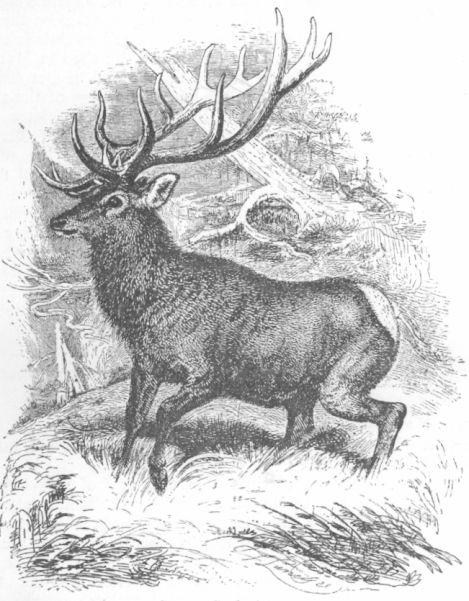
Cervus Cashmirianus.
DESCRIPTION.—Brownish-ash, darker along the dorsal line; caudal disk white, with a dark border; sides and limbs paler; ears light coloured; lips and chin and a circle round eyes white. The male has very long and shaggy hair on the lower part of the neck. The colour of the coat varies but little; at times it is liver-coloured or liver-brown, sometimes "bright pale rufous chestnut," with reddish patches on the inner sides of the hips. Jerdon says: "The belly of the male is dark brown, contrasting with the pale ashy hue of the lower part of the flanks; the legs have a pale dusky median line. In females the whole lower parts are albescent."
SIZE.—Length, 7 to 7½ feet; height, 12 to 13 hands; tail, 5 inches. The horns are very large and massive, with from ten to fifteen, or even more, points. Jerdon states that even eighteen points have been counted, but such cases are rare. Dr. Leith Adams says the largest he ever measured were four feet round the curves. "A. E. W." in his interesting papers on Kashmir game, published in The Asian, gives the following measurements of two heads:—
Length of horns. Girth above brow antler. Divergency at tips. Where obtained.
Inches. Inches. Greatest. Least.
47 7¾ 56 in. 29 in. Sindh Valley
46 8 50 in. 32 in. Sindh Valley
I once saw a beautiful head at a railway-station, the property of an officer who had just come down from Kashmir, the horns of which appeared to me enormous. The owner afterwards travelled with me in the train, and gave me his card, which I regret I lost, and, having forgotten his name, I was never enabled to write to him, either on the subject of the horns or to send him some papers he wanted on Asiatic sheep.
Dr. Leith Adams writes: "They (the horns) are shed in March, and the new horn is not completely formed till the end of October, when the rutting season commences, and the loud bellowings of the stags are heard all over the mountains." Of this bellowing Sir Victor Brooke says it is just like the voice of the Wapiti stag, which this animal closely resembles, and is quite different from that of the red deer. "In the former it is a loud squeal, ending in a more gutteral tone; in the latter it is a distinct roar, resembling that of a panther." Sir Victor Brooke also points out another peculiarity in this deer: namely, that "the second brow antler (bez) in Cervus Cashmirianus, with very rare exceptions, exceeds the brow antler in length; a peculiarity by which the antlers of this species may be distinguished from those of its allies."
The female gives birth in April, and the young are spotted.
The points on which this stag differs from the maral are the longer and more pointed head of the latter.
NO. 477. CERVUS AFFINIS vel WALLICHII. The Sikhim Stag (Jerdon's No. 218).
NATIVE NAME.—Shou, Thibetan.
HABITAT.—Eastern Himalayas; Thibet in the Choombi valley, on the Sikhim side of Thibet.
DESCRIPTION.—Jerdon describes this stag as "of very large size; horns bifurcated at the tip in all specimens yet seen; horns pale, smooth, rounded, colour a fine clear grey in winter, with a moderately large disk; pale rufous in summer." Hodgson writes of the horns: "Pedicles elevate; burrs rather small; two basal antlers, nearly straight, so forward in direction as to overshadow the face to the end of the nasal; larger than the royal antlers; median or royal antlers directed forward and upwards; beam with a terminal fork, the prongs radiating laterally and equally, the inner one longest and thinnest." Jerdon adds: "Compared with the Kashmir stag this one has the beam still more bent at the origin of the median tine, and thus more removed from C. elaphus, and like C. Wallichii (C. Cashmirianus)." The second basal tine or bez antler is generally present, even in the second pair of horns assumed. Moreover the simple bifurcation of the crown mentioned above is a still more characteristic point of difference both from the Kashmir barasingha and the stag of Europe.
Regarding the nomenclature of this species there seems to be some uncertainty. Jerdon himself was doubtful whether the shou was not C. Wallichii, and the Kashmir stag C. Cashmirianus. He says: "It is a point reserved for future travellers and sportsmen to ascertain the limits of C. Wallichii east and C. affinis west, for, as Dr. Sclater remarks, it would be contrary to all analogy to find two species of the same type inhabiting one district."
Sir Victor Brooke writes: "Should Cervus Wallichii (Cuvier) prove to be specifically identical with Cervus affinis (Hodgson), the former name, having priority, must stand."
SIZE.—Length, about 8 feet; height at shoulders, 4½ to 5 feet. Horns quoted by Jerdon 54 inches round curve, 47 inches in divergence between the two outer snags. Longest basal tine, 12 inches; the medians, 8 inches.
An allied stag, Cervus maral, is found in Circassia and Persia. Sir Victor Brooke mentions a pair kept for some years in one of his parks, which never interbred with the red deer, and kept apart from them. "The old stag maral, though considerably larger in size, lived in great fear of the red deer stag." Another very fine species, Cervus Eustephanus, was discovered by Mr. W. Blanford inhabiting the Thian Shan mountains. As yet it is only known from its antlers, which are of great size, and in their flattened crowns closely resemble Wapiti horns.
TRAGULIDÆ—THE CHEVROTIANS OR DEERLETS.
Animals of small size and delicate graceful form, which are separated from the deer and oxen by certain peculiarities which approximate them to the swine in their feet. They are, however, ruminants, having the complex stomach, composed of paunch, honeycomb-bag and reed, the manyplies being almost rudimentary; but in the true ruminants the two centre metacarpals are fused into a single bone, whilst the outer ones are rudimentary. In the pig all the metacarpal bones are distinct, and the African Tragulus closely resembles it. The Asiatic ones have the two centre bones fused, but the inner and outer ones are entire and distinct as in the swine. The legs are, however, remarkably delicate, and so slight as to be not much thicker than an ordinary lead pencil. The males have pendant tusks, like those of the musk and rib-faced deer.
GENUS TRAGULUS.
Has the hinder part of metatarsus bald and callous.
NO. 478. TRAGULUS NAPU. The Javan Deerlet.
NATIVE NAME.—Napu.
HABITAT.—Tenasserim and the Malay countries.
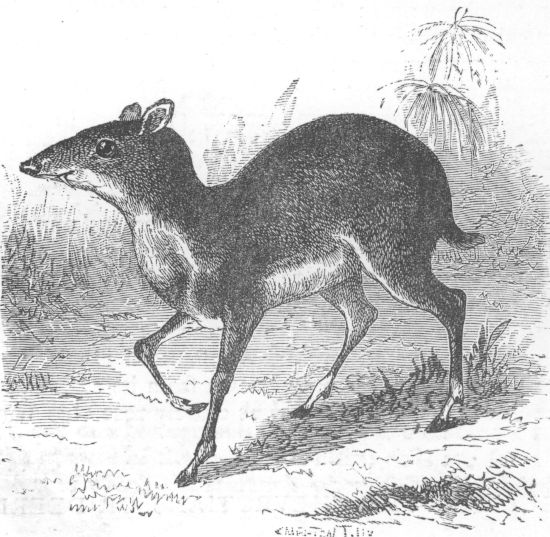
Tragulus napu.
DESCRIPTION.—Above rusty brown, with three whitish stripes; under-parts white, tail tipped with white, muzzle black.
Tragulus kauchil is another Malayan species yet smaller than the preceding; it may be found in Tenasserim. It is darker in colour than the last, especially along the back, with a broad black band across the chest.
GENUS MEMINNA.
Hinder edge of metatarsus covered with hair.
NO. 479. MEMINNA INDICA. Indian Mouse Deer.
NATIVE NAMES.—Pisuri, Pisora, Pisai, Hindi and Mahratti; Mugi in Central India; Turi-maoo, Gondi; Jitri-haran, Bengali; Gandwa, Ooria; Yar of the Koles; Wal-mooha, Singhalese.
HABITAT.—In all the large forests of India; but is not known, according to Jerdon, in the countries eastward of the Bay of Bengal. It is common in the bamboo forests of the Central provinces, where I obtained it on several occasions.
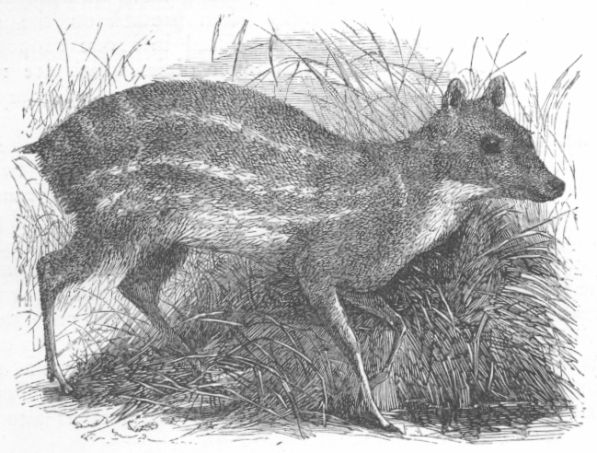
Mouse Deer. (From Sir Emerson Tennant's 'Ceylon,' by permission of Messrs. Longmans.)
DESCRIPTION.—"Above olivaceous, mixed with yellow grey; white below; sides of the body with yellowish-white lines formed of interrupted spots, the upper rows of which are joined to those of the opposite side by some transverse spots; ears reddish-brown" (Jerdon). The colour however varies; some are darker than others.
SIZE.—Length, 22 to 23 inches; tail, 1½ inches; height, 10 to 12 inches. Weight, 5 to 6 lbs.
The above measurements and weight are taken from Jerdon. Professor Garrod (Cassell's Nat. His.) gives eighteen inches for length and eight inches for height, which is nearer the size of those I have kept in confinement; but mine were young animals. They are timid and delicate, but become very tame, and I have had them running loose about the house. They trip about most daintily on the tips of their toes, and look as if a puff of wind would blow them away.
They are said to rut in June and July, and bring forth two young about the end of the rainy season.
TRIBE TYLOPODA—THE CAMELS.
This name, which is derived from the Greek [Greek: túlos], a swelling, pad, or knot, and [Greek: poús], a foot, is applied to the camels and llamas, whose feet are composed of toes protected by cushion-like soles, and not by a horny covering like those of the Artiodactyli generally. The foot of the camel consists of two toes tipped by small nails, and protected by soft pads which spread out laterally when pressed on the ground. The two centre metacarpal bones are fused into one cannon bone, and the phalanges of the outer and inner digits which are more or less traceable in all the other families of the Artiodactyli are entirely absent.
The dentition of the camel too is somewhat different from the rest of the Ruminantia, for in the front of the upper jaw there are two teeth placed laterally, one on each side, whereas in all other ruminating animals there are no cutting teeth in the upper jaw—only a hard pad, on which the lower teeth are pressed in the act of tearing off herbage.
The stomach of the camel is the third peculiarity which distinguishes it. The psalterium or manyplies is wanting. The abomasum or "reed" is of great length, and the rumen or paunch is lined with cells, deep and narrow, like those of a honeycomb, closed by a membrane, the orifice of which is at the control of the animal. These cells are for the purpose of storing water, of which the stomach when fully distended will hold about six quarts. The second stomach or reticulum is also deeply grooved.
The hump of the camel may also be said to contain a store of food. It consists of fatty cells connected by bands of fibrous tissue, which are absorbed, like the fat of hibernating bears, into the system in times of deprivation. Hard work and bad feeding will soon bring down a camel's hump; and the Arab of the desert is said to pay particular attention to this part of his animal's body.
There are two species of true camel, Camelus dromedarius, with one hump only, most commonly seen in India, and C. bactrianus, the two-humped camel, a shorter, coarser-looking, and less speedy animal.
There never was a creature about whom more poetical nonsense has been written. He has been extolled to the skies as patient, long-suffering, the friend of man, and what not. In reality he is a grumbling, discontented, morose brute, working only under compulsion and continual protest, and all writers who know anything of him agree in the above estimate of his disposition. The camel is nowhere found in a wild state.