ORDER CARNARIA. (continued 3)
Reading edition
MELIDIDÆ; OR, BADGER-LIKE ANIMALS.
This group is distinguished by a heavier form, stouter limbs, coarse hair, and slower action; in most the claws are adapted for burrowing. None of them are arboreal, although in olden times marvellous tales were told of the wolverene or glutton as being in the habit of dropping down from branches of trees on the backs of large animals, clinging on to them and draining their life blood as they fled. Some of them are capable of emitting a noisome smell. The teledu of Java (Mydaus meliceps) is the worst of the family in this respect, and almost equals the skunk. It is possible that this animal may be found in Tenasserim.
GENUS ARCTONYX.
Dentition much the same as that of the Badger (Meles). Incisors, 6/6; can., 1—1/1—1; premolars, 3—3/3—3; molars, 1—1/1—1. The incisors are disposed in a regular curve, vertical in the upper jaw, obliquely inclined in the lower; canines strong, grinders compressed; general form of the badger, but stouter. Feet five-toed, with strong claws adapted for digging, that of the index finger being larger than the other.
NO. 170. ARCTONYX COLLARIS. The Hog-Badger (Jerdon's No. 93).
NATIVE NAMES.—Balu-suar, Hind., Sand-pig, or, as Jerdon has it, Bhalu-soor, Hind., i.e. Bear-pig; Khway-too-wet-too, Arakanese.
HABITAT.—Nepal, Sikim, Assam, Sylhet, Arakan, extending, as Dr. Anderson has observed, to Western Yunnan. The late General A. C. McMaster found it in Shway Gheen On the Sitang river in Pegu. I heard of it in the forests of Seonee in the Central Provinces, but I never came across one.
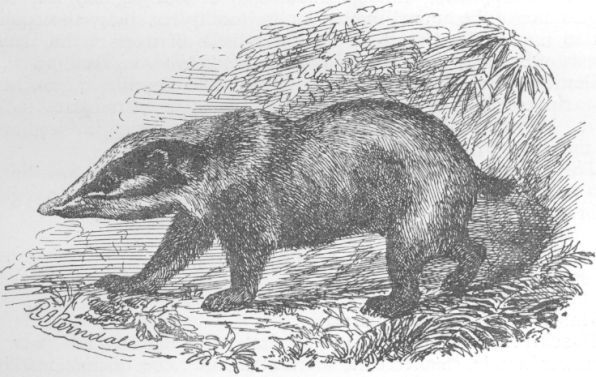
Arctonyx collaris.
DESCRIPTION.—"Hair of the body rough, bristly, and straggling; that of the head shorter, and more closely adpressed. Head, throat, and breast yellowish white; on the upper part this colour forms a broad regularly-defined band from the snout to the occiput; ears of the same colour; the nape of the neck, a narrow band across the breast, the anterior portion of the abdomen, the extremities, a band arising from the middle of the upper lip, gradually wider posteriorly, including the eyes and ears, and another somewhat narrower arising from the lower lip, passing the cheek, uniting with the former on the neck, are deep blackish-brown" (Horsfield). The tail is short, attenuated towards the end, and covered with rough hairs.
SIZE.—From snout to root of tail, 25 inches; tail, 7 inches; height at the rump, 12 inches.
M. Duvaucel states that "it passes the greatest part of the day in profound somnolence, but becomes active at the approach of night; its gait is heavy, slow, and painful; it readily supports itself erect on its hind feet, and prefers vegetables to flesh."
Jerdon alludes to all this, and adds, "one kept in captivity preferred fruit, plantains, &c., as food, and refused all kinds of meat. Another would eat meat, fish, and used to burrow and grope under the walls of the bungalow for worms and shells." My idea is Balu-suar, or Sand-pig is the correct name, although Bhalu-suar or Bear-pig may hit off the appearance of the animal better, but its locality has always been pointed out to me by the Gonds in the sandy beds of rivers in the bamboo forests of Seonee; and Horsfield also has it Baloo-soor, Sand-pig.
Bewick, who was the first to figure and describe it, got, as the vulgar phrase hath it, the wrong pig by the lug, as he translates it Sand-bear. McMaster also speaks of those he saw as being in deep ravines on the Sitang river.
The stomach of Arctonyx is simple; there is no cæcum, as is the case also with the bears; the liver has five lobes; under the tail it has glands, as in the Badgers, secreting a fatty and odorous substance.
NO. 171. ARCTONYX TAXOIDES. The Assam Badger.
HABITAT.—Assam and Burmah.
DESCRIPTION.—Smaller than the last, with longer and finer fur, narrower muzzle, smaller ears, shorter tail, and more distinct markings. The measurement of the respective skulls show a great difference. The length of a skull of a female of this species given by Dr. Anderson is 4·75 inches against 6·38 of a female of A. collaris. The breadth across the zygomatic arch is 2·38 against 3·64 of A. collaris. The breadth of the palate between the molars is only 0·81 against 1·07.
GENUS MELES. SUB-GENUS TAXIDIA.
This sub-genus is that of the American type of Badger, to which Hodgson, who first described the Thibetan T. leucurus, supposed his species to belong; but other recent naturalists, among whom are Drs. Gray and Anderson, prefer to class it as Meles. Hodgson founded his classification on the dentition of his specimen, but Blyth has thrown some doubt on its correctness, believing that the skull obtained by Hodgson with the skin was that of Meles albogularis. Hodgson, however, says: "from the English Badger type of restricted Meles our animal may be at once discriminated without referring to skulls by its inferior size, greater length of tail, and partially-clad planta or foot-sole."
NO. 172. MELES (TAXIDIA) LEUCURUS. The Thibetan White-tailed Badger.
NATIVE NAME.—Tampha.
HABITAT.—The plains of Thibet.
DESCRIPTION.—"Fur long, flaccid, dark iron-grey and white mixed; hair long, white, with a broad sub-lunate black band and a white tip; under fur abundant, long, white; a streak on each side of the forehead blackish grey, varied; chin, throat, legs and under side of the body black; tail, sides of head, and body whitish."—Gray.
The aspect, according to Hodgson, is entirely that of a long-tailed Badger (Gray remarks: "it most resembles the European animal "), with somewhat smaller head, with longer, finer fur than usual; the entire sole of the foot is not naked, but only about two-thirds, and the toe-pads are very much developed, thus raising the powerful long fossorial claws from the ground in walking.
SIZE.—Total length 37 inches, of which the tail, with the hair, is 10 inches, and without the hair 7 inches; the longest hair of the body is 4½ inches.
There is not much known about the Tampha. According to what Hodgson was able to gather concerning his habits, "he dwells in the more secluded spots of inhabited districts, makes a comfortable, spacious and well-arranged subterraneous abode, dwells there in peace with his mate, who has an annual brood of two to four young, molests not his neighbour, defends himself if compelled to it with unconquerable resolution, and feeds on roots, nuts, insects and reptiles, but chiefly the two former—on vegetables, not animals—a point of information confirmed by the prevalent triturant character of the teeth." The colouring of this animal is almost identical with the English badger, only that his tail is longer and whiter.
NO. 173. MELES ALBOGULARIS. The White-throated Thibetan Badger.
HABITAT.—Thibet.
DESCRIPTION.—Smaller and much less tufted ears than the last species; a shorter and much less bushy tail; and the fur shorter and coarser, though of finer texture than in the European badger, with much woolly hair at its base. Both the English badger and M. leucurus are black throated; this one is white throated. The English animal has a broad band of brownish-black, which begins between the muzzle and the eye, and runs through the eye and ear till it fades off on the neck; the space of white between these two bands on the forehead runs back and contracts behind the ears. In the Thibetan animal it contracts just behind the eyes, and is continued as a faint narrow streak only as far as the ears. In the English one the cheeks are broadly white between the eye-band and the black throat; in the Thibetan there is a little white below the eye, and this is bordered by a narrow black stripe, beneath which is the white throat.
There is another Thibetan badger mentioned by Professor Milne-Edwards in his 'Recherches sur les Mammifères,' a white-throated one, M. obscurus, but it appears to be the same as M. albogularis.
GENUS MELLIVORA.
Tubercular grinder transverse; flesh-tooth larger, with a small internal lobe, and with a single tubercle; lower flesh-tooth tricuspidate, sharp-edged; head depressed; nose blunt; ears not visible externally; body stout, depressed; legs short, and strong; feet plantigrade, five-toed; front claws elongated and strong; the bald sole of the hind foot occupying the whole under surface, only slightly divided across about one-third of its length from the front; tail very short, with powerfully offensive glands; it has a thick loose skin and a subcutaneous layer of fat, which doubtless protect it from stings of bees, on which this genus is supposed to feed whenever it can.
NO. 174. MELLIVORA INDICA. The Indian Ratel or Honey-Badger (Jerdon's No. 94).
NATIVE NAME.—Biju, Hind.; Biyu-khawar, Telegu; Tavakaradi, Tamil; Bajru-bhal, at Bhagulpore (Santali?); Bharsiah, Nepalese.
HABITAT.—Throughout India.
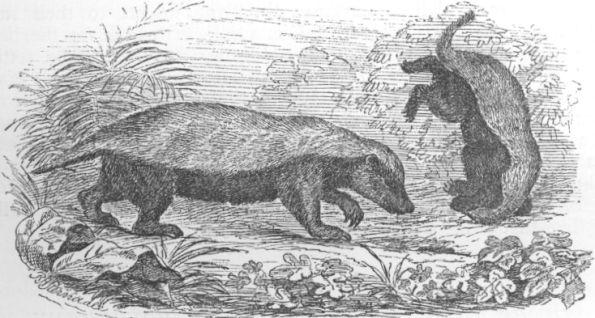
Mellivora Indica.
DESCRIPTION.—The upper half of its body is ashy-grey; the lower half, muzzle, limbs, and tail black; the general appearance is that of a black animal with a grey cloak on its back. The only difference between the Indian and the Cape Ratel is, that the grey cloak of the latter has a conspicuous white border which is wanting in the Indian species; the tail also of the latter is shorter, otherwise they are the same, and were for a long time considered the same.
SIZE.—Head and body, 26 to 32 inches; tail, 5 to 6 inches.
Jerdon says it is chiefly found in hilly districts, and that he has not found it in Lower Bengal nor on the Malabar coast. In Central India it is not uncommon. It has got a reputation for digging into graves, and is called in some parts "the grave-digger;" but I do not believe in its carnivorous propensities to this extent; it lives principally on small fry, insects, and small animals, honey and vegetable food. Jerdon says it is destructive to poultry, which is probable, for it will eat small birds. Both it and the Cape species will eagerly look out for bees, but it is not to be supposed, as some books would make out, that bees and honey form the staple diet. Its thick and loose skin, the stiffness of the hair above, and the layer of fat below, effectually preserve it from the effects of the stings. The tail glands contain a very strong and pungent secretion.
Some years ago, before I knew exactly what they were, the Ratels in the London Zoological Gardens used to interest me greatly. They had a low cage, on the ground I think, and their peculiar antics never failed to draw a crowd. They used to run round in an idiotic sort of way, and always at one point gravely turn head over heels and then proceed as before and repeat. In Cassell's 'Natural History' this is alluded to, only the writer says that now they are in fresh quarters, and the flitting seems to have disturbed them. He adds: "We have often watched one of them run round and round the cage in the usual purposeless manner of captive animals, but with this peculiarity: when he reached a particular corner of the den, he quietly, and without effort, turned head over heels, and then went on again. On one occasion, after he had been doing this with great regularity for some rounds he seemed to become abstracted, and passed the usual spot without the somersault; when, however, he had proceeded a few paces he recollected himself, stopped for a moment, returned to the exact place, turned over as usual, and proceeded without further let or hindrance." The African species is said to live largely on bees—I suppose ground bees, such as our English humble bee, for these animals are not arboreal—and it is said to exhibit great skill in tracking the flying insects to their nest. "Sparrman states that it seats itself on a hillock to look for the bees, and shades its eyes with one forepaw against the rays of the setting sun." Here is something for our Indian naturalists to observe. Some other animals are said to do the same; whether the Biju does it or not I cannot say. McMaster says of it: "Two that I saw in confinement appeared very good-tempered, and much more playful than tame bears would have been. They were, I think, fed entirely upon vegetables, rice and milk." This animal is the same as Hodgson's Ursitaxus inauritus, the Bharsiah which figures as a separate genus in Cuvier. The skull is very like that of the wolverenes in general form.
GENUS GULO—THE GLUTTON OR WOLVERENE.
This animal was placed by Linnæus among the Ursidæ, and is classed by some with the Melididæ, but its dentition is more that of the Martens, which occupy the next group. The true Glutton (Gulo luscus) is not known in India, but we have some so-called Wolverenes (Helictis) to which I shall presently allude. Still a few remarks about the typical animal, which is by no means an uninteresting creature, may not be out of place. The Glutton inhabits a wide tract of country in the Northern Hemisphere, the colder regions of Europe, Asia, and America; it is abundant in Siberia and Kamschatka, and is the pest of the trappers in North America. Fabulous stories were told of this animal in olden days, some of which are still propagated at the present time. It was supposed to be of insatiable appetite, and to attack its prey (deer, &c.) by dropping down from the branch of a tree on to the back of its victim, and to eat its way into a vital part, whilst being carried along—a decided fallacy, for neither the Glutton nor our Indian species of Helictis are arboreal in their habits. Then it was accused of eating to such a pitch of distention that it had to squeeze itself between two close-growing trees for relief ere it returned again to the repast. There is no doubt, however, that it is to a great extent voracious and extremely cunning; and what it cannot eat it will carry off and hide. The trappers complain bitterly of it, and spare no pains to kill every one they can come across; but it is not easily to be caught, and only a very cunningly-devised bait will succeed.
Were I to relate some of the stories recorded of this animal I might get accused, if not of being a romancer myself, at all events of being a too credulous propagator of other people's romances. It is told of it that it will discover hidden stores, and, digging them up out of the snow, carefully smooth the surface over again; that it will avoid every trap set for itself, and, going round to the back of spring guns, gnaw through the string connected with the trigger before it drags away the bait. It follows up the lines laid down by the trappers, taking the martens out, and devouring them, or hiding what it cannot eat, and by wearying out the patience of the hunters, compel them to strike a new "marten-road."
It is said by Dr. Coues to possess a singular habit of sitting down on its haunches, shading its eyes with a forepaw, and gazing earnestly at the approaching enemy before it takes to flight. I have already alluded to the Cape ratel doing this on the look-out for bees. The Indian form of Wolverene is a slighter and much smaller animal, with a still more weasel-like appearance. The Glutton is comparatively a large beast, the body being about 2½ feet, and the tail 10 inches; the Helictis is only half the size, and there is a slight difference in the dentition.
GENUS HELICTIS.
"Head tapering; nose acute, conical; muzzle bald, obliquely truncated; other side hairy, with a central groove; nostrils inferior; ears ovate; body slender; legs short; toes 5·5; front claws elongate, curved; hinder short and acute; sole of foot hairy behind, bald in front, and rhombic for half the length of the foot, with three large oblong pads on the front, and three small ones on the hinder edge; toes elongate; thumb short; fur black, like Herpestes; tail moderate, sub-cylindrical; teeth, 38; premolars, 4—4/4—4; grinders, 5/6."—Gray.
There are four species of this genus, and of these two come within the geographical limits of these papers, viz., Helictis Nipalensis and H. moschata; the third, H. orientalis, belongs to Java; and the fourth, H. subaurantiaca, to Formosa.
NO. 175. HELICTIS NIPALENSIS. The Nepal Wolverene (Jerdon's No. 95).
NATIVE NAME.—Oker, Nepalese; Kyoung-pyan, Arakanese.
HABITAT.—Nepal, Arakan, and Pegu.
DESCRIPTION.—Hodgson, who first described this animal in the 'Journal of the Asiatic Society of Beng.' (vol. v. pp. 237-38), says: "Above earthy brown; below, with the edge of the upper lip, the insides of the limbs, and terminal half of the tail, yellow; a white mesial stroke from the nape to the hips, and a white band across the forehead, spreading on the cheeks, and confluent with the pale colour of the animal's lower surface; head and body vermi-formed; digits and nails of the anterior extremities stronger; half way from the os calcis to the fingers hairy; fur of two sorts and abundant, but not lengthened, nor harsh, nor annulated; tail cylindrico-tapered, pointed, half the length of the animal." He goes on to add: "The anterior limbs are decidedly fossorial, and the hinder suited for walking in a sub-plantigrade manner; both wholly unfitted for rapatory or scansorial purposes."
SIZE.—Head and body 16 inches; tail 7½ inches, 9 inches, including hair.
The habits of this animal are nocturnal. Swinhoe mentions this in his account of the Formosan species, and Dr. Anderson relates that he is aware that the Nepal one is similar in its ways, and that it not unfrequently enters Bhotia huts at night; and on one occasion he killed one in a Bhotia hut, thinking it was a large rat, greatly to the chagrin of his host, who informed him that the animal was in the habit of visiting him nightly, and was most useful in destroying cockroaches and other insects.
NO. 176. HELICTIS MOSCHATA. The Chinese Wolverene.
HABITAT.—China, also Burmah (Pegu, Yunnan).
DESCRIPTION.—Similar to the last, but differing in dentition and the formation of certain points in the skull. The teeth are smaller, and the infra-orbital foramen much larger. Both the above species are noted for long skulls and palate, whereas H. orientalis has a short skull and palate. The following are the chief characteristics:—
Short head and palate, large teeth, small infra-orbital foramen = H. orientalis.
Long head and palate, large teeth, small infra-orbital foramen = H. Nipalensis.
Long head and palate, small teeth, large infra-orbital foramen = H. moschata.
Dr. Anderson obtained a specimen of this species at an elevation of 5000 feet, at Teng-yue-chow in Yunnan.
MUSTELIDÆ—MARTENS AND WEASELS.
In India the members of this family are restricted to the Weasels and Martens, but in other countries are included the Grisons, Zorillas, Skunks, &c. They are small animals of elongated form, with short legs, commonly expressed as vermiform; where the head of a weasel will go his body will follow—at least that was my experience in my boyish days, when I was particularly interested in vermin, and the gamekeeper was my first instructor in natural history. The face is rounded like a cat, but the skull behind the eye is very long and pear-shaped when viewed from above; in proportion to a cat's skull the brain case is a fourth longer. They are most sanguinary in their habits, and their agility is great, so on the whole they are most formidable to many animals, not only smaller, but in many cases four times their own size. The ferocity of the common weasel (Putorius vulgaris) ought to be as proverbial as its watchfulness. A case has been known of a kite carrying off one of these animals, but falling dead after a time with the large blood-vessels under the wing cut through by the savage little prisoner, who, on reaching terra firma, escaped apparently unhurt. I think in Wolff's admirable 'Illustrations of Natural History' this fact, related by Bell, is made the subject of a picture called "Catching a Tartar."
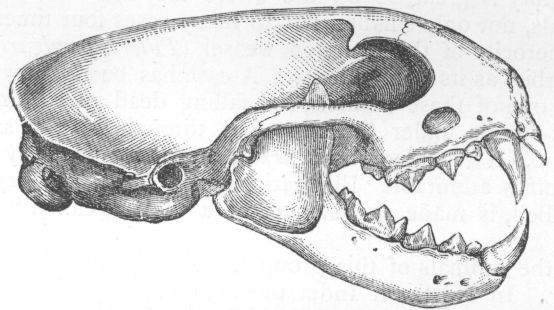
Skull of Putorius.
Most of the animals of this group are eagerly sought for on account of their fur. In Northern India the skin of one species, probably a variety of Martes abietum, is sold in the bazaars at Peshawur and Lahore. In 1868 I bought sufficient to line a large overcoat, which proved most comfortable in travelling in the cold weather in the Punjab, as well as in subsequent wanderings on the European continent in winter.
Dr. E. Coues, in his monograph on the North American Mustelidæ, gives the following interesting information regarding the number of skins of various species sold by the Hudson's Bay Company in London during the century 1769-1868:—
Sables, 1,240,511; otters, 674,027; wolverenes, 68,694; minks, 1,507,240; skunks, 218,653; badgers, 275,302; sea otters, 5349. In 1868, which appears to have been a prosperous year, the Company sold: Sables, 106,254; otters, 14,966; wolverenes, 1104; minks, 73,473; skunks, 6298; badgers, 1551; sea otters, 123.[8]
8 In the same year were sold by other firms, 22,000 otter skins and 4500 sables. See Appendix C for further statistics.
When one considers the number of those whose skins are damaged and cast aside, the number that fall victims to larger predatory animals, and the operations of disease, from which no animals, small or great, are free, we may form some idea of the immense multitude of these little creatures.
The ordinary divisions of the restricted Mustelidæ are the Martens (Martes), Pole-cats (Putorius), and Weasels (Mustela), but Gray has further subdivided them chiefly on the characteristics of the feet.
The Martens have four more teeth than the rest, which are distinguished as follows:—
Putorius.—Short ovate head; feet very hairy, especially between the pads; body stout; underside blackish.
Mustela.—Narrow, elongated head; feet very hairy between the pads; slender body; under-side yellow or white.
Vison.—Head elongate, narrow; feet slightly hairy; pads exposed; body rather slender; under-side same colour as upper.
Gymnopus.—Head elongate, narrow; feet rather naked, bald beneath, between, and rather behind the pads; toes largely webbed; soles hairy behind; body slender.
It is doubtful whether these distinctions are of sufficient importance to warrant so much subdivision; and unnecessary multiplication of genera is a thing to be avoided as much as possible.
GENUS MARTES—THE MARTENS.
A more or less arboreal group of larger size, and possibly less sanguinary habits than the weasels, although in this respect I do not think there is much difference. The tail is longer, though not so long as the head and body, and it is bushy; the fur is fine and in general highly prized; the dentition differs from the typical Mustela in having four more teeth and an additional false molar on either side in each jaw; and the inner side of the carnassial or flesh tooth has a tubercle which is not present in the weasels; head elongate; feet very hairy; space between the pads hairy, often covering them from sight, except in the case of Martes flavigula, of which the soles are nude.
NO. 177. MARTES FLAVIGULA. The White-cheeked Marten (Jerdon's No. 96).
NATIVE NAMES.—Mal-sampra, Nepalese; Tuturala in Kumaon; Kusiah in Sirmoor; Huniah or Aniar, Bhotia; Sakku, Lepcha.
HABITAT.—Nepal, Thibet, Kumaon, Gurhwal, Sirmoor, Assam, Burmah, Ceylon.
DESCRIPTION.—Glossy blackish brown, with the throat and breast yellow; the chin and lower parts white, from which I have preferred to call it after Pennant "the White-cheeked Marten" instead of the "yellow-throated," this characteristic belonging also to some other species. The fur seems to vary a good deal. Jerdon says of it: "The body is at times dirty brownish or chestnut brown, or brown mixed with grey, and the middle of the back is sometimes paler than the rest, or the same tint as the sides of the body. In some the top of the head is pale brown, but it is edged by a dark peripheral line, and in some there are one or more irregular dark spots between the fore-limbs."
Blyth writes of the Burmese specimens that they are "similar to the Himalayan, but differing from the Malayan race—found also in Formosa—by having much longer fur, and a wholly black cap instead of a brown cap with a black periphery." The soles are nude.
SIZE.—Head and body about 20 inches; tail, including fur, 12 inches.
This Indian Marten, according to Jerdon, is also found in Ceylon; it was, however, apparently unknown to Kellaart, nor does Sir Emerson Tennent allude to it. It is to be had in the Neilgherries, the Khasia hills, and the ranges in Arakan, as well as in the valleys of the great Himalayan chain up to 7000 or 8000 feet of elevation. It is found in pairs or in small families of five or six. If hunted it takes to trees at once, being a good climber. According to Captain the Hon. C. Shore, who observed its habits in Kumaon and Gurhwal, "its food is chiefly birds, rats, mice, hares and even young fawns of the kakur or barking-deer." He adds: "The specimen sent to the Zoological Society was brought to me in September 1828, when it was about four months old. It had been caught when not many days old, and was so tame that it was always kept loose about a well, sporting about the windlasses, posts, &c., and playing tricks with the people who came to draw water." This is the one alluded to by Jerdon as having been described by Mr. Bennett in the 'Gardens and Menageries of the Zoological Society.' Martes Gwatkinsi of Horsfield's Catalogue (page 99), is evidently, as Jerdon says, the same as M. flavigula, although the colouring is different, and is supposed to be the same animal in its summer fur, some specimens being darker than others. It is just one hundred years since this little animal was first described, the earliest record of it being in Pennant's 'History of Quadrupeds' (first edition), published in 1781. It must, however, have been known before that, for Pennant first observed it in Brooks's Menagerie in 1774, and named it the "White-cheeked Weasel," which Boddart afterwards in 1785 introduced into his 'Elenchus Animalium' under the name of Mustela flavigula (Horsfield).
NO. 178. MARTES ABIETUM. The Pine Marten.
HABITAT.—Ladakh and the Upper Himalayas, Afghanistan (?)
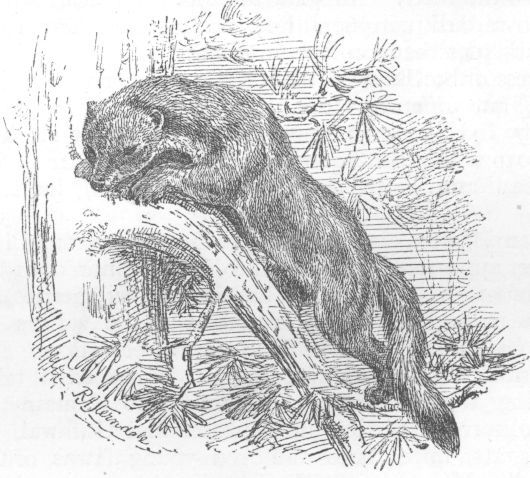
Martes abietum.
DESCRIPTION.—Brown; throat yellow or yellow spotted (Gray). Light yellowish-grey, rather deeper in a line along the back; the hair brown; extremities blackish; chin, threat and breast white (according to Horsfield).
SIZE.—About 18 to 20 inches; tail 12 inches.
Horsfield remarks that the specimens received in the Indian Museum combine the peculiarities of the Pine and Beech Martens respectively, and lead to the conclusion that both are varieties of one species. This idea was prevalent some time ago, and the Beech Marten (M. foina) was supposed to be merely a variety of the Pine species, but there are certain differences in the skulls of the two animals. It is stated by the editor of my edition of Cuvier that, on examination of the crania of the two, he found that those of M. abietum are constantly smaller, with the zygomatic arch fully twice as strong as in the other. There is also a slight difference in the teeth, the hinder upper tubercular grinder in M. foina not being quite so large as in the other.
The Pine Marten has a wide distribution; the finest specimens are found in Sweden; in England it is becoming scarce, but in other parts of Europe and Asia it is common. Professor Parker and his brother write of it: "This animal is essentially arboreal in its habits, inhabiting chiefly thick coniferous woods, whence its name of Pine Marten is derived. In the branches the female makes a nest of leaves or moss, and sometimes spares herself this trouble by ejecting squirrels or woodpeckers, and occupying the vacant dwellings. For its size it is, like all the Mustelidæ, extremely ferocious and strong. It attacks and kills fawns, notwithstanding their superior size; from these down to mice nothing comes amiss to it, and nothing is safe from its attacks." It seems almost incredible that such a small animal should venture on such large game, but the same is reported of M. flavigula; and a much smaller creature, the Yellow-bellied Weasel, M. kathiah, is reported by Hodgson to attack even goats and sheep.
NO. 179. MARTES TOUFOEUS.
NATIVE NAME.—Toufee.
HABITAT.—Thibet.
DESCRIPTION (from skins only).—General colour smoky brown, darker along the spine and on the limbs, but without marks, and paler to sordid yellowish hoary on the neck and head; head palest, except the mystaceal region and chin, which are embrowned; moustache moderate and dark brown.
SIZE.—Head and body about 20 to 22 inches.
The above description is taken from Hodgson, who had only received imperfect skins. Jerdon just alludes to it by name, but I cannot find it mentioned by any other author. As much stress cannot be laid on colouring in these animals, I feel inclined to think that it is a variety of Martes abietum, probably in its dark summer coat.
GENUS MUSTELA—THE WEASELS.
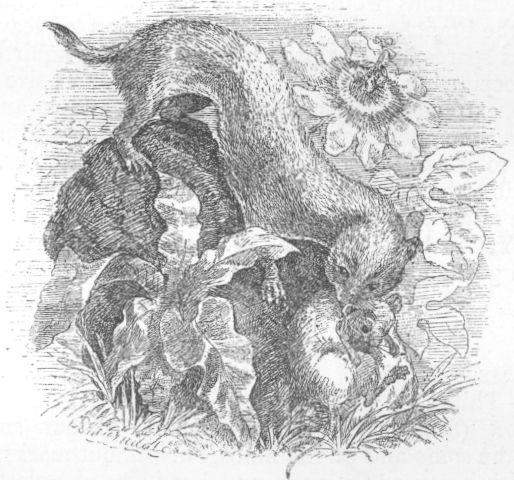
Mustela.
These are smaller animals of the true vermiform shape; the legs are very short in comparison with the body, and the neck is very thick and very long, and the head is small, so that head, neck, and body are almost equally cylindrical, and the length of the neck gives a far, set-back appearance to the forelegs, so much so that they seem to start from behind the chest instead of in front of it. The teeth are 34 in number, or four less than in the preceding genus; upper tubercular grinder transverse or broader than long; the feet are slightly webbed, covered with hair, and the space between the pads is hairy; the tail is short; fur dark above, white or yellowish beneath.
Some authors contend that the weasel, though commonly referred to the genus Mustela, should be Putorius, which is an instance of the disagreement which exists among naturalists. I have however followed Gray in his classification, although perhaps Cuvier, who classes the weasels and pole-cats under the genus Putorius, has the claim of priority. Ray applied the name of Mustela to the restricted weasels, and Martes to the martens, but Cuvier gives Mustela to the martens, and brings the weasels and pole-cats together under Putorius.
NO. 180. MUSTELA (VISON: Gray) SUB-HEMACHALANA. The Sub-Hemachal Weasel (Jerdon's No. 97).
NATIVE NAMES.—Zimiong, Bhotia; Sang-king, Lepcha; Kran or Gran, Kashmiri.
DESCRIPTION.—"Uniform bright brown, darker along the dorsal line; nose, upper lip, and forehead, with two inches of the end of the tail black-brown; mere edge of upper lip and whole of lower jaw hoary; a short longitudinal white stripe occasionally on the front of the neck, and some vague spots of the same laterally, the signs, I suspect, of immaturity; feet frequently darker than the body or dusky brown; whiskers dark; fur close, glossy and soft, of two sorts, or fine hair and soft wool, the latter and the hair basally of dusky hue, but the hair externally bright brown; head, ears, and limbs more closely clad than the body, tail more laxly, tapering to the point."—Hodgson.
SIZE.—Head and body about 12 inches; tail, 6 inches.
Jerdon calls this the Himalayan Weasel, but I have preferred to translate Hodgson's' name, which, I confess, puzzled me for some time till I found out there was a Hemachal range in Thibet.
NO. 181. MUSTELA (GYMNOPUS: Gray) KATHIAH. The Yellow-bellied Weasel (Jerdon's No. 98).
NATIVE NAME.—Kathia-nyal, Nepalese.
HABITAT.—Nepal, Bhotan.
DESCRIPTION.—Dark brown; upper lip, chin, throat, chest, underside of body and front of thighs, bright yellow; tail dark brown, shorter than the body and head, tapering, and of the same colour to the tip; the soles of the hind feet bald; pads well developed, exposed.
SIZE.—Head and body, 10 inches; tail, 5 inches.
Hodgson states that a horribly offensive yellowish-grey fluid exudes from two subcaudal glands. He says that the Nepalese highly prize this little animal for its services in ridding houses of rats. It is easily tamed; and such is the dread of it common to all murine animals that not one will approach a house wherein it is domiciled. Rats and mice seem to have an instinctive sense of its hostility to them, so much so that when it is introduced into a house they are observed to hurry away in all directions, being apprised, no doubt, of its presence by the peculiar odour it emits. Its ferocity and courage are made subservient to the amusement of the rich, who train it to attack large fowls, geese, and even goats and sheep. It seizes these by the great artery of the neck, and does not quit its hold till the victim sinks exhausted from the loss of blood—a cruel pastime which one could only expect of a barbarous people.
NO. 182. MUSTELA (GYMNOPUS: Gray) STRIGIDORSA. The Striped Weasel (Jerdon's No. 99).
HABITAT.—Sikim.
DESCRIPTION.—Dark chestnut-brown, with a narrow streak of long yellow hairs down the back; edge of upper lip, chin, throat, chest, and a narrow stripe down the centre of the belly, yellow, or yellowish-white.
SIZE.—Head and body, 12 inches; tail, 5½ inches without the hair, 6½ inches with it.
This is similar to the last, but is slightly larger, and distinguishable by the dorsal stripe.
NO. 183. MUSTELA ERMINEA. The Ermine or Stoat.
HABITAT.—Europe, America and Asia (the Himalayas, Nepal, Thibet, Afghanistan).
DESCRIPTION.—Brown above; upper lip, chin, and lower surface of body, inside of limbs and feet yellowish-white; tail brown, with a black tip. In winter the whole body changes to a yellowish-white, with the exception of the black tip of the tail.
SIZE.—Head and body, about 10 inches; tail, 4½ inches.
This is about the best known in a general way from its fur being used as part of the insignia of royalty. The fur however only becomes valuable after it has completed its winter change. How this is done was for a long time a subject of speculation and inquiry. It is, however, now proved that it is according to season that the mode of alteration is effected. In spring the new hairs are brown, replacing the white ones of winter; in autumn the existing brown hairs turn white. Mr. Bell, who gave the subject his careful consideration, says that in Ross's first Polar expedition, a Hudson's Bay lemming (Myodes) was exposed in its summer coat to a temperature of 30° below zero. Next morning the fur on the cheeks and a patch on each shoulder had become perfectly white; at the end of the week the winter change was complete, with the exception of a dark band across the shoulder and a dorsal stripe.
Hodgson remarks that the Ermine is common in Thibet, where the skins enter largely into the peltry trade with China.
In one year 187,000 skins were imported into England.
NO. 184. MUSTELA (VISON: Gray) CANIGULA. The Hoary Red-necked Weasel.
HABITAT.—Nepal hills, Thibet.
DESCRIPTION.—Pale reddish-brown, scarcely paler beneath; face, chin, throat, sides of neck and chest white; tail half as long as body and head, concolorous with the back; feet whitish. Sometimes chest brown and white mottled, according to Gray. Hodgson, who discovered the animal, writes: "Colour throughout cinnamon red without black tip to the tail, but the chaffron and entire head and neck below hoary."
SIZE.—15½ inches; tail without hair 7½ inches, with hair 9½ inches.
NO. 185. MUSTELA STOLICZKANA.
HABITAT.—Yarkand.
DESCRIPTION.—Colour pale sandy brown above; hairs light at base, white below; tail concolorous with back; small white spot close to anterior angle of each eye; a sandy spot behind the gape; feet whitish.
SIZE.—Head and body, 12·2; tail, 3 inches, including hair.
NO. 186. MUSTELA (VISON) SIBIRICA.
HABITAT.—Himalayas (Thibet?); Afghanistan (Candahar).
DESCRIPTION.—Pale brown; head blackish, varied; spot on each side of nose, on upper and lower lips and front of chin, white; tail end pale brown like back, varies; throat more or less white.
This Weasel, described first by Pallas ('Specil Zool.' xiv. t. 4, f. 1.) was obtained in Candahar by Captain T. Hutton, who describes it in the 'Bengal Asiatic Society's Journal,' vol. xiv. pp. 346 to 352.
NO. 187. MUSTELA ALPINA. The Alpine Weasel.
HABITAT.—Said to be found in Thibet, otherwise an inhabitant of the Altai mountains.
DESCRIPTION.—Pale yellow brown; upper lip, chin, and underneath yellowish-white; head varied with black-tipped hairs; tail cylindrical, unicolour, not so long as head and body.—Gray.
NO. 188. MUSTELA HODGSONI.
HABITAT.—Himalaya, Afghanistan.
DESCRIPTION.—Fur yellowish-brown, paler beneath; upper part and side of head much darker; face, chin, and throat varied with white; tail long, and bushy towards the end.
NO. 189. MUSTELA (VISON) HORSFIELDI.
HABITAT.—Bhotan.
DESCRIPTION.—Uniform dark blackish-brown, very little paler beneath; middle of front of chin and lower lip white; whiskers black; tail slender, blackish at tip, half the length of head and body.
NO. 190. MUSTELA (GYMNOPUS) NUDIPES. Gymnopus leucocephalus of Gray.
HABITAT.—Borneo, Sumatra, Java, but possibly Tenasserim.
DESCRIPTION.—Golden fulvous with white head.
As so many Malayan animals are found on the confines of Burmah, and even extending into Assam, it is probable that this species may be discovered in Tenasserim.
GENUS PUTORIUS—THE POLE-CAT.
This is a larger animal than the weasel, and in form more resembles the marten, except in the shortness of its tail; the body is stouter and the neck shorter than in Mustela; the head is short and ovate; the feet generally hairy, and the space between the pads very much so; the under side of the body is blackish; the fur is made up of two kinds, the shorter is woolly and lighter coloured than the longer, which is dark and shining.
The disgusting smell of the common Pole-cat (Putorius foetidus) is well known, and has become proverbial. In my county, as well as in many parts of England, the popular name is "foumart," which is said to be derived from "foul marten." The foumart is the special abhorrence of the game-keeper; it does more damage amongst game and poultry than any of the other Mustelidæ, and consequently greater pains are taken to trap and shoot it, in fact, so much so that I wonder that the animal is not now extinct in the British Isles. Professor Parker writes: "It has been known to kill as many as sixteen turkeys in a single night; and indeed it seems to be a point of honour with this bloodthirsty little creature to kill everything it can overpower, and to leave no survivors on its battle-fields." According to Bell, a female Pole-cat, which was tracked to her nest, was found to have laid up in a side hole a store of food consisting of forty frogs and two toads, all bitten through the brain, so that, though capable of living for some time, they were deprived of the power of escape. Now, this is a most wonderful instance of instinct bordering upon reason. Only the Reptilia can exist for any length of time after injury to the brain; to any of the smaller mammalia such a process as that adopted by the Pole-cat, would have resulted in instant death and speedy decomposition.
The Ferret (Putorius furo) is a domesticated variety of the Pole-cat, reputed to be of African origin. Certain it is that it cannot stand extreme cold like its wild cousin, and an English winter is fatal to it if not properly looked after. It inter-breeds with the Pole-cat.
Ferrets are not safe pets in houses where there are young children. Cases have been known of their attacking infants in the cradle, and severely lacerating them.
They are chiefly used for killing rats and driving rabbits out of burrows; in the latter case they are muzzled. As pets they are stupid, and show but little attachment. Forbearance as regards making its teeth meet in your fingers is, I think, the utmost you can expect in return for kindness to a ferret, and that is something, considering what a sanguinary little beast it is.
NO. 191. PUTORIUS LARVATUS vel TIBETANUS. Black-faced Thibetan Pole-cat.
HABITAT.—Utsang in Thibet, also Ladakh.
DESCRIPTION.—"Tail one-third of entire length; soles clad; fur long; above and laterally sordid fulvous, deeply shaded on the back with black; below from throat backwards, with the whole limbs and tail, black; head pale, with a dark mask over the face."—Hodgson.
SIZE.—Head and body, 14 inches; tail, 6 inches, with hair 7 inches; palma, 1¾; planta, 2-3/8.
This animal, according to Gray, is synonymous with the Siberian Putorius Eversmannii, although the sudden contraction of the brain case in front, behind the orbit, mentioned of this species, is not perceptible in the illustration given by Hodgson of the skull of this Thibetan specimen. Horsfield, in his catalogue, states that the second specimen obtained by Captain R. Strachey in Ladakh, north of Kumaon, agreed in external character.
In some respects it is similar to the European Pole-cat, but as yet little is known of its habits.
NO. 192. PUTORIUS DAVIDIANUS.
HABITAT.—Moupin in Thibet.
DESCRIPTION.—Uniform fulvous brown, yellower under the throat; upper lip and round nostrils to corner of the eye white, darker on nose and forehead.
SIZE.—Head and body about 11½ inches; tail, 6½ inches.
This is one of the specimens collected by the Abbé David, after whom it is named. A fuller description of it will be found in Milne-Edwards's 'Recherches sur les Mammifères,' page 343. There is also a plate of the animal in the volume of illustrations.
NO. 193. PUTORIUS ASTUTUS.
HABITAT.—Thibet.
DESCRIPTION.—About the size of Ermine, but with a longer tail. Colour brown, the white of the chest tinted with yellow; tail uniform in colour, darker on head.
SIZE.—Head and body, 10 inches; tail, 4-1/5 inches.
This is also described and figured by Milne-Edwards.
NO. 194. PUTORIUS MOUPINENSIS.
HABITAT.—Thibet.
DESCRIPTION.—Reddish-brown, white under the chin, and then again a patch on the chest.
LUTRIDÆ—THE OTTERS.
We now come to the third group of the musteline animals, the most aquatic of all the Fissipedia—the Lutridæ or Otters—of which there are two great divisions, the common Otters (Lutra) and the Sea-Otters, (Enhydra). With the latter, a most interesting animal in all its ways, as well as most valuable on account of its fur, we have nothing to do. I am not aware that it is found in the tropics, but is a denizen of the North Pacific. Of Lutra we have several species in two genera. Dr. Gray has divided the Otters into no less than nine genera on three characteristics, the tail, feet, and muzzle, but these have been held open to objection. The classification most to be depended upon is the division of the tribe into long-clawed Otters (Lutra), and short or rudimentary-clawed Otters (Aonyx). The characteristics of the skulls confirm this arrangement, as the short-clawed Otters are distinguishable from the others by a shorter and more globose cranium and larger molars, and, as Dr. Anderson says, "the inner portion of the last molar being the largest part of the tooth, while in Lutra the outer exceeds the inner half; the almost general absence of the first upper premolar; and the rudimentary claws, which are associated with much more feebly-developed finger and toe bones, which are much tapered to a point, while in Lutra these bones are strong and well developed." Gray has separated a genus, which he called Pteronura, on account of a flattened tail arising from a longitudinal ridge on each side, but this flattening of the tail is common to all the genera more or less.
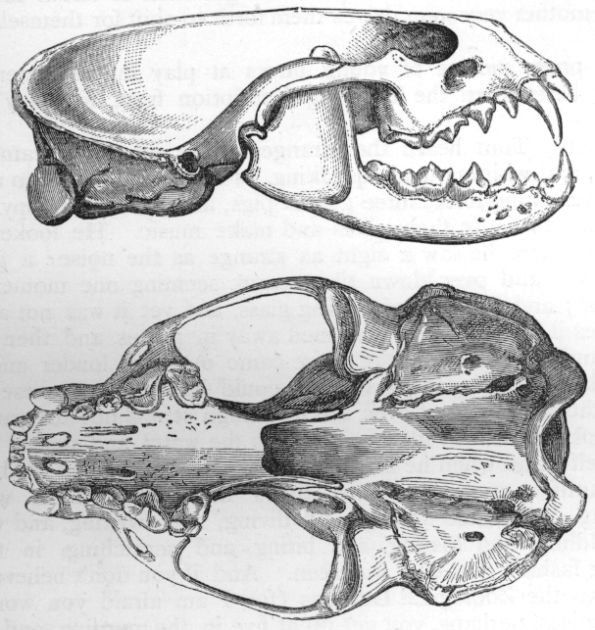
Otter's skull (side and under view).
All the Otters, though active on land, are still only thoroughly at home in the water, and they are therefore specially constituted for such a mode of life. They have an elongated flattened form; webbed feet with short claws; compressed and tapering tail; dense fur of two kinds, one of long brown shining hairs; the under fur short and fine, impervious to wet, and well adapted for keeping an equality of temperature; the skull is peculiar, the brain case being very long, and compressed from above downwards; the facial portion forms only about one-fourth of the extreme length; the teeth are strong and sharp; the upper flesh tooth very large.
Dental formula: Inc., 3—3/3—3; can., 1—1/1—1; premolars, 4—4/3—3; molars, 1—1/2—2.
Jerdon states that the otter has a nictitating membrane or additional semi-transparent eyelid, similar to that in the eyes of birds, which he supposes is a defence to them under water; but I have not noticed this myself, and have failed to discover it in the writings of others. I should think that the vision of the animal under water would not require obscuring by a semi-transparent membrane, which none of the marine carnivora possess, though their eyes are somewhat formed for seeing better under water than when exposed to the full light above. Some idea of the rapidity of these animals in the water may be conceived when we think that their food is almost exclusively fish, of which they sometimes kill more than they can eat. They reside in burrows, making the entrance under water, and working upwards, making a small hole for the ventilation of their chamber. The female has about four or five young ones at a time, after a period of gestation of about nine weeks, and the mother very soon drives them forth to shift for themselves in the water.
For a pretty picture of young otters at play in the water, nothing could be better than the following description from Kingsley's 'Water Babies':—
"Suddenly Tom heard the strangest noise up the stream—cooing, grunting, and whining, and squeaking, as if you had put into a bag two stock-doves, nine mice, three guinea-pigs, and a blind puppy, and left them there to settle themselves and make music. He looked up the water, and there he saw a sight as strange as the noise: a great ball rolling over and over down the stream, seeming one moment of soft brown fur; and the next of shining glass, and yet it was not a ball, for sometimes it broke up and streamed away in pieces, and then it joined again; and all the while the noise came out of it louder and louder. Tom asked the dragon-fly, what it could be: but of course with his short sight he could not even see it, though it was not ten yards away. So he took the neatest little header into the water, and started off to see for himself; and when he came near, the ball turned out to be four or five beautiful creatures, many times larger than Tom, who were swimming about, and rolling, and diving, and twisting, and wrestling, and cuddling, and kissing, and biting, and scratching, in the most charming fashion that ever was seen. And if you don't believe me you may go to the Zoological Gardens (for I am afraid you won't see it nearer, unless, perhaps, you get up at five in the morning, and go down to Cordery's Moor, and watch by the great withy pollard which hangs over the back-water, where the otters breed sometimes), and then say if otters at play in the water are not the merriest, lithest, gracefullest creatures you ever saw."
Professor Parker, who also notices Kingsley's description,[9] states that the Canadian otter has a peculiar habit in winter of sliding down ridges of snow, apparently for amusement. It, with its companions, scrambles up a high ridge, and then, lying down flat, glides head-foremost down the declivity, sometimes for a distance of twenty yards. "This sport they continue apparently with the keenest enjoyment, until fatigue or hunger induces them to desist."
9 In fact it was his quotation that induced me to buy a copy of that most charming little book, which I recommend every one to read.—R. A. S.
The following are the Indian species; Lutra nair, L. simung vel monticola, L. Ellioti, and L. aurobrunnea of the long-clawed family, and Aonyx leptonyx of the short-clawed.
GENUS LUTRA.
NO. 195. LUTRA NAIR. The Common Indian Otter (Jerdon's No. 100).
NATIVE NAMES.—Ud or Ood, Ood-bilao, Panikutta, Hindi; Nir-nai, Canarese; Neeru-kuka, Telegu; Jal-manjer, Mahratti.
HABITAT.—India generally, Burmah and Ceylon.
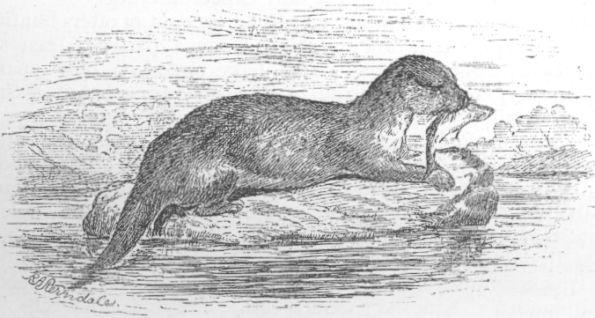
Lutra nair.
DESCRIPTION.—Hair more or less brown above, sometimes with a chestnut hue, sometimes grizzled, or with a tinge of dun; yellowish-white, or with a fulvescent tinged white below; the throat, upper lip, and sides of head are nearly white; the line of separation of upper and lower parts not very distinctly marked. Some have whitish paws.
SIZE.—Head and body, 29 to 30 inches; tail about 17 inches.
This otter, which is synonymous with L. Indica, L. Chinensis and Hodgson's L. Tarayensis, is well known throughout India, and indeed far beyond Indian limits. They are generally found in secluded spots, in parties of about half a dozen hunting in concert. The young ones are easily tamed, and become greatly attached if kindly treated. I had one for some time. Jerdon tells a curious story of one he had, and which used to follow him in his walks. He says: "As it grew older it took to going about by itself, and one day found its way to the bazaar and seized a large fish from a moplah. When resisted, it showed such fight that the rightful owner was fain to drop it. Afterwards it took regularly to this highway style of living, and I had on several occasions to pay for my pet's dinner rather more than was necessary, so I resolved to get rid of it. I put it in a closed box, and, having kept it without food for some time, I conveyed it myself in a boat some seven or eight miles off, up some of the numerous back-waters on this coast. I then liberated it, and, when it had wandered out of sight in some inundated paddy-fields, I returned by boat by a different route. That same evening, about nine whilst in the town about one and a-half miles from my own house, witnessing some of the ceremonials connected with the Mohurrum festival, the otter entered the temporary shed, walked across the floor, and came and lay down at my feet!" It is to be hoped Dr. Jerdon did not turn him adrift again; such wonderful sagacity and attachment one could only expect in a dog.
McMaster gives the following interesting account of otters hunting on the Chilka Lake: "Late one morning I saw a party, at least six in number, leave an island on the Chilka Lake and swim out, apparently to fish their way to another island, or the mainland, either at least two miles off. I followed them for more than half the distance in a small canoe. They worked most systematically in a semicircle, with intervals of about fifty yards between each, having, I suppose, a large shoal of fish in the centre, for every now and then an otter would disappear, and generally, when it was again seen, it was well inside the semicircle with a fish in its jaws, caught more for pleasure than for profit, as the fish, as far as I could see, were always left behind untouched beyond a single bite. I picked up several of these fish, which, as far as I can recollect, were all mullet." Kingsley notices this. The old otter tells Tom: "We catch them, but we disdain to eat them all; we just bite out their soft throats and suck their sweet juice—oh, so good!" (and she licked her wicked lips)—"and then throw them away, and go and catch another."
General McMaster also quotes from a letter by "W. C. R." in the Field about the end of 1868, which gives a very curious incident of a crocodile stealing up to a pack of otters fishing, and got within thirty yards; "but no sooner was the water broken by the hideous head of the reptile, than an otter, which evidently was stationed on the opposite bank as a sentinel, sounded the alarm by a whistling sort of sound. In an instant those in the water rushed to the bank and disappeared among the jungle, no doubt much to the disgust of the mugger."
I have not heard any one allude to the offensive glands of the Indian otter, but I remember once dissecting one and incautiously cutting into one of these glands, situated, I think, near the tail. It is now over twenty years ago, so I cannot speak with authority, but I remember the abominable smell, which quite put a stop to my researches at the time.
This otter is trained in some parts of India, in the Jessore district and Sunderbunds of Bengal, to drive fish into nets. In China a species there is driven into the water with a cord round its waist, which is hauled in when the animal has caught a fish.
NO. 196. LUTRA MONTICOLA vel SIMUNG. (Jerdon's No. 101).
HABITAT.—Nepal, Sumatra, and Borneo.
DESCRIPTION.—"The colour is more rufous umber-brown than L. nair, and does not exhibit any tendency to grizzling, and the under surface is only somewhat hoary, well washed with brownish; the chin and edge of the lips are whitish; and the silvery hoary on the sides of the head, on the throat, and on the under surface of the neck and of the chest is marked; the tail above and below is concolorous with the trunk. The length of the skeleton of an adult female, measured from the tip of the premaxillaries to the end of the sacral vertebræ, is 23·25, and the tail measures 17·75 inches" (Anderson). Of the Sumatran specimen the first notice was published in 1785 in the first edition of Marsden's 'History of Sumatra.' This otter is larger than the common Indian one, the skull of a female, as given by Dr. Anderson, exceeding in all points that of male of Lutra nair.
Jerdon has this as Lutra vulgaris, which is the common English otter, but there is a difference in the skull.
NO. 197. LUTRA ELLIOTI.
HABITAT.—Southern Mahratta country.
DESCRIPTION.—The colouring is the same as the last, only a little darker; the distribution of the silvery white is the same; the muzzle is however more depressed than in the last species, and it differs from L. nair by a broader, more arched head, and shorter muzzle.
Dr. Anderson, who distinguishes it by the feature of its skull from the two preceding species, says: "It may be that this otter has a north-westerly distribution, and that it is the species which occurs in the lake at Mount Abu in Rajputana, and also in Sindh and in the Indus."
NO. 198. LUTRA AUROBRUNNEA.
HABITAT.—Nepal.
DESCRIPTION.—Fur of a rich ferruginous brown colour, the upper surface of the head being a deeper brown than the back; the nose is bare; the ears are small and pointed posteriorily. All the strong bristles of the moustache, eyes, cheeks, and chin, are dark brown; claws as in Lutra (Anderson). Hodgson says it has a more vermiform body than the rest of Indian otters; tail less than two thirds of the body; nails and toes feebly developed (whence it is classed by Gray in the next genus); fur long and rough, rich chestnut-brown above, golden red below and on the extremities.
SIZE.—Head and body, 20 to 22 inches; tail, 12 to 13 inches.
GENUS AONYX—CLAWLESS OTTERS.
Muzzle bald, oblong; skull broad, depressed, shorter and more globose than in Lutra; the molars larger than in the last genus; flesh tooth larger, and with a large internal lobe; first upper premolar generally absent; feet oblong, elongate; toes slender and tapering; claws rudimentary.
NO. 199. AONYX LEPTONYX. The Clawless Otter (Jerdon's No. 102).
NATIVE NAMES.—Chusam, Bhotia; Suriam, Lepcha.
HABITAT.—Throughout the Himalayas, also in Lower Bengal and in Burmah.
DESCRIPTION.—"Above earthy brown or chestnut brown; lips, sides of head, chin, throat, and upper part of breast white, tinged with yellowish-grey. In young individuals the white of the lower parts is less distinct, sometimes very pale brownish."—Jerdon.
SIZE.—Head and body, 24 Inches; tail, 13.
Mason speaks of this species as common in Burmah, and McMaster mentions his having seen in the Sitang River a colony of white-throated otters smaller than L. nair, though larger than L. aurobrunnea, but he did not secure specimens.
ÆLUROIDEA.
This section includes the Cat family (Felidæ); the Hyænas (Hyænidæ); two families unknown in India, viz. the Cryptoproctidæ and the Protelidæ; and the Civet family (Viverridæ).
FELIDÆ—THE CAT FAMILY.
This family contains the typical carnivores. There is in them combined the greatest power of destruction, accompanied by the simplest mechanism for producing it. All complications of dentition and digestion disappear. Here are the few scissor-like teeth with the enormous canines, the latter for holding and piercing the life out of their prey, the former for chopping up the flesh into suitable morsels for swallowing. Then the stomach is a simple sac, undivided into compartments, and the intestine is short, not more than three times the length of the body, instead of being some twenty times longer, as in some herbivores. This family has the smallest number of molars, a class of tooth which would indeed be useless, for the construction of the feline jaw precludes the possibility of grinding, and therefore a flat-crowned tuberculous tooth would be out of place. As I have before described it, the jaw of a tiger is incapable of lateral motion. The condyle of the lower jaw is so broad, and fits so accurately into its socket, the glenoid cavity, that there can be no departure from the up and down scissor-like action. The true Cats have, therefore, only one molar on each side of each jaw; those in the upper jaw being merely rudimentary, and placed almost at right angles to the rest of the teeth, and seem apparently of little use; those of the lower jaw are large and trenchant, cutting against the edge of the third upper premolar.
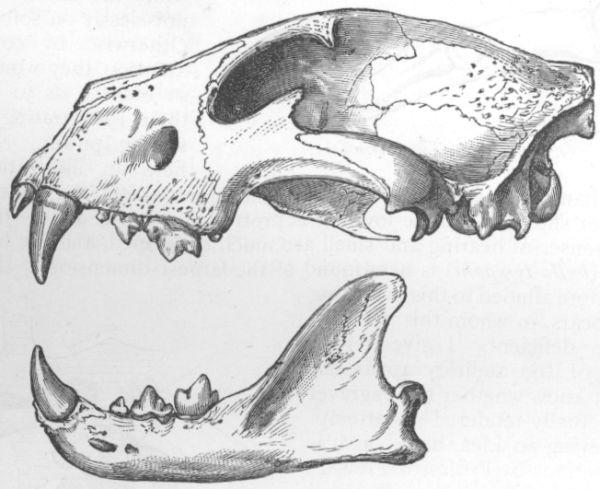
Skull of Tiger (side view).
It may interest my readers to know which are premolars and which are molars. This can be decided only by dissection of the jaw of a young animal. True molars only appear as the animal approaches the adult stage. They are never shed, as are all the rest of the teeth, commonly called milk teeth. The deciduous or milk teeth are the incisors, canines, and premolars; they drop out and are replaced, and behind the last premolar comes up the permanent molar.
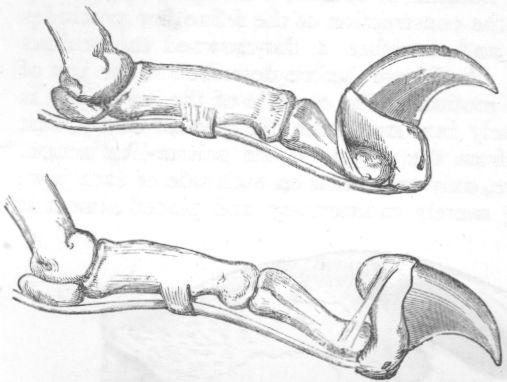
Tendons of Tiger's toe.
Another peculiar feature of the Cat family is the power of sheathing their talons. Claws to a cat are of as great importance to him in the securing of his prey as are his teeth. The badger is a digger, Hodge, who carries his mattock on his shoulder; but the feline is the free-lance whose sword must be kept keen in its scabbard, so by a peculiar arrangement of muscles the points of the claws are kept off the ground, while the animal treads noiselessly on soft pads. Otherwise by constant abrasion they would get so blunted as to fail in their penetrating and seizing power. I give here an illustration of the mechanism of the feline claw. In the upper sketch the claw is retracted or sheathed; in the lower it is protruded as in the act of striking.
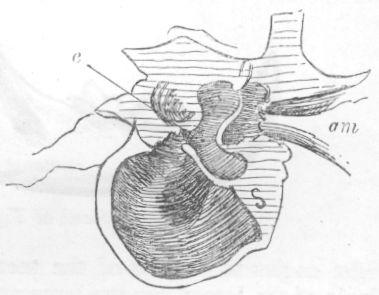
The senses of hearing and smell are much developed, and the bulb of the ear (bulla tympani) is here found of the largest dimensions. I have once before alluded to this in writing of the bears, in whom this arrangement is deficient. I give here a section of the auditory apparatus. I do not know whether the engraver has effectually rendered my attempt at conveying an idea, based as it is on dissections by Professor Flower; but if he has failed I think the fault lies in the shakiness of my hand in attempting the fine shading after nearly breaking a saw and losing my temper over a very tough old skull which I divided before commencing my illustration. The great cavity is the bulla tympani or bulb of the ear; a m is the auditory meatus or external hole of the ear. On looking into a dry skull the passage seems to be of no great depth, nor can an instrument be passed directly from the outside into the great tympanic cavity, the hindrance being a wall of bone, s, the septum which divides the bulla into two distinct chambers, the reason for which is not very clear, except that one may suppose it to be in some measure for acoustic purposes, as all animals with this development are quick of hearing. The communication between the two chambers lies in a narrow slit over the septum, the Eustachian tube, e, being on the outside of the septum and between it and the tympanum or ear drum, t.
The above are the chief characteristics of the family. For the rest we may notice that they have but a rudimentary clavicle imbedded among the muscles; the limbs are comparatively short, but immensely muscular; the body lithe and active; the foot-fall noiseless; the tongue armed with rough papillæ, which enables them to rasp the flesh off bones, and their vision is adapted for both night and day.
None of them are gregarious, as in the case of dogs and wolves. One hears sometimes of a limited number of lions and tigers being seen together, but in most cases they belong to one family, of which the junior members have not been "turned off on their own hook" as yet.
GENUS FELIS.
NO. 200. FELIS LEO. The Lion (Jerdon's No. 103).
NATIVE NAMES.—Sher-babbar, Singh, Unthia-bagh.
HABITAT.—Guzerat and Central India.
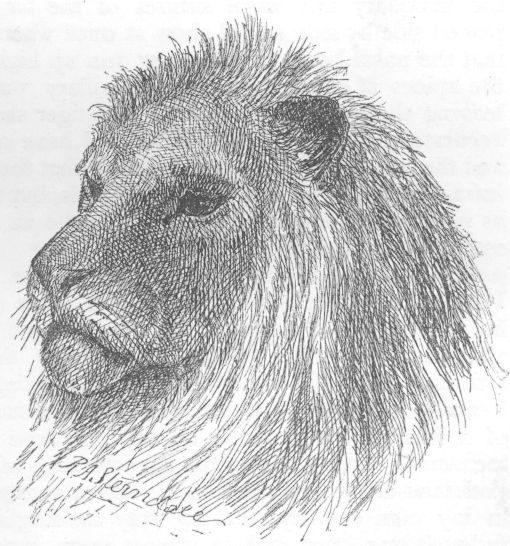
Felis leo (Indian variety).
DESCRIPTION.—The lion is almost too well known to need description, and there is little difference between the Asiatic and African animal. It may, however, be generally described as being distinguished from other Cats by its uniform tawny colour, flatter skull, which gives it a more dog-like appearance, the shaggy mane of the male, and by the tufted tail of both sexes.
SIZE.—From nose to insertion of tail, 6 to 6½ feet; tail, 2½ to 3 feet; height, 3½ feet.
The weight of one measured by Captain Smee, 8 feet 9½ inches, was (excluding the entrails) thirty-five stone. This must be the one alluded to by Jerdon, but he does not state the extraction of the viscera, which would add somewhat to the weight.
Young lions when born are invariably spotted; and Professor Parker states that there were in the Zoological Gardens in 1877 three lions which were born in the menagerie about ten years previously, and which showed "indistinct, though perfectly evident, spots of a slightly darker tawny than the general ground-tint on the belly and flanks." He adds: "This is also the case with the puma, and it looks very much as if all the great Cats were descended from a spotted ancestor." The more dog-like head of the lion is well known to all who have studied the physiognomy of the Cats, and I have not only noticed it in drawing the animal, but have seen it alluded to in the writings of others. It was not, however, till lately that I had an opportunity of comparing the skulls of the lion and tiger in the Calcutta Museum, and I am indebted to Mr. Cockburn of the museum, not only for the trouble he took in getting out the various skulls, but for his assistance in pointing out certain peculiarities known to him, but of which I was at the time ignorant. That the skull of the lion is flatter than, and wants the bold curve of, those of the tiger, leopard and jaguar, is a well-known fact, but what Mr. Cockburn pointed out to me was the difference in the maxillary and nasal sutures of the face. A glance at two skulls placed side by side would show at once what I mean. It would be seen that the nasal bones of the tiger run up higher than those of the lion, the apices of whose nasal and maxillary sutures are on a level. On leaving the museum I compared the tiger skulls in my possession with accurate anatomical drawings which I have of the osteology of the lion, and the result was the same. It is said that there is also a difference in the infra-orbital foramen of the two animals, but this I have failed to detect as yet, though asserted by De Blainville in his magnificent work on osteology ('Ostéographie').
From all that has been written of the African and Indian lions I should say that the tiger was the more formidable of the two, as he is, I believe, superior in size. About twenty-two years ago my attention was drawn to this subject by the perusal of Mr. Blyth's article on the Felidæ in the old India Sporting Review of 1856-57. If I am not mistaken there was at that time (1861) a fine skeleton of a lion in the museum, as well as those of several tigers, which I measured. I had afterwards opportunities of observing and comparing skeletons of the two animals in various museums in Europe, though not in my own country, for my stay in England on each occasion of furlough was brief, and in almost every instance I found the tiger the larger of the two. The book in which I recorded my observations, and which also contained a number of microscopic drawings of marine infusoria, collected during a five months' voyage, was afterwards lost, so I cannot now refer to my notes.
I believe there was once a case of a fair fight between a well-matched lion and tiger in a menagerie (Edmonds's, I think). The two, by the breaking of a partition, got together, and could not be separated. The duel resulted in the victory of the tiger, who killed his opponent.
The lion seems to be dying out in India, and it is now probably confined only to Guzerat and Cutch. I have not been an attentive reader of sporting magazines of late years, and therefore I cannot call to mind any recent accounts of lion-killing in India, if any such have been recorded. At the commencement of this century lions were to be found in the North-West and in Central India, including the tract of country now termed the Central Provinces. In 1847 or 1848 a lioness was killed by a native shikari in the Dumoh district. Dr. Spry, in his 'Modern India,' states that, when at Saugor in the Central Provinces in 1837, the skin of a full-grown male lion was brought to him, which had been shot by natives in the neighbourhood. He also mentions another lioness shot at Rhylee in the Dumoh district in 1834, of which he saw the skin. Jerdon says that tolerably authentic intelligence was received of the presence of lions near Saugor in 1856; and whilst at Seonee, within the years 1857 to 1864, I frequently heard the native shikaris speak of having seen a tiger without stripes, which may have been of the present species. The indistinct spots on the lion's skin (especially of young lions), to which I have before alluded, were noticed in the skin of the lioness shot at Dumoh in 1847. The writer says: "when you place it in the sun and look sideways at it, some very faint spots (the size of a shilling or so) are to be seen along the belly."
Lions pair off at each season, and for the time they are together they show great attachment to each other, but the male has to fight for his spouse, who bestows herself on the victor. They then live together till the young are able to shift for themselves. The lioness goes with young about fifteen or sixteen weeks, and produces from two to six at a litter. But there is great mortality among young lions, especially about the time when they are developing their canine teeth. This has been noticed in menageries, confirming a common Arab assertion. In the London Zoological Gardens, during the last twenty years, there has been much mortality among the lion cubs by a malformation of the palate. It is a curious fact that lions breed more readily in travelling menageries than in stationary ones.
NO. 201. FELIS TIGRIS. The Tiger (Jerdon's No. 104).
NATIVE NAME.—Bagh, Sher, Hindi; Sela-vagh, Go-vagh, Bengali; Wuhag, Mahrathi; Nahar in Bundelkund and Central India; Tut of the hill people of Bhagulpore; Nongya-chor in Gorukpore; Puli in Telegu and Tamil; also Pedda-pulli in Telegu; Parain-pulli in Malabar; Huli in Caranese; Tagh in Tibet; Suhtong in Lepcha; Tukh in Bhotia.
These names are according to Jerdon. Bagh and Sher all Indian sportsmen are familiar with. The Gonds of the Central Provinces call it Pullial, which has an affinity with the southern dialects.
HABITAT.—The tiger, as far as we are concerned, is known throughout the Indian peninsula and away down the eastern countries to the Malayan archipelago. In Ceylon it is not found, but it extends to the Himalayas, and ranges up to heights of 6000 to 8000 feet. Generally speaking it is confined to Asia, but in that continent it has a wide distribution. It has been found as far north as the island of Saghalien, which is bisected by N. L. 50°. This is its extreme north-eastern limit, the Caspian Sea being its westerly boundary. From parallel 50° downwards it is found in many parts of the highlands of central Asia.
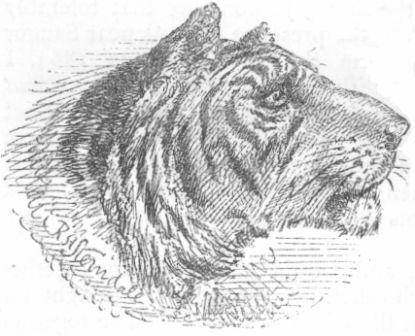
Head of Tiger.
DESCRIPTION.—A large heavy bodied Cat, much developed in the fore-quarters, with short, close hair of a bright rufous ground tint from every shade of pale yellow ochre to burnt sienna, with black stripes arranged irregularly and seldom in two individuals alike, the stripes being also irregular in form, from single streaks to loops and broad bands. In some the brows and cheeks are white, and in all the chin, throat, breast, and belly are pure white. All parts, however, whether white or rufous, are equally pervaded by the black stripes. The males have prolonged hairs extending from the ears round the cheeks, forming a ruff, or whiskers as they are sometimes called, although the true whiskers are the labial bristles. The pupil of the tiger's eye is round, and not vertical, as stated by Jerdon.
SIZE.—Here we come to a much-vexed question, on which there is much divergence of opinion, and the controversy will never be decided until sportsmen have adopted a more correct system of measurement. At present the universal plan is to measure the animal as it lies on the ground, taking the tape from the tip of the nose to the end of the tail. I will undertake that no two men will measure the same tiger with equal results if the body be at all disturbed between the two operations. If care be not taken to raise the head so as to bring the plane of the skull in a line with the vertebræ, the downward deflection will cause increased measurement. Let any one try this on the next opportunity, or on the dead body of a cat. Care should be taken in measuring that the head be raised, so that the top of the skull be as much as possible in a line with the vertebræ. A stake should be then driven in at the nose and another close in at the root of the tail, and the measurement taken between the two stakes, and not round the curves. The tail, which is an unimportant matter, but which in the present system of measurement is a considerable factor, should be measured and noted separately. I am not a believer in tails (or tales), and have always considered that they should be excluded from measurements except as an addition. I spoke of this in 'Seonee' in the following terms: "If all tigers were measured honestly, a twelve-foot animal would never be heard of. All your big fellows are measured from stretched skins, and are as exaggerated as are the accounts of the dangers incurred in killing them—at least in many cases. But even the true method of measuring the unskinned animal is faulty; it is an apparent fact that a tail has very little to do with the worthiness of a creature, otherwise our bull-dogs would have their caudal appendages left in peace. Now every shikari knows that there may be a heavy tiger with a short tail and a light bodied one with a long tail. Yet the measurement of each would be equal, and give no criterion as to the size of the brute. Here's this tiger of yours; I call him a heavy one, twenty-eight inches round the fore-arm, and big in every way, yet his measurement does not sound large (it was 9 feet 10 inches), and had he six inches more tail he would gain immensely by it in reputation. The biggest panther I ever shot had a stump only six inches long; and according to the usual system of measuring he would have read as being a very small creature indeed." Tails do vary. Sir Walter Elliot was a very careful observer, and in his comparison of the two largest males and two largest females, killed between 1829 and 1833, out of 70 to 80 specimens, it will be seen that the largest animal in each sex had the shortest tail:—
—— Adult Male Adult Female
Length of head and body Length of tail ft. in. 6 2 3 1½ ft. in. 5 6 3 3 ft. in. 5 3½ 2 11 ft. in. 5 2 3 2
9 3½ 8 9 8 2½ 8 4
Campbell, in his notes to 'The Old Forest-Ranger,' gives the dimensions of a tiger of 9 ft. 5 in. of which the tail was only 2 ft. 10 in. From the other detailed measurements it must have been an enormous tiger. The number of caudal vertebræ in the tiger and lion should be twenty-six. I now regret that I did not carefully examine the osteology of all short-tailed tigers which I have come across, to see whether they had the full complement of vertebræ. The big tiger in the museum is short by the six terminal joints = three inches. This may have occurred during life, as in the case of the above-quoted panther; anyhow the tail should, I think, be thrown out of the calculation. Now as to the measurement of the head and body, I quite acknowledge that there must be a different standard for the sportsman and for the scientific naturalist. For the latter the only reliable data are derived from the bones. Bones cannot err. Except in very few abnormal conditions the whole skeleton is in accurate proportion, and it has lately struck me that from a certain measurement of the skull a true estimate might be formed of the length of the skeleton, and approximately the size of the animal over the muscles. I at first thought of taking the length of the skull by a craniometer, and seeing what portion of the total length to the posterior edge of the sacrum it would be, but I soon discarded the idea on account of the variation in the supra-occipital process.
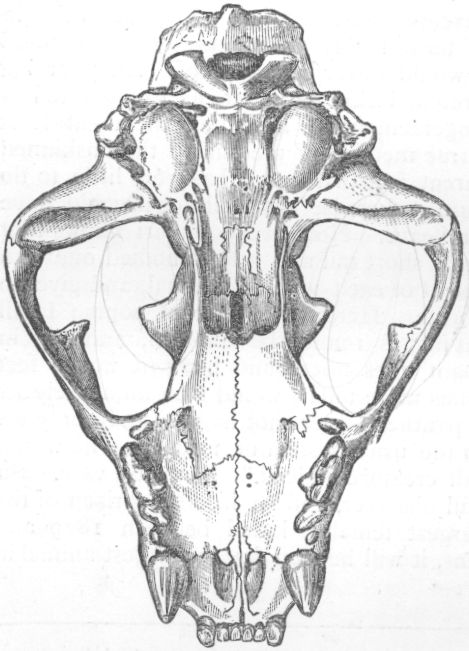
Tiger's skull (under part).
I then took the palatal measurement, from the outer edge of the border in which the incisors are set to the anterior inside edge of the brain-hole, or foramen magnum, and I find that this standard is sufficiently accurate, and is 5·50 of the length taken from the tip of the premaxillaries to the end of the sacrum. Therefore the length of this portion of any tiger's skull multiplied by 5·50 will give the measurement of the head and body of the skeleton.
For the purpose of working out these figures I applied to all my sporting friends for measurements of their largest skulls, with a view to settling the question about tigers exceeding eleven feet. The museum possesses the skeleton of a tiger which was considered one of the largest known, the cranial measurement of whose skull is 14·50 inches, but the Maharajah of Cooch Behar showed me one of his skulls which exceeded it, being 15 inches. Amongst others I wrote to Mr. J. Shillingford of Purneah, and he most kindly not only drew up for me a tabular statement of the dimensions of the finest skulls out of his magnificent collection, but sent down two for my inspection. Now in the long-waged war of opinion regarding the size of tigers I have always kept a reserved attitude, for if I have never myself killed, or have seen killed by others, a tiger exceeding ten feet, I felt that to be no reason for doubting the existence of tigers of eleven feet in length vouched for by men of equal and in some cases greater experience, although at the same time I did not approve of a system of measurement which left so much to conjecture.
There is much to be said on both sides, and, as much yet remains to be investigated, it is to be hoped that the search after the truth will be carried on in a judicial spirit. I have hitherto been ranged on the side of the moderate party; still I was bound to respect the opinion of Sir Joseph Fayrer, who, as not only as a sportsman but as an anatomist, was entitled to attention; and from my long personal acquaintance I should implicitly accept any statement made by him. Dr. Jerdon, whom I knew intimately, was not, I may safely assert, a great tiger shikari, and he based his opinion on evidence and with great caution. Mr. J. Shillingford, from whom I have received the greatest assistance in my recent investigations, and who has furnished me with much valuable information, is on the other hand the strenuous assertor of the existence of the eleven-foot tiger, and with the magnificent skulls before me, which he has sent down from Purneah, I cannot any longer doubt the size of the Bengal tiger, and that the animals to which they belonged were eleven feet, measured sportsman fashion—that is round the curves. The larger of the two skulls measures 15·25 inches taken between two squares, placed one at each end; a tape taken from the edge of the premaxillaries over the curve of the head gives 17·37 inches; the width across the zygomatic arches, 10·50.[10] The palatal measurement, which is the test I proposed for ascertaining the length of the skeleton, is 12·25, which would give 5 feet 7·37 inches; about 3¾ inches larger than the big skeleton in the Museum. This may seem very small for the body of an animal which is supposed to measure eleven feet, but I must remind my readers that the bones of the biggest tiger look very small when denuded of the muscles; and the present difficulty I have to contend with is how to strike the average rate for the allowance to be added to skeleton for muscles, the chief stumbling block being the system which has hitherto included the tail in the measurement. It all tigers had been measured as most other animals (except felines) are—i.e. head and body together, and then the tail separately—I might have had some more reliable data to go upon; but I hope in time to get some from such sportsmen as are interested in the subject. I have shown that the tail is not trustworthy as a proportional part of the total length; but from such calculations as I have been able to make from the very meagre materials on which I have to base them, I should allow one 2·50th part of the total length of skeleton for curves and muscles.
10 At Mr. Shillingford's request, I made over this skull to the Calcutta Museum.
In addition to a careful study of De Blainville's 'Ostéographie,' where the bones are figured in large size to scale, I have made many careful measurements of skulls belonging to myself and friends, and also of the skulls and skeletons in the Calcutta Museum (for most willing and valuable assistance in which I am indebted to Mr. J. Cockburn, who, in order to test my calculations, went twice over the ground); and I have adopted the following formula as a tentative measure. I quite expect to be criticised, but if the crude idea can be improved on by others I shall be glad.
I now give a tabular statement of four out of many calculations made, but I must state that in fixing an arbitrary standard of 36 inches for tail, I have understated the mark, for the tails of most tigers exceed that by an inch or two, though, on the other hand, some are less.
Formula.—Measure from the tip of the premaxillaries or outer insertion of the front teeth (incisors) along the palate to the nearest inner edge of the foramen magnum. Multiply the result by 5·50. This will give the length of the skeleton, excluding the tail. Divide this result by 2·50, and add the quotient to the length for the proportionate amount of muscles and gain in curves. Add 36 inches for tail.
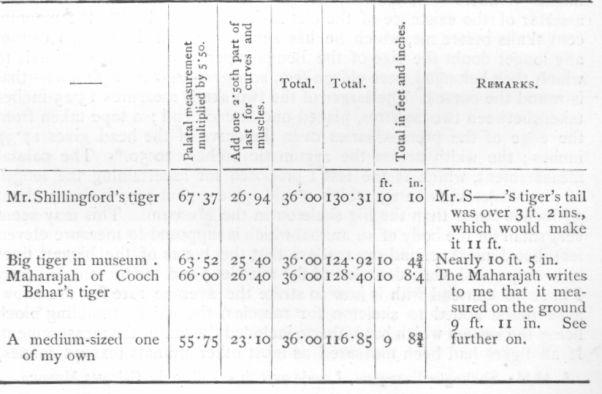
It will be seen that my calculation is considerably out in the Cooch Behar tiger, so I asked the Maharajah to tell me, from the appearance of the skull, whether the animal was young or old. He sent it over to me, and I have no hesitation in saying that it was that of a young tiger, who, in another year, might have put on the extra nine inches; the parietal sutures, which in the old tiger (as in Mr. Shillingford's specimens) are completely obliterated, are in this one almost open. It must be remembered that the bones of the skull do not grow in the same ratio to the others, and that they attain their full size before those of the rest of the body. Therefore it is only in the case of the adult that accurate results can be calculated upon. Probably I have not done wisely in selecting a portion of the skull as a standard—a bone of the body, such as a femur or humerus might be more reliable—but I was driven to it by circumstances. Sportsmen, as a rule, do not keep anything but the skull, and for general purposes it would have been of no use my giving as a test what no one could get hold of except in a museum.
I have always understood that the tiger of the plains grew to a greater size, that is in length, than the tiger of hilly country. I have never shot a tiger in Lower Bengal, therefore I cannot judge of the form of the beast, whether he be more lanky or not. If an eleven-foot Bengal tiger be anything like as robust in proportion as our Central Indian ones, I should say he was an enormous creature, but I believe the Central and Southern tiger to be the heavier one, and this is borne out by an illustration given by Mr. Shillingford in one of his able letters, which have called forth so much hostile criticism. He compares one of his largest with the measurement of a Southern India tiger:—
Locality of Tiger. Purneah Southern India
ft. in. ft. in.
Length. 11 0 10 2
Girth of Chest. 4 6 6 1
Girth of Head. 2 10 3 5
Tail. 3 4 3 1
Round Fore-arm. 2 2 2 10
Height. 3 7 3 9
Total of feet and inches. 27 5 29 4
The shorter tiger has an advantage of nearly two feet in all-round measurement.
Sir Joseph Fayrer has also been called in question for his belief in twelve feet tigers, but what he says is reasonable enough. "The tiger should be measured from the nose along the spine to the tip of the tail, as he lies dead on the spot where he fell, before the skin is removed. One that is ten feet by this measurement is large, and the full-grown male does not often exceed this, though no doubt larger individuals (males) are occasionally seen, and I have been informed by Indian sportsmen of reliability that they have seen and killed tigers over twelve feet in length." ('Royal Tiger of Bengal,' p. 29).
Sir Joseph Fayrer in a letter to Nature, June 27, 1878, brings forward the following evidence of large tigers shot by sportsmen whose names are well known in India.
Lieutenant-Colonel Boileau killed a tiger at Muteara in Oude, in 1861, over 12 feet; the skin when removed measured 13 feet 5 inches.
Sir George Yule has heard once of a 12-foot tiger fairly measured, but 11 feet odd inches is the largest he has killed, and that twice or thrice.
Colonel Ramsay (Commissioner) killed in Kumaon a tiger measuring 12 feet.
Sir Joseph Fayrer has seen and killed tigers over 10 feet, and one in Purneah 10 feet 8 inches, in 1869.
Colonel J. Sleeman does not remember having killed a tiger over 10 feet 6 inches in the skin.
Colonel J. MacDonald has killed one 10 feet 4 inches.
The Honourable R. Drummond, C.S., killed a tiger 11 feet 9 inches, measured before being skinned.
Colonel Shakespeare killed one 11 feet 8 inches.
However, conceding that all this proves that tigers do reach occasionally to eleven and even twelve feet, it does not take away from the fact that the average length is between nine and ten feet, and anything up to eleven feet is rare, and up to twelve feet still more so.[11]
11 Since writing the above I have to thank "Meade Shell" for the measurements of the skull of a tiger 11 ft. 6 in. The palatal measurement is 12 inches, which, according to my formula, would give only 10 ft. 8 in.; but it must be remembered that I have allowed only 3 ft. for the tail, whereas such a tiger would probably have been from 3½ to 4 ft., which would quite bring it up to the length vouched for. The tail of a skeleton of a much smaller tiger in the museum measures 3 ft. 3½ in., which with skin and hair would certainly have been 3½ ft. Until sportsmen begin to measure bodies and tails separately it will, I fear, be a difficult matter to fix on any correct formula.—R. A. S. See Appendix C.
VARIETIES OF THE TIGER.—It is universally acknowledged that there is but one species of tiger. There are, however, several marked varieties. The distinction between the Central Asian and the Indian tiger is unmistakable. The coat of the Indian animal is of smooth, short hair; that of the Northern one of a deep furry pelage, of a much richer appearance.
There is an idea which is also to be found stated as a fact in some works on natural history, that the Northern tiger is of a pale colour with few stripes, which arises from Swinhoe having so described some specimens from Northern China; but I have not found this to be confirmed in those skins from Central Asia which I have seen. Shortly before leaving London, in 1878, Mr. Charles Reuss, furrier, in Bond Street, showed me a beautiful skin with deep soft hair, abundantly striped on a rich burnt sienna ground, admirably relieved by the pure white of the lower parts. That light-coloured specimens are found is true, but I doubt whether they are more common than the others. Of the varieties in India it is more difficult to speak. Most sportsmen recognise two (some three)—the stout thick-set tiger of hilly country, and the long-bodied lankier one of the grass jungles in the plains. Such a division is in consonance with the ordinary laws of nature, which we also see carried out in the thick-set muscular forms of the human species in mountain tracts.
Some writers, however, go further, and attempt subdivisions more or less doubtful. I knew the late Captain J. Forsyth most intimately for years. We were in the same house for some time. I took an interest in his writings, and helped to illustrate his last work, and I can bear testimony to the general accuracy of his observations and the value of his book on the Highlands of Central India; but in some things he formed erroneous ideas, and his three divisions, based on the habits of the tiger, is, I think, open to objection, as tending to create an idea of at least two distinct varieties.
Native shikaris, he says, recognise two kinds—the Lodhia Bagh and the Oontia Bagh (which last I may remind my readers is one of the names of the lion). The former is the game-killing tiger, retired in his habits, living chiefly among the hills, retreating readily from man. "He is a light-made beast, very active and enduring, and from this, as well as his shyness, generally difficult to bring to bag."
I grant his shyness and comparative harmlessness (I once met one almost face to face)—and the nature of the ground he inhabits increases the difficulty in securing him—but I do not think he physically differs from his brother in the cattle districts. Mr. Sanderson says one of the largest tigers he had killed was a pure game-killer.
"The cattle-lifter again," says Forsyth, "is usually an older and heavier animal (called Oontia Bagh, from his faintly striped coat, resembling the colour of a camel), very fleshy and indisposed to severe exertion."
His third division is the man-eater. However, this is merely a classification on the habits of the same animal. I think most Central India sportsmen will agree with me when I say that many a young tiger is a cattle-eater, with a rich coloured hide, although it often happens that an old tiger of the first division, when he finds his powers for game failing by reason of age or increased bulk, transfers himself from the borders of the forest to the vicinity of grazing lands and villages, and he ultimately may come into the third division by becoming a man-eater. So that the Lodhia becomes the Oontia (for very old tigers become lighter in colour), and may end by being an Adam-khor, or man-eater. Tigers roam a great deal at times, and if in their wanderings they come to a suitable locality with convenience of food and water, they abide there, provided there be no occupant with a prior claim and sufficient power to dispute the intrusion. We had ample proof of this at Seonee. Close to the station, that is, within a short ride, were several groups of hills which commanded the pasture lands of the town. Many a tiger has been killed there, the place of the slain one being occupied ere long by another. On the other hand, if a tiger be accommodated with lodgings to his liking, he will stay there for years, roaming a certain radius, but returning to his home; and it is the knowledge of this that so often enables the hunter to compass his destruction. As long therefore as there are human habitations, with their usual adjuncts of herds and flocks, within a dozen miles of the jungle tiger's haunts, so long there will always be the transition from the game-killer to the cattle-lifter and the man-eater. Colour and striping must also be thrown out of the question, for no two individuals of any variety agree, and the characteristics of shade and marking are common to all kinds. The only reliable data therefore are derived from measurements, and from these it may be proved that the grass-jungle tiger of Bengal, though the longer animal, is yet inferior in all round measurement and probably in weight to the tiger of hilly country—see Mr. Shillingford's comparison quoted by me above. Let also any one compare the following measurements of one given by Colonel Walter Campbell with a tiger of equal length shot in the grassy plains of Bengal:—
ft. in.
Length from point of nose to end of tail 9 5
Ditto of tail 2 10
Height from heel to shoulder 3 2
Extreme length from shoulder to point of toe 3 11
From elbow to point of toe 2 0
Girth of body just behind the shoulder 5 3
Ditto of forearm 2 7
Ditto of neck 3 0
Circumference of head 3 3
This is a remarkably short-tailed tiger. If the concurrence of evidence establishes the difference beyond doubt, then we may say that there are two varieties in India—the hill tiger, Felis tigris, var. montanus; and the other, inhabiting the alluvial plains of great rivers, Felis tigris, var. fluviatilis. Dr. Anderson says he has examined skulls and skins of those inhabiting the hill ranges of Yunnan, and can detect no difference from the ordinary Indian species.
The tigress goes with young for about fifteen weeks, and produces from two to five at a birth. I remember once seeing four perfectly formed cubs, which would have been born in a day or two, cut from a tigress shot by my brother-in-law Col. W. B. Thomson in the hills adjoining the station of Seonee. I had got off an elephant, and, running up the glen on hearing the shots, came unpleasantly close to her in her dying throes. When about to bring forth, the tigress avoids the male, and hides her young from him. The native shikaris say that the tiger kills the young ones if he finds them. The mother is a most affectionate parent as a rule, and sometimes exhibits strange fits of jealousy at interference with her young. I heard an instance of this some years ago from my brother, Mr. H. B. Sterndale, who, as one of the Municipal Commissioners of Delhi, took a great interest in the collection of animals in the Queen's Gardens there. Both tiger and leopard cubs had been born in the gardens, and the mother of the latter shewed no uneasiness at her offspring being handled by strangers as they crept through the bars and strayed about; but one day, a tiger cub having done the same, the tigress exhibited great restlessness, and, on the little one's return, in a sudden accession of jealous fury she dashed her paw on it and killed it. I am indebted to Mr. Shillingford for a long list of tigresses with cubs killed during the years 1866 to 1880. Out of 53 cubs (18 mothers) 29 were males and 22 females, the sex of two cubs not being given. This tends to prove that there are an equal number of each sex born—in fact here the advantage is on the side of the males. I have heard it asserted that tigresses are more common, and native shikaris account for it by saying that the male tiger kills the cubs of his own sex; but I have not seen anything to justify this assertion, or the fact of there being a preponderance of females. Mr. Sanderson, however, writes: "Male and female cubs appear to be in about equal proportions. How it is that amongst mature animals tigresses predominate so markedly I am unable to say."
Tigresses have young at all seasons of the year, and they breed apparently only once in three years, which is about the time the cubs remain with their mother.
For the following interesting memorandum I have to thank Mr. Shillingford:—
Feet.
" Cubs one year old measure Males 4½ to 5½ Females 4 to 5
Ditto two years old Males 5½ to 7 Females 5 to 6½
Ditto three years old Males 7 to 8½ Females 6½ to 7½
"When they reach three years of age they lose their 'milk' canines, which are replaced by the permanent fangs, and at this period the mother leaves them to cater for themselves."