ORDER CETACEA—THE WHALES.
Reading edition
These curious creatures have nothing of the fish about them, save the form, and frequently the name. In other respects they are warm-blooded, viviparous mammals, destitute of hinder limbs, and with very short fore-limbs completely enclosed in skin, but having the usual number of bones, though very much shortened, forming a kind of fin. The fin on the back is horizontal, and not rayed and upright like that of a fish; the tail resembles that of a fish in form, the caudal vertebræ running through the middle of it. The immense muscular power of this tail, with its broad flanges, arises from the flesh of the body, terminating in long cords of tendon, running to the tip. The vertebral column is often ankylosed in the fore-part, but is extremely elastic, owing to the cartilaginous cushion between each bone in the latter half. Thus, whilst the fore-part is rigid, the hinder is flexible in the extreme. The brain is large and much convoluted; the heart is very large, and the blood-vessels extremely full and numerous, with extensive ramifications, which, being filled with oxygenated blood, assist in supporting life whilst submerged. The lungs are also very large. The laryngeal and nasal passages are peculiar. The following description is by Dr. Murie: "In front of the larynx of man we all know that there is an elastic lid, the epiglottis, which folds over and protects the air passage as food is swallowed. The side cartilages constitute the walls of the organ of voice and protect the vocal chords. Now, in the comparatively voiceless whale, the cartilages, including the epiglottis, form a long rigid cylindrical tube, which is thrust up the passage at the back of the palate in continuity with the blow-hole. It is there held in place by a muscular ring. With the larynx thus retained bolt upright, and the blow-hole being meanwhile compressed or closed, the cetacean is enabled to swallow food under water without the latter entering the lungs." The stomach is peculiar, being composed of several sacs or chambers with narrow passages between; the intestines are long, glandular and, according to Dr. Murie, full of little pouches. There is no gall bladder; the gullet is very narrow in some and wider in others. Some have teeth, others are without. The eyes are small; the ears deficient externally, though the interior small ear-bones of ordinary mammals are in these massive and exceedingly dense, so much so, as Murie observes, as to be frequently preserved fossil when other osseous structures are destroyed.
The cetacea have been divided into the Denticete, or Toothed Whales, and the Mysticete, or Whalebone Whales. The former contains the river dolphins, the ziphoid whales, the gigantic sperm whale, the sea dolphins, and the narwhal or sea unicorn. The latter contains the baleen whales.
DENTICETE—THE TOOTHED WHALES.
None of the larger species are found on these coasts, or in the Indian Ocean, the two most interesting of which are the gigantic sperm whales (Physeter macrocephalus), and the curious narwhal or sea unicorn (Monodon monoceros). The latter is an inhabitant of the northern seas only, but the sperm abounds in warmer waters, being frequently found in the sub-tropical oceans. I have occasionally seen them in the South Atlantic, though they are said to have diminished there of late years. It is a wonder that the species does not get scarce in many localities, so great is the chase after them. During the last forty years the Americans alone have taken at the rate of 10,000 barrels of sperm oil per annum, or upwards of four million barrels since 1835. The sperm whale, though of such enormous bulk and courage, yet has enemies besides man. The thrasher and the killer whale both attack it, and sailors assert that the sword-fish and thrasher combine against it, the latter stabbing from below, whilst the former leaps on it with stunning blows. I think by sword-fish (Xiphias), which is also a large but not so very sanguinary a fish, they mean the saw-fish (Pristis), which is allied to the sharks, and which attacks the largest whales. The sword-fish has however the character of being pugnacious. The old sperms, especially males, will show fight at times, but the younger ones are easily alarmed, and on being molested rush off in various directions, each looking out for himself. The sperm whale is known from the others by the way in which it spouts, the jet being thrown up obliquely forwards, and it blows at regular intervals. Although the old "bulls" show a certain amount of ferocity at times, their savageness is considerably exaggerated by the whalers, who love to spin yarns about them. Having watched the habits of these and the baleen whales with curiosity, I tried to get as much information about them as I could, from the whalers, but, with the exception of the officers of whaling ships, there was much that was unreliable in Jack's notions about the sperm. On one occasion I was just too late to see one killed. The boats, under full sail, were towing the carcase towards the ship. I would have given a good deal to have seen the encounter. The food of the sperm consists greatly of the huge rock squid or cuttle-fish, which they swallow in large lumps. I have heard whalers assert that a wounded sperm in the death agony will vomit immense pieces of squid. In this respect it differs much from the baleen whales, which have a narrow gullet. According to Professor Flower there is no sufficient evidence of the existence of more than one species of sperm whales, but an allied species, Physeter (Euphysetes) simus, is found on the Madras coast, and to this I will allude further on.
FAMILY DELPHINIDÆ—THE DOLPHINS OR PORPOISES.
GENUS PLATANISTA—THE RIVER DOLPHINS.
A globular head with a long, compressed and, towards the end, spoon-shaped rostrum or snout; flippers short, broad and triangular; a long body of moderate girth; no back fin, but a slight elevation which takes its place. There is a decided depression between the head and body on the region of the neck; the eye is remarkably small, so much so as to be hardly perceptible; in an adult of eight feet long the whole eye-ball is no bigger than a pea, and the orifice of the ear is like a pin-hole.
The skull has peculiar features. "The apparently rounded skull behind the snout has broad, thick zygomatic arches, and above and in front of these the cheek-bones (maxillæ) each send forwards and inwards a great roughened sheet of bone or crest, which forms a kind of open helmet. In the large hollow between these bony plates, and somewhat behind, are situated the nasal orifices, which are slightly awry" (Murie).[19] Professor Flower's notice of the skull ('Osteology of the Mammalia') is thus worded: "The orbit is extremely small, the temporal fossa large, and the zygomatic processes of the squamosal are greatly developed. From the outer edge of the ascending plates of the maxillæ, which lie over the frontals, great crests of bone, smooth externally, but reticulated and laminated on their inner surface, rise upwards, and, curving inwards, nearly meet in the middle line above the upper part of the face."
19 See Appendix B for illustration.
The dentition is also curious, the upper and lower jaws being provided with a number of teeth, pointed and conical in front, and smaller and more flattened behind. They vary in number. In an example quoted by Dr. Murie the total was 117, viz., 27—28/30—32, but in a specimen examined by Dr. Anderson, who has most exhaustively described these animals, the total number of teeth amounted to 128, i.e. 33—32/32—31. (See Appendix B.)
The cervical vertebræ are movable, and not ankylosed, as in many of the cetacea; the cæcum is small; the blow-hole is a narrow slit, not transverse as in other whales, but longitudinal. I have somewhat gone out of order in Jerdon's numbering in bringing in this genus here instead of letting it follow Delphinus, as he has done. These river Dolphins naturally come after the extinct Phocodontia or seal-toothed whales, and bear considerable resemblance in the dentition to the extinct genus Squalodon.
NO. 257. PLATANISTA GANGETICA. The Gangetic Porpoise (Jerdon's Nos. 144 and 145).
NATIVE NAMES.—Soonse, Soosoo, Soosa, Hindi; Susak, Shishuk, Bengali; Sisumar, Sanscrit; Bulhan or Sunsar, on the Indus; Hihoo, Siho; Assamese; Huhh in Cachar and Sylhet.
HABITAT.—In the larger rivers connected with the Ganges nearly up to the hills; also in the Brahmaputra and in the Indus, but in fresh water; only it does not go out to sea.
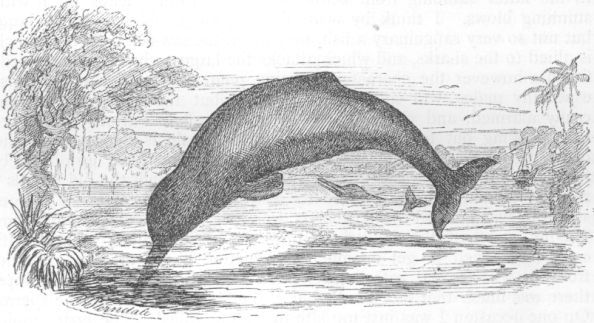
Platanista Gangetica.
DESCRIPTION.—"A long compressed snout with a formidable array of teeth; a vaulted compressed forehead; longitudinal blow-hole; scarcely perceptible eye; distinct neck; broad and abruptly truncated pectoral fins, and small dorsal fin; and the male, a smaller but heavier-built animal than the female, with a shorter snout" (Anderson). The colour is from a dark lead to a sooty black; according to Jerdon "when old with some lighter spots here and there; shining pearl-grey when dry."
SIZE.—From six to eight feet.
This animal, though not often captured, at all events in the vicinity of Calcutta, is familiar to most people who have travelled on the larger Indian rivers. It is common enough in the Hooghly. I have frequently observed it in the river abreast of the Fort whilst we were slowly driving down the Course.
I am largely indebted to Dr. Anderson for information concerning it, for he has not only most carefully watched the habits of this curious animal, but has most exhaustively described its anatomy in his 'Anatomical and Zoological Researches.' It is found in the Hooghly, chiefly in the cold weather, migrating during the hot and rainy season; at least so it was supposed, and Dr. Cantor conjectured that at such times it visited the sea, but this has been proved to be not the case. The soosoo never leaves fresh water; and it is in the river during the rains, for fishermen catch it in their nets, but it is hardly ever seen at that time. It rises so as to expose the blow-hole only, and the rush of the swollen waters prevents the peculiar sound of respiration being heard. But in the cold weather, when the river is calm, the ear is attracted at once by the hissing puff of expiration, and the animal may be seen to bound almost out of the water. Dr. Anderson had one alive in captivity for ten days, and carefully watched its respirations. "The blow-hole opened whenever it reached the surface of the water. The characteristic expiratory sound was produced, and so rapid was the inspiration that the blow-hole seemed to close immediately after the expiratory act." He states that "the respirations were tolerably frequent, occurring at intervals of about one-half or three-quarters of a minute, and the whole act did not take more than a few seconds for its fulfilment." But it is probable that in a free state and in perfect health the animal remains longer under water. It has certainly been longer on several occasions when I have watched for the reappearance of one in the river. The food of the Gangetic dolphin consists chiefly of fish and crustacea; occasionally grains of rice and remains of insects are found in the stomach, but these are doubtless, as Dr. Anderson conjectures, in the fish swallowed by the dolphin. The period of gestation is said to be eight to nine months, and usually only one at a time is born, between April and July. The young are sometimes caught with their mothers, and are said to cling by holding on by the mouth to the base of the parent's pectoral fins. "The flesh and blubber are occasionally eaten by many of the low caste Hindus of India, such as the Gurhwals, the Domes of Jessore and Dacca districts, the Harrees, Bourees, Bunos, Bunpurs, Tekas, Tollahas, the Domes of Burdwan and Bhagulpore, who compare it to venison; also by the Teewars and Machooas of Patna, the Mussahars of Shahabad, the Gourhs and Teers of Tirhoot, and the Mullahs of Sarun. In the North-west Provinces about Allahabad, the Chumars, Passees, Kooras, Khewuts or Mullahs, have rather a high estimate of the flesh, which they assert resembles turtle. The Koonths of Benares, Phunkeahs, Natehmurrahs, and Buahoas of Moradabad, and also such gipsy tribes as the Sainsees, Kunjars and Hubbossahs, in the neighbourhood of Meerut, do not despise it. In the Punjab we find the Choorahs, Dhapels, Sainsees, Budous, and Burars eating the flesh; and in Sind the Kehuls. The Moras, a tribe of Mahomedan boatmen who lead a wandering life on the streams in the Punjab and in Sind, subsist on the dolphin when by good chance they catch one; this is also the case with the Cacharies and the Nagas of Assam. The Sansee women on the Indus eat the flesh under the idea that it makes them prolific. All along the Ganges, Brahmahputra, and Indus, the oil is universally considered as of great value as an embrocation in rheumatism and for giving much strength when rubbed on the back and loins. But many other animal oils, such as those of various species of turtle, the crocodile, and the pelican, have a similar reputation. It is said to be of a very penetrating nature, and, owing to this property, it is highly prized for preserving leather, such as harness, &c. The illuminating powers of this oil are said to be very high." (Anderson's 'Anatomical and Zoological Researches.')
Jerdon gives, on the authority of Blyth, another species, Platanista Indi, or the Indus porpoise, but Dr. Anderson has conclusively proved that this is identical with the Gangetic dolphin. The dentition of the soosoo is most curious. The perfect tooth in the young animal is sharp and pointed, but as the creature advances in age the fangs get broader, and the point wears down, till in old age the crown is so worn as to leave but a bony lump in its place.
GENUS ORCELLA—THE ROUND-HEADED RIVER DOLPHINS.
The generic characteristics of these dolphins are, according to Dr. Anderson, as follows: "Head globular; dorsal fin low, situated behind the middle of the body; pectoral fins oval, about one-sixth the length of the animal; teeth conical, large, and fewer in the lower than in the upper jaw, thirteen to seventeen teeth in the upper and twelve to fourteen teeth in the lower jaw; skull beaked; beak broad at the base, anteriorly pointed; premaxillary not much laterally dilated, bearing one tooth; vertebræ sixty-two to sixty-three; first two cervical vertebræ ankylosed; lumbar transverse process moderately long; vertebræ ribs twelve to thirteen, with one or two free ribs; pelvic bones opposite thirty-fifth and thirty-sixth vertebræ."
These are the dolphins which were procured by Mr. Blyth in the Hooghly, and were supposed by him to be the young of the ca'ing whale (Globicephalus), which idea has also been adopted by Jerdon; but it has been since proved that the skeletons prepared from these supposed young whales are those of adults fully matured, and not of young animals, which have certain resemblances to Globicephalus as well as to the killer whales, Orca, from which the generic name has been derived, but yet was undoubtedly distinct. The killer whales have a very high dorsal fin in the middle of the back, with very large pectoral flippers as broad as long; in Orcella the back fin is low and behind the middle of the body, and the pectoral fin is only half as broad as long. In the ca'ing whale the back fin is more towards the shoulders, and the flippers are long and narrow; the genus Orcella in fact seems to be intermediate between the dolphin and the ca'ing whale, combining the head of Globicephalus with the body of Delphinus. Dr. Anderson, however, points out further differences than the external ones I have above alluded to. Orca, he says, is distinguished by a "more powerfully built skeleton, with considerably fewer vertebræ, there being only a maximum of fifty-three in it to a maximum of sixty-three in Orcella." In Orca generally four or five cervical vertebræ are ankylosed as in the cachelots, but in the two species of Orcella only the atlas and axis are joined. "In the killers and ca'ing whales the ribs are transferred to the transverse processes at the seventh dorsal, whilst in Orcella the transference does not take place until the eighth." The skull resembles that of Orca in the breadth of the upper jaw being produced by the maxillaries, whereas in Globicephalus this effect is caused by the premaxillaries. The teeth resemble the killer's.
As I have said so much about the killer whale, I may digress a little to explain what it is, though it is not a denizen of the Indian seas. It is to the Cetacea what the shark is to fishes—a voracious tyrant with a capacious mouth, armed with formidable teeth. It hesitates not to attack the largest sperm and Greenland whales, and the smaller whales, porpoises and seals will spring out of water and strand themselves on shore in terror at its approach. It ranges from twenty to thirty feet in length, and is of so gluttonous a character that in one recorded case a killer had been found choked in the attempt to swallow a fifteenth seal, the other fourteen, with thirteen porpoises, being found in its stomach!
According to Scammon three or four of them do not hesitate to grapple with the largest baleen whale; and, as described by Dr. Murie, "the latter often, paralysed through fear, lie helpless and at their mercy. The killers, like a pack of hounds, cluster about the animal's head, breach over it, seize it by the lips, and haul the bleeding monster underwater; and, should the victim open its mouth, they eat its tongue." In one instance he relates that a Californian grey whale and the young one were assaulted; the Orcas killed the latter, and sprang on the mother, tearing away large pieces of flesh, which they greedily devoured.
"These brutes have been known to attack a white-painted herring boat, mistaking it for a beluga; and it is stated that occasionally they will boldly lay siege to whales killed by the whalers, almost dragging them perforce under water. Near some of the Pacific sealing grounds they continually swim about, and swoop off the unwary young; even the large male sea-lions hastily retreat ashore and give these monsters a wide berth. The walrus also, with his powerful tusks, cannot keep the killers at bay, especially if young morses are in the herd. The cubs on such occasions will mount upon the mother's back for refuge, clinging for dear life, but the Orca, diving, comes suddenly up with a spiteful thud, and the cub, losing its balance, falls into the water, when in an instant it is seized by the remorseless whales." The speed of the killer whale is immense, as may be supposed when it can overtake the swift dolphins, which it catches and swallows alive. It has also been seen chasing salmon up the mouths of rivers.
The genus Orcella seems to come in between the sea and river dolphins, although Orcella fluminalis of Dr. Anderson is a purely fluviatile animal, which apparently never goes out to sea.
NO. 258. ORCELLA BREVIROSTRIS. The Short-nosed Round-headed River Dolphin.
HABITAT.—The estuaries of the Ganges and Brahmaputra rivers.
DESCRIPTION.—"The head is convex from the blow-hole to the upper lip, but its sides immediately below the angle of the mouth are somewhat anteriorly convergent, but rounded; the gape posteriorly has a long upward curve; the eye, which is well developed, is near the angle at the gape, and in the adult is placed about one inch above it, with a slightly downward slope; the ear is nearly on the same level as the angle of the mouth, but is extremely small, crescentic, and not measuring more than 0·12 inch in diameter. The posterior margin of the blow-hole is immediately behind the anterior angle of the eye; the blow-hole is crescentic and unsymmetrical, being more to the left than to the right side; there are two slight eminences about one inch behind the blow-hole; the construction of the neck occurs below the ear and slightly behind it" (Anderson's 'Anatomical and Zoological Researches,' p. 370). The other characteristics are triangular flippers half as broad as long. The back fin rises behind the centre of the back; it is comparatively small, falcate, curved over the top to a blunt point, and concave behind. The line of the back is sharp from this fin down to the tail. The ventral line is the same for some inches behind the anus. The colour is dark slaty-blue above, almost black, a little paler below, without any streaks or marks, such as in O. fluminalis and Risso's grampus.
SIZE.—From snout to caudal notch, about 7 feet.
I cannot find much on record concerning the habits of this dolphin, and my own acquaintance with it is too limited for me to afford much original information.
NO. 259. ORCELLA FLUMINALIS (Anderson). The Fresh-water Round-headed Dolphin.
HABITAT.—The Irrawaddy river; Burmah.
DESCRIPTION.—This differs from the last in a "rather smaller, lower, and more falcate dorsal fin, its more pointed and less anteriorly bulging head, and rather shorter and broader pectoral fins" (Anderson). The colour is a pale bluish above, and white underneath, with numerous streaks, as in Risso's grampus.
SIZE.—From 7 to 7½ feet from snout to fork of tail.
Dr. Anderson, who has fully described this species, says that he has "never observed it in tidal waters, so that it is even more strictly fluviatile than the Gangetic dolphin. From a little below Prome to as far up as Bhamo, which is about 550 miles, as the crow flies, from the sea, these animals abound. It is asserted by the Shans of Upper Burmah that these dolphins are not to be found beyond a point thirty miles above Bhamo, where the course of the river is interrupted by rocks, and which they style Labine or Dolphin Point, from the circumstance that, according to them, it is the residence of certain Nâts, who there impose so heavy a toll on dolphins as to deter them from proceeding upwards."
This dolphin is somewhat like its marine cousins, being fond of gambolling round the river steamers. Solitary ones are seldom met with, usually two or three being together. When they rise to breathe the blow-hole is first seen; then, after respiration, the head goes down, and the back as far as the dorsal fin is seen, but rarely the tail flippers. They rise to breathe every 70 to 150 seconds, and the respiratory act is so rapid that it requires a very expert marksman to take aim and fire before the animal disappears.
Dr. Anderson says: "I have observed some of them disporting themselves in a way that has never yet been recorded of Cetacea, as far as I am aware. They swam with a rolling motion near the surface, with their heads half out of the water, and every now and then nearly fully exposed, when they ejected great volumes of water out of their mouths—generally straight before them; but sometimes nearly vertically. The sight of this curious habit at once recalled to me an incident in my voyage up the river, when I had been quite baffled to explain an exactly similar appearance seen at a distance, so that this remarkable habit would appear to be not uncommonly manifested. On one occasion I noticed an individual standing upright in the water, so much so that one-half of its pectoral fins was exposed, producing the appearance against the background as if the animal was supported on its flippers. It suddenly disappeared, and again, a little in advance of its former position, it bobbed up in the same attitude, and this it frequently repeated. The Shan boatmen who were with me seemed to connect these curious movements with the season—spring—in which the dolphins breed."
A similar thing has been noticed in the case of marine dolphins off the coast of Ceylon by Mr. E. W. H. Holdsworth, whose observations confirm the opinion of the Shan boatmen. (See 'P. Z. S.' 1872, p. 586.)
"The food of the Irrawady dolphin is apparently exclusively fish. The fishermen believe that the dolphin purposely draws fish to their nets, and each fishing village has its particular guardian dolphin, which receives a name common to all the fellows of his school, and it is this supposition that makes it so difficult to obtain specimens of this cetacean. Colonel Sladen has told me that suits are not unfrequently brought into the native courts to recover a share in the capture of fish in which a plaintiff's dolphin has been held to have filled the nets of a rival fisherman" (Anderson). This reminds me that in the surveying voyage of the Herald, as related by Mr. H. Lee, the natives of Moreton Bay entreated the seamen not to shoot their tame porpoises, which helped them in their fishing.
GENUS DELPHINUS—THE MARINE DOLPHINS.
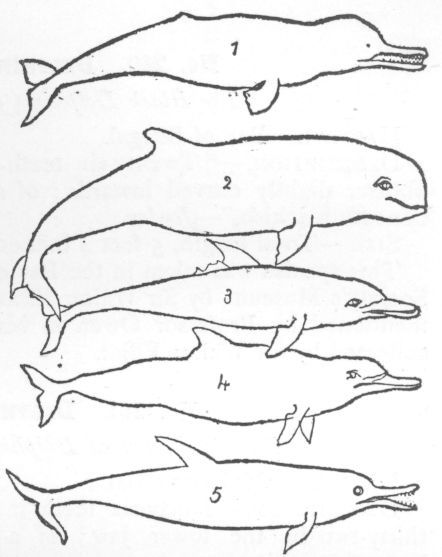
1. Gangetic Dolphin—Platanista Gangetica. 2. Round-headed River Dolphin—Orcella brevirostris. 3. Gadamu Dolphin—Delphinus Gadamu. 4. Freckled Dolphin—Delphinus lentiginosus. 5. Black Dolphin—Delphinus pomeegra.
These are characterised by a convex forehead, with a protruding muzzle which forms a sort of beak; they have teeth in both jaws, numerous and conical, broad and high cranium, nasal passages vertical, no cæcum. They are gregarious in habit, carnivorous and extremely swift, but they must not be confounded with the dolphin of sailors, which is a true fish (Coryphæna hipparis) of great velocity and brilliant colours, which change like rainbow tints when the fish is dying. I have several times in vain tried to catch the fleeting shades with both oil and water-colours, but without success; for within a few minutes they change from the most vivid of greens and blues to a pale silvery grey. The true dolphin, of which we are treating, is the dolphin of the ancients, represented in all the old pictures and sculptures. They have a medium dorsal fin, and the pectoral flippers are about two-thirds longer than the breadth.
NO. 260. DELPHINUS PERNIGER. The Black Dolphin (Jerdon's No. 142).
HABITAT.—Bay of Bengal.
DESCRIPTION.—"Twenty-six teeth on each side above and below, obtuse, slightly curved inwards; of a uniform shining black above, beneath blackish."—Jerdon.
SIZE.—Total length, 5 feet 4 inches.
This species was taken in the Bay of Bengal and sent to the Asiatic Society's Museum by Sir Walter Elliot, but it does not appear to be mentioned by Professor Owen in his notice of the Indian Cetacea collected by Sir Walter Elliot.
NO. 261. DELPHINUS PLUMBEUS. The Lead-coloured Dolphin (Jerdon's No. 143).
HABITAT.—Malabar coast.
DESCRIPTION.—Thirty-six teeth in each side in the upper jaw and thirty-two in the lower jaw; of a uniform leaden colour, with the lower jaw white.
SIZE.—About 8 feet.
Whether this be the same as or a different species to the next I am unable to say, as the description is meagre, and the number of teeth vary so much in the same species that no definite rule can be laid down on them.
The following are the species named by Professor Owen and collected by Sir Walter Elliot.
NO. 262. DELPHINUS GADAMU.
NATIVE NAME.—Gadamu.
HABITAT.—Madras coast.
DESCRIPTION.-Body fusiform, gaining its greatest diameter at the fore-part of the dorsal fin, decreasing forward to the head by straight converging lines, and with a gentle convex curve to the eyes and blow-hole; the forehead descends with a bold convex curve; the sides of the head converge from the eyes to the base of the snout, which is divided from the forehead by a transverse groove extending almost horizontally to the angles of the mouth, and it equals in length the distance from the base to the eyes, which is five inches and a-half; the lower jaw projects a little beyond the upper; the blow-hole is crescentic, in a line with the eyes, exactly in the middle of the head, with the horns of the crescent pointing towards the snout; the pectoral and dorsal fins are falcate and about equal in size; the colour is a dark plumbeous grey, almost black upon the fins, especially at their fore-part; the body below being of a pinkish ashy-grey, with a few small irregular patches of light plumbeous grey.
The dentition varies from 24—24/24—24 = 96, to 23—23/27—28 = 101, and 27—27/27—27 = 108.
SIZE.—About seven feet from snout to fork of tail; girth about 3 feet 9 inches.
NO. 263. DELPHINUS LENTIGINOSUS. The Freckled Dolphin.
NATIVE NAME.—Bolla Gadimi, Telegu.
HABITAT.—Madras coast.
DESCRIPTION.—Body fusiform, as in the last, but with smaller pectoral and dorsal but larger caudal fin; the back is straighter and not so much rounded on the shoulders, and the colour is bluish-cinerous or slaty, freckled with small irregular spots of brown or plumbeous, and longitudinal streaks of the same flecked with white; the under parts a shade lighter than rest of the body. The snout is six inches in length.
Dentition: 32—32/32—33 = 129.
SIZE.—Seven to eight feet; girth four feet.
NO. 264. DELPHINUS MACULIVENTER. Spot-bellied Dolphin.
NATIVE NAME.—Suvva.
HABITAT.—Madras coast.
DESCRIPTION.—Forehead more convex than even D. gadamu, and head proportionately larger and body deeper. A deep shining plumbeous black on the upper part, becoming paler near the belly, which from the underpart of the jaw to the perineum is ashy-grey, with irregular spots and blotches.
Dentition: 27—27/30—30 = 114.
SIZE.—About seven feet.
NO. 265. DELPHINUS FUSIFORMIS. The Spindle-shaped Dolphin.
HABITAT.—Madras coast.
DESCRIPTION.—More slender in proportion to its length; a less elevated and less convex forehead than the last species; a proportionally thicker, broader, and more obtusely terminated snout; a deeper mandible or under jaw especially posteriorly, and smaller dorsal and pectoral fins, especially the latter. The greatest girth is in middle or fore-part of the dorsal fin, from which the body tapers to both ends, presenting the true spindle form. Colour plumbeous, lighter below, darkest on the fins and snout.
Dentition: 22—22/21—21 = 86 teeth.
SIZE.—About six feet.
NO. 266. DELPHINUS POMEEGRA. The Black or Pomeegra Dolphin.
NATIVE NAME.—Pomeegra.
HABITAT.—Madras coast.
DESCRIPTION.—More slender than any of the foregoing species; longish snout, with 173 teeth, viz. 41—41/45—46. It is well to note the irregularity here, not only an odd number, but the lower jaw has the greater number, whereas it is generally the other way. Colour almost black, lighter beneath. Professor Owen's description is not so full as in other cases, but from the illustration it seems that the flukes of the caudal fin are longer, and the posterior edge of the dorsal straighter than in the others.
NO. 267. DELPHINUS LONGIROSTRIS. The Long-snouted Dolphin.
HABITAT.—Indian Ocean; coast of Ceylon.
DESCRIPTION.—Similar to the last, but with a longer and more slender snout.
NO. 268. DELPHINUS VELOX.
This is also given by Dr. Kellaart as a species found on the coast of Ceylon.
Sir Walter Elliot mentions another species of dolphin, of which he had lost the drawing, about thirty-two inches long, of a uniform black colour, small mouth, and no dorsal fin, called by the Tamil fishermen Molagan.
GENUS PHOCÆNA—THE PORPOISES.
No beak or rostrum; snout short and convex; numerous teeth in both jaws. Kellaart testifies to the existence of a true porpoise on the coasts of Ceylon—which he identifies with Phocæna communis—of a blackish colour above and whitish beneath.
GENUS GLOBICEPHALUS—THE CA'ING OR PILOT WHALE.
Head globular in front; teeth few in number; the dorsal fin is high, situated nearer to the head than to the tail; the flippers very long and narrow; the fingers possessing an unusually large number of bones.
NO. 269. GLOBICEPHALUS INDICUS. The Indian Ca'ing Whale (Jerdon's No. 146).
HABITAT.—Bay of Bengal.
DESCRIPTION.—Body cylindrical, tapering to the tail; dorsal fin high, falcate, and placed about the middle of the body proper, excluding the tail portion; the forehead with a prominent boss over the snout, which is short; pectoral fins long and narrow; colour uniform leaden black, paler beneath.
SIZE.—Fourteen feet, flippers 2 feet; dorsal fin, 2¼ feet long, 11 inches high; tail flukes, 3 feet broad.
Blyth's specimens were procured in the Salt Lakes near Calcutta. It was for the young of this that he mistook Orcella brevirostris.
PHYSETERIDÆ—THE CACHELOTS OR SPERM WHALES.
GENUS EUPHYSETES.
NO. 270. PHYSETER or EUPHYSETES SIMUS. The Snub-nosed Cachelot.
NATIVE NAME.—Wonga, Telugu.
HABITAT.—Bay of Bengal.
DESCRIPTION.—The general form of this animal resembles the porpoise, but the position of the mouth at once distinguishes it. It is small and situated, like that of the shark, considerably under the blunt rostrum, so much so as to lead one to conjecture whether or not it turns on its back in seizing its prey, as do the sharks. The blow hole is crescentic, but eccentrically placed to the left of the middle line of the head, and the horns of the crescent are turned diagonally backwards—that is to say, the lower limb points to the back whilst the upper one touches the middle line and points across; the eye is small; the pectoral fins are triangular, about one foot in length and four and a-half inches broad in the male, and four inches in the female; the dorsal fin is sub-falcate, standing about a foot high, and is nine to ten inches broad at the base, the male being the broader; the colour is a shining black above, paler and pinkish below.
Dentition: 1—1/9—9 = 20.
SIZE.—Six to seven feet.
The peculiarity of this cetacean is the preponderance of the cranial over the rostral part, more so, as Professor Owen remarks, than in any other species. The asymmetry of the bones too is remarkable, although this is characteristic of all the catodon whales, especially as regards the bones of the anterior narial passages, the left of which is very much larger than the right. This is also the case in the large sperm whale, but in Euphysetes the disproportion is still greater. In a notice on a New Zealand species (E. Pottsii), by Dr. Julius Haast, he gives the difference as fifteen times the size of the right aperture; the mouth is also peculiar from its position and small size, being very much overshot by the snout. It may, as Dr. Haast supposes, be a ground feeder, existing on the smaller hydroid zoophytes, otherwise it must, I think, turn on its side in seizing its prey.
MYSTICETE—WHALEBONE OR BALEEN WHALES.
GENUS BALÆNA—THE RIGHT WHALES.
They are distinguished from the last group by their enormous heads, with more symmetrical skulls, the facial portion of which is greatly in excess of the cranial. The bones of the lower jaw are not united at the symphysis, but are held together by strong fibrous bands; the two rami are very much rounded and arched outwards; there are no teeth. The maxillary and premaxillary bones are much produced, forming a rostrum tapering, narrow, compressed and much arched in the right whales. From this depends the mass of whalebone, which grows from a fleshy substance "similar," as is aptly described by Dr. Murie, "to the roots of our finger-nails. It grows continuously from the roots like the latter, and in many respects corresponds, save that the free end is always fringed. Baleen, therefore, though varying from a few inches to a number of feet long, in fact approximates to a series of, so to say, mouth nail-plates, which laminæ have a somewhat transverse position to the cavity of the mouth, and thus their inner split edges and lower free ends cause the mouth to appear as a great hairy archway, shallower in front and deeper behind" (Cassell's Natural History).
The object of this vast amount of whalebone is to strain from the huge gulps of water the mollusca, &c., on which this animal feeds. The tongue of these whales is very large, filling up the space between the lower jaws. The gullet is small in comparison. The nasal aperture differs from the Denticete in being symmetrical, that is, having the double aperture, and in being directed forwards as in most mammals, instead of upwards and backwards as in the dolphins. The whale produces generally one at a birth, which it suckles for some length of time. The mammæ are pudendal. The right whales have no fin on the back; those that have form a separate genus, Balænoptera, i.e. fin-whales.
They are the most valuable of the cetacea, except perhaps the cachelot or sperm whale, as producing the greatest amount of oil and whalebone. Of the various species the most sought after is the Greenland or right whale (Balæna mysticetus), which ordinarily attains a length of fifty to sixty feet. An average whale between forty and fifty feet in length will yield from sixty to eighty barrels of oil and a thousand pounds of baleen.
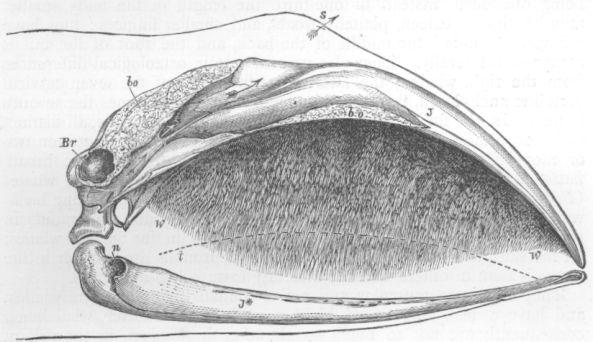
Br, brain cavity; J J*, upper and lower jawbones; the arrows indicate narial passages; S, spout-hole; W, whalebone; t, tongue in dotted line; n, nerve aperture in lower jaw; bo, bone sawed through.
Skull of Baleen Whale.
Formerly all whaling vessels were sailers, but now powerful steamships are used, and the harpoon often gives way to the harpoon gun. A whale, when struck, will sometimes run out a mile of line before it comes up again, which is generally in about half an hour. The whalers judge as best they can, from the position of the line, in which direction he will rise, and get as near as possible so as to use the lance or drive in another harpoon. When killed, the animal is towed to the vessel and fastened on the port side, belly uppermost, and head towards the stern; it is then stripped of its blubber, the body being canted by tackles till all parts are cleared. The baleen is then cut out, and the carcase abandoned to the sharks, killer whales, and sea birds.
The baleen whales are not found in the intertropical seas. Of the known species there are the Greenland whale (B. mysticetus), the Biscay whale (B. Biscayensis), the Japan whale (B. Japonica), the Cape whale (B. australis), and the South Pacific whale (B. antipodarum).
GENUS BALÆNOPTERA—FINBACK WHALES OR RORQUALS.
Are distinguished by their longer and narrower bodies, smaller heads, being one-fourth instead of one-third the length of the body, smaller mouths, shorter baleen, plaited throats, and smaller flippers; they have a dorsal fin behind the middle of the back, and the root of the tail is compressed laterally. They also present certain osteological differences from the right whales; the latter have the whole of the seven cervical vertebræ anchylosed, that is to say generally, for sometimes the seventh is free. In the finbacks the cervical vertebræ are, as a rule, all distinct and free, although occasionally anchylosis may take place between two or more of them. The sternum of the Balæna consists of a broad, flattened, heart-shaped or oval presternum. "In the fin whales (Balænoptera) it is transversely oval or trilobate, with a projecting backward xiphoid process" (Professor Flower). The ulna and radius in the rorquals are also comparatively longer than in the baleen whales. In the skull, the supraorbital processes of the frontals are broader in the rorquals than in others, and the olfactory fossa is less elongated.
They are more muscular and active animals than the right whales, and have a less amount of blubber and much shorter whalebone, consequently are not so much sought after by whalers, as the risk in attacking them is not compensated for by the commercial results. Many of them grow to enormous size, far exceeding any of the baleen whales. The common rorqual, razorback, or pike-whale of the English coasts (B. musculus) attains a length of seventy feet; it is black above and pure white below. The sulphur-bottom whale (B. sulfureus) is known by its yellowish belly, and with Sibbald's whale (B. Sibbaldii) grows to a length of one hundred feet, to which size our Indian species also approaches.
NO. 271. BALÆNOPTERA INDICA. The Indian Rorqual (Jerdon's No. 147).
HABITAT.—The Indian Ocean.
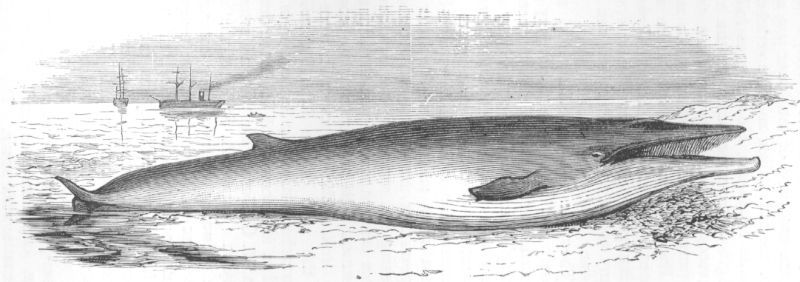
Rorqual.
DESCRIPTION.—External characteristics those of the genus, but from Mr. Blyth's observations the lower jaw of this species is more slender in proportion to its size than that of any other rorqual or even right whale.
SIZE.—Up to 90 and possibly 100 feet.
There is a most interesting article on the great rorqual of the Indian Ocean by Mr. Blyth in the 'Journal of the Asiatic Society' for 1859, p. 481. He notices that the existence of great whales was known to and recorded by the ancients. Nearchus, the commander of Alexander's fleet, which sailed from the Indus to the Persian Gulf in B.C. 327, mentions having met with them, and that on the coast of Mekran the people constructed houses of the bones of stranded whales. In modern times an occasional one gets on shore, as was the case with one at Chittagong in 1842, another on the Arakan coast in 1851. In 1858 one of 90 feet was stranded at Quilon on the west coast, as reported by the Rev. H. Baker of Aleppi, who also mentions that one, said to be 100 feet long, was cast ashore some years previously. He writes to Mr. Blyth: "Whales are very common on the coast. American ships, and occasionally a Swedish one, call at Cochin for stores during their cruises for them; but no English whalers ever come here that I have heard of."
I wonder at any whaling vessel coming out of their way after this species, for I have always heard from whalers that the finback is not worth hunting. It is possible that in cruising after sperms they may go a little out of their way to take a finback or two. However, to return to Blyth's remarks. Of the whale stranded on the Arakan coast a few bones were sent to the Society's Museum in Calcutta; they consisted of the two rami of the lower jaw, measuring 20 feet 10 inches, a right rib, the left radius, and five vertebræ, which are now to be seen at the Indian Museum. He writes as follows on them: "The proportional length of the radius indicates the animal to have been a Balænoptera or rorqual, while the remarkable slenderness of the lower jaw suffices to prove it a distinct species from any hitherto-described rorqual."
The finback does not confine itself entirely, or even chiefly, as stated by Blyth, to a diet of Cephalapoda, but is a fish-eater to boot, doing great damage to shoals of such fish as cod, herrings, &c., as many as six to eight hundred fish having been found in the stomach of one.
They are not particularly shy, and will sometimes follow a vessel closely for days. I read not very long ago an account in one of the Indian newspapers of a steamer running over one of these animals, and nearly cutting it in two; the agony of the poor brute as he struggled in the water, vainly trying to sound, was graphically described. A similar adventure occurred some years ago to the B.I.S.N. Company's steamer Euphrates, on a voyage from Kurrachee to Bombay, when about sixty miles from the latter place. The captain writes: "It appears that the animal had for about half an hour amused itself by crossing and recrossing the bow, and then at last suddenly turned and came straight for the vessel, striking us about ten feet from the stem. It struck with such force as to send a considerable quantity of spray on deck. The only other instance that has occurred here lately was in the case of the S.S. Dalhousie, when about twelve miles from Kurrachee; it was in September of last year, and the Bombay papers had a full account of it at the time." I am indebted to my friend Mr. M. C. Turner for this and some other interesting letters on this subject. Captain A. Stiffe, of the late Indian Navy, writes regarding the drowning of a whale by entanglement with a submarine cable, off the coast of Mekran: "The telegraph cable was broken, and a dead whale hove up to the surface, with three turns of cable round the neck of his tail, by which he was drowned. I had the three turns in my office at Kurrachee, and there they are now I dare say. I don't remember any more details. There are always shoals of whales about that part, and it is supposed a 'bight' of the cable lying off the ground got wound up like a rope round a screw." I myself was in a sailing vessel going about five or six knots, when a whale played about for a time, and then rose and spouted just under the bow, covering the forecastle with spray. The captain, who was standing by me, quite expected a shock, and exclaimed—"Look out! hold on!"
SIRENIA—THE MANATEES.
This group contains the phytophagous or herbivorous cetacea. Their teeth have flat crowns, and they live on aquatic vegetation, though, according to Cuvier, they sometimes leave the water for pasture on shore, but this has not been authenticated, and is probably a mistake. The other characteristics of the group are pectoral mammæ and hairy moustaches. The anterior narial aperture in the skull opens upwards, but the orifices of the nostrils are placed at the end of the muzzle. The stomach is complex, being divided into four sacs, and they have a large cæcum. The flippers are broad, and the animal uses them with some dexterity in supporting its young in the act of suckling. As at such times they frequently raise the upper part of the body out of water, they have given rise to the ancient fables regarding mermaids and sirens. There is something human-like, although repulsive, in the aspect of these creatures, especially in the erect attitude just alluded to. No wonder the ancient mariners, with their restricted knowledge and inclination to the marvellous, should have created the fabulous mermaid, half-fish and half-woman, and have peopled the rocks and seas of Ceylon with seductive sirens with imaginary flowing tresses and sweet ensnaring voices. As regards the latter it may be that the strange phenomena related by Sir Emerson Tennent, of musical sounds ascending from the bottom of the sea, and ascribed by him to certain shell-fish, gave rise to the mermaid's song. Sir Emerson's account has in itself a touch of the romantic and marvellous. He says: "On coming to the point mentioned I distinctly heard the sounds in question. They came up from the water like the gentle thrills of a musical chord, or the faint vibrations of a wineglass when its rim is rubbed by a moistened finger. It was not one sustained note, but a multitude of tiny sounds, each clear and distinct in itself, the sweetest treble mingling with the lowest bass. On applying the ear to the wood-work of the boat the vibration was greatly increased in volume." Similar sounds have been heard elsewhere in the Indian seas, and doubtless the ancients connected this mysterious music of the ocean with the animals round which they had thrown such a halo of romance. But to return to the prose of the subject. The Sirenia consists of the Manatees (Manatus), the Dugongs (Halicore), and the Stellerines (Rhytina); the latter is almost extinct; it used to be found in numbers in Behring Straits, but was exterminated by sailors and others, who found it very good eating. The Manatee inhabits the African and American coasts, along the west coast of the former continent, and in the bays, inlets, and rivers of tropical America, but the one with which we have to do is the dugong or halicore, of which the distribution is rather widespread, from the Red Sea and East African coasts to the west coast of Australia. The latter country possesses an organised dugong fishery, which bids fair to exterminate this harmless animal. They are prized for the excellent quality of the oil they yield, which is clear and free from objectionable smell.
GENUS HALICORE—THE DUGONG.
Have grinders of two cones laterally united. The premaxillary region is elongated and bent downwards, overlapping the very deep lower jaw, which is similarly bent down. They have ordinarily two incisors in the upper jaw, none in the lower. No canines, and molars 3—3/3—3, total fourteen teeth. The incisor tusks in the bent-down upper jaw are longer in the male, and sometimes project beyond the thick fleshy lips, but in the female they are small. The head is round, the lips thick and bristled with moustaches, the body is elongated, and the tail terminated by a crescent-shaped flapper.
NO. 272. HALICORE DUGONG. The Dugong. (Jerdon's No. 240).
NATIVE NAME.—Mooda Oora, Singhalese.
HABITAT.—Indian Ocean off Ceylon.
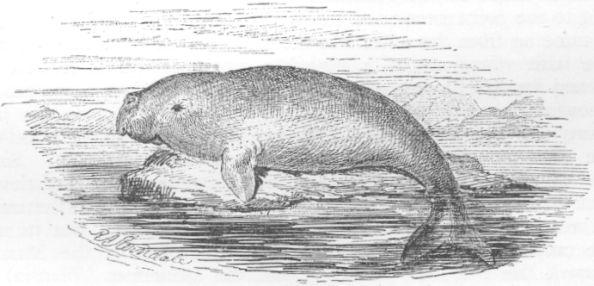
Halicore dugong.
DESCRIPTION.—Body pisciform, terminated by a horizontal fin with two lobes; colour slaty brown above, sometimes bluish black, whitish below.
SIZE.—From 5 to 7 feet long usually, but said to reach 10.
Dr. Kellaart says that at an early age this animal has as many as 32 teeth, viz. inc. 4/8, and molars 5—5/5—5, but when adult there are only 14, as mentioned above. The molars, according to Dr. Murie, succeed each other, the fore ones dropping out, and others from behind taking their places. It feeds on fucus and other seaweeds, and the flesh is considered good eating, and not unlike veal or, some say, pork. They are lethargic in disposition, and in those countries where they have been unmolested they are so fearless of man as to allow themselves to be handled—a confidence somewhat betrayed by the natives, who on such occasions manage to abstract the fattest calves, which are considered a delicacy.