ORDER EDENTATA.
Reading edition
These are animals without teeth, according to the name of their order. They are however without teeth only in the front of the jaw in all, but with a few molars in some, the Indian forms however are truly edentate, having no teeth at all. In those genera where teeth are present there are molars without enamel or distinct roots, but with a hollow base growing from below and composed of three structures, vaso-dentine, hard dentine and cement, which, wearing away irregularly according to hardness, form the necessary inequality for grinding purposes.
The order is subdivided into two groups: Tardigrada, or sloths, and Effodientia or burrowers. With the former we have nothing to do, as they are peculiar to the American continent. The burrowers are divided into the following genera: Manis, the scaly ant-eaters; Dasypus, the armadillos; Chlamydophorus, the pichiciagos; Orycteropus, the ant-bears, and Myrmecophaga, the American ant-eaters.
Of these we have only one genus in India; Manis, the pangolin or scaly ant-eater, species of which are found in Africa as well as Asia.
GENUS MANIS.
Small animals from two to nearly five feet in length; elongated cylindrical bodies with long tails, covered from snout to tip of tail with large angular fish-like scales, from which in some parts of India they are called bun-rohu, or the jungle carp; also in Rungpore Keyot-mach, which Jerdon translates the fish of the Keyots, but which probably means khet-mach or field-fish—but in this I am open to correction. The scales overlap like tiles, the free part pointing backwards. These form its defensive armour, for, although the manis possesses powerful claws, it never uses them for offence, but when attacked rolls itself into a ball.
In walking it progresses slowly, arching its back and doubling its fore-feet so as to put the upper surface to the ground and not the palm. The hind-foot is planted normally—that is, with the sole on the earth.
The tongue is very long and worm-like, and covered with glutinous saliva; and, much of this moisture being required, the sub-maxillary glands are very large, reaching down under the skin of the neck on to the chest.
The external ear is very small, and internally it is somewhat complicated, there being a large space in the temporal bone which communicates with the internal ear, so that, according to Professor Martin-Duncan, one tympanum is in communication with the other.
These animals are essentially diggers. The construction of their fore-arms is such as to economise strength and the effectiveness of their excavating instruments. The very doubling up of their toes saves the points of their claws. The joints of the fore-fingers bend downwards, and are endowed with powerful ligaments; and in the wrist the scaphoid and semi-lunar bones are united by bone, which increases its strength. As Professor Martin-Duncan remarks: "Every structure in the creature's fore-limbs tends to the promotion of easy and powerful digging, and, as the motion of scratching the ground is directly downwards and backwards, the power of moving the wrist half-round and presenting the palm more or less upwards, as in the sloths and in man, does not exist. In order to prevent this pronation and supination the part of the fore-arm bone, the radius, next to the elbow, is not rounded, but forms part of a hinge joint." He also notices another interesting peculiarity in the chest of this animal, the breast-bone being very long; the cartilage at end large, with two long projections resembling those of the lizards. There is no collar-bone.
NO. 480. MANIS PENTADACTYLA vel BRACHYURA. The Five-fingered or Short-tailed Pangolin (Jerdon's No. 241).
NATIVE NAMES.—Bajar-kit, Bajra-kapta, Sillu, Sukun-khor, Sal-salu, Hindi; Shalma of the Bauris; Armoi of the Kols; Kauli-mah, Kauli-manjra, Kassoli-manjur, Mahratti; Alawa, Telegu; Alangu, Malabarese; Bun-rohu in the Deccan, Central provinces, &c.; Keyot-mach, in Rungpore; Katpohu, in parts of Bengal; Caballaya, Singhalese.
HABITAT.—Throughout India. Jerdon says most common in hilly districts, but nowhere abundant. I have found it myself in the Satpura range, where it is called Bun-rohu.
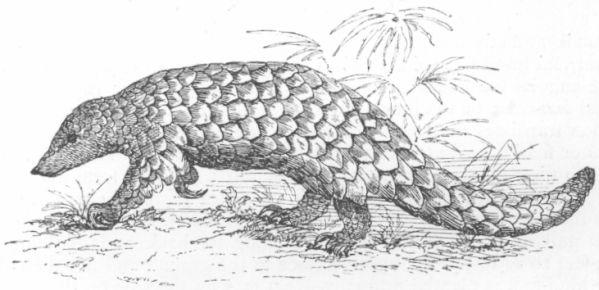
Manis pentadactyla.
DESCRIPTION.—Tail shorter than the body, broad at the base, tapering gradually to a point. Eleven to thirteen longitudinal rows of sixteen scales on the trunk, and a mesial line of fourteen on the tail; middle nail of fore-foot much larger than the others. Scales thick, striated at base; yellowish-brown or light olive. Lower side of head, body, and feet, nude; nose fleshy; soles of hind-feet dark.
SIZE.—Head and body, 24 to 27 inches; tail, about 18. Jerdon gives the weight of a female measuring 40 inches as 21 pounds.
This species burrows in the ground to a depth of a dozen feet, more or less, where it makes a large chamber, sometimes six feet in circumference. It lives in pairs, and has from one to two young ones at a time in the spring months. Sir W. Elliot, who gives an interesting detailed account of it, says that it closes up the entrance to its burrow with earth when in it, so that it would be difficult to find it but for the peculiar track it leaves (see 'Madras Journal,' x. p. 218). There is also a good account of it by Tickell in the 'Journal As. Soc. of Bengal,' xi. p. 221, and some interesting details regarding one in captivity by the late Brigadier-General A. C. McMaster in his 'Notes on Jerdon.' I have had specimens brought to me by the Gonds, but found them very somnolent during the day, being, as most of the above authors state, nocturnal in its habits. The first one I got had been kept for some time without water, and drank most eagerly when it arrived, in the manner described by Sir Walter Elliot, "by rapidly darting out its long extensile tongue, which it repeated so quickly as to fill the water with froth."
The only noise it makes is a faint hiss. It sleeps rolled up, with the head between the fore-legs and the tail folded firmly over all.
The natives believe in the aphrodisine virtues of its flesh.
NO. 481. MANIS AURITA. The Eared Pangolin (Jerdon's No. 242).
HABITAT.—Sikhim, and along the hill ranges of the Indo-Chinese frontier. Dr. Anderson says it is common in all the hilly country east of Bhamo.
DESCRIPTION.—Tail shorter and not so thick at the base as that of the last; the body less heavy; smaller and darker scales; muzzle acute; ears conspicuous; scales of head and neck not so small in proportion as in M. pentadactyla.
SIZE.—Head and body of one mentioned by Jerdon, 19 inches; tail, 15¼ inches.
NO. 482. MANIS JAVANICA. The Javan Ant-eater.
HABITAT.—Burmah and the Malayan peninsula; also Tipperah.
DESCRIPTION.—To be distinguished from the two preceding species by the greater number of longitudinal rows of scales, M. pentadactyla having from eleven to thirteen, M. aurita from fifteen to eighteen, and M. Javanica nineteen. Taking the number of scales in the longitudinal mesial line from the nose to the tip of the tail in M. pentadactyla, it is forty-two; in aurita forty-eight to fifty-six; in Javanica as high as sixty-four; on the tail the scales are: M. pentadactyla, fourteen; M. aurita sixteen to twenty; M. Javanica thirty.
I am indebted to Dr. Anderson's 'Zoological and Anatomical Researches' for the following summary of characteristics:—
"M. pentadactyla by its less heavy body; by its tail, which is broad at the base, tapering gradually to a point, and equalling the length of the head and trunk; by its large light olive-brown scales, of which there are only from eleven to thirteen longitudinal rows on the trunk, and a mesial line of fourteen on the tail; and by its powerful fore-claws, the centre one of which is somewhat more than twice as long as the corresponding claw of the hinder extremity. M. aurita is distinguished from M. pentadactyla by its less heavy body; by its rather shorter tail, which has less basal breadth than M. pentadactyla; by its smaller and darker brown, almost black scales in the adult, which are more numerous, there being from fifteen to eighteen longitudinal rows on the trunk, seventeen rows being the normal number, and sixteen to twenty caudal plates in the mesial line; and by its strong fore-claws, the middle one of which is not quite twice as long as the corresponding claw on the hind foot.
"M. Javanica is recognised by its body being longer and more attenuated than in the two foregoing species; by its narrower and more tapered tail; by its longer and more foliaceous or darker olive-brown scales, of which there are nineteen longitudinal rows on the trunk, and as many as thirty along the mesial line of the tail; and by the claws of the fore-feet being not nearly so long as in M. aurita, and being but little in excess of the claws of the hind-feet."