ORDER PROBOSCIDEA.
Reading edition
It seems a strange jump from the order which contains the smallest mammal, the little harvest mouse, to that which contains the gigantic elephant—a step from the ridiculous to the sublime; yet there are points of affinity between the little mouse and the giant tusker to which I will allude further on, and which bring together these two unequal links in the great chain of nature. The order Proboscidea, or animals whose noses are prolonged into a flexible trunk, consists of one genus containing two living species only—the Indian and African Elephants. To this in the fossil world are added two more genera—the Mastodon and Dinotherium.
The elephant is one of the oldest known of animals. Frequent mention is made in the Scriptures and ancient writings of the use of ivory. In the First Book of Kings and the Second of Chronicles, it is mentioned how Solomon's ships brought every three years from Tarshish gold and silver and ivory (or elephants' teeth) apes and peacocks. In the Apocrypha the animal itself, and its use in war, is mentioned; in the old Sanscrit writings it frequently appears. Aristotle and Pliny were firm believers in the superstition which prevailed, even to more recent times, that it had no joints.
"The elephant hath joints, but none for courtesy; His legs are for necessity, not flexure"—
says Shakespeare. Even down to the last century did this notion prevail, so little did people know of this animal. The supposition that he slept leaning against a tree is to be traced in Thomson's 'Seasons'—
"Or where the Ganges rolls his sacred waves Leans the huge elephant."
Again, Montgomery says—
"Beneath the palm which he was wont to make His prop in slumber."
At a very early period elephants were used in war, not only by the Indian but the African nations. In the first Punic war (B.C. 264-241) they were used considerably by the Carthaginians, and in the second Punic war Hannibal carried thirty-seven of them across the Alps. In the wars of the Moghuls they were used extensively. The domestication of the African elephant has now entirely ceased; there is however no reason why this noble animal should not be made as useful as its Indian brother; it is a bigger animal, and as tractable, judging from the specimens in menageries. It was trained in the time of the Romans for performances in the arena, and swelled the pomp of military triumphs, when, as Macaulay, I think, in his 'Lays of Ancient Rome,' says, the people wondered at—
"The monstrous beast that had A serpent for a hand."
It seems a cruel shame, when one comes to think of it, that thousands of these noble animals should perish annually by all sorts of ignoble means—pitfalls, hamstringing, poisoned arrows, and a few here and there shot with more or less daring by adventurous sportsmen, only for the sake of their magnificent tusks.
Few people think, as they leisurely cut open the pages of a new book or play with their ivory-handled dessert-knives after dinner, of the life that has once been the lot of that inanimate substance, so beautiful in its texture, so prized from time immemorial; still less do they think, for the majority do not know, of the enormous loss of life entailed in purveying this luxury for the market. An elephant is a long-lived beast; it is difficult to say what is the extent of its individual existence; at fifty years it is in its prime, and its reproduction is in ratio slower than animals of shorter life, yet what countless herds must there be in Central Africa when we consider that the annual requirements of Sheffield alone are reported to be upwards of 46,000 tusks, which represent 23,000 elephants a year for the commerce of one single city! The African elephant must be decreasing, even as it has been extirpated in the north of that continent, where it abounded in the time of the Carthaginians, and the time may come when ivory shall be counted as one of the precious things of the past. Even now the price is going up, and is nearly double what it was a year ago. Now enhanced price means either greater demand or deficient supply, and it is probably to this last we must look for an answer to the question. True it is that if we want ivory animals must be killed to get it, for the notion that some people have gained from obsolete works on natural history, to the effect that elephants shed their tusks, is an erroneous one. It is generally supposed that elephants do not shed their tusks at all, not even milk-teeth, but that they grow ab initio, as do the incisors of rodents, from a persistent pulp, and continue growing through life. Mr. G. P. Sanderson, the author of 'Thirteen Years among the Wild Beasts,' whom I have to thank for much and valuable information about the habits of these animals, assured me, when I spoke to him about the popular idea of there being milk-tusks, that he had watched elephants from their birth, and had never known them to shed their tusks, nor had his mahouts ever found a shed tusk; but Mr. Tegetmeier has pointed out that there are skulls in the museum of the Royal College of Surgeons, showing both the milk and permanent tusks, the latter pushing forward the former, which are absorbed to a great extent, and leave nothing but a little blackened stump, the size of one's finger. This was brought to my notice by a correspondent of The Asian, "Smooth-bore," and I have lately had the pleasure of meeting Mr. Tegetmeier, and speaking to him on the subject. There is apparently no limit to the growth of tusks, so that under favourable circumstances they might attain enormous dimensions, owing to the age of the animal, and absence of the attrition which keeps the incisors of rodents down. As in the case of rodents, malformations of whose incisors I have alluded to some time back, the tusks of elephants assume various freaks. I have heard of their overlapping and crossing the trunk in a manner to impede the free use of that organ. The tusks of fossil elephants are in many cases gigantic. There is a head in the Indian Museum, of which the tusks outside the socket measure 9¾ feet, and are of very curious formation. The two run parallel some distance, and then diverge, which would lead one to suppose that the animal inhabited open country, for such a formation would be extremely uncomfortable in thick forest. That tusks of such magnitude are not found nowadays is probably due to the fact that the elephant has more enemies, the most formidable of all being man, which prevent his reaching the great age of those of the fossil periods. It may be said, by those who disbelieve in the extermination of this animal, that, as elephants have provided ivory for several thousand years, they will go on doing so; but I would remind them that in olden days ivory was an article in limited demand, being used chiefly by kings and great nobles; it is only of late years that it has increased more than a hundredfold. Our forefathers used buck-horn handled knives, and they were without the thousand-and-one little articles of luxury which are now made of ivory; even the requirements of the ancient world drove the elephant away from the coasts, where Solomon, and later still the Romans, got their ivory; and now the girdle round the remaining herds in Central Africa is being narrowed day by day. Mr. Sanderson is of opinion that it is not decreasing in India under the present restrictions, but there is no doubt the reckless slaughter of them in Ceylon has greatly diminished their numbers. Sir Emerson Tennent states that the Government reward was claimed for 3,500 destroyed in part of the northern provinces alone in three years prior to 1848, and between 1851 and 1856, 2000 were killed in the southern provinces.
GENUS ELEPHAS—THE ELEPHANT.
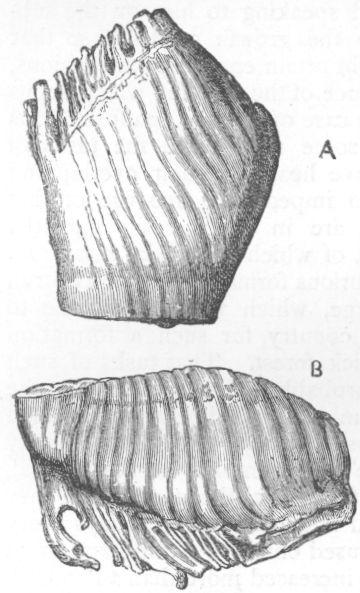
Side view of Grinders of Asiatic Elephant.
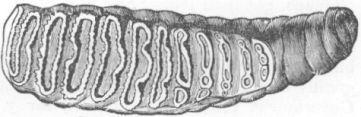
Grinder of Asiatic Elephant.
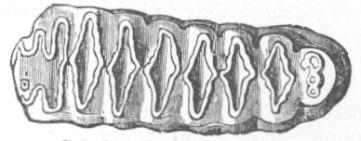
Grinder of African Elephant.
In the writings of older naturalists this animal, so singular in its construction, will be found grouped with the horse, rhinoceros, hippopotamus, tapir, coney, and pig, under the name of pachydermata, the seventh order of Cuvier, but these are now more appropriately divided, as I have said before, into three different orders—Proboscidea, the elephants; Hyracoidea, the conies; and the rest come under Ungulata. Apparently singular as is the elephant in its anatomy, it bears traces of affinity to both Rodentia and Ungulata. The composition of its massive tusks or incisors, and also of its grinders, resembles that of the Rodents. The tusks grow from a persistent pulp, which forms new ivory coated with enamel, but the grinders are composed of a number of transverse perpendicular plates, or vertical laminæ of dentine, enveloped with enamel, cemented together by layers of a substance called cortical. The enamel, by its superior hardness, is less liable to attrition, and, standing above the rest, causes an uneven grinding surface. Each of these plates is joined at the base of the tooth, and on the grinding surface the pattern formed by them distinguishes at once the Indian from the African elephant. In the former, the transverse ridges are in narrow, undulating loops, but in the African they form decided lozenges. These teeth, when worn out, are succeeded by others pushing forward from behind, and not forced up vertically, as in the case of ordinary deciduous teeth, so that it occasionally happens that the elephant has sometimes one and sometimes two grinders on each side, according to age. In the wild state sand and grit, entangled in the roots of plants, help in the work of attrition, and, according to Professor W. Boyd Dawkins, the tame animal, getting cleaner food, and not having such wear and tear of teeth, gets a deformity by the piling over of the plates of which the grinder is composed. An instance of this has come under my notice. An elephant belonging to my brother-in-law, Colonel W. B. Thomson, then Deputy Commissioner of Seonee, suffered from an aggravated type of this malformation. He was relieved by an ingenious mahout, who managed to saw off the projecting portion of the tooth, which now forms a paper-weight. In my account of Seonee I have given a detailed description of the mode in which the operation was effected.
The skull of the elephant possesses many striking features quite different from any other animal. The brain in bulk does not greatly exceed that of a man, therefore the rest of the enormous head is formed of cellular bone, affording a large space for the attachment of the powerful muscles of the trunk, and at the same time combining lightness with strength. This cellular bone grows with the animal, and is in great measure absent at birth. In the young elephant the brain nearly fills the head, and the brain-case increases but little in size during growth, but the cellular portion progresses rapidly with the growth of the animal, and is piled up over the frontals for a considerable height, giving the appearance of a bold forehead, the brain remaining in a small space at the base of the skull, close to its articulation with the neck. According to Professor Flower, the cranial cavity is elongated and depressed, more so in the African than the Indian elephant. The tentorial plane is nearly vertical, so that the cerebellar fossa is altogether behind the cerebral fossa, or, in plainer terms, the division between the big brain (cerebrum) and the little one (cerebellum) is vertical, the two brains lying on a level plane fore and aft instead of overlapping. The brain itself is highly convoluted. The nasal aperture, or olfactory fossa, is very large, and is placed a little below the brain-case. Few people who are intimate with but the external form of the elephant would suppose that the bump just above the root of the trunk, at which the hunter takes aim for the "front shot," is really the seat of the organ of smell, the channels of which run down the trunk to the orifice at the end. The maxillo-turbinals, or twisted bony laminæ within the nasal aperture, which are to be found in most mammals, are but rudimentary in the elephant—the elongated proboscis, according to Professor Flower, probably supplying their place in warming the inspired air. The premaxillary and maxillary bones are largely developed, and contain the socket of the enormous tusks. The narial aperture is thus pushed up, and is short, with an upward direction, as in the Cetacea and Sirenia, with whom the Proboscidea have certain affinities.
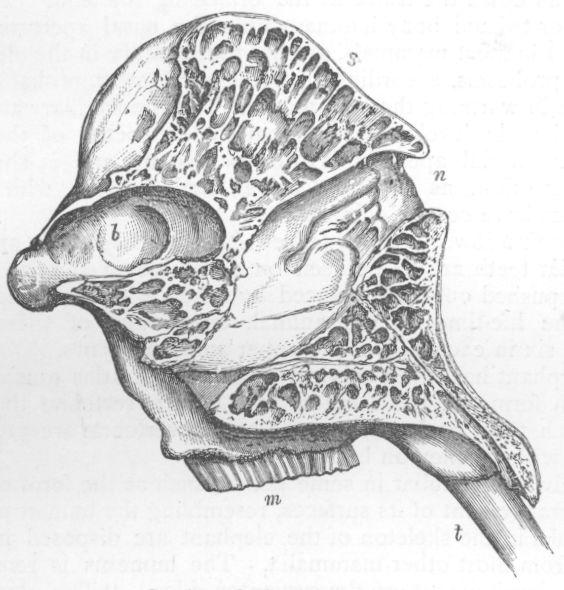
Section of Elephant's Skull.
b, Brain; s, Skull; n, Narial passage; m, Molar; t, Tusk.
There are no lower incisors (except in a fossil species), and only two of the molar teeth are to be seen on each side of the jaw at a time, which are pushed out and replaced by others which grow from behind. During the life-time of the animal, twenty-four of these teeth are produced, six in each side of the upper and lower jaws.
The elephant has seven cervical vertebræ, the atlas much resembling the human form; of the thoracic and lumbar vertebræ the number is 23, of which 19 or 20 bear ribs; the caudal vertebræ are 31, of a simple character, without chevron bones.
The pelvis is peculiar in some points, such as the form of the ileum and the arrangement of its surfaces, resembling the human pelvis.
The limbs in the skeleton of the elephant are disposed in a manner differing from most other mammalia. The humerus is remarkable for the great development of the supinator ridge. "The ulna and radius are quite distinct and permanently crossed; the upper end of the latter is small, while the ulna not only contributes the principal part of the articular surface for the humerus, but has its lower end actually larger than that of the radius—a condition almost unique among mammals" (Prof. Flower).
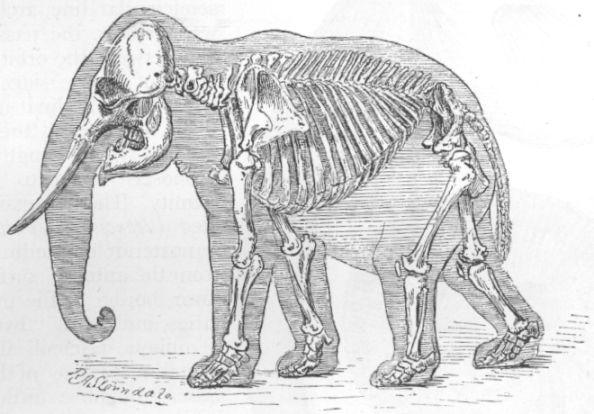
Skeleton of Elephant.
On looking at the skeleton of the elephant, one of the first things that strikes the student of comparative anatomy is the perpendicular column of the limbs; in all other animals the bones composing these supports are set at certain angles, by which a direct shock in the action of galloping and leaping is avoided. Take the skeleton of a horse, and you will observe that the scapula and humerus are set almost at right angles to each other. It is so in most other animals, but in the elephant, which requires great solidity and columnar strength, it not being given to bounding about, and having enormous bulk to be supported, the scapula, humerus, ulna and radius are all almost in a perpendicular line. Owing to this rigid formation, the elephant cannot spring. No greater hoax was ever perpetrated on the public than that in one of our illustrated papers, which gave a picture of an elephant hurdle-race. Mr. Sanderson, in his most interesting book, says: "He is physically incapable of making the smallest spring, either in vertical height or horizontal distance. Thus a trench seven feet wide is impassable to an elephant, though the step of a large one in full stride is about six and a half feet."
The hind-limbs are also peculiarly formed, and bear some resemblance to the arrangement of the human bones, and in these the same perpendicular disposition is to be observed; the pelvis is set nearly vertically to the vertebral column, and the femur and tibia are in an almost direct line. The fibula, or small bone of the leg, which is subject to great variation amongst animals (it being merely rudimentary in the horse, for instance), is distinct in the elephant, and is considerably enlarged at the lower end. The tarsal bones are short, and the digits have the usual number of phalanges, the ungual or nail-bearing ones being small and rounded.
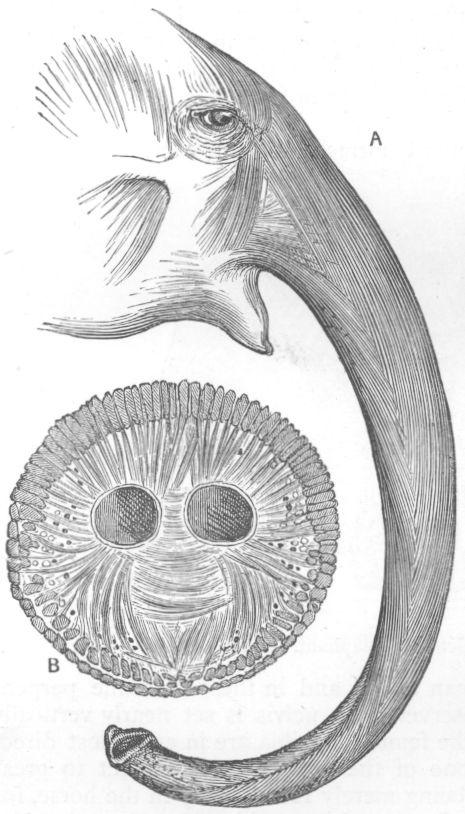
A. Muscles of Elephant's Trunk. B. Cross-section of ditto.
I have thus briefly summarised the osteology of the elephant, as I think the salient points on which I have touched would interest the general reader; but, in now proceeding to the internal anatomy, I shall restrict myself still more, referring only to certain matters affecting externally visible peculiarities. The trunk of the elephant differs somewhat from other nasal prolongations, such as the snouts of certain insectivora, which are simply development of the nasal cartilages. The nasal cartilages in the Proboscidea serve merely as valves to the entrance of the bony nares, the trunk itself being only a pipe or duct leading to them, composed of powerful muscular and membranous tissue and consisting of two tubes, separated by a septum. The muscles in front (levatores proboscidis), starting from the frontal bone, run along a semicircular line, arching upwards above the nasal bones and between the orbits. They are met at the sides by the lateral longitudinal muscles, which blend, and their fibres run the whole length of the proboscis down to the extremity. The depressing muscles (depressores proboscidis), or posterior longitudinals, arise from the anterior surface and lower border of the premaxillaries, and form "two layers of oblique fasciculi along the posterior surface of the proboscis; the fibres of the superficial set are directed downwards and outwards from the middle line. They do not reach the extremity of the trunk, but disappear by curving over the sides a little above the end of the organ. The fibres of the deeper set take the reverse direction, and are attached to a distinct tendinous raphe along the posterior median line" ('Anat. Ind. Elep.,' Miall and Greenwood). These muscles form the outer sheath of other muscles, which radiate from the nasal canals outwards, and which consist of numerous distinct fasciculi. Then there are a set of transverse muscles in two parts—one narrow, forming the septum or partition between the nasal passages, and the other broader between the narrow part and the posterior longitudinal muscles.
When we consider the bulk of these well-knit muscles we can no longer wonder at the power of which this organ is capable, although, according to Mr. Sanderson, its capabilities are much exaggerated; and he explodes various popular delusions concerning it. He doubts the possibility of the animal picking up a needle, the common old story which I also disbelieve, having often seen the difficulty with which a coin is picked up, or rather scraped up; but he quite scouts the idea of an elephant being able to lift a heavy weight with his trunk, giving an instance recorded of one of these creatures lifting with his trunk the axle of a field-piece as the wheel was about to pass over a fallen gunner, which he declares to be a physical impossibility. Certainly the story has many elements of improbability about it, and his comments on it are caustic and amusing: par exemple, when he asks: "How did the elephant know that a wheel going over the man would not be agreeable to him?" That is the weak point in the story—but, however intelligent the animal might be, Mr. Sanderson says it is physically impossible.
Another thing that strikes every one is the noiseless tread of this huge beast. To describe the mechanism of the foot of the elephant concisely and simply I am going to give a few extracts from the observations of Professor W. Boyd Dawkins and Messrs. Oakley, Miall, and Greenwood: "It stands on the ends of its five toes, each of which is terminated by comparatively small hoofs, and the heel-bone is a little distance from the ground. Beneath comes the wonderful cushion composed, of membranes, fat, nerves, and blood-vessels, besides muscles, which constitutes the sole of the foot" (W. B. D. and H. O.). "Of the foot as a whole—and this remark apples to both fore and hind extremities—the separate mobility of the parts is greater than would be suspected from an external inspection, and much greater than in most Ungulates. The palmar and plantar soles, though thick and tough, are not rigid boxes like hoofs, but may be made to bend even by human fingers. The large development of muscles acting upon the carpus and tarsus, and the separate existence of flexors and extensors of individual digits, is further proof that the elephant's foot is far from being a solid unalterable mass. There are, as has been pointed out, tendinous or ligamentous attachments which restrain the independent action of some of these muscles, but anatomical examinations would lead us to suppose that the living animal could at all events accurately direct any part of the circumference of the foot by itself to the ground. The metacarpal and metatarsal bones form a considerable angle with the surface of the sole, while the digits, when supporting the weight of the body, are nearly horizontal" (M. and G.). This formation would naturally give elasticity to the foot, and, with the soft cushion spoken of by Professor Dawkins, would account for the noiselessness of the elephant's tread. On one occasion a friend and myself marched our elephant up to a sleeping tiger without disturbing the latter's slumbers.
It is a curious fact that twice round an elephant's foot is his height; it may be an inch one way or the other, but still sufficiently near to take as an estimate.
Now we come to a third peculiarity in this interesting animal, and that is the power of withdrawing water or a similar fluid from apparently the stomach by the insertion of its trunk into the mouth, which it sprinkles over its body when heated. The operation and the modus operandi are familiar to all who have made much use of elephants, but the internal economy by which the water is supplied is as yet a mystery to be solved, although various anatomists have given the subject serious attention. It is generally supposed that the receptacle for the liquid is the stomach, from the quantity that is ejected. An elephant distressed by a long march in the heat of the sun withdraws several quarts of water, but that it is water, and not a secretion produced by salivatory glands, is not I think sufficiently evident. In talking over the matter with Mr. Sanderson, he informed me that an elephant that has drunk a short time before taking an arduous march has a more plentiful supply of liquid at his disposal. Therefore we might conclude that it is water which is regurgitated, and in such quantity as to preclude the idea of its being stored anywhere but in the stomach; but the question is, how it is so stored there without assimulating with the food in the process of digestion. Sir Emerson Tennent, in his popular and well-known, but in some respects incorrect, account of the elephant, has adopted the theory that the cardiac end of the stomach is the receptacle for the water; and he figures a section of it showing a number of transverse circular folds; and he accepts the conclusion arrived at by Camper and Sir Everard Home that this portion can be shut off as a water chamber by the action of the fold nearest to the oesophagus; but these folds are too shallow to serve as water-cells, and it has not been demonstrated that the broadest fold near the oesophagus can be contracted to such an extent as to form a complete diaphragm bisecting the stomach. Messrs. Miall and Greenwood say: "The stomach is smooth, externally elongate, and nearly straight. The cardiac end is much prolonged and tapering. A number of transverse, nearly circular, folds project inwards from the cardiac wall; they almost disappear when the stomach is greatly distended, and are at all times too shallow to serve as water-cells, though they have been figured and described as such."
That the stomach is the reservoir is, I think, open to doubt; but there is no other possible receptacle as yet discovered, though I shall allude to a supposed one presently, which would hold a moderate supply of water, and further research in this direction is desirable. Most of the dissections hitherto made have been of young and immature specimens. Dr. Watson's investigations have thrown some light on the way in which the water is withdrawn, which differs from Dr. Harrison's conclusions, which are quoted by Sir Emerson Tennent. Dr. Watson says regarding this power of withdrawal: "It is evident that were the throat of this animal similar to that of other mammals, this could not be accomplished, as the insertion of a body, such as the trunk, so far into the pharynx as to enable the constrictor muscles of that organ to grasp it, would at once give rise to a paroxysm of coughing; or, were the trunk merely inserted into the mouth, it would be requisite that this cavity be kept constantly filled with water, at the same time that the lips closely encircled the inserted trunk. The formation of the mouth of the elephant, however, is such as to prevent the trunk ever being grasped by the lips so as effectually to stop the entrance of air into the cavity, and thus at once, if I may so express it, the pump action of the trunk is completely paralysed. We find, therefore, that it is to some modification of the throat that we must look for an explanation of the function in question." He then goes on to explain minutely the anatomical details of the apparatus of the throat, which I will endeavour to sketch as simply, though clearly, as I can. The superior aperture of the pharynx is extremely narrow, so much so as to admit, with difficulty, the passage of a closed fist; but immediately behind this the pharynx dilates into a large pouch capable of containing a certain quantity of fluid—according to Dr. Watson a considerable quantity; but this is open to question. Professor Miall states that in the young specimen examined by him and Mr. Greenwood, a pint was the capacity of the pouch. However, according to Dr. Watson, it is capable of distention to a certain extent. The pouch is prolonged forward beneath the root of the tongue, which forms the anterior boundary, whilst the posterior wall is completed by depression of the soft palate; when the latter is elevated the pouch communicates freely with the oesophagus. I omit Dr. Watson's minute description of the anatomy of this part in detail, which the reader who cares to study the matter more deeply can find in his 'Contributions to the Anatomy of the Indian Elephant,' 'Journal of Anatomy and Physiology,' 1871-74, but proceed to quote some of his deductions from the observations made: "An elephant can," he says, "as the quotations sufficiently prove, withdraw water from his stomach in two ways—first, it may be regurgitated directly into the nasal passages by the action of the diaphragm and abdominal muscles, the soft palate being at the same time depressed, so as to prevent the passage of water into the mouth. Having in this manner filled the large nasal passages communicating with the trunk, the water contained in them is then forced through the trunk by means of a powerful expiration; or, in the second place, the water may be withdrawn from the cavity of the mouth by means of the trunk inserted into it."
The second deduction is, I think, the more probable one. Before an elephant spirts water over his body, he invariably puts his trunk into his mouth for the liquid, whatever it may be. Messrs. Miall and Greenwood are also against the former supposition, viz. that the fluid is regurgitated into the nasal passages. They say: "We are disposed to question the normal passage of water along this highly-sensitive tract. Examination of the parts discovers no valve or other provision for preventing water, flowing from behind forward, from gaining free entrance into the olfactory recesses." Mr. Sanderson, in discussing the habits of elephants with me, informed me that, from his observations, he was sure that an elephant, in drawing up water, did not fill more than fifteen to eighteen inches of his trunk at a time, which confirms the opinion of the two last-mentioned authors. Now we go on with Dr. Watson's second deduction:—
"It is manifestly impossible that the water can be contained within the cavity of the mouth itself, as I have already shown that the lips in the elephant are so formed as effectually to prevent this. The water regurgitated is, however, by means of the elevation of the soft palate, forced into the pharyngeal pouch. The superior aperture of this pouch being much narrower than the diameter of the pouch itself, and being completely surrounded by the muscular fibres of the stylo-glossus on each side, and the root of the tongue in front, which is prolonged backwards so as to form a free sharp margin, we have thus, as it were, a narrow aperture surrounded by a sphincter muscle, into which the trunk being inserted, and grasped above its dilated extremity by the sphincter arrangement just referred to, air is thus effectually excluded; and, the nasal passages being then exhausted by the act of inspiration, water is lodged within these passages, to be used as the animal thinks fit, either by throwing it over his body, or again returning it into his mouth."
This is doubtless a correct conclusion. The question still remaining open is, What is the fluid—water or a secretion? If water, where is it stowed in sufficient quantity? The testimony of several eminent anatomists appears to be against stomach complications such as before suggested. Dr. Anderson has told me that he had the opportunity of examining the stomachs of two very large elephants, which were perfectly simple, of enormous size; and he was astonished at the extent of mucous surface. If water were drawn from such a stomach, it would be more or less tainted with half-digested food, besides which, when drunk, it would be rapidly absorbed by the mucous surfaces. I think therefore that we may assume that these yield back a very fluid secretion, which is regurgitated, as before suggested, into the pharyngeal pouch, to be withdrawn as required. Sir Emerson Tennent figures, on the authority of Dr. Harrison, a portion of the trachea and oesophagus, connected by a muscle which he supposes "might raise the cardiac orifice of the stomach, and so aid this organ to regurgitate a portion of its contents into the oesophagus," but neither Dr. Watson nor Messrs. Miall and Greenwood have found any trace of this muscle.
Before proceeding to a detailed account of the Indian elephant, I will cursorily sketch the difference between it and its African brother.
The African elephant is of larger size as a rule, with enormously developed ears, which quite overlap his withers. The forehead recedes, and the trunk is more coarsely ringed; the tusks are larger, some almost reaching the size of those mentioned above in the fossil head at the museum. An old friend of mine, well known to all the civilised—and a great portion of the uncivilised—world, Sir Samuel Baker, had, and may still have, in his possession a tusk measuring ten feet nine inches. This of course includes the portion within the socket, whereas my measurement of the fossil is from the socket to tip.
The lamination of the molar teeth also is very distinct in the two species, as I have before stated—the African being in acute lozenges, the Indian in wavy undulations.
Another point of divergence is, that the African elephant has only three nails on the hind feet, whereas the Asiatic has four.
NO. 425. ELEPHAS INDICUS. The Indian or Asiatic Elephant (Jerdon's No. 211).
NATIVE NAMES.—Hasti or Gaja, Sanscrit; Gaj, Bengali; Hati, Hindi; Ani in Southern India, i.e. in Tamil, Telegu, Canarese, and Malabari; Feel, Persian; Allia, Singhalese; Gadjah, Malayan; Shañh, Burmese.
HABITAT.—India, in most of the large forests at the foot of the Himalayas from Dehra Doon down to the Bhotan Terai; in the Garo hills, Assam; in some parts of Central and Southern India; in Ceylon and in Burmah, from thence extending further to Siam, Sumatra and Borneo.
DESCRIPTION.—Head oblong, with concave forehead; small ears as compared with the African animal; small eyes, lighter colour, and four instead of three nails on the hind foot; the laminations of the molar teeth in wavy undulations instead of sharp lozenges, as in the African, the tusks also being much smaller in the female, instead of almost equal in both sexes.
SIZE.—The maximum height appears to be about 11 feet, in fact the only authentic measurement we have at present is 10 feet 7 inches.
"The huge elephant, wisest of brutes,"
has had a good deal of the romance about it taken away by modern observers. The staid appearance of the animal, with the intellectual aspect contributed by the enormous cranial development, combined with its undoubted docility and aptitude for comprehending signs, have led to exaggerated ideas of its intelligence, which probably does not exceed that of the horse, and is far inferior to that of the dog. But from time immemorial it has been surrounded by a halo of romance and exaggeration. Mr. Sanderson says, however, that the natives of India never speak of it as an intelligent animal, "and it does not figure in their ancient literature for its wisdom, as do the fox, the crow, and the monkey;" but he overlooks the fact that the Hindu god of wisdom, Gunesh, is always depicted with the body of a man, but the head of an elephant. However this is apparently an oversight, for both in his book and lecture he alludes to Gunesh. The rest of his remarks are so good, and show so much practical knowledge, that I shall take the liberty of quoting in extenso from a lecture delivered by him at Simla last year, a printed copy of which he kindly sent me, and also from his interesting book, 'Thirteen Years amongst the Wild Beasts.'
He says: "One of the strongest features in the domesticated elephant's character is its obedience. It may also be readily taught, as it has a large share of the ordinary cultivable intelligence common in a greater or less degree to all animals. But its reasoning faculties are undoubtedly far below those of the dog, and possibly of other animals; and in matters beyond the range of its daily experience it evinces no special discernment. Whilst quick at comprehending anything sought to be taught to it, the elephant is decidedly wanting in originality."
I think one as often sees instances of decided stupidity on the part of elephants as of sagacity, but I think the amount of intelligence varies in individuals. I have known cases where elephants have tried to get their mahouts off their backs—two cases in my own district—in the one the elephant tried shaking and then lying down, both of which proved ineffectual; in the other it tried tearing off the rafters of a hut and throwing them over its back, and finally rubbing against low branches of trees, which proved successful. The second elephant, I think, showed the greatest amount of original thought; but there is no doubt the sagacity of the animal has been greatly overrated. I quote again from Mr. Sanderson, whose remarks are greatly to the point:—
"What an improbable story is that of the elephant and the tailor, wherein the animal, on being pricked with a needle instead of being fed with sweetmeats as usual, is represented as having deliberately gone to a pond, filled its trunk with dirty water, and returned and squirted it over the tailor and his work! This story accredits the elephant with appreciating the fact that throwing dirty water over his work would be the peculiar manner in which to annoy a tailor. How has he acquired the knowledge of the incongruity of the two things, dirty water and clean linen? He delights in water himself, and would therefore be unlikely to imagine it objectionable to another. If the elephant were possessed of the amount of discernment with which he is commonly credited, is it reasonable to suppose that he would continue to labour for man instead of turning into the nearest jungle? The elephant displays less intelligence in its natural state than most wild animals. Whole herds are driven into ill-concealed inclosures which no other forest creatures could be got to enter; and single ones are caught by being bound to trees by men under cover of a couple of tame elephants, the wild one being ignorant of what is going on until he finds himself secured. Escaped elephants are re-taken without trouble; even experience does not bring them wisdom. Though possessed of a proboscis which is capable of guarding it against such dangers, the wild elephant readily falls into pits dug in its path, whilst its fellows flee in terror, making no effort to assist the fallen one, as they might easily do by kicking in the earth around the pit. It commonly happens that a young elephant falls into a pit, in which case the mother will remain until the hunters come, without doing anything to assist her offspring—not even feeding it by throwing in a few branches.
"When a half-trained elephant of recent capture happens to get loose, and the approach of its keeper on foot might cause it to move off, or perhaps even to run away altogether, the mahout calls to his elephant from a distance to kneel, and he then approaches and mounts it. The instinct of obedience is herein shown to be stronger than the animal's intelligence. When a herd of wild elephants is secured within a stockade, or kheddah, the mahouts ride trained elephants amongst the wild ones without fear, though any one of the wild ones might, by a movement of its trunk, dislodge the man. This they never do."
On the other hand we do hear of wonderful cases of reasoning on the part of these creatures. I have never seen anything very extraordinary myself; but I had one elephant which almost invariably attempted to get loose at night, and often succeeded, if we were encamped in the vicinity of sugar-cane cultivation—nothing else tempted her; and many a rupee have I had to pay for the damage done. This elephant knew me perfectly after an absence of eighteen months, trumpeted when she saw me, and purred as I came up and stroked her trunk. I then gave her the old sign, and in a moment she lifted me by the trunk on to her head. I never mounted her any other way, and, as I used to slip off by a side rope, the constant kneeling down and getting up was avoided.
Sir Emerson Tennent says: "When free in its native woods the elephant evinces rather simplicity than sagacity, and its intelligence seldom exhibits itself in cunning;" yet in the next page he goes on to relate a story told to him of a wild elephant when captured falling down, and feigning to be dead so successfully that all the fastenings were taken off; "while this was being done he and a gentleman by whom he was accompanied leaned against the body to rest. They had scarcely taken their departure and proceeded a few yards when, to their astonishment, the elephant arose with the utmost alacrity, and fled towards the jungles screaming at the top of its voice, its cries being audible long after it had disappeared in the shades of the forest." If this be correct it shows a considerable amount of cunning.
Both Mr. Sanderson and Sir Emerson Tennent agree on the subject of the rarity of the remains of dead elephants. I have never been in real elephant country; the tracks of such as I have come across have been merely single wanderers from the Bilaspore herds, or probably elephants escaped from captivity. Forsyth once came upon the bones of a small herd of five that had been driven over a precipice from the summit of a hill, on which there was a Hindoo shrine, by the drums and music of a religious procession.
The following taken from Mr. Sanderson's lecture is interesting as regards the constitution of the herds: "Herds of elephants usually consist of from thirty to fifty individuals, but much larger numbers, even upwards of a hundred, are by no means uncommon. A herd is always led by a female, never by a male. In localities where fodder is scarce a large herd usually divides into parties of from ten to twenty. These remain at some little distance from each other, but all take part in any common movement, such as a march into another tract of forest. These separate parties are family groups, consisting of old elephants with their children and grandchildren. It thus happens that, though the gregarious instincts of elephants prompt them to form large gatherings, if circumstances necessitate it a herd breaks up under several leaders. Cases frequently occur when they are being hunted; each party will then take measures for its individual safety. It cannot be said that a large herd has any supreme leader. Tuskers never interest themselves in the movement of their herds; they wander much alone, either to visit cultivation, where the females, encumbered with young ones, hesitate to follow, or from a love of solitude. Single elephants found wandering in the forests are usually young males—animals debarred from much intimate association with the herds by stronger rivals; but they usually keep within a few miles of their companions. These wandering tuskers are only biding their time until they are able to meet all comers in a herd. The necessity for the females regulating the movements of a herd is evident, as they must accommodate the length and time of their marches, and the localities in which they rest and feed at different hours, to the requirements of their young ones."
It is a curious fact that most of the male elephants in Ceylon are what are called mucknas in India, that is, tuskless males—not one in a hundred, according to Sir Emerson Tennent, being found with tusks; nearly all, however, are provided with tushes. These, he says, he has observed them "to use in loosening earth, stripping off bark, and snapping asunder small branches and climbing plants, and hence tushes are seldom seen without a groove worn into them near their extremities." Sir Samuel Baker says that the African elephant uses his tusks in ploughing up ground in search of edible roots, and that whole acres may be seen thus ploughed, but I have never seen any use to which the Indian elephant puts his tusks in feeding. I have often watched mine peeling the bark off succulent branches, and the trunk and foot were alone used. Mr. Sanderson, in his 'Thirteen Years,' remarks: "Tusks are not used to assist the elephant in procuring food;" but he says they are formidable weapons of offence in the tusker, the biggest of whom lords it over his inferiors.
The elephant usually brings forth, after a period of gestation of from eighteen to twenty-two months, a single calf, though twins are occasionally born. Mr. Sanderson says: "Elephant calves usually stand exactly thirty-six inches at the shoulder when born, and weigh about 200 lbs. They live entirely upon milk for five or six months, when they begin to eat tender grass. Their chief support, however, is still milk for some months. I have known three cases of elephants having two calves at a birth. It cannot be said that the female elephant evinces any special attachment to her offspring, whilst the belief that all the females of a herd show affection for each other's calves is certainly erroneous. During the catching of elephants many cases occur in which young ones, after losing their mothers by death or separation, are refused assistance by the other females, and are buffeted about as outcasts. I have only known one instance of a very gentle, motherly elephant in captivity, allowing a motherless calf to suck along with her own young one. When a calf is born the mother and the herd usually remain in that place for two days. The calf is then capable of marching. Even at this tender age calves are no encumbrance to the herd's movement; the youngest climb hills and cross rivers, assisted by their dams. In swimming, very young calves are supported by their mothers' trunks, and are held in front of them. When they are a few months old they scramble on to their mother's shoulders, and hold on with their fore-legs, or they swim alone. Though a few calves are born at other seasons, the largest number make their appearance about September, October, and November."
Until I read the above I, from my limited experience, had come to the conclusion that elephant mothers are very fussy and jealous of other females. (See Appendix C.)
I have only once seen an elephant born in captivity, and that was in 1859, when I was in charge of the Sasseram Levy on the Grand Trunk road. Not far from the lines of my men was an elephant camp; they were mostly Burmese animals, and many of them died; but one little fellow made his appearance one fine morning, and was an object of great interest to us all. On one occasion, some years after, I went out after a tiger on a female elephant which had a very young calf. I repented it after a while, for I lost my tiger and my temper, and very nearly my life. Those who have read 'Seonee,' may remember the ludicrous scene in which I made the doctor figure as the hero. An elephant is full grown at twenty-five, though not in his prime till some years after. Forty years is what mahouts, I think, consider age, but the best elephants live up to one hundred years or even more.[29]
29 See note in Appendix C on this subject.
A propos of my remarks, in the introductory portion of this paper on Proboscidea, regarding the probable gradual extinction of the African elephant, the following reassuring paragraphs from the lecture I have so extensively quoted will prove interesting and satisfactory. Mr. Sanderson has previously alluded to the common belief, strengthened by actual facts in Ceylon, that the elephant was gradually being exterminated in India; but this is not the case, especially since the laws for their protection have come into force: "The elephant-catching records of the past fifty years attest the fact that there is no diminution in the numbers now obtainable in Bengal, whilst in Southern India elephants have become so numerous of late years that they are annually appearing where they had never been heard of before."
He then instances the Billigarungun hills, an isolated range of three hundred square miles on the borders of Mysore, where wild elephants first made their appearance about eighty years ago, the country having relapsed from cultivation into a wilderness owing to the decimation of the inhabitants by three successive visitations of small-pox. He adds: "The strict preservation of wild elephants seems only advantageous or desirable in conjunction with corresponding measures for keeping their numbers within bounds by capture. It is to be presumed that elephants are preserved with a view to their utilisation. With its jungles filled with elephants, the anomalous state of things by which Government, when obliged to go into the market, finds them barely procurable, and then only at prices double those of twenty, and quadruple those of forty years ago, will I trust be considered worthy of inquiry. Whilst it is necessary to maintain stringent restrictions on the wasteful and cruel native modes of hunting, it will I believe be found advantageous to allow lessees every facility for hunting under conditions that shall insure humane management of their captives. I believe that the price of elephants might be reduced one-half in a year or two by such measures. The most ordinary elephant cannot be bought at present for less than Rs. 2,000. Unless something be done, it is certain that the rifle will have to be called into requisition to protect the ryots of tracts bordering upon elephant jungles. To give an idea of the numbers of wild elephants in some parts of India, I may say that during the past three years 503 elephants have been captured by the Dacca kheddah establishment, in a tract of country forty miles long by twenty broad, in the Garo hills, whilst not less than one thousand more were met with during the hunting operations. Of course these elephants do not confine themselves to that tract alone, but wander into other parts of the hills. There are immense tracts of country in India similarly well stocked with wild elephants.
"I am sure it will be regarded as a matter for hearty congratulation by all who are interested in so fine and harmless an animal as is the elephant that there is no danger of its becoming extinct in India. Though small portions of its haunts have been cleared for tea or coffee cultivation, the present forest area of this country will probably never be practically reduced, for reasons connected with the timber supply and climate of the country; and as long as its haunts remain the elephant must flourish under due regulations for its protection."
Elephants are caught in various ways. The pitfall is now prohibited, so also is the Assam plan of inclosing a herd in a salt lick. Noosing and driving into a kheddah or inclosure are now the only legitimate means of capture. The process is too long for description here, but I may conclude this article, which owes so much to Mr. Sanderson's careful observations, with the following interesting account of the mode in which the newly-caught elephant is taught to obey:—
"New elephants are trained as follows: they are first tied between two trees, and are rubbed down by a number of men with long bamboos, to an accompaniment of the most extravagant eulogies of the animal, sung and shouted at it at the top of their voices. The animal of course lashes out furiously at first; but in a few days it ceases to act on the offensive, or, as the native say, 'shurum lugta hai'—'it becomes ashamed of itself,' and it then stands with its trunk curled, shrinking from the men. Ropes are now tied round its body, and it is mounted at its picket for several days. It is then taken out for exercise, secured between two tame elephants. The ropes still remain round its body to enable the mahout to hold on should the elephant try to shake him off. A man precedes it with a spear to teach it to halt when ordered to do so; whilst, as the tame elephants wheel to the right or left, the mahout presses its neck with his knees, and taps it on the head with a small stick, to train it to turn in the required direction. To teach an elephant to kneel it is taken into water about five feet deep when the sun is hot, and, upon being pricked on the back with a pointed stick it soon lies down, partly to avoid the pain, partly from inclination for a bath. By taking it into shallower water daily, it is soon taught to kneel even on land.
"Elephants are taught to pick up anything from the ground by a rope, with a piece of wood attached, being dangled over their foreheads, near to the ground. The wood strikes against their trunk and fore-feet, and to avoid the discomfort the elephant soon takes it in its trunk, and carries it. It eventually learns to do this without a rope being attached to the object."
Sir Emerson Tennent's account of the practice in Ceylon is similar.
As regards the size of elephants few people agree. The controversy is as strong on this point as on the maximum size of tigers. I quite believe few elephants attain to or exceed ten feet, still there are one or two recorded instances, the most trustworthy of which is Mr. Sanderson's measurement of the Sirmoor Rajah's elephant, which is 10 ft. 7½ in. at the shoulder—a truly enormous animal. I have heard of a tusker at Hyderabad that is over eleven feet, but we must hold this open to doubt till an accurate measurement, for which I have applied, is received. Elephants should be measured like a horse, with a standard and cross bar, and not by means of a piece of string over the rounded muscles of the shoulder. Kellaart, usually a most accurate observer, mentions in his 'Prodromus Faunæ Zeylanicæ' his having measured a Ceylon elephant nearly twelve feet high, but does not say how it was done. Sir Joseph Fayrer has a photograph of an enormous elephant belonging to the late Sir Jung Bahadur, a perfect mountain of flesh.
We in India have nothing to do with the next order, HYRACOIDEA or Conies, which are small animals, somewhat resembling short-eared rabbits, but which from their dentition and skeleton are allied to the rhinoceros and tapir. The Syrian coney is frequently mentioned in the Old Testament, and was one of the animals prohibited for food to the Jews, "because he cheweth the cud and divideth not the hoof." The chewing of the cud was a mistake, for the coney does not do so, but it has a way of moving its jaws which might lead to the idea that it ruminates. In other parts of Scripture the habits of the animal are more accurately depicted—"The rocks are a refuge for the conies;" and again: "The conies are but a feeble folk, yet make they their houses in the rocks." Solomon says in the Proverbs: "There be four things which are little upon the earth, but they are exceeding wise." These are the ants, for they prepare their meat in summer, as we see here in India the stores laid up by the large black ant (Atta providens); the conies for the reason above given; the locusts, which have no king, yet go forth by bands; and the spider, which maketh her home in kings' palaces.