THE ANIMAL KINGDOM. SUB-KINGDOM I—VERTEBRATA.
Reading edition
CLASS I—MAMMALIA.
ORDER I. PRIMATES. The most perfect of all animals is man, for besides having a marvellous animal organism he possesses reason, which so far transcends the highest instincts of other animals, that it places him in a category by himself.
SUB-ORDER I. Man-shaped Animals. Next to man it is convenient to deal with man-shaped animals, (anthropoidea)—those animals which most resemble him in external appearance and internal organism. This brings us to the order called Quadrumana or four-handed animals which include Lemurs and their allied forms, and manlike monkeys. Monkeys are divided into five families, one at least of which has to be further divided into sub-families to accommodate its variety. These families are: I The Apes; II The Sacred Monkeys; III The Cheek-pouched Monkeys; IV The Cebidae, with its several sub-families, and V The Marmosets. The first three of these families inhabit the old world, the last two belong to the new.
The Ape Family. The family of the Apes includes the Gorilla, the Chimpanzee, the Orang-utan or mias, the Gibbons or long-armed Apes, and the Siamang; of these the Gorilla and the Chimpanzee belong to the West of Africa, the Orang-utan to Borneo, the Gibbons to Assam, the Malay Peninsula, Java, Sumatra, Borneo, Cambodia and Hainan, and the Siamang to Java and Sumatra.
The Gorilla. The gorilla is the largest of the ape family, and sometimes attains to the height of six feet. It is also the fiercest, if not the strongest, of man-shaped animals. It belongs to the genus Troglodytes of which the chimpanzee is the only other species, and it inhabits a somewhat limited range of Equatorial Africa, where it makes for itself nests of sticks and foliage, among the lower branches of trees, and lives upon berries, nuts and fruits. Though apparently a vegetarian the gorilla has enormous physical strength. His arms bear much the same proportion to the size of his body as those of man do relatively, but his lower limbs are shorter, and have no calves, the leg growing thicker from the knee downwards. The hands are broad, thick, and of great length of palm, and are remarkable for their strength; the feet, broader than those of man, and more like hands, are very large and of great power. The gorilla uses his hands when walking or running, but as his arms are longer than those of other apes, and his legs shorter he stoops less than they do in moving from place to place. The gorilla herds in small companies, or rather families, one adult male being the husband and father of the band. The females are much smaller than the males.
The Ancestors of the Gorilla. The gorilla, though rediscovered in recent years, was apparently known to the ancients. Hanno, a Carthaginian admiral who flourished some five or six hundred years B.C., once sailed from Carthage with a fleet of sixty vessels and a company of 30,000 persons, under instructions to proceed past the Pillars of Hercules (the Straits of Gibraltar), with a view to planting colonies on the western coast of Africa. In the course of their travels they discovered several islands inhabited by wild creatures with hairy bodies. "There were," says the ancient navigator, "many more females than males, all equally covered with hair on all parts of the body. The interpreters called them gorillas. On pursuing them, we could not succeed in taking a single male, they all escaped with astonishing swiftness, and threw stones at us; but we took three females, who defended themselves with so much violence, that we were obliged to kill them; but we brought their skins, stuffed with straw, to Carthage." Professor Owen remarks upon this that "though such creatures would suggest to Hanno and his crew no other idea of their nature than that of a kind of human being, yet the climbing faculty, the hairy body, and the skinning of the dead specimens strongly suggest that they were great apes. The fact that apes somewhat resembling the negroes, of human size and with hairy bodies, still exist on the west coast of Africa renders it highly probable that such were the creatures which Hanno saw, captured, and called 'gorullai'."
A Gorilla Hunt. Paul du Chaillu, in his "Stories of the Gorilla Country," gives a graphic description of his first sight of these "wild men of the woods." He was inspecting the ruins of a native village with a party of Africans, when they discovered footprints which the natives immediately recognised as those of the gorilla. "It was," says he, "the first time I had seen the footprints of these wild men of the woods, and I cannot tell you how I felt. Here was I now, it seemed, on the point of meeting, face to face, that monster, of whose ferocity, strength and cunning, the natives had told me so much, and which no man before had hunted. By the tracks it was easy to know that there must have been several gorillas in company. We prepared at once to follow them. My men were remarkably silent, for they were going on an expedition of more than usual risk; for the male gorilla is literally the king of the forest—the king of the equatorial regions. He and the crested lion of Mount Atlas are the two fiercest and strongest beasts of that continent. The lion of South Africa cannot be compared with either for strength or courage. As we left the camp, the men and women left behind crowded together, with fear written on their faces. Miengai, Ngolai, and Makinda set out for the hunt in one party; myself and Yeava formed another. We determined to keep near each other, so that in case of trouble we might be at hand to help one another. For the rest silence and a sure aim were the only cautions to be given. I confess that I was never more excited in my life. For years I had heard of the terrible roar of the gorilla, of its vast strength, of its fierce courage when only wounded. I knew that we were about to pit ourselves against an animal which even the enormous leopards of the mountains fear, which the elephants let alone and which perhaps has driven away the lion out of his territory; for the king of beasts, so numerous elsewhere in Africa, is not met with in the land of the gorilla. We descended a hill, crossed a stream on a fallen log, crept under the trees, and presently approached some huge boulders of granite. In the stream we had crossed we could see plainly that the animals had just crossed it, for the water was still disturbed. Along side of the granite blocks lay an immense dead tree, and about this the gorillas were likely to be. Our approach was very cautious. With guns cocked and ready we advanced through the dense wood, which cast a gloom even at mid-day over the whole scene. I looked at my men and saw that they were even more excited than myself. Slowly we pressed on through the dense bush, dreading almost to breathe for fear of alarming the beasts. Makinda was to go to the right of the rock, while I took the left. Unfortunately he and his party circled it at too great a distance. The watchful animals saw him. Suddenly I was startled by a strange, discordant, half human cry, and beheld four young and half-grown gorillas running towards the deep forest. I was not ready. We fired but hit nothing. Then we rushed on in pursuit; but they knew the woods better than we. Once I caught a glimpse of one of the animals again; but an intervening tree spoiled my mark, and I did not fire. We pursued them till we were exhausted, but in vain. I protest I felt almost like a murderer when I saw the gorilla this first time. As they ran on their hind legs with their heads down, their bodies inclined forward, their whole appearance was that of hairy men running for their lives. Add to this their cry, so awful yet with something human in its discordance, and you will cease to wonder that the natives have the wildest superstitions about these 'wild men of the woods.'"
Du Chaillu's First Gorilla. In his "Explorations and Adventures in Equatorial Africa" du Chaillu gives an equally thrilling account of the capture of his first gorilla. He says: "We started early, and pushed through the most dense and impenetrable part of the forest; in hopes to find the very home of the beast I so much wished to shoot. Hour after hour we travelled and yet no signs of gorillas. Only the everlasting, little, chattering monkeys—and not many of these—and occasionally birds. Suddenly Miengai uttered a little cluck with his tongue which is the native way of showing that something is stirring and that a sharp look-out is necessary. And presently I noticed, ahead of us seemingly, a noise as of some one breaking down branches or twigs of trees. This was a gorilla—I knew at once by the eager satisfied looks of the men. We walked with the greatest care making no noise at all. Suddenly, as we were yet creeping along, in a silence which made a heavy breath seem loud and distinct, the woods were at once filled with the tremendous barking roar of the gorilla. Then the underbrush swayed rapidly just ahead, and presently before us stood an immense male gorilla. He had gone through the jungle on all fours; but when he saw our party he erected himself and looked us boldly in the face. He stood about a dozen yards from us, and was a sight I think I shall never forget. Nearly six feet high (he proved four inches shorter), with immense body, huge chest, and great muscular arms, with fiercely glaring, large, deep gray eyes, and a hellish expression of face, which seemed to me like some nightmare vision: thus stood before us this king of the African forest. He was not afraid of us. He stood there and beat his breast with his huge fists till it resounded like an immense bass-drum, which is the gorillas' mode of offering defiance; meantime giving vent to roar after roar. The roar of the gorilla is the most singular and awful noise heard in these African woods. It begins with a sharp bark, like an angry dog, then glides into a deep bass roll, which literally and closely resembles the roll of distant thunder along the sky. So deep is it that it seems to proceed less from the mouth and throat than from the deep chest and vast paunch. His eyes began to flash fiercer fire as we stood motionless on the defensive, and the crest of short hair which stands on his forehead began to twitch rapidly up and down, while his powerful fangs were shown as he again sent forth his thunderous roar. He advanced a few steps—then stopped to utter that hideous roar again—advanced again, and finally stopped when at a distance of about six yards from us. And here, just as he began another of his roars, beating his breast with rage, we fired, and killed him. With a groan which had something terribly human in it, and yet was full of brutishness, he fell forward on his face. The body shook convulsively for a few minutes, the limbs moved about in a struggling way, and then all was quiet: death had done its work, and I had leisure to examine the huge body. It proved to be five feet eight inches high, and the muscular development of the arms and breast showed what immense strength it had possessed." A smaller gorilla, shot by M. du Chaillu on another occasion, measured five feet six inches in height, fifty inches round the chest, and his arms had a spread of seven feet two inches.
A Young Gorilla. A young gorilla which some natives succeeded in capturing for M. du Chaillu, and which he named "Fighting Joe," forms the subject of one of his most interesting chapters. The young cub was caught by the adroit use of a cloth which one of the natives managed to throw over his head, but not until he had severely bitten one of his captors in the hand and taken a mouthful out of the leg of another. He was about three years old, three feet six inches in height and of great strength. A cage was made for him, from which he twice escaped, on each occasion being recaptured by the use of fishing nets. On his first escape he concealed himself under the bed in M. du Chaillu's house. "Running in," says the writer, "to get one of my guns, I was startled by an angry growl. It was master Joe; there was no mistake about it; I knew his growl too well. I cleared out faster than I came in. I instantly shut the windows and called in my people to guard the door. When Joe saw the crowd of black faces he became furious, and with his eyes glaring, and every sign of rage in his face and body, he got out from beneath the bed. He was about to make a rush at all of us. He was not afraid. A stampede of my men took place, I shut the door quickly (from outside) and left Joe master of the premises." While the men outside were devising means for his recapture, the young gorilla carefully inspected the furniture and M. du Chaillu became apprehensive for the safety of his clock, the ticking of which was likely to attract unwelcome attention. However, by means of a net dexterously thrown over him, he was secured once more and carried back to his cage, which in the meantime had been repaired, the full strength of four men being required for the purpose. On his second escape he made for the woods and took refuge in a large clump of trees. "This we surrounded," says M. du Chaillu. "He did not ascend a tree, but stood defiantly at the border of the wood. About one hundred and fifty of us surrounded him. As we moved up he began to yell, and made a dash upon a poor fellow who was in advance. The fellow ran and tumbled down in affright. By his fall he escaped the tender mercies of Joe's teeth; but he also detained the little rascal long enough for the nets to be thrown over him." But Joe was a child of nature and could not live with the chain of civilisation around his neck, and he died somewhat suddenly some ten days afterwards and finally found his way to the British museum.
Gorilla Superstitions. According to du Chaillu, the natives entertain many superstitions about the gorilla, among the commonest of which is the belief that some gorillas are inhabited by human spirits. In his "Stories of the Gorilla Country" he gives an interesting illustration of this. "In the evening," he says, "the men told stories about gorillas. 'I remember,' said one, 'my father told me he once went out to the forest, when just in his path he met a great gorilla. My father had his spear in his hand. When the gorilla saw the spear he began to roar; then my father was terrified and dropped the spear. When the gorilla saw that my father had dropped the spear he was pleased. He looked at him, and then left him and went into the thick forest. Then my father was glad and went on his way.' Here all shouted: 'Yes! so we must do when we meet the gorilla. Drop the spear; that appeases him.' Next Gambo spoke. 'Several dry seasons ago, a man suddenly disappeared from my village after an angry quarrel. Some time after an Ashira of that village was out in the forest. He met a very large gorilla. That gorilla was the man who had disappeared; he had turned into a gorilla. He jumped upon the poor Ashira and bit a piece out of his arm; then he let him go. Then the man came back with the bleeding arm. He told me this, I hope we shall not meet such gorillas.' Chorus: 'No; we shall not meet such wicked gorillas.' "I myself," says du Chaillu, "afterwards met that man in the Ashira country. I saw his maimed arm and he repeated the same story." Then one of the men spoke up: 'If we kill a gorilla to-morrow, I should like to have a part of the brain for a fetich. Nothing makes a man so brave as to have a fetich of gorilla's brain. That gives a man a strong heart.' Chorus (of those who remained awake) 'Yes; that gives a man a strong heart.'" A fetich of the brain of the gorilla is said also to help its owner in love as well as war.
The Chimpanzee. The chimpanzee is a near neighbour of the gorilla in Equatorial Africa though he appears to have a more extended range. He is found in Sierra Leone and in the country lying to the north of the river Congo, and according to native accounts is gregarious in his habits, travelling in formidable companies, who carry sticks and make effective use of them. They are said to reach maturity at nine or ten years of age and to attain a height of from four to five feet. Like the gorillas they have immensely powerful limbs, and have been known without apparent effort to break off branches of trees which a man would have been powerless to bend.
The Docility and Sagacity of the Chimpanzee. The chimpanzee differs from the gorilla in his amenability to civilisation. The gorilla, however young, seems incapable of being tamed; while the chimpanzee in its infancy and youth at least has often been domesticated, though like most other apes, as it approaches maturity, it needs to be kept under strong control. Captain Brown in his "Habits and Characteristics of Animals and Birds" gives the following illustration of the docility and sagacity of the chimpanzee. He says: "M. de Grandpré saw, on board of a vessel, a female chimpanzee, which exhibited wonderful proofs of intelligence. She had learnt to heat the oven; she took great care not to let any of the coals fall out, which might have done mischief in the ship; and she was very accurate in observing when the oven was heated to the proper degree, of which she immediately apprized the baker, who, relying with perfect confidence upon her information, carried his dough to the oven as soon as the chimpanzee came to fetch him. This animal performed all the business of a sailor, spliced ropes, handled the sails, and assisted at unfurling them; and she was, in fact considered by the sailors as one of themselves. The vessel was bound for America; but the poor animal did not live to see that country, having fallen a victim to the brutality of the first mate, who inflicted very cruel chastisement upon her, which she had not deserved. She endured it with the greatest patience, only holding out her hands in a suppliant attitude, in order to break the force of the blows she received. But from that moment she steadily refused to take any food, and died on the fifth day from grief and hunger. She was lamented by every person on board, not insensible to the feelings of humanity, who knew the circumstances of her fate."
The Orang-utan. The orang-utan is one of the largest of the ape species and until the discovery of the gorilla was supposed to be the largest. It is said sometimes to attain to the height of six feet, and some travellers' tales credit it with even greater height. The orang is possessed of great strength but is of a docile disposition when brought under civilisation, and even in a wild state is often quiet and peaceable except when attacked. It inhabits country that is low, level, and swampy, and that is at the same time covered with lofty virgin forests. It belongs to the genus Simia of which it is the single species.
The Habits of the Orang-utan. The following account of the orang is given by Mr. Brooke of Sarawak. "On the habits of the orangs, as far as I have been able to observe them, I may remark that they are as dull and as slothful as can well be conceived, and on no occasion, when pursuing them, did they move so fast as to preclude my keeping pace with them easily through a moderately clear forest; and even when obstructions below (such as wading up to the neck) allowed them to get away some distance, they were sure to stop and allow us to come up. I never observed the slightest attempt at defence; and the wood, which sometimes rattled about our ears, was broken by their weight, and not thrown, as some persons represent. If pushed to extremity, however, the pappan could not be otherwise than formidable; and one unfortunate man, who with a party was trying to catch one alive, lost two of his fingers, besides being severely bitten on the face, whilst the animal finally beat off his pursuers and escaped. When hunters wish to catch an adult, they cut down a circle of trees round the one on which he is seated, and then fell that also, and close before he can recover himself, and endeavour to bind him. The rude hut which they are stated to build in the trees would be more properly called a seat, or nest, for it has no roof or cover of any sort. The facility with which they form this seat is curious; and I had an opportunity of seeing a wounded female weave the branches together, and seat herself in a minute. She afterwards received our fire without moving, and expired in her lofty abode, whence it cost us much trouble to dislodge her. The adult male I killed was seated lazily on a tree; and when approached only took the trouble to interpose the trunk between us, peeping at me and dodging as I dodged. I hit him on the wrist, and he was afterwards despatched."
The Walk of the Orang-utan. In locomotion the orang disdains the earth and perambulates the vernal terraces of the forest trees. "It is a singular sight," says Mr. Wallace, "to watch a mias (orang-utan) making his way leisurely through a forest. He walks deliberately along some of the larger branches in the semi-erect attitude which the great length of his arms and the shortness of his legs cause him naturally to assume, and seems always to choose those branches which intermingle with an adjoining tree, on approaching which he stretches out his long arms, and seizing the opposing boughs, grasps them together with both hands, seems to try their strength, and then deliberately swings himself across to the next branch on which he walks along as before. He never jumps or springs, or even appears to hurry himself, and yet manages to get along almost as quickly as a person can run through the forest beneath."
The Strength of the Orang-utan. "The Dyaks," says Mr. Wallace, "all declare that the mias is never attacked by any animal in the forest, with two rare exceptions; and the accounts received of these are so curious that I give them nearly in the words of my informants, old Dyak Chiefs, who had lived all their lives in the places where the animal is most abundant. The first of whom I enquired said, 'No animal is strong enough to hurt the mias, and the only creature he ever fights with is the crocodile. When there is no fruit in the jungle he goes to seek food on the banks of the river where there are plenty of young shoots that he likes, and fruits that grow close to the water. Then the crocodile sometimes tries to seize him, but the mias gets upon him and beats him with his hands and feet, and tears and kills him.' He added that he had once seen such a fight and that he believed that the mias is always the victor. My next informant was Orang Kayo or chief of the Balow Dyaks on the Simunjou River. He said the mias has no enemies, no animals dare attack it but the crocodile and the python. He always kills the crocodile by main strength, standing upon it, and pulling open its jaws and ripping up its throat. If a python attacks a mias he seizes it with his hands and then bites it, and soon kills it. The mias is very strong; there is no animal in the jungle so strong as he."
The Docility of the Orang-utan. Buffon thus describes an orang-utan that he saw: "His aspect was melancholy, his deportment grave, his movements regular, and his disposition gentle. Unlike the baboon or the monkey, who are fond of mischief, and only obedient through fear, a look kept him in awe; while the other animals could not be brought to obey without blows. He would present his hand to conduct the people who came to visit him, and walk as gravely along with them as if he had formed a part of the company. I have seen him sit down at table, when he would unfold his towel, wipe his lips, use a spoon or a fork to carry his victuals to his mouth, pour his liquor into a glass, and make it touch that of a person who drank along with him. When invited to take tea, he would bring a cup and saucer, place them on the table, put in sugar, pour out the tea, and allow it to cool before he drank it. All this I have seen him perform without any other instigation than the signs or the command of his master, and often even of his own accord."
The Orang-utan's Intelligence. M. de la Bosse thus describes two young orang-utans, male and female. "We had these animals with us on shipboard. They ate at the same table with us. When they wanted anything, they, by certain signs, acquainted the cabin boy with their wishes; and if he did not bring it, they sometimes flew into a rage at him, bit him in the arm, and not unfrequently threw him down. The male fell sick during the voyage, and submitted to be treated like a human patient. The disease being of an inflammatory nature, the surgeon bled him twice in the right arm; and when he afterwards felt himself indisposed, he used to hold out his arm to be bled, because he recollected that he found himself benefited by that operation on a former occasion."
The Orang-utan's Affection. Dr. Tyson in describing one of the earliest specimens of the orang brought to London, says that it conceived a great affection for those with whom travel had made it familiar, frequently embracing them with the greatest tenderness. A female orang belonging to a Dutch menagerie showed the greatest affection for her attendants, giving unmistakable signs of her delight in their company and distress in their absence. She would often take the hay from her bed and spread it at her side and with anxious and obvious signs invite her keeper to sit beside her. M. Palavicini credited a pair of orangs which he had in his possession in 1759 with the still more remarkable quality in animals of bashfulness. It is said that the female would shrink from the too persistent gaze of a spectator, and throw herself into the arms of the male, hiding her face in his bosom.
The Maternal Instinct. In his "Marvels and Mysteries of Instinct," Mr. Garrett gives the following instance of maternal affection. "A gentleman was out with a party of men in Sumatra, when in some trees removed from a dense forest a female orang-utan, with a young one in its arms, was discovered, and the pursuit commenced. In the ardour of the moment, and excited by the hope of possessing an animal so rare, the gentleman forgot everything but the prize before him, and urged on his men by the promise of a reward, should their exertions be successful. Thus stimulated they followed up the chase; the animal, encumbered by her young one, making prodigious efforts to gain the dense and intricate recesses of the wood, springing from tree to tree, and endeavouring by every means to elude her pursuers. Several shots were fired, and at length one took fatal effect, the ball penetrating the right side of the chest. Feeling herself mortally wounded, and with the blood gushing from her mouth, she from that moment took no care of herself, but with a mother's feelings summoned up all her dying energies to save her young one. She threw it onwards over the tops of the trees, and from one branch to another, taking the most desperate leaps after it herself, and again facilitating its progress until, the intricacy of the forest being nearly gained, its chances of success were sure. All this time the blood was flowing: but her efforts had been unabated, and it was only when her young one was on the point of attaining to a place of safety that she rested on one of the topmost branches of a gigantic tree. True to her ruling passion, even in death, she turned for a moment to gaze after her young one, reeled, and fell head foremost to the ground. The sight was so touching that it called forth the sympathy of the whole party. The eagerness of the chase subsided; and so deep an impression did the maternal tenderness and unexpected self-devotion of the poor orang make on the gentleman alluded to, whose heart was indeed formed in 'nature's gentlest mould,' that he expressed the utmost remorse and pity, declaring that he would not go through the same scene again for all the world; nor did the tragical death of the animal cease to haunt his mind for many weeks, and he never afterwards recurred to it but with feelings of emotion. The preserved skin is now in the Museum of the Zoological Society."
Gibbons or Long Armed Apes. The gibbons belong to the genus Hylobates, of which there are several species. They are characterised by the ability to walk almost erect, hence the name Hylobates. They live in the tops of trees, in large companies and possess marvellous powers of locomotion, swinging themselves from tree to tree with such rapidity as to baffle all pursuit. When on the ground they balance themselves in walking by holding their hands above their heads. The adult gibbon is about three feet in height and has a reach of arms of about six feet. The gibbon is tractable and capable of strong affection towards those who show it kindness. One of the Hoolock species petted by Dr. Burrough, became companionable and would sit at his master's breakfast-table, eat eggs and chicken, and drink tea and coffee with great propriety. Fruit was his favourite food, but insects were especially palatable to him and he was an expert in catching flies. The siamang differs from the other species of long-armed apes in the formation of its feet and in several other characteristics. It is, however, similar to the Hoolock in its amenity to kindness and its affection for its master, when brought under the influence of kindly treatment. The gibbons have great strength in their lower limbs, whereby they are enabled to leap surprising distances. M. Duvaneel said he once saw one of these animals clear a space of forty feet, from the branch of a tree. Mr. George Bennet, in his "Wanderings," describes the action of a siamang that belonged to him, which having managed to free himself of his tether, proceeded to embrace the legs of the Malays whom he came across, until he discovered his former master, whereupon he climbed into the Malay's arms and hugged him with the tenderest affection.
Monkeys. Monkeys differ from the apes we have dealt with in the important characteristic, among others, of possessing tails. These vary in length from inches to feet, in some cases being considerably longer than the body and in others little more than stumps. They vary also in form, some being completely covered with hair, and others only partially so; some apparently useful only as ornaments, others being prehensile, that is capable of grasp, and giving their owners almost the advantage of a fifth limb.
The Sacred Monkeys. The Sacred Monkeys (Semnopithecidæ) include two genera and a large number of species. Among these are the species which bear the name of Hanumán, a Hindoo divinity, and are worshipped in his honour. The protection these monkeys receive on account of the superstitions prevalent concerning them, leads to their large increase in numbers and to many inconveniences arising therefrom. It is said that if a traveller should be unfortunate enough to offend one of these animals he is likely enough to be followed by the whole party howling in a most hideous and discordant manner, and pelting him with any missiles upon which they can lay their hands. There are eighteen species of the Semnopithecus, all of which are found in the East. Of these the Entellus is one of the best known species. It is very susceptible to cold, and cannot live long in Europe.
The Long-nosed Monkey. The Long-nosed Monkey (Semnopithecus Larvatus) belongs to this family and is distinguished, as its name implies, by the length of its proboscis. This animal is described by Wallace as about the size of a child of three years of age, while possessing a nose considerably longer than that of any human adult. From the head to the tip of the tail the proboscis monkey measures about four feet and a half. It is sometimes called the Kahau from its cry which resembles the sound of that word. It is said to hold its nose when leaping to protect it from being injured by the branches of trees. The second genus of this family, of which there are numerous species, belongs to Africa.
Cheek-pouched Monkeys. The Cheek-pouched Monkeys form the third family of the quadrumana. They include seven genera, and sixty or seventy species, of which five genera belong to Africa and two to Asia and to the Malay Islands. Among the better known of these species is the Talapoin of West Africa; the Diana monkey and the Mona (Africa); the little White-nosed monkey (Guinea); the Grivet (Nubia and Abyssinia); the Green monkey (Cape de Verds); the Patas (Senegal); the Malbrouck monkey; and the Vervet monkey (South Africa). The Green monkey and the Vervet monkey are those most commonly seen in England. One of the best known members of this family is the Baboon.
The Baboon. The baboon is found in many parts of Africa, and one of its species in Arabia. It is of the genus cynocephalus, and some of its species attain to considerable size; the head and face of one species resembling those of a dog, it is sometimes called the dog-faced baboon. The baboon herds in large numbers, and is said to make apparently organized attacks upon villages during the absence of the peasants in harvest time, placing sentinels on the look out, to apprise them of danger, while they visit the houses and take possession of all the food they can find. They are cunning and powerful, and formidable in combat, but, greedy in habit, they eat to excess, and when gorged to satiety fall an easy prey to their enemies. In their wild state they feed on berries and bulbous roots, but when proximity to civilisation gives them wider opportunity, they show their appreciation of a more varied menu. Among the more familiar species of the baboon are the Chackma, the Drill, the Mandrill, the Anubis, the Babouin, and the Sphinx, all of which belong to the West of Africa.
The Arabian Baboon. The Arabian baboon is an animal with a history. It was worshipped by the Egyptians, who embalmed its body after death and set apart portions of their cemeteries for its use. Sacred to Thoth, the Egyptian Hermes, the God of letters, the baboon sometimes represents that deity in Egyptian sculptures, where it is usually figured in a sitting posture, the attitude in which its body was generally embalmed. The baboon was also held as emblematic of the Moon, and honoured symbolically in other connections. It is commonly represented in judgment scenes of the dead with a pair of scales in front of it, Thoth being supposed to exercise important duties in the final judgment of men. The baboon was held especially sacred at Hermopolis. According to Sir J. G. Wilkinson the Egyptians trained baboons to useful offices, making them torch-bearers at their feasts and festivals.
The Imitative Faculty of the Baboon. Like others of the monkey tribes the baboon shows an extraordinary faculty for imitation. Captain Browne in his "Characteristics of Animals" says: "The following circumstance is truly characteristic of the imitative powers of the baboon:—The army of Alexander the Great marched in complete battle-array into a country inhabited by great numbers of baboons, and encamped there for the night. The next morning, when the army was about to proceed on its march, the soldiers saw, at some distance, an enormous number of baboons, drawn up in rank and file, like a small army, with such regularity, that the Macedonians, who could have no idea of such a manœuvre, imagined at first that it was the enemy drawn up to receive them."
The Chackma Baboon. The chackma lives among the mountains of the Cape of Good Hope, where he attains about the size of an English mastiff and even greater strength. He descends to the plains on foraging expeditions, and, when not attacked, will usually make off on the approach of danger, but if aroused to anger can both show and use his teeth, and is far superior to the average English boy in throwing stones.
The Baboon's Utility. Le Vaillant gives an interesting account of a chackma baboon which accompanied him through South Africa, and which bore the name of Kees. He says: "I made him my taster. Whenever we found fruits or roots, with which my Hottentots were unacquainted, we did not touch them till Kees had tasted them. If he threw them away, we concluded that they were either of a disagreeable flavour, or of a pernicious quality, and left them untasted. The monkey possesses a peculiar property, wherein he differs greatly from other animals, and resembles man,—namely, that he is by nature equally gluttonous and inquisitive. Without necessity, and without appetite, he tastes every thing that falls in his way, or that is given to him. But Kees had a still more valuable quality,—he was an excellent sentinel; for, whether by day or night, he immediately sprang up on the slightest appearance of danger. By his cry, and the symptoms of fear which he exhibited, we were always apprized of the approach of an enemy, even though the dogs perceived nothing of it. The latter, at length, learned to rely upon him with such confidence, that they slept on in perfect tranquillity. I often took Kees with me when I went hunting; and when he saw me preparing for sport, he exhibited the most lively demonstrations of joy. On the way, he would climb into the trees to look for gum, of which he was very fond. Sometimes he discovered to me honey, deposited in the clefts of rocks, or hollow trees. But, if he happened to have met with neither honey nor gum, and his appetite had become sharp by his running about, I always witnessed a very ludicrous scene. In those cases, he looked for roots, which he ate with great greediness, especially a particular kind, which, to his cost, I also found to be very well tasted and refreshing, and therefore insisted upon sharing with him. In order to draw these roots out of the ground, he employed a very ingenious method, which afforded me much amusement. He laid hold of the herbage with his teeth, stemmed his fore feet against the ground, and drew back his head, which gradually pulled out the root. But if this expedient, for which he employed his whole strength, did not succeed, he laid hold of the leaves as before, as close to the ground as possible, and then threw himself heels over head, which gave such a concussion to the root, that it never failed to come out.
The Tame Baboon. "Serpents excepted, there were no animals of whom Kees stood in such great dread as of his own species,—perhaps owing to a consciousness of loss of natural capacity. Sometimes he heard the cry of other apes among the mountains, and, terrified as he was, he yet answered them. But, if they approached nearer, and he saw any of them, he fled, with a hideous cry, crept between our legs, and trembled over his whole body. It was very difficult to compose him, and it required some time before he recovered from his fright.
The Cunning of the Baboon "Like all other animals, Kees was addicted to stealing. He understood admirably well how to loose the strings of a basket, in order to take victuals out of it, especially milk, of which he was very fond. My people chastised him for these thefts; but that did not make him amend his conduct. I myself sometimes whipped him; but then he ran away, and did not return again to the tent until it grew dark. Once, as I was about to dine, and had put the beans, which I had boiled for myself, upon a plate, I heard the voice of a bird with which I was not acquainted. I left my dinner standing, seized my gun, and ran out of the tent. After the space of about a quarter of an hour I returned, with the bird in my hand, but, to my astonishment, found not a single bean upon the plate. Kees had stolen them all, and taken himself out of the way. When he had committed any trespass of this kind, he used always, about the time when I drank tea, to return quietly, and seat himself in his usual place, with every appearance of innocence, as if nothing had happened; but this evening he did not let himself be seen. And, on the following day, also, he was not seen by any of us; and, in consequence, I began to grow seriously uneasy about him, and apprehensive that he might be lost for ever. But, on the third day, one of my people, who had been to fetch water, informed me that he had seen Kees in the neighbourhood, but that, as soon as the animal espied him, he had concealed himself again. I immediately went out and beat the whole neighbourhood with my dogs. All at once, I heard a cry, like that which Kees used to make, when I returned from my shooting, and had not taken him with me. I looked about, and at length espied him, endeavouring to hide himself behind the large branches of a tree. I now called to him in a friendly tone of voice, and made motions to him to come down to me. But he could not trust me, and I was obliged to climb up the tree to fetch him. He did not attempt to fly, and we returned together to my quarters; here he expected to receive his punishment; but I did nothing, as it would have been of no use.
The Loyalty of the Baboon. "An officer, wishing to put the fidelity of my baboon to the test, pretended to strike me. At this he flew in a violent rage, and, from that time, could never endure the sight of the officer. If he only saw him at a distance he began to cry, and make all kinds of grimaces, which evidently showed that he wished to revenge the insult that had been done to me; he ground his teeth; and endeavoured, with all his might, to fly at his face, but that was out of his power, as he was chained down. The offender several times endeavoured, in vain, to conciliate him, by offering him dainties, but he remained long implacable.
The Intelligence of the Baboon. "When any eatables were pilfered, at my quarters, the fault was always laid upon Kees; and rarely was the accusation unfounded. For a time the eggs, which a hen laid me, were constantly stolen, and I wished to ascertain whether I had to attribute this loss also to him. For this purpose I went one morning to watch him, and waited till the hen announced, by her cackling, that she had laid an egg. Kees was sitting upon my vehicle; but, the moment he heard the hen's voice, he leapt down, and was running to fetch the egg. When he saw me, he suddenly stopped, and affected a careless posture, swaying himself backwards upon his hind legs, and assuming a very innocent look; in short, he employed all his art to deceive me with respect to his design. His hypocritical manœuvres only confirmed my suspicions, and, in order, in my turn, to deceive him, I pretended not to attend to him, and turned my back to the bush where the hen was cackling, upon which he immediately sprang to the place. I ran after him, and came up to him at the moment when he had broken the egg and was swallowing it. Having caught the thief in the fact, I gave him a good beating upon the spot, but this severe chastisement did not prevent his soon stealing fresh-laid eggs again. As I was convinced that I should never be able to break Kees off his natural vices, and that, unless I chained him up every morning, I should never get an egg, I endeavoured to accomplish my purpose in another manner; I trained one of my dogs, as soon as the hen cackled, to run to the nest, and bring me the egg, without breaking it. In a few days, the dog had learned his lesson; but Kees, as soon as he heard the hen cackle, ran with him to the nest. A contest now took place between them, who should have the egg; often the dog was foiled, although he was the stronger of the two. If he gained the victory, he ran joyfully to me with the egg, and put it into my hand. Kees, nevertheless, followed him, and did not cease to grumble and make threatening grimaces at him, till he saw me take the egg,—as if he was comforted for the loss of his booty by his adversary's not retaining it for himself. If Kees had got hold of the egg, he endeavoured to run with it to a tree, where, having devoured it, he threw down the shells upon his adversary, as if to make game of him. Kees was always the first awake in the morning, and, when it was the proper time, he awoke the dogs, who were accustomed to his voice, and, in general, obeyed, without hesitation, the slightest motions by which he communicated his orders to them, immediately taking their posts about the tent and carriage, as he directed them."
The Bonnet Monkey. The bonnet monkey is of the genus macacus, and is to be found in many parts of India. It is characterized by a bonnet, or cap of hair, which radiates from the centre of the crown. It is known as the Macacus Radiatus. Other species of the genus macacus are the Rhesus monkey, the Wanderoo, the Barbary Ape or Magot, and the Macaque.
Indian Monkeys. Many stories are told of the audacity of the Indian monkeys in which those of the genus macacus come in for more than honourable mention. Whether in their native haunts, or in European menageries, they are an endless source of amusement and not unfrequently one of annoyance. In their free state, they tax the ingenuity of native and European alike by their mischievous habits and thievish propensities. They climb upon the tops of the Bazaars and the slightest relapse from vigilance on the part of the shopkeepers is sure to be followed by the loss or spoliation of their wares. A common defence against these unwelcome intruders is to cover the roofs with a certain prickly shrub, the thorns of which command respect even from monkeys. Mrs. Bowdich says: "In some places they are even fed, encouraged, and allowed to live on the roofs of houses;" but this would be where the goods of the householder were beyond their reach. "If a man wishes to revenge himself for any injury committed upon him," says Mrs. Bowdich, "he has only to sprinkle some rice or corn upon the top of his enemy's house or granary just before the rain sets in, and the monkeys will assemble upon it, eat all they can find outside, and then pull off the tiles to get at that which has fallen through the crevices. This, of course, gives access to the torrents which fall in such countries, and house, furniture and stores are all ruined." Quoting from another writer, Mrs. Bowdich gives an amusing description of the way in which one of these monkeys watched his opportunity for making his descent upon a sweet-stuff shop. Taking up a position opposite the shop, "he pretended to be asleep, but every now and then softly raised his head to look at the tempting piles and the owner of them, who sat smoking his pipe without symptoms even of a doze. In half an hour the monkey got up, as if he were just awake, yawned, stretched himself, and took another position a few yards off, where he pretended to play with his tail, occasionally looking over his shoulder at the coveted delicacies. At length the shopman gave signs of activity, and the monkey was on the alert; the man went to his back room, the monkey cleared the street at one bound, and in an instant stuffed his pouches full of the delicious morsels. He had, however, overlooked some hornets, which were regaling themselves at the same time. They resented his disturbance, and the tormented monkey, in his hurry to escape, came upon a thorn-covered roof, where he lay stung, torn, and bleeding. He spurted the stolen bonbons from his pouches and barked hoarsely looking the picture of misery. The noise of the tiles which he had dislodged in his retreat brought out the inhabitants, and among them the vendor of the sweets, with his turban unwound, and streaming two yards behind him. All joined in laughing at the wretched monkey; but their religious reverence for him induced them to go to his assistance: they picked out his thorns and he limped away to the woods quite crestfallen."
The Monkey Outdone. The writer, from whom Mrs. Bowdich quoted the above story, gives a graphic account of the success of a stratagem he employed to rid himself of the unwelcome visits of his monkey friends. "Although," says he, "a good deal shyer of me than they were of the natives, I found no difficulty in getting within a few yards of them; and when I lay still among the brushwood they gambolled round me with as much freedom as if I had been one of themselves. This happy understanding, however, did not last long, and we soon began to urge war upon each other. The casus belli was a field of sugar-cane which I had planted on the newly cleared jungle.
"Every beast of the field seemed leagued against this devoted patch of sugar-cane. The wild elephants came and browzed in it; the jungle hogs rooted it up, and munched it at their leisure; the jackals gnawed the stalks into squash; and the wild deer ate the tops of the young plants. Against all these marauders there was an obvious remedy,—to build a stout fence round the cane-field. This was done accordingly; and a deep trench dug outside, that even the wild elephant did not deem it prudent to cross. The wild hogs came and inspected the trench and the palisades beyond. A bristly old tusker was observed taking a survey of the defences; but, after mature deliberation, he gave two short grunts, the porcine (language), I imagined, for 'No go,' and took himself off at a round trot, to pay a visit to my neighbour Ram Chunder, and inquire how his little plot of sweet yams was coming on. The jackals sniffed at every crevice, and determined to wait a bit; but the monkeys laughed the whole entrenchment to scorn. Day after day was I doomed to behold my canes devoured as fast as they ripened, by troops of jubilant monkeys. It was of no use attempting to drive them away. When disturbed, they merely retreated to the nearest tree, dragging whole stalks of sugar-cane along with them, and then spurted the chewed fragments in my face, as I looked up at them. This was adding insult to injury; and I positively began to grow bloodthirsty at the idea of being outwitted by monkeys. The case between us might have been stated in this way. 'I have, at much trouble and expense, cleared and cultivated this jungle land,' said I. 'More fool you,' said the monkeys. 'I have planted and watched over these sugar-canes.' 'Watched! Ah, ah! so have we, for the matter of that.' 'But surely I have a right to reap what I sowed.' 'Don't see it,' said the monkeys; 'the jungle, by rights prescriptive and indefeasible, is ours, and has been so ever since the days of Ram Hanumán of the long tail. If you cultivate the jungle without our consent, you must look to the consequences. If you don't like our customs, you may get about your business. We don't want you.' I kept brooding over this mortifying view of the matter, until one morning I hatched revenge in a practicable shape. A tree, with about a score of monkeys on it, was cut down, and half a dozen of the youngest were caught as they attempted to escape. A large pot of ghow (treacle) was then mixed with as much tarter emetic as could be spared from the medicine chest, and the young hopefuls, after being carefully painted over with the compound, were allowed to return to their distressed relatives, who, as soon as they arrived, gathered round them and commenced licking them with the greatest assiduity. The results I had anticipated were not long in making their appearance. A more melancholy sight it was impossible to behold; but so efficacious was this treatment, that for more than two years I hardly ever saw a monkey in the neighbourhood."
The Monkey Aroused. Tavernier was once travelling from Agra to Surat with the English president, when passing within a few miles of Amenabad through a forest of mangoes, they experienced the danger of provoking such companies. He says, "We saw a vast number of very large apes, male and female, many of the latter having their young in their arms. We were each of us in our coaches; and the English president stopped his to tell me that he had a very fine new gun; and knowing that I was a good marksman, desired me to try it, by shooting one of the apes. One of my servants, who was a native of the country, made a sign to me not to do it; and I did all that was in my power to dissuade the gentleman from his design, but to no purpose; for he immediately levelled his piece, and shot a she ape, who fell through the branches of the tree on which she was sitting, her young ones tumbling at the same time out of her arms on the ground. We presently saw that happen which my servant apprehended; for all the apes, to the number of sixty, came immediately down from the trees, and attacked the president's coach with such fury that they must infallibly have destroyed him if all who were present had not flown to his relief, and by drawing up the windows, and posting all the servants about the coach, protected him from their resentment." That diplomacy is better than war in dealing with bands of monkeys is shown by comparing the results of the foregoing experiences.
The Monkeys' Affection. That monkeys are capable of very poignant feeling is shown by the following pathetic story. Mr. Forbes, in his "Oriental Memoirs," says:—"On a shooting party one of my friends killed a female monkey, and carried it to his tent, which was soon surrounded by forty or fifty of the tribe, who made a great noise, and in a menacing posture advanced towards it. On presenting his fowling-piece they retreated, but one stood his ground, chattering and menacing in a furious manner. He at length came close to the tent door, and finding that his threatenings were of no avail, began a lamentable moaning, and by every expression of grief and supplication seemed to beg the body of the deceased. On this it was given to him. He took it up in his arms, eagerly pressed it to his bosom, and carried it off in a sort of triumph to his expecting companions. The artless behaviour of this poor animal wrought so powerfully on the sportsmen that they resolved never more to level a gun at one of the monkey tribe."
American Monkeys. To visit the family of the Cebidæ we have to cross the Atlantic Ocean, and here we find characteristics with which the monkeys of the East are unfamiliar, while we miss others which are common to the monkeys of the old world. In passing from East to West we lose the cheek-pouch characteristic and we find that of the prehensile tail. There are more than eighty species in the family of the Cebidæ, divided into ten genera and grouped in four sub-families. The first of the sub-families includes the monkeys with prehensile tails.
The Capuchin Monkey. The capuchins belong to the genus Cebus which includes the majority of American monkeys. There are a number of species of which the Brown Capuchin (Brazil), the Wheeper Capuchin (Brazil), and the White-throated Capuchin (Central America) are the best known.
The Spider Monkeys. The Spider Monkey is of the genus Ateles and is one of the best known of the Cebidæ family. In it the prehensile tail reaches its perfection. It is a remarkably sensitive organ, answering the purpose, as the Rev. J. G. Wood puts it, of "a fifth hand," being capable of use "for any purpose to which the hand could be applied," and for hooking out objects from places "where a hand could not be inserted." According to Mr. Wood they wrap their tails about them to protect themselves from cold, to which they are very sensitive, and hold on by them to the branches of trees with such tenacity that they remain suspended after death. The prehensile part of the tail is naked and of extreme sensibility. The tail is also used to preserve balance when walking erect, for which purpose it is thrown up and curled over. The appearance of these monkeys, as they leap from branch to branch in their native woods, swinging by their tails, and often hanging on to those of each other, until a living bridge is formed from tree to tree, is exceedingly picturesque.
The Howling Monkeys. The Howling Monkeys form the single genus of the second sub-family of the Cebidæ—the genus Mycetes. There are a number of species, popularly known as the "Golden Howler," the "Black Howler," &c. &c. They are chiefly characteristic for the attribute to which they owe their name. The howl is a loud mournful cry which can be heard at a great distance, and is said by Wallace to proceed from the leader of the band who howls for the whole company. These animals are larger and more clumsy than the spider monkeys and therefore less agile; they have powerful, prehensile tails. The "Howler" is much prized by the Indians as an article of food.
The Bearded Saki. The third sub-family of the Cebidæ includes some dozen species which inhabit the forests of Equatorial America. They are of the genus Pithecia, and some species have broad beards and bushy tails. The head of the Bearded Saki (Pithecia Satanas) has a singularly human appearance.
The Douroucouli. The fourth sub-family of the Cebidæ includes several genera and a number of species, of these the Douroucouli (Nyctipithecus felinus) is one of the most interesting. It is a small monkey, measuring only thirteen inches, apart from its tail, which is eighteen inches long: It is catlike in some of its habits, sleeping during the day, and prowling about at night in search of food, which it finds in fruits, insects and small birds. It has a catlike mew, though it often makes a louder cry more resembling the noise of the jaguar.
The Marmosets. The fifth family of the quadrumana comprises the marmosets, of which there are two genera—the Hapale and the Midas. These are very small, measuring about eight inches without the tail, which is eleven inches long. The marmoset is one of the prettiest of the monkeys, and, though at first shy, soon becomes playful and affectionate. Marmosets are one of the few species that breed in confinement. Sir William Jardine describes a marmoset who gave birth to three offspring in Paris. One of these, for some reason, displeased her, and she killed it, but upon the others beginning to suck the maternal instinct awoke, and she became as affectionate as she was before careless. "The male seemed more affectionate and careful of them than the mother, and assisted in the charge. The young generally keep upon the back or under the belly of the female, and Cuvier observed, that when the female was tired of carrying them, she would approach the male with a shrill cry, who immediately relieved her with his hands, placing them upon his back, or under his belly, where they held themselves and were carried about until they became restless for milk, when they were given over to the mother who, in her turn, would again endeavour to get rid of them."
SUB-ORDER II. The Lemurs. The lemurs and their allied forms make up the remaining families of the quadrumana. These are three. The Lemuridæ, of which there are many species, most of which belong to Madagascar, others to Africa, Asia, and the Indian Archipelago; the Tarsidæ, which hail from Sumatra and Borneo; and the Chiromyidæ, of which the aye-aye is the representative. The Lemuridæ are divided into four sub-families by Professor Mivart. I, the Indri; II, the true Lemurs; III, the slow Lemurs and IV, the Galagos. The lemur is nocturnal in its habits and noiseless in its movements. Some of its species much resemble the cat in appearance though its four hands unmistakably demonstrate its order. Sir William Jones describes a Slow Lemur (Nycticebus tardigradus), which he had in his possession, as "gentle except in the cold season, when his temper seemed wholly changed." This animal expressed great resentment when disturbed unseasonably. From half an hour after sunrise to half an hour before sunset he slept without any intermission, rolled up like a hedgehog: and as soon as he awoke he began to prepare himself for the occupations of his approaching day, licking and dressing himself like a cat—an operation which the flexibility of his neck and limbs enabled him to perform very completely. He was then ready for a slight breakfast, after which he commonly took a short nap; but when the sun was quite set he recovered all his vivacity. "Generally he was not voracious, but of grasshoppers he never could have enough; and passed the whole night during the hot season in prowling for them. He used all his paws indifferently as hands." Mrs. Bowdich tells of one of these animals, procured by Mr. Baird at Prince of Wales Island, who shared a cage with a dog to whom he became greatly attached, while nothing could reconcile him to a cat, which constantly jumped over his back, causing him great annoyance.
The Tarsier. The tarsier (Tarsius spectrum) is a small, kitten-faced animal with long hind legs, which enable it to leap like a frog. It is nocturnal in habit, and is found in Sumatra, Borneo, and elsewhere.
The Aye-Aye. The aye-aye (Chiromys madagascariensis) is a remarkable little animal resembling, as Professor Owen says, in size and shape the domestic cat, its head and ears being larger, and its hind legs and tail longer than those of the cat. Dr. Sandwich, writing of one he had in his possession, says:—"The thick sticks I put into his cage were bored in all directions by a large and destructive grub, called the montouk. Just at sunset the aye-aye crept from under his blanket, yawned, stretched and betook himself to his tree. Presently he came to one of the worm-eaten branches, which he began to examine most attentively, and bending forward his ears, and applying his nose close to the bark, he rapidly tapped the surface with the curious second digit, as a woodpecker taps a tree, though with much less noise, from time to time inserting the end of the slender finger into the worm-holes as a surgeon would a probe. At length he came to a part of the branch which evidently gave out an interesting sound, for he began to tear it with his strong teeth. He rapidly stripped off the bark, cut into the wood, and exposed the nest of a grub which he daintily picked out of its bed, with the slender, tapping finger, and conveyed the luscious morsel to his mouth. But I was yet to learn another peculiarity. I gave him water to drink in a saucer, on which he stretched out his hand, dipped a finger into it and drew it obliquely through his open mouth. After a while he lapped like a cat, but his first mode of drinking appeared to me to be his way of reaching water in the deep clefts of trees."
ORDER II. Wing-Handed Animals. The animals which most nearly resemble the four-handed animals or quadrumana are the wing-handed animals,—the bats or Cheiroptera. These are of singular appearance and interesting habit. "If," says the Rev. J. G. Wood, "the fingers of a man were to be drawn out like wire to about four feet in length, a thin membrane to extend from finger to finger, and another membrane to fall from the little finger to the ankles, he would make a very tolerable imitation of a bat."—Of course, it should be added, making allowance for proportion, the full grown male bat, of the largest species, rarely exceeding twelve inches in height from head to foot. Bats' wings are highly nervous and sensitive, so much so as to render their owners almost independent of sight. Besides being "well adapted for flight," says Dr. Percival Wright, "they are still capable in a small measure of seizing, differing thus from the anterior limbs of Birds."
Bats. Dr. Dobson divides the order Cheiroptera into two sub-orders: I, The Great Bats and II, The Smaller Bats. Of these there are numerous genera and a large number of species. The Great Bats abound in the tropical and sub-tropical regions of the East, where they live on fruit, and from this circumstance are classified as "fruit-eating bats," though they are sometimes called "flying-foxes." The largest of these inhabit Sumatra and Java, living in large companies, sleeping by day and foraging by night. A large tree serves them for a sleeping-chamber, where, suspending themselves head downwards from the branches, they wrap their wings about them in lieu of blankets and sleep out the sunshine. After sunset they gradually awake and proceed to ravage any fruit preserves which may be within reach, committing serious depredations while the owners outsleep the moon. According to Mr. Francis Day, "they do very great injury to cocoa-nut plantations and mangoe gardens." "Their habits," says Mr. Day, "are very intemperate, and they often pass the night drinking the toddy from the chatties in the cocoa-nut trees, which results either in their returning home in the early morning in a state of extreme and riotous intoxication, or in being found the next day at the foot of the trees, sleeping off the effects of their midnight debauch." The Smaller Bats include several families, numerous genera, and a large number of species to be found in almost all parts of the world. These bats are chiefly insect-eaters, though included among them are the vampire bats and the Megaderma lyra which have the reputation of being cannibalistic. The various families are "The Horseshoe Bats," "The Nycteridæ," "The Vespertilionidæ," "The Emballonuridæ," and "The Phyllostomidæ.
The Common English Bats. The common English bats belong to the Vespertilionidæ. The Pipistrelle feeds upon insects but will eat flesh if opportunity serves. In his "Natural History of Selbourne," Mr. White describes a tame bat which he saw, which would take flies out of a person's hand. "If you gave it anything to eat," he says, "it brought its wings round before the mouth, hovering and hiding its head in the manner of birds of prey when they feed. The adroitness it showed in shearing off the wings of the flies, which were always rejected, pleased me much. Insects seemed to be most acceptable, though it did not refuse raw flesh when offered; so that the notion that bats go down chimneys and gnaw men's bacon seems no improbable story." The Long-eared Bat, Plecotus auritus, is also common in England. "Its ears," says Mr. Wood, "are about an inch and a half in length and have a fold in them reaching almost to the lips," hence its name. "It is very easily tamed."
The Vampire Bat. The Vampire Bat which belongs to South America has been invested with a halo of romance by the stories which have been told about its sanguinary character. "It lives," says the Rev. J. G. Wood, "on the blood of animals, and sucks usually while its victim sleeps. The extremities, where the blood flows freely, as the toe of a man, the ears of a horse, or the combs and wattles of fowls, are its favourite spots. When it has selected a subject, on which it intends to feed, it watches until the animal is fairly asleep. It then carefully fans its victim with its wings while it bites a little hole in the ear or shoulder, and through this small aperture, into which a pin's head would scarcely pass, it contrives to abstract sufficient blood to make a very ample meal. The wound is so small, and the bat manages so adroitly, that the victim does not discover that anything has happened until the morning, when a pool of blood betrays the visit of the vampire. "The Vampire Bat," says Professor Darwin, "is often the cause of much trouble by biting the horses on their withers. The injury is not so much owing to the loss of blood, as to the inflammation which the pressure of the saddle afterwards produces. The whole circumstance has lately been doubted in England. I was therefore fortunate in being present when one was actually caught on a horse's back. We were bivouacking late one evening, near Coquimbo, in Chili, when my servant, noticing that one of the horses was very restive, went to see what was the matter, and fancying he could distinguish something, suddenly put his hand on the beast's withers, and secured the vampire. In the morning the spot where the bite had been inflicted was easily distinguished by its being slightly swollen and bloody. The third day afterwards we rode the horse without any ill effects."
A Traveller's Experience. Captain Steadman, in his "Narrative of a Five Years' Expedition against the Revolted Negroes of Surinam," relates, that on waking about four o'clock one morning in his hammock, he was extremely alarmed at finding himself weltering in congealed blood, and without feeling any pain whatever. "The mystery was," continues Captain Steadman, "that I had been bitten by the Vampyre or Spectre of Guiana, which is also called the Flying Dog of New Spain, and by the Spaniards, Perrovolador. This is no other than a bat of monstrous size, that sucks the blood from men and cattle while they are fast asleep, even sometimes till they die; and as the manner in which they proceed is truly wonderful, I shall endeavour to give a distinct account of it. Knowing, by instinct, that the person they intend to attack is in a sound slumber, they generally alight near the feet, where, while the creature continues fanning with his enormous wings, which keeps one cool, he bites a piece out of the tip of the great toe, so very small, indeed, that the head of a pin could scarcely be received into the wound, which is consequently not painful; yet through this orifice he continues to suck the blood until he is obliged to disgorge. Cattle they generally bite in the ear, but always in places where the blood flows spontaneously."
Megaderma Lyra. The Vampire Bat of South America has long been credited with sanguinivorous habits, and until recently was supposed to be the only bat having such propensities. Mr. Edward Blyth has, however, shown that the Megaderma Lyra of Asia will sometimes prey upon the smaller species of bat with which it comes in contact. Mr. Blyth, one evening, observed a rather large bat of this species enter an outhouse, whereupon he procured a light, closed the door to prevent escape and then proceeded to catch the intruder. In the chase the bat dropped what Mr. Blyth at first took to be a young one, but which proved to be a small Vespertilio Bat, "feeble from loss of blood, which it was evident the Megaderma had been sucking from a large, and still bleeding, wound under and behind the ear." As the Megaderma had not alighted while in the outhouse, Mr. Blyth concluded "that it sucked the vital current from its victim as it flew, having probably seized it on the wing, and that it was seeking a quiet nook where it might devour the body at leisure." Having caught the Megaderma Mr. Blyth kept both specimens until the next day, and having examined each separately put them both into a cage, whereupon the Megaderma attacked the smaller bat "with the ferocity of a tiger"; finding it impossible to escape the cage "it hung by the hind legs to one side of its prison, and after sucking the victim till no more blood was left commenced devouring it, and soon left nothing but the head and some portions of the limbs." "The voidings observed shortly afterwards in its cage," says Mr. Blyth, "resembled clotted blood, which will explain the statement of Steadman and others concerning masses of congealed blood being observed near a patient who has been attacked by a South American vampire."
ORDER III. Insect-Eating Animals. Insect-eating animals (Insectivora) include several families, of which the hedgehogs, the moles and the shrews, are the best known genera. The Colugo is perhaps the most singular member of the order. According to some writers his proper place is among the lemurs, and except that his feet are adorned with claws instead of nails, it is easy to understand why he might be classed with the quadrumana. The Colugo is covered from head to foot by a furry membrane, resembling an overcoat open in front and ending in a three cornered flap at the tail.
The Hedgehog. The family of the hedgehog contains two genera and a number of species. Its length is from six to ten inches; the head, back, and sides being covered with short spines, the under parts with soft hair. It lives in thickets, and subsists on fruits, roots, and insects. During the winter, it lies imbedded in moss, or dried leaves, in a state of torpidity. It inhabits Europe, Asia and Africa. It is valuable in the garden for destroying the insects, and in the kitchen for the extermination of cockroaches, beetles and other household pests. For defence, it rolls itself into a ball in such a manner as to present its prickly spines on all sides. In this condition it can suffer considerable violence without injury. Mr. Bell mentions a hedgehog that was in the habit of running to the edge of an area wall twelve or fourteen feet high, and without a moment's pause, leap over, contracting into a ball as he fell, and in this form reaching the ground, where it quietly unfolded itself as if nothing had happened and ran on its way. It is nocturnal in its habits and in its natural state lives in pairs. It is easily tamed. A hedgehog has been trained to serve as a turnspit "as well," says Captain Brown, "in all respects as the dog of that denomination. In a wild state it has been known to attack and kill a leveret. In attacking a snake it will roll itself up between its bites and thus protect itself against retaliation.
The Mole. The family of the Talpidæ to which the mole belongs is a large and interesting one. The common mole "when at rest," says the author of "Tales of Animals," "bears more resemblance to a small stuffed sack than to a living animal, its head being entirely destitute of external ears, and elongated nearly to a point, and its eyes so extremely small and completely hidden by the fur, that it would not be surprising should a casual observer conclude it to be blind. This apparently shapeless mass is endowed with great activity and a surprising degree of strength, and is excellently suited for deriving enjoyment from the peculiar life it is designed to lead. It is found abundantly in Europe and North America, from Canada to Virginia; often living at no great distance from water-courses, or in dykes thrown up to protect meadows from inundation. The mole burrows with great quickness, and travels under ground with much celerity; nothing can be better constructed for this purpose than its broad and strong hands, or fore paws, armed with long and powerful claws, which are very sharp at their extremities, and slightly curved on the inside. Numerous galleries, communicating with each other, enable the mole to travel in various directions, without coming to the surface, which they appear to do very rarely, unless their progress is impeded by a piece of ground so hard as to defy their strength and perseverance. The depth of their burrows depends very materially on the character of the soil, and the situation of the place; sometimes running for a great distance, at a depth of from one to three inches, and sometimes much deeper. Moles are most active early in the morning, at midday, and in the evening; after rains they are particularly busy in repairing their damaged galleries; and in long continued wet weather we find that they seek the high grounds for security."
An Enterprising Mole. Though as Captain Brown points out nothing is more fatal to the mole than excessive rain, which fills their subterranean galleries with water; the following statement made by Mr. A. Bruce in the Linnæan Transactions, shows that the animal is not without enterprise on the water:—"On visiting the Loch of Clunie, which I often did, I observed in it a small island at the distance of one hundred and eighty yards from the nearest land, measured to be so upon the ice. Upon the island, the Earl of Airly, the proprietor, has a castle and small shrubbery. I remarked frequently the appearance of fresh mole casts, or hills. I for some time took them for those of the water mouse, and one day asked the gardener if it was so. No, said he, it was the mole; and that he had caught one or two lately. Five or six years ago, he caught two in traps; and for two years after this he had observed none. But, about four years ago, coming ashore one summer's evening in the dusk, with the Earl of Airly's butler, they saw at a short distance, upon the smooth water, some animal paddling towards the island. They soon closed with this feeble passenger, and found it to be the common mole, led by a most astonishing instinct from the castle hill, the nearest point of land, to take possession of this desert island. It had been, at the time of my visit, for the space of two years quite free from any subterraneous inhabitant; but the mole has, for more than a year past, made its appearance again, and its operations I have since been witness to."
The Use of the Mole. The use of the mole is often said to be far outweighed by the mischief he perpetrates, the truth appearing to be that like many other animals, in his own place he is valuable, out of it he is a source of danger. Both conditions are illustrated by the following, which I quote from Mrs. Bowdich's "Anecdotes of Animals."
"A French naturalist of the name of Henri Lecourt devoted a great part of his life to the study of the habits and structure of moles; and he tells us that they will run as fast as a horse will gallop. By his observations he rendered essential service to a large district in France; for he discovered that numbers of moles had undermined the banks of a canal, and that unless means were taken to prevent the catastrophe, these banks would give way, and inundation would ensue. By his ingenious contrivances and accurate knowledge of their habits, he contrived to extirpate them before the occurrence of further mischief. Moles, however, are said to be excellent drainers of land; and Mr. Hogg, the Ettrick Shepherd, used to declare that if a hundred men and horses were employed to dress a pasture farm of 1500 or 2000 acres, they would not do it as effectually as moles would do, if left to themselves."
The Shrew. The shrew family is a large one and widely distributed over the surface of the earth. The common shrew (Sorex vulgaris) is that best known in England. It resembles the mouse in general form and varies in size and colour, its usual length, including the tail being about four and a half inches. Its body is moderately full, its neck short, its head tapering to a pointed snout, the fore-feet small, the hind-feet larger and the tail shorter than the body. The shrew is generally found either in burrows, or among heaps of stones, or in holes made by other animals; near dung heaps or hayricks, they are more numerous than elsewhere. Insects are their principal subsistence, but they seem no less fond of grain, and show a pig's predilection for filth of various sorts. Its principal enemies are the Kestrel and the Barn Owl. A superstition to the effect that if the shrew should run over the legs of a cow or a horse while reposing on the grass it causes lameness, is also responsible for the destruction of many by ignorant country folk. One species of the shrew enjoys the reputation of being the smallest living mammal; it is but an inch and a half long with a tail of an inch in length. The water shrew is somewhat larger than the common shrew attaining to a length of five and a half inches including the tail. The water shrew colonises on the banks of rivers.
ORDER IV. Flesh-eating Animals. The order of flesh-eating animals (carnivora) includes a large number of species among which are the lion, the tiger and the leopard, as well as the cat and the dog. The two sub-orders into which this order is divided are: I, The Fissipedia, and II, The Pinnipedia. The Fissipedia are again divided into ten families; lions, cats, dogs, hyenas, weasels, and bears being the most important members. The Pinnipedia includes the seal, the sea lion, the walrus and their allies.
SUB-ORDER I. The Fissipedia. Animals of the Cat Kind. Animals of the cat kind are distinguished by their sharp and formidable claws, which they can hide or extend at pleasure. They are remarkable for their rapacity, subsisting entirely on the flesh and blood of other animals. The dog, wolf, and bear, are sometimes known to live on vegetables, or farinaceous food; but the lion, the tiger, the leopard, and other animals of this class, devour nothing but flesh, and would starve upon any other provision. They lead a solitary, ravenous life, uniting neither for mutual defence, like vegetable feeders, nor for mutual support, like those of the dog kind. The first of the class is the lion, distinguished from all the rest by his strength, his magnitude, and his mane. The second is the tiger, rather longer than the lion, but not so tall, and known by the streaks and vivid beauty of its skin; here we may also mention the puma, which is sometimes called a panther, or colloquially a "painter", otherwise a couguar, or American lion, which is of a tawny colour. The next is the leopard, sometimes called a panther, and the next the jaguar, followed by the ounce, not so large as any of the former, spotted like them, but distinguished by the cream-coloured ground of its hair, and a tail so long as to exceed the length of its body. The next is the catamountain, or tiger-cat, less than the ounce, but differing particularly in having a shorter tail, and being streaked down the back like a tiger. The next is the lynx, of the size of a fox, with its body streaked, and the tips of its ears tufted with black. Then comes the Persian lynx, not so large as the lynx, nor mottled like it, but with longer ears, tipped also with black, and the serval, shaped and streaked like the lynx, but not having the tips of its ears tufted. Lastly, the cat, wild and tame, with all its varieties; less than any of the former, but like them insidious, rapacious, and cruel.
The Lion
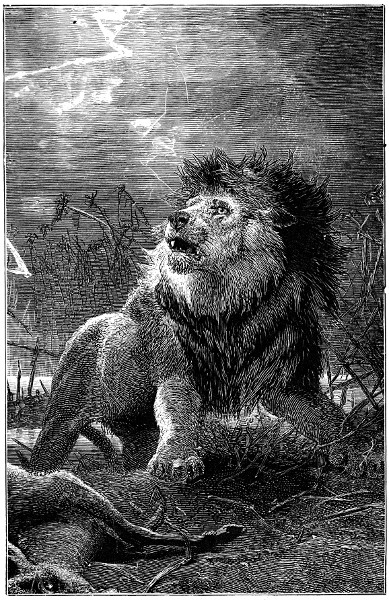
The Lion. The lion is known as the King of Beasts; though modern travellers have done much to rob him of the homage that he once received. Like a human being who has been too much lionized, he suffers from the detractions which are excited by his pre-eminence. He is found chiefly in India and Africa, though he once had a more extended range. He was well known to the Greeks, and appears in both their poetry and history. Homer celebrates him, and according to Herodotus he exploited himself by attacking the camels of the army of Xerxes. His noble appearance is said to be responsible for the popular ideal of his character, which travellers and naturalists declare to be minus the magnanimous and generous qualities with which it was at one time credited.
The Lion's Character. In judging of the lion's character it is important to remember that he belongs to the cat family, and that his virtues and vices are naturally of the cat kind. "The lion seldom runs," says the author of "Tales of Animals." "He either walks or creeps, or, for a short distance, advances rapidly by great bounds. It is evident, therefore, that he must seize his prey by stealth; that he is not fitted for an open attack; and that his character is necessarily that of great power, united to considerable skill and cunning in its exercise." Again, the lion, as well as others of the cat tribe, takes his prey at night; and it is necessary, therefore, that he should have peculiar organs of vision. In all those animals which seek their food in the dark, the eye is usually of a large size, to admit a great number of rays. This peculiar kind of eye, therefore, is necessary to the Lion to perceive his prey, and he creeps towards it with a certainty which nothing but this distinct nocturnal vision could give." Men who hunt the lion in the daytime, when he is usually sleeping off the effects of a hearty meal, and who awaken him in a surprised and dazed condition when his cat-like eyes cannot bear the blaze of the sun, ought not to be surprised if he tries to postpone fighting until a more convenient season. Nor can he be said to be less noble because he only fights when it is necessary to procure food, to protect his young, and to defend himself. A veritable Ulysses among the beasts he is ready to fight if needs be, but unless urged by hunger, or attacked by the hunter, he does not seem to bear any particular malice against mankind.
The Lion's Attitude towards Man. "It is singular," says Sparrman, "that the lion, which, according to many, always kills his prey immediately if it belongs to the brute creation, is reported, frequently, although provoked, to content himself with merely wounding the human species; or, at least, to wait some time before he gives the fatal blow to the unhappy victim he has got under him. A farmer, who the year before had the misfortune to be a spectator of a lion seizing two of his oxen, at the very instant he had taken them out of the waggon, told me that they immediately fell down dead upon the spot, close to each other; though, upon examining the carcasses afterwards, it appeared that their backs only had been broken. In several places through which I passed, they mentioned to me by name a father and his two sons, who were said to be still living, and who, being on foot near a river on their estate, in search of a lion, this latter had rushed out upon them, and thrown one of them under his feet. The two others, however, had time enough to shoot the lion dead upon the spot, which had lain almost across the youth, so nearly and dearly related to them, without having done him any particular hurt. I myself saw, near the upper part of Duyvenhoek River, an elderly Hottentot who, at that time (his wounds being still open), bore under one eye, and underneath his cheek bone the ghastly marks of the bite of a lion, which did not think it worth his while to give him any other chastisement for having, together with his master (whom I also knew), and several other Christians, hunted him with great intrepidity, though without success. The conversation ran everywhere in this part of the country upon one Bota, a farmer and captain in the militia, who had lain for sometime under a lion, and had received several bruises from the beast, having been at the same time a good deal bitten by him in one arm, as a token to remember him by; but, upon the whole, had, in a manner, had his life given him by this noble animal. The man was said then to be living in the district of Artaquaskloof."
Discretion the better part of Valour. The following seems to show a curious power of reasoning on the part of the lion. "Diederik Muller, one of the most intrepid and successful of modern lion-hunters in South Africa, had," says Sir William Jardine, "been out alone hunting in the wilds, when he came suddenly upon a lion, which, instead of giving way, seemed disposed, from the angry attitude he assumed, to dispute with him the dominion of the desert. Diederik instantly alighted, and confident of his unerring aim levelled his gun at the forehead of the lion, who was couched in the act to spring, within fifteen paces of him; but at the moment the hunter fired, his horse, whose bridle was round his arm, started back and caused him to miss. The lion, bounded forward, but stopped within a few paces, confronting Diederik who stood defenceless, his gun discharged, and his horse running off. The man and the beast stood looking at each other in the face for a short space. At length the lion moved backward as if to go away. Diederik began to load his gun, the lion looked over his shoulder, growled, and returned. Diederik stood still. The lion again moved cautiously off, and the Boer proceeded to load and ram down his bullet. The lion again looked back and growled angrily; and this occurred repeatedly, until the animal had got off to some distance when he took fairly to his heels and bounded away."
The Strength of the Lion. Whatever may be said of the lion's courage, there can be no doubt as to his strength. Burchell thus describes an encounter with a lion. "The day was exceedingly pleasant and not a cloud was to be seen. For a mile or two we travelled along the banks of the river, which in this part abounded in late mat-rushes. The dogs seemed much to enjoy prowling about and examining every rushy place, and at last met with some object among the rushes which caused them to set up a most vehement and determined barking. We explored the spot with caution as we suspected, from the peculiar tone of the bark, that it was what it proved to be—lions. Having encouraged the dogs to drive them out, a task which they performed with great willingness, we had a full view of an enormous black-maned lion and lioness. The latter was seen only for a minute, as she made her escape up the river under concealment of the rushes; but the lion came steadily forward, and stood still and looked at us. At this moment we felt our situation not free from danger, as the animal seemed preparing to spring upon us, and we were standing on the bank, at a distance of only a few yards from him, most of us being on foot, and unarmed, without any visible possibility of escaping. At this instant the dogs boldly flew in between us and the lion, and surrounding him, kept him at bay by their violent and resolute barking. The lion, conscious of his strength, remained unmoved at their noisy attempts and kept his head turned towards us. At one moment, the dogs perceiving his eye thus engaged, had advanced close to his feet, and seemed as if they would actually seize hold of him; but they paid dearly for their imprudence, for, without discomposing the majestic and steady attitude in which he stood fixed, he merely moved his paw, and the next instant I beheld two lying dead. In doing this he made so little exertion, that it was scarcely perceptible by what means they had been killed. We fired upon him, and one of the balls went through his side, just between the short ribs, but the animal still remained standing in the same position. We had now no doubt that he would spring upon us, but happily we were mistaken and were not sorry to see him move slowly away."