THE ANIMAL KINGDOM. SUB-KINGDOM I—VERTEBRATA. (continued 8)
Reading edition
The Duck. The many varieties of Ducks might well occupy much more space than we can spare for them. The better known of these are the Wild Duck, the Common Duck, the Eider Duck, the Long-tailed Duck, the King Duck, the Canvas-back Duck, the Mallard, the Teal, the Widgeon, the Mandarin, and the Common Shelldrake.
An interesting illustration of the affection which ducks sometimes show towards each other is given by Dr. Stanley. He says:—"A pair of Muscovy Ducks were landed at Holyhead from a Liverpool vessel, returning from the coast of Africa. The male was conveyed to a gentleman's house, and put with other ducks, towards whom he evinced the utmost indifference: he evidently pined for the loss of his mate; but she was brought after a time, and let loose; he did not at first see her, but when, on turning his head, he caught a glimpse of her, he rushed towards her with a joy which was quite affecting. Nothing after that would induce him to quit her; he laid his beak upon hers, nestled his head under her wing, and often gazed at her with the greatest delight."
The Swan. The Swan is one of the most graceful of the bird kind, the purity of its colour and the beauty of its form as it glides along the river making it one of the prettiest sights in nature. There are several varieties of the swan, of which the Whooping Swan and the Common Swan of Europe, the Black Swan of Australia, and the Black-necked Swan of South America are the most familiar.
The Maternal Instinct of the Swan. The swan is assiduous in the care of her young, and shows great intelligence in providing for them as well as courage in their defence. She makes her nest in the grass among reeds; and in February begins to lay, depositing egg after egg, until there are six or eight. Dr. Latham mentions two females that for three or four years successively, agreed to associate, and had each a brood yearly, bringing up together about eleven young ones: they sat by turns, and never quarrelled. Captain Brown gives a remarkable illustration of the courage of a swan in defending her nest. He says:—"A female swan, while in the act of sitting, observed a fox swimming towards her from the opposite shore: She instantly darted into the water, and having kept him at bay for a considerable time with her wings, at last succeeded in drowning him; after which, in the sight of several persons, she returned in triumph. This circumstance took place at Pensy, in Buckinghamshire."
The Swan's Intelligence. Mr. Yarrell, in his "British Birds," mentions a remarkable instance of the sagacity and intelligence of the swan: "A female swan was sitting on four or five eggs. One day she was observed to be very busy in collecting weeds, grasses, and sticks, to raise her nest above its usual level. A kind-hearted farming man threw her some handfuls of brushwood, with which she most industriously raised her nest, and soon placed the eggs about two feet and a half above the old level. That night there came down a tremendous fall of rain, which flooded all the fields and cellars, and did great damage in the village. Man made no preparation—the bird did; and instinct prevailed over reason! Her eggs were above, and only just above, the water."
The Swan and the Fawn. Swans are said to be spiteful at times, and to show a savagery of temper on occasion, for which, as in the following case, it is difficult to account. "In the park of Lord Grantley at Wonersh, near Guildford, a fawn, drinking, was suddenly pounced upon by one of the swans, which pulled the animal into the water, and held it under until quite drowned. This action was observed by the other deer in the park, and did not long go unrevenged; for shortly after, this very swan, which had hitherto never been molested by the deer, was singled out when on land, and furiously attacked by a herd, which surrounded and killed it."
The Common Sea-Gull. The Gulls are a numerous family, the Common Gull, the Herring Gull, the Great Black-Backed Gull and the Ivory Gull being well known species. The Common Gull is found everywhere. It frequents the coasts of continents and islands and feeds principally upon fish, though its voracity is very accommodating, and its taste not over fastidious.
A Tame Sea-Gull Many years ago, Mr. Scot, of Benholm, near Montrose, caught a sea-gull, and having cut its wings put it into his garden. The bird remained in this situation for several years, and being kindly treated, became so familiar, as to come at call to be fed at the kitchen door and to answer to the name of Willie. It became so tame at last that no pains were thought necessary to circumscribe its liberty, and its wings having grown to full length, it flew away, joined the other gulls on the beach, and came back, from time to time, to pay a visit to the house. When its companions left the country at the usual season, Willie accompanied them, much to the regret of the family. To their great joy, however, it returned next season; and with its usual familiarity came to its old haunt, where it was welcomed and fed very liberally. In this way it went and returned for forty years, without intermission, and kept up its acquaintance with the family, for while in the country it visited them almost daily, answered to its name like any domestic animal, and ate almost out of the hand. One year, however, very near the period of its final disappearance, Willie did not pay his respects to the family for eight or ten days after the general flock of gulls were upon the coast, and great was their lamentation for his loss, as it was feared he was dead: but to the surprise and joy of the family, a servant one morning came running into the breakfast-room with delight, announcing that Willie was returned. The whole company rose from the table to welcome the bird. Food was supplied in abundance, and Willie with his usual frankness ate of it heartily, and was as tame as any barn-yard fowl about the house. In a year or two afterwards this grateful bird disappeared for ever.
Mother Carey's Chicken. The Stormy Petrel or Mother Carey's Chicken, is a small black bird well known to mariners, and familiar to all at sea in stormy weather. It follows in the wake of ships and is regarded as a prophet of evil, at least in so far as stormy weather is concerned. It is seen in many parts of the ocean busily engaged in searching for food, braving the fury of the storm and skimming along the waves, sometimes above their tops, and sometimes screening itself from the blast by sinking down into the billows between them. It nests in all but inaccessible places, the Island of St. Kilda being the chief British breeding place of the Fulmar variety. These are of great importance to the natives who run great risks in searching for their eggs and who catch the birds for the purposes of food, and for the oil which they supply.
Catching the Stormy Petrel. The danger attaching to the capture of the Petrel in its rocky haunts in the Hebrides is thus vividly described by Mr. Drosier. "As the stormy petrel, is scarcely ever to be seen near the land, except in very boisterous weather, one of the natives for a trifling remuneration, agreed to traverse the face of a rock, and take me some from out its fissures. Accordingly, accoutred with a rope of hemp and hogs' bristles coiled over his shoulders, he proceeded to the cliff. Having made one end fast by means of a stake, he threw the coil over the face of the rock, and gradually lowered himself down, but with the utmost caution and circumspection, carefully pressing his foot hard upon the narrow ridges before he at all loosened his firm grasp of the rope, which he never altogether abandoned. I had previously thrown myself upon my chest, to enable me to have a better view of him, by looking over the cliff; and, certainly, to see the dexterity and bravery with which he threw himself from one aperture to another, was truly grand. The tumbling roar of the Atlantic was foaming many hundreds of feet beneath, and dashing its curling cream-like surge against the dark base of the cliff, in sheets of the most beautiful white; while the herring and black-backed gulls, alternately sweeping past him so as to be almost in reach of his arm, threw a wildness into the scene, by the discordant scream of the former, and the laughing, oft-repeated bark of the latter. This, however, he appeared entirely to disregard; and continuing his search, returned in about half an hour, with seven or eight of the stormy petrels, tied up in an old stocking, and a pair of the Manks puffins, together with their eggs. The birds, he told me, he had no difficulty in capturing. The eggs of the stormy petrel are surprisingly large, considering the diminutive size of the bird, being as large as those of the thrush. The female lays two eggs, of a dirty or dingy white, encircled at the larger end by a ring of fine rust-coloured freckles. The birds merely collect a few pieces of dried grass, with a feather or two, barely sufficient to prevent the eggs from rolling or moving on the rock."
The Cormorant. The Common Cormorant is familiar all round the coast of England, and will even sometimes venture inland or at any rate up the mouths of rivers. Captain Brown mentions one that, many years ago, was seen resting upon the vane of St. Martin's steeple, Ludgate Hill, London; and was shot in the presence of a large number of people. It is a voracious bird and shows great dexterity in the catching and swallowing of fish, turning them round so as to swallow them head foremost, in order to avoid the resistance of the fins and spines. Colonel Montague had one, caught in a tributary of the Bristol Channel, by a Newfoundland dog, which at first refused food but offered no resistance to being crammed. "The Colonel having retired to the library after seeing the bird fed," says Captain Brown, "was surprised in a few minutes to see it walk boldly into the room, unceremoniously place itself by him at the side of the fire, and begin to dress its feathers. This practice it continued till removed to an aquatic menagerie. Whenever it saw the water it became restless, and on being set at liberty, plunged into it, and incessantly dived for a considerable time in search of fish. After this, it seemed to be convinced that there were none to be found there, as it was not noticed to dive again for three days."
The Albatross. The great Albatross is a large and powerful bird, measuring three feet in length and having a stretch of wing of from nine to twelve or fourteen feet. It is a heavy bird, and needs great strength to sustain its weight during its long and rapid flights. Mrs. Bowdich says, "One was known to follow a ship, which made two hundred miles a day, for forty-eight hours; and besides these miles, from its irregular flight, it must have passed over a much longer distance. The Albatross darts with unerring aim and great force on its prey, as it swims on the top of the waves. A man who fell overboard near the island of St. Paul's was killed by these birds; for, although the boat was lowered immediately, nothing was found of him except his hat, pierced through and through by the beaks of three albatrosses, who had marked him, pecked him on the head, and caused him to sink." Their flight is easy and apparently performed without effort and with an almost imperceptible movement of wing. The Albatross is easily caught from the stern of a ship with a hook. Mr. Wood says: "It seems rather remarkable that a bird that lives in or over the sea during its whole life, should prove a landsman when taken on board. Yet, when the Albatross is caught and placed on deck, it begins to stagger about, and soon becomes as thoroughly sea sick as the most inexperienced cockney." Mr. Earl thus describes the haunt of the Albatross in the heights of the Island of Tristan d'Acunha: "A death-like stillness prevailed in these high regions, and to my ear our voices had a strange unnatural echo, and I fancied our forms appeared gigantic, whilst the air was piercing cold. The prospect was altogether sublime, and filled the mind with awe. The huge Albatross here appeared to dread no interloper or enemy; for their young were on the ground completely uncovered, and the old ones were stalking around them."
The Pelican. The Pelican is one of the largest of swimming birds. It is distinguished by the possession of a pouch which is capable of holding two gallons of water, and which it uses for the purposes of catching fish, and feeding its young. In this latter operation the bird presses its pouch which hangs beneath its beak, against its breast, and so disgorges its contents. This action is said to have given rise to the fable that pelicans pluck nourishment from their own breasts to feed their young. The Pelican belongs to the South and East of Europe and the North of Africa.
A Tame Pelican. Mr. Hill, of St. Domingo, gives an interesting account of a tame pelican which is quoted by Mrs. Bowdich. He says:—"The facility with which the pelican resigns itself to fasting or feasting, was very interestingly exhibited to me in a bird I saw the other day at Passage Fort. It was a pelican of mature age; it flew backwards and forwards, visiting the wild flocks, and feeding with them in the harbour during the day, and withdrew from them to roost in its master's yard during the night. In that period of restraint, when it was necessary to observe the caution of drawing its quill feathers, to keep it within diminished capabilities of flight, until it became familiar and domesticated, it was wholly dependent on the fish provided for it by the fishermen of the beach. Sunday was no fishing day with these men; and this was, therefore, a day in which there were no supplies for the pelican. It became, in time, so conscious of the recurrence of this fast-day, that although, at all other times, it went daily down to the sea-side to wait the coming in of the canoes, on the seventh day it never stirred from the incumbent trunk of a tree, on which it roosted, within the yard. It had been found necessary to pluck its wings within the last two or three months, to restrain it within bounds, in consequence of its absence latterly with the wild birds, for several days in succession, and in this state it was reduced, as formerly, to depend on the fishermen for food. The old habit of abstinence and drowsy repose on the Sundays again recurred, and when I saw it, it was once more a tranquil observer of the rest, and with it the fast, of the Sabbath-day."
The Penguin. The Penguin belongs to South America, Australia, New Zealand and the Cape of Good Hope. There are a number of species; the Jackass Penguin, so called from the peculiarity of its cry, the King Penguin of the South Pacific, and the Cape Penguin of Cape Horn, the largest of the penguins, being the principal varieties. Mr. Darwin in describing the Jackass penguin says:—"In diving, its little plumeless wings are used as fins, but on the land as front legs. When crawling (it may be said on four legs) through the tussocks, or on the side of a grassy cliff, it moved so very quickly that it might readily have been mistaken for a quadruped. When at sea and fishing, it comes to the surface, for the purpose of breathing, with such a spring, and dives again so instantaneously, that I defy any one at first sight to be sure that it is not a fish leaping for sport." The penguin is a courageous bird, and will not hesitate to attack a man. Mr. Darwin when on the Falkland Islands, placed himself between one of the Patagonian penguins and the water, and till it reached the sea, it regularly fought and drove him backwards. It stood close before him, erect and determined, and every inch gained it firmly kept. Nothing less than heavy blows would have stopped it.
The Puffin. The Puffin is a bird of singular appearance and interesting habits. It is sometimes called the sea parrot from the resemblance of its head to that of the Parrot kind. The bird measures thirteen inches in length, and its bill is a formidable weapon. The Raven seems to be its natural enemy, and when they come to close quarters a great deal depends upon which succeeds in getting the first grip. Naturally each bird has the best chance in its own element. It is a bird of passage, visiting its customary breeding places in the summer and wintering in southern Europe. Mr. Rennie says, "In the breeding season, numerous troops of them visit several places on our coasts, particularly the small island of Priestholm, near Anglesey, which might well be called puffin land, as the whole surface appears literally covered with them. Soon after their arrival in May, they prepare for breeding, and it is said, the male, contrary to the usual economy of birds, undertakes the hardest part of the labour. He begins by scraping up a hole in the sand not far from the shore; and after having got some depth he throws himself on his back, and with his powerful bill as a digger and his broad feet to remove the rubbish, he excavates a burrow with several windings and turnings, from eight to ten feet deep. He prefers, where he can find a stone, to dig under it, in order that his retreat may be more securely fortified. Whilst thus employed, the birds are so intent upon their work that they are easily caught by the hand."
ORDER X. The Ostriches. This order includes the Ostrich, the Rhea, the Cassowaries and the Emus. The Ostrich belongs to Africa, Australasia, and South America. It is the largest of the birds, attaining to a height of six feet, and a weight of three hundred pounds. It is hunted for the sake of its feathers, but being very swift of foot has to be circumvented by strategy. It is said to run in large curves, which habit gives the hunter the opportunity of riding straight and intercepting it. "A favourite method adopted by the wild Bushman for approaching the Ostrich and other varieties of game," says Captain Gumming, "is to clothe himself in the skin of one of these birds, in which, taking care of the wind, he stalks about the plain, cunningly imitating the gait and motions of the Ostrich, until within range, when, with a well-directed poisoned arrow from his tiny bow, he can generally seal the fate of any of the ordinary varieties of game." The eggs of the Ostrich are also much prized. "The nest," says Captain Gumming, "is merely a hollow scooped in the sandy soil, generally amongst heath or other low bushes; its diameter is about seven feet; it is believed that two hens often lay in one nest. The hatching of the eggs is not left, as is generally believed, to the heat of the sun, but, on the contrary, the cock relieves the hen in the incubation. The eggs form a considerable item in the Bushman's cuisine, and the shells are converted into water flasks, cups, and dishes. I have often seen Bush-girls and Bakalahari women, who belong to the wandering Bechuana tribes of the Kalahari desert, come down to the fountains from their remote habitations, sometimes situated at an amazing distance, each carrying on her back a kaross, or a net-work containing from twelve to fifteen ostrich egg-shells, which had. been emptied by a small aperture at one end; these they fill with water."
The Ostrich and its Young. The Ostrich shows the same affection for its mate, and the same devotion to the care of its young that we have noticed in other birds, and in animals. The female of a pair in Paris died through swallowing a three-cornered piece of glass which a glazier had dropped into their cage, after which the mate pined away and died in a few weeks. Of their care of their young Captain Cumming says:
"I fell in with a troop of about twelve young ostriches, which were not much larger than Guinea-fowls. I was amused to see the mother endeavour to lead us away, exactly like a wild duck, spreading out and drooping her wings, and throwing herself down on the ground before us as if wounded, while the cock bird cunningly led the brood away in an opposite direction." Professor Thunberg once rode past the place where a hen Ostrich was sitting in her nest; when the bird sprang up, and pursued him, evidently with a view to prevent his noticing her eggs or young. Every time he turned his horse towards her she retreated ten or twelve paces; but as soon as he rode again she pursued him, till he had got to a considerable distance from the place where he had started her.
The Rhea. The Cassowary. The Emu. The Rhea is a beautiful bird of the ostrich type belonging to South America. There are several species, known as the Common Rhea, the Great-billed Rhea, and Darwin's Rhea, the latter belonging to Patagonia. A Common Rhea bred some time ago in the Zoological gardens, when the male bird discharged the duties of incubation. The Cassowary and the Emu belong to Australia. The Cassowary resembles the ostrich in form, but is not so large. It stands about five feet. Like all these birds it is unable to fly, but is very swift of foot. It can kick too, with great violence, as dogs have sometimes found to their cost. The Emu is a very large bird and is said sometimes to exceed six feet in height.
Mr. Bennett says:—"The length of its legs and the muscularity of its thighs enable it to run with great swiftness; and as it is exceedingly shy, it is not easily overtaken or brought within gun-shot. Captain Currie states that it affords excellent coursing, equalling if not surpassing the same sport with the hare in England; but Mr. Cunningham says that dogs will seldom attack it, both on account of some peculiar odour in its flesh which they dislike, and because the injuries inflicted upon them by striking out with its feet are frequently very severe. The settlers even assert that the Emu will break the small bone of a man's leg by this sort of kick; to avoid which, well-trained dogs run up abreast, and make a sudden spring at the neck, whereby the bird is quickly dispatched. Its flesh has been compared to coarse beef, which it resembles both in appearance and taste." Mr. Jesse says, "The only instance I have met with in which the hen bird has not the chief care in hatching and bringing up the young, is in the case of the Emus, at the farm belonging to the Zoological Society, near Kingston. A pair of these birds bred five young ones: the female, at different times, dropped nine eggs in various places in the pen in which she was confined. These were collected in one place by the male, who rolled them gently and carefully along with his beak. He then sat upon them himself, and continued to do so with the utmost assiduity, for nine weeks, during which time the female never took his place, nor was he ever observed to leave the nest. When the young were hatched, he alone took charge of them, the female not appearing to notice them in any way. On reading this anecdote, many persons may suppose that the female emu is not possessed of that natural affection for its young which other birds have. In order to rescue it from this supposition, I will mention that a female emu belonging to the Duke of Devonshire at Chiswick, laid some eggs; and as there was no male bird, she collected them together herself, and sat upon them." The Apteryx, the wingless bird of New Zealand, belongs to this order.
CLASS III—REPTILIA.
ORDER I. The Tortoise and The Turtle. This order introduces us to creatures differing very widely, in form and character, from those which we have been considering. There are more than two hundred species of the tortoise, and these are grouped into four families. The Common European tortoise is found in the South of France and Italy, as well as in Sicily and Greece. It feeds on vegetables, and under favourable circumstances lives a great number of years. It is slow in its movements but it burrows rapidly and is soon out of sight in the sandy soil it affects. Tortoises are commonly kept in a state of domestication in England, one known to the writer showing a great preference for pansies, eating the flowers and leaving the other parts of the plant. Mr. Wood describes the efforts made by a tortoise in his possession to attain the summit of a footstool, which shows that the reptile has some measure of intelligence. "Unfit as the form of the creature may seem for such a purpose," says Mr. Wood, "it did contrive to scramble upon a footstool which was placed by the fender. Its method of attaining this elevation was as follows:—First it reared up against the footstool in the angle formed by it and the fender, and after several ineffectual attempts, succeeded in hitching the claws of one of its hind feet into the open work of the fender. On this it raised itself, and held on to the top of the stool by its fore feet, while it gained another step on the fender, and so managed to raise itself to such a height, that it only had to fall flat on the top of the footstool. When once there, it could hardly be induced to leave the elevation which it had gained with such difficulty."
The Elephant Tortoise. The gigantic tortoises of the Galapagos Islands came under the observation of Mr. Darwin, from whom we quote the following descriptive passages: "These animals are found, I believe, in all the Islands of the Galapagos Archipelago. They frequent in preference the high damp parts, but likewise inhabit the lower and arid districts. Some individuals grow to an immense size. Mr. Lawson told us that he had seen several so large that it required six or eight men to lift them from the ground, and that some had afforded as much as two hundred pounds of meat. This tortoise is very fond of water, drinking large quantities and wallowing in the mud. The larger islands alone possess springs, and these are always situated towards the central parts and at a considerable elevation. The tortoises, therefore, which frequent the lower districts, when thirsty have to travel from a long distance. Hence broad and well beaten paths radiate off in every direction from the wells, even down to the sea coasts, and the Spaniards by following them up first discovered the watering-places. Near the springs it was a curious spectacle to behold many of these great monsters; one set eagerly travelling onwards with outstretched necks, and another set returning, having drunk their fill. The tortoises when moving towards any definite point, travel by night and day, and arrive at their journey's end much sooner than would be expected. One large tortoise, which I watched, I found walked at the rate of sixty yards in ten minutes, that is three hundred and sixty in the hour, or four miles a day, allowing also a little time to eat on the road. During the breeding season, when the male and female are together, the male utters a hoarse roar or bellowing, which, it is said, can be heard at a distance of more than a hundred yards. The female never uses her voice and the male only at such times. They were at this season (the month of October) laying their eggs. The female, where the soil is sandy, deposits them together and covers them up with sand; but where the ground is rocky she drops them indiscriminately in any hollow. Mr. Bynoe found seven placed in a line on a fissure. The egg is white and spherical; one which I measured was seven inches and three-eighths in circumference. The inhabitants believe that these animals are absolutely deaf; certainly they do not overhear a person walking close behind them. I was always amused when overtaking one of these great monsters as it was quietly pacing along, to see how suddenly, the instant I paused, it would draw in its head and legs, and uttering a deep hiss, fall to the ground with a heavy sound as if struck dead. I frequently got on their backs, and then, upon giving a few raps on the hinder parts of the shell, they would rise up and walk away, but I found it very difficult to keep my balance. The flesh of these animals is largely employed, both fresh and salted; and a beautiful clear oil is prepared from the fat. When a tortoise is caught, the man makes a slit in the skin, near its tail, so as to see inside its body whether the fat under the dorsal plate is thick. If it is not, the animal is liberated; and is said to recover soon from this strange operation. In order to secure the tortoises it is not sufficient to turn them, like turtles, for they are often able to regain their upright position."
The Turtle. The Green Turtle is the turtle of the famous soup. It is a large animal, measuring five or six feet in length and weighing from five hundred to six hundred pounds; it feeds on sea-weeds and is found in large numbers in the seas of warm latitudes. The species from which we get the horny substance known as tortoiseshell (Chelonia Imbricata) is sometimes called the Hawk's-bill turtle. It is a smaller variety, measuring about three feet and belonging to tropical seas. The Leathery Turtle is said to reach eight feet in length and a weight of a thousand pounds. The Loggerhead Turtle is even larger than this, and sometimes weighs as much as fifteen hundred pounds.
Crocodile and Tiger Fight
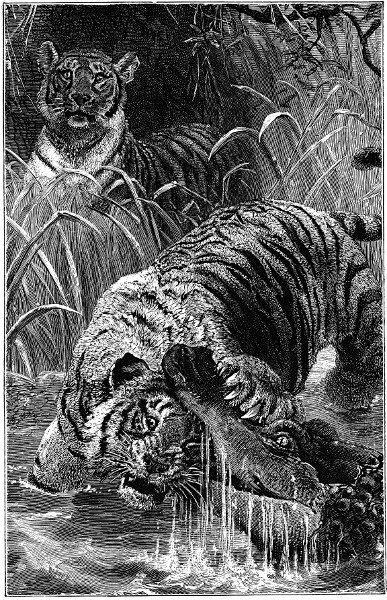
ORDER II. The Crocodile. The Crocodile and the Alligator belong respectively to the Eastern and the Western Worlds. The former infests the rivers of Africa and Asia, one species at least belonging to Australia. Some of the best known varieties are those of the river Nile, the Gavial of the Ganges being also among the more familiar species. These formidable and unwieldy monsters grow to an immense size, sometimes attaining to a length of twenty-five feet. Their enormous jaws and innumerable sharp teeth (they sometimes number a hundred) give them a terrible appearance, while their hard scaly coats are invulnerable against ordinary attack. Their point of weakness is their unwieldy character, taking advantage of which the natives will dive beneath them and stab them with knives in vulnerable parts. The huntsman aims at their eyes as being the nearest approach to their brains. Mungo Park relates that one of his guides across the river Gambia was suddenly seized by a Crocodile and pulled under the water; upon which the negro thrust his fingers into the animal's eyes with such violence that it quitted its hold, but seizing him again, he resorted to the same expedient and with more success, as it again released him, appeared stupified, and then swam down the river. This man reached the bank bleeding very much, with long and deep wounds in his thighs, which incapacitated him for travel for six days. The crocodile lays an enormous number of eggs on the banks of its native rivers, but most of these are prevented from maturing by the birds and animals which prey upon them. Mrs. Bowdich tells an amusing story of a merchant who packed some crocodiles' eggs in sand for shipment to England and placed the barrel containing them with other goods in his warehouse. Strange and unaccountable noises, attracted attention to the spot, when it was discovered that the eggs had become hatched and the young crocodiles were quite ready to assume the responsibilities of life. The natives fled in terror, and the merchant had to take speedy measures for destroying his unexpected brood. Some species of the crocodile have been tamed or partially so, the sacred crocodiles being among these. Accustomed to be fed regularly by the same hands they gradually become familiar with their priestly attendants, and to some extent obedient to their commands. Mungo Park says:—"The crocodiles of the Congo appear to be of a smaller species, and not so numerous as those at Old Calabar, where they continually float past the shipping like large grey pieces of timber, and are so bold that they frequently seize people in the small canoes. In Old Calabar river, I once observed a crocodile swimming with a large cat-fish in its mouth to the opposite shore. It held the fish by the head, whilst the body was thrown into a perpendicular position. I watched it with the spy-glass until it had dragged the fish upon the mud bank, and commenced its meal."
The Alligator. The Alligator of which there are some ten or twelve species known, is found exclusively in America. The Mississippi Alligator is one of the most familiar of these. The Alligator is smaller than the crocodile, which it much resembles in form and habit, though specimens have been met with which measure twenty-two feet in length. The Alligator is naturally most abundant in tropical regions. Captain Brown says: "In the height of the dry season in torrid regions all animated nature pants with consuming thirst. A party of wood cutters, English and Irish, went on one occasion to hunt in the neighbourhood of a lake called Pies Pond in Beef Island, one of the smaller islands of the Bay of Campeachy. To this pond the wild cattle repaired in herds to drink, and here the hunters lay in wait for them. The chase had been prosecuted with great success for a week, when an Irishman of the party going into the water during the day, stumbled upon an alligator, which seized him by the knee. His cries alarmed his companions, who fearing he had been seized by the Spaniards, to whom the island belonged, instead of affording assistance, fled from the huts which they had erected. The Irishman seeing no appearance of help, with happy presence of mind (a quality which the natives of that country possess in an eminent degree) quietly waited till the alligator loosened his teeth to take a new and surer hold; and when it did so, snatched away his knee, interposing the butt-end of his gun in its stead, which the animal seized so firmly that it was jerked out of the man's hand and carried off. He then crawled up a neighbouring tree, again shouting after his comrades, who now found courage to return." Mr. Waterton in his "Wanderings" says, "One Sunday evening, some years ago, as I was walking with Don Felipe de Ynciarte, governor of Augustura, on the bank of the Oroönque, 'Stop here a minute or two, Don Carlos,' said he to me, 'while I recount a sad accident. One fine evening last year, as the people of Augustura were sauntering up and down here, in the Alameda, I was within twenty yards of this place, when I saw a large Cayman rush out of the river, seize a man, and carry him down, before any one had power to assist him. The screams of the poor fellow were terrible as the Cayman was running off with him; he plunged in the river with his prey; we instantly lost sight of him, and never saw or heard him more.'"
A Tame Alligator. That the Alligator is amenable to kindness is shown by the following account of a tame specimen, which we quote from Mr. Jesse. He says, "The most singular instance of attachment between two animals, whose nature and habits were most opposite, was related to me by a person on whose veracity I can place the greatest reliance. Before he took up his abode at Hampden-court, he had resided for nine years in the American States, where he superintended the execution of some extensive works for the American government. One of these works consisted in the erection of a beacon in a swamp in one of the rivers, where he caught a young alligator. This animal he made so perfectly tame, that it followed him about the house like a dog, scrambling up the stairs after him, and showing much affection and docility. Its great favourite, however, was a cat, and the friendship was mutual. When the cat was reposing herself before the fire, (this was at New York) the alligator would lay himself down, place his head upon the cat, and in this attitude go to sleep. If the cat was absent, the alligator was restless; but he always appeared happy when the cat was near him. The only instance in which he showed any ferocity was in attacking a fox, which was tied up in the yard. Probably, however, the fox resented some playful advances, which the other had made, and thus called forth the anger of the alligator. In attacking the fox he did not make use of his mouth, but beat him with so much severity with his tail, that had not the chain which confined the fox, broken, he would probable have killed him. The alligator was fed on raw flesh, and sometimes with milk, for which he showed great fondness. In cold weather he was shut up in a box, with wool in it; but having been forgotten one frosty night, he was found dead in the morning."
ORDER III. Hatteria Punctata. Order III consists of a large reptile belonging to New Zealand which for anatomical reasons cannot be classed either with the Crocodiles or the Lizards. It is rare if not almost extinct, but a specimen may be seen in the Natural History Museum.
ORDER IV. The Lizards. The lizards form an exceedingly numerous order. There are many hundreds of different species, large and small, of which we can only refer to the Chameleon, the Iguana, the Common Lizard, and the Monitor.
The Chameleon. The Chameleon family belongs to Africa, the common variety being otherwise found in central Asia and Ceylon. There are several genera, and numerous species. They live on insects and possess tongues of unusual length, furnished with a sticky mucus, which they protrude and retract with such rapidity and certainty of aim that insects are caught, and conveyed to the mouth with a speed the eye cannot follow. The characteristic for which they are most famous is that of changing their colour, a power which has doubtless been much exaggerated but which no less surely exists. Mrs. Bowdich describes some she had in her possession; she says, "Mine became green and yellow, assumed lighter and brighter lines, but I could not see the bright blue or red substances on which I put them reflected in their skins." According to M. d'Obsonville, who is quoted by Mrs. Bowdich, the original colour is green, the shades of which vary according to circumstances. When at liberty, and in health, it assumes gradations of brown, red, or light grey; when well-fed and in the open air, if provoked, it becomes a blue-green; but when feeble, or deprived of free air, the prevailing tint is yellow-green. If surrounded and teased or if one of its own species comes near, it exhibits all three tints of green. If dying, especially of hunger, yellow first predominates; and when dead, it is the colour of dead leaves.
The Iguana. The Common Iguana which sometimes attains to a length of five feet, belongs to South America. It is a singular looking animal but is much esteemed as an article of food, its flesh resembling that of chickens. When taken young it may be tamed by kindness but otherwise it is fierce when attacked and its bite is very severe. It is said that the natives of the Bahama Islands who subsist largely on the Iguana, sew up their mouths to prevent them biting when they wish to keep them alive for a time.
The Common Lizard. The Common Lizard and the Sand Lizard are the varieties found in England. The Common Lizard is the smaller of the two, measuring about six inches, the Sand Lizard sometimes attaining to double that length. The former frequents green and sunny banks and is so rapid in its movements when disturbed that it is sometimes mistaken for a viper. The latter, which frequents sandy heaths and lives in burrows, assimilates to the colour of its surroundings.
The Monitor. The Monitor is the largest of the Lizards, sometimes measuring as much as six feet in length. The largest of these frequents the Nile and is known as the Nile Monitor from the habit attributed to it of signalling the presence of crocodiles by a peculiar whistling sound. Dr. Abel Smith says, "It is usually met with in rocky precipices, or on low, stony hills, and when surprised, seeks concealment in the chinks of the former, or in the irregular cavities of the latter; and when any projections exist upon the surface of the rocks or stones, it clasps them so firmly with its toes, that it becomes a task of no small difficulty to dislodge it, even though it can be easily reached. Under such circumstances, the strength of no one man is able to withdraw a full-grown individual; and I have seen two persons required to pull a specimen out of a position it had attained, even with the assistance of a rope fixed in front of its hinder legs. The moment it was dislodged, it flew with fury at its enemies, who by flight only saved themselves from being bitten. After it was killed, it was discovered that the points of all the nails had been broken previously, or at the moment it lost its hold. It feeds upon frogs, crabs, and small quadrupeds, and, from its partiality to the two former, it is often found among rocks near to springs or running streams, which fact having been observed by the natives, has led them to regard it as sacred, and not to be injured without danger of drought."
ORDER IV. Snakes. There are hundreds of species of snakes, distributed in different parts of the world, of which we can only select a few, of the better known, for present purposes. These are the Viper, the Rattlesnake, the Cobra, and the Boa Constrictor.
The Viper. The Viper is found throughout Europe and is the only venomous reptile known in England. It feeds on frogs, lizards, mice, and other small animals, but like many of the snake kind often gorges itself and falls a victim to its own rapacity. A Viper mentioned in the "Magazine of Natural History" swallowed a lizard almost as large as itself, with the result that one of the lizard's legs protruded through its side. Another Viper came into the possession of Professor Bell, which had lost its life through attempting to swallow a mouse which was too big for it, the skin of its neck being so distended as to burst in several places. The sting of the Viper, though venomous, is not nearly so fatal as is commonly supposed. The simplest remedy is suction, fomentation, and the application of oil. Vipers are sometimes caught by the sudden seizure of the hand, at the neck, whereupon the creature opens its mouth to bite its captor who cuts off its fangs with a pair of scissors.
The Viper and its Young. "On August 4th, 1776," says Gilbert White, "we surprised a large viper, which seemed very heavy and bloated, as it lay in the grass basking in the sun. When we came to cut it up, we found that the abdomen was crowded with young, fifteen in number; the shortest of which measured full seven inches, and were about the size of full-grown earth-worms. This little fry issued into the world with the true viper-spirit about them, showing great alertness as soon as disengaged from the belly of the dam; they twisted and wriggled about, and set themselves up, and gaped very wide when touched with a stick, showing manifest tokens of menace and defiance, though as yet they had no manner of fangs that we could find, even with the help of our glasses. To a thinking mind nothing is more wonderful than that early instinct which impresses young animals with a notion of the situation of their natural weapons, and of using them properly in their own defence, even before those weapons subsist or are formed. Thus a young cock will spar at his adversary before his spurs are grown; and a calf or a lamb will push with their heads before their horns are sprouted."
The Rattlesnake. The Rattlesnake belongs to America, and many exaggerated stories are current concerning it. At certain seasons it is very fierce and its bite is at all times very dangerous, but in the ordinary way it will not attack anything but the animals it feeds upon, unless molested. It has been tamed and kept in cages, one in the possession of Mr. Pierce making friends with a toad which was introduced to its cage for the purposes of food, and allowing it to take many liberties.
The Sting of the Rattlesnake. "After the death of this snake," says Mr. Pierce, "I examined his fangs; they were sharp like a sickle; a duct led from the reservoir of poison at the bottom of the tooth quite through its whole length, and terminated just by the point, which was exceedingly sharp. Thus, when the fang is darted out it makes the puncture, and simultaneously the poison flows through the duct, and is deposited in the very bottom of the wound. As this rarely fails to touch a blood-vessel, the venom is thus instantly issued into the system, and without delay, commences the march of death through every vein and artery." Mr. Smith in the "Philosophical Transactions" says:—"If a venomous serpent be made repeatedly to inflict wounds, without allowing sufficiently long intervals for it to recover its powers, each successive bite becomes less and less effective. A gentleman who had a rattlesnake in a cage, put a rat in with it; it immediately struck the rat, which died in two minutes. Another rat was then introduced, which ran as far as it could from the snake, with cries of distress. In half an hour, during which time the snake showed no hostility, on being irritated, it struck the rat, which died in twenty minutes. A third, and remarkably large rat, was then thrust into the cage, which showed no terror of the snake, and the snake took no notice of the rat; the gentleman, after watching them for the whole evening, went to bed, and when he inspected the cage the next morning, the snake was dead, and the muscular part of its back eaten by the rat."
The rattle consists of a number of horny joints which when shaken produce the sound by which it is known, and which gives notice of the proximity of the snake.
The Black Snake and the Rattlesnake. "The black snake of Central America," says Mr. Byam, "is a deadly enemy to the rattlesnake; it is next in size to the boa, but much more agile; very vicious and ill-tempered, but not poisonous; it measures from nine to ten feet, and whenever they meet a pitched battle ensues, which, if tolerably equal in size, ends in favour of the black snake. It is not known whether they bite each other, but, at all events, the poison of the venomous serpent has no effect upon his adversary, although a rattlesnake bit itself one day, and died of the wound. A black and a rattlesnake were each descending opposite banks to drink at a stream a yard broad; the black fellow sprang over the stream, and they instantly joined in conflict. They twined together, and the black snake had evidently most muscular power, so that in half an hour the rattlesnake was dead, and the black snake swallowed him, gliding into the thicket, double the size he was when he came out of it."
The Cobra. The Cobra is one of the most venomous of the snakes of the East. It is common all over India and Ceylon and the Islands of the Archipelago. It attains to a length of five or six feet, and feeds on birds, small animals, lizards, frogs, toads, and fishes, in the pursuit of which it will ascend trees and swim the sea. Notwithstanding its dangerous character, the Cobra is the chosen subject of the Indian snake charmer, who keeps it in a basket, until the time for the performance and then allows it to creep out to the sounds of a native fife, upon hearing which the Cobra immediately expands its beautiful though threatening hood, erects its neck, and commences a series of undulating movements, which are continued until the sound of the fife ceases, when the snake instantly drops, and is replaced in its basket by its master.
Snake Charming. "One morning, as I sat at breakfast," says a writer in the Penny Magazine, "I heard a loud noise and shouting among my palankeen bearers. On enquiry, I learned that they had seen a large hooded snake, and were trying to kill it. I immediately went out, and saw the snake creeping up a very high green mound, whence it escaped into a hole, in an old wall of an ancient fortification; the men were armed with their sticks, which they always carry in their hands, and had attempted in vain to kill the reptile, which had eluded their pursuit, and in his hole had coiled himself up securely, whilst we could see his bright eyes shining. I had often desired to ascertain the truth of the report, as to the effect of music upon snakes. I therefore enquired for a snake-catcher. There was one about three miles off, and I accordingly sent for him, keeping a strict watch over the snake, which never attempted to escape, whilst we, his enemies, were in sight. About an hour elapsed, when my messengers returned, bringing a snake-catcher. This man wore no covering on his head, nor any on his person, excepting a small piece of cloth round his loins; he had in his hands two baskets, one containing tame snakes, the other empty; these, and his musical pipe, were the only things he had with him. I made the snake-catcher leave his two baskets on the ground, at some distance, while he ascended the mound with his pipe alone. He began to play: at the sound of music the snake came gradually and slowly out of his hole. When he was entirely within reach, the snake-catcher seized him dexterously by the tail, and held him thus at arm's length, while the snake, enraged, darted his head in all directions, but in vain; thus suspended, he has not the power to round himself, so as to seize hold of his tormentor. He exhausted himself in vain exertions; when the snake-catcher descended the bank, dropped him into the empty basket, and closed the lid, he then began to play, and after a short time raising the lid of the basket, the snake darted about wildly, and attempted to escape; the lid was shut down again quickly, the music always playing. This was repeated two or three times; and, in a very short interval, the lid being again raised, the snake sat on his tail, opened his hood, and danced quite as quietly as the tame snakes in the other basket, nor did he again attempt to escape."
The Cobra as Companion of the Bath. A gentleman in India once visited a neighbouring station for the purpose of taking part in a cricket match, and was hospitably entertained. He was put up in a large tent, accompanied by his wife. After the day's play, at dusk, he went between the canvas walls of the tent where his bath was ready. Touching the bath-tub, were placed two large earthenware jars, full of cold water, and next to them was a brass basin, also containing water, on a stand; the light was burning in the centre of the tent so that between the canvas walls was darkness. He stepped into the tub, and finding the water too hot, bent down to take up one of the cold water jars, but something induced him instinctively to refrain. He stayed his hand, at the same time calling out to his wife to bring a light, which she did when, to his horror, he saw a large cobra coiled round the mouth of the jar, within a foot of his naked legs. The sensation can be imagined. To move was probably death, to stand still required nerve. Experience and courage decided the point, and fixing his eye on the reptile, he quietly told his wife to put down the light on the ground and get him a stick. The wife, a sensible creature, obeyed, leaving her lord in the agonies of suspense as to what the snake's next move would be. This was soon settled by the reptile uncoiling itself and gliding up the chillumchee stand on to the basin, from which it commenced drinking. By this time the stick was gently put into the bather's hand, who with a well-directed blow cut the snake in half against the edge of the copper basin, thus putting a full stop to a thrilling period.
A Night with a Cobra. "I was on a visit during the rainy season, a few years ago," says a recent writer, "when I slept upon an iron bedstead which had two lots of bedding on it. The first night I awoke, as I thought with a horrible nightmare, feeling the cold slimy body of a snake gliding over my person, and imagining myself in the regions described in Milton's Paradise Lost, and so wondrously drawn by Doré. I was bathed in perspiration, and trembled all over till daylight brought relief, and I convinced myself it must have been merely a nightmare. But the next night I again awoke in terror, feeling the same awful sensation of a cold, clammy body gliding gently along my side, and passing with a wriggle over my body; terror preventing me moving. Whether I fainted or again fell asleep I have never been able to decide, but at daylight I fled from the room and sat cowering in the verandah, in a state of mind bordering on insanity. My hostess was informed of my state, and got me round with a glass of wine. Nothing would induce me to re-enter my bedroom. The bearer and other domestics were sent for, and headed by the mistress of the house, inspected the bed by removing the sheets. Nothing was to be seen till one of the servants brushed his leg against something soft and cold, and looked down at the junction of the two beddings; he saw the end of a dark-coloured tail. A howl from him scattered the servants and made me imagine the snake was about to attack me. The valiant servants again assembled, and with sticks entered the bedroom and poked off the upper bedding, revealing a large hooded cobra coiled in the centre, which was eventually despatched by blows."
An Unpleasant Bedfellow. A soldier in a regiment stationed at C—— was, for disorderly conduct, condemned to pass the night in one of the cells. Just as he was going to sleep he was startled by hearing a noise, which he knew could only be occasioned by a snake. Instead of jumping up and calling to the sentinel for help, and perhaps treading on the snake and being bitten by it, he lay perfectly still, knowing that unless disturbed the snake would not hurt him. Presently the snake drew its cold slimy body over his bare feet. There are few persons who, in a similar condition, would not have drawn up their legs with a start, but our hero did not even move. Soon the snake began to crawl over his body and even passed over his face. The poor soldier hardly dared to breathe. At last the reptile coiled itself under his pillow, and when day broke our soldier, seizing the stone with which he ought to have blocked up the hole by which the snake entered, crushed it to death. On being examined, the reptile proved to be of a kind whose bite is almost invariably fatal.
The Boa Constrictor. The Boa Constrictor is one of the largest of the snake kind. It is not venomous, but is possessed of enormous strength which it shows by coiling itself round the object of its attack and crushing it into a shapeless mass. It belongs to tropical America and feeds on birds, and animals of all kinds, not hesitating to attack even the larger quadrupeds. The following account from the pen of Mr. Byam will give an idea of the way in which these monsters dispose of their prey.
The Boa and its Prey. An Englishman and an Indian, travelling together through a thick forest, heard a noise like the cry of a child in great pain. Pulling out their pistols, and tying up their horses, they proceeded to the spot, and there saw a boa crushing a young roebuck with short horns. It had wound itself twice round its prey, just behind the shoulders, one coil lying on the other to increase the weight, and its teeth were fastened on the back of the deer's head. The tail was twisted twice round a young tree close by. It was too busy to observe the strangers; and the Englishman wished to attack it, and save the deer; but the Indian walked off very gently, and made signs to him to follow. When they had regained their horses, the Indian said it would have been madness to have fought with the irritated animal, and they went their way. This was seven in the morning, and they marked the spot by notching the trees. At four in the afternoon they again passed that way, and found the boa lying straight upon the ground; one of the horns of the roebuck sticking out of a corner of the mouth, and the other looking as if it would perforate the neck of the snake; the tail was still coiled round the tree, and the middle of the body looked like a nine-gallon cask. A few blows of the hunting sword about the tail finished the monster; but when attacked, it tried to throw up the deer." The boa has been known to measure upwards of twenty-five feet, though commonly not exceeding eighteen feet.
The Boa's Appetite. Captain Heyland thus describes a boa which was in his possession for some time:—"The animal was brought to me early in January, and did not taste food from that time until the July following. During this period he generally drank a quart of water daily. The man who brought him stated, that he had been seen to eat a hog deer the day before he was taken. He was allowed to be at liberty in the grounds about my house. One evening early in July, hearing a noise, I went out, and discovered that the snake had left his harbour, under the boards of a stable where he generally lay; and having entered a small shed in which some fowls were roosting, had swept eleven from the perch, and destroyed them by pressing them between his folds. Then taking them one by one, head foremost into his mouth, swallowed the whole down in twenty minutes. The largest animal that he ate while in my possession was a calf, which he killed and gorged in two hours and twenty minutes. He never attacked dogs, cats, or pigs. Of these last, indeed, he seemed to be in dread, for, whenever one was presented to him, he retired to a corner, and coiled himself up, with his head undermost. If fed with animals not larger than a duck, he ate readily every day; but after the meal of a goat, refused food for a month."
A Terrible Boa. Not many years ago, says a writer in "Chums," a boa escaped from a menagerie at Grenoble, and disappeared without leaving a trace. A few days afterwards a certain Monsieur Flisson went on a visit to Beauregard along with a friend, who accompanied him on an excursion among the romantic hills and rocks in that part of the country. At a particularly interesting spot he tarried behind his friend, and, in order to enjoy the glorious prospect, sat down on what appeared to be a stone covered with soft moss. It was eight o'clock in the evening, and M. Flisson, though shortsighted, was a man of prodigious strength. This was lucky for him, for the stone now began to move under him, stretched itself out with the elasticity of a spring, and lifted him several feet from the ground. M. Flisson had sat down on the boa. Before he had time to recover his presence of mind, he felt himself rolling downwards. The serpent had curled his tail round a tree-trunk, and Flisson held its head firmly grasped between his hands. A strange and terrible struggle ensued. The boa, securely fastened to the tree, pulled upwards, and Flisson, still clinging with herculean strength to the head of the creature, found himself at last swinging over a precipice or about seventy feet in depth, as though suspended by a rope. In this terrible situation he remained ten minutes, until his friend, with the assistance of a few countrymen, came to his relief.
A Narrow Escape. Mr. Byam's book contains many interesting anecdotes of the experiences of travellers, of which the following snake story is one.
"Two travellers passed a hillock in a marsh, and heard some groans proceeding from a man on the top of it. Earnestly beckoned to approach, they at first hesitated, thinking it might be a contrivance to entice them into danger. They, however, went near, and the man told them that, while asleep, a snake had crept up his loose drawers, and was then lying on his stomach, and from what he had seen of it, he believed it to be a Coral-snake, one of the deadliest of the western serpents. He had nothing on but his drawers and a short cloak. The travellers saw the form of the snake under the drawers; they dismounted, put on thick gloves, took a pair of scissors, cut very carefully through the drawers till they came to the head of the animal, still fast asleep, and then one of them seized it by the neck, and so released the poor man. It was nearly three feet long, as thick as a walking-stick, coral-red in colour, with yellow rings. The poor man said he had passed two or three hours in that dangerous situation, which appeared as long as weeks, and had called to two or three passers-by, who had all avoided him, from the supposition that it was the decoy of a marauding Indian. He was completely unmanned, and his strength was prostrated by his apprehensions."
CLASS IV—BATRACHIA.
The Batrachia. Class IV of the Vertebrata comprises the Batrachia. Batrachia, which are divided into three orders: I Pseudophidia, II Urodela, III Anura. The first order comprises the limbless worm-like reptiles of the genus Cæcilia of Africa and South America; the second includes the Newts, the Salamanders, etc., etc.; the third the Frogs and the Toads. Leaving the first two orders, we devote a few lines to the third, dealing with the Toad, the Common Frog and the Tree Frog. The members of this order are singular for the extraordinary changes through which they pass between birth and maturity. As Tadpoles, in which form they first reach life, they have thick black legless bodies ending in tapering tails, and are provided with the fishlike anatomy necessary to an aquatic existence. In the process of development they completely change both in internal arrangement and external appearance. The gills are exchanged for lungs, the legs supersede the tail and the internal system undergoes corresponding change. In the end the animal becomes semi-aquatic, capable of living under water for some time, but compelled to come to the surface for air at intervals; and also of living out of the water altogether in such places as afford sufficient moisture, damp being as necessary to their comfort as food and air. They hybernate in the winter and propagate in the spring; and in times of drought burrow into the earth and remain lethargic until rain falls. They feed on insects and slugs for which they have a voracious appetite. Their tongues, which like those of the chameleon and other insect eaters, are furnished with a sticky mucus to which insects adhere,—when in repose, turn inwards towards the throat, and the act of catching flies and other insects is simply that of flapping the tongue out and in again, an act performed with such rapidity as to almost escape observation.
The Common Toad. The toad is found in all temperate and torrid climes. It hides in damp secluded places during the day emerging in search of food at night, or after the fall of rain. Though voracious in its appetite, it can accommodate itself to circumstances, and can subsist with little food, if its abode be damp. Failing food and damp, it has yet another resource, namely that of sleep, or torpor, in which condition it can lay by and wait for better times. Under such circumstances, the toad naturally lives a long life, and survives conditions usually fatal. The voracity of the toad is attested by the following incident, furnished by Captain Brown. "A gentleman who resides at Keswick, Cumberland, one evening in the latter end of July, observed a rustling among the strawberries in his garden, and on examining what it was, found that a toad had just seized a field-mouse, which had got on the toad's back, scratching and biting to get released, but in vain. The toad kept his hold, and as the strength of the mouse failed, he gradually drew the unfortunate little animal into his mouth, and gorged him."
Tame Toads. The toad may be easily tamed. Mr. Wood tells of one which lived with a family for years and was in the habit of supping on a piece of sugar. The story of the Duke of Wellington and the tame toad deserves telling in this connection. The Duke of Wellington was one day taking his usual country walk, when he heard a cry of distress. He walked to the spot, and found a chubby, rosyfaced boy lying on the ground, and bending his head over a tame toad, and crying as if his little heart would break. Enquiry elicited the fact that the boy was about to be sent to boarding school and that he was afraid the toad, lacking his attention, would die in his absence. The duke promised to look after the toad, and apprise the boy, from time to time, of its condition. During the time the boy was at school he received five letters couched in the following terms:—Strathfieldsaye, July 27, 1837. "Field Marshal the Duke of Wellington is happy to inform William Harries that his toad is alive and well." When the boy returned for his Christmas holidays, the toad was, as the duke said, "Alive and well," but, in accordance with the usual habits of these animals, he was in his winter's sleep, in which he remained until spring and genial weather brought him from his well-guarded hole in the ground.
The Common Frog. The Common Frog (Rana Temporaria) is now found all over the British Isles. Formerly unknown in Ireland it was introduced there about the year 1700 and has since spread all over the country. The frog is more sociable than the toad, and is often seen, and heard in large numbers; his habits, however, are very similar, and his mode of seizing his prey the same. The Edible Frog belongs to Europe, where it is used as an article of food, and is not found in England. The Bull Frog is an Indian Variety and attains to a great size. The American Bull Frog is also an interesting species.
The Ingenuity of the Frog. Mr. Jesse gives the following illustration of the ingenuity of the Frog: "I may mention a curious observation made in regard to some frogs that had fallen down a small area, which gave light to one of the windows of my house. The top of the area being on a level with the ground, was covered with some iron bars, through which the frogs fell. During dry and warm weather, when they could not absorb much moisture, I observed them to appear almost torpid; but when it rained they became impatient of their confinement, and endeavoured to make their escape, which they did in the following manner. The wall of the area was about five feet in height, and plastered and whitewashed, as smooth as the ceiling of a room. Upon this surface the frogs soon found that their claws would render them little or no assistance; they therefore contracted their large feet, so as to make a hollow in the centre, and by means of the moisture which they had imbibed in consequence of the rain, they contrived to produce a vacuum, so that by the pressure of the air on the extended feet (in the same way that we see boys take up a stone by means of a piece of wet leather fastened to a string), they ascended the wall and made their escape. This happened constantly in the course of three years."
The Tree Frog. The Tree Frog, of which there are numerous varieties, belongs to both East and West occurring in China and Japan or well as in North and South America. It is not found in England. Mr. Gosse says: "They are very numerous in the damp woods of tropical America, and reside by day in the tufts of those parasitical plants, which form reservoirs for rain-water. The under-surface of their bodies is very different to that of the terrestrial species; for the skin, instead of being smooth, is covered with granular glands, pierced by numerous pores, through which the dew or rain, spread on the surface of the leaves, is rapidly absorbed into the system, and reserved to supply the moisture needful for cutaneous respiration. The males make the woods resound throughout the night with their various cries, and, mingled with the shrill chirping of insects, quite banish sleep from the stranger's eyes."
CLASS V—PISCES.
Fishes. We come now to the fifth and last class of the Vertebrata, a class so large that it is impossible to deal adequately with it in a single volume of ordinary size, much less in a single section of one treating of the whole of the vertebrates. There are said to be 10,000 species, so that a book which devoted one page to each would make an enormous volume. All that can be done here is to deal with a few of the better known species, as far as possible selecting types of orders-without attempting to follow closely any classification. Günther divides the Fishes into six sub-classes, which are further arranged in thirteen orders. The first of these orders includes the Sticklebacks, the Perches, the Mullets, the Gurnards, the Mackerel and the Sword-fish besides others. Of these we can deal with but two or three.
The Stickleback. The Stickleback associated with the earliest efforts of the youthful angler, and most of us can remember capturing specimens of some fresh water variety, in the days of childhood, and carrying them home in triumph, in a bottle. There are a number of species of the stickleback, some living in fresh water and some being marine. They are extremely voracious and it is a good job for a large number of other living things that they are no bigger than they are. They are also very pugnacious, and fight among themselves with great determination. The Stickleback is about an inch and a half in length and is furnished with spines, which it uses with great effect when fighting with its enemies.
The Stickleback and the Leech. Mr. John Stark who experimented with some sticklebacks and leeches some years ago, gives the following description of his experiences.
"On putting the leeches into the water, the stickleback darted round the tumbler with lively motions till it found a leech detached, and in a proper situation for being seized. When the leech was very small, say about half an inch in length, it was often swallowed at once before it reached the bottom of the vessel, but when a larger one, about an inch, or an inch and a half in length in its expanded state, was put in, and had fastened itself by its mouth to the glass, the efforts of the stickleback to seize and tear it from its hold, were incessant, and never failed to succeed. It darted at the loose extremity, or, when both ends were fastened, at the curve in its middle, seized it in its mouth, rose to near the surface, and after a hearty shake (such as a dog would give a rat) let it drop. The leech, who evidently wished to avoid its enemy upon its release, again attached itself by its mouth to the glass; but again and again the attack was repeated, till the poor leech became exhausted, and ceased to attempt holding itself by its disc. The stickleback then seized it by the head in a proper position for swallowing, and after a few gulps the leech disappeared. The flattened leech being of an oval form, and having a hard skin, was not attacked, unless when very young, and small; and leeches of the other species when pretty well grown, or larger than himself when expanded, were killed in the manner above mentioned, but not swallowed. In one of his attempts to seize a leech, the stickleback having got it by the tail, the animal curled back and fixed its disc upon his snout. The efforts of the stickleback to rid himself of this encumbrance were amusing. He let go his hold of the leech, which then hung over his mouth, and darting at the bottom and sides of the glass with all his strength, endeavoured to rub off this tantalizing morsel. This lasted for nearly a minute, when at last he got rid of the leech by rubbing his back upon the bottom of the vessel. The leech, perfectly aware of the company he was in, no sooner loosed his hold, than he attempted to wriggle away from his devourer; but before he had reached mid-way up the tumbler, the stickleback had turned and finished the contest by swallowing him up."
The Mackerel. The Mackerel is one of the most useful as well as one of the most beautiful of familiar fishes. It measures from twelve to twenty inches and weighs from one and a half to two or three pounds. It is elegant of form and brilliant of colour, as well as agreeable as an article of food. Mackerel visit the coast of England in vast shoals at certain seasons, but retire to deep seas for the winter. They are exceedingly voracious, and prey upon the herrings; Captain Brown tells a story of a number of mackerel fastening on to a sailor who had plunged into their midst for a bath. The man was rescued by his comrades, but he died soon after from loss of blood.
The Sword-fish. The Sword-fish is a formidable member of this order. It is found in the Mediterranean, and the Atlantic, and sometimes visits the English coast. It has been known to measure ten feet or more without the sword, with which it attains even to a length of fifteen feet. It attacks other large fish and is a great enemy to the whale, which it charges with great force and destructive effect. It is said sometimes to mistake the hull of a ship for the body of a whale and to charge it accordingly, with the result that it leaves its sword fixed in the ship's timbers as the bee leaves its sting in human flesh. The sword of this fish is formed by the elongation of its upper jaw, and some idea of the force with which it can be used may be gained from the fact that one found in the hull of a ship at Liverpool and described by Scoresby had penetrated a sheet of copper, an oak plank two and a half inches in thickness, a solid oak timber of seven and a half inches, and another plank also of two inches. "The position of the bone was at the distance of four feet horizontally from the stern, and two feet below the surface of the water when the vessel was afloat. Hence, it appeared, that when the ship had been in rapid progress through the water, she had been met with and struck by a sword-fish advancing in an opposite direction, by the shock of which, or by the action of the water forced past the body of the animal by the vessel's progress, the snout had been broken off and detached. The blow, though it must have been singularly forcible, was not observed by any person in the ship. Had the bone been withdrawn, the vessel would probably have foundered." Mr. Wood says in one instance, a Sword-fish attacking a whaling-ship, drove its weapon "through the copper sheathing, an inch board sheathing, a three-inch plank of hard wood, the solid white oak timber of the ship twelve inches thick, through another two-and-a-half inch hard oak ceiling plank, and lastly, perforated the head of an oil-cask, where it still remained immovably fixed, so that not a single drop of oil escaped."
The Cod. The third order of Dr. Günther's classification includes many of the more familiar fishes. Here we find the Cod, the Haddock, the Plaice, the Flounder, the Halibut, the Turbot, the Brill, and the Sole. Of these we will take the Cod as representative. The Cod is one of the most prolific of fish. Enormous quantities are caught and consumed every year, and yet the number seems to increase rather than decrease. This is accounted for by the fact, that the spawn of one fish will sometimes contain nine millions of eggs. The Cod frequents the deep seas of the temperate and colder climes, not being found in any quantities north of Iceland, or South of Gibraltar. They are found chiefly in the Northern Atlantic where extensive fisheries are carried on, but they are also caught in the Firth of Forth at the mouth of which some of the best are taken. The Cod grows very rapidly and often to a great size. One is said to have been caught off Scarborough many years ago which weighed seventy-eight pounds and measured five feet eight inches in length. They feed on herrings, sprats, mollusca, worms, and small shell-fish, are very voracious, and have excellent digestions. Captain Brown killed one at Killough, Co. Down, Ireland in which he found upwards of fifty small crabs, and other testaceous and crustaceous animals. The Cod fisheries find employment for a large number of people and are a great source of profit. The flesh is highly valued as an article of diet, and the liver for the properties of the oil which it produces, while other parts are used for various purposes.
The Salmon. In the Fourth order of Dr. Günther's classification we find the Salmon, the Trout, the Pike, the Flying Fish, the Carp, the Roach, the Chub, the Herring, the Sardine, the Anchovy, the Gymnotus and the Eel, besides other fish. Of these the Salmon takes easy precedence. Izaak Walton called it "the King of fresh water fish," and many have accorded it the first place among its kind for the delicacy of its flavour. It is of migratory habits, leaving the sea in the autumn and ascending rivers for the purpose of depositing its spawn, and returning to the sea in the spring. In seeking suitable places for its purpose the salmon brooks no obstacle, leaping with great vigour the rapids and falls that impede its course even though they may sometimes exceed eight or ten feet in height. Curving the body until it forms a circular spring, it strikes the water with great force throwing itself forward and thus lifting itself over rocks and weirs. In the shallow gravelly pools which they find towards the source of rivers, Salmon form hollows in which they spawn, covering up their eggs with the loose sand they excavate in the process. The eggs deposited in the later months of the autumn are hatched in the earlier months of Spring and by the end of May the whole of the young fish have followed their parents to the sea.
The Pike. The Pike,—fierce, strong, and voracious,—holds his own in the rivers of both the old and the new Worlds. It has been known to attack a man when its retreat has been cut off; to bite the legs of bathers, and to snap at the fingers of persons cooling their hands in the water; and when pressed with hunger, to fight an otter for the possession of a carp, which the latter had caught. Its strength and endurance have often been demonstrated in the destruction of strong tackle and in its power to survive, without apparent inconvenience, with hooks and wires mingling with its anatomy. Captain Brown gives an instance of a pike being caught, which had a strong piece of twisted wire projecting from its side. It was in excellent condition, and on being opened, discovered in its stomach a double eel hook, much corroded, and attached to the protruding wire. Another pike when caught, in the river Ouse, was found in possession of a watch with a black ribbon and seals attached; property which it was afterwards discovered had belonged to a gentleman's servant who had been drowned. The pike has often been caught with portions of tackle broken from the line in former engagements hanging from the mouth. Its rapacity is extraordinary. Eight-hundred gudgeon are said to have been consumed in three weeks by eight pike of not more than five pounds weight each. "The appetite of one of my pike," says Mr. Jesse, "was almost insatiable. One morning I threw to him one after the other, five roach, each about four inches in length. He swallowed four of them, and kept the fifth in his mouth for about a quarter of an hour, when it also disappeared." The pike attains to large proportions and to a great age. When less than two pounds weight, it is called a jack, but it has been known to attain to sixty or seventy pounds weight, and if all records be true, to more than a hundred years of age. Gesner mentions a pike caught in standing water at Heilbroon, in Suabia in 1497 which had a ring round its head with an inscription in Greek which ran somewhat as follows; I am the first fish that was launched into this pond, and was thrown in by Frederick the Second, emperor of the Romans, on the fifth of October, 1230." If this be true, the pike was two hundred and fifty-seven years old at the time of its capture, when it is said to have weighed three hundred and fifty pounds.
The Herring. Probably no living thing of its size is equal to the herring in its value to man. It visits the northern coasts of England and Scotland in vast shoals, of several miles in extent, in the autumn of the year, heralded by seagulls and followed by dog-fish, both of whom take toll as it proceeds. The annual produce of these little fish is beyond all calculation. The Scotch fisheries are credited with the capture of over four hundred millions a year, while those of Norway can scarcely be much less successful. The Swedish fisheries are said to capture nearly double that number, to which must be added those taken by the English, Irish, Dutch, French, and German fisheries before the grand total can be reached. The enormous number of hands employed in these various fisheries, to say nothing of the capital invested in them, marks them out as one of the most important of European enterprises.
The Flying Fish. The Flying fish is about the size of a herring, and is furnished with strong pectoral fins, almost the length of its body, by which it is able to spring out of the water and sustain itself for a time in the air. It has apparently no power of guiding itself, or of varying its altitude while in the lighter element, both the height and the course of its flight being determined by the direction and the force of its spring. Its ordinary flight is about three feet above the surface of the water, and of no very great distance or duration, but it has been known to fly as high as fourteen or fifteen feet, and even higher, and a distance of over two hundred yards. Flying fish often fall upon the decks of ships, where they are welcomed as affording a pleasant variety to the sailors' menu. They frequent warmer latitudes, but are sometimes seen off the English coast. They leave the sea to escape the larger fish which prey upon them, only too often to fall a prey to the fowls of the air.
The Eel. The Eel from its general resemblance to the snake is not usually a favourite when alive, however popular it may be with the palate, when served up with suitable accessories at table. It is, however, full of interest as a study, and shows many remarkable characteristics and traits. It migrates from the river to the sea in the autumn to produce its young, thus reversing the order of procedure of the salmon. Mr. Jesse, writing of these migrations as observed by him in the Thames many years ago, says, "An annual migration of young eels takes place in the river Thames in the month of May, and they have generally made their appearance at Kingston, in their way upwards, about the second week in that month. These young eels are about two inches in length, and they make their approach in one regular and undeviating column of about five inches in breadth, and as thick together as it is possible for them to be. As the procession generally lasts two or three days, and as they appear to move at the rate of nearly two miles and a half an hour, some idea may be formed of their enormous number. Sir Humphrey Davy says, in his "Salmonia,"—"There are two migrations of eels, one from and the other to the sea; the first in spring and summer, and the second in autumn, or early in winter. The first of very small eels, which are sometimes not more than two and a half inches long; the second of large eels, which sometimes are three or four feet long, and weigh from fifteen to twenty pounds. There is great reason to believe, that all eels found in fresh water are the results of the first migration; they appear in millions in April and May, and sometimes continue to rise as late as July, and the beginning of August. They feed, grow, and fatten in fresh water. In small rivers, they are seldom very large; but, in large deep lakes, they become as thick as a man's arm, or even leg; and all those of a considerable size attempt to return to the sea in October or November, probably when they experience the cold of the first autumnal rains." Mr. St. John thus describes some young Eels which he saw ascending the river Findhorn "When they came to a fall, which they could not possibly ascend, they wriggled out of the water, and gliding along the rock, close to the edge, where the stone was constantly wet from the splashing and spray of the fall, they made their way up till they got above the difficulty, and then again slipping into the water, continued their course." The eel is voracious, and will leave the water in search of frogs, and other food. It will attack, and appropriate, young ducks, and one is said to have been caught near Bootle with two rats in its stomach. The Conger Eel grows to a great size and attains great weight. It is said sometimes to measure eight or even ten feet, and to weigh a hundred pounds or even more. It is plentiful in the English Channel, and on the coast of Cornwall.
The Gymnotus. The Gymnotus is the famous electric eel, and like the Torpedo of the English Channel and the Mediterranean, has the power of communicating a violent electric shock. It belongs to the Amazon and other South American rivers and their tributaries, and is well known to American Indians. Humbolt describes the shock produced by this creature, as exceeding in strength that of a large Leyden jar. Having imprudently placed his foot on one just taken from the water he received such a shock that, he says, "I was affected the rest of the day with violent pains in the knees, and in almost every joint."
Catching the Gymnotus. The following vivid description of a Gymnotus hunt is given by Humbolt: "We at first wished to make our experiments in the house we inhabited at Calabozo; but the dread of the electrical shocks of the gymnoti is so exaggerated among the vulgar, that during three days we could not obtain one, thought they are easily caught, and though we had promised the Indians two piastres for every strong and vigorous fish.
"Impatient of waiting, and having obtained very uncertain results from an electrical eel that had been brought to us alive, but much enfeebled, we repaired to the Cano de Bera, to make our experiments in the open air, on the borders of the water itself. We set off on the 19th of March for the village of Rastro de Abaxo, thence we were conducted to a stream, which, in the time of drought, forms a basin of muddy water, surrounded by fine trees. To catch the gymnoti with nets is very difficult, on account of the extreme agility of the fish, which bury themselves in the mud like serpents. We would not employ the barbasco, that is to say, the roots of Piscidea erithryna and Jacquinia armillaris, which, when thrown into the pool, intoxicate or benumb these animals. These means would have enfeebled the gymnoti; the Indians therefore told us, that they would 'fish with horses.' We found it difficult to form an idea of this extraordinary manner of fishing; but we soon saw our guides return from the Savannah, which they had been scouring for wild horses and mules. They brought about thirty with them, which they forced to enter the pool.
"The extraordinary noise caused by the horses' hoofs makes the fish issue from the mud, and excites them to combat. These yellowish and livid eels resemble large aquatic serpents, swim on the surface of the water, and crowd under the bellies of the horses and mules. A contest between animals of so different an organization furnishes a very striking spectacle. The Indians, provided with harpoons and long slender reeds, surround the pool closely; and some climb upon the trees, the branches of which extend horizontally over the surface of the water. By their wild cries, and the length of their reeds, they prevent the horses from running away and reaching the bank of the pool. The eels, stunned by the noise, defend themselves by the repeated discharge of their electric batteries. During a long time they seem to prove victorious. Several horses sink beneath the violence of the invisible strokes which they receive from all sides, in organs the most essential to life; and stunned by the force and frequency of the shocks, disappear under the water. Others, panting, with their mane standing erect, and wild looks, expressing anguish, raise themselves and endeavour to flee from the storms by which they are overtaken. They are driven back by the Indians into the middle of the water; but a small number succeeds in eluding the active vigilance of the fishermen. These regain the shore, stumbling at every step, and stretch themselves on the sand, exhausted with fatigue, and their limbs benumbed by the electric shock of the gymnoti.
"In less than five minutes two horses were drowned. The eel, being five feet long, and pressing itself against the belly of the horses, makes a discharge along the whole extent of its electric organs. It attacks at once the heart, the intestines, and the plexus cæliacus of the abdominal nerves. It is natural, that the effect felt by the horses should be more powerful than that produced upon men by the touch of the same fish at any one of his extremities. The horses are probably not killed, but only stunned. They are drowned from the impossibility of rising from amid the prolonged struggle between the other horses and the eels.
"We had little doubt, that the fishing would terminate by killing successively all the animals engaged; but by degrees the impetuosity of this unequal combat diminished, and the wearied gymnoti dispersed. They require a long rest, and abundant nourishment, to repair what they have lost of galvanic force. The mules and horses appear less frightened; their manes are no longer bristled, and their eyes express less dread. The Indians assured us, that when the horses are made to run two days successively into the same pool, none are killed the second day. The gymnoti approach timidly the edge of the marsh, when they are taken by means of small harpoons fastened to long cords. When the cords are very dry, the Indians feel no shock in raising the fish into the air. In a few minutes we observed five eels, the greater part of which were but slightly wounded. Some were taken by the same means towards the evening.