THE ANIMAL KINGDOM. SUB-KINGDOM I—VERTEBRATA. (continued 4)
Reading edition
The Mastiff as Protector. Mr. Jesse gives the following story which he reprinted from a contemporary newspaper:
"A most extraordinary circumstance has just occurred at the Hawick toll-bar, which is kept by two old women. It appears that they had a sum of money in the house, and were extremely alarmed lest they should be robbed of it. Their fears prevailed to such an extent, that, when a carrier whom they knew was passing by, they urgently requested him to remain with them all night, which, however, his duties would not permit him to do; but, in consideration of the alarm of the women, he consented to leave with them a large mastiff dog. In the night the women were disturbed by the uneasiness of the dog, and heard a noise apparently like an attempt to force an entrance into the premises, upon which they escaped by the back-door, and ran to a neighbouring house, which happened to be a blacksmith's shop. They knocked at the door, and were answered from within by the smith's wife. She said her husband was absent, but that she was willing to accompany the terrified women to their home. On reaching the house, they heard a savage but half-stifled growling from the dog. On entering they saw the body of a man hanging half in and half out of their little window, whom the dog had seized by the throat, and was still worrying. On examination, the man proved to be their neighbour the blacksmith, dreadfully torn about the throat, and quite dead."
The Bull-Dog. The Bull-dog (Canis Anglicus), is said to be an original English breed, and Colonel Smith suggests that this dog rather than the mastiff was the one which flourished in England in Roman times. Not indeed the breed as it at present exists, but "one little inferior to the mastiff," "but with the peculiar features of the bull form more strongly marked." "The bull-dog," says Colonel Smith, "differs from all others, even from the mastiff, in giving no warning of his attack by his barking, he grapples his opponents without in the least estimating their comparative weight and powers. We have seen one pinning an American Bison and holding his nose down till the animal gradually brought forward its hind feet and crushing the dog to death tore his muzzle out of the fangs, most dreadfully mangled. We have known another hallooed on to attack a disabled eagle; the bird unable to escape, threw himself on the back, and as the dog sprang at his throat, struck him with his claws, one of which penetrating the skull, killed him instantly, and caused his master the loss of a valued animal and one hundred dollars in the wager." "The bull-dog is possessed of less sagacity and less attachment than any of the hound tribe; he is therefore less favoured, and more rarely bred with care, excepting by professed amateurs of sports and feelings little creditable to humanity. He is of moderate size, but entirely moulded for strength and elasticity." He never leaves his hold, when once he has got it, while life lasts, hence he has become the type of obstinate pertinacity; and unflinching courage.
The Poodle Dog. The Poodle dog while possessing many natural qualities which endear it to its owner, is capable of great cultivation and is for this reason much affected by those who train dogs for public performances. Of the clever tricks the poodle has been trained to perform many stories are told, among which the following from M. Blaze's "History of the Dog," as quoted in Mr. Jesse's "Anecdotes of Dogs," is one of the most amusing.
"A shoe-black on the Pont Neuf at Paris had a poodle dog, whose sagacity brought no small profit to his master. If the dog saw a person with well-polished boots go across the bridge, he contrived to dirty them, by having first rolled himself in the mud of the Seine. His master was then employed to clean them. An English gentleman, who had suffered more than once from the annoyance of having his boots dirtied by a dog, was at last induced to watch his proceedings, and thus detected the tricks he was playing for his master's benefit. He was so much pleased with the animal's sagacity, that he purchased him at a high price and conveyed him to London. On arriving there, he was confined to the house till he appeared perfectly satisfied with his new master and his new situation. He at last, however, contrived to escape, and made his way back to Paris, where he rejoined his old master, and resumed his former occupation."
Weasels, Otters and Badgers. We come next to the family of the Mustelidæ which includes Weasels, Otters and Badgers, which we take as the heads of the three sub-families into which it is divided. The first of these includes the Pine Marten, occasionally found in Ireland and Scotland but more commonly in different parts of Europe; the Sable, which belongs to northern Europe and Asia; the American Sable, which supplies the English market with hundreds of thousands of skins annually; the Ermine or Stoat, still to be found in Great-Britain and familiar in the northern parts of Europe, Africa and America; the Weasel which has much the same locale as the Ermine; the Ferret which hails from Africa and which is cultivated in England for its use in the destruction of vermin; and the Glutton (Gulo luscus) which is found principally in North America. The Polecat is also a member of this family. It is about seventeen inches long and in form resembles the weasel. Its colour is deep chocolate. It generally lives in the neighbourhood of houses on hares, rabbits, and birds. When pinched for food it will also catch and eat fish. It is remarkable for an insufferably fetid odour.
The Weasel. The weasel though thought by some to be incapable of domestication has, like most other animals who have had the chance, shown itself amenable to kindly treatment. Mdlle. de Laistre possessed one which she kept in her chamber, dispelling its strong odours by perfumes. This weasel displayed towards her extravagant evidence of affection. "If the servant sets it at liberty before I am up in the morning," she writes, "after a thousand gambols, it comes into my bed, and reposes in my hand or on my bosom. If I am up before it is let out, it will fly to me in rapture, and spend half an hour in caressing me. The curiosity of this little pet is unbounded, for it is impossible to open a drawer or box, without its roving through every part of it; if even a piece of paper or a book is looked at, it will also examine it with attention." This weasel lived on friendly terms with both a cat and a dog who shared his mistress' favours. That the weasel can defend himself when attacked is shown by the following incident told by Mr. Bell: "As a gentleman was riding over his grounds, he saw, at a short distance from him, a kite pounce on some object on the ground, and rise with it in his talons. In a few moments, however, the kite began to show signs of great uneasiness, rising rapidly in the air, or as quickly falling, and wheeling irregularly round, whilst evidently endeavouring to free himself from some obnoxious thing with his feet. After a short but sharp contest, the kite fell suddenly to the earth. The gentleman instantly rode up to the spot, when a weasel ran away from the kite, apparently unhurt, leaving the bird dead, with a hole eaten through the skin under the wing, and the large blood-vessels of the part torn through." The length of the common weasel is about eight inches.
The Common Otter. There are several genera of Otters. The common otter (Lutra vulgaris) is known throughout Europe and is not uncommon in Great Britain. The otter lives on fish, for the hunting of which he is admirably fitted. He is web-footed and has a body of great flexibility and short but remarkably muscular legs. The Otter was looked upon as a friend by the peasants living near salmon preserves years ago, for after landing his prey he was content with but a small portion for himself, and left the rest which the peasants readily appropriated.
"Otters," says Mr. St. John, "are very affectionate animals; the young anxiously seek their mother if she should be killed; and if the young are injured, the parent hovers near them till she is herself destroyed. If one of a pair be killed, the one that is left will hunt for its mate with untiring perseverance; and if one be caught in a trap, its companion will run round and round, endeavouring to set it free, on which occasions, though so quiet at other times, they make a snorting and blowing like a horse."
"A labourer going to his work, soon after five o'clock in the morning, saw a number of animals coming towards him, and stood quietly by the hedge till they came alongside of him. He then perceived four old otters, probably dams, and about twenty young ones. He took a stick out of the hedge and killed one. Directly it began to squeak, all the four old ones turned back, and stood till the other young ones had escaped through the hedge, and then went quietly themselves. Several families were thus journeying together, and probably they had left their former abode from not finding a sufficiency of food." Otters have often been tamed and taught to catch fish for their masters. Captain Brown tells of an otter which was caught when young and trained by James Campbell near Inverness. "It was frequently employed in catching fish, and would, sometimes, take eight or ten salmon in a day. If not prevented, it always made an attempt to break the fish behind the anal fin, which is next the tail; and, as soon as one was taken away, it always dived in pursuit of more. It was equally dexterous at sea fishing, and took great numbers of young cod, and other fish, there. When tired, it would refuse to fish any longer, and was then rewarded with as much as it could devour. Having satisfied its appetite, it always coiled itself round, and fell asleep: in which state it was generally carried home." Professor Steller says that on killing and skinning a female otter, which he found at a place at which he had deprived her of her young eight days previously, he found her quite wasted away from grief at the loss of her progeny.
The Badger. There are several varieties of Badger, the Indian and the American being the most important, respectively of the eastern and western worlds. The common badger (Meles taxus), which is found in different parts of England, feeds upon roots, bulbs, fruits, and all kinds of vegetables, as well as small animals, snails and worms. He has also a great fancy for eggs. He lives in burrows, which form passages having a central chamber and various anti-chambers, which he makes in sandy and gravelly soil. He is nocturnal in his habits. "When pursued," says Mrs. Bowdich, "he constantly impedes the progress of his enemies by throwing the soil behind him, so as to fill up the passages, while he escapes to the surface." He is a formidable opponent to his enemies, as his skin is so tough and his bite so severe, and he displays much sagacity in avoiding traps and escaping confinement. Mr. St. John placed one in a paved court for security, but before the next morning he had displaced a stone and burrowed his way out under the wall. Captain Brown tells an affecting story of the feeling of a badger for its mate. "Two persons in France killed a badger and proceeded to drag it towards a neighbouring village. They had not proceeded far when they heard the cry of an animal in seeming distress, and stopped to listen, when another badger approached them slowly. They at first threw stones at it; notwithstanding which, it drew near, came up to the dead animal, began to lick it, and continued its mournful cry. The men, surprised at this, desisted from offering any further injury to it, and again drew the dead one along as before; when the living badger, determined not to quit its companion, lay down on it, taking it gently by one ear, and in that manner was drawn into the midst of the village; nor could dogs, boys, or men induce it to quit its situation: and to their shame be it said, they had the inhumanity to kill the poor animal, and afterwards to burn it, declaring it could be no other than a witch."
The Ratel and the Skunk. The Ratel (Mellivora capensis) of South and East Africa and the Skunk of Canada belong to this family. The Ratel is a small animal standing from ten to twelve inches high, with a very tough skin, which is so loose that, to quote Sparrman, "If anybody catches hold of the Ratel by the hind part of his neck, he is able to turn round, as it were, in his skin, and bite the arm of the person that seizes him." Dog-like in shape, the back and head are covered with a coat of lighter colour than that of the sides and under part of the body, giving it the appearance of a garment. The Ratel is the natural enemy of the Bees, his thick skin rendering him impervious to their attack, and he is said to show great sagacity in tracing their nests, watching at sundown, with his eyes shaded by his paws, the homeward flight of the honey makers and then following them to plunder and destroy. The Skunk is famous for its offensive smell, which according to Sir John Richardson is emitted by a deep yellow fluid which it discharges, and which is so strong that it retains its disgusting odour for many days. It is about eighteen inches in length, has short legs and a body that is broad and flat. It lives upon poultry and eggs, small quadrupeds, young birds, and wild fruits. Godman says: "Pedestrians, called by business or pleasure to ramble through the country during the morning or evening twilight, occasionally see a small and pretty animal a short distance before them in the path, scampering forward without appearing much alarmed, and advancing in a zigzag or somewhat serpentine direction. Experienced persons generally delay long enough to allow this unwelcome traveller to withdraw from the path; but it often happens that a view of the animal arouses the ardour of the observer, who, in his fondness for sport, thinks not of any result but that of securing a prize. It would be more prudent to rest content with pelting this quadruped from a safe distance, or to drive it away by shouting loudly; but almost all inexperienced persons, the first time such an opportunity occurs, rush forward with intent to run the animal down. This appears to be an easy task; in a few moments it is almost overtaken; a few more strides and the victim may be grasped by its long and waving tail—but the tail is now suddenly curled over the back, its pace is slackened, and in one instant the condition of things is entirely reversed;—the lately triumphant pursuer is eagerly flying from his intended prize, involved in an atmosphere of stench, gasping for breath, or blinded and smarting with pain, if his approach were sufficiently close to allow of his being struck in the eyes by the pestilent fluid of the Skunk."
The Raccoon and the Coati. Our next concern is with the family of the procyonidæ which includes several bear-like animals, the Raccoon and the Coati being the best known. The raccoon belongs to North America, the coati to Central and Southern America. The raccoon is an expert swimmer, about the size of a fox, and of nocturnal habits. "His food," says the Rev. J. G. Wood, "is principally small animals and insects. "Oysters are also a very favourite article of its diet. It bites off the hinge of the oyster, and scrapes out the animal with its paws. Like a squirrel, when eating a nut, the raccoon usually holds its food between its fore-paws pressed together and sits upon its hind quarters while it eats. It is said to be as destructive in a farm-yard as any fox, for it only devours the heads of the murdered fowl. When taken young it is easily tamed but very frequently becomes blind soon after its capture. The coati (Nasua nasica) is distinguished from the raccoon by a pointed nose. In size it resembles the cat, its tail being as long as its body. Like the cat it is a good climber, and preys upon birds. When domesticated, as it is in Paraguay, the coati is kept in tether, as its climbing habits render it dangerous to ornaments and furniture. The Kinkajou (Cercoleptes caudivolvulus) of Demerara belongs to this family. The Panda (Ælurus fulgens) constitutes another family. It is cat-like in the face, but otherwise resembles the bear. It lives in the dense forests which clothe the declivities of the Himalayas.
The Bear. After the lion and the tiger the bear is probably the most popular animal in legend and story. Dr. Gray divides the bears into three classes: the sea bear, the land bear, and the honey bear. The polar bear is the sea bear; the brown bear, the black bear, and the grizzly are land bears, and the Malayan bear is the honey bear. Mr. Wood says, "Bears and their allies are mostly heavy, and walk with the whole foot placed flat on the ground, unlike cats and dogs who walk with merely their paws or toes. They are omnivorous, that is, they can eat either animal or vegetable food, so that a leg of mutton, a pot of honey, a potatoe, or an apple are equally acceptable." The bears of Kamtchatka live principally on fish, which they are adepts in catching. The bear is found in the polar regions, in Siberia, the Caucasus, the Pyrenees, the Himalayas, in various parts of Western Asia, in Canada, and the United States.
Hunting the Polar Bear
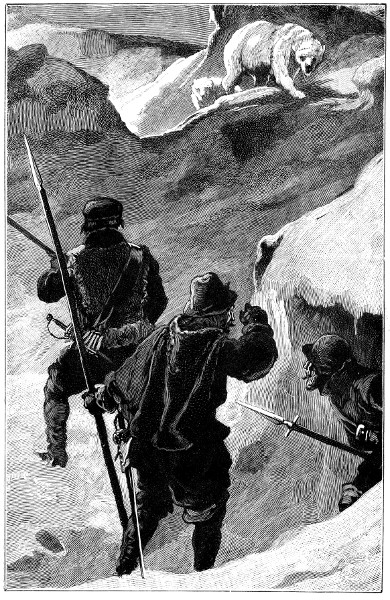
The Polar Bear. The Polar Bear is eight or nine feet long, and a little more than four feet in height. He has a long nose, short ears, large legs, and a short tail. His body and neck are long, and he has five sharp claws on each foot. His colour is a yellowish white; his hair long and shaggy. He inhabits Greenland and Lapland, as far north as eighty degrees. He lives on fish and seals and the bodies of whales, which are thrown ashore or which he finds in the sea. Dr. R. Brown deprecates the stories of the polar bear's ferocity which he regards as greatly exaggerated, though he admits, that when enraged, or suffering from hunger, they are formidable foes. That they are wary animals the following story quoted from Captain Brown will show. "The captain of a Greenland whaler, being anxious to procure a bear without injuring the skin, made trial of a stratagem of laying the noose of a rope in the snow, and placing a piece of kreng within it. A bear, ranging the neighbouring ice, was soon enticed to the spot by the smell of burning meat. He perceived the bait, approached, and seized it in his mouth; but his foot, at the same time, by a jerk of the rope, being entangled in the noose, he pushed it off with his paw, and deliberately retired. After having eaten the piece he had carried away with him, he returned. The noose, with another piece of kreng, having been replaced, he pushed the rope aside, and again walked triumphantly off with the bait. A third time the noose was laid; but, excited to caution by the evident observations of the bear, the sailors buried the rope beneath the snow, and laid the bait in a deep hole dug in the centre. The animal once more approached, and the sailors were assured of their success. But Bruin, more sagacious than they expected, after snuffing about the place for a few moments, scraped the snow away with his paw, threw the rope aside, and again escaped unhurt with his prize."
The polar bear displays a great love for its young and many pathetic stories are told of its rage and grief at the loss of them. The following is from Captain Brown's "Anecdotes of Animals." "A Greenland bear, with two cubs under her protection, was pursued across a field of ice by a party of armed sailors. At first, she seemed to urge the young ones to increase their speed, by running before them, turning round, and manifesting, by a peculiar action and voice, her anxiety for their progress; but, finding her pursuers gaining upon them, she carried, or pushed, or pitched them alternately forward, until she effected their escape. In throwing them before her, the little creatures are said to have placed themselves across her path to receive the impulse, and, when projected some yards in advance, they ran onwards, until she overtook them, when they alternately adjusted themselves for another throw."
The Black Bear. The Black Bear (Ursus Americanus) is about four and a half feet long and three feet high. He has long feet terminating in five claws each. His body is short with longish legs, and he has a large head, with small eyes, and a sharp nose. He has long, soft and woolly hair. His food is chiefly fruit, such as acorns, chestnuts, grapes, and corn; but when hungry he will feed on flesh, and attack other animals with courage and fierceness. He climbs trees, and uses his paws like hands. In winter he retires to his den, which is usually a hollow in some decayed tree, where he hybernates until spring. Though of a wild disposition, he can be tamed, and taught various tricks, in which he displays a good deal of sagacity and docility. The following story is quoted by Captain Brown from Captains Lewis' and Clarke's travels to the source of the Missouri, as a striking instance of the astonishing physical powers of the bear. "One evening, the men in the hindmost of the canoes, discovered a large bear lying in the open grounds, about three hundred paces from the river. Six of them, all good hunters, set out to attack him; and, concealing themselves by a small eminence, came unperceived within forty paces of him. Four of them now fired, and each lodged a ball in his body, two of them directly through the lungs. The enraged animal sprang up, and ran open-mouthed at them. As he came near, the two hunters who had reserved their fire, gave him two wounds, one of which, breaking his shoulder, retarded his motion for a moment; but, before they could reload, he was so near, that they were obliged to run to the river, and, when they reached it, he had almost overtaken them. Two jumped into the canoe; the other four separated, and, concealing themselves in the willows, fired as fast as each could load. They struck him several times, which only exasperated him; and he at last pursued two of them so closely, that they leaped down a perpendicular bank of twenty feet into the river. The bear sprang after them, and was within a few feet of the hindmost, when one of the hunters from the shore shot him in the head, and killed him. They dragged him to the banks of the river, and found that eight balls had passed through his body."
Of his docility Mrs. Bowdich gives the following amusing, if, at the time, alarming illustration. "A young English officer, who was stationed at a lone fortress in Canada, amused himself by taming a bear of this species. He taught him to fetch and carry, to follow him like a dog, and to wait patiently at meal times for his share. The bear accompanied him when he returned to England, and became a great favourite with the passengers and the ship's company. Bruin, however, especially attached himself to a little girl about four years old, the daughter of one of the ladies on board, who romped with him as she would with a dog. In one of these games of play, he seized her with one fore-paw, and with the other clambered and clung to the rigging, till he lodged her and himself in the main-top, where, regardless of her cries and the agony of her mother, he tried to continue his romp. It would not do to pursue the pair, for fear the bear should drop the child; and his master, knowing how fond he was of sugar, had some mattresses placed round the mast in case the child should fall, and then strewed a quantity of sugar on the deck; he called Bruin, and pointed to it, who, after a moment's hesitation, came down as he went up, bringing the child in safety. He was, of course, deprived of his liberty during the rest of his voyage." The black bear is hunted for the sake of his skin, many thousands of skins being sent to Europe every year.
The Grizzly Bear. The Grizzly Bear is an enormous animal, according to the measurement of Captains Lewis and Clarke of one they killed, nine feet from nose to tail, though they claim to have seen one of even larger size. It is said to attain to a weight of 800 pounds. The fore-foot of the animal already referred to exceeded nine inches in length, the hind foot being eleven inches and three quarters, exclusive of the talons, the breadth of the hind foot being seven inches. The Grizzly does not climb trees, like the brown and the black bear. He is ferocious when hungry, and when attacked, and the female will die hard in the defence of her young. Such is his strength that he can master a bison, and drag him to his retreat. He is by far the most dangerous brute of North America. He unhesitatingly pursues both men and animals; but, though he feeds on flesh, he is capable of subsisting upon roots and fruits. He is very tenacious of life, and will pursue his enemy after having received repeated mortal wounds. He is found in the eastern vicinity of the Rocky Mountains. Though the Grizzly will sometimes move off on the approach of the traveller, without showing fight, he will at other times attack him with great ferocity. A man named Nathan Rogers who lived on a ranch in the mountains about a mile above West Point, near the North Fork of the Mokelumne, once had a terrific encounter with a grizzly bear. He was out shooting small game when he was suddenly confronted by an enormous animal. He fired his only shot into the breast of the bear and then awaited his attack. The fight was fast and furious, and though in the end the grizzly was killed, the man only survived in a terrible condition. Conscious that he must soon have help or perish, he summoned all his resolution and staggered along, and managed to reach a spring in sight of a house, when his endurance gave way, and he fell in a dead faint by the water's edge. Fortunately he was soon discovered by his son, a lad of some twelve years, who immediately gave the alarm. In addition to his horrible wounds, the shock to his system was a terrible one. His left arm, literally mangled and torn to shreds, had to be amputated at the shoulder. His left clavicle and scapula were fractured, and the three lower ribs on the right side broken. The flesh and muscles on his back were so broken and abraded that the vertebræ were actually visible in places; while, his lower limbs were literally seamed and furrowed by the crooked claws of the bear's hind feet. The left side of the bear was literally torn to pieces, there being no less than twenty-two knife-wounds, nearly every one of which reached to a vital point. Some idea of his size can be obtained when we state that one of his fore-paws just covered an ordinary dinner plate.
The Brown Bear. The Brown Bear (Ursus arctos) was the bear of the British Isles, so long as the British Isles boasted of a bear. This was the baited bear of the Royal sports, and of the common Bear garden. His last appearance in Great-Britain in a wild state, however, dates back more than 800 years. In size, shape, and habits he much resembles the black bear of America. Like the Malayan bear he is very fond of honey as the following amusing story as told by Mrs Bowdich will show:
"A countryman in Russia, when seeking honey, climbed a very high tree, the trunk of which was hollow; and finding there was a large quantity of comb in it, he descended, and stuck fast in the tenacious substance there deposited. He was so far distant from home, that his voice could not be heard, and he remained two days in this situation, relieving his hunger with the honey. He began to despair of ever being extricated, when a bear, who, like himself, came for the sake of the honey, slid down the hollow, hind-part foremost. The man, in spite of his alarm, seized hold of him; and the bear, also in a great fright, clambered out as fast as he could, dragging the man up with him, and when clear of his tail-bearer, made off as fast as possible."
The Malayan Bear. The Malayan Bear is about four feet long and two feet high. It has a long tongue which serves it well in extracting honey from the honey combs in the hollow trunks of trees. Other bears are the Syrian Bear of Western Asia, the Spectacled Bear of South America and Peru and the Sloth Bear of India and the Mahratta country.
SUB-ORDER II. The Pinnipedia. We come now to the second sub-order of the Carnivora or flesh-eating animals, the sub-order which includes the Seal and the Walrus. These in the form of their skulls and in other ways show evident relationship to the bear, and so appropriately follow him in classification. The family of the Otaridæ, includes the Eared Seals, the Northern Sea Lion and the Northern Sea Bear. The Eared Seal is distinguished from the true seal, as his name implies by the possession of external ears.
Sea Lions. Mr. Theodore Lyman, who had excellent opportunities of observing the habits of the Sea Lions on the Seal Rocks of San Francisco, furnished Mr. Allen with a graphic account of their movements, from which we quote the following: "As they approach to effect a landing, the head only appears decidedly above water. This is their familiar element and they swim with great speed and ease, quite unmindful of the heavy surf, and of the breakers on the ledges. In landing they are apt to take advantage of a heavy wave which helps them to get the forward flippers on terra firma. As the wave retreats they begin to struggle up the steep rocks, twisting the body from side to side, with a clumsy worm-like motion, and thus alternately work their flippers into positions, where they may force the body a little onward. At such times they have a general appearance of sprawling over the ground. It is quite astonishing to see how they will go up surfaces having even a greater inclination than 45° and where a man would have to creep with much exertion. In their onward path they are accompanied by the loud barking of all the seals they pass; and these cries may be heard a great distance. They play among themselves continually by rolling on each other and feigning to bite; often too, they will amuse themselves by pushing off those that are trying to land. All this is done in a very cumbrous manner, and is accompanied by incessant barking. As they issue from the water their fur is dark and shining; but as it dries, it becomes of a yellowish brown. Then they appear to feel either too dry or too hot, for they move to the nearest point from which they may tumble into the sea. I saw many roll off a ledge at least twenty feet high, and fall like so many huge brown sacks into the water, dashing up showers of spray."
Sea Bears. The Northern Sea Bear is otherwise known as the Northern Fur Seal. Captain Charles Bryant gives a very interesting account of these singular animals, in which he describes them as approaching and taking possession of the shores of St. Paul's Island near the coast of Alaska, about the middle, or towards the end of April, when the snow has melted and the drift ice from the north has all passed. A few old male seals first make their appearance and reconnoitre for two or three days, afterwards climbing the slopes and taking possession of the rookeries, each male reserving about a square rod for himself and his wives. The scouts then return and younger male seals soon begin to arrive in small detachments, but are prevented from landing by their elders and are so forced to remain in the water or go to the upland above. By the middle of June all the males have arrived, and having adjusted their differences and divided the rookeries between them, await the arrival of the females. "These appear in small numbers at first but increase as the season advances, till the middle of July; when the rookeries are all full, the females often overlapping each other. The bachelor seals swim all day along the shore, escorting and driving the females on to the rocks as fast as they arrive. As soon as a female reaches the shore, the nearest male goes down to meet her, making meanwhile a noise like the clucking of a hen to her chickens. He bows to her, and coaxes her until he gets between her and the water so that she cannot escape him. Then his manner changes, and with a harsh growl he drives her to a place in his harem. This continues until the lower row of harems is nearly full. Then the males higher up select the time when their more fortunate neighbours are off their guard to steal their wives. This they do by taking them in their mouths and lifting them over the heads of the other females, and carefully placing them in their own harem carrying them as carefully as cats do their kittens. Those still higher up pursue the same method until the whole space is occupied. Frequently a struggle ensues between two males for the possession of the same female, and both seizing her at once, pull her in two, or terribly lacerate her with their teeth. When the space is all filled, the old male walks around complacently reviewing his family, scolding those who crowd or disturb the others, and fiercely driving off all intruders. This surveillance always keeps him actively occupied." After the birth of their young which takes place towards the end of July, the old males who have been four months without food, go to some distance from the shore to feed, teaching the young to swim on their return. "By the last of October the seals begin to leave the islands in small companies. The males going last and by themselves."
The Walrus. The Walrus. (Trichechus rosmarus) is a large and unwieldy creature. It bears a stronger resemblance to the seal than to any other quadruped, but it is distinguished by the proportions of its body and its elephant-like tusks. Vast herds formerly frequented the shores of the islands scattered between America and Asia, the coasts of Davis's Straits and those of Hudson's Bay. They have been found as far south as the Magdalen Islands in the Gulf of St. Lawrence. Now they are not met with in great numbers, except on the shores of Spitzbergen and the remotest northern borders of America. They attain to a very large size. The head is oval, short, small, and flat in front, having the eyes set in deep sockets so as to be moved forwards, or retracted at pleasure. On land the Walrus is a slow and clumsy animal, but in the water its motions are sufficiently quick and easy. When attacked, the Walrus is both fierce and formidable, and if in company with its young, becomes very furious, attempting to destroy its enemies by rising and hooking its tusks over the sides of the boat, in order to sink it.
Captain Cook thus describes a herd of walruses he met with off the north coast of America. He says: "They lie in herds of many hundreds upon the ice, huddling over one another, like swine; and roar or bray so very loud, that in the night, or in foggy weather, they gave us notice of the ice, before we could see it. We never found the whole herd asleep, some being always upon the watch. These, on the approach of the boat, would awake those next to them; and the alarm being thus gradually communicated, the whole herd would be awake presently. But they were seldom in a hurry to get away, till after they had been once fired at. They then would tumble over one another into the sea, in the utmost confusion; and, if we did not, at the first discharge, kill those we fired at, we generally lost them, though mortally wounded. They did not appear to us to be that dangerous animal which some authors have described, not even when attacked. They are more so in appearance than reality. Vast numbers of them would follow, and come close up to the oars; but the flash of the musket in the pan, or even the bare pointing of one at them, would send them down in an instant. The female will defend her young to the very last, at the expense of her own life, whether in the water or upon the ice. Nor will the young one quit the dam, though she be dead; so that, if one is killed, the other is certain prey. The dam, when in the water, holds the young one between her fore arms."
The Common Seal. The True Seals are divided by Dr. Gray into thirteen genera with eighteen species, of which the Common Seal, the Ringed Seal, the Harp Seal, the Grey Seal, the Sea Leopard, the Sea Elephant, and the Bladder-nose Hooded Seal are the best known. The common seal has a round head which in front bears some resemblance to that of the otter. Its average length is about five feet and its general colour of a yellowish gray, varied or spotted with brown or blackish in different degrees, according to the age of the animal. The Common Seal frequents the sea-coasts perhaps throughout the world, but is most numerous in high northern latitudes, and furnishes the inhabitants of those frigid regions with nearly all their necessaries and luxuries. Enormous numbers are caught annually for the sake of their skins and oil. The Harp Seal frequents the coast of Newfoundland and is so named from the harp-shaped band which marks the backs of the males. The Sea Elephant is the largest of the seals. It is said to attain to the length of twenty-five to thirty feet, and a circumference of fifteen to eighteen feet. It belongs to the Antarctic sea.
"Seals when taken young," says Captain Brown, "are capable of being completely domesticated, will answer to their name, and follow their master from place to place. In January, 1819, a gentleman, in the neighbourhood of Burnt-island, county of Fife, in Scotland, completely succeeded in taming a seal. Its singularities attracted the curiosity of strangers daily. It appeared to possess all the sagacity of a dog, lived in its master's house, and ate from his hand. In his fishing excursions, this gentleman generally took it with him, when it afforded no small entertainment. If thrown into the water, it would follow for miles the track of the boat; and although thrust back by the oars, it never relinquished its purpose. Indeed, it struggled so hard to regain its seat, that one would imagine its fondness for its master had entirely overcome the natural predilection for its native element."
The Seal's Docility. Notwithstanding the absence of external ears the common seal has a remarkable sense of hearing and a keen taste for sweet sounds. Seals have been known to follow a vessel, for miles, upon the deck of which a violin or a flute has been played. To quote Sir Walter Scott:
"Rude Heiskar's seals, through surges dark, Will long pursue the minstrel's bark."
They are also easily tamed, when they are found to be exceedingly affectionate to those who treat them kindly. Some years ago a farmer, residing on the east coast of Scotland, close to the sea-shore, obtained a young seal for the amusement of his children, who soon became exceedingly fond of it. Some time after, the farmer, having had a bad year for his crops, was told by an old woman in the village that he would never prosper as long as he kept that seal on his ground. The foolish man giving heed to the superstition sent away the seal in a boat some distance from land. Towards evening, as the children were sitting on the sea-shore, what was their joy on beholding their seal rising out of the water, and making its way straight back to them again. For some months they were allowed to retain their pet; but as the farmer's prospects did not brighten, he again determined to get rid of it, and for that purpose, hearing of a ship that was soon to sail for the Baltic, took the little seal, and gave it in charge to some sailors, begging them to keep it in the hold of the ship till they arrived at their destination, and then to throw it into the sea. This was accordingly done, but the faithful seal was not to be daunted; ere long, it reappeared, to the great delight of the children, who begged their father never to send it away again. The farmer gave a doubtful assent, for a suspicion still lurked in his mind, owing to the superstitious words of the old woman, that the presence of the seal had an evil effect upon his crops; and with these ideas preying upon his mind, the farmer conceived the cruel thought of putting out the seal's eyes with a view of preventing it from finding its way back, and again sending it away to sea. Unknown to his children, he carried this barbarous plan into execution; and they only discovered the loss of their favourite too late to aid in its recall, as the ship in which it had been placed had already sailed for Norway. Some days after the departure of the vessel, a fearful storm arose. The farmer and his family were glad enough to close up their shutters, and shut out as much as possible the wailings of the wind, as it swept in furious gusts round the house. They had scarcely retired to rest, when a faint and plaintive cry struck upon their ears—and repeated again it seemed to be—during the momentary lulls of the storm. The farmer continued to listen, but hearing nothing more, he descended to the front door and opened it; a dark object lay before him, on the very threshold, and stooping down to touch it, what was his astonishment to behold the poor blind, devoted little seal, apparently dead. The farmer was greatly touched; he took up the little body gently and carried it into the kitchen, and used every effort to restore it to life but in vain.
ORDER V. Whales and Dolphins. This order is divided into two sub-orders, the one characterised by the possession of teeth, and the other being toothless.
The Right Whale. The Right Whale when fully grown, attains to from fifty to sixty-five feet in length, and to from thirty to forty feet in circumference. It is thickest behind the fins. When the mouth is open, it presents a cavity as large as a room, and capable of containing a boat full of men. Its tongue is said to be as large as a stout feather-bed. The tail is a powerful instrument of motion and defence: it is only five or six feet long, but its motions are rapid, and its strength immense. The eyes are situated in the sides of the head; they are very small, being little larger than those of an ox. The whale has no external ear, but there is a small orifice under the skin for the admission of sound. On the most elevated part of the head are two blow holes six or eight inches in length. The mouth, instead of teeth, has two rows of whalebone, each of which contains more than three hundred laminae, the longest of which are about ten or eleven feet. A large whale sometimes contains a ton and a half of whalebone. The colour of the old whale is gray and white, that of the young ones a sort of bluish black. Immediately beneath the skin lies the blubber, or fat; its thickness round the body is eight or ten or twenty inches, varying in different parts: the lips are composed almost entirely of blubber. A large whale yields about twenty tons of oil, which is expressed from the blubber. It is for this and the whalebone that this animal is deemed so valuable, and for which it is so much sought by whalefishers. The sense of seeing in the whale is very acute. Under the surface of the water they discover one another at an amazing distance. They have no voice, but in breathing or blowing they make a loud noise.
The usual rate at which whales swim seldom exceeds four miles an hour, but for a few minutes at a time they are capable of darting through the water with amazing velocity, and of ascending with such rapidity as to leap above the surface. This feat they perform as an amusement, apparently to the high admiration of distant spectators. Sometimes they throw themselves in a perpendicular posture, with the head downwards, and rearing their tails on high, beat the water with awful violence. Sometimes they shake their tails in the air, which, cracking like a whip, resound to the distance of two or three miles. The flesh of the whale, though it would be rejected by the dainty palates of refined nations, is eaten with much relish by the Eskimo, and the inhabitants along the coasts of Hudson's Bay and Davis's Straits, who esteem it a staple article of subsistence.
Other whales of this sub-order are the common Fin Whale, which is said to reach eighty feet in length, the lesser Fin Whale and the Humpback Whale. In these, the yield of whalebone and oil is so small that they are not thought worth the trouble of catching.
The Sperm Whale. The Sperm Whale rarely exceeds sixty feet in length and lives in warm regions, such as the Indian Ocean; rarely, if ever, visiting Arctic or European seas. Its yield of oil is said to be less than that of the Greenland whale but it is of a finer quality. Ambergris is also produced from the body of the sperm whale.
The Dolphin. This is a large creature, so like the porpoise that he has been often confounded with it. He is, however, much larger, sometimes measuring from twenty to twenty-five feet in length. The body is roundish, growing gradually less towards the tail; the nose is long and pointed, the skin smooth, the back black or dusky blue, becoming white towards the belly. He is entirely destitute of gills, or any similar aperture, but respires and also spouts water through a pipe of semi-circular form placed on the upper part of the head. There are several varieties of dolphins, including the Long-nosed Dolphins of the rivers of Asia and South America and the Classical Dolphin of the Mediterranean (Delphinus delphis) The former are separately classified, and the family of the latter includes the White Whale, the Narwhal, the Common Porpoise and the Grampus. The dolphin is gregarious in its habits, herding and travelling in large shoals. It may sometimes be seen sporting in the bays and rivers of New York and is always a pretty sight.
The White Whale. The White Whale (Beluga catodon) is the whale which Dr. R. Brown calls the whale of Greenland. It is the whale which the Greenlander and the Eskimo find so valuable for its oil and flesh, the latter of which they dry for winter use. They are sometimes called sea pigs, from a fancied resemblance they bear to the pig when floundering in the sea, and sometimes sea canaries, on account of their peculiar whistle, which resembles that of a bird.
The Narwhal. The narwhal (Monodon monoceros) is found frequently in company with the white whale, and inhabits much the same geographical area. It is distinguished by the possession of a tusk, the aim and purpose of which has been much debated. "It has been supposed to use it," says Dr. Brown, "to stir up its food from the bottom, but in such a case the female would be sadly at a loss. Fabricius thought that it was to keep the holes open in the ice during the winter; and the following occurrence seems to support this view. In April, 1860, a Greenlander was travelling along the ice in the vicinity of Christianshaab, and discovered one of those open spaces in the ice, which, even in the most severe winters, remain open. In this hole hundreds of narwhals and white whales were protruding their heads to breathe, no other place presenting itself for miles around. It was described to me as an Arctic 'Black Hole of Calcutta' in the eagerness of the animals to keep at the place." "Neither the narwhal nor the white whale," he continues, are timid animals, but will approach close to, and gambol for hours in the immediate vicinity of the ship." The oil is highly esteemed, and the flesh is very palatable. The skin of the narwhal boiled to a jelly is looked upon, and justly so, as one of the prime dainties of a Greenlander.
The Common Porpoise. The Porpoise resembles the dolphin in general appearance. Its length, from the tip of the snout to the end of the tail, is from five to eight feet; and the width about two feet and a half. The figure of the whole body is conical; the colour of the back is deep blue, inclining to shining black; the sides are gray, and the belly white. When the flesh is cut up, it looks very much like pork; but, although it was once considered a sumptuous article of food, and is said to have been occasionally introduced at the tables of the old English nobility, it certainly has a disagreeable flavour. Their motion in the water is a kind of circular leap; they dive deep, but soon again rise up in order to breathe. They are seen in nearly all seas, where they sport with great activity, chiefly on the approach of a squall.
The Grampus. The Grampus (Orca Gladiator) is the natural enemy of the whale and the seal, who hold him in mortal terror. His swallow is so great that he can take a porpoise or a seal whole, and has been known to swallow several in succession. The whale escapes him by getting among the ice, whither it is said the grampus will not follow him.
ORDER VI. The Sea Cow. The Sea Cow is an aquatic vegetarian who lives on the coast. Of the three genera which constitute the family Manatidæ one is now said to be extinct. The genus Manatus contains two species, one belonging to South America and the other to the West Coast of Africa. The Dugong (Halicore Dugong) which attains to a length of nine or ten feet at maturity produces oil having similar medicinal properties to that obtained from the Cod's liver. It inhabits the Indian Ocean, the Red Sea, the neighbourhood of the Malay Islands and the North and East coasts of Australia.
ORDER VII. Hoofed Animals. The order of hoofed animals includes a number of well known species, of which the Horse, the Ass, the Ox and the Sheep among the tame, and the Rhinoceros, the Hippopotamus, the Boar and the Bison among the wild are familiar examples. The order is divided into two sub-orders and these into numerous families. The sub-orders are, I, The Perissodactyla, which includes three families of animals characterised by an odd number of toes in their hind feet, the horse having one, and the Rhinoceros three. II, The Artiodactyla which includes seven families of animals all having an even number of toes.
The Horse. The horse stands first among the hoofed animals, as the friend and servant of man. He has a history which is full of interest but which it is quite impossible to give within the limits of our present opportunity. He is mentioned in both classical and Biblical history at an early period, but there is reason to believe that he flourished in prehistoric times. He was used by the Greeks in their public games, the chariot race being one of their most popular forms of entertainment; he was also employed by them for the purposes of war, of which the writings of Homer and other classical authors give abundant proof. First used apparently to draw the chariot only, the adaptation of the means to the end soon suggested to man the propriety of mounting his back, and from the throne he thus acquired man has since conquered the whole world. Man's first appearance on horseback doubtless suggested the fable of the Centaur; those unaccustomed to the sight imagining that they beheld a monster, half man and half horse, as it is said the aborigines of America did when they first saw Spanish equestrians. The Egyptians are said to have been the first to cultivate the horse, and the Persians the first to use him in battle.
Arabian Horses. The beauty, strength and speed of the Arabian horse are well known, and the affection which subsists between him and his master is the basis of many a pathetic story. These horses are generally of a brown colour; the mane and tail being short, and the hair black and tufted. The Arabs for the most part use the mares in their ordinary excursions, as they are less vicious than the males, and are more capable of sustaining abstinence and fatigue.
The Arab often shares his tent with his mare, the husband, the wife, the child, the mare, and the foal, lying together indiscriminately; and the youngest branches of the family embracing the neck, or reposing on the body, of the mare, without any idea of fear or danger.
St. Pierre in his "Studies of Nature" tells a pretty story of the Arab's affection for his horse: "The whole stock of a poor Arabian of the desert consisted of a beautiful mare; this the French consul at Said offered to purchase, with an intention to send her to Louis XIV. The Arab, pressed by want, hesitated a long time, but at length consented, on condition of receiving a very considerable sum of money, which he named. The consul wrote to France for permission to close the bargain; and, having obtained it, sent the information to the Arab. The man, so indigent as to possess only a miserable covering for his body, arrived with his magnificent courser; he dismounted, and first looking at the gold, then steadfastly at his mare, heaved a sigh. 'To whom is it,' exclaimed he, 'that I am going to yield thee up? To Europeans! who will tie thee close, who will beat thee, who will render thee miserable! Return with me, my beauty, my jewel! and rejoice the hearts of my children.' As he pronounced the last words, he sprang upon her back, and was out of sight almost in a moment." This story forms the subject of the well known ballad by the Hon. Mrs. Norton, entitled "The Arab's farewell to his steed."
Clarke thus describes the way in which the Arab will address a horse:—"Ibrahim went frequently to Rama to inquire news of the mare whom he dearly loved; he would embrace her, wipe her eyes with his handkerchief, would rub her with his shirt sleeves, would give her a thousand benedictions during whole hours that he would remain talking to her. 'My eyes! my soul! my heart!' he would say, 'must I be so unfortunate as to have thee sold to so many masters, and not keep thee myself? I am poor, my antelope! I brought thee up in my dwelling as a child; I did never beat nor chide thee——" Arabs have been known to refuse enormous sums for horses, though actually themselves in a condition of extreme want. That the horse can reciprocate the kindness shown to him is proved by many a story of his fidelity. Chateaubriand says, "When I was at Jerusalem the feats of one of these steeds made a great noise. The Bedouin to whom the animal, a mare, belonged, being pursued by the governor's guards, rushed with her from the top of the hills that overlooked Jericho. The mare scoured at full gallop down an almost perpendicular declivity without stumbling, and left the soldiers lost in admiration and astonishment. The poor creature, however, dropped down dead on entering Jericho, and the Bedouin, who would not quit her, was taken, weeping over the body of his faithful companion."
More romantic is the story told by M. de Lamartine, thus quoted by Mrs. Bowdich. "An Arab chief and the tribe to which he belonged attacked a caravan in the night, and were returning with their plunder, when some horsemen belonging to the Pasha of Acre surrounded them, killed several, and bound the rest with cords. Among the latter was the chief Abou el Marek, who was carried to Acre, and, bound hand and foot, laid at the entrance of their tent during the night. Kept awake by the pain of his wounds he heard his horse, who was picketed at a distance from him, neigh. Wishing to caress him, perhaps for the last time, he dragged himself up to him, and said, 'Poor friend! what will you do among the Turks? You will be shut up under the roof of a khan, with the horses of a Pasha or an Aga. No longer will the women and children of the tent bring you barley, camel's milk, or dhourra, in the hollow of their hands; no longer will you gallop free as the wind in the desert; no longer will you cleave the waters with your breast, and lave your sides, as pure as the foam from your lips. If I am to be a slave, at least you may go free. Return to our tent, tell my wife that Abou el Marek will return no more; but put your head still into the folds of the tent, and lick the hands of my beloved children.' With these words, as his hands were tied, the chief with his teeth undid the fetters which held the courser bound, and set him at liberty; but the noble animal, on recovering his freedom, instead of galloping away to the desert, bent his head over his master, and seeing him in fetters and on the ground, took his clothes gently between his teeth, lifted him up, and set off at full speed towards home. Without resting he made straight for the distant but well-known tent in the mountains of Arabia. He arrived there in safety, laid his master down at the feet of his wife and children, and immediately dropped down dead with fatigue. The whole tribe mourned him, the poets celebrated his fidelity, and his name is still constantly in the mouths of the Arabs of Jericho."
For the sake of the beautiful moral it contains the following story is well worth adding. In the tribe of Negde there was a mare of great reputation for beauty and swiftness, which a member of another tribe named Daber desired to possess. Having failed to obtain her by offering all he was worth, he sought to effect his object by stratagem. Disguised as a lame beggar he waited by a roadside, knowing that Nabee, the owner of the horse, would shortly pass that way. As soon as Nabee appeared, Daber cried out to him, begging assistance and pretending to be too weak to rise. Nabee thereupon dismounted from the mare, and helped the beggar to mount her. The moment he was mounted Daber declared himself and made off. Nabee called to him to stop, and on his turning round said to him, "Thou hast my mare, since it pleased God I wish you success but I conjure thee tell no one how thou hast come by her." "Why not?" said Daber. "Lest others should refrain from charity because I have been duped," said Nabee, whereupon Daber dismounted and returned the mare.
The Domestic Horse. The Horse has only to be known to be loved, and has only to be loved to become the most tractable, patient, and useful of animals. "In the domestic horse," says Colonel Smith, "we behold an animal equally strong and beautiful, endowed with great docility and no less fire; with size and endurance joined to sobriety, speed, and patience; clean, companionable, emulous, even generous; forbearing, yet impetuous; with faculties susceptible of very considerable education, and perceptions which catch the spirit of man's intentions, lending his powers with the utmost readiness, and restraining them with as ready a compliance: saddled or in harness, labouring willingly, enjoying the sports of the field and exulting in the tumult of the battle; used by mankind in the most laudable and necessary operations, and often the unconscious instrument of the most sanguinary passions; applauded, cherished, then neglected, and ultimately abandoned to the authority of bipeds who often show little superiority of reason and much less of temper." "One who, like ourselves," continues Colonel Smith, "has repeatedly owed life to the exertions of his horse, in meeting a hostile shock, in swimming across streams, and in passing on the edge of elevated precipices, will feel with us, when contemplating the qualities of this most valuable animal, emotions of gratitude and affection which others may not so readily appreciate."
The Structure of a Horse. "The beauty of the form of the horse has often been commented upon, his structure is thus admirably described by a writer in "Cassell's Magazine of Art": "His nature is eminently courageous, without ferocity, generous, docile, intelligent, and, if allowed to be so, almost as affectionate as the dog. In his structure, the ruling characteristic may be said in one word to consist in obliquity—all the leading bones in his frame are set obliquely, or nearly so, and not at right angles. His head is set on with a subtle curve of the last few vertebræ of the neck, which at the shoulders, take another subtle curve before they become the dorsal vertebræ, or backbone; which end, in their turn, with another curve, forming the tail. His shoulders slope back more than those of other quadrupeds, the scapula, or shoulder-blade, being oblique to the humerus, which, in its turn, is oblique to the radius, or upper part of the fore-leg. So, again, in the hind-quarters, the haunch is set obliquely to the true thigh, the thigh, at the stifle joint, to the upper bone of the hind-leg, which at the hock makes another angle. The fore and hind quarters form so large a portion of the entire length that a horse, though a lengthy animal from the front of the chest to the back of the haunch, is, comparatively, very short in the actual back or 'saddle-place.' Then his hocks are much bent, and his pastern joints are rather long, and again are set at an angle, succeeded by a slightly different angle in the firm but expanding hoof, thus completing the beautiful mechanism, which preserves the limbs from jar, and ensures elasticity in every part of an animal destined to carry weight and to undergo rapid and continued exertion—a combination not existing in any other quadruped to anything like the same degree, and fitting him precisely for the purposes for which he was given to man. At present we have said nothing about his head, every part of which is equally characteristic. His well-shaped, delicate ears are capable of being moved separately in every direction, and every movement is full of meaning and in sympathy with the eye. The eye is prominent, full, and large, and placed laterally, so that he can see behind him without turning his head, his heels being his principal weapon of defence; his nostrils are large, open and flexible, and his lips fleshy, though thin, and exquisitely mobile and sensitive. The large, open nostril is essential to him, as a horse breathes solely and entirely through it, being physically incapable of breathing through his mouth, as a valve in the throat actually precludes him from so doing; hence the mouth of a horse, without a bridle in it, is opened only for purposes of eating or biting, but never from excitement or from exhaustion, like that of most other quadrupeds, except the deer species. The lips are, perhaps, even more characteristic; they are his hands as well as part of his mouth, and the horse and others of his family alone use them in this way. The ox, the sheep, the goat, the deer, the giraffe above all, and, in fact, we believe all graminivorous animals except the horse, either bite their food directly with the teeth, or grasp and gather it with the tongue, which is prehensile, and gifted with more or less power of prolongation; but the horse's tongue has no such function, and, therefore, no such powers, as these services are all performed in his case by the lips: and no horseman, who has let a favourite horse pick up small articles of food from the palm of his hand, can have failed to be struck with the extreme mobility, and also the sensibility and delicacy of touch, with which the lips are endowed."
The Horse's Speed. The quality of speed for which the horse is so justly esteemed has been the subject of extensive culture in which the Arabian horse has contributed no mean share. "Some of the horses first brought from Arabia having been by no means celebrated," says Captain Brown, "the breed had fallen into disrepute, till the descendants of one procured by Mr. Darley from the deserts, and on that account called the Darley Arabian, having borne away the palm for fleetness from all others, turned the tide of fashion in favour of that breed. Yet it is only the progeny of the Arabian horses that excels. The English race-horses are equal, if not superior, to all other coursers. As the extraordinary swiftness of the horse has been most signally displayed in the English race-course, and can also be there most precisely measured, we cannot omit the notice of some of the most remarkable of our racers. The most celebrated of these—and indeed the fleetest horse that ever was bred in the world—was Flying Childers, got by the Darley Arabian. What Achilles was among warriors, and Cæsar among conquerors, such was Childers among horses, without an equal and without a rival. He ran against the most famous horses of his age, and was always victorious. He has been known to move at the rate of nearly a mile in the minute. Next to Childers, in fame and fleetness, is Eclipse, so called from having been foaled during the great eclipse of 1764. This horse likewise was never beaten: one contemporary rival alone was supposed to exist, Mr. Shaftoe's horse Goldfinder, but Goldfinder broke down the October before the proposed competition. Eclipse's rate of going was 47 feet in the second. Childers had a rate of 49. One hundred to one were offered on Eclipse against the most famous racers of his day. Mr. O'Kelly purchased him for sixteen hundred and fifty guineas, and cleared by him twenty-five thousand pounds. He had a vast stride,—never horse threw his haunches below him with more vigour or effect; and his hind legs were so spread in his gallop, that a wheelbarrow might have been driven between them. King Herod, another famous horse, which was generally, though not like Eclipse uniformly, successful, is chiefly celebrated for his progeny; his immediate descendants having gained to their owners above two hundred thousand pounds."
The Horse's Endurance. Many marvellous stories are told of the endurance of the horse. Sir John Malcolm says, "Small parties of Toorkomans, who ventured several hundred miles into Persia, used both to advance and retreat at the average of nearly one hundred miles a day. They train their horses for these expeditions as we should do for a race, and describe him when in a condition for a foray by saying that his flesh is marble. When I was in Persia, a horseman mounted upon a Toorkoman horse, brought a packet of letters from Shiraz to Teherary, which is a distance of five hundred miles, within six days." Almost equally remarkable records are held by English horses, but the invention of the locomotive has done away with the necessity for such trying expeditions in civilized countries, and the horse is trained more for speed and strength than for such long distance efforts. M. de Pages in his travels round the world, tells a remarkable story of the endurance of the horse when out of his natural element; he says, "I should have found it difficult to give it credit had it not happened at this place (the Cape of Good Hope) the evening before my arrival; and if, besides the public notoriety of the fact, I had not been an eyewitness of those vehement emotions of sympathy, blended with admiration, which it had justly excited in the mind of every individual at the Cape. A violent gale of wind setting in from north and north west, a vessel in the road dragged her anchors, was forced on the rocks and bulged; and, while the greater part of the crew fell an immediate sacrifice to the waves, the remainder were seen from the shore struggling for their lives, by clinging to the different pieces of the wreck. The sea ran dreadfully high, and broke over the sailors with such amazing fury, that no boat whatever could venture off to their assistance. Meanwhile a planter, considerably advanced in life, had come from his farm to be a spectator of the shipwreck; his heart was melted at the sight of the unhappy seamen, and knowing the bold and enterprising spirit of his horse, and his particular excellence as a swimmer, he instantly determined to make a desperate effort for their deliverance. He alighted and blew a little brandy into his horse's nostrils, and again seating himself in the saddle, he instantly pushed into the midst of the breakers. At first both disappeared, but it was not long before they floated on the surface, and swam up to the wreck; when taking with him two men, each of whom held by one of his boots, he brought them safe to shore. This perilous expedition he repeated no seldomer than seven times, and saved fourteen lives; but, on his return the eighth time, his horse being much fatigued, and meeting a most formidable wave, he lost his balance and was overwhelmed in a moment. The horse swam safely to land, but his gallant rider was no more!"
The Horse's Memory. Many remarkable instances are recorded of the exercise of the faculty of memory by horses. Colonel Smith mentions an instance of a horse which he had used for two years while in the army abroad, and which some years later made himself known to his old master with every demonstration of pleasure, though harnessed to a mail coach. "That the horse remembers the scenes and transactions of past times," says Captain Brown, "is proved from every day's experience. It enters familiarly into its usual abode; inclines to stop at its ordinary halting-place; prefers a journey which it has formerly taken, and falls readily into an occupation to which it has been accustomed. It seeks the fields in which it has formerly pastured, and has been known long afterwards to repair to the scenes of its earlier days. A horse belonging to a gentleman of Taunton strayed from a field at Corfe, three miles distant from thence. After a long and troublesome search, he was discovered on a farm at Branscombe, in Devon, a distance of twenty-three miles, being the place where he was foaled, although it is certain that the animal had not been there for ten years, during the whole of which time he had been in the possession of the gentleman who then owned him." Horses seem to have a similar sense of locality to that for which dogs are so famous. A horse will find its way home when its master cannot see a yard before him, instances being recorded of parties lost in the snow which covered all tracks, who only saved their lives by letting a horse loose and following him. Captain Brown gives two instances of horses who on becoming ill, found their way to the veterinary surgeon, who had previously treated them, entirely of their own accord. Instances are recorded also of Cavalry horses, who, on hearing thunder while out grazing, have mistaken it for the sound of cannon and who with great excitement have formed themselves into line and "presented the front of a field of war". Old Hunters who have become coach horses have been known upon hearing the hounds, at the moment of "changing" to dash after them with their harness on their backs and riderless and guideless follow the hunt for hours. These are instances of the ruling passion strong in after life, or perhaps more correctly speaking of the force of habit, of which there are countless illustrations. Kosciusko had a horse which he once lent to a young man whom he employed upon a commission, but who on his return declared that he would never use the horse again unless also supplied with his master's purse; for said he, "as soon as a poor man on the road takes off his hat and asks charity the animal immediately stands still, and will not stir until something is bestowed upon the petitioner; and as I had no money about me I had to feign giving, in order to satisfy the horse and induce him to proceed." Such loyalty to habit, however interesting, is not always convenient, as the following, which I quote from "Anecdotes in Natural History" by the Rev. F. O. Morris will show.
"Towards the close of last century, when volunteers were first embodied in the different towns, an extensive line of turnpike road was in progress of construction in a part of the north. The clerk to the trustees upon this line used to send one of his assistants to ride along occasionally, to see that the contractors, who were at work in a great many places, were doing their work properly. The assistant, on these journeys, rode a horse which had for a long time carried a field officer, and, though aged, still possessed a great deal of spirit. One day, as he was passing near a town of considerable size which lay on the line of road, the volunteers were at drill on the common; and the instant the horse heard the drum he leaped the fence, and was speedily at that post in front of the volunteers which would have been occupied by the commanding officer of a regiment on parade or at drill; nor could the rider by any means get him off the ground until the volunteers retired to the town. As long as they kept the field the horse took the proper place of a commanding officer in all their manœuvres, and he marched at the head of the corps into the town, prancing in military style as cleverly as his stiffened legs would allow him, to the great amusement of the volunteers and spectators, and to the no small annoyance of the clerk."
Perhaps no more amusing illustration of this force of habit could be found than that cited by Captain Brown of a Scotch lawyer who purchased a horse at Smithfield upon which to make a journey north. The horse was a handsome one and started well, but on reaching Finchley common, at a place where the road ran down a slight eminence, and up another, the lawyer met a clergyman driving a one horse chaise. "There was nobody within sight, and the horse by his manœuvre instantly discovered the profession of his former owner. Instead of pursuing his journey he laid his counter close up to the chaise and stopped it, having no doubt but his rider would embrace so fair an opportunity of exercising his profession. The clergyman seemed of the same opinion, produced his purse unasked, and assured the astonished lawyer, that it was quite unnecessary to draw his pistol as he did not intend to offer any resistance. The traveller rallied his horse, and with many apologies to the gentleman he had so innocently and unwillingly affrighted, pursued his journey. The horse next made the same suspicious approach to a coach, from the windows of which a blunderbuss was levelled with denunciations of death and destruction to the hapless and perplexed rider. In short, after his life had been once or twice endangered by the suspicions to which the conduct of his horse gave rise, and his liberty as often threatened by the peace-officers, who were disposed to apprehend him as a notorious highwayman, the former owner of the horse, he was obliged to part with the inauspicious animal for a trifle, and to purchase at a large price one less beautiful, but not accustomed to such dangerous habits."
The Horse's Intelligence. Of the larger quadrupeds the horse is said to be only second in intelligence to the Elephant, and many proofs could be given of the high standard of intelligence to which he sometimes attains. The Rev. F. O. Morris says,—"We knew a blind coach-horse that ran one of the stages on the great north road for several years, and so perfectly was he acquainted with all the stables, halting-places, and other matters, that he was never found to commit a blunder. He could never be driven past his own stable; and at the sound of the coming coach he would turn out, of his own accord, into the stable-yard. So accurate was his knowledge of time, that though half-a-dozen coaches halted at the same inn daily, he was never known to stir till the sound of his own coach, the "ten o'clock" was heard in the distance." The intelligence of this horse was somewhat circumscribed but it was perfect within its limits. Colonel Smith, as already quoted, says, "Bipeds who exercise authority over horses, often show little superiority of reason, and much less of temper." The way in which horses have preserved masters who have rendered themselves incapable of taking care of themselves is proof of this. A horse has been known to poke his nose in at a tavern door and shake his master by the shoulder, when he has been lingering too long over his potations. Another horse whose master from a similar cause was unable to keep his seat watched by his side in the road all night, and on being discovered by some labourers in the early morning vigorously resented their attempts to awaken him. Professor Kruger of Halle says, "A friend of mine was one dark night riding home through a wood, and had the misfortune to strike his head against the branch of a tree, and fell from his horse, stunned by the blow. The horse immediately returned to the house which they had left, about a mile distant. He found the door closed, and the family gone to bed. He pawed at the door till one of them, hearing the noise, arose and opened it, and to his surprise saw the horse of his friend. No sooner was the door opened than the horse turned round, and the man, suspecting there was something wrong, followed the animal, which led him directly to the spot where his master lay on the ground in a faint." A pony has been known to leap into a canal and save the life of a child in danger of drowning, and a cart horse to lift a child out of the road and place it carefully on the side walk before proceeding with his load. A remarkable illustration of the intelligence of the horse under circumstances in which most human beings would have lost all presence of mind, is quoted by Captain Brown. "In the month of April, 1794, owing to a strong wind blowing contrary to the current of the river, the island Kroutsand, surrounded by the two branches of the Elbe, became entirely covered with water, to the great alarm of the horses, which, with some foals, had been grazing on it. They set up a loud neighing, and collected themselves together within a small space. To save the foals that were now standing up to their bellies in water seemed to be the object of their consultation. They adopted a method at once ingenious and effective. Each foal was arranged between horses, who pressed their sides together so as to keep them wedged up, and entirely free from injury from the water. They retained this position for six hours, nor did they relinquish their burden till the tide having ebbed and the water subsided, the foals were placed out of danger."
Horse Play. Horse-play is a term which conveys the idea of rough if not brutal romping, and yet the horse can be gentle in its friendships and considerate in its dealings with weaker animals, and with children to a remarkable degree. White in his "Natural History of Selborne", tells of a curious friendship between a horse and a hen. "These two incongruous animals spent much of their time together in a lonely orchard, where they saw no creature but each other. By degrees an apparent regard began to take place between the two sequestered individuals; the fowl would approach the horse with notes of complacency, rubbing herself quietly against his legs, while the horse would look down with satisfaction, and move with the greatest caution and circumspection, lest he should trample on his diminutive companion." A similar friendship is recorded as between a horse and a sheep, whom circumstances threw much in company. Both gregarious animals and both failing of companionships of their own kind, they found solace in their loneliness in a beautiful if curious friendship. The gentleness of horses in dealing with children has often been remarked, even when within the confined limits of a stable they will use the utmost circumspection as to movements lest they should inadvertently tread upon their playfellows. Mr. Morris tells of a plough horse who was too tall for his little master to mount and who used to put his head down to the ground and allow the boy to bestride his neck and then by gently elevating his head help him to slide on to his back. Horses have been known to allow liberties to children that they would not allow to their elders, a remarkable illustration of which is given by Captain Brown. A hunter who always violently resented any attempt on the part of his grooms to trim his fetlocks, was once the subject of conversation in his master's house, when the master defied any man "to perform the operation singly." On the following day when passing through the stable-yard he was astonished and alarmed at seeing his youngest child, who had been an unnoticed listener to the conversation the night before, with a pair of scissors, clipping the fetlocks of the horse's hind legs, the horse watching the operation with evident satisfaction. It is, however, as between horses and dogs that the truest affinity appears to exist of animals of different families, and numerous anecdotes are told in illustration of these friendships. Captain Brown gives the following: "Doctor Smith, a practising physician in Dublin, had no other servant to take charge of his horse while at a patient's door, than a large Newfoundland dog; and between the two animals, a very good understanding subsisted. When he wished to pass to another patient without remounting, he needed but to give a signal to the pair, who followed him in the most perfect good order. The dog also led the horse to the water, and would give him a signal to leap over a stream. While performing this on one occasion, the dog lost hold of the reins, when the horse, having cleared the leap, trotted back to the dog, who resumed the reins."
"A gentleman in Bristol had a greyhound which slept in the same stable, and contracted a very great intimacy with a fine hunter. When the dog was taken out the horse neighed wistfully after him; he welcomed him home with a neigh; the greyhound ran up to the horse and licked him; the horse, in return, scratched the greyhound's back with his teeth. On one occasion, when the groom had the pair out for exercise, a large dog attacked the greyhound, bore him to the ground, and seemed likely to worry him, when the horse threw back his ears, rushed forward, seized the strange dog by the back and flung him to a distance which the animal did not deem it prudent to make less."
The horse's sympathy with his own kind must, however, not pass without mention. Horses have been known to masticate food for their toothless companions, an instance being recorded by M. de Boussanelle, a cavalry officer, of a horse belonging to his company who was fed for two months in this way by the horses stationed on either side of him. Whether the horses in the following case were actuated by sympathy or fear, the story deserves to be retold for its extreme pathos. When Sir John Moore's soldiers embarked after the battle of Corunna, orders were given that the troop horses should be shot, rather than that they should fall into the hands of the enemy. "These horses," says Colonel Smith, "witnessing their companions fall one after another, stood trembling with fear, and by their piteous looks seemed to implore mercy from the men who had been their riders, until the duty imposed upon the dragoons who had been intrusted with the execution of the order became unbearable, and the men turned away from the task with scalding tears: hence the French obtained a considerable number unhurt, and among them several belonging to officers who, rather than destroy them, had left their faithful chargers with billets attached recommending them to the kindness of the enemy."
The Ass. The ass is an animal which seems to be more than ordinarily affected by its surrounding and treatment. In eastern countries where it is well cared for, and employed in the service of the rich, it rises to the occasion and becomes both graceful and spirited in action and elegant and refined in appearance: in the west where it is discarded for the sake of the horse, and used almost solely as a beast of heavy burden, often suffering great cruelty and hardship, it seems to lose spirit and become dull and obstinate, as people do who, crushed by hard circumstances, lose hope. The ass has an ancient and honourable history which dates back apparently as far as that of the horse. He is mentioned alike by sacred and profane writers, Job and Homer making flattering reference to him. In Syria and Persia, where he is cultivated, he attains to a much larger size than in the west, where he may be described as about two-thirds the size of the horse. In ancient times these animals fetched very large sums, sums which in our day would be considered very large for a horse, a stallion mentioned by Pliny realising a sum exceeding £3000. "No domestic animal," says Colonel Smith, "in proportion to its bulk, can carry a greater weight, or continue to labour longer without sustenance. The ass is emphatically the poor man's horse in every country; and if care were taken of the breed, and well selected animals imported from Arabia, a very useful and handsome race might be reared." Though the ordinary ass is slow and obstinate, his eastern cousin is both fleet and obedient, and remarkable feats have been performed by half breeds. A half-bred, Spanish and English, of twelve and a half hands high, belonging to Mr. Wilson of Ipswich, drew a light gig from Ipswich to London and back again, a distance of 140 miles, in two days. He is said to have maintained a pace little short of that of a good gig horse and to have performed the whole journey with ease, finishing it without whip, at the rate of seven miles an hour. Though patient above most animals, the ass will sometimes turn like the proverbial worm, and instances are known in which he has adopted the offensive with effect. Some years ago, a bull dog which had been set on to an ass, was caught by the latter in his teeth, carried to the river Derwent and held under water until he was drowned. Donkeys have often been known after enduring great provocation from boys to turn on their assailants and put them to speedy and anxious flight.
The Sagacity of the Ass. Dull though he appears to be, the ass show himself on occasion to be possessed of no little invention in matters that concern his liberty and comfort. His aptitude for lifting latches and drawing bolts has often been observed. Mr. Fuller describes the actions of an ass he saw, who put his head sideways between the bars of a gate and turning it into its normal position lifted the gate over the latch and pushed it forward, withdrawing his head after he had opened the gate and proceeding to enjoy the dainties of the field into which he had thus effected an entrance. A still more remarkable instance is given by Mr. East who says: "While living on the Sussex coast, I had myself a very fine donkey, which was a remarkably docile and knowing animal. He was the constant companion of my children in their rambles on the downs, and on those occasions seemed to think he had a right to share in all the eatables and drinkables, and would do so most readily, whether cakes, apples, oranges, sweetmeats, milk, or even tea; ginger-beer being the only exception. With this he was thoroughly disgusted, in consequence of the cork, which had been expelled from the bottle with the usual loud report, having struck him on the nose. This he never forgot; but would quickly march off whenever a ginger-beer bottle was produced. But his cleverness and cunning were more especially shown in the following incident:—His lodging-place at night was a small, open shed, whence he had free access to a yard; but not, of course, to the kitchen-garden which adjoined it. The latter was separated from the yard by a wall and door, fastened securely, as we imagined, by two bolts and an ordinary latch. We were, however, surprised to find that the door had been unfastened during the night, while the footprints of the donkey on the garden walks and beds too plainly told who had been the trespasser. Still we could hardly suppose he could have drawn the bolts and let himself in, especially as the upper bolt was fixed at a considerable height. This, however, proved to have been the case; for my bedroom overlooking the yard and garden, I one night watched at the window, and distinctly saw master donkey, reared on his hind legs, unfastening the upper bolt with his nose or mouth. He then withdrew the lower one, lifted the latch, and walked quietly into the garden. In a few minutes I further observed him returning to his shed with a large bunch of carrots, which he deposited in his shed, and then went back—not, certainly, to bolt, but to latch the door; after which he leisurely set about munching his slily acquired booty. Before putting a final stop to these proceedings, I gave several of my neighbours, who were incredulous upon the subject, an opportunity of witnessing them. And at these times his sagacity was further evinced by the fact that he would never commence his operations until after the light had been extinguished at the bedroom window."
The Instinct of the Ass. The sense of locality so conspicuous in the dog, the cat and the horse is also possessed in a remarkable degree by the ass, as the following story told by Captain Brown will show. "In 1816, an ass belonging to Captain Dundas was shipped on board the Ister, bound from Gibraltar to Malta. The vessel struck on a sand-bank off the Point de Gat, and the ass was thrown overboard into a sea which was so stormy that a boat that soon after left the ship was lost. In the course of a few days, when the gates of Gibraltar were opened in the morning, the guard was surprised by the same ass which had so recently been removed, presenting itself for admittance. On entering, it proceeded immediately to the stable which it had formerly occupied. The ass had not only swum to the shore, but found its own way from Point de Gat to Gibraltar, a distance of more than two hundred miles, through a mountainous and intricate country intersected by streams, which it had never passed before—but which it had now crossed so expeditiously that it must have gone by a route leading the most directly to Gibraltar."
The Trained Ass. The ass like many other animals is capable of being trained to perform many tricks, advantage of which seems to have been taken long before our time, as the following quoted by Captain Brown will show. John Leo, in a book printed as early as 1556, says, "when the Mahometan worship was over, the common people of Cairo resorted to the foot of the suburbs called Bed-Elloch to see the exhibition of stage-players and mountebanks, who teach camels, asses, and dogs to dance. The dancing of the ass is diverting enough; for after he has frisked and capered about, his master tells him, that the Soldan, meaning to build a great palace, intends to employ all the asses in carrying mortar, stones, and other materials; upon which the ass falls down with his heels upwards, closing his eyes, and extending his chest, as if he were dead. This done, the master begs some assistance of the company, to make up the loss of the dead ass; and having got all he can, he gives them to know that truly his ass is not dead, but only being sensible of his master's necessity, played that trick to procure some provender. He then commands the ass to rise, who still lies in the same posture, notwithstanding all the blows he can give him, till at last he proclaims, by virtue of an edict of the Soldan, all are bound to ride out next day upon the comeliest asses they can find, in order to see a triumphal show, and to entertain their asses with oats and Nile water. These words are no sooner pronounced, than the ass state up, prances, and leaps for joy. The master then declares, that his ass has been pitched upon by the warden of his street, to carry his deformed and ugly wife; upon which the ass lowers his ears, and limps with one of his legs, as if he were lame. The master, alleging that his ass admires handsome women, commands him to single out the prettiest lady in the company; and accordingly, he makes his choice by going round, and touching one of the prettiest with his head, to the great amusement of the company."