THE ANIMAL KINGDOM. SUB-KINGDOM I—VERTEBRATA. (continued 2)
Reading edition
The Lion's Affection. Many instances are on record of strong attachments formed by the lion for his keeper, and for dogs or other animals which have been associated with him. A remarkable example of this kind is related, where a little dog, which had been thrown into a lion's den that he might be devoured, was not only spared by the noble animal, but became his companion and favourite. In a moment of irritation caused by long hunger, the dog, having snapped at the first morsels of food, received a blow from the lion which proved fatal. From that time the lion pined away, refused his food, and at length died, apparently of melancholy.
The Lion's Docility. A carpenter was employed some years ago to do some repairs to the cage of a lion at a menagerie at Brussels. When the workman saw the lion he drew back in terror. The keeper, on this, entered the cage and led the animal to the upper part of it, while the lower was refitting. He there amused himself for some time playing with the lion, and being wearied he fell asleep. The carpenter, having finished his work, called the keeper to inspect what he had done, but the keeper made no answer. Having repeatedly called in vain he became alarmed and proceeded to the upper part of the cage, where, looking through the bars, he saw the lion and the keeper lying side by side, and immediately uttered a loud cry. The lion started up and stared at the carpenter with an eye of fury, and then, placing his paw on the breast of his keeper, lay down to sleep again. The carpenter, terrified at what he saw, ran off to secure help, whereupon some of the attendants succeeded in arousing the keeper who, far from being disconcerted by the circumstances, took the paw of the lion and shook it gently in token of regard and the animal quietly returned with him to his former residence. M. Felix, the keeper of the animals at Paris, had charge of a lion which refused food, and became sullen and mopish during the temporary absence of M. Felix through illness, but who regained his spirits and showed every demonstration of joy upon the reappearance of M. Felix at his post of duty.
The story of Androcles. With so many authentic instances which can be cited of the amenability of the lion to kindly influences, the story of Androcles and the lion does not seem so improbable as it has been sometimes thought. The following is the story:—In the days of ancient Rome, a Roman governor treated one of his slaves or subjects, called Androcles, so cruelly that he ran away. To escape pursuit he fled to a desert and crept into a cave. What was his horror to find that this cave was a lion's den, and to see a large lion approach him! He expected instantly to be destroyed; but the lion, approaching Androcles, held up his paw or foot with a supplicating air. Androcles examined the lion's paw, and found a thorn in it which he drew out, and the lion, apparently relieved, fawned upon his benefactor as a dog does upon his master. After some time Androcles ventured back to the place where he lived before. He was discovered, taken up as a runaway slave, and condemned to be the prey of a wild beast. He was accordingly thrown into a place where a large lion, recently caught, was let in upon him. The lion came bounding toward Androcles, and the spectators expected to see the man instantly torn in pieces. What was their astonishment to see the lion approach him, and fawn before him like a dog who had found his master! It was the lion Androcles had met in the desert, and the grateful animal would not rend his benefactor.
A Lion Hunt. Livingstone came to very close quarters with a lion on one occasion, the circumstances of which he thus narrates. "The Bakátla of the village Mabotsa, were much troubled by lions, which leaped into the cattle-pens by night and destroyed their cows. They even attacked the herds in open day. This was so unusual an occurrence that the people believed that they were bewitched, 'given' as they said, into the power of the lions by a neighbouring tribe. They went once to attack the animals, but being rather a cowardly people compared to Bechuanas in general on such occasions, they returned without killing any. It is well known that if one in a troop of lions is killed, the others take the hint and leave that part of the country. So the next time the herds were attacked, I went with the people in order to encourage them to rid themselves of the annoyance by destroying one of the marauders. We found the lions on a small hill, about a quarter of a mile in length and covered with trees. A circle of men was formed round it, and they gradually closed up, ascending pretty near to each other. Being down below on the plain with a native schoolmaster, named Mebálwe, I saw one of the lions sitting upon a piece of rock, within the now closed circle of men. Mebálwe fired at him before I could, and the ball struck the rock upon which the animal was sitting. He bit at the spot struck, as a dog does at a stick or a stone thrown at him, then, leaping away, broke through the opening circle and escaped unhurt. When the circle was reformed we saw two other lions in it, but we were afraid to fire lest we should strike the men; and they allowed the beasts to burst through also. If the Bakátla had acted according to the custom of the country, they would have speared the lions in their attempt to get out. Seeing that we could not get them to kill one of the lions, we bent our footsteps towards the village; in going round the end of the hill, however, I saw one of the beasts sitting on a piece of rock, as before, but this time he had a little bush in front. Being about thirty yards off, I took a good aim at his body through the bush, and fired both barrels into in. The men then called out: 'He is shot! He is shot!' Others cried: 'He has been shot by another man, too; let us go to him.' I did not see anyone else shoot at him, but I saw the lion's tail erected in anger behind the bush, and turning to the people, said: 'Stop a little till I load again.' When in the act of ramming down the bullets I heard a shout. Starting, and looking half round, I saw the lion just in the act of springing upon me. I was upon a little height. He caught my shoulder as he sprang and we both came to the ground below together. Growling horribly, close to my ear, he shook me as a terrier dog does a rat. The shock produced a stupor, similar to that which seems to be felt by a mouse after the first shake of a cat. It caused a sort of dreaminess, in which there was no sense of pain or feeling of terror, though quite conscious of all that was happening. It was like what patients partially under the influence of chloroform describe, who see all the operation but feel not the knife. This singular condition was not the result of any mental process. The shake annihilated fear, and allowed no sense of horror in looking round at the beast. This peculiar state is probably produced in all animals killed by the carnivora; and, if so, is a merciful provision by our benevolent Creator for lessening the pain of death. Turning round to relieve myself of the weight, as he had one paw on the back of my head, I saw his eyes directed to Mebálwe, who was trying to shoot him at a distance of ten or fifteen yards. His gun, a flint one, missed fire in both barrels. The lion immediately left me and attacking Mebálwe bit his thigh. Another man, whose life I had saved before, after he had been tossed by a buffalo, attempted to spear the lion while he was biting Mebálwe. He left Mebálwe and caught this man by the shoulder; but at that moment the bullets he had received took effect, and he fell down dead. The whole was the work of a few moments, and must have been his paroxysm of dying rage. In order to take out the charm from him, the Bakátla, on the following day, made a huge bonfire over the carcass, which was declared to be the largest lion they had ever seen. Besides crunching the bone into splinters, he left eleven teeth wounds on the upper part of my arm. A wound from this animal's tooth resembles a gunshot wound. It is generally followed by a great deal of sloughing and discharge, and pains are felt in the part periodically ever after. I had on a tartan jacket on the occasion, and I believe that it wiped off all the virus from the teeth that pierced the flesh; for my two companions in this affray have both suffered from the peculiar pains, while I have escaped with only the inconvenience of a false joint in my limb."
A Thrilling Experience. Professor Lichtenstein, in his "Travels" gives a thrilling story of a Boer's adventure with a lion, which he had from the lips of the Boer himself. "It is now," said the colonist, "more than two years since, in the very place where we stand, I ventured to take one of the most daring shots that ever was hazarded. My wife was sitting within the house near the door, the children were playing about her, and I was without, near the house, busied in doing something to a waggon, when suddenly, though it was mid-day, an enormous lion appeared, came up and laid himself quietly down in the shade upon the very threshold of the door. My wife, either frozen with fear, or aware of the danger of attempting to fly, remained motionless in her place, while the children took refuge in her arms. The cry they uttered attracted my attention, and I hastened towards the door, but my astonishment may well be conceived when I found the entrance to it barred in such a way. Although the animal had not seen me, unarmed as I was escape seemed impossible, yet I glided gently, scarcely knowing what I meant to do, to the side of the house, up to the window of my chamber, where I knew my loaded gun was standing. By a most happy chance, I had set it into the corner close by the window, so that I could reach it with my hand; for, as you may perceive, the opening is too small to admit of my having got in, and still more fortunately, the door of the room was open, so that I could see the whole danger of the scene. The lion was beginning to move. There was no longer any time to think; I called softly to the mother not to be alarmed, and invoking the name of the Lord, fired my piece. The ball passed directly over the hair of my boy's head and lodged in the forehead of the lion, immediately above his eyes and stretched him on the ground, so that he never stirred more." "Indeed," says Professor Lichtenstein, "we all shuddered as we listened to this relation. Never, as he himself observed, was a more daring attempt hazarded. Had he failed in his aim, mother and children were all inevitably lost; if the boy had moved he had been struck; the least turn in the lion and the shot had not been mortal to him; and to consummate the whole, the head of the creature was in some sort protected by the door-post."
Attacked by a Lion. In Phillips's "Researches in South Africa," the following account is given of the adventures of a traveller which we quote from Jardine's Naturalists' Library collated with other versions. "Our waggons, which were obliged to take a circuitous route, arrived at last, and we pitched our tent a musket-shot from the kraal, and, after having arranged everything, went to rest, but were soon disturbed; for, about midnight the cattle and horses, which were standing between the waggons, began to start and run, and one of the drivers to shout, on which every one ran out of the tent with his gun. About thirty paces from the tent stood a lion, which, on seeing us, walked very deliberately about thirty paces farther, behind a small thorn-bush, carrying something with him, which I took to be a young ox. We fired more than sixty shots at that bush, without perceiving any movement. The south-east wind blew strong, the sky was clear, and the moon shone very bright, so that we could perceive everything at that distance. After the cattle had been quieted again, and I had looked over everything, I missed the sentry from before the tent, Jan Smit, from Antwerp. We called as loudly as possible, but in vain; nobody answered, from which I concluded that the lion had carried him off. Three or four men then advanced very cautiously to the bush, which stood right opposite the door of the tent, to see if they could discover anything of the man, but returned helter-skelter; for the lion, who was there still, rose up, and began to roar. They found there the musket of the sentry, which was cocked, and also his cap and shoes. We fired again about a hundred shots at the bush, without perceiving anything of the lion, from which we concluded that he was killed, or had run away. This induced the marksman of our company to go and see if he was still there or not, taking with him a firebrand. As soon as he approached the bush, the lion roared terribly, and leapt at him; on which he threw the firebrand at him, and the other people having fired about ten shots at him, he retired directly to his former place behind that bush. The firebrand which he had thrown at the lion had fallen in the midst of the bush, and, favoured by the strong south-east wind, it began to burn with a great flame, so that we could see very clearly into and through it. We continued our firing into it until the night passed away, and the day began to break, when seven men were posted on the farthest waggons to watch him, and to take aim at him if he should come out. At last, before it became quite light, he walked up the hill, with the man in his mouth, when about forty shots were fired without hitting him, although some were very near. Every time this happened, he turned round towards the tent, and came roaring towards us; and, I am of opinion, that if he had been hit, he would have rushed on the people and the tent. When it became broad daylight, we perceived, by the blood, and a piece of the clothes of the man, that the lion had taken him away." "For the satisfaction of the curious," says Sir William Jardine, "it may be mentioned, that he was followed, and killed in the forenoon, over the mangled remains of the unfortunate sentinel."
A Night Surprise. Mr. Gordon Cumming gives an even more thrilling account of a similar adventure of his experience. He says:—"About three hours after the sun went down, I called to my men to come and take their coffee and supper which was ready for them at my fire; and after supper, three of them returned before their comrades to their own fireside and lay down.... In a few minutes an ox came out by the gate of the kraal and walked round the back of it. Hendrick got up and drove him again and then went back to his fireside and lay down. Hendrick and Ruyter lay on one side of the fire under one blanket and John Stofolus lay on the other.... Suddenly the appalling and murderous voice of an angry bloodthirsty lion, within a few yards of us, burst upon my ear, followed by the shrieking of the Hottentots. Again and again the murderous roar of the attack was repeated. We heard John and Ruyter shriek, 'the Lion! the Lion!...' Next instant John Stofolus rushed into the midst of us almost speechless with fear and terror, and eyes bursting from their sockets, and shrieked out, 'the lion! the lion! He has got Hendrick, he dragged him away from the fire beside me. I struck him with the burning brands upon his head, but he would not let go his hold. Hendrick is dead! O God! Hendrick is dead! Let us take fire and seek him....' It appeared that when the unfortunate Hendrick rose to drive in the ox, the lion had watched him to his fireside, and he had scarcely lain down, when the brute sprang upon him and Ruyter (for both lay under one blanket) with his appalling murderous roar, and roaring as he lay, grappled him with his fearful claws and kept biting him on the breast and shoulder, all the while feeling for his neck; having got hold of which, he at once dragged him away backwards round the bush into the dense shade.... The next morning, just as the day began to dawn we heard the lion dragging something up the river side under cover of the bank. We drove the cattle out of the kraal and then proceeded to inspect the scene of the night's awful tragedy. In the hollow where the lion had lain, consuming his prey, we found one leg of the unfortunate Hendrick, bitten off below the knee, the shoe still on the foot, the grass and bushes were all stained with his blood, and fragments of his pea-coat lay around. Hendrick was by far the best man I had about my waggons ... his loss to us all was very serious."
A Lion Outwitted. In the southern part of Africa, where the Hottentots live, lions were very common, and the adventures of the inhabitants with them very frequent. One evening a Hottentot saw that he was pursued by a lion. He was very much alarmed, and devised the following means of escape. He went to the edge of a precipice, and placed himself a little below it. He then put his cloak and hat on a stick, and elevated them over his head, giving them a gentle motion. The lion came crouching along, and, mistaking the cloak and hat for the man, as the Hottentot intended he should do, he sprang upon them with a swift leap, and, passing over the head of the Hottentot, was plunged headlong down the precipice.
Old Instincts and new Opportunities. In the "Miscellany of Natural History," from which several of these anecdotes are taken there is a story illustrating the way in which old instincts will show themselves in the presence of new opportunities. On the evening of the 20th October 1816, a lioness made her escape from a travelling menagerie which was drawn up on the road-side, about seven miles from the town of Salisbury. It was about eight o'clock, and quite dark, and the Exeter mail was passing when the animal suddenly darted forward, and springing at the throat of the off-leader, fastened the talons of her fore-feet on each side of the neck, close to the horse's head, while those of the hind-feet were forced into the chest. In this situation she hung, while the blood streamed from the agonized creature, as if a vein had been opened by a lancet. It may be easily supposed, that the alarm excited by this encounter, was very great. Two inside passengers instantly dashed out of the coach and fled to a house on the road-side. The keeper of the caravan came, and immediately set a large Newfoundland dog on the animal. The lioness, on finding herself seized by the leg, quitted the horse, and turned upon the dog, which the spectators expected would very soon become the victim of her fury; but she was contented with giving him only a slight punishment, and on hearing the voice of her keeper, retired under a neighbouring straw rick, and gently allowed herself to be secured. "This anecdote," says the writer, "is remarkably characteristic, the moment that the animal found herself at liberty, and an object of prey presented itself, all her original propensities, hitherto restrained, were instantly called into action; but no sooner did the voice of her keeper reach her ears, than the force of long habit prevailed, she became calm, and allowed herself to be bound, and led again to her den."
The Tiger. The tiger is one of the most beautiful, but at the same time one of the most rapacious and destructive of the whole animal race. It is found in the warm climates of the East, especially in India and Siam. It so much resembles the cat, as almost to induce us to consider the latter a tiger in miniature. It lurks generally near a fountain, or on the brink of a river, to surprise such animals as come to quench their thirst; and like the lion bounds upon its prey, easily making a spring of twenty feet and upwards. When it has killed one animal it often attacks others, swallowing their blood for which it has an insatiable thirst in large draughts; for even when satisfied with food, it is not satiated with slaughter. The tiger is said by some to prefer human flesh to that of any other animal; and it is certain, that it does not, like many other beasts of prey, shun the presence of man, but has been even known on more than one occasion to spring upon a hunting party when seated at their refreshment, and carry off one of the number, rushing through the shrubs into the forest, and devouring the unfortunate victim at its leisure. The strength as well as the agility of this animal is remarkable; it carries off a deer with the greatest ease.
The tiger is ornamented with long streaks across its body. The ground colour is yellow, very deep on the back, but growing lighter towards the belly, where it softens to white, as it does also on the throat and the inside of the legs. The bars which cross the body from the back to the belly are of the most beautiful black, and the skin altogether is so extremely fine and glossy, that it is much esteemed, and sold at a high price in all the eastern countries, especially China. "The colouring of the tiger," says the Rev. J. G. Wood, "is a good instance of the manner in which animals are protected by the similarity of their external appearance to the particular locality in which they reside. The stripes on the tiger's skin so exactly assimilate with the long jungle grass amongst which it lives, that it is impossible for unpractised eyes to discern the animal at all, even when a considerable portion of its body is exposed."
Ravages Committed by Tigers. The ravages committed by tigers have often led to the organisation of hunting parties formed with a view to exterminate the more aggressive of the enemy. The following narrative of a tiger excursion at Doongal is from the "East India Government Gazette."
"There were five tigers killed by the party, besides one bear killed, and another wounded; a wolf, a hyæna, a panther, a leopard, and some immense rock and cobra capella snakes. Among the occurrences during the excursion, some were of a peculiar and pathetic nature. The first happened to a poor Bunnia, or dealer, of the village of Doongal, who had been to the city of Hydrabad, to collect some money, and who was returning, after having gathered together a small sum, when on the way, a little beyond the cantonment of Secunderabad, he saw an armed Pæon seated, and apparently a traveller in the same direction. After mutual inquiries, the Pæon told the Bunnia he was going to the same place; and, as the Bunnia was glad to have somebody to accompany him, he gave him a part of his victuals; and, on their way, they mutually related their histories. The Bunnia innocently mentioned the object of his visit to the city, and the fact of his returning with the money he had collected; this immediately raised the avarice of the Pæon, who decided in his mind to kill the poor Bunnia in a suitable place, and strip him of his money. They proceeded together, with this design in the mind of the Pæon, until they came to a place where the ravages of the tiger were notorious, and he prepared to kill the Bunnia; and while he was struggling with him, and in the act of drawing his sword to slay him, a tiger sprang upon the Pæon, and carried him off, leaving his shield and sword, which the Bunnia carried to Doongal, as trophies of retributive justice in his favour. The next victim was the wife of a Bunjarra. They were resting under a tree, when a tiger sprang up, and seized the woman by the head. The husband, from mere impulse to save his wife, held her by the legs; and a struggle ensued between the tiger pulling her by the head, and the man by the legs, until the issue, which could not be doubted, when the tiger carried off the woman. The man seemed to be rather partial to his wife, and devoted himself to revenge her death,—forsook his cattle and property,—resigned them to his brother, and offered his services to be of the tiger-killing party, and strayed about the jungles, until he was heard of no more."
"A camel driver, who had been just married, was bringing home his bride, when a tiger followed, and kept them in view a great part of the road, for an opportunity to seize one of them. The bride having occasion to alight, was immediately pounced upon by the ferocious beast, and he scampered away with her in his mouth. A shepherd was taken by a young tiger, which was followed by the mother, a large tigress, and devoured at a distance of two miles; and a Bunnia, or dealer, from Bolarum, was seized returning from a fair. A woman, with an infant about a year old, was captured by a tiger; and the infant was found by the Puttal, or head of the village, who brought it to his house. Some of the Company's elephants that were going for forage were chased by a tiger, which was kept off by a spearman; and a comical chase of them was made up to Doongal, the elephants running before the tiger, until they entered the village. It is said the lives lost by these tigers amounted to about three hundred persons in one year, within the range of seven villages; and the destruction of cattle, sheep, and goats, was said to be immense."
Lieutenant Collet and the Tiger
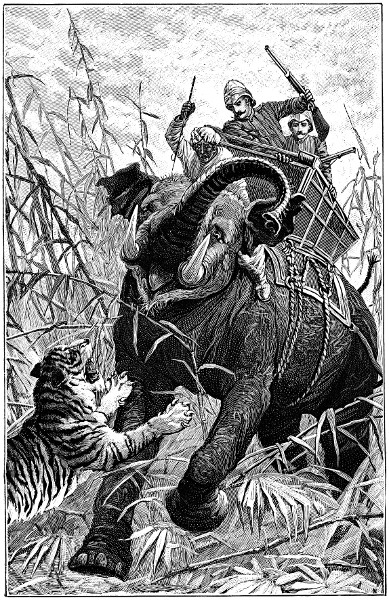
An Intrepid Hunter. Captain Brown in his "Natural History of Animals" tells a thrilling story of an adventure of Lieutenant Collet, of the Bombay army, who having heard that a very large tiger had destroyed seven inhabitants of an adjacent village, resolved, with another officer, to attempt the destruction of the monster. Having ordered seven elephants, they went in quest of the animal, which they found sleeping beneath a bush. Roused by the noise of the elephants, he made a furious charge upon them, and Lieutenant Collet's elephant received him on her shoulder, the other six having turned about, and run off, notwithstanding the exertions of their riders. The elephant shook off the tiger, and Lieutenant Collet having fired two balls at him, he fell; but, again recovering himself, he made a spring at the lieutenant. Having missed his object, he seized the elephant by the hind leg, and, having received a kick from her, and another ball, he let go his hold, and fell a second time. Supposing that he was now disabled, Collet very rashly dismounted, with the resolution of killing him with his pistols; but the tiger, who had only been crouching to take another spring, flew upon the lieutenant, and caught him in his mouth. The strength and intrepidity of the lieutenant, however, did not forsake him: he immediately fired his pistol into the tiger's body, and, finding that this had no effect, disengaged his arms with all his force, and, directing the other pistol to his heart, he at last destroyed him, after receiving twenty-five severe wounds.
The Leopard. The Leopard, who is also known as the panther, belongs to Asia and Africa. He is distinguished by the beauty of his coat which is of a rich fawn colour, graduating to white underneath his belly. It is covered with spots or clusters of marks which resemble the form of a rose. He is an agile climber and a terror to goats, sheep, monkeys and all lesser animals, but shows no special hostility to man unless attacked or cornered.
The Leopard's Tenacity of Life. Like other members of the cat family the Leopard shows remarkable tenacity of life. Whether like the domestic cat he has nine lives or not, he certainly takes a great deal of killing.
The following account is from the pen of an eye-witness quoted from Captain Brown's "Natural History of Animals".—"I was at Jaffna, at the northern extremity of the Island of Ceylon, in the beginning of the year 1819, when, one morning, my servant called me an hour or two before my usual time, with 'Master, master! people sent for master's dogs—tiger in the town!' There are no real tigers in Ceylon; but leopards or panthers are always called so, and by ourselves as well as by the natives. This turned out to be a panther. My gun chanced not to be put together; and, while my servant was doing it, the collector and two medical men, who had recently arrived, in consequence of the cholera morbus having just then reached Ceylon from the Continent, came to my door, the former armed with a fowling-piece, and the two latter with remarkably blunt hog-spears. They insisted upon setting off, without waiting for my gun,—a proceeding not much to my taste. The tiger (I must continue to call him so) had taken refuge in a hut, the roof of which, like those of Ceylon huts in general, spread to the ground like an umbrella; the only aperture into it was a small door, about four feet high. The collector wanted to get the tiger out at once. I begged to wait for my gun; but no—the fowling-piece, (loaded with ball, of course,) and the two hog-spears, were quite enough. I got a hedge-stake, and awaited my fate, from very shame. At this moment, to my great delight, there arrived from the fort an English officer, two artillery-men, and a Malay captain; and a pretty figure we should have cut without them, as the event will show. I was now quite ready to attack, and my gun came a minute afterwards. The whole scene which follows took place within an enclosure, about twenty feet square, formed, on three sides, by a strong fence of palmyra leaves, and on the fourth by the hut. At the door of this, the two artillery-men planted themselves: and the Malay captain got at the top, to frighten the tiger out, by worrying it—an easy operation, as the huts there are covered with cocoa-nut leaves. One of the artillery-men wanted to go in to the tiger, but we would not suffer it. At last the beast sprang. This man received him on his bayonet, which he thrust apparently down his throat, firing his piece at the same moment. The bayonet broke off short, leaving less than three inches on the musket; the rest remained in the animal, but was invisible to us. The shot probably went through his cheek, for it certainly did not seriously injure him, as he instantly rose upon his legs, with a loud roar, and placed his paws upon the soldier's breast. At this moment, the animal appeared to me to about reach the centre of the man's face; but I had scarcely time to observe this, when the tiger, stooping his head, seized the soldier's arm in his mouth, turned him half round staggering, threw him over on his back, and fell upon him. Our dread now was, that, if we fired upon the tiger, we might kill the man. For a moment, there was a pause, when his comrade attacked the beast exactly in the same manner as the gallant fellow himself had done. He struck his bayonet into his head; the tiger rose at him—he fired; and this time the ball took effect, and in the head. The animal staggered backwards, and we all poured in our fire. He still kicked and writhed; when the gentlemen with the hog-spears advanced, and fixed him, while he was finished by some natives beating him on the head with hedge-stakes. The brave artilleryman was, after all, but slightly hurt: He claimed the skin, which was very cheerfully given to him. There was, however, a cry among the natives, that the head should be cut off: it was; and, in so doing, the knife came directly across the bayonet. The animal measured little less than four feet, from the root of the tail to the muzzle. There was no tradition of a tiger having been in Jaffna before. Indeed, this one must have either come a distance of almost twenty miles, or have swam across an arm of the sea nearly two miles in breadth; for Jaffna stands on a peninsula, on which there is no jungle of any magnitude."
Hunters Hunted. Captain Brown gives a thrilling story of an adventure which befell two Boers in South Africa in 1822. They were returning from a hunting excursion, when they unexpectedly fell in with a leopard in a mountain ravine, and immediately gave chase to him. The animal at first endeavoured to escape, by clambering up a precipice, but, being hotly pressed, and slightly wounded by a musket-ball, he turned upon his pursuers, with that frantic ferocity, which, on such emergencies, he frequently displays, and, springing upon the man who had fired at him, tore him from his horse to the ground, biting him at the same time very severely on the shoulder, and tearing his face and arms with his claws. The other hunter, seeing the danger of his comrade, sprang from his horse, and attempted to shoot the leopard through the head; but, whether owing to trepidation, or the fear of wounding his friend, or the sudden motions of the animal, he unfortunately missed his aim. The leopard, abandoning his prostrate enemy darted with redoubled fury upon this second antagonist; and so fierce and sudden was his onset, that before the Boer could stab him with his hunting-knife, he had struck him in the face with his claws, and torn the scalp over his forehead. In this frightful condition, the hunter grappled with the raging beast, and, struggling for life, they rolled together down a steep declivity. All this passed so rapidly that the other man had scarcely time to recover from the confusion into which his feline foe had thrown him, to seize his gun and rush forward to aid his comrade, when he beheld them rolling together down the steep bank, in mortal conflict. In a few moments he was at the bottom with them, but too late to save the life of his friend, who had so gallantly defended him. The leopard had torn open the jugular vein, and so dreadfully mangled the throat of the unfortunate man, that his death was inevitable; and his comrade had only the melancholy satisfaction of completing the destruction of the savage beast, which was already much exhausted by several deep wounds it had received in the breast, from the desperate knife of the expiring huntsman."
The Jaguar. The Jaguar, otherwise known as the American Leopard, belongs to the forests of South America, and has many points of difference from as well as some of similarity with the Leopard of Asia. Though ferocious in his wild state, he is amenable to civilizing influences and becomes mild and tame in captivity. He is an excellent swimmer and an expert climber, ascending to the tops of high branchless trees by fixing his claws in the trunks. It is said that he can hunt in the trees almost as well as he can upon the ground, and that hence he becomes a formidable enemy to the monkeys. He is also a clever fisherman, his method being that of dropping saliva on to the surface of the water, and upon the approach of a fish, by a dexterous stroke of his paw knocking it out of the water on to the bank. D'Azara, says: "He is a very ferocious animal causing great destruction among horses and asses. He is extremely fond of eggs, and goes to the shores frequented by turtles, and digs their eggs out of the sand."
The Strength of the Jaguar. The strength of the Jaguar is very great, and as he can climb, swim, and leap a great distance, he is almost equally formidable in three elements. He is said to attack the alligator and to banquet with evident relish off his victim. D'Azara says that on one occasion he found a Jaguar feasting upon a horse which it had killed. The Jaguar fled at his approach, whereupon he had the body of the horse dragged to within a musket shot of a tree in which he purposed watching for the Jaguar's return. While temporarily absent he left a man to keep watch, and while he was away the jaguar reappeared from the opposite side of a river which was both deep and broad. Having crossed the river the animal approached, and seizing the body of the horse with his teeth dragged it some sixty paces to the water side, plunged in with it, swam across the river, pulled it out upon the other side, and carried it into a neighbouring wood.
A Night of Horror. Mrs. Bowdich tells a story of two early settlers in the Western States of America, a man and his wife, who closed their wooden hut, and went to pay a visit at a distance, leaving a freshly-killed piece of venison hanging inside. "The gable end of this house was not boarded up as high as the roof, but a large aperture was left for light and air. By taking an enormous leap, a hungry jaguar, attracted by the smell of the venison, had entered the hut and devoured part of it. He was disturbed by the return of the owners, and took his departure. The venison was removed. The husband went away the night after to a distance, and left his wife alone in the hut. She had not been long in bed before she heard the jaguar leap in at the open gable. There was no door between her room and that in which he had entered, and she knew not how to protect herself. She, however, screamed as loudly as she could, and made all the violent noises she could think of, which served to frighten him away at that time; but she knew he would come again, and she must be prepared for him. She tried to make a large fire, but the wood was expended. She thought of rolling herself up in the bedclothes, but these would be torn off. The idea of getting under the low bedstead suggested itself, but she felt sure a paw would be stretched forth which would drag her out. Her husband had taken all their firearms. At last, as she heard the jaguar scrambling up the end of the house, in despair she got into a large store chest, the lid of which closed with a spring. Scarcely was she within it, and had dragged the lid down, inserting her fingers between it and the side of the chest, when the jaguar discovered where she was. He smelt round the chest, tried to get his head in through the crack, but fortunately he could not raise the lid. He found her fingers and began to lick them; she felt them bleed, but did not dare to move them for fear she should be suffocated. At length the jaguar leaped on to the lid, and his weight pressing down the lid, fractured her fingers. Still she could not move. He smelt round again, he pulled, he leaped on and off, till at last getting tired of his vain efforts, he went away. The poor woman lay there till daybreak, and then only feeling safe from her enemy, she went as fast as her strength would let her to her nearest neighbour's a distance of two miles, where she procured help for her wounded fingers, which were long in getting well. On his return, her husband found a male and female jaguar with their cubs, in the forest close by, and all were destroyed."
The Puma. The Puma, or American lion, is known by several names. It is sometimes called a panther, or colloquially a "painter", and sometimes a cougar. It resembles the lioness somewhat in appearance, especially about the head, though it is smaller and less powerful. Its length varies from four feet to four feet and a half, and its colour is that of the fox, graduating in parts to white. Like the lion it inhabits plains rather than forests;—in the marshy districts, and on the borders of rivers in the south, and in the swamps and prairies of the northern districts. It lives on such wild and domestic animals as come within its reach, lying at full length upon the lower branches of trees, and dropping upon its victims as they pass beneath. Deer and cattle of all kinds it attacks, and, not content with killing enough for immediate purposes, destroys large numbers, sucking small quantities of blood from each. According to Sir William Jardine it is exceedingly destructive among sheep and has been known to kill fifty in one night. The Puma is, however, easily tamed and becomes very docile under kindly treatment. Edward Kean kept a tame one which followed him about like a dog and was as playful as a kitten.
The Puma's Ferocity. "Molina and D'Azara say," says Sir William Jardine, "that the puma will flee from men, and that its timidity renders its pursuit generally free from danger." The following incident given by Sir William Jardine and at greater length by Captain Brown, shows that this is not always the case. According to these accounts, two hunters visited the Katskills in pursuit of game, each armed with a gun and accompanied by a dog. They agreed to follow contrary directions round the base of a hill, and to join each other immediately upon hearing the report of a gun. Shortly after parting, one of the friends heard the gun of his comrade and hastening to his assistance came first upon the body of his friend's dog, torn and lacerated; proceeding further, his attention was attracted by the growl of a wild animal, and looking up, he discovered a large puma crouching over the body of his friend, upon the branch of a tree. The animal glared at him, and he, knowing the rapidity of the Puma's movements, immediately raised his gun and fired, whereupon the puma rolled over on to the ground with his prey. The dog flew at the infuriated beast, but one blow from the puma's paw silenced him for ever. Seeing that his comrade was dead the hunter left the scene in search of assistance, upon securing which, he returned to find the puma dead, beside the two dogs and the hunter whom he had killed.
Animals and Men. Captain Head, in his "Journey Across the Pampas" says:—"The fear which all wild animals in America have of man is very singularly seen in the Pampas. I often rode towards the ostriches and zamas, crouching under the opposite side of my horse's neck; but I always found that, although they would allow my loose horse to approach them, they, even when young, ran from me, though little of my figure was visible; and when I saw them all enjoying themselves in such full liberty, it was at first not pleasing to observe that one's appearance was everywhere a signal to them that they should fly from their enemy. Yet it is by this fear 'that man hath dominion over the beasts of the field,' and there is no animal in South America that does not acknowledge this instinctive feeling. As a singular proof of the above, and of the difference between the wild beasts of America and of the old world, I will venture to relate a circumstance which a man sincerely assured me had happened to him in South America:—He was trying to shoot some wild ducks, and, in order to approach them unperceived, he put the corner of his poncho (which is a sort of long narrow blanket) over his head, and crawling along the ground upon his hands and knees, the poncho not only covered his body, but trailed along the ground behind him. As he was thus creeping by a large bush of reeds, he heard a loud, sudden noise, between a bark and a roar: he felt something heavy strike his feet, and, instantly jumping up, he saw, to his astonishment, a large puma actually standing on his poncho; and, perhaps, the animal was equally astonished to find himself in the immediate presence of so athletic a man. The man told me he was unwilling to fire, as his gun was loaded with very small shot; and he therefore remained motionless, the puma standing on his poncho for many seconds; at last the creature turned his head, and walking very slowly away about ten yards, he stopped, and turned again: the man still maintained his ground, upon which the puma tacitly acknowledged his supremacy, and walked off."
The Ocelot. The Ocelot is a native of South America and one of the most beautiful of the Cat family. It is smaller than the Leopard, attaining to about three feet in length, and eighteen inches in height. Its colour is grey, tinged with fawn and the body and legs are covered with longitudinal chainlike stripes broken into patches of some inches. Its habits are like those of its near relations, the Leopard and the Jaguar, though its appetite for blood makes it perhaps even more destructive. It will suck blood with the greatest avidity and frequently leave a carcase otherwise untouched in order to pursue other animals for the sake of more blood. When tame the Ocelot is remarkably playful, climbing up the legs and nestling in the arms of its benefactors. It is apt to be dangerous in a poultry yard but will keep good friends with a house dog, and play, somewhat roughly, perhaps, but without malice, with children.
The Clouded Tiger. This animal belongs to Sumatra where it lives upon the forest birds. Like the Ocelot it is exceedingly playful when tame, seeking the notice and returning the caresses of all who encourage it.
The Serval. "The Serval," says Captain Brown, "is somewhat larger than the ordinary wild cat. Its general colour is a pale fulvous yellow. It resides on trees, where it makes a bed, and breeds its young. It seldom appears on the ground, living principally on birds, squirrels, and small animals; it is extremely agile, and leaps, with great rapidity, from one branch to another. The serval never assaults man, but rather endeavours to avoid him; if, however, it is compelled to attack, it darts furiously on its antagonist, and bites and tears, like the rest of the cat kind."
The Common Wild Cat. The common wild cat is one of the few wild animals still to be found in the British Isles. Up till recent years these cats were observed among the woody mountainous districts of Cumberland and Westmoreland and in the wild parts of Scotland and Ireland, though as the land is brought more and more under cultivation they decrease in numbers, failing suitable asylum. They abound in the forests of Germany and Russia, where they live in the hollows of trees and caves of rocks, and feed on birds, squirrels, hares and rabbits, and will even attack young lambs and fawns. The wild cat is not to be confused with the domestic cat which has relapsed into a wild state. "In the form and shape of the tail," says Sir William Jardine, "this animal somewhat resembles the Lynx. The fur is very thick, woolly and long. The general colour is a greyish yellow, in some specimens inclining much to a shade of bluish grey."—"They spring," says Mrs. Bowdich, "furiously upon whoever approaches, and utter unearthly cries. Mr. St. John, when walking up to his knees in heather over broken ground, came suddenly upon a wild cat. She rushed out between his legs, every hair standing up. He cut a good-sized stick; and three Skye terriers gave chase till she took refuge in a corner, spitting and growling. On trying to dislodge her, she flew at Mr. St. John's face, over the dogs' heads; but he struck her while in the air, and she fell among the dogs, who soon despatched her, even though it has been said that a wild cat has twelve instead of nine lives. If one of these animals is taken, those in the neighbourhood are sure to be also secured, as they will all, after the manner of foxes, assemble round the body of their relative."
The Domestic Cat. The origin of the domestic cat is difficult to determine. Cats were numerous in Egypt from an early date, and are said to be native to Syria. According to Professor Rolleston the cat was not domesticated anywhere, except in Egypt, before the Christian Era. Few animals are more familiar to the general reader, and few therefore, need less description. The "Tabby" is perhaps the commonest, though black, white, and tortoise-shell varieties abound. The Angora or Angola cat, the Persian cat, and the Manx cat, which latter is deficient in the useful and ornamental embellishment of a tail, are also well known.
Cat Superstitions. There are many superstitions concerning the cat, the black variety coming in for the larger share of popular suspicion. To steal one and bury it alive was at one time regarded as a specific against cattle disease in the Irish Highlands, while, according to Captain Brown, it was the practice for families in Scotland to tie up their cats on Hallowe'en to prevent their use for equestrian purposes by witches during the night. "They have always been regarded as attendants upon witches," says Mrs. Bowdich, "and witches themselves have been said to borrow their shapes when on their mysterious expeditions. I was once told that Lord Cochrane was accompanied by a favourite black cat in a cruise through the northern seas. The weather had been most unpropitious; no day had passed without some untoward circumstance; and the sailors were not slow in attributing the whole to the influence of the black cat on board. This came to Lord Cochrane's ears, and knowing that any attempt to reason his men out of so absurd a notion was perfectly useless, he offered to sacrifice this object of his regard, and have her thrown overboard. This, however, far from creating any satisfaction, only alarmed the men still more. They were sure that the tempests she would then raise would be much worse than any they had yet encountered; and they implored his lordship to let her remain unmolested. 'There was no help, and they could only hope, if she were not affronted, they might at the end of their time reach England in safety.'"
The Cat as a Hunter. "The cat," says the Rev. J. G. Wood, "is familiarly known to us as a persevering mouse-hunter. So strong, indeed, is the passion for hunting in the breast of the cat, that she sometimes disdains mice, 'and such small deer,' and trespasses on warrens or preserves. A large tabby cat, residing at no great distance from White Horse Vale, was accustomed to go out poaching in the preserves of a neighbouring nobleman, and so expert was she at this illegal sport that she constantly returned bearing in her mouth a leveret or a partridge, which she insisted on presenting to her mistress, who in vain endeavoured to check her marauding propensities. These exploits, however, brought their own punishment; for one day, when in the act of seizing a leveret, she found herself caught in a vermin trap, which deprived her of one of her hind legs. This misfortune did not damp her enthusiasm for hunting, as, although the loss of a leg prevented her from chasing hares, and suchlike animals, she would still bring in an occasional rat."
The Cat and her Young. "A cat, which had a numerous litter of kittens," says Captain Brown, "one sunny day encouraged her little ones to frolic in the vernal beams of noon, about the stable door, where she was domiciled. While she was joining them in a thousand tricks and gambols, a large hawk, who was sailing above the barn-yard, in a moment darted upon one of the kittens, and would have as quickly borne it off, but for the courageous mother, who, seeing the danger of her offspring, sprang on the common enemy, who, to defend itself, let fall the prize. The battle presently became severe to both parties. The hawk, by the power of his wings, the sharpness of his talons, and the strength of his beak, had for a while the advantage, cruelly lacerating the poor cat, and had actually deprived her of one eye in the conflict; but puss, no way daunted at the accident, strove, with all her cunning and agility, for her kittens, till she had broken the wing of her adversary. In this state, she got him more within the power of her claws, and availing herself of this advantage, by an instantaneous exertion, she laid the hawk motionless beneath her feet; and, as if exulting in the victory, tore the head off the vanquished tyrant. This accomplished, disregarding the loss of her eye, she ran to the bleeding kitten, licked the wounds made by the hawk's talons in its tender sides, and purred whilst she caressed her liberated offspring."
The Cat as a Foster Mother. The female cat seems to be in a special sense a born mother. She is assiduous in the care of her own young and singularly ready to extend the benefits of motherhood even to alien offspring. Instances are on record in which cats have reared squirrels, dogs, leverets, rats, ducks, chickens, and even small birds. These have usually occurred at times when the cats have been deprived of their own young. Mr. T. Foggitt says: "A cat belonging to the Albert Dock Warehouse, Liverpool, gave birth to six kittens. It was deemed necessary to destroy four of them, and they were accordingly drowned. The remaining two were placed, along with their mother, in some loose cotton, collected for the purpose in a box, in one of the warehouse rooms. On removing the box a few mornings after, to give puss her usual breakfast, great curiosity was excited on seeing a third added to the number; and the astonishment was still greater when the third was discovered to be a young rat which the cat had taken from its nest in the night-time, and brought home as a companion to the kittens she was then nursing. The young rat was very lively, and was treated by the cat with the same attention and care as if it were one of her own offspring."
The Cat as a Traveller. The distances that cats will travel, finding their way with unerring instinct many miles across country of which there seems no reason to suppose them to have had previous knowledge is very remarkable. Mrs. Bowdich records the case of a cat who disliking her new home, returned to her old one, in doing which, she had to cross two rivers, one of them about eighty feet broad and two feet and a half deep, running strong; the other wider and more rapid, but less deep. Cats are said to have found their way from Edinburgh to Glasgow, and one to the writer's knowledge returned from Dover to Canterbury after being carried from thence by rail. Captain Brown gives the following remarkable instance. In June, 1825, a farmer, residing in the neighbourhood of Ross, sent a load of grain to Gloucester, a distance of about sixteen miles. The waggoners loaded in the evening, and started early in the morning. On unloading at Gloucester, a favourite cat, belonging to the farmer, was found among the sacks, with two kittens of very recent birth. The waggoner very humanely placed puss and her young in a hay-loft, where he expected they would remain in safety, until he should be ready to depart for home. On his return to the loft shortly afterwards, neither cat nor kittens were to be found, and he reluctantly left town without them. Next morning the cat entered the kitchen of her master's house with one kitten in her mouth. It was dead; but she placed it before the fire, and without seeking food, or indulging, for a moment, in the genial warmth of her domestic hearth, disappeared again. In a short time she returned with the other kitten, laid it down by the first, stretched herself beside them, and instantly expired! The poor creature could have carried but one at a time, and, consequently, must have travelled three times over the whole line of her journey, and performed forty-eight miles in less than twelve hours.
The Cat as Sportsman. The favourite food of the cat is fish, which curiously enough inhabits an element to which the cat has a great aversion. There are, however, numerous instances on record of cats which have overcome their natural antipathy to water in order to gratify their natural taste for fish. An extraordinary case of this kind is recorded in the Plymouth Journal, June, 1828:—"There is now at the battery on the Devil's Point, a cat, which is an expert catcher of the finny tribe, being in the constant habit of diving into the sea, and bringing up the fish alive in her mouth, and depositing them in the guard-room, for the use of the soldiers. She is now seven years old, and has long been a useful caterer. It is supposed that her pursuit of the water-rats first taught her to venture into the water, to which it is well known puss has a natural aversion. She is as fond of the water as a Newfoundland dog, and takes her regular peregrinations along the rocks at its edge, looking out for her prey, ready to dive for them at a moment's notice."
Mr. Beverley R. Morris says: "When living in Worcester many years ago, I remember frequently seeing the cat of a near neighbour of ours bring fish, mostly eels, into the house, which it used to catch in a pond not far off. This was an almost everyday occurrence."
The Cat's Intelligence. Many remarkable illustrations might be given of the sagacity and intelligence of the cat. A lady had for many years been the possessor of a cat and a canary bird, who became the closest friends, never bearing any lengthy separation from each other, and spending their whole time in each other's society. One summer day the lady was sitting working in her drawing-room, and the cat and bird were a short distance off. Suddenly, without a moment's deliberation, the cat, to the great astonishment of the lady, uttered a loud growl, and then, seizing her little playmate in her mouth, darted off with it to a place of safety. A strange cat had entered the room and the friendly one had adopted this plan of saving the bird from the enemy. A still more remarkable illustration of the intelligence of a cat is given by De la Croix as follows: "I once saw," says he, "a lecturer upon experimental philosophy place a cat under the glass receiver of an air-pump, for the purpose of demonstrating that very certain fact, that life cannot be supported without air and respiration. The lecturer had already made several strokes with the piston, in order to exhaust the receiver of its air, when the animal, who began to feel herself very uncomfortable in the rarefied atmosphere, was fortunate enough to discover the source from which her uneasiness proceeded. She placed her paw upon the hole through which the air escaped, and thus prevented any more from passing out of the receiver. All the exertions of the philosopher were now unavailing; in vain he drew the piston; the cat's paw effectually prevented its operation. Hoping to effect his purpose, he let air again into the receiver, which, as soon as the cat perceived, she withdrew her paw from the aperture; but whenever he attempted to exhaust the receiver, she applied her paw as before. All the spectators clapped their hands in admiration of the wonderful sagacity of the animal, and the lecturer found himself under the necessity of liberating her, and substituting in her place another, that possessed less penetration, and enabled him to exhibit the cruel experiment."
The Lynx. The several species of the Lynx belong to the genus Lyncus, the principle varieties of which are the Canada Lynx, and the European Lynx. The Lynx has short legs, and is generally about the size of a fox, attaining often to three feet in length. It preys upon small quadrupeds and birds, in the pursuit of which it is an expert climber. The Canada Lynx preys largely upon the American hare, which it is well qualified to hunt. The Lynx is distinguished by a peculiar gait, for unlike other animals, it bounds with, and alights upon, all four feet at once. The ears are erect, and tipped with a long pencil of black hair. The fur which is long and thick is of a pale grey colour, with a reddish tinge, marked with dusky spots on the upper part of the body. The under parts are white. The European Lynx feeds upon small animals and birds. The fur of the lynx is valuable, on account of its great softness and warmth, and is in consequence an extensive article of commerce. It inhabits the northern parts of Europe, Asia, and America; and prefers cold or temperate climates, differing in this respect from most of the cat tribe.
The Chetah. The Chetah or Hunting Leopard is the one species of the genus Cynœlurus. It is a handsome animal and capable of considerable training. According to Mr. Benet's description it is "intermediate in size between the leopard and the hound, more slender in its body, more elevated in its legs, and less flattened on the fore part of its head than the leopard, while deficient in the peculiarly graceful and lengthened form, both of head and body, which characterizes the hound." "The ground colour of the Chetah is a bright yellowish fawn above, and nearly pure white beneath; covered above, and on the sides, by innumerable closely approximating spots, from half an inch to an inch in diameter, which are intensely black, and do not, as in the leopard and other spotted cats, form roses with a lighter centre, but are full and complete." The Chetah is found in India and Africa but it is only in India that it is trained for hunting purposes. Sir William Jardine says: "the employment of the hunting leopard may be compared to the sport of falconry. The natural instinct teaches them to pursue the game, the reward of a portion of it, or of the blood, induces them to give it up, and again subject themselves to their master."
The Chetah as a Huntsman. The practice of employing animals to hunt animals is of very early origin, and the docility of the Chetah early marked him out as a suitable ally in the chase. Chetahs are so gentle that they can be led about in a leash like greyhounds. The following description of a hunt is from "The Naturalist's Library". "Just before we reached our ground, the shuter suwars (camel courier), who always moved on our flanks in search of game, reported a herd of antelopes, about a mile out of the line of march, and the Chetahs being at hand, we went in pursuit of them. The leopards are each accommodated with a flat-topped cart, without sides, drawn by two bullocks, and each animal has two attendants. They are loosely bound by a collar and rope to the back of the vehicle, and are also held by the keeper by a strap round the loins. A leathern hood covers the eyes. On entering from a cotton field, we came in sight of four antelopes, and my driver managed to get within a hundred yards of them before they took alarm. The Chetah was quickly unhooded and loosed from his bonds; and, as soon as he viewed the deer, he dropped quietly off the cart on the opposite side to that on which they stood, and approached them at a slow crouching canter, masking himself by every bush, and inequality, which lay in his way. As soon, however, as the deer began to show alarm, he quickened his pace and was in the midst of them in a few bounds. He singled out a doe, and ran it close for about 200 yards, when he reached it with a blow of his paw, rolled it over, and in an instant was sucking the life blood from its throat." "As soon as the deer is pulled," says the same account, "a keeper runs up, hoods the Chetah, cuts the victim's throat, and securing some of the blood in a wooden ladle, thrusts it under the leopard's nose. The antelope is then dragged away and placed in a receptacle under the hatchery, while the Chetah is rewarded with a leg for his pains."
The Civits. The family Viverridæ includes a large number of species of small carnivorous animals of which the Civits and the Ichneumons are the best known. They belong chiefly to Africa and South Asia, but some are found in the south of Europe. The African Civit hails from Gaboon and Abyssinia and the Asiatic variety from Bengal, Nepaul, China and Formosa. It is from these animals that we get the fatty substance, used in perfumery and known as civit. Of this Mr. Piesse says: "In its pure state, civit has to nearly all persons a most disgusting odour, but when diluted to an infinitesimal portion its perfume is agreeable. The Genet, and the Paradoxure are other genera of this family."
The Ichneumon. The Ichneumon numbers some fifteen genera, and sixty species. The best known of these is the grey Ichneumon which comes from India or adjacent countries. Naturally savage it soon becomes tame under kindly treatment. It seems to have a natural enmity towards serpents, which it attacks and destroys. The Mahrattas say that it neutralizes the effects of snake bites by eating the root of the monguswail. Captain Brown records an experiment in which the ichneumon was placed in a room with a poisonous serpent which it tried to avoid. On the two being removed to the open air, the ichneumon is said to have immediately darted at the serpent and destroyed it, afterwards retiring to the wood and eating a portion of the plant said to be an antidote to the serpent's venom. The Ichneumon is about the size of the domestic cat and of a dark silver grey colour. The Egyptian Ichneumon much resembles the cat in its habits and manners and is so deadly a foe to reptiles and vermin, that it is domesticated with a view to their destruction. It is remarkably quick in its movements, darting with unerring aim at the head of the reptile it attacks. It displays also the cat's patience in watching for its prey. It has a great liking for crocodile's eggs and with remarkable instinct unearths them from the banks of rivers where they have been deposited.
Dormant Instinct. Though perfectly tame in captivity, the natural instincts of the ichneumon are only dormant, as the following illustration will show. M. d'Obsonville says, in his "Essay on the Nature of Various Animals", "I had an ichneumon very young, which I brought up. I fed it at first with milk, and afterwards with baked meat, mixed with rice. It soon became even tamer than a cat; for it came when called, and followed me, though at liberty, into the country. One day I brought to him a small water serpent alive, being desirous to know how far his instinct would carry him, against a being with which he was hitherto totally unacquainted. His first emotion seemed to be astonishment, mixed with anger: for his hair became erect; but in an instant after, he slipped behind the reptile, and, with remarkable swiftness and agility, leaped upon its head, seized it, and crushed it between his teeth. This essay, and new aliment, seemed to have awakened in him his innate and destructive voracity, which, till then, had given way to the gentleness he had acquired from his education. I had about my house several curious kinds of fowls, among which he had been brought up, and which, till then, he had suffered to go and come unmolested and unregarded; but, a few days after, when he found himself alone, he strangled them every one, eat a little, and, as it appeared, drank the blood of two."
The Aard Wolf. The Aard Wolf of South Africa, is the sole genus and species of the Protelidæ family. It much resembles the hyæna in appearance and habit, and feeds on carrion and white ants.
The Hyæna. The Hyæna, though long treated as a member of the dog family, is now separately classified as the Hyænidæ, a family of one genus and three species, all of which are found in Africa. The Hyæna is also found in Egypt, Arabia, Persia and other parts of Asia. He has immensely powerful teeth with which he can crush the bones of his victims, apparently eating bones and flesh with impunity. He is nocturnal in his habits, living in caves and hollows in the day time and prowling about at night in search of prey. Speaking of the Barbary hyæna Bruce says:—"He seems to be stupid or senseless in the day, or at the appearance of strong light, unless when pursued by hunters. I have locked up a goat, a kid, and a lamb, with him all day when he was fasting, and found them in the evening alive and unhurt." The principle varieties are the striped Hyæna, and the spotted Hyæna. Bruce speaking of the former says, "he is brutish, indolent, slovenly and impudent and seems to possess much the manners of the wolf. His courage appears to proceed from an insatiable appetite, and has nothing of the brave or generous in it, and he dies oftener flying than fighting." The cry of the hyæna, sometimes called a laugh, begins with a moan and ends with a demoniacal shriek which has been variously described by travellers but which all agree in calling hideous and disgusting. In size he resembles a large mastiff, but the formation of his neck and jaws give him a power far beyond that of other animals of his size. Whatever fear he may have of man, he has none of other animals and will even face the lion. Bruce speaks of his special liking for the flesh of the dog and of the dog's reluctance to face him. "My greyhounds, accustomed to fasten upon the wild boar, would not venture to engage with him. On the contrary, there was not a journey I made that he did not kill several of my greyhounds, and once or twice robbed me of my whole stock: he would seek and seize them in the servants' tents where they were tied, and endeavour to carry them away before the very people that were guarding them." His coat is covered with long coarse hairs of a dirty grey colour, which form a mane the length of his back, his sides being striped or spotted, according to the species. The hyæna for all his repulsiveness serves a useful purpose, as a scavenger, devouring all the offal which comes in its way, including the dead of his own species which no other animal will touch. The hyæna can be tamed and taught to follow its master and to hunt other animals.
The Striped Hyæna. Bruce tells the following story of the impudence of the striped hyæna. "One night in Maitsha, being very intent on observation, I heard something pass behind me towards the bed, but upon looking round could perceive nothing. Having finished what I was then about, I went out of my tent, resolving directly to return, which I immediately did, when I perceived large blue eyes glaring at me in the dark. I called upon my servant with a light; and there was the hyæna standing nigh the head of the bed, with two or three large bunches of candles in his mouth. To have fired at him, I was in danger of breaking my quadrant or other furniture; and he seemed, by keeping the candles steadily in his mouth, to wish for no other prey at that time. As his mouth was full, and he had no claws to tear with, I was not afraid of him, but with a pike struck him as near the heart as I could judge. It was not till then he showed any sign. of fierceness; but, upon feeling his wound, he let drop the candles, and endeavoured to run up the shaft of the spear to arrive at me; so that, in self-defence, I was obliged to draw out a pistol from my girdle and shoot him, and nearly at the same time my servant cleft his skull with a battle-axe. In a word, the hyæna was the plague of our lives, the terror of our night-walks, the destruction of our mules and asses, which above all others are his favourite food."
The Spotted Hyæna. The spotted hyæna belongs to South Africa and seems to possess more daring than his cousin of Abyssinia, and to show a greater preference for human food. According to Mr. Stepstone, the Mambookies build their houses in the form of a beehive from eighteen to twenty feet in diameter, placing a raised platform at the back and leaving the front-area for the accommodation of the calves at night. Thus the animals are nearest to the door, notwithstanding which the hyæna will "pass by the calves and take the children from under the mother's kaross; and this in such a gentle and cautious manner, that the poor parent is unconscious of her loss, until the cries of her little innocent have reached her from without, when it has been a close prisoner in the jaws of the monster." Many years ago, when animals were kept at the Tower of London, the den of a spotted hyæna required some repair. "The carpenter," says Mrs. Bowdich, "nailed a thick oaken plank upon the floor, about seven feet long, putting at least a dozen nails into it, each longer than his middle finger. At one end of this piece of wood there was a small projection, and not having a proper chisel with him by which he might remove it, the man returned to his shop to fetch one. While he was absent some persons came to see the animals, and the hyæna was let down by the keeper into the part of the den in which the carpenter had been at work. Directly the beast saw the projecting piece of wood he seized it with his teeth, tore the plank up, and drew out every nail with the utmost ease; which action will give a good idea of the muscular strength of this creature."
A Narrow Escape. Sparrman tells an amusing story of the daring and the fright of a hyæna, as follows: "One night, at a feast near the Cape, a trumpeter who had made himself drunk with liquor was carried out of doors and laid on the grass, in order that the air might both cool and sober him. The scent of the man soon attracted a spotted hyæna, which threw him on his back, and carried him away towards Table Mountain. The hyæna doubtless supposed that the senseless drunkard was a corpse, and consequently a fair prize. In the meantime the musician awoke, and was at once sufficiently sensible to know the danger of his situation, and to sound the alarm with his trumpet, which he fortunately carried at his side. The hyæna, as it may be imagined, was greatly frightened in its turn, and immediately ran away, leaving the trumpeter, it is to be hoped, 'a wiser man' for his extraordinary ride. It is remarkable that the soldier was not seriously injured by the hyæna, for the teeth of the animal were fortunately fastened in the coat and not in the flesh of the man."
Animals of the Dog Kind. Animals of the dog kind, are neither so numerous, nor, in general, so ferocious as those of the panther or cat kind. The principal species are the wolf, the jackal, the fox, and the dog. This class may be principally distinguished by their claws, which have no sheath like those of the cat kind, but are placed at the point of each toe, without the capability of being stretched forward or drawn back. The nose, as well as the jaw, of all the dog kind, is longer than in the cat; the body in proportion more strongly made, and covered with hair instead of fur. They also far exceed the other kind in the sense of smell, the olfactory nerves being diffused upon a very extensive membrane within the skull, which accounts for their surprising acuteness in this sense.
The Wolf. The Wolf is about three feet and a half long, and about two feet and a half high, larger than our great breed of mastiffs, which are seldom more than three feet by two. He bears a great resemblance to the dog, but is much stronger, and the length of his hair contributes still more to his robust appearance. The feature which principally distinguishes the visage of the wolf from that of the dog, is the eye, which opens slantingly upwards in the same direction with the nose; whereas, in the dog, it opens more at right angles with the nose, as in man. The colour of the eyeballs in the wolf, is a fiery green, giving his visage a fierce and formidable air. He generally hides by day in the thickest coverts, and only ventures out at night; when, sallying forth over the country, he keeps peering round the villages, and carries off such animals as are not under protection—attacks the sheep-fold, scratches up and undermines the thresholds of doors where the sheep are housed, enters furiously, and destroys all before he begins to fix upon and carry off his prey. The wolf has great strength, particularly in his foreparts, and the muscles of his neck and jaws. He carries off a sheep in his mouth without letting it touch the ground, and runs with it much faster than the shepherds who pursue him; so that nothing but the dogs can overtake and oblige him to quit his prey. Notwithstanding his great strength, cunning, and agility, the wolf being the declared enemy of man, is often hard pressed for subsistence; he has always a gaunt and starved appearance, and, indeed, often dies of hunger. He has been hunted down, and is now rarely to be found in civilized countries.
The Fox. The Fox is of a much more slender make than the wolf, and not nearly so large, being little more than two feet long. The tail is longer and more bushy, the nose smaller, approaching nearer to that of the greyhound, and its hair softer. Its eyes, however, are obliquely set, like those of the wolf. The fox has long been famous for cunning; he is patient and prudent, and gains by address what is denied to his courage or strength. He is most destructive to poultry. When he gets into a farm-yard, he begins by levelling all the poultry without remorse, and carrying off a part of the spoil, he hides it at some convenient distance. Returning, he carries off another fowl, which he hides in like manner, but not in the same place; and this he repeats several times, until the approach of day, or the noise of the domestics, warns him to retire to his hole. He often destroys a large quantity of game, seizing the partridge and quail while sitting on their nests. He even eats rats, mice, serpents, toads, and lizards. In vain does the hedge-hog roll itself up into a ball to oppose him; he teases it until it is obliged to appear uncovered, and then devours it. Besides the common Fox (Vulpes Vulgaris), there are numerous varieties, of which the Tahaleb or Egyptian Fox and the Fennec (Feneca Zaarensis) of North Africa, the Kit Fox, the Red, the Grey and the Silver Fox of North America, and the Arctic Fox (Leucocyon lagopus) are the best known.
The Jackal. The Jackal, one of the most common of wild animals in the East, is about the size of the fox, but in shape it more nearly resembles the wolf. Its colour is a bright yellow, or sorrel. Its cry is a howl, mixed with barking, and a lamentation resembling that of human distress. The jackal may be considered as the vulture of the quadruped kind; the most putrid substances that once had life, are greedily devoured. Like the hyæna, the jackals scratch up with their feet the new-made grave, and devour the contents, however decomposed. While at this dreary work, they make a mournful cry, like that of children under chastisement, and having thus dug up the body, they amicably share it. In countries, therefore, where they abound, the people are obliged to beat the earth over the grave, and mix it with thorns, to prevent the jackals from scraping it away. The jackal never goes alone, but always in packs of forty or fifty together. They watch the burying-grounds, follow armies, and keep in the rear of caravans. The jackal, after having tired down its prey, is often deprived of the spoil by the lion, the panther, or the tiger, whose appetites are superior to their swiftness; these attend its call, and devour the prey which it has run down by its unceasing perseverance; and this circumstance has given rise to the erroneous opinion, that the jackal is the lion's provider. The jackal is found in some parts of Europe and abounds in most parts of Asia. Those of the warmest climates are the largest, and their colour is rather of a reddish brown than of that beautiful yellow by which the smaller jackals are distinguished. Like the Fox it forms burrows in the earth and emits an offensive odour.
The Wolf's Mode of Attack. "The Wolf," says Professor Duncan in "Cassell's Natural History", "usually lives in solitary places in mountains; but in Spain he is said sometimes to make his lair in corn-fields, in close proximity to inhabited dwellings. Here he lives with his wife and family, usually caché during the day, and issuing forth at night to take his prey. During the warmer periods of the year wolves, as a rule, hunt each one for himself, but in winter they often unite into great packs, and pursue their prey over the snow at a rapid pace and with indomitable perseverance. Swift and untiring must be the animal which, on an open plain, can escape from them; even the horse, perfectly constructed as he is for rapid running, is almost certain to succumb, unless he can reach a village before his pace begins to flag. They never spring upon an animal from an ambush—the nearest approach ever made to such a mode of attack being their practice of attacking sheepfolds by leaping into the midst of the flock and killing right and left; when they reach their prey, too, the first onslaught is made with their teeth, and never by a blow of the paw. Thus, a wolfs attack—like that of all members of the genus Canis—is entirely different from a cat's. The cat lies in ambush all alone, springs upon the passing prey, which if he misses he scarcely ever pursues, and kills by a blow of the paw. The dog and wolf attack openly, sometimes alone, but oftener in company, pursue their prey with unflagging energy until it falls a victim, and give the death-wound at once with their teeth."
The Wolf's Cunning. That the wolf sometimes employs cunning as well as savagery in seeking his prey is shown by the following story from "Broke's Travels in the North of Sweden": "I observed, on setting out from Sormjole, the last post, that the peasant who drove my sledge was armed with a cutlass; and, on inquiring the reason, was told that, the day preceding, while he was passing in his sledge the part of the forest we were then in, he had encountered a wolf, which was so daring, that it actually sprang over the hinder part of the sledge he was driving, and attempted to carry off a small dog which was sitting behind him. During my journey from Tornea to Stockholm, I heard everywhere of the ravages committed by wolves, not upon the human species or the cattle, but chiefly upon the peasants' dogs, considerable numbers of which had been devoured. I was told that these were the favourite prey of this animal; and that, in order to seize upon them with the greater ease, it puts itself into a crouching posture, and begins to play several antic tricks, to attract the attention of the poor dog, which, caught by these seeming demonstrations of friendship, and fancying it to be one of his own species, from the similarity, advances towards it to join in the gambols, and is carried off by its treacherous enemy. Several peasants that I conversed with mentioned their having been eye-witnesses of this circumstance."
The Wolf's Cowardice. Mr. Lloyd in his "Field Sports in the North of Europe" gives a remarkable illustration of the cowardice of the wolf when caught in a trap. "A peasant near St. Petersburg," says Mr. Lloyd, "when one day in his sledge, was pursued by eleven of these ferocious animals. At this time he was only about two miles from home, towards which he urged his horse at the very top of his speed. At the entrance to his residence was a gate, which happened to be closed at the time; but the horse dashed this open, and thus himself and his master found refuge within the court-yard. They were followed, however, by nine out of the eleven wolves; but, very fortunately, at the instant these had entered the enclosure, the gate swung back on its hinges, and thus they were caught as in a trap. From being the most voracious of animals, the nature of these beasts—now that they found escape impossible—became completely changed: so far, indeed, from offering molestation to any one, they slunk into holes and corners, and allowed themselves to be slaughtered almost without making resistance."
Hunted by Wolves
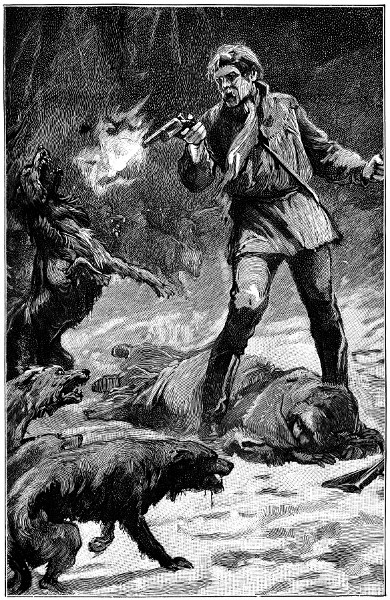
Hunted by Wolves. Many terrible stories are told of the depredations caused by packs of wolves, especially in Russia, and of the desperate adventures travellers have met with when attacked by them. The story of the Russian peasant, who, to save his master's family, leaped out of the sledge and faced the pack alone, thus delaying the wolves by his own self-sacrifice, while the sledge proceeded on its journey, is one of these. In contrast to this is the story of the Russian woman, given by Mr. Lloyd in the work already quoted.
A Terrible Alternative. A woman, accompanied by three of her children, was one day in a sledge, when they were pursued by a number of wolves. She put the horse into a gallop, and drove towards her home with the utmost speed. She was not far from it; but the ferocious animals gained upon her, and were on the point of rushing on to the sledge. For the preservation of her own life and that of the remaining children, the poor, frantic creature cast one of them to her bloodthirsty pursuers. This stopped their career for a moment; but, after devouring the poor child, they renewed the pursuit, and a second time came up with the vehicle. The mother, driven to desperation, resorted to the same horrible expedient, and threw another of her offspring to her ferocious assailants. The third child was also sacrificed in the same way, and soon after the wretched being reached her home in safety. Here she related what had happened, and endeavoured to palliate her own conduct by describing the dreadful alternative to which she had been, reduced. A peasant, however, who was among the bystanders, and heard the recital, took up an axe, and with one blow cleft her skull in two, saying at the same time, "that a mother who could thus sacrifice her children for the preservation of her own life, was no longer fit to live." The man was committed to prison, but the Emperor subsequently granted him a pardon.
A Marvellous Escape. Equally terrible and more marvellous is the story of the adventure of a Russian family which took place as recently as the winter of 1894-5. A peasant was riding in a sleigh in company with his wife and child, when he became aware that they were being pursued by wolves. He urged the horses to their utmost speed but it soon became evident that the wolves would overtake them before they could reach a place of safety. Urged to desperation, the peasant ordered his wife to throw the child to the wolves, hoping thereby to gain time and thus escape. The wife refused to part with her little one, whereupon an altercation ensued, during which the peasant tried to drag the child from her arms with a view to throwing it to the wolves himself. In the struggle both mother and child fell from the vehicle, and with a lightened load the horses dashed forward at an even greater speed. For some apparently unaccountable reason, however, the wolves took no notice of the mother and child and continued to pursue the sleigh, possibly anticipating the larger meal that the horses would supply. In this they were not disappointed, for they succeeded in overtaking the sleigh, and the peasant and the horses fell victims to their ravage. In the meantime the mother and child found their way to a farm house where they were sheltered until danger was past.
Tame Wolves. Notwithstanding his natural fierceness, the wolf becomes tame under kindly treatment, and shows much affection for those who cherish him. Instances are common in which wolves have remembered their benefactors, after years of absence, and have shown every demonstration of joy on recognition. They have even been harnessed and taught to draw carriages and to fulfil other useful offices. With wolves, as with many other animals, hunger and thirst are apparently the principal causes of savagery and the struggle for existence the main cause of rapacity and cruelty.
The Cunning of the Fox. The cunning of the fox is proverbial and if only one half of the stories told about him are true, there are quite sufficient to invest him with a degree of artfulness which is apparently unique. The extraordinary way in which he will feign himself dead, whether when hunting or being hunted, is a proof of this, as are also the various tricks he will resort to, to throw his pursuers off the scent. Captain Brown tells a story of a fox who leapt a high wall and crouched under it on the further side until the hounds had passed over, and then quietly returned, giving them the slip. Another fox who suddenly baffled two blood hounds who were in hot pursuit, was discovered lying full length upon a log of wood from which at first it was difficult to distinguish him. When feigning death he is said sometimes to hold his breath and hang out his tongue. He will sometimes baffle his pursuers by hanging on to a branch of a tree.
The Fox as a Hunter. Mr. St. John tells the following story of the fox as a hunter:—"Just after it was daylight I saw a large fox come very quietly along the edge of the plantation. He looked with great care over the turf wall into the field, and seemed to long very much to get hold of some of the hares that were feeding in it, but apparently knew that he had no chance of catching one by dint of running. After considering a short time, he seemed to have formed his plans, examined the different gaps in the wall, fixed upon one which appeared to be most frequented, and laid himself down close to it in an attitude like that of a cat at a mouse hole. In the meantime I watched all his plans. He then with great care and silence scraped a small hollow in the ground, throwing up the sand as a kind of screen. Every now and then, however, he stopped to listen, and sometimes to take a most cautious peep into the field. When he had done this, he laid himself down in a convenient posture for springing on his prey, and remained perfectly motionless, with the exception of an occasional reconnoitre of the feeding hares. When the sun began to rise, they came, one by one, from the field to the plantation: three had already come without passing by his ambush, one within twenty yards of him; but he made no movement beyond crouching still more flatly to the ground. Presently two came directly towards him, and though he did not venture to look up, I saw, by an involuntary motion of his ear, that those quick organs had already warned him of their approach. The two hares came through the gap together and the fox, springing with the quickness of lightning, caught one and killed her immediately; he then lifted up his booty and was carrying it off, when my rifle-ball stopped his course."
A Fox Hunt. Captain Brown tells an amusing story of the resource shown by a fox who was hard pressed near Tamary, Ireland, which is as follows. "After a short chase, Reynard disappeared, having cunningly mounted a turf stack, on the top of which he lay down flat. Finding himself, at last, perceived by one of the hounds, he left his retreat, closely pursued by the pack, ran up a stone wall, from which he sprang on the roof of an adjoining cabin, and mounted to the chimney-top. From that elevated situation he looked all around him, as if carefully reconnoitring the coming enemy. A cunning old hound approached, and, having gained the summit of the roof, had already seized the fox in imagination, when, lo! Reynard dropped down the chimney, like a fallen star into a draw-well. The dog looked wistfully down the dark opening, but dared not pursue the fugitive. Meantime, whilst the hound was eagerly inspecting the smoky orifice of the chimney, Reynard, half enrobed in soot, had fallen into the lap of an old woman, who, surrounded by a number of children, was gravely smoking her pipe, not at all expecting the entrance of this abrupt visitor. 'Emiladh deouil!' said the affrighted female, as she threw from her the black and red quadruped: Reynard grinned, growled, and showed his fangs; and when the sportsmen, who had secured the door, entered, they found him in possession of the kitchen, the old woman and the children having retired, in terror of the invader, to a corner of the room. The fox was taken alive."