THE ANIMAL KINGDOM. SUB-KINGDOM I—VERTEBRATA. (continued 6)
Reading edition
The Hamster. The hamster is a curious little rat-like animal of the thrifty kind, that lays up store in the summer for winter use. It lives in burrows which it connects with various apartments, used as storehouses for food. On the approach of the cold weather it closes the entrance to its burrow, and makes a nest of straw in which it sleeps; becoming torpid in extreme cold.
Swarms of Rats. The rapidity with which rats multiply, makes them troublesome and unpleasant neighbours. In the vicinity of the horse slaughter-houses at Montfaucon, near Paris, some years ago, they had become so numerous that the proposal to remove the slaughter houses was opposed on the ground of the danger that would accrue to the inhabitants from the rats being deprived of their means of subsistence. It was said that the carcases of thirty-five horses, if left unprotected, would be eaten by these rats in one night, the bones being picked clean. On one occasion, the carcases of three horses were placed in a high walled enclosure, small holes having been made in the walls for the admission of the rats, and subsequently stopped up. Several men armed with torches and sticks, then entered the yard, which was so full of rats that they could strike right and left without aim and yet be sure of destroying them. Two thousand six hundred and fifty rats fell victims to this experiment in one night. At the end of a month, the experiment having been several times repeated, sixteen thousand and fifty rats had been killed. The danger accruing from the burrowing of such enormous quantities of rats is by no means slight.
Invaded by Rats The story of Bishop Hatto and the invasion of the "Mäusethurm" on the Rhine by rats, is well known if not entirely authentic. Some idea of what it would be to be invaded by rats, may be gathered from Mrs. Bowdich's graphic account of her own painful experiences. "When living in Cape Coast Castle, I used to see the rats come in troops past my door, walking over my black boys as they lay there, and who only turned themselves over to present the other sides of their faces and bodies when the rats returned, and thought it a good joke. The fiercest encounter which I ever had with them was during one of those terrific storms which are more furious between the tropics than elsewhere. I was then, however, under the Equator, in a native hut, and heard an exceeding rustling and movement all around me. To my terror I perceived that these proceeded from a number of rats running up and down the sides of the room in which I was to pass the night, and who shortly began to run over me, they being disturbed by the torrents of rain which were then falling. The only weapon I could find was a shoe, and curling myself into a large arm-chair taken out of a French vessel, and covered with blue satin damask, I sat prepared for my enemies, whom I dreaded much more than the lightning, which was flashing across the iron bars laid upon the floor. I felt that the silk of my place of refuge was some sort of protection against this; but my own arm could alone save me from my four-footed foes. Presently my husband came in, and saluted me with a shout of laughter, which, however, abated when he saw my antagonists. The storm lulled for a while, and the rats retreated. We then crept within the curtains of bamboo cloth which encircled a rude imitation of a fourpost bedstead, but I kept possession of my shoe. Weary with watching, I closed my eyes, but was awakened by a tremendous flash of lightning, immediately followed by awful thunder and a tumultuous rush of rats. Some of them scrambled up the outside of the curtains; but, arms in hand, I sat up, and directed by the noise, I hurled the invaders to the ground, till at length resistance and the passing away of the storm allowed me to sleep in peace." This was the brown rat so familiar all over the world.
Migrations of Rats. The habit of rats to migrate in numbers, apparently well ordered, and under leadership, has often been noticed, and the way in which they will leave a burning house or a sinking ship has often been recorded. These companies will as a rule pass on their own way, and mind their own business if unmolested, but instances are recorded of their attacking and severely biting those who have opposed their progress. The Rev. Mr. Ferryman, who resided at Quorn in Leicestershire and who made somewhat of a study of rats, was walking in a meadow one evening when he observed a large number of rats in the act of migrating from one place to another. He stood perfectly still, and the whole assemblage passed close to him. His astonishment, however, was great when he saw amongst the number an old, blind rat, which held one end of a piece of stick in its mouth while another rat had hold of the other end of it, and thus conducted its blind companion.
The Intelligence of Rats. Some remarkable illustrations of the intelligence of rats have been recorded from time to time. The following which occurred recently seems to show both thought and reason. A Burley rat found a dead hen in a field, one evening, and departed to inform his brethren of the discovery, when a gentleman, who afterwards reported the incident to the Leeds Evening Post—removed the prize, which the speedy return of half-a-dozen rats was too late to secure. The first rat plainly evinced his disappointment, but his friends suspected him of hoaxing them, turned upon him suddenly, and in a few moments he was as dead as the chicken which had disappeared, and was left lying on almost the same spot which it had occupied. Captain Brown tells the following story of the ingenuity of the rat in self-preservation. "During the great flood of September, the 4th, 1829, when the river Tyne was at its height, a number of people were assembled on its margin. A swan at last appeared, having a black spot on its plumage, which the spectators were surprised to find, on a nearer approach, was a live rat. It is probable it had been borne from its domicile on some hay rick, and, observing the swan, had made for it as an ark of safety. When the swan reached the land, the rat leapt from its back, and scampered away."
Saved by a Rat. Perhaps no better example of the intelligence of the rat could be given than that afforded by the incident quoted by Jesse from Mr. Ferryman. Mr. Ferryman records that he had an old friend, a clergyman, of retired and studious habits. When sitting in his room one day, he saw an English rat come out of a hole at the bottom of the wainscot; and threw it a piece of bread. In process of time, he so familiarised the animal, that it became perfectly tame, ran about him, was his constant companion, and appeared much attached to him. He was in the habit of reading in bed at night; and was on one occasion awoke by feeling a sharp bite on his cheek, when he discovered the curtains of his bed to be on fire. He made his escape, but his house was burnt down, and he saw no more of his rat. He was, however, convinced, and remained so for the rest of his life, that his old companion had saved him from being burnt to death, by biting his cheek; and thus making him aware of his danger.
The Mouse. The mouse is a much more popular animal than the rat, though taking its size and numbers into account it is scarcely less destructive. No one weeps when the rat suffers capital punishment, but many a tear has been shed over a "dear little mouse". The house mouse is too well known to need description. Like rats, mice appear to act in companies, either under leadership or by common consent. Mrs. Bowdich describes a number of mice which she observed during an illness frequently emerge from her bed-room closet and gravely form themselves into a circle and apparently hold a council. That they frequently combine to effect purposes which they are unable to accomplish singly is well known. Mrs. Bowdich describes an attempt made by a combined force of mice to get possession of the dainties provided for her as she approached convalescence. These were placed under tin covers upon a chest of drawers, and the mice were evidently of opinion that if they could only climb to the top of these covers they would find them open like a basin, and so effect an entry. Unable to gain a footing on the smooth metal sides, "they mounted upon each other's shoulders and so accomplished the feat", though like arctic explorers they failed to find an open sea and were compelled to return with disappointment. An organised attempt to remove a cover from the bottom, when, on one occasion, it had not been firmly set down, resulted in an accident similar to those incident to human engineering, for the cover slipped and many tiny hands were severely pinched. After this they abandoned their attempts though a single mouse would occasionally reconnoitre the scene, apparently unsatisfied with the defeat. Mice, like many other animals, are said to be much affected by music.
The Harvest Mouse. The harvest mouse is a most interesting little creature; whose habits are thus described by White of Selborne:—"They build their nest amidst the straws of the corn above the ground, and sometimes in thistles. They breed as many as eight at a litter, in a little round nest composed of the blades of grass or wheat. One of these I procured this autumn, most artificially plaited, and composed of the blades of wheat, perfectly round, and about the size of a cricket ball, with the aperture so ingeniously closed that there is no discovering to what part it belonged. It was so compact and well filled that it would roll across the table without being discomposed, though it contained eight little mice that were naked and blind. As this nest was perfectly full, how could the dam come at her litter respectively so as to administer a teat to each? Perhaps she opens different places for that purpose, adjusting them again when the business is over; but she could not possibly be contained, herself, in the ball with her young, which moreover would be daily increasing in bulk. This procreant cradle—an elegant instance of the efforts of instinct—was found in a wheat field, suspended in the head of a thistle."
The Field Mouse. There are two kinds of field mice, the long-tailed and the short-tailed varieties. The long-tailed field mouse is the mouse immortalised by Burns, and is found throughout Europe. The short-tailed variety occupies much the same geographical area, though it probably extends further. The latter are very destructive, and have sometimes increased to such an extent, that organised efforts have had to be made to exterminate it.
The Dormouse. The common dormouse, and the greater dormouse are the principal varieties of this interesting little animal. They resemble the squirrel in appearance as well as in some of their habits. They live in trees, where they construct nests, on nuts, acorns, fruits, insects, birds and eggs, and squirrel-like rest upon their hindquarters when eating, holding their food between their forepaws. They lay up store for the winter and become torpid in the cold weather, rolling themselves into a ball, in which condition they may be handled without disturbance or injury. The common dormouse is found all over Europe, the greater dormouse occupying a still more extended area.
The Jerboa. The Jerboa is a curious, little animal with the body of a mouse and hind legs which resemble those of the kangaroo in appearance. There are several varieties, one belonging to Southern Russia, one to the deserts of Egypt, Nubia, Arabia, Barbary and Tartary, and one to North America. They live in burrows which they construct with great care and industry. They are naturally timid and make for their holes on the slightest disturbance, leaping kangaroo fashion sometimes as high as five feet, and so swiftly as to be very difficult of capture. They have very long tails.
The Beaver. There are two species of the beaver, the European beaver, and the American beaver. The former is most numerous in Siberia, Tartary, and the Caucasus but is also occasionally found in Central Europe. The American beaver is found throughout North America where it is eagerly hunted for the sake of its fur.
The European Beaver. The following anonymous paragraph cut from a newspaper, but likely enough quoted from some standard Natural History, perhaps that of Messrs. Cassell and Co., throws some light upon the present condition of the European beaver.
"There are still some naturalists who assert that the beaver has ceased to exist in France. This, however, is a mistake; an animal of that species was caught a short time ago in the Hérault, and is now being exhibited at Montpelier. Beavers do not live in Europe in large companies or herds as they do in America, but only in solitude, and in this state they haunt secondary rivers, such as the Gard and the Gardon. There are a few on the banks and islands of the Rhone, but as these creatures are averse to noise, the splashing of the steamers plying to and fro has driven most of them away. They give a decided preference to such streams as are overshadowed by the willow, of the bark of which they are exceedingly fond. The beaver is also to be found as far north as the Saone, in those valleys where there is peat-ground. It lives in Spain, in Italy, and in Greece, but always solitary and fugitive. This curious animal is not only called Castor Americanus, but also Castor Gallicus, and not without reason, since the fossil remains of the genus are sufficient to attest their having been very numerous in France at some remote period. The little stream of the Bièvre derives its name from its having been the habitat of these creatures; its resemblance to the English name beaver need hardly be alluded to. In Europe this amphibious animal does not build those substantial and commodious dwellings which have rendered it so celebrated, because the rapacity and spirit of destruction so common in man have made it suspicious and cautious."
The American Beaver. Writing of the American Beaver Dr. Godman says:—"Beavers are not particular in the site they select for the establishment of their dwellings, but if in a lake or pond, where a dam is not required, they are careful to build where the water is sufficiently deep. In standing waters, however, they have not the advantage afforded by a current for the transportation of their supplies of wood, which, when they build on a running stream, is always cut higher up than the place of their residence, and floated down. The materials used for the construction of their dams are the trunks and branches of small birch, mulberry, willow, and poplar trees. They begin to cut down their timber for building early in the summer, but their edifices are not commenced until about the middle or latter part of August, and are not completed until the beginning of the cold season. The strength of their teeth, and their perseverance in this work, may be fairly estimated by the size of the trees they cut down. Dr. Best informs us, that he has seen a mulberry tree, eight inches in diameter, which had been gnawed down by the beaver. The figure of the dam varies according to circumstances. Should the current be very gentle, the dam is carried nearly straight across; but when the stream is swiftly flowing, it is uniformly made with a considerable curve, having the convex part opposed to the current. Along with the trunks and branches of trees they intermingle mud and stones, to give greater security; and when dams have been long undisturbed and frequently repaired, they acquire great solidity, and their power of resisting the pressure of water and ice is greatly increased by the trees occasionally taking root, and eventually growing up into something of a regular hedge.
"The dwellings of the beaver are formed of the same materials as their dams, and are very rude, though strong, and adapted in size to the number of their inhabitants. These are seldom more than four old and six or eight young ones. Double that number have been occasionally found in one of the lodges, though this is by no means a very common circumstance. When building their houses, they place most of the wood crosswise, and nearly horizontally, observing no other order than that of leaving a cavity in the middle. Branches which project inward are cut off with their teeth, and thrown among the rest. The houses are by no means built of sticks first and then plastered, but all the materials, sticks, mud, and stones, if the latter can be procured, are mixed up together, and this composition is employed from the foundation to the summit. The mud is obtained from the adjacent banks or bottom of the stream or pond near the door of the hut. Mud and stones the beaver always carries by holding them between his fore paws and throat.
"Their work is all performed at night, and with much expedition. As soon as any part of the material is placed where it is intended to remain, they turn round and give it a smart blow with the tail. The same sort of blow is struck by them upon the surface of the water when they are in the act of diving. The outside of the hut is covered or plastered with mud late in the autumn, and after frost has begun to appear. By freezing it soon becomes almost as hard as stone, and effectually excludes their great enemy, the wolverine, during the winter."
The Squirrel. The family of the Squirrel is a very large one and with it are included the marmots, the prairie dogs, and the anomalures, the latter of which form a sub-family. The common squirrel, the variety familiar in England, is a pretty little creature with its bright piercing eyes, and knowing look, and its graceful bushy tail. It is one of the most agile of animals, ascending and descending trees with the rapidity of a flash and so sensitive, that it is said that if the tree upon which its nests is only touched at the bottom it takes alarm and seeks safety on another tree. It builds its nests in the forks of branches of trees,—of moss, twigs, and dried leaves,—and leaps great distances from tree to tree. The ground squirrel is characterised by fine longitudinal black bands on its back, which form a very pretty marking. It belongs chiefly to North America. "It lives in villages under ground," says an American writer, "and plunders the farmers worse than the gopher. Every two months the ground squirrel breeds and neither State premiums nor strychnine diminishes its numbers. It levies an assessment of thirty per cent. on the profits of a wheat crop in many sections."
The flying squirrel, also common in the United States, has a membranous skin which extends from the fore limbs along the body to the hind limbs by which its body is buoyed up as it descends obliquely through the air from the tree to the ground, the tail operating as a rudder. One species of the flying squirrel is found in Europe and several in India.
The Squirrel at Home. Mr. Head gives a graphic description of his experiences with a squirrel in the Canadian woods. He says:—"I was waiting the approach of a large flock of wild fowl, but a little villain of a squirrel on the bough of a tree close to me, seemed to have determined that even now I should not rest in quiet, for he sputtered and chattered with so much vehemence, that he attracted the attention of my dog, whom I could scarcely control. The vagrant inattention of my dog was truly mortifying; he kept his eyes fixed upon the squirrel, now so noisy as to be quite intolerable. With my hand, I made a motion to threaten him, but the little beast actually set up his back, and defied me, becoming even more passionate and noisy than before, till all of a sudden, as if absolutely on purpose to alarm the game, down he let himself drop, plump at once within a couple of yards of Rover's nose. This was too much for any four-footed animal to bear, so he gave a bounce and sprang at the impertinent squirrel, who, in one second, was safe out of his reach, cocking his tail, and showing his teeth on the identical bough where he had sat before. Away flew all the wild fowl, and my sport was completely marred. My gun went involuntarily to my shoulder to shoot the squirrel. At the same moment, I felt I was about to commit an act of sheer revenge, on a little courageous animal which deserved a better fate. As if aware of my hesitation, he nodded his head with rage, and stamped his fore paws on the tree: while in his chirruping, there was an intonation of sound, which seemed addressed to an enemy for whom he had an utter contempt. What business, I could fancy he said, had I there, trespassing on his domain, and frightening his wife and little family, for whom he was ready to lay down his life? There he would sit in spite of me, and make my ears ring with the sound of his war whoop, till the spring of life should cease to bubble in his little heart."
Tame Squirrels. Captain Brown tells of a gentleman who had a tame squirrel, who used to run up his legs and enter his pocket when he saw him preparing to go out. From this safe retreat the squirrel often poked his head and peeped at the people as they passed, but never ventured to emerge until the crowded thoroughfares were passed. When they reached the outskirts of the city, however, the squirrel leaped to the ground, ran along the road, ascended trees and hedges, with the quickness of lightning, and nibbled at the leaves and bark. If the gentleman walked on, it would descend, scamper after him, and again enter his pocket. On hearing a carriage or cart, it became much alarmed, and always hid itself till it had passed by. This gentleman had a dog, between which and the squirrel a certain enmity existed. Whenever the dog lay asleep, the squirrel would show its teasing disposition, by rapidly descending from its box, scampering over the dog's body, and quickly mounting to its box again. Another squirrel who frequented his master's pocket, on one occasion rendered important service. One evening, as was his practice, when his master's coat was taken off and hung behind a door, the squirrel ran up the door and took up his quarters in the familiar pocket, carrying with him a supply of tow with which to make himself comfortable for the night. After all the family had retired to rest, a burglar made his appearance, effected an entrance, and proceeded to examine the pockets of the coat hanging to the door. Putting his hand rather unceremoniously into the squirrel's bedroom the robber received such a sharp and unexpected bite that he could not forbear to cry out and the master of the house, aroused by the unusual sound, entered the room, armed with a poker, just in time to secure the thief as he was escaping through the window.
The Marmot. The Bobak. The Prairie Dog. Marmots are found in the northern parts of both the old and the new worlds. The Bobak belongs to southern Russia, the Prairie Dog to North America and the Woodchuck to Canada.
The marmot is easily tamed and is familiar to many from being made the companion of itinerant Savoyards who exhibit them when asking alms. The Bobak is also readily amenable to kindness. All these animals live in burrows and are exceedingly interesting in their habits. The anomalure is a squirrel with a membranous skin resembling to some extent that of the flying squirrels and used by it for the same purpose. It belongs to Fernando Po.
The Chinchilla. The Chinchilla is about nine inches long, its tail being about five inches. Its eyes are full, like those of the rabbit, its hind legs are long, its fore ones short. It sits upon its haunches, and takes its food in its fore paws. It is found in Chili and Peru, and inhabits the open country, living in burrows, and subsisting on the roots of bulbous plants, which are abundant in those regions. Great numbers of them are killed for their skins, which furnish the most delicate and beautiful of furs. The Alpine Viscacha and the Viscacha of the Pampas, are included in the same family.
The Porcupine. The Porcupine is found throughout Africa and southern Asia and also in the south of Europe. "Less completely covered with weapons of defence than the hedgehog," says Captain Brown, "the porcupine possesses them in greater strength, for its formidable quills are capable of inflicting severe wounds. When irritated or in danger it raises its quills on its back; but it is though fretful, not fierce in disposition but easily tamed." When cornered the porcupine turns its back to its assailant, who usually wounds himself by coming in contact with the quills. The porcupine lives in burrows by itself; it is a lonely animal. The Cavies and the Agouti of America are classified with this family. Among the former is the Capybara, the largest of the rodents, an animal which attains to from three to four feet in length. It belongs to Brazil, Guinea, and Paraguay. The Canadian porcupine, and the Brazilian porcupine, are tree porcupines and are only found in America.
The Guinea Pig. The Guinea Pig (Cavia Cobaya) is said to be the domestic form of the Cavia Aperea of Brazil and Peru. It derives its name from its supposed place of origin, as it was said to have been first introduced into England from Guinea. It is tailless, but clean and neat in appearance, being marked with black, white, and orange colours. It is said to lack intelligence and to be destitute of attachment, suffering its young to be destroyed without resistance. Perhaps this is due to the fact that it has so many; it breeds at intervals of two months and produces from three to twelve young ones at a birth.
Hares and Rabbits. We come now to the second sub-order of the Rodents or animals that gnaw, the Duplicidentati, the rodents having four incisor teeth in the upper jaw. This brings us to the Hares and Rabbits, of which there are numerous species, the Common Hare, the Irish or Mountain Hare and the Common Rabbit being the best known. The Irish or Mountain Hare is somewhat larger than the common hare and changes from brown to white in the winter. The Sardinian, the Egyptian, the Polar, and the Sage hares are other varieties.
The Common Hare. The Common Hare is a familiar animal and needs no description. It is found throughout Europe and is well known in England. The hare hides during the day under cover of low foliage, ferns, and the undergrowth of preserves, in spots known as 'forms'. Its habit of making a definite track from its form to its feeding grounds and of always following its own track makes it an easy sacrifice to those who know its ways. It is exceedingly swift in its movements, and it is well that it is so, for its only safety is in flight and in the sagacity and cunning it shows in eluding its pursuers. Many illustrations of the latter have been recorded. Fouilloux mentions a hare which he saw start from its form at the sound of a hunter's horn, run towards a pool of water at a considerable distance, plunge in and swim to some rushes in the middle, and there lay down and conceal itself from the pursuit of the dogs. Another hare, when closely pressed passed under a gate, the dogs leaping over it. The hare quickly perceived the advantage it had gained by this, and so doubled, returning under the gate, the dogs following over it as before. This was repeated several times until taking advantage of the exhaustion of the dogs the hare escaped. The hare will often run perfectly straight while in view of the hounds, but immediately on gaining the slightest cover will double, and redouble with astonishing rapidity, apparently to confuse the scent.
A Hare's-breadth Escape
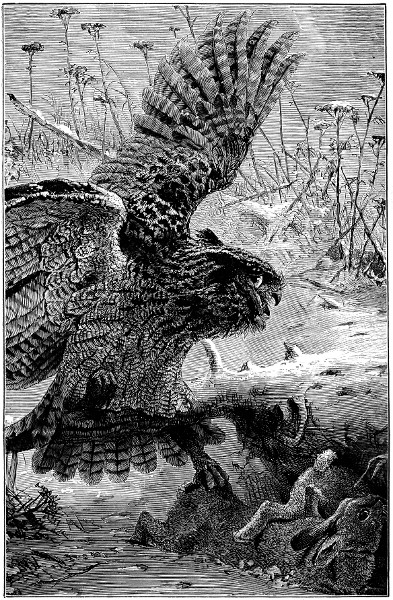
The Intelligence of the Hare. The following anecdote seems to show remarkable intelligence on the part of a hare. It is from a statement made by Mr. Yarrell in the "Magazine of Natural History":—"A harbour of great extent on our southern coast has an island near the middle, of considerable size, the nearest point of which is a mile distant from the mainland at high water, and with which point there is frequent communication by a ferry. Early one morning in spring two hares were observed to come down from the hills of the mainland towards the seaside, one of which from time to time left its companion, and proceeding to the very edge of the water, stopped there a minute or two, and then returned to its mate. The tide was rising, and after waiting some time, one of them, exactly at high water, took to the sea, and swam rapidly over, in a straight line, to the opposite projecting point of land. The observer on this occasion, who was near the spot, but remained unperceived by the hares, had no doubt that they were of different sexes, and that it was the male—like another Leander—which swam across the water, as he had probably done many times before. It was remarkable that the hares had remained on the shore nearly half an hour, one of them occasionally examining, as it would seem, the state of the current, and ultimately taking to the sea at that precise period of the tide called slack water, when the passage across could be effected without being carried by the force of the stream either above or below the desired point of landing. The other hare then cantered back to the hills."
A Hunted Hare. The following story of a hunted hare is from "The Annals of Sporting," for May 1822:—"Two years ago, a doe hare produced two young ones in a field adjoining my cottage; and the three were occasionally seen, during the summer, near the same spot. But the leverets were, I have reason to believe, killed at the latter end of September of the same year; the old doe hare was also coursed, and making directly for my cottage, entered the garden, and there blinked the dogs. I repeatedly afterwards saw her sitting, sometimes in the garden, (which is one hundred and ten yards by forty-three,) but more frequently in the garden-hedge. She was repeatedly seen by greyhounds when she sat at some distance, but uniformly made for the garden, and never failed to find security. About the end of the following January, puss was no longer to be seen about the garden, as she had probably retired to some distance with a male companion. One day, in February, I heard the hounds, and shortly afterwards observed a hare making towards the garden, which it entered at a place well known, and left not the least doubt on my mind, that it was my old acquaintance, which, in my family, was distinguished by the name of Kitty. The harriers shortly afterwards came in sight, followed Kitty, and drove her from the garden. I became alarmed for the safety of my poor hare, and heartily wished the dogs might come to an irrecoverable fault. The hare burst away with the fleetness of the wind, and was followed breast high, by her fierce and eager pursuers. In about twenty minutes I observed Kitty return towards the garden, apparently much exhausted, and very dirty. She took shelter beneath a small heap of sticks, which lay at no great distance from the kitchen door. No time was to be lost, as, by the cry of the hounds, I was persuaded they were nearly in sight. I took a fishing-net, and, with the assistance of the servant, covered poor Kitty, caught her, and conveyed the little, panting, trembling creature into the house. The harriers were soon at the spot, but no hare was to be found. I am not aware that I ever felt greater pleasure than in thus saving poor Kitty from her merciless pursuers. Towards evening I gave Kitty her liberty; I turned her out in the garden, and saw her not again for some time. In the course of the following summer, however, I saw a hare several times, which I took to be my old friend; and, in the latter end of October, Kitty was again observed in the garden. Henceforward she was occasionally seen as on the preceding winter. One morning, in January, when I was absent, a gun was fired near my cottage; Kitty was heard to scream, but, nevertheless, entered the garden vigorously. The matter was related to me on my return home; and I was willing to hope that Kitty would survive. However, I had some doubt on the subject; and, the next morning, as soon as light permitted, I explored the garden, and found that my poor unfortunate favourite had expired; she was stretched beneath a large gooseberry tree; and I could not help very much regretting her death."
Tame Hares. Though exceedingly timid creatures hares are readily tamed, and have often become as domesticated as cats and dogs. Cowper's experiments with hares will naturally occur to the reader, besides which there are cases recorded where tame hares have been associated in domesticity with cats and even sporting dogs. One possessed by Mr. A. S. Moffat was thus domiciled and would feed from the same plate with a cat and a dog. This hare would knock a book out of its master's hand to secure his attention.
The Common Rabbit. The Common Rabbit is found all over the British Isles, as well as in France and Spain; and in the north of Africa where it is indigenous. It is smaller than the hare and lives in burrows, in large numbers, completely honey-combing sand hills which are covered with grass and vegetation. Before producing her young, the female forms a separate burrow where she conceals them after birth. This is done to protect them from the male who destroys, if he discovers them. The young are born blind and gain their sight after ten days. They are a month old before they are allowed to leave the burrow.
ORDER XI. Toothless Animals. Curiously enough this order, though denominated toothless, includes several animals which have well developed dental arrangements. In these, however, the teeth are not found in the front of the jaw, and those which are found are elementary and simple. Several families are classified with this order, of which the Sloth, the Pangolin, the Armadillo, the Cape Ant-Bear, and the Ant-Eater are the best known representatives.
The Sloth. The Sloth belongs to South America. "In its wild state," says Waterton, "the Sloth spends its whole life in the trees, and never leaves them but through force or accident, and, what is more extraordinary, not upon the branches, like the squirrel and monkey, but under them. He moves suspended from the branch, he rests suspended from the branch, and he sleeps suspended from the branch." "In fact," says the Rev. J. G. Wood, "as Sydney Smith observes, he passes a life of suspense, like a curate distantly related to a Bishop. To render it fit for this singular mode of life, its long and powerful arms are furnished with strong curved claws, which hook round the branches, and keep the animal suspended without any effort. When on the ground, these claws are very inconvenient, and it can barely shuffle along; but when it is in its native element, it moves with exceeding rapidity, particularly in a gale of wind, when it passes from branch to branch, and from tree to tree, with an activity which its movements on the ground by no means portend."
The Pangolin. There are two species of the Pangolin, or Manis, the long-tailed and the short-tailed, the former being a native of Africa and the latter of the East Indies. The long-tailed manis measures about five feet inclusive of the tail which is about three feet long, the short-tailed manis about four feet in all. All the upper parts of its body are closely covered with scales of different sizes, which, as they are attached to the skin only by the lower extremity, it can erect at pleasure, opposing to its adversary a formidable row of offensive weapons. They are sharp at the point, and so hard as, on collision, to strike fire like a flint. The moment it perceives the approach of an enemy, it rolls itself up like a hedgehog, by which means it covers all the weaker parts of its body. The Pangolins live on ants, which they catch by thrusting their long slender tongues into the midst of their prey, their tongues being covered by a gummy saliva to which the ants adhere.
The Armadillo. The Armadillo is a native of South America, in which country there are several varieties. They are all covered with a strong crust or shell, resembling, as the Rev. J. G. Wood puts it, "the modified plate armour" worn by men in the 16th century. They eat vegetables and insects, and do good work as scavengers. They burrow with great rapidity and when rolled up, after the manner of the hedgehog, are invulnerable to their ordinary enemies.
The Cape Ant-Bear. The Cape Ant-Bear belongs to the Cape of Good Hope. It differs from the ant-eaters of the western world in many ways, being a hairy animal without scales, its head resembling that of the deer kind, having long ears but no horns. The length of its body which is covered with bristles is about four feet, and its feet which are short, are furnished with strong claws which enable it to excavate the cavities in which it lives.
The Ant-Eater. The true Ant-Eater is found in the South American tropics. The Great Ant-Eater belongs to La Plata, the Little Ant-Eater to the Brazils. The Great Ant-Eater is four feet in length, without its tail, which is two feet six inches long. The true ant-eater like the Pangolin already described inserts its long tongue into the nest of the ant, catching its little victims in large numbers by the sticky mucus which covers its tongue.
ORDER XII. Pouched Animals. Of the several families classed in this order the opossums and the kangaroos are the most familiar. The Dasyures of Tasmania and the Bandicoots of Australia and New Guinea also belong to this order, as do the many varieties of the Phalanger of Australasia and those of the Wombat of Tasmania. The pouch is one of the most remarkable provisions of Nature, the young of the pouched animals being small and of imperfect form at birth and requiring the protection of the pouch for their sustenance and development.
The Opossum. The common Opossum, which is a native of Virginia, is about the size of a badger. It is provided with a pouch, in which it carries its young, and into which they leap on the approach of danger. Its covering is a coat of long fur, of a dingy white colour. It feeds upon fish, birds, insects, and reptiles. Its tail is very muscular, and by this it hangs from the branches of trees and, watching its prey, lets itself fall upon its victims with great precision. Its hind feet are formed something like hands, by which it is enabled to climb with wonderful facility. The opossum when caught often simulates death so admirably that he deceives his captors and ultimately escapes them.
The Kangaroo. The Kangaroo belongs to Australia and New Guinea. The length of its body is from four to five feet six inches; its fore legs are very short; its hind ones very long. Its tail is from three to four feet in length, and its strength is such, that a stroke of it will break a man's leg. The Kangaroo moves by great leaps or bounds of from twelve to twenty feet. It is covered with a short soft fur, of a reddish ash-colour. It feeds on vegetables, and has a pouch for its young, like the opossum. Mr. Cunningham says: "The Kangaroos make no use of the short fore legs, except in grazing. When chased, they hop upon their hind legs, bounding onward at a most amazing rate, the tail wagging up and down as they leap, and serving them for a balance. They will bound over gulleys and deep declivities, and fly right over the tops of low brush wood." There are several varieties of this animal; one of which, called the Rat Kangaroo, is only the size of a rabbit; another, called the Tree Kangaroo, can hop about on trees in an extraordinary manner and is furnished with curved claws, on its fore paws, similar to those of the sloth, by which he can lay hold of the branches.
Kangaroo Hunting. Kangaroo hunting is a favourite Australian sport. It is not unattended with danger either to dogs or men, the sharp claws and powerful hind legs of the animal making it a formidable enemy at close quarters. Dawson in his "Present State of Australia" says: "A full-sized 'wool man' at bay always sits on his haunches, and when he rises to move forward, he stands four, or four and a half feet high. In this manner, he will, when pressed, meet a man, and hug and scratch him, if not to death, in such a way that he does not soon forget it. When hard pressed, and near to water, the kangaroo always takes it; if it be deep water, and the dogs follow him, one or the other is almost sure to be drowned. If a single dog, the kangaroo is nearly certain to come off victorious, by taking his assailant in his fore arms, and holding him under water till he is dead; but, if he has two dogs opposed to him, he is not left at liberty to hold either of his opponents long enough under water to drown him, and he generally himself falls a sacrifice, after a long and hard struggle. Notwithstanding the courage and ferocity of the kangaroo, when pressed, he is otherwise extremely timid, and more easily domesticated than any wild animal with which I am acquainted, The smaller ones are frequently quite as swift as a hare; and I have sometimes seen them outstrip the fleetest dogs." Young and inexperienced dogs are almost sure to fall victims to the sharp claw and powerful hind leg of the kangaroo, with one stroke of which he will rip the dog open and let his entrails out.
ORDER XIII. Monotremata. The order Monotremata includes two families, the Ornithorhynchidæ and the Echidnidæ, both of which belong to Australia. The Duck-billed Platypus belongs to the former, the Australian Hedgehog to the latter family.
The Duck-billed Platypus. The Duck-billed Platypus is one of the most singular of animals. "When it was first introduced into Europe," says Mr. Wood, "it was fully believed to be the manufacture of some impostor, who with much ingenuity had fixed the beak of a duck into the head of some unknown animal. It will, however, be seen by examining the skull of the animal, that this duck-like beak is caused by a prolongation of some of the bones of the head." The Platypus lives on the banks of rivers in burrows which it forms, and feeds on water insects and small shell fish. It is web-footed but its feet are so constructed that it can fold back the web when it wants to burrow, and unfold it when it wants to swim. The hind feet of the male are armed with a sharp spur.
The Australian Hedgehog. The Australian Hedgehog is about a foot long. It lives in burrows and feeds on insects, has a long tongue but no teeth. It has spines from which circumstance it is called a hedgehog after its English namesake, though its spines are almost hidden by its hair. It is said to be a dull, unintelligent animal.
CLASS II—AVES.
Classification. The Birds are distinguished from the Mammals by many obvious characteristics, chief among which are their bodily form, their feathery covering and their manner of producing their young by means of eggs. The Birds form the second class of the sub-kingdom Vertebrate and according to the classification followed in this work are divided into ten orders. These orders are, I Passeres: birds characterised by the habit of perching; II Picariæ: birds that climb, etc. Ill Psittacini: the Parrots; IV Columbæ: the Doves; V Gallinæ: the Fowls; VI Opisthocomi: the Hoazin of Brazil and Guinea; VII Accipitres: the Birds of Prey; VIII Grallatores: the birds that wade; IX Anseres: the Birds that swim; X Struthiones: the Ostrich, the Emu, etc., etc.
ORDER I. Perching Birds. The species of this order are very numerous, and have been variously divided by different authorities. Mr. Wallace forms them into five groups, which classification we shall find it convenient to follow. These five groups are: I The Thrushes and Thrush-like perching birds; II The Tanagers and similar kinds; III The Starlings and allied species; IV The Ant-eaters, etc., and V The Lyre Birds, and the Scrub Birds of Australia. The first group includes many well known feathered favourites: the Thrush; the Blackbird; the Mocking Bird; the Tailor Bird; the Wren; the Robin; the Nightingale; the Titmouse; the Golden Oriole; the Jay; the Magpie; the Raven; the Rook; the Carrion Crow; the Jackdaw; the Chough; and the Bird of Paradise. The second group includes the Swallow; the Martin; the Goldfinch; the Linnet; the Canary; the Bullfinch; the Bunting and many others. The third group contains the Starlings; the Weaver Bird; the Lark; the Wagtail, and the Pipits; the fourth group, the King Bird of North America; the Manakins of Guinea; the Chatterers of South America; the Bell Bird of Brazil, and the Umbrella Bird of the Amazon. The fifth group contains the Lyre Birds and the Scrub Birds of Australia.
The Thrush. The order of Thrush-like perching birds is a very large one, including nearly three thousand known varieties. Of these it will be impossible, within present limits, to even mention a very large number, and we shall content ourselves with dealing with a few of the better known species.
The Common Thrush. The Thrush is one of the most popular of English native birds, as its song is one of the most beautiful of those of the bird kind. It is a herald of the English spring and summer, beginning to sing at the end of January and continuing until July. It builds its nest in a hedge or bush, and, as it breeds early in the year, lines it with a plaster of mud to protect its young from the cold winds. It is a bold bird and will vigorously defend its nest from the attacks of larger birds. It feeds on insects, snails and worms.
"Watch an old thrush," says Dr. Stanley, "pounce down on a lawn, moistened with dew and rain. At first he stands motionless, apparently thinking of nothing at all, his eye vacant, or with an unmeaning gaze. Suddenly he cocks his ear on one side, makes a glancing sort of dart with his head and neck, gives perhaps one or two hops, and then stops, again listening attentively, and his eye glistening with attention and animation; his beak almost touches the ground,—he draws back his head as if to make a determined peck. Again he pauses; listens again; hops, perhaps once or twice, scarcely moving his position, and pecks smartly on the sod; then is once more motionless as a stuffed bird. But he knows well what he is about; for, after another moment's pause, having ascertained that all is right, he pecks away with might and main, and soon draws out a fine worm, which his fine sense of hearing had informed him was not far off, and which his hops and previous peckings had attracted to the surface, to escape the approach of what the poor worm thought might be his underground enemy, the mole."
The Missel Thrush. The Missel Thrush, so called from its fondness for the mistletoe, is larger than the common or song thrush, less melodious and not so common in England, but well known upon the continent of Europe. Like the song thrush it finds a determined enemy in the magpie, against which it often defends itself with success. It is, however, unable to withstand a combined attack. Gilbert White says: "The Missel-thrush is, while breeding, fierce and pugnacious, driving such birds as approach its nest with great fury to a distance. The Welsh call it "pen y llwyn," the head or master of the coppice. He suffers no magpie, jay, or blackbird, to enter the garden where he haunts; and is, for the time, a good guard to the new-sown legumens. In general, he is very successful in the defence of his family; but once I observed in my garden, that several magpies came determined to storm the nest of a missel-thrush: the dams defended their mansion with great vigour, and fought resolutely pro aris et focis; but numbers at last prevailed, they tore the nest to pieces, and swallowed the young alive."
The Blackbird. The Blackbird is another of the most cherished of English song birds. It is one of the earliest to wake the morning with a song. Its habits are similar to those of the Thrush; it builds its nest in bushes, in shrubberies and gardens, safe from the sight, but close to the haunts of man. It lines its nest with a plaster of mud which it covers over with dry grass, and is exemplary in the care of its young. It has a black coat as its name implies, and an orange tawny bill. The blackbird has to some extent the power of the mocking bird, of imitating the sounds it hears,—such as the chuckling of a hen, the song of the nightingale, the caw of the crow. In the "Magazine of Natural History" of September 1831, Mr. Bouchier of Wold Rectory, near Northampton, says: "Within half a mile of my residence there is a blackbird which crows constantly, and as accurately as the common cock, and nearly as loud; as it may, on a still day, be heard at the distance of several hundred yards. When first told of the circumstance, I conjectured that it must have been the work of a cock pheasant, concealed in a neighbouring brake; but, on the assurance that it was nothing more or less than a common blackbird, I determined to ascertain the fact with my own eyes and ears; and this day I had the gratification of getting close to it, seated on the top bough of an ash tree, and pursuing with unceasing zeal its unusual note. The resemblance to the crow of the domestic cock is so perfect, that more than one in the distance were answering it. It occasionally indulged in its usual song; but only for a second or two; resuming its more favourite note; and once or twice it commenced with crowing, and broke off in the middle into its natural whistle. In what way this bird has acquired its present propensity I am unable to say, except that as its usual haunt is near a mill where poultry are kept, it may have learned the note from the common fowl."
The Blackbird of America resembles his English cousin in most particulars. He is often seen following the plough, looking for worms in the fresh furrows, and frequently, like the crow, stealing the planted maize or Indian corn from the hill. In the autumn the American Blackbirds gather in vast flocks, and sometimes produce a roar like the rush of a waterfall by their flight.
The Mocking Bird. The Mocking Bird is a native of America and many stories are told of its wonderful powers of mimicry. The following description is furnished by Wilson: "The plumage of the Mocking Bird, though none of the homeliest, has nothing gaudy or brilliant in it, and, had he nothing else to recommend him, would scarcely entitle him to notice; but his figure is well proportioned, and even handsome. The ease, elegance, and rapidity of his movements, the animation of his eye, and the intelligence he displays in listening, and laying up lessons from almost every species of the feathered creation within his hearing, are really surprising, and mark the peculiarity of his genius. In his native groves, mounted upon the top of a tall bush or half grown tree, in the dawn of a dewy morning, while the woods are already vocal with a multitude of warblers, his admirable song rises pre-eminent over every competitor. The ear can listen to his music alone, to which that of all the others seems a mere accompaniment. Neither is this strain altogether imitative. His own native notes, which are easily distinguishable by such as are acquainted with those of our various song birds, are bold and full, and varied seemingly beyond all limits. They consist of short expressions of two, three, or at the most five or six syllables, generally interspersed with imitations, and all of them uttered with great emphasis and rapidity, and continued with undiminished ardour for half an hour, or an hour, at a time. His expanded wings and tail, glistening with white, and the buoyant gaiety of his action, arresting the eye, as his song most irresistibly does the ear, he sweeps round with enthusiastic ecstasy and mounts and descends as his song swells or dies away. 'He bounds aloft with the celerity of an arrow, as if to recover or recall his very soul, which expired in the last elevated strain.' He often deceives the sportsman, and sends him in search of birds that are not perhaps within miles of him, but whose notes he exactly imitates: even birds themselves are frequently imposed upon by this admirable mimic, and are decoyed by the fancied calls of their mates, or dive with precipitation into the depth of thickets at the scream of what they suppose to be the sparrow-hawk."
The Tailor Bird. The Tailor Bird is a small bird of no very remarkable appearance, but it is singular from its habit of sewing leaves together in forming its nest. This it does by using its beak as a needle, and certain vegetable fibres as thread, and sewing the edges of leaves together in the form of a pocket, in which it deposits its eggs and rears its young.
The Golden Crested Wren. The Golden Crested Wren is the smallest of British Birds, and it is one of the most beautiful, according to Mrs. Bowdich it only weighs eighty grains. It is peculiar among British birds for suspending its nest to the boughs of trees. Its nest is an elegant structure, sometimes open at the top, sometimes covered with a dome, having an entrance at the side. It is a tame bird, and often visits country gardens where it may be distinguished by its green and yellow coat with white facings, and its golden crest. Captain Brown says: "its song is weak and intermittent, yet sweet as that which fancy attributes to the fairy on the moonlight hill."
The Migration of Birds. Captain Brown, quoting from "Selby's Ornithology", gives an interesting account of the way in which our native birds are reinforced from other countries.—"On the 24th and 25th of October, 1822," says Mr. Selby, "after a very severe gale, with thick fog, from the North East, (but veering, towards its conclusion, to the east and south of east,) thousands of these birds were seen to arrive upon the sea-shore and sand-banks of the Northumbrian coast; many of them so fatigued by the length of their flight, or perhaps by the unfavourable shift of wind, as to be unable to rise again from the ground, and great numbers were in consequence caught or destroyed. This flight must have been immensely numerous, as its extent was traced through the whole length of the coasts of Northumberland and Durham. There appears little doubt of this having been a migration from the more northern provinces of Europe (probably furnished by the pine forests of Norway, Sweden, &c.), from the circumstance of its arrival being simultaneous with that of large flights of the woodcock, fieldfare, and redwing. Although I had never before witnessed the actual arrival of the gold-crested regulus, I had long felt convinced, from the great and sudden increase of the species, during the autumnal and hyemal months that our indigenous birds must be augmented by a body of strangers making these shores their winter's resort.—A more extraordinary circumstance in the economy of this bird took place during the same winter, viz., the total disappearance of the whole, natives as well as strangers, throughout Scotland and the north of England. This happened towards the conclusion of the month of January 1823, and a few days previous to the long-continued snow-storm so severely felt throughout the northern counties of England, and along the eastern parts of Scotland. The range and point of this migration are unascertained, but it must probably have been a distant one, from the fact of not a single pair having returned to breed, or pass the succeeding summer, in the situations they had been known always to frequent. Nor was one of the species to be seen till the following October, or about the usual time, as I have above stated, for our receiving an annual accession of strangers to our own indigenous birds."
The Willow Wren. The Willow Wren is a summer visitor to the British Isles. He arrives about the end of March and leaves in the month of September. He is an active little bird, an expert fly-catcher and an agreeable singer. His coat is of a greenish yellow-brown, his waistcoat is white tinged with yellow.
The Common Wren. The Common Wren is indigenous to Great Britain. It builds its nest under the shelter of thatched eaves, in out-of-the-way and unusual places. It is a plain homely looking little bird of a pale chestnut brown colour. Captain Brown gives the following interesting description of a wren's music lesson.
A Wren's Music Lesson. "A pair of wrens," says Captain Brown, "built their nest in a box, so situated that the family on the grounds had an opportunity of observing the mother's care in instructing her young ones to sing. She seated herself on one side of the opening of the box, facing her young, and commenced by singing over all her notes very slowly and distinctly. One of the little ones then attempted to imitate her. After chirping rather inharmoniously a few notes, its pipe failed, and it went off the tune. The mother immediately took up the tune where the young one had failed, and distinctly finished the remaining part. The young one made a second attempt, commencing where it had left off, and continuing for a few notes with tolerable distinctness, when it again lost the notes; the mother began again where it ceased, and went through with the air. The young one again resumed the tune and completed it. When this was done, the mother again sung over the whole of her song with great precision; and then another of the young attempted to follow it, who likewise was incapable of going through with the tune, but the parent treated it as she had done the first bird; and so on with the third and fourth. It sometimes happened that the little one would lose the tune, even three or four times in making the attempt; in which case the mother uniformly commenced where it had ceased, and always sung to the end of the tune; and when each had completed the trial, she always sung over the whole song. Sometimes two of them commenced the strain together, in which case she pursued the same conduct towards them, as she had done when one sung. This was repeated at intervals every day, while they remained in their nest."
The House Wren. The American House Wren is described by Audubon as a cheery familiar little bird, resembling the common wren in many of his habits, if not indeed identical with it.
Wilson says, "in the month of June a mower hung up his coat, under a shed, near the barn, and two or three days elapsed before he had occasion to put it on again, when thrusting his arm up the sleeve, he found it completely filled with some rubbish, as he called it, and on extracting the whole mass, found it to be the nest of a wren completely finished, and lined with a large quantity of feathers. In his retreat, he was followed by the forlorn little proprietors, who scolded him with great vehemence for thus ruining the whole economy of their household affairs." Wilson also tells a very pretty story of a pair of wrens who built their nest upon a window sill, one of whom, the female, venturing to enter the room was devoured by a cat. The male bird showed much uneasiness when he missed his mate, but after a time disappeared for two days, returning with a new wife, and with her help removing the two eggs left by her predecessor to a new nest in a more secure position.
The Nightingale. The Nightingale and the Sky-Lark, may perhaps be said to divide honours in the sphere of feathered song. Both have entranced innumerable auditors and both have won noble tributes from poets' pens. Both, moreover, are plain birds. The nightingale is of a tawny colour on the head and back, and of a greyish white on the throat and under parts. It has a full large eye of great brightness. It is one of the largest of the song birds, measuring seven inches in length. The nightingale is found in Yorkshire but not in Lancashire, also in Surrey, Sussex, Kent, Dorsetshire, Somersetshire and East Devonshire, but not in Cornwall. It belongs to France, Germany, Poland, Italy, and Palestine.
The Nightingale's Song. "The Nightingale's song," says the author of "Tales of Animals," "unites strength and sweetness, in a most wonderful degree, as its notes may be heard on a calm evening at the distance of half a mile. The most consummate musician might listen with delight to its song, whatever might be his peculiar taste, as it can at one moment thrill the heart with joy and at another melt it to sober sadness, by the laughing and sighing modulations which follow each other in rapid succession through the melody, which is seldom interrupted by a pause. As if conscious of its unrivalled powers, it does not join the sometimes discordant concert of the other songsters, but waits on some solitary twig till the blackbird and thrush have uttered their evening call, till the stock and ring doves have lulled each other to rest, and then it displays at full its melodious fancies." The following is an attempt made by a well-known naturalist to reduce the song to writing:
"Tiuu tiuu tiuu tiuu—Spe tiuu zqua—Tiō tiō tiō tio tio tio tio tix—Qutio qutio qutio qutio—Zquo zquo zquo zquo—Tzü tzü tzü tzü tzü tzü tzü tzü tzü tzi—Quorror tin zqua pipiquisi—Zozozozozozozozozozozozo zirrhading!" &c. &c.
Quaint old Izaac Walton says: "But the nightingale, another of my airy creatures, breathes such sweet, loud music out of her instrumental throat, that it might make mankind to think that miracles are not ceased. He that at midnight, when the very labourer sleeps securely, should hear, as I have very often, the clear airs, the sweet descents, the natural rising and falling, the doubling and redoubling of her voice, might well be lifted above earth, and say, 'Lord, what music hast thou provided for the saints in Heaven, when thou affordest bad men such music on earth!'"
The Robin Redbreast. The Robin Redbreast is a prime favourite in English cottage homes. Its appearance on the window sill at the approach of winter is an irresistible appeal to human sympathy and seldom fails of a hearty response. Captain Brown mentions a robin which, during a severe storm, came to the window of the room where his father sat, upon which his father opened the window, to give it some crumbs. "Instead of flying away, the robin hopped into the room, and picked the crumbs from the floor. His father, being very fond of animals, took great pleasure in taming this bird, and so completely succeeded, that it would pick small pieces of raw flesh and worms from his hand, sat on the table at which he wrote, and, when the day was very cold, perched upon the fender. When a stranger entered, it flew to the top of a door, where it perched every night. The window was frequently opened to admit air, but the robin never offered to go away. As the spring advanced, and the weather became fine, it flew away every morning, and returned every evening, till the time of incubation arrived, and it then flew away altogether. At the next fall of the year it again asked for admittance, and behaved exactly in the same manner as before. It did this a third time, but when it flew away the ensuing spring, it was never seen again." Robins have been known to build their nests in queer places. Mrs. Bowdich tells of one which attached its nest to the Bible of the parish church of Hampton, Warwickshire, and of others which built theirs on the reading desk of a church in Wiltshire and deposited six eggs in it.
The Intelligence of the Robin. The Robin is an intelligent little bird and some pretty stories are told of its sagacity. Mrs. Bowdich mentions a gardener who was in the service of a friend of hers, who having made a pet of a robin, was one day much struck with the uneasiness of his little friend, and concluding that he wanted assistance followed him to his nest, which occupied a flower pot, when he discovered that a snake had coiled itself round the little home. Happily the gardener was in time to save the birds though at the snake's expense. In "The Gardener's Chronicle" there is a story, quoted by Mrs. Bowdich, of a robin which having been caught young and kept with a nightingale, learned the nightingale's song so perfectly as to be indistinguishable in performance.
The Titmouse. There are several varieties of the Titmouse; the Blue Titmouse, the Great Titmouse, and the Long-tailed Titmouse are some of these. The Blue Titmouse, sometimes called a Tomtit, is a plucky little bird and resists capture with such vigour that according to the Rev. J. G. Wood it has become known to rustic boys by the name of "Billybiter." "The angry hiss of the female," says Mr. Wood, "has frequently caused an intruding hand to be rapidly withdrawn, for the sound is so exceedingly like the hiss of an irritated snake, and the little beak is so sharp, that few have the courage to proceed with their investigations. A pair of these birds built their nest in the coping of the Great Western Railway, at the Shrivenham station, not two feet from the fiery and noisy engines, which were constantly passing. The men respected the courage of the little birds, and the whole brood was hatched, and suffered to fly at liberty."
The Great Titmouse is found in various parts of Europe. According to Mrs. Bowdich it is sufficiently pliable to roll itself up in a ball, and is strong enough to crack a hazel nut. She says, "It will plant itself at the door of a hive, and tap loudly on the edge; which signal is answered by a sentinel bee who is immediately snapped up, taken to the bough of a tree where he is beaten to death, and then loses his head and thorax; the rest of him being unworthy of the appetite of his captor." The Long-tailed Titmouse is famous for the beauty, security and warmth of its nest.
The Golden Oriole. The Golden Oriole deserves mention if only for its beautiful name; it has, however, other claims to attention. It is found in Europe and Australia and visits England occasionally during the summer, but is not found in America. The male is a very handsome bird of a golden yellow colour, with wings and tail of black, the feathers of the latter ending in yellow. It lives on fruit and berries, and, failing these, insects, and inhabits thickets and wooded spots adjacent to orchards, upon which it commits serious depredations.
The Shrike. There are several species of Shrikes, the Thick-headed Shrike, the Great Shrike, and the Red-backed Shrike being among these. The Great Shrike belongs to both Europe and America. In appearance it resembles the Mocking Bird for which it is sometimes mistaken. It preys upon mice, frogs, birds, grasshoppers and large insects, killing and then impaling them upon thorns until such time as it chooses to eat them. Its rapacity has earned for it the name of "the Butcher Bird." According to Mr. Bell these birds are kept tame in the houses in Russia. One in his possession was furnished with a sharply pointed stick for a perch, on the end of which it spitted any bird or animal it caught. The Shrike believes in a well filled larder, and does not proceed to eat his game until he has a good stock. He is also known as the "Nine-killer" in America, from his supposed preference for spitting that number at a forage.
The Jay. We now come to the family of the Corvidæ, the crow family, which includes the Jays, the Magpies and the Choughs. The Common Jay is indigenous in England where it secludes itself in woody fastnesses, rarely exposing itself in open country. It is a handsome bird about thirteen inches long, with beautiful blue markings on its wings, but is so shy that it is difficult to get a sight of it when at liberty. Taken young it may be easily tamed, when it becomes an amusing, if mischievous pet. It has considerable powers of mimicry and can imitate the common sounds it hears with wonderful exactness. The bleat of the lamb, the mew of the cat, the neigh of the horse and the cries of other birds give exercise to this faculty, and Bewick says: "We have heard one imitate the sound made by the action of a saw, so exactly, that though it was on a Sunday, we could hardly be persuaded that the person who kept it had not a carpenter at work in the house." Like many other birds it becomes bold in the care and protection of its young. Knapp in his "Journals of a Naturalist" says:
"This bird is always extremely timid, when its own interest or safety is solely concerned; but no sooner does its hungry brood clamour for supply, than it loses all its wary character, and becomes a bold and impudent thief. At this period it will visit our gardens, which it rarely approaches at other times, plunder them of every raspberry, cherry, or bean, that it can obtain, and will not cease from rapine as long as any of the brood or the crop remains. We see all the nestlings approach, and, settling near some meditated scene of plunder, quietly await a summons to commence. A parent bird from some tree, surveys the ground, then descends upon the cherry, or into the rows, immediately announces a discovery, by a low but particular call, and all the family flock into the banquet, which having finished by repeated visits, the old birds return to the woods, with all their chattering children, and become the same wild, cautious creatures they were before."
The Blue Jay. Wilson gives the following description of the Blue Jay: "This elegant bird, peculiar to North America, is distinguished as a kind of beau among the feathered tenants of the woods, by the brilliancy of his dress; and like most other coxcombs, makes himself still more conspicuous by his loquacity, and the oddness of his tones and gestures. Of all birds he is the most bitter enemy to the owl. No sooner has he discovered the retreat of one of these, than he calls the whole feathered fraternity to his assistance, who surround the glimmering recluse, and attack him from all sides, raising such a shout as may be heard on a still day more than half a mile off. The owl at length, forced to betake himself to flight, is followed by his whole train of persecutors, until driven beyond the boundaries of their jurisdiction. But the blue jay himself is not guiltless of similar depredations as the owl and becomes in his turn the very tyrant he detested, and he is sometimes attacked with such spirit as to be under the necessity of making a speedy retreat. The blue jay is not only bold and vociferous, but possesses a considerable talent for mimicry, and seems to enjoy great satisfaction in mocking and teasing other birds, particularly the little hawk, imitating his cry whenever he sees him, and squeaking out as if caught; this soon brings a number of his own tribe around him, who all join in the frolic, darting about the hawk, and feigning the cries of a bird sorely wounded, and already in the clutches of its devourer; while others lie concealed in bushes, ready to second their associates in the attack. But this ludicrous farce often terminates tragically. The hawk, singling out one of the most insolent and provoking, swoops upon him in an unguarded moment, and offers him up a sacrifice to his hunger and resentment. In an instant the tune is changed, all their buffoonery vanishes, and loud and incessant screams proclaim their disaster. Whenever the jay has had the advantage of education from man, he has not only shown himself an apt scholar, but his suavity of manners seems equalled only by his art and contrivances, though it must be confessed that his itch for thieving keeps pace with all his other acquirements."
The Magpie. The Magpie is an ancient bird and is mentioned by Plutarch and other early writers. It is indigenous in England and shows great industry and ingenuity in the construction of its nest, which it lines with mud plaster and covers with thorns, building upon high trees and in secluded spots. It feeds upon both animal and vegetable food, attacking birds, young ducks and chickens, as well as mice and even rats, and regaling itself on both fruit and grain. It attains to a length of about eighteen inches and is a handsome bird, though captivity does not improve its appearance.
The Magpie's Mischief. The mischievous habits of the magpie have won for it the name of "the Monkey of the Birds," the Raven as Mr. Wood puts it being "the ornithological baboon." Its mischief is displayed in many ways; in the wanton destruction of articles and in their crafty secretion, as well as in the thievish appropriation of edible dainties. Mr. Wood tells of a Wiltshire magpie which "found a malicious enjoyment in pecking the unprotected ankles of little boys not yet arrived at manly habiliments, and was such a terror to the female servants that they were forced to pass his lurking-place armed with a broom. One of the servants having neglected this precaution, was actually found sitting down on the stones to protect her ankles, the magpie triumphantly pacing round her, until aid was brought, and the bird driven away." Mrs. Bowdich quotes the following from Mr. Ranson: "A magpie, kept by a branch of our family, was noted for his powers of imitation. He could whistle tunes, imitate hens and ducks, and speak very plainly. Seated upon a toll-bar gate, he would shout 'Gate, ahoy!' so distinctly, as to draw out the keeper, who was generally saluted by a loud laugh when he answered the call. When the keeper's wife was making pastry, he would practise the same manœuvre, and if the trick were not detected, and the woman rushed out to open the gate, the magpie darted into the house, and speedily made his exit with his bill full of paste; and he, in great glee, would chatter about it for some time afterwards. He would perch upon the backs of chairs, say he was hungry, or inform the juniors of the family it was time to go to school. He was allowed to run about, but was never out of mischief, and had a constant propensity to pilfer and hide small articles." Of the serious consequences sometimes attending this habit of secreting things, the following story from Lady Morgan's "Italy" is a painful illustration.—"A noble lady of Florence, resided in a house which stands still opposite the lofty Doric column which was raised to commemorate the defeat of Pietro Strozzi, and the taking of Sienna, by the tyrannic conqueror of both. Cosmo, the First, lost a valuable pearl necklace, and one of her waiting-women, (a very young girl) was accused of the theft. Having solemnly denied the fact, she was put to the torture, which was then a plaisir at Florence. Unable to support its terrible infliction, she acknowledged that 'she was guilty,' and, without further trial, was hung. Shortly after, Florence was visited by a tremendous storm; a thunder-bolt fell on the figure of Justice, and split the scales, one of which fell to the earth, and with it fell the ruins of a magpie's nest, containing the pearl necklace. Those scales are still the haunts of birds, and I never saw them hovering round them, without thinking of those 'good old times,' when innocent women could be first tortured, and then hung on suspicion."
The Raven. The Raven is a large bird, indeed the largest of the British crows, attaining to a length of two feet two inches, and having a stretch of wing of four feet eight inches, in width. It is an historic bird, being mentioned by Pliny who records that a tame one kept in the Temple of Castor, was taught by a tailor whom it used to visit, to pronounce the name of the Emperor Tiberius and of the other members of the Royal family. The fame of the bird brought the tailor riches, but excited the jealousy of his neighbours, one of whom killed the bird. The record states that the offender was punished and the bird accorded a magnificent funeral. The Raven builds its nest in high trees and among inaccessible and precipitous rocks, especially in the Hebrides, and lives on carrion, not disdaining fruit and grain. Like many other birds who afterwards show little concern for their young the Raven is assiduous in its attentions during the period of incubation. The following is from White's "Natural History of Selborne":
"In the centre of a grove near Selborne, there stood an oak, which though shapely and tall on the whole, bulged out into a large excrescence near the middle of the stem. On the tree a pair of ravens had fixed their residence for such a series of years, that the oak was distinguished by the name of the 'raven tree,' Many were the attempts of the neighbouring youths to get at this eyrie; the difficulty whetted their inclinations, and each was ambitious of surmounting the arduous task; but, when they arrived at the swelling, it jutted out so much in their way, and was so far beyond their grasp, that the boldest lads were deterred, and acknowledged the undertaking to be too hazardous. Thus the ravens continued to build nest after nest, in perfect security, till the fatal day arrived on which the wood was to be levelled. This was in the month of February, when these birds usually sit. The saw was applied to the trunk, the wedges were inserted in the opening, the woods echoed to the heavy blows of the beetle or mallet, the tree nodded to its fall; but the dam persisted to sit. At last, when it gave way, the bird was flung from her nest; and though her maternal affection deserved a better fate, was whipped down by the twigs, which brought her dead to the ground." Ravens are said to pair for life and to live for a hundred years.
Unnatural Parents. Though models of conjugal fidelity, Ravens are said to be very unnatural parents, often showing not only indifference but cruelty to their young. Mr. Morris in his "Anecdotes of Natural History" tells an interesting story of a family of ravens whose mother came to an untimely death. "For a time the surviving parent hovered about the nest, uttering loud and menacing croakings whenever anybody approached. At length, however, he disappeared, and absented himself for two or three days, and then returned with another mate, when a strange scene occurred. The poor half-starved nestlings were attacked without mercy by the step-mother, who, after severely wounding, precipitated them from the nest; two, however, were found at the foot of the tree with signs of life, and with great care and attention reared at the rectory, about half a mile distant, and after being slightly pinioned, were allowed their liberty; but they seldom quitted the lawn or offices, roosting in a tree in the shrubbery. Here, however, they were soon discovered by their unnatural parents, who for a long time used to come at early dawn and pounce upon them with fierce cries." In this case it was the step-mother and not the mother that treated the young ravens so unkindly, and the father may be charitably credited with acting under the influence of his second wife. That the Raven drives its young out of its nest as soon as they are able to provide for themselves is true, but why they should pursue them after they have become independent is not clear. This habit of the ravens, as Mr. Morris points out, may be referred to in the following quotations: "He giveth to the beast his food, and to the young ravens which cry" (Psalm CXLVII. 9). "Who provideth for the raven his food? when his young ones cry unto God, they wander for lack of meat" (Job XXXVIII. 41).
The Tame Raven. The Raven may be easily tamed, and in private life is always an amusement, if sometimes an annoyance. Like all birds which are capable of imitating sounds and which learn words and phrases it will often "speak its lines," with startling appropriateness as to time and place. Captain Brown tells a good story of a Raven which belonged to a gentleman who resided on the borders of the New Forest in Hampshire. On one occasion a traveller who was passing through the forest was startled by the frequent repetition of the words: "Fair play, gentlemen! fair play! for God's sake, gentlemen, fair play!" and upon tracing the source of the sound discovered the tame raven defending himself from the attacks of two of his own species. It is needless to say that the traveller rescued the "gentleman" from the two "ruffians" who molested him. Captain Brown also tells of a tame raven who was an expert rat-catcher and whose method was to place a meat bone in front of a rat hole and to stand on a ledge above the hole, pouncing on the rat as soon as he emerged from his retreat. In this way he captured as many as six in a fore-noon.
The Raven and the Dog. Dr. Stanley tells the following story of a Raven and a Dog: "A strong attachment was once formed between a raven and a large otter-dog. The raven had been taken when young, and reared in a stable-yard, where the dog was kept chained up. A friendship soon commenced, which, increasing from little to more, in time ripened into a most extraordinary degree of intimacy. At first the bird was satisfied with hopping about in the vicinity of the kennel, and occasionally pecking a hasty morsel from the dog's feeding-pan when the latter had finished his meal. Finding, however, no interruption on the part of his friend, the raven soon became a constant attendant at meal times, and, taking up his position on the edge of the dish, acted the part of a regular guest and partaker of the dog's dinner, which consisted usually of meal and milk, with occasional scraps of offal meat, a piece of which the bird would often snatch up, almost from the very mouth of the dog, and hasten beyond the reach of his chain, as if to tantalise his four-footed friend; and then hopping towards him, would play about, and hang it close to his nose; and then as speedily, at the moment the dog was preparing to snap it up, would dart off beyond the reach of the chain. At other times he would hide the piece of meat under a stone, and then coming back, with a cunning look, would perch upon the dog's head. It was observed, however, that he always ended his pranks by either sharing or giving up the whole piece to his friend the dog. By some accident the raven had fallen into a tub of water, and, either weakened by struggling, or unable to get out owing to its feathers being soaked with water, it was nearly drowned. The dog (whether the same dog or another does not appear), chained at a short distance, saw the poor bird's danger, and dragging his heavy kennel towards it, reached his head over the side of the tub, and taking the drowning raven up in his mouth, laid him gently on the ground, when he soon recovered."
The Rook. The Rook which is often confused with the Carrion Crow is found in many parts of Europe and is abundant in England, where it is common to see groups of trees near gentlemen's houses given up to their occupancy. Here they build their nests, rear their young, keep up an incessant cawing, quarrel and make peace as do all other large communities. If a new-comer appears among them, he is generally received in a very rough manner. At Newcastle, a pair of rooks attempted to introduce themselves into a rookery, but were so rudely treated, that, in high dudgeon, they ascended to the steeple of one of the public buildings, and built their nest on the vane. Here they lived for several successive seasons, turning about with every change of wind, and regardless of the busy scene in the town beneath. The rook is gregarious, in which particular it differs from the Carrion Crow which lives in pairs. Further differences are found in the feathering of the head and neck of these birds, that of the crow being much more completely covered than that of the rook. The croak of the crow is, moreover, much harsher than the caw of the rook. Like most, if not all other birds and animals, the rook serves a useful purpose in nature, in checking the multiplication of the worms and insects which prey upon the crops; and doubtless were he able to argue the question he would contend that helping the farmer to produce his harvest he has a right to a share in it. It is only when the rook in his turn gets too numerous that he needs a similar check.
The Carrion Crow. The Carrion Crow resembles the raven in appearance, but is about one third smaller in size. It lives in pairs and is said to be a model of conjugal fidelity and parental care. Omnivorous in habit it appropriates all kinds of food: insects, grain, eggs, fruit, nuts, mice, ducklings and chickens, as well as such dead meat as may offer opportunitty. Captain Brown quoting from a Scotch newspaper tells of a crow which made an attempt to carry off one of a brood of fourteen chickens, but which on being disturbed, dropped its prey and made its escape, returning some time after with thirteen other crows and carrying off the whole brood.
The Jackdaw. The Jackdaw, measures about fourteen inches, and is thus the smallest of the birds of its kind. It builds in old ruins, church towers, and rocky eminences, in which particular it differs from the rooks and the crows, who select the topmost branches of trees for this purpose. Like its near relatives with whom we have been dealing, it is thievish and secretive in its habits, showing a preference, in its appropriations, for bright objects such as silver spoons and gold rings. These habits and their terrible consequences have been immortalized by the history and fate of the "Jackdaw of Rheims."
The Chough. The Chough frequents the western sea coasts of England, the north, south, and west of Ireland and the Isle of Man, and the borders of the snow line or Alpine ranges on the continent of Europe. It nests in the cavities of high cliffs and attains a length of seventeen inches; its beak and legs are of a brilliant red. When tamed it shows the same qualities of curiosity and secretiveness which characterise the other birds of its kind.
The Bird of Paradise. The Bird of Paradise is one of the most beautiful of living birds. Mr. Wallace thus describes the Paradisea apoda which is the largest species known: "The body, wings, and tail are of a rich coffee brown, which deepens on the breast to a blackish-violet or purple brown. The whole top of the head and neck is of an exceedingly delicate straw-yellow, the feathers being short and close set, so as to resemble plush or velvet; the lower part of the throat up to the eye is clothed with scaly feathers of an emerald green colour, and with a rich metallic gloss, and velvety plumes of a still deeper green, extend in a band across the forehead and chin as far as the eye, which is bright yellow. The beak is pale lead blue, and the feet which are rather large and very strong and well formed, are a pale ashy pink. The two middle feathers of the tail have no webs, except a very small one at the base and at the extreme tip, forming wire-like cirri, which spread out in an elegant double curve, and vary from twenty-four to thirty-four inches long. From each side of the body beneath the wings, springs a dense tuft of long and delicate plumes, sometimes two feet in length, of the most intense golden orange colour, and very glossy, but changing towards the tips into a pale brown. This tuft of plumage can be elevated and spread out at pleasure so as almost to conceal the body of the bird. These splendid ornaments are entirely confined to the male sex; the female is a very plain and ordinary looking bird. The male is generally seventeen or eighteen inches from the beak to the tip of the tail."
Hunting the Bird of Paradise. In catching the Bird of Paradise, the natives take advantage of the apparent vanity of their victims. "In May when they are in full plumage," says Mr. Wallace, "the males assemble early in the morning to exhibit themselves in a most singular manner. This habit enables the natives to obtain specimens with comparative ease. As soon as they find that the birds have fixed upon a tree upon which to assemble, they build a little shelter of palm leaves in a convenient place among the branches, and the hunter ensconces himself in it before daylight, armed with his bow and a number of arrows terminating in a round nob. A boy waits at the foot of the tree, and when the birds come at sunrise, and a sufficient number have assembled, and have begun to dance, the hunter shoots with his blunt arrow so strongly as to stun the bird, which drops down, and is secured and killed by the boy, without its plumage being injured by a drop of blood. The rest take no notice, and fall one after another till some of them take the alarm." The Bird of Paradise is found in New Guinea and the Papuan Islands.
The Tanagers. Following Mr. Wallace's order we come now to the second class of the perching birds, the Tanagroid perchers, with the more important species of which we will now proceed to deal.
The Tanager. Tanagers are found in America and the West Indian Islands. Wilson, the American ornithologist, describing the scarlet Tanager, says: "Among all other birds that inhabit our woods, there is none that strikes the eye of the stranger or even a native with so much brilliancy as this. Seen among the green leaves, with the light falling strongly on his plumage, he really appears beautiful. If he has little melody in his notes to charm us, he has nothing in them to disgust. His manners are modest, easy and inoffensive; he commits no depredations on the property of the husbandman, but rather benefits him by the daily destruction in spring of many noxious insects; and when winter approaches he is no plundering dependant, but seeks in a distant country for that sustenance which the severity of the season denies to his industry in this. He is a striking ornament to our rural scenery and none of the meanest of our rural songsters." Its body is scarlet and its wings and tail are black. One species of the Tanager is known as the Organist Tanager from the richness of its tones.
The Swallow. Though only a summer friend the swallow is among the most popular of birds in England. It arrives in April and is always sure of a hearty welcome, and when it leaves in September for its long journey across the sea no one would withhold from it a "God speed". The swallow builds under the eaves of houses, always selecting dry and sheltered spots. Its flight is very rapid, and is a pretty sight to watch as it skims over the surface of the water, sometimes striking it with its wings as it darts hither and thither, snapping at the flies and insects which come within its reach. The marvellous flights of these birds when they migrate are among the many wonderful things of nature. Humboldt states that he saw a swallow alight on the rigging of his vessel when it was one hundred and twenty miles from land. How such tiny creatures can sustain such extended flights it is difficult to understand.