V—THE MYTHS (continued 5)
Reading edition
They tied him and carried him to the two women of the tribe who had the power to decide what should be done with him. Each of these women had two snakes tattooed on her lips, with their heads opposite each other, in such a way that when she opened her mouth the two snakes opened their mouths also. They decided to burn the soles of his feet until they were blistered, then to put grains of corn under the skin and to chase him with clubs until they had beaten him to death.
They stripped him and burnt his feet. Then they tied a bark rope around his waist, with an old man to hold the other end, and made him run between two lines of people, and with clubs in their hands. When they gave the word to start Ganogwioeoñ pulled the rope away from the old man and broke through the line and ran until he had left them all out of sight. When night came he crawled into a hollow log. He was naked and unarmed, with his feet in a pitiful condition, and thought he could never get away.
He heard footsteps on the leaves outside and thought his enemies were upon him. The footsteps came up to the log and some one said to another, “This is our friend.” Then the stranger said to Ganogwioeoñ, “You think you are the same as dead; but it is not so. We will take care of you. Stick out your feet.” He put out his feet from the log and felt something licking them. After a while the voice said, “I think we have licked his feet enough. Now we must crawl inside the log and lie on each side of him to keep him warm.” They crawled in beside him. In the morning they crawled out and told him to stick out his feet again. They licked them again and then said to him, “Now we have done all we can do this time. Go on until you come to the place where you made a bark shelter a long time ago, and under the bark you will find something to help you.” Ganogwioeoñ crawled out of the log, but they were gone. His feet were better now and he could walk comfortably. He went on until about noon, when he came to the bark shelter, and under it he found a knife, an awl, and a flint, that his men had hidden there two years before. He took them and started on again.
Toward evening he looked around until he found another hollow tree and crawled into it to sleep. At night he heard the footsteps and voices again. When he put out his feet again, as the strangers told him to do, they licked his feet as before and then crawled in and lay down on each side of him to keep him warm. Still he could not see them. In the morning after they went out they licked his feet again and said to him, “At noon you will find food.” Then they went away.
Ganogwioeoñ crawled out of the tree and went on. At noon he came to a burning log, and near it was a dead bear, which was still warm, as if it had been killed only a short time before. He skinned the bear and found it very fat. He cut up the meat and roasted as much as he could eat or carry. While it was roasting he scraped the skin and rubbed rotten wood dust on it to clean it until he was tired. When night came he lay down to sleep. He heard the steps and the voices again and one said, “Well, our friend is lying down. He has plenty to eat, and it does not seem as if he is going to die. Let us lick his feet again.” When they had finished they said to him, “You need not worry any more now. You will get home all right.” Before it was day they left him.
When morning came he put the bearskin around him like a shirt, with the hair outside, and started on again, taking as much of the meat as he could carry. That night his friends came to him again. They said, “Your feet are well, but you will be cold,” so they lay again on each side of him. Before daylight they left, saying, “About noon you will find something to wear.” He went on and about midday he came to two young bears just killed. He skinned them and dressed the skins, then roasted as much meat as he wanted and lay down to sleep. In the morning he made leggings of the skins, took some of the meat, and started on.
His friends came again the next night and told him that in the morning he would come upon something else to wear. As they said, about noon he found two fawns just killed. He turned the skins and made himself a pair of moccasins, then cut some of the meat, and traveled on until evening, when he made a fire and had supper.
That night again he heard the steps and voices, and one said, “My friend, very soon now you will reach home safely and find your friends all well. Now we will tell you why we have helped you. Whenever you went hunting you always gave the best part of the meat to us and kept only the smallest part for yourself. For that we are thankful and help you. In the morning you will see us and know who we are.”
In the morning when he woke up they were still there—two men as he thought—but after he had said the last words to them and started on, he turned again to look, and one was a white wolf and the other a black wolf. That day he reached home.—Arranged from Curtin, Seneca manuscript.
94. HATCINOÑDOÑ’S ESCAPE FROM THE CHEROKEE
Hatcinoñdoñ was a great warrior, the greatest among the Seneca. Once he led a company against the Cherokee. They traveled until they came to the great ridge on the border of the Cherokee country, and then they knew their enemies were on the lookout on the other side. Hatcinoñdoñ told his men to halt where they were while he went ahead to see what was in front. The enemy discovered and chased him, and he ran into a canebrake, where the canes were in two great patches with a narrow strip of open ground between. They saw him go into the canes, so they set fire to the patch and watched at the open place for him to come out, but before they got around to it he had run across into the second patch and escaped. When the canes had burned down the Cherokee looked for his body in the ashes, but could not find any trace of it, so they went home.
When Hatcinoñdoñ got into the second canebrake he was tired out, so he lay down and fell asleep. At night while he was asleep two men came and took him by the arm, saying: “We have come for you. Somebody has sent for you.” They took him a long way, above the sky vault, until they came to a house. Then they said: “This is where the man lives who sent for you.” He looked, but could see no door. Then a voice from the inside said “Come in,” and something like a door opened of itself. He went in and there sat Hawĕñni′o, the Thunder-god.
Hawĕñni′o said, “I have sent for you and you are here. Are you hungry?” Hatcinoñdoñ thought: “That’s a strange way to talk; that’s not the way I do—I give food.” The Thunder knew his thoughts, so he laughed and said, “I said that only in fun.” He rose and brought half a cake of bread, half of a wild apple, and half a pigeon. Hatcinoñdoñ said, “This is very little to fill me,” but the Thunder replied, “If you eat that, there is more.” He began eating, but, as he ate, everything became whole again, so that he was not able to finish it.
While he was sitting he heard some one running outside, and directly the door was thrown open and the Sun came in, so bright that Hatcinoñdoñ had to hold his head down. The two beings talked together, but the Seneca could not understand a word, and soon the visitor went out again. Then the Thunder said: “That is the one you call the Sun, who watches in the world below. It is night down there now, and he is hurrying to the east. He says there has just been a battle. I love both the Seneca and the Cherokee, and when you get back to your warriors you must tell them to stop fighting and go home.” Again he brought food, half of each kind, and when Hatcinoñdoñ had eaten, the Thunder said, “Now my messengers will take you to your place.”
The door opened again of itself, and Hatcinoñdoñ followed the two Sky People until they brought him to the place where he had slept, and there left him. He found his party and told the warriors what he had seen. They held a council over it and decided to strike the enemy once before going home. Hatcinoñdoñ led them. They met the Cherokee and went home with scalps.
He led another party against the Cherokee, but this time he was taken and carried to the Cherokee town. It was the custom among the Cherokee to let two women say what should be done with captives. They decided that he should be tortured with fire, so he was tied to a tree, and the wood was piled around him. Hatcinoñdoñ gave himself up for lost, when a rain storm came up and the people concluded to wait until it was over. They went away and left him tied to the tree.
Pretty soon an old woman came up to him, and said, “My grandson, you think you are going to die, but you are not. Try to stir your limbs.” He struggled and finally got his limbs free. Then she said, “Now you are free. I have come to repay your kindness. You remember that you once found a frog in the middle of a circle of fire and that you picked it up and put it into the water. I was that frog, and now I help you. I sent the rain storm, and now you must go down to the creek and follow the current.”
When the rain was over the people came back, but Hatcinoñdoñ was gone. They trailed him down to the creek, but he had found a hollow tree lying in the water, with a hole on the upper side through which he could breathe, so he crawled into it and they could not find him. Once two of the Cherokee came and sat on the log and he could hear them talking about him, but they did not know that he was inside. When they were all gone, he came out and kept on down the stream. After dark he came to a place where three hunters had made a fire and gone to sleep for the night. Their hatchets and arms were hung up on a tree. Hatcinoñdoñ was naked. He listened until he was sure the men were asleep, then he took one of their hatchets and killed all three, one after another. He dressed himself in the clothes of one, and put on his belt, with the knife and hatchet. Then he washed himself at the creek and sat down by the fire and cooked his supper. After that he stretched and painted the three scalps and lay down by the fire to sleep. In the morning he took what provision he could carry and traveled in a great circle until he found the road by which he and his warriors had come. He found fresh tracks and followed them until he saw smoke ahead. He listened until he heard men speaking Seneca, and knew that it was his party. Then he gave the Seneca shout—Gowe′!—three times and his friends ran out to meet him. They had been afraid that he was killed, but were glad now that they had waited for him. They went home together. This is their story.—Arranged from Curtin, Seneca manuscript.
95. HEMP-CARRIER
On the southern slope of the ridge, along the trail from Robbinsville to Valley river, in Cherokee county, North Carolina, are the remains of a number of stone cairns. The piles are leveled now, but thirty years ago the stones were still heaped up into pyramids, to which every Cherokee who passed added a stone. According to the tradition these piles marked the graves of a number of women and children of the tribe who were surprised and killed on the spot by a raiding party of the Iroquois shortly before the final peace between the two Nations. As soon as the news was brought to the settlements on Hiwassee and Cheowa a party was made under Tâle′danigi′skĭ, “Hemp-carrier,” to follow and take vengeance on the enemy. Among others of the party was the father of the noted chief Tsunu′lăhûñ′skĭ, or Junaluska, who (Junaluska) died on Cheowa about 1855.
For days they followed the trail of the Iroquois across the Great Smoky mountains, through forests and over rivers, until they finally tracked them to their very town in the far northern Seneca country. On the way they met another war party headed for the south, and the Cherokee killed them all and took their scalps. When they came near the Seneca town it was almost night, and they heard shouts in the townhouse, where the women were dancing over the fresh Cherokee scalps. The avengers hid themselves near the spring, and as the dancers came down to drink the Cherokee silently killed one and another until they had counted as many scalps as had been taken on Cheowa, and still the dancers in the townhouse never thought that enemies were near. Then said the Cherokee leader, “We have covered the scalps of our women and children. Shall we go home now like cowards, or shall we raise the war whoop and let the Seneca know that we are men?” “Let them come, if they will,” said his men; and they raised the scalp yell of the Cherokee. At once there was an answering shout from the townhouse, and the dance came to a sudden stop. The Seneca warriors swarmed out with ready gun and hatchet, but the nimble Cherokee were off and away. There was a hot pursuit in the darkness, but the Cherokee knew the trails and were light and active runners, and managed to get away with the loss of only a single man. The rest got home safely, and the people were so well pleased with Hemp-carrier’s bravery and success that they gave him seven wives.
96. THE SENECA PEACEMAKERS
In the course of the long war with the Cherokee it happened once that eight Seneca determined to undertake a journey to the south to see if they could make a peace with their enemies. On coming near the border of the Cherokee country they met some hunters of that tribe to whom they told their purpose. The latter at once hurried ahead with the news, and when the peacemakers arrived they found themselves well received by the Cherokee chiefs, who called a council to consider the proposition. All but one of the chiefs favored the peace, but he demanded that the eight delegates should first join them in a war party which was just preparing to go against a tribe farther south, probably the Creeks. The Seneca agreed, and set out with the war party for the south; but in the fight which resulted, the Seneca leader, The Owl, was captured. The other seven escaped with the Cherokee.
A council was held in the enemy’s camp, and it was decided that The Owl should be burned at the stake. The wood was gathered and everything made ready, but as they were about to tie him he claimed the warrior’s privilege to sing his death song and strike the post as he recited his warlike deeds. The request pleased his enemies, who put a tomahawk into his hands and told him to begin.
He told first his exploits in the north, and then in the west, giving times and places and the number of scalps taken, until his enemies were so pleased and interested that they forgot the prisoner in the warrior. It was a long story, but at last he came to the battle in which he was taken. He told how many relatives he had killed of the very men around him, and then, striking the post with his tomahawk, “So many of your people have I killed, and so many will I yet kill;” and with that he struck down two men, sprang through the circle of warriors, and was away. It was all so sudden that it was some moments before his enemies could recover from their surprise. Then they seized their weapons and were after him through the woods, but he had had a good start and was running for his life, so that he outran the chase and finally reached the Cherokee camp in safety and rejoined his seven companions.
On this proof of good will the Cherokee then concluded the treaty, and the peacemakers returned to their own country.—Arranged from Schoolcraft, Notes on Iroquois, p. 258.
97. ORIGIN OF THE YONTOÑWISAS DANCE
Two Seneca women who were sisters, with the baby boy of the older one, were in a sugar grove near their home when a war party of Cherokee came upon them and carried them off. When the people of the town learned what had happened, they decided not to go after the enemy for fear they would kill the women, so their made no pursuit.
The Cherokee carried the women with them until they were within one day of the Cherokee towns. The elder sister learned this and made up her mind to try to escape. She had a knife without a handle hidden under her belt, and that night when all lay down to sleep by the fire she kept awake. When they were sleeping soundly, she looked around. She and her sister were tied together, and on each side of them was a Cherokee with the end of the rope under his body on the ground. Taking out her knife, she cut the rope without waking the men, and then rousing her sister quietly she whispered to her to come. They were going to leave the little boy, but he started to cry, so she said, “Let us die together,” and took him up on her back, and the two women hurried away. In a little while they heard an alarm behind them, and knew that their escape was discovered, and then they saw the blazing pine knots waving through the trees where the Cherokee were coming on looking for them. The women knew the Cherokee would hunt for them toward the north, along the trail to the Seneca country, so they made a circuit and went around to the south until they came in sight of a fire and saw a man sitting by a tree, shaking a rattle and singing in a low voice. They found they had come directly back to the enemy’s camp, so the older sister said, “This will never do; we must try again. Let us go straight ahead to that big tree in front, and from that straight on to the next, and the next.” In this way they kept on a straight course until morning. When the sun came up, they took another direction toward home, and at night they rested in the woods.
They traveled all the next day, and at night rested again. In the night a voice spoke to the younger woman, “Is that where you are resting?” and she answered, “Yes.” The voice said again, “Keep on, and you will come out at the spot where you were captured. No harm will come to you. To-morrow you will find food.” She roused her sister and told her what the voice had said.
In the morning they went on and at noon found a buck freshly killed. Near by they found a log on fire, so they roasted some of the meat, had a good meal, and carried away afterwards as much of the meat as they could. They kept on, camping every night, and when the meat was nearly gone they saved the rest for the little boy.
At last one night the voice spoke again to the younger sister and said, “You are on the right road, and to-morrow you will be on the border of the Seneca country. You will find food. That is all.”
In the morning she told her older sister. They started on again and walked until about noon, when they came to a patch of wild potatoes. They dug and found plenty, and as they looked around they saw smoke where there had been a camp fire. They gathered wood, made up the fire, and roasted the potatoes. Then they ate as many as they wanted and carried the rest with them.
They traveled on until the potatoes were almost gone. Then at night the voice came again to the younger woman, saying: “At noon tomorrow you will reach your home, and the first person you will meet will be your uncle. When you get to the town, you must call the people together and tell them all that has happened. You must go to the long house and take off your skirt and carry it on your shoulder. Then you must go inside and go around once, singing, ‘We have come home; we are here.’ This is the Yontoñwisas song, and it shall be for women only. Know now that we are the Hadionyageonoñ, the Sky People, who have watched over you all this time.”
When the girl awoke, she told her sister, and they said, “We must do all this,” and they began to sing as they went along. About noon they heard the sound of chopping, and when they went to the place they found it was their uncle cutting blocks to make spoons. He did not see them until they spoke, and at first could hardly believe that they were living women, because he knew that they had been taken by the Cherokee. He was very glad to see them, and as they walked on to the town they told him all they had been commanded to do by the Sky People. When they arrived at the town, he called all the people together, and they went to the long house. There the two women sang their song and did everything exactly as they had been told to do, and when it was over they said, “This is all,” and sat down. This is the same Yontoñwisas song that is still sung by the women.—Arranged from Curtin, Seneca manuscript.
98. GAʼNA’S ADVENTURES AMONG THE CHEROKEE
Gaʼnaʼ was a Seneca war chief. He called a council and said, “We must go to the Cherokee and see if we can’t agree to be friendly together and live in peace hereafter.” The people consented, and the chief said, “We must go to water first before we start.” So they went, a great party of warriors, far away into the deep forest by the river side. There were no women with them. For ten days they drank medicine every morning to make them vomit and washed and bathed in the river each day.
Then the chief said, “Now we must get the eagle feathers.” They went to the top of a high hill and dug a trench there the length of a man’s body, and put a man into it, with boughs over the top so that he could not be seen, and above that they put the whole body of a deer. Then the people went off out of sight, and said the words to invite Shadaʼge′a, the great eagle that lives in the clouds, to come down.
The man under the brushwood heard a noise, and a common eagle came and ate a little and flew away again. Soon it came back, ate a little more, and flew off in another direction. It told the other birds and they came, but the man scared them away, because he did not want common birds to eat the meat. After a while he heard a great noise coming through the air, and he knew it was Shadaʼge′a, the bird he wanted. Shadaʼge′a is very cautious, and looked around in every direction for some time before he began to eat the meat. As soon as he was eating the man put his hand up cautiously and caught hold of the bird’s tail and held on to it. Shadaʼge′a rose up and flew away, and the man had pulled out one feather. They had to trap a good many eagles in this way, and it was two years before they could get enough feathers to make a full tail, and were ready to start for the Cherokee country.
They were many days on the road, and when they got to the first Cherokee town they found there was a stockade around it so that no enemy could enter. They waited until the gate was open, and then two Seneca dancers went forward, carrying the eagle feathers and shouting the signal yell. When the Cherokee heard the noise they came out and saw the two men singing and dancing, and the chief said, “These men must have come upon some errand.” The Seneca messengers came up and said, “Call a council; we have come to talk on important business.” All turned and went toward the townhouse, the rest of the Seneca following the two who were dancing. The townhouse was crowded, and the Seneca sang and danced until they were tired before they stopped. The Cherokee did not dance.
After the dance the Seneca chief said, “Now I will tell you why we have come so far through the forest to see you. We have thought among ourselves that it is time to stop fighting. Your people and ours are always on the lookout to kill each other, and we think it is time for this to stop. Here is a belt of wampum to show that I speak the truth. If your people are willing to be friendly, take it,” and he held up the belt. The Cherokee chief stepped forward and said, “I will hold it in my hand, and to-morrow we will tell you what we decide.” He then turned and said to the people, “Go home and bring food.” They went and brought so much food that it made a great pile across the house, and all of both tribes ate together, but could not finish it.
Next day they ate together again, and when all were done the Cherokee chief said to the Seneca, “We have decided to be friendly and to bury our weapons, these knives and hatchets, so that no man may take them up again.” The Seneca chief replied, “We are glad you have accepted our offer, and now we have all thrown our weapons in a pile together, and the white wampum hangs between us, and the belt shall be as long as a man and hang down to the ground.”
Then the Cherokee chief said to his people, “Now is the time for any of you that wishes to adopt a relative from among the Seneca to do so.” So some Cherokee women went and picked out one man and said, “You shall be our uncle,” and some more took another for their brother, and so on until only Gaʼnaʼ, the chief, was left, but the Cherokee chief said, “No one must take Gaʼnaʼ, for a young man is here to claim him as his father.” Then the young man came up to Gaʼnaʼ and said, “Father, I am glad to see you. Father, we will go home,” and he led Gaʼnaʼ to his own mother’s house, the house where Gaʼnaʼ had spent the first night. The young man was really his son, and when Gaʼnaʼ came to the house he recognized the woman as his wife who had been carried off long ago by the Cherokee.
While they were there a messenger came from the Seoqgwageono tribe, that lived near the great salt water in the east, to challenge the Cherokee to a ball play. He was dressed in skins which were so long that they touched the ground. He said that his people were already on the way and would arrive in a certain number of days. They came on the appointed day and the next morning began to make the bets with the Cherokee. The Seneca were still there. The strangers bet two very heavy and costly robes, besides other things. They began to play, and the Cherokee lost the game. Then the Seneca said, “We will try this time.” Both sides bet heavily again, and the game began, but after a little running the Seneca carried the ball to their goal and made a point. Before long they made all the points and won the game. Then the bets were doubled, and the Seneca won again. When they won a third game also the Seoqgwageono said, “Let us try a race,” and the Seneca agreed.
The course was level, and the open space was very wide. The Cherokee selected the Seneca runner, and it was agreed that they would run the first race without betting and then make their bets on the second race. They ran the first race, and when they reached the post the Seneca runner was just the measure of his body behind the other. His people asked him if he had done his best, but he said, “No; I have not,” so they made their bets, and the second race—the real race—began. When they got to the middle the Seneca runner said to the other, “Do your best now, for I am going to do mine,” and as he said it he pulled out and left the other far behind and won the race. Then the Seoqgwageono said, “There is one more race yet—the long race,” and they got ready for it, but the Cherokee chief said to his own men, “We have won everything from these people. I think it will be best to let them have one race, for if they lose all, they may make trouble.” They selected a Cherokee to run, and he was beaten, and the Seoqgwageono went home.
In a few days they sent a messenger to challenge the Cherokee to meet them halfway for a battle. When the Cherokee heard this they said to the Seneca, “There are so few of you here that we don’t want to have you killed. It is better for you to go home.” So the Seneca went back to their own country.
Three years later they came again to visit the Cherokee, who told them that the Seoqgwageono had won the battle, and that the chief of the enemy had said afterward, “I should like to fight the Seneca, for I am a double man.” Before long the enemy heard that the Seneca were there and sent them a challenge to come and fight. The Seneca said, “We must try to satisfy them,” so with Cherokee guides they set out for the country of the Seoqgwageono. They went on until they came to an opening in the woods within one day’s journey of the first village. Then they stopped and got ready to send two messengers to notify the enemy, but the Cherokee said, “You must send them so as to arrive about sundown.” They did this, and when the messengers arrived near the town they saw all the people out playing ball.
The two Seneca went around on the other side, and began throwing sumac darts as they approached, so that the others would think they were some of their own men at play. In this way they got near enough to kill a man who was standing alone. They scalped him, and then raising the scalp yell they rushed off through the woods, saying to each other as they ran, “Be strong—Be strong.” Soon they saw the Seoqgwageono coming on horses, but managed to reach a dry creek and to hide under the bank, so that the enemy passed on without seeing them.
The next morning they came out and started on, but the enemy was still on the watch, and before long the two men saw the dust of the horses behind them. The others came up until they were almost upon them and began to shoot arrows at them, but by this time the two Seneca were near the opening where their own friends were hiding, drawn up on each side of the pass. As the pursuers dashed in the two lines of the Seneca closed in and every man of the Seoqgwageono was either killed or taken.
The Seneca went back to the Cherokee country and after about a month they returned to their own homes. Afterward the Cherokee told them, “We hear the Seoqgwageono think you dangerous people. They themselves are conjurers and can tell what other people are going to do, but they cannot tell what the Seneca are going to do. The Seneca medicine is stronger.”—Arranged from Curtin, Seneca manuscript.
99. THE SHAWANO WARS
Among the most inveterate foes of the Cherokee were the Shawano, known to the Cherokee as Ani′-Sawănu′gĭ, who in ancient times, probably as early as 1680, removed from Savannah (i. e., Shawano) river, in South Carolina, and occupied the Cumberland river region in middle Tennessee and Kentucky, from which they were afterward driven by the superior force of the southern tribes and compelled to take refuge north of the Ohio. On all old maps we find the Cumberland marked as the “river of the Shawano.” Although the two tribes were frequently, and perhaps for long periods, on friendly terms, the ordinary condition was one of chronic warfare, from an early traditional period until the close of the Revolution. This hostile feeling was intensified by the fact that the Shawano were usually the steady allies of the Creeks, the hereditary southern enemies of the Cherokee. In 1749, however, we find a party of Shawano from the north, accompanied by several Cherokee, making an inroad into the Creek country, and afterward taking refuge among the Cherokee, thus involving the latter in a new war with their southern neighbors (Adair, Am. Inds., 276, 1775). The Shawano made themselves respected for their fighting qualities, gaining a reputation for valor which they maintained in their later wars with the whites, while from their sudden attack and fertility of stratagem they came to be regarded as a tribe of magicians. By capture or intermarriage in the old days there is quite an admixture of Shawano blood among the Cherokee.
According to Haywood, an aged Cherokee chief, named the Little Cornplanter (Little Carpenter?), stated in 1772 that the Shawano had removed from the Savannah river a long time before in consequence of a disastrous war with several neighboring tribes, and had settled upon the Cumberland, by permission of his people. A quarrel having afterward arisen between the two tribes, a strong body of Cherokee invaded the territory of the Shawano, and, treacherously attacking them, killed a great number. The Shawano fortified themselves and a long war ensued, which continued until the Chickasaw came to the aid of the Cherokee, when the Shawano were gradually forced to withdraw north of the Ohio.
Tribal warfare as a rule consisted of a desultory succession of petty raids, seldom approaching the dignity of a respectable skirmish and hardly worthy of serious consideration except in the final result. The traditions necessarily partake of the same trivial character, being rather anecdotes than narratives of historical events which had dates and names. Lapse of time renders them also constantly more vague.
On the Carolina side the Shawano approach was usually made up the Pigeon river valley, so as to come upon the Cherokee settlements from behind, and small parties were almost constantly lurking about waiting the favorable opportunity to pick up a stray scalp. On one occasion some Cherokee hunters were stretched around the camp fire at night when they heard the cry of a flying squirrel in the woods—tsu-u! tsu-u! tsu-u! Always on the alert for danger, they suspected it might be the enemy’s signal, and all but one hastily left the fire and concealed themselves. That one, however, laughed at their fears and, defiantly throwing some heavy logs on the fire, stretched himself out on his blanket and began to sing. Soon he heard a stealthy step coming through the bushes and gradually approaching the fire, until suddenly an enemy sprang out upon him from the darkness and bore him to the earth. But the Cherokee was watchful, and putting up his hands he seized the other by the arms, and with a mighty effort threw him backward into the fire. The dazed Shawano lay there a moment squirming upon the coals, then bounded to his feet and ran into the woods, howling with pain. There was an answering laugh from his comrades hidden in the bush, but although the Cherokee kept watch for some time the enemy made no further attack, probably led by the very boldness of the hunter to suspect some ambush.
On another occasion a small hunting party in the Smoky mountains heard the gobble of a turkey (in telling the story Swimmer gives a good imitation). Some eager young hunters were for going at once toward the game, but others, more cautious, suspected a ruse and advised a reconnaissance. Accordingly a hunter went around to the back of the ridge, and on coming up from the other side found a man posted in a large tree, making the gobble call to decoy the hunters within reach of a Shawano war party concealed behind some bushes midway between the tree and the camp. Keeping close to the ground, the Cherokee crept up without being discovered until within gunshot, then springing to his feet he shot the man in the tree, and shouting “Kill them all,” rushed upon the enemy, who, thinking that a strong force of Cherokee was upon them, fled down the mountain without attempting to make a stand.
Another tradition of these wars is that concerning Tunâ′ĭ, a great warrior and medicine-man of old Itsâ′tĭ, on the Tennessee. In one hard fight with the Shawano, near the town, he overpowered his man and stabbed him through both arms. Running cords through the holes he tied his prisoner’s arms and brought him thus into Itsâ′tĭ, where he was put to death by the women with such tortures that his courage broke and he begged them to kill him at once.
100. THE RAID ON TĬKWĂLI′TSĬ
The last noted leader of the Shawano raiding parties was a chief known to the Cherokee as Tawa′lĭ-ukwanûñ′tĭ, “Punk-plugged-in,” on account of a red spot on his cheek which looked as though a piece of punk (tawa′lĭ) had been driven into the flesh.
The people of Tĭkwăli′tsĭ town, on Tuckasegee, heard rumors that a war party under this leader had come in from the north and was lurking somewhere in the neighborhood. The Cherokee conjurer, whose name was Ĕtăwa′hă-tsistatla′skĭ, “Dead-wood-lighter,” resorted to his magic arts and found that the Shawano were in ambush along the trail on the north side of the river a short distance above the town. By his advice a party was fitted out to go up on the south side and come in upon the enemy’s rear. A few foolhardy fellows, however, despised his words and boldly went up the trail on the north side until they came to Deep Creek, where the Shawano in hiding at the ford took them “like fish in a trap” and killed nearly all of them.
Their friends on the other side of the river heard the firing, and crossing the river above Deep creek they came in behind the Shawano and attacked them, killing a number and forcing the others to retreat toward the Smoky mountains, with the Cherokee in pursuit. The invaders had with them two Cherokee prisoners who were not able to keep up with the rapid flight, so their captors took them, bound as they were, and threw them over a cliff. An old conjurer of their own party finding himself unable to keep up deliberately sat down against a tree near the same spot to wait for death. The pursuers coming up split his head with a hatchet and threw his body over the same cliff, which takes its name from this circumstance. The Shawano continued to retreat, with the Cherokee close behind them, until they crossed the main ridge at the gap just below Clingman’s dome. Here the Cherokee gave up the pursuit and returned to their homes.
101. THE LAST SHAWANO INVASION
Perhaps a year after the raid upon Tĭkwăli′tsĭ, the Shawano again, under the same leader, came down upon the exposed settlement of Kanuga, on Pigeon river, and carried off a woman and two children whom they found gathering berries near the town. Without waiting to make an attack they hastily retreated with their prisoners. The people of Kanuga sent for aid to the other settlements farther south, and a strong party was quickly raised to pursue the enemy and recover the captives. By this time, however, the Shawano had had several days’ start and it was necessary for the Cherokee to take a shorter course across the mountains to overtake them. A noted conjurer named Kâ′lanû, “The Raven,” of Hiwassee town, was called upon to discover by his magic arts what direction the Shawano had taken and how far they had already gone. Calling the chiefs together he told them to fill the pipe and smoke and he would return with the information before the pipe was smoked out. They sat down in a circle around the fire and lighted the pipe, while he went out into the woods. Soon they heard the cry of an owl, and after some interval they heard it again, and the next moment the conjurer walked out from the trees before yet the first smoke was finished.
He reported that he had trailed the Shawano to their camp and that they were seven days ahead. The Cherokee at once followed as The Raven guided, and reached the place in seven days and found all the marks of a camp, but the enemy was already gone. Again and once again the conjurer went ahead in his own mysterious fashion to spy out the country, and they followed as he pointed the way. On returning the third time he reported that their enemies had halted beside the great river (the Ohio), and soon afterward he came in with the news that they were crossing it. The Cherokee hurried on to the river, but by this time the Shawano were on the other side. The pursuers hunted up and down until they found a favorable spot in the stream, and then waiting until it was dark they prepared to cross, using logs as rafts and tacking with the current, and managed it so well that they were over long before daylight without alarming the enemy.
The trail was now fresh, and following it they soon came upon the camp, which was asleep and all unguarded, the Shawano, thinking themselves now safe in their own country, having neglected to post sentinels. Rushing in with their knives and tomahawks, the Cherokee fell upon their sleeping foe and killed a number of them before the others could wake and seize their arms to defend themselves. Then there was a short, desperate encounter, but the Shawano were taken at a disadvantage, their leader himself being among the first killed, and in a few moments they broke and ran, every man for himself, to escape as best he could. The Cherokee released the captives, whom they found tied to trees, and after taking the scalps from the dead Shawano, with their guns and other equipments, returned to their own country.
102. THE FALSE WARRIORS OF CHILHOWEE
Some warriors of Chilhowee town, on Little Tennessee, organized a war party, as they said, to go against the Shawano. They started off north along the great war trail, but when they came to Pigeon river they changed their course, and instead of going on toward the Shawano country they went up the river and came in at the back of Cowee, one of the Middle settlements of their own tribe. Here they concealed themselves near the path until a party of three or four unsuspecting townspeople came by, when they rushed out and killed them, took their scalps and a gun belonging to a man named Gûñskăli′skĭ, and then hurriedly made their way home by the same roundabout route to Chilhowee, where they showed the fresh scalps and the gun, and told how they had met the Shawano in the north and defeated them without losing a man.
According to custom, preparations were made at once for a great scalp dance to celebrate the victory over the Shawano. The dance was held in the townhouse and all the people of the settlement were there and looked on, while the women danced with the scalps and the gun, and the returned warriors boasted of their deeds. As it happened, among those looking on was a visitor from Cowee, a gunstocker, who took particular notice of the gun and knew it at once as one he had repaired at home for Gûñskăli′skĭ. He said nothing, but wondered much how it had come into possession of the Shawano.
The scalp dance ended, and according to custom a second dance was appointed to be held seven days later, to give the other warriors also a chance to boast of their own war deeds. The gunstocker, whose, name was Gûlsadihĭ′, returned home to Cowee, and there heard for the first time how a Shawano war party had surprised some of the town people, killed several, and taken their scalps and a gun. He understood it all then, and told the chief that the mischief had been done, not by a hostile tribe, but by the false men of Chilhowee. It seemed too much to believe, and the chief said it could not be possible, until the gunstocker declared that he had recognized the gun as one he had himself repaired for the man who had been killed. At last they were convinced that his story was true, and all Cowee was eager for revenge.
It was decided to send ten of their bravest warriors, under the leadership of the gunstocker, to the next dance at Chilhowee, there to take their own method of reprisal. Volunteers offered at once for the service. They set out at the proper time and arrived at Chilhowee on the night the dance was to begin. As they crossed the stream below the town they met a woman coming for water and took their first revenge by killing her. Men, women, and children were gathered in the townhouse, but the Cowee men concealed themselves outside and waited.
In this dance it was customary for each warrior in turn to tell the story of some deed against the enemy, putting his words into a song which he first whispered to the drummer, who then sang with him, drumming all the while. Usually it is serious business, but occasionally, for a joke, a man will act the clown or sing of some extravagant performance that is so clearly impossible that all the people laugh. One man after another stepped into the ring and sang of what he had done against the enemies of his tribe. At last one of the late war party rose from his seat, and after a whisper to the drummer began to sing of how they had gone to Cowee and taken scalps and the gun, which he carried as he danced. The chief and the people, who knew nothing of the treacherous act, laughed heartily at what they thought was a great joke.
But now the gunstocker, who had been waiting outside with the Cowee men, stripped off his breechcloth and rushed naked into the townhouse. Bending down to the drummer—who was one of the traitors, but failed to recognize Gûlsadihĭ′—he gave him the words, and then straightening up he began to sing, “Hi! Ask who has done this!” while he danced around the circle, making insulting gestures toward everyone there. The song was quick and the drummer beat very fast.
He made one round and bent down again to the drummer, then straightened up and sang, “Yu! I have killed a pregnant woman at the ford and thrown her body into the river!” Several men started with surprise, but the chief said, “He is only joking; go on with the dance,” and the drummer beat rapidly.
Another round and he bent down again to the drummer and then began to sing, “We thought our enemies were from the north, but we have followed them and they are here!” Now the drummer knew at last what it all meant and he drummed very slowly, and the people grew uneasy. Then, without waiting on the drummer, Gûlsadihĭ′ sang, “Cowee will have a ball play with you!”—and everyone knew this was a challenge to battle—and then fiercely: “But if you want to fight now my men are ready to die here!”
With that he waved his hand and left the townhouse. The dancers looked at each other uneasily and some of them rose to go. The chief, who could not understand it, urged them to go on with the dance, but it was of no avail. They left the townhouse, and as they went out they met the Cowee men standing with their guns ready and their hatchets in their belts. Neither party said anything, because they were still on friendly ground, but everyone knew that trouble was ahead.
The Cowee men returned home and organized a strong party of warriors from their own and all the neighboring Middle settlements to go and take vengeance on Chilhowee and on Kuwâ′hĭ, just below, which had also been concerned in the raid. They went down the Tennessee and crossed over the mountains, but when they came on the other side they found that their enemies had abandoned their homes and fled for refuge to the remoter settlements or to the hostile Shawano in the north.
103. COWEE TOWN
Cowee′, properly Kawi′yĭ, abbreviated Kawi′, was the name of two Cherokee settlements, one of which existed in 1755 on a branch of Keowee river, in upper South Carolina, while the other and more important was on Little Tennessee river, at the mouth of Cowee creek, about 10 miles below the present Franklin, in North Carolina. It was destroyed by the Americans in 1876, when it contained about a hundred houses, but was rebuilt and continued to be occupied until the cession of 1819. The name can not be translated, but may possibly mean “the place of the Deer clan” (Ani′-Kawĭ′). It was one of the oldest and largest of the Cherokee towns, and when Wafford visited it as a boy he found the trail leading to it worn so deep in places that, although on horseback, he could touch the ground with his feet on each side.
There is a story, told by Wafford as a fact, of a Shawano who had been a prisoner there, but had escaped to his people in the north, and after the peace between the two tribes wandered back into the neighborhood on a hunting trip. While standing on a hill overlooking the valley he saw several Cherokee on an opposite hill, and called out to them, “Do you still own Cowee?” They shouted in reply, “Yes; we own it yet.” Back came the answer from the Shawano, who wanted to encourage them not to sell any more of their lands, “Well, it’s the best town of the Cherokee. It’s a good country; hold on to it.”
104. THE EASTERN TRIBES
Besides the Iroquois and Shawano, the Cherokee remember also the Delawares, Tuscarora, Catawba, and Cheraw as tribes to the east or north with which they formerly had relations.
The Cherokee call the Delawares Anakwan′ʻkĭ, in the singular Akwan′ʻkĭ, a derivative formed according to usual Cherokee phonetic modification from Wapanaq′kĭ, “Easterners,” the generic name by which the Delawares and their nearest kindred call themselves.
BUREAU OF AMERICAN ETHNOLOGY NINETEENTH ANNUAL REPORT PL. XVIII
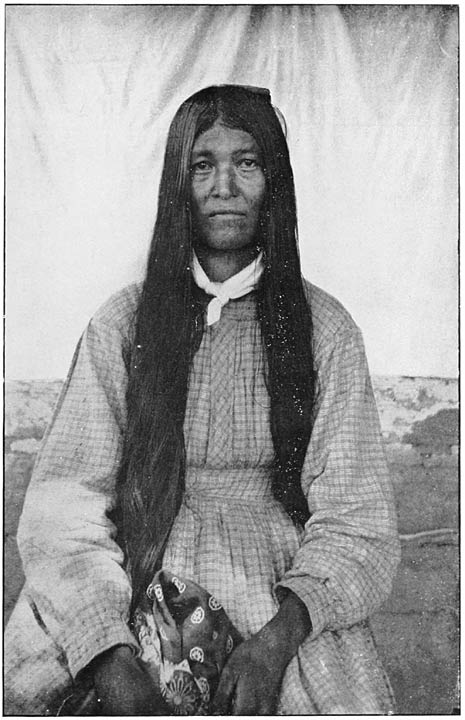
PHOTOGRAPH By AUTHOR, 1888
WALINI′, A CHEROKEE WOMAN
The Tuscarora, formerly the ruling tribe of eastern North Carolina, are still remembered under the name Ani′-Skălâ′lĭ, and are thus mentioned in the Feather dance of the Cherokee, in which some of the actors are supposed to be visiting strangers from other tribes.
The Catawba are known to the Cherokee as Ani′ta′gwa, singular Ata′gwa, or Ta′gwa, the Cherokee attempt at the name by which they are most commonly known. They were the immediate neighbors of the Cherokee on the east and southeast, having their principal settlements on the river of their name, just within the limits of South Carolina, and holding the leading place among all the tribes east of the Cherokee country with the exception of the Tuscarora. On the first settlement of South Carolina there were estimated to be about 7,000 persons in the tribe, but their decline was rapid, and by war and disease their number had been reduced in 1775 to barely 500, including the incorporated remnants of the Cheraw and several smaller tribes. There are now, perhaps, 100 still remaining on a small reservation near the site of their ancient towns. Some local names in the old Cherokee territory seem to indicate the former presence of Catawba, although there is no tradition of any Catawba settlement within those limits. Among such names may be mentioned Toccoa creek, in northeastern Georgia, and Toccoa river, in north-central Georgia, both names being derived from the Cherokee Tagwâ′hĭ, “Catawba place.” An old Cherokee personal name is Ta′gwădihĭ′, “Catawba-killer.”
About 1840 nearly the whole Catawba tribe moved up from South Carolina and joined the eastern band of Cherokee, but in consequence of tribal jealousies they remained but a short time, and afterward returned to their former home, as is related elsewhere.
Other tribal names (of doubtful authority) are Ani′-Sa′nĭ and Ani′-Sawahâ′nĭ, belonging to people said to have lived toward the north; both names are perhaps intended for the Shawano or Shawnee, properly Ani′-Sawănu′gĭ. The Ani′-Gilĭ′ are said to have been neighbors of the Anin′tsĭ or Natchez; the name may possibly be a Cherokee form for Congaree.
105. THE SOUTHERN AND WESTERN TRIBES
The nearest neighbors of the Cherokee to the south were the Creeks or Muscogee, who found mixed confederacy holding central and southern Georgia and Alabama. They were known to the Cherokee as Ani′-Ku′sa or Ani′-Gu′sa. from Kusa, the principal town of the Upper Creeks, which was situated on Coosa river, southwest from the present Talladega, Alabama. The Lower Creeks, residing chiefly on Chattahoochee river, were formerly always distinguished as Ani-Kawi′ta, from Kawita or Coweta, their ancient capital, on the west side of the river, in Alabama, nearly opposite the present Columbus, Georgia. In number the Creeks were nearly equal to the Cherokee, but differed in being a confederacy of cognate or incorporated tribes, of which the Muscogee proper was the principal. The Cherokee were called by them Tsal-gal′gi or Tsûlgûl′gi, a plural derivative from Tsa′lăgĭ′, the proper name of the tribe.
Among the names which remain to show the former presence of Creeks north of this boundary are the following: Coweeta, a small creek entering the Little Tennessee above Franklin. North Carolina; Tomatola (Cherokee. Tama′ʻlĭ), a former town site on Valley river, near Murphy, North Carolina, the name being that of a former Creek town on Chattahoochee: Tomotley (Cherokee, Tama′ʻlĭ), a ford at another town site on Little Tennessee, above Tellico mouth, in Tennessee: Coosa (Cherokee, Kusă′), an upper creek of Nottely river, in Union county, Georgia: Chattooga (Cherokee, Tsatu′gĭ), a river in northwest Georgia: Chattooga (Cherokee, Tsatu′gĭ), another river, a head-stream of Savannah: Chattahoochee river (Creek, Chatu-huchi, “pictured rocks”); Coosawatee (Cherokee, Ku′să-weti′yĭ, “Old Creek place”), a river in northwestern Georgia; Tali′wă, the Cherokee form of a Creek name for a place on an upper branch of Etowah river in Georgia, probably from the Creek ta′lua or ita′lua, “town”; Euharlee (Cherokee, Yuha′lĭ, said by the Cherokee to be from Yufala or Eufaula, the name of several Creek towns), a creek flowing into lower Etowah river; Suwanee (Cherokee, Suwaʻnĭ) a small creek on upper Chattahoochee, the site of a former Cherokee town with a name which the Cherokee say is Creek. Several other names within the same territory are said by the Cherokee to be of foreign origin, although perhaps not Creek, and may be from the Taskigi language.
According to Cherokee tradition as given to Haywood nearly eighty years ago the country about the mouth of Hiwassee river, in Tennessee, was held by the Creeks, while the Cherokee still had their main settlements farther to the north, on the Little Tennessee. In the Shawano war, about the year 1700, the Creeks pretended friendship for the Cherokee while secretly helping their enemies, the Shawano. The Cherokee discovered the treachery, and took occasion, when a party of Creeks was visiting a dance at Itsâ′tĭ (Echota), the Cherokee capital, to fall upon them and massacre nearly every man. The consequence was a war between the two tribes, with the final result that the Creeks were forced to abandon all their settlements upon the waters of the Tennessee, and to withdraw south to the Coosa and the neighborhood of the “Creek path,” an old trading trail from South Carolina, which crossed at the junction of the Oostanaula and Etowah rivers, where now is the city of Rome, Georgia, and struck the Tennessee at the present Guntersville, Alabama.
The battle of Tali′wă, which decided in favor of the Cherokee the long war between themselves and the Creeks, was fought about 1755 or a few years later at a spot on Mountain creek or Long-swamp creek, which enters Etowah river above Canton, Georgia, near where the old trail crossed the river about Long-swamp town. All our information concerning it is traditional, obtained from James Wafford, who heard the story when a boy, about the year 1815, from an old trader named Brian Ward, who had witnessed the battle sixty years before. According to his account, it was probably the hardest battle ever fought between the two tribes, about five hundred Cherokee and twice that number of Creek warriors being engaged. The Cherokee were at first overmatched and fell back, but rallied again and returned to the attack, driving the Creeks from cover so that they broke and ran. The victory was complete and decisive, and the defeated tribe immediately afterward abandoned the whole upper portion of Georgia and the adjacent part of Alabama to the conquerors. Before this battle the Creeks had been accustomed to shift about a good deal from place to place, but thereafter they confined themselves more closely to fixed home locations. It was in consequence of this defeat that they abandoned their town on Nottely river, below Coosa creek, near the present Blairsville, Georgia, their old fields being at once occupied by Cherokee, who moved over from their settlements on the head of Savannah river. As has been already stated, a peace was made about 1759, just in time to enable the Creeks to assist the Cherokee in their war with South Carolina. We hear little more concerning the relations of the two tribes until the Creek war of 1813–14, described in detail elsewhere; after this their histories drift apart.
The Yuchi or Uchee, called Ani′-Yu′tsĭ by the Cherokee, were a tribe of distinct linguistic stock and of considerable importance in early days; their territory bordered Savannah river on both sides immediately below the Cherokee country, and extended some distance westward into Georgia, where it adjoined that of the Creeks. They were gradually dispossessed by the whites, and were incorporated with the Creeks about the year 1740, but retain their separate identity and language to this day, their town being now the largest in the Creek Nation in Indian Territory.
According to the testimony of a Cherokee mixed-blood named Gansĕ′ʻtĭ or Rattling-gourd, who was born on Hiwassee river in 1820 and came west with his people in 1838, a number of Yuchi lived, before the Removal, scattered among the Cherokee near the present Cleveland, Tennessee, and on Chickamauga, Cohutta, and Pinelog creeks in the adjacent section of Georgia. They had no separate settlements, but spoke their own language, which he described as “hard and grunting.” Some of them spoke also Cherokee and Creek. They had probably drifted north from the Creek country before a boundary had been fixed between the tribes. When Tahlequah was established as the capital of the Cherokee Nation in the West in 1839 a few Yuchi were found already settled at the spot, being supposed to have removed from the East with some Creeks after the chief McIntosh was killed in 1825. They perished in the smallpox epidemic which ravaged the frontier in 1840, and their graves were still pointed out at Tahlequah in 1891. Shortly before the outbreak of the Civil war there was a large and prosperous Yuchi settlement on Cimarron river, in what was afterward the Cherokee strip.
According to the statement of James Wafford, who was born in 1806 near the site of Clarkesville, Ga., when this region was still Indian country, the “Notchees” had their town on the north bank of Hiwassee, just above Peachtree creek, on the spot where a Baptist mission was established by the Rev. Evan Jones in 1821, a few miles above the present Murphy, Cherokee county, North Carolina. On his mother’s side he had himself a strain of Natchez blood. His grandmother had told him that when she was a young woman, perhaps about 1755, she once had occasion to go to this town on some business, which she was obliged to transact through an interpreter, as the Natchez had been there so short a time that only one or two spoke any Cherokee. They were all in the one town, which the Cherokee called Gwalʻgâ′hĭ, “Frog place,” but he was unable to say whether or not it had a townhouse. In 1824, as one of the census takers for the Cherokee Nation, he went over the same section and found the Natchez then living jointly with the Cherokee in a town called Gûʻlăni′yĭ at the junction of Brasstown and Gumlog creeks, tributary to Hiwassee, some 6 miles southeast of their former location and close to the Georgia line. The removal may have been due to the recent establishment of the mission at the old place. It was a large settlement, made up about equally from the two tribes, but by this time the Natchez were not distinguishable in dress or general appearance from the others, and nearly all spoke broken Cherokee, while still retaining their own language. As most of the Indians had come under Christian influences so far as to have quit dancing, there was no townhouse. Harry Smith, who was born about 1820, father of the late chief of the East Cherokee, also remembers them as living on Hiwassee and calling themselves Na′ʻtsĭ.
Gansĕ′ʻtĭ, already mentioned, states that when he was a boy the Natchez were scattered among the Cherokee settlements along the upper part of Hiwassee, extending down into Tennessee. They had then no separate townhouses. Some of them, at least, had come up from the Creeks, and spoke Creek and Cherokee, as well as their own language, which he could not understand, although familiar with both of the others. They were great dance leaders, which agrees with their traditional reputation for ceremonial and secret knowledge. They went west with the Cherokee at the final removal of the tribe to Indian Territory in 1838. In 1890 there was a small settlement on Illinois river a few miles south of Tahlequah, Cherokee Nation, several persons in which still spoke their own language. Some of these may have come with the Creeks, as by an agreement between Creeks and Cherokee about the time of the Removal it had been arranged that citizens of either tribe living within the boundaries claimed by the other might remain without question if they so elected. There are still several persons claiming Natchez descent among the East Cherokee, but the last one said to have been of full Natchez blood, an old woman named Alkĭnĭ′, died about 1895. She was noted for her peculiarities, especially for a drawling tone, said to have been characteristic of her people, as old men remembered them years ago.
Another refugee tribe incorporated partly with the Cherokee and partly with the Creeks was that of the Taskigi, who at an early period had a large town of the same name on the south side of the Little Tennessee, just above the mouth of Tellico, in Monroe county, Tennessee. Sequoya, the inventor of the Cherokee alphabet, lived here in his boyhood, about the time of the Revolution. The land was sold in 1819. There was another settlement of the name, and perhaps once occupied by the same people, on the north bank of Tennessee river, in a bend just below Chattanooga, Tennessee, on land sold also in 1819. Still another may have existed at one time on Tuskegee creek, on the south bank of Little Tennessee river, north of Robbinsville, in Graham county, North Carolina, on land which was occupied until the Removal in 1838. Taskigi town of the Creek country was on Coosa river, near the junction with the Tallapoosa, some distance above the present Montgomery, Alabama. We find Tasquiqui mentioned as a town in the Creek country visited by the Spanish captain, Juan Pardo, in 1567. The name is evidently the same, though we can not be sure that the location was identical with that of the later town.
Who or what the Taskigi were is uncertain and can probably never be known, but they were neither Cherokee nor Muscogee proper. It would seem most probable that they were of Muskhogean affinity, but they may have been an immigrant tribe from another section, or may even have constituted a distinct linguistic stock, representing all that was left of an ancient people whose occupation of the country antedated the coming of the Cherokee and the Creeks. The name may be derived from taska or tasha′ya, meaning “warrior” in several of the Muskhogean dialects. It is not a Cherokee word, and Cherokee informants state positively that the Taskigi were a foreign people, with distinct language and customs. They were not Creeks, Natchez, Uchee, or Shawano, with all of whom the Cherokee were well acquainted under other names. In the townhouse of their settlement at the mouth of Tellico they had an upright pole, from the top of which hung their protecting “medicine,” the image of a human figure cut from a cedar log. For this reason the Cherokee in derision sometimes called the place Atsĭnă′-kʻtaûñ, “Hanging-cedar place.” Before the sale of the land in 1819 they were so nearly extinct that the Cherokee had moved in and occupied the ground.
Other old Cherokee names for western tribes which can not be identified are Tayûñ′ksĭ, the untranslatable name of a tribe described simply as living in the West; Tsuniya′tigă, “Naked people,” described as living in the far West; Gûn′-tsuskwa′ʻlĭ, “Short-arrows,” who lived in the far West, and were small, but great fighters; Yûñ′wini′giskĭ, “Man-eaters,” a hostile tribe west or north, possibly the cannibal Atakapa or Tonkawa, of Louisiana or Texas. Their relations with the tribes with which they have become acquainted since the removal to Indian Territory do not come within the scope of this paper.
106. THE GIANTS FROM THE WEST
James Wafford, of the western Cherokee, who was born in Georgia in 1806, says that his grandmother, who must have been born about the middle of the last century, told him that she had heard from the old people that long before her time a party of giants had come once to visit the Cherokee. They were nearly twice as tall as common men, and had their eyes set slanting in their heads, so that the Cherokee called them Tsunil′ kălû′, “The Slant-eyed people,” because they looked like the giant hunter Tsulʻkălû′ (see the story). They said that these giants lived very far away in the direction in which the sun goes down. The Cherokee received them as friends, and they stayed some time, and then returned to their home in the west. The story may be a distorted historical tradition.
107. THE LOST CHEROKEE
When the first lands were sold by the Cherokee, in 1721, a part of the tribe bitterly opposed the sale, saying that if the Indians once consented to give up any of their territory the whites would never be satisfied, but would soon want a little more, and a little again, until at last there would be none left for the Indians. Finding all they could say not enough to prevent the treaty, they determined to leave their old homes forever and go far into the West, beyond the Great river, where the white men could never follow them. They gave no heed to the entreaties of their friends, but began preparations for the long march, until the others, finding that they could not prevent their going, set to work and did their best to fit them out with pack horses loaded with bread, dried venison, and other supplies.
When all was ready they started, under the direction of their chief. A company of picked men was sent with them to help them in crossing the Great river, and every night until they reached it runners were sent back to the tribe, and out from the tribe to the marching band, to carry messages and keep each party posted as to how the other was getting along. At last they came to the Mississippi, and crossed it by the help of those warriors who had been sent with them. These then returned to the tribe, while the others kept on to the west. All communication was now at an end. No more was heard of the wanderers, and in time the story of the lost Cherokee was forgotten or remembered only as an old tale.
Still the white man pressed upon the Cherokee and one piece of land after another was sold, until as years went on the dispossessed people began to turn their faces toward the west as their final resting place, and small bands of hunters crossed the Mississippi to learn what might be beyond. One of these parties pushed on across the plains and there at the foot of the great mountains—the Rockies—they found a tribe speaking the old Cherokee language and living still as the Cherokee had lived before they had ever known the white man or his ways.
108. THE MASSACRE OF THE ANI′-KUTA′NĬ
Among other perishing traditions is that relating to the Ani′-Kuta′nĭ or Ani′-Kwăta′nĭ, concerning whom the modern Cherokee know so little that their very identity is now a matter of dispute, a few holding that they were an ancient people who preceded the Cherokee and built the mounds, while others, with more authority, claim that they were a clan or society in the tribe and were destroyed long ago by pestilence or other calamity. Fortunately, we are not left to depend entirely upon surmise in the matter, as the tradition was noted by Haywood some seventy years ago, and by another writer some forty years later, while the connected story could still be obtained from competent authorities. From the various statements it would seem that the Ani′-Kuta′nĭ were a priestly clan, having hereditary supervision of all religious ceremonies among the Cherokee, until, in consequence of having abused their sacred privileges, they were attacked and completely exterminated by the rest of the tribe, leaving the priestly functions to be assumed thereafter by individual doctors and conjurers.
A more detailed statement, on the authority of Chief John Ross and Dr J. B. Evans, is given in 1866 by a writer who speaks of the massacre as having occurred about a century before, although from the dimness of the tradition it is evident that it must have been much earlier:
“The facts, though few, are interesting. The order was hereditary; in this respect peculiar, for among Indians seldom, and among the Cherokees never, does power pertain to any family as a matter of right. Yet the family of the Nicotani—for it seems to have been a family or clan—enjoyed this privilege. The power that they exercised was not, however, political, nor does it appear that chiefs were elected from among them.
109. THE WAR MEDICINE
Some warriors had medicine to change their shape as they pleased, so that they could escape from their enemies. Once one of these medicine warriors who had been away from home came back and found a strong party of the enemy attacking the settlement while nearly all the men were off on a hunt. The town was on the other side of the river, but his grandmother was there, so he made up his mind to save her. Going down the stream a little way, he hunted until he found a mussel shell. With his medicine he changed this to a canoe, in which he crossed over to his grandmother’s house, and found her sitting there, waiting for the enemy to come and kill her. Again he made medicine and put her into a small gourd which he fastened to his belt. Then climbing a tree he changed himself to a swamp woodcock, and with one cry he spread his wings and flew across to the other side of the river, where both took their natural shape again and made their way through the woods to another settlement.
There was another great Cherokee warrior, named Dasiʻgiya′gĭ, or Shoe-boots, as the whites called him, who lived on Hightower creek, in Georgia. He was so strong that it was said he could throw a corn mortar over a house, and with his magic power could clear a river at one jump. His war medicine was an uktena scale and a very large turtle shell which he got from the Shawano. In the Creek war he put this scale into water and bathed his body with the water, and also burned a piece of the turtle shell and drew a black line around his men with the coal, and he was never wounded and never had a man killed.
Some great warriors had a medicine by the aid of which they could dive under the ground as under water, come up among the enemy to kill and scalp one, then dive under the ground again and come up among their friends.
Some war captains knew how to put their lives up in the tree tops during a fight, so that even if they were struck by the enemy they could not be killed. Once, in a battle with the Shawano, the Cherokee leader stood directly in front of the enemy and let the whole party shoot at him, but was not hurt until the Shawano captain, who knew this war medicine himself, ordered his men to shoot into the branches above the head of the other. They did this and the Cherokee leader fell dead.
110. INCIDENTS OF PERSONAL HEROISM
More than once women seem to have shown the courage of warriors when the occasion demanded. At the beginning of the last century there was still living among the Cherokee a woman who had killed her husband’s slayer in one of the Revolutionary engagements. For this deed she was treated with so much consideration that she was permitted to join the warriors in the war dance, carrying her gun and tomahawk. The Wahnenauhi manuscript has a tradition of an attack upon a Cherokee town and the killing of the chief by a hostile war party. His wife, whose name was Cuhtahlatah (Gatûñ′lătĭ, “Wild-hemp”?), on seeing her husband fall, snatched up his tomahawk, shouting, “Kill! Kill!” and rushed upon the enemy with such fury that the retreating Cherokee rallied and renewed the battle with so great courage as to gain a complete victory. This may be a different statement of the same incident.
In Rutherford’s expedition against the Cherokee, in 1776, the Indians made a stand near Waya gap, in the Nantahala mountains, and a hard-fought engagement took place, with a loss to the Americans of nineteen men, although the enemy was finally driven from the ground. After the main body had retreated, an Indian was seen looking out from behind a tree, and was at once shot and killed by the soldiers, who, on going to the spot, found that it was a woman, painted and striped like a warrior and armed with bow and arrows. She had already been shot through the thigh, and had therefore been unable to flee with the rest.
111. THE MOUNDS AND THE CONSTANT FIRE: THE OLD SACRED THINGS
Some say that the mounds were built by another people. Others say they were built by the ancestors of the old Ani′-Kĭtu′hwagĭ for townhouse foundations, so that the townhouses would be safe when freshets came. The townhouse was always built on the level bottom lands by the river in order that the people might have smooth ground for their dances and ballplays and might be able to go down to water during the dance.
When they were ready to build the mound they began by laying a circle of stones on the surface of the ground. Next they made a fire in the center of the circle and put near it the body of some prominent chief or priest who had lately died—some say seven chief men from the different clans—together with an Ulûñsû′tĭ stone, an uktena scale or horn, a feather from the right wing of an eagle or great tlă′nuwă, which lived in those days, and beads of seven colors, red, white, black, blue, purple, yellow, and gray-blue. The priest then conjured all these with disease, so that, if ever an enemy invaded the country, even though he should burn and destroy the town and the townhouse, he would never live to return home.
The mound was then built up with earth, which the women brought in baskets, and as they piled it above the stones, the bodies of their great men, and the sacred things, they left an open place at the fire in the center and let down a hollow cedar trunk, with the bark on, which fitted around the fire and protected it from the earth. This cedar log was cut long enough to reach nearly to the surface inside the townhouse when everything was done. The earth was piled up around it, and the whole mound was finished off smoothly, and then the townhouse was built upon it. One man, called the fire keeper, stayed always in the townhouse to feed and tend the fire. When there was to be a dance or a council he pushed long stalks of the ihyâ′ga weed, which some call atsil′-sûñ′tĭ, “the fire maker” (Erigeron canadense or fleabane), down through the opening in the cedar log to the fire at the bottom. He left the ends of the stalks sticking out and piled lichens and punk around, after which he prayed, and as he prayed the fire climbed up along the stalks until it caught the punk. Then he put on wood, and by the time the dancers were ready there was a large fire blazing in the townhouse. After the dance he covered the hole over again with ashes, but the fire was always smoldering below. Just before the Green-corn dance, in the old times, every fire in the settlement was extinguished and all the people came and got new fire from the townhouse. This was called atsi′la gălûñkwʼti′yu, “the honored or sacred fire.” Sometimes when the fire in a house went out, the woman came to the fire keeper, who made a new fire by rubbing an ihyâ′ga stalk against the under side of a hard dry fungus that grows upon locust trees.
Some say this everlasting fire was only in the larger mounds at Nĭkwăsĭ′, Kĭtu′hwa, and a few other towns, and that when the new fire was thus drawn up for the Green-corn dance it was distributed from them to the other settlements. The fire burns yet at the bottom of these great mounds, and when the Cherokee soldiers were camped near Kĭtu′hwa during the civil war they saw smoke still rising from the mound.
The Cherokee once had a wooden box, nearly square and wrapped up in buckskin, in which they kept the most sacred things of their old religion. Upon every important expedition two priests carried it in turn and watched over it in camp so that nothing could come near to disturb it. The Delawares captured it more than a hundred years ago, and after that the old religion was neglected and trouble came to the Nation. They had also a great peace pipe, carved from white stone, with seven stem-holes, so that seven men could sit around and smoke from it at once at their peace councils. In the old town of Keowee they had a drum of stone, cut in the shape of a turtle, which was hung up inside the townhouse and used at all the town dances. The other towns of the Lower Cherokee used to borrow it, too, for their own dances.
All the old things are gone now and the Indians are different.
Miscellaneous Myths and Legends
112. THE IGNORANT HOUSEKEEPER
An old man whose wife had died lived alone with his son. One day he said to the young man, “We need a cook here, so you would better get married.” So the young man got a wife and brought her home. Then his father said, “Now we must work together and do all we can to help her. You go hunting and bring in the meat and I’ll look after the corn and beans, and then she can cook.” The young man went into the woods to look for a deer and his father went out into the field to attend to the corn. When they came home at night they were hungry, and the young woman set out a bowl of walnut hominy (kanâ′talu′hĭ) before them. It looked queer, somehow, and when the old man examined it he found that the walnuts had been put in whole. “Why didn’t you shell the walnuts and then beat up the kernels,” said he to the young woman. “I didn’t know they had to be shelled,” she replied. Then the old man said, “You think about marrying and you don’t know how to cook,” and he sent her away.
113. THE MAN IN THE STUMP
A man who had a field of growing corn went out one day to see how it was ripening and climbed a tall stump to get a better view. The stump was hollow and a bear had a nest of cubs in the bottom. The man slipped and fell down upon the cubs, which set up such a squealing that the old she-bear heard them and came climbing down into the stump tail first, in bear fashion, to see what was the matter. The man caught hold of her by the hind legs and the old bear was so frightened that she at once climbed out again, dragging the man, who thus got out of the stump, when the bear ran away.
114. TWO LAZY HUNTERS
A party of warriors once started out for a long hunting trip in the mountains. They went on until they came to a good game region, when they set up their bark hut in a convenient place near the river side. Every morning after breakfast they scattered out, each man for himself, to be gone all day, until they returned at night with whatever game they had taken. There was one lazy fellow who went out alone every morning like the others, but only until he found a sunny slope, when he would stretch out by the side of a rock to sleep until evening, returning then to camp empty-handed, but with his moccasins torn and a long story of how he had tramped all day and found nothing. This went on until one of the others began to suspect that something was wrong, and made it his business to find it out. The next morning he followed him secretly through the woods until he saw him come out into a sunny opening, where he sat down upon a large rock, took off his moccasins, and began rubbing them against the rocks until he had worn holes in them. Then the lazy fellow loosened his belt, lay down beside the rock, and went to sleep. The spy set fire to the dry leaves and watched until the flame crept close up to the sleeping man, who never opened his eyes.
The spy went back to camp and told what he had seen. About supper time the lazy fellow came in with the same old story of a long day’s hunt and no game started. When he had finished the others all laughed and called him a sleepyhead. He insisted that he had been climbing the ridges all day, and put out his moccasins to show how worn they were, not knowing that they were scorched from the fire, as he had slept on until sundown. When they saw the blackened moccasins they laughed again, and he was too much astonished to say a word in his defense; so the captain said that such a liar was not fit to stay with them, and he was driven from the camp.
There was another lazy fellow who courted a pretty girl, but she would have nothing to do with him, telling him that her husband must be a good hunter or she would remain single all her life. One morning he went into the woods, and by a lucky accident managed to kill a deer. Lifting it upon his back, he carried it into the settlement, passing right by the door of the house where the girl and her mother lived. As soon as he was out of sight of the house he went by a roundabout course into the woods again and waited until evening, when he appeared with the deer on his shoulder and came down the trail past the girl’s house as he had in the morning. He did this the next day, and the next, until the girl began to think he must be killing all the deer in the woods. So her mother—the old women are usually the matchmakers—got ready and went to the young man’s mother to talk it over.
When she arrived and the greetings were done she said, “Your son must be a good hunter.” “No,” replied the old woman, “he seldom kills anything.” “But he has been killing a great many deer lately.” “I haven’t seen any,” said his mother. “Why, he has been carrying deer past our house twice a day for the last three days.” “I don’t know what he did with them,” said the young man’s mother; “he never brought them here.” Then the girl’s mother was sure there was something wrong, so she went home and told her husband, who followed up the young man’s trail into the woods until it brought him to where the body of the deer was hidden, now so far decayed that it had to be thrown away.
115. THE TWO OLD MEN
Two old men went hunting. One had an eye drawn down and was called Uk-kwûnăgi′ta, “Eye-drawn-down.” The other had an arm twisted out of shape and was called Uk-ku′sûñtsûtĭ, “Bent-bow-shape.” They killed a deer and cooked the meat in a pot. The second old man dipped a piece of bread into the soup and smacked his lips as he ate it. “Is it good?” said the first old man. Said the other, “Hayû′! uk-kwûnăgi′stĭ—Yes, sir! It will draw down one’s eye.”
Thought the first old man to himself, “He means me.” So he dipped a piece of bread into the pot, and smacked his lips as he tasted it. “Do you find it good?” said the other old man. Said his comrade, “Hayû′! uk-ku′sûñtsûtĕtĭ′—Yes, sir! It will twist up one’s arm.” Thought the second old man, “He means me”; so he got very angry and struck the first old man, and then they fought until each killed the other.
116. THE STAR FEATHERS
A long time ago a warrior of roving disposition went down into the white settlements toward the east, where for the first time he saw a peacock. The beautiful long feathers surprised and delighted him, and by trading some valuable Indian possession of his own he managed to buy a few of them, which he took with him to the mountains and hid, until he was ready to use them, in an old beaver lodge under the river bank. To get into the beaver lodge he had to dive under the water.
Then he set to work secretly and made himself a headdress, with the long peacock feathers in the front and trailing out behind and the shorter ones at the sides. At the next dance he wore the new headdress, and asserted that he had been up to the sky and that these were star feathers (see number 9, “What the stars are like”). He made a long speech also, which he pretended was a message he had received from the star spirits to deliver to the people.
Everyone wondered at the beautiful feathers, so different from any they had ever seen before. They made no doubt that he had been up to the sky and talked with spirits. He became a great prophet, and used to keep himself hidden all day in the beaver hole, and whenever there was a night gathering for a dance or a council he would suddenly appear among them wearing his feather headdress and give the people a new message from the sky. Then he would leave them again, pretending that he went up to heaven.
He grew famous and powerful among all the medicine men, until at last it happened that another Cherokee went down among the white settlements and saw there another peacock, and knew at once that the prophet was a fraud. On his return he quietly told some of his friends, and they decided to investigate. When the next night dance came around the prophet was on hand as usual with a new message fresh from the stars. The people listened reverently, and promised to do all that he commanded. Then he left them, saying that he must return at once to the sky, but as he went out from the circle the spies followed him in the darkness, and saw him go down to the river and dive under the water. They waited, but he did not come up again, and they went back and told the people. The next morning a party went to the spot and discovered the beaver lodge under the bank. One man dived and came up inside, and there he found the prophet sitting with the peacock feathers by his side.
117. THE MOTHER BEAR’S SONG
A hunter in the woods one day heard singing in a cave. He came near and peeped in, and it was a mother bear singing to her cubs and telling them what to do when the hunters came after them.
Said the mother bear to the cubs, “When you hear the hunters coming down the creek, then—
Tsâ′gĭ, tsâ′gĭ, hwĭ′lahĭ′;
Tsâ′gĭ, tsâ′gĭ, hwĭ′lahĭ′.
Upstream, upstream, you (must) go;
Upstream, upstream, you (must) go.
“But if you hear them coming up the creek, children, then—
Ge′ĭ, ge′ĭ, hwĭ′lahĭ′;
Ge′ĭ, ge′ĭ, hwĭ′lahĭ′.
Downstream, downstream, you (must) go;
Downstream, downstream, you (must) go.”
Another hunter out in the woods one day thought he heard a woman singing to a baby. He followed the sound up to the head of the branch until he came to a cave under the bushes, and inside was a mother bear rocking her cub in her paws and singing to it this baby song, which the Ani′-Tsâ′gûhĭ used to know before they were turned into bears:
Ha′-mama′, ha′-mama′, ha′-mama′, ha′-mama′;
Udâ′hale′yĭ hi′lûñnû, hi′lûñnû;
Udâ′hale′yĭ hi′lûñnû, hi′lûñnû.
Let me carry you on my back (four times);
On the sunny side go to sleep, go to sleep;
On the sunny side go to sleep, go to sleep.
118. BABY SONG, TO PLEASE THE CHILDREN
Ha′wiye′-hyuwe′, Ha′wiye′-hyuwe′,
Yu′wĕ-yuwĕhe′, Ha′wiyĕhyu′-uwe′—
Yâ′nû une′guhi′ tsana′sehâ′;
Eʼtĭ une′guhi′ tsana′sehâ′;
Yâ′nû nudûñnelû′ tsa′nadiskâ′.
Ha′wiye′-hyuwe′, Ha′wiye′-hyuwe′,
Yu′wĕ-yuwĕhe′, Ha′wiyĕhyu′-uwe′—
The Bear is very bad, so they say;
Long time ago he was very bad, so they say;
The Bear did so and so, they say.
119. WHEN BABIES ARE BORN: THE WREN AND THE CRICKET
The little Wren is the messenger of the birds, and pries into everything. She gets up early in the morning and goes round to every house in the settlement to get news for the bird council. When a new baby is born she finds out whether it is a boy or girl and reports to the council. If it is a boy the birds sing in mournful chorus: “Alas! the whistle of the arrow! my shins will burn,” because the birds know that when the boy grows older he will hunt them with his blowgun and arrows and roast them on a stick.
But if the baby is a girl, they are glad and sing: “Thanks! the sound of the pestle! At her home I shall surely be able to scratch where she sweeps,” because they know that after a while they will be able to pick up stray grains where she beats the corn into meal.
When the Cricket hears that a girl is born, it also is glad, and says, “Thanks, I shall sing in the house where she lives.” But if it is a boy the Cricket laments: “Gwe-he! He will shoot me! He will shoot me! He will shoot me!” because boys make little bows to shoot crickets and grasshoppers.
When inquiring as to the sex of the new arrival the Cherokee asks, “Is it a bow or a (meal) sifter?” or, “Is it ballsticks or bread?”
120. THE RAVEN MOCKER
Of all the Cherokee wizards or witches the most dreaded is the Raven Mocker (Kâ′lanû Ahyeli′skĭ), the one that robs the dying man of life. They are of either sex and there is no sure way to know one, though they usually look withered and old, because they have added so many lives to their own.