V—THE MYTHS (continued 2)
Reading edition
The hot coals fell all around the Otter and he jumped up. “To the water!” cried the Rabbit, and the Otter ran and jumped into the river, and he has lived in the water ever since.
The Rabbit took the Otter’s coat and put it on, leaving his own instead, and went on to the council. All the animals were there, every one looking out for the Otter. At last they saw him in the distance, and they said one to the other, “The Otter is coming!” and sent one of the small animals to show him the best seat. They were all glad to see him and went up in turn to welcome him, but the Otter kept his head down, with one paw over his face. They wondered that he was so bashful, until the Bear came up and pulled the paw away, and there was the Rabbit with his split nose. He sprang up and started to run, when the Bear struck at him and pulled his tail off, but the Rabbit was too quick for them and got away.
18. WHY THE POSSUM’S TAIL IS BARE
The Possum used to have a long, bushy tail, and was so proud of it that he combed it out every morning and sang about it at the dance, until the Rabbit, who had had no tail since the Bear pulled it out, became very jealous and made up his mind to play the Possum a trick.
There was to be a great council and a dance at which all the animals were to be present. It was the Rabbit’s business to send out the news, so as he was passing the Possum’s place he stopped to ask him if he intended to be there. The Possum said he would come if he could have a special seat, “because I have such a handsome tail that I ought to sit where everybody can see me.” The Rabbit promised to attend to it and to send some one besides to comb and dress the Possum’s tail for the dance, so the Possum was very much pleased and agreed to come.
Then the Rabbit went over to the Cricket, who is such an expert hair cutter that the Indians call him the barber, and told him to go next morning and dress the Possum’s tail for the dance that night. He told the Cricket just what to do and then went on about some other mischief.
In the morning the Cricket went to the Possum’s house and said he had come to get him ready for the dance. So the Possum stretched himself out and shut his eyes while the Cricket combed out his tail and wrapped a red string around it to keep it smooth until night. But all this time, as he wound the string around, he was clipping off the hair close to the roots, and the Possum never knew it.
When it was night the Possum went to the townhouse where the dance was to be and found the best seat ready for him, just as the Rabbit had promised. When his turn came in the dance he loosened the string from his tail and stepped into the middle of the floor. The drummers began to drum and the Possum began to sing, “See my beautiful tail.” Everybody shouted and he danced around the circle and sang again, “See what a fine color it has.” They shouted again and he danced around another time, singing, “See how it sweeps the ground.” The animals shouted more loudly than ever, and the Possum was delighted. He danced around again and sang, “See how fine the fur is.” Then everybody laughed so long that the Possum wondered what they meant. He looked around the circle of animals and they were all laughing at him. Then he looked down at his beautiful tail and saw that there was not a hair left upon it, but that it was as bare as the tail of a lizard. He was so much astonished and ashamed that he could not say a word, but rolled over helpless on the ground and grinned, as the Possum does to this day when taken by surprise.
19. HOW THE WILDCAT CAUGHT THE GOBBLER
The Wildcat once caught the Rabbit and was about to kill him, when the Rabbit begged for his life, saying: “I’m so small I would make only a mouthful for you, but if you let me go I’ll show you where you can get a whole drove of Turkeys.” So the Wildcat let him up and went with him to where the Turkeys were.
When they came near the place the Rabbit said to the Wildcat, “Now, you must do just as I say. Lie down as if you were dead and don’t move, even if I kick you, but when I give the word jump up and catch the largest one there.” The Wildcat agreed and stretched out as if dead, while the Rabbit gathered some rotten wood and crumbled it over his eyes and nose to make them look flyblown, so that the Turkeys would think he had been dead some time.
Then the Rabbit went over to the Turkeys and said, in a sociable way, “Here, I’ve found our old enemy, the Wildcat, lying dead in the trail. Let’s have a dance over him.” The Turkeys were very doubtful, but finally went with him to where the Wildcat was lying in the road as if dead. Now, the Rabbit had a good voice and was a great dance leader, so he said, “I’ll lead the song and you dance around him.” The Turkeys thought that fine, so the Rabbit took a stick to beat time and began to sing: “Gălăgi′na hasuyak′, Gălăgi′na hasuyak′ (pick out the Gobbler, pick out the Gobbler).”
“Why do you say that?” said the old Turkey. “O, that’s all right,” said the Rabbit, “that’s just the way he does, and we sing about it.” He started the song again and the Turkeys began to dance around the Wildcat. When they had gone around several times the Rabbit said, “Now go up and hit him, as we do in the war dance.” So the Turkeys, thinking the Wildcat surely dead, crowded in close around him and the old gobbler kicked him. Then the Rabbit drummed hard and sang his loudest, “Pick out the Gobbler, pick out the Gobbler,” and the Wildcat jumped up and caught the Gobbler.
20. HOW THE TERRAPIN BEAT THE RABBIT
The Rabbit was a great runner, and everybody knew it. No one thought the Terrapin anything but a slow traveler, but he was a great warrior and very boastful, and the two were always disputing about their speed. At last they agreed to decide the matter by a race. They fixed the day and the starting place and arranged to run across four mountain ridges, and the one who came in first at the end was to be the winner.
The Rabbit felt so sure of it that he said to the Terrapin, “You know you can’t run. You can never win the race, so I’ll give you the first ridge and then you’ll have only three to cross while I go over four.”
The Terrapin said that would be all right, but that night when he went home to his family he sent for his Terrapin friends and told them he wanted their help. He said he knew he could not outrun the Rabbit, but he wanted to stop the Rabbit’s boasting. He explained his plan to his friends and they agreed to help him.
When the day came all the animals were there to see the race. The Rabbit was with them, but the Terrapin was gone ahead toward the first ridge, as they had arranged, and they could hardly see him on account of the long grass. The word was given and the Rabbit started off with long jumps up the mountain, expecting to win the race before the Terrapin could get down the other side. But before he got up the mountain he saw the Terrapin go over the ridge ahead of him. He ran on, and when he reached the top he looked all around, but could not see the Terrapin on account of the long grass. He kept on down the mountain and began to climb the second ridge, but when he looked up again there was the Terrapin just going over the top. Now he was surprised and made his longest jumps to catch up, but when he got to the top there was the Terrapin away in front going over the third ridge. The Rabbit was getting tired now and nearly out of breath, but he kept on down the mountain and up the other ridge until he got to the top just in time to see the Terrapin cross the fourth ridge and thus win the race.
The Rabbit could not make another jump, but fell over on the ground, crying mĭ, mĭ, mĭ, mĭ, as the Rabbit does ever since when he is too tired to run any more. The race was given to the Terrapin and all the animals wondered how he could win against the Rabbit, but he kept still and never told. It was easy enough, however, because all the Terrapin’s friends looked just alike, and he had simply posted one near the top of each ridge to wait until the Rabbit came in sight and then climb over and hide in the long grass. When the Rabbit came on he could not find the Terrapin and so thought the Terrapin was ahead, and if he had met one of the other terrapins he would have thought it the same one because they looked so much alike. The real Terrapin had posted himself on the fourth ridge, so as to come in at the end of the race and be ready to answer questions if the animals suspected anything.
Because the Rabbit had to lie down and lose the race the conjurer now, when preparing his young men for the ball play, boils a lot of rabbit hamstrings into a soup, and sends some one at night to pour it across the path along which the other players are to come in the morning, so that they may become tired in the same way and lose the game. It is not always easy to do this, because the other party is expecting it and has watchers ahead to prevent it.
21. THE RABBIT AND THE TAR WOLF
Once there was such a long spell of dry weather that there was no more water in the creeks and springs, and the animals held a council to see what to do about it. They decided to dig a well, and all agreed to help except the Rabbit, who was a lazy fellow, and said, “I don’t need to dig for water. The dew on the grass is enough for me.” The others did not like this, but they went to work together and dug their well.
They noticed that the Rabbit kept sleek and lively, although it was still dry weather and the water was getting low in the well. They said, “That tricky Rabbit steals our water at night,” so they made a wolf of pine gum and tar and set it up by the well to scare the thief. That night the Rabbit came, as he had been coming every night, to drink enough to last him all next day. He saw the queer black thing by the well and said, “Who’s there?” but the tar wolf said nothing. He came nearer, but the wolf never moved, so he grew braver and said, “Get out of my way or I’ll strike you.” Still the wolf never moved and the Rabbit came up and struck it with his paw, but the gum held his foot and it stuck fast. Now he was angry and said, “Let me go or I’ll kick you.” Still the wolf said nothing. Then the Rabbit struck again with his hind foot, so hard that it was caught in the gum and he could not move, and there he stuck until the animals came for water in the morning. When they found who the thief was they had great sport over him for a while and then got ready to kill him, but as soon as he was unfastened from the tar wolf he managed to get away.—Wafford.
SECOND VERSION
“Once upon a time there was such a severe drought that all streams of water and all lakes were dried up. In this emergency the beasts assembled together to devise means to procure water. It was proposed by one to dig a well. All agreed to do so except the hare. She refused because it would soil her tiny paws. The rest, however, dug their well and were fortunate enough to find water. The hare beginning to suffer and thirst, and having no right to the well, was thrown upon her wits to procure water. She determined, as the easiest way, to steal from the public well. The rest of the animals, surprised to find that the hare was so well supplied with water, asked her where she got it. She replied that she arose betimes in the morning and gathered the dewdrops. However the wolf and the fox suspected her of theft and hit on the following plan to detect her:
They made a wolf of tar and placed it near the well. On the following night the hare came as usual after her supply of water. On seeing the tar wolf she demanded who was there. Receiving no answer she repeated the demand, threatening to kick the wolf if he did not reply. She receiving no reply kicked the wolf, and by this means adhered to the tar and was caught. When the fox and wolf got hold of her they consulted what it was best to do with her. One proposed cutting her head off. This the hare protested would be useless, as it had often been tried without hurting her. Other methods were proposed for dispatching her, all of which she said would be useless. At last it was proposed to let her loose to perish in a thicket. Upon this the hare affected great uneasiness and pleaded hard for life. Her enemies, however, refused to listen and she was accordingly let loose. As soon, however, as she was out of reach of her enemies she gave a whoop, and bounding away she exclaimed: ‘This is where I live.’”—Cherokee Advocate, December 18, 1845.
BUREAU OF AMERICAN ETHNOLOGY NINETEENTH ANNUAL REPORT PL. XIV
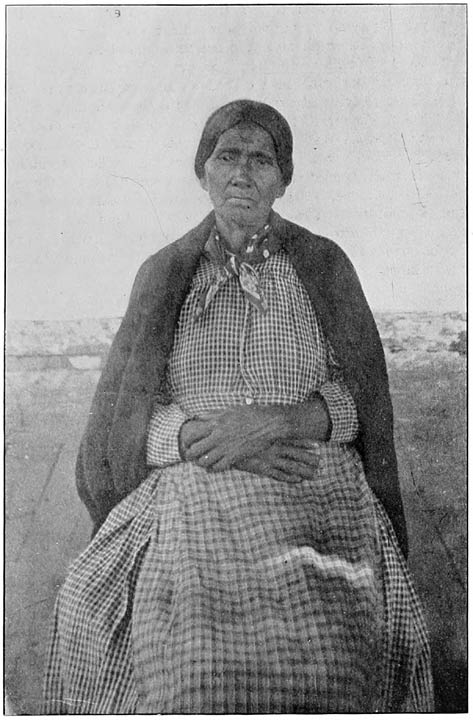
PHOTOGRAPH BY AUTHOR, 1888
AYÂSTA
22. THE RABBIT AND THE POSSUM AFTER A WIFE
The Rabbit and the Possum each wanted a wife, but no one would marry either of them. They talked over the matter and the Rabbit said, “We can’t get wives here; let’s go to the next settlement. I’m the messenger for the council, and I’ll tell the people that I bring an order that everybody must take a mate at once, and then we’ll be sure to get our wives.”
The Possum thought this a fine plan, so they started off together to the next town. As the Rabbit traveled faster he got there first and waited outside until the people noticed him and took him into the townhouse. When the chief came to ask his business the Rabbit said he brought an important order from the council that everybody must get married without delay. So the chief called the people together and told them the message from the council. Every animal took a mate at once, and the Rabbit got a wife.
The Possum traveled so slowly that he got there after all the animals had mated, leaving him still without a wife. The Rabbit pretended to feel sorry for him and said, “Never mind, I’ll carry the message to the people in the next settlement, and you hurry on as fast as you can, and this time you will get your wife.”
So he went on to the next town, and the Possum followed close after him. But when the Rabbit got to the townhouse he sent out the word that, as there had been peace so long that everybody was getting lazy the council had ordered that there must be war at once and they must begin right in the townhouse. So they all began fighting, but the Rabbit made four great leaps and got away just as the Possum came in. Everybody jumped on the Possum, who had not thought of bringing his weapons on a wedding trip, and so could not defend himself. They had nearly beaten the life out of him when he fell over and pretended to be dead until he saw a good chance to jump up and get away. The Possum never got a wife, but he remembers the lesson, and ever since he shuts his eyes and pretends to be dead when the hunter has him in a close corner.
23. THE RABBIT DINES THE BEAR
The Bear invited the Rabbit to dine with him. They had beans in the pot, but there was no grease for them, so the Bear cut a slit in his side and let the oil run out until they had enough to cook the dinner. The Rabbit looked surprised, and thought to himself, “That’s a handy way. I think I’ll try that.” When he started home he invited the Bear to come and take dinner with him four days later.
When the Bear came the Rabbit said, “I have beans for dinner, too. Now I’ll get the grease for them.” So he took a knife and drove it into his side, but instead of oil, a stream of blood gushed out and he fell over nearly dead. The Bear picked him up and had hard work to tie up the wound and stop the bleeding. Then he scolded him, “You little fool, I’m large and strong and lined with fat all over; the knife don’t hurt me; but you’re small and lean, and you can’t do such things.”
24. THE RABBIT ESCAPES FROM THE WOLVES
Some Wolves once caught the Rabbit and were going to eat him when he asked leave to show them a new dance he was practicing. They knew that the Rabbit was a great song leader, and they wanted to learn the latest dance, so they agreed and made a ring about him while he got ready. He patted his feet and began to dance around in a circle, singing:
Tlâge′sitûñ′ găli′sgi′sidâ′hă—
Ha′nia lĭl! lĭl! Ha′nia lĭl! lĭl!
On the edge of the field I dance about—
Ha′nia lĭl! lĭl! Ha′nia lĭl! lĭl!
“Now,” said the Rabbit, “when I sing ‘on the edge of the field,’ I dance that way”—and he danced over in that direction—“and when I sing ‘lĭl! lĭl!’ you must all stamp your feet hard.” The Wolves thought it fine. He began another round singing the same song, and danced a little nearer to the field, while the Wolves all stamped their feet. He sang louder and louder and danced nearer and nearer to the field until at the fourth song, when the Wolves were stamping as hard as they could and thinking only of the song, he made one jump and was off through the long grass. They were after him at once, but he ran for a hollow stump and climbed up on the inside. When the the Wolves got there one of them put his head inside to look up, but the Rabbit spit into his eye, so that he had to pull his head out again. The others were afraid to try, and they went away, with the Rabbit still in the stump.
25. FLINT VISITS THE RABBIT
In the old days Tăwi′skălă (Flint) lived up in the mountains, and all the animals hated him because he had helped to kill so many of them. They used to get together to talk over means to put him out of the way, but everybody was afraid to venture near his house until the Rabbit, who was the boldest leader among them, offered to go after Flint and try to kill him. They told him where to find him, and the Rabbit set out and at last came to Flint’s house.
Flint was standing at his door when the Rabbit came up and said, sneeringly, “Siyu′! Hello! Are you the fellow they call Flint?” “Yes; that’s what they call me,” answered Flint. “Is this where you live?” “Yes; this is where I live.” All this time the Rabbit was looking about the place trying to study out some plan to take Flint off his guard. He had expected Flint to invite him into the house, so he waited a little while, but when Flint made no move, he said, “Well, my name is Rabbit; I’ve heard a good deal about you, so I came to invite you to come and see me.”
Flint wanted to know where the Rabbit’s house was, and he told him it was down in the broom-grass field near the river. So Flint promised to make him a visit in a few days. “Why not come now and have supper with me?” said the Rabbit, and after a little coaxing Flint agreed and the two started down the mountain together.
When they came near the Rabbit’s hole the Rabbit said, “There is my house, but in summer I generally stay outside here where it is cooler.” So he made a fire, and they had their supper on the grass. When it was over, Flint stretched out to rest and the Rabbit got some heavy sticks and his knife and cut out a mallet and wedge. Flint looked up and asked what that was for. “Oh,” said the Rabbit, “I like to be doing something, and they may come handy.” So Flint lay down again, and pretty soon he was sound asleep. The Rabbit spoke to him once or twice to make sure, but there was no answer. Then he came over to Flint and with one good blow of the mallet he drove the sharp stake into his body and ran with all his might for his own hole; but before he reached it there was a loud explosion, and pieces of flint flew all about. That is why we find flint in so many places now. One piece struck the Rabbit from behind and cut him just as he dived into his hole. He sat listening until everything seemed quiet again. Then he put his head out to look around, but just at that moment another piece fell and struck him on the lip and split it, as we still see it.
26. HOW THE DEER GOT HIS HORNS
In the beginning the Deer had no horns, but his head was smooth just like a doe’s. He was a great runner and the Rabbit was a great jumper, and the animals were all curious to know which could go farther in the same time. They talked about it a good deal, and at last arranged a match between the two, and made a nice large pair of antlers for a prize to the winner. They were to start together from one side of a thicket and go through it, then turn and come back, and the one who came out first was to get the horns.
On the day fixed all the animals were there, with the antlers put down on the ground at the edge of the thicket to mark the starting point. While everybody was admiring the horns the Rabbit said: “I don’t know this part of the country; I want to take a look through the bushes where I am to run.” They thought that all right, so the Rabbit went into the thicket, but he was gone so long that at last the animals suspected he must be up to one of his tricks. They sent a messenger to look for him, and away in the middle of the thicket he found the Rabbit gnawing down the bushes and pulling them away until he had a road cleared nearly to the other side.
The messenger turned around quietly and came back and told the other animals. When the Rabbit came out at last they accused him of cheating, but he denied it until they went into the thicket and found the cleared road. They agreed that such a trickster had no right to enter the race at all, so they gave the horns to the Deer, who was admitted to be the best runner, and he has worn them ever since. They told the Rabbit that as he was so fond of cutting down bushes he might do that for a living hereafter, and so he does to this day.
27. WHY THE DEER’S TEETH ARE BLUNT
The Rabbit felt sore because the Deer had won the horns (see the last story), and resolved to get even. One day soon after the race he stretched a large grapevine across the trail and gnawed it nearly in two in the middle. Then he went back a piece, took a good run, and jumped up at the vine. He kept on running and jumping up at the vine until the Deer came along and asked him what he was doing?
“Don’t you see?” says the Rabbit. “I’m so strong that I can bite through that grapevine at one jump.”
The Deer could hardly believe this, and wanted to see it done. So the Rabbit ran back, made a tremendous spring, and bit through the vine where he had gnawed it before. The Deer, when he saw that, said, “Well, I can do it if you can.” So the Rabbit stretched a larger grapevine across the trail, but without gnawing it in the middle. The Deer ran back as he had seen the Rabbit do, made a spring, and struck the grapevine right in the center, but it only flew back and threw him over on his head. He tried again and again, until he was all bruised and bleeding.
“Let me see your teeth,” at last said the Rabbit. So the Deer showed him his teeth, which were long like a wolf’s teeth, but not very sharp.
“No wonder you can’t do it,” says the Rabbit; “your teeth are too blunt to bite anything. Let me sharpen them for you like mine. My teeth are so sharp that I can cut through a stick just like a knife.” And he showed him a black locust twig, of which rabbits gnaw the young shoots, which he had shaved off as well as a knife could do it, in regular rabbit fashion. The Deer thought that just the thing. So the Rabbit got a hard stone with rough edges and filed and filed away at the Deer’s teeth until they were worn down almost to the gums.
“It hurts,” said the Deer; but the Rabbit said it always hurt a little when they began to get sharp; so the Deer kept quiet.
“Now try it,” at last said the Rabbit. So the Deer tried again, but this time he could not bite at all.
“Now you’ve paid for your horns,” said the Rabbit, as he jumped away through the bushes. Ever since then the Deer’s teeth are so blunt that he can not chew anything but grass and leaves.
28. WHAT BECAME OF THE RABBIT
The Deer was very angry at the Rabbit for filing his teeth and determined to be revenged, but he kept still and pretended to be friendly until the Rabbit was off his guard. Then one day, as they were going along together talking, he challenged the Rabbit to jump against him. Now the Rabbit is a great jumper, as every one knows, so he agreed at once. There was a small stream beside the path, as there generally is in that country, and the Deer said:
“Let’s see if you can jump across this branch. We’ll go back a piece, and then when I say Kû! then both run and jump.”
“All right,” said the Rabbit. So they went back to get a good start, and when the Deer gave the word Kû! they ran for the stream, and the Rabbit made one jump and landed on the other side. But the Deer had stopped on the bank, and when the Rabbit looked back the Deer had conjured the stream so that it was a large river. The Rabbit was never able to get back again and is still on the other side. The rabbit that we know is only a little thing that came afterwards.
29. WHY THE MINK SMELLS
The Mink was such a great thief that at last the animals held a council about the matter. It was decided to burn him, so they caught the Mink, built a great fire, and threw him into it. As the blaze went up and they smelt the roasted flesh, they began to think he was punished enough and would probably do better in the future, so they took him out of the fire. But the Mink was already burned black and is black ever since, and whenever he is attacked or excited he smells again like roasted meat. The lesson did no good, however, and he is still as great a thief as ever.
30. WHY THE MOLE LIVES UNDERGROUND
A man was in love with a woman who disliked him and would have nothing to do with him. He tried every way to win her favor, but to no purpose, until at last he grew discouraged and made himself sick thinking over it. The Mole came along, and finding him in such low condition asked what was the trouble. The man told him the whole story, and when he had finished the Mole said: “I can help you, so that she will not only like you, but will come to you of her own will.” So that night the Mole burrowed his way underground to where the girl was in bed asleep and took out her heart. He came back by the same way and gave the heart to the man, who could not see it even when it was put into his hand. “There,” said the Mole, “swallow it, and she will be drawn to come to you and can not keep away.” The man swallowed the heart, and when the girl woke up she somehow thought at once of him, and felt a strange desire to be with him, as though she must go to him at once. She wondered and could not understand it, because she had always disliked him before, but at last the feeling grew so strong that she was compelled to go herself to the man and tell him she loved him and wanted to be his wife. And so they were married, but all the magicians who had known them both were surprised and wondered how it had come about. When they found that it was the work of the Mole, whom they had always before thought too insignificant for their notice, they were very jealous and threatened to kill him, so that he hid himself under the ground and has never since dared to come up to the surface.
31. THE TERRAPIN’S ESCAPE FROM THE WOLVES
The Possum and the Terrapin went out together to hunt persimmons, and found a tree full of ripe fruit. The Possum climbed it and was throwing down the persimmons to the Terrapin when a wolf came up and began to snap at the persimmons as they fell, before the Terrapin could reach them. The Possum waited his chance, and at last managed to throw down a large one (some say a bone which he carried with him), so that it lodged in the wolf’s throat as he jumped up at it and choked him to death. “I’ll take his ears for hominy spoons,” said the Terrapin, and cut off the wolf’s ears and started home with them, leaving the Possum still eating persimmons up in the tree. After a while he came to a house and was invited to have some kanahe′na gruel from the jar that is set always outside the door. He sat down beside the jar and dipped up the gruel with one of the wolf’s ears for a spoon. The people noticed and wondered. When he was satisfied he went on, but soon came to another house and was asked to have some more kanahe′na. He dipped it up again with the wolf’s ear and went on when he had enough. Soon the news went around that the Terrapin had killed the Wolf and was using his ears for spoons. All the Wolves got together and followed the Terrapin’s trail until they came up with him and made him prisoner. Then they held a council to decide what to do with him, and agreed to boil him in a clay pot. They brought in a pot, but the Terrapin only laughed at it and said that if they put him into that thing he would kick it all to pieces. They said they would burn him in the fire, but the Terrapin laughed again and said he would put it out. Then they decided to throw him into the deepest hole in the river and drown him. The Terrapin begged and prayed them not to do that, but they paid no attention, and dragged him over to the river and threw him in. That was just what the Terrapin had been waiting for all the time, and he dived under the water and came up on the other side and got away.
Some say that when he was thrown into the river he struck against a rock, which broke his back in a dozen places. He sang a medicine song:
Gû′daye′wû, Gû′daye′wû,
I have sewed myself together, I have sewed myself together,
and the pieces came together, but the scars remain on his shell to this day.
32. ORIGIN OF THE GROUNDHOG DANCE: THE GROUNDHOG’S HEAD
Seven wolves once caught a Groundhog and said, “Now we’ll kill you and have something good to eat.” But the Groundhog said, “When we find good food we must rejoice over it, as people do in the Green-corn dance. I know you mean to kill me and I can’t help myself, but if you want to dance I’ll sing for you. This is a new dance entirely. I’ll lean up against seven trees in turn and you will dance out and then turn and come back, as I give the signal, and at the last turn you may kill me.”
The wolves were very hungry, but they wanted to learn the new dance, so they told him to go ahead. The Groundhog leaned up against a tree and began the song, Ha′wiye′ĕhĭ′, and all the wolves danced out in front, until he gave the signal, Yu! and began with Hi′yagu′wĕ, when they turned and danced back in line. “That’s fine,” said the Groundhog, and went over to the next tree and started the second song. The wolves danced out and then turned at the signal and danced back again. “That’s very fine,” said the Groundhog, and went over to another tree and started the third song. The wolves danced their best and the Groundhog encouraged them, but at each song he took another tree, and each tree was a little nearer to his hole under a stump. At the seventh song he said, “Now, this is the last dance, and when I say Yu! you will all turn and come after me, and the one who gets me may have me.” So he began the seventh song and kept it up until the wolves were away out in front. Then he gave the signal, Yu! and made a jump for his hole. The wolves turned and were after him, but he reached the hole first and dived in. Just as he got inside, the foremost wolf caught him by the tail and gave it such a pull that it broke off, and the Groundhog’s tail has been short ever since.
The unpleasant smell of the Groundhog’s head was given it by the other animals to punish an insulting remark made by him in council. The story is a vulgar one, without wit enough to make it worth recording.
33. THE MIGRATION OF THE ANIMALS
In the old times when the animals used to talk and hold councils, and the Grubworm and Woodchuck used to marry people, there was once a great famine of mast in the mountains, and all the animals and birds which lived upon it met together and sent the Pigeon out to the low country to see if any food could be found there. After a time she came back and reported that she had found a country where the mast was “up to our ankles” on the ground. So they got together and moved down into the low country in a great army.
34. THE WOLF’S REVENGE—THE WOLF AND THE DOG
Kana′tĭ had wolves to hunt for him, because they are good hunters and never fail. He once sent out two wolves at once. One went to the east and did not return. The other went to the north, and when he returned at night and did not find his fellow he knew he must be in trouble and started after him. After traveling on some time he found his brother lying nearly dead beside a great greensnake (sălikwâ′yĭ) which had attacked him. The snake itself was too badly wounded to crawl away, and the angry wolf, who had magic powers, taking out several hairs from his own whiskers, shot them into the body of the snake and killed it. He then hurried back to Kana′tĭ, who sent the Terrapin after a great doctor who lived in the west to save the wounded wolf. The wolf went back to help his brother and by his magic powers he had him cured long before the doctor came from the west, because the Terrapin was such a slow traveler and the doctor had to prepare his roots before he started.
In the beginning, the people say, the Dog was put on the mountain and the Wolf beside the fire. When the winter came the Dog could not stand the cold, so he came down to the settlement and drove the Wolf from the fire. The Wolf ran to the mountains, where it suited him so well that he prospered and increased, until after a while he ventured down again and killed some animals in the settlements. The people got together and followed and killed him, but his brothers came from the mountains and took such revenge that ever since the people have been afraid to hurt a wolf.
Bird Myths
35. THE BIRD TRIBES
Winged creatures of all kinds are classed under the generic term of aninâ′hilidâ′hĭ (flyers). Birds are called, alike in the singular and plural, tsi′skwa, the term being generally held to exclude the domestic fowls introduced by the whites. When it is necessary to make the distinction they are mentioned, respectively, as inăgĕhĭ (living in the woods), and uluñni′ta (tame). The robin is called tsiskwa′gwă, a name which can not be analyzed, while the little sparrow is called tsiskwâ′yă (the real or principal bird), perhaps, in accord with a principle in Indian nomenclature, on account of its wide distribution. As in other languages, many of the bird names are onomatopes, as waʻhuhu′ (the screech owl), u′guku′ (the hooting owl), wagulĭ′ (the whippoorwill), kâgû (the crow), gŭgwĕ′ (the quail), huhu (the yellow mocking-bird), tsĭ′kĭlilĭ′ (the chickadee), sa′sa′ (the goose). The turtledove is called gulĕ′-diskaʻnihĭ′ (it cries for acorns), on account of the resemblance of its cry to the sound of the word for acorn (gulĕ′). The meadow lark is called năkwĭsĭ′ (star), on account of the appearance of its tail when spread out as it soars. The nuthatch (Sitta carolinensis) is called tsulie′na (deaf), and is supposed to be without hearing, possibly on account of its fearless disregard for man’s presence. Certain diseases are diagnosed by the doctors as due to birds, either revengeful bird ghosts, bird feathers about the house, or bird shadows falling upon the patient from overhead.
The eagle (awâ′hĭlĭ) is the great sacred bird of the Cherokee, as of nearly all our native tribes, and figures prominently in their ceremonial ritual, especially in all things relating to war. The particular species prized was the golden or war eagle (Aquila chrysætus), called by the Cherokee the “pretty-feathered eagle,” on account of its beautiful tail feathers, white, tipped with black, which were in such great demand for decorative and ceremonial purposes that among the western tribes a single tail was often rated as equal in value to a horse. Among the Cherokee in the old times the killing of an eagle was an event which concerned the whole settlement, and could be undertaken only by the professional eagle killer, regularly chosen for the purpose on account of his knowledge of the prescribed forms and the prayers to be said afterwards in order to obtain pardon for the necessary sacrilege, and thus ward off vengeance from the tribe. It is told of one man upon the reservation that having deliberately killed an eagle in defiance of the ordinances he was constantly haunted by dreams of fierce eagles swooping down upon him, until the nightmare was finally exorcised after a long course of priestly treatment. In 1890 there was but one eagle killer remaining among the East Cherokee. It does not appear that the eagle was ever captured alive as among the plains tribes.
The eagle must be killed only in the winter or late fall after the crops were gathered and the snakes had retired to their dens. If killed in the summertime a frost would come to destroy the corn, while the songs of the Eagle dance, when the feathers were brought home, would so anger the snakes that they would become doubly dangerous. Consequently the Eagle songs were never sung until after the snakes had gone to sleep for the winter.
When the people of a town had decided upon an Eagle dance the eagle killer was called in, frequently from a distant settlement, to procure the feathers for the occasion. He was paid for his services from offerings made later at the dance, and as the few professionals guarded their secrets carefully from outsiders their business was a quite profitable one. After some preliminary preparation the eagle killer sets out alone for the mountains, taking with him his gun or bow and arrows. Having reached the mountains, he goes through a vigil of prayer and fasting, possibly lasting four days, after which he hunts until he succeeds in killing a deer. Then, placing the body in a convenient exposed situation upon one of the highest cliffs, he conceals himself near by and begins to sing in a low undertone the songs to call down the eagles from the sky. When the eagle alights upon the carcass, which will be almost immediately if the singer understands his business, he shoots it, and then standing over the dead bird, he addresses to it a prayer in which he begs it not to seek vengeance upon his tribe, because it is not a Cherokee, but a Spaniard (Askwa′nĭ) that has done the deed. The selection of such a vicarious victim of revenge is evidence at once of the antiquity of the prayer in its present form and of the enduring impression which the cruelties of the early Spanish adventurers made upon the natives.
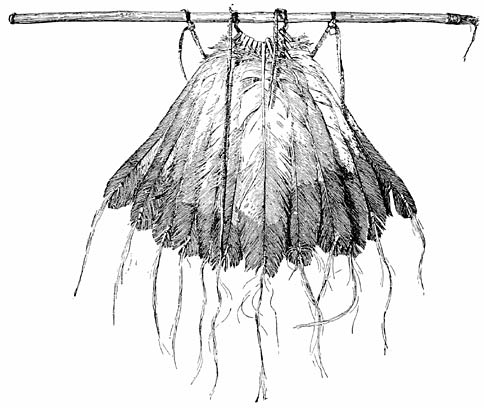
Fig. 1—Feather wand of Eagle dance (made by John Ax).
The prayer ended, he leaves the dead eagle where it fell and makes all haste to the settlement, where the people are anxiously expecting his return. On meeting the first warriors he says simply, “A snowbird has died,” and passes on at once to his own quarters, his work being now finished. The announcement is made in this form in order to insure against the vengeance of any eagles that might overhear, the little snowbird being considered too insignificant a creature to be dreaded.
Having waited four days to allow time for the insect parasites to leave the body, the hunters delegated for the purpose go out to bring in the feathers. On arriving at the place they strip the body of the large tail and wing feathers, which they wrap in a fresh deerskin brought with them, and then return to the settlement, leaving the body of the dead eagle upon the ground, together with that of the slain deer, the latter being intended as a sacrifice to the eagle spirits. On reaching the settlement, the feathers, still wrapped in the deerskin, are hung up in a small, round hut built for this special purpose near the edge of the dance ground (detsănûñ′lĭ) and known as the place “where the feathers are kept,” or feather house. Some settlements had two such feather houses, one at each end of the dance ground. The Eagle dance was held on the night of the same day on which the feathers were brought in, all the necessary arrangements having been made beforehand. In the meantime, as the feathers were supposed to be hungry after their journey, a dish of venison and corn was set upon the ground below them and they were invited to eat. The body of a flaxbird or scarlet tanager (Piranga rubra) was also hung up with the feathers for the same purpose. The food thus given to the feathers was disposed of after the dance, as described in another place.
The eagle being regarded as a great ada′wehĭ, only the greatest warriors and those versed in the sacred ordinances would dare to wear the feathers or to carry them in the dance. Should any person in the settlement dream of eagles or eagle feathers he must arrange for an Eagle dance, with the usual vigil and fasting, at the first opportunity; otherwise some one of his family will die. Should the insect parasites which infest the feathers of the bird in life get upon a man they will breed a skin disease which is sure to develop, even though it may be latent for years. It is for this reason that the body of the eagle is allowed to remain four days upon the ground before being brought into the settlement.
The raven (kâ′lănû) is occasionally seen in the mountains, but is not prominent in folk belief, excepting in connection with the grewsome tales of the Raven Mocker (q. v.). In former times its name was sometimes assumed as a war title. The crow, so prominent in other tribal mythologies, does not seem to appear in that of the Cherokee. Three varieties of owls are recognized, each under a different name, viz: tskĭlĭ′, the dusky horned owl (Bubo virginianus saturatus); u′guku′, the barred or hooting owl (Syrnium nebulosum), and waʻhuhu′, the screech owl (Megascops asio). The first of these names signifies a witch, the others being onomatopes. Owls and other night-crying birds are believed to be embodied ghosts or disguised witches, and their cry is dreaded as a sound of evil omen. If the eyes of a child be bathed with water in which one of the long wing or tail feathers of an owl has been soaked, the child will be able to keep awake all night. The feather must be found by chance, and not procured intentionally for the purpose. On the other hand, an application of water in which the feather of a blue jay, procured in the same way, has been soaked will make the child an early riser.
The buzzard (sulĭ′) is said to have had a part in shaping the earth, as was narrated in the genesis myth. It is reputed to be a doctor among birds, and is respected accordingly, although its feathers are never worn by ball players, for fear of becoming bald. Its own baldness is accounted for by a vulgar story. As it thrives upon carrion and decay, it is held to be immune from sickness, especially of a contagious character, and a small quantity of its flesh eaten, or of the soup used as a wash, is believed to be a sure preventive of smallpox, and was used for this purpose during the smallpox epidemic among the East Cherokee in 1866. According to the Wahnenauhi manuscript, it is said also that a buzzard feather placed over the cabin door will keep out witches. In treating gunshot wounds, the medicine is blown into the wound through a tube cut from a buzzard quill and some of the buzzard’s down is afterwards laid over the spot.
There is very little concerning hawks, excepting as regards the great mythic hawk, the Tlă′nuwă′. The tlă′nuwă′ usdi′, or “little tlă′nuwă,” is described as a bird about as large as a turkey and of a grayish blue color, which used to follow the flocks of wild pigeons, flying overhead and darting down occasionally upon a victim, which it struck and killed with its sharp breast and ate upon the wing, without alighting. It is probably the goshawk (Astur atricapillus).
The common swamp gallinule, locally known as mudhen or didapper (Gallinula galeata), is called diga′gwanĭ′ (lame or crippled), on account of its habit of flying only for a very short distance at a time. In the Diga′gwanĭ′ dance the performers sing the name of the bird and endeavor to imitate its halting movements. The dagûl′kû, or white-fronted goose (Anser albifrons), appears in connection with the myth of the origin of tobacco. The feathers of the tskwâyĭ, the great white heron or American egret (Herodias egretta), are worn by ball players, and this bird probably the “swan” whose white wing was used as a peace emblem in ancient times.
BUREAU OF AMERICAN ETHNOLOGY NINETEENTH ANNUAL REPORT PL. XV
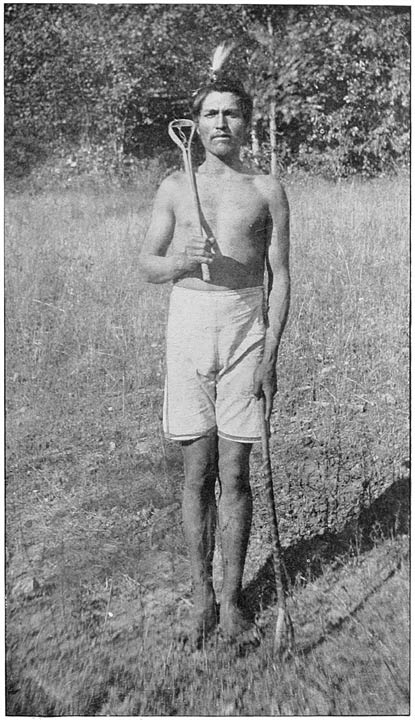
PHOTOGRAPH BY AUTHOR, 1888
SAWĂNU′GĬ, A CHEROKEE BALL-PLAYER
A rare bird said to have been seen occasionally upon the reservation many years ago was called by the curious name of nûñdă-dikanĭ′, “it looks at the sun,” “sun-gazer.” It is described as resembling a blue crane, and may possibly have been the Floridus cerulea, or little blue heron. Another infrequent visitor, which sometimes passed over the mountain country in company with flocks of wild geese, was the gu′wisguwĭ′, so called from its cry. It is described as resembling a large snipe, with yellow legs and feet unwebbed, and is thought to visit Indian Territory at intervals. It is chiefly notable from the fact that the celebrated chief John Ross derives his Indian name, Gu′wisguwĭ′, from this bird, the name being perpetuated in Cooweescoowee district of the Cherokee Nation in the West.
Another chance visitant, concerning which there is much curious speculation among the older men of the East Cherokee, was called tsun′digwûntsu′ʻgĭ or tsun′digwûn′tskĭ, “forked,” referring to the tail. It appeared but once, for a short season, about forty years ago, and has not been seen since. It is said to have been pale blue, with red in places, and nearly the size of a crow, and to have had a long forked tail like that of a fish. It preyed upon hornets, which it took upon the wing, and also feasted upon the larvæ in the nests. Appearing unexpectedly and as suddenly disappearing, it was believed to be not a bird but a transformed red-horse fish (Moxostoma, Cherokee âligă′), a theory borne out by the red spots and the long, forked tail. It is even maintained that about the time those birds first appeared some hunters on Oconaluftee saw seven of them sitting on the limb of a tree and they were still shaped like a red-horse, although they already had wings and feathers. It was undoubtedly the scissor-tail or swallow-tailed flycatcher (Milvulus forficatus), which belongs properly in Texas and the adjacent region, but strays occasionally into the eastern states.
On account of the red throat appendage of the turkey, somewhat resembling the goitrous growth known in the South as “kernels” (Cherokee, dule′tsĭ), the feathers of this bird are not worn by ball players, neither is the neck allowed to be eaten by children or sick persons, under the fear that a growth of “kernels” would be the result. The meat of the ruffed grouse, locally known as the pheasant (Bonasa umbellus), is tabued to a pregnant woman, because this bird hatches a large brood, but loses most of them before maturity. Under a stricter construction of the theory this meat is forbidden to a woman until she is past child bearing.
The redbird, tatsu′hwă, is believed to have been originally the daughter of the Sun (see the story). The huhu, or yellow mocking-bird, occurs in several stories. It is regarded as something supernatural, possibly on account of its imitative powers, and its heart is given to children to make them quick to learn.
The chickadee (Parus carolinensis), tsĭkĭlilĭ′, and the tufted titmouse, (Parus bicolor), utsu′ʻgĭ, or u′stûtĭ, are both regarded as news bringers, but the one is venerated as a truth teller while the other is scoffed at as a lying messenger, for reasons which appear in the story of Nûñyunu′wĭ (q. v.). When the tsĭkĭlilĭ′ perches on a branch near the house and chirps its song it is taken as an omen that an absent friend will soon be heard from or that a secret enemy is plotting mischief. Many stories are told in confirmation of this belief, among which may be instanced that of Tom Starr, a former noted outlaw of the Cherokee Nation of the West, who, on one occasion, was about to walk unwittingly into an ambush prepared for him along a narrow trail, when he heard the warning note of the tsĭkĭlilĭ′, and, turning abruptly, ran up the side of the ridge and succeeded in escaping with his life, although hotly pursued by his enemies.
36. THE BALL GAME OF THE BIRDS AND ANIMALS
Once the animals challenged the birds to a great ballplay, and the birds accepted. The leaders made the arrangements and fixed the day, and when the time came both parties met at the place for the ball dance, the animals on a smooth grassy bottom near the river and the birds in the treetops over by the ridge. The captain of the animals was the Bear, who was so strong and heavy that he could pull down anyone who got in his way. All along the road to the ball ground he was tossing up great logs to show his strength and boasting of what he would do to the birds when the game began. The Terrapin, too—not the little one we have now, but the great original Terrapin—was with the animals. His shell was so hard that the heaviest blows could not hurt him, and he kept rising up on his hind legs and dropping heavily again to the ground, bragging that this was the way he would crush any bird that tried to take the ball from him. Then there was the Deer, who could outrun every other animal. Altogether it was a fine company.
The birds had the Eagle for their captain, with the Hawk and the great Tlă′nuwă, all swift and strong of flight, but still they were a little afraid of the animals. The dance was over and they were all pruning their feathers up in the trees and waiting for the captain to give the word when here came two little things hardly larger than field mice climbing up the tree in which sat perched the bird captain. At last they reached the top, and creeping along the limb to where the Eagle captain sat they asked to be allowed to join in the game. The captain looked at them, and seeing that they were four-footed, he asked why they did not go to the animals, where they belonged. The little things said that they had, but the animals had made fun of them and driven them off because they were so small. Then the bird captain pitied them and wanted to take them.
But how could they join the birds when they had no wings? The Eagle, the Hawk, and the others consulted, and at last it was decided to make some wings for the little fellows. They tried for a long time to think of something that might do, until someone happened to remember the drum they had used in the dance. The head was of ground-hog skin and maybe they could cut off a corner and make wings of it. So they took two pieces of leather from the drumhead and cut them into shape for wings, and stretched them with cane splints and fastened them on to the forelegs of one of the small animals, and in this way came Tla′mehă, the Bat. They threw the ball to him and told him to catch it, and by the way he dodged and circled about, keeping the ball always in the air and never letting it fall to the ground, the birds soon saw that he would be one of their best men.
Now they wanted to fix the other little animal, but they had used up all their leather to make wings for the Bat, and there was no time to send for more. Somebody said that they might do it by stretching his skin, so two large birds took hold from opposite sides with their strong bills, and by pulling at his fur for several minutes they managed to stretch the skin on each side between the fore and hind feet, until they had Tewa, the Flying Squirrel. To try him the bird captain threw up the ball, when the Flying Squirrel sprang off the limb after it, caught it in his teeth and carried it through the air to another tree nearly across the bottom.
When they were all ready the signal was given and the game began, but almost at the first toss the Flying Squirrel caught the ball and carried it up a tree, from which he threw it to the birds, who kept it in the air for some time until it dropped. The Bear rushed to get it, but the Martin darted after it and threw it to the Bat, who was flying near the ground, and by his dodging and doubling kept it out of the way of even the Deer, until he finally threw it in between the posts and won the game for the birds.
The Bear and the Terrapin, who had boasted so of what they would do, never got a chance even to touch the ball. For saving the ball when it dropped, the birds afterwards gave the Martin a gourd in which to build his nest, and he still has it.
37. HOW THE TURKEY GOT HIS BEARD
When the Terrapin won the race from the Rabbit (see the story) all the animals wondered and talked about it a great deal, because they had always thought the Terrapin slow, although they knew that he was a warrior and had many conjuring secrets beside. But the Turkey was not satisfied and told the others there must be some trick about it. Said he, “I know the Terrapin can’t run—he can hardly crawl—and I’m going to try him.”
So one day the Turkey met the Terrapin coming home from war with a fresh scalp hanging from his neck and dragging on the ground as he traveled. The Turkey laughed at the sight and said: “That scalp don’t look right on you. Your neck is too short and low down to wear it that way. Let me show you.”
The Terrapin agreed and gave the scalp to the Turkey, who fastened it around his neck. “Now,” said the Turkey, “I’ll walk a little way and you can see how it looks.” So he walked ahead a short distance and then turned and asked the Terrapin how he liked it. Said the Terrapin, “It looks very nice; it becomes you.”
“Now I’ll fix it in a different way and let you see how it looks,” said the Turkey. So he gave the string another pull and walked ahead again. “O, that looks very nice,” said the Terrapin. But the Turkey kept on walking, and when the Terrapin called to him to bring back the scalp he only walked faster and broke into a run. Then the Terrapin got out his bow and by his conjuring art shot a number of cane splints into the Turkey’s leg to cripple him so that he could not run, which accounts for all the many small bones in the Turkey’s leg, that are of no use whatever; but the Terrapin never caught the Turkey, who still wears the scalp from his neck.
38. WHY THE TURKEY GOBBLES
The Grouse used to have a fine voice and a good halloo in the ballplay. All the animals and birds used to play ball in those days and were just as proud of a loud halloo as the ball players of to-day. The Turkey had not a good voice, so he asked the Grouse to give him lessons. The Grouse agreed to teach him, but wanted pay for his trouble, and the Turkey promised to give him some feathers to make himself a collar. That is how the Grouse got his collar of turkey feathers. They began the lessons and the Turkey learned very fast until the Grouse thought it was time to try his voice. “Now,” said the Grouse, “I’ll stand on this hollow log, and when I give the signal by tapping on it, you must halloo as loudly as you can.” So he got upon the log ready to tap on it, as a Grouse does, but when he gave the signal the Turkey was so eager and excited that he could not raise his voice for a shout, but only gobbled, and ever since then he gobbles whenever he hears a noise.
39. HOW THE KINGFISHER GOT HIS BILL
Some old men say that the Kingfisher was meant in the beginning to be a water bird, but as he had not been given either web feet or a good bill he could not make a living. The animals held a council over it and decided to make him a bill like a long sharp awl for a fish-gig (fish-spear). So they made him a fish-gig and fastened it on in front of his mouth. He flew to the top of a tree, sailed out and darted down into the water, and came up with a fish on his gig. And he has been the best gigger ever since.
Some others say it was this way: A Blacksnake found a Yellowhammer’s nest in a hollow tree, and after swallowing the young birds, coiled up to sleep in the nest, where the mother bird found him when she came home. She went for help to the Little People, who sent her to the Kingfisher. He came, and after flying back and forth past the hole a few times, made one dart at the snake and pulled him out dead. When they looked they found a hole in the snake’s head where the Kingfisher had pierced it with a slender tugălû′nă fish, which he carried in his bill like a lance. From this the Little People concluded that he would make a first-class gigger if he only had the right spear, so they gave him his long bill as a reward.
40. HOW THE PARTRIDGE GOT HIS WHISTLE
In the old days the Terrapin had a fine whistle, but the Partridge had none. The Terrapin was constantly going about whistling and showing his whistle to the other animals until the Partridge became jealous, so one day when they met the Partridge asked leave to try it. The Terrapin was afraid to risk it at first, suspecting some trick, but the Partridge said, “I’ll give it back right away, and if you are afraid you can stay with me while I practice.” So the Terrapin let him have the whistle and the Partridge walked around blowing on it in fine fashion. “How does it sound with me?” asked the Partridge. “O, you do very well,” said the Terrapin, walking alongside. “Now, how do you like it,” said the Partridge, running ahead and whistling a little faster. “That’s fine,” answered the Terrapin, hurrying to keep up, “but don’t run so fast.” “And now, how do you like this?” called the Partridge, and with that he spread his wings, gave one long whistle, and flew to the top of a tree, leaving the poor Terrapin to look after him from the ground. The Terrapin never recovered his whistle, and from that, and the loss of his scalp, which the Turkey stole from him, he grew ashamed to be seen, and ever since he shuts himself up in his box when anyone comes near him.
41. HOW THE REDBIRD GOT HIS COLOR
A Raccoon passing a Wolf one day made several insulting remarks, until at last the Wolf became angry and turned and chased him. The Raccoon ran his best and managed to reach a tree by the river side before the Wolf came up. He climbed the tree and stretched out on a limb overhanging the water. When the Wolf arrived he saw the reflection in the water, and thinking it was the Raccoon he jumped at it and was nearly drowned before he could scramble out again, all wet and dripping. He lay down on the bank to dry and fell asleep, and while he was sleeping the Raccoon came down the tree and plastered his eyes with dung. When the Wolf awoke he found he could not open his eyes, and began to whine. Along came a little brown bird through the bushes and heard the Wolf crying and asked what was the matter. The Wolf told his story and said, “If you will get my eyes open, I will show you where to find some nice red paint to paint yourself.” “All right,” said the brown bird; so he pecked at the Wolf’s eyes until he got off all the plaster. Then the Wolf took him to a rock that had streaks of bright red paint running through it, and the little bird painted himself with it, and has ever since been a Redbird.
42. THE PHEASANT BEATING CORN; ORIGIN OF THE PHEASANT DANCE
The Pheasant once saw a woman beating corn in a wooden mortar in front of the house. “I can do that, too,” said he, but the woman would not believe it, so the Pheasant went into the woods and got upon a hollow log and “drummed” with his wings as a pheasant does, until the people in the house heard him and thought he was really beating corn.
In the Pheasant dance, a part of the Green-corn dance, the instrument used is the drum, and the dancers beat the ground with their feet in imitation of the drumming sound made by the pheasant. They form two concentric circles, the men being on the inside, facing the women in the outer circle, each in turn advancing and retreating at the signal of the drummer, who sits at one side and sings the Pheasant songs. According to the story, there was once a winter famine among the birds and animals. No mast (fallen nuts) could be found in the woods, and they were near starvation when a Pheasant discovered a holly tree, loaded with red berries, of which the Pheasant is said to be particularly fond. He called his companion birds, and they formed a circle about the tree, singing, dancing, and drumming with their wings in token of their joy, and thus originated the Pheasant dance.
43. THE RACE BETWEEN THE CRANE AND THE HUMMINGBIRD
The Hummingbird and the Crane were both in love with a pretty woman. She preferred the Hummingbird, who was as handsome as the Crane was awkward, but the Crane was so persistent that in order to get rid of him she finally told him he must challenge the other to a race and she would marry the winner. The Hummingbird was so swift—almost like a flash of lightning—and the Crane so slow and heavy, that she felt sure the Hummingbird would win. She did not know the Crane could fly all night.
They agreed to start from her house and fly around the circle of the world to the beginning, and the one who came in first would marry the woman. At the word the Hummingbird darted off like an arrow and was out of sight in a moment, leaving his rival to follow heavily behind. He flew all day, and when evening came and he stopped to roost for the night he was far ahead. But the Crane flew steadily all night long, passing the Hummingbird soon after midnight and going on until he came to a creek and stopped to rest about daylight. The Hummingbird woke up in the morning and flew on again, thinking how easily he would win the race, until he reached the creek and there found the Crane spearing tadpoles, with his long bill, for breakfast. He was very much surprised and wondered how this could have happened, but he flew swiftly by and soon left the Crane out of sight again.
The Crane finished his breakfast and started on, and when evening came he kept on as before. This time it was hardly midnight when he passed the Hummingbird asleep on a limb, and in the morning he had finished his breakfast before the other came up. The next day he gained a little more, and on the fourth day he was spearing tadpoles for dinner when the Hummingbird passed him. On the fifth and sixth days it was late in the afternoon before the Hummingbird came up, and on the morning of the seventh day the Crane was a whole night’s travel ahead. He took his time at breakfast and then fixed himself up as nicely as he could at the creek and came in at the starting place where the woman lived, early in the morning. When the Hummingbird arrived in the afternoon he found he had lost the race, but the woman declared she would never have such an ugly fellow as the Crane for a husband, so she stayed single.
44. THE OWL GETS MARRIED
A widow with one daughter was always warning the girl that she must be sure to get a good hunter for a husband when she married. The young woman listened and promised to do as her mother advised. At last a suitor came to ask the mother for the girl, but the widow told him that only a good hunter could have her daughter. “I’m just that kind,” said the lover, and again asked her to speak for him to the young woman. So the mother went to the girl and told her a young man had come a-courting, and as he said he was a good hunter she advised her daughter to take him. “Just as you say,” said the girl. So when he came again the matter was all arranged, and he went to live with the girl.
The next morning he got ready and said he would go out hunting, but before starting he changed his mind and said he would go fishing. He was gone all day and came home late at night, bringing only three small fish, saying that he had had no luck, but would have better success to-morrow. The next morning he started off again to fish and was gone all day, but came home at night with only two worthless spring lizards (duwĕ′gă) and the same excuse. Next day he said he would go hunting this time. He was gone again until night, and returned at last with only a handful of scraps that he had found where some hunters had cut up a deer.
By this time the old woman was suspicious. So next morning when he started off again, as he said, to fish, she told her daughter to follow him secretly and see how he set to work. The girl followed through the woods and kept him in sight until he came down to the river, where she saw her husband change to a hooting owl (uguku′) and fly over to a pile of driftwood in the water and cry, “U-gu-ku! hu! hu! u! u!” She was surprised and very angry and said to herself, “I thought I had married a man, but my husband is only an owl.” She watched and saw the owl look into the water for a long time and at last swoop down and bring up in his claws a handful of sand, from which he picked out a crawfish. Then he flew across to the bank, took the form of a man again, and started home with the crawfish. His wife hurried on ahead through the woods and got there before him. When he came in with the crawfish in his hand, she asked him where were all the fish he had caught. He said he had none, because an owl had frightened them all away. “I think you are the owl,” said his wife, and drove him out of the house. The owl went into the woods and there he pined away with grief and love until there was no flesh left on any part of his body except his head.
45. THE HUHU GETS MARRIED
A widow who had an only a daughter, but no son, found it very hard to make a living and was constantly urging upon the young woman that they ought to have a man in the family, who would be a good hunter and able to help in the field. One evening a stranger lover came courting to the house, and when the girl told him that she could marry only one who was a good worker, he declared that he was exactly that sort of man; so the girl talked to her mother, and on her advice they were married.
The next morning the widow gave her new son-in-law a hoe and sent him out to the cornfield. When breakfast was ready she went to call him, following a sound as of some one hoeing on stony soil, but when she came to the spot she found only a small circle of hoed ground and no sign of her son-in-law. Away over in the thicket she heard a huhu calling.
He did not come in for dinner, either, and when he returned home in the evening the old woman asked him where he had been all day. “Hard at work,” said he. “But I didn’t see you when I came to call you to breakfast.” “I was down in the thicket cutting sticks to mark off the field,” said he. “But why didn’t you come in to dinner?” “I was too busy working,” said he. So the old woman was satisfied, and they had their supper together.
Early next morning he started off with his hoe over his shoulder. When breakfast was ready the old woman went again to call him, but found no sign of him, only the hoe lying there and no work done. And away over in the thicket a huhu was calling, “Sau-h! sau-h! sau-h! hu! hu! hu! hu! hu! hu! chi! chi! chi!—whew!”
She went back to the house, and when at last he came home in the evening she asked him again what he had been doing all day. “Working hard,” said he. “But you were not there when I came after you.” “O, I just went over in the thicket a while to see some of my kinsfolk,” said he. Then the old woman said, “I have lived here a long time and there is nothing living in the swamp but huhus. My daughter wants a husband that can work and not a lazy huhu; so you may go.” And she drove him from the house.
46. WHY THE BUZZARD’S HEAD IS BARE
The buzzard used to have a fine topknot, of which he was so proud that he refused to eat carrion, and while the other birds were pecking at the body of a deer or other animal which they had found he would strut around and say: “You may have it all, it is not good enough for me.” They resolved to punish him, and with the help of the buffalo carried out a plot by which the buzzard lost not his topknot alone, but nearly all the other feathers on his head. He lost his pride at the same time, so that he is willing enough now to eat carrion for a living.
47. THE EAGLE’S REVENGE
Once a hunter in the mountains heard a noise at night like a rushing wind outside the cabin, and on going out he found that an eagle had just alighted on the drying pole and was tearing at the body of a deer hanging there. Without thinking of the danger, he shot the eagle. In the morning he took the deer and started back to the settlement, where he told what he had done, and the chief sent out some men to bring in the eagle and arrange for an Eagle dance. They brought back the dead eagle, everything was made ready, and that night they started the dance in the townhouse.
About midnight there was a whoop outside and a strange warrior came into the circle and began to recite his exploits. No one knew him, but they thought he had come from one of the farther Cherokee towns. He told how he had killed a man, and at the end of the story he gave a hoarse yell, Hi! that startled the whole company, and one of the seven men with the rattles fell over dead. He sang of another deed, and at the end straightened up with another loud yell. A second rattler fell dead, and the people were so full of fear that they could not stir from their places. Still he kept on, and at every pause there came again that terrible scream, until the last of the seven rattlers fell dead, and then the stranger went out into the darkness. Long afterward they learned from the eagle killer that it was the brother of the eagle shot by the hunter.
48. THE HUNTER AND THE BUZZARD
A hunter had been all day looking for deer in the mountains without success until he was completely tired out and sat down on a log to rest and wonder what he should do, when a buzzard—a bird which always has magic powers—came flying overhead and spoke to him, asking him what was his trouble. When the hunter had told his story the buzzard said there were plenty of deer on the ridges beyond if only the hunter were high up in the air where he could see them, and proposed that they exchange forms for a while, when the buzzard would go home to the hunter’s wife while the hunter would go to look for deer. The hunter agreed, and the buzzard became a man and went home to the hunter’s wife, who received him as her husband, while the hunter became a buzzard and flew off over the mountain to locate the deer. After staying some time with the woman, who thought always it was her real husband, the buzzard excused himself, saying he must go again to look for game or they would have nothing to eat. He came to the place where he had first met the hunter, and found him already there, still in buzzard form, awaiting him. He asked the hunter what success he had had, and the hunter replied that he had found several deer over the ridge, as the buzzard had said. Then the buzzard restored the hunter to human shape, and became himself a buzzard again and flew away. The hunter went where he had seen the deer and killed several, and from that time he never returned empty-handed from the woods.
Snake, Fish, and Insect Myths
49. THE SNAKE TRIBE
The generic name for snakes is inădû′. They are all regarded as anida′wehĭ, “supernaturals,” having an intimate connection with the rain and thunder gods, and possessing a certain influence over the other animal and plant tribes. It is said that the snakes, the deer, and the ginseng act as allies, so that an injury to one is avenged by all. The feeling toward snakes is one of mingled fear and reverence, and every precaution is taken to avoid killing or offending one, especially the rattlesnake. He who kills a snake will soon see others; and should he kill a second one, so many will come around him whichever way he may turn that he will become dazed at the sight of their glistening eyes and darting tongues and will go wandering about like a crazy man, unable to find his way out of the woods. To guard against this misfortune there are certain prayers which the initiated say in order that a snake may not cross their path, and on meeting the first one of the season the hunter humbly begs of him, “Let us not see each other this summer.” Certain smells, as that of the wild parsnip, and certain songs, as those of the Unika′wĭ or Townhouse dance, are offensive to the snakes and make them angry. For this reason the Unika′wĭ dance is held only late in the fall, after they have retired to their dens for the winter.
When one dreams of being bitten by a snake he must be treated the same as for an actual bite, because it is a snake ghost that has bitten him; otherwise the place will swell and ulcerate in the same way, even though it be years afterwards. For fear of offending them, even in speaking, it is never said that a man has been bitten by a snake, but only that he has been “scratched by a brier.” Most of the beliefs and customs in this connection have more special reference to the rattlesnake.
The rattlesnake is called utsa′nătĭ, which may be rendered, “he has a bell,” alluding to the rattle. According to a myth given elsewhere, he was once a man, and was transformed to his present shape that he might save the human race from extermination by the Sun, a mission which he accomplished successfully after others had failed. By the old men he is also spoken of as “the Thunder’s necklace” (see the story of Ûñtsaiyĭ′), and to kill one is to destroy one of the most prized ornaments of the thunder god. In one of the formulas addressed to the Little Men, the sons of the Thunder, they are implored to take the disease snake to themselves, because “it is just what you adorn yourselves with.”
For obvious reasons the rattlesnake is regarded as the chief of the snake tribe and is feared and respected accordingly. Few Cherokee will venture to kill one except under absolute necessity, and even then the crime must be atoned for by asking pardon of the snake ghost, either in person or through the mediation of a priest, according to a set formula. Otherwise the relatives of the dead snake will send one of their number to track up the offender and bite him so that he will die (see story, “The Rattlesnake’s Vengeance”). The only thing of which the rattlesnake is afraid is said to be the plant known as campion, or “rattlesnake’s master” (Silene stellata), which is used by the doctors to counteract the effect of the bite, and it is believed that a snake will flee in terror from the hunter who carries a small piece of the root about his person. Chewed linn bark is also applied to the bite, perhaps from the supposed occult connection between the snake and the thunder, as this tree is said to be immune from the lightning stroke.
Notwithstanding the fear of the rattlesnake, his rattles, teeth, flesh, and oil are greatly prized for occult or medical uses, the snakes being killed for this purpose by certain priests who know the necessary rites and formulas for obtaining pardon. This device for whipping the devil around the stump, and incidentally increasing their own revenues, is a common trick of Indian medicine men. Outsiders desiring to acquire this secret knowledge are discouraged by being told that it is a dangerous thing to learn, for the reason that the new initiate is almost certain to be bitten, in order that the snakes may “try” him to know if he has correctly learned the formula. When a rattlesnake is killed the head must be cut off and buried an arm’s length deep in the ground and the body carefully hidden away in a hollow log. If it is left exposed to the weather, the angry snakes will send such torrents of rain that all the streams will overflow their banks. Moreover, they will tell their friends, the deer, and the ginseng in the mountains, so that these will hide themselves and the hunters will seek them in vain.
The tooth of a rattlesnake which has been killed by the priest with the proper ceremonies while the snake was lying stretched out from east to west is used to scarify patients preliminary to applying the medicine in certain ailments. Before using it the doctor holds it between the thumb and finger of his right hand and addresses it in a prayer, at the end of which the tooth “becomes alive,” when it is ready for the operation. The explanation is that the tense, nervous grasp of the doctor causes his hand to twitch and the tooth to move slightly between his fingers. The rattles are worn on the head, and sometimes a portion of the flesh is eaten by ball players to make them more terrible to their opponents, but it is said to have the bad effect of making them cross to their wives. From the lower half of the body, thought to be the fattest portion, the oil is extracted and is in as great repute among the Indians for rheumatism and sore joints as among the white mountaineers. The doctor who prepares the oil must also eat the flesh of the snake. In certain seasons of epidemic a roasted (barbecued) rattlesnake was kept hanging up in the house, and every morning the father of the family bit off a small piece and chewed it, mixing it then with water, which he spit upon the bodies of the others to preserve them from the contagion. It was said to be a sure cure, but apt to make the patients hot tempered.
The copperhead, wâ′dige-askâ′lĭ, “brown-head,” although feared on account of its poisonous bite, is hated, instead of being regarded with veneration, as is the rattlesnake. It is believed to be a descendant of a great mythic serpent (see number 5) and is said to have “eyes of fire,” on account of their intense brightness. The blacksnake is called gûle′gĭ, “the climber.” Biting its body is said to be a preventive of toothache, and there is also a belief, perhaps derived from the whites, that if the body of one be hung upon a tree it will bring rain within three (four?) days. The small greensnake is called sălikwâ′yĭ, the same name being also applied to a certain plant, the Eryngium virginianum, or bear grass, whose long, slender leaves bear some resemblance to a greensnake. As with the blacksnake, it is believed that toothache may be prevented and sound teeth insured as long as life lasts by biting the greensnake along its body. It must be held by the head and tail, and all the teeth at once pressed down four times along the middle of its body, but without biting into the flesh or injuring the snake. Some informants say that the operation must be repeated four times upon as many snakes and that a certain food tabu must also be observed. The water moccasin, kanegwâ′tĭ, is not specially regarded, but a very rare wood snake, said to resemble it except that it has blue eyes, is considered to have great supernatural powers, in what way is not specified. The repulsive but harmless spreading adder (Heterodon) is called dalĭkstă′, “vomiter,” on account of its habit of spitting, and sometimes kwandăya′hû, a word of uncertain etymology. It was formerly a man, but was transformed into a snake in order to accomplish the destruction of the Daughter of the Sun (see the story). For its failure on this occasion it is generally despised.
The Wahnenauhi manuscript mentions a legend of a great serpent called on account of its color the “ground snake.” To see it was an omen of death to the one who saw it, and if it was seen by several persons some great tribal calamity was expected. For traditions and beliefs in regard to the Uktena, the Uksuhĭ, and other mythic serpents, see under those headings.
50. THE UKTENA AND THE ULÛÑSÛ′TĬ
Those who know say that the Uktena is a great snake, as large around as a tree trunk, with horns on its head, and a bright, blazing crest like a diamond upon its forehead, and scales glittering like sparks of fire. It has rings or spots of color along its whole length, and can not be wounded except by shooting in the seventh spot from the head, because under this spot are its heart and its life. The blazing diamond is called Ulûñsû′tĭ, “Transparent,” and he who can win it may become the greatest wonder worker of the tribe, but it is worth a man’s life to attempt it, for whoever is seen by the Uktena is so dazed by the bright light that he runs toward the snake instead of trying to escape. Even to see the Uktena asleep is death, not to the hunter himself, but to his family.
No white man must ever see it and no person but the owner will venture near it for fear of sudden death. Even the conjurer who keeps it is afraid of it, and changes its hiding place every once in a while so that it can not learn the way out. When he dies it will be buried with him. Otherwise it will come out of its cave, like a blazing star, to search for his grave, night after night for seven years, when, if still not able to find him, it will go back to sleep forever where he has placed it.
Whoever owns the Ulûñsû′tĭ is sure of success in hunting, love, rain-making, and every other business, but its great use is in life prophecy. When it is consulted for this purpose the future is seen mirrored in the clear crystal as a tree is reflected in the quiet stream below, and the conjurer knows whether the sick man will recover, whether the warrior will return from battle, or whether the youth will live to be old.
51. ÂGĂN-UNI′TSĬ’S SEARCH FOR THE UKTENA
In one of their battles with the Shawano, who are all magicians, the Cherokee captured a great medicine-man whose name was Âgăn-uni′tsĭ, “The Ground-hogs’ Mother.” They had tied him ready for the torture when he begged for his life and engaged, if spared, to find for them the great wonder worker, the Ulûñsû′tĭ. Now, the Ulûñsû′tĭ is like a blazing star set in the forehead of the great Uktena serpent, and the medicine-man who could possess it might do marvelous things, but everyone knew this could not be, because it was certain death to meet the Uktena. They warned him of all this, but he only answered that his medicine was strong and he was not afraid. So they gave him his life on that condition and he began the search.
The Uktena used to lie in wait in lonely places to surprise its victims, and especially haunted the dark passes of the Great Smoky mountains. Knowing this, the magician went first to a gap in the range on the far northern border of the Cherokee country. He searched and found there a monster blacksnake, larger than had ever been known before, but it was not what he was looking for, and he laughed at it as something too small for notice. Coming southward to the next gap he found there a great moccasin snake, the largest ever seen, but when the people wondered he said it was nothing. In the next gap he found a greensnake and called the people to see “the pretty sălikwâ′yĭ,” but when they found an immense greensnake coiled up in the path they ran away in fear. Coming on to U′tăwagûn′ta, the Bald mountain, he found there a great diya′hălĭ (lizard) basking, but, although it was large and terrible to look at, it was not what he wanted and he paid no attention to it. Going still south to Walâsi′yĭ, the Frog place, he found a great frog squatting in the gap, but when the people who came to see it were frightened like the others and ran away from the monster he mocked at them for being afraid of a frog and went on to the next gap. He went on to Duniskwaʻlgûñ′yĭ, the Gap of the Forked Antler, and to the enchanted lake of Atagâ′hĭ, and at each he found monstrous reptiles, but he said they were nothing. He thought the Uktena might be hiding in the deep water at Tlanusi′yĭ, the Leech place, on Hiwassee, where other strange things had been seen before, and going there he dived far down under the surface. He saw turtles and water snakes, and two immense sun-perches rushed at him and retreated again, but that was all. Other places he tried, going always southward, and at last on Gahû′tĭ mountain he found the Uktena asleep.
Turning without noise, he ran swiftly down the mountain side as far as he could go with one long breath, nearly to the bottom of the slope. There he stopped and piled up a great circle of pine cones, and inside of it he dug a deep trench. Then he set fire to the cones and came back again up the mountain.
The Uktena was still asleep, and, putting an arrow to his bow, Âgăn-uni′tsĭ shot and sent the arrow through its heart, which was under the seventh spot from the serpent’s head. The great snake raised his head, with the diamond in front flashing fire, and came straight at his enemy, but the magician, turning quickly, ran at full speed down the mountain, cleared the circle of fire and the trench at one bound, and lay down on the ground inside.
The Uktena tried to follow, but the arrow was through his heart, and in another moment he rolled over in his death struggle, spitting poison over all the mountain side. But the poison drops could not pass the circle of fire, but only hissed and sputtered in the blaze, and the magician on the inside was untouched except by one small drop which struck upon his head as he lay close to the ground; but he did not know it. The blood, too, as poisonous as the froth, poured from the Uktena’s wound and down the slope in a dark stream, but it ran into the trench and left him unharmed. The dying monster rolled over and over down the mountain, breaking down large trees in its path until it reached the bottom. Then Âgăn-uni′tsĭ called every bird in all the woods to come to the feast, and so many came that when they were done not even the bones were left.