V—THE MYTHS (continued 4)
Reading edition
Tlanu′sĭ găne′ga digi′găge
Dakwa′nitlaste′stĭ.
I’ll tie red leech skins
On my legs for garters.
But before he was half way across the water began to boil into white foam and a great wave rose and swept over the rock and carried him down, and he was never seen again.
Just before the Removal, sixty years ago, two women went out upon the ledge to fish. Their friends warned them of the danger, but one woman who had her baby on her back said, “There are fish there and I’m going to have some; I’m tired of this fat meat.” She laid the child down on the rock and was preparing the line when the water suddenly rose and swept over the ledge, and would have carried off the child but that the mother ran in time to save it. The great leech is still there in the deep hole, because when people look down they see something alive moving about on the bottom, and although they can not distinguish its shape on account of the ripples on the water, yet they know it is the leech. Some say there is an underground waterway across to Nottely river, not far above the mouth, where the river bends over toward Murphy, and sometimes the leech goes over there and makes the water boil as it used to at the rock ledge. They call this spot on Nottely “The Leech place” also.
78. THE NÛÑNĔ′HĬ AND OTHER SPIRIT FOLK
The Nûñnĕ′hĭ or immortals, the “people who live anywhere,” were a race of spirit people who lived in the highlands of the old Cherokee country and had a great many townhouses, especially in the bald mountains, the high peaks on which no timber ever grows. They had large townhouses in Pilot knob and under the old Nĭkwăsĭ′ mound in North Carolina, and another under Blood mountain, at the head of Nottely river, in Georgia. They were invisible excepting when they wanted to be seen, and then they looked and spoke just like other Indians. They were very fond of music and dancing, and hunters in the mountains would often hear the dance songs and the drum beating in some invisible townhouse, but when they went toward the sound it would shift about and they would hear it behind them or away in some other direction, so that they could never find the place where the dance was. They were a friendly people, too, and often brought lost wanderers to their townhouses under the mountains and cared for them there until they were rested and then guided them back to their homes. More than once, also, when the Cherokee were hard pressed by the enemy, the Nûñnĕ′hĭ warriors have come out, as they did at old Nĭkwăsĭ′, and have saved them from defeat. Some people have thought that they are the same as the Yûñwĭ Tsunsdi′, the “Little People”; but these are fairies, no larger in size than children.
There was a man in Nottely town who had been with the Nûñnĕ′hĭ when he was a boy, and he told Wafford all about it. He was a truthful, hard-headed man, and Wafford had heard the story so often from other people that he asked this man to tell it. It was in this way:
When he was about 10 or 12 years old he was playing one day near the river, shooting at a mark with his bow and arrows, until he became tired, and started to build a fish trap in the water. While he was piling up the stones in two long walls a man came and stood on the bank and asked him what he was doing. The boy told him, and the man said, “Well, that’s pretty hard work and you ought to rest a while. Come and take a walk up the river.” The boy said, “No”; that he was going home to dinner soon. “Come right up to my house,” said the stranger, “and I’ll give you a good dinner there and bring you home again in the morning.” So the boy went with him up the river until they came to a house, when they went in, and the man’s wife and the other people there were very glad to see him, and gave him a fine dinner, and were very kind to him. While they were eating a man that the boy knew very well came in and spoke to him, so that he felt quite at home.
After dinner he played with the other children and slept there that night, and in the morning, after breakfast, the man got ready to take him home. They went down a path that had a cornfield on one side and a peach orchard fenced in on the other, until they came to another trail, and the man said, “Go along this trail across that ridge and you will come to the river road that will bring you straight to your home, and now I’ll go back to the house.” So the man went back to the house and the boy went on along the trail, but when he had gone a little way he looked back, and there was no cornfield or orchard or fence or house; nothing but trees on the mountain side.
He thought it very queer, but somehow he was not frightened, and went on until he came to the river trail in sight of his home. There were a great many people standing about talking, and when they saw him they ran toward him shouting, “Here he is! He is not drowned or killed in the mountains!” They told him they had been hunting him ever since yesterday noon, and asked him where he had been. “A man took me over to his house just across the ridge, and I had a fine dinner and a good time with the children,” said the boy, “I thought Udsi′skală here”—that was the name of the man he had seen at dinner—“would tell you where I was.” But Udsi′skală said, “I haven’t seen you. I was out all day in my canoe hunting you. It was one of the Nûñnĕ′hĭ that made himself look like me.” Then his mother said, “You say you had dinner there?” “Yes, and I had plenty, too,” said the boy; but his mother answered, “There is no house there—only trees and rocks—but we hear a drum sometimes in the big bald above. The people you saw were the Nûñnĕ′hĭ.”
Once four Nûñnĕ′hĭ women came to a dance at Nottely town, and danced half the night with the young men there, and nobody knew that they were Nûñnĕ′hĭ, but thought them visitors from another settlement. About midnight they left to go home, and some men who had come out from the townhouse to cool off watched to see which way they went. They saw the women go down the trail to the river ford, but just as they came to the water they disappeared, although it was a plain trail, with no place where they could hide. Then the watchers knew they were Nûñnĕ′hĭ women. Several men saw this happen, and one of them was Wafford’s father-in-law, who was known for an honest man. At another time a man named Burnt-tobacco was crossing over the ridge from Nottely to Hemptown in Georgia and heard a drum and the songs of dancers in the hills on one side of the trail. He rode over to see who could be dancing in such a place, but when he reached the spot the drum and the songs were behind him, and he was so frightened that he hurried back to the trail and rode all the way to Hemptown as hard as he could to tell the story. He was a truthful man, and they believed what he said.
There must have been a good many of the Nûñnĕ′hĭ living in that neighborhood, because the drumming was often heard in the high balds almost up to the time of the Removal.
On a small upper branch of Nottely, running nearly due north from Blood mountain, there was also a hole, like a small well or chimney, in the ground, from which there came up a warm vapor that heated all the air around. People said that this was because the Nûñnĕ′hĭ had a townhouse and a fire under the mountain. Sometimes in cold weather hunters would stop there to warm themselves, but they were afraid to stay long. This was more than sixty years ago, but the hole is probably there yet.
Close to the old trading path from South Carolina up to the Cherokee Nation, somewhere near the head of Tugaloo, there was formerly a noted circular depression about the size of a townhouse, and waist deep. Inside it was always clean as though swept by unknown hands. Passing traders would throw logs and rocks into it, but would always, on their return, find them thrown far out from the hole. The Indians said it was a Nûñnĕ′hĭ townhouse, and never liked to go near the place or even to talk about it, until at last some logs thrown in by the traders were allowed to remain there, and then they concluded that the Nûñnĕ′hĭ, annoyed by the persecution of the white men, had abandoned their townhouse forever.
There is another race of spirits, the Yûñwĭ Tsunsdi′, or “Little People,” who live in rock caves on the mountain side. They are little fellows, hardly reaching up to a man’s knee, but well shaped and handsome, with long hair falling almost to the ground. They are great wonder workers and are very fond of music, spending half their time drumming and dancing. They are helpful and kind-hearted, and often when people have been lost in the mountains, especially children who have strayed away from their parents, the Yûñwĭ Tsunsdi′ have found them and taken care of them and brought them back to their homes. Sometimes their drum is heard in lonely places in the mountains, but it is not safe to follow it, because the Little People do not like to be disturbed at home, and they throw a spell over the stranger so that he is bewildered and loses his way, and even if he does at last get back to the settlement he is like one dazed ever after. Sometimes, also, they come near a house at night and the people inside hear them talking, but they must not go out, and in the morning they find the corn gathered or the field cleared as if a whole force of men had been at work. If anyone should go out to watch, he would die. When a hunter finds anything in the woods, such as a knife or a trinket, he must say, “Little People, I want to take this,” because it may belong to them, and if he does not ask their permission they will throw stones at him as he goes home.
Once a hunter in winter found tracks in the snow like the tracks of little children. He wondered how they could have come there and followed them until they led him to a cave, which was full of Little People, young and old, men, women, and children. They brought him in and were kind to him, and he was with them some time; but when he left they warned him that he must not tell or he would die. He went back to the settlement and his friends were all anxious to know where he had been. For a long time he refused to say, until at last he could not hold out any longer, but told the story, and in a few days he died. Only a few years ago two hunters from Raventown, going behind the high fall near the head of Oconaluftee on the East Cherokee reservation, found there a cave with fresh footprints of the Little People all over the floor.
During the smallpox among the East Cherokee just after the war one sick man wandered off, and his friends searched, but could not find him. After several weeks he came back and said that the Little People had found him and taken him to one of their caves and tended him until he was cured.
About twenty-five years ago a man named Tsantăwû′ was lost in the mountains on the head of Oconaluftee. It was winter time and very cold and his friends thought he must be dead, but after sixteen days he came back and said that the Little People had found him and taken him to their cave, where he had been well treated, and given plenty of everything to eat except bread. This was in large loaves, but when he took them in his hand to eat they seemed to shrink into small cakes so light and crumbly that though he might eat all day he would not be satisfied. After he was well rested they had brought him a part of the way home until they came to a small creek, about knee deep, when they told him to wade across to reach the main trail on the other side. He waded across and turned to look back, but the Little People were gone and the creek was a deep river. When he reached home his legs were frozen to the knees and he lived only a few days.
Once the Yûñwĭ Tsunsdi′ had been very kind to the people of a certain settlement, helping them at night with their work and taking good care of any lost children, until something happened to offend them and they made up their minds to leave the neighborhood. Those who were watching at the time saw the whole company of Little People come down to the ford of the river and cross over and disappear into the mouth of a large cave on the other side. They were never heard of near the settlement again.
There are other fairies, the Yûñwĭ Amai′yĭnĕ′hĭ, or Water-dwellers, who live in the water, and fishermen pray to them for help. Other friendly spirits live in people’s houses, although no one can see them, and so long as they are there to protect the house no witch can come near to do mischief.
Tsăwa′sĭ and Tsăga′sĭ are the names of two small fairies, who are mischievous enough, but yet often help the hunter who prays to them. Tsăwa′sĭ, or Tsăwa′sĭ Usdi′ga (Little Tsăwa′sĭ), is a tiny fellow, very handsome, with long hair falling down to his feet, who lives in grassy patches on the hillsides and has great power over the game. To the deer hunter who prays to him he gives skill to slip up on the deer through the long grass without being seen. Tsăga′sĭ is another of the spirits invoked by the hunter and is very helpful, but when someone trips and falls, we know that it is Tsăga′sĭ who has caused it. There are several other of these fairies with names, all good-natured, but more or less tricky.
Then there is De′tsătă. De′tsătă was once a boy who ran away to the woods to avoid a scratching and tries to keep himself invisible ever since. He is a handsome little fellow and spends his whole time hunting birds with blowgun and arrow. He has a great many children who are all just like him and have the same name. When a flock of birds flies up suddenly as if frightened it is because De′tsătă is chasing them. He is mischievous and sometimes hides an arrow from the bird hunter, who may have shot it off into a perfectly clear space, but looks and looks without finding it. Then the hunter says, “De′tsătă, you have my arrow, and if you don’t give it up I’ll scratch you,” and when he looks again he finds it.
There is one spirit that goes about at night with a light. The Cherokee call it Atsil′-dihye′gĭ, “The Fire-carrier,” and they are all afraid of it, because they think it dangerous, although they do not know much about it. They do not even know exactly what it looks like, because they are afraid to stop when they see it. It may be a witch instead of a spirit. Wafford’s mother saw the “Fire-carrier” once when she was a young woman, as she was coming home at night from a trading post in South Carolina. It seemed to be following her from behind, and she was frightened and whipped up her horse until she got away from it and never saw it again.
79. THE REMOVED TOWNHOUSES
Long ago, long before the Cherokee were driven from their homes in 1838, the people on Valley river and Hiwassee heard voices of invisible spirits in the air calling and warning them of wars and misfortunes which the future held in store, and inviting them to come and live with the Nûñnĕ′hĭ, the Immortals, in their homes under the mountains and under the waters. For days the voices hung in the air, and the people listened until they heard the spirits say, “If you would live with us, gather everyone in your townhouses and fast there for seven days, and no one must raise a shout or a warwhoop in all that time. Do this and we shall come and you will see us and we shall take you to live with us.”
The people were afraid of the evils that were to come, and they knew that the Immortals of the mountains and the waters were happy forever, so they counciled in their townhouses and decided to go with them. Those of Anisgayâ′yĭ town came all together into their townhouse and prayed and fasted for six days. On the seventh day there was a sound from the distant mountains, and it came nearer and grew louder until a roar of thunder was all about the townhouse and they felt the ground shake under them. Now they were frightened, and despite the warning some of them screamed out. The Nûñnĕ′hĭ, who had already lifted up the townhouse with its mound to carry it away, were startled by the cry and let a part of it fall to the earth, where now we see the mound of Sĕ′tsĭ. They steadied themselves again and bore the rest of the townhouse, with all the people in it, to the top of Tsuda′yeʻlûñ′yĭ (Lone peak), near the head of Cheowa, where we can still see it, changed long ago to solid rock, but the people are invisible and immortal.
The people of another town, on Hiwassee, at the place which we call now Du′stiyaʻlûñ′yĭ, where Shooting creek comes in, also prayed and fasted, and at the end of seven days the Nûñnĕ′hĭ came and took them away down under the water. They are there now, and on a warm summer day, when the wind ripples the surface, those who listen well can hear them talking below. When the Cherokee drag the river for fish the fish-drag always stops and catches there, although the water is deep, and the people know it is being held by their lost kinsmen, who do not want to be forgotten.
When the Cherokee were forcibly removed to the West one of the greatest regrets of those along Hiwassee and Valley rivers was that they were compelled to leave behind forever their relatives who had gone to the Nûñnĕ′hĭ.
In Tennessee river, near Kingston, 18 miles below Loudon, Tennessee, is a place which the Cherokee call Gustĭ′, where there once was a settlement long ago, but one night while the people were gathered in the townhouse for a dance the bank caved in and carried them all down into the river. Boatmen passing the spot in their canoes see the round dome of the townhouse—now turned to stone—in the water below them and sometimes hear the sound of the drum and dance coming up, and they never fail to throw food into the water in return for being allowed to cross in safety.
80. THE SPIRIT DEFENDERS OF NĬKWĂSĬ′
Long ago a powerful unknown tribe invaded the country from the southeast, killing people and destroying settlements wherever they went. No leader could stand against them, and in a little while they had wasted all the lower settlements and advanced into the mountains. The warriors of the old town of Nĭkwăsĭ′, on the head of Little Tennessee, gathered their wives and children into the townhouse and kept scouts constantly on the lookout for the presence of danger. One morning just before daybreak the spies saw the enemy approaching and at once gave the alarm. The Nĭkwăsĭ′ men seized their arms and rushed out to meet the attack, but after a long, hard fight they found themselves overpowered and began to retreat, when suddenly a stranger stood among them and shouted to the chief to call off his men and he himself would drive back the enemy. From the dress and language of the stranger the Nĭkwăsĭ′ people thought him a chief who had come with reinforcements from the Overhill settlements in Tennessee. They fell back along the trail, and as they came near the townhouse they saw a great company of warriors coming out from the side of the mound as through an open doorway. Then they knew that their friends were the Nûñnĕ′hĭ, the Immortals, although no one had ever heard before that they lived under Nĭkwăsĭ′ mound.
BUREAU OF AMERICAN ETHNOLOGY NINETEENTH ANNUAL REPORT PL. XVI
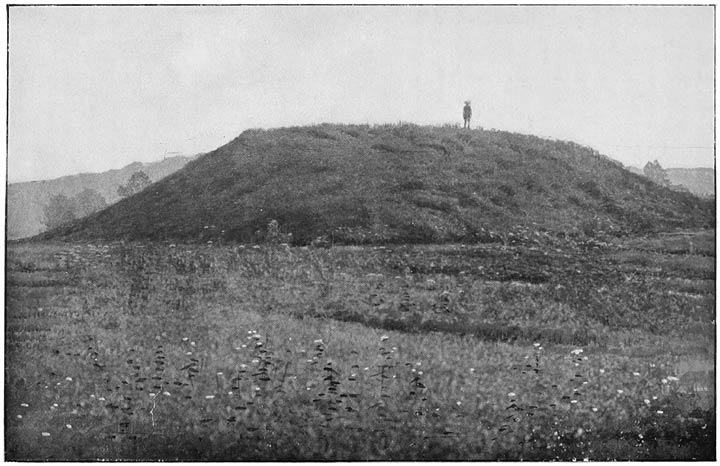
NĬKWĂSĬ MOUND AT FRANKLIN, NORTH CAROLINA.
(From photograph of 1890 furnished by Mr H. G. Trotter, owner of the mound)
The Nûñnĕ′hĭ poured out by hundreds, armed and painted for the fight, and the most curious thing about it all was that they became invisible as soon as they were fairly outside of the settlement, so that although the enemy saw the glancing arrow or the rushing tomahawk, and felt the stroke, he could not see who sent it. Before such invisible foes the invaders soon had to retreat, going first south along the ridge to where joins the main ridge which separates the French Broad from the Tuckasegee, and then turning with it to the northeast. As they retreated they tried to shield themselves behind rocks and trees, but the Nûñnĕ′hĭ arrows went around the rocks and killed them from the other side, and they could find no hiding place. All along the ridge they fell, until when they reached the head of Tuckasegee not more than half a dozen were left alive, and in despair they sat down and cried out for mercy. Ever since then the Cherokee have called the place Dayûlsûñ′yĭ, “Where they cried.” Then the Nûñnĕ′hĭ chief told them they had deserved their punishment for attacking a peaceful tribe, and he spared their lives and told them to go home and take the news to their people. This was the Indian custom, always to spare a few to carry back the news of defeat. They went home toward the north and the Nûñnĕ′hĭ went back to the mound.
And they are still there, because, in the last war, when a strong party of Federal troops came to surprise a handful of Confederates posted there they saw so many soldiers guarding the town that they were afraid and went away without making an attack.
There is another story, that once while all the warriors of a certain town were off on a hunt, or at a dance in another settlement, one old man was chopping wood on the side of the ridge when suddenly a party of the enemy came upon him—Shawano, Seneca, or some other tribe. Throwing his hatchet at the nearest one, he turned and ran for the house to get his gun and make the best defense that he might. On coming out at once with the gun he was surprised to find a large body of strange warriors driving back the enemy. It was no time for questions, and taking his place with the others, they fought hard until the enemy was pressed back up the creek and finally broke and retreated across the mountain. When it was over and there was time to breathe again, the old man turned to thank his new friends, but found that he was alone—they had disappeared as though the mountain had swallowed them. Then he knew that they were the Nûñnĕ′hĭ, who had come to help their friends, the Cherokee.
81. TSULʻKĂLÛ′, THE SLANT-EYED GIANT
A long time ago a widow lived with her one daughter at the old town of Kănuga on Pigeon river. The girl was of age to marry, and her mother used to talk with her a good deal, and tell her she must be sure to take no one but a good hunter for a husband, so that they would have some one to take care of them and would always have plenty of meat in the house. The girl said such a man was hard to find, but her mother advised her not to be in a hurry, and to wait until the right one came.
Now the mother slept in the house while the girl slept outside in the âsĭ. One dark night a stranger came to the âsĭ wanting to court the girl, but she told him her mother would let her marry no one but a good hunter. “Well,” said the stranger, “I am a great hunter,” so she let him come in, and he stayed all night. Just before day he said he must go back now to his own place, but that he had brought some meat for her mother, and she would find it outside. Then he went away and the girl had not seen him. When day came she went out and found there a deer, which she brought into the house to her mother, and told her it was a present from her new sweetheart. Her mother was pleased, and they had deersteaks for breakfast.
He came again the next night, but again went away before daylight, and this time he left two deer outside. The mother was more pleased this time, but said to her daughter, “I wish your sweetheart would bring us some wood.” Now wherever he might be, the stranger knew their thoughts, so when he came the next time he said to the girl, “Tell your mother I have brought the wood”; and when she looked out in the morning there were several great trees lying in front of the door, roots and branches and all. The old woman was angry, and said, “He might have brought us some wood that we could use instead of whole trees that we can’t split, to litter up the road with brush.” The hunter knew what she said, and the next time he came he brought nothing, and when they looked out in the morning the trees were gone and there was no wood at all, so the old woman had to go after some herself.
Almost every night he came to see the girl, and each time he brought a deer or some other game, but still he always left before daylight. At last her mother said to her, “Your husband always leaves before daylight. Why don’t he wait? I want to see what kind of a son-in-law I have.” When the girl told this to her husband he said he could not let the old woman see him, because the sight would frighten her. “She wants to see you, anyhow,” said the girl, and began to cry, until at last he had to consent, but warned her that her mother must not say that he looked frightful (usga′sĕʻti′yu).
The next morning he did not leave so early, but stayed in the âsĭ, and when it was daylight the girl went out and told her mother. The old woman came and looked in, and there she saw a great giant, with long slanting eyes (tsulʻkălû′), lying doubled up on the floor, with his head against the rafters in the left-hand corner at the back, and his toes scraping the roof in the right-hand corner by the door. She gave only one look and ran back to the house, crying, Usga′sĕʻti′yu! Usga′sĕʻti′yu!
Tsulʻkălû′ was terribly angry. He untwisted himself and came out of the âsĭ, and said good-bye to the girl, telling her that he would never let her mother see him again, but would go back to his own country. Then he went off in the direction of Tsunegûñ′yĭ.
Soon after he left the girl had her monthly period. There was a very great flow of blood, and the mother threw it all into the river. One night after the girl had gone to bed in the âsĭ her husband came again to the door and said to her, “It seems you are alone,” and asked where was the child. She said there had been none. Then he asked where was the blood, and she said that her mother had thrown it into the river. She told just where the place was, and he went there and found a small worm in the water. He took it up and carried it back to the âsĭ, and as he walked it took form and began to grow, until, when he reached the âsĭ, it was a baby girl that he was carrying. He gave it to his wife and said, “Your mother does not like me and abuses our child, so come and let us go to my home.” The girl wanted to be with her husband, so, after telling her mother good-bye, she took up the child and they went off together to Tsunegûñ′yĭ.
Now, the girl had an older brother, who lived with his own wife in another settlement, and when he heard that his sister was married he came to pay a visit to her and her new husband, but when he arrived at Kănuga his mother told him his sister had taken her child and gone away with her husband, nobody knew where. He was sorry to see his mother so lonely, so he said he would go after his sister and try to find her and bring her back. It was easy to follow the footprints of the giant, and the young man went along the trail until he came to a place where they had rested, and there were tracks on the ground where a child had been lying and other marks as if a baby had been born there. He went on along the trail and came to another place where they had rested, and there were tracks of a baby crawling about and another lying on the ground. He went on and came to where they had rested again, and there were tracks of a child walking and another crawling about. He went on until he came where they had rested again, and there were tracks of one child running and another walking. Still he followed the trail along the stream into the mountains, and came to the place where they had rested again, and this time there were footprints of two children running all about, and the footprints can still be seen in the rock at that place.
Twice again he found where they had rested, and then the trail led up the slope of Tsunegûñ′yĭ, and he heard the sound of a drum and voices, as if people were dancing inside the mountain. Soon he came to a cave like a doorway in the side of the mountain, but the rock was so steep and smooth that he could not climb up to it, but could only just look over the edge and see the heads and shoulders of a great many people dancing inside. He saw his sister dancing among them and called to her to come out. She turned when she heard his voice, and as soon as the drumming stopped for a while she came out to him, finding no trouble to climb down the rock, and leading her two little children by the hand. She was very glad to meet her brother and talked with him a long time, but did not ask him to come inside, and at last he went away without having seen her husband.
Several other times her brother came to the mountain, but always his sister met him outside, and he could never see her husband. After four years had passed she came one day to her mother’s house and said her husband had been hunting in the woods near by, and they were getting ready to start home to-morrow, and if her mother and brother would come early in the morning they could see her husband. If they came too late for that, she said, they would find plenty of meat to take home. She went back into the woods, and the mother ran to tell her son. They came to the place early the next morning, but Tsulʻkălû′ and his family were already gone. On the drying poles they found the bodies of freshly killed deer hanging, as the girl had promised, and there were so many that they went back and told all their friends to come for them, and there were enough for the whole settlement.
Still the brother wanted to see his sister and her husband, so he went again to the mountain, and she came out to meet him. He asked to see her husband, and this time she told him to come inside with her. They went in as through a doorway, and inside he found it like a great townhouse. They seemed to be alone, but his sister called aloud, “He wants to see you,” and from the air came a voice, “You can not see me until you put on a new dress, and then you can see me.” “I am willing,” said the young man, speaking to the unseen spirit, and from the air came the voice again, “Go back, then, and tell your people that to see me they must go into the townhouse and fast seven days, and in all that time they must not come out from the townhouse or raise the war whoop, and on the seventh day I shall come with new dresses for you to put on so that you can all see me.”
The young man went back to Kănuga and told the people. They all wanted to see Tsulʻkălû′, who owned all the game in the mountains, so they went into the townhouse and began the fast. They fasted the first day and the second and every day until the seventh—all but one man from another settlement, who slipped out every night when it was dark to get something to eat and slipped in again when no one was watching. On the morning of the seventh day the sun was just coming up in the east when they heard a great noise like the thunder of rocks rolling down the side of Tsunegûñ′yĭ. They were frightened and drew near together in the townhouse, and no one whispered. Nearer and louder came the sound until it grew into an awful roar, and every one trembled and held his breath—all but one man, the stranger from the other settlement, who lost his senses from fear and ran out of the townhouse and shouted the war cry.
At once the roar stopped and for some time there was silence. Then they heard it again, but as if it were going farther away, and then farther and farther, until at last it died away in the direction of Tsunegûñ′yĭ, and then all was still again. The people came out from the townhouse, but there was silence, and they could see nothing but what had been seven days before.
Still the brother was not disheartened, but came again to see his sister, and she brought him into the mountain. He asked why Tsulʻkâlû′ had not brought the new dresses, as he had promised, and the voice from the air said, “I came with them, but you did not obey my word, but broke the fast and raised the war cry.” The young man answered, “It was not done by our people, but by a stranger. If you will come again, we will surely do as you say.” But the voice answered, “Now you can never see me.” Then the young man could not say any more, and he went back to Kănuga.
82. KĂNA′STA, THE LOST SETTLEMENT
Long ago, while people still lived in the old town of Kăna′sta, on the French Broad, two strangers, who looked in no way different from other Cherokee, came into the settlement one day and made their way into the chief’s house. After the first greetings were over the chief asked them from what town they had come, thinking them from one of the western settlements, but they said, “We are of your people and our town is close at hand, but you have never seen it. Here you have wars and sickness, with enemies on every side, and after a while a stronger enemy will come to take your country from you. We are always happy, and we have come to invite you to live with us in our town over there,” and they pointed toward Tsuwaʻtel′da (Pilot knob). “We do not live forever, and do not always find game when we go for it, for the game belongs to Tsulʻkălû′, who lives in Tsunegûñ′yĭ, but we have peace always and need not think of danger. We go now, but if your people will live with us let them fast seven days, and we shall come then to take them.” Then they went away toward the west.
The chief called his people together into the townhouse and they held a council over the matter and decided at last to go with the strangers. They got all their property ready for moving, and then went again into the townhouse and began their fast. They fasted six days, and on the morning of the seventh, before yet the sun was high, they saw a great company coming along the trail from the west, led by the two men who had stopped with the chief. They seemed just like Cherokee from another settlement, and after a friendly meeting they took up a part of the goods to be carried, and the two parties started back together for Tsuwaʻtel′da. There was one man from another town visiting at Kăna′sta, and he went along with the rest.
When they came to the mountain, the two guides led the way into a cave, which opened out like a great door in the side of the rock. Inside they found an open country and a town, with houses ranged in two long rows from east to west. The mountain people lived in the houses on the south side, and they had made ready the other houses for the new comers, but even after all the people of Kăna′sta, with their children and belongings, had moved in, there were still a large number of houses waiting ready for the next who might come. The mountain people told them that there was another town, of a different people, above them in the same mountain, and still farther above, at the very top, lived the Ani′-Hyûñtĭkwălâ′skĭ (the Thunders).
Now all the people of Kăna′sta were settled in their new homes, but the man who had only been visiting with them wanted to go back to his own friends. Some of the mountain people wanted to prevent this, but the chief said, “No; let him go if he will, and when he tells his friends they may want to come, too. There is plenty of room for all.” Then he said to the man, “Go back and tell your friends that if they want to come and live with us and be always happy, there is a place here ready and waiting for them. Others of us live in Datsu′nalâsgûñ′yĭ and in the high mountains all around, and if they would rather go to any of them it is all the same. We see you wherever you go and are with you in all your dances, but you can not see us unless you fast. If you want to see us, fast four days, and we will come and talk with you; and then if you want to live with us, fast again seven days, and we will come and take you.” Then the chief led the man through the cave to the outside of the mountain and left him there, but when the man looked back he saw no cave, but only the solid rock.
The people of the lost settlement were never seen again, and they are still living in Tsuwaʻtel′da. Strange things happen there, so that the Cherokee know the mountain is haunted and do not like to go near it. Only a few years ago a party of hunters camped there, and as they sat around their fire at supper time they talked of the story and made rough jokes about the people of old Kăna′sta. That night they were aroused from sleep by a noise as of stones thrown at them from among the trees, but when they searched they could find nobody, and were so frightened that they gathered up their guns and pouches and left the place.
83. TSUWE′NĂHĬ: A LEGEND OF PILOT KNOB
In the old town of Kănuga, on Pigeon river, there was a lazy fellow named Tsuwe′năhĭ, who lived from house to house among his relatives and never brought home any game, although he used to spend nearly all his time in the woods. At last his friends got very tired of keeping him, so he told them to get some parched corn ready for him and he would go and bring back a deer or else would never trouble them again. They filled his pouch with parched corn, enough for a long trip, and he started off for the mountains. Day after day passed until they thought they had really seen the last of him, but before the month was half gone he was back again at Kănuga, with no deer, but with a wonderful story to tell.
He said that he had hardly turned away from the trail to go up the ridge when he met a stranger, who asked him where he was going. Tsuwe′năhĭ answered that his friends in the settlement had driven him out because he was no good hunter, and that if he did not find a deer this time he would never go back again. “Why not come with me?” said the stranger, “my town is not far from here, and you have relatives there.” Tsuwe′năhĭ was very glad of the chance, because he was ashamed to go back to his own town; so he went with the stranger, who took him to Tsuwaʻtel′da (Pilot knob). They came to a cave, and the other said, “Let us go in here;” but the cave ran clear to the heart of the mountain, and when they were inside the hunter found there an open country like a wide bottom land, with a great settlement and hundreds of people. They were all glad to see him, and brought him to their chief, who took him into his own house and showed him a seat near the fire. Tsuwe′năhĭ sat down, but he felt it move under him, and when he looked again he saw that it was a turtle, with its head sticking out from the shell. He jumped up, but the chief said, “It won’t hurt you; it only wants to see who you are.” So he sat down very carefully, and the turtle drew in its head again. They brought food, of the same kind that he had been accustomed to at home, and when he had eaten the chief took him through the settlement until he had seen all the houses and talked with most of the people. When he had seen everything and had rested some days, he was anxious to get back to his home, so the chief himself brought him to the mouth of the cave and showed him the trail that led down to the river. Then he said, “You are going back to the settlement, but you will never be satisfied there any more. Whenever you want to come to us, you know the way.” The chief left him, and Tsuwe′năhĭ went down the mountain and along the river until he came to Kănuga.
He told his story, but no one believed it and the people only laughed at him. After that he would go away very often and be gone for several days at a time, and when he came back to the settlement he would say he had been with the mountain people. At last one man said he believed the story and would go with him to see. They went off together to the woods, where they made a camp, and then Tsuwe′năhĭ went on ahead, saying he would be back soon. The other waited for him, doing a little hunting near the camp, and two nights afterwards Tsuwe′năhĭ was back again. He seemed to be alone, but was talking as he came, and the other hunter heard girls’ voices, although he could see no one. When he came up to the fire he said, “I have two friends with me, and they say there is to be a dance in their town in two nights, and if you want to go they will come for you.” The hunter agreed at once, and Tsuwe′năhĭ called out, as if to some one close by, “He says he will go.” Then he said, “Our sisters have come for some venison.” The hunter had killed a deer and had the meat drying over the fire, so he said, “What kind do they want?” The voices answered, “Our mother told us to ask for some of the ribs,” but still he could see nothing. He took down some rib pieces and gave them to Tsuwe′năhĭ, who took them and said, “In two days we shall come again for you.” Then he started off, and the other heard the voices going through the woods until all was still again.
In two days Tsuwe′năhĭ came, and this time he had two girls with him. As they stood near the fire the hunter noticed that their feet were short and round, almost like dogs’ paws, but as soon as they saw him looking they sat down so that he could not see their feet. After supper the whole party left the camp and went up along the creek to Tsuwaʻtel′da. They went in through the cave door until they got to the farther end and could see houses beyond, when all at once the hunter’s legs felt as if they were dead and he staggered and fell to the ground. The others lifted him up, but still he could not stand, until the medicine-man brought some “old tobacco” and rubbed it on his legs and made him smell it until he sneezed. Then he was able to stand again and went in with the others. He could not stand at first, because he had not prepared himself by fasting before he started.
The dance had not yet begun and Tsuwe′năhĭ took the hunter into the townhouse and showed him a seat near the fire, but it had long thorns of honey locust sticking out from it and he was afraid to sit down. Tsuwe′năhĭ told him not to be afraid, so he sat down and found that the thorns were as soft as down feathers. Now the drummer came in and the dancers, and the dance began. One man followed at the end of the line, crying Kû! Kû! all the time, but not dancing. The hunter wondered, and they told him, “This man was lost in the mountains and had been calling all through the woods for his friends until his, voice failed and he was only able to pant Kû! Kû! and then we found him and took him in.”
When it was over Tsuwe′năhĭ and the hunter went back to the settlement. At the next dance in Kănuga they told all they had seen at Tsuwaʻtel′da, what a large town was there and how kind everybody was, and this time—because there were two of them—the people believed it. Now others wanted to go, but Tsuwe′năhĭ told them they must first fast seven days, while he went ahead to prepare everything, and then he would come and bring them. He went away and the others fasted, until at the end of seven days he came for them and they went with him to Tsuwaʻtel′da, and their friends in the settlement never saw them again.
84. THE MAN WHO MARRIED THE THUNDER’S SISTER
In the old times the people used to dance often and all night. Once there was a dance at the old town of Sâkwi′yĭ, on the head of Chattahoochee, and after it was well started two young women with beautiful long hair came in, but no one knew who they were or whence they had come. They danced with one partner and another, and in the morning slipped away before anyone knew that they were gone; but a young warrior had fallen in love with one of the sisters on account of her beautiful hair, and after the manner of the Cherokee had already asked her through an old man if she would marry him and let him live with her. To this the young woman had replied that her brother at home must first be consulted, and they promised to return for the next dance seven days later with an answer, but in the meantime if the young man really loved her he must prove his constancy by a rigid fast until then. The eager lover readily agreed and impatiently counted the days.
In seven nights there was another dance. The young warrior was on hand early, and later in the evening the two sisters appeared as suddenly as before. They told him their brother was willing, and after the dance they would conduct the young man to their home, but warned him that if he told anyone where he went or what he saw he would surely die.
He danced with them again and about daylight the three came away just before the dance closed, so as to avoid being followed, and started off together. The women led the way along a trail through the woods, which the young man had never noticed before, until they came to a small creek, where, without hesitating, they stepped into the water. The young man paused in surprise on the bank and thought to himself, “They are walking in the water; I don’t want to do that.” The women knew his thoughts just as though he had spoken and turned and said to him, “This is not water; this is the road to our house.” He still hesitated, but they urged him on until he stepped into the water and found it was only soft grass that made a fine level trail.
They went on until the trail came to a large stream which he knew for Tallulah river. The women plunged boldly in, but again the warrior hesitated on the bank, thinking to himself, “That water is very deep and will drown me; I can’t go on.” They knew his thoughts and turned and said, “This is no water, but the main trail that goes past our house, which is now close by.” He stepped in, and instead of water there was tall waving grass that closed above his head as he followed them.
They went only a short distance and came to a rock cave close under Ugûñ′yĭ (Tallulah falls). The women entered, while the warrior stopped at the mouth; but they said, “This is our house; come in and our brother will soon be home; he is coming now.” They heard low thunder in the distance. He went inside and stood up close to the entrance. Then the women took off their long hair and hung it up on a rock, and both their heads were as smooth as a pumpkin. The man thought, “It is not hair at all,” and he was more frightened than ever.
The younger woman, the one he was about to marry, then sat down and told him to take a seat beside her. He looked, and it was a large turtle, which raised itself up and stretched out its claws as if angry at being disturbed. The young man said it was a turtle, and refused to sit down, but the woman insisted that it was a seat. Then there was a louder roll of thunder and the woman said, “Now our brother is nearly home.” While they urged and he still refused to come nearer or sit down, suddenly there was a great thunder clap just behind him, and turning quickly he saw a man standing in the doorway of the cave.
“This is my brother,” said the woman, and he came in and sat down upon the turtle, which again rose up and stretched out its claws. The young warrior still refused to come in. The brother then said that he was just about to start to a council, and invited the young man to go with him. The hunter said he was willing to go if only he had a horse; so the young woman was told to bring one. She went out and soon came back leading a great uktena snake, that curled and twisted along the whole length of the cave. Some people say this was a white uktena and that the brother himself rode a red one. The hunter was terribly frightened, and said “That is a snake; I can’t ride that.” The others insisted that it was no snake, but their riding-horse. The brother grew impatient and said to the woman, “He may like it better if you bring him a saddle, and some bracelets for his wrists and arms.” So they went out again and brought in a saddle and some arm bands, and the saddle was another turtle, which they fastened on the uktena’s back, and the bracelets were living slimy snakes, which they got ready to twist around the hunter’s wrists.
He was almost dead with fear, and said, “What kind of horrible place is this? I can never stay here to live with snakes and creeping things.” The brother got very angry and called him a coward, and then it was as if lightening flashed from his eyes and struck the young man, and a terrible crash of thunder stretched him senseless.
When at last he came to himself again he was standing with his feet in the water and both hands grasping a laurel bush that grew out from the bank, and there was no trace of the cave or the Thunder People, but he was alone in the forest. He made his way out and finally reached his own settlement, but found then that he had been gone so very long that all the people had thought him dead, although to him it seemed only the day after the dance. His friends questioned him closely, and, forgetting the warning, he told the story; but in seven days he died, for no one can come back from the underworld and tell it and live.
85. THE HAUNTED WHIRLPOOL
At the mouth of Suck creek, on the Tennessee, about 8 miles below Chattanooga, is a series of dangerous whirlpools, known as “The Suck,” and noted among the Cherokee as the place where Ûñtsaiyĭ′, the gambler, lived long ago (see the story). They call it Ûñ′tiguhĭ′, “Pot-in-the-water,” on account of the appearance of the surging, tumbling water, suggesting a boiling pot. They assert that in the old times the whirlpools were intermittent in character, and the canoemen attempting to pass the spot used to hug the bank, keeping constantly on the alert for signs of a coming eruption, and when they saw the water begin to revolve more rapidly would stop and wait until it became quiet again before attempting to proceed.
It happened once that two men, going down the river in a canoe, as they came near this place saw the water circling rapidly ahead of them. They pulled up to the bank to wait until it became smooth again, but the whirlpool seemed to approach with wider and wider circles, until they were drawn into the vortex. They were thrown out of the canoe and carried down under the water, where one man was seized by a great fish and was never seen again. The other was taken round and round down to the very lowest center of the whirlpool, when another circle caught him and bore him outward and upward until he was finally thrown up again to the surface and floated out into the shallow water, whence he made his escape to shore. He told afterwards that when he reached the narrowest circle of the maelstrom the water seemed to open below him and he could look down as through the roof beams of a house, and there on the bottom of the river he had seen a great company of people, who looked up and beckoned to him to join them, but as they put up their hands to seize him the swift current caught him and took him out of their reach.
86. YAHULA
Yahoola creek, which flows by Dahlonega, in Lumpkin county, Georgia, is called Yahulâ′ĭ (Yahula place) by the Cherokees, and this is the story of the name:
Years ago, long before the Revolution, Yahula was a prosperous stock trader among the Cherokee, and the tinkling of the bells hung around the necks of his ponies could be heard on every mountain trail. Once there was a great hunt and all the warriors were out, but when it was over and they were ready to return to the settlement Yahula was not with them. They waited and searched, but he could not be found, and at last they went back without him, and his friends grieved for him as for one dead. Some time after his people were surprised and delighted to have him walk in among them and sit down as they were at supper in the evening. To their questions he told them that he had been lost in the mountains, and that the Nûñnĕ′hĭ, the Immortals, had found him and brought him to their town, where he had been kept ever since, with the kindest care and treatment, until the longing to see his old friends had brought him back. To the invitation of his friends to join them at supper he said that it was now too late—he had tasted the fairy food and could never again eat with human kind, and for the same reason he could not stay with his family, but must go back to the Nûñnĕ′hĭ. His wife and children and brother begged him to stay, but he said that he could not; it was either life with the Immortals or death with his own people—and after some further talk he rose to go. They saw him as he sat talking to them and as he stood up, but the moment he stepped out the doorway he vanished as if he had never been.
After that he came back often to visit his people. They would see him first as he entered the house, and while he sat and talked he was his old self in every way, but the instant he stepped across the threshold he was gone, though a hundred eyes might be watching. He came often, but at last their entreaties grew so urgent that the Nûñnĕ′hĭ must have been offended, and he came no more. On the mountain at the head of the creek, about 10 miles above the present Dahlonega, is a small square inclosure of uncut stone, without roof or entrance. Here it was said that he lived, so the Cherokee called it Yahulâ′ĭ and called the stream by the same name. Often at night a belated traveler coming along the trail by the creek would hear the voice of Yahula singing certain favorite old songs that he used to like to sing as he drove his pack of horses across the mountain, the sound of a voice urging them on, and the crack of a whip and the tinkling of bells went with the song, but neither driver nor horses could be seen, although the sounds passed close by. The songs and the bells were heard only at night.
There was one man who had been his friend, who sang the same songs for a time after Yahula had disappeared, but he died suddenly, and then the Cherokee were afraid to sing these songs any more until it was so long since anyone had heard the sounds on the mountain that they thought Yahula must be gone away, perhaps to the West, where others of the tribe had already gone. It is so long ago now that even the stone house may have been destroyed by this time, but more than one old man’s father saw it and heard the songs and the bells a hundred years ago. When the Cherokee went from Georgia to Indian Territory in 1838 some of them said, “Maybe Yahula has gone there and we shall hear him,” but they have never heard him again.
87. THE WATER CANNIBALS
Besides the friendly Nûñnĕ′hĭ of the streams and mountains there is a race of cannibal spirits, who stay at the bottom of the deep rivers and live upon human flesh, especially that of little children. They come out just after daybreak and go about unseen from house to house until they find some one still asleep, when they shoot him with their invisible arrows and carry the dead body down under the water to feast upon it. That no one may know what has happened they leave in place of the body a shade or image of the dead man or little child, that wakes up and talks and goes about just as he did, but there is no life in it, and in seven days it withers and dies, and the people bury it and think they are burying their dead friend. It was a long time before the people found out about this, but now they always try to be awake at daylight and wake up the children, telling them “The hunters are among you.”
This is the way they first knew about the water cannibals: There was a man in Tĭkwăli′tsĭ town who became sick and grew worse until the doctors said he could not live, and then his friends went away from the house and left him alone to die. They were not so kind to each other in the old times as they are now, because they were afraid of the witches that came to torment dying people.
He was alone several days, not able to rise from his bed, when one morning an old woman came in at the door. She looked just like the other women of the settlement, but he did not know her. She came over to the bed and said, “You are very sick and your friends seem to have left you. Come with me and I will make you well.” The man was so near death that he could not move, but now her words made him feel stronger at once, and he asked her where she wanted him to go. “We live close by; come with me and I will show you,” said the woman, so he got up from his bed and she led the way down to the water. When she came to the water she stepped in and he followed, and there was a road under the water, and another country there just like that above.
They went on until they came to a settlement with a great many houses, and women going about their work and children playing. They met a party of hunters coming in from a hunt, but instead of deer or bear quarters hanging from their shoulders they carried the bodies of dead men and children, and several of the bodies the man knew for those of his own friends in Tĭkwăli′tsĭ. They came to a house and the woman said “This is where I live,” and took him in and fixed a bed for him and made him comfortable.
By this time he was very hungry, but the woman knew his thoughts and said, “We must get him something to eat.” She took one of the bodies that the hunters had just brought in and cut off a slice to roast. The man was terribly frightened, but she read his thoughts again and said, “I see you can not eat our food.” Then she turned away from him and held her hands before her stomach—so—and when she turned around again she had them full of bread and beans such as he used to have at home.
So it was every day, until soon he was well and strong again. Then she told him he might go home now, but he must be sure not to speak to anyone for seven days, and if any of his friends should question him he must make signs as if his throat were sore and keep silent. She went with him along the same trail to the water’s edge, and the water closed over her and he went back alone to Tĭkwăli′tsĭ. When he came there his friends were surprised, because they thought he had wandered off and died in the woods. They asked him where he had been, but he only pointed to his throat and said nothing, so they thought he was not yet well and let him alone until the seven days were past, when he began to talk again and told the whole story.
Historical Traditions
88. FIRST CONTACT WITH WHITES
There are a few stories concerning the first contact of the Cherokee with whites and negroes. They are very modern and have little value as myths, but throw some light upon the Indian estimate of the different races.
One story relates how the first whites came from the east and tried to enter into friendly relations, but the Indians would have nothing to do with them for a long time. At last the whites left a jug of whisky and a dipper near a spring frequented by the Indians. The Indians came along, tasted the liquor, which they had never known before, and liked it so well that they ended by all getting comfortably drunk. While they were in this happy frame of mind some white men came up, and this time the Indians shook hands with them and they have been friends after a fashion ever since. This may possibly be a Cherokee adaptation of the story of Hudson’s first landing on the island of Manhattan.
At the creation an ulûñsû′tĭ was given to the white man, and a piece of silver to the Indian. But the white man despised the stone and threw it away, while the Indian did the same with the silver. In going about the white man afterward found the silver piece and put it into his pocket and has prized it ever since. The Indian, in like manner, found the ulûñsû′tĭ where the white man had thrown it. He picked it up and has kept it since as his talisman, as money is the talismanic power of the white man. This story is quite general and is probably older than others of its class.
When Sequoya, the inventor of the Cherokee alphabet, was trying to introduce it among his people, about 1822, some of them opposed it upon the ground that Indians had no business with reading. They said that when the Indian and the white man were created, the Indian, being the elder, was given a book, while the white man received a bow and arrows. Each was instructed to take good care of his gift and make the best use of it, but the Indian was so neglectful of his book that the white man soon stole it from him, leaving the bow in its place, so that books and reading now belong of right to the white man, while the Indian ought to be satisfied to hunt for a living.—Cherokee Advocate, October 26, 1844.
The negro made the first locomotive for a toy and put it on a wooden track and was having great fun with it when a white man came along, watched until he saw how to run it, and then killed the negro and took the locomotive for himself. This, also, although plainly of very recent origin, was heard from several informants.
89. THE IROQUOIS WARS
Long wars were waged between the Cherokee and their remote northern relatives, the Iroquois, with both of whom the recollection, now nearly faded, was a vivid tradition fifty years ago. The (Seneca) Iroquois know the Cherokee as Oyadaʼgeʻoñnoñ, a name rather freely rendered “cave people.” The latter call the Iroquois, or rather their largest and most aggressive tribe, the Seneca, Nûndăwe′gĭ, Ani′-Nûn-dăwe′gĭ, or Ani′-Sĕ′nikă, the first forms being derived from Nûndawa′ga or Nûndawa′-ono, “people of the great hills,” the name by which the Seneca know themselves. According to authorities quoted by Schoolcraft, the Seneca claim to have at one time had a settlement, from which they were afterward driven, at Seneca, South Carolina, known in history as one of the principal towns of the Lower Cherokee.
The league of the Iroquois was probably founded about the middle of the sixteenth century. Before 1680 they had conquered or exterminated all the tribes upon their immediate borders and had turned their arms against the more distant Illinois, Catawba, and Cherokee. According to Iroquois tradition, the Cherokee were the aggressors, having attacked and plundered a Seneca hunting party somewhere in the west, while in another story they are represented as having violated a peace treaty by the murder of the Iroquois delegates. Whatever the cause, the war was taken up by all the tribes of the league.
From the Iroquois country to the Cherokee frontier was considered a five days’ journey for a rapidly traveling war party. As the distance was too great for large expeditions, the war consisted chiefly of a series of individual exploits, a single Cherokee often going hundreds of miles to strike a blow, which was sure to be promptly retaliated by the warriors from the north, the great object of every Iroquois boy being to go against the Cherokee as soon as he was old enough to take the war path. Captives were made on both sides, and probably in about equal numbers, the two parties being too evenly matched for either to gain any permanent advantage, and a compromise was finally made by which the Tennessee river came to be regarded as the boundary between their rival claims, all south of that stream being claimed by the Cherokee, and being acknowledged by the Iroquois, as the limit of their own conquests in that direction. This Indian boundary was recognized by the British government up to the time of the Revolution.
Morgan states that a curious agreement was once made between the two tribes, by which this river was also made the limit of pursuit. If a returning war party of the Cherokee could recross the Tennessee before they were overtaken by the pursuing Iroquois they were as safe from attack as though entrenched behind a stockade. The pursuers, if they chose, might still invade the territory of the enemy, but they passed by the camp of the retreating Cherokee without offering to attack them. A similar agreement existed for a time between the Seneca and the Erie.
The Buffalo dance of the Iroquois is traditionally said to have had its origin in an expedition against the Cherokee. When the warriors on their way to the south reached the Kentucky salt lick they found there a herd of buffalo, and heard them, for the first time, “singing their favorite songs,” i. e., bellowing and snorting. From the bellowing and the movements of the animals were derived the music and action of the dance.
According to Cherokee tradition, as given by the chief Stand Watie, the war was finally brought to an end by the Iroquois, who sent a delegation to the Cherokee to propose a general alliance of the southern and western tribes. The Cherokee accepted the proposition, and in turn sent out invitations to the other tribes, all of which entered into the peace excepting the Osage, of whom it was therefore said that they should be henceforth like a wild fruit on the prairie, at which every bird should pick, and so the Osage have remained ever a predatory tribe without friends or allies. This may be the same treaty described in the story of “The Seneca Peacemakers.” A formal and final peace between the two tribes was arranged through the efforts of the British agent, Sir William Johnson, in 1768.
In 1847 there were still living among the Seneca the grandchildren of Cherokee captives taken in these wars. In 1794 the Seneca pointed out to Colonel Pickering a chief who was a native Cherokee, having been taken when a boy and adopted among the Seneca, who afterward made him chief. This was probably the same man of whom they told Schoolcraft fifty years later. He was a full-blood Cherokee, but had been captured when too young to have any memory of the event. Years afterward, when he had grown to manhood and had become a chief in the tribe, he learned of his foreign origin, and was filled at once with an overpowering longing to go back to the south to find his people and live and die among them. He journeyed to the Cherokee country, but on arriving there found to his great disappointment that the story of his capture had been forgotten in the tribe, and that his relatives, if any were left, failed to recognize him. Being unable to find his kindred, he made only a short visit and returned again to the Seneca.
From James Wafford, of Indian Territory, the author obtained a detailed account of the Iroquois peace embassy referred to by Stand Watie, and of the wampum belt that accompanied it. Wafford’s information concerning the proceedings at Echota was obtained directly from two eyewitnesses—Sequoya, the inventor of the alphabet, and Gatûñ′waʻlĭ, “Hard-mush,” who afterward explained the belt at the great council near Tahlequah seventy years later. Sequoya, at the time of the Echota conference, was a boy living with his mother at Taskigi town a few miles away, while Gatûñ′waʻlĭ was already a young man.
The treaty of peace between the Cherokee and Iroquois, made at Johnson Hall in New York in 1768, appears from the record to have been brought about by the Cherokee, who sent for the purpose a delegation of chiefs, headed by Âgănstâ′ta, “Groundhog-sausage,” of Echota, their great leader in the war of 1760–61 against the English. After the treaty had been concluded the Cherokee delegates invited some of the Iroquois chiefs to go home with them for a visit, but the latter declined on the ground that it was not yet safe, and in fact some of their warriors were at that very time out against the Cherokee, not yet being aware of the peace negotiations. It is probable, therefore, that the Iroquois delegates did not arrive at Echota until some considerable time, perhaps three years, after the formal preliminaries had been concluded in the north.
According to Sequoya’s account, as given to Wafford, there had been a long war between the Cherokee and the northern Indians, who were never able to conquer the Cherokee or break their spirit, until at last the Iroquois were tired of fighting and sent a delegation to make peace. The messengers set out for the south with their wampum belts and peace emblems, but lost their way after passing Tennessee river, perhaps from the necessity of avoiding the main trail, and instead of arriving at Itsâ′tĭ or Echota, the ancient peace town and capital of the Cherokee Nation—situated on Little Tennessee river below Citico creek, in the present Monroe county, Tennessee—they found themselves on the outskirts of Tă′likwă′ or Tellico, on Tellico river, some 10 or 15 miles to the southward.
Concealing themselves in the neighborhood, they sent one of their number into the town to announce their coming. As it happened the chief and his family were at work in their cornfield, and his daughter had just gone up to the house for some reason when the Iroquois entered and asked for something to eat. Seeing that he was a stranger, she set out food for him according to the old custom of hospitality. While he was eating her father, the chief, came in to see what was delaying her, and was surprised to find there one of the hereditary enemies of his tribe. By this time the word had gone out that an Iroquois was in the chief’s house, and the men of the town had left their work and seized their guns to kill him, but the chief heard them coming and standing in the doorway kept them off, saying: “This man has come here on a peace mission, and before you kill him you must first kill me.” They finally listened to him, and allowed the messenger to go out and bring his companions to the chief’s house, where they were all taken care of.
When they were well rested after their long journey the chief of Tă′likwă himself went with them to Itsâ′tĭ, the capital, where lived the great chief Âgănstâ′ta, who was now the civil ruler of the Nation. The chiefs of the various towns were summoned and a council was held, at which the speaker for the Iroquois delegation delivered his message and produced the wampum belts and pipes, which they brought as proofs of their mission and had carried all the way in packs upon their backs.
He said that for three years his people had been wanting to make peace. There was a spring of dark, cloudy water in their country, and they had covered it over for one year and then looked, but the water was still cloudy. Again they had covered it over, but when they looked at the end of another year it was still dark and troubled. For another year they had covered the spring, and this time when they looked the water was clear and sparkling. Then they knew the time had come, and they left home with their wampum belts to make peace with their enemies.
The friendly message was accepted by the Cherokee, and the belts and other symbolic peace tokens were delivered over to their keeping. Other belts in turn were probably given to the Iroquois, and after the usual round of feasting and dancing the messengers returned to their people in the north and the long war was at an end.
For nearly a century these symbolic records of the peace with the Iroquois were preserved by the Cherokee, and were carried with them to the western territory when the tribe was finally driven from its old home in 1838. They were then in the keeping of John Ross, principal chief at the time of the removal, and were solemnly produced at a great intertribal council held near Tahlequah, in the Indian Territory, in June, 1843, when they were interpreted by the Cherokee speaker, Gatûñ′waʻlĭ, “Hard-mush,” who had seen them delivered to the chiefs of his tribe at old Itsâ′tĭ seventy years before. Wafford was present on this occasion and describes it.
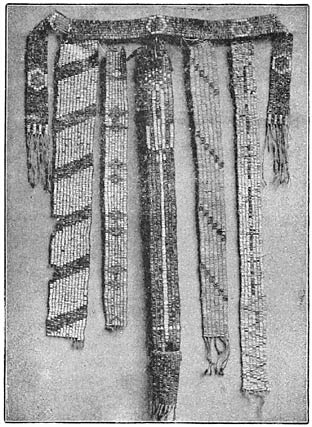
Holding the belts over his arm while speaking, Hard-mush told of the original treaty with the Iroquois, and explained the meaning of each belt in turn. According to the best of Wafford’s recollection, there was one large belt, to which the smaller belts were fitted. The beads did not seem to be of shell, and may have been of porcelain. There were also red pipes for the warriors, grayish-white pipes for the chiefs who were foremost in making the peace, and some fans or other ornaments of feathers. There were several of the red pipes, resembling the red-stone pipes of the Sioux, but only one, or perhaps two, of the white peace pipes, which may have been only painted, and were much larger than the others. The pipes were passed around the circle at the council, so that each delegate might take a whiff. The objects altogether made a considerable package, which was carefully guarded by the Cherokee keeper. It is thought that they were destroyed in the War of the Rebellion when the house of John Ross, a few miles south of Tahlequah, was burned by the Confederate Cherokee under their general, Stand Watie.
90. HIADEONI, THE SENECA
“Hiadeoni was the father of the late chief Young-king. He was a Seneca warrior, a man of great prowess, dexterity, and swiftness of foot, and had established his reputation for courage and skill on many occasions. He resolved while the Seneca were still living on the Genesee river to make an incursion alone into the country of the Cherokee. He plumed himself with the idea that he could distinguish himself in this daring adventure, and he prepared for it, according to the custom of warriors. They never encumber themselves with baggage. He took nothing but his arms and the meal of a little parched and pounded corn. The forest gave him his meat.
Hiadeoni reached the confines of the Cherokee country in safety and alone. He waited for evening before he entered the precincts of a village. He found the people engaged in a dance. He watched his opportunity, and when one of the dancers went out from the ring into the bushes he dispatched him with his hatchet. In this way he killed two men that night in the skirts of the woods without exciting alarm, and took their scalps and retreated. It was late when he came to a lodge, standing remote from the rest, on his course homeward. Watching here, he saw a young man come out, and killed him as he had done the others, and took his scalp. Looking into the lodge cautiously he saw it empty, and ventured in with the hope of finding some tobacco and ammunition to serve him on his way home.
While thus busied in searching the lodge he heard footsteps at the door, and immediately threw himself on the bed from which the young man had risen, and covered his face, feigning sleep. They proved to be the footsteps of his last victim’s mother. She, supposing him to be her son, whom she had a short time before left lying there, said, “My son, I am going to such a place, and will not be back till morning.” He made a suitable response, and the old woman went out. Insensibly he fell asleep, and knew nothing till morning, when the first thing he heard was the mother’s voice. She, careful for her son, was at the fireplace very early, pulling some roasted squashes out of the ashes, and after putting them out, and telling him she left them for him to eat, she went away. He sprang up instantly and fled; but the early dawn had revealed his inroad, and he was hotly pursued. Light of foot, and having the start, he succeeded in reaching and concealing himself in a remote piece of woods, where he laid till night, and then pursued his way toward the Genesee, which, in due time he reached, bringing his three Cherokee scalps as trophies of his victory and prowess.”—Schoolcraft, Notes on Iroquois, p. 253, 1847.
91. THE TWO MOHAWKS
“In the year 1747 a couple of the Mohawk Indians came against the lower towns of the Cheerake, and so cunningly ambuscaded them through most part of the spring and summer, as to kill above twenty in different attacks before they were discovered by any party of the enraged and dejected people. They had a thorough knowledge of the most convenient ground for their purpose, and were extremely swift and long-winded. Whenever they killed any and got the scalp they made off to the neighboring mountains, and ran over the broad ledges of rocks in contrary courses, as occasion offered, so as the pursuers could by no means trace them. Once, when a large company was in chase of them, they ran round a steep hill at the head of the main eastern branch of Savana river, intercepted, killed, and scalped the hindmost of the party, and then made off between them and Keeowhee. As this was the town to which the company belonged, they hastened home in a close body, as the proper place of security from such enemy wizards. In this manner did those two sprightly, gallant savages perplex and intimidate their foes for the space of four moons in the greatest security, though they often were forced to kill and barbecue what they chiefly lived upon, in the midst of their watchful enemies. Having sufficiently revenged their relations’ blood and gratified their own ambition with an uncommon number of scalps, they resolved to captivate one and run home with him as a proof of their having killed none but the enemies of their country. Accordingly, they approached very near to Keeowhee, about half a mile below the late Fort Prince George. Advancing with the usual caution on such an occasion, one crawled along under the best cover of the place about the distance of a hundred yards ahead, while the other shifted from tree to tree, looking sharply every way. In the evening, however, an old, beloved man discovered them from the top of an adjoining hill, and knew them to be enemies by the cut of their hair, light trim for running, and their postures. He returned to the town and called first at the house of one of our traders and informed him of the affair, enjoining him not to mention it to any, lest the people should set off against them without success before their tracks were to be discovered and he be charged with having deceived them. But, contrary to the true policy of traders among unforgiving savages, that thoughtless member of the Choktah Sphynx Company busied himself, as usual, out of his proper sphere, sent for the headmen, and told them the story. As the Mohawks were allies and not known to molest any of the traders in the paths and woods, he ought to have observed a strict neutrality. The youth of the town, by order of their headmen, carried on their noisy public diversions in their usual manner to prevent their foes from having any suspicion of their danger, while runners were sent from the town to their neighbors to come silently and assist them to secure the prey in its state of security. They came like silent ghosts, concerted their plan of operation, passed over the river at the old trading ford opposite to the late fort, which lay between two contiguous commanding hills, and, proceeding downward over a broad creek, formed a large semicircle from the river bank, while the town seemed to be taking its usual rest. They then closed into a narrower compass, and at last discovered the two brave, unfortunate men lying close under the tops of some fallen young pine trees. The company gave the war signal, and the Mohawks, bounding up, bravely repeated it; but, by their sudden spring from under thick cover, their arms were useless. They made desperate efforts, however, to kill or be killed, as their situation required. One of the Cheerake, the noted half-breed of Istanare [Ustăna′lĭ] town, which lay 2 miles from thence, was at the first onset knocked down and almost killed with his own cutlass, which was wrested from him, though he was the strongest of the whole nation. But they were overpowered by numbers, captivated, and put to the most exquisite tortures of fire, amidst a prodigious crowd of exulting foes.
One of the present Choktah traders, who was on the spot, told me that when they were tied to the stake the younger of the two discovered our traders on a hill near, addressed them in English, and entreated them to redeem their lives. The elder immediately spoke to him, in his own language, to desist. On this, he recollected himself, and became composed like a stoic, manifesting an indifference to life or death, pleasure or pain, according to their standard of martial virtue, and their dying behaviour did not reflect the least dishonor on their former gallant actions. All the pangs of fiery torture served only to refine their manly spirits, and as it was out of the power of the traders to redeem them they, according to our usual custom, retired as soon as the Indians began the diabolical tragedy.”—Adair, American Indians, p. 383, 1775.
BUREAU OF AMERICAN ETHNOLOGY NINETEENTH ANNUAL REPORT PL. XVII
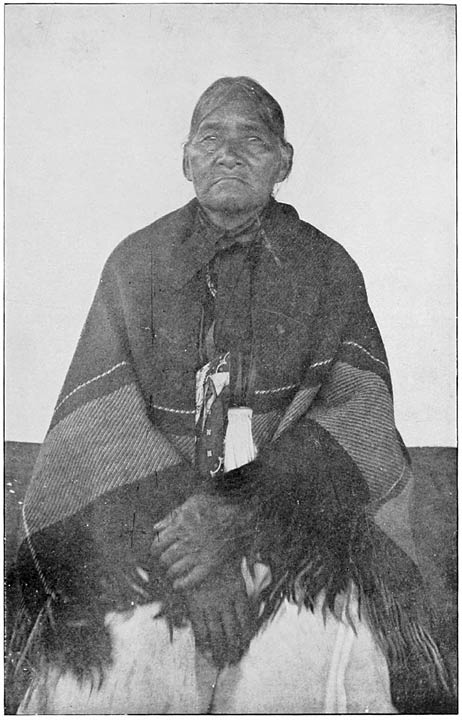
PHOTOGRAPH BY AUTHOR, 1888
ANNIE AX (SADAYĬ)
92. ESCAPE OF THE SENECA BOYS
Some Seneca warriors were hunting in the woods, and one morning, on starting out for the day, they left two boys behind to take care of the camp. Soon after they had gone, a war party of Cherokee came up, and finding the boys alone took them both and started back to the south, traveling at such a rate that when the hunters returned in the evening they decided that it was of no use to follow them. When the Cherokee reached their own country they gave the boys to an old man, whose sons had been killed by the Seneca. He took the boys and adopted them for his own, and they grew up with him until they were large and strong enough to go hunting for themselves.
But all the time they remembered their own home, and one day the older one said to his brother, “Let’s kill the old man and run away.” “No,” said the other, “we might get lost if we ran away, we are so far from home.” “I remember the way,” said his brother, so they made a plan to escape. A few days later the old man took the boys with him and the three set out together for a hunt in the mountains. When they were well away from the settlement the boys killed the old man, took all the meat and parched corn meal they could easily carry, and started to make their way back to the north, keeping away from the main trail and following the ridge of the mountains. After many days they came to the end of the mountains and found a trail which the older brother knew as the one along which they had been taken when they were first captured. They went on bravely now until they came to a wide clearing with houses at the farther end, and the older brother said, “I believe there is where we used to live.” It was so long ago that they were not quite sure, and besides they were dressed now like Cherokee, so they thought it safer to wait until dark. They saw a river ahead and went down to it and sat behind a large tree to wait. Soon several women came down for water and passed close to the tree without noticing the boys. Said the older brother, “I know those women. One of them is our mother.” They waited until the women had filled their buckets and started to the village, when both ran out to meet them with the Seneca hailing-shout, “Gowe′! Gowe′!” At first the women were frightened and thought it a party of Cherokee, but when they heard their own language they came nearer. Then the mother recognized her two sons, and said, “Let us go back and dance for the dead come to life,” and they were all very glad and went into the village together.—Arranged from Curtin, Seneca manuscript.
93. THE UNSEEN HELPERS
Ganogwioeoñ, a war chief of the Seneca, led a party against the Cherokee. When they came near the first town he left his men outside and went in alone. At the first house he found an old woman and her granddaughter. They did not see him, and he went into the âsĭ and hid himself under some wood. When darkness came on he heard the old woman say, “Maybe Ganogwioeoñ is near; I’ll close the door.” After a while he heard them going to bed. When he thought they were asleep he went into the house. The fire had burned down low, but the girl was still awake and saw him. She was about to scream, when he said, “I am Ganogwioeoñ. If you scream I’ll kill you. If you keep quiet I’ll not hurt you.” They talked together, and he told her that in the morning she must bring the chief’s daughter to him. She promised to do it, and told him where he should wait. Just before daylight he left the house.
In the morning the girl went to the chief’s house and said to his daughter, “Let’s go out together for wood.” The chief’s daughter got ready and went with her, and when they came to the place where Ganogwioeoñ was hiding he sprang out and killed her, but did not hurt the other girl. He pulled off the scalp and gave such a loud scalp yell that all the warriors in the town heard it and came running out after him. He shook the scalp at them and then turned and ran. He killed the first one that came up, but when he tried to shoot the next one the bow broke and the Cherokee got him.