II—HISTORICAL SKETCH OF THE CHEROKEE
Reading edition
The Traditionary Period
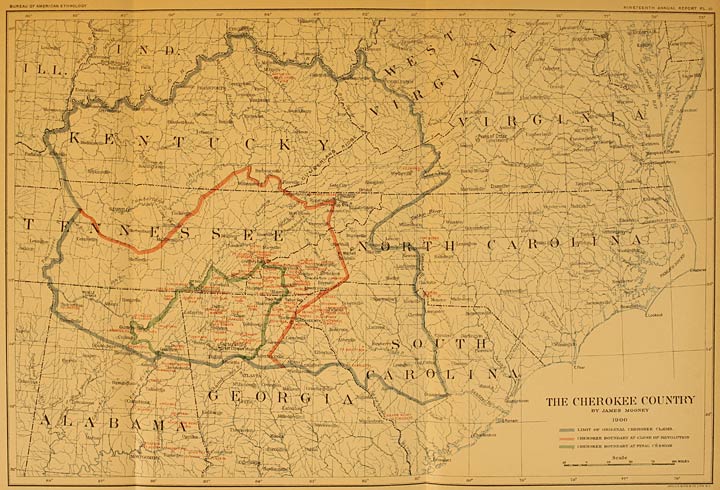
The Cherokee were the mountaineers of the South, holding the entire Allegheny region from the interlocking head-streams of the Kanawha and the Tennessee southward almost to the site of Atlanta, and from the Blue ridge on the east to the Cumberland range on the west, a territory comprising an area of about 40,000 square miles, now included in the states of Virginia, Tennessee, North Carolina, South Carolina, Georgia, and Alabama. Their principal towns were upon the headwaters of the Savannah, Hiwassee, and Tuckasegee, and along the whole length of the Little Tennessee to its junction with the main stream. Itsâtĭ, or Echota, on the south bank of the Little Tennessee, a few miles above the mouth of Tellico river, in Tennessee, was commonly considered the capital of the Nation. As the advancing whites pressed upon them from the east and northeast the more exposed towns were destroyed or abandoned and new settlements were formed lower down the Tennessee and on the upper branches of the Chattahoochee and the Coosa.
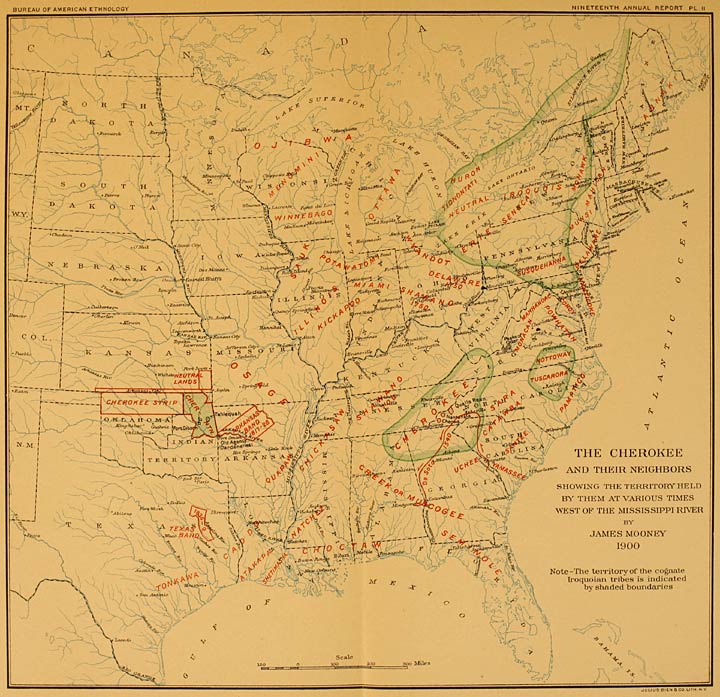
As is always the case with tribal geography, there were no fixed boundaries, and on every side the Cherokee frontiers were contested by rival claimants. In Virginia, there is reason to believe, the tribe was held in check in early days by the Powhatan and the Monacan. On the east and southeast the Tuscarora and Catawba were their inveterate enemies, with hardly even a momentary truce within the historic period; and evidence goes to show that the Sara or Cheraw were fully as hostile. On the south there was hereditary war with the Creeks, who claimed nearly the whole of upper Georgia as theirs by original possession, but who were being gradually pressed down toward the Gulf until, through the mediation of the United States, a treaty was finally made fixing the boundary between the two tribes along a line running about due west from the mouth of Broad river on the Savannah. Toward the west, the Chickasaw on the lower Tennessee and the Shawano on the Cumberland repeatedly turned back the tide of Cherokee invasion from the rich central valleys, while the powerful Iroquois in the far north set up an almost unchallenged claim of paramount lordship from the Ottawa river of Canada southward at least to the Kentucky river.
BUREAU OF AMERICAN ETHNOLOGY NINETEENTH ANNUAL REPORT PL. II
Julius Bien & Co. Lith N.Y.
THE CHEROKEE AND THEIR NEIGHBORS
SHOWING THE TERRITORY HELD BY THEM AT VARIOUS TIMES WEST OF THE MISSISSIPPI RIVER
BY JAMES MOONEY 1900
Note—The territory of the cognate Iroquoian tribes is indicated by shaded boundaries
On the other hand, by their defeat of the Creeks and expulsion of the Shawano, the Cherokee made good the claim which they asserted to all the lands from upper Georgia to the Ohio river, including the rich hunting grounds of Kentucky. Holding as they did the great mountain barrier between the English settlements on the coast and the French or Spanish garrisons along the Mississippi and the Ohio, their geographic position, no less than their superior number, would have given them the balance of power in the South but for a looseness of tribal organization in striking contrast to the compactness of the Iroquois league, by which for more than a century the French power was held in check in the north. The English, indeed, found it convenient to recognize certain chiefs as supreme in the tribe, but the only real attempt to weld the whole Cherokee Nation into a political unit was that made by the French agent, Priber, about 1736, which failed from its premature discovery by the English. We frequently find their kingdom divided against itself, their very number preventing unity of action, while still giving them an importance above that of neighboring tribes.
Cherokee, the name by which they are commonly known, has no meaning in their own language, and seems to be of foreign origin. As used among themselves the form is Tsa′lăgĭ′ or Tsa′răgĭ′. It first appears as Chalaque in the Portuguese narrative of De Soto’s expedition, published originally in 1557, while we find Cheraqui in a French document of 1699, and Cherokee as an English form as early, at least, as 1708. The name has thus an authentic history of 360 years. There is evidence that it is derived from the Choctaw word choluk or chiluk, signifying a pit or cave, and comes to us through the so-called Mobilian trade language, a corrupted Choctaw jargon formerly used as the medium of communication among all the tribes of the Gulf states, as far north as the mouth of the Ohio (2). Within this area many of the tribes were commonly known under Choctaw names, even though of widely differing linguistic stocks, and if such a name existed for the Cherokee it must undoubtedly have been communicated to the first Spanish explorers by De Soto’s interpreters. This theory is borne out by their Iroquois (Mohawk) name, Oyataʼgeʻronoñʼ, as given by Hewitt, signifying “inhabitants of the cave country,” the Allegheny region being peculiarly a cave country, in which “rock shelters,” containing numerous traces of Indian occupancy, are of frequent occurrence. Their Catawba name also, Mañterañ, as given by Gatschet, signifying “coming out of the ground,” seems to contain the same reference. Adair’s attempt to connect the name Cherokee with their word for fire, atsila, is an error founded upon imperfect knowledge of the language.
Among other synonyms for the tribe are Rickahockan, or Rechahecrian, the ancient Powhatan name, and Tallige′, or Tallige′wi, the ancient name used in the Walam Olum chronicle of the Lenape′. Concerning both the application and the etymology of this last name there has been much dispute, but there seems no reasonable doubt as to the identity of the people.
The Eastern dialect, formerly often called the Lower Cherokee dialect, was originally spoken in all the towns upon the waters of the Keowee and Tugaloo, head-streams of Savannah river, in South Carolina and the adjacent portion of Georgia. Its chief peculiarity is a rolling r, which takes the place of the l of the other dialects. In this dialect the tribal name is Tsa′răgĭ′, which the English settlers of Carolina corrupted to Cherokee, while the Spaniards, advancing from the south, became better familiar with the other form, which they wrote as Chalaque. Owing to their exposed frontier position, adjoining the white settlements of Carolina, the Cherokee of this division were the first to feel the shock of war in the campaigns of 1760 and 1776, with the result that before the close of the Revolution they had been completely extirpated from their original territory and scattered as refugees among the more western towns of the tribe. The consequence was that they lost their distinctive dialect, which is now practically extinct. In 1888 it was spoken by but one man on the reservation in North Carolina.
The Middle dialect, which might properly be designated the Kituhwa dialect, was originally spoken in the towns on the Tuckasegee and the headwaters of the Little Tennessee, in the very heart of the Cherokee country, and is still spoken by the great majority of those now living on the Qualla reservation. In some of its phonetic forms it agrees with the Eastern dialect, but resembles the Western in having the l sound.
The Western dialect was spoken in most of the towns of east Tennessee and upper Georgia and upon Hiwassee and Cheowa rivers in North Carolina. It is the softest and most musical of all the dialects of this musical language, having a frequent liquid l and eliding many of the harsher consonants found in the other forms. It is also the literary dialect, and is spoken by most of those now constituting the Cherokee Nation in the West.
Scattered among the other Cherokee are individuals whose pronunciation and occasional peculiar terms for familiar objects give indication of a fourth and perhaps a fifth dialect, which can not now be localized. It is possible that these differences may come from foreign admixture, as of Natchez, Taskigi, or Shawano blood. There is some reason for believing that the people living on Nantahala river differed dialectically from their neighbors on either side (3).
The Iroquoian stock, to which the Cherokee belong, had its chief home in the north, its tribes occupying a compact territory which comprised portions of Ontario, New York, Ohio, and Pennsylvania, and extended down the Susquehanna and Chesapeake bay almost to the latitude of Washington. Another body, including the Tuscarora, Nottoway, and perhaps also the Meherrin, occupied territory in northeastern North Carolina and the adjacent portion of Virginia. The Cherokee themselves constituted the third and southernmost body. It is evident that tribes of common stock must at one time have occupied contiguous territories, and such we find to be the case in this instance. The Tuscarora and Meherrin, and presumably also the Nottoway, are known to have come from the north, while traditional and historical evidence concur in assigning to the Cherokee as their early home the region about the headwaters of the Ohio, immediately to the southward of their kinsmen, but bitter enemies, the Iroquois. The theory which brings the Cherokee from northern Iowa and the Iroquois from Manitoba is unworthy of serious consideration. (4)
In the Walam Olum, which is, it is asserted, a metrical translation of an ancient hieroglyphic bark record discovered in 1820, the main tradition is given in practically the same way, with an appendix which follows the fortunes of the defeated tribe up to the beginning of the historic period, thus completing the chain of evidence. (5)
In the Walam Olum also we find the Delawares advancing from the west or northwest until they come to “Fish river”—the same which Heckewelder makes the Mississippi (6). On the other side, we are told, “The Talligewi possessed the East.” The Delaware chief “desired the eastern land,” and some of his people go on, but are killed, by the Talligewi. The Delawares decide upon war and call in the help of their northern friends, the “Talamatan,” i. e., the Wyandot and other allied Iroquoian tribes. A war ensues which continues through the terms of four successive chiefs, when victory declares for the invaders, and “all the Talega go south.” The country is then divided, the Talamatan taking the northern portion, while the Delawares “stay south of the lakes.” The chronicle proceeds to tell how, after eleven more chiefs have ruled, the Nanticoke and Shawano separate from the parent tribe and remove to the south. Six other chiefs follow in succession until we come to the seventh, who “went to the Talega mountains.” By this time the Delawares have reached the ocean. Other chiefs succeed, after whom “the Easterners and the Wolves”—probably the Mahican or Wappinger and the Munsee—move off to the northeast. At last, after six more chiefs, “the whites came on the eastern sea,” by which is probably meant the landing of the Dutch on Manhattan in 1609 (7). We may consider this a tally date, approximating the beginning of the seventeenth century. Two more chiefs rule, and of the second we are told that “He fought at the south; he fought in the land of the Talega and Koweta,” and again the fourth chief after the coming of the whites “went to the Talega.” We have thus a traditional record of a war of conquest carried on against the Talligewi by four successive chiefs, and a succession of about twenty-five chiefs between the final expulsion of that tribe and the appearance of the whites, in which interval the Nanticoke, Shawano, Mahican, and Munsee branched off from the parent tribe of the Delawares. Without venturing to entangle ourselves in the devious maze of Indian chronology, it is sufficient to note that all this implies a very long period of time—so long, in fact, that during it several new tribes, each of which in time developed a distinct dialect, branch off from the main Lenape′ stem. It is distinctly stated that all the Talega went south after their final defeat; and from later references we find that they took refuge in the mountain country in the neighborhood of the Koweta (the Creeks), and that Delaware war parties were still making raids upon both these tribes long after the first appearance of the whites.
The traditions of the Cherokee, so far as they have been preserved, supplement and corroborate those of the northern tribes, thus bringing the story down to their final settlement upon the headwaters of the Tennessee in the rich valleys of the southern Alleghenies. Owing to the Cherokee predilection for new gods, contrasting strongly with the conservatism of the Iroquois, their ritual forms and national epics had fallen into decay even before the Revolution, as we learn from Adair. Some vestiges of their migration legend still existed in Haywood’s time, but it is now completely forgotten both in the East and in the West.
BUREAU OF AMERICAN ETHNOLOGY NINETEENTH ANNUAL REPORT PL. III
JULIUS BIEN & CO. LITH. N.Y.
THE CHEROKEE COUNTRY
BY JAMES MOONEY
1900
The Period of Spanish Exploration—1540–?
The definite history of the Cherokee begins with the year 1540, at which date we find them already established, where they were always afterward known, in the mountains of Carolina and Georgia. The earliest Spanish adventurers failed to penetrate so far into the interior, and the first entry into their country was made by De Soto, advancing up the Savannah on his fruitless quest for gold, in May of that year.
The outrageous conduct of the Spaniards had so angered the Indian queen that she now refused to furnish guides and carriers, whereupon De Soto made her a prisoner, with the design of compelling her to act as guide herself, and at the same time to use her as a hostage to command the obedience of her subjects. Instead, however, of conducting the Spaniards by the direct trail toward the west, she led them far out of their course until she finally managed to make her escape, leaving them to find their way out of the mountains as best they could.
In the summer of 1567, according to previous agreement, Captain Pardo left the fort at Santa Elena with a small detachment of troops, and after a week’s travel, sleeping each night at a different Indian town, arrived at “Canos, which the Indians call Canosi, and by another name, Cofetaçque” (the Cofitachiqui of the De Soto chronicle), which is described as situated in a favorable location for a large city, fifty leagues from Santa Elena, to which the easiest road was by a river (the Savannah) which flowed by the town, or by another which they had passed ten leagues farther back. Proceeding, they passed Jagaya, Gueza, and Arauchi, and arrived at Otariyatiqui, or Otari, in which we have perhaps the Cherokee â′tărĭ or â′tălĭ, “mountain”. It may have been a frontier Cherokee settlement, and, according to the old chronicler, its chief and language ruled much good country. From here a trail went northward to Guatari, Sauxpa, and Usi, i. e., the Wateree, Waxhaw (or Sissipahaw?), and Ushery or Catawba.
The Colonial and Revolutionary Period—1654–1784
I found the nation much attached to the French, who have the prudence, by familiar politeness—which costs but little and often does a great deal—and conforming themselves to their ways and temper, to conciliate the inclinations of almost all the Indians they are acquainted with, while the pride of our officers often disgusts them. Nay, they did not scruple to own to me that it was the trade alone that induced them to make peace with us, and not any preference to the French, whom they loved a great deal better.... The English are now so nigh, and encroached daily so far upon them, that they not only felt the bad effects of it in their hunting grounds, which were spoiled, but had all the reason in the world to apprehend being swallowed up by so potent neighbors or driven from the country inhabited by their fathers, in which they were born and brought up, in fine, their native soil, for which all men have a particular tenderness and affection.
Fort Du Quesne was taken by the American provincials under Washington, November 25, 1758. Quebec was taken September 13, 1759, and by the final treaty of peace in 1763 the war ended with the transfer of Canada and the Ohio valley to the crown of England. Louisiana had already been ceded by France to Spain.
Although France was thus eliminated from the Indian problem, the Indians themselves were not ready to accept the settlement. In the north the confederated tribes under Pontiac continued to war on their own account until 1765. In the South the very Cherokee who had acted as allies of the British against Fort Du Quesne, and had voluntarily offered to guard the frontier south of the Potomac, returned to rouse their tribe to resistance.
At this juncture, in November, 1758, a party of influential chiefs, having first ordered back a war party just about to set out from the western towns against the Carolina settlements, came down to Charleston and succeeded in arranging the difficulty upon a friendly basis. The assembly had officially declared peace with the Cherokee, when, in May of 1759, Governor Lyttleton unexpectedly came forward with a demand for the surrender for execution of every Indian who had killed a white man in the recent skirmishes, among these being the chiefs of Citico and Tellico. At the same time the commander at Fort Loudon, forgetful of the fact that he had but a small garrison in the midst of several thousands of restless savages, made a demand for twenty-four other chiefs whom he suspected of unfriendly action. To compel their surrender orders were given to stop all trading supplies intended for the upper Cherokee.
The event soon proved how little he knew of Indian temper. Oconostota at once laid siege to Fort Prince George, completely cutting off communication at a time when, as it was now winter, no help could well be expected from below. In February, 1760, after having kept the fort thus closely invested for some weeks, he sent word one day by an Indian woman that he wished to speak to the commander, Lieutenant Coytmore. As the lieutenant stepped out from the stockade to see what was wanted, Oconostota, standing on the opposite side of the river, swung a bridle above his head as a signal to his warriors concealed in the bushes, and the officer was at once shot down. The soldiers immediately broke into the room where the hostages were confined, every one being a chief of prominence in the tribe and butchered them to the last man.
It was now war to the end. Led by Oconostota, the Cherokee descended upon the frontier settlements of Carolina, while the warriors across the mountains laid close siege to Fort Loudon. In June, 1760, a strong force of over 1,600 men, under Colonel Montgomery, started to reduce the Cherokee towns and relieve the beleaguered garrison. Crossing the Indian frontier, Montgomery quickly drove the enemy from about Fort Prince George and then, rapidly advancing, surprised Little Keowee, killing every man of the defenders, and destroyed in succession every one of the Lower Cherokee towns, burning them to the ground, cutting down the cornfields and orchards, killing and taking more than a hundred of their men, and driving the whole population into the mountains before him. His own loss was very slight. He then sent messengers to the Middle and Upper towns, summoning them to surrender on penalty of the like fate, but, receiving no reply, he led his men across the divide to the waters of the Little Tennessee and continued down that stream without opposition until he came in the vicinity of Echoee (Itse′yĭ), a few miles above the sacred town of Nĭkwăsĭ′, the present Franklin, North Carolina. Here the Cherokee had collected their full force to resist his progress, and the result was a desperate engagement on June 27, 1760, by which Montgomery was compelled to retire to Fort Prince George, after losing nearly one hundred men in killed and wounded. The Indian loss is unknown.
The troops marched out and proceeded far enough to camp for the night, while the Indians swarmed into the fort to see what plunder they might find. “By accident a discovery was made of ten bags of powder and a large quantity of ball that had been secretly buried in the fort, to prevent their falling into the enemy’s hands” (Hewat). It is said also that cannon, small arms, and ammunition had been thrown into the river with the same intention (Haywood). Enraged at this breach of the capitulation the Cherokee attacked the soldiers next morning at daylight, killing Demeré and twenty-nine others at the first fire. The rest were taken and held as prisoners until ransomed some time after. The second officer, Captain Stuart (13), for whom the Indians had a high regard, was claimed by Ata-kullakulla, who soon after took him into the woods, ostensibly on a hunting excursion, and conducted him for nine days through the wilderness until he delivered him safely into the hands of friends in Virginia. The chief’s kindness was well rewarded, and it was largely through his influence that peace was finally brought about.
Realizing their common danger, the border states determined to strike such a concerted blow at the Cherokee as should render them passive while the struggle with England continued. In accord with this plan of cooperation the frontier forces were quickly mobilized and in the summer of 1776 four expeditions were equipped from Virginia, North Carolina, South Carolina, and Georgia, to enter the Cherokee territory simultaneously from as many different directions.
On September 26 the South Carolina army, 1,860 strong, under Colonel Andrew Williamson, and including a number of Catawba Indians, effected a junction with Rutherford’s forces on Hiwassee river, near the present Murphy, North Carolina. It had been expected that Williamson would join the northern army at Cowee, on the Little Tennessee, when they would proceed together against the western towns, but he had been delayed, and the work of destruction in that direction was already completed, so that after a short rest each army returned home along the route by which it had come.
The Virginia army, about two thousand strong, under Colonel William Christian (18), rendezvoused in August at the Long island of the Holston, the regular gathering place on the Tennessee side of the mountains. Among them were several hundred men from North Carolina, with all who could be spared from the garrisons on the Tennessee side. Paying but little attention to small bodies of Indians, who tried to divert attention or to delay progress by flank attacks, they advanced steadily, but cautiously, along the great Indian warpath (19) toward the crossing of the French Broad, where a strong force of Cherokee was reported to be in waiting to dispute their passage. Just before reaching the river the Indians sent a Tory trader with a flag of truce to discuss terms. Knowing that his own strength was overwhelming, Christian allowed the envoy to go through the whole camp and then sent him back with the message that there could be no terms until the Cherokee towns had been destroyed. Arriving at the ford, he kindled fires and made all preparations as if intending to camp there for several days. As soon as night fell, however, he secretly drew off half his force and crossed the river lower down, to come upon the Indians in their rear. This was a work of great difficulty; as the water was so deep that it came up almost to the shoulders of the men, while the current was so rapid that they were obliged to support each other four abreast to prevent being swept off their feet. However, they kept their guns and powder dry. On reaching the other side they were surprised to find no enemy. Disheartened at the strength of the invasion, the Indians had fled without even a show of resistance. It is probable that nearly all their men and resources had been drawn off to oppose the Carolina forces on their eastern border, and the few who remained felt themselves unequal to the contest.
The British having reconquered Georgia and South Carolina and destroyed all resistance in the south, early in 1780 Cornwallis, with his subordinates, Ferguson and the merciless Tarleton, prepared to invade North Carolina and sweep the country northward to Virginia. The Creeks under McGillivray (23), and a number of the Cherokee under various local chiefs, together with the Tories, at once joined his standard.
It is in place here to quote a description of these men in buckskin, white by blood and tradition, but half Indian in habit and instinct, who, in half a century of continuous conflict, drove back Creeks, Cherokee, and Shawano, and with one hand on the plow and the other on the rifle redeemed a wilderness and carried civilization and free government to the banks of the Mississippi.
To strike the blow at Kings mountain the border men had been forced to leave their own homes unprotected. Even before they could cross the mountains on their return the news came that the Cherokee were again out in force for the destruction of the upper settlements, and their numerous small bands were killing, burning, and plundering in the usual Indian fashion. Without loss of time the Holston settlements of Virginia and Tennessee at once raised seven hundred mounted riflemen to march against the enemy, the command being assigned to Colonel Arthur Campbell of Virginia and Colonel John Sevier of Tennessee.
Relations with the United States
FROM THE FIRST TREATY TO THE REMOVAL—1785–1838
The Cumberland settlements founded by Robertson and Donelson in the winter of 1779–80 had had but short respite. Early in spring the Indians—Cherokee, Creeks, Chickasaw, and northern Indians—had begun a series of attacks with the design of driving these intruders from their lands, and thenceforth for years no man’s life was safe outside the stockade. The long list of settlers shot down at work or while hunting in the woods, of stock stolen and property destroyed, while of sorrowful interest to those most nearly concerned, is too tedious for recital here, and only leading events need be chronicled. Detailed notice may be found in the works of local historians.
To forestall more serious difficulty it was necessary to negotiate a new treaty with a view to purchasing the disputed territory. Accordingly, through the efforts of Governor Blount, a convention was held with the principal men of the Cherokee at White’s fort, now Knoxville, Tennessee, in the summer of 1791. With much difficulty the Cherokee were finally brought to consent to a cession of a triangular section in Tennessee and North Carolina extending from Clinch river almost to the Blue ridge, and including nearly the whole of the French Broad and the lower Holston, with the sites of the present Knoxville, Greenville, and Asheville. The whole of this area, with a considerable territory adjacent, was already fully occupied by the whites. Permission was also given for a road from the eastern settlements to those on the Cumberland, with the free navigation of Tennessee river. Prisoners on both sides were to be restored and perpetual peace was guaranteed. In consideration of the lands surrendered the Cherokee were to receive an annuity of one thousand dollars with some extra goods and some assistance on the road to civilization. A treaty was signed by forty-one principal men of the tribe and was concluded July 2, 1791. It is officially described as being held “on the bank of the Holston, near the mouth of the French Broad,” and is commonly spoken of as the “treaty of Holston.”
While these negotiations had been pending at Philadelphia a young man named Leonard D. Shaw, a student at Princeton college, had expressed to the Secretary of War an earnest desire for a commission which would enable him to accompany the returning Cherokee delegates to their southern home, there to study Indian life and characteristics. As the purpose seemed a useful one, and he appeared well qualified for such a work, he was accordingly commissioned as deputy agent to reside among the Cherokee to observe and report upon their movements, to aid in the annuity distributions, and to render other assistance to Governor Blount, superintendent for the southern tribes, to study their language and home life, and to collect materials for an Indian history. An extract from the official instructions under which this first United States ethnologist began his work will be of interest. After defining his executive duties in connection with the annuity distributions, the keeping of accounts and the compiling of official reports, Secretary Knox continues—
A due performance of your duty will probably require the exercise of all your patience and fortitude and all your knowledge of the human character. The school will be a severe but interesting one. If you should succeed in acquiring the affections and a knowledge of the characters of the southern Indians, you may be at once useful to the United States and advance your own interest.
You will endeavor to learn their languages; this is essential to your communications. You will collect materials for a history of all the southern tribes and all things thereunto belonging. You will endeavor to ascertain their respective limits, make a vocabulary of their respective languages, teach them agriculture and such useful arts as you may know or can acquire. You will correspond regularly with Governor Blount, who is superintendent for Indian affairs, and inform him of all occurrences. You will also cultivate a correspondence with Brigadier-General McGillivray [the Creek chief], and you will also keep a journal of your proceedings and transmit them to the War Office.... You are to exhibit to Governor Blount the Cherokee book and all the writings therein, the messages to the several tribes of Indians, and these instructions.
Early in 1792 a messenger who had been sent on business for Governor Blount to the Chickamauga towns returned with the report that a party had just come in with prisoners and some fresh scalps, over which the chiefs and warriors of two towns were then dancing; that the Shawano were urging the Cherokee to join them against the Americans; that a strong body of Creeks was on its way against the Cumberland settlements, and that the Creek chief, McGillivray, was trying to form a general confederacy of all the Indian tribes against the whites. To understand this properly it must be remembered that at this time all the tribes northwest of the Ohio and as far as the heads of the Mississippi were banded together in a grand alliance, headed by the warlike Shawano, for the purpose of holding the Ohio river as the Indian boundary against the advancing tide of white settlement. They had just cut to pieces one of the finest armies ever sent into the West, under the veteran General St Clair (28), and it seemed for the moment as if the American advance would be driven back behind the Alleghenies.
Knoxville, September 11, 1792.
Sir: You are hereby commanded to repair with your company to Knoxville, equipped, to protect the frontiers; there is imminent danger. Bring with you two days’ provisions, if possible; but you are not to delay an hour on that head.
The Tennesseeans, especially those on the Cumberland, had long ago come to the conclusion that peace could be brought about only through the destruction of the Chickamauga towns. Anticipating some action of this kind, which the general government did not think necessary or advisable, orders against any such attempt had been issued by the Secretary of War to Governor Blount. The frontier people went about their preparations, however, and it is evident from the result that the local military authorities were in connivance with the undertaking. General Robertson was the chief organizer of the volunteers about Nashville, who were reenforced by a company of Kentuckians under Colonel Whitley. Major Ore had been sent by Governor Blount with a detachment of troops to protect the Cumberland settlements, and on arriving at Nashville entered as heartily into the project as if no counter orders had ever been issued, and was given chief command of the expedition, which for this reason is commonly known as “Ore’s expedition.”
In consequence of urgent representations from the people of Tennessee, Congress took steps in 1797 for procuring a new treaty with the Cherokee by which the ejected settlers might be reinstated and the boundaries of the new state so extended as to bring about closer communication between the eastern settlements and those on the Cumberland. The Revolutionary warfare had forced the Cherokee west and south, and their capital and central gathering place was now Ustanali town, near the present Calhoun, Georgia, while Echota, their ancient capital and beloved peace town, was almost on the edge of the white settlements. The commissioners wished to have the proceedings conducted at Echota, while the Cherokee favored Ustanali. After some debate a choice was made of a convenient place near Tellico blockhouse, where the conference opened in July, but was brought to an abrupt close by the peremptory refusal of the Cherokee to sell any lands or to permit the return of the ejected settlers.
Wayne’s victory over the northern tribes at the battle of the Maumee rapids completely broke their power and compelled them to accept the terms of peace dictated at the treaty of Greenville in the summer of 1795. The immediate result was the surrender of the Ohio river boundary by the Indians and the withdrawal of the British garrisons from the interior posts, which up to this time they had continued to hold in spite of the treaty made at the close of the Revolution. By the treaty made at Madrid in October, 1795, Spain gave up all claim on the east side of the Mississippi north of the thirty-first parallel, but on various pretexts the formal transfer of posts was delayed and a Spanish garrison continued to occupy San Fernando de Barrancas, at the present Memphis, Tennessee, until the fall of 1797, while that at Natchez, in Mississippi, was not surrendered until March, 1798. The Creeks, seeing the trend of affairs, had made peace at Colerain, Georgia, in June, 1796. With the hostile European influence thus eliminated, at least for the time, the warlike tribes on the north and on the south crushed and dispirited and the Chickamauga towns wiped out of existence, the Cherokee realized that they must accept the situation and, after nearly twenty years of continuous warfare, laid aside the tomahawk to cultivate the arts of peace and civilization.
Much of the advance in civilization had been due to the intermarriage among them of white men, chiefly traders of the ante-Revolutionary period, with a few Americans from the back settlements. The families that have made Cherokee history were nearly all of this mixed descent. The Doughertys, Galpins, and Adairs were from Ireland; the Rosses, Vanns, and McIntoshes, like the McGillivrays and Graysons among the Creeks, were of Scottish origin; the Waffords and others were Americans from Carolina or Georgia, and the father of Sequoya was a (Pennsylvania?) German. Most of this white blood was of good stock, very different from the “squaw man” element of the western tribes. Those of the mixed blood who could afford it usually sent their children away to be educated, while some built schoolhouses upon their own grounds and brought in private teachers from the outside. With the beginning of the present century we find influential mixed bloods in almost every town, and the civilized idea dominated even the national councils. The Middle towns, shut in from the outside world by high mountains, remained a stronghold of Cherokee conservatism.
Notwithstanding the promise to the Cherokee in the treaty of 1798 that the Government would “continue the guarantee of the remainder of their country forever,” measures were begun almost immediately to procure another large cession of land and road privileges. In spite of the strenuous objection of the Cherokee, who sent a delegation of prominent chiefs to Washington to protest against any further sales, such pressure was brought to bear, chiefly through the efforts of the agent, Colonel Meigs, that the object of the Government was accomplished, and in 1804 and 1805 three treaties were negotiated at Tellico agency, by which the Cherokee were shorn of more than eight thousand square miles of their remaining territory.
In 1810 the Cherokee national council registered a further advance in civilization by formally abolishing the custom of clan revenge, hitherto universal among the tribes. The enactment bears the signatures of Black-fox (Ina′lĭ), principal chief, and seven others, and reads as follows:
In Council, Oostinaleh, April 18, 1810.
1. Be it known this day, That the various clans or tribes which compose the Cherokee nation have unanimously passed an act of oblivion for all lives for which they may have been indebted one to the other, and have mutually agreed that after this evening the aforesaid act shall become binding upon every clan or tribe thereof.
2. The aforesaid clans or tribes have also agreed that if, in future, any life should be lost without malice intended, the innocent aggressor shall not be accounted guilty; and, should it so happen that a brother, forgetting his natural affections, should raise his hands in anger and kill his brother, he shall be accounted guilty of murder and suffer accordingly.
3. If a man have a horse stolen, and overtake the thief, and should his anger be so great as to cause him to shed his blood, let it remain on his own conscience, but no satisfaction shall be required for his life, from his relative or clan he may have belonged to.
Passing over for the present some negotiations having for their purpose the removal of the Cherokee to the West, we arrive at the period of the Creek war.
From the Creeks the new revelation was brought to the Cherokee, whose priests at once began to dream dreams and to preach a return to the old life as the only hope of the Indian race. A great medicine dance was appointed at Ustanali, the national capital, where, after the dance was over, the doctrine was publicly announced and explained by a Cherokee prophet introduced by a delegation from Coosawatee. He began by saying that some of the mountain towns had abused him and refused to receive his message, but nevertheless he must continue to bear testimony of his mission whatever might happen. The Cherokee had broken the road which had been given to their fathers at the beginning of the world. They had taken the white man’s clothes and trinkets, they had beds and tables and mills; some even had books and cats. All this was bad, and because of it their gods were angry and the game was leaving their country. If they would live and be happy as before they must put off the white man’s dress, throw away his mills and looms, kill their cats, put on paint and buckskin, and be Indians again; otherwise swift destruction would come upon them.
His speech appealed strongly to the people, who cried out in great excitement that his talk was good. Of all those present only Major Ridge, a principal chief, had the courage to stand up and oppose it, warning his hearers that such talk would inevitably lead to war with the United States, which would end in their own destruction. The maddened followers of the prophet sprang upon Ridge and would have killed him but for the interposition of friends. As it was, he was thrown down and narrowly escaped with his life, while one of his defenders was stabbed by his side.
It is not our purpose to give a history of the Creek war, but only to note the part which the Cherokee had in it. The friendly Lower Creeks, under McIntosh, with a few refugees from the Upper towns, operated chiefly with the army under General Floyd which invaded the southern part of the Creek country from Georgia. Some friendly Choctaw and Chickasaw also lent their assistance in this direction. The Cherokee, with some friendly Creeks of the Upper towns, acted with the armies under Generals White and Jackson, which entered the Creek country from the Tennessee side. While some hundreds of their warriors were thus fighting in the field, the Cherokee at home were busily collecting provisions for the American troops.
As the army advanced down the Coosa the Creeks retired to Tallaseehatchee, on the creek of the same name, near the present Jacksonville, Calhoun county, Alabama. One thousand men under General Coffee, together with a company of Cherokee under Captain Richard Brown and some few Creeks, were sent against them. The Indian auxiliaries wore headdresses of white feathers and deertails. The attack was made at daybreak of November 3, 1813, and the town was taken after a desperate resistance, from which not one of the defenders escaped alive, the Creeks having been completely surrounded on all sides. Says Coffee in his official report:
They made all the resistance that an overpowered soldier could do—they fought as long as one existed, but their destruction was very soon completed. Our men rushed up to the doors of the houses and in a few minutes killed the last warrior of them. The enemy fought with savage fury and met death with all its horrors, without shrinking or complaining—not one asked to be spared, but fought as long as they could stand or sit.
We come now to the final event of the Creek war, the terrible battle of the Horseshoe bend. Having received large reenforcements from Tennessee, Jackson left a garrison at Fort Strother, and, about the middle of March, descended the Coosa river to the mouth of Cedar creek, southeast from the present Columbiana, where he built Fort Williams. Leaving his stores here with a garrison to protect them, he began his march for the Horseshoe bend of the Tallapoosa, where the hostiles were reported to have collected in great force. At this place, known to the Creeks as Tohopki or Tohopeka, the Tallapoosa made a bend so as to inclose some eighty or a hundred acres in a narrow peninsula opening to the north. On the lower side was an island in the river, and about a mile below was Emukfaw creek, entering from the north, where Jackson had been driven back two months before. Both locations were in the present Tallapoosa county, Alabama, within two miles of the present post village of Tohopeka. Across the neck of the peninsula the Creeks had built a strong breastwork of logs, behind which were their houses, and behind these were a number of canoes moored to the bank for use if retreat became necessary. The fort was defended by a thousand warriors, with whom were also about three hundred women and children. Jackson’s force numbered about two thousand men, including, according to his own statement, five hundred Cherokee. He had also two small cannon. The account of the battle, or rather massacre, which occurred on the morning of March 27, 1814, is best condensed from the official reports of the principal commanders.
Coffee’s official report to his commanding officer states that he had taken seven hundred mounted troops and about six hundred Indians, of whom five hundred were Cherokee and the rest friendly Creeks, and had come in behind, having directed the Indians to take position secretly along the bank of the river to prevent the enemy crossing, as already noted. This was done, but with fighting going on so near at hand the Indians could not remain quiet. Continuing, Coffee says:
The Creeks had been fighting the Americans in their front at such close quarters that their bullets flattened upon the bayonets thrust through the portholes. This attack from the rear by five hundred Cherokee diverted their attention and gave opportunity to the Tennesseeans, Sam Houston among them, cheering them on, to swarm over the breastwork. With death from the bullet, the bayonet and the hatchet all around them, and the smoke of their blazing homes in their eyes, not a warrior begged for his life. When more than half their number lay dead upon the ground, the rest turned and plunged into the river, only to find the banks on the opposite side lined with enemies and escape cut off in every direction. Says General Coffee:
Attempts to cross the river at all points of the bend were made by the enemy, but not one ever escaped. Very few ever reached the bank and that few was killed the instant they landed. From the report of my officers, as well as from my own observation, I feel warranted in saying that from two hundred and fifty to three hundred of the enemy was buried under water and was not numbered with the dead that were found.
Quoting again from Jackson—
On the other side the loss was 26 Americans killed and 107 wounded, 18 Cherokee killed and 36 wounded, 5 friendly Creeks killed and 11 wounded. It will be noted that the loss of the Cherokee was out of all proportion to their numbers, their fighting having been hand to hand work without protecting cover. In view of the fact that Jackson had only a few weeks before been compelled to retreat before this same enemy, and that two hours of artillery and rifle fire had produced no result until the Cherokee turned the rear of the enemy by their daring passage of the river, there is considerable truth in the boast of the Cherokee that they saved the day for Jackson at Horseshoe bend. In the number of men actually engaged and the immense proportion killed, this ranks as the greatest Indian battle in the history of the United States, with the possible exception of the battle of Mauvila, fought by the same Indians in De Soto’s time. The result was decisive. Two weeks later Weatherford came in and surrendered, and the Creek war was at an end.
We turn aside now for a time from the direct narrative to note the development of events which culminated in the forced expatriation of the Cherokee from their ancestral homes and their removal to the far western wilderness.
With a few notable exceptions the relations between the French and Spanish colonists and the native tribes, after the first occupation of the country, had been friendly and agreeable. Under the rule of France or Spain there was never any Indian boundary. Pioneer and Indian built their cabins and tilled their fields side by side, ranged the woods together, knelt before the same altar and frequently intermarried on terms of equality, so far as race was concerned. The result is seen to-day in the mixed-blood communities of Canada, and in Mexico, where a nation has been built upon an Indian foundation. Within the area of English colonization it was otherwise. From the first settlement to the recent inauguration of the allotment system it never occurred to the man of Teutonic blood that he could have for a neighbor anyone not of his own stock and color. While the English colonists recognized the native proprietorship so far as to make treaties with the Indians, it was chiefly for the purpose of fixing limits beyond which the Indian should never come after he had once parted with his title for a consideration of goods and trinkets. In an early Virginia treaty it was even stipulated that friendly Indians crossing the line should suffer death. The Indian was regarded as an incumbrance to be cleared off, like the trees and the wolves, before white men could live in the country. Intermarriages were practically unknown, and the children of such union were usually compelled by race antipathy to cast their lot with the savage.
While the missionary may be pardoned for making the best showing possible for his friends, his statement contains several evident errors, and it is probable that Haywood’s account is more correct in the main. As the Cherokee annuity at that time amounted to but fifteen hundred dollars for the whole tribe, or somewhat less than ten cents per head, they could hardly have had enough money from that source to pay such extravagant prices as sixteen dollars apiece for pocket-mirrors, which it is alleged the boatmen obtained. Moreover, as the Chickamauga warriors had refused to sign any treaties and were notoriously hostile, they were not as yet entitled to receive payments. Haywood’s statement that the emigrant party was first attacked while passing the Chickamauga towns and then pursued to the Muscle shoals and there massacred is probably near the truth, although it is quite possible that the whites may have provoked the attack in some such way as is indicated by the missionary. As Washburn got his account from one of the women of the party, living long afterward in New Orleans, it is certain that some at least were spared by the Indians, and it is probable that, as he states, only the men were killed.
The emigrants soon became involved in difficulties with the native tribes, the Osage claiming all the lands north of Arkansas river, while the Quapaw claimed those on the south. Upon complaining to the government the emigrant Cherokee were told that they had originally been permitted to remove only on condition of a cession of a portion of their eastern territory, and that nothing could be done to protect them in their new western home until such cession had been carried out. The body of the Cherokee Nation, however, was strongly opposed to any such sale and proposed that the emigrants should be compelled to return. After protracted negotiation a treaty was concluded at the Cherokee agency (now Calhoun, Tennessee) on July 8, 1817, by which the Cherokee Nation ceded two considerable tracts—the first in Georgia, lying east of the Chattahoochee, and the other in Tennessee, between Waldens ridge and the Little Sequatchee—as an equivalent for a tract to be assigned to those who had already removed, or intended to remove, to Arkansas. Two smaller tracts on the north bank of the Tennessee, in the neighborhood of the Muscle shoals, were also ceded. In return for these cessions the emigrant Cherokee were to receive a tract within the present limits of the state of Arkansas, bounded on the north and south by White river and Arkansas river, respectively, on the east by a line running between those streams approximately from the present Batesville to Lewisburg, and on the west by a line to be determined later. As afterward established, this western line ran from the junction of the Little North Fork with White river to just beyond the point where the present western Arkansas boundary strikes Arkansas river. Provision was made for taking the census of the whole Cherokee nation east and west in order to apportion annuities and other payments properly in the future, and the two bands were still to be considered as forming one people. The United States agreed to pay for any substantial improvements abandoned by those removing from the ceded lands, and each emigrant warrior who left no such valuable property behind was to be given as full compensation for his abandoned field and cabin a rifle and ammunition, a blanket, and a kettle or a beaver trap. The government further agreed to furnish boats and provisions for the journey. Provision was also made that individuals residing upon the ceded lands might retain allotments and become citizens, if they so elected, the amount of the allotment to be deducted from the total cession.
In the meantime the government, through Governor McMinn, was bringing strong pressure to bear upon the eastern Cherokee to compel their removal to the West. At a council convened by him in November, 1818, the governor represented to the chiefs that it was now no longer possible to protect them from the encroachments of the surrounding white population; that, however the government might wish to help them, their lands would be taken, their stock stolen, their women corrupted, and their men made drunkards unless they removed to the western paradise. He ended by proposing to pay them one hundred thousand dollars for their whole territory, with the expense of removal, if they would go at once. Upon their prompt and indignant refusal he offered to double the amount, but with as little success.
About this time occurred an event which at once placed the Cherokee in the front rank among native tribes and was destined to have profound influence on their whole future history, viz., the invention of the alphabet.
BUREAU OF AMERICAN ETHNOLOGY NINETEENTH ANNUAL REPORT PL. IV
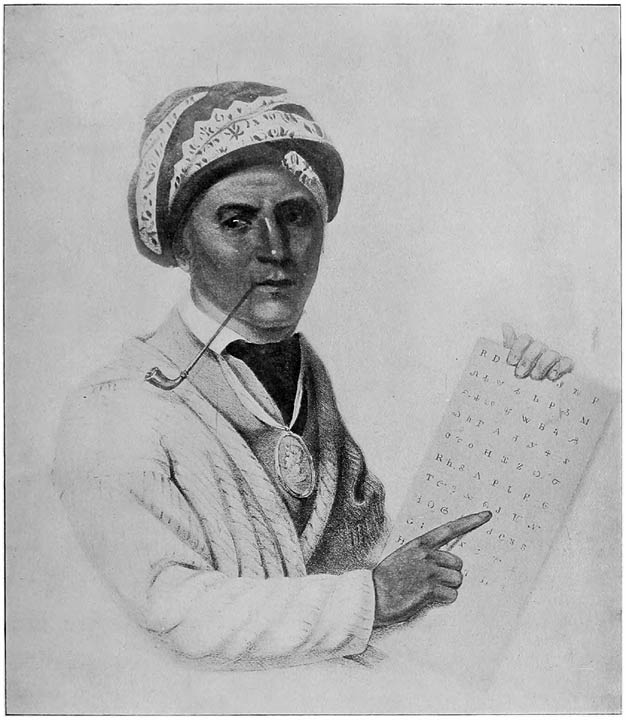
SEQUOYA (SIKWÂYĬ)
(From McKenney and Hall’s copy of the original painting of 1828)
In 1827 the Cherokee council having formally resolved to establish a national paper in the Cherokee language and characters, types for that purpose were cast in Boston, under the supervision of the noted missionary, Worcester, of the American Board of Commissioners for Foreign Missions, who, in December of that year contributed to the Missionary Herald five verses of Genesis in the new syllabary, this seeming to be its first appearance in print. Early in the next year the press and types arrived at New Echota, and the first number of the new paper, Tsa′lăgĭ Tsu′lehisanuñ′hĭ, the Cherokee Phœnix, printed in both languages, appeared on February 21, 1828. The first printers were two white men, Isaac N. Harris and John F. Wheeler, with John Candy, a half-blood apprentice. Elias Boudinot (Gălagi′na, “The Buck”), an educated Cherokee, was the editor, and Reverend S. A. Worcester was the guiding spirit who brought order out of chaos and set the work in motion. The office was a log house. The hand press and types, after having been shipped by water from Boston, were transported two hundred miles by wagon from Augusta to their destination. The printing paper had been overlooked and had to be brought by the same tedious process from Knoxville. Cases and other equipments had to be devised and fashioned by the printers, neither of whom understood a word of Cherokee, but simply set up the characters, as handed to them in manuscript by Worcester and the editor. Such was the beginning of journalism in the Cherokee nation. After a precarious existence of about six years the Phœnix was suspended, owing to the hostile action of the Georgia authorities, who went so far as to throw Worcester and Wheeler into prison. Its successor, after the removal of the Cherokee to the West, was the Cherokee Advocate, of which the first number appeared at Tahlequah in 1844, with William P. Ross as editor. It is still continued under the auspices of the Nation, printed in both languages and distributed free at the expense of the Nation to those unable to read English—an example without parallel in any other government.
BUREAU OF AMERICAN ETHNOLOGY NINETEENTH ANNUAL REPORT PL. V
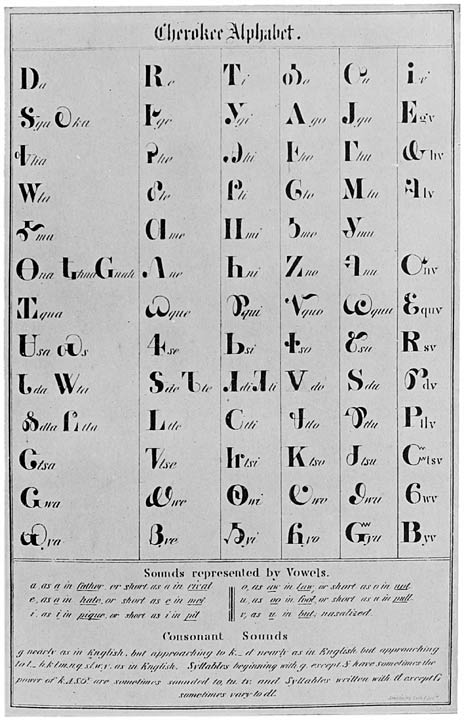
THE CHEROKEE ALPHABET
Ꭰ a Ꭱ e Ꭲ i Ꭳ o Ꭴ u Ꭵ v
Ꭶ ga Ꭷ ka Ꭸ ge Ꭹ gi Ꭺ go Ꭻ gu Ꭼ gv
Ꭽ ha Ꭾ he Ꭿ hi Ꮀ ho Ꮁ hu Ꮂ hv
Ꮃ la Ꮄ le Ꮅ li Ꮆ lo Ꮇ lu Ꮈ lv
Ꮉ ma Ꮊ me Ꮋ mi Ꮌ mo Ꮍ mu
Ꮎ na Ꮏ hna Ꮐ nah Ꮑ ne Ꮒ ni Ꮓ no Ꮔ nu Ꮕ nv
Ꮖ qua Ꮗ que Ꮘ qui Ꮙ quo Ꮚ quu Ꮛ quv
Ꮜ sa Ꮝ s Ꮞ se Ꮟ si Ꮠ so Ꮡ su Ꮢ sv
Ꮣ da Ꮤ ta Ꮥ de Ꮦ te Ꮧ di Ꮨ ti Ꮩ do Ꮪ du Ꮫ dv
Ꮬ dla Ꮭ tla Ꮮ tle Ꮯ tli Ꮰ tlo Ꮱ tlu Ꮲ tlv
Ꮳ tsa Ꮴ tse Ꮵ tsi Ꮶ tso Ꮷ tsu Ꮸ tsv
Ꮹ wa Ꮺ we Ꮻ wi Ꮼ wo Ꮽ wu Ꮾ wv
Ꮿ ya Ᏸ ye Ᏹ yi Ᏺ yo Ᏻ yu Ᏼ yv
Sounds represented by Vowels.
a as a in father, or short as a in rival.
e as a in hate, or short as e in met.
i as i in pique, or short as i in pit.
o as aw in law, or short as o in not.
u as oo in fool, or short as u in pull.
v as u in but; nasalized.
Consonant Sounds.
g nearly as in English, but approaching to k. d nearly as in English but approaching to t h, k, l, m, n, q, s, t, w, y, as in English. Syllables beginning with g, except Ꭶ have sometimes the power of k. Ꮩ, Ꮪ, Ꮫ are sometimes sounded to, tu, tv; and Syllables written with d except Ꮭ sometimes vary to dl.
And now, just when it seemed that civilization and enlightenment were about to accomplish their perfect work, the Cherokee began to hear the first low muttering of the coming storm that was soon to overturn their whole governmental structure and sweep them forever from the land of their birth.
Briefly stated, by this treaty of New Echota, Georgia, the Cherokee Nation ceded to the United States its whole remaining territory east of the Mississippi for the sum of five million dollars and a common joint interest in the territory already occupied by the western Cherokee, in what is now Indian Territory, with an additional smaller tract adjoining on the northeast, in what is now Kansas. Improvements were to be paid for, and the Indians were to be removed at the expense of the United States and subsisted at the expense of the Government for one year after their arrival in the new country. The removal was to take place within two years from the ratification of the treaty.
On the strong representations of the Cherokee signers, who would probably not have signed otherwise even then, it was agreed that a limited number of Cherokee who should desire to remain behind in North Carolina, Tennessee, and Alabama, and become citizens, having first been adjudged “qualified or calculated to become useful citizens,” might so remain, together with a few holding individual reservations under former treaties. This provision was allowed by the commissioners, but was afterward struck out on the announcement by President Jackson of his determination “not to allow any preemptions or reservations, his desire being that the whole Cherokee people should remove together.”
Provision was made also for the payment of debts due by the Indians out of any moneys coming to them under the treaty; for the reestablishment of the missions in the West; for pensions to Cherokee wounded in the service of the government in the war of 1812 and the Creek war; for permission to establish in the new country such military posts and roads for the use of the United States as should be deemed necessary; for satisfying Osage claims in the western territory and for bringing about a friendly understanding between the two tribes; and for the commutation of all annuities and other sums due from the United States into a permanent national fund, the interest to be placed at the disposal of the officers of the Cherokee Nation and by them disbursed, according to the will of their own people, for the care of schools and orphans, and for general national purposes.
The treaty of 1833, assigning the first described tract to the western Cherokee, states that the United States agrees to “guaranty it to them forever, and that guarantee is hereby pledged.” By the same treaty, “in addition to the seven millions of acres of land thus provided for and bounded, the United States further guaranty to the Cherokee nation a perpetual outlet west and a free and unmolested use of all the country lying west of the western boundary of said seven millions of acres, as far west as the sovereignty of the United States and their right of soil extend ... and letters patent shall be issued by the United States as soon as practicable for the land hereby guaranteed.” All this was reiterated by the present treaty, and made to include also the smaller (second) tract, in these words:
Art. 3. The United States also agree that the lands above ceded by the treaty of February 14, 1833, including the outlet, and those ceded by this treaty, shall all be included in one patent, executed to the Cherokee nation of Indians by the President of the United States, according to the provisions of the act of May 28, 1830....
Art. 5. The United States hereby covenant and agree that the lands ceded to the Cherokee nation in the foregoing article shall in no future time, without their consent, be included within the territorial limits or jurisdiction of any state or territory. But they shall secure to the Cherokee nation the right of their national councils to make and carry into effect all such laws as they may deem necessary for the government and protection of the persons and property within their own country belonging to their people or such persons as have connected themselves with them: Provided always, that they shall not be inconsistent with the Constitution of the United States and such acts of Congress as have been or may be passed regulating trade and intercourse with the Indians; and also that they shall not be considered as extending to such citizens and army of the United States as may travel or reside in the Indian country by permission, according to the laws and regulations established by the government of the same....
Art. 6. Perpetual peace and friendship shall exist between the citizens of the United States and the Cherokee Indians. The United States agree to protect the Cherokee nation from domestic strife and foreign enemies and against intestine wars between the several tribes. The Cherokees shall endeavor to preserve and maintain the peace of the country, and not make war upon their neighbors; they shall also be protected against interruption and intrusion from citizens of the United States who may attempt to settle in the country without their consent; and all such persons shall be removed from the same by order of the President of the United States. But this is not intended to prevent the residence among them of useful farmers, mechanics, and teachers for the instruction of the Indians according to treaty stipulations.
Article 7. The Cherokee nation having already made great progress in civilization, and deeming it important that every proper and laudable inducement should be offered to their people to improve their condition, as well as to guard and secure in the most effectual manner the rights guaranteed to them in this treaty, and with a view to illustrate the liberal and enlarged policy of the government of the United States toward the Indians in their removal beyond the territorial limits of the states, it is stipulated that they shall be entitled to a Delegate in the House of Representatives of the United States whenever Congress shall make provision for the same.
Upon the treaty of New Echota and the treaty previously made with the western Cherokee at Fort Gibson in 1833, the united Cherokee Nation based its claim to the present territory held by the tribe in Indian Territory and to the Cherokee outlet, and to national self-government, with protection from outside intrusion.
Notwithstanding this suppression of opinion, the feeling of the Nation was soon made plain through other sources. Before the ratification of the treaty Major W. M. Davis had been appointed to enroll the Cherokee for removal and to appraise the value of their improvements. He soon learned the true condition of affairs, and, although holding his office by the good will of President Jackson, he addressed to the Secretary of War a strong letter upon the subject, from which the following extract is made:
Other letters from General Wool while engaged in the work of disarming and overawing the Cherokee show how very disagreeable that duty was to him and how strongly his sympathies were with the Indians, who were practically unanimous in repudiating the treaty. In one letter he says:
How it was to be brought about is explained in part by a letter addressed to the President by Major Ridge himself, the principal signer of the treaty:
We now come to address you on the subject of our griefs and afflictions from the acts of the white people. They have got our lands and now they are preparing to fleece us of the money accruing from the treaty. We found our plantations taken either in whole or in part by the Georgians—suits instituted against us for back rents for our own farms. These suits are commenced in the inferior courts, with the evident design that, when we are ready to remove, to arrest our people, and on these vile claims to induce us to compromise for our own release, to travel with our families. Thus our funds will be filched from our people, and we shall be compelled to leave our country as beggars and in want.
THE REMOVAL—1838–39
The history of this Cherokee removal of 1838, as gleaned by the author from the lips of actors in the tragedy, may well exceed in weight of grief and pathos any other passage in American history. Even the much-sung exile of the Acadians falls far behind it in its sum of death and misery. Under Scott’s orders the troops were disposed at various points throughout the Cherokee country, where stockade forts were erected for gathering in and holding the Indians preparatory to removal (43). From these, squads of troops were sent to search out with rifle and bayonet every small cabin hidden away in the coves or by the sides of mountain streams, to seize and bring in as prisoners all the occupants, however or wherever they might be found. Families at dinner were startled by the sudden gleam of bayonets in the doorway and rose up to be driven with blows and oaths along the weary miles of trail that led to the stockade. Men were seized in their fields or going along the road, women were taken from their wheels and children from their play. In many cases, on turning for one last look as they crossed the ridge, they saw their homes in flames, fired by the lawless rabble that followed on the heels of the soldiers to loot and pillage. So keen were these outlaws on the scent that in some instances they were driving off the cattle and other stock of the Indians almost before the soldiers had fairly started their owners in the other direction. Systematic hunts were made by the same men for Indian graves, to rob them of the silver pendants and other valuables deposited with the dead. A Georgia volunteer, afterward a colonel in the Confederate service, said: “I fought through the civil war and have seen men shot to pieces and slaughtered by thousands, but the Cherokee removal was the cruelest work I ever knew.”
To prevent escape the soldiers had been ordered to approach and surround each house, so far as possible, so as to come upon the occupants without warning. One old patriarch, when thus surprised, calmly called his children and grandchildren around him, and, kneeling down, bid them pray with him in their own language, while the astonished soldiers looked on in silence. Then rising he led the way into exile. A woman, on finding the house surrounded, went to the door and called up the chickens to be fed for the last time, after which, taking her infant on her back and her two other children by the hand, she followed her husband with the soldiers.
When nearly seventeen thousand Cherokee had thus been gathered into the various stockades the work of removal began. Early in June several parties, aggregating about five thousand persons, were brought down by the troops to the old agency, on Hiwassee, at the present Calhoun, Tennessee, and to Ross’s landing (now Chattanooga), and Gunter’s landing (now Guntersville, Alabama), lower down on the Tennessee, where they were put upon steamers and transported down the Tennessee and Ohio to the farther side of the Mississippi, when the journey was continued by land to Indian Territory. This removal, in the hottest part of the year, was attended with so great sickness and mortality that, by resolution of the Cherokee national council, Ross and the other chiefs submitted to General Scott a proposition that the Cherokee be allowed to remove themselves in the fall, after the sickly season had ended. This was granted on condition that all should have started by the 20th of October, excepting the sick and aged who might not be able to move so rapidly. Accordingly, officers were appointed by the Cherokee council to take charge of the emigration; the Indians being organized into detachments averaging one thousand each, with two leaders in charge of each detachment, and a sufficient number of wagons and horses for the purpose. In this way the remainder, enrolled at about 13,000 (including negro slaves), started on the long march overland late in the fall (44).
Those who thus emigrated under the management of their own officers assembled at Rattlesnake springs, about two miles south of Hiwassee river, near the present Charleston, Tennessee, where a final council was held, in which it was decided to continue their old constitution and laws in their new home. Then, in October, 1838, the long procession of exiles was set in motion. A very few went by the river route; the rest, nearly all of the 13,000, went overland. Crossing to the north side of the Hiwassee at a ferry above Gunstocker creek, they proceeded down along the river, the sick, the old people, and the smaller children, with the blankets, cooking pots, and other belongings in wagons, the rest on foot or on horses. The number of wagons was 645.
On their arrival in Indian Territory the emigrants at once set about building houses and planting crops, the government having agreed under the treaty to furnish them with rations for one year after arrival. They were welcomed by their kindred, the “Arkansas Cherokee”—hereafter to be known for distinction as the “Old Settlers”—who held the country under previous treaties in 1828 and 1833. These, however, being already regularly organized under a government and chiefs of their own, were by no means disposed to be swallowed by the governmental authority of the newcomers. Jealousies developed in which the minority or treaty party of the emigrants, headed by Ridge, took sides with the Old Settlers against the Ross or national party, which outnumbered both the others nearly three to one.
While these differences were at their height the Nation was thrown into a fever of excitement by the news that Major Ridge, his son John Ridge, and Elias Boudinot—all leaders of the treaty party—had been killed by adherents of the national party, immediately after the close of a general council, which had adjourned after nearly two weeks of debate without having been able to bring about harmonious action. Major Ridge was waylaid and shot close to the Arkansas line, his son was taken from bed and cut to pieces with hatchets, while Boudinot was treacherously killed at his home at Park Hill, Indian territory, all three being killed upon the same day, June 22, 1839.
The agent’s report to the Secretary of War, two days later, says of the affair:
While all the evidence shows that Ross was in no way a party to the affair, there can be no question that the men were killed in accordance with the law of the Nation—three times formulated, and still in existence—which made it treason, punishable with death, to cede away lands except by act of the general council of the Nation. It was for violating a similar law among the Creeks that the chief, McIntosh, lost his life in 1825, and a party led by Major Ridge himself had killed Doublehead years before on suspicion of accepting a bribe for his part in a treaty.
THE ARKANSAS BAND—1817–1838
Having followed the fortunes of the main body of the Nation to their final destination in the West, we now turn to review briefly the history of the earlier emigrants, the Arkansas or Old Settler Cherokee.
The preamble of the Washington treaty of May 6, 1828, recites that “Whereas, it being the anxious desire of the Government of the United States to secure to the Cherokee nation of Indians, as well those now living within the limits of the territory of Arkansas as those of their friends and brothers who reside in states east of the Mississippi, and who may wish to join their brothers of the West, a permanent home, and which shall, under the most solemn guarantee of the United States, be and remain theirs forever—a home that shall never, in all future time, be embarrassed by having extended around it the lines or placed over it the jurisdiction of a territory or state, nor be pressed upon by the extension in any way of any of the limits of any existing territory or state; and whereas the present location of the Cherokees in Arkansas being unfavorable to their present repose, and tending, as the past demonstrates, to their future degradation and misery, and the Cherokees being anxious to avoid such consequences,” etc.—therefore, they cede everything confirmed to them in 1817.
Article 2 defines the boundaries of the new tract and the western outlet to be given in exchange, lying immediately west of the present Arkansas line, while the next article provides for the removal of all whites and others residing within the said boundaries, “so that no obstacles arising out of the presence of a white population, or any population of any other sort, shall exist to annoy the Cherokees, and also to keep all such from the west of said line in future.”
Other articles provide for payment for improvements left behind; for a cash sum of $50,000 to pay for trouble and expense of removal and to compensate for the inferior quality of the lands in the new tract; for $6,000 to pay for recovering stock which may stray away “in quest of the pastures from which they may be driven;” $8,760 for spoliations committed by Osage and whites; $500 to George Guess (Sequoya)—who was himself one of the signers—in consideration of the beneficial results to his tribe from the alphabet invented by him; $20,000 in ten annual payments for education; $1,000 for a printing press and type to aid in the enlightenment of the people “in their own and our language”; a personal indemnity for false imprisonment; and for the removal and reestablishment of the Dwight mission.
In article 6 “it is moreover agreed by the United States, whenever the Cherokee may desire it, to give them a set of plain laws, suited to their condition; also, when they wish to lay off their lands and own them individually, a surveyor shall be sent to make the surveys at the cost of the United States.” This article was annulled in 1833 by request of the Cherokee.
Article 9 provides for the Fort Gibson military reservation within the new tract, while article 7 binds the Cherokee to surrender and remove from all their lands in Arkansas within fourteen months.
Article 8 shows that all this was intended to be only preliminary to the removal of the whole Cherokee Nation from the east of the Mississippi, a consummation toward which the Jackson administration and the state of Georgia immediately began to bend every effort. It is as follows:
Article 8. The Cherokee nation, west of the Mississippi, having by this agreement freed themselves from the harassing and ruinous effects consequent upon a location amidst a white population, and secured to themselves and their posterity, under the solemn sanction of the guarantee of the United States as contained in this agreement, a large extent of unembarrassed country; and that their brothers yet remaining in the states may be induced to join them and enjoy the repose and blessings of such a state in the future, it is further agreed on the part of the United States that to each head of a Cherokee family now residing within the chartered limits of Georgia, or of either of the states east of the Mississippi, who may desire to remove west, shall be given, on enrolling himself for emigration, a good rifle, a blanket, a kettle, and five pounds of tobacco; (and to each member of his family one blanket), also a just compensation for the property he may abandon, to be assessed by persons to be appointed by the President of the United States. The cost of the emigration of all such shall also be borne by the United States, and good and suitable ways opened and procured for their comfort, accommodation, and support by the way, and provisions for twelve months after their arrival at the agency; and to each person, or head of a family, if he take along with him four persons, shall be paid immediately on his arriving at the agency and reporting himself and his family or followers as emigrants or permanent settlers, in addition to the above, provided he and they shall have emigrated from within the chartered limits of the State of Georgia, the sum of fifty dollars, and this sum in proportion to any greater or less number that may accompany him from within the aforesaid chartered limits of the State of Georgia.
BUREAU OF AMERICAN ETHNOLOGY NINETEENTH ANNUAL REPORT PL. VI
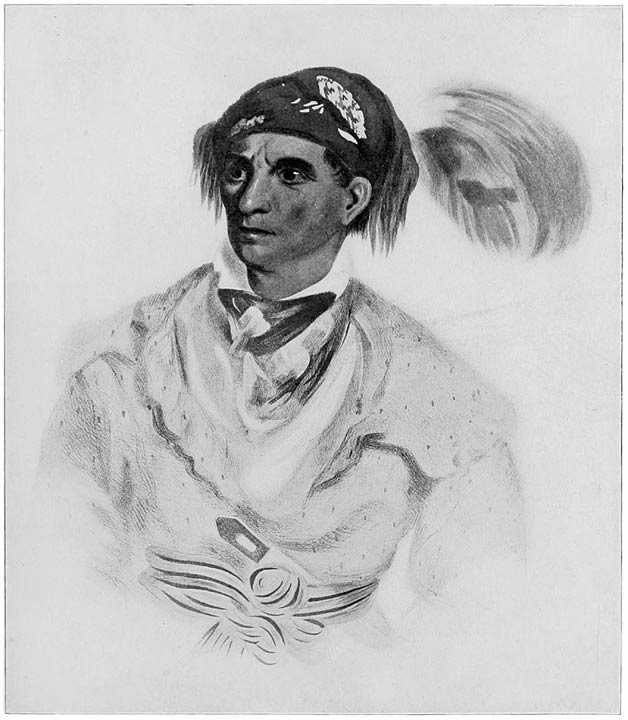
TAHCHEE (TĂTSĬ′) OR DUTCH
(From Catlin’s painting of 1834)
By the treaty made on this occasion with the Cherokee the boundaries of the tract of seven million acres granted by the treaty of 1828 are defined so as to correspond with the present boundaries of the Cherokee country in Indian territory, together with a strip two miles wide along the northern border, which was afterward annexed to the state of Kansas by the treaty of 1866. A tract in the northeastern corner, between Neosho or Grand river and the Missouri line, was set apart for the use of the Seneca and several other remnants of tribes removed from their original territories. The western outlet established by the treaty of 1828 was reestablished as a western extension from the seven-million-acre tract thus bounded, being what was afterward known as the Cherokee strip or outlet plus the two-mile strip extending westward along the south line of Kansas.
After describing the boundaries of the main residence tract, the first article continues:
In addition to the seven millions of acres of land thus provided for and bounded the United States further guarantee to the Cherokee nation a perpetual outlet west and a free and unmolested use of all the country lying west of the western boundary of said seven millions of acres, as far west as the sovereignty of the United States and their right of soil extend—provided, however, that if the saline or salt plain on the great western prairie shall fall within said limits prescribed for said outlet the right is reserved to the United States to permit other tribes of red men to get salt on said plain in common with the Cherokees—and letters patent shall be issued by the United States as soon as practicable for the lands hereby guaranteed.
BUREAU OF AMERICAN ETHNOLOGY NINETEENTH ANNUAL REPORT PL. VII
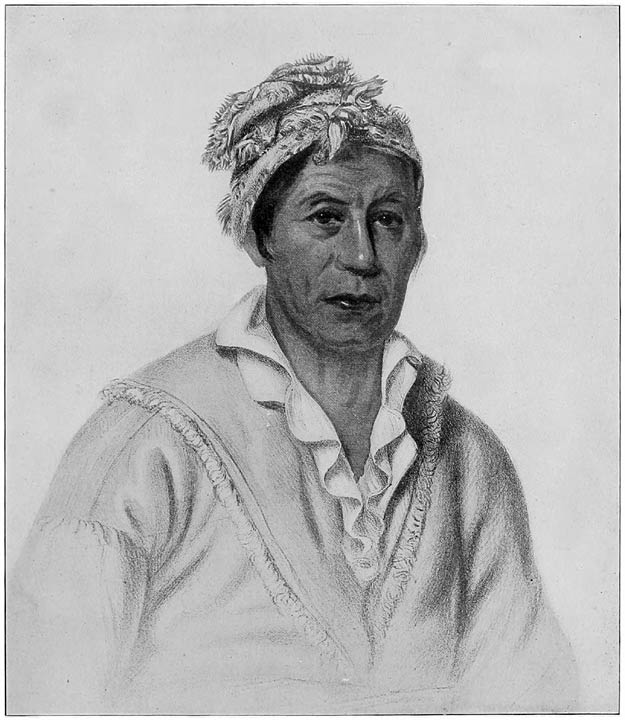
SPRING-FROG OR TOOANTUH (DU′TSU′)
(From McKenney and Hall’s copy of the original painting of about 1830)
THE TEXAS BAND—1817–1900
As already stated, a band of western Cherokee under Chief Bowl, dissatisfied with the delay in fulfilling the terms of the treaty of 1817, had left Arkansas and crossed Red river into Texas, then under Mexican jurisdiction, where they were joined a few years later by Tahchee and others of the western band who were opposed to the treaty of 1828. Here they united with other refugee Indians from the United States, forming together a loose confederacy known afterward as “the Cherokee and their associated bands,” consisting of Cherokee, Shawano, Delaware, Kickapoo, Quapaw, Choctaw, Biloxi, “Iawanie” (Heyowani, Yowani), “Unataqua” (Nada′ko or Anadarko, another Caddo subtribe), “Tahookatookie” (?), Alabama (a Creek subtribe), and “Cooshatta” (Koasa′ti, another Creek subtribe). The Cherokee being the largest and most important band, their chief, Bowl—known to the whites as Colonel Bowles—was regarded as the chief and principal man of them all.
THE CHEROKEE NATION IN THE WEST—1840–1900
With the final removal of the Cherokee from their native country and their reunion and reorganization under new conditions in Indian Territory in 1840 their aboriginal period properly comes to a close and the rest may be dismissed in a few paragraphs as of concern rather to the local historian than to the ethnologist. Having traced for three full centuries their gradual evolution from a savage tribe to a civilized Christian nation, with a national constitution and national press printed in their own national alphabet, we can afford to leave the rest to others, the principal materials being readily accessible in the Cherokee national archives at Tahlequah, in the files of the Cherokee Advocate and other newspapers published in the Nation, and in the annual reports and other documents of the Indian office.
For many years the hunter and warrior had been giving place to the farmer and mechanic, and the forced expatriation made the change complete and final. Torn from their native streams and mountains, their council fires extinguished and their townhouses burned behind them, and transported bodily to a far distant country where everything was new and strange, they were obliged perforce to forego the old life and adjust themselves to changed surroundings. The ballplay was neglected and the green-corn dance proscribed, while the heroic tradition of former days became a fading memory or a tale to amuse a child. Instead of ceremonials and peace councils we hear now of railroad deals and contracts with cattle syndicates, and instead of the old warrior chiefs who had made the Cherokee name a terror—Oconostota, Hanging-maw, Doublehead, and Pathkiller—we find the destinies of the nation guided henceforth by shrewd mixed-blood politicians, bearing white men’s names and speaking the white man’s language, and frequently with hardly enough Indian blood to show itself in the features.
The change was not instantaneous, nor is it even yet complete, for although the tendency is constantly away from the old things, and although frequent intermarriages are rapidly bleaching out the brown of the Indian skin, there are still several thousand full-blood Cherokee—enough to constitute a large tribe if set off by themselves—who speak only their native language and in secret bow down to the nature-gods of their fathers. Here, as in other lands, the conservative element has taken refuge in the mountain districts, while the mixed-bloods and the adopted whites are chiefly on the richer low grounds and in the railroad towns.
On the reorganization of the united Nation the council ground at Tahlequah was designated as the seat of government, and the present town was soon afterward laid out upon the spot, taking its name from the old Cherokee town of Tălikwă′, or Tellico, in Tennessee. The missions were reestablished, the Advocate was revived, and the work of civilization was again taken up, though under great difficulties, as continued removals and persecutions, with the awful suffering and mortality of the last great emigration, had impoverished and more than decimated the Nation and worn out the courage even of the bravest. The bitterness engendered by the New Echota treaty led to a series of murders and assassinations and other acts of outlawry, amounting almost to civil war between the Ross and Ridge factions, until the Government was at last obliged to interfere. The Old Settlers also had their grievances and complaints against the newcomers, so that the history of the Cherokee Nation for the next twenty years is largely a chronicle of factional quarrels, through which civilization and every good work actually retrograded behind the condition of a generation earlier.
BUREAU OF AMERICAN ETHNOLOGY NINETEENTH CENTURY ANNUAL REPORT PL. VIII
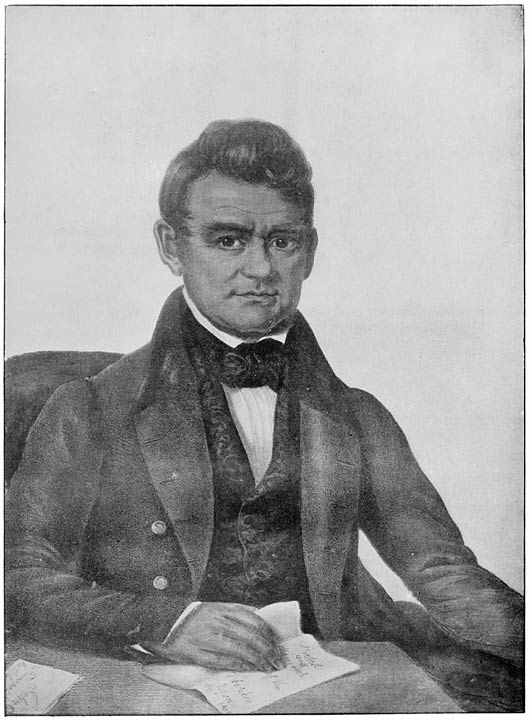
JOHN ROSS (GU′WISGUWĬ′)
(From McKenney and Hall’s copy of the original painting of about 1835)
For a number of years the pressure for the opening of Indian territory to white settlement had been growing in strength. Thousands of intruders had settled themselves upon the lands of each of the five civilized tribes, where they remained upon various pretexts in spite of urgent and repeated appeals to the government by the Indians for their removal. Under treaties with the five civilized tribes, the right to decide citizenship or residence claims belonged to the tribes concerned, but the intruders had at last become so numerous and strong that they had formed an organization among themselves to pass upon their own claims, and others that might be submitted to them, with attorneys and ample funds to defend each claim in outside courts against the decision of the tribe. At the same time the Government policy was steadily toward the reduction or complete breaking up of Indian reservations and the allotment of lands to the Indians in severalty, with a view to their final citizenship, and the opening of the surplus lands to white settlement. As a part of the same policy the jurisdiction of the United States courts was gradually being extended over the Indian country, taking cognizance of many things hitherto considered by the Indian courts under former treaties with the United States. Against all this the Cherokee and other civilized tribes protested, but without avail. To add to the irritation, companies of armed “boomers” were organized for the express purpose of invading and seizing the Cherokee outlet and other unoccupied portions of the Indian territory—reserved by treaty for future Indian settlement—in defiance of the civil and military power of the Government.
After prefacing that the government of the United States seems determined to break up the tribal autonomy of the five civilized tribes and to divide their lands, thus bringing about conditions under which the Cherokee could not exist, he continues:
THE EASTERN BAND
It remains to speak of the eastern band of Cherokee—the remnant which still clings to the woods and waters of the old home country. As has been said, a considerable number had eluded the troops in the general round-up of 1838 and had fled to the fastnesses of the high mountains. Here they were joined by others who had managed to break through the guard at Calhoun and other collecting stations, until the whole number of fugitives in hiding amounted to a thousand or more, principally of the mountain Cherokee of North Carolina, the purest-blooded and most conservative of the Nation. About one-half the refugee warriors had put themselves under command of a noted leader named U′tsălă, “Lichen,” who made his headquarters amid the lofty peaks at the head of Oconaluftee, from which secure hiding place, although reduced to extremity of suffering from starvation and exposure, they defied every effort to effect their capture.
Thomas accepted the commission, and taking with him one or two Indians made his way over secret paths to U′tsălă’s hiding place. He presented Scott’s proposition and represented to the chief that by aiding in bringing Charley’s party to punishment according to the rules of war he could secure respite for his sorely pressed followers, with the ultimate hope that they might be allowed to remain in their own country, whereas if he rejected the offer the whole force of the seven thousand troops which had now completed the work of gathering up and deporting the rest of the tribe would be set loose upon his own small band until the last refugee had been either taken or killed.
U′tsălă turned the proposition in his mind long and seriously. His heart was bitter, for his wife and little son had starved to death on the mountain side, but he thought of the thousands who were already on their long march into exile and then he looked round upon his little band of followers. If only they might stay, even though a few must be sacrificed, it was better than that all should die—for they had sworn never to leave their country. He consented and Thomas returned to report to General Scott.
To Colonel William Holland Thomas the East Cherokee of to-day owe their existence as a people, and for half a century he was as intimately connected with their history as was John Ross with that of the main Cherokee Nation. Singularly enough, their connection with Cherokee affairs extended over nearly the same period, but while Ross participated in their national matters Thomas gave his effort to a neglected band hardly known in the councils of the tribe. In his many-sided capacity he strikingly resembles another white man prominent in Cherokee history, General Sam Houston.
Thomas was born in the year 1805 on Raccoon creek, about two miles from Waynesville in North Carolina. His father, who was related to President Zachary Taylor, came of a Welsh family which had immigrated to Virginia at an early period, while on his mother’s side he was descended from a Maryland family of Revolutionary stock. He was an only and posthumous child, his father having been accidentally drowned a short time before the boy was born. Being unusually bright for his age, he was engaged when only twelve years old to tend an Indian trading store on Soco creek, in the present Jackson county, owned by Felix Walker, son of the Congressman of the same name who made a national reputation by “talking for Buncombe.” The store was on the south side of the creek, about a mile above the now abandoned Macedonia mission, within the present reservation, and was a branch of a larger establishment which Walker himself kept at Waynesville. The trade was chiefly in skins and ginseng, or “sang,” the latter for shipment to China, where it was said to be worth its weight in silver. This trade was very profitable, as the price to the Indians was but ten cents per pound in merchandise for the green root, whereas it now brings seventy-five cents in cash upon the reservation, the supply steadily diminishing with every year. The contract was for three years’ service for a total compensation of one hundred dollars and expenses, but Walker devoted so much of his attention to law studies that the Waynesville store was finally closed for debt, and at the end of his contract term young Thomas was obliged to accept a lot of second-hand law books in lieu of other payment. How well he made use of them is evident from his subsequent service in the state senate and in other official capacities.
Soon after entering upon his duties he attracted the notice of Yonaguska, or Drowning-bear (Yâ′na-gûñ′skĭ, “Bear-drowning-him”), the acknowledged chief of all the Cherokee then living on the waters of Tuckasegee and Oconaluftee—the old Kituhwa country. On learning that the boy had neither father nor brother, the old chief formally adopted him as his son, and as such he was thenceforth recognized in the tribe under the name of Wil-Usdi′, or “Little Will,” he being of small stature even in mature age. From his Indian friends, particularly a boy of the same age who was his companion in the store, he learned the language as well as a white man has ever learned it, so that in his declining years it dwelt in memory more strongly than his mother tongue. After the invention of the Cherokee alphabet, he learned also to read and write the language.
BUREAU OF AMERICAN ETHNOLOGY NINETEENTH ANNUAL REPORT PL. IX
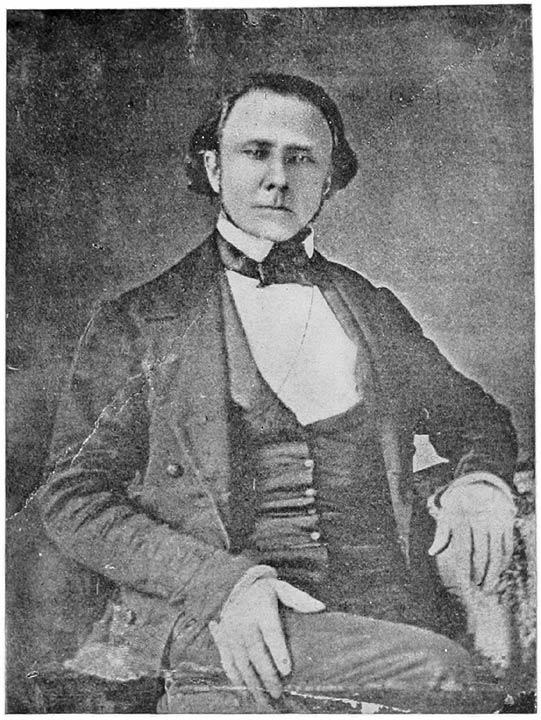
COL. W. H. THOMAS (WIL-USDI′)
(From photograph of 1858 kindly loaned by Capt. James W. Terrell)
In 1819 the lands on Tuckasegee and its branches were sold by the Indians, and Thomas’s mother soon after removed from Waynesville to a farm which she purchased on the west bank of Oconaluftee, opposite the mouth of Soco, where her son went to live with her, having now set up in business for himself at Qualla. Yonaguska and his immediate connection continued to reside on a small reservation in the same neighborhood, while the rest of the Cherokee retired to the west of the Nantahala mountains, though still visiting and trading on Soco. After several shiftings Thomas finally, soon after the removal in 1838, bought a farm on the northern bank of Tuckasegee, just above the present town of Whittier in Swain county, and built there a homestead which he called Stekoa, after an Indian town destroyed by Rutherford which had occupied the same site. At the time of the removal he was the proprietor of five trading stores in or adjoining the Cherokee country, viz, at Qualla town, near the mouth of Soco creek; on Scott’s creek, near Webster; on Cheowa, near the present Robbinsville; at the junction of Valley river and Hiwassee, now Murphy; and at the Cherokee agency at Calhoun (now Charleston), Tennessee. Besides carrying on a successful trading business he was also studying law and taking an active interest in local politics.
With his colleagues in the state senate he voted for secession in 1861, and at once resigned to recruit troops for the Confederacy, to which, until the close of the war, he gave his whole time, thought, and effort. In 1862 he organized the Thomas Legion, consisting of two regiments of infantry, a battalion of cavalry, a company of engineers, and a field battery, he himself commanding as colonel, although then nearly sixty years of age. Four companies were made up principally of his own Cherokee. The Thomas Legion operated chiefly as a frontier guard for the Confederacy along the mountain region southward from Cumberland gap.
Yonaguska, properly Yâ′nû-gûñ′skĭ, the adopted father of Thomas, is the most prominent chief in the history of the East Cherokee, although, singularly enough, his name does not occur in connection with any of the early wars or treaties. This is due partly to the fact that he was a peace chief and counselor rather than a war leader, and in part to the fact that the isolated position of the mountain Cherokee kept them aloof in a great measure from the tribal councils of those living to the west and south. In person he was strikingly handsome, being six feet three inches in height and strongly built, with a faint tinge of red, due to a slight strain of white blood on his father’s side, relieving the brown of his cheek. In power of oratory he is said to have surpassed any other chief of his day. When the Cherokee lands on Tuckasegee were sold by the treaty of 1819, Yonaguska continued to reside on a reservation of 640 acres in a bend of the river a short distance above the present Bryson City, on the site of the ancient Kituhwa. He afterward moved over to Oconaluftee, and finally, after the Removal, gathered his people about him and settled with them on Soco creek on lands purchased for them by Thomas.
He was a prophet and reformer as well as a chief. When about sixty years of age he had a severe sickness, terminating in a trance, during which his people mourned him as dead. At the end of twenty-four hours, however, he awoke to consciousness and announced that he had been to the spirit world, where he had talked with friends who had gone before, and with God, who had sent him back with a message to the Indians, promising to call him again at a later time. From that day until his death his words were listened to as those of one inspired. He had been somewhat addicted to liquor, but now, on the recommendation of Thomas, not only quit drinking himself, but organized his tribe into a temperance society. To accomplish this he called his people together in council, and, after clearly pointing out to them the serious effect of intemperance, in an eloquent speech that moved some of his audience to tears, he declared that God had permitted him to return to earth especially that he might thus warn his people and banish whisky from among them. He then had Thomas write out a pledge, which was signed first by the chief and then by each one of the council, and from that time until after his death whisky was unknown among the East Cherokee.